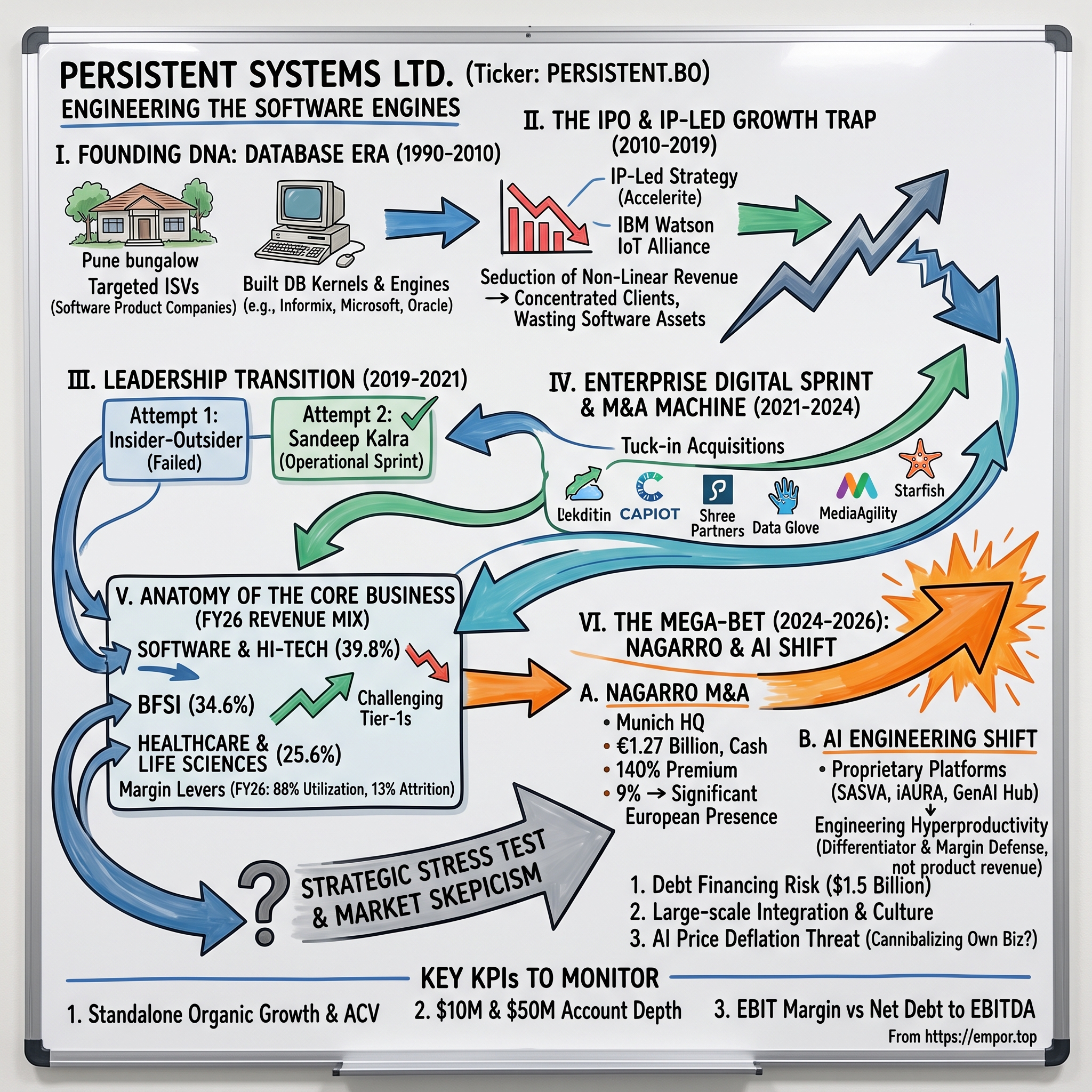
Persistent Systems: Engineering the Software Engines
I. Introduction & Episode Roadmap
On the evening of April 21, 2026, an array of Indian and foreign institutional analysts dialed into a conference call that, five years earlier, few on Dalal Street would have attended. Persistent Systems had just closed its financial year with $1.65 billion in revenue, up 17.4% year over year, and an EBIT margin of 15.6% — marking its 24th consecutive quarter of sequential revenue growth.1 In an Indian IT sector where tier-1 giants were reporting low-single-digit growth and warning of frozen client budgets, the Pune-based firm, which spent much of its early history as a niche database-engineering specialist, was compounding revenue faster than nearly any peer at its scale.
Two months later, on June 26, 2026, that management team announced the largest strategic transaction in the company's 36-year history: an all-cash voluntary takeover offer of €81 per share for Nagarro SE, a Munich-headquartered digital engineering firm, valuing the target at roughly €1.27 billion.2 Market reaction was immediate and negative. Persistent's shares fell about 10% in a single session to a 52-week low, erasing thousands of crores in market value, even as Nagarro's stock soared.3 Persistent's stock has since recovered part of that decline — trading around ₹5,550 in late July 2026, representing a market capitalization near ₹87,000 crore (roughly $10 billion) — but remains well below its peak of ₹6,597 set in December 2025.4
That divergence between strong operational performance and market skepticism lies at the heart of Persistent's current narrative.
The central hook. Persistent's trajectory departs from the standard Indian IT model. The firm bypassed the labor-arbitrage "body shopping" model that built TCS and Infosys, spent two decades serving software product companies rather than traditional enterprise IT departments, and later struggled while attempting to convert engineering skill into licensed intellectual property. It moved past that strategy after bringing in professional outside leadership, executed a rapid operational scale-up — growing revenue from roughly $500 million to $1.65 billion in six years — and has now leveraged its clean balance sheet for a debt-funded European acquisition at a 140% premium.
The competitive paradigm. The primary peer group for Persistent is not the Indian tier-1 IT majors, but the global product engineering services (PES) cohort: EPAM Systems, Globant, and Endava. These firms sell engineering services to technology companies and enterprises developing commercial software products, rather than managing legacy back-office IT infrastructure. On that measure, Persistent's FY26 revenue growth of 17.4% compares with EPAM's 15.4% for calendar year 2025, Globant's 1.6%, and Endava's 4.3% for its fiscal year 2025.1567 That growth differential underscores Persistent's operational momentum — and explains why the Nagarro acquisition carries such significance. Management is risking a track record of organic execution on a large-scale, cross-border integration.
The roadmap. This analysis examines: the founding DNA and database era (1990–2010); the IPO and the IP-led growth trap (2010–2019); the leadership crisis and the arrival of Sandeep Kalra (2019–2021); the enterprise digital sprint and tuck-in M&A strategy (2021–2024); the current business structure and peer benchmarking; the Nagarro acquisition and the shift toward AI engineering (2024–2026); governance, capital allocation, and a strategic stress test; Hamilton Helmer's 7 Powers and Michael Porter's Five Forces frameworks; and finally, the bull case, bear case, and core metrics to monitor.
One note on timing: as of August 2, 2026, Persistent's Q1 FY27 results are scheduled for release the following day, August 3, 2026, with a non-deal roadshow for institutional investors to follow.8 The analysis is therefore grounded in the full-year FY26 results for the period ended March 31, 2026, alongside subsequent transaction disclosures.
 Subscribe on LinkedIn
II. Founding DNA & The Database Era (1990–2010)
Picture Pune in 1990. Not the modern hub of glass IT parks and Hinjawadi traffic jams, but a university town best known for engineering colleges, academic institutions, and quiet, monsoon-battered bungalows. India had not yet liberalised its economy. Importing a computer required a license and substantial paperwork, the rupee was not convertible, and the idea of an Indian company selling software engineering to American technology firms was unproven.
Into that environment came a 27-year-old with a doctorate and a distinct thesis. Dr. Anand Deshpande had taken a B.Tech with honours in computer science from IIT Kharagpur, then an M.S. and Ph.D. in computer science from Indiana University Bloomington, and had begun his career at Hewlett-Packard Laboratories in Palo Alto — working on the internals of database systems, the plumbing layer that almost nobody sees and almost everybody depends on.9 He came home and started Persistent Systems with an investment of roughly $21,000.9 The company was incorporated in Pune in 1990, a full year before the 1991 economic reforms opened Indian software exports.
The strategic choice that defined everything. In the 1990s, the dominant Indian software playbook was straightforward and lucrative: recruit talent at scale, deploy engineers onsite with Western enterprises, bill by the hour, and drive headcount growth. Deshpande took a different path. Persistent targeted Independent Software Vendors (ISVs) — companies whose core product was software itself. That required building database kernels, storage engines, middleware, and the deep infrastructure of commercial off-the-shelf software, working alongside firms like Informix, Microsoft, and Oracle, as well as the Postgres open-source lineage familiar from Deshpande's academic background.
That distinction proved fundamental. Maintaining an enterprise payroll system is an administrative cost center for a client — heavily scrutinized, benchmarked, and periodically rebid on price. Building the core engine of a software vendor's commercial product sits on the income statement as R&D. It demands engineers fluent in compilers and concurrency rather than standard IT configuration, and once a team masters the institutional memory of a complex codebase, replacing them requires a costly rewrite.
The trade-off was equally clear. ISVs represent a smaller, more cyclical, and more concentrated client base than Fortune 500 IT departments. Persistent grew capital-efficiently, funding operations through internal cash flow rather than external equity, and established Pune as a specialized R&D hub by recruiting from the region's dense network of engineering colleges. Yet its pace of expansion lagged the rapid scaling of tier-1 IT majors.
Going public. By 2010, Persistent sought capital from public markets. The IPO ran from March 17 to March 19, 2010, with a book-built issue priced in a ₹290–₹310 band, and the shares listed on the BSE and NSE on April 6, 2010.10 The book was heavily oversubscribed and the stock closed its debut session at a healthy premium to the issue price.10 Investors saw a rare listed pure-play in software product engineering: technically specialized, high-margin relative to traditional IT services, backed by a clean balance sheet and strong founder ownership.
Underneath that successful public debut, however, lay a structural ceiling. ISV R&D budgets are naturally capped, and the legacy software vendors Persistent spent two decades serving were confronting an industry-wide transition toward cloud-based software-as-a-service. The perpetual-license model that defined Persistent's core customer base was beginning to erode, setting up the strategic challenges of the decade that followed.
III. The IPO & The "IP-Led Growth" Trap (2010–2019)
In the fiscal year ended March 2019, Persistent Systems reported revenue of $480.97 million, representing annual growth of just 2.2%.11 In the final quarter of that fiscal year, revenue fell 2.1% sequentially.11 Nine years after its public listing, and amidst a global enterprise cloud expansion, a firm founded on specialized software engineering capabilities had reached an operational bottleneck.
Understanding that deceleration requires examining a core dilemma in technology services: the pursuit of non-linear revenue.
The seduction of non-linear revenue. Pure services businesses face inherent scaling constraints because revenue remains directly tied to headcount. Adding revenue requires adding engineers, margins face persistent wage inflation pressure, and public markets value services providers at lower earnings multiples than software product companies. For IT services leadership, building or acquiring proprietary software intellectual property (IP) appears to offer an attractive exit from this treadmill—promising software licensing revenue that scales without proportional hiring.
Persistent pursued an IP-led strategy more aggressively than most Indian peers. It established a products unit, Accelerite, acquiring mature software assets from ISV partners—frequently products approaching the end of their commercial lifecycle.11 In 2016, the company expanded this approach through a strategic alliance with IBM, dedicating over 1,000 engineers to IBM's Watson IoT platform and continuous engineering solutions as a specialized partner managing mature IBM software assets.12 Persistent restructured its internal operations around the alliance, creating a dedicated business division effective April 1, 2016.
The financial arrangement appeared structured for steady returns: Persistent committed capital and engineering talent to maintain and enhance external software products in exchange for a share of generated licensing revenues. In theory, this created predictable, high-margin annuity income without continuous workforce expansion.
Why it broke. In practice, three structural vulnerabilities undermined the model, as disclosed during Persistent's FY19 earnings call.
First, revenue concentration. IBM became Persistent's largest client by a substantial margin. When IBM's legacy product portfolio encountered commercial headwinds, Persistent's financial performance deteriorated in tandem. On the FY19 earnings call, Deshpande acknowledged the shortfall, noting that full-year growth fell well below expectations due primarily to contraction in the top customer relationship from lower IP revenues and client-specific operational challenges.11
Second, depreciating software assets. Deshpande confirmed that Accelerite's IP revenue had declined, attributing the drop to the portfolio's underlying composition of mature and end-of-life software acquired without ongoing replacement acquisitions.11 Rather than generating a perpetual annuity, the acquired IP acted as a wasting asset requiring continuous capital deployment just to maintain baseline revenue.
Third, the distribution deficit. While Persistent possessed strong engineering capabilities to maintain complex software code, it lacked the global enterprise sales infrastructure, channel relationships, and marketing scale necessary to sell licensed software against cloud-native competitors. Maintaining software IP without controlling direct enterprise client relationships limited commercial monetization.
These challenges left Persistent caught between two distinct operating models: shrinking IP licensing revenues dragged down financial results, while services growth proved insufficient to compensate, leaving margins compressed. In response, Persistent paid an FY19 dividend totaling ₹11 per share and authorized a ₹2,250 million open-market share buyback at a maximum price of ₹750 per share, completing roughly 63% of the authorization by late April 2019.11 While returning capital to shareholders, the buyback highlighted an absence of high-return internal growth investments.
The de-rating. Capital markets re-rated the company accordingly. Persistent was neither valued as a high-margin software firm—given its declining IP portfolio and limited distribution—nor as a high-growth digital engineering provider, given its 2.2% growth rate while peers compounded at double digits. When an analyst on the FY19 call questioned whether a meaningful operational recovery might be delayed until FY21 or FY22, Deshpande accepted the benchmark, stating, "I think we have to demonstrate this through real performance."11
That admission marked an inflection point. Rebuilding investor confidence required operational execution rather than strategic repositioning. Recognizing the need for a different skill set to scale the enterprise, Deshpande initiated a fundamental restructuring of company leadership, setting the stage for professional executive management.
IV. The Leadership Crisis & Sandeep Kalra's Playbook (2019–2021)
Founder transitions in Indian promoter-led companies often present governance challenges. Typically, a founder retains a controlling stake, appoints a professional chief executive, and continues to influence strategy from the chairman's seat until the executive departs. Persistent's transition proved more complex than standard promoter handoffs, ultimately requiring two attempts.
Attempt one: the insider-outsider. In February 2019, Persistent hired Christopher O'Connor as chief executive; the board formally appointed him as an Executive Director at its April 2019 meeting.11 Deshpande stepped back from operational management while retaining the chairman's role and a promoter stake near 30%.
On paper, O'Connor matched the board's strategic priorities, signaling how Persistent diagnosed its operational bottleneck. He was not a traditional IT services executive, having served as a Persistent customer for nearly a decade, most recently as general manager of IBM's Watson IoT business.11 Deshpande introduced him on the FY19 earnings call by emphasizing that background. O'Connor outlined a strategy to layer revenue across royalties, reselling, product services, and new Persistent-originated IP, aiming to become a category owner in areas like data and AI.11
In hindsight, Persistent's response to the initial slowing of its IP-led model was to hire an executive who had helped design those arrangements, attempting to refine the model rather than pivot away from it. It was an effort to double down rather than alter course.
The arrangement proved short-lived. O'Connor resigned as Executive Director and CEO through a letter dated August 9, 2020, effective immediately, with the company citing personal reasons.13 While neither party elaborated publicly on the departure, the structure placed a US-based product sales executive at the helm of an India-based engineering delivery organization tasked with executing a strategy that was already struggling. The mandate itself proved misaligned with the company's operational reality.
Attempt two: the operator from within. Fifteen months before O'Connor's exit, in May 2019, Persistent had hired Sandeep Kalra as President — Technology Services.14 He joined from HARMAN International, a Samsung subsidiary, where he had served as Senior Vice President and General Manager for Digital Transformation Solutions. He had previously overseen growth at Symphony Teleca through its acquisition by HARMAN and held multiple leadership roles at HCL Technologies, including running healthcare, emerging markets, LATAM, and Canada.14 Kalra holds an engineering degree and a master's degree from IIM Calcutta.
Kalra brought a strictly commercial orientation. Rather than focusing primarily on technical problem-solving, he concentrated on account expansion, sales incentive structures, and converting total contract value into realized revenue. In October 2020, the board elevated Kalra to chief executive.
The playbook. Kalra's operating model focused on three core operational shifts.
First, sector focus. Persistent narrowed its focus to three primary verticals: Software, Hi-Tech and Emerging Industries (its historical core); Banking, Financial Services and Insurance; and Healthcare and Life Sciences. The latter two represented new domains. The underlying premise was that product engineering capabilities developed for software vendors could be repurposed for financial institutions and healthcare providers building proprietary digital platforms.
Second, account mining. Rather than prioritizing new client logos, the firm structured its sales operations around expanding relationships with existing clients across defined revenue thresholds—moving accounts from $1 million to $5 million, $10 million, $20 million, and $50 million. Expanding within an established client base reduced acquisition costs, improved win rates, and embedded Persistent's engineering teams directly into client product release cycles.
Third, margin-aligned incentives. Persistent restructured sales compensation, pivoting from raw revenue volume to gross margin contribution and total contract value. This change aligned commercial incentives with profitable growth, preventing sales teams from discounting margins to secure unremunerative contracts.
This leadership pivot highlighted a structural truth in IT services: technical talent alone is insufficient without commercial execution. Deshpande's willingness to relinquish operational authority to a commercial operator—and to maintain that governance structure after the initial leadership transition faltered—unlocked the firm's growth potential.
The efficacy of this new operational framework ultimately depended on top-line performance, which materialized rapidly in the quarters that followed.
V. The Enterprise Digital Sprint & M&A Machine (2021–2024)
The strategic reset produced an immediate operational acceleration. Persistent moved from 2.2% growth in FY19 to organic growth exceeding 20%, maintaining that trajectory over an extended period. By the quarter ended March 31, 2026, the company had recorded 24 consecutive quarters of sequential revenue growth — six consecutive years of expansion through pandemic disruptions, wage inflation, macroeconomic headwinds in North America, and the rise of generative AI.1
Revenue expanded from approximately $500 million in FY20 to $1.41 billion in FY25 and $1.65 billion in FY26.115 Sustaining this compounding rate across an expanding base stood out within the technology services sector.
The tuck-in machine. Alongside organic execution, executive management pursued a disciplined series of targeted acquisitions. The operational focus of these transactions proved more significant than their individual purchase prices.
The core strategy centered on capability expansion through hyperscaler partnerships. Rather than purchasing legacy revenue streams, Persistent acquired specialized capabilities to secure top-tier status within major cloud ecosystems, gaining access to partner-led co-selling opportunities.
- CAPIOT (2020) brought enterprise integration expertise across MuleSoft and TIBCO middleware platforms. Financial terms were not disclosed.
- Shree Partners (2021), a New Jersey-based cloud and data consulting firm, expanded the company's banking, financial services, and insurance footprint.
- Data Glove (announced February 2022) served as the template for the strategy. Persistent agreed to acquire the business for total consideration of $90.50 million, structured as $50.69 million in upfront cash and up to $34.88 million in performance-contingent earnouts payable to the founders over two years; Data Glove had generated $48.96 million in 2021 revenue with over 700 employees.16 Based on the upfront payment, Persistent acquired control at approximately one time trailing revenue, conditioning the remaining consideration on post-close performance. Persistent used the platform to establish a dedicated Microsoft business unit centered on Azure.16
- MediaAgility (2022), a Google Cloud premier partner, established the foundation for a dedicated Google Cloud business unit.17
- Starfish Associates (2024) added enterprise communications platforms and AI-enabled contact center automation capabilities.18
Two structural features defined this M&A strategy. First was earnout discipline. Structuring over one-third of total consideration as contingent payments aligned founder incentives with multi-year post-acquisition performance, mitigating key-person retention risks common in human-capital-intensive services businesses. Second was capital scale. Each transaction was funded through internal cash generation, ensuring that no single integration failure could destabilize the broader enterprise.
This historical discipline highlights why the Nagarro transaction marks a structural departure rather than a routine expansion. For five years, Persistent managed an acquisition framework where potential downsides were contained relative to annual operating cash flow. The Nagarro offer, by contrast, represents a transaction roughly fourteen times larger than its previous largest acquisition and relies on debt financing. While small-scale integration success demonstrates repeatable process controls, it does not guarantee the seamless absorption of a firm two-thirds Persistent's size in a European jurisdiction where Persistent has historically operated with limited scale.
By FY24, Persistent had surpassed $1 billion in annual revenue, joined the cohort of Indian technology firms valued near $10 billion, and restored its market credibility following the operational slowdown of FY19. The central analytical question, however, shifts to how this operating model is structured internally.
VI. Anatomy of the Core Business & Segment Economics
At its financial core, Persistent operates by converting engineering capacity into recurring revenue streams across three major client segments. In FY26, Software, Hi-Tech, and Emerging Industries generated 39.8% of total revenue, followed by Banking, Financial Services, and Insurance (BFSI) at 34.6%, and Healthcare & Life Sciences at 25.6%. Two years earlier, in FY24, the vertical breakdown stood at 47.1%, 31.9%, and 21.0%, respectively.1920
This shifting balance illustrates an important evolution in the business model. The historical Independent Software Vendor (ISV) core, which previously generated nearly half of total revenue, declined below 40% over two years. While the ISV segment continued expanding in absolute terms—with FY26 Software and Hi-Tech revenue rising 13.8% year over year—it was outpaced by BFSI.1 BFSI revenue expanded 28.4% in FY26, reaching an annualized run rate of approximately $600 million, according to the vertical head on the Q4 earnings call.1
This migration shifts Persistent's competitive position. The company's core differentiation—providing deep software product engineering rather than traditional enterprise IT outsourcing—was forged in the ISV market. As BFSI becomes the primary growth driver, Persistent increasingly competes directly against tier-1 Indian providers and global consultancies, where operational scale and procurement leverage carry greater weight. Management has addressed this dynamic directly. Barath Narayanan, head of BFSI and Europe, noted on the Q4 FY26 call that Persistent counts four of the top five U.S. banks and four of the top five Indian banks as clients, stating that the firm is "increasingly being brought in as a credible challenger to Tier-1 outsourcing firms."1 Narayanan also highlighted a competitive displacement win against an incumbent Nordic bank based on specialized payments domain capabilities.1 These market-share gains against established incumbents demonstrate technical credibility, though sustained profitability in BFSI will remain critical to ensure revenue expansion is not diluting operating margins.
Healthcare & Life Sciences presented a contrasting trajectory. After leading growth in FY25, the vertical grew 10.1% in FY26, representing the slowest expansion among the three segments.1 Addressing analyst queries regarding payor-account softness affecting broader industry peers, Chief Executive Sandeep Kalra stated on the Q4 call that Persistent maintained client overlap with those affected accounts while continuing to expand within them.1 Looking ahead to FY27, Kalra offered a directional observation that healthcare and BFSI are expected to lead top-line growth, with technology ranking third.1
Geographic concentration. Geographically, North America generated 80.6% of FY26 revenue, Europe contributed 8.7%, India accounted for 8.8%, and the rest of the world represented 1.9%.19 This geographic distribution reveals that the firm derived less than one-tenth of its revenue from Europe, the world's second-largest enterprise technology market. Although European revenue expanded 26.7% for the full year, it did so from a modest base, leaving quarterly performance vulnerable to individual client budget adjustments; sequential European revenue contracted 1.8% in the March 2026 quarter, prompting Kalra to highlight Europe as a region where the company intends to increase investment.1
This geographic imbalance directly informs the strategic rationale for acquiring Nagarro, addressing a long-standing structural gap that organic efforts had not fully bridged over three decades.
Delivery economics and margin levers. Operating metrics for FY26 show the delivery organization functioning near peak capacity. Total headcount reached 27,502 at the end of the March 2026 quarter, with utilization at 88% and trailing-twelve-month attrition declining to 13% from 13.5% in the prior quarter.1 Offshore employees accounted for approximately 85% of total headcount, a level Chief Financial Officer Vinit Teredesai characterized as optimal.21
With utilization at 88% and offshore staffing near its structural limit, traditional operational levers for margin expansion—offshoring work, increasing bench utilization, and flattening the experience pyramid—are largely exhausted. Consequently, future margin performance depends primarily on contract pricing, service mix, and productivity gains derived from automated AI engineering workflows.
Client concentration and account expansion. Persistent's account expansion methodology delivered measurable gains across middle-tier client categories during FY26. The number of clients generating over $10 million in annual revenue expanded from 21 to 29, representing a 38% increase. Clients billing above $5 million rose from 55 to 62, while those above $1 million increased from 191 to 201. Accounts exceeding $50 million and $75 million remained unchanged at four each.1
While account mining broadened the mid-tier client base, the firm has yet to expand its top-tier enterprise relationships into the multi-hundred-million-dollar category dominated by tier-1 competitors. Revenue concentration increased slightly year over year: the top five clients contributed 32.2% of FY26 revenue and the top ten represented 41.6%, compared with 31.3% and 40.9% in FY25.2019
Two major multi-year contract wins partially bolster top-tier client depth. In June 2026, Persistent disclosed a strategic agreement with a U.S. technology provider valued at over $650 million in total contract value over six and a half years, representing roughly $125 million in annual contract value for product development and site reliability engineering operations.22 Additionally, during the March quarter, the company secured a net-new contract exceeding $50 million in total contract value with a Japan-based industrial technology firm, marking one of its largest SAP services engagements to date.1
Peer benchmarking and market position. Positioned against the global product engineering services cohort, Persistent's FY26 revenue of $1.65 billion places it behind EPAM Systems, which generated $5.457 billion in calendar year 2025 on 15.4% growth.5 Globant reported $2,454.9 million in calendar 2025 revenue with 1.6% growth.6 Endava generated £772.3 million for its fiscal year 2025, representing 4.3% growth.7
Among these specialized global peers, Persistent remains smaller than all except Endava, but it maintains the fastest growth rate in the cohort. While broader industry peers experienced sluggish growth, Persistent captured market share through organic execution.
This growth differential stems from the structural nature of software product engineering. Engineering commercial software products creates high switching costs, as external engineering teams accumulate institutional knowledge of code architecture, dependencies, and development routines. Replacing an established engineering partner requires significant capital and time, reinforcing client retention and driving incremental revenue per account.
Conversely, scale constraints continue to limit Persistent's reach in massive enterprise transformations. When global enterprises tender multi-hundred-million-dollar infrastructure and application mandates, tier-1 IT providers retain competitive advantages due to scale and geographic reach. Furthermore, Persistent's historical lack of European scale limited its access to multinational clients seeking local-language delivery and nearshore European centers—setting the backdrop for its major strategic acquisition.
VII. The Mega-Bet: Nagarro M&A & The AI Engineering Shift (2024–2026)
On June 26, 2026, Persistent and Nagarro SE signed a business combination agreement, with Persistent launching a voluntary public takeover offer under the German Securities Acquisition and Takeover Act for all outstanding Nagarro shares at €81 per share in cash.223 Structured through a German holding vehicle, Galaxy Germany Holding, the offer followed Persistent securing a roughly 21% stake via a purchase agreement with Nagarro's founding shareholder, Lantano Beteiligungen.2324 Nagarro's management and supervisory boards support the transaction and intend to recommend acceptance to shareholders.2
The transaction values Nagarro's equity at approximately €1.27 billion, representing a 140% premium over its undisturbed closing price on June 25, 2026, and a 94% premium over its three-month volume-weighted average price. The offer carries a minimum acceptance threshold of 50% plus one share, with completion targeted for late calendar 2026 or early 2027, subject to BaFin approval and standard regulatory clearances.2324 Pending closure, both companies continue to operate as independent entities.24
What Persistent is actually buying. Upon completion, the combined group would achieve an annualized revenue run-rate exceeding $2.9 billion, employ over 46,000 workers, and serve more than 350 major clients across 40 countries.224 The primary strategic driver is geographic scale: the transaction expands Persistent's footprint to over $1.7 billion in North America, more than $600 million in Europe, and over $400 million across the rest of the world.24 Sector diversity also expands beyond Persistent's traditional trio, creating industry verticals generating over $500 million each in BFSI, healthcare, and telecommunications, media, and technology (TMT), alongside more than $400 million in industrial, $300 million in consumer goods, and $100 million across public sector and education accounts.24
In a single transaction, Persistent would expand its European revenue contribution from roughly 9% to a substantial transatlantic presence, entering new domain verticals such as automotive, industrial engineering, and European retail. Executive management characterized the combination as "a leap that would have taken years to achieve organically."24 While the strategic expansion is clear, evaluating the transaction requires examining its financial terms, integration risks, and capital structure impact.
The valuation, examined properly. Assessing the purchase price requires analyzing reported earnings alongside management's proposed adjustments.
Nagarro reported calendar 2025 EBITDA of €118.7 million on approximately €1 billion in revenue, representing an 11.9% margin.24 In its investor disclosures, Persistent outlined several proposed add-backs: €19.5 million in one-time expenses, which included a €12.4 million provision for India Labour Code compliance, raising reported adjusted EBITDA to €138.2 million, or a 13.8% margin. Additionally, disclosures noted a potential add-back—explicitly marked as subject to audit review—of a €15.5 million unrealized foreign-exchange loss on intra-group loans. Including this adjustment would bring calendar 2025 adjusted EBITDA to €153.7 million (a 15.4% margin) and adjusted EBIT to €118.0 million (11.8%).24
Persistent explicitly noted in its filings that "the treatment of FX gains and losses within EBITDA is subjective" and acknowledged that Persistent itself records foreign-exchange effects below the EBITDA line.24 Consequently, the upper-tier profitability figures depend on accounting conventions that differ from Persistent's standard reporting practices, making Nagarro's reported 11.9% margin the most conservative baseline for financial modeling.
At a €1.27 billion equity valuation against roughly €1 billion in revenue, the transaction values Nagarro at approximately 1.3 times trailing sales—a discount compared to the three-times-plus multiples typical for U.S. and Indian digital engineering peers. Relative to earnings, the purchase price equates to roughly 11 times reported EBITDA, or nearly 8 times under the most optimistic adjusted scenario. This valuation discount reflects Nagarro's modest 5% revenue compound annual growth rate from 2023 to 2025, operating margins below Persistent's baseline, and exposure to softer macroeconomic conditions in Europe.3
The financing, and why the market flinched. To fund the transaction without issuing equity, Persistent secured a committed bridge facility of up to €1.4 billion from Barclays, which served as sole mandated lead arranger, bookrunner, and underwriter.25 Persistent's pro-forma model assumes total debt financing of $1,498 million—comprising $1,143 million for the equity acquisition and $354 million to refinance Nagarro's existing debt. On a five-year repayment schedule priced at approximately EURIBOR plus 2.2%, first-year interest expense is estimated at $62 million.24
For a company that maintained a net-cash balance sheet throughout its 36-year history, assuming nearly $1.5 billion in debt represents a fundamental shift in capital structure—a change that drove immediate investor caution.
Following the announcement, Persistent's stock dropped 10% to 12%, touching a 52-week low of ₹4,312 on the National Stock Exchange and erasing approximately ₹8,353 crore in market capitalization, while Nagarro's shares rallied sharply toward the offer price.326 Equity research analysts expressed divided views. Brokerages including Motilal Oswal and PL Capital noted that the deal addresses Persistent's historical scale deficit in Europe. Conversely, Elara Capital highlighted that while the enterprise-value-to-sales multiple appears reasonable, the transaction dilutes the combined entity's near-term growth profile and operating margins.3
The accretion claim, stress-tested. Management projected that the transaction would be earnings-per-share accretive, providing illustrative pro-forma trailing-twelve-month figures. Assuming full consolidation and excluding non-recurring transaction costs, the combined entity would generate $2,795 million in revenue, $463 million in EBITDA (a 16.6% margin), $337 million in EBIT, and $215 million in net profit—yielding pro-forma EPS of $1.36 compared with $1.30 for Persistent standalone.24
Evaluating these projections highlights three key financial considerations.
First, the projected EPS accretion is narrow at approximately 4.6%. For a debt-funded transaction adding $1.5 billion in leverage and nearly doubling total workforce, a single-digit earnings uplift leaves limited buffer against margin pressure, elevated interest rates, or integration costs.
Second, the combined entity carries a lower net margin profile. Projected net profit of $215 million on $2,795 million in revenue yields a net margin of 7.7%, compared with Persistent's standalone net margin of 12.6% in FY26.124 The transaction exchanges near-term margin strength for international scale and broader market access.
Third, purchase price allocation assumptions assign 30% of consideration to intangible assets amortized over eight years, subject to final accounting determination.24 This leaves roughly 70% allocated to goodwill. Carrying significant goodwill for a business growing at 5% in a subdued European demand environment places long-term valuation reliance on achieving operational synergies post-close.
The AI shift, and what it is actually for. Beneath these capital allocation decisions lies a central strategic question facing IT engineering services: how generative AI automation impacts the core billable-headcount business model.
Persistent's strategy centers on a platform architecture organized around three pillars—engineering hyperproductivity, business hyperproductivity, and enterprise data readiness. This framework is anchored by three primary offerings: SASVA for software development lifecycle automation, iAURA for enterprise data integration, and GenAI Hub with Agent Studio for workflow automation.1 The firm has filed more than 120 patents and deployed over 500 specialized AI agents across internal projects and major partner platforms, including Google, Microsoft, Salesforce, and NVIDIA.1
Rather than operating as a standalone code generator competing with tools like GitHub Copilot, SASVA functions as an orchestration layer integrated across client-selected foundation models, including Anthropic's Claude, GitHub Copilot, and OpenAI Codex. It provides enterprise infrastructure that raw coding assistants lack, such as contextual codebase mapping, dependency management, security controls, release governance, and system observability.1 In effect, while underlying AI developer tools become commoditized, Persistent positions its platforms to manage complex, enterprise-scale engineering workflows.
Client implementations provide initial evidence of these automated workflows. For a European bank navigating complex regulatory mandates across Basel, anti-money-laundering, and know-your-customer compliance, iAURA reduced documentation cycle times by approximately 70% while validating 25,000 lines of legacy code. For a U.S. financial institution, iAURA Migrate accelerators modernized over 3,500 legacy reports with more than 50% automation.1 Similarly, for a U.S. insurance provider, Persistent refactored a legacy COBOL policy administration system onto the Duck Creek platform using AI-assisted engineering tools.1
The materiality check. Despite their strategic emphasis, these proprietary platforms do not generate significant standalone software license revenue. When questioned during the Q4 FY26 earnings call regarding license fees and capitalized R&D, Chief Financial Officer Vinit Teredesai declined to break out standalone software revenue, explaining that platform capabilities are bundled directly into broader services engagements, while placing annual intangible expenditure at $8 million to $9 million.1 Representing less than 0.6% of total annual revenue, these internal tools function primarily as deal-win differentiators and delivery margin defenses rather than independent software products.
Regarding potential pricing deflation from AI automation, Chief Executive Sandeep Kalra outlined an evolving perspective across quarterly investor calls. On the Q2 FY26 call, Kalra disputed direct pricing deflation, framing the dynamic as "scope, inflation-deflation" and noting that hourly billing rates were "fairly consistently moving up" even as AI reduced overall project labor hours.21 By the Q4 call, however, Kalra acknowledged potential risks to the technology vertical, stating that Persistent might "cannibalize our own business" and noting that revenue from technology clients could compress for several quarters as rapid platform advances from AI providers alter project scopes.1
This shift from confident repositioning to an explicit acknowledgment of market uncertainty reflects the broader disruption facing product engineering providers. As automated tools compress traditional software development lifecycles, management's ability to maintain revenue growth will depend on expanding scope and driving productivity faster than project delivery hours shrink.
VIII. Management Credibility, Capital Allocation & Skeptical Stress Test
Evaluating executive credibility requires testing historical management commitments against actual operational delivery. Roughly two years prior to FY26, Persistent's leadership signaled an ambition to expand EBIT margins by 200 to 300 basis points. That trajectory began with an EBIT margin of 14.7% in FY25.15 On the Q2 FY26 earnings call, Chief Financial Officer Vinit Teredesai outlined the multi-year roadmap explicitly, noting that "we are looking at 100 basis point improvement in FY26, and probably another 100 basis point in FY27."21 Full-year FY26 delivered a 15.6% EBIT margin—representing a 90 basis point expansion.1 Teredesai attributed the minor gap relative to the 100-basis-point target to specific line items, including a one-time wage code compliance cost in the third quarter and 60 basis points of corporate development advisory fees in the fourth quarter—expenses that, in hindsight, represented transaction costs for the Nagarro acquisition.1
This tracking reflects a disciplined approach to public targets, accompanied by granular reconciliations when unexpected costs intervene. While the company's long-term margin aspiration remains 16% to 17%, Teredesai has explicitly characterized that range as an operational target rather than formal guidance, outlining management's commercial priorities: "in this environment our first priority is growth... On the way if we can maintain or improve our margins, we will do that."1
The $2 billion target, and a definitional catch. Management has also consistently highlighted a milestone of reaching $2 billion by FY27. On the Q4 FY26 call, Chief Executive Sandeep Kalra clarified a critical distinction regarding that threshold: the target represents a quarterly annualized exit run rate rather than total full-year revenue for FY27—specifically aiming for an exit run rate near $500 million in the fourth quarter of FY27.1 Kalra added that the company expected to achieve that benchmark "plus minus a quarter at worst."1
Although management's public statements have maintained this precise phrasing—such as the Q2 FY26 prepared remarks citing an "aspiration of reaching $2 billion by end of FY27"—market commentary frequently conflates an exit run rate with full-year annual revenue.21 Assessing management's progress against this milestone requires tracking quarterly exit velocity rather than full-year top-line totals.
Capital allocation, before and after. Prior to the Nagarro announcement, Persistent maintained a conservative balance sheet and consistent capital return practices. As of March 31, 2026, total cash and investments stood at ₹27,622 million. Dividend distributions expanded to ₹40 per share for FY26—including interim payouts—up from ₹35 per share in FY25 on a ₹5 face value.1 Operating efficiency remained high: return on capital employed excluding cash reached 45.2% in the March 2026 quarter, up from 43.8% a year earlier.1 Cash conversion also strengthened, with operating cash flow reaching 93.6% of net profit in FY26, compared with 82.6% in FY25.1 To manage foreign-exchange risk for a firm generating four-fifths of its revenue in North America, the company maintained $500 million in forward currency contracts at an average rate of ₹90.70 per dollar.1
Historically, this capital allocation framework reflected an asset-light business model that generated high returns on capital, converted net earnings into operating cash flow, paid an expanding dividend, and financed tuck-in acquisitions entirely through internal cash reserves.
The decision to fund the Nagarro transaction entirely through debt transforms that historical capital structure, forming the basis for a strategic stress test.
The skeptical case against the transaction. Skeptical market observers present four core arguments against the transaction.
First, execution timing and transaction scale. After five years of disciplined tuck-in acquisitions ranging from $6 million to $90 million funded entirely from internal cash flow, Persistent committed approximately €1.27 billion at a 140% premium, using 100% debt financing, at a time when its own share price had experienced a substantial correction from its December 2025 peak.3 Critics view this shift as an aggressive bid for scale following a period of decelerating equity valuation. While issuing equity at depressed valuations would have been dilutive, financing the transaction entirely through debt shifts financial leverage risk onto existing balance sheet cash flows.
Second, valuation premium and synergy transparency. A 140% premium over Nagarro's undisturbed share price assumes either substantial market mispricing or significant operational synergies. While management cites cost rationalization, cross-selling opportunities between U.S. clients and European delivery teams, and long-term earnings accretion, the disclosed pro-forma EPS accretion stands at a modest 4.6% before accounting for synergies—and Persistent has not published a quantified synergy target.24 The absence of explicit synergy guidance introduces analytical uncertainty for an acquisition of this magnitude.
Third, cultural and operational integration risks. Nagarro operates with an autonomous, decentralized organizational culture that differs markedly from Persistent's centralized account management structure and 85% offshore delivery model. Following transaction close, retaining key engineering talent and client relationships will depend on sustaining leadership continuity across a decentralized organization where legacy equity incentives have been realized.
Fourth, debt service sensitivity. Estimating first-year interest expense at $62 million against projected pro-forma net profit of $215 million indicates that servicing acquisition debt will absorb over a quarter of combined net income in year one.24 Although management projects debt reduction over a two-year horizon, rapid deleveraging assumes stable European IT demand, margin expansion toward adjusted targets, and minimal client attrition.2 These operational variables remain interdependent during a large-scale integration.
Management's counter-arguments and disclosures. In response to market skepticism, Persistent's disclosure practices have provided detailed visibility into the deal structure. The company published a comprehensive investor FAQ detailing underlying transaction assumptions, explicitly categorizing illustrative financials as non-guidance, and noting potential accounting variations in reported EBITDA figures.24 Operationally, the firm announced a major contract win exceeding $650 million in total contract value during the same week as the takeover offer, indicating sustained momentum in its standalone business.22 Furthermore, executive leadership scheduled extensive institutional investor outreach, including one-on-one investor meetings through July and a non-deal roadshow set for early August 2026.8
Governance and enterprise overlays. From a governance perspective, Dr. Anand Deshpande retains an anchor promoter stake near 30%, aligning founder interests with long-term capital preservation, though the transaction structure did not require a minority shareholder vote. On environmental, social, and governance (ESG) metrics, Persistent ranked in the top 10% of the S&P Sustainability Yearbook with a score of 86 out of 100, improved its CDP Climate Change rating from B to A, and announced carbon neutrality two years ahead of its internal target.1 While secondary to core financial metrics, sustainability ratings serve as evaluation criteria in European enterprise procurement, gaining heightened relevance as Persistent expands its European presence.
Client concentration dynamics. Revenue concentration remains an ongoing operational factor, with top-five clients accounting for 32.2% of FY26 revenue and the top ten representing 41.6%, alongside four client relationships exceeding $50 million.19 Addressing revenue softness among top-five accounts on the Q4 call, Kalra attributed the trend to scheduled client cost-savings programs and increased work offshoring rather than market share loss, stating that he "would not be reading anything much into it."1 While transitioning mature accounts offshore reduces top-line revenue while protecting operating margins, verifying this dynamic will depend on whether top-tier accounts resume revenue expansion following the completion of these offshoring transitions.
IX. Hamilton Helmer's 7 Powers & Porter's 5 Forces Analysis
Frameworks are useful only when applied objectively, especially when they yield uncomfortable conclusions. Scored against Hamilton Helmer's 7 Powers and Michael Porter's Five Forces, Persistent reveals a business with a real but narrow competitive moat.
Helmer's 7 Powers.
Switching costs — strong, and the most durable power in the portfolio. This represents the most durable power in Persistent's portfolio. When the firm's engineers spend years working within a client's core banking architecture or a software vendor's product codebase, replacing them requires reconstructing years of undocumented institutional knowledge. That stickiness is evident in account expansion: the number of clients contributing more than $10 million in annual revenue expanded from 21 to 29 in a single year.1 Similarly, complex modernizations like the COBOL-to-Duck Creek insurance transformation and the multi-year $650 million product engineering agreement represent deeply embedded, multi-year relationships.122
Process power — moderate to strong, but harder to prove than to assert. Thirty-six years spent engineering software products rather than managing legacy IT systems represents an institutional capability that cannot be quickly replicated through hiring alone. That operational difference showed in recent performance: Persistent grew 17.4% in FY26, compared with 1.6% for Globant and 4.3% for Endava.167 Process power erodes, however, when the underlying process shifts. Generative artificial intelligence is automating software development faster than previous technical transitions, gradually diminishing the premium placed on manual software engineering expertise.
Scale economies — moderate, and geographically lopsided. Reusable internal platforms like SASVA and iAURA amortize development costs across an expanding client base, while top-tier hyperscaler partnerships—the primary rationale for acquiring Data Glove and MediaAgility—provide distribution leverage smaller peers cannot replicate.1617 Yet at $1.65 billion in revenue, Persistent remains less than one-third the size of EPAM Systems and a small fraction of tier-1 IT majors. As Chief Executive Sandeep Kalra noted on the Q4 earnings call, "At $1.7 billion, roughly we are very, very small."1 For Persistent, scale economies remain an operational goal rather than an established competitive power—explaining the strategic impetus behind the Nagarro acquisition.
Counter-positioning — weak to moderate, and fading. Persistent's initial counter-position was structural: focusing on specialized software product R&D engagements that volume-driven IT majors were not organized to serve. That advantage has diminished as tier-1 Indian providers have built dedicated digital engineering practices and global consultancies have established technical development arms, narrowing Persistent's historic differentiation.
Cornered resource, network economies, branding — absent or immaterial. Persistent controls no exclusive raw inputs or proprietary data assets, and clients derive no direct network benefits from other clients using the firm's services. Although the company was named the fastest-growing IT services brand globally in the 2026 Brand Finance IT Services 25 report, brand equity in enterprise technology services secures vendor shortlist placement rather than long-term pricing power.1
In summary, Persistent possesses one strong power (switching costs), two moderate powers (process power and scale economies), and four weak or absent powers. That combination creates a real but narrow moat—sufficient to protect existing accounts, but insufficient to command premium pricing indefinitely.
Porter's 5 Forces.
Threat of substitutes — high, and rising. Automated AI coding tools represent a direct substitute for billable software engineering hours. Kalra acknowledged this structural dynamic on the Q4 call, noting that technology sector revenue "may be compressed" as client project scopes adapt.1 The counterargument—that AI expands overall market demand by making legacy software modernizations economically viable—is supported by Persistent's recent enterprise implementations. However, whether expanded project volume will offset compressed delivery hours remains an unproven industry transition.
Bargaining power of buyers — moderate, and bifurcated. Buyer leverage depends heavily on service complexity. For standardized cloud migration and application maintenance, enterprise procurement teams exercise substantial pricing leverage. For complex product engineering embedded directly within a client's revenue-generating software, buyer leverage is significantly lower due to high switching costs. As Persistent's revenue mix shifts toward broader enterprise banking engagements, overall buyer bargaining power will likely increase over time.
Bargaining power of suppliers (talent) — moderate to high. Wage inflation for senior cloud and AI architects remains a persistent cost pressure across technology services. While Persistent's 13% attrition rate remains low relative to industry averages, operational levers such as 88% utilization and 85% offshore staffing are operating near structural capacity.121 Following the Nagarro acquisition, the combined entity inherits greater exposure to Central and Eastern European talent pools, where labor costs are higher than in India.
Threat of new entrants — low at scale, trivial at the bottom. While entry barriers for boutique IT consultancies are minimal, entering large-scale enterprise services requires passing extensive security reviews, regulatory audits, hyperscaler certifications, and institutional compliance checks. The qualifications needed to secure a $50 million banking contract serve as a high barrier to entry, particularly as regulatory standards such as DORA and BCBS 239 impose stricter vendor oversight on financial institutions.1
Rivalry — fierce. Persistent competes simultaneously against global product engineering specialists, tier-1 IT providers expanding into digital engineering, global management consultancies building technical delivery practices, and enterprise clients' internal, AI-assisted development teams. This intense competitive rivalry represents the primary structural constraint on operating margins, even as top-line revenue continues to expand.
X. Bull vs. Bear Case, Key KPIs & Playbook Lessons
The bull case. It rests on three linked propositions.
First, Persistent's growth differential is structural rather than cyclical. Outperforming EPAM, Globant, and Endava simultaneously over multiple years in a muted demand environment cannot be explained by general market conditions.1567 The expansion of middle-tier enterprise accounts demonstrates a systematic mechanism—deepening existing client relationships—rather than random luck.
Second, the Nagarro acquisition delivers on its strategic promise. If the integration retains European leadership and client relationships, and if Nagarro's operating margins gradually move toward Persistent's baseline, the combined entity establishes a global digital engineering platform with an annualized run rate exceeding $2.9 billion and a balanced transatlantic footprint.24 In that scenario, management's deleveraging roadmap—achieving meaningful debt reduction within two years—becomes realistic, allowing initial single-digit earnings accretion to compound over time.2
Third, generative artificial intelligence drives market-share gains rather than overall value destruction, positioning Persistent on the winning side of the transition. Chief Executive Sandeep Kalra argues that Persistent's relative scale allows market-share gains and client outsourcing shifts to outweigh project-level efficiency gains—noting during investor commentary that net revenue had expanded despite software development lifecycle automation, stating, "So far, yes. We have been able to deliver more value and get more in return."1 Combined with margin expansion toward the 16% to 17% operational target, the core thesis holds.
The bear case. It rests on the same three propositions, inverted.
First, integration risks override operational momentum. The company has committed to a 140% premium and a $1.5 billion debt load, with roughly 70% of the consideration allocated to goodwill for a target growing at 5%, inheriting a decentralized corporate culture after previously capping acquisitions at $90 million.32416 If European demand remains soft or key Nagarro executives depart, the combination creates a lower-margin, slower-growing, and highly leveraged entity—increasing the risk of future goodwill impairment.
Second, generative AI compresses billable hours faster than outcome-based commercial models can replace them. The operational dynamic is straightforward: if an enterprise modernization engagement that once required 80 engineers over 18 months drops to 30 engineers over 12 months, time-and-materials revenue contracts immediately, while negotiating alternative value-sharing terms takes extended client discussions. Kalra has acknowledged the difficulty of forecasting this shift across client portfolios.1
Third, North American enterprise technology spending encounters a multi-year slowdown. With North America generating over 80% of total revenue, a sustained capital spending pullback across financial services and technology clients would depress organic growth regardless of delivery execution.19
Where the two cases diverge. The bull and bear cases agree on the strength of the business model built between 2020 and 2026. Both acknowledge the quality of the company's organic execution. They diverge on whether two major 2026 strategic bets—leveraging the balance sheet for European scale and assuming AI expands total engineering demand—will yield favorable returns.
The three KPIs worth tracking.
One: standalone organic revenue growth and annual contract value (ACV). Once Nagarro's results are consolidated, headline growth figures will mask underlying trends. The key operational metric is standalone performance from the legacy Persistent business. ACV—representing contracted revenue over the next 12 months—serves as the primary leading indicator, reflecting Kalra's observation that quarterly revenue flows directly from prior ACV bookings and multi-year contract conversions.1 In FY26, total contract value reached $2.4 billion, while ACV reached $1.8 billion.1 Monitoring whether ACV booking velocity holds steady as AI automation reduces required project labor will indicate demand stability.
Two: account depth in the $10 million and $50 million client tiers. Expanding client accounts tests whether high switching costs drive long-term client retention. Increasing the $10 million client tier from 21 to 29 accounts in FY26 demonstrated successful account mining, whereas keeping the $50 million tier unchanged at four clients highlighted the challenge of breaking into massive enterprise IT budgets.1 Moving accounts into higher tiers separates mid-market engineering specialists from tier-1 IT competitors.
Three: EBIT margin alongside net debt to EBITDA. Prior to the acquisition, margin trajectory alone provided a sufficient check on operating efficiency. Post-transaction, operating margin and leverage must be evaluated together, as reported margins can appear stable if an acquired unit is underfunded while debt persists. Persistent reported an FY26 EBIT margin of 15.6% against its 16% to 17% target, while management committed to meaningful debt reduction over a two-year horizon.12 Maintaining margin discipline while reducing debt will be required to validate the combined balance sheet.
Playbook lessons.
Leadership transitions require diagnosing the core operational constraint. Founder Anand Deshpande's decision to transition operational authority unlocked significant growth. However, the initial executive handoff faltered within 16 months because the board recruited leadership to refine an IP strategy that was already encountering structural limits. The broader lesson is that changing executive leadership succeeds only when the organization correctly identifies its primary bottleneck—which, for Persistent, was commercial account expansion rather than technical capability.
Intellectual property resale carries structural vulnerabilities. Licensing mature third-party software in exchange for revenue sharing combines the capital demands of a product business with the distribution constraints of a services firm, creating significant customer concentration risks. Persistent's FY19 financial deceleration demonstrated the cost of relying on acquired software assets approaching end-of-life status without continuous replacement capital.11
Proactively adopting productivity tools protects market positioning. Developing internal platforms like SASVA to reduce project labor hours intentionally reduces short-term billable time on individual engagements. However, adopting automated workflows remains the necessary defense against clients adopting those tools independently. Whether this productivity strategy succeeds long-term will be reflected in future ACV trends rather than promotional announcements.
The company releases its Q1 FY27 financial results tomorrow. The pace of organic expansion, margin stability, and executive commentary regarding Nagarro integration plans will offer an immediate test of Persistent's strategic trajectory.
References
-
Persistent Systems Earnings Conference Call, Fourth Quarter FY26 Ended March 31, 2026 — Persistent Systems, 2026-04-21 ↩↩↩↩↩↩↩↩↩↩↩↩↩↩↩↩↩↩↩↩↩↩↩↩↩↩↩↩↩↩↩↩↩↩↩↩↩↩↩↩↩↩↩↩↩↩↩↩↩
-
Persistent and Nagarro sign Business Combination Agreement to form the Persistent - Nagarro Group, a global leader in AI-led digital engineering — Nagarro SE, 2026-06-26 ↩↩↩↩↩↩↩↩
-
Persistent Systems shares selloff: Should you buy, sell or hold the stock after 10% crash? — Business Today, 2026-06-29 ↩↩↩↩↩↩↩
-
Persistent Systems (NSE:PERSISTENT) Market Cap & Net Worth — StockAnalysis ↩
-
Globant Reports 2025 Fourth Quarter Financial Results — Globant, 2026-02-26 ↩↩↩↩
-
Endava Announces Fourth Quarter Fiscal Year 2025 & Fiscal Year 2025 Results — Endava plc, 2025-09-03 ↩↩↩↩
-
Persistent Systems plans August non-deal roadshow with key institutional investors — TipRanks ↩↩
-
Persistent Systems IPO Date, Price, GMP, Review, Details — Chittorgarh ↩↩
-
Persistent Systems Q4 FY19 Results Analyst Call Transcript — Persistent Systems, 2019-04-29 ↩↩↩↩↩↩↩↩↩↩↩
-
Persistent Systems Launches Specialized Engineering Services for IBM Watson IoT Platform — PR Newswire ↩
-
Mr. Christopher O'Connor resigns from the position of Executive Director and Chief Executive Officer of Persistent Systems Limited — PR Newswire, 2020-08-10 ↩
-
Persistent Systems Appoints Sandeep Kalra as President – Technology Services — PR Newswire, 2019-05-13 ↩↩
-
Persistent Reports $1,409.1M FY25 Revenue with 18.8% Y-o-Y Growth and 14.7% EBIT Margin — PR Newswire, 2025-04-21 ↩↩
-
Persistent Announces Acquisition of Data Glove and Launches New Microsoft Business Unit with Focus on Azure Cloud — PR Newswire, 2022-02-10 ↩↩↩↩
-
Persistent Acquires MediaAgility, a Leading Google Cloud Partner — Persistent Systems ↩↩
-
Persistent Acquires Starfish Associates, Strengthening Its Position in AI-Powered Contact Center and Unified Communications — Persistent Systems, 2024-07-17 ↩
-
Persistent Systems Investor Presentation and Factsheet, Q4 FY26 — Persistent Systems, 2026-04-21 ↩↩↩↩↩
-
Persistent Systems Investor Presentation and Factsheet, Q4 FY25 — Persistent Systems, 2025-04-21 ↩↩
-
Persistent Systems Earnings Conference Call, Second Quarter FY26 — Persistent Systems, 2025-10-14 ↩↩↩↩↩
-
Persistent Systems secures USD 650M contract in strategic agreement — Business Upturn, 2026-06-27 ↩↩↩
-
Persistent and Nagarro sign Business Combination Agreement to Form the Persistent – Nagarro Group, a Global Leader in AI-Led Digital Engineering — PR Newswire, 2026-06-26 ↩↩
-
Persistent × Nagarro Combination — Investor Frequently Asked Questions — Persistent Systems, 2026-06 ↩↩↩↩↩↩↩↩↩↩↩↩↩↩↩↩↩↩↩
-
A&O Shearman supports Barclays on EUR 1.4 billion financing for transformational cross-border technology acquisition — A&O Shearman ↩
-
Persistent Systems shares tumble 12% to 52-week low after Nagarro acquisition; here's what analysts say — Upstox ↩
 LinkedIn
 WhatsApp
 Reddit
 Hacker News
 Email
Email Kindle
 RSS Feed
 Spotify
 Apple Podcasts
 Amazon Music
 Audible
 YouTube