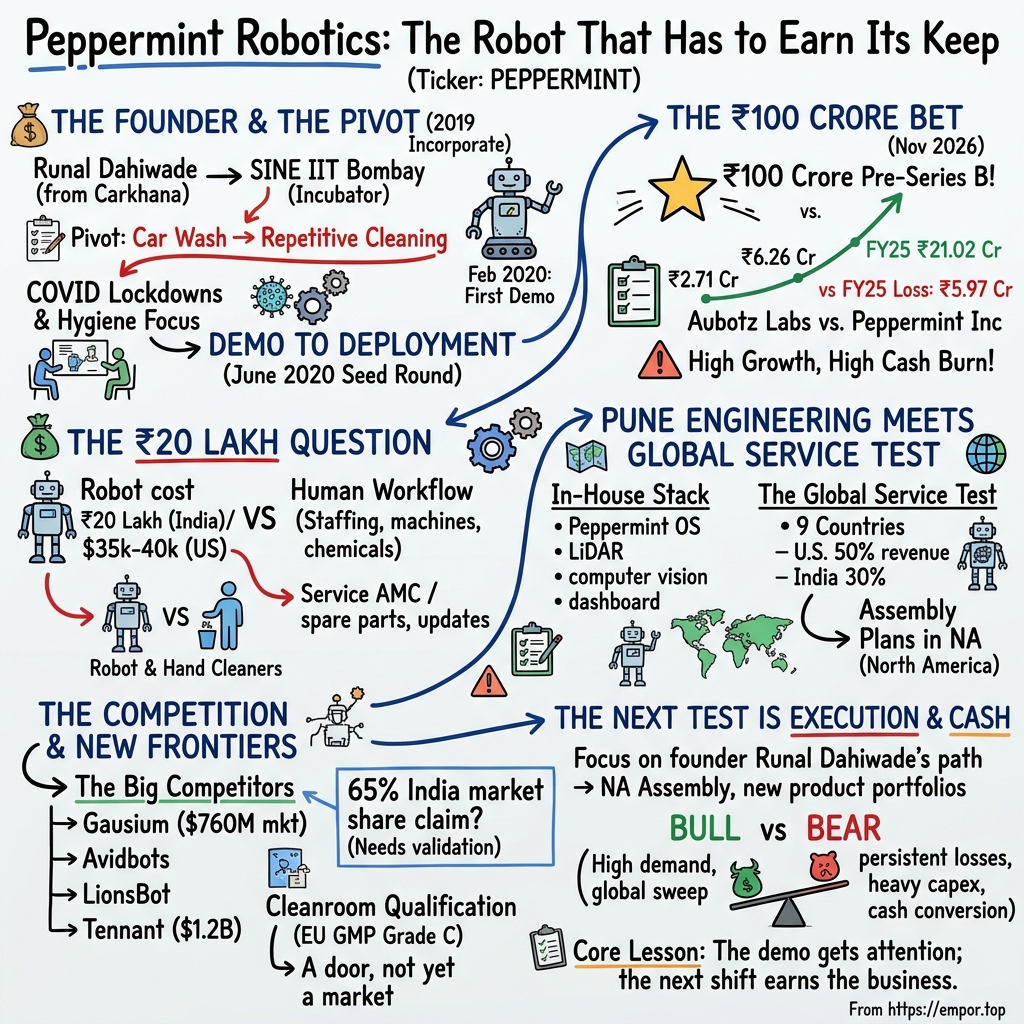
Peppermint Robotics: The Robot That Has to Earn Its Keep
I. A ₹100 Crore Bet on the Factory Floor
Picture the hour before a shift change in a large plant. Forklifts park, a supervisor checks the roster, and down a long aisle a squat machine moves at walking pace, scrubbing and drying the floor along a route it learned once and now repeats without being asked. Nobody watches it. That indifference is the point. A cleaning robot succeeds when it becomes as unremarkable as the lights, and it fails the moment a person has to stop work to rescue it.
On 4 November 2026, the company that builds machines like that one asked investors to take the indifference seriously. Peppermint Robotics announced a ₹100 crore Pre-Series B round, led by pi Ventures and Crane Venture Partners, that combined fresh capital for the company with secondary share transactions between investors.12 In the same announcement, it said revenue had doubled over the past year and had grown nearly sixfold between FY24 and FY26.1
Those are the numbers that make a funding headline. They are also the numbers that invite the first question a public-market investor would ask: growth of what, measured where, and paid for by whom?
The answer begins with a name most customers never see. In India, the Peppermint brand is operated by Aubotz Labs Private Limited, a Pune-registered company incorporated in 2019, which the company's own website names as the data controller for its operations.34 Aubotz's filings, as summarised by a company-data service drawing on Ministry of Corporate Affairs records, show operating revenue of about ₹2.7 crore in FY23, ₹6.3 crore in FY24 and ₹21 crore in FY25.4 That is close to an eightfold rise in two years. In the last of those years, Aubotz also lost about ₹6 crore.4
Set the round beside that loss and the shape of the company comes into focus. Peppermint is not a business with a decade of returns on capital to show a buyer. It is a young hardware company still financing its growth, and its newest round is roughly five times its latest annual Indian revenue and about seventeen times its latest annual loss. Investors wrote that cheque against what the business might become, not against what it has already earned.
There is a second problem folded inside the first. The FY23 to FY25 figures belong to Aubotz Labs, the Indian statutory company. The nearly sixfold growth claim covers Peppermint as a whole, and Peppermint as a whole is a larger and less transparent thing. The website footer carries the name Peppermint Robotics Inc., and a Press Trust of India report on the new round described the company as US-based.35 How the Indian company, Peppermint Robotics Inc. and the American operating company, Peppermint Robotics USA, LLC, fit together has never been laid out publicly: which owns which, where the American sales are booked, and what each charges the other. Until consolidated accounts reconcile them, the Indian figures and the company-wide growth claim measure different perimeters, and a reader cannot lay one on top of the other.
The headline amount carries a similar caveat. Because the ₹100 crore mixes new money with shares changing hands between holders, it is not ₹100 crore of cash arriving in the company's bank account.1 Peppermint has not said how the round splits between the two, at what price shares were sold, or what the company was valued at. The round tells readers that sophisticated investors wanted exposure to the business at some price. It does not tell us the price, and it tells us even less about the value.
Nor is there a prospectus to settle these questions. Peppermint is tagged as a startup because it is not listed anywhere, and no draft offer document has been filed: the Securities and Exchange Board of India's processing list for draft offer documents, dated 9 November 2026, does not include Aubotz Labs or Peppermint Robotics.[^6] Everything a future public investor would want to know, from the share count to the auditor's remarks, still sits in private agreements and in statutory filings that the company has not chosen to publicise.
So this story has to hold three questions at once. Can Peppermint sell, install and support robots across many countries at a profit? Does it have an edge that survives contact with much larger rivals? And how much of the money it has just raised will fund that expansion rather than reward earlier backers?
The polished version of a robotics company is always the demonstration: a clean strip of floor, a crowd, a dashboard glowing with metrics. The harder test is quieter. It is the same floor, clean every shift, across the full life of a paying customer's contract, with the robot repaired when it breaks and replaced before it becomes a liability. That test does not happen at a launch event. It happens on an ordinary Tuesday night, and it is the only one that decides whether this robot earns its keep.
 Subscribe on LinkedIn
II. The Founder Finds a Better Job for a Robot
Runal Dahiwade did not arrive at robotics from a laboratory. He arrived from the garage. Before Peppermint, he built Carkhana, an online marketplace for automotive services that he has said was later acquired.6[^8] Running a business that sent people to wash, service and repair cars taught him something that would shape everything after it: a large share of service work is repetitive, physically draining, hard to staff and hard to keep consistent. The customer notices only when it goes wrong.
That observation produced Peppermint's first idea, and it was not floor cleaning. Dahiwade and his early team began by exploring a robot that could wash cars.6[^8] It was a natural extension of what he knew. It was also, as the team discovered, a narrow market with awkward engineering, because every car is a slightly different shape, parked in a slightly different place, and the economic prize for automating a car wash in India is modest when labour is comparatively cheap.
The pivot that followed is the first decision in Peppermint's history worth dwelling on, because it reveals how the company chooses markets. Instead of chasing the more novel application, the team looked for a task that was frequent, visible and structurally similar from site to site. Commercial floor cleaning fit. Airports, warehouses, factories, schools, hospitals and hotels all need large, flat surfaces cleaned again and again, to a standard someone inspects, often during hours when staff are scarce.[^8]6 A floor does not change shape from one visit to the next. A robot that has mapped it once can, in principle, clean it a thousand times.
Aubotz Labs, incorporated that year,4 was in its earliest form what most hardware startups are: a handful of engineers, a prototype and a long list of things that could break. It found an early home at SINE, the technology business incubator at IIT Bombay, which provided incubation, technical guidance and early grant support.[^8]6 That matters more for a hardware company than for a software one. A software founder can ship a test version over a weekend. A robotics founder needs motors, sensors, enclosures, batteries and many cycles of fabrication and testing before anything can be put in front of a customer, and every cycle costs money that no customer has yet paid.
Peppermint launched its first robot in February 2020.[^8] It was a demonstration product, built to show prospective customers what the machine could do and to gather feedback on what it could not. There was not yet a commercial fleet, a service network or a reliable sense of what a customer would pay. The company had proved that it could build a robot that cleaned a floor. It had not proved that anyone would build their operations around it.
There is a useful founder-market fit in this beginning. Dahiwade had spent years in a business where the hard part was not the idea of a service but its delivery, shift after shift, with people who could leave or fall ill. That background is the right instinct for a company whose real product is not a machine but a promise that a floor will be clean. It is also worth noting what the early record does not show. A founder's earlier exit says something about his ability to build and sell a business; it says nothing yet about his ability to manufacture hardware at scale, run service operations on several continents or price a capital good. Those are different skills, and the rest of this story is in large part a test of whether he and his team acquired them.
The early strategy also made a claim that would echo for years: that Peppermint was early, perhaps first, to bring autonomous commercial cleaning to India. In a narrow sense that may have been true. In the wider market, autonomous scrubbers were already being developed and sold elsewhere, and the companies that built them would, in time, become Peppermint's competitors in the very markets it would most want to win. Being early in one country is an advantage only until a better-funded rival decides the country is worth entering.
Within weeks of the first robot's launch, though, the question of who would buy a cleaning robot was answered in a way no founder could have planned. A virus was about to make every surface in every public building a matter of public concern. The prototype was about to get its chance in the field, sooner and under more pressure than anyone expected.
III. COVID Turned the Demo Into a Deployment
In the spring of 2020, India locked down. Factories that made essential goods kept running, hospitals filled, airports emptied and then reopened under new rules, and the people who cleaned these places were suddenly asked to do more of a dangerous job with fewer colleagues. For a company with one robot and a pitch about reducing human exposure to repetitive cleaning work, the change in the room was immediate.
Peppermint obtained clearance to serve government agencies during the lockdown and began demonstrating its machines to essential industries that were allowed to keep operating.[^8] The value proposition had not changed, but its urgency had. A robot that could clean a large floor without putting another worker in a crowded space was no longer a productivity experiment. It was, for a few months, part of a safety plan.
Capital followed the attention. In June 2020, Peppermint raised a seed round led by Venture Catalysts, with participation from a former head of Castrol's Asia business, among others.7 Little more than a year later, in September 2021, it raised about ₹5 crore in a round led by Venture Catalysts and Indian Angel Network.8 The company moved from demonstrations to production during this period, building robots for paying customers rather than prospective ones.[^8]
By 2021, Peppermint was describing itself as having a first-mover advantage in its market.[^8] It is worth pausing on that phrase, because it was the company's own early theory of why it would win, and five years later there is enough record to test it.
The pandemic did three things for Peppermint. It shortened the distance between prototype and paying customer. It gave the company a story that investors in 2020 and 2021 found easy to fund. And it put robots on real floors, where the engineering team could learn what broke. All three were genuine gains. None of them, by itself, proves lasting demand, because urgent interest and durable economics are different animals. A hospital that bought a robot in a crisis may renew its service contract because the robot saves money; it may also let the robot gather dust once the crisis passes and the old cleaning routines return.
The public record cannot tell these stories apart. Peppermint has never published a series of deployment counts, fleet utilisation, renewal rates or customer retention over time. Without that, there is no way to measure how much of the pandemic-era pull endured. What the record does show is suggestive in both directions. On the positive side, Aubotz's revenue continued to rise after the emergency faded.4 On the more cautious side, the capital history shows a long gap. After the ₹5 crore round in 2021, no new priced equity round was announced until a ₹34 crore Series A in April 2025.89 In between, in FY23, Updater Services, a listed Indian facility-management group, invested ₹3 crore through zero-interest convertible debentures carrying a two-year lock-in and conditional conversion terms, including a 25% discount if Aubotz hit agreed targets.10
That instrument is worth reading closely. A convertible with a target-linked discount is a structure investors use when they like a business but do not want to fix its price yet. It lets the money go in now and defers the argument about valuation until results arrive. It is not a down round, and it is far from a sign of distress, but it is also not the kind of financing a company receives when demand is so obvious that investors are queuing at a high price. The debentures converted into 784 compulsorily convertible preference shares in FY25, by which time Peppermint's revenue had climbed sharply.10 Whether Aubotz met the targets that triggered the discount is not disclosed.
The first-mover theory therefore emerges narrowed rather than rejected. Peppermint was early in Indian commercial cleaning robotics, and the pandemic gave it a head start that it used to get machines into the field and build a customer list. But first-mover advantage only becomes a moat if it turns into something a later entrant cannot easily copy: customer relationships that renew, service density that lowers cost, or data that improves the product faster than rivals can. A four-year gap between priced equity rounds, bridged in part by a performance-linked instrument from a facility-management company, suggests that in the middle years the market was still waiting to see the evidence. The evidence that would confirm the claim today is not a launch date. It is a public record of customers who bought in 2021 and are still paying in 2026.
By the end of the pandemic the question had changed. It was no longer whether the robot worked. It was whether the company could make enough of them, sell them to buyers with no emergency to justify the purchase, and keep them working.
IV. A ₹20 Lakh Robot Has to Beat a Human Workflow
Imagine the person who actually decides whether a Peppermint robot is bought. Usually it is not the factory owner or the airport director. It is a manager at a facility-management company, the contractor that the factory or airport pays to keep the place clean. Peppermint sells primarily through these firms.11 Their business is to deliver a contracted standard of cleanliness at a cost lower than the fee they charge, and every machine they buy has to fit inside that margin.
This buying chain shapes everything about Peppermint's economics. A facility-management firm is a sophisticated, price-sensitive customer that runs on thin margins and measures cost per square foot per shift. It is not buying a robot because it is impressive. It is buying one only if the robot lowers its cost of meeting a contract, or lets it win a contract it would otherwise lose, or solves a staffing problem it cannot solve with people.
So start where the buyer starts: with the price. Dahiwade has said that an average Peppermint robot costs around ₹20 lakh in India, while in the United States prices range from about $35,000 to $40,000.11 At recent exchange rates, the American price is roughly one and a half times the Indian one. That difference is the first clue to where the company's growth has come from.
Now put the robot against the alternative. A facility-management manager compares the machine's purchase price, its maintenance and its downtime against the wages of the people who would otherwise do the job, the conventional cleaning equipment they use, the chemicals, the supervision and the cost of covering repeated shifts, weekends and absences. In a country where cleaning labour is relatively inexpensive, a ₹20 lakh capital outlay has to replace a lot of hours before it pays for itself. In the United States, where cleaning labour is far more expensive and harder to hire, the same arithmetic tilts sharply toward the machine, even at a higher price.
That is why the geographic mix the founder describes is not an accident. He has said the United States contributes nearly half of revenue, India close to 30% and other markets the remainder.11 An Indian robotics company whose largest market is America is following the money: it is selling where the human workflow it replaces is most expensive. The strategic logic is sound. It also means that the company's economics depend most on the market where its competitors are strongest and its service network is furthest from home.
The second part of the model comes after the sale. Peppermint says that, from the second year, robots generate further revenue through spare parts, annual maintenance contracts and software or hardware upgrades.11 This is the lifecycle opportunity that every capital-equipment company wants. Sell the machine once, then earn steady, higher-margin service income for as long as it runs. Elevator makers and industrial cleaning-equipment companies have built durable businesses on exactly this pattern, because the installed base becomes an annuity and the service relationship makes switching to a rival more awkward.
Peppermint does not disclose how much of its revenue already comes from that annuity. It publishes no split between new robot sales and service, parts and upgrades, no service attach rate, no contract length, no minimum commitments, no renewal rate and no gross margin on either stream.11 That silence matters, because the two streams have very different qualities. Hardware orders are lumpy and depend on customers' capital budgets. Service revenue recurs, but only if robots stay in use and customers renew. A company that reports only total revenue makes the two look the same.
A rough calculation shows what scale the company is working at. If all of Aubotz's ₹21 crore in FY25 revenue had come from new robots at the ₹20 lakh Indian average, it would have represented about a hundred robots in a year.411 The true number of machines is different, because some revenue is service, some robots are priced differently and some American sales may be booked elsewhere in the group. But the order of magnitude is the lesson. This is a company selling machines by the dozens and low hundreds, not by the thousands, and at that scale every lost order and every warranty repair moves the results.
Then compare revenue with the losses. From FY23 to FY25, Aubotz's net loss stayed between about ₹4.4 crore and ₹6 crore.412 Measured against sales, the loss shrank from more than one and a half times revenue in FY23 to under a third of revenue in FY25. That is real operating leverage, and the bull case rests on it: fixed engineering and overhead costs are being spread over a rapidly growing base, and if revenue keeps compounding while costs grow more slowly, the loss could close. But a narrowing loss ratio is not the same thing as attractive unit economics. It does not tell us whether each robot is sold at a healthy gross margin, whether service contracts make money, or whether the narrowing came from price, mix, volume or simply from deferring spending. The FY23 and FY24 loss figures also come from secondary reporting rather than the filed accounts themselves, so the trend is a strong clue, not a verdict.12
Another crude ratio sharpens the point. The company says it has more than 120 team members across eight countries, while employee-provident-fund records show 130 employees at the Indian entity in May 2026.134 Set against FY25 revenue, that is something like ₹16 lakh of sales per person, less than the price of a single robot. The dates and perimeters do not match exactly, so the ratio is only indicative, but it describes a company that is still staffed for the business it hopes to become rather than the one it is.
The proof that would settle the economics is concrete and unglamorous. It is revenue and gross margin broken out by new robots, service contracts, parts and upgrades; renewal rates on maintenance contracts; the average payback period a customer experiences; and how many robots in the installed base are actually running on a typical day. Those figures would tell a reader whether each new installation is an asset that will pay the company for years or an obligation that will cost it for years.
Because that is the catch hidden in every sale. Each new robot adds a customer who expects it to work tomorrow, next month and in five years. Each one needs spare parts stocked somewhere nearby, a technician who can reach it and software that keeps up with changes on the floor. In Pune, that is a manageable promise. In an American warehouse or a European plant, it is a logistics business layered on top of an engineering one. The more robots Peppermint sells abroad, the more that promise becomes the business.
V. Pune Engineering Meets a Global Service Test
A new Peppermint robot arriving at a customer's site faces an exam before it cleans anything. It has to build a map of a building it has never seen, learn where the walls, pillars, racks and doorways are, and then follow a cleaning route through a space full of people, pallets, trolleys and the occasional misplaced box. It has to stop for a worker who steps into its path, go around an obstacle that was not there yesterday, and finish the route without anyone needing to push it or reprogram it. If it fails that exam often enough, the facility manager will quietly stop using it.
Peppermint's answer to that exam is to build almost everything itself. The company describes an in-house technology stack: its own operating software, which it calls Peppermint OS, together with computer vision, LiDAR sensing, mapping and navigation, and a dashboard through which customers can monitor their robots' work.11411 The robots are designed in India and assembled in Pune.115 LiDAR, in plain terms, is a spinning laser rangefinder that measures distances to everything around the machine many times a second, so the robot can see the geometry of a room even in poor light. Computer vision uses cameras to recognise what those shapes are, a person rather than a pillar, for instance.
The argument for doing all this in-house is familiar from other hardware businesses. When one team controls the hardware and the software, it can change both together, fix problems faster and trim costs that a company assembling bought-in components cannot touch. Indian engineering salaries are lower than those in North America or Europe, so a Pune-based development team may be able to iterate more cheaply than rivals with similar talent elsewhere. And local assembly can, in principle, give the company more control over quality and lead times.
The argument against is just as familiar. Owning the whole stack means paying for the whole stack. Every sensor upgrade, every new robot model and every software release is the company's own cost to bear, and a small company has to fund all of that from a revenue base of a few tens of crores. Integration is only an advantage if it shows up in something customers can feel: higher uptime, fewer service calls, cleaner floors per hour or a lower total cost of ownership than the alternatives.
None of those outcomes is published. Peppermint has not disclosed robot uptime, failure rates, mean time between service calls, cleaning coverage per hour, labour hours saved for customers or service response times. It does not disclose how densely its robots are clustered in any one city or region, which is what determines whether a technician can service several machines in a day or must travel hours for one. So the claimed technology advantage remains a claim. It may be real. The public record simply does not yet contain the operating evidence that would distinguish a well-integrated product from an ambitious one.
The geography raises the stakes. Peppermint says it operates in nine countries, and the founder has described the United States as its largest market, with nearly half of revenue.511 Its careers page describes a team of more than 120 people across eight countries.13 For a company of this size, that is an unusually wide footprint. Wide footprints are expensive in hardware because the cost of service rises with distance and falls with density. A hundred robots in one metropolitan area can share a technician, a parts store and a training programme. A hundred robots spread across nine countries cannot.
The newest plan addresses part of this problem and creates another. Peppermint says it will use part of the new round to set up an assembly line in North America to complement Pune.111 The logic is clear enough. Building near the largest market can cut shipping times, reduce exposure to tariffs and trade friction, make customisation easier and reassure American customers that their supplier has a local presence. A facility-management firm deciding whether to standardise on a robot across dozens of sites wants to know that parts and people are nearby.
But a second assembly site is not a free option. It requires leased space, equipment, local hiring, supplier qualification and quality systems that match those in Pune, all before it produces a single robot. For a company with Indian-entity revenue of about ₹21 crore in FY25, that is a meaningful fixed-cost commitment.4 If American volumes grow as planned, it will be absorbed. If they grow more slowly, the plant becomes a cost centre that the company must keep funding. The decision also complicates the entity puzzle further: robots assembled in North America will presumably be sold by an American entity, which makes the absence of consolidated accounts even harder to work around.
Currency adds a quieter layer of risk. With roughly half of revenue in the United States and most engineering and assembly costs in India, Peppermint has a natural exposure to the rupee-dollar rate. A weaker rupee would flatter margins on American sales; a stronger one would squeeze them. The company does not disclose its transaction currencies, hedging policy or any foreign-exchange gains or losses.115 For a business at this stage the exposure is more an operational fact than a crisis, but it will matter more as overseas sales grow.
So the question a customer asks after the installation is the one that decides this section of the story. The robot has been delivered, mapped and switched on. Who keeps it productive every shift for the next five years, and at what cost to the company that promised it would?
VI. The Bigger Competitors Are Already on the Floor
Picture the facility manager again, this time with a procurement spreadsheet. On it are several names. One is Peppermint. Another is Gausium, a Chinese robotics company that says it is the world's largest supplier of commercial cleaning robots. Another is LionsBot, from Singapore. Another is Avidbots, a Canadian company that makes autonomous floor scrubbers. And at the bottom, almost certainly, is the company whose conventional scrubbers the facility already owns, perhaps Tennant or Nilfisk, the established names in professional cleaning equipment, with their dealer networks, service technicians and decades of relationships.
That spreadsheet is the most important fact about Peppermint's market. The category is real and growing, but the buyer is not choosing between a robot and nothing. The buyer is choosing among robots from several specialists, robotic versions of machines from the incumbents, and simply hiring more people.
Start with scale. Gausium, citing International Data Corporation's 2025 tracker, said in July 2026 that the global commercial-cleaning-robot market was worth about $760 million and ranked Gausium first by both shipments and revenue.16 Peppermint's Indian entity reported about ₹21 crore of revenue in FY25, roughly $2.5 million.4 Even allowing for American sales that may be booked elsewhere in the group, Peppermint is a fraction of a percent of the global category. Tennant, the American cleaning-equipment group, reported total sales of about $1.20 billion in 2025, almost all of it from equipment, parts, consumables and service that have nothing to do with autonomy.17 Avidbots had disclosed more than $107 million raised by the time of its 2022 Series C.18 By comparison, Peppermint's disclosed equity rounds before 2026, the ₹5 crore round in 2021 and the ₹34 crore Series A in 2025, together come to roughly $5 million at today's rates.89
These comparisons describe different things and must be handled carefully. Tennant's revenue covers a broad equipment business, not autonomous robots. Avidbots' figure is capital raised, not sales. The IDC-based market estimate comes from a competitor's press release. But read together they make one point unmistakably: Peppermint is competing against companies that are much larger, much better funded or both, and that have service networks it does not yet have.
The economics of the category explain why that matters. A buyer of commercial cleaning equipment cares about four things: that the machine works reliably, that its total cost of ownership is lower than the alternative, that service is available when it breaks and that it fits into existing cleaning operations without retraining the whole workforce. Novel technology helps with none of those directly. Scale helps with all of them. A company that ships many thousands of robots can spread its research spending, buy sensors more cheaply and afford technicians in more cities. An incumbent with a dealer network can bundle a robotic scrubber with the conventional machines and maintenance contracts a customer already has.
Against that backdrop, Peppermint's founder has made a striking claim: that the company holds about 65% of India's floor-cleaning robotics market.11 If true, it would be a meaningful home-market position. But the company has not disclosed how the market was defined, which competitors were counted or what data the share was calculated from, and no independent shipment tracker in the public record corroborates it. India is also only a minority of Peppermint's revenue, by its own account, and the domestic market for autonomous cleaning robots is small relative to the global category.11 A high share of a small, early market is a foothold, not a fortress, and it is precisely the kind of share that a larger rival can contest by cutting prices for a few years.
What evidence would confirm the claim? Independent shipment data for India, Peppermint's win rate in competitive tenders, renewal rates among existing customers, and realised pricing compared with rivals. Until some of that appears, the 65% figure belongs in the category of founder positioning rather than established fact.
The deeper question is whether Peppermint has any of the structural advantages that let smaller companies survive against larger ones. Hamilton Helmer's framework of seven powers is useful here precisely because most of them do not yet apply. Peppermint does not have scale economies; its rivals do. It does not have network effects; one customer's robot does not make another's more valuable in any demonstrated way. It does not have a cornered resource, such as exclusive technology or a regulatory licence. It does not have the brand power of an incumbent equipment maker.
That leaves switching costs and process power as the plausible candidates. Switching costs could arise because a robot has been mapped to a site, integrated into cleaning schedules and supported by trained staff and a service relationship; replacing it means repeating that work with a new vendor. Process power could arise if Peppermint's in-house integration lets it build robots more cheaply or improve them faster than rivals. Both are plausible. Neither is proven. The company discloses no retention data, no evidence of customers trying and abandoning a rival's robots, and no cost comparison. A proprietary technology stack does not by itself confer pricing power; it confers pricing power only if customers would pay more, or leave less often, because of it.
Michael Porter's five forces point the same way. Buyers are concentrated and powerful, because facility-management firms aggregate demand and negotiate hard. Suppliers of key components, such as LiDAR units and batteries, sell to every robot maker. Substitutes, in the form of human cleaners and conventional machines, set a ceiling on price. Rivalry is intense and likely to intensify as Chinese manufacturers push down hardware costs. The threat of entry is moderate rather than low, because a capable engineering team can build a working cleaning robot, even if building a service business around it is harder.
The verdict on the moat is therefore early and unproven, not absent. Peppermint has customers, revenue growth and a product that works well enough for buyers in nine countries, according to the company, to have paid for it. What it does not yet have is evidence that customers stay because they cannot easily leave, or that it can make robots more cheaply than rivals. And the most consequential test of its overseas expansion is the one its biggest rivals have spent years and many millions of dollars preparing for: not whether Peppermint can sell robots abroad, but whether it can support them as well as it sells them.
VII. The Cleanroom Qualification Is a Door, Not a Market
There is one place where a cleaning robot cannot afford to be ordinary. In a pharmaceutical cleanroom, the air is filtered, the people wear gowns and masks, and the number of particles floating in a cubic metre of air is measured and regulated. Anything that enters the room, including a cleaning machine, can itself be a source of contamination. A robot that sheds particles from its wheels, brushes or exhaust, or that cannot itself be cleaned and disinfected properly, is not a helper there. It is a hazard.
That is why Peppermint's most interesting technical milestone sits in a cleanroom. The company says its cleanroom scrubber-dryer, the SD20 CR, passed qualification testing in an EU GMP Grade C cleanroom at a global pharmaceutical company.114 EU GMP refers to the European Union's good manufacturing practice rules for medicines, and Grade C is one of the controlled cleanliness classes used for stages of pharmaceutical production. To pass qualification there, a machine has to show that it can operate without compromising the room's controlled environment.
The milestone matters because regulated settings are where automation can command better economics. A pharmaceutical manufacturer cares less about the purchase price of a cleaning machine than about consistency, documentation and the cost of a contamination event. A robot that cleans the same way every time, and logs what it did, offers the kind of repeatability that regulated plants value. Peppermint's existing customer references already lean toward this world: industry profiles name pharmaceutical companies such as Cipla, Torrent Pharma and Laurus Labs, and the capsule and pharmaceutical-equipment maker ACG among its deployments or customers.19
But a qualification is a door, not a room full of buyers. There are three separate steps between passing a test and building a business, and the public record shows only the first. A machine can be qualified and never ordered. It can be ordered once as a trial and never reordered. It can be ordered repeatedly but at margins that do not justify the engineering. Peppermint has not disclosed the identity of the pharmaceutical company where the qualification took place, the number of paid cleanroom installations, revenue from cleanroom products, repeat orders or the profitability of the line.
The founder has gone further than the qualification, describing Peppermint as the world's first cleanroom robotics company.11 That is a positioning statement, not a proof of category advantage. Being first to describe a category is not the same as being first to sell into it, and being first to sell into it is not the same as winning it. The relevant evidence would be repeat orders from the same pharmaceutical customers, expansion from one plant to several, and revenue and margin from the cleanroom line reported separately.
The record of how named customers translate into revenue elsewhere in Peppermint's business should also temper expectations. The company's public material cites deployments at well-known names, including Honda, Nestlé, Coca-Cola, Bosch, Goldman Sachs and Mumbai Airport.13 Those names are impressive, and they suggest that large organisations have been willing to try Peppermint's robots. But the company has never said how many robots each customer bought, whether any are still running, or what share of revenue any of them represents. A logo on a careers page can mean a fleet or a single pilot. Until Peppermint discloses which, the cleanroom qualification deserves the same treatment: a meaningful signal of technical credibility, with commercial value still to be demonstrated.
The same proportion applies to the rest of the product roadmap. Peppermint also builds material-handling robots, which move goods around factories and warehouses, and it has spoken of plans for an outdoor cleaning line.111 Each broadens what the company can sell to an existing customer, and material handling in particular addresses a large market. But no segment revenue shows either to be a material business today, and every new product line asks a small engineering team to divide its attention and a small service team to learn another machine.
Cleanroom capability is a real option. Options have value, but they are valued by the probability that they will be exercised and what they will pay when they are. For now, Peppermint has proved that the door opens. The next step is to show that customers walk through it, again and again, at prices that make the walk worthwhile.
VIII. Growth Has Not Yet Closed the Cash Question
The most important number in Peppermint's public record is not its revenue. It is the gap between two figures that appear in the same year. In FY25, Aubotz Labs' loss amounted to just under a third of sales.4
Read across time, that gap tells an encouraging story. Revenue rose nearly eightfold from FY23 to FY25, while losses, according to secondary reporting for the earlier years, rose from about ₹4.4 crore to ₹6 crore.412 If that pattern continued, it could eventually bring the business to break-even.
Then comes the company-wide claim. Peppermint says its revenue doubled over the past year and grew nearly sixfold between FY24 and FY26.1 Two things need to be said about that sentence. First, it is a company-wide statement, not an audited FY26 figure for Aubotz Labs, and the company has not given an absolute number. Second, it does not fit perfectly onto the Indian accounts. Doubling Aubotz's FY25 revenue would imply about ₹42 crore for FY26, which would be closer to a sevenfold increase from Aubotz's FY24 level than a sixfold one. The gap is small, and it may simply reflect rounding or a different base, but it is exactly the kind of discrepancy that exists when two perimeters are being described with one vocabulary. A reader can say that Peppermint's revenue is probably in the region of a few tens of crores today. A reader cannot yet say exactly how much, in which entity, or at what margin.
The more important absence is cash. Net loss is an accounting result. For a hardware company, the cash story can be very different, in either direction. Robots have to be built before they are sold, which ties up money in components and finished inventory. Large customers often pay on extended terms, which ties up money in receivables. Installation and commissioning happen before some contracts are fully billed. New manufacturing capacity, such as the planned North American line, requires spending before it produces anything. A company can report a narrowing loss and still burn more cash each year because its growth is absorbing working capital.
Peppermint does not publish the figures that would show which is happening. Aubotz's filed accounts for FY25 exist, but operating cash flow, receivables and their ageing, inventory, capital expenditure, research-and-development spending, cash balances and borrowings are not reproduced in the public summaries, and the company has not disclosed them elsewhere.4 Without them, it is impossible to say whether growth is being funded by customers paying promptly or by the company's own capital, how much cash the business consumes each year, or how long the money it has raised will last.
A rough comparison of the visible numbers is suggestive. Aubotz's reported losses over FY23 to FY25 add up to roughly ₹16 crore.412 The publicly reported capital raised before the 2025 Series A, including the ₹5 crore round in 2021 and the ₹3 crore Updater Services debentures, is about half of that.810 The seed round's size was not disclosed, losses include non-cash charges, and suppliers and customers can finance part of a company's working capital, so the gap does not prove hidden borrowing. It does show that the full financing history of the business is wider than its announced rounds, and that the balance sheet holds answers that the funding press releases do not.
Updater Services' accounts provide one rare outside view of how investors have marked the company. Updater Services, a listed Indian facility-management group, invested ₹3 crore through convertible debentures in FY23; those debentures converted into 784 preference shares in FY25, and Updater reported the holding at a fair value of about ₹7.9 crore at the end of March 2025, recognising a gain of about ₹4.9 crore that year.10 That works out to roughly ₹1 lakh per preference share, against a cost of about ₹38,000. The mark more than doubled in value in the hands of an investor that is itself a facility-management company, the very kind of buyer Peppermint sells to. It is a meaningful signal. But it belongs to Updater, not to Aubotz, and it is not Aubotz's income. Without the total share count and the terms attached to each class of share, it cannot be turned into a valuation of the whole company.
That limitation is the heart of the capital-structure problem. A proper underwriting starts with the fully diluted share count: common shares, each series of preference shares, the employee stock option pool, any warrants or convertible notes, and anything promised to future holders. Then it asks what rights each class carries. Venture preference shares usually come with liquidation preferences that give their holders their money back before common shareholders receive anything in a sale, and sometimes with anti-dilution protections that adjust their conversion price if a later round is priced lower. Peppermint has not publicly disclosed any of this. Its preference shares, option pool, investor rights and post-round ownership are unknown outside the company's statutory filings and shareholder agreements.
The new round's use of proceeds is the one clear part. Peppermint says the primary capital will go to engineering and product development, manufacturing expansion, North American operations, market development and hiring.1 That is a growth plan, not a rescue. But the ₹100 crore headline includes secondary transactions in which existing shareholders sold shares to new investors.1 Money paid in a secondary transaction goes to the seller, not to the company. It does not build robots or hire engineers. It may reward early backers, give employees liquidity or simply rebalance the cap table, all of which can be healthy. Yet because the split is not disclosed, the actual cash added to the company could be anywhere from a modest fraction of ₹100 crore to most of it.
The same gap prevents any reliable bridge from equity value to enterprise value. Enterprise value adds debt and debt-like obligations to the value of the shares and subtracts cash, so it describes what the operating business is worth regardless of how it is financed. For Peppermint, the cash, borrowings, lease liabilities and planned primary proceeds are all undisclosed. Any enterprise value calculated today would be a guess dressed in arithmetic.
What would settle the question is a short list of documents: consolidated FY26 accounts that bring together Aubotz Labs, Peppermint Robotics Inc. and Peppermint Robotics USA, LLC; an operating cash-flow statement with a working-capital bridge; gross and operating margins; capital expenditure; and filed share-allotment records showing how much of the new round was primary, at what price and with what dilution. Until those exist publicly, the growth is visible, the losses are visible, and the cash that connects them is not.
IX. Runal Dahiwade’s Next Test Is Execution
When Dahiwade describes Peppermint's next phase, it sounds like the plan of a company several times its size. There is a North American assembly line to complement Pune, more engineers to hire, a broader portfolio of robots that adds outdoor cleaning to floor scrubbing, cleanroom machines and material handling, and expansion across the United States, Asia and Europe.111 The plan is coherent. It follows the money to the markets where labour is expensive, and it tries to build the local presence that customers there will expect. The question is whether the company that has to deliver it has shown the habits that make such plans come true.
Judged by behaviour rather than biography, the record has real strengths. Dahiwade abandoned the car-wash idea when the market was wrong, which shows a willingness to kill a favourite project.6[^8] He used the pandemic to move from prototype to production instead of waiting for perfect conditions.[^8] He kept the company alive and growing through a long stretch between priced equity rounds, and then raised a ₹34 crore Series A and a ₹100 crore Pre-Series B led by specialist deep-technology investors.92 Revenue at the Indian entity grew close to eightfold in two years while the annual loss stayed in a narrow band.4 Those are not small achievements for a hardware company in a country without a deep robotics supply chain.
The record also has gaps that matter to anyone who might one day hold the shares in public. Peppermint has never published guidance that can be checked against results, so there is no history of promises kept or missed. It has not disclosed the founder's shareholding, the stake held by senior management, the size of the employee option pool or how much the founder and directors are paid. The return on earlier capital, the thing that would show whether past money was spent well, cannot be calculated without the accounts and the cap table.
The board is small and its composition reflects a founder-led private company. Company-data records list directors Runal Dahiwade, Vijay Madhukar Dahiwade, Pawan Sharma and Vishnuraj Rao Kunjur, with an additional director appointed in December 2025.4 There is no public statement about which directors are independent, which represent investors and what committees exist. None of that is unusual for a private company at this stage. All of it would have to change before a listing, and a future offer document would need to explain it.
The legal record is thin and, on its face, benign. Company-data records list three cases at the Bombay High Court filed by Aubotz Labs, two pending and one disposed, including a commercial case against an individual and one against the Registrar of Trade Marks.4 These are cases the company brought rather than claims against it, and the trademark matter suggests Peppermint has been working to protect its brand. The full case history is not public, and neither are the auditor's report, the auditor's remarks on internal controls or any contingent liabilities, all of which sit in filed accounts that the company has not publicised. No credit rating agency has published a rating rationale for the business, so there is no independent view of its liquidity.
The skeptical investor's concern is not about any one of these gaps. It is about sequence. In Peppermint's plan, product breadth and geographic reach come first and measurable cash conversion comes later. That is a common pattern in venture-backed hardware, and it sometimes works: build the footprint while capital is available, then let scale bring profitability. It also sometimes fails in a recognisable way. Each new product and each new country adds fixed cost and management attention before it adds profit, so the company needs another round to reach the point where the previous round was supposed to take it. If that cycle repeats, early shareholders are diluted and the business never quite demonstrates that it can stand on its own.
The 2026 plan gives investors a fair way to judge which pattern Peppermint is following. The North American assembly line either opens and starts producing robots on a timeline the company can point to, or it does not. American service coverage either grows to match sales, or customers start reporting delays. Revenue either converts into operating cash, or the losses keep pace with growth. And the company either reports enough operating detail to let outsiders see the difference, or it keeps reporting only headlines.
That last point is the founder's real test. Every promising startup can tell a compelling story. The ones that deserve public-market capital are those whose managers volunteer the numbers that could prove the story wrong: retention, uptime, service margins, cash flow. Peppermint has not yet had to do that. Whether Dahiwade chooses to, before anyone forces him, will say as much about his credibility as any funding round.
X. Bull Versus Bear: Can Peppermint Make the Robot Pay?
Look at the same robot from two sides of the room. From one side, it is a tireless worker in a facility that cannot hire enough cleaners, doing the dullest job in the building to a consistent standard, night after night, and freeing people for work that needs judgement. From the other, it is a ₹20 lakh machine that has to be designed, financed, built, shipped, installed, maintained, repaired and eventually replaced, by a company that has not yet shown it can do all of that at a profit.11 Both views are correct. The investment question is which one will dominate the economics.
The bull case starts with real demand and growth: customers in nine countries have bought Peppermint's robots, and the company says revenue doubled again over the latest year.541 It rests, too, on Peppermint's in-house technology and the potential for service revenue to grow with its installed base.111 The cleanroom qualification offers another growth opportunity,14 while the narrowing loss ratio suggests operating leverage.412
The bear case starts where the bull case runs out of evidence. The founder's claimed 65% share of the Indian market and description of Peppermint as the world's first cleanroom robotics company are not independently validated.11 Losses persisted in FY25,4 and key operating and financial figures remain undisclosed. The FY26 growth claim cannot be reconciled with audited accounts, and the legal structure connecting the Indian company to its American affiliates remains unexplained.
The bear case continues with competition and execution. Peppermint is small beside larger rivals with established service networks.1617 Its American expansion raises the cost and complexity of manufacturing and support, while its reported US revenue share makes currency movements and overseas execution significant risks.11
Weighing the two, the bull case has the better story and the bear case has the better evidence. That is not a dismissal. For a company at this stage, it is normal. But it does mean that the investment case rests on what Peppermint will become rather than on what it has shown, and any valuation has to be built that way.
What a Robot Company Is Worth Before It Earns
Price and value are separate questions here, and only one of them has even a partial answer. The latest round established that investors were willing to pay some price for Peppermint shares, but that price has not been disclosed. There is therefore no headline valuation to test, and it would be false precision to reverse-engineer one from the round size. What can be done is to sketch what the business would need to achieve to justify a substantial valuation, and how sensitive that is to assumptions.
Start with a base. If the company's claim of doubling applied to the Indian entity's FY25 revenue, FY26 revenue would be about ₹42 crore. That is an illustration, not a reported figure. Now imagine two paths. In an optimistic path, revenue compounds at about 35% a year for five years, which would take it to roughly ₹180 crore. Suppose that, by then, a growing share of revenue comes from service, gross margins improve with scale, and the company reaches a sustainable operating margin of 12% to 15%, comparable to what a good capital-equipment business with a service tail can earn. That would mean operating profit of about ₹22 to ₹27 crore, and something like ₹16 to ₹20 crore after tax. In a harder path, growth slows to about 20% a year because larger rivals compete on price, revenue reaches roughly ₹100 crore in five years, and margins settle in the low single digits because service costs across nine countries eat most of the gross profit. That business would earn a few crore at best, and might still need outside capital.
The difference between those paths is not a percentage. It is the difference between a company that can fund itself and one that cannot. And even the optimistic path must be discounted heavily. Investors in a loss-making hardware company typically require returns of 20% a year or more to compensate for the risk that the plan fails, and at that rate a rupee of value five years away is worth only about forty paise today. Any further rounds before profitability would also dilute today's shareholders, so the value of the whole company is not the same as the value of each existing share.
The sensitivities that matter most are clear. Growth determines scale, but margins determine whether scale is worth having. A few points of operating margin, set by gross margin on robots, service costs and how quickly the North American line becomes efficient, swing the eventual profit by a multiple. Retention determines whether service revenue becomes an annuity or evaporates. And capital need determines how much of the eventual value belongs to today's shareholders rather than tomorrow's.
The Rivals Who Set the Yardstick
A comparable-company view is harder still, because Peppermint's closest operating peers are private. Gausium, LionsBot and Avidbots are the closest comparisons, but their funding rounds do not establish market value. Avidbots' $107 million of capital raised by 2022, for instance, tells us what investors committed, not what the business is worth today.18
Tennant and other listed cleaning-equipment makers are aspirational rather than direct peers. They are mature, profitable, global and diversified, with large dealer networks, and most of their revenue comes from conventional machines and service.17 Their valuations reflect stable profits and dividends, not early-stage growth with losses, and applying their multiples to Peppermint would understate the growth while ignoring the risk. Conversely, applying the multiples of fast-growing software or artificial-intelligence companies would credit Peppermint with economics it has not shown; a robot is a physical product with a bill of materials, and it does not scale like code. There is no recent listed Indian robotics peer close enough in model and size to serve as a clean comparison.
So the reconciliation between intrinsic and comparable views has to be stated in terms of what a valuation would embed, rather than what it should be. Any valuation that treats Peppermint as a substantial company is betting that revenue keeps compounding at well above 30% a year for several years, that service grows into a meaningful and profitable share of sales, that customers renew at high rates, that the company holds a defensible position against much larger rivals in the United States, and that operating margins eventually reach double digits without endless new capital. If a public listing ever comes, the market may price the shares above or below such a range for reasons that have little to do with the business itself. Scarcity of listed robotics companies, enthusiasm for anything associated with automation and artificial intelligence, a small free float and momentum after listing could all push the price up; a weak market or a disappointing quarter could push it down. None of those forces would change what the robots earn.
Three measures would tell an investor whether the thesis is working. The first is the installed base: how many robots are deployed and how many are actually running, measured by utilisation and uptime. The second is recurring revenue: service, parts and upgrade revenue as a share of total, with its gross margin. The third is cash: operating cash flow reconciled to revenue growth and capital expenditure.
The thesis strengthens if robots stay in use, customers renew service contracts, recurring revenue grows faster than total revenue, and cash conversion improves as the company scales. It weakens if revenue growth keeps requiring new capital without any improvement in unit economics, if service costs rise faster than service revenue, or if the American expansion consumes cash without building density. That rule does not require faith in the founder's claims. It requires only that the company publish the numbers.
XI. Business & Investing Lessons
Go back to February 2020 and the first Peppermint robot, built to show what was possible rather than to prove what was profitable. Almost everything that has happened since, the pandemic deployments, the new markets, the cleanroom test, the latest round, can be read as an effort to turn that demonstration into a business. The lessons are not about robotics in general. They are about this company's particular path, and they travel well beyond it.
The first lesson is in the car wash that never was. Dahiwade's team chose floors over the more unusual application. The founders' best decision was to choose the customer's most repetitive pain over the engineer's most interesting problem. For anyone building hardware, the market that repeats is worth more than the market that impresses. A prototype proves the machine can move; a renewal proves it belongs in the building.
The second lesson is in the lockdown, when urgency put Peppermint's demo into deployment. But urgency fades, and the post-pandemic funding gap showed how quickly it did. Founders who ride a crisis should read its demand as a loan, not a gift. An emergency can put a robot on the floor; only the economics keep it there when the emergency ends.
The third lesson is in the cleanroom qualification, which opened a credible door into a premium market. It remains an invitation to compete, not a promise of revenue. Investors in deep-technology companies are routinely shown certifications, pilots and famous logos as if they were revenue. They are not.
The fourth lesson is in the ₹100 crore: the undisclosed terms matter more to shareholders than the headline.
And the fifth lesson is the one the company's name almost hides. Peppermint's business is the service obligation behind each robot. In robotics, the sale is the beginning of the cost.
XII. Epilogue
Tonight, Peppermint stands in an unusual place for an Indian startup. It is a hardware company with its largest market on the other side of the world, a fresh round of capital from specialist investors, and a plan to put an assembly line in North America alongside the one in Pune.111 Its robots run in nine countries.5 It says revenue doubled in the latest year.1 And almost every number that would tell an outsider whether the business is becoming self-sustaining remains private.
The next chapter will be written in a handful of moments. The first is the opening of North American assembly. If it arrives on schedule and leads to faster delivery and better service for American customers, Peppermint will have shown that it can build capacity where its customers are. If it is delayed or costs more than planned, the company will have taken on a fixed burden in its most competitive market just as larger rivals press their advantage.
The second moment is the FY26 statutory filing season. Aubotz Labs' audited FY26 accounts will show whether the doubling claim holds in the Indian entity, and whether the loss continued to narrow. More valuable would be consolidated accounts that bring together Aubotz Labs, Peppermint Robotics Inc. and Peppermint Robotics USA, LLC, including intercompany sales, so that the company's growth and its losses can at last be read in the same perimeter. Filed share-allotment records from the new round would also show how much of the ₹100 crore actually reached the company and at what price.
The third moment is quieter and will take longer: the first cleanroom reorder. If the pharmaceutical customer that qualified the SD20 CR orders more machines, or if a second customer follows, the cleanroom line will have crossed from technical milestone into commercial business. If neither happens within a reasonable time, the qualification will remain an impressive line in a funding announcement.14
Beneath all three runs a longer test. Every year, the installed base of Peppermint robots grows, and every year, more of the company's fate depends on whether those robots stay in use, whether customers renew service contracts and whether the cash they generate covers the cost of supporting them. If utilisation, recurring revenue and operating cash flow rise together, Peppermint will have crossed from fast-growing startup into scalable robotics business, and the question of a public listing will become one of timing. If headline growth keeps outrunning cash conversion, the company will need more rounds before it can show the returns that a public investor would demand.
That is the unresolved question, and no round can answer it for the company. Can a robot built in Pune earn its keep across the world?
XIII. Outro
Go back to that plant at shift change. The supervisor has left, the forklifts are parked, and the robot reaches the end of its route, turns, and heads back to its charging dock. Nobody applauds. In an hour, the next shift will walk across the floor it cleaned without noticing that it is clean.
That is the whole of Peppermint's story, compressed into one moment. The demonstration earned it attention, the pandemic earned it customers, and the new round earned it time. What it has not yet earned, at least in public, is proof that each of those quiet, unnoticed nights adds up to a company that pays for itself. The clean floor matters only if the robot can deliver it again tomorrow. In robotics, the demo gets attention; the next shift earns the business.
References
-
Peppermint Robotics Pre-Series B announcement — Peppermint Robotics, 2026-11-04 ↩↩↩↩↩↩↩↩↩↩↩↩↩↩↩↩
-
Peppermint Robotics raises ₹100 Cr pre-series B funding led by pi Ventures, Crane Venture Partners — ETEntrepreneur, 2026-11-04 ↩↩
-
Aubotz Labs Private Limited company profile and MCA-derived financial summary — The Company Check ↩↩↩↩↩↩↩↩↩↩↩↩↩↩↩↩↩↩↩↩
-
Peppermint Robotics raises Rs 100 cr in a funding round led by pi Ventures, Crane Venture Partners — PTI / The Week, 2026-11-04 ↩↩↩↩↩
-
Runal Dahiwade, founder of Peppermint Robots, talks about various aspects of their autonomous floor-cleaning robots — CircuitDigest, 2021-07-15 ↩↩↩↩↩
-
Venture Catalysts, former Castrol Asia head invest in robotics startup Peppermint — VCCircle, 2020 ↩
-
Peppermint gets Rs 5 crore funding from Venture Catalysts, others — The Economic Times, 2021-09-01 ↩↩↩↩
-
Peppermint Robotics bags INR 34 Cr from Indian Angel Network, others — Inc42, 2025-04-16 ↩↩↩
-
Updater Services Limited consolidated financial statements FY2025-26, Note 4 — Updater Services Limited ↩↩↩↩
-
Peppermint Robotics Bags ₹100 Cr To Scale Its Industrial Robotics Bet — Inc42, 2026-11-04 ↩↩↩↩↩↩↩↩↩↩↩↩↩↩↩↩↩↩↩↩
-
Startup Deep Dive: Peppermint Robotics — Indian Startup Times ↩↩↩↩↩
-
SD20 CR Autonomous Cleanroom Scrubber Dryer — Peppermint Robotics ↩↩↩↩
-
Gausium ranked world's No. 1 commercial-cleaning robot supplier by IDC — PR Newswire, 2026-07-15 ↩↩
-
Avidbots raises $70 million in Series C funding — Avidbots, 2022-09-27 ↩↩
 LinkedIn
 WhatsApp
 Reddit
 Hacker News
 Email
 Kindle
 RSS Feed
 Spotify
 Apple Podcasts
 Amazon Music
 Audible
 YouTube