PC Jeweller: From Karol Bagh Showroom to Debt-Free—Can the Turnaround Make Cash?
I. The ₹142 Crore That Came Back
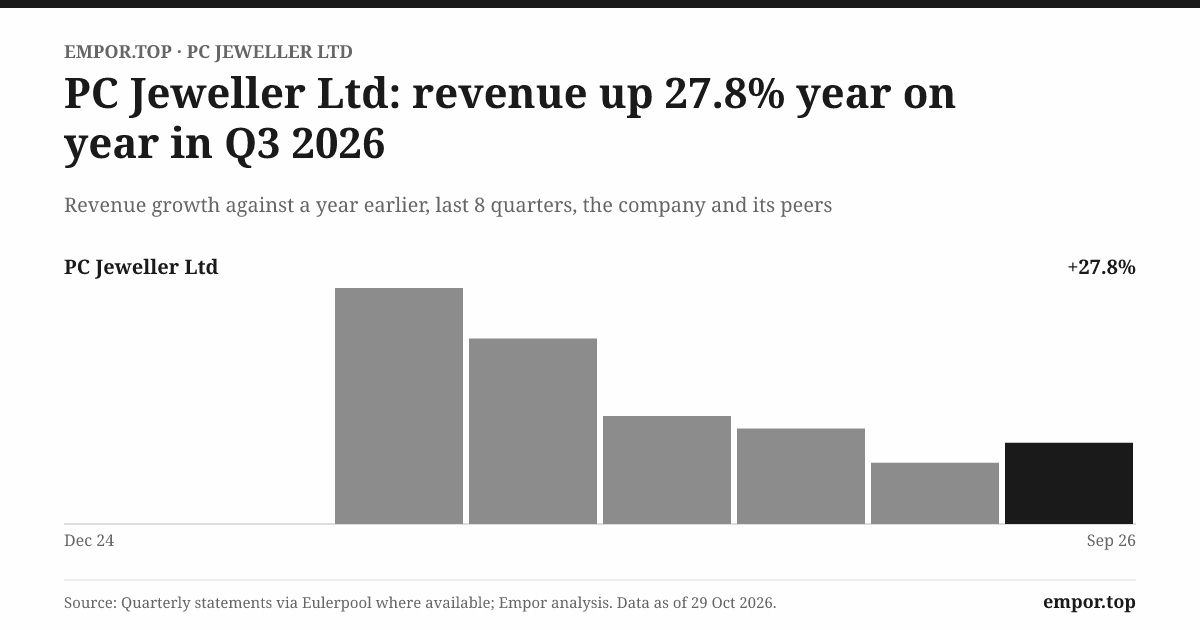
On the evening of 7 October 2026, PC Jeweller sent the stock exchanges a short business update. For most listed companies a pre-results note like this is routine, but this one carried three sentences that, for anyone who had followed the company over the past eight years, read almost like a different company. Revenue for the September quarter was up about 28% from a year earlier.
The company had become, in its own words, "Debt Free," after repaying every one of its consortium banks ahead of schedule. And for the first time in years, money had come back from the overseas customers who had owed it for most of a decade: roughly ₹142 crore of remittances from export debtors during the quarter.1
A week earlier, on 30 September, the company had told the exchanges that the last of its 14 consortium banks had issued a "No Objection cum No Dues cum Release Letter."2 On 8 October it followed up: every mortgaged property had been released, the original title deeds handed back, and every personal and corporate guarantee given by the promoters cancelled. "With this," the filing ended, "all the necessary formalities with respect to the clearance of outstanding debt stands closed."3
When the September-quarter results arrived on 21 October, managing director Balram Garg framed the moment as the end of the banking chapter and the start of an expansion one, with up to 100 new showrooms, a new brand for younger buyers and a gold-mining licence in Chad.4
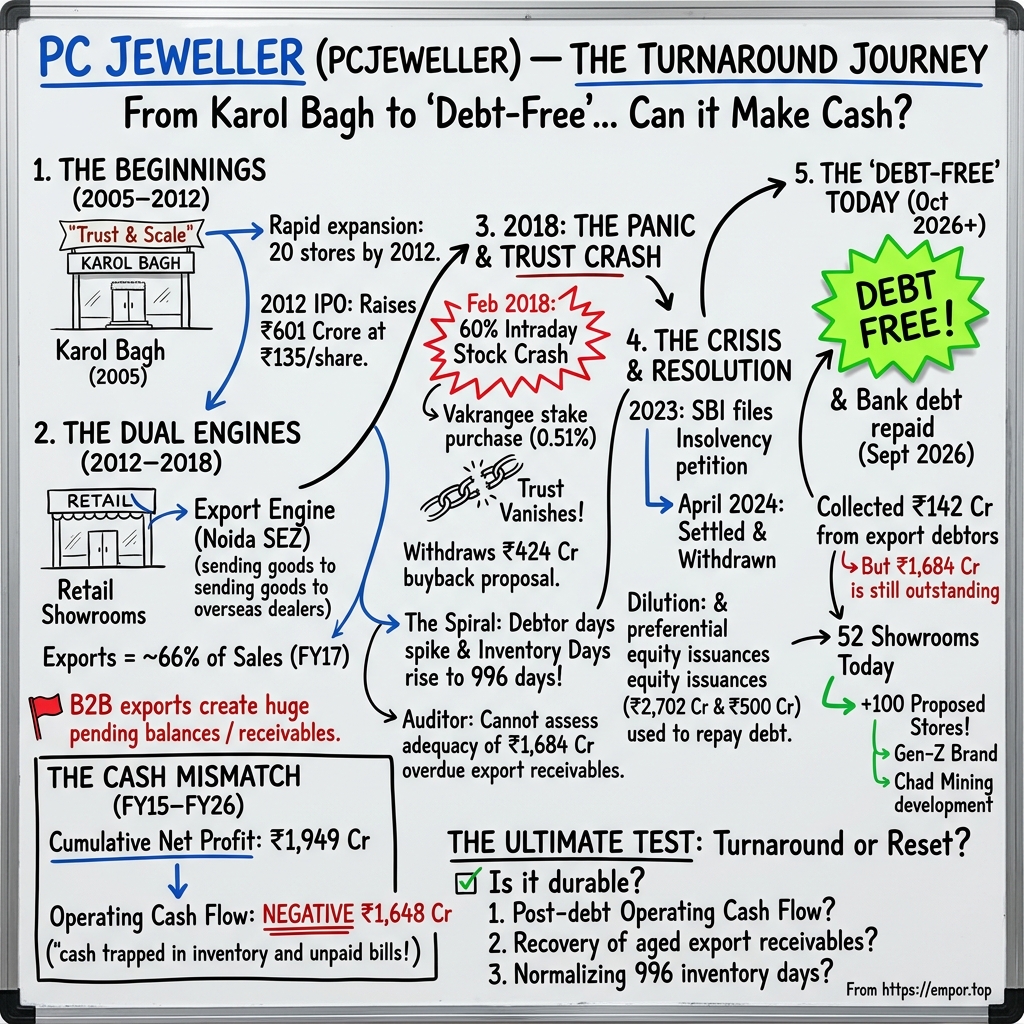
Read that sequence quickly and it sounds like a comeback that is already complete. Read it slowly and the numbers begin to argue with each other. The ₹142 crore that came home is real cash, but it sits against an export receivable book that stood at about ₹1,684 crore, net of provisions, at the end of March 2026.5 On that maths, the first remittance in years covered less than a tenth of what was still owed.
The company's auditor has qualified its opinion on that book for four straight years, saying it cannot judge whether the ₹281 crore set aside for bad debts is enough, because the customers have not paid on schedule and the company has gone to court to recover.5 The inventory on the shelves and in the vaults, measured against the cost of what PC Jeweller sells, still equalled roughly 996 days of sales at the March 2026 year-end. Put plainly, the company held close to three years of stock.
The longest-running number is the starkest. Add up every year from FY2015 to FY2026 and PC Jeweller reported about ₹1,949 crore of net profit. Over the same twelve years its operations consumed about ₹1,648 crore of cash rather than producing it.5 That is not a rounding difference. It is a business that, across a full cycle of boom, scandal, collapse and recovery, recorded profits on paper while the cash went somewhere else, mostly into stock and unpaid invoices.
So the comeback raises four questions, and this story is built around them. The first is whether the retail business, the showrooms selling gold and diamond jewellery to Indian families, can now generate cash rather than just earnings. The second is whether the old export receivables, mostly owed by wholesale dealers abroad, will ever turn into money or will stay an accounting asset that slowly shrinks.
The third is whether PC Jeweller has any durable reason to win in one of the world's most fragmented retail markets, against rivals many times its size. The fourth is whether "debt-free" creates value for each shareholder, given that the debt was cleared partly by issuing a very large number of new shares.
The company that faces those questions is smaller than its own history. At the end of March 2026 it ran 52 showrooms, including four franchise stores, in 37 cities.5 It reported consolidated revenue of ₹3,353 crore for FY2026, up from ₹2,245 crore a year earlier, and consolidated net profit of ₹722 crore.5
In 2018 it had been a business turning over close to ₹10,000 crore a year. In between lies one of the most dramatic round trips on the Indian stock market: a stock that fell close to 60% in a single morning, a withdrawn buyback, an insider-trading case that reached the Supreme Court, an insolvency petition from the State Bank of India, and a settlement with 14 banks.
The verdict at the start is a narrow one, and it should be stated plainly. The debt repayment is a genuine milestone, documented by the banks' own release letters, and the first export collection is real money. Neither yet shows that PC Jeweller can turn its reported earnings into cash, or that the old export book will be recovered in full.
To understand why those are the right tests, the story has to go back to a single showroom on a busy street in west Delhi, and to the moment when the same expansion that built a fast-growing jeweller began to depend on cash it had not yet collected.
 Subscribe on LinkedIn
II. The Name on the Karol Bagh Sign
Karol Bagh is not a quiet place to open a jewellery shop. The west Delhi market is a dense grid of wholesale and retail trade, wedding shopping and family businesses that have sold gold to the same households for generations. In April 2005, a new 13,000-square-foot showroom opened there under a name that was, in effect, a person's name: P. Chand Jeweller.6 The company behind it had been incorporated on 13 April 2005 as P. Chand Jeweller Private Limited and only became PC Jeweller in December 2009.7
The "P. Chand" on the sign was Padam Chand Gupta, the elder of two brothers who promoted the business. When the company went public seven years later, its prospectus described him as the chairman, aged 58, with "basic education" and more than 20 years in the jewellery trade, most of it in a family-run business before this one.6 The younger brother, Balram Garg, then 42, was the managing director. He held a commerce degree from the University of Delhi and also had more than two decades in the family's jewellery trade.6 It is a small detail that the prospectus also noted neither man held a driver's licence; it is a larger one that the business was built by people who had grown up behind a jewellery counter rather than in a boardroom.
That distinction matters, because the family's history in jewellery is not the same as the listed company's history. PC Jeweller as a company started in 2005, with one store. What it inherited from the family was knowledge of how gold is bought, made and sold in north India, and relationships with suppliers and craftsmen. What it had to build from scratch was a brand that a stranger in Indore or Lucknow would trust.
The early expansion came fast. A Noida store opened in October 2007, Panchkula in Haryana that December, then Faridabad, Dehradun, Pitampura, Gurgaon, Lucknow, Indore, Bhopal and Jodhpur over the following three years.6 By September 2012, the company had 30 showrooms across 23 cities in north and central India, 27 of them "large-format" stores of 3,000 square feet or more, and four of them, including Karol Bagh, South Extension, Gurgaon and Panchkula, larger than 10,000 square feet.6 The flagship still mattered more than any other single store: in FY2012 Karol Bagh alone produced about a fifth of the company's domestic sales.6
The pitch was easy to understand. Large, bright showrooms on high streets, a wide range of gold and diamond designs, a particular focus on wedding jewellery, and the reassurance of hallmarked gold and certified diamonds.6 The prospectus said the company had "a strong brand in our markets in north and central India" and leaned hard on diamond jewellery, which earned better margins than plain gold and had grown to about a third of domestic sales by the six months to September 2012.6
Why does trust carry so much weight in this trade? A gold necklace is expensive, bought rarely, often with a family's savings, and almost impossible for an ordinary buyer to check at the counter. Is it really 22 carat? Is the stone what the tag says? Will the jeweller give a fair price if the family wants to exchange it in ten years? For most of Indian history, the answer to those questions was a family jeweller the household had used for decades.
The organised chains, of which PC Jeweller wanted to be one, proposed a different answer: a recognisable brand, independent hallmarking and a uniform promise across every city. In 2012 the prospectus put the organised share of the market at only about 5% to 6% if counting national players, against roughly 450,000 traditional neighbourhood jewellers.6 That was the opportunity. The industry was moving away from the family jeweller, slowly, and whoever earned the customer's trust first in a new city could take share.
The prospectus also contained a quieter warning, of the kind most investors skim. Before the listing, Balram Garg and his nephew Sachin Gupta undertook not to run any competing jewellery business through themselves, their spouses or their children while associated with the company, and a related family partnership agreed to wind down. But the document conceded there could be "no assurance" that other members of the extended family would not compete, and that the promoters were under no obligation to route jewellery opportunities through the listed company.6 It was a reminder that PC Jeweller was a family business that had put on a listed company's clothes, and that the line between the two would need watching.
The question the early years leave hanging is whether a promise made on one Delhi street could travel. A brand built around trust can, in principle, scale; but a jewellery retailer also has to carry an enormous amount of stock in every new store, and that stock has to be paid for before it is sold. The prospectus itself showed the scale of that burden.
Karol Bagh was holding about ₹76 crore of inventory against roughly ₹144 crore of sales in six months.6 Every new large-format showroom would need a similar pile of gold. And PC Jeweller, it turned out, had a second business that was absorbing capital too, one that never appeared on a high street.
III. The Export Engine Behind the Showrooms
Twenty kilometres east of Karol Bagh, inside the Noida Special Economic Zone, PC Jeweller ran two factories that most of its retail customers never heard of. These units, set up in a tax-advantaged export zone, made plain gold jewellery for overseas wholesale buyers, chiefly distributors in Dubai and Hong Kong.6 The gold for them was bought directly by the SEZ units, worked into chains and bangles, and shipped abroad on credit.6
This was not a side project. In the three years before the IPO, exports made up roughly a third of the company's revenue, from about 33.5% in FY2010 to 33% in FY2012.6 They grew as fast as the showrooms did. Between FY2010 and FY2012, export sales roughly tripled, from about ₹330 crore to about ₹1,002 crore.6 By FY2017 the split was much the same. In that year's annual report the company said 66% of standalone revenue came from domestic sales and 34% from exports, which it described as "largely a B2B business."8 In money terms, exports brought in about ₹2,766 crore that year.8
So PC Jeweller had two engines. The first was the one in its advertising: showrooms selling directly to consumers, who paid at the counter. The second was a wholesale business that sold to overseas dealers and waited to be paid. They had very different economics. A retail customer pays before walking out of the door.
A wholesale dealer in Dubai receives the goods and pays later, sometimes much later, and in dollars. That second engine gave PC Jeweller reach far beyond its stores and kept its factories busy. It also tied the company's cash to the payment habits of a small number of foreign buyers, and to the rupee–dollar exchange rate.
Management in 2017 did not see the exports as risky. In the FY2017 annual report, Balram Garg's letter to shareholders said the existing export business was "a B2B without any significant capital requirements."8 The same letter acknowledged a weakness of a different kind: the exports consisted "of only plain gold jewellery which have limited margins," and the plan was to add higher-value, branded items.8
With hindsight, the first sentence is the one that matters. Trade receivables on the balance sheet rose from about ₹908 crore to about ₹1,274 crore during FY2017, an increase of roughly ₹366 crore in a single year.8 An export business that does not need capital on paper can need a great deal of it in practice if the customer pays slowly, because every unpaid invoice is cash the company has spent on gold and labour and not yet recovered.
The turn came in the first months of 2018. The FY2018 quarterly segment figures show exports of about ₹880 crore in the December 2017 quarter, then just ₹303 crore in the March 2018 quarter.9 Years later, the company offered its own explanation. The company says export payments arrived "within normal credit periods" until December 2017.
The company says that from January 2018 onwards, the UAE imposed a 5% import duty and 5% VAT on jewellery imports, which "adversely affect[ed] the jewellery trade and significantly delay[ed] payment cycles from overseas customers." It says COVID-19 then hit global trade, and that more recently conflict in the Middle East further "blocked" receivables.5 The company says it has started legal proceedings against overseas buyers who defaulted.5
It is worth separating what that explanation can and cannot carry. A tax change in the buyers' market could plausibly slow orders and stretch payments for a season. It is harder to see how it explains customers failing to pay for eight years. The 2026 answer to that question has to come from this company's specific buyers, not from the UAE's tax code, and the company has not named them.
Today the exposure is concentrated and plain. In FY2026, the company says, its domestic retail sales involved no customer credit at all; credit risk "arises only from the export sales which are on a B2B basis."5 And there are no new export sales: the export business no longer qualifies as a reportable segment because there was no export revenue.5 What remains is a legacy ledger. Of the ₹1,689 crore of net standalone trade receivables at 31 March 2026, about ₹1,684 crore was owed by export wholesale customers, and roughly ₹1,053 crore was classified as non-current, all of it more than three years past due.5
That legacy did not come out of nowhere. It came from a growth strategy that ran two capital-hungry engines at once: showrooms that needed stockpiles of gold, and exports that needed patience from the balance sheet. The question was how far PC Jeweller could expand both before its profits and its cash began to drift apart. The public market was about to give it the money to find out.
IV. The IPO and the Promise of Twenty Stores a Year
In the second week of December 2012, PC Jeweller asked public investors for about ₹601 crore. The issue priced at ₹135 a share, 13.5 times the ₹10 face value, with a ₹5 discount for retail investors and employees.6 SEBI's records show the final offer documents filed on 20 December 2012.10 For a seven-year-old company it was an ambitious debut, and the story it told was simple: a fast-growing, profitable jeweller in a market still dominated by family shops, now raising capital to go national.
The numbers in the prospectus supported the ambition. Revenue had grown from about ₹985 crore in FY2010 to about ₹3,042 crore in FY2012, a compound rate of more than 50% a year, and net profit had followed, rising from about ₹78 crore to about ₹230 crore.6 The use of the money was equally clear.
About ₹517 crore of the net proceeds was set aside for 20 new showrooms in 20 cities by FY2014, including the south and west of India where the brand did not yet operate.6 Most of that was not for shopfittings. It was for gold. A new showroom without a vault full of stock is only an empty room.
The market context helped. Organised retail was spreading, hallmarking was being pushed by the government, which had proposed in January 2012 to make it mandatory for gold jewellery, and listed peers were attracting investors to the idea that branded chains would steadily take share from the neighbourhood jeweller.6 PC Jeweller's pitch was that it could ride that shift faster than most.
For five years it did. The company closed FY2013 with 24 showrooms. By March 2016 it had 60, and by March 2017, 75, which meant it had tripled its network in four years.8 In October 2015 it opened its first franchise store, and four more followed in FY2017; management called franchising "a good margin accretion model" because it allowed expansion "without investing its own capital."8
By October 2017 the count had reached 84 showrooms across 67 cities in 20 states.11 That month, the company signed Akshay Kumar and Twinkle Khanna, one of Bollywood's best-known couples, as brand ambassadors on a one-year deal, a bet that celebrity could do for a north Indian jeweller what decades of local reputation had done for older rivals.11
Revenue kept up. In FY2017 standalone revenue grew about 12% to roughly ₹8,105 crore, and net profit grew about 8% to about ₹431 crore.8 In FY2018 consolidated total income reached about ₹9,707 crore, and consolidated net profit was about ₹536 crore.12 PC Jeweller had become one of the largest listed jewellers in India by sales.
The company also began to spend its success on adjacent bets. Its wholly owned subsidiary, Luxury Products Trendsetter, acquired the premium gold brand Azva, which management said gave PC Jeweller a presence in the high-end segment at home and abroad; and in 2017 the company issued bonus shares one-for-one.8
Neither was large, but the Azva vehicle left a small, telling residue. By March 2026 the subsidiary owed the parent a ₹5.6 crore loan and about ₹16.7 crore of accrued interest, and the parent had written down part of that interest as impaired.5 It was a modest example of a pattern that would recur: money deployed with confidence in the boom, and recovered slowly, if at all.
Underneath the headlines, though, the company was also running a quieter experiment in how to finance gold. The FY2018 audited results show that trade payables included about ₹3,384 crore of "gold on loan" in the standalone accounts.9 Gold metal loans are a common financing tool in the Indian jewellery trade: a bank lends physical gold, the jeweller makes and sells jewellery from it, and repays later, in effect borrowing inventory rather than cash.
That made rapid expansion possible without the equity to pay for all the stock outright. It also meant the business depended on bankers being willing to keep lending metal. In FY2018, the company's days payable stood at about 160 days. By FY2026 they had collapsed to about two.5 The gold that banks had once lent was gone, and the stock had to be funded some other way.
Now set the long-run picture beside that growth. The long-run cash mismatch persisted through FY2026.5 Even in the good years, the conversion was patchy. In FY2016 operating cash flow was barely above zero, and in FY2018, the peak year, it was a little over a third of EBITDA. Then, in FY2019, the first year of trouble, operations consumed roughly ₹1,900 crore of cash.
That is the gap the IPO did not close. The money raised in 2012 financed a striking expansion and a company that, at its peak, sold close to ₹10,000 crore of jewellery a year. But rising sales did not prove that the model could produce cash at the same pace. Every new showroom and every new export shipment absorbed money before it returned any, and the returns arrived more slowly than the reported profits suggested. Whether investors saw that mismatch before the stock collapsed, or whether the collapse revealed it, is the question that hangs over what came next.
V. When the Growth Story Became the Moat
By late 2017, PC Jeweller's message to investors was that its growth was itself the advantage. It had 84 showrooms, a national advertising campaign with film stars, a franchise model that promised expansion without capital, and a strategy for "ROE accretion" laid out in the managing director's own letter: reduce physical inventory by digitising catalogues, create virtual showrooms, push online sales, and lean on in-house design and manufacturing.811 Balram Garg wrote that as the sector organised, "the only differentiating factor between the two organized/branded players will be the availability of maximum number of designs at all price points."8
That sentence is worth pausing on, because it contains a theory of competition. If the winner in Indian jewellery is whoever offers the most designs, then the moat is manufacturing and design capacity, and PC Jeweller, with its own factories, had one. But design range is a weapon that every large chain can buy. It requires inventory, which ties up capital, and capital was exactly what PC Jeweller was shortest of.
The economics of selling jewellery explain why. A jewellery retailer is a gold warehouse with a shop in front of it. The gold has to be bought or borrowed long before it is sold; prices move with global gold markets, which change both the ticket size and the moment customers choose to buy; and demand bunches around weddings and festivals such as Akshaya Tritiya and Diwali.
A chain earns its margin on making charges, design, diamonds and studded pieces, while the gold itself is almost a pass-through. That means the decisive measures are how fast stock turns, how much each store sells per square foot, and how cheaply the gold is financed.
Measured that way, PC Jeweller's rivals were in a different league. JM Financial's 2025 estimates of Indian jewellery market shares are the clearest benchmark. In FY2024, Malabar Gold & Diamonds held about 7.5% of the Indian market and Titan's jewellery business, Tanishq and its sister brands, about 7.1%; both had roughly doubled their share since FY2019. Kalyan Jewellers held about 2.9%. PC Jeweller had held about 2.2% in FY2019.
By FY2024 the estimate was about 0.1%.13 Euromonitor's 2025 figures, measured differently, put Titan in the lead with about 8% value share, and Malabar and Kalyan at about 5% each.14 The two sets of numbers are not directly comparable, but they point the same way. The organised segment grew, from about 31% of the market to about 38% between FY2019 and FY2024 in JM Financial's estimate, and PC Jeweller's share of it nearly disappeared.13
That is the most direct test of the moat the company claimed. If the brand, hallmarking and design range had created loyal customers, the network would have held up when the balance sheet weakened, because people return to a jeweller they trust. Instead, when the gold loans dried up and stock thinned, sales fell much faster than the store count.
Revenue went from close to ₹10,000 crore at the peak to roughly ₹600 crore on a consolidated basis in FY2024. The standalone figure for that year was only about ₹189 crore, against a standalone loss of about ₹649 crore.15 The customers had other places to go, and they went.
Run the familiar competitive forces and the picture is consistent. Buyers have power, because a family shopping for a wedding set can walk across the street, compare the making charges and leave. Switching costs are close to zero; there is no subscription and no contract. Hallmarking, which once distinguished organised chains, became mandatory and therefore universal.
Local jewellers compete on relationships, credit to trusted families, flexibility on design and price, while the national chains compete on scale, marketing budgets, gold-sourcing costs and the reassurance of a big name. PC Jeweller sat uncomfortably between the two: too small to match Titan or Malabar on scale, too far from its customers' homes to match the family jeweller on intimacy.
The franchise plan was meant to get around the capital problem. The 2017 letter described Tier II and III locations with "less capital requirement and lower running costs which result in quicker break even and higher returns."8 The company never published the store-level paybacks or franchise economics that would have proved that claim, and the record that followed did not prove it. At the end of March 2026, the network stood at 52 showrooms, including four franchise stores.5 There were 84 in October 2017.11 Store count, it turned out, had not been proof of execution at all.
The verdict on this period is that a growing market and rising organised share gave PC Jeweller room to grow, but hallmarked products and store openings were not enough to build a moat. The market-share data show how wide the scale gap became, and nothing the company has published demonstrates better customer retention, store economics or pricing than its peers. That left the business exposed to a loss of confidence, whether from customers, bankers or shareholders. In February 2018, shareholders went first.
VI. Vakrangee's Stake, and the Day Trust Vanished
On 17 January 2018, PC Jeweller's shares closed at an all-time high of about ₹587, valuing the company at more than ₹23,000 crore.12 A week later, on 25 January, Vakrangee, a listed company known for its network of small "Kendra" service outlets, bought 20 lakh PC Jeweller shares on the open market at about ₹562 each, a little over ₹112 crore, roughly a 0.51% stake.12
For an unrelated company to put that much of its treasury into a jeweller's shares was unusual. It became explosive when, in the first days of February, media reports said SEBI was examining Vakrangee for possible price manipulation, which Vakrangee called "completely baseless and factually incorrect."12
On Friday, 2 February 2018, PC Jeweller's stock fell as much as 59.65% intraday, touching about ₹195, before recovering to close down about 24% at roughly ₹366.12 More than ₹11,000 crore of market value disappeared and partly reappeared in a few hours. That afternoon, at short notice, the company held a conference call.
The CFO, Sanjeev Bhatia, opened with a prepared statement. Operations across manufacturing, retail and franchise stores were "functioning in a healthy manner." There had been no regulatory notices. Banking operations continued "on back of a strong balance sheet and a robust business model." The promoter group held 60.5% of the company, had sold nothing and had no pledges. And, crucially, PC Jeweller had "no business agreement" with Vakrangee or its affiliates, and the share purchase was "a secondary transaction on which the company, its directors, and its employee have no influence."16
The question-and-answer session was less tidy. Dhimant Shah of Principal Mutual Fund asked how minority shareholders were meant to stomach a 50% intraday move; Balram Garg answered that the company "do[es] not have any control" over the market, and pointed out that it had opened a new store in Mumbai that very day.16 Then Dinshaw Irani of Artemis said he had in front of him a Vakrangee investor presentation, slide 26, listing PC Jeweller among Vakrangee's "key business alliances" in e-commerce.
How had PC Jeweller ended up there if there was no relationship? Garg replied that there was no tie-up "as on today," nor earlier; the CFO said the company had not seen the slide; when asked whether it would take action, the CFO said, "We will see that."16 The final questioner, from Centrum, said it seemed "unbelievable" that management had been unaware of a block purchase of 20 lakh shares at the top of the market; Bhatia replied that he and the MD had been on a roadshow in Asia.16
Read today, the call shows a management team giving categorical assurances about fundamentals and governance while answering specific questions with general ones. None of that proves wrongdoing. It does show why the market did not fully settle.
One answer from that afternoon is worth holding on to. Asked about the shares, Garg said: "As far as promoters are concerned we are not selling anything yet and there is no plan to sell in future also."16 Strictly, what happened next was not a sale.
The next months made things worse. In April 2018, promoter Padam Chand Gupta transferred part of his holding to family members through off-market transactions, which further unsettled investors.12 SEBI later recorded that his reduction in holdings took promoter ownership from about 60.2% to about 57.6% between the March and June quarters.7 Then came the buyback. On 10 May 2018, the board approved buying back up to about 1.21 crore shares at ₹350 each, up to ₹424 crore, at a time when the stock traded near ₹209.7
The shares jumped to their 10% upper limit. Two months later, on 7 July, the State Bank of India, the consortium's lead bank, refused the company's request for a no-objection certificate for the buyback, and refused again on 12 July. On 13 July, after market hours, the board withdrew the offer. The next trading day the stock hit its 20% lower circuit and closed below ₹90.7
That sequence is the real financial clue in the 2018 story, and it is easy to miss beside the Vakrangee drama. A company with the "strong balance sheet" management had described in February was not able, by July, to persuade its own lead banker to let it spend ₹424 crore on its shares.
The buyback also produced a regulatory case. In December 2019 SEBI issued an interim order impounding about ₹6.2 crore and ₹2.1 crore of alleged notional gains and losses avoided from relatives of the promoters and from a company linked to Amit Garg, a nephew of both brothers, who had traded during the buyback announcement and withdrawal.7 In May 2021 SEBI's final order restrained Balram Garg and four other noticees from the securities market for a year, barred them from dealing in PC Jeweller shares for two years, directed the relatives and the linked company to disgorge the impounded sums, and fined each noticee ₹20 lakh.17
The Securities Appellate Tribunal upheld it, but in April 2022 the Supreme Court set aside both the SEBI and SAT orders, holding that communication of price-sensitive information had to be proved by cogent evidence rather than inferred from family ties and trading patterns.18 So the legal record ends in Garg's favour. What remains is the credibility record: a buyback announced and withdrawn within two months, and a long dispute over who knew what.
Trust in a jewellery brand has two audiences. Customers have to believe the gold is what the tag says, and investors have to believe the accounts and disclosures are what they say. The February 2018 shock tested the second kind of trust, and the company failed to restore it. The crash did not explain everything that followed; the deepest revenue decline was still years away. But it was the first sign that a business built on borrowed gold and slow-paying export customers could not withstand a loss of confidence. The receivable days, which had been about 71 at the end of FY2018, kept climbing.
VII. The Receivables That Became a Balance-Sheet Story
There is a paragraph that the auditor of PC Jeweller has repeated, with only the figures changing, in every annual report since FY2023. In its FY2026 form it says that export receivables, outstanding for more than nine months, include ₹1,684 crore owed by export customers on a net basis; that the company has recognised a lifetime expected-credit-loss allowance of ₹281 crore; and that "due to no realization as per scheduled expected dates from the export receivables and considering the initiation of legal route for recovery, we are unable to examine adequacy of the provision."5
That is a qualified audit opinion, and it is worth explaining in plain terms. An auditor qualifies an opinion when it cannot sign off on part of the accounts. Here, the problem is not that the numbers are wrong but that nobody can yet say whether they are right. The provision might be enough if the debtors pay most of what they owe. It might be far too small if they do not. The auditor has no way to tell, so it says so.
There is a second qualification, older still. In FY2019, the company gave its export customers discounts of about ₹514 crore, roughly a 25% cut on what they owed as of March 2019, and booked them against revenue.5 Under India's foreign-exchange rules, writing down export receivables needs approval from the authorised dealer banks. The company obtained approval for about ₹330 crore of the discounts, but approval for the remaining ₹183 crore is still pending, and the auditor has said, every year since FY2019, that without that approval and supporting evidence it cannot assess the consequences.5 Management says it does not expect a material penalty.5
How did a jeweller with a retail brand end up here? Follow the cash. Across FY2015 to FY2026, the gap between reported net profit and operating cash flow exceeded ₹3,500 crore, and the balance sheet shows what absorbed it. In the early years, receivables did much of the absorbing.
Debtor days, the receivable balance measured in days of sales, rose from 45 in FY2015 to 71 in FY2018 and peaked at 187 in FY2021, as sales collapsed but the old export invoices stayed on the books.5 Later, inventory became the bigger sink. Inventory days rose from about 232 in FY2018 to more than 1,400 in FY2022, and to an extraordinary 3,043 in FY2024, when the company had stock but almost no money or gold credit to run its stores.5
FY2025 and FY2026 show the mechanism clearly, because they were recovery years in which profit was strong. In FY2025, the company restocked: inventory rose by about ₹1,013 crore, and operating cash flow was about negative ₹633 crore.5 In FY2026, standalone profit before working-capital changes was about ₹656 crore.
Inventory then absorbed about ₹549 crore, other financial assets about ₹28 crore and other non-financial assets about ₹199 crore. After tax refunds, operating cash flow came out at about negative ₹78 crore.5 In other words, PC Jeweller reported a large profit, and then put more than all of it, and a little more, back into gold on the shelves and other working capital.
Some of that is understandable. A jeweller coming back from near-insolvency had to rebuild stock in empty showrooms, and gold prices were high. But it is also why the profit line, on its own, says little about the cash a shareholder can ever expect to receive.
There is a further complication in the profit itself. Because the export receivables are owed in foreign currency, the company restates them each year at the closing exchange rate. When the rupee weakens, the rupee value of the receivables rises, and the difference is booked as income, even though no money has been received. In FY2026, standalone other income was about ₹197 crore, of which about ₹187 crore was net foreign-currency gains, against standalone profit before tax of about ₹707 crore.5
Roughly a quarter of the year's pre-tax profit, then, came from revaluing an unpaid debt. The company itself is unusually candid about this. It says the restatement "is accounting entry only" and that unrealised foreign-exchange gains have been recognised "despite no actual realisation of export proceeds" since FY2022.5 By March 2026, those accumulated unrealised gains had added about ₹498 crore to the receivable balance.5
The currency gains create a tax puzzle too. The company says it paid tax on this notional income in earlier years and now claims it as an allowable deduction, on the principle that no tax should fall on income not yet received, while promising to pay tax when the money is actually recovered.5 It is a reasonable argument, but it is an argument, and income-tax disputes already make up the largest item in its contingent liabilities, about ₹111 crore at the FY2026 year-end.5
Put the pieces together and the export book looks like this. The original, non-restated amount owed was about ₹1,468 crore. Currency restatement added about ₹498 crore. The ₹281 crore provision then came off, leaving the net figure of about ₹1,684 crore.5 The book has, in effect, grown on paper while the customers have not paid.
Then came the September 2026 quarter. The company reported about ₹142 crore of remittances from its export debtors and said that "the issue between the company and its export debtors have been resolved and the realization of outstanding export receivables has commenced."1 That is the first concrete evidence in years that these customers can pay. It is also less than a tenth of the original balance. The company has not said which debtors paid, what terms were agreed, whether the settlement involved further discounts, or what schedule governs the rest.
A sceptical investor would want four things before treating the export book as cash. The first is an audited reconciliation of cumulative collections against the original ₹1,468 crore. The second is the foreign-exchange restatement on the collected portion, separated so that the realised and unrealised gains are clear. The third is the remaining gross exposure after each remittance. The fourth is the auditor's view, in the FY2027 annual report, of whether the qualification can be lifted. The UAE tax changes and the pandemic may explain why the payments slowed. Only collections will show whether they can be recovered.
The verdict is that this was a working-capital crisis more than a demand crisis: a business whose cash went into inventory and an export book far faster than it came back, until its bankers lost patience. That raised a second, more immediate question. Could PC Jeweller survive its banks long enough to try to rebuild?
VIII. The Insolvency Petition That Did Not Become Insolvency
By 2023 the bankers had run out of patience. That year the State Bank of India, as lead lender, filed a petition under Section 7 of the Insolvency and Bankruptcy Code at the National Company Law Tribunal in New Delhi, asking for PC Jeweller to be admitted to a corporate insolvency resolution process.19 For a promoter-run company, that is the worst outcome on the table. If admitted, management loses control to a resolution professional, and the business is offered to bidders, with existing shareholders typically wiped out or close to it.
The petition was never admitted. On 29 April 2024 SBI's counsel asked to withdraw it, citing settlement terms agreed with the company, and on 30 April 2024 the tribunal allowed the withdrawal and dismissed the petition.19 The NCLT did add a pointed footnote: it imposed costs of ₹5 lakh each on SBI and on PC Jeweller, to be paid into the Prime Minister's National Relief Fund, "for engaging the Tribunal on number of hearings before the matter got settled."19
That correction matters for how the story is often told. PC Jeweller is sometimes described as having been "thrust into insolvency." It was not. It faced a formal insolvency petition, and the petition was withdrawn after a settlement; no resolution professional ever ran the company. What it went through instead was a negotiated workout with its lenders, on terms that cost its shareholders a great deal.
The final deal took months more. On 30 September 2024 the company and all 14 consortium banks signed a Joint Settlement Agreement based on a one-time settlement that combined cash and equity.15 As of 31 March 2024, the banks were owed about ₹4,082 crore.15 Part of the debt was settled in shares: in March 2025 the board allotted about 51.7 crore new equity shares, at the new ₹1 face value, to the consortium lenders.15
The rest was to be repaid in cash, and the company raised that cash largely from the equity market. Shareholders approved a programme of fully convertible warrants of roughly ₹2,700 crore, and about ₹1,175 crore had been received by March 2025.15 A further ₹1,259 crore or so of share and warrant money came in during FY2026, and in September 2026 the company completed a separate preferential issue of up to ₹500 crore, after the conversion of warrants held by Balram Garg.51
The repayment track record is the cleanest part of the recent story. The FY2025 annual report said debt had been cut by about half during that year.15 At the FY2026 year-end, the standalone balance sheet still carried about ₹1,072 crore of bank borrowings under the settlement, but the auditor reported no repayment defaults under its terms.5
Then, during the September 2026 quarter, the company repaid the remaining balance ahead of schedule and completed the release process with all 14 banks.23 It should be said that the target slipped once. In mid-2025 the company told shareholders it was "confident of becoming debt free by the end of financial year 2025-26."15 The FY2026 report then moved that to the July–September 2026 quarter, and the company met the revised date.5
Debt-free in this sense means free of bank debt. The company still carries lease liabilities on its showrooms, about ₹94 crore at the FY2026 year-end, which are a fixed obligation but not borrowings.5 And the outside world's credit view has not caught up. CRISIL's latest rating rationale, dated 25 May 2026, continued a "D" rating with "Issuer not cooperating" status on about ₹3,937 crore of bank facilities, saying the company had not supplied requested information or recent no-default statements.20 That rating predates the full repayment and so says little about today's credit risk, but it is a fair signal about the company's disclosure habits with outside reviewers.
What does the debt reset actually prove? It removes the single biggest threat to the equity, which was that the banks would take the company away. It eliminates the interest bill, which the company says will add to profit from the second half of FY2027.4 It does not, by itself, show that the business can produce cash. The banks were repaid with cash raised from new shareholders and from the promoter's own warrant conversions, not with cash the showrooms had generated.
That is the dilution question, and it has to be counted honestly. Adjusting for the 2024 split of each ₹10 share into ten ₹1 shares, PC Jeweller had roughly 394 crore shares in 2018.715 As of publication, the market value and share price imply about 800 crore shares. Each shareholder from 2018 now owns roughly half as much of the company as they did.
The balance sheet is far cleaner than it has been in a decade. The question is what kind of company the cleaner balance sheet is now supporting, and who is running it.
IX. Fifty-Two Showrooms and a Hundred More on the Plan
The Q2FY27 investor presentation, released on 21 October 2026, reads like a company that has stopped worrying about survival and started thinking about scale. Balram Garg's commentary runs across three pages. "With the banking issues resolved," it says, "the company is now focussed on strategic expansion."4 There are plans for up to 100 new large-format showrooms in 12 to 18 months, a mix of company-owned and franchise stores, across Tier I, II and III cities.
There are memoranda of understanding with the National Skill Development Corporation and with the Uttar Pradesh government's CM YUVA scheme to onboard up to 2 lakh and 1,000 micro-franchise partners respectively, aimed at rural and semi-urban markets "where no other established brand has its presence yet." There is a new brand of lightweight and lab-grown-diamond jewellery for younger, self-purchasing buyers. And there is gold mining in Chad.4
The numbers that accompanied the vision were strong. Consolidated revenue in the September 2026 quarter was about ₹1,054 crore, up 28% from a year earlier. Operating EBITDA, which excludes other income, rose about 74% to ₹310 crore, and operating profit before tax more than doubled.4 Gross profit grew far faster than sales, about 68%, which points to wider margins rather than just more volume, perhaps from higher gold prices on older, cheaper stock, perhaps from mix; the company does not break it down.4
Garg is still the central figure, as he has been since 2005. He remains managing director, and in FY2026 he drew no remuneration, voluntarily.5 His family's ownership has shrunk sharply, though not because the promoters sold. Promoter and promoter-group ownership was about 54.5% in December 2023 and about 39.1% by September 2026, after the lender share issue, the warrants and the preferential allotments.21
The modest rise in the latest quarter reflected his own warrant conversion, not market purchases.21 In February 2018 the promoters held 60.5%.16 He has kept control of the management, put his own money into the warrants, and taken no salary. Those are meaningful signals of alignment.
The governance record alongside them is mixed. The board changed substantially in September 2024, when three independent directors left and two joined, and the CFO who had fronted the 2018 call, Sanjeev Bhatia, was succeeded by Vishan Deo.5 The stock exchanges fined the company for listing-rule non-compliance, including a one-day delay in filing postal-ballot results in machine-readable form, which the company called "entirely unintentional."5
SEBI has a show-cause matter over alleged delayed or missing disclosures in FY2024, which the company has applied to settle.5 None of these is large. Together, along with the CRISIL "issuer not cooperating" status, they describe a company whose disclosure discipline has not caught up with its ambitions.
Shareholders, for their part, have not pushed back. In the July–August 2025 postal ballot on the preferential warrants to Garg and equity to Capital Ventures, only about 0.28% of valid votes were cast against each resolution.22 That is near-unanimous support, though the participation of ordinary public shareholders was low, so the vote reflects the institutions and promoters who turned out more than the retail base that owns most of the company.22
Now test the plan against the record. The company opened its first franchise in October 2015 on the argument that franchising was a way to grow without capital.8 It had 84 showrooms in October 2017. It had 52 in March 2025 and 52 in March 2026.155 The plan to add up to 100 stores in 18 months would mean roughly tripling the network in a time frame shorter than any in the company's history.
What a sceptical investor would want before believing it is the same set of disclosures that were missing in 2017: mature-store sales per square foot, capital and inventory per new store, payback periods, the share of franchise stores and the terms on which franchisees buy stock, and the number of closures. The company says the franchise model is "receiving very encouraging response."4 Encouraging response is not a signed lease.
The micro-franchise idea needs particular care, because its headline number is so large. Memoranda with the National Skill Development Corporation and a state scheme to onboard "up to" 2 lakh partners describe a ceiling, not a commitment, and the company has not said what a micro-franchisee would sell, how much stock it would hold, who would own that stock, or how quality and hallmarking would be policed across thousands of small outlets.4
For a brand whose whole proposition is trust, a village outlet that sells a doubtful piece under the PC Jeweller name is a risk to the 52 stores as well as an opportunity. Until the first such outlets report sales, the figure belongs in the plan rather than in any estimate of the business.
The new Gen-Z brand and the Chad mine deserve the same discipline. Management says the lightweight and lab-grown segment "typically carry materially higher gross margins" and is capital-efficient, and that business will start this financial year.4 It may. But there is no disclosed revenue, store, customer or margin data yet, and the earlier "virtual reality stores" and digital-inventory plans from 2017 and 2018 did not change the company's capital intensity in any visible way.168 The mine is further away still.
PCJ Mining SARL, a step-down subsidiary, holds a licence for semi-mechanised artisanal gold mining in Chad and began on-site development work during the September 2026 quarter; management "expect[s] the production through mining activities to commence in this financial year."4 A licence and site work are not production, production is not sales, and a small artisanal mine in central Africa carries operating, security and repatriation risks that a jeweller in Delhi has never managed. For now, both projects are options, not earnings.
For anyone weighing management's word today, two documents are the best tools. The first is the 2 February 2018 call, with its unqualified assurances about strength. The second is the Q2FY27 presentation and its results, with the debt-free claim, the collections and the expansion plans. The 2018 call at least put management in front of analysts' questions. The 2026 materials are prepared commentary and slides, so they show what management chooses to emphasise rather than how it answers hard questions about the export book or store economics.
The test management must now meet is not complicated. It is to show a full fiscal year, after the banks are gone, in which operating cash flow is positive, the new stores earn their keep, and export collections keep coming. That is the test the bull and bear cases turn on.
X. Analysis & Bear vs. Bull Case
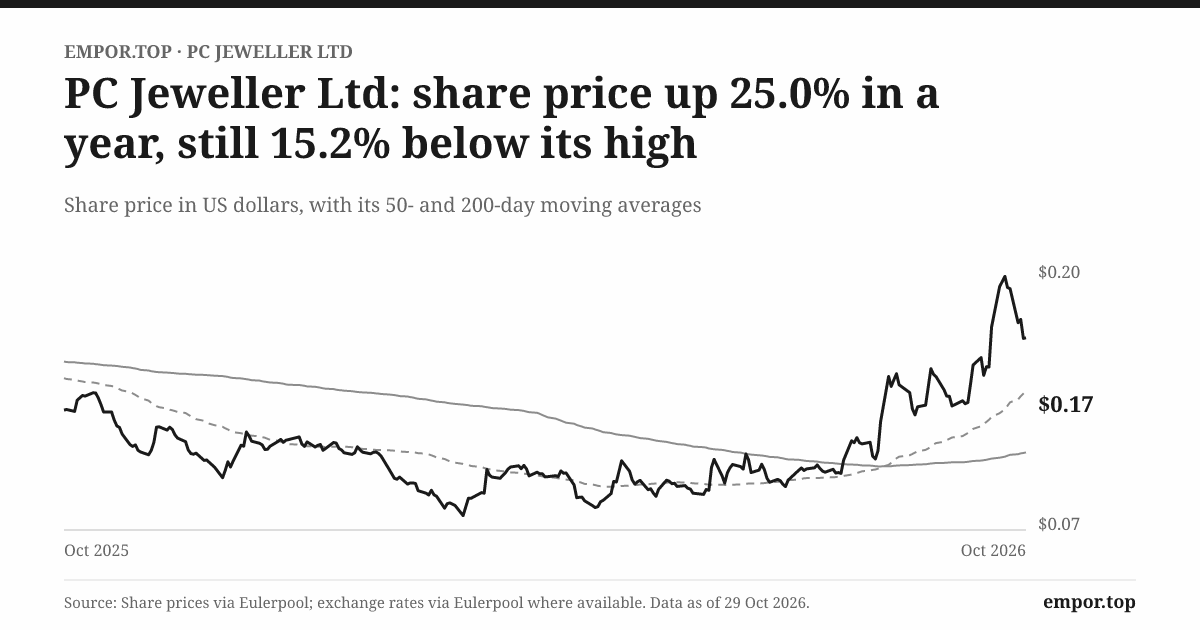
At the close on 29 October 2026, PC Jeweller's shares traded at about ₹15.83, giving it a market value of roughly ₹12,700 crore. On trailing earnings the stock sat at about 16.4 times, almost exactly its own five-year median of about 16.1 times. On enterprise value to EBITDA it was about 13.5 times. The free-cash-flow yield was about 0.3%, which is a polite way of saying that the business produced almost no free cash for the price.
To put the price in context, adjust for the split. ₹15.83 today is equivalent to about ₹158 per pre-split share, roughly a quarter of the January 2018 peak of about ₹587, but far above the 2019 low of about ₹27.12 The stock had also more than doubled from its 52-week low of about ₹7.57, and at its worst point in the last five years it had been 78% below an earlier peak. It is, by any measure, a volatile security.
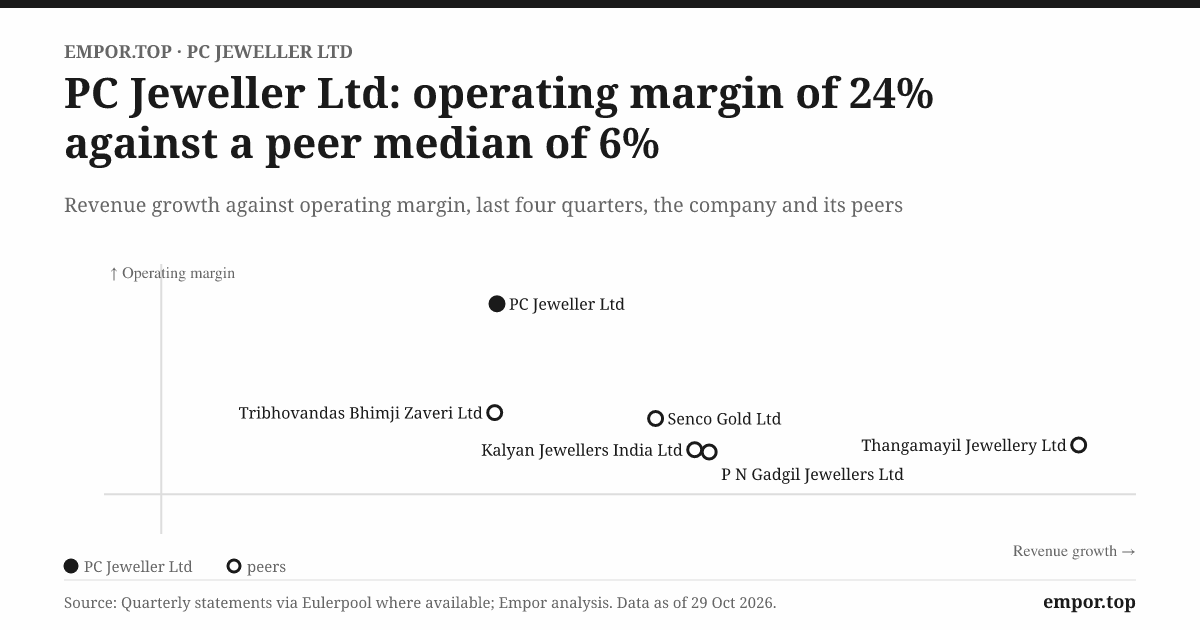
What does a market multiple near the five-year median assume? Over most of the last five years, PC Jeweller was a distressed company with losses, a defaulting balance sheet and an uncertain future. Today it reports strong profits and no bank debt. So a median-like multiple looks, at first glance, like a market that has not paid up for the recovery. Peers make the same point from the other direction. On the same date, Kalyan Jewellers traded at about 36.9 times earnings and Senco Gold at about 28 times.2324 PC Jeweller's discount is large.
But the multiple is only as good as the earnings beneath it, and those earnings deserve a second look before they are trusted. About a quarter of FY2026 standalone pre-tax profit came from unrealised currency gains on the export book. The share count has roughly doubled since 2018. And reported profit has not, so far, turned into operating cash. A low multiple of earnings that are partly non-cash and spread across far more shares is not necessarily cheap. That is the core disagreement between the bull and the bear, and both sides have evidence.
The bull case starts with the balance sheet. If the bank debt is truly gone, and the release letters from all 14 banks suggest it is, then the interest bill that weighed on profits through the settlement years disappears from the second half of FY2027 onwards.4 Every rupee of operating profit then flows further down to shareholders. The operating trend is strong. Revenue grew about 28% in the September 2026 quarter and operating EBITDA about 74%, and operating profit after tax roughly doubled.425
For the first time in years, the export debtors paid something, about ₹142 crore, and management says the dispute with them has been resolved.1 If that is the start of a steady flow, every crore collected is cash that never shows up as new profit but goes straight into the bank. Add the franchise and micro-franchise plans, which could expand reach without the company carrying all the inventory, and a bull can see a business that grows, collects and finally generates cash.
The bear case counts the other side of the ledger. FY2026 operating cash flow was negative, even in a year of record profit. Much of standalone profit before tax came from foreign-exchange gains on an unpaid debt. The auditor has qualified its opinion on the FY2019 export discounts every year since FY2019, and on the adequacy of the export provision every year since FY2023; neither matter has been resolved.5
Inventory still stood at about 996 days of cost of sales at year-end, which means that even with sales recovering, the company holds far more stock than its sales justify. The CRISIL rating remains "D, issuer not cooperating," a warning about disclosure if not about current solvency.20 And the bank debt was replaced, in effect, by new shareholders, so the per-share gain from being debt-free is much smaller than the headline suggests.
There is also a risk that neither side talks about enough: the price of gold itself. Management's own industry review for FY2026 notes that elevated gold prices shaped how much and when customers bought.5 For a jeweller holding nearly three years of stock, a rising gold price is a quiet tailwind, because inventory bought cheaply is sold at today's price, which may help explain why gross profit grew far faster than sales in the September 2026 quarter.
A falling gold price would work in reverse. And the company says it entered into no foreign-currency forwards, no gold-price fixation contracts and no other derivatives in FY2025 or FY2026, even though its policies permit them.5 With so much inventory on the books and no hedges, PC Jeweller's profits are, in part, a bet on the gold price, whether or not anyone chose to make one.
The bull-bear disagreement leads to a deeper question: whether PC Jeweller has a competitive advantage at all. The cleanest way to test it is Hamilton Helmer's seven powers, which ask what would let a company earn better returns than its rivals for a long time.
Scale economies favour the giants. Titan and Malabar buy gold, advertise and build stores at a scale PC Jeweller cannot match, and their share gains since FY2019 suggest that advantage is widening rather than narrowing.13 Network effects do not exist in jewellery retail; one customer's purchase does not make the product better for the next. Switching costs are close to zero; a family can buy its next set from anyone.
Counter-positioning, a business model incumbents cannot copy without hurting themselves, might apply to the micro-franchise idea in villages where no chain operates, but there is no evidence yet that it works. Cornered resources, such as exclusive access to a key input, are what the Chad mine would aim to provide, and today it produces nothing. Process power, the deep operating know-how that rivals cannot easily copy, is what the in-house factories once represented, but the collapse in market share suggests it did not protect the business when financing failed.
That leaves branding. PC Jeweller is a recognised name in north and central India, and a wedding buyer in Delhi will know it. But the company does not publish repeat-purchase rates, price premiums over local jewellers, customer-acquisition costs or same-store sales growth, the evidence that would show the brand earns a better price or a more loyal customer. The record shows the opposite under stress: when the stock thinned, sales fell from close to ₹10,000 crore to about ₹600 crore, and the market share went from about 2.2% to about 0.1%.13 A powerful brand would have held up better.
Porter's five forces point the same way. The rivalry among existing firms is fierce and fragmented, with national chains, strong regional players such as GRT and Joyalukkas, and hundreds of thousands of local jewellers. Buyers have strong bargaining power, because they can compare prices and walk away.
Suppliers of gold are largely price-setters, since the metal trades globally; and the company's dependence on trading houses and bullion supply is concentrated, with ten trading houses accounting for nearly all of what it bought from such houses in FY2026.5 New entrants come constantly, from digital-first brands to lab-grown-diamond start-ups. Substitutes include gold coins, gold ETFs and lightweight fashion jewellery. None of the five forces is especially favourable to a mid-sized chain.
The calibrated conclusion is that history narrows PC Jeweller's moat to a regional brand that recognised customers will visit, rather than a power that protects returns. It is intact enough to sell jewellery when the shelves are full, which the FY2026 recovery shows. It has not been proven durable under stress, and it should not be priced as if it had been.
Capital allocation tells the same story. There is no major acquisition at the centre of PC Jeweller's history, and that is itself revealing. The defining capital decisions were all about working capital: the export book, the gold-funded inventory, the stores, and then the debt settlement financed with new equity. The FY2017 promise that franchising would let the company grow "without investing its own capital" is the best yardstick for the new plan, and the record against it is a network that shrank from 84 stores to 52.8115
A sceptical long-short investor or an activist would push hard on five points. They would ask for an audited reconciliation of export collections against the original ₹1,468 crore balance, separating the currency effects. They would ask for a full post-debt year of positive operating cash flow, reconciled to inventory, receivables and other working capital. They would want inventory turns brought down to something closer to industry norms. They would want store-level economics, by format, published before 100 new stores are funded. And they would want a clear, diluted, post-conversion share count, with per-share operating cash earnings, so that the debt-free story can be measured where it matters, in each shareholder's slice.
All of which reduces the investment case to three numbers. If an investor could follow only three, they would be these. The first is operating cash flow after working-capital changes: negative ₹78 crore on a standalone basis in FY2026, an improvement from about negative ₹633 crore in FY2025 but still below zero.5 It is the single clearest test of whether reported earnings are real for shareholders.
The second is inventory days alongside sales growth. They stood at about 996 at the end of FY2026, down from more than 3,000 in FY2024 and about 1,340 in FY2025, but still four times the level of the boom years. The third is cash collected from export debtors against a reconciled outstanding balance: about ₹142 crore in the September 2026 quarter, set against roughly ₹1,684 crore of net export receivables at the end of FY2026.15
The verdict, then, is that the bull case has real catalysts, debt clearance, store growth and the first export collections, but its proof lies ahead. The bear case rests on a long cash deficit, aged receivables, persistent audit qualifications, high inventory and dilution, all documented in the company's own filings. A 16-times multiple does not settle that argument either way. It is context, not validation.
XI. Playbook: Business & Investing Lessons
There is a moment in PC Jeweller's history that sums up its whole arc. In October 2017, with 84 showrooms and two film stars on its billboards, the company was one of the fastest-growing jewellers in India.11 Nine years later, it had fewer showrooms and no bank debt, but an export ledger that still owed it about half a year's revenue.5 The lessons from that journey belong to this company, and they are sharper for that.
The first lesson is that a showroom is a promise, but the receivable is the bill. PC Jeweller built its brand on a retail promise: that a family could trust what was sold to them. Meanwhile, a third of its sales went to wholesale buyers who paid when they chose.
When those buyers stopped paying, the promise on the shopfront did not matter; the balance sheet carried the bill. For founders, the point is that the riskiest part of a business can be the part that looks least risky, the one described as needing no capital. For investors, it means reading the receivables note before the brand story.
The second lesson is that growth is not self-funding because the sales line rises. PC Jeweller's long record shows that reported profit did not translate into operating cash. In a jewellery business, every rupee of sales growth needs gold on the shelf first. A company growing quickly can look highly profitable while it is quietly borrowing to stand still. The question is never how fast revenue grows, but how much capital each rupee of new revenue requires, and who supplies it.
The third lesson is that debt-free is an event; cash generation is a habit. The release letters from 14 banks marked a genuine achievement.2 But, as the settlement showed, the banks were repaid largely with new equity, not with cash the business produced. A balance sheet can be reset in a quarter. Proving that a business can fund itself takes years, and it is measured in operating cash flow, not in press releases.
The fourth lesson is that a franchise plan is only as good as its store returns. The current plan repeats the capital-light argument, while store economics remain unpublished.84 A capital-light model is a claim about unit economics. Until those economics are disclosed and tested, it remains a slogan, however sensible it sounds.
XII. Epilogue
Tonight, PC Jeweller is a company in between. Its bank debt is gone, and export collections have begun, though the amount collected remains small beside the balance outstanding.15
The next few moments will decide what kind of comeback this is. The first is the second half of FY2027, the wedding and festive season that the company says its showrooms are stocked for.4 It will be the first half-year without bank interest, and the first real test of whether the network can sell through its inventory without rebuilding it at the same pace. If inventory days fall while sales grow, the cash-flow statement will finally start to look like the profit and loss account.
The second is the export collections. If the ₹142 crore of the September quarter becomes a steady flow, with each payment reconciled against the original ₹1,468 crore and the currency restatement, the auditor may at last be able to sign off on the receivables. That would remove the single largest uncertainty in the accounts. If the payments stall, the unrealised currency gains will remain gains on paper and the provision may prove too small.
The third is the store rollout. The company has said it is confident new showrooms will open in this financial year.4 The measure of success is not how many open, but whether management publishes how much each one sells, how much stock it needs and how long it takes to pay back. The Gen-Z brand and the Chad mine will start to matter only when they show revenue, margins and cash.
The fourth is the share count. After the warrant conversions, investors will be able to measure what the debt-free company earns per share and, more importantly, what it generates in operating cash per share.
All four point to the same document: the FY2027 annual report, due in the second half of 2027. It will contain the first full year of results after the banks have gone, the first full year of export collections, and the auditor's verdict on whether the qualifications can be lifted. If it shows positive operating cash flow, falling inventory days, audited collections and disclosed store returns, the turnaround will have moved from a balance-sheet event to a business. If it does not, PC Jeweller will have swapped its bankers for its shareholders and kept the same underlying problem.
The company has cleared its bank debt. The old question remains: can the jewellery sold today pay for the business being rebuilt tomorrow?
XIII. Outro
Go back to Karol Bagh, where the first showroom opened in April 2005. PC Jeweller's registered office is still there, on Bank Street, and at the time of the IPO the registered office itself housed a showroom.16 A customer walking in there has always had one simple question: is this jewellery what the seller says it is? For twenty years, the company has built its name on answering yes.
Its shareholders have had a different question, and it has taken far longer to answer: will the sale become cash? Fifty-two showrooms later, with its bank debt finally paid, PC Jeweller still carries a large balance of old export receivables, which are now beginning to be paid.51 The jeweller has proved it can sell. What the next chapter has to prove is that it can collect.
References
-
Business Update for the Quarter Ended 30 September 2026 — PC Jeweller, 2026-10-07 ↩↩↩↩↩↩↩↩
-
Update on Clearance of Debt: No-Dues Letters from All 14 Consortium Banks — PC Jeweller, 2026-09-30 ↩↩↩
-
Release of Mortgaged Assets, Charges and Guarantees — PC Jeweller, 2026-10-08 ↩↩
-
Q2 FY2027 Results Presentation — PC Jeweller, 2026-10-21 ↩↩↩↩↩↩↩↩↩↩↩↩↩↩↩
-
Annual Report 2025–26 — PC Jeweller, 2026-09-07 ↩↩↩↩↩↩↩↩↩↩↩↩↩↩↩↩↩↩↩↩↩↩↩↩↩↩↩↩↩↩↩↩↩↩↩↩↩↩↩↩↩↩↩↩↩↩↩
-
Impounding Order in the Matter of PC Jeweller Limited — SEBI, 2019-12-17 ↩↩↩↩↩↩
-
Audited Financial Results for Q4 and FY2018 — PC Jeweller, 2018-05 ↩↩
-
PC Jeweller Limited: Final Offer Documents Filing Record — SEBI, 2012-12-20 ↩
-
Mr. & Mrs. Khiladi, the New Face of PC Jeweller — Indian Jeweller, 2017-10-16 ↩↩↩↩↩↩
-
PC Jeweller Share Price Falls: From Vakrangee Share Buy to Buyback Withdrawal — Business Today, 2019-08-22 ↩↩↩↩↩↩↩
-
Kalyan Jewellers Initiation and Indian Jewellery Market Shares — JM Financial, 2025-07-14 ↩↩↩↩
-
Investor Conference Call Transcript — PC Jeweller, 2018-02-02 ↩↩↩↩↩↩↩
-
SEBI Order in the Matter of Insider Trading in the Scrip of PC Jeweller Ltd. (Circular MSE/ID/10418/2021) — Metropolitan Stock Exchange of India, 2021-05-12 ↩
-
Supreme Court Sets Aside SEBI, SAT Order in PC Jewellers Insider-Trading Case — Bar & Bench, 2022-04-21 ↩
-
NCLT Order Allowing SBI to Withdraw Insolvency Petition (Company Intimation) — PC Jeweller, 2024-05-08 ↩↩↩
-
Rating Rationale: PC Jeweller Limited — CRISIL, 2026-05-25 ↩↩
-
Postal Ballot Voting Results and Scrutinizer Report — PC Jeweller, 2025 ↩↩
-
Kalyan Jewellers Market Snapshot — StockAnalysis, 2026-10-29 ↩
 LinkedIn
 WhatsApp
 Reddit
 Hacker News
 Email
 Kindle
 RSS Feed
 Spotify
 Apple Podcasts
 Amazon Music
 Audible
 YouTube