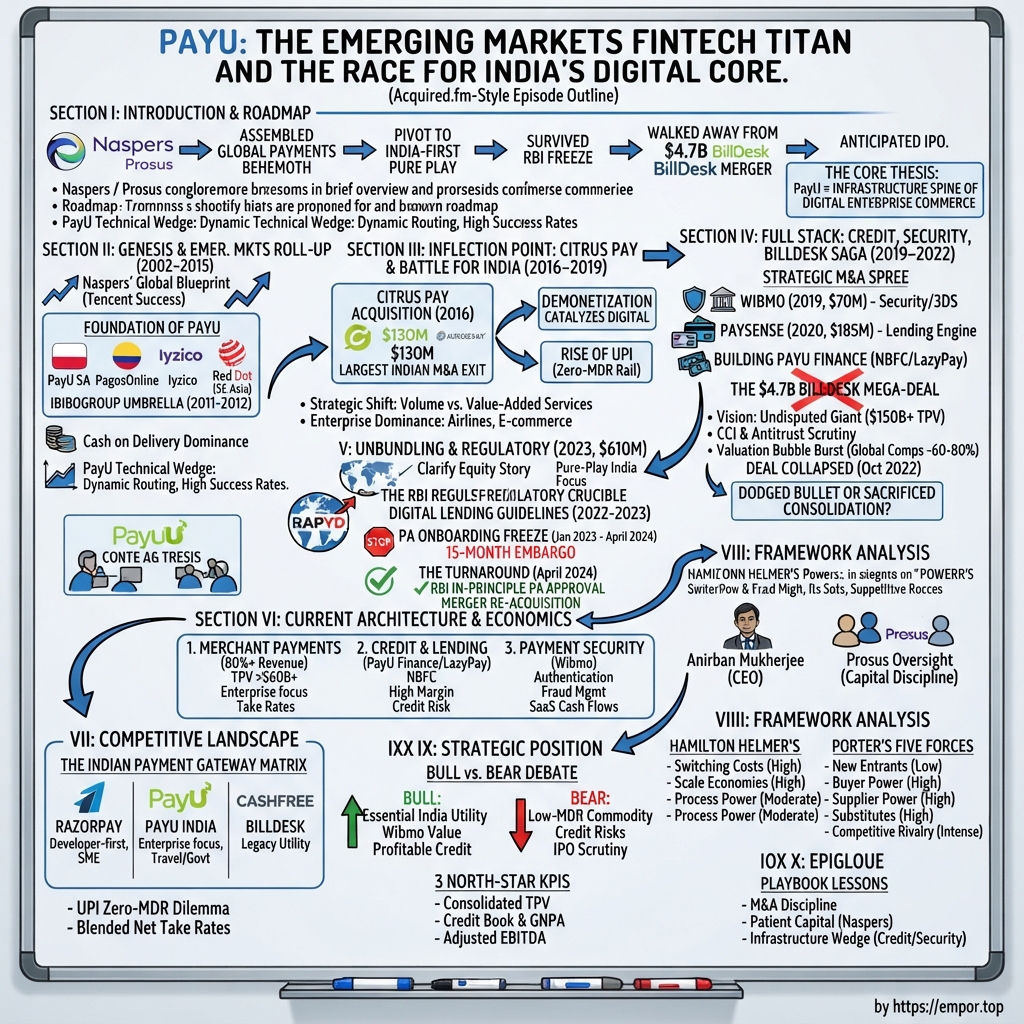
PayU: The Emerging Markets Fintech Titan and the Race for India’s Digital Core
I. Introduction & Episode Roadmap [00:00 – 09:30]
On 29 June 2026, Prosus published its financial results for the year ended 31 March 2026 and disclosed a milestone PayU India had pursued for more than a decade: a full-year adjusted EBITDA profit of $18 million on revenue of $781 million.1 It marked the first time the business delivered positive full-year operating profit on that metric, following an adjusted EBIT loss that narrowed from $49 million to $10 million over twelve months.2 For an enterprise supported across fourteen years by the capital and patience of a South African-Dutch investment group, an $18 million operating profit on $781 million in revenue is less a triumph than a baseline credential—the minimum operational threshold required to approach public equity markets.
That dynamic forms the central tension of the PayU story. The company operates as one of the largest payment processors in India—processing $90 billion in total payment volume in FY26, up 15% year-on-year, with transaction volumes up 49%1—yet generated a 2.3% adjusted EBITDA margin3 characteristic of high-volume transaction utilities rather than software platforms. Its parent, Prosus, has deferred an initial public offering three times, most recently in June 2025, citing the need to "strengthen operations" first.4 Along the way, PayU walked away from a $4.7 billion acquisition of BillDesk that would have created an undisputed market leader in Indian payments,5 sold its Global Payments Organization to Rapyd for $610 million to establish an India-focused operating profile,6 and navigated a fifteen-month regulatory embargo during which the Reserve Bank of India barred it from onboarding new online merchants.
The central investment thesis turns on whether PayU can serve as the core infrastructure spine for Indian digital commerce, converting low-take-rate payment processing into distribution for higher-margin digital credit and banking software. Prosus reports that PayU captures approximately 25% of online payment revenue in India, and that its Wibmo and Mindgate subsidiaries process or authenticate roughly half of all UPI volume and three-quarters of credit card transactions across their partner banks.1 These figures represent material market reach, but they remain parent-disclosed management estimates with unstated methodologies, rather than metrics audited under statutory public-offering rules.
PayU's corporate structure also distinguishes it from peer fintechs. Often grouped with venture-backed startups, PayU is a fourteen-year-old, wholly owned operating subsidiary of a publicly traded European holding company. It is directed by professional management, with no founder equity on the cap table and no independent price discovery established through arm's-length funding rounds. That architecture carries direct implications for executive compensation, capital allocation, and forecasting discipline.
The analysis that follows evaluates how this portfolio was assembled, what the operating data shows, and what public investors must underwrite: the original Naspers emerging-markets roll-up; the acquisitions of Citrus Pay, Wibmo, PaySense, and Mindgate; the termination of the BillDesk transaction; the divestment of global operations; the RBI licensing process and its resolution; segment unit economics; competition with Razorpay, Cashfree, Pine Labs, and Paytm; balance-sheet structure; valuation scenarios against comparable payment networks; and the primary bull and bear cases.
One structural condition underpins this analysis: as of 17 August 2026, PayU India has not filed a Draft Red Herring Prospectus (DRHP). There is no statutory prospectus, no audited restated financial disclosure under SEBI standards, no formal risk-factor schedule, no public share-capital breakdown, and no stated use of proceeds. The evidentiary base consists of parent-company segment reports, corporate filings from Indian operating subsidiaries, regulatory orders, and disclosed transaction terms. This provides a detailed operational record, but the absence of a formal regulatory filing does not imply an absence of risk.
 Subscribe on LinkedIn
II. Genesis & The Emerging Markets Roll-Up (2002–2015) [09:30 – 21:00]
To understand why an Indian payment gateway in Gurugram reports through Amsterdam, the narrative begins with a $32 million investment made in Hong Kong in 2001. Naspers, a South African media group whose origins trace back to Afrikaans-language newspapers, acquired roughly one-third of a Chinese messaging startup named Tencent. The return on that single position eventually exceeded the value of the rest of the company by orders of magnitude. It also embedded an enduring institutional conviction within Naspers: that the highest risk-adjusted returns available to a patient balance sheet came from acquiring category-defining technology platforms across emerging markets that Western institutional capital found difficult to underwrite.
The operational challenge with that thesis was its reproducibility. Naspers spent the subsequent fifteen years attempting to replicate an outcome that may have been a singular historical anomaly, with digital payments serving as one of its primary investment laboratories. The strategic rationale was coherent: in economies where formal banking penetration was low, credit card adoption was nascent, and payment card economics had not settled into a mature duopoly, the entity controlling the merchant-facing checkout infrastructure would occupy a structurally defensible choke point. In theory, emerging-market payment rails offered greater merchant stickiness and broader cross-sell optionality into adjacent financial services than mature Western acquiring networks.
Assembling a payments company out of acquisitions
PayU was assembled through a sequence of regional acquisitions rather than built from a single codebase. It was pieced together across Central and Eastern Europe—anchored by the Polish processor PayU S.A.—and Latin America, where Naspers acquired the Colombian gateway PagosOnline. The PayU brand operated as connective tissue over a disparate collection of national businesses that shared little underlying technology or infrastructure beyond common corporate ownership. It functioned as a holding-company portfolio of domestic payment processors operating under a unified logo—a fragmented operating architecture that would complicate capital allocation and eventual divestment efforts a decade later.
India, cash on delivery, and the reliability wedge
India became part of this portfolio between 2011 and 2012, when PayU India was established as an enterprise checkout gateway under the ibibo Group umbrella, a Naspers-controlled Indian internet holding entity. As a result, PayU India developed along a distinct trajectory from conventional venture-backed fintechs: it operated without founder equity, external venture rounds, or independent governance, funded entirely from the parent balance sheet and measured against internal holding-company return targets.
The commercial environment in 2012 presented acute operational friction. Indian e-commerce was a low-margin sector dominated by cash on delivery. A decisive majority of online transactions were settled in physical banknotes upon arrival, burdening merchants with heavy logistics fees, cash-handling overhead, and high return-to-origin rates that frequently rendered unit economics unviable across the sales funnel.
Cash on delivery persisted less from consumer preference than from systemic infrastructure failure. The Reserve Bank of India had mandated two-factor authentication for all card-not-present transactions—a prudent regulatory safeguard against fraud that, in execution, required every online card payment to route through an issuing bank's authentication gateway. Those bank servers frequently suffered outages, timed out during session handoffs, and rendered poorly on mobile browsers. Baseline transaction success rates across Indian online payments were low enough that merchants routinely lost completed orders to bank infrastructure downtime rather than customer drop-off.
This operational failure provided PayU India with its initial commercial wedge. A payment gateway sits between a merchant's checkout interface and acquiring banks. When a customer initiates a transaction, the gateway selects the routing path across partner banks and card networks. If a specific issuing or acquiring bank's server degraded, a gateway capable of detecting the drop in real time and dynamically re-routing traffic to healthier nodes could deliver a measurably higher transaction completion rate. In an environment defined by weak baseline conversion, a modest improvement in success rates generated immediate top-line revenue for merchants—a far more compelling commercial proposition than discounting payment processing fees.
PayU built dynamic transaction routing algorithms around this structural defect, targeting commercial verticals where failed transactions carried the highest financial penalty: high-ticket, time-sensitive travel bookings. An airline or online travel agency losing a ₹40,000 reservation to an authentication timeout suffered far greater revenue loss than a merchant losing a ₹400 retail order. Because Naspers' ibibo Group operated Goibibo, and MakeMyTrip served as an anchor client, PayU established its initial enterprise footprint in travel, pairing routing reliability with developer APIs that offered cleaner integration paths than legacy public-sector bank gateways.
This commercial dynamic explains both PayU's initial market capture and its subsequent margin ceiling. A payment gateway competing solely on price sells a commoditized utility into corporate procurement departments. A gateway competing on transaction reliability sells revenue recovery, commanding a pricing premium by protecting merchant conversion. PayU's early competitive moat was direct: the domestic banking infrastructure was fragile enough that reliability engineering commanded real commercial value.
That advantage carried an inherent structural limit. As the underlying banking infrastructure matured—and as the Unified Payments Interface (UPI) introduced inherently more reliable routing rails—the enterprise value of proprietary routing optimization declined. The operational problem PayU was engineered to solve was progressively resolved by national public infrastructure, compressing the pricing leverage historically tied to routing intelligence.
By 2015, PayU India had established an enterprise gateway with clear technical differentiation in a rapidly growing digital economy. What altered the competitive landscape thereafter, however, was not another private-sector product release, but direct structural intervention by the state.
III. Inflection Point: The Citrus Pay Acquisition & The Battle for India (2016–2019) [21:00 – 35:00]
In September 2016, Naspers agreed to acquire Mumbai-based Citrus Pay for $130 million in cash, folding the business directly into PayU.7 At the time, the transaction represented the largest M&A exit in the Indian fintech sector. While the acquisition expanded transaction volume through Citrus's merchant portfolio and consumer wallet, its primary strategic contribution was human capital. Citrus co-founders Amrish Rau and Jitendra Gupta took operational command of PayU India, transitioning a foreign-owned subsidiary into a business directed by operators who had built a domestic payments processor from scratch.
Both executives eventually departed, reflecting the talent dynamics of the Indian fintech market: Rau moved on to lead Pine Labs, while Gupta founded the neobank Jupiter. An organization that incubates executive talent that subsequently leads or establishes competing platforms gains an institutional hiring reputation, but faces persistent retention challenges at the executive level.
Demonetisation, and then the shock that actually mattered
Two months after the Citrus acquisition, on 8 November 2016, the Indian government abruptly demonetised high-denomination ₹500 and ₹1,000 banknotes. Demonetisation was an executive policy action with heavily debated macroeconomic outcomes, but its immediate operational effect on digital payments was pronounced: an economy transacting overwhelmingly in physical cash was temporarily forced into digital settlement channels. Digital wallets and enterprise payment gateways experienced a compression of adoption timelines that would have otherwise required years of organic onboarding.
The enduring structural transformation of the market, however, stemmed not from demonetisation, but from the rollout of the Unified Payments Interface (UPI).
Built by the National Payments Corporation of India (NPCI), UPI became the defining operational reality of domestic payments—and the central structural headwind on PayU's income statement. As an interoperable, real-time, account-to-account protocol, UPI allows consumers to initiate direct bank-to-bank settlements instantaneously via mobile identifiers or QR codes. The rail scaled at an unprecedented velocity: in May 2026, UPI processed a record 23.2 billion transactions valued at ₹29.9 lakh crore, or roughly $312 billion in a single month.8 According to NPCI operational data, UPI settled the decisive majority of India's retail digital transaction volume.
The commercial challenge for payment gateways lies in the unit economics: person-to-merchant UPI transactions carry a government-mandated Merchant Discount Rate (MDR) of zero. On conventional credit card transactions, merchants pay an acquiring fee distributed across the issuing bank, card network, acquiring bank, and gateway. On zero-MDR UPI transactions, the processing rail yields zero direct merchant fee revenue. Consequently, the payment rail that captured market share across India generated no core processing fees for payment gateways.
This regulatory pricing framework separates Indian payment processors from global peers such as Adyen, Stripe, or Nubank, limiting the utility of direct valuation multiple comparisons. As UPI expanded its share of checkout volume, domestic gateways handled surging transaction counts alongside contracting average fee realizations. The FY26 operating metrics illustrate this divergence: PayU's transaction count increased 49%, while Total Payment Volume rose 15% and core payments revenue grew roughly 10%.1 Transaction volumes expanded nearly five times faster than top-line revenue, reflecting the margin-dilutive expansion of zero-MDR volume.
From product to distribution
The economic transition resembles a commercial toll operator whose toll road is paralleled by a free public highway. While traffic through the transportation corridor expands rapidly, the private operator can no longer monetize basic road transit. Instead, future earnings depend entirely on cross-selling ancillary commercial services to captive fleet operators—such as fleet management, fuel credit, insurance, and equipment telemetry.
PayU responded to this structural shift by repositioning its core payment gateway from a standalone revenue product into a merchant distribution channel. Under this dual-engine operating model, the volume engine—the payment gateway—monetizes the remaining fee-bearing payment methods, including credit cards, debit cards, net banking, equated monthly installment (EMI) checkouts, and tokenized card-on-file arrangements. The value engine cross-sells higher-margin financial software and services, encompassing digital credit, fraud prevention, transaction authentication, settlement infrastructure, and merchant SaaS. The volume engine establishes enterprise merchant integration; the value engine generates operating margin.
This strategic pivot was adopted across the domestic fintech landscape, with major competitors establishing comparable product architectures over the same period. Because the dual-engine strategy became the industry standard, strategic differentiation shifted entirely to execution: whether PayU could distribute adjacent credit and software products at higher attachment rates, wider gross margins, and lower customer acquisition costs than peers like Razorpay, Cashfree, or Paytm.
Simultaneously, PayU concentrated its commercial coverage on enterprise clients where fee-bearing payment methods retained material share. Large airlines, telecommunications providers, insurance carriers, enterprise e-commerce platforms, and utility operators process large ticket sizes, rely more heavily on credit cards and net banking than small retail merchants, and prioritize high-availability routing infrastructure. Enterprise payment processing became PayU's core market segment, contrasting with the self-serve, developer-centric small-and-medium-business (SMB) strategy pursued concurrently by Razorpay.
The divergence between enterprise and SMB merchant focus highlights a fundamental trade-off in payment acquiring. SMB merchants generate higher take-rates per transaction and rarely maintain the technical resources to route volume across multiple gateways, but they require automated, product-led distribution. Enterprise accounts deliver substantial processing volume and institutional scale, but operate dedicated corporate treasury teams focused on compressing gateway basis points and routinely multi-home across competing processors to mitigate operational risk. By prioritizing enterprise volume, PayU captured scale while operating in the merchant tier with the lowest pricing power.
IV. Building the Full Stack: Credit, Security, and The BillDesk Saga (2019–2022) [35:00 – 52:00]
By 2019 the strategic conclusion was settled inside PayU: processing alone would not produce an attractive return. What followed was an acquisition programme aimed at owning the profitable layers adjacent to the transaction.
Wibmo: owning both sides of the same transaction
In April 2019, PayU acquired Wibmo for $70 million.9 Wibmo, headquartered in California with its engineering centre in Bengaluru, sells authentication and fraud-management software to card-issuing banks — the 3-D Secure infrastructure that sits behind the one-time-password screen an Indian consumer sees on a card payment, plus risk scoring, tokenisation and issuer processing. The strategic logic was genuinely elegant rather than merely additive. PayU's gateway sits on the acquirer side of a transaction, seeing merchant behaviour. Wibmo sits on the issuer side, seeing bank-side authentication behaviour. Owning both ends of the same transaction produces a data asset about why payments fail that a pure gateway cannot assemble, and Wibmo's revenue is bank software — recurring, high gross margin, and sold on multi-year contracts rather than on basis points.
There is a second, less flattering reading of the Wibmo purchase, and the subsequent record supports it as well. Bank software in India is a slow, relationship-driven, procurement-heavy business with long sales cycles and constant price pressure from domestic system integrators. It produces predictable revenue and it does not scale the way a product company scales. When PayU cut roughly 6% of its Indian workforce in late 2022, the reductions were concentrated in Wibmo.10 A business being cut during a cost programme is not usually the business management believes is compounding.
In January 2020, PayU acquired a controlling stake in the consumer lending platform PaySense at a valuation of $185 million, announcing that it would merge PaySense with its own BNPL product LazyPay to form a full-stack digital lending business, with equity capital of up to $200 million committed to grow the book.[^11] Management's stated ambition at the time was a loan book of $1.5 billion within five years. That figure is worth remembering, because the record against it is the single cleanest test of this management team's forecasting available in the public domain. Six years later, in FY26, PayU reported credit assets under management of $682 million.11 The book reached roughly 45% of a five-year target. Not a catastrophe; not delivery either.
The $4.7 billion deal that died
Then came the deal that defines the company's reputation for capital discipline, and it is worth being careful about why.
In August 2021, Prosus agreed to acquire BillDesk for $4.7 billion. BillDesk was the veteran of Indian payments — founded in 2000, dominant in the recurring, utility, insurance-premium and bank-mandate flows that constitute the least glamorous and most reliable payment volume in the country. Combined, PayU and BillDesk would have processed volumes that no Indian competitor could approach, and the combination would have handed PayU exactly what it lacked: sticky, low-churn, biller-side flows with contractual duration rather than merchant-side flows subject to annual repricing.
It is worth being specific about why biller flows are structurally superior to merchant flows, because this is the strategic gap that still defines PayU. When a consumer pays an electricity bill or an insurance premium through a gateway, the relationship is with the biller, the mandate is recurring, the contract typically runs for years, the switching cost involves re-papering a utility's or an insurer's back office, and the volume is non-discretionary — people pay their electricity bills in recessions. When a consumer buys a shirt through an e-commerce checkout, the volume is discretionary, the merchant reprices annually, and the integration can be re-weighted with a configuration change. BillDesk owned the first kind of flow. PayU owns the second.
The Competition Commission of India reviewed the transaction and granted unconditional approval in September 2022.12 Antitrust was not, in the end, the obstacle.
Time was. Between signing in August 2021 and the long-stop date in late 2022, the price of every listed comparable collapsed. Global payment companies that had traded at multiples appropriate to secular growth stories re-rated violently as interest rates rose and as the pandemic-era e-commerce pull-forward reversed. A price agreed at the top of a fintech valuation cycle looked, fourteen months later, like an act of vandalism against Prosus shareholders. On 3 October 2022, Prosus terminated the agreement, stating that conditions precedent had not been satisfied by the long-stop date.13[^15]
The generous reading, which Prosus has encouraged, is that the group demonstrated exceptional discipline: it had contractual optionality, the world changed, and it exercised the option rather than closing a value-destroying deal out of embarrassment. On the arithmetic, that reading is hard to argue with. Paying $4.7 billion for BillDesk in 2022 would have loaded PayU with an impairment that would still be visible today, and Prosus's own current ambitions for PayU's entire equity value are well below the price it had agreed for BillDesk alone.
The skeptical reading is that this framing flatters a decision that was partly forced. Terminating on unsatisfied conditions precedent rather than paying a break fee is a legal position, not a strategic one, and it invited exactly the dispute that followed. More importantly, the strategic hole BillDesk was meant to fill was never filled by anything else. PayU still lacks a large, contractually sticky biller franchise. It walked away from the asset and then spent four years demonstrating why it wanted it. Capital discipline that leaves the strategic problem unsolved is prudence, not strategy — and an investor should credit Prosus for the former without granting it the latter.
V. The Great Unbundling & Regulatory Storm (2022–2024) [52:00 – 01:08:00]
With the BillDesk transaction terminated, Prosus adopted an inverted playbook: rather than buying domestic scale, it began shedding international complexity.
In August 2023, Prosus agreed to sell PayU’s Global Payments Organization—the Latin American, Central and Eastern European, and African operations assembled during the initial roll-up era—to Rapyd for $610 million in cash.14 The transaction excluded India, Turkey (where PayU had acquired iyzico for $165 million in 201915), and Southeast Asia via Red Dot Payment. Management framed the divestment around corporate clarity: restructuring PayU into a focused, India-centric growth asset with a simplified equity narrative legible to domestic public-market investors.
The transaction valuation provided a sober assessment of the legacy international strategy. The Global Payments Organization represented nearly two decades of capital deployment and acquisitions across a dozen emerging markets, yet transacted for $610 million. That outcome demonstrated that international acquiring portfolios generate limited cross-border synergies: scale in Poland provided little operational leverage in Colombia, and scale in Colombia offered no defensible moat in India. Rather than compounding enterprise value across geographies, the roll-up yielded a fragmented collection of domestic acquirers whose eventual realization reflected the terminal value of local licences and customer rosters to a strategic buyer.
The regulatory crucible
The streamlined, India-dedicated entity immediately entered the most challenging operating environment in its corporate history.
Two distinct regulatory actions converged on the business. The first reshaped digital credit. Throughout 2022 and 2023, the Reserve Bank of India enacted strict rules governing how unregulated technology intermediaries originate consumer loans, prohibiting non-bank entities from loading credit lines onto prepaid payment instruments.16 That directive dismantled the product structure behind LazyPay’s card-linked buy-now-pay-later model, forcing PayU to reconstruct its lending operations around licensed non-banking financial company (NBFC) rails and formal co-lending partnerships with regulated commercial banks. Comprehensive digital lending guidelines followed, establishing stringent requirements on customer consent, data localization, cooling-off periods, and direct loan disbursement between regulated balance sheets.17
The second intervention overhauled merchant payments. The RBI’s Payment Aggregator framework mandated that entities collecting and settling merchant transactions obtain formal regulatory authorization, maintain statutory net-worth thresholds, and hold merchant float in tightly audited escrow accounts with prescribed settlement timelines.18 Because payment aggregators handle systemic liquidity between consumers and merchants, the central bank mandated bank-grade prudential supervision over third-party payment rails.
While PayU’s payment aggregator application was under review, the RBI issued an embargo in January 2023, directing the company to halt the onboarding of new online merchants pending structural alignment and regulatory compliance.
An onboarding freeze represents a severe commercial penalty. Unlike finite financial fines, an onboarding embargo leaves an existing customer base intact while legally prohibiting top-line customer acquisition—barring the sales organization from new market volume during a period of rapid industry expansion. For roughly fifteen months, PayU could service existing enterprise clients but could not contract a single new digital merchant, ceding new commercial relationships to licensed rivals such as Razorpay and Cashfree, whose own regulatory review timelines differed. In payment acquiring, where enterprise software integrations carry high switching costs, fifteen months of merchant onboarding freezes inflicted permanent cohort losses.
Amid these regulatory headwinds, the company initiated cost reductions, eliminating approximately 150 positions—roughly 6% of its Indian workforce—with retrenchment falling heavily on the Wibmo software unit.10
The turnaround, and what it did not fix
Regulatory resolution arrived sequentially. In April 2024, the RBI granted PayU Payments Private Limited in-principle approval to operate as a payment aggregator, lifting the fifteen-month embargo and allowing merchant acquisition to resume.19 Final authorization under the Payment and Settlement Systems Act followed in May 2025.20 In November 2025, the central bank granted PayU an integrated payment aggregator licence encompassing online, offline, and cross-border acquiring—expanding the company's operating mandate from e-commerce checkouts into point-of-sale terminals and cross-border merchant trade.21
This resolution carries two distinct operational implications. First, PayU now holds one of the broader payment aggregator licences issued by the RBI, converting an initial regulatory bottleneck into a defensible barrier to entry. Second, post-embargo commercial recovery has proceeded gradually. In FY25—the initial operational year following the lifting of the embargo—PayU onboarded approximately 13,000 new merchants,22 a modest addition relative to its claimed merchant network of more than 450,000 sellers.23 Regulatory permission to sell proved to be a necessary, but not immediately sufficient, condition for re-accelerating merchant acquisition.
The episode also highlights a key disclosure gap. The onboarding freeze was not an exogenous market disruption; it stemmed from an application that did not meet central bank standards at the time of submission, in a market where direct peers navigated the process to clearance. While Prosus and PayU have acknowledged the commercial friction caused by the embargo, neither entity has published detailed disclosures explaining the specific structural or governance deficiencies identified by the regulator. A Draft Red Herring Prospectus will require full statutory disclosure of that regulatory history, providing public investors with an audited accounting of past compliance remediations and operational controls.
VI. Current Business Architecture & Segment Financials [01:08:00 – 01:23:00]
FY26 represents the first reporting period permitting an empirical evaluation of PayU's operating model, as it marks the point where the business delivered positive operating earnings rather than forward-looking guidance.
The payments engine. Payments generated $577 million of revenue in FY26—roughly 74% of consolidated revenue—growing approximately 10% year-on-year and delivering adjusted EBITDA of $12 million, representing an operating margin near 2%.13 Total payment volume reached $90 billion.1 Dividing reported revenue by volume yields a blended take rate of approximately 64 basis points. That figure requires an important caveat: summary disclosures do not specify whether payments revenue is recognized gross or net of interchange fees and network scheme costs remitted to card networks and acquiring banks. Corporate filings for PayU Payments Private Limited report an FY25 payment gateway commission fee of ₹3,868 crore within total operating revenue of ₹5,563 crore,24 an accounting presentation indicating gross revenue recognition. If the 64-basis-point take rate reflects gross revenue, the net economics accruing to PayU after banking system disbursements represent a fraction of that figure, clarifying the modest ~2% EBITDA margin achieved on that revenue base.
A more revealing indicator lies in the half-year revenue distribution. PayU reported first-half payments revenue of $301 million.22 Against full-year payments revenue of $577 million, second-half revenue was approximately $276 million—a sequential decline, as well as a year-on-year contraction against the prior-year second half. Management attributed this trend to an intentional exit from negative-margin merchant portfolios in the second half of the year.3 While that strategic rationalization aligns with the observed margin improvement, it highlights an essential analytical distinction: PayU's payments profitability in FY26 was achieved through revenue pruning rather than operating leverage. The enterprise did not expand earnings on constant scale; it shed unprofitable processing volume.
Portfolio rationalization delivers an immediate margin reset, but it constitutes a single-step adjustment rather than compounding operating leverage. Operating leverage occurs when top-line revenue outpaces the underlying cost structure, whereas portfolio pruning contracts lower-margin revenue to lower total operating expense. Whether PayU can re-accelerate payments revenue at double-digit rates while defending these newly expanded margins represents the central operational test for FY27.
A structural offset appears in the segment's product mix. PayU disclosed that higher-margin value-added services—including fraud prevention, multi-factor authentication, and merchant SaaS tooling—reached 34% of payments revenue in the first half of FY26.22 If sustained and expanded, this represents a meaningful operational shift: software revenue insulated from UPI's zero-MDR mandate and carrying software-grade gross margins rather than commoditized processing economics.
However, the metric warrants scrutiny until further standardized disclosure is provided. Value-added services lack a uniform accounting definition across fintech issuers, creating incentives for pre-IPO reporting to aggregate disparate revenue streams under software classifications. Whether this 34% comprises multi-year, recurring SaaS contracts or variable, per-transaction fraud-screening fees tethered to underlying checkout volumes fundamentally alters the valuation multiple the revenue stream commands. A statutory prospectus will need to delineate the exact composition, contract duration, and net revenue retention of this cohort.
Revenue quality. PayU's consolidated top line divides into three distinct tiers of revenue quality. The most durable tier consists of bank-contracted infrastructure software delivered via Wibmo and Mindgate: multi-year institutional contracts, high switching costs embedded in core-banking architectures, and revenue insulated from cyclical consumer spending. The middle tier encompasses digital credit: contractual interest income and origination fees over defined loan tenors, delivering high margins during benign credit cycles while carrying balance-sheet downside if default rates surge. The most volatile tier remains core payment gateway processing: transactional, repriced annually, dependent on merchant checkout velocity, and vulnerable to dynamic routing shifts executed by enterprise treasury desks.
Because payment processing accounts for roughly three-quarters of consolidated revenue—with recurring infrastructure software representing an undisclosed portion—PayU's revenue base remains predominantly transactional.
Customer concentration presents an additional structural consideration. PayU's focus on enterprise merchants implies material volume concentration across its top client tiers, though neither merchant concentration ratios nor top-ten revenue contributions are publicly disclosed. Furthermore, related-party volumes from Prosus's broader Indian portfolio—including Swiggy, Meesho, Rapido, and ixigo—route payment processing and credit origination through PayU's rails.11 Captive volume generated through parent-controlled platforms does not represent open-market enterprise wins, raising questions regarding volume retention as Prosus monetizes or pares down its underlying equity stakes.
Cash, burn and the path to durable profitability. PayU does not publish segment-level cash balances, leaving parent capital injections as the primary indicator of historical cash absorption—exemplified by an equity infusion of ₹1,013 crore in April 2025.25 Analytically, capital allocated to fund an NBFC balance sheet represents productive balance-sheet deployment for interest-bearing assets, whereas capital consumed to fund cash deficits in payment processing represents operational burn.
The FY26 results indicate that processing cash burn has stabilized while balance-sheet funding needs continue. An adjusted EBITDA of $18 million against an adjusted EBIT loss of $10 million on $781 million in revenue indicates that depreciation and amortization—largely tied to historical M&A intangible assets—continues to exceed operating cash generation. Furthermore, adjusted EBITDA excludes equity-settled share-based compensation, which carries real dilution to equity value. Because statutory profitability under audited Indian accounting standards has not yet turned positive, PayU has achieved adjusted operating breakeven rather than demonstrated sustainable free cash flow generation.
Reaching mid-teens adjusted EBITDA margins over a medium-term horizon requires simultaneous execution across multiple vectors: payments revenue must re-accelerate into double-digit growth without diluting pruned margins; value-added services must maintain their upward mix trajectory; credit assets under management must expand significantly while preserving credit quality; and corporate overhead sized for a global holding structure must remain flat in absolute terms. Conversely, that earnings thesis would be challenged by consecutive periods of contracting payments revenue, credit loss rates exceeding 5%, or stagnation in high-margin software adoption.
The addressable market, with restraint. PayU's investor materials project India's digital payments total addressable market expanding approximately fourfold and digital lending sevenfold by 2030.26 However, aggregate market projections do not equate to monetizable merchant revenue. Because the majority of India's payment volume growth is concentrated in zero-MDR UPI rails, a fourfold expansion in gross transaction value yields a much smaller expansion in the addressable fee pool available to payment aggregators.
The reachable market under PayU's enterprise-focused model is defined by online and offline merchants with sufficient transaction volume to warrant enterprise sales coverage, monetized across cards, net banking, EMI plans, and software services, alongside merchant and consumer credit origination. Third-party research estimates the domestic payment gateway market in the low single-digit billions of dollars, growing at low double-digit rates. Against this revenue pool, Prosus's disclosure that PayU commands approximately 25% of India's online payments revenue1 suggests the company already captures a substantial portion of its core enterprise market. Accelerating growth from a 25% market share requires capturing volume from established peers—including Razorpay, Paytm, BillDesk, and Cashfree—several of which maintain strong balance sheets and are preparing their own public listings.
The credit engine. Credit revenue grew 19% on a reported basis and 26% in local currency to $204 million in FY26, generating an adjusted EBITDA of $6 million compared to an adjusted EBITDA loss of $28 million in FY25—a $34 million operational swing that drove the consolidated turnaround.13 Credit assets under management reached $682 million,11 while the net credit loss rate improved from approximately 5% to 4%.1
The credit turnaround was facilitated by a strategic transition toward an asset-light operating model, tighter consumer underwriting parameters, and increased origination across co-lending partnerships and merchant checkout finance.122 Under an asset-light framework, loan balances reside primarily on partner bank and NBFC balance sheets, allowing PayU to collect distribution, origination, and servicing fees. This structure reduces regulatory capital requirements and limits credit default risk, though it yields lower net revenue per rupee originated and increases reliance on institutional lending partners who retain contractual repricing power.
This operating shift alters how the credit segment should be valued. Balance-sheet lenders that retain credit risk compound net interest income against book value, trading on price-to-book and return-on-equity metrics. Distribution-led originators generate fee-based income tethered to origination volume, trading on revenue and EBITDA multiples. PayU's transition toward distribution lowers balance-sheet intensity while pivoting the segment's financial profile away from a conventional NBFC model.
Additionally, a 4% net credit loss rate on unsecured consumer and small-business lending represents an operational sensitivity. While manageable during supportive macroeconomic conditions, unsecured retail lending books in India exhibit non-linear loss acceleration during credit downcycles. In a regulatory climate marked by heightened RBI scrutiny and increased risk weights on unsecured retail credit, an operating profit of $6 million on a $682 million credit book leaves limited underwriting margin: a 150-basis-point increase in credit losses would fully eliminate the segment's operating profit and erase consolidated company-level EBITDA.
The infrastructure engine. Infrastructure software across Wibmo and Mindgate represents the third and least transparent operating vertical. Wibmo supplies authentication, risk-scoring, and fraud-prevention software to card issuers, while Mindgate provides the transaction routing software connecting commercial banks to the UPI network. PayU acquired an initial 43.5% stake in Mindgate in March 202527 and increased its ownership to roughly 70% in September 2025.28 Transaction terms and valuations were not officially published, leaving conflicting press estimates in the public record. Prosus reports that these entities authenticate or process roughly 50% of domestic UPI volume and 75% of credit card transactions across their partner banks,1 yet PayU does not report disaggregated financial results, software revenue, operating margins, or client retention metrics for the unit.
This disclosure gap limits independent verification. While high-margin, bank-contracted infrastructure software forms a core pillar of the consolidated investment narrative, public disclosures provide no standalone software metrics. A Draft Red Herring Prospectus will need to provide granular segment financials to substantiate software-grade valuation multiples for this vertical.
Reconciling the two sets of books
Two distinct revenue figures exist for PayU's Indian operations. On a segment reporting basis, Prosus reported FY26 revenue of $781 million. In statutory Indian registry filings, PayU Payments Private Limited reported FY25 operating revenue of ₹5,563 crore, up 22.8% year-on-year, with a consolidated net loss of ₹248 crore, narrowing 42% from ₹430 crore in FY24.2429 At historical exchange rates, the FY25 statutory top line aligns with Prosus's disclosed $669 million segment revenue. However, while Prosus reports unaudited adjusted EBITDA figures that exclude non-cash items such as equity-settled share-based compensation, the operating subsidiary continues to report statutory net losses under Indian accounting standards. Both the $18 million parent-level adjusted EBITDA profit and the operating subsidiary's statutory net loss reflect accurate accounting representations, but only the statutory loss reflects an audited filing under domestic accounting standards.
Management, ownership, and the capitalisation that cannot be built
Management and governance. Anirban Mukherjee, formerly of McKinsey, Airtel Payments Bank, and Standard Chartered, managed PayU India through the regulatory embargo before being appointed global CEO of PayU in October 2023.30 Management has structured its operational strategy around a three-pillar framework—"Grow Core, Build New, Invest or partner"—focusing on expanding merchant credit, extending payment acquiring to mid-market accounts, and exporting third-party payment capabilities to international markets.26 Management has guided toward approximately 25% annualized growth across payments and credit over an eighteen-month horizon.26 That forward projection stands in contrast to the 10% payment revenue growth delivered in FY26, providing a measurable operational benchmark for subsequent quarters.
Management's disclosures demonstrate transparency regarding the commercial impact of the regulatory embargo and the financial rationale behind pruning unprofitable merchant volume. Conversely, disclosures remain limited regarding the long-term loan-book target of $1.5 billion that yielded $682 million in actual assets, the operational considerations behind three deferred IPO timelines, and the precise breakdown of value-added services.
PayU India remains wholly owned by Prosus and Naspers through MIH Payments Holdings B.V.25 The corporate structure features no external institutional venture capital representation, no preferred share classes, and no independent price discovery established through arm's-length financing rounds. Operational funding has been provided directly by the parent: in April 2025, PayU India executed a ₹1,013 crore (approximately $120 million) rights issue to MIH Payments Holdings, issuing 13 crore equity shares at ₹77.96 per share (comprising a face value of ₹10 and a share premium of ₹67.96).25
This rights issue represents a parent-subsidiary internal transaction rather than an independent market valuation, reflecting an internally set capital allocation price without third-party negotiation.
Capital structure: what cannot be built. A fully diluted share count for PayU India is not available in public disclosures. The aggregate number of outstanding equity shares following the April 2025 rights issue is unstated, leaving the 13 crore newly issued shares without a defined denominator. Similarly, details regarding the employee stock option pool, exercise strike prices, potential dilution overhang, and voting right classifications remain undisclosed. While there are no disclosed convertible notes, SAFEs, warrants, liquidation preferences, or participation rights, the absence of public disclosure in a wholly owned subsidiary prevents statutory confirmation until a formal filing is published. Consequently, any quoted market valuation reflects an implied target rather than a mathematically derived market capitalization.
The enterprise-value bridge: why it cannot be drawn. PayU India does not disclose segment-level cash balances, statutory debt obligations, or lease liabilities, and the size of primary capital proceeds in an eventual listing remains unannounced. Furthermore, because PayU consolidates its regulated lending subsidiary, PayU Finance, financial leverage cannot be evaluated under standard corporate software metrics: an NBFC's borrowings represent raw working capital deployed to generate interest income rather than structural balance-sheet debt. Consequently, enterprise value cannot be calculated from existing public disclosures, and valuation multiples must be evaluated strictly on an equity-value basis.
VII. Competitive Landscape & Core Industry Economics [01:23:00 – 01:36:00]
The Indian payment gateway market represents one of the few financial technology sectors globally where multiple well-capitalised competitors serve overlapping enterprise clients with largely substitutable software products.
Razorpay presents the most direct peer comparison and the primary competitive threat. Built on a developer-first distribution model—characterised by clean API documentation, automated self-serve onboarding, and rapid integration workflows—Razorpay expanded its product surface from core merchant checkout into automated payouts, recurring subscription billing, working-capital lending, and corporate banking software. For FY25, Razorpay reported operating revenue of ₹3,783 crore, representing year-on-year growth of 65%,31 and subsequently filed a confidential Draft Red Herring Prospectus with SEBI in June 2026 seeking to raise between ₹5,000 crore and ₹6,000 crore at an anticipated valuation of ₹50,000 crore to ₹60,000 crore.3231 Management has stated that Razorpay's core payment processing operations have achieved standalone EBITDA profitability.31
This comparison highlights a distinct trade-off between scale and top-line momentum. PayU’s domestic operating entity reported FY25 revenue of ₹5,563 crore against Razorpay’s ₹3,783 crore—establishing PayU as the larger absolute revenue generator—yet Razorpay expanded 65% year-on-year compared to PayU’s 23% growth rate.2431 When two peer businesses of comparable scale expand at diverging growth rates, public equity markets rarely assign equivalent valuation multiples. Razorpay approaching public markets ahead of PayU with faster top-line growth introduces a tangible valuation benchmark and pricing overhang for PayU's eventual listing.
Paytm provides the most instructive listed benchmark, serving as the only domestic payment aggregator evaluated by public equity markets across a complete market cycle. One 97 Communications reported FY26 revenue from operations of ₹8,437 crore and delivered its first full-year consolidated net profit of ₹552 crore, reversing a prior-year net loss of ₹663 crore.33 The company's market capitalisation has traded near ₹1 lakh crore.34 Paytm's public-market trajectory—a November 2021 listing followed by a roughly 75% market capitalization drawdown before executing a multi-year recovery anchored by operational cost rationalization—remains the primary precedent for how Indian public investors value high-volume, low-take-rate transaction processors transitioning into digital credit origination.
Pine Labs offers the most recent public listing comparable and a sober indicator of valuation recalibration. Listing in November 2025, Pine Labs adjusted its initial public offering valuation to approximately $2.9 billion—roughly 40% below its peak private valuation of over $5 billion set in 2022—raising approximately $439 million and trading up on debut to reach a market valuation near $3.64 billion.35 While Pine Labs maintains an omnichannel business mix weighted toward in-store point-of-sale hardware and merchant software across roughly twenty international markets, its listing discount illustrates public market scrutiny toward mature private fintech valuations.
Cashfree serves as the closest operational peer in API-first banking infrastructure, competing directly across automated payout routing, settlement acceleration, and merchant disbursal workflows rather than basic checkout acquiring alone. While privately held with limited public financial disclosures, Cashfree’s presence demonstrates that specialised segments of the transaction stack can be defended by nimble balance sheets, challenging the premise that top-line processing scale alone guarantees an insurmountable competitive moat.
Beyond direct gateway rivals, the broader competitive ecosystem fragments across distinct operational niches: BillDesk retains an entrenched market position across recurring utility billings, insurance premiums, and institutional bank mandates; Infibeam's CCAvenue captures specialised vertical acquiring and government portals; PhonePe, advancing toward its own public listing, commands consumer UPI market share and continues expanding merchant acceptance; while orchestration providers like Juspay and M2P supply multi-gateway routing software directly to enterprise merchants and aggregators. This orchestration layer introduces a structural headwind for pure processors: by allowing enterprise treasury desks to dynamically switch transaction traffic across multiple gateways based on real-time pricing and uptime, orchestration platforms commoditise the proprietary routing intelligence that originally formed PayU’s core commercial wedge.
The economics of the industry
The operating margin ceiling across Indian merchant acquiring is defined by two structural constraints. First, the zero-MDR mandate on UPI means that the fastest-growing payment rail in the country generates no direct merchant acquiring fees. Second, fee-bearing payment methods—encompassing credit cards, commercial debit cards, net banking, and equated monthly installments—operate against non-negotiable interchange floors and network scheme costs set by issuing banks and card networks. A payment gateway’s gross margin represents the residual spread between the merchant acquiring fee and mandatory banking disbursements—two price points where aggregators exercise limited unilateral pricing power.
Under this market structure, operating scale is a prerequisite for survival but insufficient for pricing leverage. Expanding transaction volume strengthens an aggregator's negotiating position with acquiring banks, amortises fixed cloud and compliance infrastructure, and enriches fraud-detection telemetry. However, scale does not confer sustainable pricing power over enterprise merchants, who maintain multi-homing integrations and can reallocate transaction traffic with minimal switching friction.
This dynamic separates Indian payment processors from mature Western acquiring networks. Global processors such as Adyen and Stripe operate in markets where card-based interchange applies across checkout channels, allowing gross transaction volume and net processing revenue to scale in tandem while supporting stable net take rates. In contrast, Indian aggregators operate where the dominant transaction rail is a fee-free public good, causing volume growth to decouple from top-line revenue—as demonstrated in PayU’s FY26 operating metrics, where transaction counts expanded 49% while payments revenue grew roughly 10%.1 Consequently, applying Western acquiring valuation models to the Indian market over-indexes on headline volume while understating the margin drag of zero-MDR volume.
As a result, competitive strategy across the sector has pivoted from pursuing undifferentiated volume to competing for the residual fee-bearing transaction mix, followed by cross-selling high-margin ancillary financial services. This economic reality explains why every major Indian payment aggregator has built digital lending operations, expanded into authentication software, and launched merchant SaaS tooling. When competing processors deploy convergent product strategies to sell substitutable utilities to cost-conscious corporate procurement desks, industry dynamics point toward sustained margin pressure rather than structural pricing expansion.
The MDR wildcard
A potential structural shift in industry unit economics emerged in regulatory discussions in August 2026. The Ministry of Finance clarified that UPI transactions will remain free for retail consumers, that peer-to-peer transfers will carry no transaction fees, and that any future Merchant Discount Rate would apply strictly to merchants exceeding defined turnover thresholds at nominal rates.3637 The legislative framework is being introduced through the Taxation and Other Laws (Amendment) Bill, 2026, which proposes amending Section 10A of the Payment and Settlement Systems Act to authorize a steering committee led by the National Payments Corporation of India to determine MDR guidelines, with proposed merchant rates between 0.25% and 0.4% discussed for large-merchant transactions exceeding ₹2,000.3637
If enacted and implemented at those fee levels, statutory MDR on large-ticket commercial UPI transactions would represent the most significant positive unit-economic catalyst for Indian payment aggregators in a decade, monetising the processing rail that carries the decisive majority of national payment volume. However, the proposal remains draft legislation before Parliament, requiring formal statutory enactment and subsequent regulatory rate determination by an unformed committee. For valuation purposes, prospective UPI merchant fees represent policy optionality rather than bankable operating cash flow, and cannot be underwritten as base-case earnings until implemented in law.
VIII. Framework Analysis: Porter’s Five Forces & Helmer’s 7 Powers [01:36:00 – 01:48:00]
Strategic frameworks are useful here only to the extent they enforce precision about which competitive advantages are structurally proven and which remain aspirational assertions.
Helmer's 7 Powers
Switching costs: moderate, and weaker than the narrative claims. The argument holds that an enterprise merchant integrating PayU's routing algorithms, risk engine, and automated reconciliation systems faces material friction and operational risk in replacing the gateway—particularly the risk of transaction drops during high-volume promotional events, where failed conversions directly destroy top-line sales. While directionally valid, that switching moat is constrained in practice. During PayU's fifteen-month onboarding embargo, the company retained the right to service existing enterprise clients yet conceded market share. If integration switching costs were prohibitive, an incumbent barred from adding new accounts would have maintained its proportional share of existing client growth. Instead, enterprise merchants routinely multi-home by design, splitting transaction traffic across two or three aggregators and adjusting volume allocations via dynamic routing rules. This dynamic converts a customer switching decision from an all-or-nothing event into a real-time dial. Switching costs are tangible at the margin of complete vendor replacement, but negligible at the margin of volume reallocation—and volume reallocation is how enterprise treasury desks operate in practice.
Scale economies: real, and the strongest of PayU's structural powers. Processing $90 billion in Total Payment Volume provides measurable operational advantages: preferential interchange settlement tiers from acquiring banks, fixed compliance and technical infrastructure amortised across a large transaction base, and machine-learning fraud datasets that improve with processing density. The margin expansion achieved in FY26 reflects this scale efficiency. However, scale economies in payment processing encounter a structural ceiling: the largest cost line consists of mandatory banking and card-network interchange fees, which do not compress indefinitely with processing volume, and PayU shares this scale tier with well-capitalised domestic peers.
Counter-positioning: absent across core products. Counter-positioning requires an insurgent business model that established incumbents cannot replicate without cannibalising their core profit pools. PayU possesses no structural counter-positioning relative to Razorpay, Cashfree, or Paytm, as all major competitors offer convergent product suites spanning payment gateways, digital credit origination, and merchant software. The single differentiated architectural asset remains the combination of Wibmo and Mindgate on the issuer and bank-infrastructure side with PayU's gateway on the merchant acquiring side. In theory, owning both endpoints generates bidirectional visibility into transaction failures that a standalone acquirer cannot replicate. In practice, PayU has published no empirical benchmarks—such as transaction success-rate premiums, software attach rates, or pricing power—demonstrating that this technical integration translates into a durable commercial advantage. It remains an unverified structural hypothesis.
Process power: moderate and eroding. Proprietary transaction routing algorithms designed to navigate intermittent bank-server downtimes represented a genuine technical differentiator in 2014. In 2026, real-time dynamic routing is a baseline capability deployed across all major competitors, while third-party orchestration platforms sell equivalent multi-gateway routing software directly to enterprise merchants. Proprietary process power that can be procured off the shelf from third-party vendors ceases to function as a defensible competitive moat.
The remaining powers in Helmer’s taxonomy provide limited structural defensibility. Branding carries negligible pricing power in an enterprise sector where end consumers rarely interact with the underlying gateway brand and procurement decisions are directed by corporate treasury departments. Cornered resource is absent: PayU holds no exclusive operating licences, proprietary datasets unavailable to well-funded competitors, or scarce structural inputs that rivals cannot access. Network economies are similarly limited. A merchant does not derive incremental utility from other merchants adopting the same payment gateway. While digital payments exhibit the surface characteristics of a network business, the underlying networks belong to the UPI protocol and global card schemes; PayU operates as an intermediary on sovereign and scheme infrastructure rather than the proprietor of an independent payment network.
Porter's Five Forces
Threat of new entrants: low. Regulatory barriers represent PayU's most defensible operational moat, established following an intensive compliance cycle. The RBI's payment aggregator framework, statutory net-worth thresholds, segregated escrow requirements, and recurring compliance audits prevent newly funded startups from entering enterprise acquiring at scale. PayU's integrated authorization covering online, offline, and cross-border acquiring positions it among the broader regulatory licences in the domestic market.21 The regulatory scrutiny that previously imposed a fifteen-month onboarding freeze now functions as a high barrier to entry against prospective challengers.
Bargaining power of buyers: high, representing the primary margin constraint. Enterprise merchants are sophisticated, price-sensitive, and operationally multi-homed. They negotiate fee structures in single basis points and maintain the technical infrastructure to reallocate transaction routing instantaneously. PayU’s historical focus on top-tier enterprise accounts concentrated its business in the merchant cohort possessing the greatest pricing leverage. Management's stated initiative to expand into mid-market and small-and-medium businesses represents an operational effort to diversify toward merchants that accept higher take-rates and exhibit lower multi-homing tendencies. However, executing this mid-market expansion places PayU into direct competition with Razorpay across Razorpay’s core developer-led distribution channels.
Bargaining power of suppliers: high. Card schemes, the National Payments Corporation of India, and partner acquiring banks establish non-negotiable interchange floors, scheme fees, and technical network uptime standards. Payment aggregators operate within these mandatory infrastructure parameters without unilateral pricing control.
Threat of substitutes: high and structurally unique. In conventional commercial sectors, product substitutes originate from private-sector competitors. In Indian digital payments, the primary substitute is a sovereign public utility. The rollout of zero-MDR UPI displaced the fee-bearing payment rails that originally supported payment gateway unit economics. Future sovereign interventions—whether through Central Bank Digital Currency (CBDC) rollouts or novel NPCI payment protocols—present unhedgeable structural substitution risks that private aggregators cannot counter through product design.
Competitive rivalry: intense. The domestic payments landscape remains characterized by well-capitalized processors competing for overlapping enterprise accounts with largely substitutable software products, with leading peers pursuing concurrent public market listings.
The composite
A clear method for evaluating which operational model applies to PayU is to examine how profitability behaves during periods of revenue moderation. A software platform possessing strong structural powers exhibits operating margin expansion as revenue scales, driven by low marginal servicing costs. A regulated transaction utility exhibits bounded margin expansion followed by an operating plateau, because transaction processing costs are predominantly variable and determined by upstream financial institutions. PayU's FY26 financial performance—where margin gains were achieved primarily through pruning unprofitable merchant accounts rather than compounding top-line operating leverage—points directly toward the utility model.
The composite assessment reveals an enterprise supported by a formidable regulatory barrier and meaningful scale economies, but constrained by moderate switching costs, zero-MDR sovereign substitution, and high buyer pricing leverage. This operating profile aligns with a durable, regulated transaction utility rather than a high-multiple compounding software platform—an essential distinction for public market valuation frameworks.
IX. Strategic Position, Material Risks, & Bull vs. Bear Case [01:48:00 – 02:00:00]
What the market has said so far. Prosus originally targeted a PayU listing valuation between $5 billion and $7 billion, seeking to raise in excess of $500 million.38 That target has since been revised downward toward a $4.2 billion to $5.0 billion range, with UBS reported to ascribe roughly $4.2 billion in a sum-of-the-parts analysis on Prosus.39 Goldman Sachs was engaged as lead banker, with Morgan Stanley and Bank of America advising.40 The proposed offering timeline has been deferred repeatedly: initially slated for the second half of 2024, pushed to 2025, and delayed again in June 2025 in favor of strengthening operational metrics first.441 PayU was separately reported to be exploring a pre-IPO minority stake sale of up to $300 million with HSBC as banking partner, structured to gauge institutional demand and establish a private valuation benchmark.39
Each of these figures represents a price signal rather than market-clearing evidence of value. The $4.2 billion sell-side figure reflects an analyst's internal allocation within a listed holding company's sum-of-the-parts model, designed to value Prosus rather than acquire PayU. A pre-IPO minority stake sale, if completed, would constitute a bilateral transaction where per-share pricing is negotiated with a single strategic or institutional investor positioned for an upcoming IPO allocation—extrapolating a minority transaction across the entire enterprise. Meanwhile, the April 2025 rights issue at ₹77.96 per share represented a parent entity subscribing to its own subsidiary.25 PayU has operated without arm's-length external price discovery, meaning public equity markets will establish valuation from a clean slate.
Building a peer set that actually compares
The direct operating peer group comprises Razorpay (Indian online merchant acquiring with adjacent financial services, private, confidential DRHP filed), Paytm (Indian payments and credit distribution, listed), and Cashfree (Indian merchant acquiring and API payouts, private, limited disclosure). Pine Labs occupies an adjacent category—merchant acquiring weighted toward offline point-of-sale hardware, merchant software, and international markets—serving primarily as an IPO valuation calibration precedent rather than an operational comparable. BillDesk, unlisted following the termination of the acquisition agreement, provides no current public market mark.
Global peers—including Adyen, Stripe, Block, PayPal, and Nubank—are deliberately excluded from the direct comparable set. Adyen operates in interchange-plus markets where the underlying payment rail is monetized, reporting on a net revenue basis at gross margins Indian aggregators cannot replicate. Stripe remains private, focused on developed markets, and valued against a different growth and take-rate profile. Nubank operates as a licensed digital bank compounding net interest margins rather than a merchant processor. Applying global fintech multiples to PayU imports an economic model that domestic zero-MDR regulations have dismantled.
The comparable-multiple view, stated carefully. On an equity-value basis against FY26 revenue of $781 million, an implied valuation of $4.2 billion to $5.0 billion equates to roughly 5.4x to 6.4x trailing revenue. Razorpay's reported target valuation of ₹50,000 crore to ₹60,000 crore against FY25 revenue of ₹3,783 crore represents approximately 13x to 16x trailing revenue in Indian rupees.3132 Paytm, trading near ₹1 lakh crore against FY26 revenue of ₹8,437 crore, trades at approximately 12x trailing revenue on a consolidated business reporting statutory net profit.3334 Each metric compares equity value to top-line revenue because enterprise-value conversions remain distorted by undisclosed net cash and regulated NBFC balance-sheet debt.
While PayU appears discounted against both domestic peers on headline revenue multiples, that delta reflects underlying operational divergence. Razorpay expanded 65% year-on-year in its latest disclosed fiscal period compared to PayU’s 23% statutory revenue growth,31 while PayU’s core payments segment grew roughly 10% in FY26 and contracted sequentially in the second half of the year.122 Paytm offers statutory accounting profits and five years of public-market reporting scrutiny. A 5x to 6x multiple on an asset expanding at low double digits with a 2.3% adjusted EBITDA margin reflects a different risk profile and operational tier. Furthermore, the Pine Labs public listing demonstrated institutional valuation sensitivity, pricing at a 40% discount to peak private marks before completing its offering.35
An intrinsic view, as a range
The following valuation scenarios are constructed from disclosed operational data to model conditional equity values across distinct operational trajectories.
The baseline starting point uses FY26 performance: $781 million in consolidated revenue, an adjusted EBITDA of $18 million, an adjusted EBIT loss of $10 million, and $682 million in credit assets under management.111 The model assumes an Indian equity cost of capital between 13% and 14%, alongside ongoing equity dilution from an unquantified employee stock option pool and primary share issuance at listing.
In a conservative scenario, payments revenue expands at high single-digit rates as expanding UPI transaction mix continues to dilute average take rates and enterprise pricing pressure persists. Credit AUM expands in the mid-teens under restrictive central bank risk weights on unsecured lending, bringing consolidated revenue to $1.15 billion to $1.25 billion by FY31. Adjusted EBITDA margins plateau near 6% to 8% as the FY26 margin improvement proves to be a one-time adjustment from merchant pruning rather than compounding operational leverage. Applying a mid-twenties price-to-earnings multiple to estimated post-tax earnings of $45 million to $70 million, discounted across five years, yields an implied present equity value of roughly $1.0 billion to $1.5 billion.
In a base scenario, payments revenue accelerates to low-to-mid teens growth as value-added software services exceed 40% of payments revenue. Credit assets compound at roughly 20% annualized while maintaining credit loss rates near 4%, lifting consolidated revenue to $1.5 billion to $1.7 billion by FY31. Adjusted EBITDA margins expand to 13% to 16% as post-divestment India-dedicated corporate overhead is amortized across a larger revenue base, generating $200 million to $270 million in adjusted EBITDA. After accounting for share-based compensation, depreciation, NBFC regulatory capital retention, and statutory taxes, normalized free cash flow reaches $110 million to $160 million. Discounted across five years at a 22x to 28x multiple, the implied present equity value spans $1.9 billion to $2.9 billion.
In an optimistic scenario, commercial UPI MDR on large merchants is enacted and implemented within the proposed 0.25% to 0.40% band, monetizing the payment rail that settles the majority of domestic transaction volume. Integrated offline and cross-border payment aggregator authorizations open new enterprise flows; Wibmo and Mindgate demonstrate high software attach rates with disclosed recurring margins; and credit AUM surpasses $1.5 billion without credit loss degradation. Consolidated revenue reaches $2.0 billion to $2.2 billion by FY31 at a 19% to 22% adjusted EBITDA margin, generating $230 million to $300 million in normalized cash flow. At a 28x to 32x multiple discounted back, the implied present equity value reaches $3.6 billion to $4.6 billion.
These scenarios highlight four primary operational sensitivities: 1. The UPI MDR regulatory outcome: An exogenous legislative decision that represents the largest single unit-economic catalyst for transaction acquiring. 2. Credit loss stability: At a 4% net credit loss rate, lending operations generate positive operating income; an increase to 5.5% would eliminate segment earnings and erase consolidated EBITDA. 3. Software revenue expansion: The mix of high-margin value-added services represents the primary internal hedge against core payment take-rate compression. 4. Equity dilution: Structural dilution from employee option exercises and primary listing proceeds, which remains unquantified in public disclosures.
Reconciling the two views. The comparable analysis and intrinsic framework converge on an important structural finding. A valuation target of $4.2 billion to $5.0 billion sits at the upper boundary of the constructed intrinsic range, embedding the assumptions of the optimistic scenario: sustained mid-to-high-teens top-line growth across five years, an eightfold expansion in adjusted EBITDA margins from 2.3% toward the high teens, credit AUM scaling more than twofold without underwriting deterioration, bank infrastructure software substantiating recurring margins, and supportive legislative action on UPI merchant pricing.
Market dynamics during an initial public offering can support valuations distinct from baseline cash flows. India's domestic institutional and retail demand for scaled fintech listings remains strong, while a constrained free float from a partial parent sell-down can restrict market supply. Furthermore, an offering structured predominantly as an offer for sale by a single controlling shareholder creates distinct commercial incentives: Prosus operates with an interest in defending holding-company carrying values and sum-of-the-parts valuations.
The risk radar and the governance gaps
Regulatory exposure remains a dual-edged structural factor: stringent RBI payment aggregator licensing establishes high barriers to entry against prospective competitors, yet central bank directives on merchant onboarding, unsecured lending risk weights, and data localization can swiftly alter operational economics. Digital credit underwriting volatility presents an acute earnings risk, as credit represents the entirety of consolidated operating profit and unsecured domestic retail lending remains cyclical. Merchant multi-homing and take-rate erosion represent chronic operational headwinds rooted in the enterprise-heavy client base.
Two corporate governance factors remain central to public market diligence: - Related-party transaction flow: Prosus's broader Indian portfolio includes Swiggy, Meesho, Rapido, and ixigo, with PayU providing payment processing and credit origination across these platforms.11 The absolute volume, pricing terms, and commercial durability of these parent-ecosystem arrangements have not been publicly disaggregated. - Ownership structure and minority shareholder alignment: With Prosus holding full ownership through MIH Payments Holdings B.V., the incentives of a selling parent and incoming public shareholders diverge regarding offer valuation, public float liquidity, lock-up agreements, and board governance. Statutory disclosures regarding board independence, executive equity compensation pools, and listing proceeds will remain unverified until a formal prospectus is filed.
Bull, bear, and the post-listing test
The bear case, stated at its strongest. PayU operates as a low-margin transaction processor within a regulated market. Core payments revenue expanded 10% in FY26 and contracted sequentially in the second half of the year. Consolidated operating profit was driven entirely by a digital credit portfolio generating a 3% adjusted EBITDA margin at a 4% credit loss rate, falling short of its historical five-year loan-book target. The bank infrastructure software vertical publishes no standalone segment financials. Prosus has deferred public listing timelines three times while lowering its valuation target. Direct peer Razorpay has grown faster and filed for an initial public offering ahead of PayU. Meanwhile, zero-MDR sovereign payment rails continue to handle the majority of digital payment growth.
The bull case, stated at its strongest. PayU holds an integrated online, offline, and cross-border payment aggregator authorization from the RBI, commanding an established footprint across $90 billion in Total Payment Volume and more than 450,000 registered merchants. The enterprise achieved full-year adjusted EBITDA profitability in FY26 by prioritizing portfolio margin health over unmonetized volume. Value-added services account for over a third of payments revenue. Bank-side infrastructure units process or authenticate significant domestic UPI and card authorization traffic. Digital credit achieved an operational turnaround, delivering positive adjusted EBITDA while lowering capital intensity. Furthermore, potential statutory MDR legislation on commercial UPI transactions would allow PayU to monetize its existing transaction scale without incremental integration expense.
The corporate relationship with Prosus introduces an important operational dynamic. Prosus consolidates PayU within its published segment results, creating an incentive at the point of listing to optimize the valuation of both the secondary shares sold and the retained equity stake. Incoming public market investors will be evaluating the asset against standalone operational earnings and audited domestic filings.
The three KPIs that settle it. Market valuation across subsequent reporting cycles will turn on three verifiable operational benchmarks: 1. Payments revenue growth with margin retention: Demonstrating double-digit top-line payments revenue expansion across consecutive half-year cycles while sustaining adjusted EBITDA margins above 2%, distinguishing compounding operating leverage from one-off volume pruning. 2. Credit AUM expansion relative to net credit losses: Sustaining credit book growth above 20% while keeping net loss rates at or below 4%, validating the underwriting quality of the asset-light co-lending model. 3. Value-added services revenue mix: Expanding software and value-added services as a proportion of total payments revenue beyond the disclosed 34% level, confirming structural diversification away from commoditized processing basis points.
Total Payment Volume remains an incomplete indicator of economic value, as headline processing volume expansion in zero-MDR environments can decouple from top-line revenue. Near-term catalysts include the filing of a Draft Red Herring Prospectus with statutory financial disclosures, the valuation established by any pre-IPO minority transaction, Razorpay's public market debut, and legislative progress on UPI Merchant Discount Rates. These benchmarks will determine whether PayU is valued by public equity markets as a compounding financial technology platform or as a high-volume, regulated transaction utility.
X. Epilogue & Playbook Lessons [02:00 – 02:10:00]
The M&A discipline lesson. Prosus's termination of the $4.7 billion BillDesk acquisition is frequently cited as a case study in capital protection, and on the arithmetic it is one: walking away from a transaction agreed at the peak of a valuation cycle prevented an impairment larger than PayU's entire current target equity value.13 Yet the strategic lesson is narrower than the conventional framing suggests. Optionality carries value only when the underlying strategic requirement can be resolved through alternative means. By exercising its contractual exit right, PayU preserved billions of dollars in parent capital, but it never acquired the sticky, recurring biller franchise that motivated the transaction. Four years later, PayU remains predominantly a merchant-side payment processor facing high buyer leverage, brief contract duration, and annual merchant repricing. Capital discipline prevents balance-sheet value destruction, but it does not resolve an unfulfilled strategic mandate.
The emerging-markets conglomerate arbitrage—and its limits. A conventionally financed, venture-backed startup likely could not have navigated the sequence of operational shocks PayU absorbed: a fifteen-month regulatory freeze on new merchant onboarding, a mandatory restructuring of its consumer lending architecture following central bank directives, the divestment of a sprawling global operating footprint, and three deferred public listing timelines. Prosus's balance sheet absorbed each disruption, culminating in a ₹1,013 crore (approximately $120 million) rights issue in April 2025 executed without an external term sheet, third-party valuation discovery, or a liquidation preference stack.25 That endurance demonstrates the tangible advantage of patient conglomerate sponsorship. However, the structural limitation is equally pronounced: an operating subsidiary insulated from arm's-length price discovery enters public markets without a track record of withstanding independent investor diligence. The $610 million realized from nearly two decades of international acquiring roll-ups reflects the same dynamic: patient capital funds operational survival, but it cannot manufacture equity value where underlying unit economics do not compound.14
The geographic lesson. The most expensive insight of PayU's multi-decade history is that payment acquiring does not readily export across borders. Naspers assembled regional payment processors across Poland, Colombia, Turkey, India, and adjacent markets on the premise that unified brand identity and centralized holding capital would yield a global emerging-markets payments leader. Instead, the strategy produced a fragmented collection of domestic processors, each bounded by local banking rails, domestic central bank mandates, card-scheme interchange tiers, and regional competitive dynamics, sharing little underlying technology. The eventual divestment of the non-India, non-Turkey, and non-Southeast Asia operations for $610 million in cash14 established the market's terminal valuation for that thesis. Payment processing remains an intensely local, relationship-driven regulatory utility; core technology may travel across borders, but merchant and banking franchises do not.
The lesson of sovereign rails. The single most significant determinant of PayU's domestic unit economics over the past decade was an executive policy decision made by a sovereign public institution. When NPCI deployed UPI as a real-time, bank-to-bank settlement rail and the government mandated zero MDR on peer-to-merchant transactions, it eliminated direct acquiring revenue from the fastest-growing transaction channel in the country. No degree of product design, balance-sheet capital, or proprietary routing optimization could counter that structural intervention. For investors underwriting financial infrastructure in economies with activist central banks and state-backed payment utilities, the state functions not as an external macroeconomic backdrop, but as a non-commercial competitor capable of reducing merchant pricing to zero by statutory decree. The mirror image of that risk—the prospect that Parliament may legislate a nominal merchant discount rate back into effect on large-ticket commercial UPI transactions36—underscores that the largest prospective unit-economic catalyst on PayU's horizon remains a legislative bill rather than an internal product initiative.
The infrastructure wedge, correctly framed. In an acquiring environment dominated by zero-MDR sovereign rails, core transaction processing operates as a low-margin utility. PayU's FY26 results illustrate that financial reality: $90 billion in Total Payment Volume produced $12 million in payment segment adjusted EBITDA.1 Consequently, scalable enterprise value resides in adjacent, higher-margin layers: digital credit originated across captive merchant distribution, alongside authentication, fraud-prevention, and UPI routing software sold directly to commercial banks. PayU recognized that structural transition early, acquiring Wibmo in 2019, PaySense in 2020, and Mindgate in 2025. Yet management has not yet published the granular operational disclosures needed to prove that owning these adjacent layers generates durable, high-margin software economics. Digital credit delivered a modest operating profit in FY26 after falling short of its initial five-year loan-book target, while bank infrastructure software has not published standalone segment financials.
Talent dynamics in a wholly owned subsidiary. PayU India's most consequential executive operators arrived via acquisition and subsequently departed to lead or establish competing platforms: Amrish Rau went on to lead Pine Labs, while Jitendra Gupta founded Jupiter. A wholly owned subsidiary of a foreign holding company faces structural constraints in offering the primary mechanism that retains entrepreneurial talent in high-growth technology ecosystems: founder-scale equity upside in the specific platform being built. Conglomerate ownership provides institutional scale, regulatory endurance, and parent balance-sheet funding, enabling PayU to recruit capable professional management. However, it struggles to replicate the uncapped equity incentives that retain the builders who originate strategic optionality. A public listing, by establishing an independently priced and liquid domestic equity instrument, represents the standard corporate mechanism to address that incentive gap.
Strategy versus verifiable proof. Across each major strategic juncture, a recurring divergence appears between strategic diagnosis and empirical verification. PayU correctly identified that commoditized payment processing required diversification into adjacent credit and software layers. It recognized that international acquiring sprawl diluted domestic focus and divested non-core assets. It acknowledged that processing unprofitable merchant volume destroyed operating margins and pruned negative-margin accounts. Each of those managerial decisions appears sound in retrospect. What remains absent, fourteen years into its corporate existence, is the audited disclosure required to confirm that the consolidated enterprise generates compounding, sustainable economic returns: no standalone margins for bank software, unquantified contract durations and retention rates for value-added services, undisclosed customer concentration metrics, and ongoing statutory net losses under domestic accounting standards. A strategic thesis that lacks public verification remains indistinguishable from an unproven concept.
The central tension of PayU's story converges on that disclosure threshold. The enterprise has repeatedly diagnosed the structural evolution of Indian payments accurately—prioritizing India over global sprawl, digital credit and infrastructure over pure acquiring, and margin health over unmonetized volume—yet has moved slowly to substantiate that transition with comprehensive public reporting. In FY26, the company delivered its first full-year adjusted EBITDA profit, an operational milestone achieved in part by shedding unprofitable volume. Public market investors will now be asked to underwrite a subsequent phase of profitable expansion, relying on operational signals from a corporate subsidiary that has never been valued by an independent arm's-length counterparty. Whether PayU is priced as a high-multiple financial technology platform or as a tightly regulated transaction utility will be determined once its Draft Red Herring Prospectus is formally placed on the public record.
References
-
PayU India turns profitable for the first time in FY26, revenue rises 13% to $781Mn — The Tech Portal, 2026-06-29 ↩↩↩↩↩↩↩↩↩↩↩↩↩↩↩
-
Prosus India posts $781 Mn revenue in FY26; turns adjusted EBITDA positive — Entrackr, 2026-06-29 ↩
-
Prosus FY26 slides: revenue hits $9.7B, profitability triples — Investing.com, 2026-06-29 ↩↩↩↩
-
Prosus Eyes 5 Public Listings In India In FY26, Defers PayU IPO — Inc42, 2025-06 ↩↩
-
Prosus Terminates $4.7 Billion Acquisition of Indian Payments Firm BillDesk — Reuters, 2022-10-03 ↩
-
PayU Sells Global Payments Business to Rapyd for $610 Million — Bloomberg, 2023-08-01 ↩
-
Naspers Acquires Citrus Pay for $130 Million in Cash — Reuters, 2016-09-14 ↩
-
UPI Hits New High in May 2026 with 23.2 Billion Transactions Worth Rs 29.9 Trillion, NPCI Data Shows — ANI, 2026-06-02 ↩
-
PayU Acquires Digital Payment Security Specialist Wibmo for $70 Million — The Economic Times, 2019-04-12 ↩
-
PayU Axes Nearly 150 Employees as Part of Restructuring in India — Electronic Payments International, 2022-12 ↩↩
-
Prosus India posts $781 Mn revenue in FY26 — segment detail on AUM and ecosystem flows — Entrackr, 2026-06-29 ↩↩↩↩↩
-
Trilegal represents Prosus and PayU India in obtaining unconditional CCI approval for the USD 4.7 billion acquisition of BillDesk — Trilegal, 2022 ↩
-
Prosus N.V. — Termination of Agreement to Acquire BillDesk — Businesswire, 2022-10-03 ↩↩
-
Prosus Financial Results & Regulatory Filings — Prosus Investors ↩↩↩
-
Naspers' PayU Acquires Turkish Online Payments Startup Iyzico for $165 Million — MENAbytes, 2019 ↩
-
How PayU Navigated the RBI Ban and Reshaped Its India Strategy — Moneycontrol, 2024-05-02 ↩
-
Reserve Bank of India: Guidelines on Digital Lending — Reserve Bank of India ↩
-
Reserve Bank of India: Guidelines on Regulation of Payment Aggregators and Payment Gateways — Reserve Bank of India ↩
-
RBI Grants In-Principle Approval to PayU as Payment Aggregator — The Economic Times, 2024-04-24 ↩
-
PayU Gets Final RBI Approval to Operate as Online Payment Aggregator — Business Standard, 2025-05-13 ↩
-
PayU Gets RBI Nod To Operate As Online, Offline & Cross Border Payment Aggregator — Medianama, 2025-11 ↩↩
-
PayU India's Revenue Jumps 20% in H1 FY26 on Payments & Credit Growth — Outlook Business, 2025-11 ↩↩↩↩↩
-
PayU India FY25: Loss Down 42% YoY To INR 248 Cr, Top Line Zooms 23% — Inc42, 2026-01 ↩↩↩
-
Exclusive: PayU Bags INR 1,013 Cr Via Rights Issue From Parent Prosus — Inc42, 2025-04-30 ↩↩↩↩↩
-
The Digital Payment Provider: Anirban Mukherjee, CEO, PayU — Entrepreneur India, 2026 ↩↩↩
-
PayU Joins Mindgate as a Strategic Investor to Accelerate Global Innovation in Real-Time Digital Payments — Prosus, 2025-03-21 ↩
-
PayU Raises Holding in Payments Startup Mindgate to 70% — YourStory, 2025-09 ↩
-
PayU Payments' Loss Narrows to Rs 248 Cr in FY25 — YourStory, 2026-01 ↩
-
PayU India CEO Anirban Mukherjee Elevated to Global CEO Position — Business Standard, 2023-10-03 ↩
-
Razorpay Moves Closer to Market Debut with Confidential IPO Filing — Business Standard, 2026-06-15 ↩↩↩↩↩↩
-
Razorpay Eyes ₹5,700-Crore IPO, Confidential DRHP Filing Likely Next Week — Free Press Journal, 2026-06 ↩↩
-
Paytm Share Price Jumps After One97 Communications Posts First Annual Profit, Q4 Revenue Up 18% — Goodreturns, 2026 ↩↩
-
One 97 Communications Ltd — Share Price and Key Financials — Screener.in ↩↩
-
Pine Labs Gets Warm Market Welcome on $440M India IPO Despite a Valuation Trim — TechCrunch, 2025-11-14 ↩↩
-
Any UPI MDR Will Apply Only to Select Merchants, Not Consumers: FinMin — Medianama, 2026-08 ↩↩↩
-
Govt Clarifies UPI to Remain Free; MDR May Apply to Large Merchants Later — Business Standard, 2026-08-08 ↩↩
-
Prosus-Backed PayU Looking To File DRHP For $500 Mn India IPO In February — Inc42 ↩
-
Prosus-Backed PayU Eyes $300 Mn Minority Stake Sale Ahead of IPO — Outlook Business, 2026 ↩↩
-
Prosus-Owned PayU Targets Feb for India IPO Filing, Hires Bankers — Reuters via ThePrint, 2023-10-10 ↩
-
Prosus Eyes PayU IPO in 2025 After Stellar Swiggy Listing — TechCrunch, 2024-11-13 ↩
 LinkedIn
 WhatsApp
 Reddit
 Hacker News
 Email
Email Kindle
 RSS Feed
 Spotify
 Apple Podcasts
 Amazon Music
 Audible
 YouTube