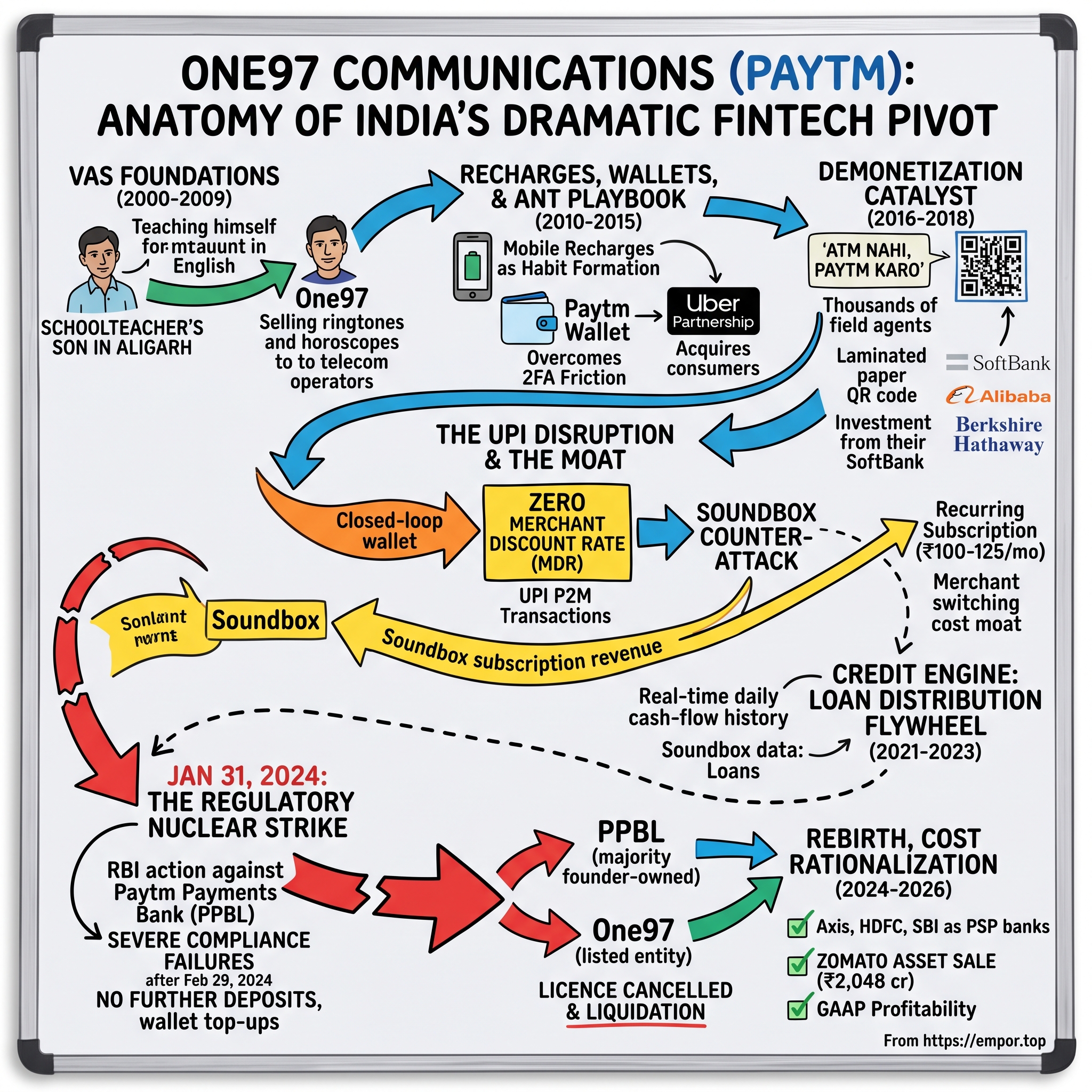
One97 Communications (Paytm): The Anatomy of India's Most Dramatic Fintech Pivot
I. Introduction & Episode Roadmap
On the evening of January 31, 2024, a two-page press release appeared on the Reserve Bank of India's website. Written in the restrained register typical of central bank enforcement actions, it instructed Paytm Payments Bank Limited to accept no further deposits, credit transactions, wallet top-ups, or FASTag recharges after February 29, 2024. The directive was issued under Section 35A of the Banking Regulation Act, 1949 — a regulatory authority deployed when severe compliance failures persist.1
Inside One97 Communications, Paytm's listed parent, the release landed as an existential crisis. The payments bank was not an ancillary unit; it provided the core infrastructure. The bank held consumer wallet balances, operated merchant nodal accounts settling billions of rupees daily, issued millions of FASTag toll passes, and anchored the company's @paytm Unified Payments Interface (UPI) handle. A business that had spent eight years making "Paytm karo" a household phrase suddenly had roughly four weeks to reconstruct its operating model while continuing to serve millions of customers.
Public markets responded immediately. By May 9, 2024, One97 shares fell to an all-time low of ₹310 on the exchanges — roughly 86% below the ₹2,150 price at which the company had sold India's largest-ever IPO less than three years earlier.2 Key early backers had already retreated: Berkshire Hathaway had already sold out at a 40% loss two months before the RBI order,3 SoftBank exited its position, and Alibaba's Ant Group was on its way out.
The turnaround that followed makes this corporate trajectory remarkable. For the quarter ended June 30, 2026, One97 Communications reported revenue of ₹2,448 crore, up 28% year on year, its highest-ever quarterly EBITDA of ₹203 crore, and a cash balance of ₹13,529 crore.4 The financial year ended March 2026 was its first full year of profitability, with profit after tax of ₹552 crore against a loss of ₹663 crore the year before.5 The stock closed near ₹1,341 on the BSE in early August 2026, giving the company a market capitalisation of roughly ₹86,000 crore.6 On a GAAP basis, the company is profitable once again.
That recovery forms the central spine of this story, though it warrants scrutiny alongside recognition. The central question is not merely how Paytm survived, but what the underlying business has become — and whether the drivers of its recovery represent a durable enterprise or simply another transition for a company accustomed to regulatory pivots.
The core paradox. Paytm pioneered digital payments in India, only to see public infrastructure render basic payment processing free. The state-backed Unified Payments Interface enables instant bank-to-bank transfers, while government regulations mandate a zero Merchant Discount Rate on person-to-merchant UPI transactions. Paytm responded with a physical solution: the Soundbox, a small battery-powered speaker that verbally confirms payment amounts in the merchant's local language. By charging merchants a monthly subscription fee of ₹100 to ₹125 to rent the device, Paytm converted zero-margin payment volume into recurring subscription revenue. That hardware innovation anchored the company's turnaround.
Four central themes. First, the trade-off between growth velocity and regulatory compliance: the same speed that expanded the payments network created severe compliance debt. Second, hardware as a software moat: how a low-cost audio device introduced merchant switching costs into an otherwise commoditised payments market. Third, the strategic pivot from balance-sheet exposure to pure distribution — earning fees by distributing third-party loans, insurance, and mutual funds. Fourth, crisis capital allocation under extreme operational pressure.
The roadmap. The analysis begins in 2000, with a company selling ringtones and horoscopes to telecom operators. It moves through mobile recharges, the closed-loop wallet, early investments from Alibaba, and the defining shock of Indian demonetisation on November 8, 2016. The narrative then traces the arrival of zero-fee UPI, the Soundbox counter-strategy, the ₹18,300 crore IPO and its collapse, the loan flywheel, the regulatory strike, and the disciplined rebuild that followed. Finally, the analysis evaluates current financial metrics, key operational risks, and the core indicators that demonstrate whether the financial recovery is sustainable.
 Subscribe on LinkedIn
II. Origins & Telecom VAS Foundations (2000–2009)
Aligarh, Uttar Pradesh, in the 1980s was an unlikely origin for a technology fortune. A mid-sized city best known for its university and lock-manufacturing industry, it was where Vijay Shekhar Sharma grew up as the son of a schoolteacher, educated in Hindi-medium schools. He finished school at fourteen and arrived at Delhi College of Engineering to discover that the lectures, textbooks, and social currency of the institution were all in English — a language he could read only haltingly.
In accounts Sharma has shared over the following two decades, he taught himself English by reading Hindi and English editions of the same textbooks side by side while reading American technology publications in the college library. That experience of encountering an artificial barrier shaped his business ethos. Product strategies across his subsequent ventures focused on removing access barriers for everyday Indian consumers who lacked credit cards, formal banking relationships, or English fluency.
After building websites in college and losing most of the proceeds from the sale of an early startup, Sharma founded One97 Communications in 2000. Named after 197, India's legacy telephone enquiry directory, One97 began not as a consumer brand, but as a business-to-business vendor to major telecom operators, including Airtel, Vodafone, Idea, and BSNL. It operated in the category then known as Value Added Services (VAS).
During India's mobile expansion between 2000 and 2009, hundreds of millions of subscribers acquired basic feature phones capable only of voice calls and text messaging. Telecom operators filled the capability gap with add-on VAS products: caller ring-back tones, daily horoscopes, cricket scores, devotional content, SMS quizzes, and interactive voice response systems for television voting. One97 built and managed these backend platforms; when a viewer in Patna called in to vote for a television contestant, One97 frequently routed the connection.
The VAS model offered attractive short-term economics: minimal content production costs, distribution managed entirely by carriers, and rapid cash collection. Early institutional backing came from SAIF Partners (later renamed Elevation Capital), led in India by Ravi Adusumalli — an investor relationship that proved vital a decade and a half later. Although profitable, One97 remained relatively small, leading the company to file for an initial public offering in 2010 before ultimately withdrawing it.
A structural flaw soon threatened the model: One97 did not own the end customer. Telecom operators held the billing relationships, subscriber data, and pricing power. Standard VAS revenue-sharing agreements routinely awarded carriers the majority of sales, and operators could alter terms unilaterally. Combined with severe customer concentration across a small group of mobile operators, One97 operated a high-margin enterprise devoid of structural leverage.
In Sharma's strategic view, network owners extracted the majority of industry value until internet connectivity bypassed them. The impending arrival of smartphones and 3G networks threatened to reduce telecom carriers to passive bandwidth conduits, transferring customer engagement to mobile application layers. The central strategic question was determining which application layer to control.
Sharma selected payments. Although digital transactions were minimal in India in 2009, payments functioned as the fundamental utility underlying all digital activities. While content and commerce represented distinct verticals, the payment layer sat underneath both, providing visibility into consumer spending, merchant activity, and transaction volumes — creating a defensible foundation for a broader digital ecosystem.
Reinvesting the VAS business's cash flow to build a consumer payments network in 2010 represented a bold capital allocation decision by a founder lacking formal banking experience or a financial license. That early emphasis on controlling distribution and owning customer relationships over providing pure content established a defining operational pattern that recurred throughout One97's subsequent expansion and regulatory trials.
III. The Paytm Pivot: Recharges, Wallets, & The Ant Financial Playbook (2010–2015)
The initial iteration of Paytm, launched in 2010 as an acronym for "Pay Through Mobile," began modestly as a simple website for topping up prepaid mobile connections and direct-to-home (DTH) satellite television subscriptions.
Yet simplicity belied strategic value. In 2010, the overwhelming majority of Indian mobile connections were prepaid. Recharging required consumers to visit physical kirana stores, pay cash, and wait for a scratch card or SMS confirmation. These transactions were small — typically ₹10, ₹20, or ₹50 — but constant, making recharges the highest-frequency financial interaction in Indian daily life. By digitising this routine task, Paytm cultivated digital payment habits among millions of first-time users.
A major operational bottleneck soon emerged: regulatory compliance. The Reserve Bank of India had long mandated two-factor authentication (2FA) for card transactions, requiring a one-time password (OTP) alongside card details. While robust for security, 2FA introduced significant checkout friction. On a small ₹50 recharge, an OTP delayed by forty seconds over a congested SMS network frequently led to abandoned transactions. During that period, Indian e-commerce platforms routinely suffered checkout drop-off rates near 50% due to authentication failures.
The Paytm Wallet, launched in 2014, provided an elegant workaround. Built on the closed-loop prepaid payment instruments permitted by the RBI, the wallet allowed users to load funds once — completing the 2FA process a single time — and subsequently spend from that stored balance with a single tap. Economically, the wallet created a pool of low-cost float under Paytm's control; strategically, it dramatically improved transaction completion rates; and operationally, it transformed the app from a transient payment gateway into a repository for consumer funds.
A regulatory intervention in late 2014 accelerated adoption dramatically. When the RBI enforced its 2FA mandate on international card transactions processed offshore, Uber's seamless India payment experience — which charged saved cards without an OTP — was rendered non-compliant. Uber publicly stated at the time that compliance made its service "less convenient,"7 and it resolved the issue by adopting the Paytm Wallet as its primary payment option in India.
The deal proved transformative. Urban commuters across major metros like Delhi, Mumbai, and Bengaluru were required to download Paytm, fund their wallets, and maintain active balances. Uber effectively financed customer acquisition for Paytm, acquiring an affluent, high-frequency demographic that digital financial platforms covet. The partnership highlighted Vijay Shekhar Sharma's ability to turn regulatory disruption into strategic distribution.
Paytm subsequently expanded into utility bill payments, bus ticketing, and broader recharge services. While individual categories yielded thin margins, collectively they established high-frequency engagement and solidified daily usage habits among consumers.
The Ant Financial playbook. In February 2015, Ant Financial — the fintech affiliate of Alibaba — acquired roughly 25% of One97 Communications for over $500 million, valuing the company at more than $2 billion. In September 2015, Alibaba invested directly alongside Ant, elevating the combined stake and becoming One97's largest shareholder.8 The connection originated through SAIF Partners, an early investor with ties to both firms.
Beyond capital, the investment provided Paytm with a proven operational playbook developed by Alipay in China, where card adoption was similarly low. The strategy rested on three core pillars: aggressive cashback subsidies to drive consumer adoption, closed-loop ecosystem design to retain funds within the wallet network, and rapid expansion into a multi-service "super-app" to monetize user engagement.
Paytm executed this strategy aggressively. Cashback promotions became central to its brand identity, merchant acquisition surged, and by early 2016, Paytm had established itself as the leading digital payments platform in India.
In retrospect, two strategic vulnerabilities were embedded in this expansion. First, the closed-loop wallet successfully bypassed 2FA friction, but its competitive moat depended on the absence of a zero-cost, open public infrastructure. Second, major Chinese equity backing — initially viewed as a premier endorsement — would later become a significant regulatory liability as geopolitical tensions increased scrutiny on foreign capital in critical infrastructure. Ant Financial eventually divested its entire position at a substantial loss.
In 2015, however, both risks remained latent. Before either materialized, Paytm was about to encounter an unprecedented macroeconomic catalyst.
IV. The Demonetization Catalyst & Hyper-Growth (2016–2018)
At 8:15 p.m. on November 8, 2016, Prime Minister Narendra Modi appeared on national television to announce that ₹500 and ₹1,000 banknotes would cease to be legal tender at midnight. Those two denominations accounted for roughly 86% of the currency in circulation in an economy where the overwhelming majority of retail transactions were settled in cash.
What followed was several weeks of national improvisation. Queues stretched outside banks and ATMs that lacked replacement notes. Small merchants — vegetable sellers, chai stalls, and neighbourhood kirana stores — faced an immediate crisis: customers wanted to make purchases but had no cash to pay with.
Paytm's response the next morning became a defining moment in Indian business history. The company published full front-page advertisements across major national newspapers featuring an image of the Prime Minister, congratulating him on "the boldest decision in the financial history of independent India." The accompanying tagline quickly embedded itself in popular culture: ATM nahi, Paytm karo — "Don't go to the ATM, use Paytm."
Commercially, it was a remarkably effective campaign. Strategically, it publicly bound Paytm's brand to a state policy — a bet on political alignment that would carry a very different complexion eight years later when regulatory scrutiny intensified.
The field operation. Print advertising was merely the visible layer; the execution on the ground proved far more consequential. Paytm deployed thousands of field agents into wholesale markets, commercial hubs, and residential neighbourhoods with instructions to onboard any willing merchant. The operational advantage lay in the low friction required of the vendor: no expensive card terminal, no monthly rental, no dedicated phone line, and no formal banking setup. The merchant needed only a paper QR code sticker, laminated and taped to the counter. A customer scanned the code, funds transferred from their Paytm wallet to the merchant's wallet, and a confirmation appeared instantly on the merchant's phone.
The economics of this deployment reshaped Indian fintech. Traditional point-of-sale card terminals cost thousands of rupees to install and required substantial monthly transaction volume to justify the expense, limiting card acceptance across India to a few million outlets. By contrast, a paper QR sticker cost a few rupees to produce. Paytm could therefore expand into a merchant universe an order of magnitude larger — millions of micro-merchants previously ignored by commercial banks.
Growth over the subsequent two years transformed the market. Paytm's monthly transacting users and transaction volumes compounded rapidly, establishing the company as the dominant centre of Indian digital payments. "Paytm" entered daily usage as a synonym for digital payments across multiple Indian languages — a brand equity that ultimately proved far more durable than the transaction market share underlying it.
The capital wave. Global venture capital followed this rapid expansion. In 2017, SoftBank invested approximately $1.4 billion at a valuation of around $7 billion — acquiring a board seat and purchasing secondary shares from early investor SAIF Partners and Sharma.9 In 2018, Berkshire Hathaway invested about $260 million for roughly a 3% stake at a valuation near $10 billion, marking a rare venture-style commitment in an Indian technology enterprise for a firm historically cautious toward early-stage technology.3
Yet the market enthusiasm of 2017 obscured a structural vulnerability that would become the central pivot of Paytm's trajectory. While demonetisation provided Paytm with massive user scale and an unprecedented merchant network, it did not yield an intrinsically sustainable business model. The economics of every wallet transaction depended on two pillars: the interest earned on float balances retained in stored wallets, and a merchant discount rate that Paytm could collect because it controlled both sides of the payment loop.
At the very moment demonetisation expanded Paytm's user base, the Indian state was preparing to launch a public payments architecture that would dismantle both revenue streams.
V. The UPI Disruption & The Soundbox Counter-Attack (2016–2021)
Launched in 2016 by the National Payments Corporation of India — a bank-owned entity overseen by the Reserve Bank of India — the Unified Payments Interface (UPI) fundamentally reshaped Indian digital finance. Understanding its architecture is essential to evaluating Paytm’s strategic pivot.
Whereas a digital wallet operates as a closed prepaid instrument requiring users to pre-fund a balance, UPI functions as an open, interoperable protocol. It allows any licensed application to transfer funds directly between bank accounts instantly and continuously using virtual payment addresses like name@bank. Crucially, because the underlying protocol is open, transfers sent from one application can be seamlessly received by any other without stored-value accounts.
For consumers, UPI offered immediate convenience over closed-loop wallets without requiring pre-funding friction. Regulatory intervention then altered market economics: the Indian government mandated a zero Merchant Discount Rate (MDR) on person-to-merchant UPI transactions. By statutory decree, the fee structure supporting payment processors globally was eliminated in one of the world's largest digital payment markets.
Paytm's misstep. Paytm initially hesitated to embrace the open protocol. That reluctance reflected commercial trade-offs: closed-loop wallets generated interest income on stored float as well as merchant transaction fees. Having invested heavily in building a proprietary closed loop, Paytm faced a structural disadvantage: every user migrating to UPI represented a payment flow the company could no longer directly monetize.
Competitors without legacy wallet infrastructure moved aggressively. PhonePe, then owned by Flipkart and later acquired by Walmart, adopted UPI immediately. Google launched Tez (later Google Pay), leveraging Android's distribution reach. Both platforms offered frictionless bank-to-bank transfers and rapidly captured consumer transaction share.
By 2026, PhonePe accounted for roughly 46% of UPI transaction volume and Google Pay held about 33%, while Paytm trailed at approximately 8%.10 By defending its closed-loop wallet against an open public standard, Paytm surrendered dominant market share in consumer-initiated UPI payments.
However, consumer transaction volume reflects only one side of the payments market. Consumer UPI metrics track payment initiation, but they do not measure merchant acquisition — the entity controlling the physical checkout relationship, managing daily settlements, and cross-selling financial services. Although Paytm lost consumer volume leadership, it refocused its strategy on securing the merchant point of sale.
The Soundbox. Paytm's recovery relied on an operational insight from physical retail counters. In crowded micro-merchant environments, verifying digital payments created operational friction. When a customer scanned a counter QR code and displayed a confirmation screen, merchants frequently lacked time to inspect their own mobile phones for SMS alerts. This vulnerability exposed small vendors to payment fraud via spoofed confirmation screens or uncompleted transfers.
To address this trust gap, Paytm introduced the Soundbox in 2019 — a compact, battery-powered speaker equipped with a dedicated cellular SIM card. Upon settlement, the device audibly broadcasts the received amount in the merchant's chosen language — such as "Paytm par pachaas rupaye praapt hue" (fifty rupees received on Paytm) — providing immediate verification without requiring the vendor to check a personal mobile screen.11
The innovation addressed an operational workflow problem rather than a payment processing flaw. Crucially, because the device delivered tangible operational value, Paytm charged merchants a monthly rental fee of approximately ₹100 to ₹125. In doing so, Paytm converted a zero-MDR regulated payment utility into a recurring hardware-enabled subscription stream.
The device scaled rapidly across India's commercial footprint. By the quarter ended June 2026, Paytm reported 1.57 crore (15.7 million) merchants on paid subscription plans, after adding approximately 2.7 million net devices over the preceding twelve months.4 On its Q1 FY2027 earnings call, management reiterated an annual deployment target of 2.5 million to 3.0 million net additions.12
This hardware deployment established durable switching costs in an otherwise commoditized payments market. While a merchant can display multiple paper QR stickers from competing processors, an active Soundbox occupies physical counter space, integrates into daily cashier workflows, and captures real-time transaction data.
Beyond subscription revenue, the network provided Paytm with a high-frequency dataset capturing daily cash flows across millions of small businesses — establishing the data foundation for its subsequent expansion into merchant credit distribution.
VI. M&A Missteps, Experiments, & The $20 Billion IPO Debacle (2017–2021)
Before examining Paytm's expansion into credit distribution, it is necessary to assess the costs of its broader super-app ambition. Between 2017 and 2021, capital from major backers like SoftBank and Alibaba funded a series of costly acquisitions and internal ventures that ultimately failed to deliver sustainable returns.
Paytm Mall. Backed by Alibaba, Paytm Mall was an ambitious attempt to build a third-party e-commerce marketplace to rival Flipkart and Amazon. The strategy mirrored Alibaba's playbook in China, where Alipay grew alongside Taobao on the premise that payments and e-commerce mutually reinforce each other. In India, however, the dynamic proved fundamentally different. While established competitors spent a decade constructing physical logistics networks, Paytm Mall relied heavily on customer cashbacks. These promotional subsidies attracted price-sensitive shoppers who departed as soon as incentives waned, while also exposing the platform to promotional fraud. Paytm Mall burned through vast sums before being progressively written down and restructured, illustrating that a consumer payments relationship does not automatically convert into an e-commerce moat.
The hyperlocal and deals acquisitions. Paytm acquired deals and discovery platforms Nearbuy and Little, merging them in a bid to deepen local commerce engagement through restaurant and salon coupons. Anticipated synergies failed to materialize in a category facing global structural headwinds, and the ventures failed to become meaningful operational contributors.
Scattered venture bets. Beyond core payments, One97 made fragmented investments across insurance distribution, merchant software tools, and adjacent technology assets. Though individually modest, these expenditures collectively reflected a strategy of unfocused capital deployment.
A rare success. One notable exception was the 2017 acquisition of Insider.in, a live-events and ticketing platform, for a single-digit million-dollar sum. Integrated directly into the main application, it established Paytm's entertainment ticketing division across concerts, comedy, sports, and cinema — an asset that acquired renewed strategic importance years later.
In aggregate, Paytm's pre-IPO capital allocation reflected significant strategic inefficiencies. The company repeatedly acquired distribution channels it already possessed and entered verticals where it held no distinct operational advantage, justifying the expenditures through a super-app narrative that assumed a large user base could automatically sustain adjacent business lines.
The November 2021 initial public offering. Against this backdrop of scattered bets and unproven unit economics, One97 Communications launched India's largest initial public offering at the time, raising ₹18,300 crore (approximately $2.4 billion). The issue price of ₹2,150 per share implied a valuation near $20 billion.13 However, the Red Herring Prospectus filed with the Securities and Exchange Board of India (SEBI) outlined a company with massive scale but no clear path to profitability.[^14]
The market debut on November 18, 2021, proved disastrous. The stock opened at ₹1,955, well below the issue price, and plummeted roughly 27% on its first trading day to close at ₹1,564 — marking one of the worst debuts for a major Indian technology company.14
Institutional pushback was immediate and focused. Analysts questioned the business model's basic viability given that government mandates rendered the core payment product free. They raised sharp concerns regarding structural complexity — specifically the web of subsidiaries and the related-party dependency on Paytm Payments Bank, where the listed entity held a 49% stake while Sharma personally held 51%. Analysts also criticized a price-to-sales valuation that demanded years of flawless execution, alongside broader corporate governance concerns regarding executive compensation and stock option grants.
Those governance concerns proved well-founded. In May 2025, SEBI settled a matter regarding employee stock options granted to Sharma and his brother. Under the settlement, Sharma paid ₹1.11 crore, his brother Ajay Shekhar Sharma paid ₹57.1 lakh plus disgorged gains, and Sharma accepted a three-year restriction on receiving fresh stock options from listed entities. The regulator's investigation focused on Sharma's reclassification as a non-promoter shortly before filing the IPO prospectus, which affected his legal eligibility for option grants. One97 subsequently cancelled the options and recorded a one-time charge of ₹492 crore.15 Beyond the financial settlement, the enforcement action validated institutional criticisms regarding pre-IPO governance.
The public listing also marked the beginning of a sustained exit by early institutional backers. Berkshire Hathaway sold its entire holding in November 2023 at roughly a 40% loss.3 SoftBank's Vision Fund 1 fully exited its position in 2024, disclosing a gross loss of $544 million.16 Ant Group's affiliate Antfin sold its remaining 5.84% stake in August 2025, completing a full exit from an investment that had once made Alibaba the company's largest shareholder.17
A company can withstand the departure of marquee investors. Far more difficult to navigate, however, were the underlying operational and regulatory vulnerabilities that prompted their exit — vulnerabilities that culminated in the regulatory action of January 2024.
VII. The Credit Engine: Loan Distribution Flywheel (2021–2023)
Stripped to fundamentals in 2021, Paytm presented a core monetization challenge. The company processed vast payment volumes, but government mandates capped the merchant discount rate at zero on Unified Payments Interface (UPI) transactions — the platform's fastest-growing segment. While Soundbox device rentals generated recurring revenue at modest gross margins, hardware subscriptions offered limited pricing power. To build a highly profitable enterprise, Paytm required a higher-margin business line.
For major payment platforms globally, credit provides that margin. Processing payments acquires users and yields transactional data; distributing credit monetizes both.
Fintech platforms generally approach lending through two distinct operating models: balance-sheet underwriting or third-party distribution. Direct underwriting captures the full interest spread while absorbing all credit losses. Distribution acts as a fee-based marketplace — acquiring borrowers, packaging applications, and routing them to commercial banks and non-banking financial companies (NBFCs) that hold the loans and default risks on their own balance sheets.
Paytm consistently pursued the pure-distribution approach. Partnering with commercial banks, small finance banks, and NBFCs, the company structured its credit distribution across three primary categories: Paytm Postpaid (a small-ticket buy-now-pay-later consumer facility), unsecured personal loans, and merchant working capital loans.
The underwriting edge. Among these offerings, merchant loans provided a distinct structural advantage enabled directly by the Soundbox deployment. Assessing small micro-merchants traditionally presents an information vacuum, as these vendors typically lack audited financial statements, formal tax filings, or credit histories. Paytm bridged this gap using daily settlement flows captured through Soundbox devices, generating a real-time, passive cash-flow history across millions of small businesses. That data revealed daily revenue trends, seasonality, and operating stability without requiring manual disclosures.
Loan servicing was similarly integrated into daily merchant workflows. Because transaction revenues settled through Paytm's payment rails, loan repayments could be deducted directly from daily settlements rather than relying on monthly bank mandates. Combined with the merchant's operational reliance on the physical Soundbox device, this cash-flow visibility and operational connection created a low-friction collection mechanism.
The economics. Paytm monetized these origination services through upfront distribution fees and ongoing collection fees on merchant portfolios. Crucially, management repeatedly emphasized that it operated without providing First Loss Default Guarantees (FLDG), thereby avoiding synthetic credit risk or off-balance-sheet loan loss exposures. Vijay Shekhar Sharma reiterated this position on the July 2026 earnings call, noting that the business operated "mostly without requiring any FLDG" and emphasizing that Paytm remained "a purely distribution company" with no intention of holding loans on its own balance sheet.12
Then the cycle turned. Credit distribution expanded rapidly through fiscal 2023, turning financial services into Paytm's fastest-growing and highest-margin segment. Paytm Postpaid alone reached a peak of approximately ₹9,000 crore in quarterly disbursements during 2023 — a volume that management later cited on its Q1 FY2027 earnings call as the benchmark it aimed to rebuild toward.12
In late 2023, however, regulatory conditions tightened across the sector. The Reserve Bank of India increased risk weights on unsecured consumer loans, requiring banks and NBFCs to allocate higher capital reserves against small-ticket credit and raising capital costs. Institutional lenders responded by curtailing loan originations, causing Paytm's distribution volumes — particularly in small-ticket consumer BNPL — to decline sharply.
The contraction exposed the structural trade-off of the pure-distribution strategy. While insulating Paytm from direct default losses, the model left loan volumes entirely dependent on institutional partners' underwriting appetite, macro credit cycles, and central bank directives. By choosing distribution over balance-sheet lending, Paytm traded credit default risk for partner-concentration and regulatory cycle risk.
Paytm was still adapting to this credit slowdown when an even more consequential shock struck its core operating infrastructure.
VIII. The Regulatory Nuclear Strike: RBI vs. Paytm Payments Bank (Jan 2024–March 2024)
Understanding the crisis of January 2024 requires examining a corporate ownership structure that public market investors had long treated as a minor technicality.
Paytm Payments Bank Limited (PPBL) was not a subsidiary of listed One97 Communications. One97 held a 49% stake, while founder Vijay Shekhar Sharma held the remaining 51% personally. This arrangement satisfied the Reserve Bank of India's rules on payments bank ownership and foreign equity caps: the listed parent carried substantial foreign capital, while banking regulations required majority resident Indian control.
Consequently, the group's most critical operational engine sat outside the listed entity, majority-owned by the founder in his personal capacity, and linked to One97 through a web of related-party agreements. PPBL held consumer wallet balances, operated the nodal accounts settling daily merchant transactions, issued FASTag toll passes, and anchored Paytm's @paytm Unified Payments Interface (UPI) handle. If PPBL ceased operations, Paytm's core service grid would grind to a halt.
The warnings. The regulatory intervention was not unprecedented. In March 2022, the RBI barred PPBL from onboarding new customers and ordered a comprehensive external IT audit.18 For a financial institution, an onboarding prohibition is not merely a financial fine — it represents a severe operational freeze while regulatory authorities evaluate systemic risks.
The compliance deficiencies that surfaced over the following two years were extensive. Examinations revealed hundreds of thousands of accounts that failed to satisfy Know Your Customer (KYC) standards, alongside thousands of instances where a single Permanent Account Number (PAN) — India's national tax identifier — was linked to multiple accounts, a classic signature of illicit mule-account activity. Transaction volumes across minimum-KYC prepaid instruments repeatedly exceeded regulatory caps, raising money-laundering concerns. Furthermore, regulatory filings were characterized as incomplete and, on occasion, false.19 In October 2023, the RBI imposed a monetary penalty on PPBL for ongoing KYC non-compliance.
Nineteen months elapsed between the initial onboarding freeze and the final directive — an extended interval during which market participants were repeatedly assured that the deficiencies were procedural.
January 31, 2024. The RBI issued a Section 35A directive instructing PPBL to cease accepting further deposits, credit transactions, wallet top-ups, FASTag recharges, or prepaid instruments after February 29, 2024, permitting only interest accruals, cashbacks, or refunds. The order also mandated the termination of all nodal accounts belonging to One97 Communications and Paytm Payments Services by the same date.1 On February 16, the central bank granted operational clarifications, extending key compliance deadlines to March 15 and specifying rules governing the withdrawal of existing balances.20
Financial markets reacted severely. One97 shares hit daily lower price bands across consecutive trading sessions, eventually dropping to an all-time low of ₹310 by May 2024.2 However, the immediate operational disruption presented a far greater threat. Merchants settling daily transactions through Paytm nodal accounts faced uncertainty regarding whether revenue settlements would arrive, while consumers questioned the safety of their wallet deposits. Competing fintech sales teams quickly mobilized across commercial centers, attempting to poach Paytm's merchant base with migration incentives.
The operational response. Navigating the emergency required immediate structural restructuring and technical execution across three primary fronts.
First, governance decoupling. Sharma resigned from the board of PPBL, and One97 initiated the termination of all inter-company and related-party agreements connecting the listed entity to the payments bank. The complex related-party arrangement that had drawn investor criticism during the IPO was dismantled under regulatory compulsion.
Second, nodal account migration. Within weeks, One97 migrated its core merchant settlement infrastructure and payment routing to commercial banking institutions, establishing Axis Bank as its primary initial partner before diversifying routing across additional major banks. Rerouting live transaction processing for millions of merchants under a rigid regulatory deadline without prolonged system outages represented a substantial technical achievement.
Third, the multi-bank UPI transition. On March 14, 2024, the National Payments Corporation of India (NPCI) granted approval for One97 Communications to operate as a Third-Party Application Provider (TPAP) under a multi-bank model. Axis Bank, HDFC Bank, State Bank of India, and YES Bank stepped in as payment service provider banks, with Axis Bank serving as the primary merchant acquiring bank for existing business accounts.5 This regulatory approval stabilized Paytm's consumer payments application: rather than routing @paytm handles through its captive payments bank, Paytm transitioned to the third-party partner model utilized by competitors PhonePe and Google Pay.
The structural arrangement Paytm had resisted for years — relying on external commercial banks rather than an internal banking license — became the operational framework that ultimately enabled its financial recovery.
The cost of restructuring. Stabilizing the platform carried significant operational expenses. One97 substantially reduced headcount, curtailed marketing expenditure, and paused loan originations while partner lending institutions evaluated regulatory risks. Furthermore, the company permanently forfeited a key revenue line: float income and stored-value wallet fee economics derived from holding consumer deposits within an affiliated bank.
Licence cancellation and liquidation. PPBL never resumed operations. On April 24, 2026, the RBI revoked the institution's banking licence under Section 22(4) of the Banking Regulation Act, concluding that the bank's operations were conducted in a manner detrimental to depositors, that the character of its management was prejudicial to the public interest, and that its continued existence served no regulatory purpose. The central bank noted that PPBL maintained sufficient liquidity to satisfy depositor claims in full and initiated winding-up proceedings.21 In July 2026, the Delhi High Court formally ordered the liquidation of PPBL and appointed an Official Liquidator.22
The regulatory overhang concluded with the permanent dissolution of the asset rather than its rehabilitation. For One97 shareholders, the direct balance-sheet impact was largely contained, as the 49% equity stake had been fully written down and operational dependencies severed two years prior. However, the governance implications remain significant: central bank findings that management of a founder-controlled affiliate acted in a manner prejudicial to the public interest present an ongoing reputational consideration when evaluating corporate governance and management execution, even as core financial metrics recover.
IX. Rebirth, Cost Rationalization, & The Zomato Asset Sale (2024–2026)
Faced with severe operational disruption following regulatory action, One97 Communications avoided dilutive equity raises at distressed valuations by pursuing targeted asset monetization and sweeping operational retrenchment.
The August 2024 divestment. Paytm agreed to sell its entertainment and events ticketing business—comprising the Insider.in platform acquired in 2017, TicketNew, and its movie ticketing operations—to Zomato for ₹2,048 crore, roughly $245 million, in cash.[^24]
Three analytical takeaways define the transaction: 1. Capital return: An asset acquired for single-digit millions of dollars in 2017 was monetized for nearly a quarter of a billion dollars, representing a rare high-return deal in Paytm's acquisition history. 2. Strategic refocus: Event ticketing aligns naturally with Zomato's consumer lifestyle and dining business rather than Paytm's merchant credit operations. Selling the unit signaled a formal retreat from the 2018 super-app thesis. 3. Non-dilutive liquidity: By monetizing a non-core asset during peak operational stress, Paytm strengthened its balance sheet without issuing heavily discounted equity, demonstrating disciplined capital allocation under pressure.
The cost reset. The subsequent reorganization focused on operational retrenchment: reducing headcount in discontinued divisions, curtailing marketing and promotional spend, renegotiating software contracts, and narrowing the product suite.
By fiscal 2026, the financial impact was evident in reported figures. For the year ended March 31, 2026, One97 Communications reported revenue from operations of ₹8,437 crore, up 22% year-on-year. The company recorded EBITDA of ₹502 crore—a swing of over ₹2,000 crore from the previous year's loss—and generated a profit after tax of ₹552 crore, compared to a loss of ₹663 crore in fiscal 2025. Within segment totals, payment services revenue grew 20% to ₹4,646 crore, while financial services distribution revenue grew 52% to ₹2,593 crore.5
Two structural dynamics underlay these results. First, the ₹2,000 crore EBITDA turnaround stemmed primarily from overhead reduction rather than organic demand expansion, reflecting the substantial discretionary costs carried prior to 2024. Second, revenue composition shifted fundamentally: financial services grew nearly three times faster than payment processing, shifting the company's profit center from payment processing to loan distribution.
Regulatory rehabilitation. Regulatory approvals resumed in phases through 2025. Paytm Payments Services Limited (PPSL), a wholly owned subsidiary, received Reserve Bank of India authorization to operate as an online payment aggregator in November 2025—ending a three-year regulatory freeze on onboarding new online merchants—and was authorized for offline and cross-border payment aggregation as well in December 2025.23 On its July 2026 earnings call, management cited the online license as the reason online merchant gross merchandise value had begun contributing to growth after years of being frozen.12
In July 2026, One97 disclosed that PPSL had applied to the RBI for a Prepaid Payment Instrument licence to issue digital wallets directly without a banking partner. The application is pending.24 If approved, the license would allow Paytm to rebuild its wallet ecosystem within a wholly owned subsidiary, eliminating the related-party structure that characterized its former payments bank affiliate.
Product realignment. In hardware, Paytm expanded its device offerings to include display screens, solar-powered units for regions with spotty electricity, and NFC-enabled Card Soundboxes. These hybrid devices accept contactless credit card taps alongside QR payments, turning a ₹100-a-month speaker into a card acceptance terminal at a fraction of a traditional terminal's cost.11 The shift carries a distinct economic advantage: card processing earns merchant discount fees, whereas person-to-merchant UPI transactions carry a mandated zero fee.
In lending, Paytm shifted distribution away from small-ticket buy-now-pay-later facilities toward higher-value merchant credit and personal loans. On the July 2026 earnings call, management reported establishing double-digit lending partnerships across commercial and small finance banks, asserting that available partner capital reached four to six times current disbursement levels.12
This assertion reflects institutional balance-sheet capacity rather than guaranteed funding. If partner risk appetite remains stable, credit growth depends on borrower demand and underwriting quality; however, if credit cycles tighten or default rates rise, partner capital can contract quickly, exposing loan distribution once again to broader macroeconomic cycles.
X. Business Segments & Unit Economics Deep Dive
Stripped of narrative, Paytm operates four distinct business lines built atop a single distribution network. Evaluating how each unit generates revenue clarifies the company's financial model and unit economics.
1. Payment services to merchants — the anchor. As Paytm's largest and most strategically vital segment, merchant payment services operates through two distinct revenue drivers.
The first is subscription revenue: monthly rental fees of roughly ₹100 to ₹125 per device collected across 1.57 crore paying merchants for Soundboxes and point-of-sale card terminals. Because devices are capitalized and depreciated, the segment functions like a classic hardware rental business, where upfront capital expenditures are recovered over a payback period, after which rental revenue converts largely into gross profit. Depreciation and amortization expense fell 21% year-on-year to ₹131 crore in the June 2026 quarter due to declining hardware production costs, with full-year FY2027 depreciation and amortization guided between ₹550 crore and ₹600 crore.4 Decreasing device costs alongside stable monthly rental fees drive steady margin expansion.
The second is payment processing margin: the fee income Paytm retains from transaction processing after compensating partner banks and card networks. While person-to-merchant UPI transactions yield virtually zero margin by government mandate, credit card, debit card, net banking, and RuPay credit-on-UPI transactions carry commercial merchant discount rates (MDR). Management reported that payment processing margins expanded comfortably above 4 basis points, attributing the improvement to favorable payment mix—specifically higher adoption of MDR-bearing instruments—alongside market share gains and pricing discipline.4
While 4 basis points equals just 0.04%, applied across ₹7.1 lakh crore in quarterly merchant gross merchandise value (GMV), small basis-point gains translate into substantial absolute revenue. However, the underlying mechanism depends heavily on external tailwinds: Paytm's payment margins improved not through price increases, but because non-zero-MDR instruments expanded as a share of total volume—a dynamic reliant on broader consumer adoption of credit facilities on UPI.
Combined, subscription rentals and payment processing generated net payment revenue of ₹601 crore in the June 2026 quarter, representing a 25% increase on a comparable basis.4 Notably, net payment margin relative to GMV declined from 8.8 to 8.4 basis points excluding government incentives. When questioned regarding the gap between 31% GMV growth and 25% net payment revenue growth, management explained that monthly device rentals are selectively discounted or waived for high-volume merchants who generate significant financial services revenue, alongside tighter revenue recognition standards.12 Founder Vijay Shekhar Sharma framed the strategy directly, noting that when a merchant generates substantial lending distribution fees, hardware rental becomes secondary and is discounted to defend the account against competitors.
This trade-off presents two competing interpretations: either it reflects disciplined customer lifetime-value optimization—using a low-margin anchor product to lock in high-margin credit distribution—or it signals that Soundbox subscription pricing power is weakening under competitive pressure. Both readings align with the disclosed metrics. The key test over time will be whether financial services revenue per merchant expands faster than hardware subscription revenue per merchant contracts.
2. Payment services to consumers. This category encompasses consumer-facing utility bill payments, mobile recharges, FASTag top-ups, travel bookings, and peer-to-peer UPI transfers routed through Paytm's third-party application architecture. Consumer UPI gross transaction value reached ₹5.9 lakh crore in the June 2026 quarter—up 45% year-on-year, compared to roughly 20% growth across the broader industry—with monthly transacting users reaching 8 crore.4 This high-volume segment yields minimal direct revenue; its primary strategic role is serving as a low-cost customer acquisition funnel feeding higher-margin business lines.
On the July 2026 earnings call, Sharma challenged the notion that person-to-person (P2P) transfers are inherently unprofitable, noting that P2P routing yields originating bank fees. Conversely, person-to-merchant UPI revenue relies partly on government subsidy allocations that, Sharma disclosed, had not yet been received for the prior fiscal year.12 Within UPI's distinct economics, consumer transfers can sometimes yield more reliable net revenue than merchant transactions.
3. Financial services distribution — the profit engine. Financial services revenue reached ₹814 crore in the June 2026 quarter, up 45% year-on-year, driven by 7.6 lakh active financial services customers, with over half of merchant loan disbursements going to repeat borrowers.4 Operating as a pure distribution marketplace with minimal direct fulfillment cost, incremental revenue converts into operating earnings at a high rate, as management confirmed on the earnings call.12 The repeat-borrower rate above 50% serves as a key operational indicator, providing empirical evidence that Paytm's transaction-data underwriting is effectively identifying creditworthy merchants rather than simply expanding disbursement volume.
4. Cloud, commerce, and emerging lines. This segment includes merchant advertising, co-branded credit card distribution, gift cards, and enterprise software services. Segment revenue remained roughly flat year-on-year in the June 2026 quarter, constrained by lower travel booking volumes amid elevated airfares.12 Management also outlined an emerging initiative to commercialize Paytm's internal artificial intelligence models as a software service for enterprise clients. Sharma noted that this offering had generated nominal revenue—describing it as "a few lakhs" to date—making it an early-stage enterprise initiative that warrants longer-term monitoring.
XI. Strategic Analysis: Helmer's 7 Powers & Porter's 5 Forces
War-gaming this business requires separating what Paytm has built from what it claims to possess.
Hamilton Helmer's 7 Powers Assessment
Switching costs — high on the merchant side, near zero on the consumer side. This asymmetry defines the business model. A consumer switching from Paytm to PhonePe loses nothing: UPI is an open, interoperable protocol, and the consumer application functions essentially as an interface over public infrastructure. That structural reality explains why Paytm surrendered consumer transaction share and why an 8% market share can coexist with a viable enterprise. On the merchant side, the dynamic inverts. A physical device on the checkout counter, an embedded audio verification habit, years of daily settlement history, and—for a meaningful minority—a working-capital credit relationship create real friction against switching. High repeat-borrower rates and sustained net device additions provide empirical evidence of merchant retention.
Scale economies — moderate and real, but not decisive. Fixed costs in software engineering, banking integrations, risk algorithms, and a national field force are distributed across a broad merchant footprint. The June 2026 quarter illustrates this operating leverage: total indirect expenses grew just 6% year-on-year while revenue expanded 28%, reducing indirect costs from 56% to 47% of total revenue. Within those figures, sales, marketing, and service expenses rose 27%—reflecting continued growth investment—while platform development costs fell 3%, anchored by a modest 7% rise in non-sales employee expenses and a 5% decline in software and cloud spending.4 However, because rival PhonePe operates at a significantly larger payment volume, scale alone does not deliver a decisive competitive moat.
Cornered resource — moderate to high, representing the company's most defensible asset. The proprietary merchant cash-flow dataset functions as a key competitive barrier. No competitor lacking a comparable physical footprint can replicate the daily settlement histories of over fifteen million small businesses. This transactional dataset underpins Paytm's lending distribution engine, creating a compounding advantage: additional devices generate richer transaction data, enabling sharper underwriting and attracting broader lender participation.
Counter-positioning — historical, and largely eroded. Charging a monthly subscription fee for an audio confirmation device while competitors distributed free paper QR stickers represented genuine counter-positioning in 2019. That advantage no longer holds. PhonePe, BharatPe, Pine Labs, and major commercial banks now market audio-confirmation hardware, transforming a unique hardware innovation into a broader contest of field execution and distribution scale.
Process power — emerging and unproven. Management's central efficiency thesis in 2026 rests on internally fine-tuned artificial intelligence models—specifically compressing a 200-billion-parameter open model into a 4-billion-parameter Indian-language model hosted on proprietary infrastructure to displace third-party software and customer-service costs.12 While reported expense reductions confirm operational progress, whether these tools constitute true process power remains questionable. Sharma conceded on the earnings call that competitors can eventually replicate such software models, noting that distribution reach—rather than model architecture—serves as the primary barrier. That assessment positions AI as an effective tool for margin expansion rather than a structural moat.
Branding and network economies — weak. "Paytm karo" remains a prominent brand phrase, yet brand equity failed to prevent two principal competitors from capturing three-quarters of consumer UPI transactions. Because UPI's interoperable protocol deliberately eliminates closed-loop network effects, long-term valuation models relying on consumer brand loyalty or payment network lock-in lack structural support.
Porter's 5 Forces Assessment
Rivalry — extreme. PhonePe at roughly 46% and Google Pay at roughly 33% of consumer UPI transaction volume dominate consumer payments.10 BharatPe and Pine Labs compete aggressively for merchant counter space, while Jio Financial Services leverages a vast commercial distribution footprint. Furthermore, commercial banks increasingly deploy proprietary merchant terminal solutions. Crucially, none of these competitors depends on payment processing fees as its primary source of earnings.
Buyer power — high. Indian merchants have been accustomed by regulatory mandate to treat payment processing as a free public utility. While vendors demonstrate a willingness to pay monthly rentals for physical hardware and interest on working-capital loans, they resist paying transaction fees on basic payments. This structural resistance establishes a permanent cap on merchant pricing, reflected in Paytm's selective hardware rental discounts and waivers for high-volume merchants.
Supplier power — high and structurally elevated following 2024. Paytm relies on partner commercial banks for UPI routing and settlement, alongside a network of institutional lenders for its credit distribution business. While diversifying these partnerships across multiple banks and NBFCs has mitigated single-point operational risk, it has not eliminated supplier dependency. For a pure-distribution platform, high supplier power carries the persistent risk that underlying capital providers could alter commercial terms or bypass the distributor.
Threat of substitution — moderate. The primary substitution threat stems from underlying protocol shifts rather than rival applications. Features such as UPI Lite, on-device processing, bank-native applications, and new capabilities deployed by the National Payments Corporation of India can alter transaction pathways without requiring Paytm's intermediary infrastructure.
Regulatory intervention — the overarching operational force. In Indian digital finance, regulatory action acts as the primary structural force rather than an external variable. Central bank authorities establish zero-MDR pricing mandates, maintain ownership over payment rails, license financial products, and retain full authority to revoke operational licenses—as demonstrated by the formal liquidation of Paytm Payments Bank. While NPCI's proposed 30% market-share ceiling on third-party UPI applications has seen its compliance deadline repeatedly extended, Paytm's roughly 8% market share leaves it as the sole major platform for whom the proposed cap represents a potential market-share opportunity rather than an operational constraint.25 Nevertheless, the same regulatory authority that could redistribute market share from market leaders retains equal power to impose new compliance burdens on Paytm, making regulatory policy an ongoing operational consideration.
XII. Management Credibility & Investor Stress Test
Assessing Paytm's leadership requires weighing significant operational execution against a history of governance vulnerabilities.
The case for Vijay Shekhar Sharma. Sharma pioneered key digital payment products in India—first the mobile wallet, then the Soundbox—and, when regulatory directives disrupted his company's operational base with four weeks' notice, executed a complete migration of live settlement infrastructure without shutting down the business. Rather than raising dilutive equity at distressed valuations, he monetized a non-core ticketing asset at a favorable price. Furthermore, he has maintained a consistent policy on the company's core lending strategy—operating strictly as a fee-based distributor without taking loan exposures onto the balance sheet or offering first-loss default guarantees—even when expanding credit risk could have boosted short-term revenue.
His public communication style remains distinctively candid for a listed company chief executive. On the July 2026 earnings call, he told analysts on the record, "Cash is the spine and strength. I wish that we have INR 40,000 crore cash," while predicting further stress across the fintech ecosystem and inviting call attendees to test the application. When asked about the consumer application's growth outlook, he remarked: "We are putting effort in everything. Something or the other will work. There are so many missiles and rockets. Something will work."12 That commentary reflects both frankness and strategic imprecision.
The case against. The corporate record exhibits a pattern of capital misallocation and governance friction that predates the 2024 crisis. Paytm Mall absorbed substantial capital long after its unit economics proved unviable, while pre-IPO acquisitions yielded poor financial returns. At listing, the corporate structure's complexity drew sharp institutional criticism, particularly regarding its reliance on a related-party payments bank majority-owned by Sharma personally—the exact mechanism that triggered the 2024 regulatory crisis. For nineteen months following the RBI's March 2022 onboarding freeze, management framed the regulatory intervention as a routine procedural issue. Furthermore, an investigation into executive stock option grants ended in a regulatory settlement involving disgorgement, a three-year restriction on Sharma receiving fresh option grants from listed entities, and a ₹492 crore charge to shareholders.15
The central bank's April 2026 order revoking the payments bank's licence cited management conduct prejudicial to depositor and public interest.21 Because Sharma held a 51% stake in that entity, those regulatory findings remain a permanent element of the corporate governance record despite subsequent operational recovery.
Governance changes. One97 has restructured its corporate governance and reporting framework. The board of directors has been reconstituted, with the company stating in July 2026 that four new directors with backgrounds in financial services, technology, and artificial intelligence had joined over the preceding year, alongside Sharma's announcement of three additional independent directors on the Q1 call.4 The complete exit of Antfin eliminated the Chinese equity stake that had complicated regulatory filings, while voting control was restructured through Resilient Asset Management in 2023. Operationally, the company adopted a more conservative revenue recognition policy on merchant subscriptions, eliminated adjusted financial metrics in favor of GAAP reporting, and calibrated its cost structure to maintain profitability without relying on government UPI or Payments Infrastructure Development Fund (PIDF) subsidies.4
This subsidy-independent cost calibration represents a verifiable operational shift. Paytm now reports comparable financial figures that exclude PIDF incentives received through December 2025; on that unadjusted basis, the EBITDA margin reached 8% in the June 2026 quarter, compared to 1% a year earlier.12
The activist stress test. Evaluating the durability of Paytm's turnaround requires examining four key operational questions.
One: Is Soundbox subscription yield durable, or being eroded by competition? Operational metrics show mixed signals. While net device additions remain within management's target band of 2.5 million to 3.0 million annually, net payment margin per rupee of gross merchandise value declined, driven partly by selective hardware rental waivers for high-volume merchants. If subscription revenue per merchant continues to fall while deployment expands, hardware retention is effectively being funded through price discounting.
Two: Without a captive bank, is float income permanently lost? In its original form, float income cannot return. While a pending Prepaid Payment Instrument (PPI) licence application would restore wallet capabilities, a PPI issuer operates under a different regulatory framework than a licensed bank, and approval remains pending.
Three: How will the business perform when credit cycles tighten? Because Paytm operates strictly as a loan distributor, it carries no direct credit default risk; however, distribution fee revenue contracts sharply if partner banks curtail lending. That vulnerability materialized during the 2023–2024 regulatory tightening on unsecured credit. During the July 2026 call, analysts noted that monthly digital personal loan disbursements across the industry had reached ₹25,000 crore to ₹30,000 crore at high annual percentage rates (APRs), raising questions regarding potential regulatory intervention or margin compression. Management responded that institutional partners had resumed credit expansion after eight to twelve quarters of cautious underwriting, and stated that Paytm intends to lead the transition toward lower-APR credit products rather than defend high yields.12 While that strategy aligns with long-term distribution expansion, it does not insulate fee income from broader credit contractions.
Four: Is artificial intelligence driving genuine operational leverage? Recent cost reductions demonstrate significant overhead retrenchment. However, management has adopted "AI-led operating leverage" as the narrative framework for margin expansion while declining to quantify AI's specific contribution to cost savings. Scepticism remains warranted regarding how much of the cost reset stems from AI deployment in 2025–2026 versus headcount reductions initiated in 2024.
XIII. Bear vs. Bull Case & Key Metrics
The Bull Case
The optimistic investment thesis does not require Paytm to regain dominant consumer UPI market share; any model reliant on a consumer volume recovery overlooks the structural transition toward merchant monetization.
Instead, the bull case rests on four operational drivers:
First, merchant device expansion: Sustaining the projected 2.5 million to 3.0 million annual net device additions in an underpenetrated merchant market, as declining hardware production costs and higher-yield, card-accepting variants improve revenue per merchant.
Second, financial services acceleration: Ensuring credit distribution continues outgrowing payment processing — having expanded 45% year-on-year in the June 2026 quarter compared to 28% overall company revenue growth — supported by a double-digit network of lending partners with available capital several times current disbursement levels.
Third, structural operating leverage: Maintaining expense discipline, with indirect costs reduced to 47% of revenue, supporting management's target of achieving a 15% to 20% EBITDA margin within two to three years and structural margins above that threshold.12
Fourth, balance-sheet liquidity: Leveraging a cash balance of ₹13,529 crore alongside positive free cash flow to eliminate near-term refinancing risk, providing operational flexibility while unlisted fintech competitors navigate tighter funding conditions.
Complementing these operational pillars is a potential valuation re-rating: public markets that previously priced One97 as a distressed payment processor may revalue the enterprise as a merchant software and credit distribution platform. This repricing reflects concrete financial progress: a full year of GAAP profitability in fiscal 2026, a clean first-quarter EBITDA margin of 8% (excluding subsidies), and a share price recovery from an all-time low of ₹310 to roughly ₹1,341 — though the equity remains well below its ₹2,150 initial public offering price.6
Two potential catalysts lie outside the core valuation model and carry minimal weight until regulatory approval materializes: the grant of a pending Prepaid Payment Instrument (PPI) wallet license and potential government policy adjustments permitting a merchant discount rate on large-merchant UPI transactions. Addressing the regulatory policy outlook on the July 2026 earnings call, Vijay Shekhar Sharma took a cautious stance, stating that management had attempted to model potential fee revenue but found no material basis for projections without explicit regulatory formulas, adding that "whatever will come will come in the bottom line."12 Management's refusal to incorporate policy speculation into earnings guidance reflects a disciplined communication strategy.
Similarly, international initiatives — including a Payment Institution licence granted to a wholly owned step-down subsidiary in Luxembourg on July 2, 2026, alongside a partner-operated hardware and technology agreement with Indonesia's Flip and its subsidiary DTK — remain early-stage and immaterial to current earnings.4
The Bear Case
Hardware commoditisation. Audio-confirmation devices carry modest manufacturing complexity, and competing processors — including PhonePe, BharatPe, and Pine Labs — market similar terminals. If competitive pressure forces monthly subscription fees down, or if selective rental waivers for high-volume merchants become widespread, device subscriptions risk transitioning from a profitable revenue stream into an absorbed customer-acquisition expense, forcing the merchant relationship to rely almost entirely on credit distribution economics.
Structural subordination in consumer payments. Controlling roughly 8% of UPI transaction volume leaves Paytm a distant third in a category it pioneered, operating over public rails without proprietary network lock-in. While consumer transaction growth of 45% in the June 2026 quarter exceeded the broader market's 20% expansion rate, that outperformance reflects growth off a compressed user base following the 2024 regulatory restructuring.
Dependency on external lending partners. Financial services distribution generates the highest operating margins across Paytm's portfolio, yet disbursement volumes remain entirely governed by external factors: institutional risk appetite across partner banks and NBFCs, alongside central bank policy directives. As demonstrated by the 2023 regulatory increase in risk weights on unsecured loans, central bank actions or a broader credit downturn can immediately constrain distribution volumes — a revenue contraction Paytm cannot offset through balance-sheet lending.
Permanent regulatory authority. While enforcing NPCI's proposed 30% market-share ceiling on third-party UPI applications could theoretically redistribute market share toward smaller players, regulatory authority in Indian digital finance presents ongoing asymmetric risk. Central bank enforcement actions culminated in the revocation of Paytm Payments Bank's license and subsequent court-ordered liquidation in mid-2026, demonstrating that central bank directives can fundamentally alter corporate operating structures.
Execution and capital allocation history. Management's current growth narrative encompasses artificial intelligence tools, merchant payment processing, credit distribution, and international expansion. While cost reductions since 2024 demonstrate operational discipline, that record spans only two years and follows an earlier super-app expansion that absorbed substantial capital across e-commerce, deals, and hyperlocal services. On the July 2026 earnings call, Sharma outlined plans to invest aggressively in consumer acquisition, merchant onboarding, and wealth management — reinvestment plans that mirror earlier high-expenditure expansion cycles.
Valuation expectations. With a market capitalisation of approximately ₹86,000 crore against fiscal 2026 revenue of ₹8,437 crore and net profit of ₹552 crore, current market pricing reflects sustained top-line growth and margin expansion rather than a deeply discounted turnaround valuation. That premium leaves limited buffer if credit cycles contract, competitive pricing worsens, or regulatory rules shift.
The Three KPIs That Matter
1. Merchant subscription device footprint (total active base and quarterly net additions). As the physical anchor for Paytm's ecosystem, active Soundbox and point-of-sale terminal deployments underpin both subscription revenue and merchant data collection. Management's stated target of 2.5 million to 3.0 million net annual additions serves as a primary benchmark; tracking net additions rather than gross deployments reveals whether hardware churn is accelerating under competitive pressure.
2. Net payment margin and processing margin (measured in basis points of GMV). These metrics indicate the underlying profitability of transaction processing. A payment processing margin expanding above 4 basis points (0.04% of gross merchandise value) demonstrates that higher-margin, MDR-bearing instruments like credit cards and RuPay credit-on-UPI are gaining adoption. Conversely, a declining net payment margin during periods of rising gross merchandise value indicates that monthly device subscription fees are being discounted to retain merchant accounts.
3. Financial services distribution revenue and active financial services customers. Representing ₹814 crore in the June 2026 quarter across 7.6 lakh (760,000) active financial customers, credit distribution operates as Paytm's primary profit driver. Because financial distribution revenue carries high operating margins, revenue compounding faster than payment processing validates the credit-led turnaround; conversely, a deceleration in disbursement growth would indicate that institutional lending partners are tightening credit supply.
XIV. Playbook: Business & Investing Lessons
1. When the product becomes free by law, sell the thing next to it. Zero Merchant Discount Rate mandates could have proved fatal to a payment processor. Paytm's response was to identify an unaddressed merchant need — audible payment confirmation in noisy storefronts — and charge a monthly subscription for the hardware that provided it. The broader lesson is that regulation can commoditize a payment utility without commoditizing the merchant workflow around it. The strategy lies in identifying and monetizing the operational friction that a free product leaves behind.
2. Regulatory arbitrage has an expiration date, and the bill arrives all at once. Paytm expanded for over a decade by outpacing regulations and treating compliance friction as an acceptable operational cost. The Reserve Bank of India's enforcement actions in early 2024 and the eventual court-ordered liquidation of Paytm Payments Bank were not unexpected bad luck; they represented the accumulated cost of nineteen months of warnings treated as procedural hurdles. In regulated finance, compliance is not overhead — it is the license to operate.
3. Structure is strategy. The single most damaging vulnerability in Paytm's history was structural rather than operational: holding core banking infrastructure inside an entity 51% owned personally by the founder and linked to the listed parent through related-party agreements. Institutional investors flagged the arrangement during the 2021 initial public offering, and it ultimately became the exact fault line along which the operating model fractured. When critical operating infrastructure sits outside the publicly traded entity, it represents a primary strategic risk rather than a governance footnote.
4. In a crisis, sell the non-core asset before you sell the stock. Divesting the entertainment ticketing business for ₹2,048 crore while One97's stock traded near historic lows protected shareholders from severe equity dilution at a distressed valuation while fully funding the operational transition. The strategic corollary is that non-dilutive crisis liquidity requires having valuable, non-core assets available to sell — an unexpected benefit of an otherwise wasteful pre-IPO acquisition spree.
5. Distribution beats balance sheet — until distribution depends on someone else's balance sheet. Distributing third-party loans for a fee creates a capital-light business free of direct credit default risk. However, origination volumes remain entirely governed by institutional partners' risk appetite. While pure distribution avoids credit losses, it exchanges balance-sheet risk for partner-concentration and regulatory cycle risk — as demonstrated by the sharp contraction during the 2023 credit slowdown.
6. Interrogate the difference between structural operating leverage and a one-time cost reset. Paytm's margin expansion is evident across its fiscal 2026 financial disclosures. However, eliminating substantial discretionary spend during an operational crisis yields a mechanical, one-time margin boost. Whether the company can sustain operating leverage over time — driving top-line expansion while maintaining overhead discipline — is what separates a structural competitive advantage from a single cost-cutting cycle. Demonstrating that gap across multiple fiscal years will determine whether the turnaround represents a durable enterprise.
References
-
Action against Paytm Payments Bank Ltd under Section 35A of the Banking Regulation Act, 1949 — Reserve Bank of India, 2024-01-31 ↩↩
-
Why Paytm's Share Price Just Hit An All-Time Low — Forbes, 2024-05-10 ↩↩
-
Warren Buffett's Berkshire Hathaway exits Paytm at a 40% loss — TechCrunch, 2023-11-24 ↩↩↩
-
Earnings Release, Q1 FY 2027 (quarter ended 30 June 2026) — One97 Communications Limited, 2026-07-20 ↩↩↩↩↩↩↩↩↩↩↩
-
Paytm FY2026 Results: Full Year Profitability with PAT at ₹552 Cr, Revenue Grows to ₹8,437 Cr — Paytm Investor Relations Blog, 2026 ↩↩↩
-
One97 Communications Ltd (PAYTM, 543396) share price — BSE India ↩↩
-
Uber Is Now Compliant but Less Convenient — Uber India Blog ↩
-
Alibaba, Ant Financial Invest In India's Paytm — Forbes, 2015-09-29 ↩
-
SoftBank Said in Talks to Invest $1.4 Billion in India's Paytm — Bloomberg, 2017-05-02 ↩
-
PhonePe vs Paytm: Scale, Profits and the Valuation Puzzle — Outlook Business ↩↩
-
Paytm Launches India's First NFC Card Soundbox — Paytm Blog ↩↩
-
Earnings Call Transcript, Q1 FY 2027 — One97 Communications Limited, 2026-07-21 ↩↩↩↩↩↩↩↩↩↩↩↩↩↩↩
-
Paytm IPO — date, price band, issue size and details — Chittorgarh ↩
-
Paytm share slips 10% in early trade, down 34% over IPO issue price — Business Today, 2021-11-22 ↩
-
Paytm's Vijay Shekhar Sharma Barred from Receiving ESOPs for 3 Years in SEBI Settlement Order — Moneylife, 2025 ↩↩
-
SoftBank Vision Fund Reports $544M Loss After Complete Paytm Exit — Outlook Business ↩
-
Paytm share sale: Alibaba-backed Antfin to offload entire stake via block deal on August 5 — Business Today, 2025-08-04 ↩
-
RBI bars Paytm Payments Bank from onboarding new customers — Business Standard, 2022-03-12 ↩
-
Money-laundering concerns and KYC non-compliance led to ban on Paytm Bank by RBI — The Tribune, 2024-02 ↩
-
Regulatory directives on Paytm Payments Bank Ltd — Further Clarifications — Reserve Bank of India, 2024-02-16 ↩
-
RBI cancels the Licence of Paytm Payments Bank Limited — Reserve Bank of India, 2026-04-24 ↩↩
-
After 4 Years of RBI Action, Delhi High Court Orders Paytm Payments Bank's Winding Up — The Logical Indian, 2026-07 ↩
-
RBI clears Paytm arm PPSL as payment aggregator for offline, cross-border transactions — Outlook Money, 2025-12 ↩
-
Paytm wallet to return? One97 Communications applies for RBI PPI licence — Business Today, 2026-07-22 ↩
-
NPCI Extends Deadline For 30% Market Cap On UPI Apps Till 2026 — Inc42 ↩
 LinkedIn
 WhatsApp
 Reddit
 Hacker News
 Email
Email Kindle
 RSS Feed
 Spotify
 Apple Podcasts
 Amazon Music
 Audible
 YouTube