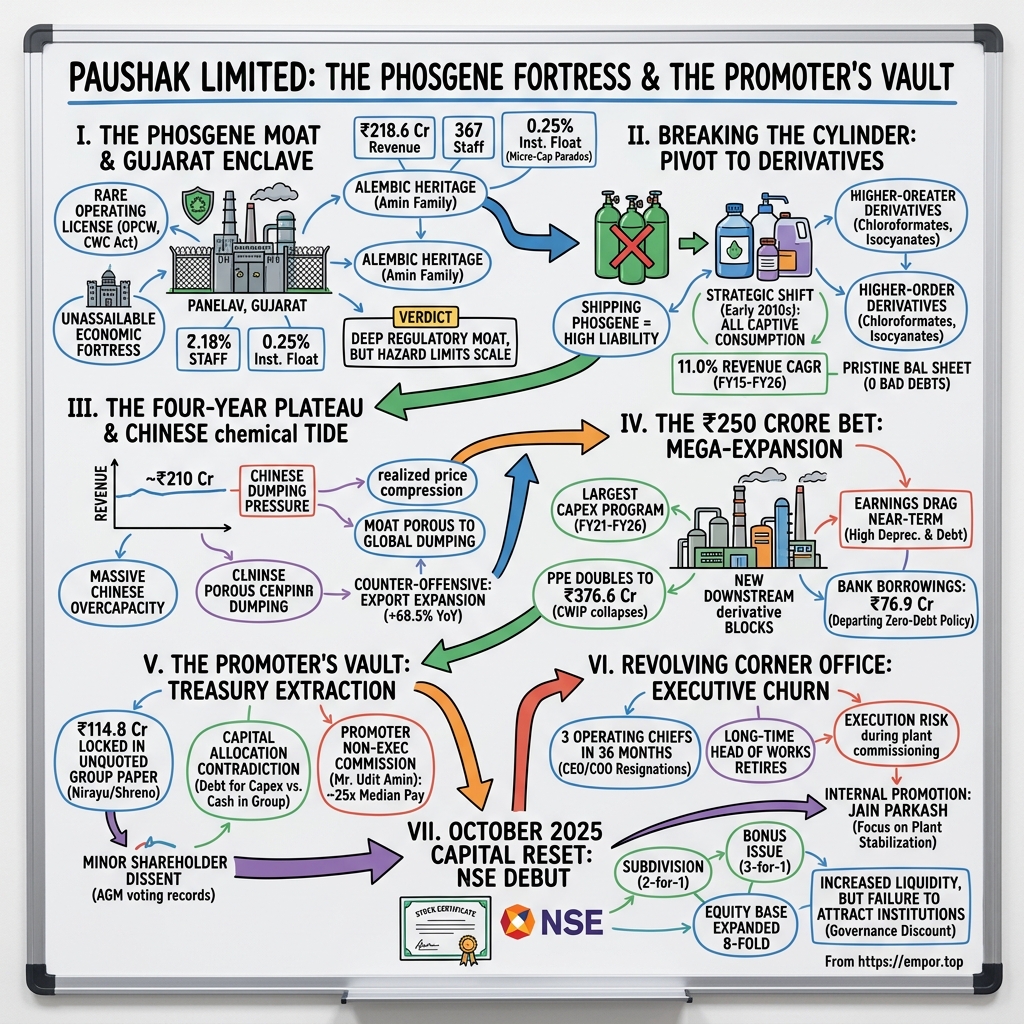
Paushak Limited: The Fortress of Phosgene and the Promoter's Vault
I. The Phosgene Moat and the Gujarat Enclave
Drive west out of Vadodara, past the textile godowns and the ring of pharmaceutical estates that have grown up around Gujarat's old princely capital, and the road eventually narrows towards Panelav, in the industrial country of Panchmahal district. The plant there doesn't look like much from a distance: steel columns, pipe racks, a tank farm, scrubber towers. What makes it unusual is the molecule inside. Chlorine and carbon monoxide are fed into a reactor over a catalyst, and they come out as carbonyl dichloride, which the world knows as phosgene. Every pipe joint is a liability. Every valve is a decision someone had to defend to a regulator.
Phosgene has a dark history. In the First World War it was among the deadliest of the trench gases. It smells faintly of freshly mown hay, gives a soldier little warning, and floods the lungs hours after exposure. That history is why the molecule now sits on the schedules of the international Chemical Weapons Convention, and why India's domestic version of that treaty, the Chemical Weapons Convention Act, 2000, puts producers of listed chemicals under a regime of declarations, inspections and licensing run by a national authority in New Delhi[^1].
The molecule's peacetime life is far less sinister and much bigger. Phosgene is one of organic chemistry's best tools for welding a carbonyl group into another molecule. That makes it a building block for polyurethanes and polycarbonates, for carbamate crop-protection chemicals, and for a long list of reagents that pharmaceutical chemists use to assemble active ingredients. The global giants that make polycarbonate and MDI produce phosgene by the hundreds of thousands of tonnes and use it all inside their own plants. Paushak plays a different game. It is one of the very few Indian companies that makes phosgene for sale, in the form of derivatives, to outside customers.
A licence that is hard to copy
Paushak describes its own operations as falling under the Chemical Weapons Convention Act, 2000, and reports its compliance with that framework in the statutory annexures of its annual report1. For an investor, the important point is economic, not legal. A new entrant who wanted to make merchant phosgene in India would need to get through the treaty regime, explosive and hazardous-substance permissions, state pollution-control consent and the local politics of siting a toxic-gas plant near people. All of that comes before spending a rupee on reactors. Nobody has to prove that these barriers are insurmountable. They only need to be slow, expensive and uncertain, and they are.
The Alembic heritage matters here too. Alembic, founded in Vadodara in 1907, is one of the oldest names in Indian pharmaceuticals, and the Amin family has run it for generations. Paushak grew up as the group's specialty-chemicals arm, and the company held its 53rd Annual General Meeting in July 2026, so it has more than half a century behind it2. Chairman Chirayu Amin, the patriarch who led the wider group through India's liberalisation decades, still chairs the board1.
Drawing the boundary
Readers should be clear about what Paushak is and what it is not. It is a standalone company with a single operating site and no subsidiaries, associates or joint ventures1. Alembic Pharmaceuticals, the group's listed drug maker, is a separate company. So is Alembic Limited, which holds real estate and treasury assets. Both sit beside Paushak, not inside it. The thread that ties them together is Nirayu Private Limited, the Amin family's holding company, which owns about 41% of Paushak directly. Alembic Limited owns another 19%, and the promoter group as a whole holds about 67%1. This story is about Paushak's own profit and loss, its own plant and its own balance sheet. The group's drug pipeline and land bank appear only where they touch Paushak's money, and as Section V shows, they touch it more than a single-plant chemical company's investors might expect.
The micro-cap paradox
Paushak reported revenue of about ₹219 crore in FY26, roughly $25 million. It ended the year with 367 permanent employees1. That is a strange size for a company that holds what is plausibly one of the hardest-to-copy industrial positions in Indian chemistry. Fifty years of near-uncontested merchant phosgene have produced a business that would fit inside a single product line at a mid-sized competitor.
The shareholder register is just as strange. Domestic and foreign institutions together owned 0.25% of the company at March 31, 2026. About 22,000 retail shareholders held the remaining 32% of the float outside the promoter group1. In practice, Paushak is a family company that happens to have a stock quote.
The first verdict is this. Paushak's licence to make phosgene is a real fortress against Indian competitors. The same hazard that keeps rivals out also keeps the company on one site, in one set of chemistries, at one modest scale. A fortress protects what is inside it, but it doesn't make what is inside any bigger. The next question is how a company with a cylinder of poison gas learned to sell something more valuable than the gas.
 Subscribe on LinkedIn
II. Breaking the Cylinder: Merchant Phosgene to Specialized Derivatives
The basic commercial problem with phosgene is easy to state. Moving it is worse than making it. A tanker of toxic gas on a national highway is an accident waiting to happen, and few insurers, regulators or village councils will stand for it. So Paushak's growth has always meant moving downstream: reacting the phosgene inside the fence, immediately, into something far less dangerous that can be put in a drum and shipped.
The business has followed that logic for decades. Rather than selling the gas, Paushak sells what the gas becomes. Chloroformates are reagents that pharma chemists use to cap reactive sites on a molecule. Carbamoyl chlorides are building blocks for carbamate pesticides and some drugs. Isocyanates are reactive cousins used in agrochemicals and coatings. Acid chlorides are workhorse acylating agents. In each case the phosgene is spent at Panelav, and the customer receives a stable, specified intermediate1.
An analogy helps. Paushak is less a gas company than a locksmith that owns the only licensed forge in town. Customers don't want the forge; they want keys cut to their pattern. The forge is the barrier to entry, and the keys are the business.
How Paushak gets paid
The pricing unit is ordinary. Paushak sells by the kilogram and the metric tonne, against short- to medium-term purchase orders and frame agreements. It discloses no long-term take-or-pay contracts and no recurring licence income1. Volumes therefore move with downstream demand from API makers, agrochemical formulators and polymer producers. That demand is cyclical and prone to destocking. The moat protects Paushak's right to supply. It doesn't guarantee that anyone has to buy.
The customer list is spread out. No single customer accounted for 10% or more of revenue in FY25 or FY261. Paushak doesn't publish its top-five or top-ten customer shares. Standard credit terms run from 30 to 120 days1.
Collection is where the record is unusual. Receivables stood at about ₹55 crore at March 31, 2026, roughly 81 days of sales. Almost four-fifths of that was not yet due, essentially none was more than six months overdue, and nothing was more than a year old1. Paushak carries an expected-credit-loss provision of zero and reported no receivable write-offs1. In a sector where small Indian chemical makers often lend to their customers through stretched receivables, Paushak gets paid. That tells an investor something about customer quality and about the company's willingness to walk away from bad credit. It doesn't tell them anything about growth.
The long-run base rate
Over the full span of available filings, the business compounded at a respectable pace. Revenue rose from about ₹69 crore in FY15 to about ₹140 crore in FY19 and about ₹212 crore in FY23345. That works out to roughly 11% a year to FY26. Net profit rose from about ₹13 crore in FY15 to ₹39 crore in FY26, compounding at a little under 11%31.
The peak came in FY23. In the post-pandemic scramble for non-Chinese suppliers, Indian specialty intermediates were in demand. Paushak's revenue jumped about 40% in a single year to around ₹212 crore, and pre-tax profit reached about ₹72 crore, a pre-tax margin of roughly a third5. Net profit hit about ₹54 crore and held there in FY245.
That 11% base rate is a useful anchor. It is a little above Indian nominal GDP growth and well behind the 15–20% that the best Indian specialty-chemicals compounders produced over the same decade. The history says Paushak converted its moat into steady growth, not explosive growth. The step from merchant phosgene to derivatives succeeded commercially, but it was the move of a careful supplier: purchase orders, pristine receivables and no big contracts.
Then the growth stopped.
III. The Four-Year Plateau and the Chinese Chemical Tide
Picture the procurement desk of a mid-sized API maker in Hyderabad in 2024. For three years its buyers had worried about whether Chinese suppliers would deliver at all: factory shutdowns, zero-COVID lockdowns, power rationing. By 2024 the worry had flipped. Chinese chemical parks had added enormous capacity during a decade of state-supported expansion, and as China's property sector slumped, domestic demand for polyurethanes and other construction-linked chemicals softened. The surplus went looking for buyers abroad, and quotations for many intermediates fell accordingly.
That is the backdrop to the most important pattern in Paushak's recent numbers: four years of standing still.
The flatline
Revenue was about ₹212 crore in FY23, ₹206 crore in FY24, ₹211 crore in FY25 and ₹219 crore in FY2651. Across four years the top line moved by about 3%. Meanwhile net profit fell from ₹54 crore to ₹39 crore, a drop of 27.6%. Pre-tax profit fell from about ₹72 crore to about ₹50 crore51. The operating margin slid from above 25% at the peak to about 21% in FY25 and 18% in FY266.
Several things drove that decline. Depreciation rose sharply as new plant was capitalised, which Section IV covers. Other income shrank as treasury assets were redeployed into the plant. But CRISIL's January 2026 rating rationale names the commercial driver plainly: pricing pressure from Chinese competition, and a product-mix shift towards semi-specialised derivatives that earn lower margins6. Those are the rating agency's words, not management's, and they fit the shape of the numbers. When volumes hold up but profit falls, the usual explanation is weaker realisations, meaning lower prices per kilogram.
Myth versus reality: is the phosgene specialty irreplaceable?
The claim. Paushak's regulatory licence and decades of hazardous-chemistry know-how insulate it from global commodity cycles. Customers have nowhere else to go.
The test. That claim breaks through one mechanism: a customer doesn't need a second Indian phosgene producer if it can import the finished derivative. Chinese phosgenation capacity is vast and built mostly for polycarbonate and isocyanate chains. When those chains slow, some of that capability can be redirected towards fine chemicals such as chloroformates and isocyanates. An Indian pesticide formulator buying a generic carbamoyl chloride faces moderate switching costs. It can requalify an imported grade, and at a large enough price gap it will.
The record. Paushak's own numbers show exactly that pressure. Revenue held flat while profit fell by more than a quarter, and the rating agency points to Chinese pricing and a mix shift6. The domestic licence didn't stop margins from compressing.
The verdict. The history narrows the claim; it doesn't reject it. The moat works against a new Indian plant, and it plausibly works for molecules that are written into a customer's drug filing. It is porous for semi-commodity derivatives that can be imported. The useful version of the thesis is "irreplaceable for qualified pharma specialties, contestable for the rest". What decides which version describes Paushak is something the company doesn't publish: the revenue split between those two buckets. The operating margin is the best proxy, and it was moving the wrong way in FY26.
The counter-offensive abroad
The more encouraging clue sits in the export line. Export sales rose from about ₹22 crore in FY25 to almost ₹38 crore in FY26, an increase of about 68%. Net foreign-exchange earnings came to about ₹34 crore1. Exports are now roughly one-sixth of revenue, up from about one-tenth.
There is a plausible reason. Western pharmaceutical buyers who have been audited, pressured and sometimes stung by single-country supply now pay something for a second, non-Chinese source. Paushak manages its currency exposure simply. It holds no complex derivatives, relies on its receivables as a natural hedge, and had a net long dollar position of only about ₹11 crore at year-end1.
The caution is just as plain. One year of export growth from a small base is a signal, not a trend, and exports still added only about ₹15 crore of revenue against a ₹219 crore business. If the moat is to be renewed, it will be renewed by validated sales to customers in Europe and the US. Paushak spent the same years building plant on the bet that those customers, and its Indian ones, would want much more of its output.
IV. The ₹250 Crore Bet: Capitalizing the Mega-Expansion
Every capex cycle has a quiet accounting moment when years of spending stop being a promise and become an asset. For Paushak, that moment arrived in the final months of FY26. Capital work-in-progress, the line where half-finished plant waits on the balance sheet, had reached about ₹190 crore at March 31, 2025. A year later it had shrunk to about ₹26 crore, and property, plant and equipment had grown from about ₹141 crore to about ₹377 crore1. In one fiscal year Paushak more than doubled the asset base that its fifty-year history had built.
What the money bought
The company and its rating agency put the program at roughly ₹250 crore6. The cash went out unevenly. Capex was about ₹50 crore a year in FY21 and FY22, then fell to about ₹17 crore in FY23, rose to ₹39 crore in FY24, jumped to ₹160 crore in FY25 and came to ₹88 crore in FY26751. FY25 was the moment of commitment. In that single year Paushak spent more on plant than its entire revenue had been in FY15.
The program covered new downstream derivative blocks, utility infrastructure including high-voltage power supply, effluent and safety systems, and expanded R&D facilities61. R&D spending rose from about ₹3 crore to almost ₹5 crore in FY26, or about 2% of revenue1. That is still a modest amount in absolute terms. Customer-specific pharma intermediates need process development, and a ₹4–5 crore budget funds a capable team, not a research institution.
Unspent capital commitments fell from about ₹61 crore to under ₹6 crore over FY261. Construction is essentially finished, and from here the question is how fully and at what prices the new capacity is used, not how big the cheque is.
The depreciation wall
Accounting gives the first verdict before customers do. Depreciation rose about 43% in FY26 to around ₹21 crore1. Most of the newly capitalised assets were in service for only part of that year, so FY27 will carry a fuller charge even if revenue doesn't move at all. Profit can therefore keep falling in FY27 without anything going wrong at the plant. Investors who read only the headline earnings line will see the cost of the new capacity before they see any of its revenue.
The end of zero debt
The funding mix tells its own story. For most of its modern history Paushak had essentially no debt. By March 31, 2026, bank borrowings had reached about ₹77 crore: a ₹75 crore term loan, of which ₹15 crore falls due within twelve months, plus about ₹2 crore of working-capital credit1. The term loan carries interest of between 6.87% and 8.20% and amortises at ₹3.75 crore a quarter. The lender holds a first charge on movable assets and a negative lien on the land1. Debt was about 0.16 times net worth. The auditor reported no defaults and full covenant compliance1. In January 2026 CRISIL reaffirmed its "A/Stable" long-term rating, assigned "A1" for short-term facilities, and raised the company's rated bank lines from ₹40 crore to ₹145 crore6.
On any normal measure that is conservative leverage. It is also a strategic choice that Section V calls into question, because Paushak borrowed while holding a nine-figure sum of illiquid investments in its own promoter group.
Profit into cash
This is the strongest pillar of the bull case, and the evidence is good. Over the six years from FY21 to FY26, Paushak reported cumulative net profit of about ₹272 crore and generated about ₹264 crore of operating cash flow. That is a conversion rate of about 97%751. For a chemical maker that went through a volatile commodity cycle and a plant build in that period, this is a clean record. It shows that the earnings are real cash, not inventory on the shelf or receivables stretched out.
FY26 shows the mechanics in miniature. Operating cash flow was about ₹54 crore against net profit of ₹39 crore, helped by the non-cash depreciation charge, even after about ₹15 crore went into working capital as inventory rose to almost ₹37 crore to feed the new plant1. A build-up of raw materials and work-in-progress during commissioning is normal. If inventory keeps rising without matching sales, that becomes a warning sign.
Paushak built the largest asset base in its history without stretching its balance sheet. That is what cash conversion like this pays for. But the higher depreciation and the new debt service are fixed costs now, and they only pay off if utilisation rises. Before asking whether it will, there is a stranger question to answer: why did a company with this much cash need to borrow at all?
V. The Promoter's Vault: Treasury Extraction and the ₹115 Crore Question
On July 30, 2026, a scrutinizer at Paushak's 53rd AGM tallied the votes on the resolutions2. One of them approved commission for Udit Amin, a promoter and non-executive director, of ₹1.35 crore1. The outcome was never in doubt: with two-thirds of the shares in promoter hands, every resolution passed with roughly 99.99% approval2. The commission resolution is still worth reading closely, together with Note 3 of the balance sheet, where the investments are listed.
The vault
At March 31, 2026, Paushak held about ₹115 crore in unquoted equity and preference shares of Nirayu Private Limited, the controlling shareholder, and of Shreno Limited, a group affiliate1. That is 23.4% of Paushak's ₹491 crore net worth1. In plain terms, nearly one rupee in every four of public shareholders' book equity sits in securities of the family holding structure that cannot be traded on an exchange.
These securities do earn something. In FY26 Paushak booked about ₹3.1 crore of interest income, accounted on an effective-interest basis, on its Nirayu preference shares1. Against the preference balance of about ₹40 crore that remains outstanding1, that is a yield of roughly 7–8%. Measured against the whole ₹115 crore block, though, the visible cash yield is under 3%, and the equity portion pays nothing that shows up as material.
Nirayu has redeemed some of the preference capital: about ₹4 crore in FY25 and ₹8 crore in FY261. CRISIL rates Nirayu "AA+/Stable" and treats parent support as a strength in Paushak's own rating6. So this is not a story of impaired assets. It is a story of how capital is allocated.
The contradiction
Set two facts next to each other. Paushak borrowed about ₹77 crore from banks at up to 8.2% to build its plant1. At the same moment it held about ₹115 crore in promoter-group paper that, taken as a whole, yields well below that cost of debt. If the investments were sold, or the preference shares redeemed, the term loan could be retired with money left over. The company has not done that.
There are reasonable explanations, but the company doesn't give one. Unquoted holdings are hard to sell, preference shares redeem on their own schedule, and keeping a bank relationship alive has value. Still, a sceptical investor's reading is straightforward. The promoter group's need for capital in its holding vehicle has been put ahead of the listed company's lowest cost of funding. Minority shareholders effectively finance part of the family's holding structure while paying bank interest on their own factory.
The commission
Udit Amin received commission of about ₹1.65 crore in FY24, ₹1.50 crore in FY25 and ₹1.35 crore in FY26. Each year that was close to 3% of net profit1. The amount falls when profit falls, which is the proper direction. Paushak discloses that this one non-executive director accounts for well over 90% of all non-executive compensation, and that his pay ratio is about 25 times the median employee's pay of roughly ₹5.5 lakh1. Independent directors receive sitting fees that are small by comparison.
Is ₹1.35 crore large? Next to the ₹115 crore question, it isn't. What it signals matters more than its size. The commission ties a promoter's pay to profit at a company where the promoter already owns the majority, and it pays a non-executive role more than executive pay at many companies of this size.
The scrutinizer's report shows what dissent looks like when it cannot win. Among public non-institutional shareholders who voted, 1,874 votes were cast against the commission, about 1.7% of the 1,10,710 votes that group polled2. That is a small number. But retail shareholders rarely vote at all, and the dissent comes from the only constituency without a promoter's interest in the outcome. Institutions, which usually lead such pushback, hold too little stock to matter.
Ordinary commerce with the group
Day-to-day trade with the group looks ordinary. Sales to Alembic Pharmaceuticals were about ₹6.4 crore in FY26, under 3% of revenue, down from about ₹7.8 crore the year before. Paushak reports no material overdue amounts from affiliates1. Purchases of plant equipment from Shreno Engineering, a promoter-linked fabricator, came to about ₹2.6 crore in FY26 and ₹6.9 crore in FY251. Those are disclosed, modest figures, small next to a ₹250 crore program. The group doesn't rely on Paushak for trade. Its link to Paushak runs through the balance sheet.
The verdict on this section is uncomfortable. On the shop floor, Paushak is a disciplined manufacturer that collects its cash. In its treasury, it behaves partly like an extension of the family holding structure. Both are true at once, and the market values the company knowing both. The plant also needs people to run it, and the corner office has seen a lot of change.
VI. The Revolving Corner Office: Executive Churn Amid Technical Ramp
On April 1, 2026, Jain Parkash took a Whole-time Director's seat at Paushak. He was elevated from Senior Vice President of Operational Excellence, and he took over from a predecessor who had lasted twelve months1. For a plant handling one of chemistry's most dangerous gases, in the very quarter its biggest-ever expansion was coming on stream, that is not the continuity a cautious investor would want.
The timeline
The sequence of departures is quick:
- April 2, 2025: Abhijit Joshi, the long-serving Whole-time Director and CEO, resigned1.
- March 31, 2026: His successor, Chintan Gosaliya, Whole-time Director and COO, resigned after about a year in the role1.
- March 31, 2026: Ramakrishnan Iyer, Head of Works and the senior plant engineer, retired on superannuation the same day1.
- April 1, 2026: Jain Parkash was elevated to Whole-time Director1.
The finance seat was also unsettled. Kaushik Shah served as acting CFO from August 2024 to March 2025 before Kirti Shah resumed the role1.
That makes three operating chiefs in roughly a year, plus the plant's senior engineer and seven months of an acting CFO, all while ₹250 crore of new capacity was being built and commissioned.
Paushak has not explained publicly why Joshi or Gosaliya left. In a family-controlled company, departures can reflect strategic disagreement, personal reasons or simply the difficulty of being a professional chief executive answering to a promoter chairman. Nothing in the filings tells an outsider which applies here. The absence of an explanation is itself a governance fact worth noting.
Myth versus reality: does family stewardship make turnover irrelevant?
The claim. The Alembic Group's long-standing systems, and Chairman Chirayu Amin's continuous presence, mean that turnover among professional managers doesn't affect performance.
The evidence for it. The audit record is spotless. The statutory auditor, CNK & Associates LLP, gave an unmodified opinion for FY26. Its CARO 2020 report found proper title to fixed assets, regular payment of statutory dues, working audit-trail logs and no reported fraud1. Contingent liabilities are tiny: a Gujarat VAT dispute of about ₹2.55 lakh dating from FY 2006-07, and about ₹2.5 crore of bank guarantees1. Compliance and controls kept working through the turnover.
The evidence against it. Running a factory well is one thing; bringing new capacity into commercial use is another. Commissioning new derivative blocks means qualifying new products with customers, setting up sales commitments and stabilising process yields. That is commercial and technical work that depends on whoever is in charge. The leadership changes coincided with the commissioning and with the inventory build of FY261. The filings don't allow anyone to say that the turnover delayed the ramp-up. They do show that the company's most important execution phase happened while its leadership was changing.
The verdict. The claim survives in a narrower form. Family stewardship has kept governance, compliance and, as far as the filings show, plant safety intact. It hasn't shown that it can keep commercial leadership in place. Whether the turnover affects results will show up in utilisation, and FY27 will be the first year to test that.
What Jain Parkash's elevation signals
Choosing an internal operations specialist over an outside commercial leader tells investors something. The board's priority appears to be stabilising the new plant (yields, safety, uptime) rather than expanding sales aggressively. That is a defensible priority for a phosgene site. It does leave open who will find buyers for the extra capacity. Paushak also made a move in 2025 to bring in a different kind of outsider: a broader base of shareholders.
VII. The October 2025 Capital Reset: Split, Bonus, and the NSE Debut
For decades Paushak was one of the Bombay Stock Exchange's more obscure stocks. It had just 30,82,114 shares in issue, and with two-thirds of them held by the promoter group, only about a million traded in practice1. The share price ran into the thousands of rupees, a handful of shares changed hands on many days, and bid-ask spreads deterred anyone who needed to buy in size. For a fund manager, it was barely investable.
The reset
In October 2025 the company changed its share structure in two steps. First, the face value was split from ₹10 to ₹5, with October 3, 2025 as the record date. Then came a 3-for-1 bonus issue, deemed allotted on October 6, 2025, which created about 1.85 crore new shares. The bonus was funded by capitalising about ₹3.1 crore from the capital redemption reserve and ₹6.1 crore from the general reserve1. The share count rose eightfold to 2,46,56,912, and paid-up capital rose to about ₹12.3 crore1.
On December 1, 2025, Paushak's shares were admitted to trading on the National Stock Exchange18, giving them a second, deeper venue alongside the BSE.
None of this created any value by itself. A split and a bonus divide the same company into more pieces, and every shareholder's percentage stake stayed the same. What changes is how easy the shares are to trade. A lower share price and an NSE listing make the stock accessible to systematic retail investors, smaller funds and index-style strategies that need daily liquidity.
There has been no recent equity dilution. Paushak issued no warrants or preferential allotments, the promoter has pledged no shares, and the company last returned capital through a buyback in May 20181.
Why the institutions stayed away
Here is the test. After the split, the bonus and the NSE listing, institutions held 0.25% of the company at March 31, 2026, or about 62,000 shares1. Liquidity was the obstacle the company removed. If institutions still aren't buying, liquidity was not the only obstacle.
The remaining reasons are straightforward. Free float is still only about a third of the shares, so the market value available to outside investors is roughly ₹500 crore, too small for most mutual-fund mandates. And the issues described in Section V, the ₹115 crore of promoter-group paper and the promoter's commission, are exactly what institutional governance screens are designed to catch. Paushak doesn't explain why institutions haven't arrived; the absence itself is the evidence.
The verdict is that the October reset fixed the mechanics of trading and nothing else. It made Paushak easier to buy without giving an institution a new reason to buy it. To see what reasons might exist, it helps to test the business against two standard frameworks for competitive advantage.
VIII. Frameworks: Porter's 5 Forces & Hamilton Helmer's 7 Powers
Imagine a strategy session in 2036, ten years from now, at which someone asks whether anyone still needs phosgene. The question isn't idle. Green chemists have spent decades looking for phosgene-free routes to carbonyl chemistry. Dimethyl carbonate made by catalytic processes is already used in some polycarbonate production. Catalytic carbonylation and other alternatives exist in laboratories and in some industrial niches. If those routes became cheap for complex pharmaceutical intermediates, Paushak's dangerous licence would protect a declining technology. That is the long-range threat. The near-range threats are more ordinary, and this is the section where the moat gets argued in full.
Porter's Five Forces
Threat of new entrants: very low. The treaty regime, hazardous-substance permissions and environmental consents described in Section I make a new merchant phosgene plant in India slow and uncertain to build[^1]. CRISIL highlights Paushak's established position in phosgene chemistry built over four decades as its first strength6. This is the strongest force in Paushak's favour.
Buyer power: moderate to high. No customer accounts for 10% of sales, which limits any one buyer's leverage1. But buyers as a group have options: imported Chinese derivatives, and captive phosgene at large Indian chemical companies such as Atul for some chemistries. Where a product is written into a customer's drug filing, switching is expensive. Where it isn't, buyers can push on price, as the FY24–FY26 margin compression in Section III showed.
Supplier power: low to moderate. The main inputs, chlorine and carbon monoxide or the coke used to make it, are basic industrial chemicals with several domestic sources. Paushak doesn't disclose input-cost dependency on any single supplier.
Threat of substitutes: moderate, mainly long-term. Phosgene-free routes are real but expensive for complex, low-volume pharma intermediates. They are a reason for caution over a decade, not over the next year.
Competitive rivalry: high in derivatives, low in the gas itself. Paushak has almost no rivals in merchant phosgene within India, but its derivatives compete directly with Chinese chloroformates and isocyanates6. The fortress controls its supply of the raw material; it doesn't control the price of what it sells.
Hamilton Helmer's 7 Powers
Cornered Resource: strong. The licensed Panelav site, with its permissions, infrastructure and safety record, is Paushak's one genuinely scarce asset. It meets Helmer's test of preferential access to a valuable resource on terms that others can't get. Its limit is that it is scarce only inside India.
Switching Costs: moderate to high, for some products. Once a derivative is written into a regulated drug filing in the US or Europe, changing supplier means validation work and regulatory notifications. That is why exports to such customers matter. Paushak doesn't disclose how much revenue comes from filed, qualified products versus generic grades, so the strength of this power can't be measured from outside.
Process Power: moderate. Decades of handling a lethal gas safely is institutional knowledge that is hard to copy quickly. The leadership turnover described in Section VI is a reminder that some of that knowledge lives in people, not just in procedures.
Scale Economies: weak. Revenue of about ₹219 crore is tiny next to global phosgene users. Chinese competitors have scale advantages in raw materials, energy and overheads that Paushak can't match.
Network Effects, Counter-Positioning and Branding: absent or weak. Batch specialty chemicals have no network effects. Paushak's model isn't one that incumbents find awkward to copy, and customers buy on specification, reliability and price, not on brand.
Earnings quality as a lens
One more observation sits beside the frameworks. Other income, mostly investment gains and the preference interest, contributed about ₹12 crore, or 24%, of FY26 pre-tax profit, and about 24% and 29% in the two prior years1. Part of the reported profit therefore comes from the treasury, not from chemistry. That makes the operating business look stronger than it is, and it ties the quality of earnings directly to the investment holdings discussed in Section V.
The combined verdict: Paushak has one real power, a cornered resource that works inside India, plus switching costs in its qualified pharma products. It lacks the scale needed to set prices in a global market. That leaves Paushak protected from local competition but exposed on price. The question for the valuation is how much the market is paying for that position.
IX. Bull vs. Bear Case: The ₹1,600 Crore Valuation Crucible
Picture an analyst at a desk in October 2026 with two columns of numbers. In one is a single-plant chemical company with four flat years of revenue and falling profit. In the other is the price the market puts on it. The two don't obviously match.
What the price implies
Paushak is worth about ₹1,600–1,630 crore in early October 20269. Against FY26 net profit of about ₹39 crore, or about ₹16 a share after the bonus and split1, that is a trailing P/E of roughly 38–41 times. The stock trades at about 3.3 times its book value of around ₹199 a share, and at about 22 times EBITDA of roughly ₹73 crore19.
The worked calculation that matters starts by removing the treasury. Pre-tax profit was about ₹50 crore. Subtracting about ₹12 crore of other income leaves roughly ₹38 crore of operating pre-tax profit1. After tax at roughly a quarter, that is about ₹29 crore of profit from chemistry. Divide ₹1,615 crore by ₹29 crore and the market is paying around 55 times operating earnings, while also valuing the treasury holdings at roughly book.
For comparison, diversified Indian chemical companies with much greater scale, including Atul and Aarti Industries, have traded at roughly the mid-30s or lower on trailing earnings, and Clean Science, a faster-growing specialty company, in the low-to-mid 40s9. A market that pays more for Paushak's operating profit than for those peers is not paying for its past four years. It is paying for the plant that was just commissioned.
The bull case
- The new capacity gets used. Fixed assets more than doubled in FY26. If utilisation rises and realisations hold, revenue could move out of the ₹205–220 crore range where it has been stuck, and the fixed cost base gives operating leverage once volumes rise. CRISIL expects operating margins to recover above 20% as the plant ramps up6. That is a forecast by the rating agency, not a result.
- Exports become a second engine. Export sales grew about 68% in FY261. If Western customers continue to diversify away from China, Paushak's qualified grades are the obvious beneficiary.
- The balance sheet can carry the wait. With 97% cash conversion, no bad debts, receivables collected on time and debt at 0.16 times equity, Paushak can afford a slow ramp-up without needing to raise equity.
- The treasury could be released. If Nirayu continues redeeming its preference shares, the proceeds could retire the term loan, improve return on capital and remove the main governance discount, all without any change to the plant.
The bear case
- The capital allocation trap. About ₹115 crore stays in promoter-group paper while the company pays interest to banks. Nothing in the filings commits the company to changing that.
- Leadership instability. Three operating chiefs in a year during commissioning raise execution risk, and the reasons for the departures haven't been disclosed.
- Chinese overcapacity. The margin compression of FY24–FY26 came from pricing, not from any production problem. More capacity sold into a market where prices are set in China could mean more volume at weak margins.
- The depreciation wall. A full year of depreciation on the new assets, plus ₹15 crore a year of loan repayment, means FY27 earnings can fall even if sales rise somewhat.
The activist stress test
Suppose a determined minority shareholder demanded that Paushak redeem the Nirayu preference shares and sell the Shreno and Nirayu equity, use the proceeds to repay the term loan, and pay the rest out as a dividend. On paper, return on equity would rise, interest cost would disappear and the governance discount would narrow. In practice the promoter group owns about 67% of the votes, so any resolution the promoter opposes is certain to fail. A minority investor can't force the change. They can only price it in, and the 0.25% institutional holding suggests most professionals have done that by staying away.
The KPIs that matter
Two numbers will decide which case wins:
- Quarterly revenue. FY26 revenue of about ₹219 crore works out to roughly ₹55 crore a quarter. Sustained quarters above about ₹75 crore would show that the new capacity is finding buyers.
- Operating margin. It fell from above 25% to 18% in FY266. A recovery above 20% would show that realisations are holding. A further decline would mean the new volume is coming at commodity prices.
The verdict on the valuation is that the market is paying in advance for a successful ramp-up. If the plant fills at decent margins, the multiple will compress as earnings grow into it. If it fills slowly or at low prices, the multiple has little support.
X. Playbook: Business & Investing Lessons
"A licence to make poison is a fortress, not an escalator." Paushak spent fifty years as one of India's very few merchant phosgene producers, and that position earned it a ₹219 crore business that stopped growing for four years. Regulation can keep competitors out. It can't make customers buy more. Founders who build moats should ask what is supposed to make the business inside them grow. Investors who pay for moats should ask the same thing.
"Prices in Shandong set margins in Panelav." No Indian rival took a rupee of Paushak's business, yet its profit fell by more than a quarter because of capacity built in China. A domestic moat around a product that can be shipped across borders protects market share, not price. The competitor that matters is the cheapest one anywhere in the world, not the nearest one.
"Cash conversion is what turns ambition into an asset." Paushak turned about 97% of six years of profit into operating cash, and that is what allowed it to more than double its asset base without issuing shares or taking on heavy debt. Before trusting a company's expansion plans, check whether its past profits actually arrived as cash. Paushak's did.
"A spotless shop floor can sit beside a revolving door in the corner office." The auditor found no problems and the controls held, while three operating chiefs came and went in a year. Good procedures keep a plant safe. They don't keep its leaders. Investors should judge the two separately.
"The hardest money to move is the money in the family's vault." About a quarter of Paushak's book equity sits in unlisted paper of its own promoters while the company borrows from banks. No financial ratio fully captures that cost. It shows up in the 0.25% institutional holding and in a valuation that has to price the plant and the governance together.
XI. Epilogue
As of October 2026, the plant at Panelav is built. Capital work-in-progress has been largely cleared from the balance sheet, the term loan has started amortising at ₹3.75 crore a quarter, and Jain Parkash, promoted from inside the company, runs operations under the same chairman who has overseen the group for decades1. Everything that money could buy has been bought. What's left depends on customers, prices and people.
Three tests will decide the story over the coming year.
The revenue breakout test. The September- and December-quarter results for FY27 will be the first full periods with all the new capacity in service. If quarterly revenue moves steadily towards ₹75 crore and the operating margin returns above 20%, the bet will have worked, and the high multiple will start to look like an early price for real growth. If revenue stays around ₹55 crore a quarter while depreciation rises, the four-year plateau will have absorbed a ₹250 crore investment.
The treasury test. Nirayu has redeemed about ₹12 crore of preference shares over two years, and about ₹40 crore remains1. Faster redemptions, and especially using the proceeds to repay the term loan, would be the clearest possible sign that the promoter group sees Paushak's capital as belonging to Paushak's shareholders. If the redemptions continue at a trickle, the opposite conclusion will be hard to avoid.
The leadership test. If Jain Parkash completes the full FY27 reporting cycle, and the next Board's Report shows a clean safety record across the new derivative blocks, the turnover of 2025–26 will look like a disruption that passed. Another departure would make it look like a pattern.
These tests come back to the central tension in Paushak's story. The company has world-class chemical capability, and the people who control it have not yet shown that they will run its capital entirely for all shareholders.
XII. Outro
At the plant gate in Panelav, the warning signs are in Gujarati, Hindi and English, and they mean what they say. Inside, a molecule that once killed soldiers in the trenches of Flanders is turned, every day, into reagents for antiretroviral and cancer drugs and for crop-protection chemicals. Paushak has spent half a century proving that it can contain one of the most dangerous gases in industrial chemistry.
The test it faces now is a different kind of containment. The chemistry stays inside the fence because the company built the fence well. Whether the value the plant creates reaches the shareholders outside the promoter family is a matter of choice, not engineering, and the choice belongs to the family. Paushak built a wall that no rival could get through, and found that the hardest thing to get out of the fortress was its own capital.
References
-
53rd Annual Report 2025-26 — Paushak Limited, 2026-07-02 ↩↩↩↩↩↩↩↩↩↩↩↩↩↩↩↩↩↩↩↩↩↩↩↩↩↩↩↩↩↩↩↩↩↩↩↩↩↩↩↩↩↩↩↩↩↩↩↩↩↩↩↩↩↩↩↩↩↩↩↩↩↩
-
Declaration of Voting Results of the 53rd AGM along with Scrutinizer's Report — Paushak Limited, 2026-07-30 ↩↩↩↩
-
51st Annual Report 2023-24 — Paushak Limited, 2024-06-20 ↩↩↩↩↩↩↩
-
Rating Rationale: Paushak Limited — CRISIL Ratings Limited, 2026-01-15 ↩↩↩↩↩↩↩↩↩↩↩
-
Listing of Equity Shares of Paushak Limited on National Stock Exchange — National Stock Exchange of India (NSE), 2025-11-28 ↩
-
Paushak Limited Company Profile and Historical Multiples — Screener India ↩↩↩
 LinkedIn
 WhatsApp
 Reddit
 Hacker News
 Email
Email Kindle
 RSS Feed
 Spotify
 Apple Podcasts
 Amazon Music
 Audible
 YouTube