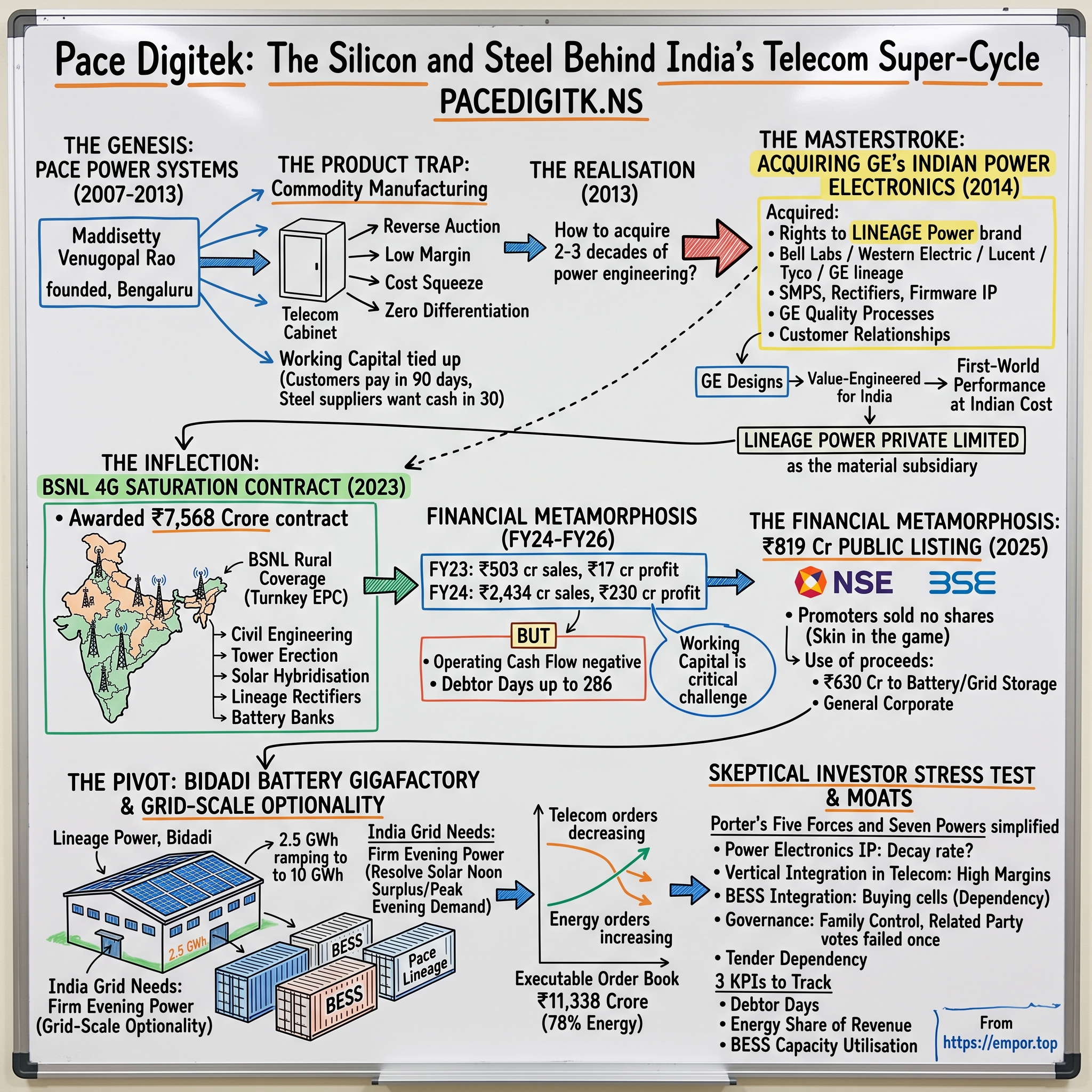
Pace Digitek: The Silicon and Steel Behind India's Telecom Super-Cycle
I. Introduction & Episode Roadmap
There is a particular kind of Indian industrial company that almost nobody outside its own supply chain has heard of until, quite suddenly, everybody has. It fabricates unglamorous things. It works for government counterparties. It does not advertise. And then one year, a policy decision lands on its head like a piano falling from a great height, and its revenue increases by nearly five times in twelve months.
That is roughly what happened to Pace Digitek Limited.
In the financial year ending March 2023, the company recorded consolidated sales of about ₹503 crore — a mid-sized Bengaluru engineering business, respectable, invisible.1 In the year ending March 2024, it recorded ₹2,434 crore.1 Net profit went from roughly ₹17 crore to ₹230 crore over the same span.1 For the three years to FY25, sales compounded at 74% a year and profit at 174%.1 By October 2025 the company was listed on the National Stock Exchange and BSE after an ₹819.15 crore fresh issue.2 By May 2026 it was reporting an executable order book of ₹11,338 crore — more than four times its annual revenue.3
The obvious question is: what actually happened here?
The obvious answer — a big government contract — is correct but incomplete, and the incomplete part is where the investment story lives.
The narrative paradox. Scan the standard descriptions of Pace Digitek and you will find the words "telecom infrastructure solutions provider" and "EPC" — engineering, procurement, construction. That framing implies a contractor: a business that wins tenders on price, deploys labour, and books thin margins on other people's equipment. EPC is a famously unforgiving business model. It is capital-hungry, cyclical, and structurally low-return.
But Pace Digitek's reported operating margin in FY25 was roughly 20%, and 17% in FY26.1 Those are not contractor margins. They are the margins of a company that makes the expensive things it installs. And the reason it can make them traces back to a transaction in 2014 that received almost no attention at the time: a Bengaluru company with roughly ₹300 crore of revenue bought the entire Indian power electronics business of General Electric, including rights to use the Lineage Power brand.4 That brand carries a genealogy running back through GE to The Gores Group, to Tyco Electronics, to Lucent Technologies' Power Systems division — decades of telecom rectifier and switched-mode power supply engineering, acquired by a company most of the market had never heard of.
The strategic tension. Here is the thing that makes this a genuinely interesting company to argue about rather than simply admire. In FY26, Pace Digitek reported profit after tax of ₹307.3 crore.3 In the same year, it reported operating cash flow of negative ₹917 crore and free cash flow of negative ₹998 crore.1 Debtor days stood at 286.1 The company grew, it profited, and it consumed cash on an industrial scale.
That is not necessarily damning — a business scaling into a build-own-operate asset portfolio and a battery gigafactory should absorb cash. But it does mean the entire investment case reduces to a single unresolved question: does the accounting profit eventually become cash in the bank, or does it remain a receivable owed by a state electricity board?
The roadmap. Over the next several thousand words this piece traces five arcs. The genesis — how a metal-and-wiring shop in Bengaluru spent six years learning that commodity manufacturing has no future. The masterstroke — the 2014 GE acquisition that bought world-class power electronics IP at what was almost certainly a distressed price, and what that did to the company's cost position. The inflection — how the ₹7,568 crore BSNL 4G saturation contract, awarded in 2023, converted a component maker into a turnkey infrastructure operator overnight, and what it cost in working capital to do that.5 The pivot — the Bidadi battery gigafactory and the extraordinary, fast, and not-yet-proven swing of the order book from telecom into grid-scale energy storage. And finally the spine — a cold-eyed test of whether the moats here are real, using Porter's competitive framework and Hamilton Helmer's Seven Powers, benchmarked against Exicom, HFCL and Bondada Engineering, and stress-tested the way a short seller would do it.
Let us start where all of it started: with a man, a shed, and a very bad business model.
 Subscribe on LinkedIn
II. The Genesis: Pace Power Systems & The Maddisetty Vision (2007–2013)
Picture Bengaluru in 2007. Not the Bengaluru of glass office parks and unicorn valuations — the other one. The industrial belt on the western edge of the city, where sheet metal is cut and bent and painted, where three-phase power lines sag over corrugated roofs, and where a few hundred small engineering firms fight for orders from India's newly unleashed telecom industry.
India was, at that moment, building mobile towers faster than any country on earth had ever built them. Subscriber additions were running in the millions per month. Every operator — and there were more than a dozen of them then, in a market that would eventually consolidate down to three — needed towers, and every tower needed a shelter, a battery bank, a rectifier to convert grid AC into the 48-volt DC that telecom equipment runs on, and a diesel generator for the many hours a day when the grid simply was not there.
Into this market stepped Maddisetty Venugopal Rao, incorporating Pace Power Systems Private Limited in 2007.1 The name told you exactly what the business was: power systems. Cabinets. Distribution boxes. Chargers. The physical furniture of a telecom site.
The product trap. It is worth dwelling on what kind of business this actually was, because the answer explains everything the company did afterwards.
A telecom power cabinet is, engineering-wise, a box. A good box — weatherproof, ventilated, corrosion-resistant, correctly earthed — but a box. Any competent fabricator with a press brake, a powder-coating line and a few electricians can make one. The customer is a tower company or a telecom operator, both of which buy through reverse auction, both of which have professional procurement departments whose entire job is to grind suppliers, and neither of which cares which of the forty available vendors wins as long as the specification is met.
The result is the classic commodity-manufacturing squeeze. You have no pricing power because your product is not differentiated. You have no cost advantage because your inputs — steel, copper, labour — are priced in open markets and your competitors buy them at the same price. You have working capital tied up because your customers pay you in ninety days while your steel supplier wants cash in thirty. And you have no intellectual property, which means the moment volumes get large enough to matter, your customer will simply invite more bidders.
For roughly the first six years, this was Pace's world. The company grew — by 2014 revenue had reached something over ₹300 crore, with about 2,400 employees4 — but it grew the way a treadmill moves: rapidly and without going anywhere in particular. Growth in a commodity business buys you scale, and scale in a commodity business buys you the ability to bid slightly lower. It does not buy you a margin.
The realisation. What appears to have changed the company's trajectory was a specific recognition about where the value in a telecom power system actually sits. It is not in the cabinet. It is in the rectifier — the switched-mode power supply, or SMPS — and in the digital controller that manages it.
Here is the layman's version, because this matters for the rest of the story. The grid delivers alternating current, which reverses direction fifty times a second. Telecom electronics need steady direct current at 48 volts. Converting one into the other sounds trivial and is not. Do it badly and you waste a large fraction of the input energy as heat, which at scale across tens of thousands of tower sites translates into an enormous diesel and electricity bill for the operator. Do it well — with high-frequency switching, tight control loops, good thermal design and firmware that intelligently manages the battery charge cycle — and you can push conversion efficiency into the high nineties.
That efficiency difference is worth real money to whoever operates the tower. It is also genuinely hard to engineer. The firmware alone represents years of accumulated field learning about failure modes, temperature derating, battery chemistry behaviour and grid instability. This is where the intellectual property lives.
So the strategic question in front of Venugopal Rao Maddisetty around 2013 was straightforward and brutal: how does a Bengaluru cabinet fabricator acquire two or three decades of power electronics engineering? You do not hire it — the talent does not exist locally in sufficient depth. You do not build it — you would need a decade and a balance sheet you do not have. You cannot license it, because the incumbents will not license their crown jewels to a future competitor.
There is exactly one remaining option, and it depends entirely on someone else's misfortune or indifference. You buy it — and you buy it from a seller who has stopped caring.
For investors, the lesson embedded in this early period is one that recurs throughout the story: Pace's returns have never come from being a better fabricator. They have come from moving up the value stack. Everything that follows is a test of whether that move up is defensible or merely temporary. And as it happened, in 2013 a very large American conglomerate was in the process of deciding it no longer wanted to be in the telecom power business at all.
III. The 2014 M&A Masterstroke: Acquiring GE's Indian Power Electronics & Resurrecting Lineage Power
To understand the deal, you first have to understand the object being sold — because the Lineage Power business had been passed around the industrial world like an unwanted heirloom, and each transfer had stripped a little more strategic attention from it while leaving the engineering largely intact.
The lineage — the pun is unavoidable — begins at Bell Labs and Western Electric, whose power systems division became part of Lucent Technologies when AT&T split in 1996. Lucent's Power Systems unit designed the rectifiers and DC plants that ran American telephone networks. Tyco Electronics acquired it. Tyco sold it to The Gores Group, a private equity firm, in 2007, at which point it was renamed Lineage Power. General Electric bought it in 2011, folding it into GE Energy Management.
And then GE, under a strategic review that would eventually dismantle most of the conglomerate, decided that low-margin telecom power electronics in an emerging market was not a business worth the boardroom oxygen.
The transaction. In 2014, Pace Power Systems acquired the entire business of GE Power Electronics India — the operations that supplied energy management solutions to Indian telecom tower companies and operators — and secured the rights to use the Lineage Power brand in certain areas of operation.4 The purchase price was never made public; both parties declined to disclose it.4 Contemporary reporting framed the deal as a consolidation event in a market then contested by Pace, GE, Emerson, Delta and Eltek.4
Because the consideration was not disclosed, any claim about the multiple paid is speculation, and this piece will not manufacture one. What can be said with confidence is structural rather than numerical. GE was a motivated seller disposing of a sub-scale non-core unit in a market where it had no path to leadership. Pace was the natural acquirer — a local operator who already understood the customer set and could absorb the operations without integration drama. Deals with that shape do not, as a rule, clear at premium valuations.
What was actually bought. The strategic content of the acquisition had four parts, and it is worth separating them because they have different durability.
The engineering. High-efficiency SMPS designs, industrial rectifiers, digital controllers and the power conversion firmware that had accumulated inside Lucent-to-Tyco-to-Gores-to-GE over three decades. This is the durable part.
The brand. The right to sell under a name that Indian telecom procurement departments already recognised and had already qualified. In a market where vendor approval processes take quarters and a failed power plant takes a tower off air, an established brand is not marketing — it is a shortcut past the qualification queue.
The organisation. Engineers, test facilities, quality systems. GE's manufacturing and quality processes, dropped whole into a company that had previously been doing sheet metal.
The customer relationships. Existing supply positions with tower companies and operators, which is to say revenue that arrived on day one.
The integration play. The division was reconstituted as Lineage Power Private Limited, which today remains Pace Digitek's material subsidiary and its power management systems manufacturing arm.5 The operational work was not the acquisition; it was what came after — taking designs originally engineered for developed-market cost structures and re-engineering them for a market where the customer's willingness to pay was a fraction of what GE had been used to.
This is the least glamorous and most important part of the story. Global designs carry global costs: imported components, conservative over-specification, redundancy that Western carriers pay for and Indian tower companies will not. Localising them means value-engineering every subsystem without breaking the efficiency and reliability that made the design worth acquiring in the first place. Do it badly and you have destroyed the asset. Do it well and you arrive at a product with first-world performance and Indian cost — which is precisely the position from which you can win price-driven tenders and still earn a manufacturing margin.
The evidence that this worked is indirect but reasonably strong. A decade later, the company's structural advantage over pure-play EPC contractors is that it manufactures the high-value electronics that go into its own projects rather than buying them from third parties. That vertical position is the most plausible explanation for why a business that describes itself in EPC language reports margins that EPC contractors do not achieve.
The skeptical read. An honest investor should note the limits of this asset. Acquired IP is not perpetual IP. Power electronics is not a static field: efficiency standards ratchet upward, gallium nitride and silicon carbide switching devices are steadily displacing older silicon topologies, and a design edge from 2014 is not automatically a design edge in 2030. The question is not whether Pace bought good engineering — it clearly did. The question is whether it has been reinvesting in that engineering hard enough to keep the edge, and the company's disclosure on R&D spending is not detailed enough for an outsider to answer that with confidence. Investors watching this name should treat "we own GE's old technology" as a claim requiring ongoing evidence, not a permanent fact.
That caveat noted, the 2014 deal gave Pace something it could not otherwise have obtained: the technical credibility to be considered for jobs far larger than a cabinet order. Nine years later, the government of India handed it one.
IV. The Holy Grail of Scaling: Earning the ₹7,568 Crore BSNL 4G Saturation Contract (2023)
There are perhaps 25,000 villages in India where, as of the early 2020s, a mobile phone was an ornament. No 4G. In many cases no 2G. The commercial logic was unarguable: a tower serving four hundred subscribers at an average revenue of under two hundred rupees a month will never repay its capital cost, let alone the diesel to run it. Private operators had done the arithmetic and declined.
So the state did what states do when the market clears at zero: it paid.
The policy catalyst. Under the Universal Service Obligation Fund — the levy collected from telecom operators precisely to subsidise uneconomic rural coverage — the government of India funded a "4G saturation" programme to bring coverage to uncovered villages, executed through the state-owned carrier Bharat Sanchar Nigam Limited. BSNL, in turn, needed contractors who could deliver an entire site: land, civil foundation, tower, power, backhaul, and then keep it running for years afterwards in places where the nearest technician might be a hundred kilometres away.
The award. In 2023, Pace won a slice of that programme valued at ₹7,568 crore, inclusive of engineering, procurement and construction plus operations and maintenance.5 Set that against the company's FY23 revenue of roughly ₹503 crore and the scale becomes legible: the order was worth about fifteen years of the company's then-current sales.1
Why did BSNL award something this large to a company of that size? The honest answer is that the qualification criteria for these programmes reward exactly the combination Pace had assembled — in-house manufacturing of the critical power equipment, demonstrated telecom field experience, and the willingness to take on a six-year O&M tail that most equipment vendors do not want. A pure equipment maker could not bid. A pure civil contractor could not bid credibly on the electronics. Pace sat in the narrow overlap.
The operational transformation. The scope of the work reveals how completely the business had to change. A saturation site required civil engineering — foundations poured in terrain where concrete arrives by tractor. Tower erection. Optical fibre cable laid across country to provide backhaul. Installation of the DC power plant, which in Pace's case meant its own Lineage rectifiers. Battery banks. Solar hybridisation at many sites, because diesel logistics in remote India is its own separate nightmare. And then years of keeping it alive.
Executing that across thousands of sites in more than a dozen states simultaneously is a project management problem of a different species from manufacturing. It requires distributed supervision, materials logistics into places with no roads worth the name, subcontractor networks, and — critically — the ability to finance an enormous quantity of work-in-progress before a single completion certificate is signed.
The financial big bang. The numbers tell the story of the transformation, and then a second, quieter story underneath it.
Consolidated revenue moved from roughly ₹503 crore in FY23 to ₹2,434 crore in FY24 — near enough a fivefold jump.1 Operating margin expanded from about 6% to 17%.1 Net profit went from ₹17 crore to ₹230 crore, and then to ₹279 crore in FY25 on revenue of ₹2,439 crore.1 CRISIL, assessing the group in early 2025, described operating income of ₹2,512.51 crore in FY2024 with a PAT margin of 9.67%, and attributed the surge explicitly to the BSNL 4G saturation project.5
The margin expansion is the analytically interesting part. Revenue going up fivefold because you won a big contract is a scale event, not a quality event. Operating margin nearly tripling at the same time is different. It suggests two things working together: fixed-cost absorption across a vastly larger revenue base, and a mix shift toward work that contained Pace's own manufactured content — its rectifiers, its power systems — rather than bought-in goods. The vertical integration thesis, in other words, showed up in the P&L.
But look at the balance sheet. CRISIL's assessment flagged what the income statement concealed. Gross current assets stood at 239 days, with debtors at 173 days, even though BSNL payments were being received within 60 to 90 days of billing.5 Read that gap carefully: the delay was not principally BSNL being slow to pay an invoice. The delay was in the length of the cycle from spending money on a site to being able to bill for it at all — materials procured, civil work done, tower erected, equipment installed, commissioning tested, acceptance certified. Only then does an invoice exist.
That is a structural feature of turnkey rural infrastructure, not a collections failure, and it means every rupee of revenue growth in this business demands a substantial rupee of working capital before it produces cash. Bank limit utilisation ran at 92.79% over the twelve months to December 2024 — a business running close to the top of its credit lines.5
Concentration. CRISIL also quantified the dependency directly: of ₹7,109 crore in outstanding orders at the time, 63% came from the single BSNL 4G saturation contract.5 By September 2024, ₹4,508 crore of that contract remained to be executed.5
For investors, this section produces a two-sided conclusion. The BSNL award proved Pace could execute at ten times its prior scale without the wheels falling off — genuinely difficult, and the strongest single piece of evidence in favour of management's operating competence. It simultaneously created a company whose fortunes rode on one customer, one programme, and one government's budgeting decisions, funded by bank lines that were already nearly fully drawn.
That combination — proven execution, dangerous concentration, exhausted credit capacity — has exactly one conventional solution. You go to the public markets.
V. The Financial Metamorphosis: The ₹819 Crore Public Listing
The pre-IPO housekeeping began well before the prospectus. The entity converted from a private company and adopted the name Pace Digitek Limited — the rebranding away from "Pace Power Systems" being itself a statement of positioning, from a maker of power boxes to something broader and more digital-sounding.5
The issue. Pace Digitek came to market in late 2025 with a fresh issue of ₹819.15 crore at a price band of ₹208 to ₹219 per share.6 The structure deserves attention: it was a fresh issue, entirely. No offer for sale. The promoters sold not a single share into the listing. All proceeds went to the company.
This matters more than it sounds. In the Indian small and mid-cap IPO market of 2024 and 2025, a large proportion of issues were dominated by offer-for-sale components — existing holders monetising into public demand. An all-primary issue means the promoters chose dilution of their percentage over cash in their pockets. Promoter holding fell from about 84% before the issue to roughly 69.5% after, and stood at 69.52% as of the June 2026 shareholding disclosure.1 The promoter group comprises Maddisetty Venugopal Rao, Padma Venugopal Maddisetty, Rajiv Maddisetty and Lahari Maddisetty — a family holding, undiluted by outside control.7
The reception. The market's verdict was tepid rather than enthusiastic. The company raised ₹245.14 crore from anchor investors on 25 September 2025, allotting 1.12 crore shares at ₹219 — the top of the band — to a book that included Bandhan Small Cap Fund, SBI General Insurance, Samsung India Small & Mid Cap Focus Trust and several alternative funds.8 The public issue closed subscribed 1.59 times overall: qualified institutions at 1.60 times, non-institutional investors at 2.90 times, and retail at a bare 1.03 times.6 Shares listed on 6 October 2025 and opened at ₹225, about 2.7% above the issue price.9
A 1.59x subscription and a 3% listing pop, in a market that had been routinely delivering double-digit-multiple subscriptions and 30% listing gains, is a market politely saying: we see the growth, and we have questions about the cash. Retail investors, who as a class had been the most enthusiastic buyers of Indian IPOs in that cycle, barely covered their portion.
The use of proceeds — and the pivot hidden inside it. Here is where the listing becomes strategically revealing rather than merely financial.
The single largest allocation, ₹630 crore of the ₹819 crore raised, was earmarked not for telecom at all. It was designated as capital expenditure to be invested in subsidiary Pace Renewable Energies Private Limited, to build battery energy storage systems for a project awarded by the Maharashtra State Electricity Distribution Company.10 The remainder went to general corporate purposes.
Read that again. A company whose revenue was, at the time of listing, roughly 94% telecom, raised its public equity almost entirely to fund grid-scale batteries.11 The MSEDCL mandate covered pilot projects of 250 MW / 500 MWh with a green-shoe extension to 500 MW / 1,000 MWh — potentially 750 MW / 1,500 MWh in total — structured on a build-own-operate basis, with ₹630 crore of equity from the IPO and debt tied up from the Indian Renewable Energy Development Agency.10
The "build-own-operate" phrase is the one to linger on, because it changes the business model fundamentally. Under EPC, you build an asset, hand it to a customer, get paid, and go home. Under BOO, you build the asset, keep it on your balance sheet, and earn a tariff over decades. The first is a contracting business with modest capital intensity and modest returns. The second is an infrastructure-asset business — front-loaded capex, long-dated annuity revenue, and a capital structure that looks much more like a utility.
By the end of FY26 the company had deployed ₹417.3 crore of IPO proceeds toward the MSEDCL BESS capex, so this is not a plan on paper.3
The alignment question. The promoter family's stake, taken at face value, represents substantial skin in the game and no evidence of exit behaviour at listing. That is a genuine positive and should be credited.
But alignment and governance are not synonyms. A family holding just under 70% of a listed company controls every ordinary resolution outright and can pass most special resolutions with limited public support. The IPO changed the cap table's arithmetic without meaningfully changing who decides. Institutional ownership remains thin — domestic institutions at 5.36% and foreign institutions at 0.98% as of June 2026, against a public float of 24.14% spread across roughly 94,000 shareholders.1 There is, at present, no large outside shareholder with the standing to force a difficult conversation.
Hold that thought; it becomes relevant when we reach the related-party votes of 2026. First, though, we need to look at the factory the IPO money built.
VI. The New Frontier: Bidadi BESS & Grid-Scale Battery Optionality
Bidadi sits about thirty kilometres south-west of Bengaluru on the road to Mysuru, an industrial area best known for hosting Toyota's Indian manufacturing. It is now also the site of what Pace Digitek describes as one of the larger utility-scale cell-to-BESS integration operations built by an Indian company.12
What a BESS container actually is. Strip away the acronym and a battery energy storage system is a shipping container filled with battery racks, plus the equipment needed to make those batteries useful to an electricity grid. That equipment matters as much as the cells. A power conversion system converts the batteries' DC into grid-synchronised AC. A battery management system watches every cell's voltage and temperature to prevent the thermal runaway that turns a battery into a fire. An energy management system decides when to charge and when to discharge. Then there is thermal management — essentially industrial air conditioning — fire suppression, and the container itself, which must survive a decade or more of Indian weather.
Assembling all that is genuinely difficult systems engineering, and it is a different discipline from making the cells. Pace does not make cells. It integrates them.
Why India suddenly needs tens of gigawatt-hours of this. The mechanism is worth explaining plainly because it drives the entire bull case. India has installed solar capacity at extraordinary speed. Solar generates in the middle of the day. Indian electricity demand peaks in the evening, after the sun has set, when air conditioners and lights and cooking loads coincide. The result is a grid that increasingly has surplus power at noon and a shortfall at eight in the evening — and the gap widens with every additional gigawatt of solar.
Storage is the only technology that resolves this without burning coal. Hence a wave of tenders from state distribution companies and central utilities, typically structured either as standalone storage capacity contracts or as solar-plus-storage bundles delivering firm evening power.
The first year. Lineage Power's Bidadi facility completed its first full year of commercial BESS manufacturing in July 2026, having produced more than 260 utility-scale BESS containers representing over 1.25 GWh of integrated storage capacity.12 Chairman and Managing Director Venugopal Rao Maddisetty called it "an important achievement," and the company characterised it as one of the largest utility-scale cell-to-BESS manufacturing runs by an Indian company in a single year.12 Within FY26 specifically, the company reported 178 BESS containers delivered and 480 MWh of utility-scale storage executed, on an installed manufacturing platform of 2.5 GWh.3
The expansion. The stated plan is aggressive. Capacity is to scale from 2.5 GWh toward 10 GWh, with an additional 2.5 GWh line and a container fabrication facility slated for the first half of FY27, and 5 GWh of backward integration targeted by the third quarter of FY27.3 Reporting in June 2026 put the 10 GWh milestone at December.13
The orders that justify it — or are meant to. The energy order pipeline built with remarkable speed. In FY26 the company reported total order inflows of ₹6,459.7 crore, of which the energy segment contributed ₹5,814.7 crore — that is, roughly nine-tenths of new business won in the year came from energy, in a company whose revenue was still overwhelmingly telecom.14
The specific wins tell the story. In June 2026, an asset-holding arm signed a power purchase agreement with BESCOM for a 250 MW solar project integrated with 250 MW / 1,100 MWh of storage at Pavagada Solar Park in Karnataka — awarded by the state renewable energy development agency at a total project cost of about ₹1,775 crore, at an interim tariff of ₹5.51 per unit with viability gap funding support, on a 25-year term with commissioning targeted within 18 months of signing.15 In May 2026, Damodar Valley Corporation awarded ₹702 crore of contracts covering supply, EPC and twelve years of operations and maintenance for a 250 MW / 500 MWh system at Maithon, Jharkhand — the first BESS win of FY27.16 And in April 2026, the company signed an exclusive OEM agreement with NEC XON Systems giving that partner distribution rights for Pace's BESS products across South Africa, Botswana, Mozambique, Namibia and Mauritius, with Pace and Lineage retaining manufacturing and supply.17
The reversal nobody has fully priced. By 25 May 2026, the executable order book of ₹11,338 crore split ₹8,854 crore energy — 78.1% — against ₹2,484 crore telecom and ICT.3 Within energy, the company cited 5.32 GWh of executable BESS order visibility across build-own-operate, EPC and supply models.3 The order book reportedly crossed ₹10,000 crore during 2026.13
Pause on the implication. As recently as FY25, energy was roughly 5% of revenue and telecom about 94%.11 The order book has now inverted. Management has guided to revenue of ₹3,200–3,400 crore in FY27 and ₹4,000–4,200 crore in FY28.18 This is no longer a telecom company with a battery side-project. It is a company attempting, in the space of about three years, to become a grid-storage business — and to do so while its telecom engine still pays the bills.
The vulnerability at the base of it all. Pace does not manufacture battery cells, and cells are the majority of a BESS's cost. On 29 June 2026, Lineage Power signed a master supply agreement with Guangzhou Rongjie Energy Technology — RJE Tech — for 3 GWh of lithium iron phosphate cells based on RJE's 314 Ah prismatic storage cell, alongside provisions for technical collaboration, product validation and quality assurance.19 Maddisetty framed it as foundational: "Securing a reliable long-term supply of high-quality battery cells is fundamental to building a scalable and resilient BESS platform."19
He is right that it is fundamental. He is also describing a dependency. The supplier is Chinese, in a category where India has repeatedly deployed tariffs, local-content mandates and approved-list mechanisms against Chinese imports, and where the India–China relationship is a live geopolitical variable rather than a settled one. Pace's cost position in BESS is, at present, a function of Chinese cell prices and Indian import policy — neither of which it controls.
The stated answer is backward integration, and 5 GWh of it is targeted by Q3 FY27.3 Investors should treat that target with the scepticism appropriate to any Indian company's first attempt at cell-adjacent manufacturing: the capital intensity is high, the process engineering is unforgiving, and the reference class of Indian firms that announced cell or module ambitions and delivered them on schedule is not encouraging.
So: real factory, real containers, real orders, real dependency. Which raises the question of who else is trying to do this, and whether Pace is actually better at it.
VII. Competitive Landscape & Comparative Economics
Every company operating at the intersection of Indian telecom infrastructure and energy storage tells a version of the same story right now, which is a reasonable reason to be suspicious of all of them. The useful exercise is not to listen to the stories but to compare the shapes of the businesses.
Exicom Tele-Systems — the pure-play technologist. Exicom is the most direct comparator on telecom power. It designs and manufactures DC power systems, it has been in the business for decades, it holds relationships with the large private operators, and it has diversified into EV charging and, more recently, storage. It is also part-owned within the HFCL orbit, with HFCL holding 5.44% and promoter Nextwave Communications holding 54.72% as of March 2026.20
Exicom's FY26 is instructive precisely because it was difficult. Standalone revenue came in around ₹895 crore, up 19%, with standalone EBITDA of roughly ₹70 crore and PAT of ₹13.6 crore. Consolidated revenue was about ₹1,152 crore, up 33% — but consolidated EBITDA was a loss of roughly ₹103 crore and consolidated PAT a loss of about ₹274 crore.20 The gap between a modestly profitable standalone business and a heavily loss-making consolidated one points to the EV charging expansion, and it is a cautionary tale about adjacency: the technology was real, the market was real, and the economics were nonetheless punishing.
Exicom's own commentary on the telecom market is the more valuable data point for Pace investors. It noted that telecom tower rollout growth softened to about 3.7% year-on-year in FY26 against a five-year compound rate of 5.8%, as operator capex shifted from expansion to densification and 5G upgrades.20 Exicom also commissioned an integrated Hyderabad plant in March 2026 on a roughly ₹216 crore investment, expanding capacity 2.5 times, and commissioned ten BESS projects in the year.20
Two conclusions follow. First, the Indian telecom power market is maturing — which validates Pace's urgency about energy. Second, Exicom is competing directly in storage, with better private-operator relationships and a longer R&D history, though at a fraction of Pace's current BESS order visibility.
HFCL — the scaled incumbent. HFCL is far larger, anchored in optical fibre cable manufacturing and telecom systems integration, and has been a major beneficiary of BharatNet and defence electronics programmes. Its advantage over Pace is scale, an established optical fibre manufacturing position, and diversification. Its structural constraint is that a large share of its work is exactly the kind of tender-driven systems integration where margins are compressed by competitive bidding.
Bondada Engineering — the agile challenger. Bondada has grown quickly in greenfield telecom tower EPC and has moved into solar EPC on a similar logic to Pace's. It is operationally nimble and cost-competitive. What it does not have is a captive high-value electronics business of the Lineage type; it competes on execution rather than on owning the content of what it installs. Notably, Bondada also appears among Exicom's own customer relationships — a reminder that in this ecosystem, today's competitor is frequently tomorrow's customer.20
Where the margin actually comes from. The comparative economics reduce to a single mechanism. A pure EPC contractor's revenue consists largely of bought-in equipment on which it earns a handling margin, plus labour and project management on which it earns a contracting margin. Pace, on the telecom side, supplies its own power systems into its own projects — capturing the manufacturing margin and the contracting margin in the same rupee of revenue. That is the credible explanation for a reported operating margin in the high teens to twenty percent range where peers struggle to sustain low double digits.1
But interrogate the durability. Three cautions belong here.
First, this advantage applies to the telecom business — the segment now representing under a quarter of the order book. In BESS, the equivalent question is whether Pace's integration margin survives when the cells, which dominate the bill of materials, are bought from a third party at prices any competitor can also negotiate. Container integration is a valuable skill, but it is a less defensible one than proprietary power electronics.
Second, margins have already begun moving the other way. FY26 EBITDA declined 5.5% year-on-year to ₹455.2 crore even as revenue grew, with the EBITDA margin at 17.2% against 20% in FY25.181 Management framed this as investment-phase dynamics.18 That framing is plausible — you do carry cost before a new factory earns revenue — but it is also the framing every company uses when margins fall, and it is falsifiable. If FY27 revenue lands in the guided ₹3,200–3,400 crore range and margins do not recover, the investment-phase explanation stops being credible.
Third, competitive intensity in Indian BESS is rising fast. Storage tenders attract established power-sector EPC players, international equipment vendors, and independent power producers with far deeper balance sheets than Pace's. The structural barrier in grid storage is less about technology than about the ability to finance an asset for twenty-five years — a game in which the largest balance sheet frequently wins.
Which brings us to the analytical frameworks, and to the uncomfortable business of naming which of Pace's advantages are real powers and which are merely current conditions.
VIII. Hamilton Helmer's 7 Powers & Porter's 5 Forces Analysis
Frameworks are useful mainly as discipline: they force you to distinguish between a company doing well and a company being structurally protected. Those are different things, and the difference is usually where money is made or lost.
Helmer's Seven Powers, applied honestly.
Cornered Resource — present but eroding. Helmer's test for a cornered resource is preferential access to a coveted asset that independently enhances value. The Lineage Power engineering inheritance qualifies in form: proprietary rectifier designs, control firmware and a brand carrying institutional credibility with Indian telecom buyers, acquired at what was almost certainly a favourable price because the seller had stopped caring.4 The caveat stated earlier applies with force here. A cornered resource must remain cornered. Twelve years after acquisition, in a field where switching technology keeps advancing, the burden of proof sits with the company to show the resource is being renewed. Rate it real, rate it decaying at an unknown rate.
Scale Economies — genuine in manufacturing, absent in EPC. The Bidadi platform at 2.5 GWh moving toward 10 GWh is a scale asset: fixed engineering, tooling and overhead spread across more units, plus purchasing leverage on cells.3 That is a real mechanism. But it only bites if utilisation is high, which requires the order book to convert on schedule. And on the EPC side there are essentially no scale economies at all — a bigger contractor does not build a rural tower more cheaply than a smaller one, which is why contracting is a perpetually competitive business.
Switching Costs — overstated as usually presented. The bull framing points to the six-year O&M tail on the BSNL network and the twelve-year O&M on the DVC storage project as locked-in annuity revenue.516 Contractual revenue is genuinely valuable. But it is not a switching cost in Helmer's sense. A switching cost exists when the customer would find it painful and expensive to change supplier. Here the lock-in derives from a contract with a defined term, awarded through a tender, to a counterparty that will run a fresh tender when it expires. When BSNL retenders that O&M, Pace bids again against everyone else. Call it revenue visibility, not power.
Counter-Positioning, Network Economies, Branding, Process Power — not present. There is no business model the incumbents cannot copy, no network effect, no consumer brand premium, and no evidence of proprietary process advantage of the kind Helmer means. Claiming any of these would be manufacturing a moat where none exists.
The honest verdict from the Helmer lens: Pace has one real power of uncertain durability and one developing power contingent on execution. That is more than most Indian mid-cap contractors have. It is considerably less than a franchise.
Porter's Five Forces.
Buyer power — very high, and this is the dominant force in the analysis. Pace's customers are BSNL, state distribution utilities, central utilities like DVC, and the large private telecom operators. Every one of them is either a monopsony buyer within its geography or a member of an oligopoly that has spent two decades systematically compressing supplier margins. They procure through competitive tender. They dictate payment terms. They can, and do, delay payment without meaningful consequence. The 286-day debtor position is not an accident of one bad quarter; it is what buyer power looks like on a balance sheet.1
Threat of new entrants — moderate, and lower than the bull case suggests. Telecom power systems have genuine qualification barriers: an operator will not put an unproven DC plant on a live site. BESS integration has lower barriers than commonly claimed. The cells are purchasable, the power conversion systems are purchasable, and container integration, while demanding, is learnable. What is hard is the capital and the credibility to win utility contracts — a barrier that favours large entrants over small ones, meaning the plausible new competition is a Tata or an Adani-scale player, not a startup.
Supplier power — high and rising in the new business. In telecom, Pace's own manufacturing neutralised much of this. In storage, cell suppliers hold the leverage, concentrated in China, subject to policy risk on both sides of the border.19
Threat of substitutes — low near-term, non-trivial long-term. Grid storage's function — shifting energy across hours — is hard to substitute. But the chemistry is substitutable. Lithium iron phosphate is today's answer because it is cheap and safe. Sodium-ion, flow batteries and other approaches are advancing. A company that has invested heavily in LFP-specific integration and backward integration carries technology-selection risk that a pure EPC contractor does not.
Rivalry — high, and intensifying. Multiple credible players are pointing at the same Indian storage opportunity, tenders are won on price, and the mechanism by which rivalry destroys returns in tendered infrastructure is well documented: the winner is frequently the bidder who was most optimistic about costs.
The synthesis is this. Pace operates in an industry structure that is fundamentally unattractive — powerful buyers, price-based competition, working-capital intensity — and has partially escaped it in one segment through vertical integration into proprietary electronics. Its current growth comes from a second segment where that escape route has not yet been built. The entire question is whether backward integration in storage recreates the telecom advantage, or whether Pace ends up as a well-run contractor in a commodity business.
Which is the sort of question you answer by examining how management behaves when things are hard.
IX. Management, Capital Allocation & Skeptical Investor Stress Test
Let us do this the way a short seller would: not by asking what could go right, but by asking what an unfriendly analyst would put on slide four.
Exhibit one: profits that do not become cash. In FY26, Pace Digitek reported net profit of ₹307.3 crore.3 It also reported operating cash flow of negative ₹917 crore and free cash flow of negative ₹998 crore.1 Debtor days stood at 286 and inventory days at 182.1 Working capital days had roughly doubled, from 72 to 117.1
The company's defence is available and partly persuasive: FY26 was the year it deployed ₹417.3 crore of IPO money into MSEDCL BESS capex, built out Bidadi, and carried an enormous quantity of in-progress work across two businesses simultaneously.3 Balance sheet metrics support a benign reading — cash and bank balances of ₹769 crore, total equity of ₹2,252.2 crore, net debt of ₹191.6 crore and a net-debt-to-equity ratio of 0.09 times.3 A company drowning in working capital does not usually hold ₹769 crore of cash.
But note what that reconciliation requires. Financing cash flow in FY26 was positive ₹1,524 crore.1 The cash on the balance sheet came from the IPO and from borrowings, not from operations. That is entirely legitimate for a company in an investment phase — and it is also precisely the pattern that, if it persists for another two or three years, becomes a solvency conversation rather than a growth conversation. The reported payable days of 603 and a cash conversion cycle of negative 136 days are unusual enough to merit close reading of the audited cash flow statement and the composition of trade and capex payables.1 Extended supplier credit is a legitimate financing tool; it is also a fragile one, because it can be withdrawn quickly.
Exhibit two: the related-party votes. This is the most substantive governance issue in the file, and it deserves to be stated plainly.
In 2026, Pace Digitek sought shareholder approval by postal ballot for related-party transaction limits totalling ₹5,595 crore: ₹3,650 crore with Lineage Power covering BESS purchases, inter-corporate loans and management consultancy; ₹1,035 crore with Pace Ecoplanet Solace for product and service sales relating to the MAHAGENCO project and management support; and ₹910 crore with Inso Pace for EPC execution on the KPTCL project, loans and investments.21 The audit committee and board endorsed them as being in the ordinary course of business and at arm's length. Voting ran from 23 June to 22 July 2026 on a 19 June cut-off, with results due by 24 July.21
Here is the part that matters: the company had sought similar approvals in April 2026 and failed to obtain the required majority, prompting a resubmission with enhanced disclosures.21
Two readings are possible. The charitable one is that these are enabling limits — headroom, not committed spending — that a vertically integrated group legitimately needs to move products and capital between subsidiaries executing state-utility projects. That is a real argument, and the aggregate figure overstates likely actual flows.
The uncharitable one is that a related-party envelope of ₹5,595 crore, against FY26 revenue of ₹2,641 crore, is more than twice annual sales flowing through channels where minority shareholders depend on the audit committee's judgement of arm's-length pricing. And the fact that public shareholders declined to approve it once already tells you the market shares the discomfort. Under Indian rules on material related-party transactions, related parties abstain from voting — which means the April failure was a decision by the non-promoter shareholder base specifically. That is a signal, not noise. It is the clearest instance so far of minority holders exercising the only leverage a 24% float possesses.
An investor's reasonable position here is neither outrage nor dismissal, but attention: watch the actual transacted amounts disclosed in the annual report against these approved limits, and watch whether the pricing methodology is disclosed with enough specificity to be checked.
Exhibit three: board composition and key-person risk. The board is family-centric. All four promoters — Venugopal Rao Maddisetty, Padma Venugopal Maddisetty, Rajiv Maddisetty and Lahari Maddisetty — are in executive roles, with the family holding just under 70%.71 There is no non-family professional CEO and, as noted, no institutional shareholder of a size to influence the board. Family-controlled Indian industrials can be superbly run, and this one has executed a genuinely hard operational scale-up. But concentration of that degree means the quality of governance depends almost entirely on the continued good judgement of one family, with limited external check.
Related, and worth flagging without over-weighting: Sunil Jayam, Business Head – Energy, resigned on 30 March 2026 for stated personal reasons, with the resignation accepted on 7 April and a last working day of 30 May 2026.22 One departure is not a pattern. But the loss of the senior executive of the segment that constitutes 78% of the order book, during the year that segment becomes the company, is worth monitoring for whether it becomes one.
Exhibit four: tender dependency and the peak-capex question. Essentially all of Pace's revenue derives from winning competitively bid, state-funded programmes. BharatNet, 4G saturation, state storage tenders — each is a policy-driven capital cycle with a beginning and an end. The company has replaced its telecom pipeline with an energy pipeline, which is exactly the right response. But it has replaced one policy-dependent order book with another policy-dependent order book. It has not diversified away from the underlying risk; it has rotated it.
Exhibit five: the capacity bet. Scaling BESS integration capacity from 2.5 GWh to 10 GWh is a substantial commitment against an order book of 5.32 GWh of executable BESS visibility.3 If Indian storage tendering continues at its current pace, the capacity gets used. If state utilities delay — and Indian state distribution companies have a long and well-documented history of delaying payments and deferring commitments — Pace owns an underutilised gigafactory and the fixed costs that come with it.
The credibility counterweight. Against all of that, three pieces of behavioural evidence deserve weight.
Management raised equity rather than selling shares, and put the money into the stated projects — ₹417.3 crore visibly deployed within the first post-IPO year.3 They gave specific, checkable numerical guidance for FY27 and FY28 rather than hiding behind adjectives.18 And an independent credit assessor upgraded the group: CRISIL moved the long-term rating from BBB+/Stable to A-/Stable and the short-term rating from A2 to A2+ in December 2025, citing an improved credit profile and healthy financial risk profile, then reaffirmed those ratings in April 2026 while enhancing rated bank facilities from ₹1,000 crore to ₹1,400 crore, and separately assigned the same ratings to Lineage Power.2324
A credit rating upgrade is not a solvency guarantee, and rating agencies are not infallible. But an agency that had explicitly flagged working capital intensity and order concentration in early 2025 subsequently upgraded the credit — which suggests the post-IPO balance sheet materially improved the risk picture in the eyes of an analyst with access to more detail than any outside investor.523
So the fair summary of management is: operationally proven, strategically aggressive, financially aggressive, and governed by a structure that requires investors to extend a degree of trust they cannot enforce. Whether that trust is warranted is the crux of the bull-bear debate.
X. The Bull vs. Bear Case & Key KPIs to Track
Why this company wins from here.
The bull case rests on a specific and testable proposition: that Pace has assembled a combination of capabilities — power electronics manufacturing, turnkey field execution at national scale, and now battery system integration — that very few Indian companies possess together, at exactly the moment when India's grid needs tens of gigawatt-hours of storage.
The supporting evidence is not merely rhetorical. The company executed a fivefold revenue scale-up without a visible operational failure, which is genuinely hard and is the single best predictor available of whether it can execute the next one.1 It built and ramped a BESS facility from nothing to 260-plus containers and 1.25 GWh in a year.12 It won ₹5,814.7 crore of energy orders in FY26 against essentially no energy track record, which means procurement committees at multiple state and central utilities independently concluded it could deliver.14 It has secured cell supply for 3 GWh.19 It has a 25-year BESCOM PPA with viability gap funding support, a 12-year DVC O&M contract, and a build-own-operate MSEDCL portfolio — all of which convert one-off contracting revenue into long-dated annuity revenue.151610 And it has established an export beachhead through the NEC XON arrangement in Southern Africa.17
If the transition from EPC toward owning and operating storage assets completes, the business that emerges is fundamentally different from the one that exists: less lumpy, less tender-dependent, and valued differently. That is the prize.
Additional upside optionality sits in the telecom base. As the BSNL 4G network moves from build to steady-state operation, the revenue mix within telecom should shift from capital-intensive construction toward operations and maintenance — lower revenue, but lower capital and typically better margin. Further BharatNet phases, of which the ₹264.65 crore Sikkim middle-mile and last-mile award in 2026 was one instance, keep the pipeline alive.25
What breaks the case.
The bear case does not require anything exotic to go wrong. It requires only that ordinary Indian infrastructure realities assert themselves.
Working capital swallows the growth. This is the primary risk and it is already visible. If receivables stay near 286 days while revenue grows toward the guided ₹4,000-plus crore, the incremental working capital requirement is enormous.118 State distribution companies are among the weakest payers in Indian industry. The BOO model compounds this — you fund the asset entirely, then collect a tariff monthly from a discom whose own finances are chronically stressed. A company can be profitable and illiquid at the same time, and India's infrastructure history contains many examples.
Margin compression proves structural, not transitional. FY26 EBITDA fell in absolute terms.18 If the mix shift toward BESS — where Pace buys the most expensive component rather than making it — is inherently lower-margin than telecom power systems, then growth dilutes profitability rather than compounding it.
Supply chain and technology risk. Dependence on a single Chinese cell supplier is a live exposure to tariffs, import restrictions and geopolitical friction.19 Backward integration is the stated fix but is unproven and capital-hungry. A chemistry shift away from LFP would strand purpose-built integration capacity.
The order book does not convert. Order books are announcements; revenue is delivery. A ₹11,338 crore book against ₹2,641 crore of revenue implies years of execution runway, but Indian infrastructure orders are routinely delayed, descoped or repriced.3 The gap between order intake and revenue recognition is where optimism goes to die.
Governance discount persists. A ₹5,595 crore related-party envelope, near-70% family control, and a failed first RPT vote are the kind of facts that cause institutional investors to apply a valuation discount regardless of operating performance — and thin institutional ownership at 6.34% combined suggests that discount is already being applied.211
The three KPIs that actually matter.
Ignore quarterly revenue. Three metrics will determine whether this works.
One: the cash conversion cycle — specifically debtor days. This is the master variable. Everything about Pace's model — tender-driven revenue, government counterparties, long project cycles, build-own-operate assets — routes through it. If debtor days trend down from 286 while revenue grows, the model is working and the profits are real.1 If they trend up, the company is financing its customers' balance sheets with borrowed money, and no amount of order book announcement compensates. Watch it every quarter, and watch it alongside operating cash flow, which should turn positive as the capex phase matures.
Two: energy segment revenue as a share of total, versus the order book share. The order book is 78% energy; revenue is not.311 The distance between those two numbers is the conversion story in a single measure. Management has guided to FY27 revenue of ₹3,200–3,400 crore; the mix within that number tells you whether the BESS pivot is a business or a press release.18
Three: BESS capacity utilisation. Capacity is going from 2.5 GWh toward 10 GWh.3 The relevant question is never installed capacity — it is GWh actually manufactured and delivered against installed capacity. A gigafactory running at a third of nameplate is a fixed-cost anchor. Delivered volume against nameplate is the cleanest read on whether the capital allocation was sound.
Three metrics, all of them cash-and-utilisation metrics rather than growth metrics. That is not an accident. For a business of this shape, growth was never the question.
XI. Epilogue & Episode Wrap-Up
The durable lesson of Pace Digitek is a lesson about arbitrage — not financial arbitrage, but the arbitrage of corporate attention.
In 2013, General Electric looked at a small Indian power electronics business inside a division it was exiting and saw a rounding error. A Bengaluru cabinet maker looked at the same business and saw thirty years of Bell Labs-descended engineering, an established brand, a qualified customer list and a working factory — the exact assets that would otherwise have taken a decade and a fortune to build. The asset had not changed. The frame around it had.
That is the repeatable insight for anyone studying emerging-market industrials: the fastest route from commodity manufacturing to defensible margin is frequently to buy someone else's abandoned technology at the moment they stop valuing it. Pace did not invent its way up the value chain. It purchased its way up, cheaply, and then did the unglamorous work of localising designs until they fit an Indian price point.
The second surprise in this story is how quietly the scale arrived. A company crossed a gigawatt-hour of battery storage manufacturing in its first commercial year, took an order book past ₹11,000 crore, signed a 25-year power purchase agreement, and entered five African markets — largely without mainstream financial press coverage.1231517 Indian capital markets in 2026 are noisy about many things. They have been notably quiet about this one, which is itself information: the 1.59x IPO subscription and 3% listing pop said the market's initial verdict was "interesting, unproven."69
Where that leaves the story is genuinely unresolved, and pretending otherwise would be dishonest.
The steel is in place — Bidadi is real, the containers are counted, the factory is running. The silicon is proven, at least in telecom, where the Lineage inheritance visibly shows up in a margin structure that contractors do not achieve. The order book is real enough that independent utility procurement committees have staked their own money on it.
What remains untested is the plumbing between all of it: the conversion of accounting profit into bank balances. A company that earned ₹307 crore and consumed ₹917 crore of operating cash in the same year is telling you, quite loudly, that the answer is not yet known.31 It may resolve benignly — capex phases end, receivables from a build-out normalise, annuity assets begin paying tariffs. It may not, and the graveyard of Indian infrastructure companies is populated almost entirely by firms whose order books were excellent and whose cash conversion was not.
Pace Digitek has spent nineteen years teaching itself that the value is never in the box. Whether it can also learn that the value is never in the order book — only in the cash that eventually arrives — is the question the next three years will settle.
References
-
Pace Digitek Ltd — consolidated financials, ratios and shareholding, Screener.in ↩↩↩↩↩↩↩↩↩↩↩↩↩↩↩↩↩↩↩↩↩↩↩↩↩↩↩↩
-
Pace Digitek reports FY26 PAT of ₹307.3 crore, order book at ₹11,338 crore — ScanX, 2026-05 ↩↩↩↩↩↩↩↩↩↩↩↩↩↩↩↩↩↩↩
-
Pace Power buys GE Power business — Pace Digitek Insights (Times of India report) ↩↩↩↩↩↩
-
Pace Digitek Limited — Rating Rationale, CRISIL Ratings, 2025-03-12 ↩↩↩↩↩↩↩↩↩↩↩
-
Pace Digitek IPO ends with 1.59 times subscription — Business Standard, 2025-10-01 ↩↩↩
-
Pace Digitek Ltd IPO details — promoters and holdings, Kotak Neo ↩↩
-
Pace Digitek IPO subscribed 1.59 times — anchor allotment details, Business Standard, 2025-09-30 ↩
-
Pace Digitek files DRHP with SEBI for INR 900 crore IPO, plans investment in BESS projects — Energetica India ↩↩↩
-
Pace Digitek Ltd: Powering India's Digital Infrastructure Revolution — segment revenue breakdown, EquityReads ↩↩↩
-
Pace Digitek unit manufactures more than 260 utility-scale BESS containers in first year — pv magazine India, 2026-07-08 ↩↩↩↩↩
-
Pace Digitek to reach 10 GWh BESS manufacturing capacity by December — pv magazine India, 2026-06-22 ↩↩
-
Pace Digitek Limited announces ₹64,597 million order inflows for FY26 — ScanX ↩↩
-
Pace Digitek arm signs PPA with BESCOM for 250 MW solar with 1,100 MWh BESS project in Karnataka — Energetica India, 2026-06 ↩↩↩
-
Pace Digitek secures order worth ₹702 cr from Damodar Valley Corporation — Business Standard, 2026-05-08 ↩↩↩
-
PACE Digitek signs exclusive OEM deal with NEC XON Systems for Southern Africa — ScanX, 2026-04-24 ↩↩↩
-
Pace Digitek advances multi-front capacity expansion; guides FY27 revenue of ₹32–34 billion — ScanX ↩↩↩↩↩↩↩
-
Lineage Power signs 3 GWh battery cell supply agreement with Rongjie Energy Tech — pv magazine India, 2026-06-29 ↩↩↩↩↩
-
Exicom delivers its strongest quarter of FY26 as both businesses return to sharp growth — PR Newswire India, 2026-05 ↩↩↩↩↩
-
Pace Digitek seeks nod for RPTs worth ₹5,595 crore; approves ₹200 crore expansion to 10 GWh — ScanX, 2026-06 ↩↩↩↩
-
Pace Digitek Limited announces resignation of senior management personnel — ScanX, 2026-04 ↩
-
Pace Digitek receives upgrade in credit ratings from CRISIL — Business Standard, 2025-12-09 ↩↩
-
Pace Digitek Limited credit rating upgraded by CRISIL; Lineage Power gets CRISIL A-/Stable / CRISIL A2+ — pv magazine India ↩
-
Pace Digitek wins ₹264.65 crore BharatNet project from BSNL — VARINDIA, 2026 ↩
 LinkedIn
 WhatsApp
 Reddit
 Hacker News
 Email
Email Kindle
 RSS Feed
 Spotify
 Apple Podcasts
 Amazon Music
 Audible
 YouTube