PRISM (formerly Oravel Stays): The Oyo Story
I. Introduction & Episode Roadmap (0:00–0:12)
In June 2026, a company that spent a decade as the most argued-about startup in India walked back up to the edge of the public markets for the third time. Prism Hotels and Resorts Limited — the entity most people still know as OYO — filed an Updated Draft Red Herring Prospectus with the Securities and Exchange Board of India for a fresh issue of equity shares worth up to ₹6,650 crore, roughly $800 million, after receiving SEBI's observations in the first week of June.12 It was the third attempt: OYO had filed and withdrawn once around 2021 and again in 2024.3 The persistence itself is part of the story. Companies that are healthy do not usually need three runs at a listing.
The pitch this time is transformation. The narrative the company would like a public investor to accept is that OYO has stopped being the poster child of SoftBank-fuelled venture excess — the business that once bled billions guaranteeing hotel owners a fixed monthly rent regardless of whether a single guest ever walked in — and has rebuilt itself into an asset-light travel-technology platform that throws off cash. Management points to an adjusted EBITDA it reported at ₹1,132 crore for the fiscal year ending March 2025, up from ₹889 crore a year earlier, and to the December 2024 all-cash purchase of America's iconic Motel 6 chain for $525 million.45 The parent company changed its name in 2025, retiring "Oravel Stays" for a holding-company brand meant to signal that this is no longer a one-app budget-hotel business but a multi-brand global franchise group.5
That is the claim. The job here is to separate it from the proof, because the two are not the same, and because OYO's own history is a warning against taking its framing at face value. This is a business whose reported profit has, more than once, depended heavily on how you count. It is a company whose founder borrowed $2 billion against his own shares at the top of the market. It is a turnaround whose single largest engine of recent profitability is not a software platform in India at all, but a chain of American roadside motels acquired with borrowed money — which is precisely why three-quarters of the IPO proceeds are earmarked to pay that money back.16
The arc worth following runs like this. The Genesis: a college dropout, a Thiel Fellowship, and the genuinely broken state of India's budget lodging. The Blitzscaling Deluge: Masayoshi Son, the Vision Fund, and a land-grab that ignored gravity. The Near-Collapse: partner revolts, a ₹168.88 crore antitrust penalty, and a pandemic that took revenue to zero. The Pivot: how OYO shed leases, rewrote its unit economics, and rebranded. The Motel 6 Deal: a cheap, cash-generative American acquisition that is doing more of the heavy lifting than the "software platform" language admits. And finally, the underwriting — what the business might actually be worth, what the prospective valuation embeds, and what has to be true for the turnaround to become durable rather than merely adjusted.
 Subscribe on LinkedIn
II. The Genesis: Oravel and the Eureka Moment in Gurgaon (0:12–0:30)
Ritesh Agarwal grew up in Bissam Cuttack, a small town in Odisha, one of the poorer states in India, and moved through Kota and then Delhi with the restlessness of someone who had decided early that formal education was an obstacle rather than a ladder. He dropped out of college, and in 2013 became one of the first Indians — and among the youngest people anywhere — to win a Thiel Fellowship, the $100,000 grant Peter Thiel offers young founders explicitly to not finish school.7 The Thiel money is small in the arc of a company that would later raise billions, but it matters to the story for a non-financial reason: it stamped Agarwal, very early, with the identity of a bet-the-farm founder validated by a famous investor. That identity — the wunderkind who is always right about the next order of magnitude — would later become both his greatest fundraising asset and the source of the governance questions that still shadow the company.
The problem he set out to solve was real, and this is important, because a genuine underlying problem is what separates a durable business from a funding artifact. In 2012, booking a cheap room in India was a gamble. The country had tens of thousands of independent guest houses and small hotels with no consistent standard: a room advertised online might have a broken air conditioner, dirty linen, no hot water, and no Wi-Fi, and you would not know until you arrived. Agarwal's first venture, Oravel Stays, launched in 2012 as an Airbnb-style listings marketplace for budget accommodation. It did not work well, and the reason it did not work is the single most instructive fact in OYO's early history: in an emerging market, aggregation without standardization is close to useless. Listing a hundred unreliable hotels on an app just gives a traveler a hundred ways to be disappointed. The trust problem was the product problem.
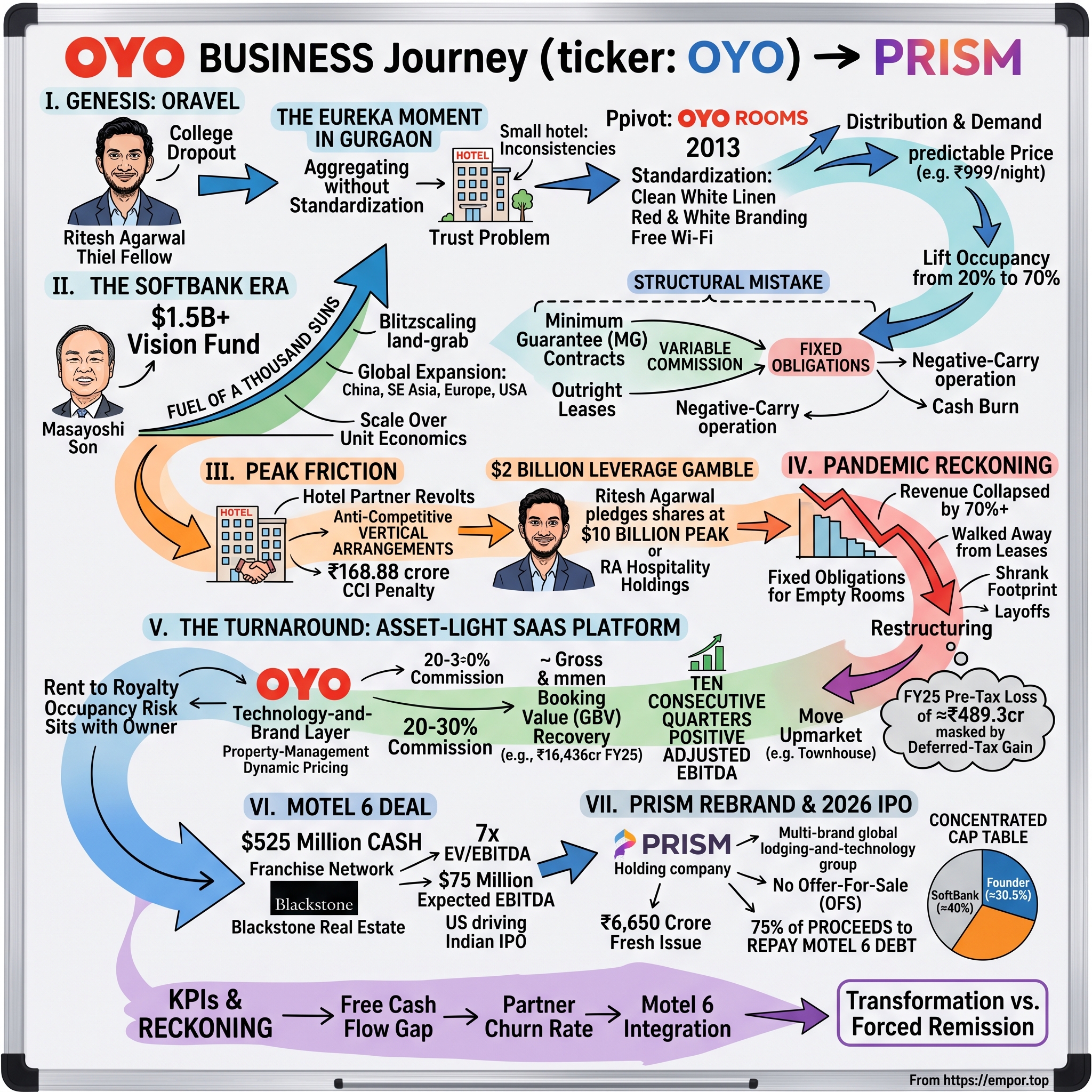
The pivot came in 2013, when Oravel became OYO Rooms — later mythologized as "On Your Own." The insight was to stop being a listings site and start being a brand. OYO would take a block of rooms in an independent hotel, impose a checklist of standards — clean white linen, the trademark red-and-white branding, free Wi-Fi, a flat-screen TV, branded toiletries, a working air conditioner — and sell those rooms under the OYO name at a predictable price, often around ₹999 a night, bookable in a few taps. The customer was no longer buying a random hotel; they were buying OYO's promise that this random hotel would meet a floor of quality.
The value proposition genuinely worked at small scale, and it is worth stating plainly because it is the seed of everything defensible in the business. For a small hotel owner running at maybe 20% occupancy, OYO offered distribution and demand that could lift occupancy dramatically — the company's own case studies claimed jumps toward 70% within months. For the traveler, OYO offered the thing the market could not otherwise provide: predictability. That is a real service, and where OYO delivers it, the brand has value. The trouble — the whole subsequent decade of trouble — began when the company decided that the way to make this small, sound idea enormous was to guarantee the hotel owner's revenue in cash. But that comes later. In 2014 and 2015, OYO looked like exactly the kind of company a growth investor dreams about: a real problem, a differentiated fix, a young and relentless founder, and a country with hundreds of millions of first-time travelers about to come online.
III. The SoftBank Era: The Fuel of a Thousand Suns (0:30–0:55)
In 2015, Masayoshi Son's SoftBank looked at OYO and saw the lodging chapter of the same thesis he was writing across ride-hailing, offices, and food delivery: that a well-capitalized aggregator could use capital itself as a weapon, buying supply and demand faster than any competitor could, until the market tipped and the winner owned it. Over the following years SoftBank, later through its Vision Fund, poured well over $1.5 billion into OYO across multiple rounds. The apex was a round announced in 2019 that raised roughly $1.5 billion — from Agarwal himself, SoftBank, and existing backers Lightspeed and Sequoia India — at a valuation of about $10 billion.8 For a company barely six years past its rebrand, running physical rooms in a low-margin corner of a developing economy, that was an extraordinary number, and it is the number the market still measures OYO against today.
The capital came with a philosophy, and the philosophy is the villain of the first act. SoftBank's model rewarded scale over unit economics on the theory that scale would eventually produce good unit economics through density and market power. OYO was told, in effect, to grab land. It expanded at a pace that is hard to overstate: into China, where it leased hundreds of thousands of rooms and briefly became one of the country's largest hotel operators; into Southeast Asia; into Europe, where it bought the vacation-rental firm Leisure Group; and into the United States. Headcount ballooned toward 30,000 people globally.9 By any conventional measure of a hotel company, OYO in 2019 was growing several times faster than was safe.
The structural mistake — the one a public-market investor has to understand because it is the exact thing management now claims to have fixed — was in how OYO locked up supply. To win hotels faster than rivals like FabHotels and Treebo, OYO moved away from a light commission model and began signing "minimum guarantee" (MG) contracts and outright leases. Under an MG, OYO promised the hotel owner a fixed monthly payment no matter how many rooms actually sold. Under a lease, OYO took the property on its own books entirely.
Read those two sentences again, because they contain the whole disaster. A minimum guarantee converts a variable, commission-based, capital-light marketplace into something with the risk profile of a master tenant: OYO took on fixed obligations to pay owners, while selling variable and heavily discounted inventory to travelers. When occupancy or room rates fell — a Tuesday in a weak market, a monsoon, a slow city — OYO ate the gap. The company was, functionally, running a giant, unhedged, negative-carry real-estate operation, and calling it a technology platform. Venture capital hid the cash burn. The reported "revenue" grew spectacularly because leases and guarantees let OYO book gross room revenue as its own. And the losses grew right alongside it. In 2019, China operations alone accounted for about $197 million of loss, roughly 64% of OYO's total losses that year.10 The blitzscaling engine was not building a moat. It was digging a hole.
There is a subtler lesson buried in this era that pays dividends when reading OYO's numbers today. Because OYO leased or guaranteed so much of its inventory, it recognized the gross room revenue of those hotels as its own — a room sold for ₹1,000 showed up as ₹1,000 of OYO revenue, not as the ₹200 or ₹300 commission a pure marketplace would book. That accounting choice made OYO's top line look enormous and its growth explosive, and it was one of the things that helped justify the $10 billion valuation. But gross-basis revenue from leased rooms is low-quality, capital-hungry, and margin-thin; net-basis commission revenue from an asset-light platform is scarcer but far more valuable per rupee. Much of OYO's post-pandemic revenue decline — the FY24 contraction discussed later — is simply this reversing: as leases were shed, the inflated gross revenue disappeared, leaving a smaller but healthier net-basis business behind. An investor who does not understand that a lower revenue number can represent a better company will misread OYO's entire recovery. It is the single most important accounting nuance in the story, and it is why revenue growth, in isolation, is close to meaningless for this particular business.
IV. Peak Friction, Antitrust, and the $2 Billion Leverage Gamble (0:55–1:25)
The first cracks came not from a spreadsheet but from OYO's own supply base. To fill discounted rooms, OYO leaned on its hotel partners with aggressive price cuts, and to protect its own economics it levied penalties, fees, and deductions that owners said were arbitrary and often left promised minimum guarantees unpaid. By 2018 and 2019, hotel owners' associations across India were organizing. There were public protests, threats of mass delisting, and a steady drumbeat of complaints that OYO changed commercial terms unilaterally and treated the small businesses that supplied its rooms as adversaries. This matters far beyond the bad press. In the platform model OYO now sells to investors, hotel owners are the supply side of a marketplace, and a marketplace whose suppliers have organized against it has a structural weakness that no amount of software elegance erases. The partner-trust deficit is not history; it is a live risk, and it began here.
The friction turned into a formal legal liability through OYO's approach to competition. To starve rivals of demand, OYO entered into an arrangement with MakeMyTrip–Goibibo, India's dominant online travel agency, under which budget competitors FabHotels and Treebo were disadvantaged on the platform. The Competition Commission of India investigated, and in October 2022 imposed a penalty of ₹168.88 crore on OYO for anti-competitive vertical arrangements — the kind of exclusive, rival-foreclosing conduct the law treats as an abuse when done by parties with market power.11 The company has contested the order, and the amount is not large relative to today's balance sheet, but the finding tells a public investor something about how this company competes: not only through product, but through control of distribution choke points. That instinct can create regulatory exposure in every market it operates in.
The most revealing episode of the era, though, had nothing to do with hotels and everything to do with governance. In July 2019, at the very top of the valuation bubble, Ritesh Agarwal moved to roughly triple his personal stake — from under 10% toward 30% — through a Cayman Islands vehicle, RA Hospitality Holdings, in a transaction valued at about $2 billion.1213 The mechanics matter. Agarwal did not have $2 billion; he borrowed most of it from global financial institutions, pledging OYO shares — marked at the $10 billion peak — as collateral. The purpose was partly to let early backers such as Lightspeed and Sequoia India take some money off the table, and partly to concentrate control and upside in the founder's hands.12
For a pre-IPO underwriter, this is a flashing light, and it is worth being explicit about why. First, it is a founder taking on personal leverage against his own company's shares at a peak valuation — a bet that only works if the number keeps going up. When OYO's private valuation later collapsed, that debt became an overhang and a source of stress and questions about what pressures the founder was under. SoftBank cut its own internal mark on OYO to about $2.7 billion in 2022 — a roughly 70% write-down from the $10 billion — which gives a sense of how far the collateral value fell.14 Second, it is a transaction that primarily benefited insiders and a controlling shareholder, executed inside offshore holding structures, at a company controlled by a single dominant investor. None of that is illegal, and some of it is ordinary for late-stage private companies. But it is exactly the category of related-party, founder-control, and incentive question that a public shareholder — who will hold common stock with none of the protections the insiders negotiated — needs answered before, not after, buying in. The presence of former SEBI chairman Ajay Tyagi on the board as an independent director from February 2026 is a signal that management understands governance will be scrutinized;6 whether the board is genuinely independent of a founder-and-SoftBank axis that together control a large majority is a diligence item, not a settled fact.
V. The Pandemic Reckoning and the Near-Death Experience (1:25–1:45)
Then the world stopped. When COVID-19 shut down travel in early 2020, OYO's revenue did not decline — it collapsed, by more than 70% in a matter of weeks, because a hotel business with no travelers has essentially no sales. For most hotel companies that is a brutal but survivable demand shock. For OYO it was very nearly fatal, and the reason is the structural flaw from Act III made concrete: the minimum guarantees and leases were fixed obligations that did not care that the rooms were empty. OYO owed owners money whether or not anyone came. A demand shock in a variable-cost business is a bad quarter; the same shock in a business carrying disguised fixed real-estate liabilities is a solvency event.
The restructuring that followed was fast and brutal, and — this is the part that ultimately mattered — it was the right response to the wrong business model. OYO tore up minimum-guarantee contracts en masse, walked away from unprofitable leases, and shrank its physical footprint. It cut staff on a large scale: reports at the time described layoffs and furloughs that, together with attrition, would pull global headcount down sharply from the roughly 30,000 peak, including plans to cut around 60% of the China workforce.1516 Whole markets, China above all, were wound down from operator-scale to something far smaller.
It is tempting to narrate this as heroism, and management does. The more accurate reading is that the pandemic forced OYO to do involuntarily what it should have done voluntarily years earlier: stop pretending a leveraged real-estate operation was a software company. The crisis did not reveal a new strategy so much as destroy the old one, leaving management no choice but to rebuild around the only model the balance sheet could support — one where the hotel owner, not OYO, carries the occupancy risk. Survival and strategy converged. What a skeptical investor should take from this chapter is not that OYO is resilient, but that OYO's discipline was externally imposed by a near-death experience, and the honest question for the future is whether that discipline holds when growth beckons again and capital is once more cheap.
VI. The Turnaround: Rebuilding as an Asset-Light SaaS Platform (1:45–2:10)
The post-pandemic OYO tells a genuinely different story about how it makes money, and the direction of travel is real even where the "SaaS" label is generous. Instead of leasing rooms or guaranteeing revenue, OYO positions itself as a technology-and-brand layer sitting on top of independent hotels. Owners run their properties on OYO's software — a property-management system and a suite of tools for dynamic pricing, billing, and channel management that push a hotel's rooms out to booking sites — and in exchange OYO takes a commission or revenue share, typically in the 20–30% range, rather than a rent liability. Travelers book on the OYO app; OYO handles demand generation, pricing, and the brand promise. The critical change is where the occupancy risk sits: in the new model it sits with the owner. That single shift is what converts a negative-carry balance sheet into a potentially high-margin royalty stream.
Layered on top is a deliberate move upmarket. Rather than chase the vast, unbranded, rock-bottom budget tier — where take rates are thin and churn is brutal — OYO has pushed higher-value brands like Townhouse and premium formats, aiming for properties where a higher room rate supports a higher absolute commission per booking. In principle, premiumization improves unit economics without requiring the company to add rooms recklessly.
The right unit of analysis for the marketplace half of this business is gross booking value — the total value of stays transacted across the platform — and the take rate OYO earns on it, because those two numbers, multiplied together, are the platform's real revenue engine. On this measure the recovery is genuine: GBV reached about ₹16,436 crore in FY25, up roughly 54% year on year, and the company has now strung together ten consecutive quarters of positive adjusted EBITDA.4 A 54% jump in the value flowing across the platform, against 16% audited revenue growth, tells you something specific and worth pausing on — OYO's take rate on that booking value is compressing, not expanding. That is the predictable price of premiumization and of shifting mix toward franchise and commission arrangements where OYO captures a slimmer slice of a larger, higher-quality pie rather than the fat, risky margin of a leased room. It is a healthier revenue mix, but it is not the picture of a platform steadily raising its rake, and it caps how quickly commission revenue can outgrow booking volume. For a public investor, the durable question is not whether GBV can keep growing — in an under-penetrated market it probably can — but whether OYO can hold or lift its take rate against organized, price-sensitive hotel owners without reigniting the churn that has dogged it since 2018.
One number from the recent past deserves to sit uncomfortably next to the growth story, because it quantifies the cost of the cleanup. In FY24 — the year of the first-ever profit — OYO's revenue actually fell, by about 1.4%, to roughly ₹5,388 crore from ₹5,463 crore the year before, as the company deliberately exited leases and low-quality inventory and cut total costs by around 13%.17 That is the honest signature of a rent-to-royalty pivot done properly: revenue that used to be inflated by booking gross lease income shrinks even as profitability appears, because the company is trading vanity revenue for real margin. It is a point in OYO's favor on discipline. But it also means the FY25 return to double-digit top-line growth is only one full year old, and a single year of reaccelerating revenue after a deliberate contraction is a thin base on which to underwrite years of compounding. The cohorts that matter — how a hotel signed in 2023 is performing in 2026, whether owners who joined at premium brands stay and expand — are exactly the retention data a real prospectus will have to disclose and that the public reporting so far does not.
Now the evidence, because the label is not the proof. The audited numbers in the DRHP tell a more complicated — and more honest — story than the headline "SaaS platform" framing. In FY24, OYO reported its first-ever full-year net profit, ₹229 crore (₹229.6 crore), a landmark after years of losses.17 In FY25, on an audited basis, operating revenue was ₹6,252.8 crore, up about 16% year on year, and reported net profit was ₹244.8 crore, up a modest 7%.5 Two things about that FY25 figure deserve emphasis and do not appear in the promotional version of the story. First, the widely circulated ₹623 crore FY25 profit that the founder announced in May 2025 was an unaudited number; the audited profit in the filing is ₹244.8 crore.185 Second, and more important, that ₹244.8 crore is almost entirely an accounting artifact: excluding a deferred-tax gain of about ₹765.6 crore and other exceptional items, OYO ran a pre-tax loss of roughly ₹489.3 crore in FY25.5 A deferred-tax gain is not cash and not operations — it is the company recognizing the future value of past losses against expected future profits. Strip it out, and the underlying business was still losing money before tax in the most recent full audited year.
This does not make OYO uninvestable, but it reframes the "path to profitability" claim precisely. The adjusted EBITDA improvement is real — audited EBITDA rose to about ₹1,083.5 crore in FY25 from ₹887.8 crore in FY24 — and the operating trend is upward.5 But there is a wide gulf between adjusted EBITDA of a thousand crore and a genuine, tax-paying, cash-generating net profit, and that gulf is filled by depreciation, interest on the debt raised to buy Motel 6, and the ordinary costs that adjustments exclude. Management is selling durable profitability; the audited record so far shows adjusted profitability plus a one-time tax benefit. The revenue mix reinforces the caution: in FY25, "accommodation services" was still the single largest revenue line at about ₹3,824.8 crore, with booking commissions and royalty — the truly platform-like, capital-light revenue — at roughly ₹1,562 crore, and rental income actually growing 77% to ₹156.9 crore.5 A pure asset-light software marketplace does not have a growing rental line. OYO is meaningfully more asset-light than it was; it is not yet the clean royalty business the narrative implies.
Revenue quality is the deeper test, and here the picture is mixed in a way that rewards patience over slogans. The most valuable revenue a lodging platform can have is recurring and contractual — franchise fees and software subscriptions that show up every month regardless of any single booking. OYO's booking-commission-and-royalty line is the closest thing it has to that, and its growth is encouraging, but the largest share of revenue still moves with transactions: it depends on travelers choosing to book, on room rates holding, and on seasonal and macro demand that OYO does not control. Transactional revenue is not bad revenue — Booking Holdings is built on it — but it is more volatile and deserves a lower multiple than a genuine subscription stream, and management's "SaaS platform" framing invites investors to pay the higher multiple for the lower-quality mix. Layered on top is real geographic and brand concentration: after the Motel 6 acquisition, a large and rising slice of group revenue depends on one American economy chain, while the Indian core that carries the growth narrative is now only about a fifth of revenue.1122 Concentration cuts both ways — it is diversification away from India and dependence on Motel 6 at the same time — but either way it means the group's fortunes are increasingly tied to how two very different businesses in two very different markets perform, not to a single elegant platform compounding everywhere at once.
VII. Capital Deployment: The $525 Million Motel 6 Acquisition (2:10–2:30)
If FY25's operating profit was thin, the single most consequential act of capital allocation in OYO's recent history was not organic at all. In September 2024, OYO's parent agreed to buy G6 Hospitality — the franchisor of Motel 6 and the extended-stay brand Studio 6 — from Blackstone Real Estate for $525 million in cash, and the deal closed in December 2024.192021 Blackstone had owned G6 since 2012 and had spent the intervening years converting it into an asset-light franchise network of roughly 1,500 economy-lodging properties across the United States and Canada, generating on the order of $1.7 billion in annual gross room revenues across the system.19 What OYO bought, in other words, was not real estate — it was a franchise-fee stream.
On the numbers OYO has put forward, the deal looks cheap, and the arithmetic is worth walking through because it is the crux of the current investment case. G6 is expected to contribute more than ₹630 crore — roughly $75 million — of EBITDA in its first full year under OYO.22 Against a $525 million purchase price, that is close to 7x EV/EBITDA. Publicly listed U.S. lodging franchisors such as Choice Hotels and Wyndham have generally traded in a 12–15x EV/EBITDA band. If G6's cash flows are as stable and as franchise-like as advertised, buying them at 7x when comparable public franchisors trade at twice that is genuinely accretive: OYO acquired an established, self-funding American cash flow at a discount to where the market values similar streams.
The strategic logic is sound and the price appears favorable — but the skeptical reading is essential, and it runs in two directions. First, why was it cheap? Motel 6 is an economy brand with an aging physical estate and legacy digital infrastructure; a discount to Choice and Wyndham partly reflects that Motel 6's franchise fees may be lower-quality and lower-growth than a mid-scale franchisor's. Blackstone, a sophisticated seller, chose to exit at this price. Cheap can mean mispriced, or it can mean fairly priced for a business with more hair on it than the multiple alone suggests, and an underwriter should not assume the former. Second, and more decisive for the IPO: how was it paid for? The $525 million was cash, but that cash was substantially debt-financed, including a U.S.-dollar term loan. This is why the acquisition sits at the very center of the listing rather than off to the side. The single largest use of IPO proceeds — about ₹4,987.5 crore, roughly 75% of the ₹6,650 crore raise — is earmarked to repay borrowings, materially the debt taken on to fund and carry the G6 acquisition.13 In effect, public shareholders are being asked to fund the deleveraging of a debt-financed acquisition. The accretion is real only after that debt is retired; before it, the interest cost is one of the reasons FY25 slipped to a pre-tax loss.
The most important structural consequence is geographic. With G6 consolidated, the United States accounted for about 27% of OYO's revenue in the first nine months of FY26, while India — the historical core — contributed only around 20% of FY25 revenue.2211 A Skift analysis of the updated filing put it bluntly: the U.S. Motel 6 business is now a primary driver of the Indian IPO.22 That cuts both ways. It genuinely diversifies OYO away from a single emerging market and hands it a stable, hard-currency, franchise-fee base. But it also means the company asking Indian public investors for growth-technology multiples is deriving a large and rising share of its cash flow from mature American roadside motels — a fine business, but not a hyper-growth one, and one whose integration risk (upgrading Motel 6's dated website and app, imposing OYO's pricing tools on a traditionally offline customer base) is real and unproven.
It is worth being precise about what OYO actually bought, because the phrase "a franchisor bought at 7x" is doing a great deal of work in the investment case. A pure hotel franchisor collects a royalty — a percentage of a franchisee's room revenue — plus fees for marketing, the reservation system, and brand programs, and it carries almost no property risk and very little capital intensity; that is why Choice and Wyndham earn high margins and command 12–15x. Motel 6 sits at the economy end of that model, which brings both an advantage and a caution. The advantage is that economy roadside lodging is genuinely counter-cyclical demand — budget-conscious travelers, contractors, and displaced residents keep the lights on when the wider economy softens, giving G6's fee stream a stability that a luxury or business-hotel franchisor lacks. The caution is that an economy brand has thinner per-room economics, an older physical estate maintained by independent franchisees, and less pricing headroom, all of which explain why a sophisticated seller like Blackstone parted with it at a single-digit multiple. OYO's value-creation plan is to bolt its dynamic-pricing and distribution technology onto that stable base and lift the franchisees' revenue — and therefore OYO's royalty — without spending capital of its own. That is a coherent thesis and precisely the kind of software-on-top-of-real-assets play the whole company now aspires to be. But it has never been executed by this management team in the United States, on American franchisees with their own habits and their own lawyers, and a franchisor that pushes its franchisees too hard on pricing or fees can trigger exactly the supplier revolt OYO already knows how to cause. The accretion math assumes the fee stream holds and improves; the integration risk is that a clumsy rollout erodes the very stability that made the asset attractive.
VIII. Corporate Identity: The PRISM Rebrand & 2026 IPO Structure (2:30–2:50)
The rebrand formalizes what the Motel 6 deal made true on the ground. In 2025, the parent company shed the "Oravel Stays" name and reorganized under a holding-company identity — PRISM — with OYO retained as the consumer-facing budget and mid-scale travel brand in India, Southeast Asia, and the Middle East, sitting alongside Motel 6 and Studio 6 in North America and the European vacation-homes business.5 The message to investors is deliberate: this is no longer a single app but a multi-brand global lodging-and-technology group, and the listed entity should be valued as a holding company rather than as "OYO the budget-hotel brand." Whether that reframing earns a premium or simply spreads a still-thin profit across more logos is exactly the question the market will price.
The IPO structure is where the story gets genuinely interesting for a public-market reader, and where management's stated confidence is easiest to test. The offer is a 100% fresh issue of up to ₹6,650 crore with no offer-for-sale component whatsoever.12 That means neither Ritesh Agarwal, nor SoftBank, nor any other pre-IPO backer is selling a single share into the listing; all the money raised goes to the company, not to cashing out insiders. Management frames this as a powerful signal of alignment and long-term conviction — nobody is heading for the exit. On the most charitable reading, that is true, and a 100% fresh issue used mainly to retire debt is a balance-sheet-cleaning event that leaves the company stronger.
But the same fact carries a colder interpretation that an underwriter should hold alongside the flattering one. Insiders not selling at a proposed roughly $7–8 billion valuation may reflect conviction — or it may reflect that this level is still a down round from the $10 billion peak of 2019 and far above SoftBank's own $2.7 billion internal mark of 2022, and that neither the founder (who has personal leverage tied to the share price) nor SoftBank (which has already written the position down and up again) wishes to crystallize a sale at a price the narrative hopes to grow into.814 "Nobody is selling" and "nobody wants to sell here" produce the same cap table. It is a genuinely positive structural feature — no insider overhang hitting the market at listing — but it is weaker evidence of value than the marketing suggests.
The cap table itself is unusually concentrated for a company about to go public, and this is the governance heart of the underwriting. On a pre-issue fully diluted basis, SoftBank's SVF India Holdings (Cayman) holds about 40.04%.6 Ritesh Agarwal holds roughly 30.52% in total — about 6.59% directly, 20.12% through RA Hospitality Holdings (the same Cayman vehicle from the 2019 leveraged buyback), and 3.81% through another entity, Patient Capital.6 A chief human resources officer, Dinesh Ramamurthi, is listed with about 5.39%, and Airbnb, which invested during the private years, holds around 1.22%.6 The company reports roughly 81,848 total shareholders and dozens of promoter-group entities.6 Two owners — SoftBank and the founder — together control well over 70% before the offering. After a ₹6,650 crore fresh issue that might represent something like a tenth of the company, they will still control a decisive majority. A public shareholder buying into this IPO is buying a minority position in a company that will remain, for the foreseeable future, controlled by a single strategic investor and a founder whose interests are intertwined with that investor through years of offshore structures and a peak-priced leveraged buyback. The board's independent additions are welcome, but control is control.
Two structural features of that cap table deserve more scrutiny than the "no OFS, strong alignment" headline allows, because they bear directly on what a public share is actually worth. The first is the nature of the pre-IPO equity itself. A decade of private financing rounds — Vision Fund money, Airbnb's strategic investment, the various down-rounds after 2020 — will have created layers of preferred stock, and preferred stock typically carries rights that common stock does not: liquidation preferences that pay preferred holders back first in a sale or wind-down, anti-dilution protection that adjusts their conversion ratio if new shares are issued cheaply, and information and consent rights. Those terms are not disclosed in the public reporting available before a full prospectus, and they matter enormously, because the headline "$7–8 billion" is a price for the whole equity as if all shares were equal — and until conversion at listing, they are not. Ahead of an IPO, preferred shares customarily convert to common, which would flatten these preferences, but the conversion terms — whether any holder negotiated a ratchet that hands them extra shares if the IPO prices below a threshold — are exactly the kind of provision that transfers value from new public buyers to old private ones, and they are a first-order diligence item for the real filing. A public investor should assume nothing about the economic equivalence of private preferred and public common until the conversion mechanics are on the table.
The second is the distinction between total equity value and free float. A ₹6,650 crore fresh issue at a $7–8 billion valuation implies a free float on the order of a tenth of the company, with the remaining ~90% held by SoftBank, the founder, employees, and other pre-IPO holders. Even setting aside the fresh-issue lock on insiders, that is a thin float, and a thin float has a specific, double-edged consequence that has nothing to do with business value. On the upside, scarce supply against strong demand can push the listing price well above any intrinsic estimate — Indian new-age IPOs have repeatedly listed at rich premiums on scarcity and narrative alone. On the downside, thin float means the eventual expiry of insider lock-ups becomes a genuine overhang: when SoftBank and the founder are finally free to sell, roughly nine-tenths of the company can, in principle, come looking for a buyer. Lock-up terms are not yet disclosed and must not be assumed, but their eventual shape is one of the most important things a long-term holder will need to understand, because the difference between "insiders can't sell yet" and "insiders won't sell ever" is the difference between a supported price and a durable one.
IX. Playbook: Business & Investing Lessons (2:50–3:10)
Step back from the transaction and OYO offers three lessons that generalize well beyond hospitality.
Lesson 1 — Venture capital cannot repeal the unit economics of physical operations. The founding error was believing that software-style capital efficiency could be bolted onto a real-estate operation by force of funding. When OYO guaranteed hotel owners' revenue to win supply, it did not create a technology moat; it created fixed liabilities against variable, discounted cash flows — a structure that magnified every downturn. Capital can subsidize a broken unit economic for a while, but it cannot make it sound. The pandemic simply presented the bill.
Lesson 2 — The "rent-to-royalty" pivot is the whole turnaround. Everything defensible about today's OYO comes from moving the occupancy risk off its own books and onto the hotel owner while keeping the software, the demand generation, and the brand. That is the difference between a master tenant and a franchisor, and it is the difference between a business that dies in a demand shock and one that merely has a bad quarter. The lesson for founders is that surviving a crisis often means converting physical liabilities into digital ones — but the lesson for investors is to check whether the conversion is complete or merely rhetorical. In OYO's case, the growing rental line and the still-dominant accommodation-services revenue show the conversion is well underway but not finished.
Lesson 3 — Watch where the profit actually comes from. The company's recent profitability leans on a deferred-tax gain and on an acquired American franchise stream, not yet on a self-sustaining Indian software platform. That is not a scandal; it is a fact about the composition of the improvement, and composition is destiny when you are underwriting durability.
The moat analysis is best done with restraint, because OYO's advantages are real but narrower than the pitch. In Hamilton Helmer's framework, the strongest candidate is a network effect in India: more listed budget hotels attract more app users, and more app users attract more hotels, in a loop that is genuinely hard for a sub-scale rival to bootstrap. Scale economies exist in demand generation — a large direct-booking app spreads customer-acquisition cost across more room-nights than a small competitor can — but they are moderate, not commanding, because the underlying rooms are commodity supply. Switching costs are the most contested: they are meaningfully high for an owner deeply integrated into OYO's property-management and billing software, but OYO's own history of owner revolts and churn shows those costs have often been lower than the moat story requires, because an aggrieved owner will absorb switching friction to escape a partner they distrust. On Porter's forces, the threat of new entrants at national scale is low — replicating physical distribution across 15,000-plus properties is capital-intensive — but supplier power is genuinely high and organized: hotel owners have struck, litigated, and lobbied, and they are the one input OYO cannot manufacture. A marketplace whose suppliers can collectively bargain has a permanent ceiling on how hard it can push its take rate.
The honest verdict on the moat is that OYO has a brand and distribution advantage in Indian budget travel that is real but shallow, and it should not be confused with the deep, compounding powers that justify a technology multiple. The brand does genuine work: a traveler who trusts "OYO" to clear a quality floor will pick an OYO-listed room over an unknown independent, and that trust is expensive for a new entrant to replicate. The app's scale in demand generation is a real edge over a single hotel's own website. But none of these is the kind of power that lets a company raise prices at will or lock customers in. Guests are promiscuous — they compare OYO against MakeMyTrip, Booking, and the hotel's own rate on every trip, and OYO's own discounting habit trained them to. Owners have proven, repeatedly, that they will leave. And the "network effect" that reads so well on a slide is strong only within a local market and only up to the point where a city has enough supply and demand density to be useful; beyond that, adding the ten-thousandth budget hotel in India does little for the customer in a city that already had a hundred choices. The most durable thing OYO owns is probably the least glamorous: an operational capability, built over a decade of painful trial and error, in signing, standardizing, and servicing thousands of small, chaotic, independent hotels — a low-margin, high-effort competence that larger and better-capitalized rivals have generally not wanted to build. That is a moat of sorts. It is just not a software moat, and the valuation will ask investors to pay for the latter.
X. Analysis: The Bull vs. Bear Stress Test & Risk Radar (3:10–3:30)
Pricing versus value. Start with the discipline the whole exercise requires: the reported $7–8 billion target is a price, not a value. It is not yet even a firm price, because the offer has been filed but a price band has not been set, so the implied equity value is a market expectation, not a fact. That expectation sits below the $10 billion of 2019 and well above the $2.7 billion SoftBank carried internally in 2022 — three very different numbers for roughly the same asset across seven years, which is itself the clearest possible evidence that private marks are opinions, not measurements.814 A public common shareholder, moreover, will not inherit the liquidation preferences, anti-dilution ratchets, or information rights that OYO's preferred investors negotiated over a decade of rounds; the specific terms of those preferences are not publicly disclosed and are a first-order diligence item, because they determine how proceeds are shared in any outcome short of a runaway success. The headline valuation is the beginning of the analysis, not the end.
What a valuation has to embed. Working from disclosed operating evidence rather than the private mark: OYO generated roughly ₹6,253 crore of audited operating revenue in FY25 and about ₹6,941 crore in just the first nine months of FY26, so the business is scaling toward an annual revenue run-rate in the region of ₹9,000 crore, with reported nine-month profitability that again benefits from non-operating items.56 Adjusted EBITDA of roughly ₹1,083 crore, growing, is the number the bull case leans on. At a $7–8 billion equity value — on the order of ₹58,000–67,000 crore — the market would be paying somewhere around 50–60x that adjusted EBITDA, and a far higher multiple of any honest measure of free cash flow, because true free cash flow after interest, tax, maintenance capital, and the exclusions in "adjusted" is not yet clearly positive. Even generously, this is not a value multiple; it is a growth-and-improvement multiple. It embeds three assumptions stacked on top of one another: that revenue keeps compounding at double digits, that the adjusted-to-actual gap closes as debt is repaid and the deferred-tax crutch is removed, and that margins expand toward the 25–30%+ EBITDA territory of a mature franchisor. A transparent scenario frame makes the sensitivity obvious. In a base case where revenue compounds in the low-to-mid teens and post-IPO deleveraging lifts net margins toward the high single digits, the business could grow into a valuation of this order over several years — but "grow into" is the operative phrase, meaning today's price is borrowing from tomorrow's execution. In a bear case where Indian partner churn caps take-rate growth, Motel 6 integration disappoints, and the deferred-tax tailwind reverses into a normalized tax charge, the durable earnings power supports a materially lower number, and the down-round trajectory from $10 billion continues. In a bull case where the platform's network effects compound, Motel 6's franchise stream proves as stable as advertised and gets re-rated toward its U.S. peers, and the group converts adjusted EBITDA into real free cash flow, the current price looks like an entry point rather than an exit. The honest output is a wide range, not a point.
The market, sized with restraint. The bull narrative reaches instinctively for enormous category numbers — the multi-hundred-billion-dollar global hotel industry, hundreds of millions of Indians traveling for the first time — and those numbers are real but nearly useless for underwriting, because they describe a category, not a reachable market. The market OYO can actually address at its present product, price point, and distribution is far narrower on each axis. Geographically it is concentrated: India is now only about a fifth of revenue, the United States about a quarter and mature, and the rest scattered across Southeast Asia, the Middle East, and European vacation homes.1122 By segment it is the branded-budget and lower-midscale tier — a genuinely under-penetrated slice in India, where the overwhelming majority of hotel rooms remain independent and unbranded, but also the tier with the thinnest per-room economics and the most price-sensitive, least loyal owners and guests. And competitively it is contested from every side: FabHotels and Treebo in branded budget, MakeMyTrip and Booking in distribution, the hotel owners themselves who can always go direct, and, in the U.S., every other economy franchisor. The reachable, monetizable market is therefore a fraction of the headline TAM, and OYO's share of it is bounded not by how many hotels exist but by how many owners will accept its take rate and stay. A credible growth case rests on deepening penetration of the branded-budget tier and lifting revenue per property through software, not on capturing some fixed percentage of a trillion-dollar category — and any market-share assumption should be checked against the named rivals who will respond to every pricing move.
The comparable-company problem. The peer set matters, and OYO does not have a clean one. The closest operating analogs for the acquired half of the business are the U.S. lodging franchisors — Choice, Wyndham, and by extension Hilton and Marriott — which are pure-fee, high-margin, low-capital businesses trading at roughly 12–15x EV/EBITDA. But those are enterprise-value multiples on mature, developed-market, essentially all-franchise businesses; applying them to OYO's equity value would be an error, because OYO carries acquisition debt and a large chunk of its revenue is still accommodation and rental, not fee. The closest analogs for the demand-generation half are online travel agencies — Booking, and in India MakeMyTrip — but those are pure-marketplace, negative-working-capital, asset-light businesses with cleaner economics than OYO's hybrid. And the "new-age Indian tech IPO" cohort that the offering will inevitably be compared to is a narrative peer set, not an economic one; membership in it is a reason the stock might price richly, not a reason it is worth more. The correct read is that OYO is a hybrid — part budget-hotel brand, part software platform, part American franchisor — and no single peer multiple fits it, which is precisely why applying the highest available multiple would flatter it.
Reconciling the two views. Put the intrinsic and comparable lenses side by side and a coherent picture emerges: a central, evidence-based valuation grounded in current cash-generating power sits meaningfully below the mooted $7–8 billion, because that price is underwritten not by today's free cash flow but by a multi-year path of revenue compounding, margin expansion, debt repayment, and the normalization of a tax-flattered bottom line. That does not make the price wrong — it makes it forward-looking, and forward-looking prices are bets on execution. The specific things the prospective valuation embeds are worth naming: sustained double-digit GBV growth in India, a take rate that holds despite organized owner power, a Motel 6 fee stream that stays stable and ideally re-rates toward its U.S. peers, disciplined capital allocation from a founder with a history of the opposite, and a conversion of adjusted EBITDA into real, taxed free cash flow within a few years of listing. The market may well price above even that optimistic central case, and an investor should understand why without mistaking the reasons for value: a thin free float, a recognizable consumer brand that retail investors know from personal experience, membership in a fashionable new-age-IPO cohort, and simple momentum can all lift a listing price above what the cash flows justify. Equally, the market may price below, if it fixates on the down-round trajectory from $10 billion, the tax-driven profits, or the partner-trust overhang. Scarcity, narrative, and momentum are real forces on the price; they are not evidence about the business, and the discipline of underwriting is to keep the two ledgers separate.
The risk radar. Three risks sit above the rest. Motel 6 integration is the execution test the near-term case rests on: OYO has said it will invest in modernizing Motel 6's website and the My6 app and layer on its dynamic-pricing tools, and doing so without alienating a traditionally offline American road-traveler base is unproven. Debt and refinancing is the reason the IPO exists at all — the plan depends on raising ₹6,650 crore and directing ~₹4,987.5 crore to repay borrowings; any delay in the H2 2026 window leaves the group exposed to interest costs that already helped push FY25 to a pre-tax loss.13 Regulatory and partner exposure is the tail that never quite disappears: the ₹168.88 crore CCI penalty remains contested, and the underlying instinct to control distribution — plus the unresolved trust deficit with hotel owners — could constrain pricing power in every market.11
Reading the record as diligence, not marketing. A pre-IPO underwriter has to treat everything public about OYO as a diligence file rather than a brochure, and several features of that file reward a skeptical eye. The reliance on a ₹765.6 crore deferred-tax gain to convert a pre-tax loss into a headline profit is not fraud — it is standard accounting — but it is precisely the kind of non-operating item that a marketing story foregrounds and an underwriter strips out.5 The distance between the founder's May 2025 claim of ₹623 crore in profit and the audited ₹244.8 crore in the filing is a reminder that unaudited management numbers and audited disclosures can diverge materially, and that the more optimistic figure traveled further.45 The persistence of accommodation and rental revenue inside a company that describes itself as an asset-light platform is a wording-versus-reality gap worth holding onto.5 And the fact that this is a third attempt at listing, after two earlier filings were withdrawn, tells you the company's readiness has been a moving target for half a decade.3 None of these is disqualifying. Collectively they argue for weighting the audited, disclosed, operating record heavily and the promotional framing lightly — and for treating the items a real prospectus has not yet disclosed (lock-up terms, the full risk-factor section, final use-of-proceeds accounting, the specific rights attached to preferred shares) as open questions rather than as reassuring silences. Their absence is not evidence of safety; it is simply evidence not yet produced.
Bull against bear, in plain terms. The bull case is that post-IPO deleveraging strips out interest expense and unlocks the margin of a genuinely capital-light royalty model; that Motel 6, bought at ~7x, injects stable hard-currency cash flow and re-rates toward its 12–15x peers; and that zero insider selling signals real conviction on the path to a $10 billion-plus market value. The bear case answers each: the partner-trust deficit and organized supplier power cap how far take rates and margins can actually go; a $7–8 billion price is still a down round that concedes the company has lost its hyper-growth premium; the reported profits lean on a deferred-tax gain and an acquired motel chain rather than a self-sustaining Indian platform; and the same "nobody is selling" that reads as conviction also reads as insiders declining to crystallize a loss against a $10 billion memory. Both cases are built from the same facts. That is what makes this a real underwriting rather than a story.
Catalysts and the reckoning. Several near-term events will move the story from filing to fact, and each is a moment where the market's mood and the business's substance can diverge. The most immediate is pricing: the offer has been filed and SEBI has given its observations, but the price band that fixes the implied valuation has not been set, and whether the book comes at the lower or upper end of the mooted $7–8 billion range will reveal how much of the "growth-tech" premium institutional investors are actually willing to underwrite versus how much they treat this as a leveraged franchisor to be valued on cash flow. The listing itself is a catalyst in the narrow, and often misleading, sense that a thin float and a strong retail appetite for a recognizable brand can produce a pop that reflects scarcity rather than value. The first full set of post-listing results — particularly the first year in which the deferred-tax benefit no longer flatters the bottom line and the G6 acquisition debt has been at least partly repaid from proceeds — is where the profitability question gets its first honest public answer. And the eventual lock-up expiry, whenever it is set, is the moment the market discovers whether the "nobody is selling" of the IPO was conviction or merely timing. The reckoning a public market eventually forces on every richly priced story is the same one here: at some point, adjusted EBITDA has to become cash in the bank net of interest and tax, or the multiple compresses to meet the cash flow. OYO can defer that meeting through the listing; it cannot cancel it.
The KPIs that will settle it. Three numbers, tracked over the first several quarters as a public company, will confirm or falsify the thesis faster than any narrative. First, the gap between adjusted EBITDA and actual, tax-normalized free cash flow — the single most important disclosure, because it is where the "adjusted profitability" claim either becomes "durable profitability" or does not. Second, hotel-partner churn, the rate at which owners leave the platform, because it is the direct measure of whether the switching-cost moat and the repaired trust are real. Third, Motel 6's franchise revenue and EBITDA trajectory post-integration, because the entire diversification-and-cash-cow thesis rests on that acquired stream holding up under new ownership. If those three move the right way, the underwriting holds. If they do not, no rebrand will hide it.
XI. Epilogue & Outro (3:30–3:40)
OYO's arc is one of the most dramatic in the short history of Indian startups, and its two halves are equally instructive. The first half is a near-perfect cautionary tale about what happens when abundant venture capital persuades a company to ignore the economics of the physical world: OYO guaranteed hotel revenues it could not honor, scaled a negative-carry operation across four continents, called it software, and very nearly did not survive the first serious shock. The second half is a genuine, and genuinely difficult, corporate turnaround: the shedding of leases and guarantees, the shift of risk back onto hotel owners, the move upmarket, and the opportunistic purchase of an American cash cow at a discount. Both halves are real, and the company deserves credit for the second without being excused for the first.
What a long-term public-market investor is left with, on the eve of the third IPO attempt, is a business that is much better than it was and not yet as good as it says. The turnaround is authentic in direction but incomplete in substance: the most recent audited year still shows a pre-tax loss beneath a tax-driven headline profit; the cash engine is as much an acquired motel franchise as an Indian software platform; and the company remains firmly controlled by the same founder-and-SoftBank axis whose incentives produced the excesses of the first act. The prospective valuation asks the market to pay today for a durability that the numbers have not yet proven. None of that means the story ends badly — the same facts support a constructive case if execution holds and the debt comes down. It means the reckoning has been deferred, not avoided, and the public market, unlike the private one, tends to insist on collecting. The next few quarters of disclosure — free cash flow, partner churn, and Motel 6's fee stream — will be where OYO finally has to show whether it has become the company its new name implies, or merely renamed the one it was.
For founders, the concluding lesson is that the market eventually charges for the physics you ignore: capital can subsidize a broken unit economic for years, but it cannot repeal it, and the bill, when it arrives, arrives all at once. The discipline OYO now displays was not chosen so much as extracted by a near-death experience, and the open question — the one that separates a genuine transformation from a forced remission — is whether that discipline survives the return of cheap capital and the temptation to grow fast again. For investors, the lesson is the older one that every cycle relearns: a private mark is an opinion, an adjusted metric is an argument, and a headline profit built on a deferred-tax gain is a sentence with an asterisk. The way to underwrite a company like this is not to accept or reject the story but to hold the flattering and the skeptical readings of the same facts at once, to weight the audited record over the narrative, and to insist — patiently, and after the applause of the listing has faded — that adjusted profitability turn into the real thing. OYO has earned the right to be taken seriously as a business again. It has not yet earned the right to be taken at its word.
References
-
OYO Parent PRISM Files Updated DRHP for ₹6,650 Crore IPO With SEBI — Groww, 2026-06-30 ↩↩↩↩↩
-
OYO parent Prism files updated IPO papers: No share sale by Ritesh Agarwal or SoftBank — The Week, 2026-06-30 ↩↩
-
OYO IPO update 2026: Latest news, IPO size, valuation, DRHP and listing timeline — Ventura Securities, 2026 ↩↩↩↩
-
OYO most profitable startup in FY25 with ₹623 cr profit: Ritesh Agarwal — Business Standard, 2025-05-08 ↩↩↩
-
OYO Retains Profitability In FY25 On Deferred Tax Gain, Changes Corporate Identity — Inc42, 2025 ↩↩↩↩↩↩↩↩↩↩↩↩
-
PRISM DRHP: A Look At Shareholding Pattern & Key Personnel — Inc42, 2026 ↩↩↩↩↩↩↩
-
India Startup Oyo Raises $1.5 Billion at $10 Billion Valuation — Bloomberg, 2019-10-07 ↩↩↩
-
Oyo makes lay offs official, over 5,000 fired globally amid profitability rush — The Tech Portal, 2020-03-04 ↩
-
Oyo is cutting 60% of its China staff — TechNode, 2020-03-03 ↩
-
India Made Up 20% of OYO FY25 Revenue As It Rebrands — Medianama, 2025-09 ↩↩↩↩↩
-
Oyo's Ritesh Agarwal buys back shares of his own company — The Week, 2019-07-20 ↩↩
-
Founder Ritesh Agarwal to buy back stake worth $2 billion in Oyo — Business Today, 2019-07-19 ↩
-
SoftBank cuts internal valuation of $10 billion Oyo to $2.7 billion — TechCrunch, 2022-09-22 ↩↩↩
-
Oyo is cutting 60% of its China staff — TechNode, 2020-03-03 ↩
-
Oyo makes lay offs official, over 5,000 fired globally amid profitability rush — The Tech Portal, 2020-03-04 ↩
-
IPO-bound OYO reports first ever net profit of Rs 229 crore in FY24 — Business Standard, 2024-08-14 ↩↩
-
OYO becomes most profitable Indian startup in FY25 with Rs 623 crore profit — Indian Startup News, 2025-05 ↩
-
Oyo parent to acquire G6 Hospitality from Blackstone for $525 million — CoStar, 2024-09-20 ↩↩
-
Global Travel Technology Company OYO Completes Acquisition of G6 Hospitality from Blackstone Real Estate — Blackstone, 2024-12 ↩
-
This Indian Startup Is Buying Motel 6 For $525 Million — Forbes, 2024-09-23 ↩
-
U.S. Motel 6 Business Is Driving Prism's Indian IPO, New Filing Shows — Skift, 2026-06-30 ↩↩↩↩↩
 LinkedIn
 WhatsApp
 Reddit
 Hacker News
 Email
Email Kindle
 RSS Feed
 Spotify
 Apple Podcasts
 Amazon Music
 Audible
 YouTube