Orkla India: The Multi-Brand Spice & Heritage Food Engine
I. Introduction & Episode Roadmap
There is a particular kind of business story that only makes sense when zooming out far enough to see two clocks running at once. One clock started ticking in 1654, in a mining district in central Norway, where a copper pit called Orkla gave its name to a company that would spend the next three and a half centuries reinventing itself — from mining to chemicals to media to, finally, branded consumer goods. The other clock started in 1924, in a modest eating house in Bangalore, where a family from the Udupi coastal belt began serving South Indian vegetarian food with exceptional operational consistency.
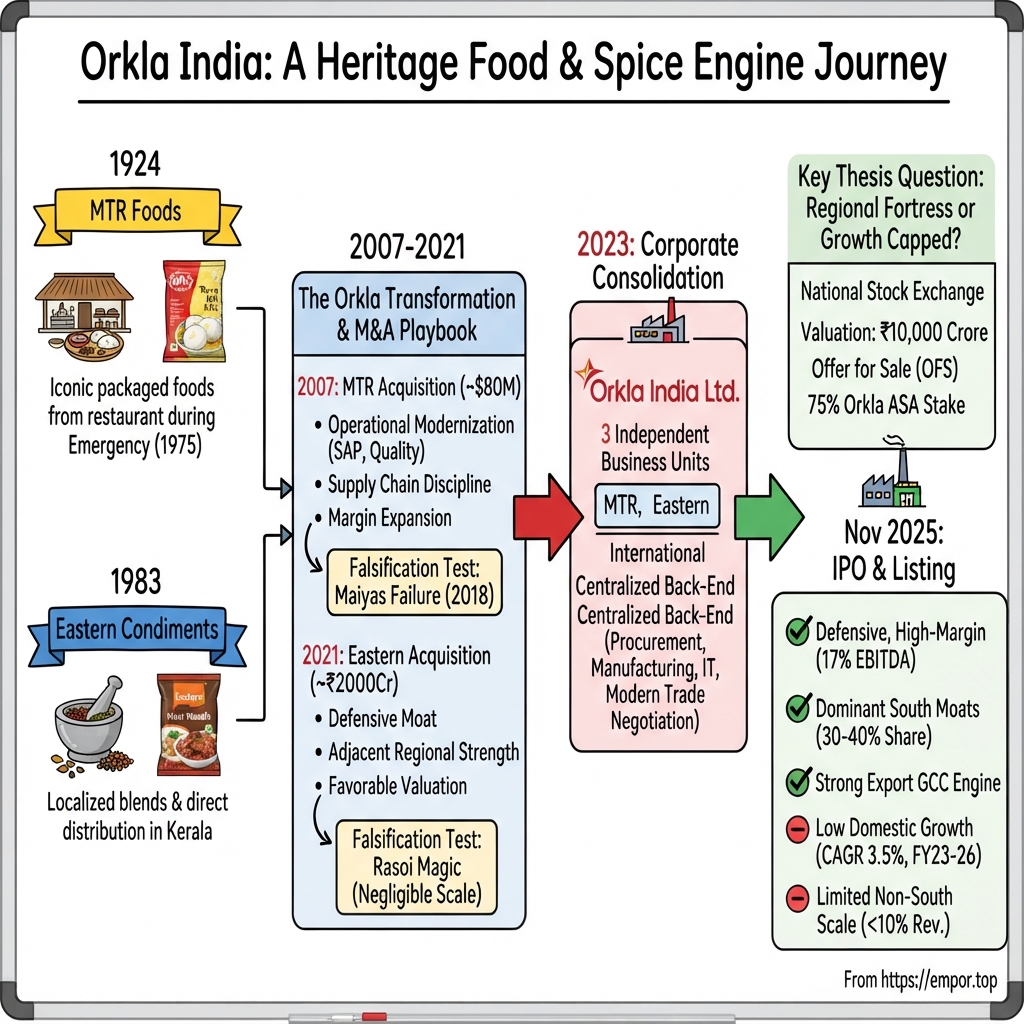
Those two timelines converged in 2007. By November 2025, when Orkla India Ltd. rang the bell on the National Stock Exchange at a valuation of roughly ₹10,000 crore, the result was a distinctive entity in Indian consumer goods: a Norwegian-controlled, Bangalore-headquartered, Kerala-powered spice and convenience food enterprise that sells sambar powder to Mysore households and chicken masala to Malayali expatriates in Doha, operating at margins superior to most Indian food peers.18
That hook frames a central question for investors.
Orkla India presents itself — and the market has largely accepted it — as a defensive, high-margin, cash-generative regional champion. Its two flagship brands hold dominant local market share: roughly 42% of the branded spice market in Kerala under the Eastern brand, and roughly 31% in Karnataka under MTR.3 These positions resemble near-monopolies in regional taste preferences. For many households in Kerala, Eastern remains the default choice for meat masala.
However, a second reading of these facts presents a less flattering picture. A company holding a 42% market share in a state of 35 million people faces natural limits on domestic expansion. Between FY23 and FY26, Orkla India's revenue grew from roughly ₹2,300 crore to ₹2,509 crore — representing a compound annual growth rate of about 3.5%, well below India's double-digit nominal GDP growth during the same period.39 Meanwhile, the company's decade-long effort to expand into North and West India through the acquired Rasoi Magic brand has delivered negligible commercial results.
This raises a fundamental dilemma: Is Orkla India a cash-generative fortress with enduring regional moats, or a saturated regional player whose Norwegian parent monetised its stake near a growth ceiling?
This analysis evaluates that core question along a clear roadmap.
The investigation begins with two founding legacies. First is MTR, founded as a restaurant in 1924, which developed iconic packaged foods during Indira Gandhi's Emergency to navigate raw material shortages. Second is Eastern Condiments, established in 1983 in Kerala by M.E. Meeran, who built the business on the insight that Indian spice preferences are highly localized, meaning a blend successful in Malabar may fail 200 kilometers south in Travancore.
Next is the Norwegian entry — Orkla's 2007 acquisition of MTR Foods for approximately $80 million, followed by the transition from a family enterprise into a corporate FMCG entity. That period provided an instructive case study: MTR's selling founder later launched a competing brand with identical recipes after his non-compete expired, yet the venture ultimately failed. The episode tested whether MTR's value derived from proprietary recipes or from its distribution and operational infrastructure.
The analysis then evaluates the 2020–21 Eastern acquisition, benchmarking its valuation against contemporaneous FMCG deals, such as Dabur's purchase of Badshah and Tata Consumer's acquisition of Capital Foods, to assess capital allocation discipline.
Finally, the study examines the 2023 corporate consolidation into a single entity, the November 2025 IPO and its structural nuances, segment-level economics, and competitive dynamics. Each core thesis is evaluated alongside disconfirming evidence from the company's operational track record.
The story begins where the taste did.
 Subscribe on LinkedIn
II. The Origins of Two Heritage Giants: MTR & Eastern (1924–2006)
In 1924, long before Bangalore transformed into a technology hub, three brothers from the Parampalli family of Udupi opened a small eating house near the Lalbagh botanical garden in the Mavalli district. They named it Mavalli Tiffin Rooms.
The Udupi culinary tradition brought by the brothers descended from temple kitchens where food preparation followed rigid, ritualized standards. Yagnanarayana Maiya, who eventually defined the institution, applied that temple discipline to commercial operations. MTR built its early reputation on meticulous practices: sourcing rice from specific growers, roasting coffee beans in-house, and maintaining an open kitchen visible to diners. In an era when dining outside the home carried widespread concern over hygiene and preparation standards, MTR established trust through operational transparency.
By the mid-twentieth century, MTR had grown from a local eatery into a Bangalore institution. Its brand equity accreted over decades of consistent quality, laying the foundation for a commercial reputation that would extend far beyond its physical dining room.
The Emergency and the Accidental Invention
In 1975, a regulatory shock reshaped the company's trajectory.
The declaration of the Emergency by Prime Minister Indira Gandhi introduced strict food controls, including price caps, rationing, and restrictions on the movement of rice. For a restaurant dependent on rice-based staples like idli and dosa, these controls threatened commercial viability.
The Maiya family responded by reformulating the idli, replacing fermented rice batter with semolina, or rava. The resulting rava idli required no overnight fermentation, cooked quickly, and gained immediate consumer acceptance as a distinct dish rather than a wartime compromise.
The operational innovation yielded an unexpected commercial asset. Because dry semolina mix did not require fermentation, it could be packaged and distributed. MTR began selling the pre-packaged mix to retail customers. Discovering that its brand reputation transferred seamlessly to grocery shelves, the company expanded into sambar powder, rasam powder, vangibath masala, and gulab jamun mix. A regulatory crisis had effectively converted a single-location restaurant into a packaged foods business.
This transition demonstrated a key asset: consumer trust. MTR's packaged products did not require aggressive marketing campaigns to establish credibility; decades of restaurant operations had already certified the brand's alignment with local taste preferences.
In 1984, the family formally separated the enterprise. The original restaurant stayed with one branch of the family, while the packaged goods business, MTR Foods, went to Sadanand Maiya.11 He would later play a pivotal role in the corporate transitions that followed.
Eastern: Kerala, Meat Masalas, and the Gulf
Nine hundred kilometers southwest, a parallel heritage brand emerged from a different operational thesis.
In 1983, M.E. Meeran founded Eastern Condiments in Adimali, a town in Kerala's spice-growing Idukki district. At the time, the regional spice market was unorganized, with households purchasing whole spices to grind at home or at local mills.
Meeran built Eastern on four strategic pillars:
First, he anticipated that machine-ground, hygienically packaged spices would gain traction as rising household incomes reduced available time for manual kitchen labor. This shift accelerated through the 1980s and 1990s as Gulf remittance inflows converted Kerala into one of India's earliest mass consumer markets for packaged convenience foods.
Second, Eastern prioritized proprietary spice blends over commodity single-ingredient spices. While pure turmeric or chili powder offers limited differentiation, regional blends such as chicken, fish, and meat masala establish specific flavor baselines. Once a household adopts a specific blend recipe, competing alternatives are often perceived as inferior, creating a sticky consumer preference that becomes central when analyzing the company's competitive moat.
Third, Eastern established a direct-to-retail distribution network. Rather than relying on wholesale intermediaries, the company delivered directly to neighborhood kirana stores across Kerala. The state's geography—narrow, densely populated, and well-connected by road—made direct distribution economically viable, allowing Eastern to secure retail shelf space before national FMCG competitors entered the region.
Fourth, Eastern leveraged the Kerala diaspora. As millions of Malayali workers moved to Gulf Cooperation Council (GCC) countries, demand for regional spices followed. Eastern established an export pipeline to the GCC early, creating one of its highest-margin business channels—a driver evaluated in subsequent financial analysis.
In 2010, American spice maker McCormick & Company acquired a 26% strategic stake in Eastern.4 The investment introduced international food safety standards, rigorous processing protocols, and governance discipline. It also created a consolidated 26% equity block that would simplify future corporate acquisitions.
Why Spices Resist National Scale
The economic dynamics of the Indian spice market explain why regional dominance does not easily translate into national scale.
The Indian branded spice sector is not a single national market, but an aggregation of distinct regional taste preferences. Sambar powder formulated for Karnataka features a specific roast profile and coriander emphasis that differs markedly from consumer expectations in Tamil Nadu or Kerala. Similarly, meat masala recipes vary significantly across neighboring sub-regions.
For national FMCG conglomerates, these hyper-local preferences create a structural barrier. Serving multiple regions requires significant SKU proliferation, distinct sourcing and manufacturing operations, and localized distribution setups. The economies of scale that drive cost efficiencies in categories like soap or tea invert in the spice industry, where geographical expansion adds operational complexity.
This structure creates a double-edged reality for investors. The deep regional moats that protect Eastern in Kerala and MTR in Karnataka simultaneously constrain their expansion into northern and western Indian states. A competitive advantage rooted in hyper-local taste preferences inherently operates within a defined geographical radius.
This dynamic set the stage for Orkla's entry into India in 2007: determining what value a global conglomerate could extract from deeply rooted regional champions.
III. The Norwegian Blueprint: Orkla's 2007 MTR Buyout & Operational Transformation
In February 2007, Orkla ASA announced the acquisition of MTR Foods for approximately $80 million (around ₹354 crore at prevailing exchange rates), representing a valuation of roughly 2.4 times trailing sales.10 While modest by global M&A standards, the transaction marked a pivotal moment in Indian packaged foods: a major European consumer goods group acquired outright control of an established Indian heritage brand, rather than establishing a joint venture or acquiring a distribution shell.
The transaction highlighted Orkla's core operating playbook.
By 2007, Orkla had established itself in the Nordics as a brand aggregator backed by a centralized operating platform. Across Norway, Sweden, Denmark, and Finland, the company acquired regional food brands with generations of domestic heritage, running them on shared infrastructure—unified procurement, enterprise resource planning (ERP) systems, standardized quality control, and capital discipline—while preserving original recipes. The core thesis assumed that local taste preferences were sacred, but back-end operations could be fully industrialised.
India represented a test of whether that Nordic model could scale internationally. MTR presented the ideal target profile: a brand with deep consumer trust built over decades, coupled with unprofessionalised, fragmented operations.
What Institutionalisation Actually Meant
Following the acquisition, Orkla systematically overhauled MTR's operational foundation.
Manufacturing facilities were modernized and consolidated. Quality control shifted from artisanal assessment to documented, repeatable testing protocols—a critical transition in a food category where a single quality failure can erode decades of brand equity. The deployment of an enterprise SAP system established daily operational visibility, enabling precise management of volatile agricultural input costs and gross margins.
In trade channels, Orkla replaced founder-era informal distributor arrangements with standardized FMCG execution: fixed distributor margins, structured coverage targets, and performance-tracked outlet metrics.
Sanjay Sharma, who led MTR through this transformation and later assumed leadership of the consolidated Orkla India entity, brought structured corporate management from large FMCG organizations to a business that had previously operated as a family enterprise.15 This fifteen-year continuity of leadership across ownership transitions, acquisitions, corporate restructurings, and an eventual IPO represents a rare stability in Indian consumer goods. Consequently, the operational track record and the management record are effectively unified: management earns credit for margin expansion and the Eastern integration, but also bears responsibility for the revenue growth moderation examined in Section VIII.
However, attributing MTR's long-term success solely to Orkla's professionalization represents an untested management narrative. Evaluating such claims requires testing whether brand heritage alone or corporate execution drove the business.
In this instance, market events provided an explicit real-world test.
The Maiyas Experiment: A Natural Falsification Test
Following the expiration of his non-compete agreement, Sadanand Maiya—who had built MTR Foods and sold it to Orkla—launched a direct competitor in 2012, Maiyas Beverages and Foods, in Bangalore, targeting the same consumer base, categories, and South Indian packaged food repertoire.11
The new venture possessed key advantages: the original recipes, founder provenance, decades of category experience, and strong brand recognition among core consumers. Capital was also secured, as Maiyas raised substantial private equity funding from institutional investors including Peepul Capital and Ascent Capital.11
If MTR's franchise relied primarily on proprietary recipes and founder heritage, Maiyas should have captured significant market share.
Instead, Maiyas expanded aggressively across product lines and geographies, built manufacturing capacity ahead of demand, and burned cash at rates revenue could not support. By 2018, the company entered insolvency proceedings before the National Company Law Tribunal. In 2019, the bankruptcy court approved a resolution plan from Akashika Foods, concluding the founder's second enterprise through a formal insolvency process.11
This sequence offered a clear market test. Operating in the same city, category, and decade, with identical recipes and institutional backing, the founder's second venture ended in insolvency while MTR expanded under Orkla's ownership.
These findings refine the understanding of MTR's competitive moat. The outcome falsifies the pure-heritage thesis: recipes and founder lineage, without supply chain discipline, distribution depth, and capital controls, do not constitute a sustainable business. It also supports the view that Orkla's operational contributions were structural rather than cosmetic. However, it does not prove that Orkla's operating system alone forms the moat. Orkla also controlled the incumbent brand, complete with established shelf space and distributor networks. Maiyas competed simultaneously against an integrated operating system and a dominant installed base.
What can be concluded with confidence is that the combination of brand equity and operational discipline proved decisive. The failure modes that undermined Maiyas—premature geographical expansion and capacity building ahead of demand—are precisely the errors Orkla India avoided over the subsequent decade. While this operational conservatism mitigates downside risk, it also explains the growth ceiling visible in regional markets, a dynamic later reflected in the performance of Rasoi Magic.
Having demonstrated its ability to institutionalize one heritage brand, Orkla faced its next strategic test: whether it could replicate the model with a second regional leader, and at a valuation that justified the capital allocation.
IV. The Kerala Spice Powerhouse: Acquiring Eastern Condiments (2020–2021)
In September 2020, amid the uncertainty of pandemic-related lockdowns and volatile consumer demand, Orkla announced a major expansion in India: acquiring a 67.8% stake in Eastern Condiments at an enterprise valuation of roughly ₹2,000 crore — about $260 million.4 The transaction structure combined a 41.8% equity purchase from the founding Meeran family with the buyout of McCormick’s 26% minority stake, which the American spice maker had held since 2010. The deal completed in March 2021.5
The Price, in Context
With Eastern generating trailing revenue of approximately ₹900 crore, the transaction valued the company at roughly 2.2 times enterprise value to sales.
Benchmarking that valuation against contemporaneous FMCG transactions in India reveals significant capital allocation discipline. In October 2022, Dabur acquired a 51% stake in Badshah Masala for ₹587 crore, a transaction that valued Badshah at roughly 4.5 times sales.13 In January 2024, Tata Consumer Products acquired Capital Foods—owner of Ching's Secret and Smith & Jones—alongside a separate deal for Organic India.14 The Capital Foods acquisition closed at a valuation multiple of roughly seven times sales.
Against this peer set, Orkla paid roughly half Dabur’s revenue multiple and less than a third of Tata Consumer’s multiple, despite acquiring an asset with dominant regional market share in Kerala and an established export channel to the GCC.
Several factors drove this valuation discount. Orkla negotiated with a family owner and a minority institutional shareholder, McCormick, which was seeking to exit a position it could not convert into majority control. Furthermore, initiating the deal in 2020 allowed Orkla to deploy parent-level capital at a time when competing domestic bidders were focused primarily on balance sheet preservation.
However, this successful deal must be weighed against Orkla’s broader acquisition record in India. While Eastern strengthened an adjacent regional base, Orkla's earlier purchase of Rasoi Magic—intended to establish a footprint in Northern and Western India—yielded limited commercial returns, contributing under 3% of combined revenue a decade later. The contrasting outcomes indicate that Orkla’s M&A playbook has proven effective when acquiring leaders in adjacent regional markets, but far less successful when attempting to buy entry into unfamiliar geography.
What the Combination Created
Strategically, the Eastern acquisition complemented MTR’s operational footprint. Because consumer taste profiles in Karnataka and Kerala differ substantially, the two product portfolios presented minimal direct cannibalization. Instead, operational synergies emerged behind the scenes.
Combining the two entities enabled unified procurement for key agricultural commodities like chillies, coriander, turmeric, and pepper. It also allowed for load-balanced manufacturing, standardized quality assurance systems, and consolidated bargaining leverage with modern trade retailers and quick-commerce platforms.
Together, MTR and Eastern gave Orkla control of over 35% of the South Indian branded spice and convenience food market.3 This combined footprint altered the company's retail dynamics, shifting its positioning from an individual product supplier to an essential category anchor for regional retailers.
The acquisition also served a key defensive purpose. Had Eastern been acquired by a national competitor such as Dabur, ITC, or Tata Consumer, Orkla’s MTR brand would have faced an aggressively funded national player operating from a neighboring stronghold. Securing Eastern established two adjacent regional strongholds operating on a single shared back-end infrastructure, setting the stage for subsequent corporate consolidation into a single operating entity.
V. The Great Consolidation: Building Orkla India & The 2025 IPO
In multi-brand corporate acquisitions, parent companies face a persistent operational tension: preserving too much subsidiary independence sacrifices post-merger synergies, while over-centralization risks eroding the hyper-local brand identities that created consumer value in the first place.
Orkla addressed that balance through a 2023 restructuring that merged MTR Foods, Eastern Condiments, and their export operations into a single corporate entity, Orkla India Ltd., drawing a clear line between consumer-facing operations and back-end infrastructure.6
Three Business Units, One Machine
Under this structure, consumer-facing functions—including brand management, product formulation, regional marketing, and local trade relations—remained divided across three dedicated business units, each maintaining independent leadership and profit-and-loss accountability. The MTR business unit, led by Sunay Bhasin, oversaw convenience foods, breakfast mixes, and the Karnataka and Telangana spice portfolios. The Eastern business unit, managed by Girish Nair, retained control over Kerala's pure and blended spice ranges, including the core meat and fish masalas. The International Business unit, directed by Ashvin Subramanyam, managed export distribution across the GCC, North America, the UK, and Europe.1
Conversely, operations invisible to the consumer were centralized: raw material procurement across agricultural inputs, capacity planning across nine production facilities, IT systems, and commercial negotiations with modern trade chains and quick-commerce platforms.3
This centralized commercial desk proved strategically significant. In quick commerce, platforms like Blinkit or Zepto negotiate aggressively over operating margins, product placement, and catalog visibility within delivery apps where virtual shelf space is far more restricted than in physical retail. A supplier presenting a single brand with ₹900 crore in annual revenue negotiates from a position of limited leverage. By contrast, a consolidated entity representing two dominant regional brands generating ₹2,500 crore commands far greater bargaining power. Corporate consolidation functioned as a structural defense of gross margins in Indian retail's fastest-growing channel.
While this dual structure is logically sound, it mirrors the operating model claimed by many multi-brand consumer goods conglomerates. The ultimate test is whether centralized functions yield measurable gross margin expansion. With limited post-IPO public reporting available, empirical evidence verifying these procurement synergies remains modest, requiring investors to evaluate management's synergy claims against future operational disclosures.
November 2025: The Listing
The IPO priced in a band of ₹695 to ₹730 per share, raising approximately ₹1,667 crore, and the stock listed in November 2025 at a valuation of roughly ₹10,000 crore.78 Orkla ASA retained 75.0% of the equity, leaving a public float of 25.0%, while the founding Meeran family fully monetized its remaining position.7
A central structural feature of the transaction was that the offering consisted entirely of an Offer for Sale (OFS), with zero primary capital entering the company's balance sheet. Every rupee raised went directly to selling shareholders.7
This capital structure supports two distinct interpretations:
The operational interpretation suggests that Orkla India genuinely required no new capital. A business generating a 17% EBITDA margin with capital expenditure running at low single digits of revenue and virtually zero long-term debt generates sufficient organic free cash flow to fund its operational needs. Raising primary equity without an immediate capital deployment plan would have diluted return on capital metrics.
The strategic interpretation suggests that an OFS-only structure reflects management's realistic view of its growth horizon. A company pursuing capital-intensive expansion—such as constructing greenfield manufacturing facilities in Northern India, executing major brand acquisitions, or financing a massive distribution build-out across the Hindi belt—typically raises primary capital. Orkla India did not raise fresh capital because no such expansion program was underway. The capital structure reinforces that the business is positioned for public markets as a cash-generative regional compounder rather than a high-growth national roll-up.
From a corporate governance perspective, Orkla ASA's 75.0% stake represents the maximum promoter holding permissible under Indian listing rules, granting the Norwegian parent complete voting control. For minority shareholders, this structure presents clear trade-offs: while it provides governance transparency and insulation from promoter-level related-party transactions, it results in a thin public float and leaves strategic direction entirely at the discretion of the parent company, which may prioritize steady dividend upstreaming over aggressive reinvestment. Furthermore, the Meeran family's full exit eliminated the sole shareholder block with independent regional standing.
Evaluating whether this consolidated structure can sustain its financial performance requires examining the segment-level economics and operational metrics across its core brand portfolios.
VI. Core Economics & Segment Deep Dive: Spices, Convenience Foods, & GCC Exports
In a supermarket in Kochi, the Eastern display dominates an entire aisle—featuring dozens of stock-keeping units, from single-origin turmeric to blended meat masalas. In Bangalore, MTR commands comparable retail real estate with a distinct product mix centered on breakfast mixes and instant meals.
Together with export shipments bound for Jebel Ali in the United Arab Emirates, these retail strongholds define Orkla India's core economics.
The Shape of the P&L
For FY26, Orkla India reported revenue of ₹2,509 crore, up roughly 4.8% year-over-year, with adjusted EBITDA of ₹424 crore—reflecting a 16.9% margin—and profit after tax of ₹282 crore, yielding a net margin of 11.2%.93
This margin profile forms a central pillar of the positive investment thesis. A net margin exceeding 11% is exceptionally resilient in Indian packaged foods, where peers at similar scale often operate on thinner margins due to promotional discounting. Orkla India's profitability suggests robust pricing power: households accustomed to specific spice blends rarely substitute products for minor price differences, given the perceived risk to dish preparation.
Recent operational results indicate near-term momentum. In the first quarter of FY27, revenue reached ₹660 crore, up 10.4% year-over-year, with EBITDA of ₹112 crore at a 17.05% margin.9 Although a single quarter reflects seasonal and comparison-base effects, the return to double-digit top-line growth after a multi-year stall represents a critical data point for post-IPO investors. However, current disclosures do not reveal whether this growth stemmed from volume expansion or the reversal of agricultural commodity deflation into price realization—a distinction vital for determining long-term growth quality.
Where the Revenue Sits
Revenue generation across the portfolio is relatively balanced: MTR contributes roughly 53% of total sales, while Eastern accounts for roughly 47%.3 This balance mitigates single-brand dependency and insulates the broader enterprise from localized demand shocks.
By product category, spices and seasonings generate roughly 65% of revenue, while convenience foods—comprising ready-to-cook and ready-to-eat products—account for the remaining 35%.3 The two segments exhibit distinct economic profiles. Spices serve as inelastic household staples, though input costs remain exposed to agricultural commodity cycles. Convenience foods are more discretionary and sensitive to urban lifestyle shifts, but they benefit from higher technical barriers in processing and packaging.
Geographically, South India generates roughly 70% of total revenue, international exports account for 20% to 21%, and the remainder of India represents just 9% to 10%.3
This geographical distribution highlights the boundaries of the company's market reach. Generating only 10% of revenue from non-southern states after more than a decade of effort underscores the structural challenge of expanding regional brand equity beyond its core consumer base.
The Density Metrics
Within its core regional markets, Orkla India maintains high market density. Eastern holds approximately 41.8% of the branded spice market in Kerala, while MTR commands roughly 31.2% in Karnataka. In Andhra Pradesh and Telangana, the combined entities hold about 15.2%, while in convenience foods, the company retains roughly 18.6% of the national market.3
These figures illustrate a clear gradient of market penetration. Market share drops in direct proportion to cultural distance from each brand's home state—reflecting persistent regional taste preferences rather than a simple shortfall in distribution coverage.
Consequently, the 15.2% market share in Andhra Pradesh and Telangana serves as a key performance indicator. The figure is substantial enough to demonstrate geographic portability, yet modest enough to highlight expansion friction. Sustainable share gains in these adjacent markets would challenge the regional growth-ceiling thesis, whereas plateauing market share would confirm geographical constraints.
The Export Engine
Beyond domestic markets, international distribution represents a vital economic pillar. Eastern has maintained its position as India's largest branded spice exporter for more than 24 consecutive years.3 Its primary customer base comprises the Indian diaspora in the Gulf Cooperation Council (GCC) countries—roughly nine million expatriates across the United Arab Emirates, Saudi Arabia, Qatar, Oman, and Kuwait, heavily weighted toward South India.
The financial dynamics of export sales exceed domestic profitability due to structural advantages. Products are priced in foreign currencies such as dirhams and riyals against a rupee-denominated manufacturing cost base. Expatriate brand loyalty remains high, dampening price sensitivity. Furthermore, distribution relies on concentrated regional grocery chains rather than fragmented retail outlets, reducing serving costs.
As a result, roughly one-fifth of corporate revenue generates premium gross margins, supported by high entry barriers. Few domestic competitors possess the multi-decade retail relationships and regulatory compliance infrastructure required for GCC distribution.
However, as evaluated further in Section VIII, the international business remains exposed to geopolitical, logistics, and demographic shifts. Workplace nationalization policies across GCC labor markets present long-term structural variables affecting the size of the expatriate consumer base—factors outside the company's operational control.
This economic structure sets up the central question of competitive dynamics: how vulnerable are these high-margin regional moats to national FMCG challengers?
VII. Competitive Landscape & Strategic Playbook: 7 Powers & Porter's 5 Forces
If you wanted to attack Orkla India, where would you aim?
That is the right way to run this analysis, because moat language is cheap and attack plans are specific. Let us take Hamilton Helmer's framework first, then Porter's, and in each case ask not whether the power exists but how it could be broken.
The 7 Powers Read
Cornered resource, in the form of regional brand equity. This is the strongest power in the portfolio, and it is unusually literal. What Orkla India owns is not a trademark; it is the reference taste in two states. A century of MTR and four decades of Eastern have made these brands the standard against which alternatives are judged as deviations. You cannot buy that, and you cannot advertise your way to it in under a generation.
How would you break it? Generational taste drift. If the cohort now in its twenties in Kochi grows up cooking less from scratch, ordering more, and forming its habits around food delivery and gourmet D2C brands rather than a weekly masala purchase, the reference taste stops transmitting. This is a slow risk, essentially invisible in quarterly numbers, and genuinely material over a decade. It is the real threat to this moat, and it is not the one the company's disclosures emphasise.
Scale economies in procurement. Buying Byadgi and Guntur chillies, Nizamabad turmeric and coriander at consolidated volume across nine facilities, gives cost advantage against sub-scale regional rivals and supports gross margins in the mid-to-high thirties.3 Real, but bounded — this is a moderate power, not a decisive one, because the national players buying these same commodities are considerably larger. Against Everest or ITC, Orkla India has no procurement advantage whatsoever. The advantage exists only against the tier below.
Counter-positioning against national FMCG. National players sell pan-Indian flavour profiles because their business model requires SKU economy. Orkla India sells micro-regional blends because its business model does not. A national competitor that wanted to match this would have to accept SKU proliferation, forecast complexity and plant fragmentation that its own system is designed to avoid — the classic counter-positioning trap, where the incumbent can see the move and still cannot make it.
The limit, and it is important: this is only counter-positioning if the national player cannot simply buy the regional specialist. Dabur bought Badshah. Tata Consumer bought Capital Foods. The consolidation logic of Indian FMCG is precisely to acquire the thing you cannot build. Orkla India's counter-positioning protects it from being out-competed, not from being out-acquired in categories or states where it is not already the leader.
Process power in retort and shelf life. The ready-to-eat business rests on retort packaging technology — in plain terms, cooking and sterilising food inside a sealed pouch at high temperature so it stays stable at room temperature for a year without chemical preservatives. Getting that right without the food tasting cooked-to-death is genuinely hard, and decades of iteration constitute real accumulated know-how. It is a narrow power confined to about a third of revenue, but it is the reason MTR's ready-to-eat range has a credibility that newer entrants lack.
Porter's Five Forces
Rivalry: high, and intensifying. The competitive set splits into three groups. National conglomerates buying their way into spices — Tata Consumer, Dabur with Badshah, ITC with Aashirvaad, Adani Wilmar.1314 Large unlisted specialists with enormous scale and their own regional fortresses — Everest, MDH, Sakthi, Aachi. And a long tail of local mills and regional brands that compete on price in exactly the segments where brand permission is weakest. Every one of these players wants share in the same South Indian market, and the ones with national balance sheets can fund losses in a region far longer than a regional leader can defend margin.
Substitutes: medium. The long-running structural tailwind of this category has been conversion from loose, mill-ground spices to packaged branded ones. In urban South India that conversion is roughly 65% complete, which means the easiest two-thirds of the migration has already happened and been captured.3 Rural conversion remains, but rural consumers are more price-sensitive and more likely to be won by value brands than by premium heritage ones. The tailwind that carried this category for three decades is weakening in precisely the geography where Orkla India is strongest — an underappreciated component of the growth stall.
Buyer power: medium to high, and rising. This is the most active negative force on the business right now. Traditional kirana trade operates on retailer margins in the 12–15% range; modern trade and quick commerce demand 18–25%.3 As channel mix shifts toward ten-minute delivery and organised retail — which it is doing rapidly across urban India — the same rupee of consumer spending yields less to the manufacturer unless offset by price, mix or scale. Orkla India's centralised negotiating desk helps at the margin. It does not reverse the arithmetic. Any investor modelling stable 17% EBITDA margins through a major channel shift is making an assumption, not an observation.
Supplier power: medium. Agricultural inputs are weather-dependent and volatile. Direct farmer procurement programmes reduce spot-market exposure but cannot eliminate a bad monsoon. Note the asymmetry that emerged in FY24–FY26: when input prices fall, a spice company's revenue falls with them, because pricing follows commodity cost down. Suppliers are not the problem; the pass-through mechanism is.
New entrants: low to medium, with a caveat. Building a traditional trade network reaching a million-plus retail touchpoints is a decade-long, capital-intensive undertaking that nobody rational attempts from scratch. But the barrier that matters is falling in one specific place: digital-first gourmet and specialty brands can now reach urban consumers through quick commerce and D2C without any traditional distribution at all. Those brands will not threaten Eastern's Kerala volume base. They will nibble at the premium, urban, higher-margin end — which is exactly where growth was supposed to come from.
The Synthesis
Put the two frameworks together and a coherent picture emerges. Orkla India possesses a genuinely powerful, genuinely durable moat within a bounded territory, and possesses essentially no moat outside it. The forces pressing on the business — channel economics, rivalry from acquisitive nationals, a maturing conversion tailwind — operate mainly on growth rather than on the core profit pool. The forces that could threaten the profit pool itself — generational taste drift, a food safety event — are slow or low-probability but severe.
That is a defensible business with a capped addressable market. Which is precisely the claim we now have to test against the record.
VIII. The Investor Spine & Historical Falsification Pass: Why Win vs. Why Not
Three central claims underpin the investment thesis for Orkla India. Evaluating each claim against the company's historical performance highlights where the bull case holds and where it encounters structural limits.
Thesis Claim 1: The high-margin regional moat makes Orkla India a cash compounder.
The supporting evidence is robust. A net margin exceeding 11%, persistent pricing power in core markets, negligible long-term debt, and low capital intensity are reflected directly in reported financial statements rather than reliance on management commentary.39
The falsification test: the FY23–FY26 revenue record.
Between FY23 and FY26, annual revenue grew from approximately ₹2,300 crore to ₹2,509 crore, representing a compound annual growth rate of roughly 3.5%.39 In an Indian consumer economy expanding at double-digit nominal rates over the same period, this top-line performance reflects a market-share contraction relative to broader retail growth, even if regional category share remained stable.
Two primary mechanisms explain this deceleration, carrying distinct long-term implications.
First is agricultural commodity deflation. Prices for core raw materials such as chilli and coriander fell by approximately 30% from their peak levels through 2024 and 2025. In packaged spices, retail pricing closely tracks raw material costs; consequently, falling commodity prices mechanically suppress nominal revenue even when unit volumes remain steady. This dynamic is cyclical and self-correcting rather than a structural decay in demand, as evidenced by the return to 10.4% top-line growth in the first quarter of FY27 as commodity markets stabilized.9
Second is market saturation, which is structural rather than cyclical. With a market share of roughly 42% in Kerala and 31% in Karnataka, securing incremental share becomes increasingly capital-intensive. In mature regional markets, staple volume growth closely mirrors population growth and per-capita consumption shifts. In South India, where demographic trends show lower fertility rates and slower population growth than the national average, underlying category volume growth remains bounded in the low single digits.
Verdict: narrows the claim. The evidence confirms Orkla India's high cash conversion and margin durability; the underlying profit pool remains resilient. However, the designation of "compounder" applied to top-line revenue is unsupported by recent performance. The historical record indicates a defensive, high-return, cash-generative regional operator rather than an enterprise capable of outpacing national GDP growth from its established base.
The key performance indicator to watch: the volume-versus-price breakdown of top-line growth. If future quarterly disclosures reveal that top-line expansion is driven predominantly by unit volume growth, the market saturation thesis weakens. Conversely, if growth relies primarily on price realizations recovering alongside input costs, the underlying business remains constrained to low single-digit volume expansion. Tracking this breakdown provides empirical verification of whether the growth moderation was cyclical or structural.
Thesis Claim 2: Orkla can expand into North and West India to unlock national scale.
This expansion thesis is frequently cited to justify a valuation premium over mature regional peers. However, it is also the claim contradicted by the longest operational track record.
The falsification test: the Rasoi Magic record.
Orkla acquired Rasoi Magic, a Pune-based ready-to-cook mix brand, specifically to establish a commercial platform tailored to Northern and Western Indian culinary preferences. The strategic logic assumed that regional brand boundaries prevented MTR and Eastern from selling North Indian gravy bases directly, requiring a localized brand acquisition.
More than a decade after the acquisition, Rasoi Magic contributes under 3% of combined corporate revenue and remains financially immaterial to overall operations.3
This outcome reflects a structural barrier rather than an execution oversight. Northern and Western Indian spice markets feature deeply entrenched incumbents—including Everest and MDH with decades of brand equity, Badshah supported by Dabur's national distribution network, and established regional specialists—each defending localized taste preferences similar to Eastern's position in Kerala. Expanding into Northern states requires overcoming incumbent taste-reference moats without the benefit of a home-region distribution network.
This dynamic illustrates the dual nature of counter-positioning. While regional specialization shields Orkla India from national conglomerates in the South, it creates an equivalent barrier when Orkla India attempts to penetrate Northern markets.
Verdict: rejects the claim. The historical record invalidates national expansion as a foundation for valuation models. Geographic expansion beyond the company's core footprint represents low-probability optionality. Consequently, baseline valuation rests on the South Indian core and export channels, treating Northern expansion as an unpriced option given the decade-long lack of commercial traction.
An emerging variable is whether quick-commerce platforms alter geographic barriers to brand adoption. Delivery services enable South Indian heritage brands to reach urban consumers in Northern metros without constructing traditional physical distribution networks. Tracking market share trajectories in Andhra Pradesh and Telangana, alongside the proportion of non-Southern revenue, will indicate whether digital channels can overcome historical geographic constraints.
Thesis Claim 3: The GCC export business provides an unassailable growth runway.
The affirmative case for international expansion features the strongest unit economics among the three growth theses, supported by favorable export pricing and established distribution networks.
The falsification test: the 2024 ethylene oxide episode and corridor risk.
In 2024, the Indian spice export sector faced heightened regulatory scrutiny following the detection of ethylene oxide residues—a chemical sterilant—in exported spice blends across several international markets, prompting product recalls and mandatory testing protocols introduced by the Spices Board of India.12
Although the regulatory actions did not center on Orkla India's portfolio—where food safety standards were modernized during McCormick's ten-year institutional partnership with Eastern—the event highlighted category-level regulatory exposure.4 Industry-wide testing mandates, shipping delays, and heightened compliance costs affect all exporters originating from India, regardless of individual processing standards.
Geopolitical and demographic factors introduce additional operational variables. Trade routes to the Gulf region experienced periodic maritime disruptions through the mid-2020s, impacting freight rates and transit schedules. Concurrently, labor nationalization initiatives across Gulf Cooperation Council member states influence long-term growth trends in the South Indian expatriate demographic.
Verdict: narrows the claim. The export channel represents a high-margin business with sticky consumer demand, but characterizing the franchise as unassailable understates systemic exposures. International revenues remain subject to regulatory, logistical, and demographic variables that introduce operational volatility.
The key performance indicator to watch: international revenue as a percentage of total sales, monitored on a quarterly basis. Maintaining export revenues above 20% alongside local-currency expansion confirms channel stability, whereas a sustained contraction would signal logistical friction or shifting demographic demand.
The Activist's Brief
A skeptical investor constructing a bear case would highlight several specific operational and governance considerations.
First, the listing was structured entirely as an Offer for Sale, enabling the parent company to monetize a 25% stake without injecting fresh capital into the operating entity. Second, the 3.5% revenue CAGR between FY23 and FY26 contrasts with the market valuation assigned at listing. Third, revenue from non-Southern states remains under 10% despite a decade of geographic expansion efforts, while Rasoi Magic provides minimal top-line contribution. Fourth, a 75% parent shareholding grants complete voting control to Orkla ASA, limiting minority shareholder influence over strategic capital allocation. Finally, maintaining a 17% EBITDA margin amid shifting trade channels toward modern trade and quick commerce remains an operational assumption rather than a proven track record.
This critique reflects valuation discipline rather than fundamental operational distress. Orkla India maintains strong profitability, a debt-free balance sheet, dominant regional market share, and robust cash conversion. The fundamental debate centers not on business quality, but on the valuation multiple assigned to a mature, geographically bounded enterprise.
Which leaves the leadership team executing that balance.
IX. Management, Governance, & Capital Allocation Audit
One of the defining features of Orkla India's leadership is its structural continuity. In a consumer goods sector where chief executive tenures often average three to four years, the company has maintained steady executive leadership through an ownership transition, a major acquisition, a corporate merger, and an initial public offering.
The Executive Bench
Managing Director and Chief Executive Officer Sanjay Sharma brought extensive consumer goods experience to MTR, leading the enterprise for over fifteen years before taking the consolidated Orkla India public.15 His tenure encompasses the operational modernization of MTR, the acquisition and integration of Eastern, the establishment of the company's margin profile, and the corporate consolidation into a unified operating entity.
However, that same record includes the revenue growth moderation between FY23 and FY26 and the limited commercial traction of Rasoi Magic. A balanced evaluation indicates a management team with strong operational capabilities—characterized by cost discipline, margin protection, and integration execution—paired with a weaker track record in developing new growth vectors. In public strategic discussions and industry forums, leadership has consistently emphasized digital transformation and a multi-brand architecture over aggressive national expansion, aligning corporate messaging with actual operational performance.15 While conservative guidance reduces the risk of strategic overreach, it also signals that investors should not anticipate rapid geographic expansion.
Chief Financial Officer Suniana Calapa oversees a balance sheet with zero long-term debt and operating margins that have remained near 17% through significant raw material price volatility.39 Preserving operating margins during periods of flat revenue growth requires strict operational discipline, as companies facing volume headwinds often increase promotional spending at the expense of profitability. The stability of Orkla India's margins demonstrates that its cost control represents a structural operational practice rather than a temporary tactic.
The leadership structure across the three business units—Sunay Bhasin at MTR, Girish Nair at Eastern, and Ashvin Subramanyam at International—is designed to balance regional brand autonomy with centralized operational scale.1 Determining whether this matrix structure generates long-term value will require multi-year segment disclosures beyond the initial public reporting period.
Governance Under a Norwegian Parent
Parent company Orkla ASA exercises corporate control through a 75.0% equity stake and board leadership under Chairman Atle Vidar Nagel Johansen, instilling Nordic standards of disclosure and corporate compliance.72 For minority shareholders in Indian consumer goods companies, where complex related-party transactions can undermine investor value, this governance framework provides meaningful protection against promoter risk.
However, this ownership structure creates clear governance trade-offs. Holding 75% of total equity grants the parent company unilateral authority over capital allocation, dividend policy, and board strategy. Furthermore, a 25% public float limits trading liquidity and index representation, while capital allocation choices in India remain subject to the broader portfolio priorities of the global parent company. These dynamics represent structural characteristics inherent to a majority-controlled subsidiary rather than governance deficiencies.
The Capital Allocation Ledger
A review of Orkla India's capital allocation reveals three distinct strategic initiatives.
First, the acquisition of Eastern Condiments at approximately 2.2 times sales represents a disciplined deployment of capital, particularly when benchmarked against valuation multiples paid in peer FMCG transactions.41314
Second, the acquisition of Rasoi Magic delivered poor returns relative to the management effort invested over a decade, with the brand contributing under 3% of total revenue.3 While the initial financial outlay was modest, the limited scale achieved qualifies the performance of Orkla's broader acquisition strategy.
Third, internal capital deployment has remained conservative, with annual capital expenditure averaging 2% to 3% of revenue focused on plant automation and sales infrastructure, including the digital initiative known as Project Bolt.315 This low capital intensity supports strong free cash flow conversion and consistent dividend capacity, though it also reflects an operational focus centered on optimizing established regional markets rather than funding large-scale growth projects.
Regarding cash returns, expectations for steady dividend payouts are supported by cash generation and low capital expenditure requirements. However, dividend policy remains at the sole discretion of the 75% parent company. While Orkla ASA's preference for cash distributions aligns with minority shareholders seeking yield in a mature business, that alignment stems from shared commercial interests rather than explicit contractual guarantees.
This structural profile sets up the key monitoring metrics for long-term investors.
X. Epilogue, Core KPIs & What to Watch
Stepping back, Orkla India presents a distinctive case in Indian business history: a foreign industrial parent acquired two regional heritage brands and, over nearly two decades, modernized their operational back end without compromising their local brand identities. Recipes were preserved, and regional taste profiles were kept intact. Instead, transformation occurred behind the scenes—across procurement, manufacturing, quality control, distribution execution, and capital discipline—building a ₹2,500 crore enterprise with EBITDA margins near 17%, surpassing most domestic food peers.
The Maiyas experiment demonstrated that operational discipline mattered, while the Rasoi Magic initiative showed that regional brand equity does not easily travel across geographies. Both insights define the analytical core: an enterprise highly efficient within its regional stronghold, yet structurally constrained in geographic expansion.
The Three Numbers That Matter
One: the split between volume growth and price realization. The growth debate hinges on this single decomposition. A spice company's reported revenue fluctuates alongside agricultural commodity cycles, meaning top-line growth can appear robust during inflationary periods and subdued during deflationary phases even while underlying consumption remains steady. For investors, tracking whether physical volume is expanding is critical. Consistent disclosure of volume growth, separated from price realizations, provides the clearest signal of true consumer demand.
Two: non-Southern domestic revenue as a percentage of total sales, alongside quick-commerce contribution. This metric tests the regional ceiling thesis. Non-Southern domestic markets currently account for roughly 10% of revenue. If digital-first distribution and initiatives like Project Bolt alter the economics of reaching consumers outside traditional trade networks, this share should expand. Conversely, if the figure remains near 10% over coming years, the historical verdict from Rasoi Magic holds, confirming that valuation should rest on the South Indian core.
Three: adjusted EBITDA margin through an agricultural inflation cycle. Maintaining a 17% EBITDA margin during a deflationary period represents only part of the operational test, as lower input costs support gross margins even while suppressing nominal revenue. The key test will occur when raw material prices for chilli, coriander, and cumin rise sharply. Management will then face a choice between passing higher costs to consumers or absorbing margin compression. How leadership navigates input inflation—and whether margin pressure is compounded by higher channel costs in quick commerce—will demonstrate whether the company's pricing power can endure adverse commodity cycles.
Final Thoughts
Orkla India occupies a distinctive position: an enterprise with near-monopoly economics within a defined geographic territory, a high-margin export franchise, a debt-free balance sheet, operational discipline, and high parent governance standards—paired with a core domestic market near saturation and a constrained track record of geographic expansion.
Whether this combination offers an attractive investment depends on whether market pricing aligns with realistic growth expectations. The underlying quality of the operational asset is established. The central valuation question is whether public markets price Orkla India as a defensive, cash-generative regional operator or as a high-growth national FMCG enterprise—with empirical evidence pointing clearly toward the former.
Subsequent quarterly disclosures of volume trends and channel performance will ultimately provide greater clarity on that valuation thesis than any corporate strategic plan.
References
-
Orkla India Corporate Website & Investor Relations Portal — Orkla India, 2026 ↩↩↩
-
Orkla ASA Official Website & Group Financial Reports — Orkla ASA, 2026 ↩
-
Draft Red Herring Prospectus (DRHP) Filing — Securities and Exchange Board of India (SEBI) / Orkla India Ltd., 2025 ↩↩↩↩↩↩↩↩↩↩↩↩↩↩↩↩↩↩↩
-
Orkla ASA Agrees to Acquire Majority Stake in Eastern Condiments — Orkla Corporate Newsroom, 2020-09-04 ↩↩↩↩
-
Orkla Completes Acquisition of Eastern Condiments via MTR Foods — GlobeNewswire, 2021-03-31 ↩
-
Orkla India Consolidates MTR, Eastern, and International Business Units — Livemint, 2023-10-18 ↩
-
Orkla India Files DRHP for ₹1,667 Crore Public Offering — VCCircle, 2025-06-20 ↩↩↩↩
-
Orkla India Debuts on Stock Exchanges at ₹10,000 Crore Valuation — Reuters, 2025-11-06 ↩↩
-
Orkla India Reports Q1 FY27 Financial Results: Revenue Up 10.4% to ₹660 Crore — Economic Times, 2026-08-12 ↩↩↩↩↩↩↩
-
Orkla Buys India's MTR Foods for $80 Million — Financial Express, 2007-02-14 ↩
-
Bankruptcy Court Approves Akashika Foods Plan for Bankrupt Maiyas Beverages — Business Standard, 2019-05-20 ↩↩↩↩
-
Spices Board of India Mandates Strict ETO Testing for Spice Exports — Press Information Bureau (PIB) / Government of India, 2024-05-15 ↩
-
Dabur Acquires 51% Stake in Badshah Masala for ₹587 Crore at 4.5x Sales Multiple — Moneycontrol, 2022-10-26 ↩↩↩
-
Tata Consumer Products Acquires Capital Foods and Organic India — Bloomberg, 2024-01-12 ↩↩↩
-
Managing Director Sanjay Sharma on Orkla India's Multi-Brand Strategy & Digital Transformation — India Food Forum / Retail4Growth, 2025-04-10 ↩↩↩↩
 LinkedIn
 WhatsApp
 Reddit
 Hacker News
 Email
Email Kindle
 RSS Feed
 Spotify
 Apple Podcasts
 Amazon Music
 Audible
 YouTube