OptiValue Tek: From IT Projects to Defence Drones
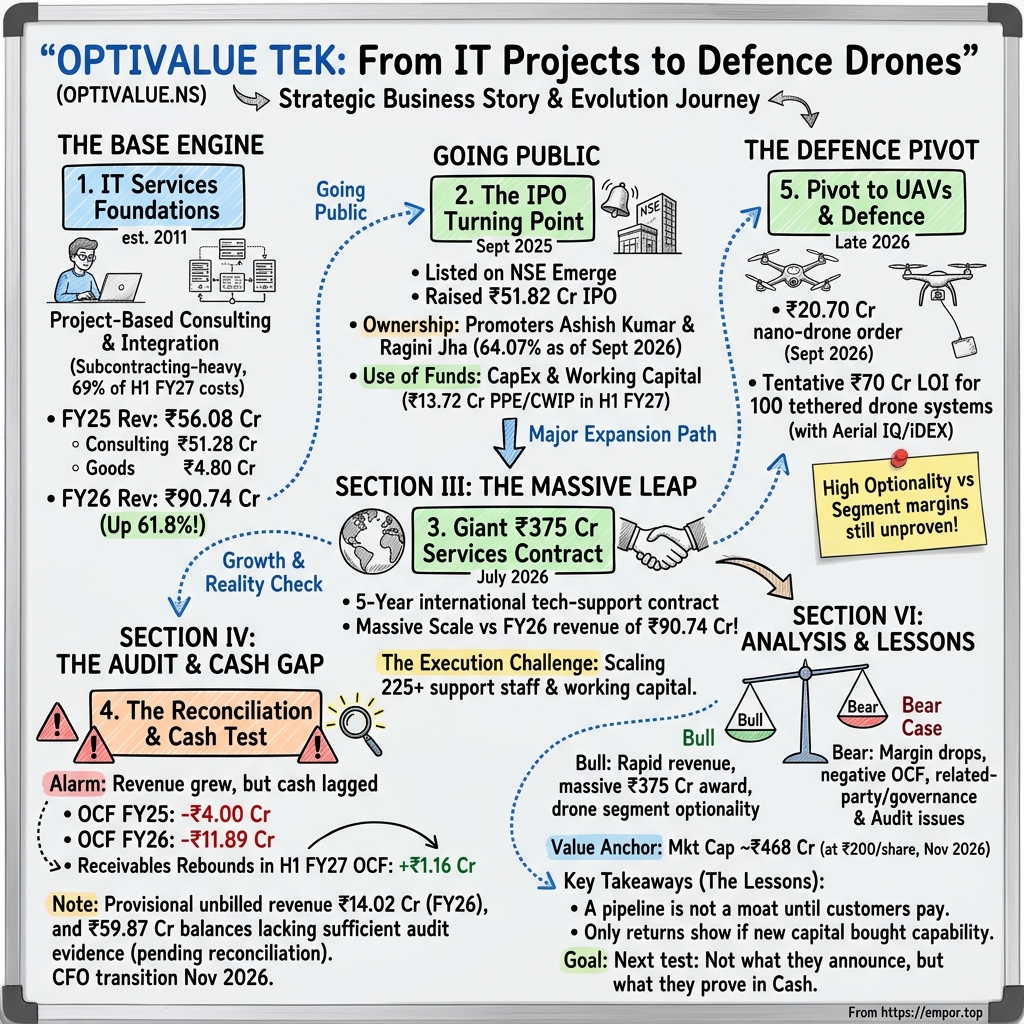
I. A ₹70 Crore Drone Letter Meets a ₹375 Crore Services Contract
On the evening of September 25, 2026, Ashish Kumar put his digital signature on a two-page letter to the National Stock Exchange. Its subject line would have looked strange on the letterhead of almost any Indian IT consultancy: a letter of intent for the manufacture and supply of one hundred tethered drone systems, including spares, linked to a proposed order from India's Ministry of Defence.1 The letter put a number on it, a tentative minimum of ₹70 crore, and then immediately softened that number: final consideration was still under negotiation and would be disclosed later.1
Eleven weeks earlier, the same managing director had signed a different kind of announcement. On July 9, 2026, OptiValue Tek Consulting told the exchange it had won a five-year international technical support services contract valued at approximately ₹375 crore, which the company called one of the largest engagements in its history.2 Now hold those two headlines against the size of the company that issued them. In the financial year that ended in March 2026, OptiValue reported revenue from operations of about ₹90.7 crore.3 The services contract alone carried a headline value roughly four times a full year of sales. The drone letter, if it converted at its tentative floor, would be worth about three quarters of a year.
That contrast is the story. A company of OptiValue's size cannot announce contracts of this scale without inviting a question that its filings have not yet answered: is it building a much larger business, or announcing opportunities whose scale outruns what it can deliver, invoice and collect? The question is not idle, because the reported growth is real. In the six months to September 2026, revenue reached about ₹67.6 crore, more than double the ₹30.5 crore of the same half a year earlier, and profit after tax rose to about ₹10.4 crore.4 On those numbers alone, OptiValue looks like a company in a hurry.
But revenue is only the first chapter of a sale. The second is the invoice, the third is the cash, and the auditor's job is to make sure the first chapter was written honestly. In OptiValue's case the auditor flagged two matters on the FY2026 accounts, one about revenue booked for customers who had not yet been billed and one about ₹59.87 crore of balances the auditor could not confirm, and the company's operating cash flow was negative for the second year running.3 A business that is growing fast and consuming cash at the same time is not unusual in project services. A business doing so while also announcing a move into defence hardware is carrying two very different bets on one small balance sheet.
The stakes, then, come in two parts. The first is whether OptiValue's project-based consulting engine can keep growing without eating more and more working capital, because every rupee of revenue it books before a customer pays has to be financed by someone, and lately that someone has been banks and IPO investors. The second is whether the defence ambitions, tethered drones, nano drones and counter-drone systems, can become repeatable revenue rather than a sequence of letters, pilots and press releases.
One boundary keeps the story clean. OptiValue is the listed company itself, not the Indian arm of a multinational or a subsidiary of a larger group; its prospectus described no holding company and no subsidiaries.5 Everything in this story, every rupee of revenue and every rupee of debt, belongs to one standalone entity run by two promoters. And for all the drone talk, OptiValue still tells the exchange that it operates in a single reportable segment, IT consultancy services.3 The defence business, so far, lives in announcements and in a changed charter, not in a separately reported line of the accounts.
To understand how a Delhi consultancy with roughly seventy full-time employees at the time of its prospectus ended up signing drone letters, the story has to go back to the moment it decided to become a public company, because that decision changed both what it could afford to try and what it would have to explain.
 Subscribe on LinkedIn
II. The Company That Went Public Before It Changed Its Business
OptiValue was incorporated on June 27, 2011, with Ashish Kumar as its founding director.5 Kumar holds a master's degree in computer applications from the University of Delhi, and at the time of the prospectus he was 44 years old with about thirteen years of experience in information technology; the company described his skills as stakeholder management, business development and delivery management.5 In May 2012 he was joined on the board by Ragini Jha, who holds a postgraduate diploma in management from Vamnicom in Pune and was 41 at the prospectus date. She ran daily operations and human resources.5 Together, the prospectus said, the two of them managed customer relations and oversaw the whole business.5 Each held a little over 43% of the company before the IPO.5
The origin story was not glamorous, and that is part of what makes it useful. OptiValue began by providing managed services to telecom companies in India and abroad and described itself as one of the implementers of telecom OSS/BSS applications.5 Those letters stand for operations support systems and business support systems, the unseen software that lets a telephone company provision a new connection, track a network fault and send a bill. It is plumbing work: unglamorous, technical, and paid for by the hour or by the project. From there the company expanded into enterprise application integration, the craft of making different software systems inside a company talk to each other, and later into cloud, data and DevOps services.5 For the three years ending FY2024, every rupee of revenue came from outside India.5
The financial record of those private years was uneven rather than steady. Revenue went from about ₹29 crore in FY2022 to about ₹39 crore in FY2023, dipped to about ₹37 crore in FY2024 and then jumped to about ₹56 crore in FY2025, while profit after tax rose from about ₹5 crore to about ₹12 crore over the same span.6 The FY2025 leap is the year that set up the IPO, and it arrived after a down year, not as the latest step on a smooth staircase. That matters, because a business that can fall as well as rise from one year to the next is a business whose growth depends on which projects land in which year.
The path to listing was compact. The company converted from a private to a public company in September 2024, increased its authorized capital, issued a small rights allotment and a bonus issue, and in FY2025 privately placed 516,800 shares for about ₹2.07 crore.[^7] Then came the IPO. The issue was open from September 2 to September 4, 2025, and raised ₹51.82 crore.7 OptiValue allotted 61,69,600 new shares at ₹84 each, and the shares listed on NSE Emerge on September 10, 2025.8 They debuted at a premium of about 23% to the issue price.9
The detail that matters most for minority investors is what did not happen in that IPO. It was entirely a fresh issue, with no offer for sale; the promoters did not sell a single share.6 Every rupee raised went to the company rather than to its founders. The promoters' combined stake was diluted to 64.07% after listing and has stayed exactly there through September 2026.10 Ragini Jha held 75 lakh shares and Ashish Kumar held just under 75 lakh at March 2026, which made them by far the two largest shareholders.8
Pay tells a similarly restrained story, at least on paper. In FY2025 the two promoter-directors received about ₹39 lakh between them, about 0.7% of the company's total income, and in FY2026 the figure was essentially unchanged at about ₹39 lakh.68 The company has not granted any stock options.8 A founder pair that owns nearly two thirds of the company, takes modest salaries and sells nothing at the IPO looks, at first glance, like the textbook picture of alignment. But alignment is a claim about behaviour, not about ownership percentages, and the record of the first public year will test it against how the founders treated the company's cash. That test belongs to a later chapter of this story.
The listing was a turning point in two directions at once. In one direction, public investors handed OptiValue more capital in a week than it had earned in profit in its previous four years combined, with the explicit purpose of expanding capacity and developing new products. In the other, the company stepped into a regime of half-yearly results, exchange queries, monitoring-agency reports and Regulation 30 disclosures, under which every material order has to be announced. For a firm whose track record as a listed business is barely fourteen months long, the second direction is where credibility is earned. There is no decade of public-market behaviour to lean on. There are only the last few filings, and what the company did with the money.
Before following that money, it is worth understanding the engine that produced the profits public investors were buying, because the way OptiValue earns a rupee explains almost everything that happened next.
III. The Work Order That Pays for the Engineers
On September 9, 2026, OptiValue received a purchase order of ₹16.25 crore for the modernisation of the website of the Indian Railway Catering and Tourism Corporation, one of the most heavily used e-commerce sites in India. The scope covered design, delivery, demonstration and audit over about nine months.11 The interesting part is the name on the order. It did not come from IRCTC. It came from Aaroosha Technologies Limited, which sat between the railway ticketing giant and OptiValue.11 Within a month, the order was expanded in scope and its value revised to ₹64 crore including GST, with execution stretched to about twelve months, still awarded by Aaroosha.12
That chain of command, an end client at the top, a system integrator in the middle, and OptiValue supplying the people and delivery capacity at the bottom, is how the company has always described its business. Its prospectus said work is generally won through project-specific work orders, often as a subcontractor or service provider to system integrators, and that the company had no long-term contracts with its customers.6 Think of a general contractor building a house who hires a specialist firm to wire it. The specialist gets paid for the wiring, but it does not own the relationship with the homeowner, it does not decide when the next house gets built, and it can be replaced on the next project by another electrician who quotes a lower price.
Revenue is recognized as performance obligations are met, sometimes at a point in time and sometimes over the life of a project.6 In FY2025, about ₹51 crore of revenue came from professional consultancy services and about ₹5 crore from goods sales.6 OptiValue does not publish how much of its revenue repeats from one year to the next, how long its contracts run, or whether it bills by the hour, by the person-month or by the milestone. Those are exactly the numbers an investor would want to judge whether the engine is a subscription-like machine or a series of one-off jobs, and the company keeps them to itself.
What the company does publish is its cost structure, and the cost structure tells a striking story. In the half year to September 2026, OptiValue spent about ₹46.9 crore on subcontracting, roughly 69% of revenue, against only about ₹4.3 crore on its own employees.4 For every ₹100 of revenue, about ₹69 went out to other firms that actually supplied people, and about ₹6 went to OptiValue's own payroll. The trend is the revelation. In FY2025, subcontracting was about 39% of revenue and employee costs about 21%.3 By FY2026 subcontracting had risen to about 66% of revenue while the employee bill actually fell, from about ₹12 crore to about ₹10.8 crore.3 And in the first half of FY2027, payroll fell again compared with the same half a year earlier, from about ₹5.9 crore to about ₹4.3 crore, even as revenue more than doubled.4
In plain English: OptiValue's growth since listing has come from work it passes through to other firms, not from engineers it employs. That is a legitimate model. Many Indian IT services firms use subcontractors to handle peaks in demand. But a firm that subcontracts most of its delivery has a smaller claim on the value of the work, because its profit is the gap between what the system integrator pays it and what it pays the subcontractor. It also carries the awkward position of sitting in the middle of a payment chain, owing money to suppliers on one side while waiting for customers on the other.
Customer concentration has improved but remains a real exposure. The top five customers accounted for about 82% of sales in FY2024, and that fell to about 46% in FY2025; the top ten went from about 91% to about 68%.6 That is a meaningful widening of the customer base in a single year. Still, when nearly half of revenue comes from five buyers who have no long-term contracts, the loss or delay of one of them can move the whole company's year. OptiValue does not name those customers, does not disclose its current concentration, and does not publish repeat-order rates, so an outsider cannot tell whether the big buyers of FY2025 are the big buyers of FY2027.
Scale matters here too. India's large IT services firms, companies such as TCS, Infosys and HCLTech, operate at an entirely different order of magnitude, with hundreds of thousands of employees and global client rosters. OptiValue is not a small version of them; it is a different animal, a specialist that often works one or two rungs below the client. No market-share figure or like-for-like peer comparison establishes where it ranks among the thousands of smaller firms competing for the same subcontracted modernisation work.
There is also the question of how many people OptiValue actually has. At September 30, 2024, the company said it had 71 full-time employees plus around 40 to 50 people working on a contractual basis.5 Its website today speaks of "200+ technology experts."13 Those numbers are not necessarily inconsistent, because a firm that leans on subcontractors can fairly describe the experts working on its projects as part of its delivery bench. But they are not the same thing, and OptiValue does not publish a consistent headcount series that would let an investor reconcile them. Falling payroll costs suggest the in-house team has not grown with the revenue.
So the verdict on the engine is double-edged. The model can scale fast, because adding subcontracted capacity is quicker than hiring and training. The filings do not show recurring revenue, durable pricing power or a proprietary asset that makes OptiValue hard to replace in the chain. And the model was about to be stretched far harder than ever before, by a single contract that, on paper, dwarfed everything the company had done.
IV. A Bigger Contract, and a Bigger Test of Execution
The July 9, 2026 announcement read like the moment a small company becomes a different company. In the release, OptiValue said it would provide comprehensive technical support for "a leading international enterprise" across mission-critical platforms.2 Ashish Kumar, described in the release as founder and CEO, said the contract reflected "the trust our global clients place in our engineering expertise and service excellence."2
The annexure to that letter is where the headline becomes a business. It named the awarding entity as M/s Citrix Project Development Consultant LLC, an international entity in which, the company said, its promoters had no interest.2 The company offered no further description of the counterparty, and the release itself said certain client information had been withheld because of confidentiality obligations.2 The annexure then gave the two operating terms that matter most: OptiValue would deploy more than 225 support staff on the project, and the agreed billing rate was USD 16 per hour.2 The ₹375 crore figure was described as approximate and inclusive of all taxes.2
Those two numbers allow a back-of-the-envelope reconstruction. Two hundred and twenty-five people, working roughly 2,000 hours a year each at sixteen dollars an hour, produce billings of about $7.2 million a year. At an exchange rate somewhere in the high eighties of rupees to the dollar, that is in the region of ₹60 to ₹65 crore a year, or a little over ₹300 crore across five years before taxes. The arithmetic broadly reconciles with the headline. It also translates the headline into the number that matters: if fully staffed from day one, the contract would add perhaps two thirds of FY2026's revenue every year, not four times it. Large, transformational for a company this size, but a very different picture from "₹375 crore" read as a single number.
The billing rate tells a second story. Sixteen dollars an hour is roughly ₹1,400 an hour, a rate typical of offshore support and help-desk work rather than high-end consulting. At that price the contract is a volume business, and its profitability depends almost entirely on what OptiValue pays for each of those 225 people. If they are OptiValue employees, the company will need to hire on a scale far beyond its existing payroll; its entire employee bill in the half year to September 2026 was about ₹4.3 crore.4 If they are subcontracted, OptiValue's margin is the spread between sixteen dollars and whatever its subcontractors charge, and it has to pay those subcontractors while waiting for an overseas customer to settle invoices. Either way, staffing, payroll or supplier payments come before collections, which means the contract will consume working capital before it produces cash.
There is a geographic twist as well. The prospectus described OptiValue as entirely export-based.5 By FY2026, the directors' report put foreign-exchange earnings at only about ₹1.2 crore, a sliver of the year's revenue, which means the growth that carried OptiValue through its first listed year was overwhelmingly domestic.8 The ₹375 crore contract would swing the company back toward dollar revenue and back toward the currency exposure the prospectus warned about, where the rupee value of a sale can move between invoice and collection. The company has described making provisions for exchange fluctuations but has not set out a formal hedging policy.6
Now put the contract's promise beside the most recent evidence of how OptiValue's economics behave as it grows. The two halves of FY2026 were the cleanest experiment available. In the first half, revenue was about ₹30 crore and profit before tax about ₹9.8 crore. In the second half, revenue doubled to about ₹60 crore, while profit before tax fell to about ₹7.9 crore.3 Twice the sales, less profit. The cost lines explain why. Subcontracting jumped from about 44% of revenue in the first half to about 77% in the second, swallowing the gain from lower payroll and leaving the company with a pre-tax margin of about 13%, down from about a third.3 The growth that arrived in the second half was work OptiValue largely bought in and passed on.
That experiment is the strongest piece of disconfirming evidence for any assumption that a giant support contract will bring proportionate profit. OptiValue's own record shows that when it scaled quickly through outside capacity, its margin compressed sharply. A low hourly rate and a large staffing requirement point in the same direction. The first half of FY2027 offered a partial recovery, with a pre-tax margin of about 21% on revenue of about ₹68 crore, but subcontracting still took about 69% of sales.4
What OptiValue has not disclosed since July is equally telling. The half-yearly results do not split revenue by geography or by contract, do not say how many of the 225 staff have been deployed, and do not mention the contract at all.4 An investor cannot tell from the filings whether the work has started, whether the first invoices have gone out, or whether any dollars have arrived.
The contract could change OptiValue's scale. Its headline value does not establish annual revenue, margin, staffing ramp, payment terms or cash conversion, and the milestones that would prove it are concrete: a disclosed headcount on the project, a jump in overseas revenue, foreign-exchange earnings that look like ₹60 crore a year rather than ₹1 crore, and customer concentration that will inevitably rise if a single client becomes the company's largest. Funding that ramp, though, depends on what OptiValue did with the money public investors had already given it.
V. The IPO Money Goes Into Capacity, Not Acquisitions
When OptiValue went to the market in September 2025, it told investors exactly how it would spend the ₹51.82 crore. About ₹14.5 crore would go to capital expenditure, of which ₹12.77 crore was for developing new products and ₹1.70 crore for a branch office in Bangalore. Another ₹6.41 crore would fund hardware and software upgrades, ₹17.52 crore would go to working capital, ₹5.56 crore to general corporate purposes, and ₹7.87 crore to issue expenses.7 The schedule runs through March 31, 2027.7
The most interesting line is the first one, because it shows that the drone story did not begin with a letter of intent in September 2026. In its draft prospectus, OptiValue said it intended to start operations in drone analytics, integrating drones with surveillance systems, locomotives and existing assets for centralized monitoring in sectors such as railways and defence.5 It described digital twins, virtual replicas of physical assets kept in sync with real-time data, and synthetic air-traffic systems adapted for railway scheduling.5 And it said revenue from these new products was expected to become visible in FY2027.5 Investors were told, in other words, that a software-and-analytics bet on drones was coming. What has arrived since is a broader push into drone and counter-drone hardware, which is a different and more capital-hungry business.
By September 30, 2026, the money had mostly moved. The monitoring agency, Acuité Ratings and Research, reported that the full ₹12.77 crore for new products had been used, describing the use as advance payments towards software development.7 About ₹14.8 crore of the ₹17.52 crore working-capital allocation and about ₹5.1 crore of general corporate purposes had been spent, while the hardware and software upgrade had used ₹4.84 crore, leaving ₹1.57 crore pending.7 Roughly ₹5.9 crore remained unutilized, down from ₹19.09 crore at March 2026, when the unused balance had been parked in fixed deposits and bank balances.73 In its note on that March figure, the company added a phrase worth remembering: utilisation of funds "includes advances given to parties."3
The monitoring agency found no deviation from the stated objects.7 That finding deserves weight, but only the weight its authors gave it. Acuité's report states plainly that it relied on information provided by the issuer, including bank statements, invoices and a certificate from the statutory auditor, that it does not perform an audit, and that it undertakes no independent verification.7 A "no deviation" verdict confirms that the money was spent under the right headings. It cannot confirm that the spending bought anything valuable.
On the balance sheet, the spending shows up mostly as intangible assets. Intangible assets under development, which the company describes as software it is building, rose from about ₹6.7 crore at March 2026 to about ₹17.2 crore by September 2026, alongside about ₹11.3 crore of completed intangible assets.4 The auditor drew attention to this line in its review of the half-year results, noting that, as certified by management, the product was still under development and not ready to use.4 Property, plant and equipment, the physical assets, rose to about ₹8.6 crore.4 In the first half of FY2027, cash spent on property, equipment and capital work in progress came to about ₹13.7 crore, after about ₹20.4 crore in FY2026.4
That is a lot of investment for a company of this size, roughly ₹34 crore in eighteen months, about a third of a year's revenue. The question every investor should ask of capital spending is what it is meant to earn, and here the company is quiet. OptiValue does not separately disclose research and development spending, does not say which products the capitalized software belongs to, does not provide a comparable headcount trend, and does not attribute any revenue to the new products.4 The prospectus planned to hire 75 employees for the new Bangalore office; payroll costs have continued to fall.54
There is one thing OptiValue has not done with its money, and it deserves a sentence. The company has made no acquisitions; the FY2026 directors' report confirmed that it had no subsidiaries, associates or joint ventures.8 There is no purchase price to benchmark and no goodwill to impair. The capital-allocation record consists entirely of organic spending on software, equipment and working capital.
The investment test, then, is concrete and still ahead. If the ₹17 crore of software under development is the brain of the counter-drone and drone products, it should eventually be visible as product revenue with a margin that justifies having capitalized it, rather than having run it through the profit-and-loss account as an expense. Capitalizing development costs is permitted under Indian accounting standards when certain conditions are met, but it does flatter current profits, because the spending appears on the balance sheet rather than as a cost. If the products stall, the asset will eventually have to be written down. Until then, capital deployment is visible, and its returns are not.
The IPO cash, though, was only half of the money story. The other half was the cash the business itself was supposed to generate, and in FY2026 that half pointed in the wrong direction.
VI. Revenue Grew Faster Than Cash—and the Auditor Asked for Support
On May 28, 2026, OptiValue's board met at five in the afternoon and approved the company's first full-year results as a listed business.3 On the surface they were a triumph. Revenue from operations rose about 62% to roughly ₹90.7 crore. Profit after tax rose too, but only by about 13%, to roughly ₹13.8 crore.3 Attached to the results was the report of the statutory auditor, A. Mishra & Associates, signed by partner Alok Mishra. Its opinion was unmodified: the statement gave a true and fair view.3 Then came two paragraphs headed "Key Audit Matters," and those paragraphs are the most important text OptiValue has published since its prospectus.
The first concerned revenue. The company had recognized about ₹14.02 crore of revenue during the year on a provisional basis for customers that had not yet been billed. That amount included about ₹2.30 crore for services said to have been rendered in a previous financial year, which had remained unbilled for more than a year.3 Management kept that amount as a current asset because it expected to raise invoices within twelve months. The auditor's verdict was blunt: in the absence of sufficient appropriate audit evidence supporting the timing of revenue recognition and the recoverability of those balances, it was unable to determine whether any adjustments were required to revenue, receivables and current assets.3
To see why this matters, imagine a plumber who finishes a job, does not send the bill, and records the income anyway because he expects to send it eventually. Accounting rules allow that, within limits, when the work is genuinely done and the amount is reliable. But revenue booked for work done more than a year earlier and still not invoiced is a different creature. Most customers are invoiced within weeks of work being completed. A year-old unbilled balance raises the obvious question of why the customer has not been asked to pay, and whether the customer agrees the work was done.
The second matter was larger. Balances of about ₹59.87 crore appearing under the note for trade receivables were subject to confirmation and reconciliation with the respective parties.3 Pending those confirmations, the auditor said it could not obtain sufficient evidence about the existence, accuracy and recoverability of those balances.3 Management said it believed the amounts were fully recoverable.3 Set that number against the balance sheet and it becomes stark. Trade receivables at March 2026 were about ₹59.9 crore, up from about ₹17.2 crore a year earlier.8 The balances the auditor could not confirm were, in effect, essentially the company's entire receivables book, equal to about two thirds of a full year's revenue.
Two clarifications keep this in proportion. First, key audit matters are not a qualified opinion. The auditor signed an unmodified opinion, and the company's directors' report stated that the auditors' report contained no qualification, reservation, adverse remark or disclaimer.8 Second, unconfirmed is not the same as fictitious. Small companies often struggle to get customers to return balance confirmations, and an auditor that cannot get confirmations will say so. But it is unusual for an auditor to write, about the bulk of a company's receivables, that it cannot determine whether adjustments are needed, and still sign an unmodified opinion. That is language one usually sees in a qualification, and an investor is entitled to read it as a sign that the auditor's comfort was limited.
The cash-flow statement explains why receivables matter so much. In FY2026, OptiValue's profit before working-capital changes was about ₹18 crore. Then working capital swallowed it. Trade receivables absorbed about ₹42.8 crore, short-term loans and advances another ₹13.7 crore, and after a ₹31.9 crore offset from higher payables and about ₹6.2 crore of taxes paid, operating cash flow ended at about negative ₹11.9 crore.8 That followed about negative ₹4.0 crore in FY2025, when profit after tax had been about ₹12.2 crore.86 Two years, roughly ₹26 crore of reported profit, and a cumulative operating cash outflow of about ₹16 crore. Every rupee of the company's reported earnings over its listing period, and more, had been converted into money owed to it rather than money in its bank account.
The second-half margin compression was another sign of the pressure from bought-in capacity. The company's own explanation, offered in its ratio analysis, was compressed and general: it attributed lower net margins to a competitive market and lower margins earned.8 It did not explain why the second half, in particular, turned so much more dependent on bought-in capacity.
The advances that should not have been made
Then there is a disclosure that is unusual enough to quote in full. In the notes to its audited results, OptiValue stated: "The Company has given advance to related parties during the financial year which is in contravention of the provisions of Companies Act."3 The company was, in plain words, telling the exchange that it had broken the law governing how companies may lend to insiders.
The annual report supplies the amounts. During FY2026, OptiValue gave an unsecured loan of about ₹4.55 crore to Ashish Kumar, its managing director; about ₹2.27 crore came back during the year, leaving about ₹2.75 crore outstanding at March 31, 2026.8 The company explained that the director had been given an imprest advance to purchase IT assets for the company, that procurement could not be executed for "other commercial reasons," and that the money was refunded with interest after the balance-sheet date.8 Separately, it lent about ₹5.08 crore to Winghover Technologies Private Limited, an entity in which a key managerial person is a director, and charged about ₹0.31 crore of interest; that party, too, had been given an advance to execute a project for the company that could not be executed, and the money was refunded with interest after the year end.8 Both arrangements were approved by the board on May 29, 2025, before the IPO, and were reported in the form for related-party contracts as being at arm's length.8
Together, those two related-party advances came to about ₹9.6 crore, roughly 70% of FY2026's profit after tax, in the same year that the company raised money from public investors. They were reportedly refunded with interest, which limits the economic damage. They do not limit the governance damage. A company that has just listed, whose promoters own nearly two thirds of the equity, sent close to ₹10 crore to its managing director and to a company connected to its management, for purchases and projects that never happened, and then had to disclose that doing so contravened company law.
The reporting trail around the results was ragged, too. NSE raised observations on the May 28 submission, and on July 1, 2026 the company replied that its segment data had been filed under a "geographical" segment option only because the exchange's XBRL utility would not otherwise validate, and that it was re-submitting a machine-readable and legible copy of the results.3 The FY2026 note describing the IPO misprinted the number of shares issued and the proceeds received.3 The annual report and notice of the August 20 AGM were not filed with the exchange 21 days before the meeting as the rules require; the company filed the report on September 21, 2026, a month after the meeting, describing the omission as inadvertent and unintentional.8 None of these lapses is grave on its own. Together they describe a finance and compliance function that had not yet caught up with the obligations of a listed company.
A half-year that helped, but did not settle it
The half year to September 2026 gave the bulls something to work with. Operating cash flow turned positive, at about ₹1.2 crore.4 Trade receivables fell from about ₹59.9 crore to about ₹38.8 crore, releasing about ₹21 crore of cash.4 And the unbilled revenue question moved: the company reversed about ₹14.1 crore of previously recognized customer-due-but-not-billed amounts and booked about ₹4.7 crore of new unbilled revenue for work performed in the period.4
Look closer and the improvement is thinner than it seems. Almost all the cash freed from receivables went straight out to suppliers: trade payables fell from about ₹34.2 crore to about ₹4.9 crore, a ₹29 crore outflow.4 The company funded its investments by borrowing, taking long-term borrowings from about ₹1.6 crore to about ₹17.3 crore.4 And the auditor's limited review of the half year carried four emphasis-of-matter paragraphs. One pointed to about ₹15.9 crore of loans and advances still awaiting confirmation from the counterparties, for which, management confirmed, services or materials had not yet been received. Another noted that about ₹2.3 crore of inventory had not been physically verified by the auditor.4 The board itself again stated that receivable, payable and current-asset balances remained subject to reconciliation or confirmation.4
So the verdict here is the most important one in this story. The growth is reported and audited, but the profits that accompany it have not yet turned into cash, the auditor has been unable to confirm the balances that would have to turn into cash, and the company has admitted lending to insiders in breach of the law. None of this amounts to a modified audit opinion, and some of it was reversed or repaid. All of it means that OptiValue's reported earnings are, for now, a weaker foundation than their headline growth suggests. The settling evidence is specific: audited FY2027 accounts in which receivables are confirmed, unbilled revenue has been invoiced and collected, and operating cash flow is positive without being propped up by squeezing suppliers or borrowing.
It was in the middle of this, between the audit report and the cleanup, that OptiValue told its shareholders it was becoming a defence technology company.
VII. Drones Move From Website Portfolio to Exchange Filings
On March 25, 2026, a procurement contract was generated on the Government e-Marketplace, the state's online buying platform. The buyer was the Central Research Laboratory of Bharat Electronics Limited in Ghaziabad, the defence electronics company owned by the Ministry of Defence. The seller was OptiValue Tek Consulting. The order covered one electro-optical sensor priced at ₹30 lakh and two radio-frequency detectors at ₹56.5 lakh each, for a total of ₹1.43 crore, with delivery due by May 6, 2026 and 90% of the payment due within 30 days of acceptance.14 The next day OptiValue told the exchange it had won a pilot order from a defence public sector undertaking for deployment and evaluation of a specific technology, adding that, on successful completion of trials, it expected volume orders from the same customer and possibly from others.14
That small order is the right place to start, because it is real. A radio-frequency detector is, roughly speaking, an electronic ear tuned to the frequencies drones use to talk to their pilots; an electro-optical sensor is a camera system that can see and track a small object in the sky. Put them together with software that decides what is a threat and you have the bones of a counter-drone system. On July 10, 2026, OptiValue said it had delivered and operationalized its AI-driven integrated counter-UAV defence system under a pilot-phase contract for a leading Indian defence PSU, after successful user acceptance testing, which it said established the company as an approved technology partner for that customer.15
From there the defence narrative accelerated. In April 2026 the company announced what it called a multi-million-dollar government order through the Government e-Marketplace linked to its counter-drone platform, without disclosing the value or the buyer.16 In June it launched a counter-drone defence shield called SENTINEL-DOME.13 On July 21, the board passed a circular resolution proposing to amend the company's main objects so that it could manufacture, develop, integrate and supply defence and homeland security drones, counter-drone systems, autonomous systems and surveillance technologies, and shareholders were asked to approve it at the August 20 AGM.8 In September, an order of about ₹20.70 crore from Rchobbytech Solutions Private Limited for the supply of nano drones was reported, with delivery within nine months on a monthly milestone basis.17 Then came the Aerial IQ letter of intent for one hundred tethered systems, and in October the company's website carried releases on FPV drones for defence and an agricultural drone platform.13 The website now lists 29 drone models and more than 50 UAV and defence systems.13
At the August 20 AGM, Ashish Kumar framed all of this as a deliberate strategic evolution. OptiValue, he said, was moving "beyond conventional technology services" toward an integrated portfolio spanning defence, security, artificial intelligence, digital twins, UAVs and autonomous systems, and critical infrastructure protection.18 The speech closed with a string of slogans, ending "From Technology Services to Strategic Defence & Security Technology. From Growth to Institutional Scale."18
Here the story needs a ladder, because a listener hearing "drone orders" might picture a factory shipping aircraft. The rungs are different things. A product page on a website is a claim. A technical specification is a stronger claim. A pilot order, like BEL's, is a customer paying a small amount to test whether the claim holds. A purchase order, like the nano-drone order, is a commitment to buy, subject to delivery and acceptance. A letter of intent is a promise to negotiate an order. And only at the top of the ladder sits delivered, accepted, invoiced and collected revenue. OptiValue's defence business has real activity on the lower and middle rungs, but is not yet reflected as a separate business in its accounts.4
The ₹70 crore letter of intent deserves the closest reading. It came from Aerial IQ India Private Limited, not from the Ministry of Defence, and it related to a "proposed" iDEX order. iDEX, Innovations for Defence Excellence, is the ministry's programme for funding and buying from startups and smaller firms. The order would be executed through Aerial IQ "pursuant to the existing Technology Transfer Agreement" with OptiValue, the value was a tentative minimum, and final consideration was under negotiation.1 That makes OptiValue a supplier to an intermediary whose own order from the government was itself proposed rather than placed. Several things have to go right, in sequence, before the ₹70 crore becomes revenue: the ministry has to place the iDEX order, Aerial IQ and OptiValue have to agree terms, the hundred systems have to be built and accepted, and the money has to flow down the chain.
The nano-drone order sits one rung higher, a disclosed order with a delivery schedule. It is also a test with a clear timetable. If deliveries are monthly over nine months from September, then by the time the FY2027 accounts are prepared OptiValue should be able to show goods sold, inventory moving and cash collected. The balance sheet at September 2026 offers only a hint that hardware work has begun: inventory rose from about ₹0.1 crore in March to about ₹2.3 crore, and that inventory had not been physically verified by the auditor.4
The strongest test of the defence story is the company's own history of turning technical claims into revenue. The prospectus promised drone analytics products with revenue "visible in FY27."5 The IPO's new-products allocation has been spent, much of it as advances for software development.7 FY2025 goods sales were about ₹5 crore, and FY2026's cost of materials was only about ₹0.3 crore, which is not the profile of a hardware business.63 The company does not disclose research and development spending, defence certifications, production capacity or the economics of any drone product.
There is also a mismatch in timing worth noticing. The chairman's letter in the FY2026 annual report, signed on May 28, 2026, spoke only of IT consulting, cloud, AI and digital services; the management discussion in the same report described a single IT consulting segment and did not mention drones at all.8 Less than three months later, the AGM speech described a company deliberately evolving into defence technology.18 Strategies can change quickly, and a company is entitled to pivot. But a pivot announced in a speech, between an annual report that ignored it and half-year results that do not measure it, is a pivot that still has to be proved.
The defence line is plausible optionality, because the disclosed engagements are material relative to the existing business and at least one defence PSU has bought and accepted a pilot system. It is not yet a business. The proof points are segment revenue, repeat orders from the same buyers, gross margins on hardware, and cash collected from the nano-drone and tethered-drone programmes. And this second growth vector must not be confused with the services contract. They carry different risks and will need different proof. Both, in the end, run through the same two people.
VIII. The Founder's Next Test Is Governance
On October 26, 2026, OptiValue's chief financial officer, Pramod Kumar T.C., resigned, with his cessation effective November 13.1910 He had been appointed only on March 27, 2026.8 His predecessor, Sudhir Kumar Sahni, had served from November 7, 2024 until September 30, 2025, the month the company listed.8 For roughly six months after its IPO, through the period in which it was running a listed company's first half-year close, OptiValue had no chief financial officer recorded in its annual report. The company secretary changed in February 2026 as well.8 On November 13, 2026, the board appointed Jayesh Mahajan as CFO, describing him as a finance professional with about twenty years of experience at organisations including Tribhovandas Bhimji Zaveri, the Ashok Piramal Group, Sony Music India and Syntel India, with expertise in listed-company operations, treasury, audit coordination and regulatory compliance.4
That makes three CFOs in about fourteen months, and the timing matters more than the count. The finance function turned over precisely when receivables were swelling, unbilled revenue was being questioned, related-party advances were being disclosed as illegal, and borrowings were rising. A new CFO with listed-company experience could be exactly what the company needs. It could also be that each successive CFO inherited a set of reconciliations nobody had finished. The record does not say which, and the company has not explained why its CFOs have left.
Control over money, meanwhile, sits firmly with the founders. At the same November 13 meeting, the board reconstituted its borrowing and finance committee with Ashish Kumar as chairman, Ragini Jha and the CFO as members, and authority to negotiate, finalise and administer loans and credit facilities.4 It also appointed Amit Jaiswal & Associates as internal auditor for FY2027, the same firm that held the role for FY2026.48 Bank borrowings stood at about ₹19.9 crore at September 2026, up from about ₹5.5 crore of total debt at March 2025.46 The company reports that it is not a wilful defaulter, and the overdraft is secured against current assets, which is to say against the very receivables the auditor could not confirm.4
The contrast with the pre-IPO record is instructive. In FY2025, the founder was a lender to the company rather than a borrower from it: OptiValue repaid about ₹85 lakh of an unsecured loan from Ashish Kumar and still owed him about ₹47 lakh at the year end.6 In FY2026, after the listing, the direction reversed: the company lent about ₹4.6 crore to him and about ₹5.1 crore to a management-linked company, and then disclosed that the advances contravened the Companies Act.83 The amounts were reportedly refunded with interest, but the company has not set out what specific controls it has added to prevent a repeat.
The board itself is small. At March 2026 it had five directors: the two promoters and three independent directors, Girish Kamal Gupta, Sumit Kumar and Ankit Aggarwal.8 Ragini Jha sits on the audit committee, the risk committee and the stakeholder committee, which is permitted but means a promoter helps oversee the audit of her own company.8 Exchange filings show an independent director resignation in October 2026.20 In a company where the promoters own 64% and chair the borrowing committee, independent directors are the main internal check, and a smaller independent bench weakens it.
The public narrative should be stress-tested against outcomes, and here the record is short but specific. In the prospectus, management promised new products with revenue in FY2027; none has yet been reported. In July it announced a ₹375 crore contract; nothing in subsequent results measures it. In March it announced a pilot order and said volume orders were expected; in July it said the pilot was operational and created opportunities "subject to the customer's procurement processes, commercial negotiations, and applicable approvals."1415 Each announcement is individually accurate. Taken together, they form a pattern in which the company is generous with announcements and sparing with the follow-through data that would let investors check them.
Ownership by institutions has moved in the opposite direction from the announcements. Foreign institutional investors held about 5% of the company in September 2025 and about 1.8% a year later; domestic institutions went from about 3.7% to about 0.4%.10 Shareholder numbers on the exchange have stayed small, in the mid-five hundreds, which is typical of the SME platform, where shares trade in large minimum lots.10 The professional money that came in at the IPO has largely left while the stock rose.
There is no earnings call to test management's live answers. OptiValue's investor materials consist of exchange letters, press releases, the annual report and an AGM speech, and no analyst question-and-answer session appears among its published disclosures.13 That leaves the August AGM speech and the November board outcome as the most recent statements of intent. The speech was ambitious and abstract, built around slogans rather than targets.18 The board outcome was administrative: a new CFO, a reconstituted borrowing committee, an internal auditor reappointed.4
Founder ownership is substantial, and the founders did not sell at the IPO. But the first listed year produced related-party advances that broke the law, a revolving CFO chair, late statutory filings and an auditor unable to confirm most of the receivables. Governance execution, not stated intent, is now the credibility test, and the CFO transition matters because it coincides with the unresolved reconciliations. Whether OptiValue can earn that credibility depends partly on its people and partly on its position in the market: whether it does something customers cannot easily get elsewhere.
IX. Why This Consultancy Wins—or Gets Squeezed
Picture the decision from the other side of the table. A system integrator has won a contract to modernise a large public website or to support a foreign enterprise's IT platforms. It needs a delivery partner fast. It can call a large IT services firm, which will be expensive and slow to mobilise for a mid-sized job. It can call one of hundreds of smaller Indian specialists. Or it can call OptiValue, which has a decade of telecom integration work behind it, a GeM seller registration, and a demonstrated willingness to mobilise subcontracted capacity at speed. On some days OptiValue wins that call. The question for a long-term investor is why, and whether the reason lasts.
Start with the buyers, because they hold most of the cards. OptiValue's customers are often system integrators, and its FY2025 customer concentration fell sharply from the prior year.6 Its disclosed contracts are project-based.6 Its large orders have also come through intermediaries.121 An intermediary that controls the end-client relationship controls award timing, scope and price, and can switch to another delivery partner at the next project. Unbilled revenue is a reminder of who sets the pace of payment.3
Rivals and substitutes press from two sides. Large IT services firms and thousands of smaller specialists compete for modernisation and support work, and the work itself, integration, support, website rebuilding, is described in near-identical terms across the industry. OptiValue's management lists intense competition and pricing pressure among its threats.8 Artificial intelligence adds a substitute for some of the most routine tasks: help-desk support, testing and code maintenance are exactly the jobs that AI tools are being deployed to automate. A five-year contract built on 225 people billing sixteen dollars an hour is the kind of work most exposed to that pressure. The company does not quantify how much of its revenue is at risk from automation.
Suppliers are the subtle force here. Because OptiValue relies heavily on subcontractors, they are not a minor input; they are the product.4 If a subcontractor can raise its rates or deal directly with the system integrator, OptiValue's margin shrinks. Second-half margin compression in FY2026 shows the pressure.3 The company does not disclose supplier concentration.
Now test the claimed advantages against the evidence. Switching costs would show up as repeat orders from the same customers at stable or rising prices. OptiValue does not publish retention, repeat-order rates or pricing trends, and its changing customer concentration is consistent with either winning new customers or losing old ones.6 A specialist reputation in telecom and integration may help win assignments, but the company's revenue has since shifted from 100% overseas to overwhelmingly domestic, which suggests the customer base itself has changed substantially rather than deepened.58 A large international support contract and a growing domestic order book are evidence that OptiValue can win work. They are not evidence that it can hold that work on better terms than the next bidder.
Certifications and credentials deserve the same scepticism. OptiValue is a registered seller on the government's procurement marketplace, and it has passed a defence PSU's user-acceptance test for a pilot counter-drone system.1415 Those are real gates, and many companies never get through them. But government buyers in India deliberately build multi-vendor supplier bases for drones and counter-drone systems, and indigenization policies that favour Indian vendors open the door to many Indian vendors, not one. The BEL pilot contract itself carried an option clause letting the buyer raise or cut the ordered quantity by up to 50%, and required a performance guarantee and a one-year warranty.14 That is the bargaining position of a buyer who can choose. If OptiValue's proposed defence programmes convert, its customer will be one of the most price-disciplined buyers in the country, and on the tethered drones its direct counterparty is a private intermediary rather than the ministry.
So the honest conclusion is narrower than the company's self-description. OptiValue has a niche in integration and delivery work that lets it win assignments, a willingness to scale through partners, and early proof that defence buyers will test its products. The filings do not yet prove switching costs, price realization, customer retention or a durable advantage over larger IT providers and other subcontractors. The test that would change that verdict is simple to state: rising revenue from the same named or banded customers at stable margins, year after year. With the competitive position mapped, the remaining question is what the market is paying for it.
X. Analysis & Bear vs. Bull Case
At the close on November 13, 2026, the day OptiValue published its half-year results and appointed its new CFO, the shares ended at ₹200.10 That valued the company at about ₹468 crore, nearly two and a half times the ₹84 IPO price fourteen months earlier.108 Over the previous year, the stock had traded between about ₹56 and ₹247.10 At ₹200, the market was paying roughly 34 times FY2026 profit after tax of about ₹13.8 crore, and about 5.1 times the shareholders' equity of about ₹92 crore at March 2026.38 On trailing twelve-month earnings, which include the stronger first half of FY2027, the multiple was lower, at about 28 times.10
What does that price assume? A company earning ₹14 to ₹17 crore a year, valued at nearly ₹470 crore, is being priced for earnings to keep growing quickly for several years. The first half of FY2027 gave that assumption support: revenue up about 122% year on year, profit after tax up about 44%.4 The gap between those two growth rates is the same story the cost lines have told throughout. Revenue is growing far faster than profit because the new revenue carries lower margins.
The case for, and the case against
The bull case runs like this. OptiValue more than doubled its revenue in a year and kept growing. It won a services contract that could, if fully staffed, add something like two thirds of a year's revenue annually for five years. It has disclosed multiple orders since September, from IRCTC website modernisation through Aaroosha to nano drones, and a letter of intent for tethered drones. The founders own nearly two thirds of the company and did not sell at the IPO. A defence PSU has accepted a pilot counter-drone system. If even part of the drone pipeline converts into repeat hardware and software sales, OptiValue would be a very different company in three years, and the current price would look modest in hindsight.
The bear case is built from the company's own disclosures. There are no long-term customer contracts. Five customers made up nearly half of FY2025 sales, and current concentration is undisclosed. Margins collapsed in the second half of FY2026 as subcontracting surged. Operating cash flow was negative in both FY2025 and FY2026. The auditor could not confirm about ₹60 crore of balances or the timing of ₹14 crore of unbilled revenue. The company lent nearly ₹10 crore to insiders in breach of the Companies Act. Borrowings have more than tripled since the prospectus. Three CFOs have come and gone or arrived in fourteen months. And the drone business has no reported revenue, margin or segment.
Run the two frameworks investors use to judge durable advantage, and the bear case gets sharper. Through Michael Porter's five forces, OptiValue faces strong buyer power from concentrated customers and intermediaries, strong supplier power from the subcontractors who deliver most of its work, intense rivalry across a crowded IT services market, rising substitution from AI-driven automation of support work, and low barriers to entry for any firm that can assemble a delivery bench. In defence, the buyer is the state, which uses multi-vendor procurement and fixed-price tenders to hold suppliers' margins down. None of the five forces clearly favours OptiValue.
Through Hamilton Helmer's seven powers, the sources of lasting advantage, the picture is similar. Scale economies are absent; OptiValue is small. Network effects do not apply to project services. Counter-positioning would require a business model incumbents cannot copy, and subcontracted delivery is easily copied. Switching costs are unproven without retention data. Branding is negligible in a market where buyers choose on price and availability. A cornered resource would need proprietary technology or exclusive access; the counter-drone software and the technology transfer agreement with Aerial IQ are candidates, but neither has yet produced disclosed revenue. Process power, the hard-won operational excellence that lets a company deliver cheaper or better, is contradicted by the margin compression and the reconciliation problems. On the evidence available, OptiValue has no proven power. That does not mean it cannot develop one. It means the market price is paying for powers not yet demonstrated.
A skeptical investor or activist would press on four points. First, why did the company lend money to its managing director and to a management-linked company in its first listed year, and what has changed to stop it happening again? Second, what has the ₹17 crore of capitalized software produced, and when will it be tested for impairment? Third, why has the CFO seat turned over three times, and will the new CFO publish receivable ageing and confirmation status? Fourth, what is the ₹375 crore contract actually billing, at what margin, and with how many people?
There is no acquisition history to benchmark and no company-specific valuation range to compare against, because OptiValue has been public for only fourteen months and has made no acquisitions.8 The valuation, then, rests on a single question: how much of the reported earnings base is real cash earnings? Until the audit questions are resolved and cash flow is positive, a 34-times multiple sits on a fragile foundation. The drone portfolio should not be read as a reason for a premium until it shows recognized revenue, customer acceptance at scale, margins and cash collection.
Three measures will settle the debate. The first is operating cash flow against profit after tax: in FY2026 it was about negative ₹11.9 crore against profit of about ₹13.8 crore, and in the first half of FY2027 it improved to about positive ₹1.2 crore against profit of about ₹10.4 crore.34 The direction is better, the gap is still wide. The second is the state of receivables and unbilled revenue: receivables fell from about ₹60 crore to about ₹39 crore in six months, still more than half a year of revenue outstanding, and still subject to confirmation.4 The third is revenue by line, services and defence, with margins and customer concentration; today the company reports none of it.
What would change the view? Audited accounts with confirmed balances and a clean audit report, repeat orders from the same customers, a positive and sustained operating cash flow, stable margins as the support contract ramps, and the first reported drone revenue with a disclosed margin. Each is measurable, and each can be checked within the next year.
XI. Business & Investing Lessons
Go back to the moment that best sums up OptiValue's first year as a public company: a profit and loss account showing revenue up about 62%, from about ₹56 crore to about ₹91 crore, and a cash-flow statement showing that for the second year in a row the business consumed cash rather than generated it, about ₹4 crore in FY2025 and about ₹12 crore in FY2026.36 Four lessons sit inside that contrast, and each belongs to this company.
The first is about the work order. OptiValue's revenue rests on project-specific orders, often passed down through system integrators, with no long-term contracts. Its newest large wins came through intermediaries, and its growth came from subcontracted capacity rather than its own engineers. A company like that can show a full pipeline of orders and still own very little of the relationship that generates them. The wider lesson for founders and investors is that a backlog announced is not a customer retained. A full pipeline is not a moat until customers come back on terms you can collect.
The second is about the audit report. In the same week that OptiValue reported its best year ever, its auditor wrote that it could not confirm most of the receivables and could not determine whether revenue booked for unbilled customers needed adjusting. The profits were real in the sense that the accounting rules allowed them. Whether they were real in the sense that matters, money in the bank, was left open. Revenue is the beginning of the proof; reconciliation and cash are the ending.
The third is about the drones. OptiValue's defence push has genuine technical milestones: a BEL pilot order, a system that passed user acceptance testing, a portfolio of products on its website. It also has no reported revenue, no segment, no disclosed margin, and a ₹70 crore headline that depends on a proposed government order flowing through an intermediary. A product can be technically ambitious and commercially unproven at the same time, and investors who confuse the first for the second are paying for a future the company has not yet earned.
The fourth is about the IPO. OptiValue's public investors gave it ₹51.82 crore, which bought software under development, equipment, working capital, and a year of runway. The same year, ₹10 crore went out to insiders and came back. Capital raised is not capability built, and the only way to tell the difference is to wait for returns. New capital buys time to build; only returns show whether it bought capability.
XII. Epilogue
Tonight, OptiValue stands at a crossroads it chose for itself. It carries about ₹19.9 crore of bank borrowings and unresolved questions over cash conversion, alongside a new CFO who has been in the job for two days and announced engagements whose combined headline value is several times its annual revenue.4 The next audited reporting cycle, for the year ending March 2027, will be the first full test of nearly every claim this story has examined.
The first moment to watch is the FY2027 audit. If the receivables are confirmed, the unbilled revenue is invoiced and collected, and the auditor's report is free of key audit matters about existence and recoverability, the biggest question mark over OptiValue's earnings will have been removed. If the confirmations are still pending, or if the auditor moves from key audit matters to a qualification, the earnings base on which the market is pricing the company will be in doubt. The related-party question will be tested the same way: a clean year, with no advances to insiders, would let the FY2026 contravention look like a first-year mistake. Another would make it a pattern.
The second set of moments sits in the contracts. The ₹375 crore services award should, if it is running, show up as a jump in foreign-exchange earnings, a rise in revenue concentration, and a disclosed headcount on the project. The nano-drone order, due over nine months from September, should leave visible traces in inventory, goods sales and collections by the time the year closes. The tethered-drone letter of intent should either become a signed order with a final value or quietly disappear from the company's disclosures. Each of these is a binary event that a listener can check against the filings.
The third question is what the borrowing is buying. If the new bank debt is financing productive growth, operating cash flow should turn sustainably positive as the larger contracts mature. If it is financing customers who pay ever more slowly, receivables will rise again and the company will need still more debt or equity. OptiValue's overdraft is secured against current assets, the same receivables the auditor could not confirm, which links the lender's comfort directly to the reconciliation.
Management has yet to fill the disclosure gaps. The tension that remains is whether the next set of audited accounts will make OptiValue look like a small company that grew up fast, or like a small company that announced faster than it could deliver.
XIII. Outro
The image to hold onto is a single balance sheet with two very different businesses folded into it: the project-based services operation and the drone ambitions still awaiting proof in revenue and cash. Above both sits the company, whose two headline announcements arrived within three months.
OptiValue's story is the distance between those announcements and a business that can deliver, invoice and collect them. At OptiValue, the next chapter is not what it can announce; it is what it can prove in cash.
References
-
Letter of Intent from Aerial IQ India for 100 Tethered Drone Systems, Regulation 30 Disclosure — NSE India, 2026-09-25 ↩↩↩↩
-
Intimation regarding Securing ₹375 Crore International Technical Support Services Contract — OptiValue Tek Consulting, 2026-07-09 ↩↩↩↩↩↩↩
-
Clarification on FY2026 Results, with Audited Results and Auditor's Report for the Year Ended March 31, 2026 — NSE India, 2026-07-01 ↩↩↩↩↩↩↩↩↩↩↩↩↩↩↩↩↩↩↩↩↩↩↩↩↩↩↩
-
Unaudited Results, Limited Review Report and Board Meeting Outcome, Half Year Ended September 30, 2026 — NSE India, 2026-11-13 ↩↩↩↩↩↩↩↩↩↩↩↩↩↩↩↩↩↩↩↩↩↩↩↩↩↩↩↩↩↩↩↩
-
Draft Red Herring Prospectus — NSE India, 2025-03-27 ↩↩↩↩↩↩↩↩↩↩↩↩↩↩↩↩↩
-
Red Herring Prospectus — Optivalue Tek Consulting Ltd, 2025-08-26 ↩↩↩↩↩↩↩↩↩↩↩↩↩↩↩↩
-
Monitoring Agency Report for IPO Proceeds, Half Year Ended September 30, 2026 — Acuité Ratings & Research via NSE India, 2026-11-13 ↩↩↩↩↩↩↩↩↩
-
Annual Report FY2025–26 — NSE India, 2026-09-21 ↩↩↩↩↩↩↩↩↩↩↩↩↩↩↩↩↩↩↩↩↩↩↩↩↩↩↩↩↩↩
-
Optivalue Tek Consulting Shares List at 23% Premium on NSE Emerge — Moneycontrol, 2025-09-10 ↩
-
Optivalue Tek Consulting Ltd: Share Price, Shareholding Pattern and Announcements — Screener, accessed 2026-11-15 ↩↩↩↩↩↩↩↩
-
Intimation of Receipt of Purchase Order from Aaroosha Technologies — NSE India, 2026-09-10 ↩↩
-
OptiValue Tek Consulting Revises Government Client Website Order to ₹64 Crore — Arthneeti, 2026-10-05 ↩↩
-
Company Business and Product Portfolio — OptiValue Tek ↩↩↩↩↩
-
Intimation regarding Pilot Order from Defence PSU, with GeM Contract — NSE India, 2026-03-26 ↩↩↩↩↩
-
Successful Operationalization of AI-Driven Integrated Counter-UAV Defence System — OptiValue Tek Consulting, 2026-07-10 ↩↩↩
-
OptiValue Tek Expands Defence Portfolio with Multi-Million Dollar ICUDS-Linked Order — Prittle Prattle News, 2026-04-11 ↩
-
ICU #49: Important SME Corporate Updates — Law of Investing, 2026-09-14 ↩
-
Chairman's Speech at 15th Annual General Meeting — OptiValue Tek Consulting, 2026-08-28 ↩↩↩↩
 LinkedIn
 WhatsApp
 Reddit
 Hacker News
 Email
 Kindle
 RSS Feed
 Spotify
 Apple Podcasts
 Amazon Music
 Audible
 YouTube