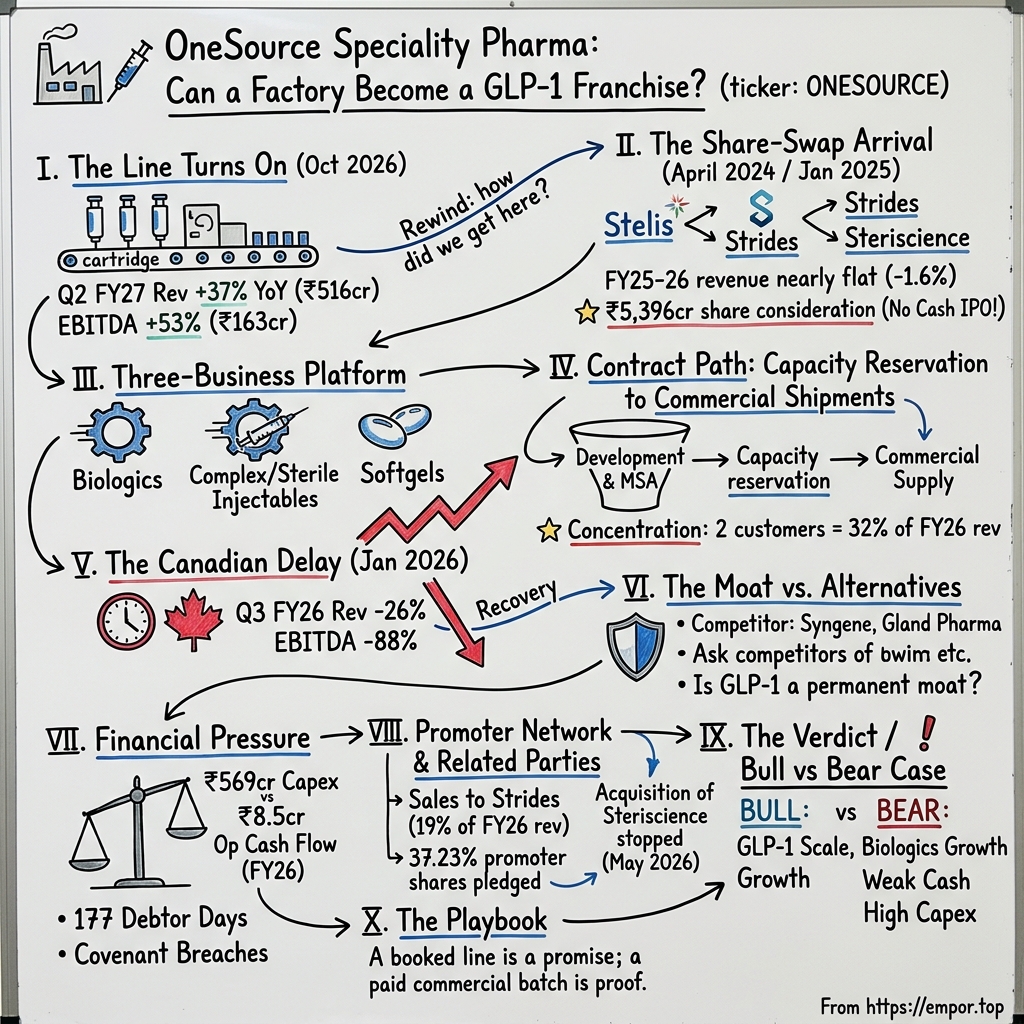
OneSource Specialty Pharma: Can a Factory Become a GLP‑1 Franchise?
I. The line that finally turned on
Picture a sterile room in Bengaluru where almost nothing moves by human hand. Empty glass cartridges, each about the size of a finger and destined to sit inside an injection pen, ride a conveyor through a wall of filtered air. A needle drops, fills each one with a precisely measured dose, and a rubber plunger seals it. A camera checks every unit. Downstream, the cartridges are assembled into pens, labelled, packed and moved into cold storage, because the drug inside them, a copy of the diabetes and weight-loss molecule semaglutide, spoils if it gets warm. By October 2026, OneSource Specialty Pharma's second cartridge line was doing this for paying customers. Management told investors on its second-quarter call that the line had begun running commercial batches.1
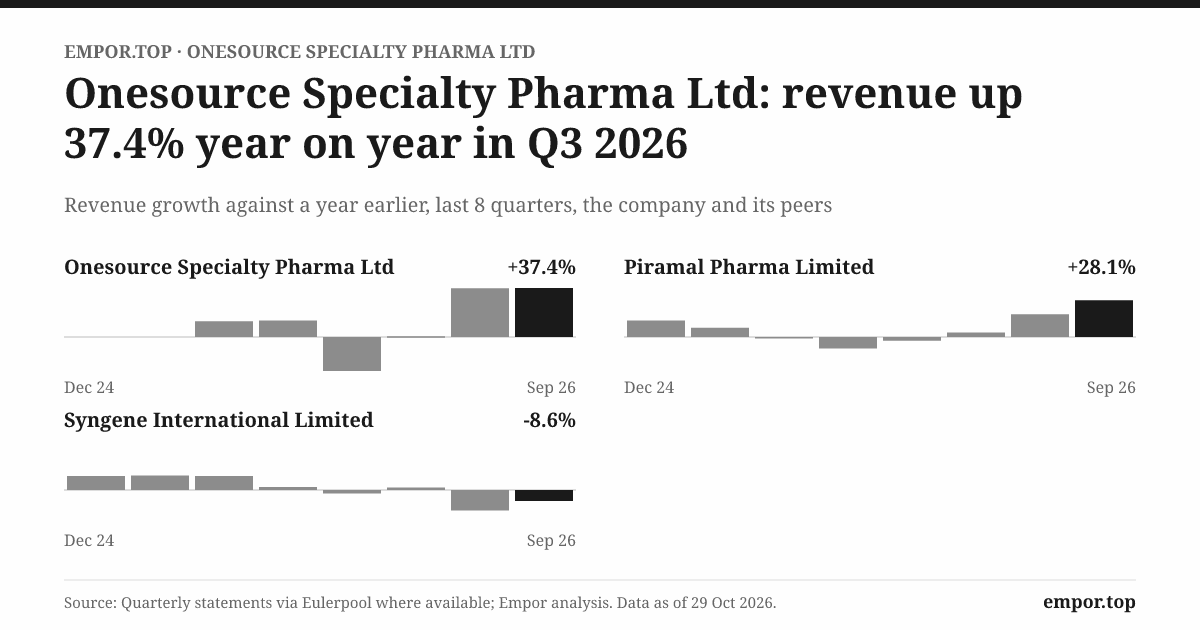
The quarter that line helped produce looked like the turn the company had been promising. In the three months to September 2026, the second quarter of the 2027 financial year, revenue rose 37% from a year earlier to about ₹516 crore. EBITDA, the profit before interest, tax, depreciation and amortisation, rose 53% to about ₹163 crore, which meant that almost a third of every rupee of sales survived the company's operating costs.2 It was the third quarter in a row in which revenue grew on the one before.3 For a company that had spent much of the previous year explaining a delay, it was the first set of numbers that looked like the plan rather than an apology for it.
The relief made sense, because the year behind it had been difficult. Over the twelve months to March 2026, OneSource booked about ₹1,422 crore of revenue and kept almost none of it as operating profit: its operating margin was below 2%.4 Cash generated by operations was barely positive, about ₹8.5 crore, in a year when the company spent about ₹569 crore building plant.4 A business valued in the market at about ₹18,000 crore had, in its latest full year, produced roughly enough operating cash to pay for a few weeks of its own construction.5
That gap between the factory and the cash is the subject of this story. OneSource is a contract development and manufacturing organisation, or CDMO: a company that makes medicines other companies sell under their own names. In two years it went from a loss-making biologics unit to a listed company with three manufacturing businesses and a bold promise. Management has said it will reach $400 million of organic revenue and $160 million of EBITDA in the 2028 financial year, which ends in March 2028.1 At today's exchange rate, that means roughly two and a half times its FY26 revenue, and a margin of 40%.
Three questions decide whether that promise holds. The first is where the growth comes from. Much of OneSource's apparent history of hypergrowth is the arithmetic of a merger, and the organic record is short. The second is what the GLP‑1 opportunity can actually earn for a contract manufacturer that does not own the drug, the approvals or the customer relationships at the pharmacy counter. The third is whether all the equipment is turning into cash, or whether receivables, inventory and new capital spending keep swallowing it.
One distinction runs through all three questions, and it should be stated now. A capacity reservation, a qualified line or a long funnel of customer enquiries all count as interest. None of them is a commercial shipment that a customer has accepted and paid for. OneSource's history so far is the story of the company learning how wide that gap can be. The line that turned on in October narrowed it. It did not close it, because one strong quarter cannot show that growth will last or that it will reach the bank. To see why, the story has to rewind to the moment OneSource was assembled, which happened not in a factory but in a court-approved share swap.
 Subscribe on LinkedIn
II. The company that arrived through a share swap
Most companies list on an Indian stock exchange by selling shares to the public: a prospectus, a price band, a subscription book, a bell-ringing at the exchange. OneSource arrived differently. It had no IPO prospectus, no price band and no public subscription. On 21 January 2025, the company filed an Information Memorandum with the exchanges to list 114,436,021 shares it had issued under a scheme of arrangement. The memorandum stated that no shares were being offered for sale or subscription.6 Three days later, on 24 January 2025, the shares began trading on the NSE and BSE, after SEBI granted an exemption from the rule that a new listing must start with a minimum public float.7
To understand what began trading that day, start with the old name on the company's registration: Stelis Biopharma. Stelis had been the Strides group's attempt to build a biologics business. Biologics are large, complex medicines grown in living cells rather than made by chemical synthesis. The work demanded heavy investment and produced little revenue. In the year to March 2023, the company that would become OneSource booked revenue of under $5 million against an operating loss more than five times that size.7 It was a promising but expensive laboratory, and it was looking for a business to carry it.
In 2023 the group proposed a reorganisation that would give it one. Under the scheme, Strides Pharma Science would move its oral softgel business and certain identified CDMO operations into Stelis, and Steriscience, another promoter-linked company, would move in its identified sterile-injectables business. The appointed date, the moment from which the businesses were treated as combined for accounting purposes, was 1 April 2024. The National Company Law Tribunal process ran through 2024.7 Stelis became OneSource Specialty Pharma, and the shareholders of the companies giving up the businesses received OneSource shares in exchange.
This was a reorganisation of businesses already inside a group, not a takeover paid for in cash, and that difference matters later. OneSource issued shares valued at about ₹5,396 crore as consideration for the business combination.7 That figure sounds like a purchase price, but no cash changed hands. It is the accounting value of the shares issued. The transferred businesses had no clean, standalone EBITDA history of their own, so an investor cannot calculate the multiple OneSource paid and compare it with peer deals. Nobody can say whether the price was cheap or expensive. The deal was a way of putting assets under one roof, and its value can only be judged by what the combined company earns from now on.
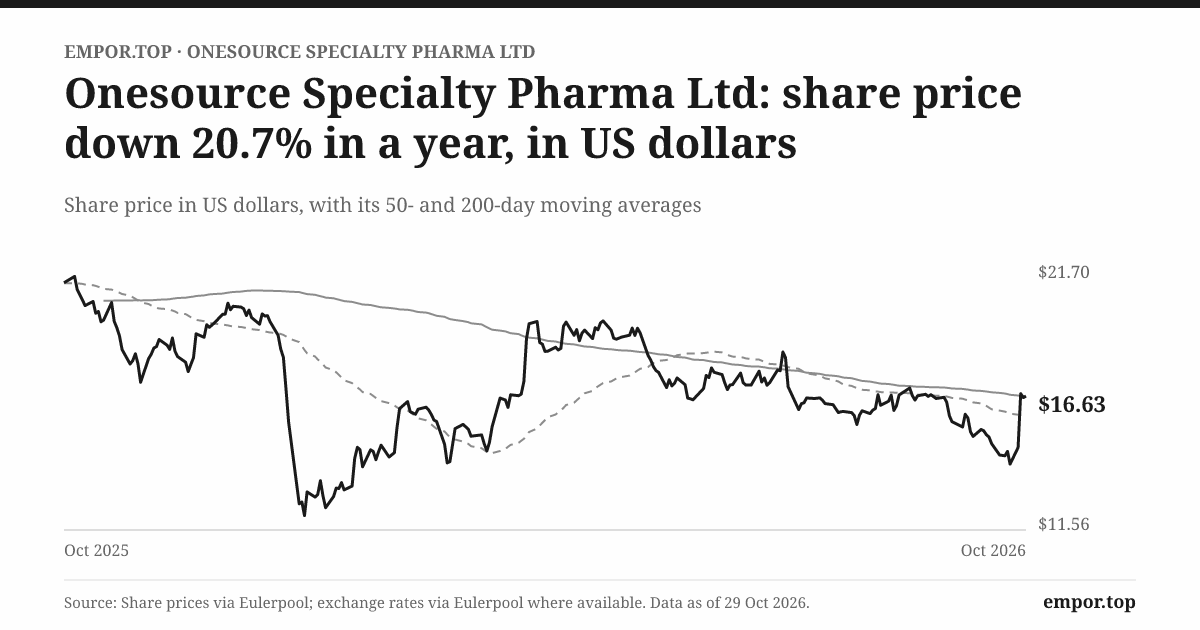
Real cash arrived separately. In January 2025, around the time of listing, OneSource raised about ₹801 crore by privately placing about 6.28 million shares at ₹1,276 each. HBM Healthcare Investments, a Swiss healthcare investor, led the placement, and other institutional buyers joined.7 That money went to work in the factories. It also gave public investors a reference price: on 29 October 2026, the shares traded near ₹1,584, roughly a quarter above the placement price, after swinging during the year between about ₹1,114 and ₹1,878.5
Now consider the growth figure that a quick screen of OneSource produces. Measured from FY23 to FY26, revenue grew about 232% a year.4 That sounds like a rocket. In fact, it is mostly a merger. FY23 and FY24 were the old Stelis, a small biologics unit. FY25 was the first full year in which the softgel and sterile-injectables businesses sat inside the accounts. Any growth rate that crosses 1 April 2024 compares a laboratory with a manufacturing group.
The comparison that actually measures the combined business is much less exciting. Revenue was about ₹1,445 crore in FY25 and about ₹1,422 crore in FY26, a decline of about 1.6%.4 In its first two full years as a combined company, OneSource did not grow. The headline growth rate describes what the scheme assembled, not what the business built.
That is not a damning verdict, because the company's own plan never said FY26 would be the breakout year. But it resets the burden of proof. A company that lists through a share swap starts with an assembled platform and no organic track record, and every claim about momentum has to be tested against a very short series. The interesting question, then, is not how fast OneSource has grown. It is whether the three businesses it inherited form something more valuable together than they did apart.
The Strides group itself should stay at the edge of this picture. Strides Pharma Science and the other promoter-linked companies are outside OneSource's consolidated accounts; their revenue, headcount and market positions are not OneSource's.4 The group matters here in two ways only: through the assets it handed over, and through the trading relationships that continued after the handover. The second of those turns out to be large enough to need its own chapter. First, though, the inheritance itself.
III. Stelis's long build becomes a three-business platform
Stelis started with a bet that India could build biologics capacity before the market needed it. A biologics plant is more like a greenhouse than a chemical factory. Cells are grown in steel bioreactors and coaxed into producing a protein, which is then purified, tested and filled. The process is slow to establish and expensive to validate, and every step has to be documented for regulators. During the pandemic, Stelis's affiliate Biolexis signed up to manufacture the Sputnik Light vaccine for Prestige Biopharma, a contract that later collapsed and turned into a ₹1,286 crore arbitration claim against Biolexis.4 That episode belongs later in the story. For now, it shows what the inheritance included: real sterile manufacturing assets, and obligations that came with them.
FY25 was the first full year in which the former Stelis platform sat beside the transferred businesses, and it gave OneSource a pitch no single unit could have made on its own.7 The first engine is biologics, the original Stelis capability. The second is complex and sterile injectables, including drug-device combinations, the category where the GLP‑1 cartridge lines sit. The third is softgels, the soft gelatin capsules used for many oral drugs and supplements, which came from Strides and brought existing commercial customers with it.
The breadth was a deliberate sales argument. Speaking at the CPHI pharmaceutical trade fair in Milan in 2024, chief executive Neeraj Sharma presented OneSource as an end-to-end partner that could take a customer from development to commercial supply across several dosage forms.8 The logic is a familiar one in contract manufacturing. A pharmaceutical company that already trusts a supplier with one product, has audited its quality systems and has a working relationship with its engineers will find it easier to give that supplier a second product than to qualify a new one.
To see why customers pay a CDMO at all, think about what a drug company is actually buying. A plant that makes a medicine for the United States, Europe or Canada has to be approved by those regulators, and the specific process for each product has to be validated. That means proving, batch after batch, that the plant makes exactly the same thing every time. A company launching a generic semaglutide could build its own sterile cartridge line. It would spend years and a large amount of capital, and it would compete against the clock of a patent expiry that does not wait. Renting a qualified line from a specialist saves time and capital.
The same logic is the source of a CDMO's staying power. Once a product's process has been validated on a particular line and regulators have approved that site in the product's dossier, moving it elsewhere means repeating much of the work and accepting a gap in supply. That switching friction is real. It is not permanent, though. Customers routinely qualify a second supplier precisely so they are never hostage to one.
The pitch has a weakness that the numbers expose. In FY26, OneSource split its revenue into about ₹675 crore from the sale of goods and about ₹747 crore from services.4 That split is not a split by business. Goods sales can include commercial supply of softgels or injectables; services can include development work, manufacturing services and capacity reservations across all three modalities. OneSource reports as a single CDMO segment.4 It does not publish revenue, profit or return on capital for biologics, injectables or softgels separately.
That matters more than it might seem. Three businesses with very different economics sit inside one set of accounts. Softgels are a mature, high-volume capsule business. Sterile injectables and drug-device combinations need expensive, highly automated lines, and they earn well only when those lines are full. Biologics, by management's own reckoning, is still building toward commercial revenue. An investor cannot tell from the filings which of the three generates most of the profit, which consumes most of the capital, or whether the combination is better than the sum of its parts. Nobody should invent a ranking. OneSource has not published the data needed to make one.
What the filings do show is that the company spent heavily in its first full combined years. Capital expenditure jumped from about ₹128 crore in FY25 to about ₹569 crore in FY26, and permanent headcount reached 1,674 by March 2026, after more than 500 additions during the year.4 OneSource is not harvesting an inherited business. It is building, mainly in the sterile and device lines that the GLP‑1 thesis depends on.
So the verdict on the platform is narrower than the pitch. The breadth is strategically plausible: one quality system, several dosage forms and a reason for customers to stay for the next product. Whether it is economically superior to a focused specialist has not been shown, because the profit by modality is not published. The best evidence available will come from watching how a single customer relationship turns into money, which is where the business gets more intricate than a factory tour suggests.
IV. From a reserved line to a commercial shipment
Imagine a mid-sized generic drug company in late 2023 with a plan to sell semaglutide in a market where patents are about to lapse. It has a formulation, a regulatory strategy and a launch window. It does not have a sterile line that can fill millions of pen cartridges. So it signs with a contract manufacturer, and that signature begins a sequence that can take years to produce a single commercial sale.
The sequence has three stages, and OneSource earns money in each one, in very different amounts. The first is development and manufacturing services, which management calls MSA work. OneSource adapts the product to its line, runs trial and registration batches, and generates the data the customer will submit to regulators. This is paid work, often at good margins, but it is project revenue, and it ends when the project ends. The second stage is the capacity reservation. A customer that wants to be certain of a slot pays to hold one. OneSource recognises those reservation fees over the period the capacity is reserved.4 The third stage is the commercial supply agreement, or CSA. It begins after the product is approved and launched, when the customer orders commercial volumes and OneSource ships finished product.4
Management has described two protections built into the GLP‑1 contracts: upfront fees paid to reserve capacity, and take-or-pay commitments that oblige customers to pay for agreed volumes whether or not they need them.9 Both are valuable. Both also depend on details outside investors don't see. A take-or-pay clause is worth what its minimum volumes, penalty terms and enforceability make it worth. And a manufacturer that depends on a small number of customers for future business has every reason to be gentle in enforcing one. An upfront fee is real cash, but it pays for capacity the company then has to build and staff.
Commercial volume arrives only when someone else's product is approved, launched and selling, and OneSource controls almost none of that sequence.
Management has described where it wants the mix to settle. On the Q2 FY27 call, it outlined a steady-state mix for the drug-device combination business of roughly 75% commercial supply and 25% manufacturing services.1 That is a target for one business at maturity, not a description of the company today. OneSource does not regularly report what share of current revenue comes from commercial supply rather than development work and reservations.
Analysts on the same call pressed on that gap. They asked how much of the quarter's growth came from commercial shipments rather than MSA work, and how receivables were behaving as revenue rose.1 The questions were the right ones, because headline revenue cannot answer them. A quarter heavy in development fees can look as good as a quarter heavy in commercial batches, even though the first is project income and the second is the recurring stream that justifies building lines. Management's answers described progress on commercial supply without giving a clean figure for the mix.1 Until OneSource publishes that figure, investors are inferring the quality of revenue from its quantity.
The economics of the model are attractive if it works. Development work earns money while the customer waits for approval. Reservation fees cover part of the cost of standing capacity. Commercial supply, once it ramps, fills the line at volumes that spread fixed costs thinly. A sterile line has heavy fixed costs: depreciation, specialised staff, environmental monitoring, validation. The difference between a half-full line and a full one decides almost all of the margin. That is why EBITDA rose much faster than revenue in Q2 FY27, and why it collapsed so sharply when volumes slipped a year earlier.
The model also concentrates risk in a few hands. In FY26, two customers each accounted for more than a tenth of OneSource's revenue, and together they contributed about ₹454 crore, or roughly 32% of sales. A year earlier, three customers had contributed about ₹746 crore, roughly 52%.4 The annual report does not name them, and it gives no top-five or top-ten concentration figures.4
The improvement looks good at first glance, but part of it comes from the denominator rather than from diversification. Revenue was roughly flat between the two years, so concentration fell because the largest accounts shrank, or because one fell below the 10% disclosure threshold, rather than because a wave of new customers arrived. Management did report 82 or more customer logos and more than 75 active requests for proposal in Q2 FY27, which suggests a wider base is forming.2 A logo is a relationship, though, not a revenue stream, and the disclosed figures still show a business where two buyers can shape a year.
The way this revenue is booked is itself a judgment, and the auditors treat it as one. Deloitte named revenue recognition as a key audit matter in the FY26 consolidated accounts, alongside goodwill impairment.4 That is not a criticism. It is the auditor's way of saying that deciding when a reservation fee has been earned, when a development milestone counts as complete, and when control of a commercial batch has passed to the customer involves estimates that could move profit from one period to another. At year-end, unbilled revenue, work recognised but not yet invoiced, was small at about ₹8 crore.4 That is reassuring: most of what OneSource reported had at least reached an invoice. Whether the invoice reached cash is a different question, and the receivables answer it later in this story.
There is one more feature of the model worth naming, because it is often misunderstood in a period of excitement about artificial intelligence. Software can speed up formulation work, process modelling and the paperwork of a regulatory submission. It cannot replace a sterile line that regulators have inspected and approved, or the batch records that prove the line makes the same product every time. The scarce thing in this business is validated physical capacity and the trust of regulators. That protects OneSource from one kind of disruption. It also means its growth is limited by the speed at which it can build, qualify and fill lines, which is where every delay in this story has come from.
That combination of a handful of customers whose product approvals OneSource cannot control and lines whose margins depend on being full set up the test the company faced in 2026. It came in Canada.
V. The Canadian delay put the GLP‑1 thesis on trial
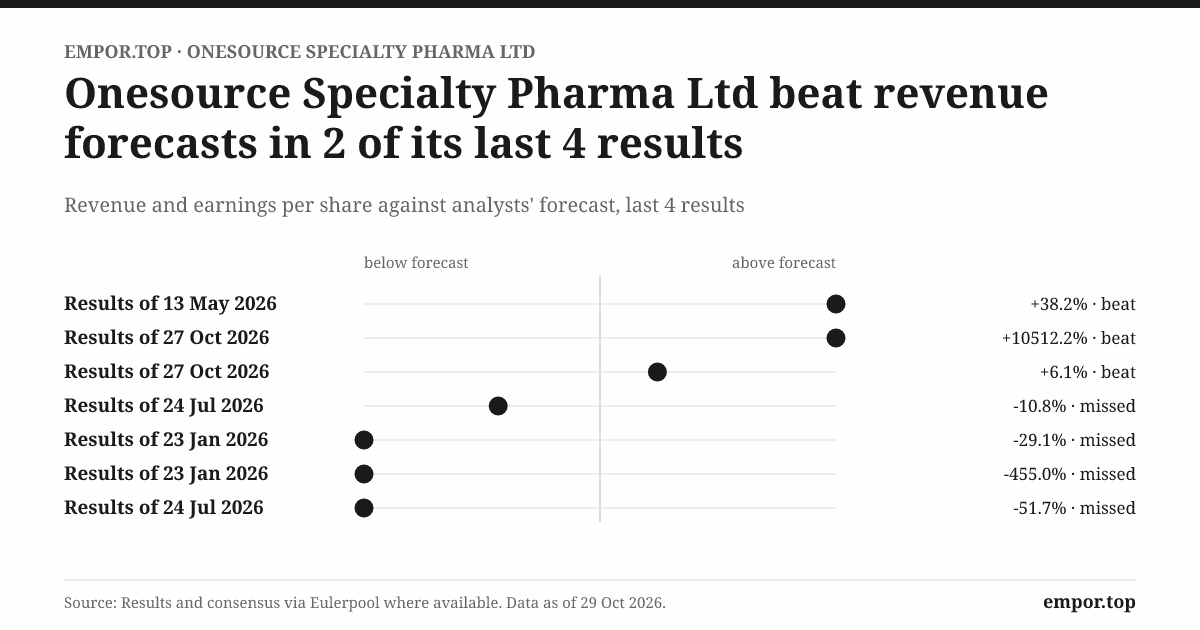
On 23 January 2026, OneSource issued its results for the third quarter of FY26, the three months to December 2025. The headline figures were bad. Revenue fell about 26% from a year earlier to roughly ₹290 crore, and EBITDA fell about 88% to roughly ₹17 crore.10 The company's explanation was short. Its customers' semaglutide approvals in Canada had arrived later than expected, and the commercial sales that were supposed to follow had been pushed back.10
To see why one country's regulator could knock nearly nine-tenths off a quarter's operating profit, start with the molecule. Semaglutide, the active ingredient in Novo Nordisk's Ozempic and Wegovy, is one of the most commercially important drugs in the world. It treats type 2 diabetes and obesity, and demand has outrun supply for years. Its patent protection began to lapse in 2026 in a number of markets outside the United States and Europe, including Canada, India, Brazil and China. That opened the door for generic versions.11 For a generic company, the first months after a patent lapses are the most valuable. Prices are highest before many competitors arrive, and early entrants gain share with pharmacies and payers. Speed matters, and speed is exactly what a ready-qualified contract manufacturer sells.
OneSource positioned itself early for that window. In June 2025, Moneycontrol reported that the company was preparing for the launch of generic anti-diabetes and obesity drugs, and that it was looking to double revenue within three years on the back of that opportunity.11 Large published forecasts for the global GLP‑1 market describe sales of branded and generic drugs at pharmacy prices. A contract manufacturer earns a fee per unit filled, assembled and packed. Its addressable revenue is a small slice of that figure, and it shares that slice with every other qualified supplier.
Canada was meant to be the first big commercial market for those generics, and it was where the plan stumbled. On the Q3 call, management explained that partner approvals had come through later than planned, so the move from MSA work to commercial supply, the transition the whole model depends on, was delayed.12 It added that it had chosen not to fill the empty capacity with new, lower-throughput manufacturing-services projects.12 The decision was defensible. A line reserved for high-volume semaglutide cartridges would have earned less from small development jobs, and loading it up could have tied up capacity just as commercial orders arrived. It also meant the quarter took the full hit.
The episode tests the GLP‑1 thesis in a useful way. Did demand disappear? The evidence says no. The delay was in a regulator's timetable for customers' products, not in a decision by customers to walk away, and the volumes came back in later quarters. Did the episode show how little control OneSource has? Clearly yes. One market's approval timing, for products OneSource does not own, moved a quarter's EBITDA from respectable to almost nothing. The supplier carried fixed costs while the customer's timetable slipped.
What management said next was as revealing as the miss. On the Q4 FY26 call in May 2026, the prepared remarks held firmly to the FY28 targets of $400 million in organic revenue and $160 million in EBITDA.9 The Q&A told a messier story. Executives acknowledged delays in bringing lines up, shipping problems and qualification work still under way, while insisting that the trajectory to FY28 remained intact.9 Holding a target through a miss can show conviction or stubbornness, and only results tell the two apart. What can be said is that management kept the same numbers, explained the miss in specific terms rather than vague ones, and set a date by which the claim can be checked.
The recovery came through the following two quarters. Revenue in the March 2026 quarter roughly matched the year before, the June 2026 quarter grew about 37%, and then came the September quarter that opened this story.3 On the Q2 FY27 call, management said the second cartridge line had entered commercial batches and that a customer had launched in Saudi Arabia.1 It also gave ground on the third line. Expected earlier to be qualified in the fourth quarter of FY27, that line could slip into FY28 for qualification.1 Even in the good quarter, the next piece of capacity was running late.
That mixture of a strong quarter and a slipping schedule is exactly how the rest of the story should be read. Some things are now proven. OneSource can make GLP‑1 cartridges at commercial scale on more than one line. Customers have launched in more than one market. The company can handle the full chain from filling to assembly, labelling, packing and cold storage under one roof, a capability management emphasises as a differentiator.1 Other things remain options. Openings in the United States and Europe, where semaglutide patents run later, depend on partner approvals that are years away and on competition that will be fiercer. Commercial biologics revenue is, by management's own account, a story for FY29 and beyond.1
The question that matters most has not been answered. When an analyst asked how much of the reported growth came from commercial supply rather than MSA work, the answer described progress without giving the split.1 That split decides what the recovery is worth. Commercial supply is the recurring stream that should fill lines for years. MSA revenue is valuable but finite. And neither means much until it turns into cash, which brings in a figure that sat uncomfortably beside the strong quarter: receivables.
The verdict on Canada, then, is that the approval delay was a serious operating setback, not proof that demand was missing. The recovery since then strengthens the case that the demand is real and that OneSource can serve it. It does not yet show that the company has escaped its dependence on a few customers' approval calendars. And it does not yet show that the revenue converts into cash on the timetable the FY28 target needs. Before testing the cash, it is worth asking a harder strategic question. If GLP‑1 demand is real, why should it flow to OneSource rather than to anyone else with a sterile line?
VI. The moat has to survive the buyer's alternatives
Walk the GLP‑1 line from end to end and the claimed advantage becomes visible. At one end, cartridges are filled under sterile conditions. They are then assembled into a pen, labelled for the destination market, packed and held in a cold chain until they ship. Management argues that doing all of this in one place, rather than filling at one supplier, assembling at another and packing at a third, saves customers time, reduces handovers where quality can slip, and gives them one partner to audit and hold accountable.1 It is a real convenience. The question for a long-term investor is whether it is a moat, something that lets OneSource earn better returns than its rivals for years, or simply a good feature that competitors can copy.
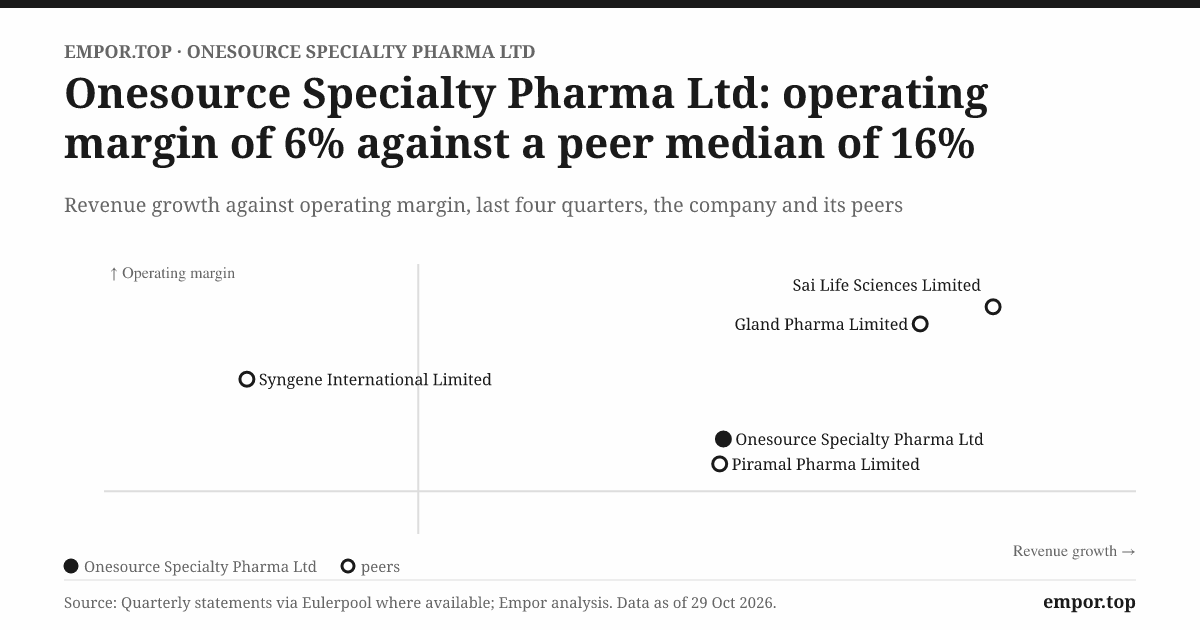
Start with scale, because it frames everything else. OneSource reported about ₹1,422 crore of revenue in FY26.4 Syngene International, India's best-known integrated research, development and manufacturing services company, reported about ₹3,739 crore over the same year.13 That is more than two and a half times as much. The comparison is not like for like. Syngene earns most of its money from discovery and development services for global innovators, while OneSource's growth depends on manufacturing for generic and specialty launches. But it shows that OneSource is not the biggest Indian outsourcing partner a global drug company can call. Piramal Pharma Solutions offers development and manufacturing across a global network of plants. Gland Pharma is a large specialist in sterile injectables. Behind them stand global contract manufacturers with decades of regulatory history and much larger sterile capacity. OneSource does not publish market-share data for its niche, and no reliable public figure exists for its share of cartridge or drug-device filling.
Apply the competitive forces once and in order. Buyer power is the most serious. The disclosed concentration, with two customers making up about a third of revenue, means a small number of buyers can shape a year.4 Generic drug companies are also among the most cost-conscious buyers in pharmaceuticals, because they compete on price themselves. They multi-source as a matter of policy, qualifying a second manufacturer so that no single plant can hold them hostage. That limits how much any contract manufacturer can charge once a product matures.
Switching costs push the other way, and they are OneSource's strongest structural argument. Validated programs are harder to move, though that protection fades once a customer qualifies a second source.
The threat of new entrants is moderate. Sterile drug-device lines are expensive, slow to qualify and hard to run well, which keeps out casual competition. But the GLP‑1 opportunity is so visible that well-funded manufacturers in India, China, Europe and elsewhere have every reason to build similar capacity, and many have the regulatory track record to qualify it. Substitutes are a longer-term worry. Oral versions of GLP‑1 drugs and other changes in delivery could reduce the need for injectable pen capacity over time. Supplier power, from glass, device components and specialised equipment vendors, is a real operational constraint in a crowded market, though not one OneSource has identified as decisive.
Put together, the forces describe an industry where technical difficulty raises the bar to entry but does not guarantee anyone a full line or a fat price. OneSource's integration and regulatory work probably help it win programs, and they make it harder for an existing customer to leave. A customer launch in Saudi Arabia, the commercial ramp that followed the Canadian approvals, and repeat projects with existing logos are positive signs.1 The company has not published what would turn a plausible moat into a demonstrated one: customer retention rates, price realisation over time, win and loss rates on proposals, or utilisation by line. An investor today is asked to take the moat partly on trust.
The GLP‑1 opportunity itself is easy to mistake for a moat. A product window is not a durable advantage. When semaglutide goes generic in a market, the first few manufacturers to qualify gain an edge. Within a few years, more qualified capacity arrives, generic prices fall and the contract manufacturer's fee per unit comes under pressure. Customers' own programs can shift, too, toward other molecules, other markets or their own plants. The real test of OneSource's position is whether it can turn the first GLP‑1 wave into relationships that bring the next molecule, the next market and the next modality to the same lines.
That is where biologics is supposed to help, and it needs to be kept in proportion. Biologics was Stelis's founding business and remains strategically important. A credible biologics CDMO with a regulatory track record could become a second growth engine with stronger long-term economics than generic cartridge filling. But management's own timeline places commercial biologics revenue from FY29 onward.1 Today's evidence is an expanding funnel and development work, not an established revenue stream. The Sputnik Light dispute is a reminder of the risk.4 That history does not decide the future, but it is the company's own record of converting a high-profile biologics milestone into revenue, and the record is poor.
The verdict on the moat is that it is plausible and unproven. The switching friction on validated programs is real. The integrated device capability is a genuine selling point. Both sit inside a market where concentrated, price-sensitive buyers have alternatives and where the hottest opportunity is, by its nature, temporary. The evidence that would settle the question is commercial: repeat programs from existing customers, stable pricing as generic competition intensifies, and lines that stay full after the first wave. That evidence takes time, and in the meantime the company has to pay for the lines. The payment shows up in the cash-flow statement.
VII. ₹569 crore of capex meets a weak cash conversion record
The FY26 cash-flow statement reads like a construction site's ledger. The company reported a pre-tax loss of about ₹92 crore.4 Adding back about ₹279 crore of depreciation and amortisation, the non-cash cost of the plant already built, and about ₹122 crore of finance costs gives a business that, before working capital, produced a meaningful amount of operating cash.4 Then working capital took nearly all of it. Receivables rose by about ₹190 crore, as customers took longer to pay or the company billed more late in the year. Inventory rose by about ₹281 crore, as materials and products piled up ahead of launches. Larger payables to suppliers, which supplied about ₹209 crore, offset only part of that.4 What was left as operating cash flow was about ₹8.5 crore.4
Against that, the company spent about ₹569 crore on property, plant, equipment and work in progress during the year, roughly 40% of revenue and more than four times the previous year's spending.4 At year-end, it had about ₹53 crore of capital work in progress on the balance sheet and about ₹283 crore of further capital commitments already contracted.4 The cash for the build came from the January 2025 placement, from borrowing and from the balance sheet. Little of it came from the business itself.
That pattern is not new. Over the four years from FY23 to FY26, OneSource's operating cash flow was negative in total by several hundred crore rupees, and free cash flow, operating cash minus capital spending, was negative by well over ₹1,100 crore.4 Some of that belongs to the old Stelis, which was a cash-hungry biologics start-up before the scheme. Some of it is the normal shape of an investment cycle. A capacity business builds first and earns later. What the record does not yet contain is a single year in which the combined company paid for its own growth.
The receivables deserve a closer look, because they are where revenue either becomes cash or does not. Measured against revenue, receivables stood at about 177 days of sales at the end of FY26, up from about 113 days a year earlier.4 In plain terms, the average rupee of sales took roughly half a year to collect. Gross trade receivables were about ₹703 crore. About ₹92 crore of that had been outstanding for six months to a year, and about ₹64 crore for one to two years.4 The provision for bad debts was a modest ₹13 crore, after the company had written off about ₹13 crore and added about the same amount during the year.4 The provision suggests management expects most of the money to come in. The ageing suggests a meaningful part of it is coming in slowly. Some of the largest balances, as the next chapter shows, are owed by the company's own promoter group.
The balance sheet carries the strain. At March 2026, borrowings were about ₹1,276 crore, and lease liabilities of about ₹228 crore were reported separately.4 Leases are long-term rental obligations for plants and equipment. They are real commitments, but they are not bank debt. Against equity of several thousand crore rupees, the borrowings look modest: debt was about a quarter of shareholders' equity.4 Against the earnings that have to service them, they are not. FY26 EBITDA was only a fraction of the debt, and interest costs exceeded what the business produced in operating profit.
Liquidity was thinner than the size of the company suggests. At March 2026, cash and cash equivalents were about ₹36 crore, and other bank balances were about ₹62 crore. About ₹56 crore of those balances was pledged as margin money with banks, so it was not free to spend.4 Most of the investments on the books were stakes in OneSource's own subsidiaries, not a reserve of surplus cash. A company with more than ₹1,200 crore of borrowings and close to ₹300 crore of contracted spending ahead was relying on its lenders' patience and on the next few quarters of collections.
The most telling line in the debt note is the one about covenants. Covenants are the financial tests banks write into loans, such as minimum interest cover or maximum leverage. In FY26, OneSource failed financial covenants on multiple facilities, identified in the annual report as Loans 4 to 10 and 12 to 13, and obtained waivers from its lenders.4 It had also needed waivers for breaches that occurred before the merger, in FY25.7 A waiver means the banks chose not to call in the loans. It does not mean the tests were passed. Two consecutive years of waivers point to real refinancing and covenant pressure, even though no default was reported.
The credit view deserves weight, because rating agencies see more than the public filings. In August 2026, India Ratings upgraded OneSource's bank facilities to IND A with a Positive outlook and affirmed its short-term rating at IND A1.14 The agency cited the commercialisation of the drug-device and GLP‑1 platform, long-term supply agreements and improving visibility of cash flows. It also listed what it was watching: product concentration, price volatility, execution and approval risk, and the Prestige arbitration.14 Earlier in 2026, CARE Ratings' ratings of BBB+ with a Stable outlook and A3+ had been withdrawn at the company's request, which leaves India Ratings as the active independent view.15 A rating upgrade amid covenant waivers is not a contradiction. The agency is judging where the business is going, and the waivers record where it has been.
The investment record has one more chapter that tells investors a lot about management's appetite. In 2025, OneSource proposed acquiring Steriscience's businesses in Poland and Brooks Steriscience, again through a share swap rather than for cash.16 It would have made OneSource larger again, with more sterile capacity and more promoter-linked history, at a time when the existing lines had not yet proven their economics. In May 2026, the board decided to stop pursuing the deal and said it would revisit the idea only after the FY28 guidance had been delivered.16 Moneycontrol reported that the decision followed resistance from shareholders.16
That reversal is meaningful but should not be over-read. It counts in the board's favour that it listened, and that it tied any future deal to proven delivery rather than to promises. It is not, on its own, proof of capital discipline. The proposal was made in the first place, by a company with negative free cash flow and covenant waivers, to buy assets from a related party. Because the deal was a proposed share swap, never completed, and the target businesses had no clean public earnings, no comparable purchase multiple can say whether the terms were cheap or expensive. The safest reading is that the episode showed outside shareholders could push back successfully. Whether management's instinct for expansion has changed is a separate question.
Management has given investors a clear standard to judge all this capital against. On the Q2 FY27 call, it said it expected return on capital in the high twenties by FY28 and debt of around 1.5 times EBITDA.1 Today, return on capital employed was about 0.4% in FY26, and about 1.6% over the twelve months to September 2026.4 Getting from there to the high twenties in roughly eighteen months requires lines to fill, collections to speed up and capital spending to slow. All three have to happen together. Lines that fill but are paid slowly leave the cash problem in place. Faster collections without full lines leave the returns problem. If spending keeps rising, both remain. The test is clear, which is to management's credit. It is also a long way from the current numbers.
VIII. The listed company still trades with its promoter network
The FY26 annual report contains a list that every minority shareholder should read. It records OneSource's transactions with related parties: companies controlled by, or connected to, its promoters and directors. One name stands out. In FY26, OneSource sold about ₹274 crore of materials to Strides Pharma Inc., the US arm of Strides, about 19% of its consolidated revenue.4 After the businesses were separated into a listed CDMO and a promoter group outside it, one of the listed company's largest customers was still inside the family.
The flows run in both directions. In the same year, OneSource paid about ₹88 crore of process and conversion charges to Strides Pharma Science, which means Strides performed manufacturing steps for OneSource, and about ₹25 crore of support-service charges to Strides.4 Purchases and service charges were also recorded with other entities linked to the Strides, Tenshi and Arcolab group.4 These are customer sales, supplier costs and shared services, and they should be kept apart from the two unnamed large customers in the concentration disclosure. The annual report does not say whether Strides Pharma Inc. is one of those two. A sale to Strides Pharma Inc. counts as revenue whether or not it appears in the top-customer figure.
The balances matter as much as the flows. At year-end, the largest related-party receivables included about ₹46 crore owed by Strides Pharma Science, about ₹44 crore by Strides Pharma Inc. and about ₹21 crore by Steriscience Pte.4 Together that is more than ₹110 crore, a significant share of the ₹700 crore of gross trade receivables that pushed debtor days to 177. The notes describe the transactions as conducted at arm's length.4 That is the required disclosure. It does not, on its own, say whether the prices were the ones an unrelated buyer would pay, or whether these counterparties pay on the same schedule as everyone else.
There is a reasonable business case for the relationship. Strides has commercial customers for softgels and other products, and OneSource inherited manufacturing that once served them. Cutting the connection overnight would have meant losing revenue for no benefit. There is also a reasonable investor concern. When a fifth of revenue comes from a promoter-linked buyer and a meaningful slice of receivables is owed by the same group, minority shareholders need to know that the listed company is not financing the group's working capital or pricing its output to suit the group. The question has a clear answer: reconcile related-party sales, costs, receivable ageing and subsequent collections, counterparty by counterparty. OneSource publishes the year-end balances. It does not publish how quickly those balances are collected.
Ownership adds a second layer. Promoter-group ownership fell from about 37.8% in December 2024 to about 30.5% by June 2026.17 The September 2026 pattern showed about 30%, alongside foreign institutions at about 19.5%, domestic institutions at about 24.2% and nearly 80,000 shareholders.5 Domestic institutions nearly doubled their weight over that period, which shows local funds buying into the story. The June 2026 filing also showed about 37% of promoter shares, about 13 million shares, pledged or otherwise encumbered.17 Pledged promoter shares are a known risk in Indian markets. If the share price falls far enough, lenders can sell the pledged shares, adding pressure just when the stock is weak. The group's holdings belong to the promoter entities, not to the chief executive, and should not be confused with management's own stake.
Management is best judged by its behaviour. Neeraj Sharma, the managing director and chief executive, and Anurag Bhagania, the chief financial officer, held to those targets through the Q3 FY26 miss and into the Q2 FY27 recovery.121 They explained the shortfall in specific terms: Canadian approvals, line delays, qualification steps. They did not blame the market in general. That is better than many companies manage. Holding a target, however, is not the same as hitting it. The fair test is to track each quarter's progress against those targets, and to note each time a line, a launch or a qualification moves to the right. The third line's slip is the first such move after the recovery.1
Pay invites a similar test. In FY26, Sharma received about ₹6.25 crore, up from about ₹5.30 crore the year before. That figure included about ₹1.40 crore of performance pay relating to FY24. Bhagania received about ₹2.77 crore, up from about ₹2.16 crore.4 The company then asked shareholders to approve a further ₹1 crore for the managing director to offset the effect of currency movements on his pay, in a year when the consolidated company reported a loss.4 At the September 2026 AGM, the resolution passed, with about 6% of votes cast against it.18 That is a minority, but a measurable one for an Indian company with a large promoter bloc.
The board itself is changing. In FY26, five of its eight directors were independent.4 On 27 October 2026, Dr. Claudio Albrecht was redesignated as a non-independent director, subject to shareholder approval.19 The annual report also recorded the departures of the senior vice-president who led technical development and of the global head of injectables and corporate strategy, in May and July 2026.4 Neither departure is alarming on its own. Together they show that the senior operating bench behind the FY28 plan has turned over during its most demanding period.
The verdict on this chapter is that the disclosures answer the question of scale: related-party sales are material, and so are related-party balances. They do not settle the question of quality. Whether the related-party economics are fair and the balances are collected on time cannot be judged from an arm's-length label. It requires the counterparty-level collection data OneSource does not publish. With that picture of the business, its cash and its governance in place, it is time to weigh what the market is paying for it.
IX. Analysis & Bear vs. Bull Case
Set two numbers side by side and the whole debate comes into view. The first is the promise: $400 million of organic revenue and $160 million of EBITDA in FY28.1 The second is the price. On 29 October 2026, OneSource's enterprise value, its market capitalisation plus net debt, was about ₹19,900 crore. That was about 50 times trailing EBITDA, nearly 12 times trailing sales and about three times book value, with free cash flow running at a negative 2% of the company's value.5 Its price-to-earnings ratio, above 1,000 times, is almost meaningless. Earnings are so close to zero that the ratio says more about the denominator than about the business.5
Turn the promise into rupees and the market's assumption becomes clearer. At today's exchange rate, $160 million of EBITDA is roughly ₹1,500 crore. If OneSource delivered it, today's enterprise value would be about 13 times that future EBITDA. That is a far more ordinary multiple for a growing Indian CDMO. In other words, the current price makes sense only if investors believe that most of the FY28 plan will happen. Over the trailing twelve months, return on capital employed was about 1.6%, and in FY26 it was about 0.4%.45 The market is paying for the destination, not the journey so far.
Peer comparisons should be handled carefully. On Screener, Syngene traded at roughly 52 times earnings and Anthem Biosciences at about 78 times.2021 Both are profitable businesses with longer track records and different mixes, so their multiples are not a clean benchmark for a company whose earnings are near zero. OneSource has been listed only since January 2025, so it has no long valuation history of its own against which to judge today's price. The fairest description is that the market is valuing OneSource as a high-growth CDMO already, even though its accounts do not yet show one.
The bull case starts with the operating proof in the latest quarter. Commercial drug-device volumes are scaling across more than one market. The second cartridge line is running commercial batches. Customers have begun launching in new markets, including Saudi Arabia.1 If the third line qualifies and fills, utilisation should drive margins well above the 32% of Q2 FY27, because the fixed cost of each line is spread over more units.2 Softgels and injectable launches add steadier revenue underneath the GLP‑1 wave. Biologics, from FY29, could add a second growth engine with longer product lives and higher barriers. On this view, FY26 was the trough of an investment cycle, and the share price is early recognition of a franchise taking shape.
The bear case is grounded in the same documents. Approval timing and customer decisions have already moved revenue once, and the third line is already late.1 Two customers and a promoter-linked buyer remain material to sales.4 Receivables, inventory and capital spending absorbed almost all the cash the business generated in FY26, and covenant waivers were needed two years running.47 Capacity is arriving at a pace set by the company, while qualification and demand are set by customers. On this view, OneSource is building ahead of commercial proof, and the valuation gives little room for another quarter like the one Canada produced.
There are also smaller signals the bear case would point to. In FY26, net foreign-exchange gains of about ₹31 crore flattered results, in a year when the pre-tax loss was about ₹92 crore.4 Without those gains, the loss would have been larger. Other income, mostly interest, added about ₹15 crore.4 Neither is a sign of manipulation, but both show how thin the operating profit was.
Currency is a real part of the business, not just an accounting line. OneSource earns much of its revenue in dollars and euros and also borrows in foreign currency. At March 2026, its net monetary assets included about ₹214 crore in dollars and about ₹147 crore in euros.4 The company estimated that a 5% move in the dollar would change profit by about ₹11 crore, and a similar move in the euro by about ₹7 crore.4 The annual report does not describe a hedge ratio. A weaker rupee has helped the rupee figures, and it also helps the FY28 target, because $400 million converts into more rupees at today's rate of about ₹95 to the dollar than at the FY26 average of roughly ₹88. An investor tracking progress should therefore follow the target in dollars, as management states it, and not take comfort from rupee growth that partly reflects the exchange rate.
A skeptical long-short investor would press on two points. The first is sequencing: why add capacity before the existing lines have proven their utilisation and their returns? Management's answer is that GLP‑1 windows reward suppliers who are ready, and that customers' reservations justify the build. That answer is reasonable. It would be more convincing if the company published the commercial-supply mix and utilisation by line, so investors could see whether the build is matched to signed demand. The second is governance: why should minority holders accept a fifth of revenue from a promoter-linked buyer, and more than ₹110 crore of promoter-group receivables, without counterparty-level collection data? Neither concern requires bad faith. Both are about disclosure that would let outside shareholders check what the company asserts.
The largest single legal overhang belongs in this weighing, not in a footnote. Prestige Biopharma has claimed about ₹1,286 crore from Biolexis, a OneSource subsidiary, over the termination of the Sputnik Light vaccine manufacturing contract, in arbitration before the Singapore International Arbitration Centre.4 OneSource denies liability and is seeking the return of the ₹128.5 crore capacity fee it paid.4 OneSource discloses the claim as a contingent liability rather than a provision, and the auditor, Deloitte, issued an unmodified opinion, naming goodwill impairment and revenue recognition as its key audit matters.4 India Ratings lists the arbitration among the issues it is monitoring.14 An adverse award of anything close to the claimed amount would be a major cash and credit event for a company with OneSource's earnings. A favourable outcome, or a settlement that returns the fee, would remove a cloud. Either way, the outcome is binary and its timing is outside the company's control.
A strategy lens adds structure without changing the verdict. Of Hamilton Helmer's seven powers, the ones that could plausibly apply are switching costs, from validated processes and regulatory filings, and process power, if OneSource's integrated device chain proves hard to copy. Scale economies do not apply yet. OneSource is smaller than several competitors. Network effects and counter-positioning do not fit a contract manufacturer. Brand matters only as reputation with regulators and customers. A regulatory approval is not a cornered resource, because competitors can earn the same approvals. On that reading, OneSource has the beginnings of one power and the possibility of a second. Neither is proven by retention or pricing data.
Everything that matters can be reduced to three operating tests. The first is the share of revenue that comes from commercial supply rather than development and reservation work. The company has a target of 75% for its device business at maturity but does not regularly report the current figure.1 The second is cash: operating cash flow against capital spending, and debtor days, which rose from about 113 to 177 between FY25 and FY26.4 The third is return on capital alongside leverage and covenant compliance. ROCE was 0.4% in FY26 and improved to about 1.6% over the latest twelve months, against a target in the high twenties, with debt around 1.5 times EBITDA.51 If all three move together, the bull case is working. If revenue rises while the second and third tests stall, the bear case is the one being proved.
The verdict, weighed once, is that the bull case has real operating proof in the Q2 rebound and in new commercial capacity, while the bear case has stronger proof in cash conversion, concentration and returns. The valuation assumes a large amount of execution that the record has not yet shown. That leaves the investor with a set of lessons that apply well beyond this company.
X. Playbook: Business & Investing Lessons
A customer can reserve a line years before the first commercial batch leaves it. The manufacturer, meanwhile, must buy the equipment, hire and train the staff, stock the materials and run the qualification batches. It pays for all of that with its own money, at its own risk, on the customer's timetable. OneSource has lived that sequence more vividly than most. The lessons it teaches are specific to the company, but they travel.
The first lesson came out of Canada: a booked line is a promise; a paid commercial batch is proof. The Canadian delay showed that reserved capacity and finished development work could not protect results when customers' approvals had not arrived.10 The later commercial ramp on the second line showed the other side of that gap.12 Founders building capacity businesses should price their plans on shipments rather than signatures. Investors should ask, every quarter, how much of revenue came from product a customer actually launched.
The second lesson is about where OneSource came from: a merger can create a platform in a day, but it takes years to prove the economics. The merger created the platform; the short post-merger record has yet to prove its economics.674 The wider point applies to every reorganisation-driven listing in Indian markets: judge the business from the appointed date forward, and treat everything before it as prehistory.
The third lesson concerns the customer that is also family: a related-party sale is still a customer sale, but it deserves a customer-level collection test. The related-party sales and balances are material, but their quality cannot be judged without collection data.4 For a minority shareholder, an arm's-length label is a disclosure, and the way to check it is to watch cash arrive.
The fourth lesson is the one the board learned in public: the best capex plan is the one that survives the cash-flow statement. OneSource's board stepped back from the proposed acquisition after shareholder resistance.16 In FY26, the company spent far more on plant than it generated in operating cash.4 Any plan to grow, whether by building or buying, has to be measured against that ratio. Here, the shareholders did the measuring.
Put the four lessons together and they form one larger idea. In contract manufacturing, capacity is an option, and customers decide whether to exercise it. The equipment is necessary but not sufficient. The value lies in conversion: from reservation to approval, from approval to commercial supply, from supply to an invoice, and from the invoice to cash that comes back faster than the next line consumes it.
XI. Epilogue
On the evening of 29 October 2026, OneSource stands between two versions of itself. In one, the second cartridge line is running commercial batches, revenue has grown for three quarters in a row, EBITDA margins have reached about a third, and India Ratings has a Positive outlook on its debt.1214 In the other, the third line has reached the site but still needs qualification, its timing has drifted into FY28, debtor days stand near half a year, and return on capital in the last full year was well under 1%.14 Management says all three lines should be operational for FY28.1 The next eighteen months will show which version of the company is the real one.
The first moment to watch is the third line's qualification and the commercial ramp on the second line. If qualification completes early in FY28 and the second line's volumes keep rising, the capacity in the FY28 plan will exist on time. If the third line slips again, the FY28 revenue target would depend on squeezing more out of two lines, and investors will need to ask whether the target's arithmetic still works.
The second is the customer calendar. Further launches and approvals in the markets where semaglutide is going generic will show whether Canada was an isolated delay or a pattern. Each launch on time is evidence that OneSource has learned to plan around its customers' regulators. Each slip is a reminder that it cannot control them.
The third is the cash. As revenue rebounds in FY27, operating cash flow should rise with it. If it does, and debtor days fall back from 177, the investment cycle will have started paying for itself. If revenue grows but receivables and inventory grow faster, the FY26 pattern will have repeated at a larger scale, and the covenant waivers of the past two years will look less like history and more like a habit.
Commercial mix, cash conversion and returns will carry the story from here. If all three move in the right direction, the GLP‑1 franchise in the title becomes a description rather than a question.
Several matters will remain open regardless. Customer-level disclosure and profit by modality remain limited, and the Prestige arbitration remains unresolved.4 The proposal funnel and expanding set of qualified lines are inputs. The output that will decide this story is a commercial batch, shipped, invoiced and paid for, and then another, and another.
XII. Outro
Go back to that sterile room in Bengaluru where the second line began running commercial batches. The machines do their work with a precision no human hand could match: fill, seal, inspect, assemble, label, chill. It is an impressive sight, and it was the image that opened this story. But the machine running is not the decisive image. Any well-funded manufacturer can install a line.
The decisive image comes later, and it is quieter. A customer whose product has passed through the line comes back with the next order. Its regulator has approved the site, its launch has gone to plan, and it pays its invoice on time. OneSource is not a simple bet on GLP‑1 drugs. It is a bet that technical readiness can be turned into trusted, paid, repeat manufacturing. In FY26, it barely reached positive operating cash.4 October's commercial batches suggest that conversion has begun. The company's next chapter depends on whether customers keep coming back to the line.
References
-
Q2 FY27 earnings call transcript — OneSource Specialty Pharma via Stock Analysis, 2026-10-27 ↩↩↩↩↩↩↩↩↩↩↩↩↩↩↩↩↩↩↩↩↩↩↩↩↩
-
Q2 FY27 results presentation — OneSource Specialty Pharma, 2026-10 ↩↩↩↩↩
-
Financial reports and investor presentations — OneSource Specialty Pharma ↩↩
-
Integrated Annual Report FY 2025–26 — OneSource Specialty Pharma, 2026-08-28 ↩↩↩↩↩↩↩↩↩↩↩↩↩↩↩↩↩↩↩↩↩↩↩↩↩↩↩↩↩↩↩↩↩↩↩↩↩↩↩↩↩↩↩↩↩↩↩↩↩↩↩↩↩↩↩↩↩↩↩
-
OneSource Specialty Pharma consolidated financials, valuation and shareholding — Screener, accessed 2026-10-29 ↩↩↩↩↩↩↩
-
Information Memorandum for listing under the scheme — NSE, 2025-01-21 ↩↩
-
Integrated Annual Report FY 2024–25 — OneSource Specialty Pharma, 2025-08-29 ↩↩↩↩↩↩↩↩↩
-
OneSource Specialty Pharma: an exclusive interview with CEO Neeraj Sharma at CPHI Milan 2024 — World Pharma Today, 2024 ↩
-
Q4 FY26 earnings call transcript — OneSource Specialty Pharma via Stock Analysis, 2026-05-13 ↩↩↩
-
Q3 FY26 results release: Canadian approval delays — OneSource Specialty Pharma, 2026-01-23 ↩↩↩
-
OneSource gears up for launch of generic anti-diabetes and obesity drugs, looks to double revenue in 3 years — Moneycontrol, 2025-06-12 ↩↩
-
Q3 FY26 earnings call transcript — OneSource Specialty Pharma, 2026-01-24 ↩↩↩
-
India Ratings upgrade rationale — India Ratings and Research, 2026-08-17 ↩↩↩↩
-
CARE rating withdrawal rationale — CARE Ratings, 2026-03-13 ↩
-
Why the Brooks Steriscience–OneSource deal was called off — Moneycontrol, 2026-05-25 ↩↩↩↩
-
Shareholding pattern, June 30, 2026 — OneSource Specialty Pharma, 2026-07 ↩↩
-
AGM voting results and scrutinizer's report — OneSource Specialty Pharma, 2026-09-24 ↩
-
Syngene International valuation and financial data — Screener ↩
-
Anthem Biosciences valuation and financial data — Screener ↩
 LinkedIn
 WhatsApp
 Reddit
 Hacker News
 Email
 Kindle
 RSS Feed
 Spotify
 Apple Podcasts
 Amazon Music
 Audible
 YouTube