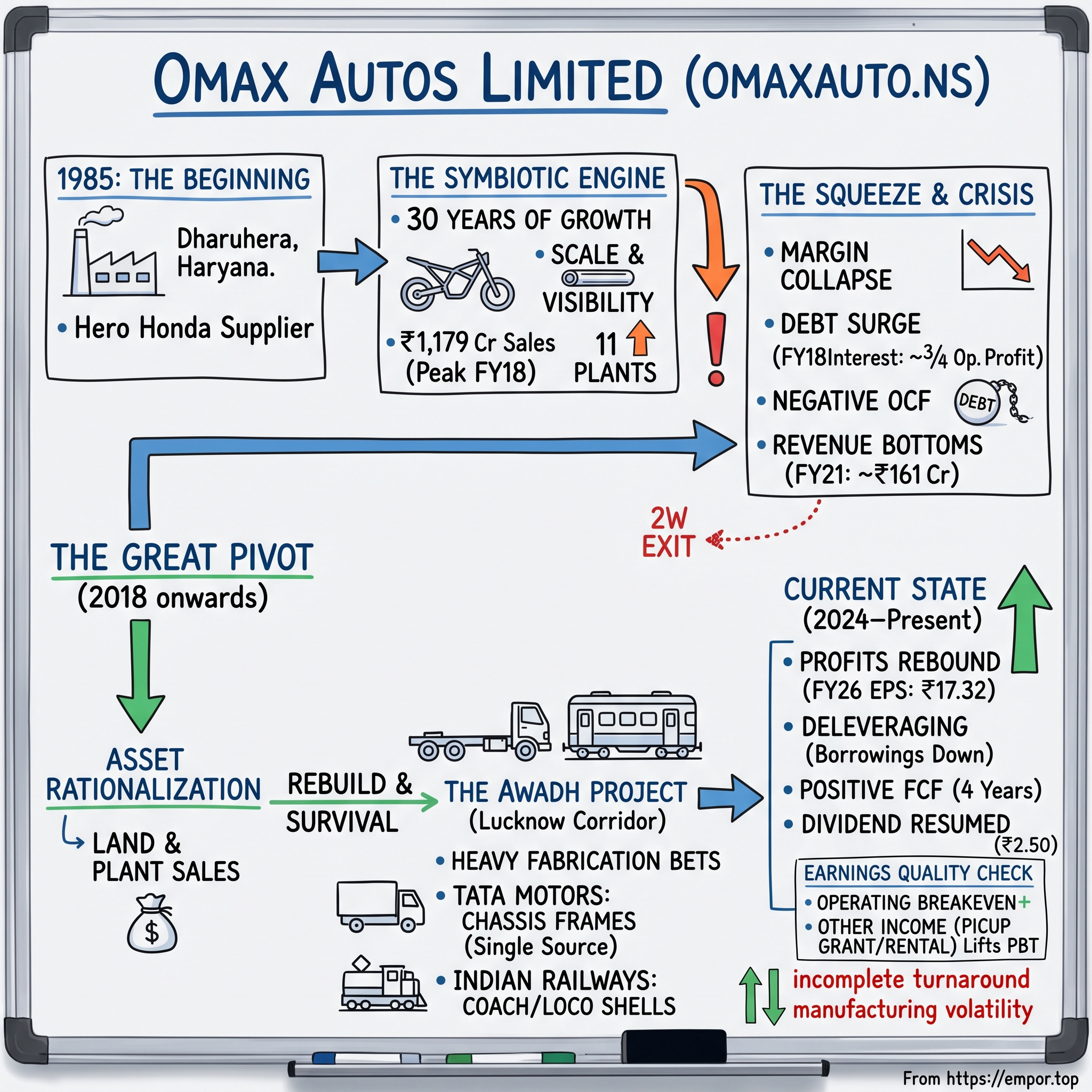
Omax Autos Limited: The Anatomy of a Small-Cap Pivot
I. Introduction & Episode Roadmap
There is a particular kind of Indian industrial company that almost nobody writes about, and Omax Autos is the archetype. It has no consumer brand. It has never held an earnings call that shows up in a transcript database. It employs, on its own books, 153 permanent people.1 Its entire market value — roughly ₹419 crore at a share price of about ₹196 in late July 2026 — would not cover a single quarter's marketing budget at the company that made it.2 And yet its history is one of the more instructive case studies available to anyone who wants to understand what actually happens to a supplier when the customer it was built to serve decides it no longer needs quite so much of what the supplier makes.
Start with the physical fact. In 1985, a group of engineers put up a workshop on three acres of land in Dharuhera, a dusty industrial town in Haryana about 70 kilometres southwest of Delhi.3 They chose the location for one reason: Hero Honda's motorcycle plant was next door. The business model was not complicated. Steel arrives. It gets bent, stamped, welded into the tubular frame of a motorcycle. A truck carries it a few hundred metres to the customer's assembly line. Repeat, for thirty years, at scale.
For a long stretch that model worked spectacularly. Omax rode the Splendor. At its peak in the financial year ending March 2018, the company put through ₹1,179 crore of sales across eleven plants stretched from Uttarakhand to Bengaluru.1 Then, in the space of about four years, it shrank to a quarter of that size — revenue bottomed at roughly ₹161 crore in FY2021 — closed or sold most of those plants, exited the two-wheeler component business entirely, and rebuilt itself around two customers it barely served before: Tata Motors' commercial vehicle plant at Lucknow, and Indian Railways.14
The shares trade on both Indian exchanges — as OMAXAUTO on the National Stock Exchange and under scrip code 520021 on BSE — and the register is unusual for a company this size.215 Roughly 16,000 shareholders hold it, institutional ownership is effectively nil at well under half a percent between foreign and domestic institutions combined, and the promoter family holds a shade under 55%.1 In practice that means there is no institutional analyst covering the name, no research note to argue with, and no large holder pressing management on disclosure. The stock is priced by retail flows against statutory filings. For anyone doing genuine primary work, that combination is either an opportunity or a warning, depending on how much weight one places on the absence of a second opinion.
That is the story. It is not a story about a clever entrepreneur spotting a trend. It is a story about a company that spent a decade discovering that its business had no economic floor, and then performed a controlled demolition of itself in order to survive. The interesting question for an investor in 2026 is not whether the demolition worked — the company is profitable and its debt has fallen sharply — but whether what got rebuilt on the site is a genuinely better business, or simply a smaller version of the same one with better real estate.
The core paradox. For most of its life, Omax's revenue rose and fell with a single customer's motorcycle production schedule. That gave it visibility and gave it nothing else. A tier-1 sheet-metal supplier co-located with one dominant original equipment manufacturer has all the operating leverage of a factory and none of the pricing power of a brand. Every year the customer asks for a price reduction; every year the supplier funds new tooling; the ratchet only turns one way. Omax lived inside that ratchet for roughly twenty-five years, and its financial statements show what that does over a full cycle: revenue of over ₹1,000 crore producing operating margins in the 3–5% range and, in several years, no net profit at all.1
Where this goes. Five threads run through what follows. First, the economics of being a captive component maker, and why scale in that position is a trap rather than a moat. Second, the slow-motion crisis of the 2010s, when volume grew but returns did not, and debt did. Third, the capital realignment — the sale of land and plants that funded the company's survival, and which continues to flatter its earnings today. Fourth, the pivot into heavy fabrication for trucks and trains, including exactly what Omax has been approved to make and what it has not. And fifth, the uncomfortable arithmetic of the present: a company whose reported profits still lean heavily on income that has nothing to do with manufacturing.
A word on why this company is worth the attention despite its size. India has several hundred listed auto ancillaries, most of them structurally similar to what Omax was in 2015: mid-sized, customer-concentrated, low-margin, and quietly financed by banks against factory assets. A great many of them are currently repositioning toward railways, defence and infrastructure fabrication, and are being re-rated by the market for doing so. Omax is several years ahead of that cohort. It has already made the pivot, already sold the legacy assets, already published five years of post-restructuring accounts. Whatever its own investment merits, it functions as a natural experiment: this is what the transition actually looks like in the financial statements, including the parts that promotional narratives leave out.
That last point deserves flagging up front, because it colours everything. In the June 2026 quarter, Omax earned ₹7.98 crore of other income against a profit before tax of about ₹13.7 crore — roughly 58% of pre-tax profit from non-operating sources.5 A year earlier the figure was worse than 100%, meaning the manufacturing business by itself did not cover its own interest and depreciation.5 The turnaround is real, and it is also incomplete. Holding both of those ideas at once is the whole job here.
 Subscribe on LinkedIn
II. The Hero Honda Crucible: Founding & Two-Wheeler Monoculture (1983–2010)
Picture the Delhi–Jaipur highway in the mid-1980s. Dharuhera was farmland with a factory dropped into it. Hero Honda Motors — the joint venture between the Munjal family's bicycle empire and Honda Motor Company — had just begun building what would become the best-selling motorcycle platform in the world. Around it, in the manner of every industrial cluster in history, a ring of suppliers materialised: pressing shops, plating lines, welding sheds, tool rooms.
Omax Autos was incorporated on 28 April 1983 by a group of six friends, with the encouragement of Raman Kant Munjal, then a leading figure in the Hero group.36 Among the founders was Jatender Kumar Mehta, born in April 1949, a Bachelor of Engineering by training who would still be running the company forty years later.7 Commercial production began in 1985 at the first Dharuhera unit, supplying sheet metal and tubular welded components to Hero.6 The following year — remarkably early for a company of that size — Omax went public, listing with more than 7,500 shareholders.3
That 1986 listing tells you something about the founders' temperament. Most Indian ancillary firms of that vintage stayed private for decades. Omax raised public equity in its third year of production. It was a company that intended to grow by adding plants, and it wanted access to capital to do it.
The symbiotic engine
What Omax built over the next twenty years was competence in a narrow, physically demanding craft: taking flat and tubular steel and turning it into structural assemblies. Tube processing. High- and low-tonnage stamping. Robotic welding. Surface treatment — electro-deposition, powder coating, autophoretic, electroplating. Machining. In-house tool rooms.3 None of this is glamorous. All of it is capital-hungry and exacting: a motorcycle frame is a safety-critical part, and a weld that fails in the field is a recall.
The plant map grew accordingly, and the timeline reads like a company that could not stop building. A second unit, Automax, in Gurgaon in 1988. A third, Speedomax, at Sidhrawali in 1999 — this one to serve Honda Siel Cars and New Holland Tractors, an early attempt to diversify the customer list. A fourth at Manesar in 2002 with a ₹200 million outlay. A fifth in Dharuhera in 2003. A sixth at Bengaluru in 2004 for machining and sheet metal. A seventh, Indital, at Dharuhera. An eighth at Binola in 2005 aimed at export clients. A ninth at Lucknow in 2008 to make chassis for Tata Motors' commercial vehicles. A tenth at Bawal in 2010, making home furnishing products — the company had tied up with IKEA in 2009 for metal housewares. An eleventh at Pantnagar in Uttarakhand in 2012 to serve Ashok Leyland, plus a 2.5 MW wind power project in Jaisalmer.3
Eleven plants. Four states. Motorcycle frames, car body parts, tractor axles, truck chassis, and IKEA furniture. It is worth pausing on how strange that portfolio is. Read charitably, it was diversification — a management team that understood its Hero exposure and kept trying to reduce it. Read less charitably, it was a company that added capacity wherever a customer would sign something, without a clear view of whether any given line would earn its cost of capital.
Two of those tie-ups deserve a moment, because they reveal the company's instinct. The 1999 Speedomax plant at Sidhrawali was built to serve Honda Siel Cars and New Holland Tractors — passenger vehicles and agricultural equipment, deliberately chosen because their demand cycles do not correlate with motorcycles.3 The 2009 IKEA arrangement for metal housewares was stranger still: a motorcycle-frame maker producing furniture for a Swedish retailer, on the theory that a press is a press and a weld is a weld. Both were rational hedges against Hero dependence. Neither achieved the scale needed to matter, and both were eventually unwound. The instinct was right; the execution never reached escape velocity.
The company also invested steadily in process capability during these years rather than merely in floor space. It brought in an ABB paint shop at Speedomax in 2000, rolled out SAP across eight plants by 2006, obtained ISO/TS-16949 certification in 2003, and established an in-house research centre, Innovomax, in 2015.3 These are the marks of a supplier trying to move up the quality ladder — and they matter, because they are precisely the capabilities that made the later pivot into railway fabrication technically feasible. A shop that cannot document its welding processes cannot be approved by a railway regulator. Omax spent two decades unknowingly building the credential that would save it.
The hidden trap
The financial evidence supports the less charitable reading. Even in its largest years, Omax's returns were thin. Sales of ₹1,027 crore in FY2016 produced an operating margin of about 5%; FY2017 sales of ₹1,042 crore produced 3.2%; FY2018's peak ₹1,179 crore produced 3.6%.1 Return on capital employed sat in the single digits throughout. This is the tier-1 vendor's structural condition, and it is worth explaining in plain terms, because it is the single most important thing to understand about the first half of Omax's life.
An OEM like Hero buys the same part, in the same specification, from a supplier it helped set up. Each year it negotiates a price reduction — in the industry's polite phrasing, an annual productivity discount — on the theory that the supplier should be getting more efficient. Sometimes the supplier is. Often it is not, and the reduction simply comes out of margin. Meanwhile the supplier funds the dies, the fixtures, the dedicated presses. Those assets are model-specific: when the motorcycle platform changes, the tooling is scrap.
So the supplier carries the capital risk of a product cycle it does not control, absorbs an annual price decline it cannot refuse, and has no alternative buyer because the part fits exactly one machine. Scale does not fix this. Scale makes it worse, because a larger captive supplier has more fixed cost to absorb when the customer's volumes dip. The only real defence is either proprietary technology or genuine customer diversification — and Omax's diversification attempts, spread across eleven plants and half a dozen unrelated end markets, delivered breadth without depth in any of them.
Omax never disclosed the exact share of revenue coming from Hero MotoCorp. But the company's own risk disclosures have been consistent for years: "The Company's customer base is not very broad. The Company's major turnover comes from very few customers."4 That sentence, repeated across annual reports through 2025, is the honest summary of the first three decades.
There is a simple way to see how thin the position was. In FY2012, Omax turned over ₹1,287 crore — the largest revenue year in its history — and earned ₹28 crore of net profit, for a net margin of roughly 2%.14 In FY2013, on ₹1,099 crore, it earned ₹14 crore. In FY2014 it lost ₹10 crore on ₹985 crore of sales.14 A swing of a few percentage points in steel prices or a few weeks of soft motorcycle offtake was enough to move the company from profit to loss. There was no buffer anywhere in the structure — not in the margin, not in the customer mix, not in the balance sheet.
What kept the machine running was volume growth. As long as Hero's production expanded, Omax's revenue expanded, and revenue growth papered over the return problem. When that growth stopped — and when the Hero–Honda partnership itself came apart at the turn of the 2010s, opening the supply base to renewed competition — the paper tore.
III. The Squeeze & The Crisis: Labor Unrest, Margin Collapse, and Asset Rationalization (2011–2018)
The Gurgaon–Manesar–Dharuhera industrial belt in the early 2010s was one of the most economically productive and socially combustible stretches of land in India. Thousands of contract workers, many migrants, moved between plants that ran three shifts. Wage disputes at large OEMs periodically shut down entire supply chains for days at a time. It was a region where a single labour dispute at an assembly plant could idle fifty supplier sheds simultaneously.
It should be said plainly that Omax's own public filings do not document a company-specific strike or lockout at Dharuhera or Binola in this period, and no such event surfaced in the sources reviewed for this piece. What the filings do document is something less dramatic and more corrosive: a decade in which the company got bigger and did not get better.
The tripping point
The structural shock came from the customer's boardroom rather than the shop floor. When Honda and the Munjal family unwound their motorcycle joint venture at the turn of the 2010s, the newly independent Hero MotoCorp had to build engineering and sourcing capabilities it had previously drawn from its Japanese partner — and it did so while facing, for the first time, a Honda that competed against it directly in India. A newly independent OEM under margin pressure does two things to its vendor base: it broadens it, and it leans on it.
For a supplier like Omax, whose entire founding logic was privileged proximity to a single customer, this was the moment the ground shifted. Privileged access is only valuable while it is exclusive. As the entry-level motorcycle segment's growth also slowed through the mid-2010s, the volume that had always covered Omax's structural weakness stopped arriving on schedule.
The company's response — visible in the numbers rather than in any announcement — was to defend share by absorbing price. That is a rational short-term choice for a plant with high fixed costs, and a fatal long-term one. It is the mechanism that turns a low-margin business into a no-margin business.
The arithmetic of a slow crisis
Follow the numbers as a sequence rather than a table. Revenue climbed from about ₹1,027 crore in FY2016 to ₹1,179 crore in FY2018 — a respectable growth rate for a components business. Over the same stretch, operating profit fell from ₹53 crore to ₹42 crore, and the operating margin compressed from 5% to 3.6%.1 The company was buying revenue at declining incremental profitability, which is the classic signature of a supplier absorbing price-downs to hold volume.
Meanwhile the balance sheet was loading up. Borrowings rose from ₹98 crore at March 2016 to ₹156 crore a year later, then to ₹211 crore by March 2019 and ₹231 crore by March 2020.1 Interest expense more than doubled across the same window, from ₹14 crore in FY2016 to ₹31 crore in FY2018.1 By FY2018, interest alone consumed roughly three-quarters of operating profit. That is the point at which a manufacturing business stops being a business and starts being a mechanism for servicing debt.
Cash flow told the same story more brutally. FY2017 and FY2019 both produced negative operating cash flow — minus ₹21 crore and minus ₹87 crore respectively — as working capital swelled.1 Debtor days stretched to 48; inventory days climbed toward 39.1 A company with 3% margins cannot fund that kind of working capital absorption out of earnings. It funds it out of the bank, and the bank charges for the privilege.
There is a useful way to think about what was happening. A components business has three sources of cash: the margin on each part, the speed at which customers pay, and the speed at which it must pay suppliers. Omax's margin was being negotiated away by customers. Its receivables were lengthening. And it was funding an ever-larger inventory of model-specific parts that could become worthless if a platform was discontinued — a risk the company's own auditors would later formalise as a key audit matter.4 Every one of the three levers was moving the wrong way at once, and the bank facility was the shock absorber. That is how a company with a billion rupees of monthly revenue ends up unable to fund itself.
The pivot to the balance sheet
By 2019, the board had run out of room to hope. On 20 May 2019, it approved the closure and sale of assets of two units: the Speedomax plant at Sidhrawali and the Sprocket unit at Dharuhera.8 On 11 November 2019, it approved consolidating the Pantnagar plant in Uttarakhand into the Lucknow unit.8 These were the first irreversible acts of the restructuring — not a strategic repositioning announced at an investor day, but a secretarial-audit footnote recording that a board had decided to shut down factories.
The effect on the income statement was immediate and violent. Total revenue fell from ₹1,004.43 crore in FY2019 to ₹488.33 crore in FY2020 — cut in half in a single year, which management attributed directly to "closure of Company's two 2W plants and declining automotive demand across the country."8 Profit before tax, however, rose to ₹46.52 crore from ₹5.15 crore.8 That inversion — collapsing revenue, rising profit — is the tell. The profit was not coming from operations. It was coming from disposals and from the elimination of loss-making capacity.
Then COVID-19 arrived. The two new Uttar Pradesh manufacturing units that were meant to be commissioned in the first quarter of FY2021 could not become operational.8 Plants shut in April 2020 and partially in May, resuming at reduced capacity at the end of May.9 Worse for the railway ambitions, Indian Railways suspended passenger train operations for most of the year, freezing the very demand Omax had been building toward.9
Facing that, the board did the only thing available. It closed the Bengaluru and Bawal units after "assessing the viability of its products," and approved disposal of all assets of those units except the land and building at Bawal.9 The Bengaluru land and building were sold, producing a gain of ₹45.29 crore booked as an exceptional item, alongside a ₹2.51 crore write-back of excess provisions for closed-plant vendors.9 Revenue for FY2021 came in at ₹183.53 crore.10 The operating loss was ₹42 crore.1
That is what a company looks like at the bottom. Eleven plants had become a handful. Revenue had fallen by 85% from its peak. The operating business was deeply loss-making, and the only thing standing between Omax and insolvency was the accumulated value of industrial land bought decades earlier, when Gurgaon was farmland.
The strategic conclusion management drew — stated flatly in the FY2022 annual report, that the "company has already exited from two-wheelers business"10 — was correct but arrived at late. A skeptical reader is entitled to ask why it took until 2019 to act on economics that were visible in the margin trend by 2016. That delay cost years of compounding, and it is the single most consequential capital-allocation failure in the company's history. What came next was the attempt to buy those years back.
IV. The Great Pivot: Heavy Fabrication, Commercial Vehicles, and Indian Railways (2018–2023)
The geography of the rebuild says most of what matters. Omax did not reinvent itself in Haryana. It moved 500 kilometres east, to a stretch of the Lucknow–Raebareli highway in Uttar Pradesh, and built two new plants on greenfield sites in villages most investors have never heard of — Malhipur at the 48th kilometre stone, and Kandawan at the 54th.4 The project had an internal name: Awadh, after the historic region around Lucknow.
The logic was straightforward once you see the map. Tata Motors runs a large commercial vehicle plant at Lucknow, and Omax already had a facility inside the Tata Motors Vendor Park at Chinhat, established back in 2008 to make chassis frames.34 Roughly 80 kilometres down the same road sits the Modern Coach Factory at Raebareli, one of Indian Railways' newer passenger-coach production units. One highway, two anchor customers, both of them making very large steel structures. For a company whose actual competence was bending and welding heavy steel to tight tolerances, that road was the most valuable asset it could find.
Two plants, two bets
The Long Member Plant began commercial production on 13 January 2021, supplying BS-VI truck models to Tata Motors Lucknow.911 A "long member" is the spine of a truck — the two enormous C-section steel rails that run the length of a chassis, to which everything else bolts. Making them requires very heavy presses and precise hole patterns over lengths of eight to twelve metres; get the geometry wrong and the axles do not line up. It is a part with a natural logistics moat, because shipping raw chassis rails long distances is expensive and awkward. A plant next to the customer's gate has a structural cost advantage over one 500 kilometres away.
Crucially, Omax describes itself in its statutory filings as "a single source for Chassis Frame Assemblies for Tata Motors in Lucknow," specialising in the integrated chassis and frame for Tata's heavy truck range.4 Single-source status is genuinely valuable — it means the customer has not dual-sourced the part, so switching requires re-validating an entire structural assembly. It is also, of course, the same customer-concentration structure that nearly destroyed the company the first time. The identity of the monopsonist changed; the shape of the relationship did not.
The second bet was railways, and here the record needs care, because the popular version of the Omax story overstates it.
Omax became an approved supplier to Indian Railways in 2013, and in June 2018 the board approved doubling railway manufacturing capacity over two to three years.11 The New Railway Plant at Raebareli was commissioned during 2022.11 What it was approved to make, per the company's own disclosure, was specific and limited: coach side wall and roof assemblies, and electric locomotive shells.9 Loco shells were to be built at both Raebareli and the Binola unit.9
The prototype record is documented and real. The first WAP-7 locomotive shell prototype was developed and dispatched to the Diesel-Loco Modernisation Works in October 2020. A WAG-9HC prototype followed to Chittaranjan Locomotive Works in June 2021. A water closet unit was developed and installed in locomotives at BHEL. Omax received RDSO approval for all types of LHB coach dampers, and developed prototype bolsters, headstocks and tailstocks for Alstom's regional rapid transit and AGKNP programmes.9
Note what is not on that list. There is no disclosed Vande Bharat trainset contract. The FY2025 annual report mentions Vande Bharat only as an industry tailwind — "the demand for Vande Bharat trains for improving passenger safety and comfort will go a long way in improving the passenger riding experience" — not as an Omax order.4 Anyone underwriting this company on a Vande Bharat thesis is underwriting something the company has not claimed.
The regulatory moat, honestly assessed
The one genuinely defensible asset the railway business created is qualification. Supplying structural parts to Indian Railways requires approval from the Research Designs and Standards Organisation — RDSO — which validates the product, the process, and the plant. Think of it less as a certificate and more as an apprenticeship: prototypes get built, tested, rejected, rebuilt, and eventually a source is added to an approved vendor list. The cycle runs for years. A competitor cannot simply decide to enter next quarter.
That is a real barrier. It is also a narrow one. Approval is product-specific and does not confer pricing power — which the company learned the hard way. The FY2025 annual report notes that the "Railway business was impacted due to the increase in the raw material prices and the fixed price nature of railway contracts with the production units."4 Read that carefully: Omax swapped a private buyer that squeezed prices annually for a public buyer that fixes prices contractually and leaves the supplier holding steel-price risk. That is not obviously an upgrade in bargaining position. It is a different failure mode.
How the Awadh plants were paid for
The financing structure of the Uttar Pradesh expansion is worth unpacking, because it explains a large part of the "other income" that dominates the company's profit today, and because it shows a management team stitching together capital from several directions at once when conventional bank debt was scarce.
Three sources funded and support the Lucknow-corridor operation. First, the Uttar Pradesh state industrial promotion agency, PICUP, extended an interest-free loan. Under Indian accounting standards an interest-free government loan must be fair-valued, with the difference between the cash received and that fair value recognised as a government grant and released to the profit and loss account over the life of the grant.9 In plain terms: a subsidy the state gave in cash arrives in the income statement as income, spread over years. It is real economic value, but it is not a manufacturing margin.
Second, the company hedged. It entered fully hedged fixed-rate currency transactions with IndusInd Bank tied specifically to the Long Member project, with outstanding exposure of ₹40.60 crore as of March 2021.9 For a company of this size to run a currency-hedged foreign-currency facility for equipment financing shows a treasury function with more sophistication than the market typically credits small caps with — and, equally, a company reaching for cheaper capital wherever it could find it.
Third, and most consequential, the Tata Motors relationship carries an embedded lease. The company reassessed its arrangement with Tata Motors and concluded it was reasonably certain the lease would be extended on existing terms for a further fifteen years, adjusting retained earnings by ₹24.17 crore in consequence under Ind AS 116.9 Set the accounting aside and look at what it implies commercially: Omax is not merely a vendor to Tata Motors' Lucknow plant, it operates inside a leasehold arrangement with an expected fifteen-year horizon. That is a deeper and more durable relationship than a purchase order — and it is also a fifteen-year concentration of fate in one customer's plant.
Funding it with land
None of this was financed with new equity. Across the entire restructuring, the share count never moved — paid-up capital sat at ₹21.39 crore, or 2,13,88,213 shares, throughout.48 Promoters did not dilute minority holders to fund the pivot, which is a genuine mark in management's favour and unusual among distressed Indian small caps.
Instead, the capital came from the ground. The Bengaluru sale funded the FY2021 hole. Bawal and Binola were retained but repurposed. And in FY2025 the company sold a non-core land asset at Sidhrawali for ₹19.36 crore, using the proceeds to reduce finance cost and improve liquidity.4 Borrowings, which had peaked around ₹231 crore in March 2020, fell to ₹143 crore by March 2022, ₹118 crore by March 2024, ₹77 crore by March 2025 and ₹53 crore by March 2026.1 Interest expense fell from ₹28 crore in FY2022 to ₹16 crore in FY2026.1
Deleveraging of that magnitude, funded entirely by asset sales rather than dilution, is the clearest evidence the company has of capital-allocation discipline. It is also, by construction, a one-time resource. Land can only be sold once. The question that dominates the rest of this analysis is whether the operating business built with that money can stand up without further sales.
V. Current State & Segment Economics: Automotive vs. Railway Fabrication (2024–Present)
Here is the headline version of the last two years, and it is a good one. Revenue from operations rose from ₹355 crore in FY2024 to ₹369 crore in FY2025 to ₹484.5 crore in FY2026 — a 31.2% jump in the most recent year.412 Net profit went from ₹11.6 crore to ₹21.5 crore to ₹37.04 crore, with earnings per share climbing from ₹5.45 to ₹10.07 to ₹17.32.112 The board declared an interim dividend of ₹2.50 per share with a record date of 8 May 2026.12 Reported return on capital employed reached 17% in FY2026, against 2% three years earlier.1 The stock, which traded as low as ₹84.50 in the preceding twelve months, changed hands around ₹196 in late July 2026.2
Now here is the version an investor actually needs.
Where the profit comes from
Omax reports as a single segment. The FY2025 annual report states it plainly: "The Company operates in a single segment of metal sheet components and parts."4 There is no disclosed revenue split between commercial vehicles and railways, no segment margin, no order book number. Any percentage breakdown you encounter for this company between CV and railway revenue is an estimate, not a disclosure. That absence is itself material: it means outside investors cannot verify which of the two bets is actually working.
What is disclosable, and disclosed, is the composition of profit — and it is uncomfortable.
Take FY2025. Total income was ₹393.69 crore against ₹372.94 crore the prior year.4 But profit before tax and exceptional items was ₹17.26 crore, and the exceptional item — the Sidhrawali land gain — was ₹18.06 crore.4 More than half of pre-tax profit came from selling land. Go back a year and it is starker: FY2024 profit before tax and exceptional items was ₹0.48 crore, against an exceptional gain of ₹22.50 crore.4 Strip out the disposal and FY2024 was, at the pre-tax line, a company that broke exactly even.
FY2026 was cleaner in that specific respect — exceptional items were a small charge of ₹2.02 crore, not a gain.12 But a second layer of the same issue remains. Total income of ₹519.99 crore against revenue from operations of ₹484.50 crore implies about ₹35.5 crore of other income, against profit before tax of ₹49.46 crore.12 Roughly seven-tenths of pre-tax profit came from something other than making parts.
The quarterly data makes the mechanism visible. In the December 2025 quarter, other income of ₹9.74 crore accounted for 61.4% of profit before tax.13 In the June 2026 quarter, other income of ₹7.98 crore was 58.2% of pre-tax profit — and in the comparable quarter a year earlier, other income of ₹10.78 crore represented 127.6% of pre-tax profit, meaning the operating business lost money before it was rescued by non-operating items.5
What is that other income? Partly interest on a growing investment balance, which rose from nil to ₹41 crore in FY2025 and ₹66 crore in FY2026.1 Partly government grant amortisation from an interest-free PICUP loan tied to the Uttar Pradesh investment.9 And partly rent: the company let out its Bawal and Binola properties, now classified as investment properties, and disclosed rental revenue of ₹8 crore on an annualised basis from previously vacant built-up sheds in the national capital region.4
So a fair characterisation of Omax in 2026 is this: a mid-sized fabrication operation that has finally reached operational breakeven-plus, attached to a property and treasury portfolio that generates roughly as much pre-tax income as the factories do. That is not fraud and it is not even bad — the rental income is recurring and the land was paid for long ago. But it means the reported earnings multiple is measuring two very different businesses stapled together, and the manufacturing half is far smaller than the headline suggests.
The margin question
Management's own framing deserves scrutiny. The FY2025 annual report reported "an increase in EBIDTA margin from operations to 14.39 % in 2024-25 as compared to 11.55 % in the previous year."4 Independent computation from the reported profit and loss account gives an operating margin nearer 9% for FY2025 and 7% for FY2024.1 The same report's key-ratios table lists "Operating Profit Margin (%)" at 22.87%.4 Three different numbers for the same underlying concept, in the same document, without a reconciliation.
This is not necessarily an accounting problem — companies define EBITDA differently, and the higher figures likely include other income or exclude certain costs. It is a disclosure problem. When a small-cap company reports a margin substantially above what its own income statement supports and does not define the bridge, the burden of proof shifts. Investors should anchor on the reported operating profit line, not on the narrative margin.
That said, the operating trend is genuinely improving and the improvement is visible in the raw numbers. Quarterly operating margin ran at 6–9% through FY2024 and most of FY2025, then stepped up to about 12% in the December 2025 and March 2026 quarters and 11.05% in June 2026.15 The March 2026 quarter — revenue of ₹174.41 crore, more than 52% above the prior year — was the largest in the company's post-restructuring history.12 Operating leverage at the Lucknow plants is real: fixed costs were sized for a bigger business, so incremental volume drops through at high margin.
The counterpoint is volatility. Quarterly revenue over the last two years has swung between roughly ₹79 crore and ₹174 crore.113 A supplier whose top line can more than double between quarters has very little visibility, which is what you would expect from a business dependent on OEM production schedules and railway production-unit release orders rather than a contracted order book. The June 2026 quarter's 30% sequential decline from the March peak is the normal shape of this business, not a warning sign — but it does mean single-quarter results are close to meaningless as a trend indicator.
What the balance sheet is telling you
There is a quieter story in the asset side of the balance sheet that most commentary misses.
Gross fixed assets have been shrinking, not growing. They stood at ₹324 crore in March 2022, then ₹313 crore, ₹291 crore, ₹271 crore, and ₹258 crore by March 2026, with capital work in progress at essentially nil throughout.1 Meanwhile investments — financial assets, not plant — went from zero to ₹41 crore to ₹66 crore over the last two years.1 Total assets have been broadly flat at around ₹500 crore for four years.1
Read that sequence carefully and it says something specific: the recent revenue surge was achieved by filling existing capacity, not by adding it. Depreciation has been running ahead of new capital expenditure, and the surplus cash has gone into financial investments and debt reduction rather than into new presses. That is exactly what a company should do when it has under-utilised plants — and it is the mechanical explanation for both the margin expansion and the strong free cash flow.
It also sets a limit. Operating leverage from filling a plant is finite. At some point the Long Member and Railway plants run out of headroom, and further growth requires capital expenditure that has not yet appeared in the accounts. When it does, free cash flow will compress and the return metrics will be tested on a fresh capital base rather than a depreciated one. Investors extrapolating current cash generation should discount for that turn in the cycle.
Myth versus reality
Four consensus claims circulate about this company. Each is worth testing against the filings.
Myth: Omax is a Vande Bharat supplier. Reality: the disclosed railway approvals cover coach side wall and roof assemblies, electric locomotive shells, and LHB coach dampers, with prototypes delivered for WAP-7, WAG-9HC and Alstom regional transit components.9 Vande Bharat appears in the company's own annual report as a description of industry demand, not as a customer relationship.4 The distinction matters: coach shells and loco shells are conventional fabrication packages, while trainset programmes are integrated builds dominated by much larger players.
Myth: the railway business is now a major revenue segment. Reality: nobody outside the company knows. Omax reports a single segment and has published no railway revenue figure.4 As of the FY2025 report, the New Railway Plant was executing trial orders.4 The capability is documented; the volume is not.
Myth: the turnaround is a margin story. Reality: it is substantially a balance-sheet and cost story. Debt reduction cut interest expense by more than ₹12 crore a year, closed plants removed fixed overhead, and land sales and rent added income.14 Operating margin has improved — from negative in FY2021 and FY2022 to roughly 10% in FY2026 — but from a base so low that recovering to a normal contract-fabricator margin was the achievement, not exceeding one.1
Myth: promoters hold 60–65% and are tightly aligned. Reality: the promoter group held 54.63% as of June 2026, and the stake had drifted down from 57.88% in March 2021 to a low of 52.75% in September 2025 before recovering.1 The alignment is real — this is a family whose wealth is in the shares — but the holding is smaller and less static than commonly assumed.
The honest conclusion for an investor: the operating business has crossed from destroying cash to generating it, working capital has been managed tightly with a persistently negative cash conversion cycle, and free cash flow has been positive for four consecutive years.1 What has not yet been demonstrated is that manufacturing alone can produce the level of profit the market is currently capitalising.
VI. Management, Capital Allocation, & The Governance Stress Test
In July 2016, Omax Autos appointed a 25-year-old as Managing Director.
Devashish Mehta was born on 21 January 1991, holds a B.Sc. in marketing from Pennsylvania State University, and is the son of the founder.7 By the company's own account, his role has been to spearhead the non-two-wheeler business segment — which is to say, he was handed the pivot.4 He was reappointed for a further five-year term running to July 2026, drew remuneration of ₹76.22 lakh in FY2025, and held 5,10,000 shares directly as of 31 March 2025.4
Jatender Kumar Mehta remains Vice Chairman cum Managing Director, and in 2025 the board recommended reappointing him for five more years to 31 December 2030 — a term that would take him past his 81st birthday.4 Sakshi Kaura, his daughter, serves as Joint Managing Director.4 The promoter group held 54.63% as of June 2026, down from 57.88% in March 2021 and drifting lower for most of the intervening period before a recovery in the March 2026 quarter.1
This is, in short, a family firm with three family members in executive positions and an outside whole-time director. That structure is common in Indian small caps and is not inherently a problem. What matters is how it behaves under stress — and here the record is genuinely mixed.
What management got right
Three things, and they are not trivial.
First, no dilution. Through the deepest part of the crisis — an 85% revenue collapse and years of operating losses — the promoters did not issue equity to rescue the balance sheet. Share count is unchanged. Minority holders who sat through the drawdown own the same fraction of the recovery that they owned before it.
Second, the asset sales were used for deleveraging rather than for expansion into something new. The proceeds went to debt paydown and liquidity, not to a fashionable adjacency. In a country where distressed promoters routinely announce pivots into unrelated high-multiple sectors, staying inside the sheet-metal competence — trucks and trains instead of motorcycles — was the disciplined choice. The pivot moved into adjacent applications of the same machines, which is the lower-risk form of reinvention.
Third, the return of cash to shareholders resumed quickly and at a sensible size. Omax paid no dividend at all from FY2017 through FY2023 — seven consecutive years, which is what a company in a solvency fight ought to do. It then reinstated distributions as soon as the balance sheet permitted: a payout of roughly 18% of earnings for FY2024, about 25% for FY2025, and an interim dividend of ₹2.50 per share for FY2026 representing around 14% of a much larger profit.112 Reinstating a dividend early in a recovery, at a modest fraction of earnings, while continuing to retire debt, is a reasonable balance. It signals confidence without pre-committing cash the company may need for capacity.
Fourth, related-party dealing is small. The FY2025 disclosures list a long roster of family-influenced entities, but the transactions are modest: ₹60 lakh paid to Automax Constructions for capital assets, ₹7.85 lakh to Haridwar Estates, ₹39.98 lakh of interest paid to Omax Fusion Private Limited, ₹58.77 lakh of rent paid to Kiran Mehta.4 The board's own assessment is that there is "no materially significant related party transaction that may have potential conflict with the interest of the Company at large."4 On the evidence disclosed, that holds up. This is not a company being hollowed out through the back door.
What an activist would attack
Now the harder read.
Executive pay against results. Jatender Kumar Mehta drew ₹3.06 crore in FY2025.4 That is 127.72 times the median employee's remuneration.4 Against a pre-exceptional profit before tax of ₹17.26 crore, one executive's compensation absorbed roughly 18% of it. And the comparison that stings most: median employee remuneration fell 8.88% during FY2025, and salaries of non-managerial employees fell 16.14%, while the Managing Director's remuneration rose 7.39%.4 Management explains the aggregate percentages as artifacts of headcount mix rather than actual pay cuts — a reasonable technical point that does not fully answer the optics of the divergence. An activist would put that table on the first slide.
Combined MD and CFO. Devashish Mehta is described in the related-party disclosures as "Managing Director cum Chief Financial Officer."4 Concentrating the chief executive and chief financial officer roles in one person — a promoter — removes an internal check on financial reporting that the market normally relies on. Given the reporting inconsistencies noted earlier around margin definition, this is not an abstract concern.
Turnover in control functions. The Company Secretary resigned with effect from 6 May 2025.4 Separately, the board named new internal auditors alongside the FY2026 results.14 Neither event is individually alarming; small companies churn compliance staff. But changes in the secretarial and internal-audit functions within roughly a year warrant attention rather than dismissal.
Headcount. 153 permanent employees on the rolls as of 31 March 2025.4 For a company running four plants and turning over close to ₹500 crore, that implies heavy reliance on contract labour — normal in Indian fabrication, but it concentrates industrial-relations risk in a workforce the company does not directly employ, and it means the "permanent employee" median-pay disclosures describe a small and unrepresentative slice of the people actually building the products.
Disclosure quality overall. No earnings conference call transcripts or investor presentations for Omax could be located in the sources reviewed. There is no published order book, no segment reporting, no capacity utilisation disclosure, no capex guidance. Investors are working from statutory filings and quarterly result tables alone. That is a legitimate discount factor: it is very difficult to independently verify whether the railway business is scaling or stalling, because the company does not report it separately.
The credibility verdict
Judged on behaviour over a full cycle, management's record is that of an operator that was slow to diagnose and decisive once it did. The delay from 2016 — when margin compression was already unmistakable — to the May 2019 closure decisions represents years of value destruction that no subsequent execution can recover. Against that, the execution since 2019 has been consistent: the stated plan (exit two-wheelers, redeploy to CV and railways, sell non-core land, cut debt, avoid dilution) was announced in the FY2020 annual report and has been followed, step by step, for six years without a change of story.8 Narrative consistency across filings is one of the more reliable signals available in a company that does not hold calls, and here it is present.
What has not been demonstrated is target-setting discipline. Because management publishes no guidance, there is nothing to hold it to, and no track record of hitting or missing numbers. That cuts both ways: no broken promises, but also no evidence of forecasting competence. For a business whose next chapter depends on ramping a railway plant against tender timelines it does not control, that is a meaningful blind spot.
VII. Playbook: Business, Strategy, & Investing Lessons
Four lessons generalise from this story, and each has a testable edge.
Lesson 1: The tier-1 vendor trap
Co-location with a dominant customer is a liability disguised as an asset. The Dharuhera plant existed because Hero's plant existed. That proximity was pitched — and genuinely functioned — as a competitive advantage: just-in-time delivery, low logistics cost, deep process integration. But the same specificity that made Omax efficient made it captive. The asset had one economically viable use, so its value was set entirely by the customer's willingness to keep buying. The general principle: when evaluating a supplier, ask what the plant is worth if the anchor customer disappears. If the answer is "the land," you are looking at a real estate holding with a factory-shaped liability on top. Omax's own history proves the point twice over — the land really was worth more than the operation, which is precisely how the company survived.
There is a diagnostic that follows from this. Growth in a captive supplier's revenue is not evidence of a good business; it is evidence that the customer is growing. The metric that actually discriminates is whether operating margin holds or expands as revenue rises. Omax's did neither for a decade — margin fell as revenue rose — and that single relationship, visible from the outside years before the crisis broke, was the whole warning.
Lesson 2: The art of the industrial pivot
Pivot along the machine, not along the market. Omax did not go into electric vehicle batteries or defence electronics or any of the other sectors that would have attracted a re-rating. It took the presses, the tube benders, the robotic welders and the paint lines it already owned and pointed them at bigger steel structures — truck chassis rails and locomotive shells instead of motorcycle frames. The capability transferred; the customer did not. That is the low-risk form of reinvention, and it is why the pivot took four years rather than failing outright. The falsification test is equally clear: if a company's stated pivot requires capabilities it does not possess and cannot buy, treat the announcement as an aspiration.
Note also what the pivot required that had nothing to do with machines: years of prototype development, regulatory qualification and customer validation, running in parallel with a collapsing legacy business. The WAP-7 prototype went out in October 2020, in the middle of the worst year the company ever had.9 Pivots are usually described as decisions. They are better understood as a sustained expenditure of engineering effort during the period when a company can least afford it — which is why so few succeed.
Lesson 3: Balance sheet preservation via non-core asset sales
Legacy industrial land is a real but non-repeating option. The single most valuable thing Omax owned in 2019 was not a customer relationship or a process patent. It was land in Bengaluru and Haryana bought when those places were cheap. That option funded a corporate restructuring without diluting a single shareholder — an outcome most distressed companies cannot achieve. But an option exercised is an option gone. The Bengaluru gain, the Sidhrawali sale, the Bawal and Binola rental streams: each of these converted a stock of hidden value into a flow of reported earnings. Investors should mentally separate the two. A company whose profit is 70% non-operating is not a 15x-earnings manufacturer; it is a cheaper manufacturer wrapped in a property yield, and the multiple should reflect the mix.
The corollary is a screening idea, applied with care. Old industrial companies in cities that grew around them often carry land at historical cost that bears no relation to market value. That hidden value can fund a restructuring — but only if management is willing to sell, and only once. It is a source of survival, rarely a source of compounding.
Lesson 4: Government monopsony versus private monopsony
Trading a private monopsonist for a public one changes the risk, not the power balance. This is the lesson most specific to India's current industrial moment, when every mid-sized fabricator is repositioning toward railway and defence orders. A private OEM squeezes price annually but pays reasonably quickly and forecasts its own demand. A state buyer runs fixed-price contracts, which means the supplier eats input-cost inflation between price revisions — exactly what Omax reported happening to its railway business in FY2025.4 It also runs on tender cycles and budget allocations that no supplier can influence, and it pays on government timelines. The offsetting advantage is the qualification barrier: RDSO approval takes years, so the competitive set is smaller. Whether that trade is favourable depends entirely on whether the escalation clauses are indexed properly and whether the volume is large enough to absorb the working capital. Neither is knowable from Omax's current disclosures, which is the honest answer.
The meta-lesson connecting all four: in low-margin contract manufacturing, the durable question is never "is demand growing?" It is "who captures the growth?" Omax's revenue grew for twenty-five years and its shareholders got very little of it. The pivot is only a success if the answer to that second question has changed — and the evidence so far is suggestive rather than conclusive.
VIII. Analytical Deep-Dive: 7 Powers, 5 Forces, Bull vs. Bear Case, & Risk Radar
A. Hamilton Helmer's 7 Powers Analysis
Helmer's framework asks a specific question: what allows a company to earn returns above its cost of capital that a competitor cannot compete away? Applied strictly, Omax scores poorly, and it is worth saying so directly.
Cornered Resource — present but narrow. RDSO approvals and the qualified welding process certifications behind them are the closest thing Omax has to a true power. They took years to obtain, they are product-specific, and they cannot be bought. Approval for LHB coach dampers, coach side wall and roof assemblies, and electric locomotive shells represents accumulated regulatory capital.9 But a cornered resource only generates excess returns if it constrains supply and the holder can price against it. Fixed-price railway contracts explicitly prevent that. The resource protects volume, not margin.
Scale Economies — weak and localised. The heavy presses required for truck long members and the specialised fixtures for coach roof assemblies create a genuine minimum efficient scale, and Omax's Lucknow-corridor plants have a logistics advantage over distant competitors for bulky structural parts. That is a local cost moat, not a global one. At roughly ₹485 crore of revenue, Omax is an order of magnitude smaller than the listed rail-fabrication peers and cannot claim procurement or overhead-absorption advantages against them.
Switching Costs — low to moderate, and asymmetric. Being single-source for Tata Motors' Lucknow chassis frames does create friction: requalifying a structural assembly is expensive and slow.4 But that friction protects an incumbent position rather than enabling price increases. And it is a power Omax holds over exactly one customer at one plant.
Counter-Positioning, Network Economies, Branding, Process Power — absent. Omax is a contract fabricator. It has no business model a competitor would be reluctant to copy, no network, no brand that reaches an end customer, and no demonstrated proprietary process. Its in-house R&D centre, Innovomax, has existed since 2015 without producing a disclosed technology advantage.3
The conclusion a strict application yields: Omax has one narrow power protecting a slice of revenue, and otherwise competes on price, proximity and reliability. That is consistent with historical returns on capital in the single digits for most of the company's life, and it means the recent 17% ROCE should be treated as cyclical and mix-driven rather than structural until proven otherwise.1
B. Porter's Five Forces
Buyer power — very high, and now doubly so. Tata Motors sets terms on the CV side; Indian Railways production units set them on the rail side. Both are monopsonists in their respective transactions. Omax's own filings concede the concentration.4
Supplier power — high with a lag. Steel is the dominant input, sourced from a concentrated domestic industry. Omax's annual report describes the industry convention that OEMs "compensate their suppliers for increase in raw material prices and suppliers pass on the benefit when raw material prices decrease, keeping operating margins intact."4 The FY2025 railway commentary shows this convention breaking down where contracts are fixed-price.4 The pass-through is a norm, not a guarantee, and it operates with a lag of a quarter or more.
Threat of new entrants — moderate. Heavy presses, robotic welding cells and RDSO qualification are meaningful barriers to a startup. They are not meaningful barriers to an existing auto ancillary with idle capacity and a balance sheet, and India has many of those.
Threat of substitutes — low. Truck chassis rails and railway coach structures will be made of steel for the foreseeable future. Aluminium and composite car-body technologies exist in high-speed rail but are not displacing conventional fabrication in Indian volume programmes. This is the one force genuinely in Omax's favour.
Rivalry — high. The competitive set spans Jay Bharat Maruti in auto sheet metal and Texmaco Rail & Engineering, Jupiter Wagons, Titagarh Rail Systems and Ramkrishna Forgings in rail and forged components. The scale gap is stark: at late-July 2026 prices, Jupiter Wagons carried a market value of roughly ₹11,100 crore, Titagarh about ₹11,200 crore, Ramkrishna Forgings about ₹11,700 crore, Texmaco about ₹4,600 crore and Jay Bharat Maruti about ₹1,660 crore — against Omax's ₹419 crore.2 Omax is not competing for the same tenders as Titagarh or Jupiter, and cannot; it competes for structural sub-assemblies and component packages where its size is not disqualifying.
That size difference has a strategic consequence worth stating explicitly. India's railway modernisation programme is procured largely through very large integrated contracts — trainsets, wagon rakes, complete coaches — which require balance sheets capable of absorbing performance guarantees, advance-purchase working capital and multi-year execution risk. A company with ₹53 crore of borrowings and ₹347 crore of total equity is structurally excluded from that tier.112 Omax's addressable market is therefore the sub-assembly layer beneath the prime contractors: shells, structures, dampers, bogie components. That layer is real and growing, but it is also the layer where the prime contractors have the most leverage over price, because they can in principle bring the work in-house. Being a small fabricator in a market of large integrators is not a niche moat; it is a position that must be continually re-earned on cost and delivery.
The peer set is also a useful reminder of what a structurally better version of this business looks like. The larger rail names carry meaningfully higher market values relative to revenue because they own product platforms, prime-contractor status and multi-year order books they disclose. Omax has none of the three. The valuation gap is not a mispricing to be arbitraged; it is a description of different competitive positions.
C. Material Risk Radar
Customer concentration, restated in a new form. The pivot did not solve the problem that caused the crisis; it relocated it. If Tata Motors' Lucknow medium and heavy commercial vehicle volumes fall, the Long Member Plant's utilisation falls with them, and the operating leverage that has driven the recent margin expansion reverses just as fast. The FY2025 report already flagged that demand for heavy trucks was "fairly muted."4
Railway execution and tender risk. The New Railway Plant was described as fully commissioned and "in the process of executing trial orders" as of the FY2025 report.4 Trial orders are not production orders. Until the company discloses sustained railway revenue — which, given single-segment reporting, it currently does not — the railway thesis rests on capability rather than demonstrated throughput.
Input-cost pass-through. Already documented as having compressed railway profitability in FY2025.4 Fixed-price contracts plus volatile flat steel is a structurally adverse combination, and it is the mechanism most likely to disappoint in an inflationary quarter.
Earnings quality and the exhaustion of non-core assets. The dependence on other income and past exceptional gains is the central analytical risk. Remaining monetisable assets are finite. When the property and treasury income is fully reflected in the base and no further land remains to sell, the manufacturing business must carry the earnings alone — and on FY2026 figures, manufacturing after interest and depreciation contributed roughly ₹17 crore of pre-tax profit against a reported ₹49.5 crore.112
Working capital and the PSU payment cycle. Omax has run an unusually favourable cash conversion cycle — negative in most recent years, meaning suppliers finance the business.1 Scaling railway revenue typically stretches receivables. If the negative cycle normalises as rail mix grows, working capital will absorb cash precisely when the company wants to fund capacity.
Technology transition risk, correctly scoped. The electrification of Indian road transport is the risk most frequently attributed to auto ancillaries, and for Omax it is largely misapplied — which is worth saying because it cuts in the company's favour. A truck chassis long member is a steel structure that exists regardless of whether the powertrain burns diesel, burns compressed natural gas, or runs on batteries. Omax's own annual report treats electrification chiefly as an opportunity, noting the growth in CNG and electric buses driven by state transport demand.4 The more relevant near-term regulatory driver is mundane and specific: following a Supreme Court mandate, commercial vehicles sold after 1 April 2025 require air-conditioned driver cabins, prompting OEMs to redesign platforms — which the company identified as an opening to introduce new products on existing infrastructure with incremental investment.4 That is the correct shape of technology risk for this business: not obsolescence, but the need to keep pace with customers' platform changes and fund the tooling each time.
Cost of capital and refinancing. This risk has genuinely diminished. Net borrowings of ₹53 crore against total equity of roughly ₹347 crore at March 2026, with cash of ₹28 crore, leaves a debt-to-equity ratio well below any covenant threshold that would concern a lender.112 The debt-equity ratio disclosed for FY2025 was 0.29, down from 0.42, and interest coverage improved to 2.74 times from 2.1.4 For a company that spent FY2018 paying three-quarters of operating profit to banks, this is the most durable improvement in the entire story.
Key-person concentration. Executive authority sits with two members of one family, one of whom also holds the CFO role and one of whom is 77 and proposed for a term to 2030.4 There is no disclosed succession framework beyond the family. For a company whose competitive position rests substantially on customer relationships and regulatory qualifications built over decades, that is a genuine, unhedged risk.
Auditor and inventory judgement. The statutory auditors identified inventory as a key audit matter for FY2025, citing large quantities held at multiple plants, customer-specific products, and the risk of slow-moving or damaged stock from model discontinuation.4 That is a reasonable flag for this business model, not a red flag — but inventory provisioning is a genuine management judgement here, and one that directly affects reported margin.
D. The Investment Thesis: Bull vs. Bear
The bull case, stated at its strongest. Omax is a restructured business whose fixed cost base was sized for a much larger company and which is now filling that capacity. The evidence: revenue up 31% in FY2026 with operating margin expanding from roughly 9% to 10%, and quarterly margin reaching 12% at peak volumes.112 Borrowings have fallen by roughly three-quarters from their peak, taking annual interest cost down by over ₹12 crore since FY2022 — money that now drops to the bottom line.1 Operating cash flow of ₹67 crore in FY2026 was the strongest in a decade, and free cash flow has been positive for four straight years.1 The Lucknow corridor gives it structural proximity to two large, growing customers, and single-source status on Tata's heavy chassis frames is a defensible position. If Indian Railways' capex cycle and the commercial vehicle replacement cycle both hold, this is a company with genuine operating leverage and almost no leverage risk.
The bear case, stated at its strongest. The recovery has been substantially manufactured by the balance sheet rather than by the factories. Two of the last three years' profits depended on land sales; the most recent year's profit is roughly 70% non-operating.412 Reported ROCE of 17% is calculated on a capital base that includes investment properties earning rent, not on the manufacturing capital. Margin guidance in the annual report is not reconcilable to the income statement.4 Revenue is volatile enough to swing more than 100% between quarters, indicating no contracted visibility.1 The company has traded one dominant customer for two dominant buyers, one of which imposes fixed prices. There is no order book disclosure, no segment reporting, no earnings call, and the CFO function sits with the promoter Managing Director. And the stock has more than doubled off its twelve-month low of ₹84.50 to around ₹196, with a 200-day average of roughly ₹142 — meaning much of the operational improvement has already been priced.2
Reconciling them. Both cases are supported by the same facts, which is the honest situation. The pivot is real: the plants exist, the approvals exist, the debt is gone, and the operating business has genuinely crossed from loss to profit. What has not been established is durability. The bull case requires the March 2026 quarter to be the new baseline rather than a peak, and requires railway trial orders to convert into repeat production. The bear case requires only that volumes normalise and the non-operating income stop growing. An investor's view should turn on which of those is more likely — and, given the absence of segment and order-book disclosure, on a frank acknowledgement that the company does not currently provide enough information to answer the question from outside.
IX. Epilogue & Key KPIs to Watch
Forty-three years after six friends set up a workshop next to a motorcycle plant, Omax Autos makes almost nothing it made in 1985. The Dharuhera sprocket line is gone. Speedomax is gone. Bengaluru is sold. Pantnagar was folded into Lucknow. Manesar, Bawal and Binola have either closed or been converted into rental property. What remains is four plants strung along a highway in Uttar Pradesh and inside a vendor park at Chinhat, making steel spines for trucks and shells for locomotives.4
That is an unusually complete corporate metamorphosis for a company that never raised a rupee of new equity to fund it. The founder who started it is still Vice Chairman cum Managing Director at 77, proposed for a term running to 2030. The son who ran the pivot became Managing Director at 25. Whether one regards that as admirable continuity or as concentrated key-person and governance risk depends largely on temperament — but both readings are defensible on the evidence.
What should not be in dispute is the analytical position. Omax in 2026 is a company that has finished the demolition and is early in the construction. Its survival was purchased with land. Its recovery has been real but is not yet self-sustaining on manufacturing alone. Its competitive position rests on proximity, qualification and a single-source status with one customer — defensible, narrow, and not obviously permanent.
It is also worth naming what would falsify each side of the case, since that is more useful than a verdict.
The bull case breaks if quarterly revenue reverts toward the ₹90–110 crore range while other income stays flat, because that would demonstrate that the March 2026 quarter was order timing rather than structural capacity utilisation. It also breaks if a steel-price cycle compresses margin in the fixed-price railway work faster than the CV business can offset — a mechanism the company has already reported experiencing once.4
The bear case breaks if operating profit grows fast enough that non-operating income becomes a minority of pre-tax profit, and if the company begins disclosing railway revenue or an order book that shows repeat production rather than trials. Either development would convert an inference-based thesis into an evidence-based one, and would justify treating the manufacturing business as the primary asset rather than the smaller half of a hybrid.
Three metrics will tell an investor whether the second half of this story goes better than the first. Track them; do not compute them from a thesis.
1. Operating profit as a share of profit before tax. This is the single most revealing number for Omax, and it requires no modelling — take the operating profit line, take the reported profit before tax, and watch the ratio. Every quarter for the past two years, non-operating income has done a large share of the work, ranging from roughly 58% of pre-tax profit in the June 2026 quarter to more than 100% a year earlier.513 If the manufacturing business is genuinely compounding, this ratio should climb steadily toward the point where operations carry the profit and rent and interest are the garnish. If it plateaus, the market is capitalising a landlord.
2. Quarterly revenue run-rate against the March 2026 peak. The company's largest quarter delivered ₹174.41 crore of revenue at roughly 12% operating margin.12 The question is whether that was capacity finally being utilised or a one-off order concentration. Watch whether quarterly revenue trends toward that level as a floor or oscillates back toward the ₹80–100 crore range that characterised FY2024 and FY2025.1 Sustained volume above ₹150 crore per quarter would be the clearest possible evidence that the Lucknow plants have reached scale; repeated reversion below ₹110 crore would suggest the pivot has produced capacity without throughput.
3. Any disclosure of railway revenue or order book. Omax currently reports as a single segment and publishes no order book.4 The moment that changes — a segment note, an order announcement, an investor presentation — it becomes possible to evaluate the railway thesis directly instead of by inference. Until then, the absence itself is the datapoint: management is asking investors to believe in a business it has chosen not to quantify.
One final observation about how to read this company. Omax's story is unusually legible precisely because it has no investor-relations apparatus. There are no adjusted metrics beyond the one margin definition that does not reconcile, no forward-looking slides, no management framing to unpick. What exists is a set of statutory filings written by lawyers and accountants, in which the important facts — the plant closures, the land sales, the exceptional gains, the single-segment reporting, the remuneration table — sit in plain sight for anyone willing to open a 200-page PDF. That is more than most small caps offer, even if it is less than most investors want.
The first act of this company's history was a lesson in what happens when you build your entire enterprise around someone else's assembly line. The second act was an expensive, slow, and ultimately successful escape from it. The third act — whether trucks and trains prove to be a better master than motorcycles were — has barely started, and the company has not yet given its shareholders the disclosure they would need to score it.
References
-
Omax Autos Ltd — financials, quarterly results, balance sheet, ratios and shareholding — Screener.in ↩↩↩↩↩↩↩↩↩↩↩↩↩↩↩↩↩↩↩↩↩↩↩↩↩↩↩↩↩↩↩↩↩↩↩↩↩↩↩
-
Omax Autos Limited share price and stock details — National Stock Exchange of India (NSE) ↩↩↩↩↩
-
Omax Autos Limited Annual Report 2020-21 — company milestones, plants, process capabilities and railways division ↩↩↩↩↩↩↩↩↩
-
Omax Autos Limited Annual Report 2024-25 — Directors' Report, Management Discussion and Analysis, auditor's report, related-party and remuneration disclosures ↩↩↩↩↩↩↩↩↩↩↩↩↩↩↩↩↩↩↩↩↩↩↩↩↩↩↩↩↩↩↩↩↩↩↩↩↩↩↩↩↩↩↩↩↩↩↩↩↩↩↩↩
-
Omax Autos Q1 FY27 result analysis — MarketsMojo, 2026 ↩↩↩↩↩
-
Omax Autos Limited company profile and history — Omax Autos official website ↩↩
-
Omax Autos Limited Annual Report 2020-21 — director appointment and re-appointment disclosures under SEBI LODR Regulation 36(3) ↩↩
-
Omax Autos Limited Annual Report 2019-20 — Directors' Report and Secretarial Audit Report ↩↩↩↩↩↩↩
-
Omax Autos Limited Annual Report 2020-21 — notes to financial statements on plant closures, asset disposals, Awadh Project and railway product approvals ↩↩↩↩↩↩↩↩↩↩↩↩↩↩↩
-
Omax Autos Limited Annual Report 2021-22 — Directors' Report ↩↩
-
Omax Autos Limited — annual reports archive, Omax Autos investor relations ↩↩↩
-
Omax Autos Limited reports FY26 results with 31.21% revenue growth and ₹2.50 interim dividend — ScanX, 2026-05 ↩↩↩↩↩↩↩↩↩↩↩↩↩
-
Omax Autos Ltd consolidated financials and corporate disclosures — Screener.in ↩↩↩
-
Omax Autos Ltd stock price and corporate information, scrip code 520021 — BSE India ↩
 LinkedIn
 WhatsApp
 Reddit
 Hacker News
 Email
Email Kindle
 RSS Feed
 Spotify
 Apple Podcasts
 Amazon Music
 Audible
 YouTube