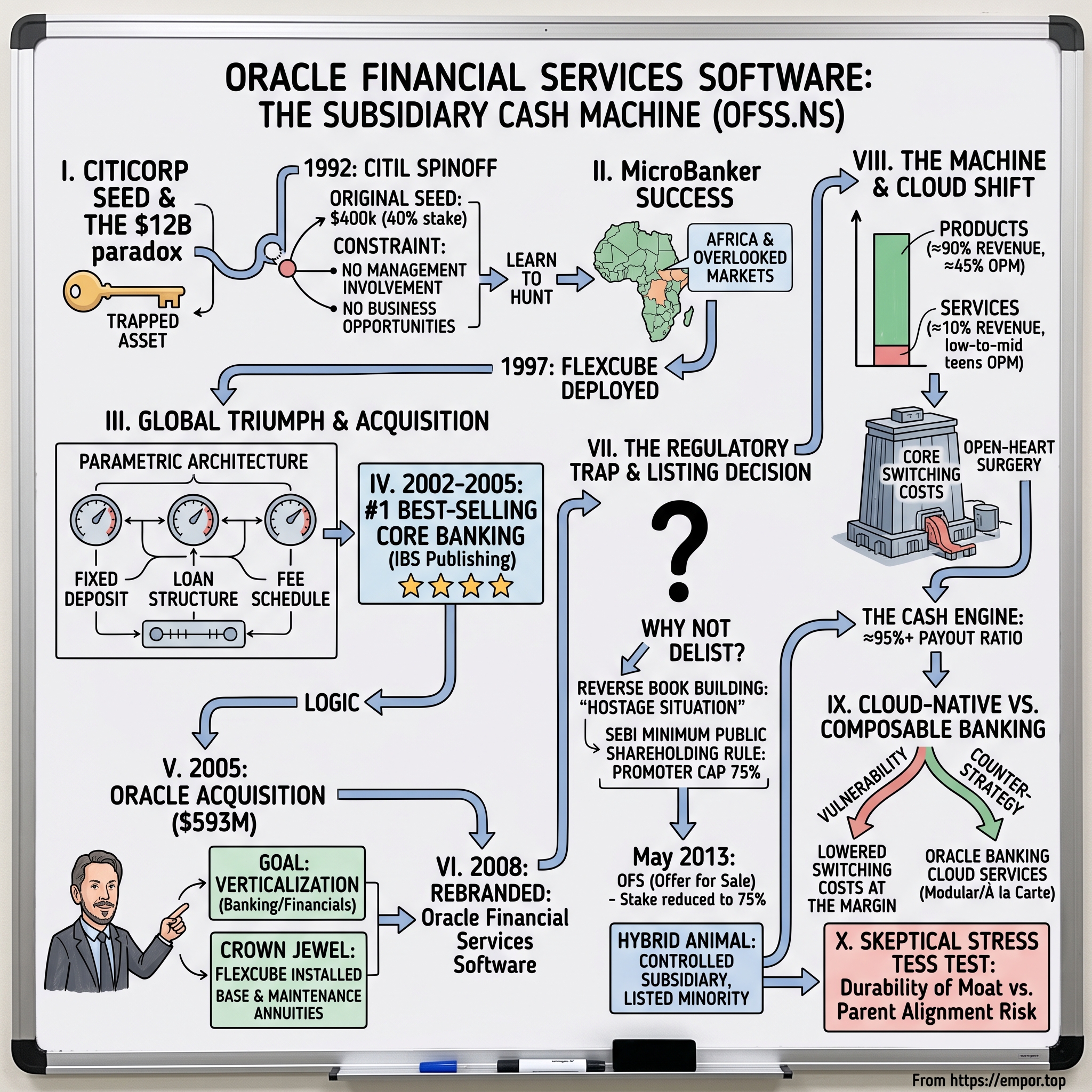
Oracle Financial Services Software: The Ultimate Subsidiary Cash Machine
I. Episode Prologue & The $12 Billion Paradox
Somewhere inside Oracle's cloud-infrastructure empire — past the databases, past the Larry Ellison quotes about crushing SAP, past the tens of billions being poured into AI data centers — there is a small, almost invisible line item that behaves unlike anything else in the company. Once or twice a year, a listed company in Mumbai wires an enormous cash dividend across the Arabian Sea into a Mauritius holding vehicle that ultimately reports up to Redwood Shores, California. The company doing the wiring is one most Americans have never heard of, and most Oracle shareholders never think about. Yet it is arguably one of the most efficient cash machines in global enterprise software, and one of the strangest corporate structures in public markets anywhere.
That company is Oracle Financial Services Software Limited, ticker OFSS on India's National Stock Exchange.6 As of mid-2026 it carried a market capitalization of roughly ₹1.01 lakh crore — a little over $12 billion — trading around ₹11,600 a share at a price-to-earnings multiple in the high thirties.1 That is a premium valuation for a business whose revenue has compounded at roughly 6% over a decade and roughly 9% over five years.1 It earns a return on capital employed north of 45% and a return on equity above 32%. Its borrowings, on a balance sheet carrying a book value of around ₹899 per share, amounted to a rounding error of about ₹32 crore.1 And it pays out nearly everything it earns.
In fiscal 2026 — the year ended March 31, 2026 — the company declared ₹400 per share in dividends against earnings of roughly ₹305 per share.21 Read that again. The payout ratio exceeded 130%. The company returned not just the entire year's profit but a slice of its accumulated cash reserves on top. Most companies with a 130% payout ratio are in liquidation or distress. This one earned an operating margin of 51% in its fourth quarter.3
Here is the paradox. This is not a scrappy independent product startup, and it is not one of the labor-arbitrage IT services giants — Infosys, TCS, Wipro — that made Indian software famous worldwide. It is a majority-owned, publicly listed subsidiary of a American technology corporation whose own market value runs into the hundreds of billions. Oracle Corporation, through an entity called Oracle Global (Mauritius) Limited, holds roughly 72.4% of the shares.1 The remaining quarter-plus floats freely on Indian exchanges — foreign institutions held about 9.7%, domestic institutions about 8.8%, and the broader public about 9.1% as of June 2026 — owned by investors who have discovered something interesting.1 Being a minority passenger in Larry Ellison's cash car has, for years, been a rather comfortable ride.
What this story is actually about
The thesis here is how that strange animal came to exist, and whether the arrangement that has served minority investors so well can survive the technology transition now underway.
It is a story that starts not in Silicon Valley but inside Citibank's back office in Mumbai in the early 1990s, where a group of managers realized the software they were building for their own employer might be worth more sold to everybody else. It runs through FLEXCUBE, the product that briefly made an Indian company the best-selling core banking vendor on the planet, beating the Swiss and the Americans at their own game. It passes through a $593 million acquisition by Oracle in 2005, a rebranding that erased the founder's creation from the masthead, and a regulatory trap that made it economically irrational for Oracle to buy out the minority shareholders it would clearly have preferred to be rid of.7 And it lands in the present, where the whole edifice is being tested by a shift from selling perpetual software licenses to renting cloud subscriptions — a transition that threatens the very margins that make the machine hum.
The roadmap: first the spinoff, from Citicorp cost-center to independent champion. Then the product, and how it broke a global oligopoly. Then the acquisition, and the tactical logic behind it. Then the listing trap — a genuinely fascinating case of how Indian securities law shaped a foreign parent's hand. Then the unit economics of the cash engine itself, segment by segment. And finally the modern battle over cloud-native banking, where the outcome is genuinely uncertain and both the bull and bear cases have real teeth.
A word on posture before we begin. OFSS is a beautiful business with a real, measurable moat, and this analysis will not pretend otherwise. But it is also a controlled company whose parent's interests and minority shareholders' interests are aligned only up to a point. Where that alignment frays — specifically, in where the next generation of products gets built and booked — is where the risk lives, and no amount of dividend generosity settles that question. The dividend aligns everyone on cash already earned. It says nothing about tomorrow's.
To understand any of it, you have to go back to a captive software shop that wasn't supposed to sell anything to anyone.
 Subscribe on LinkedIn
II. The Citicorp Seed & The Birth of CITIL (1990–1997)
Picture Mumbai in the late 1980s. India's economy is still hemmed in by the License Raj — permits for everything, foreign exchange rationed, imports throttled. The country is known abroad, in the words of the man at the center of this story, as "an exporter of tea and jute, not high-tech services."5 Inside a Citibank facility, a captive unit called Citicorp Overseas Software Limited quietly writes banking software. But only for Citibank's own branches around the world. It is a cost center, an internal utility, a plumbing department. It sells nothing on the open market because it isn't allowed to.
Running the show is Rajesh Hukku, a man whose biography is itself a small parable of ambition. The son of two college professors, he grew up in Jodhpur, Rajasthan. He turned down a place at the vaunted Indian Institutes of Technology — an almost unthinkable act of contrarianism in a country where an IIT seat was the golden ticket — to attend the Birla Institute of Technology & Science instead, where he later said he discovered "innovation and survival."5 He cut his teeth in sales at Tata Consultancy Services before joining Citicorp's software operation.5 That combination mattered enormously: Hukku was a salesman-technologist, someone who could argue about database architecture in the morning and get on a plane to close a deal in Lagos in the afternoon. He had no patience for the parochialism of India's emerging tech aristocracy, remarking that he didn't want to "sit in a corner of India thinking of myself as some IT god."5
The epiphany, and the trap inside it
Hukku's insight was deceptively simple. The software his team built for Citibank had enormous commercial value for hundreds of other banks — regional lenders, retail banks, institutions across the developing world that needed real core systems and could never afford to build their own. The addressable market was global and largely unserved.
The problem was structural, and almost comic in its neatness. Citibank's competitors would never buy software from a division of Citibank. Confidentiality fears, competitive paranoia — no rival institution wanted its master ledger, the definitive record of every customer's money, running on code owned and maintained by the most aggressive predator in global banking. The asset was trapped inside the very brand that made it credible. The only way to unlock it was to sever it.
So in 1992, Hukku made a radical pitch: let the software business go. Spin it out. Citicorp agreed, and did something that in hindsight ranks among the great bargains in software history. It seeded a new company — Citicorp Information Technology Industries Limited, or CITIL — with roughly $400,000 for about a 40% stake.54 Then it imposed a constraint that would prove far more valuable than the money.
Citicorp would provide no management involvement and no business opportunities. As Hukku recalled the arrangement: "We like you guys. We respect that you can do something great. So we will put our money into it."4 And that was it. No safety net. The restriction preventing the new company from soliciting Citigroup business, Hukku said, "forced us to go out and look for other customers."5
This deserves a moment. What looked like abandonment was actually the making of the company. A captive unit fed by its parent never learns to hunt — it optimizes for internal politics, builds what it is told, and atrophies commercially. CITIL, cut loose with a small check and no protection, had no choice but to learn how to win business from strangers who owed it nothing. Every successful product company in enterprise software has this in its DNA somewhere. Most captive IT units never develop it and never escape.
Africa first: the strategy of the overlooked
The starting weapon was modest. CITIL took the rights to a basic retail-banking package called MicroBanker from the old Citicorp Overseas Software shop, enhanced it, and pointed it at the places the Western incumbents ignored entirely.4 "Let's go to Africa," Hukku said. "That's all we can handle right now."4
That line reads like humility. It was actually strategy. Africa, Eastern Europe, and Southeast Asia were full of banks that needed genuine software and could not command the attention of the American and European vendors — too small to matter, too far away, too complicated. There was no competitive pressure, which meant CITIL could sell on capability rather than price wars, learn on real deployments, and make mistakes without a Fortune 500 client destroying its reputation.
It worked. By 1995, MicroBanker topped the international sales league tables, sold to 117 banks, most of them African.4 Nobody in Palo Alto or Geneva noticed. That was the point.
More important than the revenue was the education. Selling MicroBanker taught CITIL how to sell software as a product — priced per license, shipped as a package, supported under contract — rather than renting engineers by the hour. And that distinction is the whole game.
The contrarian bet: products, not hours
In the 1990s, Infosys, TCS, and Wipro were building fortunes on labor arbitrage. The "time-and-material" model: a client pays for hours of Indian engineering talent at a steep discount to Western rates. It was, and remains, a wonderful business. It is also fundamentally linear. To earn more, you hire more. Revenue per employee is capped by what the market will pay for an hour of skilled work, and margins are structurally bounded by wage inflation.
Hukku bet the other way, on packaged product intellectual property. The economics are brutally different. You write the code once and sell it many times. The upfront cost is enormous, the failure rate is high, and you can spend years building something nobody wants. But if a product lands, the operating leverage is close to magical: the hundredth license costs almost nothing to ship and drops almost entirely to profit. The services giants were renting time. CITIL was trying to build an annuity.
Hukku also made a hiring choice that shaped the company permanently. He deliberately staffed the firm with domain experts rather than pure technologists, targeting something like 10-15% of employees to be actual bankers.4 And he recruited them from Indian financial institutions rather than importing Western banking veterans, on the theory that people without the incumbent playbook in their heads could "still think of things that can leapfrog ahead."4 It was a wager that fresh domain judgment beat prestigious pedigree. In a product category where the hard part is not the code but knowing what a bank actually needs at 3 a.m. on settlement day, that wager paid.
The discipline extended to what the company refused to do. When the Y2K remediation boom swept through Indian IT in the late 1990s — a windfall of easy, high-margin patching work that funded half the industry's expansion — CITIL largely passed, choosing to keep its engineers pointed at long-term product innovation instead.4 Turning down free money to protect a roadmap is the single clearest evidence of genuine product conviction in that entire era of Indian software. The profits from MicroBanker were never the prize. They were the fuel for something far more ambitious.
III. FLEXCUBE and the Global Software Triumph (1997–2005)
In 1997, CITIL shipped the product that would define it, outlive its founder's tenure, survive two rebrandings, and still be running banks in more than a hundred countries three decades later. They called it FLEXCUBE — a somewhat strained acronym for a "flexible and comprehensive universal banking environment" — and it was a bet that the company's accumulated MicroBanker profits could buy a seat at the adult table.5
The ambition was total: a single, multi-currency, relational-database-driven system that could run the whole of a bank. Retail accounts, corporate banking, internet banking, asset management, investor services — unified, where legacy systems were a patchwork of incompatible modules bolted together over decades by different vendors in different eras.5
What core banking software actually is
Strip away the jargon and a bank's core system is the master ledger: the definitive record of who has what money. Every deposit, withdrawal, loan payment, fee, and interest accrual has to be recorded correctly, in the right currency, in the right regulatory format, without ever losing a rupee or a cent. It is the beating heart of the institution.
If it stops, the bank stops — no ATMs, no transfers, no payroll. If it makes an error, the bank can lose money, lose customer trust, or lose its license. This is software that has to work at 3 a.m. on a public holiday during a market panic, forever, across every jurisdiction the bank operates in, each with its own tax rules, reporting formats, and central bank clearing protocols.
That is why banks are terrified of it. It is why they pay enormous sums for it. And it is why, once installed, they almost never rip it out. Every economic characteristic of this industry flows from that single fact.
The parametric breakthrough
FLEXCUBE's genius was in what engineers call parametric architecture. In plain terms: instead of a bank having to rewrite the software's source code every time it wanted to launch a new product — a new kind of fixed deposit, a new loan structure, a new fee schedule — it could configure that product by changing settings. Like adjusting the dials on a machine rather than rebuilding the machine.
The practical consequence was dramatic. A bank could roll out a new financial product in days instead of months, without an army of programmers touching the core and without the regression-testing nightmare that accompanies any change to a live ledger.5 For a bank competing on speed to market, that was not a feature. That was a strategic weapon.
Now combine that flexibility with a cost structure no European vendor could match. Development and engineering were based in Bangalore and Mumbai, where the fully loaded cost of a brilliant engineer was a fraction of the cost in Geneva or New York. That meant CITIL could fund a deeper R&D program for the same money, or the same program for far less — and it could afford the unglamorous, endless work of localizing the product for dozens of small markets that a high-cost vendor would have to skip. The cost advantage did not just improve margins. It expanded the addressable map.
Land and expand, before it had a name
The go-to-market strategy was as disciplined as the product. Storming a global bank's headquarters and demanding it replace its entire core was a suicidal sales motion — the decision-makers were too senior, the risk committee too conservative, the sales cycle too long to survive. So CITIL practiced what the software industry would later christen land-and-expand: win a smaller regional subsidiary of a large bank first, prove the system worked in production for a couple of years, then climb toward the mothership carrying an internal reference nobody could dismiss.
It worked steadily. The customer base grew across the developing world and then crept into the developed one, eventually counting Citigroup itself as its largest client alongside UBS, Japan's Shinsei Bank, the American Stock Exchange, and even the International Monetary Fund.5 By the mid-2000s the company served roughly 570 customers across 115 countries — every single one a bank or financial institution.5 FLEXCUBE was closing on the order of 36 deals a year at its peak.5
There was a wrinkle in that success worth flagging, because it is exactly the kind of thing a diligent investor should catch. Citigroup — the parent that had cut the company loose and promised it nothing — eventually became its largest customer, contributing over 40% of revenues at one point.5 A single client at 40% of the top line is a serious concentration risk in any business. It meant the company's fortunes were partly hostage to one institution's IT budget, and it complicated the independence story that had been the whole rationale for the spinoff.
Two acts of corporate housekeeping
Along the way, the company signaled its growing confidence twice. In 2000 it dropped the "Citi" from its name and rebranded as i-flex Solutions — shedding any lingering perception of Citibank bias and elevating its blockbuster product to the marquee. And in 2002, i-flex went public, listing on both the Bombay Stock Exchange and the National Stock Exchange in an oversubscribed offering that let public investors buy, for the first time, a genuine Indian software-product company rather than another services shop.423
That IPO mattered beyond the capital raised. It established a public market price for Indian product IP, created the shareholder base whose existence would later constrain Oracle's options entirely, and put the company's financials on permanent public display.
The crown
Then came the milestone that still gets quoted in Oracle marketing decks two decades later. IBS Publishing, the British firm that tracks core banking sales worldwide, ranked FLEXCUBE the number-one selling core banking system on the planet. Not once — for four consecutive years, covering 2002 through 2005.[^12]
An Indian software company, barely a decade removed from being a captive Citibank utility, had outsold every Western incumbent, including the Swiss market leader that had long dominated the category. It is hard to overstate how improbable this was. This was the era when "Indian software" meant cheap coding hours and Y2K remediation. Here was an Indian company beating Europe and America on product, at the high end, in the most conservative buyer market in the world, where the entire purchasing psychology is built around not taking chances on unproven vendors.
The triumph, however, contained the seed of its next chapter. A company generating over $260 million in revenue, more than half from product, throwing off 30%-plus operating margins and leading a global category is not a company that stays independent for long.5 It is a company that shows up on the acquisition radar of the most aggressive dealmaker in enterprise software. And in 2005, Larry Ellison came calling.
IV. The Larry Ellison Land Grab: Oracle Buys i-flex (2005)
By 2005, Oracle was at war. Ellison had spent the previous two years on an acquisition rampage — the hostile takeover of PeopleSoft, then a lengthening list of others — in an unapologetic drive to consolidate the enterprise applications market and body-check his great rival, Germany's SAP. The strategy was maximalist and openly stated: buy the installed bases, own the maintenance streams, and let scale do the rest.
But Ellison could see the ground shifting beneath his feet. Databases, Oracle's foundation, were commoditizing — open-source alternatives were improving and price pressure was relentless. Generic, horizontal enterprise resource planning software, the one-size-fits-all systems that ran every company's back office, was becoming a knife fight in which differentiation was hard and discounting was constant.
The high-margin future, Ellison bet, lay in verticalization: industry-specific applications that understood the deep, peculiar workflows of a single sector so intimately that they could command premium pricing and near-permanent customers. A generic ledger competes on price. A ledger that knows the reserve requirements of the Reserve Bank of India, the clearing protocols of the Federal Reserve, and the tax treatment of Islamic finance instruments does not.
Why banking, and why this asset
Which single sector spends more on information technology than any other on earth? Banking and financial services. It is the largest enterprise IT market in existence, driven by regulatory mandates that force continuous spending regardless of the economic cycle, and by an industry where technology failure is existential rather than inconvenient.
It was also precisely where Oracle had product depth in the database layer but no crown jewel at the application layer. i-flex was that crown jewel: a proven, category-leading core banking platform, already architected to run on Oracle's own database, with an installed base of hundreds of banks paying recurring maintenance fees. As Oracle president Charles Phillips framed it, the company was "looking for a new-generation company with a proven technology to lead our charge into banking."5
Note the phrase "new-generation." Oracle was not buying a legacy asset for its cash flow. It was buying a modern architecture it did not have time to build.
The deal structure, and why it was elegant
Announced in August 2005, the transaction had a shape worth studying, because it shows a buyer solving for control at minimum cost.
Oracle did not buy the whole company. It bought the single largest block — Citigroup Venture Capital International's roughly 41% stake — for about $593 million in cash.78 That alone made Oracle the controlling shareholder without any need to negotiate with thousands of public holders.
Under Indian takeover law, crossing that control threshold automatically triggered a mandatory open offer to public shareholders. Oracle had to offer to buy an additional slice, up to 20% of shares outstanding, from the public at a fixed price of ₹882.62 per share — a tender that would cost roughly another $316 million if fully taken up.8 All in, the transaction was valued at up to around $909 million.5
For Citicorp, whose original 1992 seed was about $400,000, this was one of the great returns in corporate venture history. Hukku himself marveled that "no one at the time, including me, ever dreamed that the $400,000 they put in would become almost $600 million in 13 years."4 The founder's own roughly 1.5% stake was worth about $25 million at the deal price — a good outcome, though a striking illustration of how little of the equity value flowed to the operator versus the financier in India's pre-ESOP-culture era.5
Was Oracle overpaying?
On the numbers, no — and the answer illuminates why this was a tactical bargain rather than a trophy purchase.
At roughly $26 per share, the price implied a trailing earnings multiple in the high twenties. Set that against global enterprise software comparables changing hands at forty times earnings and up, and Oracle was buying a category leader at a discount to the sector. The discount existed largely because the asset was Indian-listed, and global buyers systematically underweighted Indian product companies at the time.
More importantly, i-flex came with 30%-plus operating margins and a large, high-quality maintenance annuity — the recurring fees banks pay every year to keep their core system supported, patched, and compliant. Those fees are the closest thing enterprise software has to a bond coupon: predictable, extraordinarily high-margin, and paid whether or not the customer buys anything new that year. Folding that into Oracle was immediately accretive to earnings. Oracle was buying an existing earnings stream, not a promise about a future one. That is the difference between a disciplined strategic acquisition and a growth-story purchase, and it is why this deal has aged well while many contemporaneous software acquisitions have not.
Absorption
Oracle moved quickly to knit the asset into its machine, and the sequence reveals the parent's operating philosophy.
In 2006, i-flex acquired Mantas, a U.S. anti-money-laundering and behavior-detection software vendor, for $122.6 million in cash — a business whose technology was already deployed at ABN Amro, Barclays Capital, Charles Schwab, Citibank, Merrill Lynch, and Credit Suisse.10 The deal closed on October 3, 2006.10 Critically, i-flex funded it by selling 4.45 million new shares to Oracle for about $125 million — meaning the parent both financed the acquisition and increased its ownership in the process.10 Mantas became the backbone of what is now Oracle Financial Services Analytical Applications, or OFSAA, the compliance and analytics arm of the product portfolio.
Then in 2008 the erasure was completed at the level of identity. Effective that August, i-flex Solutions was renamed Oracle Financial Services Software Limited, with Oracle by then holding roughly 81% of the equity.9 Charles Phillips, by then also a director of the Indian company, framed the rechristening as reflecting "the importance that Oracle attaches to the financial services sector."9 Continuity was preserved operationally — CEO N R K Raman stayed on to run the business through the transition — but the founder's brand was gone.9 Rajesh Hukku, the salesman-technologist who had turned $400,000 into a global champion, transitioned out.
Which raises the obvious question, and it is the hinge of this entire story. Oracle now controlled a company it had renamed after itself, whose founder had departed, whose technology it had absorbed, and whose ownership it had pushed above 80%. Why on earth did it not simply buy out the last minority shareholders, delist the thing, and run it as a wholly owned unit like virtually every other Oracle acquisition in history?
The answer is not that Oracle didn't want to. The answer is that India's securities regulator made it too expensive to try.
V. The Regulatory Trap: SEBI's 25% Rule and the Listing Decision
Every acquirer of a controlled public company eventually reaches the same fork in the road. You own 80-something percent of a cash-gushing subsidiary. The remaining sliver is, from the parent's perspective, pure friction: it forces detailed public disclosure of a business you would rather keep opaque, it invites minority-shareholder litigation, it requires an independent board with fiduciary duties that may conflict with yours, and — crucially for a multinational — it subjects your intra-group pricing to the permanent scrutiny of outside investors, analysts, and Indian tax authorities.
The tidy move is to buy out the minority, take the company private, and run it in the dark. Oracle, holding north of 80% of OFSS, had every corporate incentive to do exactly that. It had the cash. It had the control. It had the motive.
The reverse book building problem
The obstacle was the mechanism India makes you use.
To voluntarily delist a company in India, a promoter for years had only one route: a process called reverse book building. It works backwards from a normal share sale. Instead of the company setting a price and investors deciding whether to buy, the public shareholders bid the price at which they are willing to sell, and the promoter must accept a discovered price high enough to get across the delisting threshold.
In a business with a sleepy, dispersed shareholder base, that is manageable. In a business full of sophisticated investors who know precisely what they own, it is a hostage situation dressed up as an auction.
Consider the position of a domestic institution or a well-informed retail holder of OFSS. You own a slice of an irreplaceable, high-margin, zero-debt cash cow with a global installed base and a foreign parent who obviously wants it badly. You are under no obligation to sell. If you and enough others simply bid an outlandish exit price and refuse to budge, the promoter either pays a ruinous premium or walks away. The mathematics of reverse book building hand the pricing power to precisely the shareholders least likely to be intimidated.
Oracle, by all available evidence, ran that calculation and concluded that taking OFSS private was not worth what it would cost. No delisting attempt was consummated. The minority stayed.
Then the regulator closed the other door
Having decided not to buy up, Oracle discovered it was legally required to sell down.
India's Securities and Exchange Board tightened its Minimum Public Shareholding rule, requiring every private-sector listed company to keep at least 25% of its shares in public hands — effectively capping promoter ownership at 75%.11 The rule carried real enforcement teeth. If public holding falls below the threshold, promoters, management, and the company can be held jointly and severally liable to restore it within three months, with the threat of enforcement action, up to and including forced delisting, behind it.11
Oracle, sitting comfortably above 80%, was suddenly on the wrong side of Indian law.
So on May 22, 2013, Oracle Global (Mauritius) executed an Offer for Sale through the stock exchange mechanism — an accelerated institutional placement of roughly 4.43 million shares, about 5.3% of the company, at a floor price around ₹2,275 — pulling its stake down to the 75% ceiling.13 The company came into compliance not by going private but by becoming, marginally, more public.
There is a genuine irony in this. The regulation designed to protect Indian retail investors from being squeezed out by dominant promoters had the effect of forcing one of the world's most acquisitive software companies to permanently share one of its best assets with the Indian investing public. Regulation rarely produces such a clean windfall for minority holders.
In the years since, ordinary share issuance tied to employee stock plans and other dilution has nudged the promoter stake modestly below the ceiling, to around 72.4% by mid-2026, leaving a public float of roughly 27.6%.1 Oracle sits with a comfortable buffer above the legal minimum, which removes any near-term forced-selling pressure.
Does the trap still hold in 2026?
An honest analysis has to ask whether the constraint that created this structure is still binding, because the rules have changed.
SEBI amended the delisting regulations in September 2024, introducing a fixed-price mechanism as an alternative to reverse book building for certain voluntary delistings.12 That is a material development. A fixed-price route, where the acquirer sets a price at a prescribed premium rather than submitting to shareholder-driven price discovery, meaningfully reduces the hostage dynamic that made delisting uneconomic for Oracle in the first place.
This does not mean a delisting is coming — there is no disclosed indication that Oracle intends any such thing, and buying out roughly 27% of a company valued above ₹1 lakh crore would still require an enormous cheque at a premium to a share price already trading at a high multiple. But investors who hold OFSS on the comfortable assumption that Oracle cannot take it private should update that assumption. The regulatory door that was welded shut in 2013 has been fitted with a handle. Whether anyone ever turns it is unknown; that it exists is a fact worth carrying.
The hybrid animal
What remains is one of the more unusual corporate structures in global markets: a company operating entirely under the strategic direction of a foreign parent that controls it utterly, yet legally bound to respect minority shareholder rights, publish detailed segment financials, maintain an independent board, and transact with its parent on an arm's-length basis.
Oracle can steer OFSS. It cannot loot it — not openly. Every related-party transaction sits in the annual report for outside investors and Indian tax authorities to inspect.[^4] This is the central tension of the entire investment case, and it cuts in both directions. It is the source of OFSS's celebrated governance discipline, its debt-free balance sheet, and its extraordinary dividends. It is also the source of the single largest risk a minority investor faces.
We will return to that tension armed with evidence. But first, it is worth going inside the machine to see exactly what generates the cash everyone is fighting over.
VI. Inside the Machine: FLEXCUBE Segment Economics & Corporate Architecture
Strip OFSS down to its financial anatomy and you find something clarifying: this is really two very different businesses wearing one ticker, and almost all of the value lives in one of them.
Two engines, wildly unequal
The first and dominant business is Products. This is the FLEXCUBE franchise, plus the Oracle Banking cloud suite, plus OFSAA — the analytics and financial-crime engine descended from the Mantas acquisition. It sells software licenses, the annual maintenance that keeps those licenses supported, and the professional-services work of implementing them inside banks.
In fiscal 2026 this segment generated about ₹6,942 crore of the company's ₹7,672 crore in total revenue — roughly 90% of the whole — and it grew 12% year over year.2 In the fourth quarter alone it produced ₹1,871 crore, up 21%, an acceleration that drove the company's headline results.2
The second business is Services: legacy IT consulting, systems integration, and custom development for financial institutions, the operation once branded PrimeSourcing. In fiscal 2026 it produced about ₹730 crore — the remaining tenth — growing 16% off a small base, with fourth-quarter revenue of ₹194 crore.2
The two could not be more different in economic quality, and understanding why is essential to understanding the stock.
The Products business is a software business, with the economics that implies. Gross margins on licensing approach the theoretical ceiling of software, because once the code is written, shipping another copy costs essentially nothing. After the real-world costs of localizing the product for each country's regulations, supporting deployments, and servicing clients, the segment still throws off operating margins in the high forties as a share of its own revenue.
The Services business, by contrast, is a people business. It bills for hours. To grow it, you hire. Its margins sit in the low-to-mid teens at best, and it carries all the wage-inflation exposure that the product business escapes.
So why keep it? Not because it is a good business, but because it is a useful one. It supports key enterprise accounts and handles the integration work that keeps the profitable product relationships glued in place. A bank that can get its FLEXCUBE customizations done by the vendor's own team is a bank less likely to invite a systems integrator into the relationship — and systems integrators have a habit of eventually recommending a different core.
The analytical takeaway: when you hear that OFSS earns a group operating margin in the mid-forties, understand that this is a blended figure dragged down by the low-margin services tail.1 The real engine runs considerably hotter. In the fourth quarter of fiscal 2026, group operating margin reached 51% and net margin hit 41% — up from 44% in the comparable quarter a year earlier.32 The company's chief financial officer, Avadhut Ketkar, flagged those margins explicitly in the results commentary.2
The lumpiness nobody mentions in the highlight reel
That fourth-quarter margin figure deserves a skeptical footnote, because quarterly results in this business are genuinely lumpy and the highlight reel tends to feature the good quarters.
Perpetual license deals are large, discrete, and closed on the customer's timetable, not the vendor's. When several land in one quarter, revenue and margin spike, because license revenue drops almost entirely to the operating line. When they slip, the quarter looks soft. Fiscal 2026 illustrates the swing perfectly: the first quarter grew revenue only about 6%, while the fourth grew 20%.172 The full year settled at 12%.2
An investor extrapolating the 51% fourth-quarter margin as the new run-rate would be making a basic error. The full-year operating margin was closer to 44-45%, consistent with the company's long-run pattern, and the half-year figures reported at the midpoint of fiscal 2026 showed a 43% operating margin and 33% net margin.1[^16] The right way to read this business is annually, not quarterly.
The real moat: the annuity, not the sale
The deepest part of the economic protection is not the license sale at all. It is what happens afterward, every year, forever.
When a bank buys a core banking license, it pays a large upfront capital expense — think of a headline figure in the millions of dollars for a serious institution, more for a tier-one bank rolling it out across geographies. That is the number that makes the press release.
But the economically precious part is the annual maintenance contract that follows, which in enterprise software of this type conventionally runs at something like a fifth of the license value every single year, effectively in perpetuity. That is the annuity. The bank pays it not for exciting new features but simply to keep the system it cannot live without patched, compliant with changing regulation, and supported when something breaks at 2 a.m.
Why does the bank keep paying, year after year, without seriously shopping around? Because the alternative is terrifying.
Open-heart surgery on a running patient
Replacing a core banking system has been aptly described as performing open-heart surgery on a patient who is running a marathon. The project takes three to five years. It costs tens of millions of dollars in licenses, integration, testing, and parallel running. And it carries genuine catastrophic downside: corrupted balances, frozen accounts, failed settlements, regulatory penalties, front-page headlines, and — in the worst cases — senior executives losing their jobs. The industry has a long, quiet history of nine-figure core migrations that went sideways and were written off.
Faced with that risk profile, a rational bank executive will tolerate an aging system, grumble about annual price increases, defer the decision past their own tenure, and renew the maintenance contract. For decades.
This is not a marketing phrase. It is a measurable, structural wall, and it produces the defining financial characteristic of this business: retention rates that run extraordinarily high and revenue so predictable it is almost boring. Boring, in this context, is the highest compliment available. It is what allows a company to pay out essentially all of its earnings without endangering itself.
And that predictability — a base of banks across more than a hundred countries paying recurring fees they dare not stop paying — sets up the next remarkable feature of this company.18 It barely needs to keep any of the money it makes.
VII. The Capital Allocation Masterclass: Anatomy of a 95%+ Payout Ratio
Most companies have a capital-allocation problem in the ordinary sense: they generate cash and must decide, often agonizingly and often badly, where to reinvest it. OFSS has the opposite problem, and it is a luxurious one. It generates torrents of cash and has almost nothing productive to do with it inside the business.
Understanding why requires walking through each of the usual uses of corporate cash and watching them all evaporate.
Where the money isn't going
Research and development is already paid for. The ongoing work of updating FLEXCUBE, building the cloud suite, and maintaining regulatory compliance across jurisdictions is expensed straight through the income statement as it happens, not capitalized onto the balance sheet as an asset to be amortized later. This is worth pausing on, because it is an accounting choice with real analytical consequences. Companies that capitalize development costs report higher current profits and carry a software asset that must eventually be written down if the product disappoints. OFSS's approach is the conservative one: every rupee of R&D has already been deducted before the profit you are looking at. The earnings are, in that specific sense, higher quality than a capitalizing peer's. And critically, R&D creates no separate future call on cash.
There is no heavy capital expenditure. Software companies do not build factories or buy machine tools. The "plant" is engineers, laptops, and office space. Maintenance capex is trivial relative to cash generation.
There is no acquisition ambition. This is the deliberate one. Oracle keeps OFSS a purely organic operation. The big acquisitions — the multibillion-dollar platform bets, the health-records purchases — all happen up at the parent level in California, funded by parent cash and executed on parent strategy. OFSS is not permitted to be an empire-builder. It is engineered to be a generator. The Mantas transaction remains the conspicuous exception that, by its rarity across two decades, proves the rule.
For a minority investor, this constraint is a genuine double-edged sword. On one hand, it eliminates "diworsification" risk entirely: OFSS will never blow ₹5,000 crore on an ill-conceived adjacency to satisfy a CEO's ambition, because it isn't allowed to. That is a real protection, and one that many Indian mid-caps would benefit from. On the other hand, it means the company cannot buy its way into new capabilities when the technology landscape shifts. If the cloud-native future requires an acquisition, the parent will make it — and there is no guarantee the acquired asset lands inside the listed entity.
The dividend as designed mechanism
So the cash piles up. And rather than let it sit idle earning treasury yields, or funnel it into share buybacks — which in India have historically been more procedurally complex and, at various points, more heavily taxed than in the United States — the board does the direct thing. It declares enormous dividends.
The pattern has been consistent and escalating. In fiscal 2024 the company paid ₹240 per share against net profit of about ₹2,219 crore, a payout ratio around 94%.[^16] In fiscal 2025 it paid ₹265 per share on net profit of about ₹2,380 crore, a payout near 96%.[^16]1 And in fiscal 2026 it went further, declaring ₹400 per share across two tranches — a ₹130 interim in October 2025 and a ₹270 second interim announced in May 2026.2
Follow the money and the design becomes unmistakable. Because Oracle Global (Mauritius) owns about 72.4% of the shares, roughly that fraction of every rupee distributed flows to the parent. On the fiscal 2026 payout, that translated into something on the order of ₹2,500 crore — comfortably north of $280 million — piped from a Mumbai-listed subsidiary into Oracle's global treasury in a single year, routed through a Mauritius holding structure long favored for its treatment of India-sourced income.1
The dividend, in other words, is not incidental generosity. It is the mechanism. It is how a controlling parent that cannot easily take the company private, and cannot easily run large buybacks, extracts the cash the machine produces. The escalation in fiscal 2026 to a payout exceeding earnings suggests the parent is accelerating that extraction, drawing down accumulated reserves rather than merely sweeping current profit.
Why this is not simply extraction
Here is the genuinely interesting part, and the reason this structure has attracted rather than repelled sophisticated Indian investors.
The very mechanism built to serve Oracle's treasury happens to serve minority shareholders beautifully, because of a simple legal fact: a dividend is paid at an identical per-share rate to every shareholder. There is no mechanism by which Oracle can pay itself a fatter dividend than the public. The 27.6% rides along on precisely the same terms as the 72.4%.
The result for the public investor is a defensive, bond-like equity: a business with a deep moat, effectively no debt, extraordinary returns on capital, and a dividend yield that has swung between roughly 2.5% and 4% depending on the share price — sitting around 3.4% in mid-2026.122 In an Indian market where high-quality compounders typically yield well under 1%, that combination of yield and business quality is genuinely rare. It is the closest thing the market offers to a high-grade corporate bond that also grows.
But — and this is where the analysis has to stay honest — a dividend the parent must share equally is one thing. Where the parent chooses to build and book its newest, fastest-growing products is another thing entirely. The first is settled by law. The second is settled by Oracle's internal decisions, and those decisions are being made right now, in the shift to the cloud.
VIII. The SaaS/Cloud Shift: Core vs. Composable Banking
For thirty years the core banking business rested on a simple, lucrative model: sell a bank a giant monolithic system, install it over several years, and collect maintenance forever. That model is now under genuine architectural attack, and how OFSS navigates the next few years will determine whether the following decade looks anything like the last one.
The attackers, and what they actually offer
The pressure comes from two directions at once: a new class of banks and a new class of vendors.
Digital challenger banks and neobanks — institutions born on the internet with no legacy mainframe to protect and no thirty-year-old COBOL to preserve — never wanted a monolith in the first place. They want cloud-native, API-first, modular software: systems assembled from interchangeable microservices rather than delivered as one indivisible slab.
The analogy that makes this concrete: think of the traditional core as a single enormous appliance that does everything, sits in your basement, and cannot be opened without a specialist. Think of the new architecture as a set of Lego bricks you can snap together, swap out, and rearrange as your business changes. If your payments brick becomes obsolete, you replace the brick, not the building.
Vendors like Britain's Thought Machine and Germany's Mambu built exactly that — "headless," cloud-native banking cores that run natively on Amazon Web Services or Google Cloud and let a bank launch a new product in months rather than years.
How threatening are they, really? The honest answer is: not yet, in absolute terms, but directionally significant. Mambu counts its bank customers in the low hundreds against the many hundreds served by the established leaders, and industry leaderboards place both Mambu and Thought Machine in a second tier alongside Finastra, Jack Henry, TCS, and Sopra rather than at the very top.1516 They are small. But they are growing where the growth is — among digitally native institutions and the modernization budgets of larger banks — and, more importantly, they have reset the architectural expectation that every buyer now measures incumbents against. That expectation shift costs incumbents deals even when the challenger doesn't win them, because it forces the incumbent to compete on the challenger's terms.
An uncomfortable fact about the throne
There is also a sobering piece of history that Oracle's marketing does not dwell on. The four-year reign at the top of the sales league tables that FLEXCUBE enjoyed in the early 2000s did not last.
The Swiss vendor Temenos reclaimed the number-one selling core banking position and has now held it, by IBS Intelligence's count, for two decades running — named the best-selling core banking provider for the twentieth consecutive year in the 2025 league table.1421 Oracle remains a genuine heavyweight, with FLEXCUBE deployed across more than a hundred countries and the broader market still sorting Temenos, FIS, TCS, and Oracle into the top tier ahead of the cloud upstarts.1618 India's other core banking exporters — Infosys with Finacle and TCS with BaNCS — compete in many of the same tenders.1920
But the plain reading is this: OFSS is defending a large, sticky installed base rather than leading a category. That is a perfectly good business. It is not the same business as the one that won four consecutive crowns, and investors should price it accordingly.
Oracle's counter: composability
The counter-strategy is Oracle Banking Cloud Services — a rewrite of the suite into cloud-native components, including services for accounts, payments, and related functions, that can be bought à la carte rather than as a single slab.
The strategic pivot here is subtle but genuinely clever. Instead of forcing a bank into a high-friction, multi-year, career-risking replacement of its entire core, OFSS now sells composable modules. A bank can keep its existing legacy core and buy just Oracle's cloud-native payments engine, or just its accounts service, layering new capability on top of old infrastructure.
This changes the sales motion fundamentally. It turns a bet-the-institution decision, which requires board approval and a multi-year business case, into a series of smaller, digestible ones that a divisional head can champion. It dramatically lowers the barrier to a first purchase. And it gives OFSS a way back into banks that would never sign up for a full core swap.
There is a strategic cost, though, and it deserves stating plainly. Composability cuts both ways. The same modularity that lets a bank buy one Oracle brick without committing to the whole building also lets a bank remove one Oracle brick without ripping out the whole building. Every step toward composable architecture is, at the margin, a step away from the switching-cost wall that is the foundation of the entire economic model. Oracle is being forced by the market to sell a product architecture that is structurally less sticky than the one that made it rich. That is not a criticism of the strategy — the alternative is losing the deals entirely — but it is the central strategic bind, and it is rarely acknowledged in the bull case.
The proof points, read carefully
The marquee reference management most likes to cite is Navy Federal Credit Union, the largest credit union in the world, which selected Oracle Banking Cloud Services running on Oracle Cloud Infrastructure to modernize its operations.[^19] It is genuinely important. A win at an institution of that scale opens doors that a hundred mid-market deployments cannot, because it answers the only question a conservative buyer really has: has anyone my size done this and survived?
It should nonetheless be read with a clear eye. Modernization programs at institutions of that size are multi-vendor, multi-year affairs involving many partners, and a landmark logo is evidence of credibility rather than proof of a broad, repeatable, high-volume cloud franchise. One lighthouse account does not establish a run rate.
The better evidence is contractual. The company's remaining performance obligations — the value of contracted future revenue not yet recognized, which is the cleanest available proxy for committed forward business — stood at ₹7,761 crore at the end of fiscal 2026, up more than 9% in a single quarter.2 For context, that figure was ₹6,349 crore as of September 30, 2025, meaning the committed book grew materially over the second half of the year.[^16] That is real, verifiable signal that the pipeline is building rather than merely being described.
What is not well disclosed, and what an investor should genuinely want, is a clean breakout of true cloud subscription revenue versus legacy perpetual license revenue. The company reports Products and Services as its segments; it does not publish a granular cloud-versus-license split. Without it, the pace of the SaaS transition has to be inferred from margin behavior, RPO growth, and management commentary rather than observed directly. That disclosure gap is itself worth noting: it is the single number that would most efficiently settle the bull-bear argument, and it is not published.
The parent synergy, and who captures it
Underneath all of this runs the relationship with the parent, and it is a double-edged sword sharper than most commentary allows.
OFSS's cloud services are structurally optimized to run on Oracle Cloud Infrastructure. When a bank adopts Oracle's financial-services cloud, it tends to run those workloads on OCI, feeding Oracle's core cloud-infrastructure revenue — the business Ellison has staked the parent company's future on. In that sense OFSS functions as a high-margin Trojan horse, pulling the world's most conservative and highest-spending customers onto the parent's cloud and database stack. Strategically, that makes OFSS far more valuable to Oracle than its own ₹7,672 crore of revenue would suggest.
But notice carefully who captures the infrastructure revenue. It flows to Oracle Corporation in California. Not, necessarily, to the listed Indian entity. The same integration that makes OFSS's products competitive also blurs the question of where the total value of a cloud banking relationship gets booked — how much lands as OFSS software revenue versus parent-level OCI consumption revenue.
This is not an allegation of impropriety. Related-party pricing is disclosed and subject to Indian arm's-length requirements.[^4] But it is the precise economic seam where the interests of a 72.4% parent and a 27.6% minority can diverge, and it is why the two forces of this whole story — the moat and the parent — collide directly. Making that collision legible requires stepping back into strategic frameworks.
IX. Strategic Frameworks: Hamilton Helmer's 7 Powers & Porter's 5 Forces
Strip away the narrative and ask the cold question a strategist asks: what, precisely, protects this business, how durable is each protection, and which ones are eroding? Two frameworks help — Hamilton Helmer's 7 Powers and Michael Porter's Five Forces — and applied honestly they reveal a formidable moat with specific, identifiable soft spots.
Hamilton Helmer's 7 Powers
Switching costs — the dominant power, and the one under attack. This is the engine of the entire enterprise. As established, ripping out a core banking system is a multi-year, multi-million-dollar exercise with catastrophic downside risk, so banks tolerate aging software and annual price increases for decades rather than migrate. The power is extreme, proven, and visible in the near-perpetual maintenance annuities and the predictability of revenue.
Its vulnerability is precise and worth naming: the composable-cloud model, by design, lowers switching costs at the margin. The power that protects the installed base is the same power the new architecture is engineered to dissolve. This is the single most important thing to monitor over a ten-year horizon.
Scale economies — high and durable. The cost of writing and maintaining regulatory-compliant banking code across more than a hundred jurisdictions — every country's tax rules, clearing protocols, reporting formats, and central bank requirements — is enormous, and it is amortized across a global base of banks. A venture-funded startup cannot afford the localized compliance overhead to match FLEXCUBE's geographic footprint. This is the hardest thing for a Mambu or Thought Machine to replicate, and it explains precisely where the challengers win and lose: they take single-market digital banks, and they struggle against sprawling multinationals that need forty jurisdictions supported on day one.
Cornered resource — moderate, and fading. OFSS's deep, decades-long optimization for the Oracle Database — the stack that bank CIOs and database administrators have defaulted to for a generation — gives it a home-field advantage across a huge share of installed banking infrastructure. It is genuine. It is also diminishing in importance as banking workloads move toward cloud-native and open database architectures where Oracle's historical grip is looser.
Branding — the "nobody gets fired for buying Oracle" power, high and underrated. Bank boards are congenitally conservative about core vendors for an existential reason: if your core vendor fails, your bank is in mortal danger. The backing of a parent worth hundreds of billions provides institutional assurance that a venture-funded startup, however elegant its technology, structurally cannot match. In the most risk-averse buyer market on earth, vendor survivability is a product feature. This power is probably stronger today than it was in 2005, because the challengers are venture-backed and the funding environment for unprofitable infrastructure companies has tightened.
Process power — high. Three decades of accumulated domain expertise in localized compliance, central-bank clearing, and the thousand edge cases of real banking across jurisdictions is embedded in the product and in the organization's institutional memory in ways that cannot be bought or quickly rebuilt.
Two of Helmer's seven are essentially absent, and one absence is telling. There are no meaningful network economies — a bank's core system does not become more valuable because other banks use the same one. And OFSS has no counter-positioning power. In fact the reverse is true: the cloud upstarts are counter-positioned against OFSS, offering a business model the incumbent cannot fully embrace without cannibalizing the license-and-maintenance economics that fund everything. That is the classic innovator's-dilemma pincer, and OFSS sits inside it.
Porter's Five Forces
Threat of new entrants — low. The barriers are close to prohibitive: hundreds of localized integrations, regulatory approvals, and a multi-decade track record of zero-downtime reliability that cannot be manufactured or accelerated. A new entrant needs a decade of clean production history before a tier-one bank will consider it. This force sits firmly in OFSS's favor and shows no sign of changing.
Bargaining power of buyers — moderate at purchase, near-zero afterward. A large bank has real leverage during the initial competitive bid, when three vendors are hungry for a marquee logo and discounting is rampant. Once the system is installed and entangled in the bank's operations, that leverage collapses and pricing power flips to the vendor on every renewal. This asymmetry — thin margins on the initial win, rich margins forever after — explains why vendors in this industry fight so hard and discount so heavily to land accounts.
Threat of substitutes — moderate-to-high, and rising. This is where the genuine pressure is. Cloud-native, API-first cores and, over a longer horizon, entirely new financial infrastructure represent real structural substitution risk. It is not an immediate threat to an installed base protected by migration terror, but over ten years it is the force most capable of eroding the moat. Investors should treat this as the primary long-duration risk rather than dismissing it as vendor noise.
Bargaining power of suppliers — uniquely extreme, because the key supplier is the parent. OFSS's most important supplier is Oracle Corporation itself, which controls the database it depends on, the cloud infrastructure it runs on, the enterprise sales force that distributes it, and, ultimately, the strategic decision about where new products get built and booked. No ordinary supplier relationship looks remotely like this.
It is simultaneously OFSS's greatest operational asset — world-class global distribution, handed over at negligible cost — and its greatest structural dependency. A supplier who is also your controlling shareholder, your primary distribution channel, and your technology substrate is not a supplier in any conventional sense. Which is the natural bridge into the argument every serious investor in this stock must eventually have with themselves.
X. The Skeptical Investor Stress Test (Bear vs. Bull)
Any honest analysis of OFSS ends in a genuine argument, because both sides are grounded in verifiable fact rather than sentiment. This is not a company where one camp is obviously right and the other obviously deluded.
The bull case: the defensive fortress
Start with what is demonstrably true rather than asserted.
The annuity is real, and it is verifiable. A very large share of the product segment's revenue is recurring — maintenance and, increasingly, subscription streams that banks renew almost automatically because the cost of not renewing is unthinkable. The evidence supports the claim rather than merely restating it: returns on capital employed above 45%, returns on equity above 32%, effectively no debt, and a growing book of contracted future work.12 Businesses without genuine recurring revenue do not produce that combination of metrics through multiple economic cycles.
The cloud re-rating thesis has an early, tentative evidence base. As legacy banks migrate from lumpy, one-time perpetual licenses to smooth, recurring cloud subscriptions, a successful transition would improve both the quality and the predictability of revenue. Markets reliably pay higher multiples for recurring revenue than for episodic license sales. If OFSS executes, the multiple could expand even without dramatic revenue acceleration. The rising remaining-performance-obligations figure is the honest evidence that something is building.2 It is not yet proof.
The distribution advantage is structural, not rhetorical. Oracle's global enterprise sales force calls on essentially every major bank on earth, functioning as a commission-light sales engine and keeping customer-acquisition costs low. Very few software companies of this size are handed distribution of that reach. That is a durable edge — conditional on the parent continuing to point that sales force at the listed entity's products, which is exactly where the bears plant their flag.
The bear case: the sword over the minority
The alignment problem is the single most important risk, and it is not competitive. Oracle controls where new products are conceived, built, owned, and sold. The listed Indian entity captures value only for what is routed through it.
If Oracle chooses to develop and book its newest, highest-growth cloud banking products through a wholly owned entity elsewhere — a U.S. or other Oracle subsidiary with no minority shareholders to share profits with — then the public holders of OFSS could find themselves owning the mature, slower-growing legacy business while the interesting growth accrues to the parent alone. Nothing in the present arrangement guarantees that the cloud future flows through the listed company on the same terms as the license past did.
This is not an accusation that Oracle is doing so. It is the structural reason a minority investor can never fully relax, and it is why the company's related-party disclosures and arm's-length pricing deserve continuous scrutiny rather than trust.[^4] The absence of a published cloud-versus-license revenue split makes this harder to monitor than it should be.
The growth is pedestrian and the multiple is not. Core banking software is a mature market. Revenue growth has generally run in the high-single to low-double digits; the 12% delivered in fiscal 2026 was a good year, and the ten-year revenue compound growth rate sits at a distinctly unexciting 6%, with profit compounding around 9% over the same span.21 A high-thirties earnings multiple on that growth profile leaves very little room for disappointment.
The activist's angle. A skeptical long-short investor or activist would assemble the following indictment, and it holds together uncomfortably well. A premium-multiple valuation on a slow-growth business. Complete control by a single foreign parent with no realistic prospect of a governance challenge succeeding. A payout ratio that crossed 100% in fiscal 2026, meaning distributions were funded partly by drawing down accumulated reserves rather than by growth — a policy that flatters the yield today and is sustainable only as long as the underlying business holds.1 Related-party dependency across supply, distribution, and technology simultaneously. And a disclosure gap on precisely the metric that would settle the transition question. None of these individually is disqualifying. Together they describe a stock where the investor is underwriting the parent's continued goodwill as much as the business's continued performance.
Leadership: continuity, and its limits. The founder-era energy has been gone for nearly two decades. Longtime CEO Chaitanya "Chet" Kamat retired in October 2023, and the reins passed to Makarand Padalkar — a company veteran of some four decades who had served as chief financial officer for roughly fifteen years before taking the top job.[^26]
On the credibility ledger, the record is respectable. Padalkar's public commentary has stayed consistent across quarters, emphasizing recurring revenue, deal pipeline, margin discipline, and partnerships rather than making splashy targets the company would struggle to hit.2 There has been no pattern of overpromising, no unexplained strategy pivot, no blame-shifting on weak quarters. In a business built on institutional trust and financial discipline, a CFO-turned-CEO is a defensible choice, and the consistency of the narrative across filings and results commentary is a genuine positive signal.
The fair skeptical question is whether a career finance executive is the profile best suited to out-innovate nimble, venture-backed competitors in a market whose fundamental architecture is being rewritten. Financial discipline is exactly the right skill for running a harvest operation. It is not obviously the skill that wins a next-generation product war. That tension — a superbly run cash machine facing a growth market it must actually fight for — is the real thing an investor in this company is underwriting.
XI. Epilogue & Outro
The story of Oracle Financial Services Software is, in the end, a story about what happens when a great product outlives its independence.
Rajesh Hukku turned $400,000 and an inherited retail-banking package into the best-selling core banking software in the world, built out of Mumbai and Bangalore, sold first to the banks nobody else wanted. Larry Ellison bought the result at a sensible price, renamed it, absorbed its technology into a global vertical strategy, and then discovered that Indian securities law would not let him make it disappear. What survives is a hybrid that exists almost nowhere else: a world-class product business run as a listed cash machine for a foreign parent, disciplined by regulation into sharing its bounty with the Indian investing public.
Two lessons that generalize
The peculiar power of the listed multinational subsidiary in India. Companies like OFSS — and Nestlé India, Colgate-Palmolive India, and others in that category — often trade at rich valuations precisely because foreign parentage imposes high governance standards, debt-free balance sheets, conservative accounting, and a habit of returning cash rather than empire-building. The market pays a real premium for that discipline, and it is usually right to.
The catch, always, is that the same parent whose standards create the premium also holds interests that need not perfectly coincide with a minority holder's. The premium and the risk share a single source. An investor cannot buy one without the other, and should not pretend the second does not exist because the first has been reliable.
The hard truth of software IP. Building high-operating-leverage packaged product intellectual property is brutally difficult. Most attempts fail. CITIL's eventual operating leverage was earned across years of unglamorous work in markets no one else wanted, funded by a product nobody remembers, staffed by bankers rather than only engineers, and protected by a refusal to chase easy money when it was on offer.
But when it works, it creates a compounding machine with switching costs so deep the product can outlast several complete technology cycles. FLEXCUBE lost its sales crown two decades ago and still underpins banks across more than a hundred countries, still throwing off cash at a 45% return on capital. That is the strange, underappreciated durability of embedded enterprise software — and the reason these businesses so often look overvalued right up until you try to displace one.
What actually matters from here
The entire investment argument compresses into a very short list. Three things determine whether the machine keeps humming.
First, the growth rate of license and cloud revenue. For a business at this multiple, the combined top line of new licenses and cloud subscriptions needs to keep growing at a healthy clip. Stall it, and the premium is difficult to defend on a 6% ten-year revenue trend.
Second — and most important — the shape of the SaaS transition. The ratio of genuine recurring cloud subscription revenue to legacy on-premise license revenue is the number that settles the argument. Is the mix shifting toward the higher-quality recurring side, or is the cloud mostly being talked about while the old model quietly carries the results? The company does not currently publish this split cleanly, which makes remaining performance obligations and the products segment's growth the best available proxies.
Third, operating margins through the transition. Cloud delivery carries hosting and infrastructure costs that perpetual licensing simply did not. The open question is whether OFSS can migrate its customers to the cloud without eroding the very margins that make it a cash machine in the first place. Watch the full-year figure, not the flattering quarters.
Underneath those three, keep one eye on the related-party disclosures for any sign that the growth is being routed away from the listed entity, and one eye on the promoter shareholding for any sign that the delisting door, now fitted with a handle, is being approached.
The machine still hums. The genuinely open question is whether it can keep humming in a world that is quietly rebuilding the engine it was designed to run.
References
-
Oracle Financial Services Software Ltd — Financials, ratios, shareholding and dividend history — Screener.in, accessed 2026-07-21 ↩↩↩↩↩↩↩↩↩↩↩↩↩↩↩
-
Oracle Financial Services Software reports Rs 7,672 crore revenue for FY26, up 12% — Business Upturn, 2026-04-22 ↩↩↩↩↩↩↩↩↩↩↩↩↩↩
-
Oracle Financial Services Software Q4 FY26 Results: Profit Jumps 38%, Margins Hit 51% — Bajaj Broking, 2026-04-22 ↩↩
-
i-flex solutions' Rajesh Hukku: 'No One Dreamed That $400,000 Would Become Almost $600 Million in 13 Years' — Knowledge at Wharton, 2005 ↩↩↩↩↩↩↩↩↩↩
-
Oracle Financial Services Software Share Price & Quote — National Stock Exchange of India, accessed 2026-07-21 ↩
-
Oracle i-flex Deal: Larry Ellison's Banking Ambitions — Business Standard, 2005-08-03 ↩↩
-
Oracle to Acquire Majority Stake in India's i-flex Solutions — SEC EDGAR Form 8-K Press Release, 2005-08-02 ↩↩
-
i-flex Solutions to change its name to Oracle Financial Services Ltd — domain-b.com, 2008-04-04 ↩↩↩
-
I-flex to acquire AML vendor Mantas for $122.6m — Finextra, 2006-08-14 ↩↩↩
-
Requirement of Public Holding for Listing — Department of Economic Affairs, Government of India ↩↩
-
Key amendments to the SEBI Delisting Regulations: Introduction of a fixed price offer in voluntary delistings — Lexology, 2024 ↩
-
Oracle Financial Services Software Ltd — Offer for Sale note — Nirmal Bang, 2013 ↩
-
Temenos named Best Core Banking System at Banking Tech Awards 2025 — GlobeNewswire via FinancialContent, 2025-12-05 ↩
-
Temenos Core vs Mambu — Banking market share comparison — 6sense, accessed 2026-07-21 ↩
-
Core Banking Systems Market: Temenos, FIS & Mambu Revealed as Leaders in New Competitor Leaderboard — Juniper Research, 2024 ↩↩
-
Oracle Financial Services Software Reports Q1 FY26 Results with 6% Revenue Growth — ScanX, 2025 ↩
-
Oracle Financial Services Industry Solutions — Oracle Corporation, accessed 2026-07-21 ↩↩
-
Infosys Finacle Core Banking Platform Overview — Infosys, accessed 2026-07-21 ↩
-
TCS BaNCS Universal Financial Suite — Tata Consultancy Services, accessed 2026-07-21 ↩
-
Temenos Core Banking Solutions — Temenos Group, accessed 2026-07-21 ↩
-
OFSS Stock Details and Dividend History — Moneycontrol, accessed 2026-07-21 ↩
-
Oracle Financial Services Software Corporate Overview — Bombay Stock Exchange, accessed 2026-07-21 ↩
 LinkedIn
 WhatsApp
 Reddit
 Hacker News
 Email
Email Kindle
 RSS Feed
 Spotify
 Apple Podcasts
 Amazon Music
 Audible
 YouTube