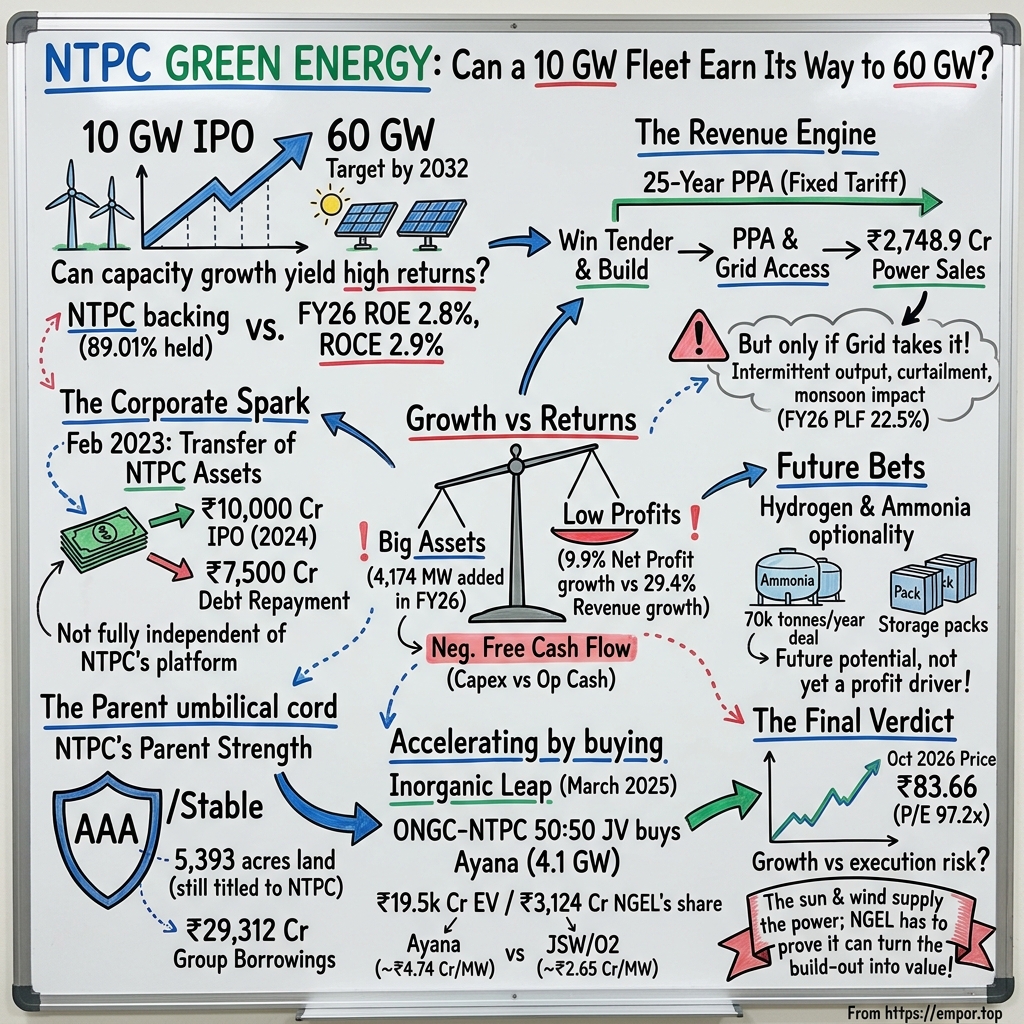
NTPC Green Energy: Can a 10-Gigawatt Fleet Earn Its Way to 60?
I. A 10-Gigawatt IPO, and the 60-Gigawatt Promise
Somewhere in the salt flats of Kutch, close to the border with Pakistan, rows of solar modules run to the horizon on land that used to be good for almost nothing. In the closing weeks of March 2026, crews for NTPC Green Energy were still bolting, cabling and energising blocks of that desert plant at Khavda, racing a fiscal-year deadline that management had promised analysts it would meet.1 When the books closed on March 31, the group had added 4,174 megawatts in a single year and taken its operating fleet to 10,076 megawatts.2 For a company that had been incorporated less than four years earlier, that was a genuine milestone. NTPC Green Energy, known in filings and around Delhi's power ministries as NGEL, had crossed ten gigawatts.
And yet the number that hung over every conversation about the company was not ten. It was sixty. NTPC, the state-controlled giant that still owns roughly nine of every ten NGEL shares, has said for years that it wants 60 gigawatts of renewable capacity by 2032, and it has made NGEL the vehicle meant to carry that ambition.3 Ten gigawatts is a big fleet by almost any standard. It is also one-sixth of the promise. To close the gap in the time remaining, NGEL would have to add nearly as much capacity every year as it took the whole of its short life to accumulate.
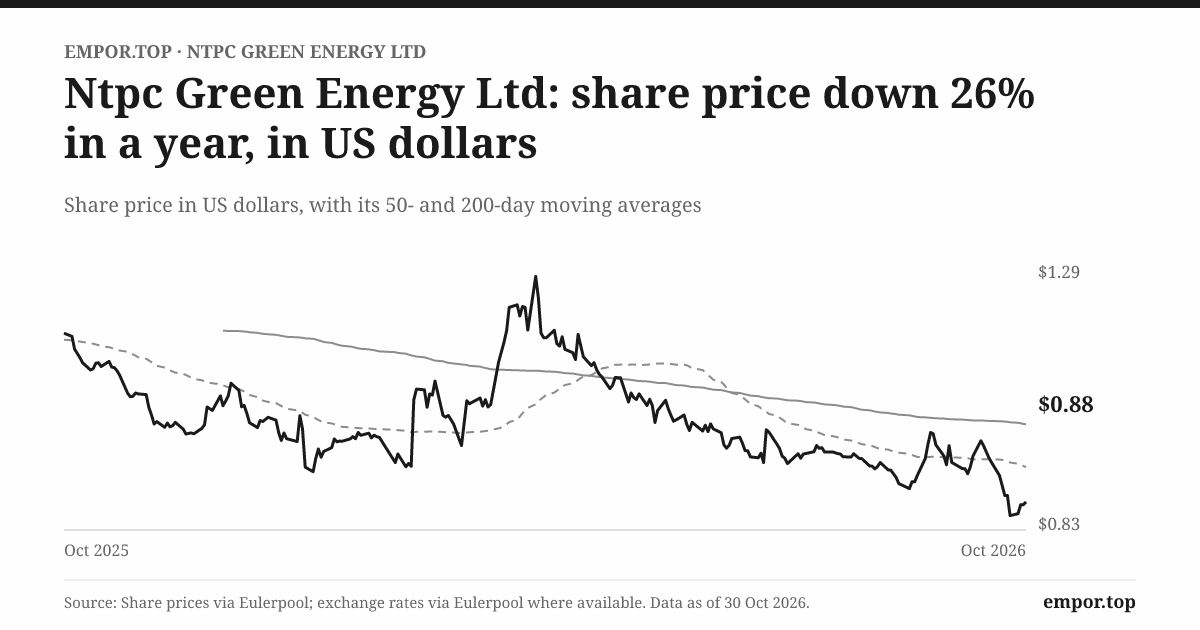
That gap is the subject of this story. On October 30, 2026, the day NGEL reported its results for the six months to September, the stock closed at about ₹84, and the whole company was valued at roughly ₹58,950 crore. NTPC held 89.01% of it; the public held the rest, spread across more than 1.2 million shareholders.4 The price sat almost a third below its 52-week high and comfortably below the ₹108 at which the shares had been sold in the November 2024 IPO.5 Investors who bought the flotation had watched the fleet grow and their holding shrink.
The question is whether NGEL is becoming a valuable renewable-power business in its own right, or whether it is mainly a vehicle for turning NTPC's green ambitions into listed-company growth. Those are not the same thing. A vehicle can grow enormously while earning thin returns, because its owner cares about national targets, balance-sheet optics or strategic positioning as much as about return on capital. A business has to earn its keep. Minority shareholders bought the second thing, and they need to know whether they own it.
Four threads will run through the investigation. The first is whether capacity growth turns into higher returns once the new plants are switched on. The second is how much of what makes NGEL work belongs to NGEL and how much is borrowed from NTPC: its people, its land titles, its credit. The third is whether an expansion of this size can be funded without leaning ever harder on debt or flooding the market with promoter shares. The fourth is what today's share price already assumes about all three.
Before following any thread, it helps to draw the boundary carefully. NGEL's consolidated figures include its subsidiaries, most importantly NTPC Renewable Energy, and its share of joint ventures such as the one that owns Ayana Renewable Power.2 They do not include every renewable asset the NTPC group owns, nor NTPC's thermal, hydro or trading businesses. When NTPC's management talks about "group" renewable capacity, its number is larger than NGEL's, because some green assets sit elsewhere in the family.3 Mixing those two denominators is the most common error in coverage of the company, and it flatters the listed entity.
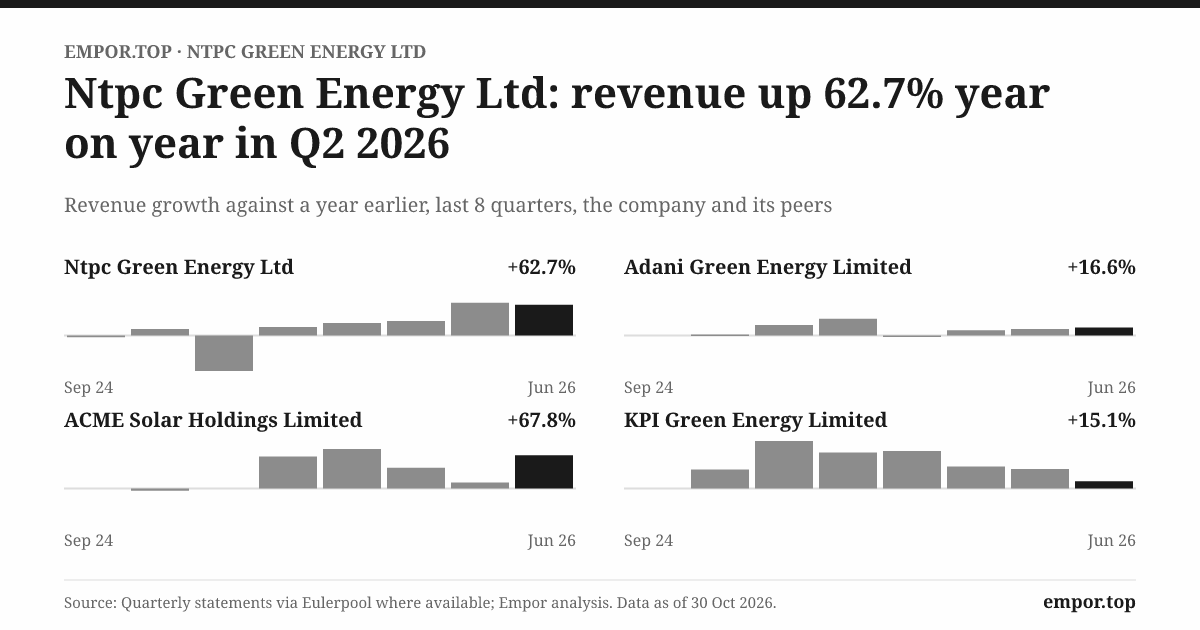
Inside that boundary, the central tension is easy to state. The portfolio is growing quickly: revenue rose by almost 30% in the year to March 2026.2 But return on equity for that year was about 2.8%, and return on capital employed about 2.9%.2 Those are returns a bank deposit can beat. A fleet that earns 3% on the capital tied up in it is not yet a value-creating machine, however many megawatts it adds. The optimist's answer is that a construction company always looks unprofitable in the middle of construction, because the capital is spent before the electricity flows. The skeptic's answer is that NGEL has been "in the middle of construction" for its entire existence, and is promising to stay there until 2032.
Both may be right. To see which is closer to the truth, the story has to start where NGEL's did: not with a solar farm, but with a corporate reorganisation in which a very old company put its newest business into a very new box.
 Subscribe on LinkedIn
II. The Renewable Fleet Was Built Above the New Company
In April 2022, NTPC incorporated a new subsidiary with an unremarkable name and a remarkable job.6 NTPC had spent half a century as India's largest coal-fired power producer, the dependable engine behind the national grid. It had also, quietly and somewhat unevenly, built a renewable portfolio of its own: solar parks in Rajasthan and Gujarat, wind farms, and a subsidiary called NTPC Renewable Energy that had been bidding for new projects. NGEL was created to bring those pieces under one roof, give them a dedicated management team and, eventually, a stock-market listing that could raise capital without diluting NTPC's own shareholders.
The order of operations matters, because it explains what investors actually bought. First came the shell. Then, under a business-transfer arrangement, NTPC moved its operating renewable assets into NGEL, a process that was completed in February 2023.2 NTPC Renewable Energy, which held much of the project pipeline, was placed beneath NGEL as a subsidiary.6 Only after the assets and the pipeline were inside the new structure did the company file to go public. In other words, the fleet was built above the new company and then lowered into it. NGEL did not grow up the way most renewable developers do, scrapping for its first tender and its first bank loan. It was born with an inheritance.
That inheritance shows up in the early financial statements as a mirage of growth. In the year to March 2023, NGEL's reported revenue was tiny, because the asset transfer had only just happened; in the following year it jumped more than tenfold.2 That leap was not the market discovering a brilliant new business. It was the accounting catching up with assets that NTPC had already built. Anyone quoting NGEL's three-year revenue growth rate of almost 159% a year is quoting a reorganisation, not an operating achievement. The more honest growth figures start from the year to March 2024.
In its draft prospectus, filed with the exchanges in September 2024, the company described itself exactly as its parent intended: the vehicle for consolidating NTPC's renewable assets and developing new ones.6 The company filed the red herring prospectus in November.5 The offer itself was a fresh issue of 92.63 crore shares, raising ₹10,000 crore gross.5 That detail is easy to skim past and important to hold onto. NTPC sold nothing. Every rupee went into NGEL rather than out to the parent. Many state-owned listings in India have been sales by the government or a parent; this one was a capital raise.
Where did the money go? After issue expenses, NGEL had about ₹9,946 crore of net proceeds. It invested ₹7,500 crore in NTPC Renewable Energy, which used the money to repay debt, and kept the balance for general corporate purposes.2 By September 2025, less than a year after listing, the proceeds had been fully used.2 The flotation, then, was in large part a deleveraging transaction for the subsidiary that held the growth pipeline. It cleaned up a balance sheet so that the subsidiary could borrow again, which it promptly did. By March 2026, the group's borrowings had climbed back above where they stood before the IPO.2
That is not a criticism by itself. A developer that repays expensive construction debt with equity and then reborrows against operating assets is doing what developers do. But it does mean that the IPO money was not a war chest sitting on the balance sheet waiting for the 60-gigawatt build. It was spent within months, and the next chapter had to be funded the ordinary way. That chapter began in November 2025, when NGEL issued ₹1,500 crore of unsecured non-convertible debentures, and continued in July 2026 with another ₹2,500 crore.2 4 On NTPC's January 2026 call, management noted that the first issue was priced at 7.01% and oversubscribed by roughly eight times.1 Bond investors, at least, were happy to lend.
The shareholding tells the rest of the structural story. NTPC owned 89.01% of NGEL at March 2025 and still owned exactly 89.01% at September 2026.7 4 The public float was therefore 10.99%, well short of the 25% minimum that Indian rules require listed companies to reach within a prescribed period; the company has told the exchanges that it will comply.4 Within that thin float, foreign portfolio investors drifted from about 2% to about 1.6% between March 2025 and September 2026, while domestic institutions edged up to around 5.3%.7 8 4 More than 1.2 million public shareholders, many of them retail investors who applied in the IPO, held the remainder.4 None of NTPC's shares were pledged.4
What does that structure mean for an outside investor? It means the listing created a separate company with a separate balance sheet and separate disclosures, but not a separate centre of gravity. The board, the strategy and the capital plan are set inside the NTPC family. The listed company's minority holders own a slice of a business whose most important decisions, from which tenders to bid for to when to sell down the parent's stake, are made by a shareholder with other priorities, including a coal fleet, a nuclear programme and its own dividend.1 That is not unusual for an Indian public-sector subsidiary. It is simply the starting fact.
One more caution belongs here, because it shapes how the valuation will later be read. Data providers quote a "five-year median" price-to-earnings ratio for NGEL of about 128 times. The company has been publicly traded only since November 2024, so whatever that series measures, it is not five years of investors setting a price on the open market. Comparing today's multiple with that median says less about NGEL's history than it appears to.
So the IPO gave NGEL capital, a ticker and a dedicated management team. It did not give it independence from NTPC's operating platform, assets or people. To understand whether the business can earn its keep, the next step is to look at what NGEL actually sells, and at who decides whether it gets paid.
III. The PPA Pays for Power, but Only If the Grid Takes It
Follow a single project from start to finish and the business model reveals itself. It begins with a tender. A central agency such as the Solar Energy Corporation of India, or a state electricity utility, announces that it wants to buy a few hundred megawatts of solar, wind or hybrid power, and invites developers to bid the lowest tariff they will accept per unit of electricity. Bidding is an act of nerve. A developer has to forecast the cost of modules, land, cabling, transmission access and capital years into the future, and then lock in a price it will live with for a quarter of a century. The lowest credible bid wins.
The winner then signs a power purchase agreement, the PPA, which is the contract at the heart of the industry. For NGEL's tied-up projects, CRISIL describes these as generally 25-year fixed-tariff agreements.9 Think of a PPA as a very long lease on a machine that produces electricity: the buyer agrees to pay a set price for each unit the machine delivers, for 25 years, regardless of what wholesale power prices do in the meantime. The developer's job is to build the machine on time and on budget, keep it running, and collect the bills.
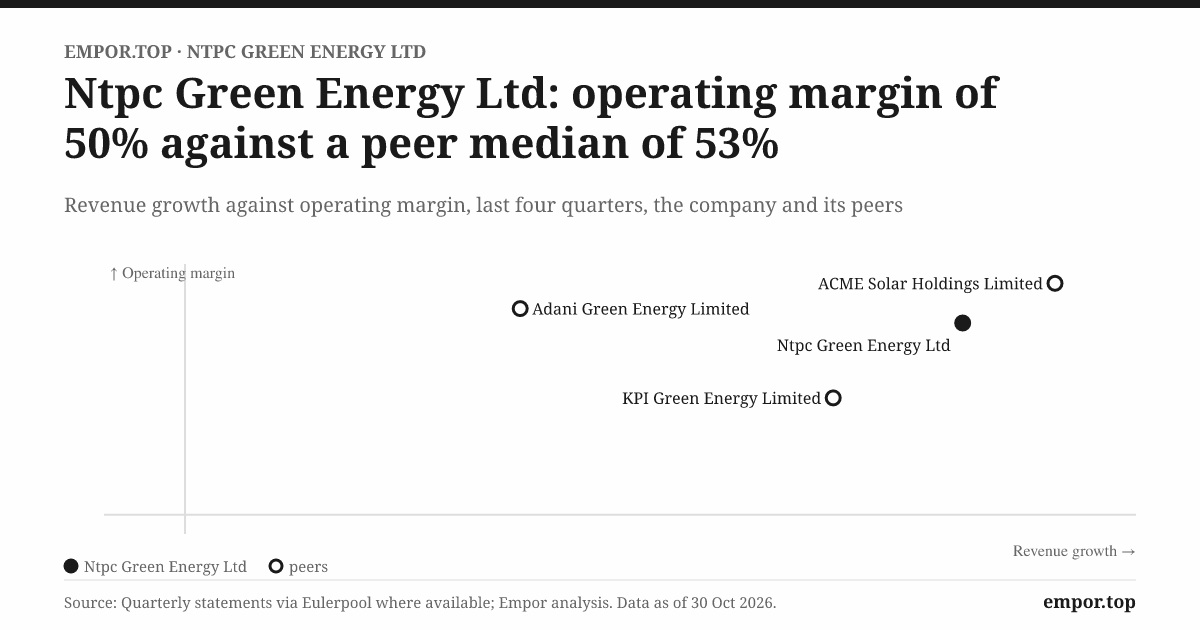
Building comes next, and it is where most of the money goes. The developer needs land, often thousands of acres in places like the Thar desert or Kutch; it needs a connection to the national transmission network; it needs modules, inverters and turbines; and it needs years of construction financing before the first unit is sold. Once commissioned, a solar plant has almost no fuel cost, because sunlight is free. Its costs are mostly the capital it consumed: depreciation as the equipment wears out, and interest on the debt that paid for it. That is why renewable developers report striking operating margins and modest profits. NGEL's operating EBITDA margin was about 87% in the year to March 2026, a figure its management highlighted on the year-end call.3 What sits below that line, interest and depreciation, is what determines whether a shareholder ever sees a return.
The revenue mix that results is simple. In the year to March 2026, NGEL's consolidated revenue from operations was about ₹2,858 crore, and sales of power were about ₹2,749 crore of it, more than 96%.2 The small remainder came from project-management and consultancy fees. This is an electricity seller, nearly full stop. What the company does not publish is just as telling: it gives no quantified share of revenue protected by minimum-take commitments, and no contract-level detail on volumes or payment terms.2 Investors know NGEL is paid per unit; they cannot see how much of that payment is guaranteed if the units do not flow.
And the units do not always flow, for three reasons. The first is weather. A solar plant in India produces its best output in the dry, bright months before the monsoon; when the rains arrive, cloud cover cuts generation. Wind is seasonal too. The industry measures this through the capacity utilisation factor, or CUF, the share of a plant's theoretical maximum output it actually delivers over a year. A solar plant running at a CUF of 22% is producing, over a full year, what it would produce if it ran at full power for about a fifth of the hours. CRISIL put NGEL's plant load factor for the year to March 2026 at 22.5%, and said an early monsoon and grid curtailment had both weighed on it.9 On the January call, management cited a nine-month CUF of 21.8%, "despite weather-related challenges".1
The second reason is the grid itself. Curtailment is what happens when the transmission network cannot take all the power a plant can make, so the grid operator tells the plant to back down. For a renewable developer, curtailment is the cruellest kind of loss: the plant is built, the debt is drawn, the sun is shining, and the electricity simply has nowhere to go. In late January 2026, NGEL's chief executive, Sarit Maheshwari, told analysts that the company had lost about 420 million units to curtailment in the first nine months of the year at NGEL alone, plus about 212 million units at NTPC Renewable Energy.1 He then made an optimistic claim: a key transmission line had been commissioned, and "henceforth, there will be no curtailment loss" at NGEL on that account.1
Four months later, the year-end call told a more complicated story. Management said NGEL had experienced about 314 million units of curtailment during the year, plus another 135 million units of losses under a grid-balancing mechanism for which it is compensated, and put the uncompensated hit at close to ₹90 crore.3 The two calls' figures are not easy to reconcile, and management did not explain the difference in definitions. The bigger point is the size of the problem. Ninety crore rupees is roughly a sixth of NGEL's ₹521 crore net profit for the year.2 And the problem has not gone away. Management said in May that only about 57% of the capacity planned for FY27 had firm grid connectivity, with the rest relying on temporary access, and that curtailment "should taper" as connections were added.3 The promise of zero curtailment had become a promise of less.
The third reason a unit may not turn into rupees is the buyer. NGEL's customers are concentrated and, in many cases, state-owned. In the year to March 2026, four major customers accounted for about ₹2,004 crore of group revenue, roughly 70% of the total.2 NGEL does not name them in its annual report. CRISIL, in its June 2026 rationale, listed the weaker credit quality of state distribution companies as one of the constraints on the rating.9 Indian distribution utilities have a long history of paying generators late and renegotiating when tariffs look expensive in hindsight. The 25-year contract protects NGEL from wholesale price swings, but it does not remove the counterparty.
So what is NGEL's moat? A long contract is a kind of protection, but it is not lock-in in the way investors usually mean. The buyer is locked into this plant for 25 years; it is not locked into NGEL for the next tender, where every developer competes afresh on price. Any edge NGEL has must therefore lie in being better at the things that happen before and after the contract: executing projects on time, finding land and grid access, and borrowing cheaply. Those are real capabilities, and NTPC's name helps with all of them. But they are execution and financing advantages, not customer captivity.
The competitive landscape reinforces that reading. At March 2026, NGEL's group had about 10 gigawatts of commissioned capacity.2 Adani Green Energy reported about 19.3 gigawatts of operational renewable capacity at the same date.10 ReNew reported roughly 12.5 gigawatts.11 JSW Energy reported 13.45 gigawatts, but across thermal, hydro and renewables, so it is not a like-for-like renewable comparison.12 The right denominator here is commissioned capacity, plants that are generating, rather than locked-in pipelines, which every developer presents as generously as it can. On commissioned capacity, NGEL is a large player but not the leader, and it trails the largest private developer by a wide margin.
Michael Porter's five forces sharpen the picture. Rivalry is intense, because tenders are explicit price contests among well-funded developers. Buyer power is high, because a handful of state and central agencies set the rules, run the auctions and occasionally cancel or re-bid them. The threat of substitutes is limited for clean power as a category, but within the category, solar, wind, storage and hybrid projects compete for the same procurement budget. Supplier power has eased as module prices fell, but transmission access, controlled by state and central grid agencies, acts like a supplier with a veto. Barriers to entry exist in the form of capital, land and grid access, and NTPC backing clearly lowers those barriers for NGEL. What the evidence does not establish is any durable switching cost or protected price realisation. NGEL wins when it bids low enough, like everyone else.
That leaves an operating test rather than a structural one. If NGEL's edge is execution, it should show up in a handful of numbers that the company only partly publishes: generation and CUF by plant, curtailment by region, the gap between contracted and commissioned capacity, and the speed at which bills turn into cash. One analyst made the point bluntly on the January call, asking that these basic operating figures be published alongside results, because "it is very difficult to interpret performance in the absence of these basic numbers".1 Management pointed him to the company website.1 Until those numbers are routinely visible, the moat claim stays a claim. The financial statements, though, are fully visible, and they show what happens when the fleet grows faster than the profits.
IV. Growth Came Faster Than Returns
Picture the year-end board meeting for the twelve months to March 2026. On one side of the ledger, the operating news was as good as NGEL had ever reported. The group had added 4,174 megawatts in a year, more than in any previous year of its existence.2 Generation, by NTPC's count, had more than doubled.3 Revenue from operations had risen by about 29%.2 Then the profit line arrived, and it had risen by less than 10%.2
That gap is the puzzle of this chapter. A business adding capacity at that pace should, eventually, see profits grow at least as fast as revenue, because each new plant brings revenue at a high operating margin. Why did the fleet grow faster than the earnings?
Start by separating real growth from inherited growth. NGEL's early reported years were shaped by the asset transfer from NTPC, which inflated the first comparison beyond meaning. The three-year growth rates, close to 159% a year for revenue and about 45% for net profit, describe a corporate reorganisation as much as a business.2 The cleaner story starts in the year to March 2024, the first full year with the transferred assets inside. From there, revenue grew by about 16% and then about 29%, while net profit grew by about 39% and then about 10%.2 Growth was accelerating in the top line and decelerating in the bottom line. That is the opposite of what a maturing fleet should do.
The clues are in the cost lines below operating profit. Depreciation rose by about 45% in the year to March 2026, to about ₹1,102 crore, as newly commissioned plants began wearing out on the books.2 Finance costs reached about ₹887 crore.2 Together, depreciation and interest absorbed most of the gap between revenue and profit. There was a quieter drag too. Other income, much of it interest on the IPO money parked in bank deposits, fell from about ₹256 crore to about ₹177 crore as the proceeds were spent, and the interest earned on those deposits nearly halved.2 In the year to March 2025, that deposit interest had flattered profits. In the following year it faded, exactly as one would expect once the cash went into projects.
Management also offered a mechanical explanation on the January call, when an analyst asked why profit had dipped from the second quarter to the third. New capacity commissioned partway through a month, management said, earns revenue only from the commissioning date, while depreciation is charged for the whole month; and the giant Khavda plant had gone through an initial "stabilisation period" in which it generated less than it should.1 Both points are plausible and both are temporary by nature. Neither explains why the full year's profit growth trailed revenue growth by such a margin. The deeper reason is simpler: each new plant arrives with its full capital cost on the balance sheet and only part of a year's output in the income statement, and NGEL is adding so many plants that this lag never washes out.
Returns tell the same story from another angle. Return on equity was about 3.5% in the year to March 2023, rose to about 5.5% the following year, then fell to about 2.6% and stayed near 2.8%.2 Return on capital employed peaked around 5% and has drifted down to about 2.9%.2 Part of the fall in return on equity is the IPO itself: ₹10,000 crore of new equity arrived before the projects it would fund could earn anything. But capital employed has been rising faster than operating profit for two years in a row. On the evidence so far, NGEL is adding assets faster than it is learning to earn on them.
Now the cash puzzle, which looks at first like good news. Over the four years to March 2026, NGEL reported cumulative net profit of about ₹1,512 crore and cumulative operating cash flow of about ₹5,988 crore, almost four times as much.2 A company whose cash generation outruns its reported profit sounds like a company with conservative accounting. Here the explanation is more mundane. Depreciation and interest are deducted to arrive at profit, but neither is a cash cost of operating the plants: depreciation never leaves the bank account, and interest is classified separately as a financing payment. In the year to March 2026 alone, operating cash flow was about ₹2,386 crore against profit of about ₹521 crore, with depreciation of about ₹1,102 crore and finance costs of ₹887 crore doing most of the reconciling.2 Operating cash is real, and it services debt. It is not a sign that the plants are secretly more profitable than they look.
The decisive number is what happened after the operating cash came in. In the year to March 2026, NGEL spent about ₹15,264 crore buying property, plant and equipment and funding construction work in progress.2 Its operating cash covered about one-sixth of that. Free cash flow, operating cash minus capital spending, was therefore negative by roughly ₹12,900 crore in a single year. Over the four years to March 2026, the cumulative figure was about negative ₹31,450 crore, with not one rupee paid out in dividends.2 This is not a business with a receivables problem or a cash-leakage problem. It is a construction programme that consumes capital several times faster than its operating plants can produce it, and borrows the difference.
The first half of the year to March 2027 offered an early update, and it was encouraging on the surface. Consolidated revenue for the six months to September rose to about ₹2,045 crore from about ₹1,293 crore a year earlier, and profit attributable to shareholders rose to about ₹442 crore from about ₹308 crore.13 That was profit growth of more than 40% against revenue growth of almost 60%. The plants commissioned in the rush of early 2026 were now running for full quarters.
Look underneath, and the old pattern is still there. Depreciation for the half-year rose to about ₹732 crore from about ₹482 crore, and finance costs rose by three-quarters, to about ₹700 crore from about ₹399 crore.13 The second quarter, which carried the monsoon, earned a pre-tax profit less than half that of the first quarter, on revenue of about ₹938 crore against about ₹1,107 crore.13 Seasonality is normal for a solar-heavy fleet. Rising interest costs that outpace revenue are a choice about how the growth is funded, and the bill grows with every gigawatt.
So the verdict for this chapter is narrow but firm. Expansion is lifting sales and operating cash. It has not yet shown mature-asset returns catching up with the capital deployed. Three numbers will decide whether it does. The first is commissioned capacity against the company's own additions guidance, which tells investors whether the build is on schedule. The second is CUF alongside curtailment, which tells them whether the built plants are actually producing. The third is return on capital employed set against operating cash after capex, which tells them whether the whole machine is earning more than it costs. At the latest reported point, the first was behind guidance, the second was around 22% with curtailment still present, and the third was about 2.9% and falling.2 9 3
Which raises the question that every NGEL bull eventually answers with one word: NTPC. If the listed company's own returns are thin, does the parent's balance sheet make the risk tolerable? That depends on what, precisely, the parent provides.
V. The Parent’s Balance Sheet Is Part of the Product
A solar project needs four things before it produces a single unit of electricity: land, people, credit, and years of patience. At NGEL, each of those connects back to NTPC in a different way, and tracing each connection is the best way to see what the listed company really is.
Begin with land. When NTPC transferred its renewable assets to NGEL in February 2023, the plants moved, but not all of the paperwork followed. At March 2026, about 5,393 acres of freehold land, nearly 3,965 acres of right-of-use land, and buildings and plant structures carried at about ₹103 crore were still registered in NTPC's name, with the legal formalities of transfer pending.2 NGEL operates on that land, earns from it, and depreciates the assets on it; NTPC holds the title. The auditor recorded the matter in the statutory annexure on company law compliance, not as a qualification of the financial statements, and it is the sort of administrative backlog that Indian public-sector transfers often leave behind.2 But just over three years after the transfer, it remains a concrete dependency on the parent, and minority shareholders have no say in when it is resolved.
Next, people. NGEL's chairman and functional directors hold their NGEL roles as additional charges alongside NTPC positions, and their pay comes from NTPC.2 The company's own payroll is strikingly small: 516 employees at March 2026, up from 346 a year earlier, against a project pipeline measured in tens of gigawatts.2 It also reported 3,165 workers, mostly non-permanent.2 The auditor noted that about ₹83 crore of employee expense related to NTPC staff on secondment, and that the supporting records were held by NTPC.2 Much of NGEL's execution capacity, in other words, is borrowed NTPC expertise. That is a strength when it means decades of experience building power plants. It is a dependency when it means the listed company's key capability sits on another company's payroll.
The related-party ledger shows the parent everywhere and nowhere at once. At the standalone level, NGEL earned about ₹35 crore of service revenue from NTPC in the year to March 2026, and about ₹86.5 crore in total from related parties, including its subsidiaries and joint ventures, against standalone revenue of about ₹1,967 crore.2 It paid NTPC about ₹14 crore for secondments and about ₹11 crore in lease rent.2 The company says these transactions are at arm's length and reports no royalty, brand fee or management fee to the parent.2 Measured by money flowing in the income statement, NTPC is a minor counterparty. Measured by what NGEL could not do without it, people, land, funding and the original asset transfer, NTPC is the whole operating platform.
The auditor added one more signal. The statutory audit opinion for the year to March 2026 was unmodified, but it included an emphasis of matter on periodic confirmations and reconciliations of customer receivables, trade payables, other payables and advances; the auditor said any resulting adjustment would not be material.2 This is not a red flag in the sense of an accounting dispute. It is a reminder that a young company built from transferred assets and run partly with borrowed staff is still tidying its books.
Then credit, which is where the parent matters most. At March 2026, NGEL's group borrowings were about ₹29,312 crore, almost all of it rupee loans, with about ₹1,540 crore of bonds.2 Lease liabilities are separate, with a carrying amount of about ₹2,458 crore, and should not be added to the funded debt figure.2 By September 2026, the company's reported debt capital had risen to about ₹35,228 crore.13 That increase of roughly ₹6,000 crore in six months is almost exactly what NGEL spent on capital projects over the same half-year.13 The build is being paid for with borrowed money, half-year by half-year.
Against that debt stand covenants that NGEL reports it has not breached: total liabilities no more than three times net worth, and EBITDA at least 1.75 times interest.2 Its interest-service coverage was about 2.7 times in the first half of the year to March 2027.13 Those are comfortable cushions today. They are also cushions that shrink if interest costs keep growing faster than operating profit, as they did in that half-year.
The credit agencies, though, are not worried, and the reason is NTPC. CRISIL affirmed AAA/Stable on NGEL's long-term facilities in June 2026, citing NTPC's support, the long-tenor fixed-tariff PPAs, a diversified portfolio and healthy debt-service coverage.9 India Ratings affirmed its own AAA/Stable rating the same month, explicitly using a top-down approach that reflects NTPC's 89.01% ownership and strategic links.14 The top-down language is worth dwelling on. It means the rating starts from the parent's credit and works down, rather than starting from NGEL's own cash flows and working up. CRISIL's constraints are telling as well: execution risk on the large capital programme, possible delays and cost overruns, grid curtailment, and the credit quality of distribution companies.9 The agencies are saying that lenders will be repaid because NTPC stands behind NGEL. They are not saying NGEL's projects earn attractive returns, and they never claim to.
That distinction is the heart of the parent question. NTPC support improves NGEL's financing access and execution capacity, and both are real economic advantages. A AAA rating lets NGEL borrow at rates that smaller private developers can only envy, and borrowed NTPC engineers can build plants that a 516-person company could not. But parent support is an economic dependency, not a substitute for returns, and it comes with a price. A controlling shareholder that owns 89% of the company, sets its strategy and supplies its people can also decide how hard to push for capacity targets, which projects to route through NGEL and which through the wider group, and when to sell its own shares.
Who runs the listed company day to day? Sarit Maheshwari became chief executive on May 10, 2025, succeeding Rajiv Gupta.2 On the earnings calls he comes across as a site-level operator rather than a strategist: asked whether NGEL could hit its year-end capacity target, he walked analysts through Khavda, Bhadla, Kalasar and three Gujarat wind sites, megawatt by megawatt.1 His pay for the year to March 2026 was about ₹0.93 crore, and the chief financial officer, Neeraj Sharma, received about ₹0.81 crore.2 No exceptional bonus is disclosed, and the remuneration disclosures show no meaningful shareholding by either.2 These are public-sector salaries in a public-sector structure: managers who are accountable to a parent, not owner-operators whose wealth rises and falls with the minority shareholders'. With a chief executive who has held the job for barely a year and a half, there is not yet a long record of guidance against delivery to judge. The one clear test so far, the year-end capacity target, comes up in the chapter on auctions.
Three of NGEL's six directors were independent at March 2026, and the independent cohort changed during 2025.2 At the annual meeting on August 28, 2026, all four resolutions passed, as they must when one shareholder owns 89%. But about 9% of institutional votes cast opposed the reappointment of director Jaikumar Srinivasan, and about 6.7% of non-institutional votes did the same; opposition to the other resolutions was much smaller.15 In a company where minority votes cannot change any outcome, a one-in-ten institutional protest is a small, deliberate signal. It says some independent shareholders want the board to look more independent than it does.
What should an investor take from NTPC's own calls about the subsidiary? The pattern across the January and May 2026 calls is consistent: questions about NGEL are answered with confidence on targets and with less precision on operating detail. On both calls, NTPC held to roughly 8 gigawatts of NGEL additions a year; on the second, it also disclosed a capital spending plan of about ₹35,800 crore for the year to March 2027, rising to about ₹46,000 crore and then about ₹48,000 crore in the two years after, funded at roughly 80% debt and 20% equity.1 3 Asked about other cost lines, management promised to send data later.3 NTPC also told investors that the government had raised the investment approval limit for its renewable subsidiaries to ₹20,000 crore, supporting the 60-gigawatt target.3 That is a parent signalling it can put more equity in. It is also a parent signalling that the plan depends on it.
The numbers make the stakes plain. If NGEL spends anything close to ₹35,800 crore this year at 80% debt, it will add more than ₹28,000 crore of borrowing to the ₹29,312 crore it carried in March, nearly doubling the debt pile in a single year. In the first half, it actually spent about ₹6,064 crore, roughly a sixth of the full-year plan.13 Either the second half will see a very large acceleration in spending and borrowing, or the guidance will slip. Neither outcome is comfortable for a minority shareholder. One means far more leverage; the other means the build is slower than promised.
The parent's balance sheet, then, is part of what NGEL sells to lenders and investors. The question is whether NGEL buys sensibly with it. The clearest test of that came in the biggest single purchase in its history.
VI. Ayana Bought Four Gigawatts in One Move
In late March 2025, as the fiscal year closed, two of India's biggest state-controlled energy companies completed a deal that would add more capacity to NGEL's world in one stroke than it had built organically in some entire years. ONGC NTPC Green Private Limited, a joint venture owned equally by the oil producer ONGC and NGEL, completed its acquisition of 100% of Ayana Renewable Power.16 Ayana was a private developer that had grown up with backing from international infrastructure investors, and it came with about 4,112 megawatts of renewable capacity: about 2,123 megawatts already operating and about 1,989 megawatts still under construction.17
The structure matters before the price does. NGEL did not buy Ayana. A 50:50 joint venture did, and NGEL owns half of that joint venture. In NGEL's own accounts, Ayana therefore appears not as a consolidated subsidiary with its revenue and debt on the group's lines, but as an equity-accounted investment whose profits arrive in a single line called the share of profits of joint ventures.2 That distinction will matter later, when the question becomes whether the acquisition earned its keep.
The headline enterprise value was about ₹19,500 crore.17 Enterprise value is the price of the whole business, including the debt that comes with it, so it overstates what the buyers paid in cash. NGEL's exchange filing put its own share of the acquisition cost at about ₹3,124 crore, funded as an equity contribution into the joint venture.17 For a company that had raised ₹10,000 crore in its IPO only four months earlier, that was a meaningful cheque, but not a bet-the-company one.
Was it a good price? The cleanest benchmark is a deal announced just months earlier. In December 2024, JSW Neo Energy agreed to buy O2 Power, another private renewable platform, at an enterprise value of about ₹12,468 crore for roughly 4,696 megawatts.18 Divide price by capacity and the comparison is stark. Ayana cost about ₹4.74 crore per megawatt of portfolio capacity; O2 Power cost about ₹2.65 crore. By that crude measure, the NTPC-ONGC venture paid almost 80% more per megawatt than JSW did.
Crude measures deserve crude caveats, and here they are substantial. A megawatt that is already operating, with a signed PPA and a track record of generation, is worth far more than a megawatt that exists only as an award. Ayana's portfolio was roughly half operating, and the two platforms differed in their mix of operating, under-construction and pipeline capacity.18 17 Tariffs, CUFs, debt levels, the cost to complete unfinished projects and the quality of the offtakers all differ between the two. The right comparison would be price per operating megawatt, adjusted for contracted cash flows and remaining capex, and neither buyer published enough to make it precisely. So the per-megawatt gap is a diligence flag, not proof of overpayment. It is, however, a big enough flag that an investor should want an answer.
At announcement, CRISIL said the acquisition did not materially change NGEL's credit risk profile.9 That is reassuring for lenders, and it is exactly what one would expect of a deal that cost NGEL about a third of its IPO proceeds. It is not a verdict on whether NGEL's shareholders earned a good return.
The record since the deal gives a first, partial answer. Ayana contributed heavily to NGEL's operating numbers: on the January 2026 call, management said that of the 4,535 megawatts by which commercial capacity had grown over the previous year, about 2,624 megawatts came from the Ayana acquisition, and that nine-month generation had risen 206%, "primarily driven by Ayana".1 In capacity terms, the deal did what it was meant to do. It bought speed.
The earnings tell a quieter story. For the full year to March 2026, NGEL's share of profits from all its joint ventures, of which Ayana is the main operating contributor, was about ₹20 crore.13 Against an equity contribution of more than ₹3,100 crore for Ayana alone, that is a return well under 1% in the first full year of ownership. The first half of the following year looked better, with about ₹70 crore of joint-venture profits.13 Annualised, that would still be a single-digit percentage return on NGEL's Ayana investment, before counting the other joint ventures in the same line. Acquired renewable platforms often take time to stabilise and refinance, and the under-construction half of Ayana's portfolio had to be finished before it could earn. But the early evidence does not show acquired megawatts earning faster than organic ones.
There is also a sign that NTPC sees Ayana as a growth engine rather than a finished purchase. On the May 2026 call, management said that of the roughly 8 gigawatts NGEL planned to add in the year to March 2027, about 1.9 gigawatts would come through joint ventures, primarily Ayana and a venture with Indian Oil.3 Ayana had also won a 140-megawatt round-the-clock renewable project at ₹4.35 per unit.1 The acquisition, in other words, did not just buy plants. It bought a development team that now carries part of the 60-gigawatt load.
And that is where the capital-allocation question bites. The 60-gigawatt target creates a powerful rationale for buying platforms, because buying is faster than building. On the same May call, management said it would explore "inorganic acquisitions" to top up the 8 gigawatts a year and to reach 60 gigawatts "much ahead" of 2032.3 The danger in that sentence is subtle. When a target is fixed and the clock is running, a buyer can always justify a higher price by pointing to time saved. If acquisitions become the shortcut to headline capacity, weak underwriting gets more expensive with every deal.
The fair verdict on Ayana, for now, is that it accelerated scale through a joint venture at a price that looks rich against the most obvious comparable, and that its early earnings contribution has been thin. The comparison does not prove overpayment, because the portfolios differ. What would settle it is disclosure that NGEL does not routinely provide: Ayana's own operating capacity, CUF, debt and returns, set against the cost of NGEL's organic projects. Until then, the deal is best understood as what the 60-gigawatt promise looks like when it shops. The rest of the promise has to be won the hard way, one auction at a time.
VII. The 60-GW Bet Meets the Auction Market
Every winning bid in India's renewable auctions is a small act of prophecy. The developer who quotes the lowest tariff on auction day is promising to deliver a plant, on land it may not yet own, connected to a transmission line that may not yet exist, financed at interest rates it cannot fully know, and to sell the output at that price for 25 years. If module prices fall, the developer keeps the windfall. If the grid connection slips by a year, the developer eats the cost. The auction ends in minutes. The consequences last a generation.
This is the contest NGEL has entered at enormous scale. Developers compete for solar, wind, hybrid and, increasingly, "firm and dispatchable" tenders that require storage to deliver power when the sun is down. Winners must source land, grid access, equipment and capital while living with a fixed tariff. What separates a good developer from a bad one is not the ability to win auctions, since anyone can win by bidding low, but the ability to win at prices that leave a return after everything goes wrong that usually goes wrong.
So what does NGEL bring to this contest? Some advantages are concrete. Its AAA ratings and NTPC parentage lower its cost of debt.9 14 Its project additions are visible on the ground, from Khavda in Gujarat to Bhadla in Rajasthan.1 And it has scale, though its operating fleet remains smaller than Adani Green's and ReNew's.2 10 11 What the record does not establish is a distinct cost advantage per megawatt, a superior CUF, stronger price realisation, or a persistently higher win rate than peers. Those would be the signs of a real competitive edge in this industry. NGEL publishes too little plant-level data to show them, and its returns do not suggest them.
Hamilton Helmer's 7 Powers framework, which asks what lets a business earn persistent returns above its cost of capital, is a useful lens here, because it forces precision about which powers are actually present. Scale economies exist in procurement and financing, and NGEL has some, though Adani Green has more. Cornered resource is the most interesting candidate: preferential access to cheap state-backed credit and to NTPC's land and people. But the credit is available to other state-backed developers too, and the land and people belong to the parent. Switching costs, network effects, brand and counter-positioning do not meaningfully apply to a business that sells an identical electron under tender. Process power, the ability to build and run plants measurably better than rivals, would be the most valuable power of all, and it is precisely the one NGEL has not yet demonstrated. On this evidence, NGEL has financing advantages that compress its cost of capital, but no proven power that protects its returns from competitive bidding.
The pipeline is where the 60-gigawatt promise lives, and it needs careful handling. CRISIL counted about 13 gigawatts under construction at March 2026.9 NTPC management, at the end of December 2025, cited about 15.5 gigawatts of contracted and awarded capacity at NGEL.1 By May 2026, the CFO, Neeraj Sharma, explained that the wider pipeline figure had been revised down from 32 gigawatts to 30 gigawatts after the company "actualized" numbers across its subsidiaries and joint ventures.3 None of these are commissioned assets, and none earn revenue. Awards turn into revenue only after land, connectivity, construction and a signed PPA, and each of those can fail separately.
The PPA question in particular deserves attention. On the May call, management said that about 79% of the capacity planned for commissioning in the year to March 2027 had PPAs in place, falling to about 66% for the year after.3 Put plainly, roughly one in three megawatts NGEL plans to build two years from now does not yet have a buyer under contract. In January, the chief executive described 400 megawatts of a Uttar Pradesh allocation for which NGEL had no PPA and had not started work, and 600 megawatts in Madhya Pradesh in "advanced stages" of tie-up.1 An unsigned PPA is a project that can be built but not yet sold, or worse, a project that waits.
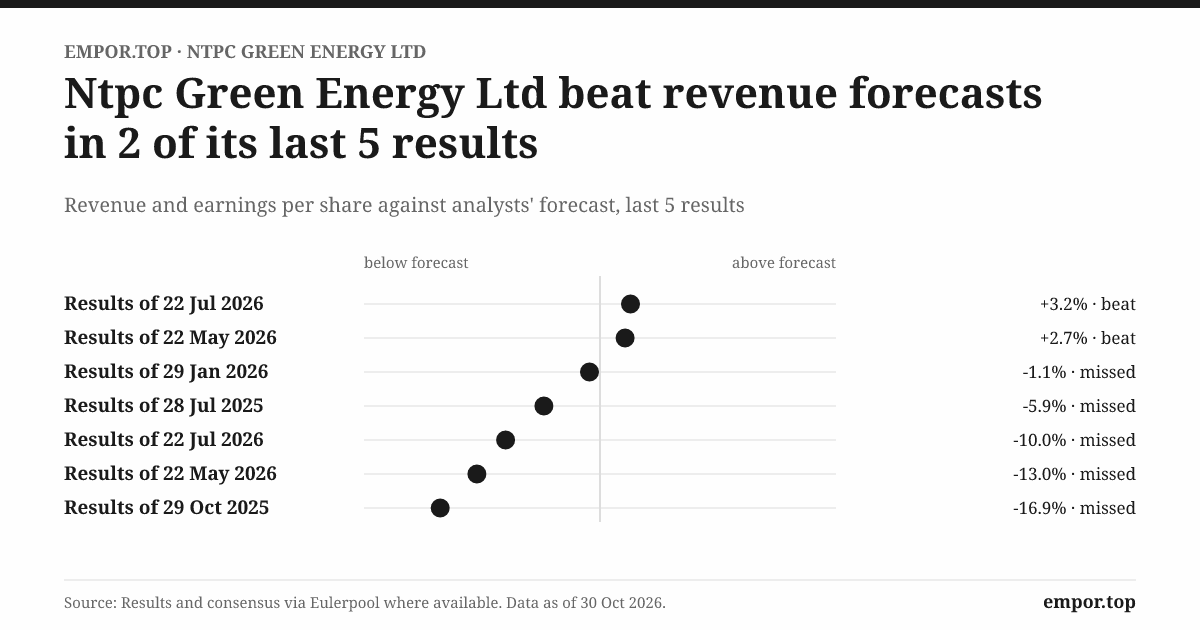
The most useful test of management's credibility is the one where a promise and an outcome can be compared directly. In late January 2026, asked whether NGEL would hit its target for the year, Maheshwari told analysts that "we would be touching our 5 GW target", and walked through roughly 2,500 megawatts that would come online in the final two months.1 The year closed with 4,174 megawatts added.2 On the May call, management acknowledged that some units had "spilled over" into the new year, while holding firm on 8 gigawatts for the year to March 2027.3 A miss of about a sixth against a target reaffirmed two months before year-end is not a disaster in an industry plagued by grid delays. But it is a miss, it was not signalled in advance, and the next target is 60% larger.
There is a second piece of the record that tells investors something about discipline. Asked in May why NGEL had won fewer projects in competitive auctions during the year, Maheshwari said the company has "threshold levels" and stays away when it does not "find merit in the competitive bid".3 Taken at face value, that is exactly what minority shareholders should want: a developer that refuses to buy capacity at uneconomic tariffs. It also sits in tension with the 60-gigawatt target. A company that bids selectively will win less, and a company with a fixed capacity goal will feel pressure to win more. Something has to give, and the acquisitions route, as Ayana illustrates, is one obvious release valve.
The buyers, meanwhile, hold more power than their customer role suggests. Central agencies and state utilities design the tenders, set the bid ceilings, and sometimes delay or cancel auctions or decline to sign PPAs for awarded capacity. Tariff competition can squeeze economics even when demand for renewable power is growing fast, because the growth flows to whoever bids lowest. Demand growth is a necessary condition for NGEL's success. It is not a sufficient one.
So the task facing current management is clear. It must convert a large pile of awards and plans into operating projects, protect returns while doing it, and keep capex from slipping. NTPC gives NGEL a credible platform for scale and financing; the evidence is much stronger for its capacity to expand than for a differentiated cost position. The decisive proof will come cohort by cohort: whether the plants commissioned in a given year come online on schedule, run at the CUF their bids assumed, and lift return on capital rather than dragging it down. Commissioned capacity against guidance, CUF and curtailment, and ROCE on the expanded asset base are the numbers that can falsify the growth thesis. Two of the three are pointing the wrong way today.
Before weighing the full bull and bear case, there is one more part of the story that NTPC's management talks about with real enthusiasm, and that investors sometimes treat as a free option. It is not free.
VIII. Hydrogen and Storage: Optionality With a Price Tag
On August 4, 2025, the Solar Energy Corporation of India ran an e-reverse auction for a product most investors had never seen traded: green ammonia, ammonia made with hydrogen split from water using renewable electricity rather than from natural gas. NTPC Renewable Energy, NGEL's subsidiary, won the full volume on offer—70,000 tonnes a year—at ₹51.80 per kilogram, for supply to a fertiliser maker, Krishana Phoschem, in Meghnagar, Madhya Pradesh.19 Trade publications called it a record-low bid.19 In March 2026, the subsidiary signed the green ammonia purchase agreement with SECI, which acts as the intermediary buyer under the national hydrogen mission.20
The scale is worth putting in proportion. Seventy thousand tonnes a year at that price implies annual sales of roughly ₹360 crore once the plant runs at full volume, a meaningful addition to the business. But none of it has been recognised yet, the plant to produce it has to be built, and the electricity to power it has to come from renewable capacity that runs close to round the clock. The existing build-out has left NGEL's free cash flow deeply negative.2 Green ammonia is a contracted future product attached to a large future capital bill.
Analysts noticed. On the January 2026 call, an analyst from Bernstein noted that the winning bids "look aggressive" and asked directly whether the project met NGEL's equity return threshold of 11–12%, or whether there were plans to reconsider it.1 Maheshwari answered that the key input is the cost of round-the-clock renewable power, that such prices are "quite competitive these days", and that NGEL would maintain "the healthy IRR as we do for other projects".1 That is an assurance, not a demonstration. The company's consolidated returns remain low, and its reported results have not yet shown investors what a healthy project-level return looks like.
Storage is the other half of this optionality, and it matters more to the core business. Solar plants produce in the middle of the day; Indian electricity demand peaks in the evening. A battery or pumped-hydro system lets a developer shift output into the hours when power is worth more and helps solve the intermittency problem that drives curtailment. In the nine months to December 2025, NGEL secured its first battery storage project, 80 megawatts with 320 megawatt-hours of storage in Kerala, through NHPC.1 NTPC told investors in May 2026 that NGEL was executing that project and had further capacity in the pipeline, and that work had begun at the Pudimadaka green hydrogen hub on green methanol and sustainable aviation fuel.3
What storage changes in the economics is twofold. It can raise the value of each unit produced, because firm and dispatchable power commands a higher tariff than plain solar; Ayana's round-the-clock project is one example of what such contracts can look like.1 But it adds capital cost and operating complexity to a business whose biggest problem is already that capital is spent faster than it earns. A battery is another machine that must be paid for before it pays back.
The fair way to treat green ammonia, hydrogen and storage is as strategically relevant options that may help NGEL deliver firm clean power and diversify its product. They are not yet profit pools. An auction win is a milestone, not revenue; a signed purchase agreement is a commitment, not cash collected; and a hydrogen hub under construction is a cost centre until it ships product at a price that covers its capital. The evidence that would change that verdict is straightforward: commissioned capacity, utilisation, realised tariffs, offtake actually taken, and project returns. Until then, the options belong in the story as possibilities with a price tag, not as hidden value. Which leaves the question every investor ultimately has to answer: what does the market price already assume?
IX. What Would Break the Case?
On October 30, 2026, the day NGEL published its first-half results, the share closed at about ₹84, almost 30% below its 52-week high of about ₹119 and near its 52-week low of about ₹81. The results were, on the headline, strong: revenue up by almost 60% and owner profit up by more than 40% for the half-year.13 And yet the stock sat close to its lows. The market seemed to be saying that it had heard the growth story and wanted to see the returns.
What is priced in? At that price, NGEL traded at about 97 times its trailing earnings. Data providers compare that with a five-year median of about 128 times, which suggests the stock has de-rated, though the median covers a period before the company listed and should be read loosely. On enterprise value, which adds debt to the equity price, NGEL traded at about 20 times EBITDA, about 36 times operating profit and about 21 times sales, and at about 3.6 times book value. Its return on equity over the twelve months to June 2026 was about 3.2%, its return on capital employed for the year to March 2026 about 2.9%.2 Its free-cash-flow yield was about negative 7%: for every ₹100 of market value, the business consumed about ₹7 of cash in a year after capital spending.
Put those numbers together and the logic of the valuation becomes clear. A company earning about 3% on its capital is not worth 3.6 times its book value on current returns. At that price, the market is assuming that returns will rise substantially as the new capacity matures, that interest costs will be contained, and that the build-out will eventually slow and turn cash-generative. The share price below the IPO price and near its lows says investors have become less confident of that path. The multiple, still high, says they have not abandoned it.
Peer multiples offer context but not a verdict. On the same date, data-provider screens put Adani Green at about 119 times earnings and about 25 times EBITDA, and JSW Energy at about 39 times earnings and about 16 times EBITDA.21 22 NGEL sits between the two on earnings and above JSW on enterprise value to EBITDA. But JSW is a diversified generator with thermal and hydro assets, and Adani Green is a larger, faster-growing private developer with its own very different balance sheet. The peer table tells investors that the market prices Indian renewable growth richly in general. It does not tell them NGEL deserves its multiple.
The bull case is serious and should be stated at its strongest. India's renewable build-out is one of the largest in the world, and demand for clean power is growing with the economy. NGEL has a rapidly expanding operating base, already above 10 gigawatts; long-term fixed-tariff PPAs that insulate it from wholesale price swings; NTPC support that gives it AAA/Stable ratings and access to some of the cheapest debt in Indian infrastructure; and a management team that has, at least verbally, committed to staying away from uneconomic bids.2 9 14 3 The first-half results show that when newly commissioned plants run for full quarters, revenue and profit climb quickly.13 If the 8-gigawatt-a-year additions mature into cash-generative assets, and if interest costs grow more slowly than operating profit, today's valuation could be supported by earnings growth. In that world, today's low returns are the cost of building, not a permanent feature.
The bear case is equally serious. Annual profit growth has lagged revenue growth, and returns on capital have fallen for two years.2 Capital spending exceeds operating cash by several times, and the company plans to spend more, not less, funded mostly with debt.2 3 Finance costs in the first half grew faster than revenue.13 Curtailment did not disappear when management said it would, and a large share of next year's additions lack firm grid connectivity.1 3 A meaningful fraction of planned capacity two years out lacks a signed PPA.3 The largest customers are concentrated and partly state utilities with a history of slow payment.2 9 And the one capacity target that can be checked was missed.1 2 In this world, the 60-gigawatt promise is a target set by a parent with national objectives, and minority shareholders fund the gap between the target and the returns.
Receivables are a useful place to stress the bear case without overstating it. At March 2026, NGEL's current trade receivables were about ₹614 crore, of which about ₹367 crore was unbilled and about ₹223 crore was not yet due.2 In other words, most of what customers owed was not overdue at all. But about ₹14 crore was disputed and still classified as good, including about ₹6 crore outstanding for more than three years, and the company recognised no allowance at all for credit-impaired receivables.2 A further ₹99 crore of non-current receivables, unbilled and linked to regulatory change-in-law compensation, sat on the balance sheet as good.2 CRISIL counted receivable days of 91 at March 2026 against 85 a year earlier, and said most balances were unbilled or not yet due.9 None of this is alarming at today's scale. But a zero allowance is a management judgment, not a guarantee, and the next annual report's ageing schedule and collections record will show whether the judgment holds.
Then there is the float. NTPC owns 89.01%, and NGEL must eventually raise its public shareholding to 25%.4 That requires roughly 14 percentage points of the company to come into public hands, either through NTPC selling shares or NGEL issuing new ones. At today's market value, 14% of the company is worth more than ₹8,000 crore. A promoter sell-down would widen the float and could improve liquidity and index eligibility. It would also add a large block of tradable supply to a stock already trading near its lows, and if NGEL issues new shares instead, existing shareholders would be diluted, although the company would gain equity to fund its build. The timing and form of that transaction is one of the most important unknowns in the story, and it is in NTPC's hands, not the minority's.
Put the strongest disconfirming evidence next to each claim and the case sharpens. The claim that scale creates value is challenged by returns that have fallen as scale grew; the evidence narrows it to a smaller, unproven version, that scale might create value once the build slows, with ROCE as the confirming KPI. The claim that NTPC support makes NGEL a safer builder survives for lenders but is qualified for shareholders by land titles still in NTPC's name, seconded staff and an 89% controlling stake. The claim that NGEL allocates capital with discipline rests on management's statement about bidding thresholds, and is challenged, though not refuted, by the Ayana price-per-megawatt comparison and the thin early earnings from joint ventures. The claim that management delivers on targets has been tested once, and missed by about a sixth.
The next evidence that matters is concrete. It is returns and cash flow from the capacity commissioned in 2026; collections from the largest customers and the fate of disputed balances; whether second-half capex accelerates toward guidance, and how much debt it adds; and when and how NTPC begins selling down. Each will arrive in a filing on a known date. Together, they will tell investors whether the price they pay today is for a builder that learns to earn, or for a builder that never stops building.
X. Playbook: Business & Investing Lessons
There is a moment in this story that captures the whole transition in miniature. In November 2024, more than a million Indians applied for shares in a brand-new green company, and NTPC raised ₹10,000 crore without selling a single share of its own.5 Within ten months, ₹7,500 crore of it had gone to pay down a subsidiary's debt and the rest had been spent.2 The next stage, a programme that will cost tens of thousands of crores a year, would have to be paid for the old-fashioned way, with borrowing and the parent's patience. The lessons NGEL teaches all spring from that gap between the excitement of a listing and the grind of what comes after.
The first lesson is that a new ticker does not make an old capability independent. NGEL's credit rating starts from NTPC's and works down. Many of its key people are NTPC employees on secondment, paid and documented by the parent. Thousands of acres of the land under its plants are still titled to NTPC, three and a half years after the transfer.2 14 For founders and corporate strategists, the wider point is that carving a business out of an incumbent creates a reporting entity long before it creates an independent one. For investors, it means that the most important question about a subsidiary listing is not what the subsidiary owns, but what it would lose if the parent's attention moved elsewhere.
The second lesson is that a megawatt is a promise until it generates and gets paid. NGEL's fleet passed 10 gigawatts, and that number appears in every presentation. But a megawatt that is built and curtailed earns nothing; a megawatt that runs at 22% of its capacity earns a fraction of its nameplate; and a megawatt whose output is billed to a slow-paying utility earns on paper long before it earns in cash.9 3 2 Capacity is the input. Generation, CUF and collections are the output. A company that reports the first loudly and the second quietly is asking investors to take the output on trust.
The third lesson is that buying speed is only disciplined if the price fits the project. Ayana gave NGEL's joint venture four gigawatts in a single transaction, and it did deliver capacity fast.17 1 But it was priced at almost twice the per-megawatt headline of a comparable deal done months earlier, and its first full year contributed only a sliver of profit to NGEL.18 13 When a company has a fixed target and a clock, every acquisition can be justified as time saved. The investor's job is to ask what the same money would have built, and whether it would have built it more cheaply.
The fourth lesson is that the transition has to earn its next rupee. NGEL has never paid a dividend, has burned through more than ₹31,000 crore of free cash over four years, and funds its build with debt that grows by thousands of crores every six months.2 13 None of that is wrong for a company in a construction phase. But a construction phase is supposed to end, and the measure of whether it was worth it is whether each new cohort of plants earns more than it costs to finance. Revenue growth of almost 30% with profit growth under 10% is what it looks like when the build-out is outrunning the returns.2 The energy transition is an opportunity for India. Whether it is an opportunity for NGEL's minority shareholders depends on whether the rupees spent on the build come back with interest.
XI. Epilogue
Tonight, NGEL stands at an awkward midpoint between its ten-gigawatt fleet and sixty-gigawatt target. Its first half offered the best evidence yet that plants switched on in early 2026 are earning.13 But interest costs, capital spending and debt still point to a build-out outrunning returns.13 3 The story is open, and the next few moments will decide which way it turns.
The first moment is March 31, 2027. NTPC has told investors to expect about 8 gigawatts of NGEL additions in the year to that date, after the previous year's shortfall against its target.3 1 2 If NGEL commissions close to 8 gigawatts, the fleet will approach 18 gigawatts and the 60-gigawatt promise will begin to look like a schedule rather than an aspiration. If it delivers half that, the credibility gap between NTPC's targets and NGEL's execution will widen, and the market will start discounting every future target. Investors will watch not just the total but whether CUF and curtailment explain the generation those plants produce, given the grid-connectivity shortfall management disclosed.3
The second moment is the next annual report, which will show whether newly commissioned assets are lifting return on capital or dragging it down. ROCE at about 2.9% is the number to beat.2 So is operating cash after capex. If the build-out accelerates as guided, free cash flow will get more negative before it gets better, and the question will become whether operating cash is rising fast enough to make that tolerable. If ROCE rises even as capex does, the bull case will have its first hard evidence. If ROCE falls again, the bear case will have its third year of confirmation.
The third set of moments is quieter but no less important: the completion of land-title transfers from NTPC, the collection or resolution of disputed receivables, the trajectory of borrowing against covenants, and, above all, the timing and form of the sell-down that will take NTPC's stake toward 75%.2 4 Each will reveal whether NGEL is becoming a self-standing company or remaining a carefully managed extension of its parent.
And the green ammonia plant, the storage projects, the hydrogen hub? They deserve attention when the company's operating and financial disclosures show them at commercial scale, and not before. Those projects remain options until they operate commercially.19 20
The tension that remains is the one this story began with. Capacity is arriving faster than the record can prove mature returns. NTPC's industrial scale can clearly build. Whether it can build at returns that reward a minority shareholder is still the unanswered question.
XII. Outro
Go back to Khavda, to the salt desert where modules stretch out to the horizon and the grid connection arrives a few hundred megawatts at a time. Every one of those panels is real. Every one of them was paid for, much of that cost covered by borrowed money, and every one of them will produce electricity for 25 years at a price fixed on the day an auction closed. Ten gigawatts of that machinery now belongs to NGEL. Sixty is the promise.
Between a commissioned megawatt and a shareholder return lies everything this story has been about: weather and curtailment, state utilities and their payment habits, interest and depreciation, a parent that owns 89% and decides when to sell, and a return on capital that today sits at about 2.9%.2 NGEL is a wager that NTPC's industrial scale can build a renewable giant. The unresolved test is whether that scale can earn a renewable investor's return. The sun and wind can supply the power; NGEL still has to prove it can turn the build-out into value.
References
-
NTPC Q3 FY26 Earnings Call Transcript — NTPC, call held 2026-01-30 ↩↩↩↩↩↩↩↩↩↩↩↩↩↩↩↩↩↩↩↩↩↩↩↩↩
-
Annual Report 2025–26 — NTPC Green Energy, 2026-08-05 ↩↩↩↩↩↩↩↩↩↩↩↩↩↩↩↩↩↩↩↩↩↩↩↩↩↩↩↩↩↩↩↩↩↩↩↩↩↩↩↩↩↩↩↩↩↩↩↩↩↩↩↩↩↩↩↩↩↩↩↩↩↩↩↩↩↩↩↩↩
-
NTPC Q4 FY26 Earnings Call Transcript — NSE filing, call held 2026-05-23 ↩↩↩↩↩↩↩↩↩↩↩↩↩↩↩↩↩↩↩↩↩↩↩↩↩
-
Shareholding Pattern as at September 30, 2026 — NTPC Green Energy, 2026-10 ↩↩↩↩↩↩↩↩↩
-
Shareholding Pattern as at March 31, 2025 — NTPC Green Energy, 2025-04-15 ↩↩
-
Shareholding Pattern as at December 31, 2025 — NTPC Green Energy, 2026-01 ↩
-
Adani Green Integrated Annual Report 2025–26 — Adani Green Energy, 2026 ↩↩
-
JSW Energy Integrated Annual Report FY 2025–26 — JSW Energy, 2026 ↩
-
Unaudited Consolidated Results for Quarter and Six Months Ended September 30, 2026 — NTPC Green Energy, 2026-10-30 ↩↩↩↩↩↩↩↩↩↩↩↩↩↩↩↩
-
India Ratings Affirms NGEL Facilities at IND AAA/Stable — India Ratings, 2026-06-17 ↩↩↩↩
-
AGM Voting Results and Scrutinizer Report — NTPC Green Energy, 2026-08-29 ↩
-
ONGC NTPC Green Private Limited Completes 100% Acquisition of Ayana Renewable Power — NTPC, 2025-03-28 ↩
-
Ayana Acquisition Terms and NGEL Share — NTPC Exchange Filing, 2025-03-28 ↩↩↩↩↩
-
NTPC REL Wins SECI Auction for 70,000 MT/Year Green Ammonia Supply — pv magazine India, 2025-08-05 ↩↩↩
-
NTPC Renewable Energy Signs 70,000 TPA Green Ammonia Purchase Agreement with SECI — pv magazine India, 2026-03-31 ↩↩
-
Adani Green Energy Statistics — StockAnalysis, accessed 2026-10-30 ↩
-
JSW Energy Statistics — StockAnalysis, accessed 2026-10-30 ↩
 LinkedIn
 WhatsApp
 Reddit
 Hacker News
 Email
 Kindle
 RSS Feed
 Spotify
 Apple Podcasts
 Amazon Music
 Audible
 YouTube