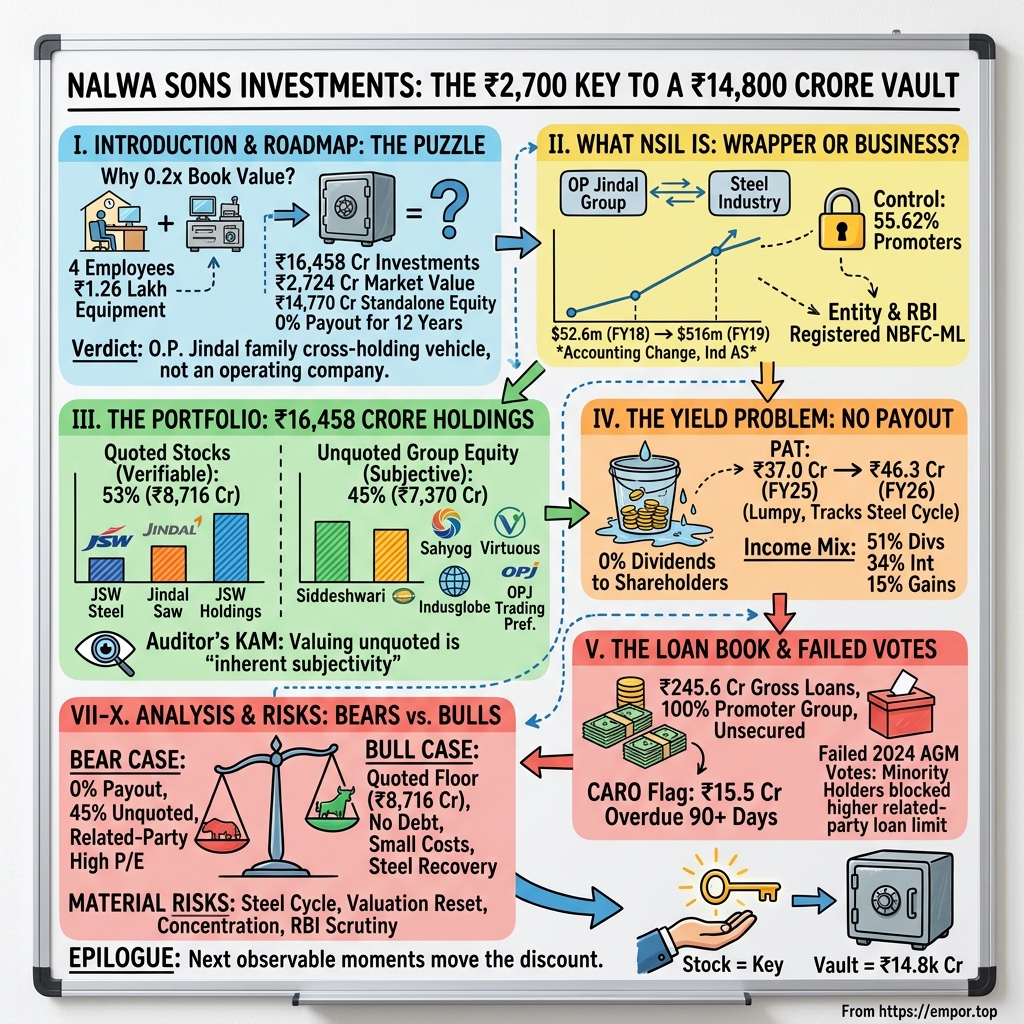
Nalwa Sons Investments: The ₹2,700 Crore Key to a ₹14,800 Crore Vault
I. Introduction & Episode Roadmap
Picture an office with four permanent employees in it1. There are three whole-time key managers and one general staff member. The furniture, computers and fittings, everything a fixed-asset register would count, are carried at about ₹1.26 lakh1. That is less than the price of a mid-range motorcycle in India.
On the same balance sheet, the company owns investments carried at roughly ₹16,458 crore1. That is more than ten thousand crore rupees per employee. It owns millions of shares of JSW Steel and Jindal Saw, a stake in JSW Holdings, and large blocks of private companies whose names most Indian investors have never heard. It has no borrowings to speak of1. It has not paid a dividend in any of the twelve years on record.
This is Nalwa Sons Investments Limited, ticker NSIL on the National Stock Exchange. On 1 October 2026 the market valued the whole company at about ₹2,724 crore, at a share price of ₹5,3002. Its standalone shareholders' equity at 31 March 2026 was about ₹14,770 crore1. Buy every share, and on paper you pay about 18 paise for each rupee of book value.
That is the puzzle at the centre of this story. Why does the market value a debt-free company with no operating business, whose assets are mostly the shares of other companies, at about one-fifth of its book?
The short answer, which the rest of this story tests, is that NSIL is not really a company in the usual sense. It is a cross-holding vehicle for the O.P. Jindal family's group stakes, and its own annual report says its prospects depend on the O.P. Jindal group and the steel industry1. Buying NSIL stock does not buy the vault. It buys a key, and the question is whether that key opens anything.
A lender with no customers
Formally, NSIL is a non-banking financial company registered with the Reserve Bank of India, in the "middle layer" of the RBI's scale-based rules, and it does not take deposits1. It is not a core investment company and has no holding company above it1.
That label sounds like a lender. In practice NSIL has no customers in the usual sense. Its "revenue" is three things: dividends from the companies it owns, interest on loans it has made to promoter-group companies, and gains on mutual-fund units1. There is no product, no pricing and no market share.
So the usual investor toolkit has to be put aside. The data providers compute debtor days, inventory days and a cash conversion cycle for NSIL, and the numbers swing from 5 days to almost 2,000 days. They are artefacts of dividing tiny receivables by tiny "revenue". Margins that jump from 123% to minus 400% from one quarter to the next say nothing about business quality. Even return on equity, 0.4%, is mostly a statement about how large the denominator has become.
Equity that is not earned capital
That denominator deserves a warning of its own. The equity on NSIL's balance sheet is largely mark-to-market value on stakes held "at fair value through other comprehensive income". Under Indian accounting standards, when JSW Steel's share price moves, NSIL's equity moves with it, and the change goes through a separate line below profit.
The scale of those swings makes reported profit look like a rounding error. In FY25, total comprehensive income was about +₹4,147 crore, against standalone profit of about ₹37 crore. In FY26 it was about −₹1,582 crore, against profit of about ₹46 crore13. One year's market moves were worth roughly a century of reported earnings.
So the $1.7 billion "equity" the data providers show is not capital the company built by retaining profits. It is the current market price of stakes the family put into this box decades ago, plus valuations of private holdcos that nobody trades.
Four questions
The story runs on four questions.
First: how much of the reported net worth is real and independently valued? Second: is profit growth coming from the investees, or from accounting? Third: is the loan book to promoter-group companies safe, and do minority holders have a voice? And fourth, the one that matters most for the stock: is the 0.2x price-to-book a discount that will close, or a fair price for assets minority holders cannot reach?
One housekeeping note before starting. NSIL's consolidated accounts include a small steel-trading business at its subsidiary Jindal Steel & Alloys, which booked about ₹20.2 crore of goods sold in FY261. It is real but immaterial to the investment case, and this story sets it aside. The economics live in the standalone balance sheet.
To understand why the vault exists at all, start with what NSIL is and how it came to look this way.
 Subscribe on LinkedIn
II. What NSIL Is, and How It Got Here
Most companies describe their prospects in terms of their products, markets or customers. NSIL describes its own in terms of somebody else's. Its directors write that the company's prospects depend on the O.P. Jindal group and on the steel industry13. It is an unusually candid sentence. It tells the reader that this is not a business with its own engine. It is a wrapper.
The family and the wrapper
The O.P. Jindal group grew from a steel-pipe business started by Om Prakash Jindal into one of India's largest industrial families. After his death in 2005 the group split into branches run by his sons: JSW under Sajjan Jindal, Jindal Steel & Power under Naveen Jindal, Jindal Saw under Prithviraj Jindal, and stainless steel under Ratan Jindal. Across all of those branches, family members and their investment companies hold stakes in one another.
NSIL is one of the places where those cross-holdings sit. Its biggest listed holdings are JSW Steel, Jindal Saw and JSW Holdings1. Its own shareholders, apart from the public, are a set of promoter-group entities, including companies in which NSIL itself owns large stakes (more on that circle in Section V).
Why keep listed stakes inside an RBI-registered finance company rather than holding them directly? The filings do not explain the family's reasoning. The practical effects are clear enough. The structure keeps the stakes under the voting control of a promoter block that owns 55.62% of NSIL1. It keeps them in a listed, ring-fenced vehicle whose own shares can be held by other family entities. And because NSIL is a registered NBFC, lending to group companies is part of its regular business rather than an exception that needs explaining.
The one inflection point
On the data providers' tables, NSIL's history has a single step-change. Shareholders' equity sits at about $50–57 million from FY15 to FY18. Then, in FY19, it jumps to about $516 million, nearly ten times as much. In the same year, net profit spikes to about $11.9 million, roughly six times the year before.
That jump looks like a deal. It was not. FY2018-19 was the year Indian NBFCs of NSIL's size moved from the old Indian accounting rules to Ind AS, which require equity stakes to be carried at fair value rather than at historical cost. Stakes bought decades earlier at old prices were restated at market value, and the balance sheet ballooned overnight. The FY19 profit spike sits in the same transition year and reads as a one-off; it is not repeated. Nothing about the underlying holdings or the family's control changed. The accounting lens changed.
This matters because the long-run growth numbers on the fact sheet inherit that break. Equity "compounding at 46% a year over ten years" is a measurement change, not a record of capital allocation. Revenue growing about 12.8% a year over ten years is closer to real, since dividends and interest are cash flows, but the revenue line is small and lumpy. Over the last three years, revenue has fallen about 9.4% a year and net profit about 15.7% a year on the fact sheet's consolidated figures.
Control has not moved
The regime behind the wrapper has been stable. The promoter group's 55.62% was unchanged between 31 March 2025 and 31 March 20261. The family has not sold down, and nobody has bid for the minority.
The group structure beneath NSIL is small. There are three subsidiaries, Jindal Steel & Alloys, Nalwa Trading and Brahmaputra Capital & Financial Services, and one associate, Jindal Equipment Leasing & Consultancy Services1. Together they barely register against the investment book.
A clean, frozen capital structure
NSIL has 51,36,163 shares of ₹10 each, and the count did not change in FY25 or FY2613. There was no buyback, rights issue, preferential allotment or employee stock option in FY25, and none is shown for FY2613. There are no term loans and no loans raised against pledged group shares1.
By the usual tests of balance-sheet strength, this is about as clean as it gets: no dilution, no leverage, no refinancing risk. The one item missing is an external credit opinion. NSIL has no credit rating, and its reports say none was required13. With no debt to rate, that is unsurprising, but it does mean nobody independent has ever been paid to look under the hood.
The frozen share count also means minority holders have had no event to vote on that would change their claim on the assets. That is the backdrop for what the assets actually are.
III. The Portfolio: What ₹16,458 Crore Actually Holds
Every year, NSIL's auditor, N.C. Aggarwal & Co., signs an unmodified opinion on the accounts3. But inside that clean opinion sits a paragraph that matters more to an investor than the opinion itself. The auditor names, as a key audit matter, the valuation of NSIL's unquoted investments. These are valued with "level 2" inputs, the auditor says, and they involve "inherent subjectivity"3.
That is the polite language of a professional telling you where to look. Roughly half the vault is priced by the stock market every day. The other half is priced by a valuation model.
The quoted half
Start with the part you can check on a phone. At 31 March 2026 NSIL held about 45.5 million shares of JSW Steel, carried at roughly ₹5,106 crore; about 107 million shares of Jindal Saw, at roughly ₹1,961 crore; and JSW Holdings at about ₹1,285 crore1. Quoted stakes at fair value total about ₹8,716 crore, about 53% of investments1.
This half is real in the sense that matters: a market price exists, and a buyer exists at that price, at least for a block of normal size. It is also concentrated. The core economic exposure is steel-sector equity in two names, JSW Steel and Jindal Saw, plus a listed holding company, JSW Holdings, which is itself a box of JSW group shares4. If steel stocks fall a third, NSIL's quoted half falls about a third, and nothing on the other side of the balance sheet offsets it.
The unquoted half
Now the harder half. About ₹7,370 crore, roughly 45% of investments, sits in unquoted promoter-group companies and preference shares1. The biggest names are Sahyog Holdings at about ₹1,846 crore, Virtuous Tradecorp at about ₹1,337 crore, Siddeshwari Tradex at about ₹1,248 crore and Indusglobe at about ₹845 crore. There is also about ₹1,352 crore of optionally convertible preference shares in OPJ Trading1.
What do these companies own? NSIL does not say. The natural guess is that they, too, are boxes of JSW and Jindal shares, since they are family investment companies. That is plausible, and it may be right. But the annual report does not confirm it, and NSIL does not publish their balance sheets. The reader is left with an inference, not a disclosure.
The valuations also move a lot. In FY26, Indusglobe fell from about ₹956 crore to ₹845 crore. Strata Multiventures halved, from about ₹128 crore to ₹63.5 crore. Sahyog rose from about ₹1,607 crore to ₹1,846 crore1. Double-digit moves in private holdcos are not proof of anything wrong; if those holdcos hold listed shares, their values should move with markets. But they show that this half of the book is not a stable number either.
A clue in the preference shares
The clearest hint of how soft these marks can be came in FY25. NSIL took a ₹34.4 crore non-cash loss from re-measuring non-convertible preference shares after their redemption date was pushed out by 20 years3.
Think about what that means. NSIL held a promise from a group company to repay capital on a date. The date moved two decades into the future. Under fair-value accounting, a rupee due in twenty years is worth much less today, so NSIL wrote the value down. The counterparty was within the same family orbit, and the extension was presumably agreed between parties under common influence. A minority shareholder had no say, and the cost showed up in NSIL's profit.
It was small against the vault. As a clue to how the group treats NSIL's claims, it is not small at all.
Equity in a falling year
The whole book moved down in FY26. Standalone equity fell about 9.7%, from about ₹16,352 crore to ₹14,770 crore, mainly as JSW Holdings and Jindal Saw stakes lost value1. And sitting against all those unrealised gains is a deferred tax liability of about ₹1,937 crore1. That is the tax NSIL would owe if it ever sold at those prices, which tells you the book value is, at best, a pre-tax number.
The auditor's record
On the specific reports for FY25 and FY26, the auditor's opinion was unmodified, with disputed tax demands and unquoted valuations named as key audit matters13. In FY25 the auditor reported that it had tested the valuations and found no differences beyond its threshold3. That is meaningful assurance on method. It is not assurance that a minority holder could realise these values.
The verdict on the vault
Roughly half the net worth is marked daily and verifiable, and that half alone is worth more than three times NSIL's market value. The other half is unquoted group equity, valued on a subjective basis, moving by double digits a year, and issued by entities the family controls on both sides. The claim that NSIL's net worth is "real" survives for the quoted half and is intact but unproven for the unquoted half. The look-through to JSW and Jindal stock is a reasonable inference that the filings do not confirm.
How this compares with other Indian holding companies is the obvious next question. Listed holdcos of promoter-group stakes in India, JSW Holdings among them, have long traded at large discounts to the value of what they hold45. NSIL's discount sits at the deep end of that tradition; Section VIII returns to why.
The vault is big. What does it actually pay out?
IV. The Yield Problem: A Dividend Machine That Barely Pays
In FY26, NSIL's dividend income fell 38%, from about ₹55.3 crore to ₹34.5 crore1. In a normal holding company, that would be the headline: the main recurring income stream shrank by more than a third. Yet NSIL's standalone profit rose that year, from about ₹37.0 crore to ₹46.3 crore1.
How does profit rise when the core income falls? That is the question this section answers. The short version is that FY25 was depressed by a one-off, and FY26 was flattered by gains that are not cash.
Three streams, one thin yield
Standalone revenue in FY26 was about ₹67.5 crore. Roughly half, ₹34.5 crore, came from dividends. About a third, ₹22.8 crore, was interest on loans to promoter-group companies. The remaining ₹10.2 crore, about 15%, was fair-value gains on mutual-fund units1.
Now put that against the vault. Dividend income was about 0.2% of the ₹16,458 crore investment book1. A savings account pays more than ten times as much. Even counting all revenue, NSIL earns well under half a percent on its assets.
Why so thin? Part of the answer is that the listed investees pay modest dividends relative to their share prices, and those payouts follow the steel cycle with a lag6[^7]. The larger part is that the unquoted half of the vault pays nothing visible. NSIL describes its dividend income only as coming from quoted equity instruments1. So about ₹7,370 crore of assets contribute no dividends to the profit line at all.
Why the quarterly numbers are noise
That income mix explains the wild quarterly figures. A quarter with a large dividend receipt shows a margin above 100%. A quarter with a fair-value loss, like March 2025, shows an operating margin of minus 400%. Neither tells you anything about how well the company is run, because there is almost nothing to run. Costs were about ₹5.4 crore for the whole of FY261. There is no capex, no R&D and no operating leverage story. Whatever comes in, minus a small fixed cost and tax, is profit.
Walking profit into cash
The more useful test is what arrives as cash. Standalone cash from operations was about ₹35.1 crore in FY26, about 76% of profit. A year earlier it was about ₹53.6 crore, about 145% of profit1.
The walk from profit to cash is simple once you separate the streams. Dividends arrive as cash. Mutual-fund gains, ₹10.2 crore in FY26, do not; they are marks on units still held. Interest is partly cash and partly accrual: NSIL received about ₹17.0 crore against ₹22.8 crore booked, so roughly ₹5.7 crore was recorded as income without cash arriving1. In FY25 the same gap was wider, about ₹18.1 crore received against ₹26.0 crore accrued1. Tax paid was about ₹14.6 crore1.
So FY26's profit rise is partly cosmetic. Strip out the non-cash gains and the uncollected interest, and the cash earnings fell with dividends. Look back three years, and standalone profit was about ₹46.4 crore in FY24 against ₹46.3 crore in FY261. In rupees, NSIL's earnings have gone nowhere.
The persistent gap between interest booked and interest received deserves a pause. These are loans to related parties, repayable on demand. If the borrowers were paying on time, cash and accrual should match. They do not, and the gap recurs. It is a small number, but it points straight at the loan book, which is the subject of the next section.
What the price implies
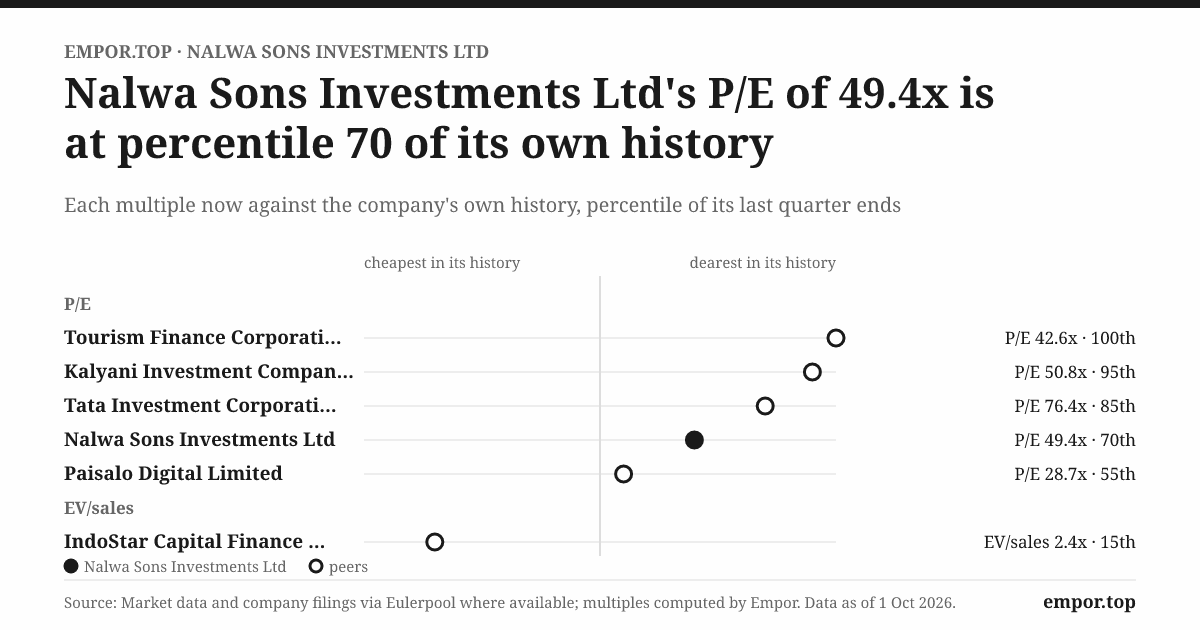
At a P/E of about 49x, against its own five-year median of about 29x, NSIL's earnings yield is about 2.0%2. Free cash flow yield is about 1.6%. For a company whose earnings are flat over three years and lumpy within them, that is a rich multiple of profit. It is only cheap if you price the assets, not the earnings. The earning power simply does not support the price; the vault does, if minorities can reach it.
Where the cash goes
The closest thing NSIL has to M&A is buying more group securities. Purchases of investments were about ₹60.3 crore in FY26 and ₹52.9 crore in FY25, against sales of about ₹10.8 crore and ₹10.5 crore1. FY26 purchases were larger than the ₹35.1 crore of operating cash. The gap was met by running down fixed deposits by about ₹16.8 crore and by loan repayments1.
So when cash arrives, it is not paid out. It is redeployed into more group securities, through a schedule that does not name the counterparties in the cash-flow statement. For a minority shareholder, the money trail ends inside the family's own portfolio.
The verdict: profit is lumpy and tracks a few investees' payout decisions, with a steel-cycle lag. FY26's improvement was partly accounting. Whether the underlying earning power is stabilising or shrinking stays open until FY27 dividends from JSW Steel and Jindal Saw arrive. In the meantime, the one place NSIL earns contractual income, the loan book, is where the governance questions start.
V. The Loan Book and the Votes That Failed
On 30 September 2024, NSIL's shareholders gathered, virtually, for the 53rd annual general meeting. On the agenda were requests that would have been routine at many Indian family companies. The board sought approval for unsecured loans of ₹75 crore each to two promoter-group entities, JSL Limited and Virtuous Tradecorp. It also sought to raise its Section 186 limit, the statutory ceiling on loans and investments, to ₹1,500 crore3.
The resolutions failed. They "did not receive the requisite majority", and the company did not proceed3.
Related-party resolutions under Indian law require approval from shareholders who are not interested in the transaction, which in practice means the minority. On that day, the minority said no. It is the single clearest moment in NSIL's recent history where the people who do not control the company constrained the people who do. The annual report records the outcome without the vote percentages; those sit in the scrutiniser's report filed with the exchanges25.
What is already lent
To see why the minority balked, look at what was already on the book. At 31 March 2026, NSIL had about ₹245.6 crore of gross loans outstanding. Every rupee was to "promoters (including promoter group)", and every loan was repayable on demand1. The RBI disclosure table classifies all the net loans as unsecured lending to companies in the same group1.
The borrowers are not named. About ₹141.1 crore, roughly 57% of the book, is due from group companies that have accumulated losses1. Management's answer is that these borrowers hold quoted or marketable securities sufficient to cover the exposure, and that it is "confident of recovering" the loans "as and when called for"1. That is a claim, not a disclosure. The securities, their value and whether they are pledged to NSIL are not shown.
The CARO flags in plain English
India's Companies (Auditor's Report) Order, known as CARO, makes auditors answer a checklist of specific questions. Two of NSIL's answers matter.
The first concerns overdue loans. About ₹15.5 crore has been overdue for more than 90 days, and the auditor reports that "reasonable steps" have been taken for recovery1. The striking thing is that the figure, ₹1,552.15 lakh, is identical in FY25 and FY2613. The same money has been overdue for at least two years.
The second flag records that 100% of loans are to the promoter group1. CARO also notes that the wider group contains seven core investment companies1, a reminder of how many boxes sit inside boxes.
Is the book deteriorating?
Here the evidence cuts both ways. NSIL holds an impairment allowance of about ₹16.4 crore, about 6.7% of gross loans, and provides 0.40% on standard assets, above the RBI minimum1. The provision is roughly equal to the overdue balance, which suggests the problem loans are largely provided for. The overdue figure has not grown. Other receivables are trivial at about ₹52 lakh1.
So this is not a book that is visibly getting worse. It is a book that is opaque, unsecured, concentrated in loss-making affiliates, and dependent on the borrowers' own investments for repayment. The recurring gap between interest accrued and interest received hints at slow payment. The fair reading: losses are contained today, but a minority holder has no way to check the collateral behind the claim.
The circle
Now the part that makes NSIL unusual even among Indian family holdcos. The entities that own NSIL are also entities NSIL owns.
Siddeshwari Tradex holds about 13.51% of NSIL; NSIL holds about ₹1,248 crore of Siddeshwari. Virtuous Tradecorp, OPJ Trading and Genova Multisolutions each hold about 11.12% of NSIL; NSIL holds about ₹1,337 crore of Virtuous, ₹1,352 crore of OPJ preference shares and ₹18 crore of Genova1. JSL Limited holds 2.35% and JSW Holdings 0.49%, and NSIL holds shares in both1.
Draw it on a whiteboard and you get a circle. Money and votes flow round it, and the family sits at every node. A large part of NSIL's "net worth" is, in effect, a claim on companies whose own main asset may be NSIL's shares and similar group stakes. That does not make the values fictional. It does make them hard to realise for anyone outside the circle.
The disclosure does not help. NSIL's related-party note under Ind AS 24 lists only its subsidiaries, its associate and key managers1. It does not list the promoter-group holdcos that borrow from NSIL or own its shares, and it shows no interest income by counterparty. For FY26, the board states there were no material related-party transactions under Section 188(1)1. Pricing is described only as "arm's length"3. Every major asset on the balance sheet is a group transaction in substance, and the related-party note describes almost none of them.
Smaller details, sized down
Two governance items are worth a sentence each. NSIL pays lease rent of about ₹5.04 lakh a year to the CFO's spouse1: trivial in money, notable in principle. And a late disclosure under SEBI's takeover regulations led to a secretarial-audit qualification, settled by a SEBI order of 13 March 2025, with ₹3,04,500 paid by Urvi Jindal and no impact on the company37.
Credit evidence and contingencies
With no rating, the only credit evidence is asset cover. NSIL has essentially no debt, and its equity is close to its total assets, so creditors, of whom there are almost none, are safe1. Contingent tax liabilities of about ₹7.3 crore relate to AY 2004-05, now at the Supreme Court, and AY 2016-17, before the Commissioner (Appeals)13. Nothing has been paid on them, and they are small against net worth.
The verdict on this section: the loan book is not deteriorating, but it is unsecured, unnamed and circular, and its health depends on affiliates' own investments. The 2024 votes narrow the governance worry. The system worked once, when the minority had the right to say no. It does not remove the worry, because most of what matters, the existing loans, the valuations, the cross-holdings, never comes to a minority vote at all.
Which raises the question of who sits at the controls.
VI. Who Runs It, and Who Gets Paid
The notice for NSIL's 55th AGM, held on 30 September 2026, carried a special resolution about one man. It proposed re-appointing Mahender Kumar Goel as whole-time director for five years from 30 November 2026, with annual fixed pay of up to ₹36 lakh, capped at 5% of net profit, and with approval to continue beyond the age of 701.
That ceiling is about 2.3 times his FY26 pay of ₹15.60 lakh1. In percentage terms it sounds dramatic. In rupees it is small change against a ₹46 crore profit line, let alone a ₹14,770 crore balance sheet.
A tiny payroll
Goel is the company's sole whole-time director. He received ₹15.60 lakh in FY26, a 19% increase, though the related-party note shows a lower salary figure of ₹10.52 lakh because the two disclosures count different components1. CFO Deepak Garg, in the post since 17 October 2017, was paid ₹31.30 lakh, up about 10%; the company secretary was paid ₹10.67 lakh1. No bonuses are disclosed.
The former Executive Director and CEO, Rakesh Kumar Garg, left on 31 August 2023, having been paid about ₹36 lakh in his last full year1. Goel became whole-time director on 30 November 2023, and no CEO has been named since1. The proposed ₹36 lakh ceiling, notably, matches roughly what the departed CEO drew.
The lesson from the pay table is that salary is not where the incentive problem lives. Nobody running NSIL gets rich from NSIL's payroll. The incentive that matters is the promoter family's control of the capital, and its interest in keeping that capital where it is.
The board
NSIL has three independent directors, Thind, Shrivastava and Bhargava, and two non-independent directors1. In 2024, independent director R.P. Jindal retired in September and Nrender Garg left in November3. Earlier in 2026, shareholders re-appointed Thind and Shrivastava for second five-year terms by postal ballot1. Two of the three independents are therefore long-tenured, which tends to weigh against fresh challenge, though it is common in Indian boards.
Ownership: a block and a trustee
The promoter group holds 2,856,490 shares, 55.62%, spread across family investment companies and operating group firms, including JSW Organics at 2.50%, Jindal Power at 2.42% and JSL Limited at 2.35%, alongside the four holdcos in the circle1. The only public holder above 5% is Vistra ITCL (India), at 9.46%, up slightly from 9.40%1. Vistra is a trustee; NSIL does not identify the beneficiaries behind it. The exchange shareholding pattern is where FII and DII trends show up5.
The implication is arithmetic. With 55.62% held by the promoter group, the minority is about 44%, and a meaningful slice of that sits with a single trustee account. On ordinary resolutions, the promoter wins. On related-party resolutions, where interested parties cannot vote, the minority decides, and a concentrated minority holder can be decisive.
Credibility without a track record
How do you judge management credibility at a company that never speaks? NSIL holds no earnings calls, gives no guidance and has no investor presentations. Its dividend policy says dividends may be paid "if surplus funds" exist3. With no promises, there are no broken promises; with no targets, nothing to miss. Credibility on capital allocation is therefore unprovable, and has to be read from annual reports, AGM votes and filings.
What the record shows: a CEO role vacant for three years; a payout of zero for twelve years despite a cash surplus large enough to buy group securities every year; a request for more group lending that the minority refused. That is a pattern of a vehicle run for the stability of the controlling block. It is not a record of malfeasance either. The secretarial issue was the family's, not the company's, and the auditor's opinion is clean.
The voting results of the 55th AGM, including the Goel re-appointment, are due in the exchange filings within two working days of the meeting25. They will show whether the minority's 2024 mood has hardened or faded.
The activist's stress test
Imagine an activist with 10% of NSIL. What would they demand?
A dividend, first. NSIL earns about ₹35 crore a year in cash and pays none. Even paying out half would establish that minority holders receive something.
Second, a buyback or unwinding of the cross-holdings. If NSIL bought back the shares held by Siddeshwari, Virtuous, OPJ and Genova, paying in the shares of those same holdcos it already owns, the circle would shrink and remaining holders would own more of the vault directly.
Third, a merger or simplification of the holdcos, so that NSIL's shareholders look through to JSW Steel and Jindal Saw shares rather than to private boxes.
Why has none of this happened? Because each idea would move value from a structure the family controls to shareholders it does not. The family has no reason to volunteer, and minority holders have no lever beyond the related-party vote. The 2024 votes show that lever exists. They also show its limit: it can block new money going in, but it cannot force old money out.
That tension is where the lessons begin.
VII. Playbook: Business & Investing Lessons
On NSIL's balance sheet sits a deferred tax liability of about ₹1,937 crore1. It is a tax on gains nobody has realised, on shares nobody plans to sell. In its own quiet way it is the perfect emblem of this company: a large, precise number attached to an event that, under the current owners, may never happen.
Here is what NSIL teaches.
"A discount to book is not a margin of safety if the control block never has to sell."
The value investor's reflex is to see 0.2x book and reach for the word "safety". But safety comes from a mechanism that forces value to the surface: a payout, a liquidation, a takeover, a lender's demand. NSIL has none of them. No debt means no creditor will ever force a sale. A 55.62% promoter block means no hostile bid. Twelve years at a 0% payout means no stream of cash to collect while you wait. A discount without a catalyst is not a margin of safety. It is a waiting room with no clock on the wall.
"When the owners sit on both sides of the cross-holding, the balance sheet is a claim, not a cheque."
NSIL owns over ₹3,900 crore of Siddeshwari, Virtuous and OPJ securities; those same entities own over a third of NSIL1. On paper, both sides have value. In practice, neither side can cash its claim without the other's consent, and the same family gives that consent on both sides. For founders and investors anywhere, the wider lesson is that circular ownership turns assets into promises, and promises held between related parties are worth what the controller decides they are worth.
"Read the vote, not the brochure."
NSIL publishes no brochure; there are no investor presentations to read. What it does publish is the outcome of shareholder votes, and on 30 September 2024 that outcome said more about the company than any management narrative could. The minority refused ₹150 crore of new unsecured lending to the promoter group and a much higher ceiling on loans and investments3. In companies like this, the AGM results page is the earnings call.
"Mark-to-market is not earnings."
In FY25, NSIL's comprehensive income swung by about ₹4,147 crore while a single re-dated preference share cost it ₹34.4 crore of real reported profit13. The giant number made no one richer in cash; the small one quietly showed that group counterparties can rewrite terms. Investors who read the comprehensive-income line as performance will misread every holding company they meet. The informative number is often the smallest one.
"A company with no debt can fall hard and still not break."
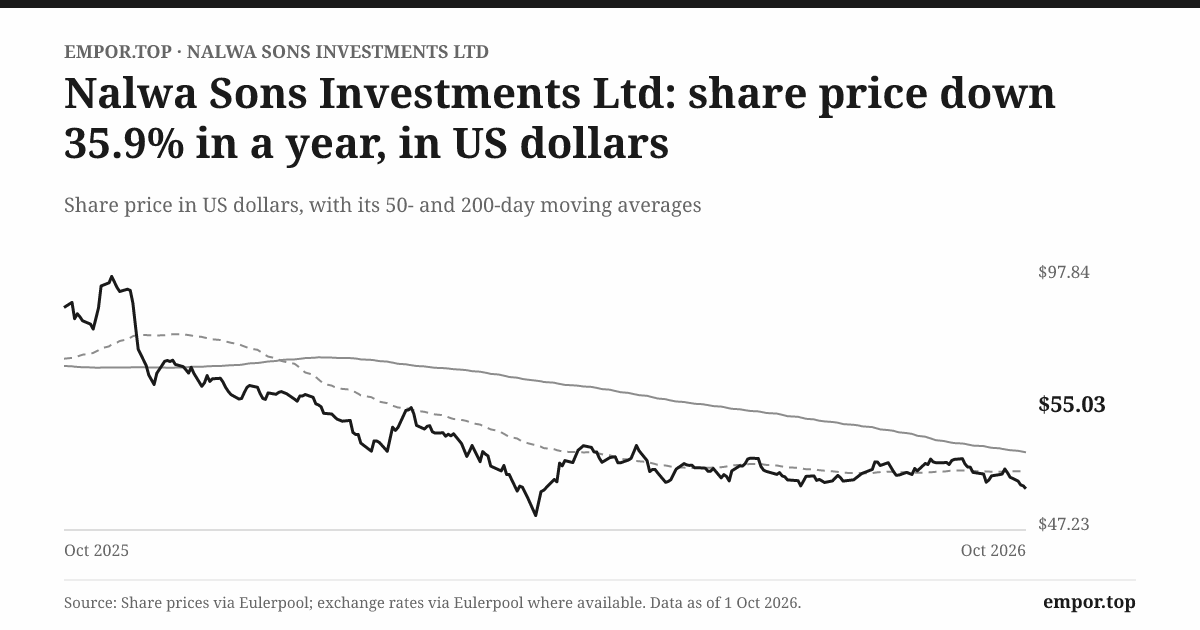
NSIL's shares have fallen as much as about 50% in five years, and sit about 37% below their 52-week high2. At no point was the company in any danger. That cuts both ways. It means the downside is about price, not survival. It also means nothing in the balance sheet will ever force the hand of the people who control it. Solvency and shareholder value are different things, and NSIL is a lesson in the space between them.
Lessons are about the past. The investment question is about whether any of this changes.
VIII. Analysis & Bear vs. Bull Case
Lay two ledgers side by side. On the left, the stock market's valuation of NSIL on 1 October 2026: about ₹2,724 crore2. On the right, NSIL's quoted stakes alone, at fair value on 31 March 2026: about ₹8,716 crore1. The right-hand number is about 3.2 times the left. And that is before counting a single rupee of the unquoted half, the loans or the cash.
So the market is saying something stronger than "the unquoted holdcos are worth less than book". It is saying that even the listed JSW Steel and Jindal Saw shares inside NSIL are worth, to an outside shareholder, about a third of what they would fetch on the exchange. Is that mispricing, or is that the fair price of a key that does not turn?
The bull case
The bull has a real floor. The quoted stakes alone exceed the market cap several times over, even after deducting the deferred tax that would fall due on a sale. There is no debt. Costs are about ₹5 crore a year, so almost every rupee of income reaches the bottom line. The share price sits about 37% below its 52-week high of ₹8,373, near the bottom of a range whose low was about ₹4,7312.
There are also plausible triggers. A recovery in the steel cycle would raise JSW Steel and Jindal Saw payouts6[^7], restoring dividend income toward FY25's level. The group could choose to simplify: a holdco merger, a cross-holding unwind or a first dividend would each begin to close the gap. And the 2024 votes prove that the minority, at least on lending, is not powerless.
The bear case
The bear's case is that the discount is not a mistake at all. The yield on the vault is about 0.2%. Return on equity is about 0.4%. The payout has been zero for twelve years. About 45% of the investment book is unquoted group equity on subjective marks. Dividend income fell 38% last year. More than half the loan book is to loss-making affiliates, unsecured and unnamed. Deferred tax of about ₹1,937 crore sits against the gains. And the controlling family sits on both sides of a cross-holding circle that turns much of the book into claims on itself.
Put simply: if minority holders receive almost nothing in cash, and have no way to force a distribution, then the present value of their claim depends on an event the controller has shown no interest in triggering. A large discount is the rational price of that uncertainty.
Moat, briefly, and why it does not apply
The usual frameworks have little to grip here. Porter's five forces describe competition for customers, and NSIL has none: no buyers to bargain, no suppliers, no substitutes, no rivals for its "product". Hamilton Helmer's seven powers ask what lets a business earn persistent returns above its cost of capital; NSIL earns well below any plausible cost of capital.
The one power that does apply is a "cornered resource", and it runs the wrong way. The promoter family's control of NSIL, through 55.62% of the votes and through the holdcos on both sides of the circle, is an asset that cannot be competed away. It ensures the vault stays shut. For the family, it is durable. For the minority, it is the moat around the vault, and they are on the outside of it.
The risks that matter, with mechanisms
Steel cycle and investee payouts: when steel prices fall, JSW Steel and Jindal Saw tend to cut dividends, and NSIL's main cash stream falls with a lag. FY26 already showed that.
Concentration: two listed stocks drive most of the quoted half. A sharp fall in either moves NSIL's book by thousands of crores and its market value with it.
Unquoted valuation reset: if the holdcos' marks are revised down, as Strata's halving and the FY25 preference-share write-down show can happen, book value falls without any market event.
Related-party loan impairment: if a loss-making borrower's securities fall, the "confident of recovery" claim weakens, and provisions rise.
Regulation: as an NBFC in the RBI's middle layer, NSIL is subject to scale-based rules on governance and concentration8. Whether tighter RBI scrutiny of group lending would force disclosure or limit related-party loans is an open question worth watching.
What to track
Three numbers carry the story.
First, dividends received from JSW Steel and Jindal Saw. The latest annual reading is about ₹34.5 crore, down 38% from about ₹55.3 crore1. This is NSIL's only recurring cash.
Second, the discount of market value to standalone net worth. Today the market cap is about 18% of book12. It has stayed deeply discounted through every market move on record.
Third, overdue loans against provisions: about ₹15.5 crore overdue against a ₹16.4 crore allowance, flat for two years1. A rise in the first without a matching rise in the second would be the earliest sign of trouble in the circle.
The verdict on the central question: the bull's floor is real, but the bear has explained the discount better than the bull has explained how it closes. On the record so far, the claim that NSIL is "a mispriced bargain" narrows to a smaller one: it is a cheap claim on steel assets whose value will reach minority holders only when, and if, the controlling family decides it should. That remains unproven either way until the group returns value to the minority.
IX. Epilogue
On the evening of 30 September 2026, NSIL's 55th AGM closed. The resolutions had been put; the e-votes were in; the scrutiniser was counting. As of 1 October 2026, the results were due on the exchanges within two working days25. For a company that speaks so rarely, those results are the next thing it will say.
Here is what to listen for, and what each answer would mean.
The first moment is the AGM itself. The Goel re-appointment was a special resolution needing three-quarters of votes cast1. The promoter block can carry most of the way, but not all of it. A comfortable pass means the minority sees the pay ceiling as the trivial matter it is. A narrow one, or a large "against" vote from the public, would say that the mood of 2024 has not faded, and that the minority is willing to use every vote it has.
The second moment is FY27 dividend season. JSW Steel and Jindal Saw set their payouts for the year6[^7], and those decisions will largely decide whether NSIL's dividend income recovers from ₹34.5 crore or falls further. The June 2026 quarter showed profit up about 3.5% on a year earlier2, a flat start that settles nothing.
The third moment would be the rarest: any disclosure that reaches inside the circle. Named borrowers, the holdcos' balance sheets, a payout, a buyback, a holdco merger, or any change in the 55.62% promoter stake. None has come in the years on record. Any one of them would begin to close the discount, because each would turn a claim into something closer to a cheque.
And there is a fourth moment that would test the system rather than the assets: a new request to lend to the promoter group. In 2024, the minority said no. If the board asks again, the vote will show whether that refusal was a one-off or a standing veto.
So the tension remains exactly where it was. The vault is full and its quoted half is verifiable. The key trades at a fraction of what the vault holds. And whether that key will ever turn depends less on steel prices than on decisions made in a room where minority shareholders do not sit.
X. Outro
Go back to that office: four permanent employees, about ₹1.26 lakh of furniture and computers, and more than ₹16,000 crore of investments on the books1. In most companies, the people do the work and the assets follow. At NSIL, the assets sit still and the people mostly keep the records.
The stock is a key priced at ₹2,700 crore to a vault valued at ₹14,800 crore. Every number in this story says the vault is real, at least in its quoted half. What no number says is who holds the other key. Until that answer changes, the discount is not a mistake waiting to be corrected. It is the price of standing outside the door.
References
-
Annual Report 2025-26 with 55th AGM notice — Nalwa Sons Investments Limited via NSE, 2026-09-05 ↩↩↩↩↩↩↩↩↩↩↩↩↩↩↩↩↩↩↩↩↩↩↩↩↩↩↩↩↩↩↩↩↩↩↩↩↩↩↩↩↩↩↩↩↩↩↩↩↩↩↩↩↩↩↩↩↩↩↩↩↩↩↩↩↩↩↩↩↩↩↩↩↩↩↩↩↩
-
NSIL quote and corporate announcements — NSE India ↩↩↩↩↩↩↩↩↩↩
-
Annual Report 2024-25 with 54th AGM notice — Nalwa Sons Investments Limited, 2025-09-03 ↩↩↩↩↩↩↩↩↩↩↩↩↩↩↩↩↩↩↩↩
-
NSIL shareholding pattern and corporate filings — BSE India (scrip 532256) ↩↩↩↩↩
 LinkedIn
 WhatsApp
 Reddit
 Hacker News
 Email
Email Kindle
 RSS Feed
 Spotify
 Apple Podcasts
 Amazon Music
 Audible
 YouTube