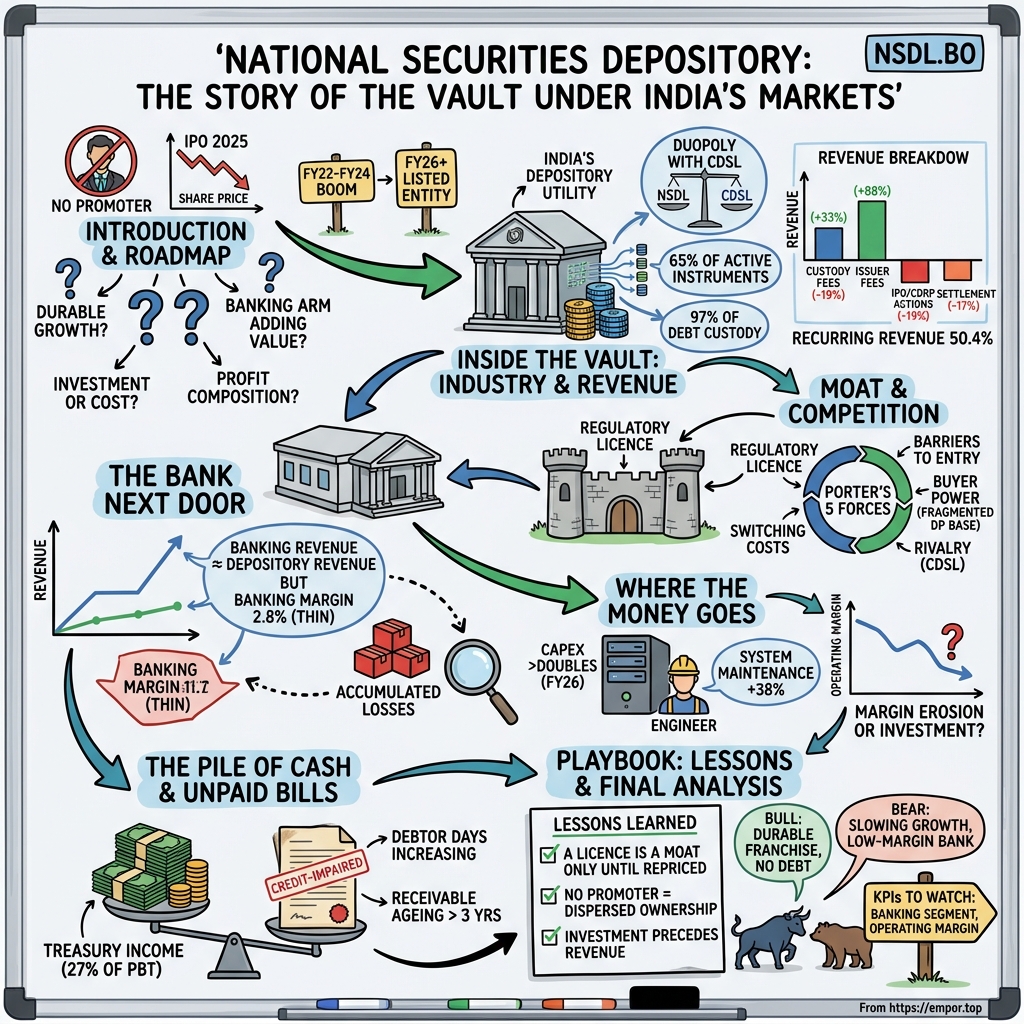
National Securities Depository: The Story of the Vault Under India's Markets
I. Introduction & Episode Roadmap (≈5 min)
On 6 August 2025, a company that holds almost every rupee of India's dematerialised debt and a majority of its listed instruments rang in its first day on the BSE.1 The offer price was ₹800 a share.1 The bankers had done their work, the book had been built, and the shares had found new owners. And yet National Securities Depository Limited, the company whose name was on the prospectus, did not receive a single rupee.
That is the strange first fact of this story. Every one of the 5,01,45,001 shares sold in the offer came from existing holders.1 It was a pure offer for sale: the National Stock Exchange, IDBI Bank, State Bank of India, HDFC Bank, Union Bank of India and the Administrator of the Specified Undertaking of the Unit Trust of India (SUUTI) were the ones selling.1 The sellers even picked up the bill. All ₹161.64 crore of IPO expenses were borne by the selling shareholders, not by the company.1
So the listing was not a capital-raising event. It was an exit, or more precisely a rebalancing, by institutions that had built and owned the depository for nearly three decades. When the dust settled, all 20 crore shares of NSDL were classified as "Public."1 There is no promoter. The prospectus says plainly that the company has no identifiable promoter under Indian securities or company law.2
At the offer price, those 20 crore shares implied a value of roughly ₹16,000 crore. Fourteen months later, the stock trades a little below that, at about ₹753, for a market value of roughly ₹15,000 crore.3 Which raises the question this episode is built around: why is a company with no promoter, no IPO proceeds and no borrowings worth that much, and does the price make sense?
Start with what a depository actually is. Before the late 1990s, owning an Indian share meant owning a piece of paper. Certificates were printed, posted, signed, stamped, lost, forged and occasionally eaten by termites. A depository replaced the paper with a ledger entry. Today, when an investor opens a "demat account" with a broker or bank, the shares in it are not sitting with the broker. They are recorded electronically at one of two places: NSDL or its younger rival, Central Depository Services (India) Limited, better known as CDSL. The broker is just a "depository participant," a front desk that connects the investor to the vault.
That makes NSDL one of the quiet load-bearing walls of Indian capitalism. It does not trade, lend or advise. It records who owns what, moves ownership when trades settle, processes dividends and corporate actions, and sends the consolidated account statements that land in millions of inboxes each month. When it works, nobody notices. If it ever stopped, the market would stop with it.
But a vault is not automatically a great business, and the listed NSDL is not only a vault. It also owns a payments bank that now earns more revenue than the depository itself. So this story turns on four questions.
First, is the depository's own growth durable after the boom years of FY22 to FY24, or was it a market-cycle sugar high? Second, is the banking arm adding value, or has the group's growth simply moved into a low-margin business? Third, is the sharp step-up in technology and people costs an investment that will pay back, or the start of margin erosion? And fourth, how much of reported profit is really treasury income and receivable accounting rather than fees for service?
The answers begin with a curious fact about who owns this company, and why the rules forced the owners to sell.
 Subscribe on LinkedIn
II. Why India Has Two Vaults: Origins and Ownership in One Breath (≈7 min)
Picture the boardroom arithmetic in the months before the listing. IDBI Bank owned 26.10% of NSDL. The National Stock Exchange owned 24.00%.1 Together, two institutions held half of a company that sits at the heart of India's market plumbing. Then the regulator's rulebook came into play: no single shareholder may own more than 15% of a market infrastructure institution, or MII, the category that covers exchanges, clearing corporations and depositories.2
That cap is why the listing happened the way it did. By 31 March 2026, IDBI Bank was down to 14.99% and NSE to exactly 15.00%.1 HDFC Bank had trimmed to 6.95% and SUUTI to 5.12%, with SBI at 3.00% and Union Bank at 2.56% still among the top ten.1 The offer for sale was, in effect, a compliance exercise dressed as an IPO.
A short origin story. The roots go back to the Depositories Act of 1996, which made electronic holding of securities legal in India and created the framework for paperless settlement. NSDL was the first depository, sponsored by IDBI, the Unit Trust of India and the National Stock Exchange, the three pillars of India's post-liberalisation financial architecture. CDSL followed, promoted by the BSE. That is why India has two vaults: the country's two major exchanges each sponsored a depository, and the regulator has kept both alive ever since. The history matters for one reason only. The structure that exists today, two regulated depositories competing for the same brokers and issuers, was a policy choice made a generation ago, and it can be revisited by policy.
Ownership after the sell-down. By June 2026, NSDL had 8.94 million shareholders.3 Domestic institutions held about 38%, foreign institutions about 12%, and the broad public about 51%.3 The board is led by Public Interest Directors, independent members chosen under the regulator's governance norms for market institutions.1
Is dispersed ownership good or bad? Both. For a utility that must treat every broker and issuer even-handedly, independence from any one shareholder is a feature. An exchange that owned 24% of the depository serving its competitor's investors was always an awkward arrangement. But dispersed ownership has a cost too. No owner has the concentrated incentive a founder or promoter has to push growth, challenge costs or demand better returns on idle cash. Nobody is in charge in the way an owner is in charge.
Related parties are small. In companies with powerful sponsors, the first question is whether the sponsors extract value through transactions. Here, the answer is reassuringly dull. In FY26, NSE paid NSDL just ₹0.80 crore in transaction fees, and IDBI Bank about ₹0.50 crore, plus small custody and operational fees.1 Together these are well under 1% of revenue. The money flows the other way, if anything: NSDL had ₹77.75 crore of fixed deposits with IDBI at the end of FY26, more than double the prior year, earning ₹2.47 crore of interest.1 NSDL is a depositor at its shareholder bank, not a borrower.
Dividends to the two big holders were ₹6 crore each in FY26.1 That is the full extent of what they take out each year beyond their share of the market value.
So the ownership puzzle resolves cleanly: no controlling shareholder, no meaningful related-party leakage, and a board built for neutrality. What that structure cannot tell an investor is whether the business underneath is growing. For that, the story has to go inside the vault and watch the fee meter run.
III. Inside the Vault: Industry Structure and How the Fee Meter Runs (≈20 min)
A 24-year-old in Pune downloads a fintech trading app on a Sunday evening. Within twenty minutes, after a video verification and an e-signature, she has a demat account. She buys a few shares of an index ETF and a sliver of a recently listed company. She never hears the name NSDL. But from that moment, the depository's meter starts running in several directions at once.
Someone pays for the custody of her holdings. Someone pays each time a security moves in or out of her account. The company whose shares she bought pays an annual fee to have its securities admitted. If that company declares a dividend or a bonus, or holds a shareholder vote, there is a fee for processing it. If she receives a consolidated account statement, there is a fee for that too. Each line is priced differently, and each responds to a different force in the market.
The two-player map. India has exactly two depositories. NSDL is the older and, by value, by far the larger. It holds 65.27% of active instruments across the two depositories and about 97% of the value of debt securities in custody.2 That debt dominance is the quiet crown jewel: corporate bonds, commercial paper and much of the institutional fixed-income world sit in NSDL. CDSL, by contrast, built its strength among retail accounts, riding the fintech brokers that onboarded millions of first-time investors after 2020. By March 2025, NSDL had 39.45 million active accounts, up from 35.77 million a year earlier, served through 294 depository participants, and 79,773 issuers against 46,015 the year before.2
The issuer number deserves a pause. It nearly doubled in a year, and the reason is regulatory: unlisted public and private companies have been pushed to dematerialise their securities. Each new issuer is a new source of annual fees. That is a tailwind created by rule-making, not by the market cycle.
The fee meter, line by line. Standalone FY26 revenue was ₹704.71 crore, up 13.9%.1 Here is where it came from, told as a story rather than a ledger.
The biggest line, by far, is custody. Custody fees were ₹312.36 crore, up 33%, about 44% of revenue.1 This is the vault rent: what is charged for holding securities, largely billed to issuers and participants. It grows with the number and value of holdings and with the number of issuers, and it does not depend much on whether markets are busy on any given day.
Next come transaction fees of ₹142.47 crore, up 17%, charged as securities move between accounts.1 Then the cyclical pair. Corporate actions and IPO fees fell 19% to ₹87.01 crore, and settlement fees fell 17% to ₹55.99 crore.1 These depend on how many companies list and raise money, and on how much trading flows through settlement. FY26 was a year when both cooled.
Smaller lines fill in the picture. E-voting, which runs shareholder votes, and consolidated account statements each grew about 5%.1 Annual fees from issuers jumped 88% to ₹32.29 crore, the dematerialisation push showing up in cash.1 Software licences remain a rounding error.
The mix shift is the story. Put those lines together and a pattern appears. Revenue recognised "over time," the accountants' term for recurring service income, was 50.4% of FY26 revenue, against 42.2% a year earlier.1 Half the depository's income is now rent-like rather than event-like. That is the bullish reading of FY26: the boring lines carried the year while the exciting ones shrank.
But it also means FY26 growth of 13.9% was achieved despite, not because of, market activity. And here a crucial question cannot be answered from the outside. NSDL does not disclose whether custody growth came from higher tariffs, more holdings, rising holding values or new issuers. The difference matters enormously. Volume growth is earned. Rate growth is granted, and anything granted by a regulatory environment can be taken back.
The long view: a boom, then a glide. Zoom out to the consolidated group and the trajectory becomes clear. Revenue grew about 63% in FY22 and 34% in FY23, the years when India's retail investor base exploded.3 Then growth slowed to about 24%, 12% and finally 7.7% in FY26.3 Over six years, profit compounded at about 20% a year.3 Standalone profit in FY26 grew 12.1%, a little behind revenue.1
The verdict on durability, then, is narrower than "durable growth." It is "recurring but slowing." The depository has shifted toward rent-like income, which reduces cyclicality. But its growth rate has drifted down toward the low teens, below its own six-year base rate, and the lines that delivered the boom years are now subtracting. Management has not published a view on whether the cyclical profit pool has peaked, so investors must infer it from the quarterly fee mix.
Who pays, and how much power do they have? The customers here are mostly the depository participants and issuers. Concentration is low and falling. The top five participants were 12.35% of depository revenue in FY25, down from 13.65% in FY23, and the top ten were 15.15%, down from 17.55%.2 No single participant is above 10%.
There is a twist, though. The prospectus says fintech-led brokers now account for about 70% of market share in broking.2 That is a claim about the broking industry, not NSDL's customer base, but it signals who the big participants of the future will be: a handful of large, technology-native brokers who can negotiate harder and who choose which depository to route new accounts to. Low concentration today does not guarantee low buyer power tomorrow.
Where growth gets tested: cash collection. One last clue sits in the receivables. NSDL offers a 30-day credit period and charges 12% interest after that.1 Debtor days, however, rose to about 41 from about 33.3 Customers are paying later than the contract says, a theme the story returns to in section VIII.
So the vault's own engine is sound but cooling, with rent growing and events shrinking. That raises the question every investor in a duopoly must ask: what, exactly, protects it?
IV. The Moat Question: What Protects a Regulated Duopoly? (≈10 min)
Imagine trying to start a third depository in India tomorrow. The first meeting is not with customers. It is with the regulator. A depository needs a licence, years of approvals, capital, connection to every exchange and clearing corporation, and the trust of hundreds of brokers and tens of thousands of issuers. Then it needs investors to move holdings, which almost no investor would do voluntarily. This is the core of NSDL's moat, and it is worth arguing once, here, properly.
Porter's five forces, applied.
Barriers to entry are very high. The regulator sets the rules, licenses the players and has not admitted a third depository since CDSL. Entry is a policy decision, not a market one.
Buyer power is low but shifting. The participant base is fragmented, with the top ten at about 15% of revenue and falling.2 But the rise of a few large fintech brokers means the most important buyers are concentrating at the industry level even as NSDL's concentration falls.
Supplier power sits mainly with technology vendors. System repairs and maintenance, at ₹89.77 crore, is the single largest cost line.1 A depository is, in the end, a very reliable database, and the people who build and maintain it have leverage.
Substitutes are essentially absent for the regulated function. Technology change, including blockchain-style ledgers that are periodically pitched as replacements, does not remove the legal requirement for a regulated depository; it changes how the ledger is built.
Rivalry is a two-player game with CDSL, fought on service quality, onboarding ease and relationships with brokers and issuers, within a fee environment shaped by the regulator.
Hamilton Helmer's 7 Powers, applied. Switching costs are real. An issuer that has admitted securities, or an institution holding a debt portfolio, faces friction and risk in moving. Scale economies matter too: a depository's costs are largely fixed, so each extra account and issuer is high-margin, and NSDL's 97% share of debt custody gives it scale in a segment CDSL barely contests.2 Cornered resource is better described as a regulatory licence than a unique asset, which makes it powerful but revocable. Network economies exist only weakly, through the links with exchanges and participants. Counter-positioning, branding and process power are not meaningful here.
Testing the moat against its own history. The strongest test of a moat is whether the business keeps share and price when someone tries to take them. The share test is mixed. NSDL's dominance by value and in debt is overwhelming. But in the retail account race of FY21 to FY24, CDSL, not NSDL, captured the majority of new accounts, because the fintech brokers mostly routed there. NSDL does not publish its share of new accounts, which is the single best measure of competitive momentum in the retail segment.
The price test is the more troubling one. NSDL does not disclose the pricing history of its custody tariffs or whether custody growth came from rate or volume. A business whose largest revenue line is set in a regulated environment has pricing power only to the extent the regulator allows. Fee circulars issued by the regulator are the break point: a single rule change on custody charges, or a push toward uniform investor-friendly pricing, could reprice the biggest line overnight.
The verdict. The moat is intact but unproven on pricing power. It rests on switching costs, regulation and debt-market scale, and falling participant concentration strengthens it. The mechanisms that could break it are visible: a third entrant licensed under new market-infrastructure norms, a regulatory reset of tariffs, or a shift of new retail flows that leaves NSDL holding the institutional and debt book while CDSL owns the growth. None of those has happened. The KPI that would confirm or weaken the moat is custody fee growth set against any change in the regulator's tariff rules.
The peer yardstick. CDSL, listed for years, is the natural comparison for valuation and returns, and investors should hold NSDL's multiples against CDSL's before drawing conclusions about relative value. The structural contrast is clear even without the numbers: CDSL is a purer depository, while NSDL carries a bank. And that bank is where the story turns next.
V. The Bank Next Door: A Second Business at Half the Revenue and a Fraction of the Margin (≈14 min)
In the June 2026 quarter, NSDL's consolidated revenue jumped 65.6% to about ₹517 crore.4 For a company whose depository business grows in the low teens, that is a startling number. Then look at the bottom line: consolidated net profit rose only about 10%, to about ₹98 crore.4 Revenue up two-thirds, profit up a tenth. That gap is the whole story of NSDL's second business.
Two companies wearing one name. It matters, every time, to say which NSDL is being discussed. The standalone company is the depository: FY26 revenue of ₹704.71 crore, up 13.9%.1 The consolidated group adds two subsidiaries. NSDL Database Management Limited, or DMS, is wholly owned and earned ₹78.48 crore of revenue.1 And NSDL Payments Bank, 95.05% owned since FY26, earned ₹746.79 crore.1 Consolidated FY26 revenue was ₹1,529.96 crore, up just 7.7%.1
Read that again. The bank now produces more revenue than the depository. It is the largest revenue line in the group.
What the bank does. A payments bank in India is a licensed, limited bank: it can take deposits up to a cap and offer payment services, but it cannot make loans. NSDL Payments Bank earns transaction-linked income from UPI merchant acquiring, micro-ATM services, remittances and deposits.1 Think of it as a toll operator on India's digital payment highways, collecting thin fees on enormous volumes.
Thin is the operative word. In FY26, the banking segment's revenue grew just 3.7%, and its segment result, the closest proxy for operating profit, was ₹20.57 crore.1 That is a margin of about 2.8%. For comparison, the depository earns a profit margin above 50%.1 The year before, the bank's segment result was ₹3.73 crore.1 So the bank's profit did rise sharply, but from almost nothing to very little. Its costs sit inside consolidated "other expenses" of ₹896.34 crore, most of which is the pass-through cost of running payments.1 The prospectus also flagged that the payments bank carried accumulated losses.2
Is growth being created, or just relocated? The bull case for the bank is simple: it gives NSDL a second engine in the fastest-growing part of Indian finance, digital payments, and its segment result rose more than fivefold in a year. The bear case is that the revenue is low quality. Payments acquiring is a scale game with fierce competition from large banks and fintech platforms, and the economics of UPI, which is largely free for consumers, leave little for intermediaries.
The June 2026 quarter's revenue surge almost certainly came from the bank, because the standalone depository grew only about 13%.4 NSDL has not explained in segment detail what drove the bank's jump. Until the September and December 2026 quarters show whether the bank's segment result grows faster than its revenue, the honest verdict is that this is an execution question, not optionality. Optionality would mean a cheap option with big upside. A business already larger than the parent by revenue, earning under 3%, is not an option. It is a bet already placed.
Capital allocation: modest, and without a scorecard. The parent's investment in its subsidiaries stood at ₹221.05 crore, and its 20% stake in India International Bullion Holding IFSC, a bullion exchange venture, at ₹50 crore.1 These sums are small against a treasury of more than ₹2,300 crore. NSDL has made no acquisitions, and there is no market benchmark against which to judge whether these investments were well priced, so neither a "disciplined" nor a "wasteful" label is earned yet. Inter-company flows are tiny: the bank paid the parent ₹0.21 crore and charged it ₹0.64 crore.1 The parent has made no loans or guarantees to subsidiaries.1
In FY26, the bank brought in outside shareholders for the first time, raising ₹29.47 crore for a 4.95% stake.1 That implies a valuation for the whole bank of roughly ₹600 crore, a useful reference point, though a small private placement is a thin basis for a fair price.
The cash trap. Here is a subtle point that matters for anyone reading the consolidated cash-flow statement. Consolidated cash from operations was ₹713.49 crore in FY26, almost double consolidated profit of ₹380.01 crore.1 That looks like superb cash generation. But a large part of it, ₹355.87 crore, came from a rise in "other financial liabilities."1 For a group that includes a bank, that line most plausibly reflects customer balances and payables in the payments business. That cash belongs to the bank's customers, not to NSDL's shareholders. An investor who capitalises consolidated cash flow as if it were owner earnings would be counting other people's money.
Dilution at the bank. The payments bank has an employee stock option pool of 90 lakh options, of which 25.44 lakh were granted in FY26.1 As those vest and are exercised, the parent's 95.05% stake will drift lower. It is a small leak, but in a business whose value is uncertain, it is worth watching.
The quiet subsidiary. DMS, the database-management arm, is the opposite of the bank: small, profitable and generous, paying the parent a dividend of ₹18.32 crore in FY26.1
So the bank is real, large and barely profitable. Meanwhile, back at the vault, costs have begun rising faster than revenue. The question is whether that is the price of building a better vault.
VI. Where the Money Goes: Investment or Margin Erosion? (≈12 min)
Every market infrastructure company has a nightmare scenario. It is a morning when the system does not come up. Trades executed the day before cannot settle. Dividends cannot be credited. Brokers cannot move client securities. Phones ring at the regulator. For a depository holding the bulk of a country's debt market, an outage is not a business inconvenience; it is a systemic event. That nightmare is the backdrop to the biggest change in NSDL's cost structure in years.
The capex step-up. In FY26, standalone capital expenditure more than doubled, to ₹109.60 crore from ₹46.95 crore.1 As a share of revenue, it rose from about 8% to about 16%. Amortisation of intangible assets, mainly software, rose from about ₹5 crore to about ₹12 crore.1 The system repairs and maintenance bill rose 38% to ₹89.77 crore.1
NSDL describes this spending in broad terms as systems and technology, without detailing the platform being built or its expected payback. The most reasonable reading is a technology platform renewal: modernising core depository systems, adding capacity for a much larger investor base, and hardening cyber and operational resilience. Those are legitimate needs. A depository designed for a market of a few crore accounts is being asked to serve a market many times larger, with real-time expectations that did not exist when the original systems were built.
The people step-up. Employee costs rose 33% to ₹116.73 crore, lifting their share of revenue from about 14% to about 17%.1 NSDL had 549 permanent employees at the end of March 2026.1 Part of the increase reflects a new leadership team and the cost of attracting technology talent, which in India's market for engineers is not cheap.
What FY26 shows, and what the latest quarter shows. Here is the reassuring part. Despite all this, the standalone profit margin barely moved in FY26, slipping to 51.2% from 52.0%.1 Treasury income and the fee mix absorbed the step-up. The cost wave arrived, and the margin held.
Then came the June 2026 quarter. Technology costs in the depository business rose 53.8% year on year, and the standalone operating margin fell from about 49.7% to about 43.8%.4 Standalone net profit rose only 7.9%, on revenue growth of about 13%.4 For the first time, costs visibly outran revenue.
Investment or erosion? The honest answer is that one quarter cannot settle it. The case for "investment" is strong in principle: a depository that underinvests in resilience risks a catastrophic outage, and the spending looks like a deliberate, front-loaded platform build. The case for "erosion" is that the revenue lines that would justify the spending are themselves slowing, and no target for operating margin, technology spend or payback period has been published. Without a stated destination, shareholders have no way to tell a build phase from a permanently higher cost base.
The KPIs that will decide it are two: standalone operating margin and technology cost as a share of revenue, read over the next four quarters. If revenue catches up and the margin recovers toward the high 40s, FY26 to FY27 will look like an investment cycle. If the margin settles in the low 40s while growth stays in the low teens, the step-up will have been a reset.
And whether the spending proves wise depends heavily on the people approving it, a team that is, almost entirely, new.
VII. The New Team: Who Is Running the Vault? (≈8 min)
On 31 August 2024, Padmaja Chunduru left the corner office at NSDL.1 She had steered the company through the run-up to its listing. Three months later, on 28 November 2024, Vijay Chandok arrived as managing director and chief executive.1
Chandok came from a long career in Indian financial services, most prominently at ICICI Bank and as head of ICICI Securities, one of the country's largest brokers. That background matters. He has sat on the other side of the depository relationship, as the head of a large participant. He knows what brokers want from a depository, which is speed, reliability and price, and he knows how fintech competitors changed the economics of broking. He also inherited a company in the middle of a listing process, a technology rebuild and a bank that had not yet proven itself. A new chief financial officer, Jigar Shah, completed the top team.1
Pay, put in proportion. Chandok's FY26 pay was ₹3.08 crore, 23.39 times the median employee.1 That increase looks enormous in percentage terms, up about 283%, but it compares a full year with a part year.1 The CFO's pay rose about 1,695% to ₹93.98 lakh, a jump the company does not explain beyond the change in role and timing.1 Across key managerial personnel, short-term pay rose 45% to ₹4.76 crore, while median employee pay rose about 13% and standalone profit rose about 12%.1
The absolute numbers are modest for a company earning more than ₹360 crore of standalone profit. On these figures, pay is not a governance problem. What is missing is any disclosed link between pay and performance. NSDL does not disclose a long-term incentive plan tied to shareholder returns, margins or growth for its top team, and the executives have no disclosed large shareholdings. In a company with no promoter, that is a meaningful gap: the people running the business are paid like professional managers of a utility, which is precisely what they are.
The board. The chairman, Parveen Kumar Gupta, is a Public Interest Director, as are four other directors.1 Two directors, Sriram Krishnan and Sanjay Panicker, are non-independent.1 The board has been turning over: Dr Shashank Saksena joined on 6 February 2026 and Dr Madhu Sudan Sahoo left on 17 April 2026.1 Directors' sitting fees were ₹1.70 crore.1 Shareholder voting on the MD's pay at the 2026 annual meeting, and the regulator's approval of it, are the next governance data points.
The auditor's view. K C Mehta & Co LLP gave an unmodified opinion on the FY26 accounts, with key audit matters on investments and IT controls and no exceptions.1 The auditor's statutory checklist for FY26 reported no fraud, no whistle-blower complaints and no doubt about the company's ability to continue as a going concern.1 For a single year's audit, that is a clean bill.
Can the team be judged? Not yet. Chandok has one full financial year behind him. There is no record of guidance set and met, because NSDL does not give numerical guidance. The capital allocation record is short and conservative: no acquisitions, and a dividend that doubled to ₹40 crore in FY26, roughly 11% of profit.1 That last number is where a skeptical shareholder would start asking questions, because the company is sitting on a very large pile of money.
VIII. The Pile of Cash and the Pile of Unpaid Bills (≈10 min)
Open NSDL's standalone balance sheet and two very different piles sit side by side.
The first is large and orderly: about ₹2,337 crore of financial assets.1 Of that, about ₹1,257 crore is in debt instruments, about ₹416 crore in mutual funds, and about ₹260 crore in bank balances and cash, with the rest in subsidiaries and the associate.1
The second is smaller and messier: ₹36.83 crore of credit-impaired receivables, of which ₹26.93 crore is more than three years overdue.1 Unpaid bills that old are rarely collected.
Both piles shape reported profit, and the fourth question of this story is how much.
The treasury. Standalone other income was ₹130.42 crore in FY26, about 27% of profit before tax.1 Roughly a quarter of what NSDL earns before tax comes not from running the vault but from investing the cash the vault has accumulated. The return on that portfolio was about 6.9%.1
Look closer and the quality of the treasury income varies. Interest on long-term investments was ₹84.11 crore, steady and real.1 The subsidiary dividend from DMS was ₹18.32 crore.1 And mutual-fund gains were ₹22.98 crore, but only ₹2.99 crore of that was actually realised; the rest is a mark-to-market gain that will reverse if bond or equity markets turn.1
The debt book also includes perpetual bonds issued by SBI, REC and others.1 Perpetual bonds pay higher yields because they carry more risk: they have no maturity date, the issuer can choose whether to call them, and in bank capital structures they can absorb losses before senior debt. NSDL's annual report does not discuss those risks. It is not an alarm, because the issuers are strong state-linked institutions, but a market utility holding loss-absorbing bank capital instruments is a detail worth knowing.
Profit into cash. Does the profit turn into cash? Standalone, yes. Over FY25 and FY26 combined, cash from operations was about ₹679 crore against profit of about ₹682 crore, a conversion of roughly 100%.1 In FY26 alone it was about 89%, with tax paid of ₹109.02 crore running ahead of the current tax charge of ₹96.77 crore.1 Interest and investment gains are moved into the investing section of the cash-flow statement, as they should be. Standalone cash conversion is credible. The consolidated figures, as section V showed, are a different matter.
The receivables. Gross trade receivables were flat at about ₹149 crore.1 But the ageing is lengthening. Performing balances overdue by six months to a year rose to ₹42.63 crore from ₹31.23 crore, and those overdue by one to two years nearly doubled to ₹20.61 crore.1 Receivables turnover fell to about 7 times from about 8.1
There is a story behind the provisions. In FY25, NSDL booked about ₹23 crore of expected credit loss provisions, a real charge against profit.1 In FY26, it wrote off ₹20.20 crore of bad debts and reversed ₹23.48 crore of earlier provisions, so the net profit effect in FY26 was only about ₹5 crore.1 The FY25 provisioning was genuine, and FY26's write-offs largely settled it. No profit was manufactured from the reversal. But the growth of performing balances aged beyond six months, against a 30-day contract, says customers are slow to pay, and that will need watching.
Contingent liabilities: small but old. The largest single dispute is a service-tax demand of ₹52.36 crore covering FY05 to FY09, relating to depository participant services and pending in the Supreme Court; ₹32.33 crore has already been paid under protest.1 Income-tax demands total ₹64.12 crore, mostly for assessment years 2016-17 and 2018-19.1 With a small GST matter, the total is about ₹118 crore, against standalone equity of about ₹2,488 crore.1 In FY25, NSDL also paid ₹18.70 crore of "settlement charges" within rates and taxes, and the company does not explain their nature.1
What is not a risk. NSDL has no borrowings; standalone lease liabilities were just ₹1.54 crore.1 Overseas revenue was 0.16% of the total, and the company reports no foreign exchange exposure.1 Share capital has been unchanged at ₹40 crore, with no GDRs, warrants or convertibles.1 The balance sheet is strong on every measure of leverage and dilution.
The verdict. About a quarter of profit is treasury income, and a slice of that is unrealised. Receivables carry a recurring, manageable ageing problem. Neither undermines the conclusion that NSDL's profits are real and cash-backed. But they do mean that an investor paying a fee-business multiple for the whole profit stream is paying that multiple for bond coupons as well. Which brings the story to the lessons a vault without an owner can teach.
IX. Playbook: Business & Investing Lessons (≈6 min)
1. A licence is a moat only until the regulator reprices it. NSDL's custody line grew a third in FY26 and now carries nearly half the depository's revenue. It is the strongest line in the business and the most exposed, because its price lives inside a rulebook someone else writes. The lesson for investors in any regulated utility: separate the growth the market gave from the growth the regulator allowed. Only one of them compounds safely.
2. When the cash isn't yours, don't count it. NSDL's consolidated cash flow nearly doubled its profit in FY26, and a large part of that came from money the payments bank holds for its customers. A bank inside a utility turns the cash-flow statement into a hall of mirrors. The rule: before multiplying any cash figure, ask whose cash it is.
3. Utilities earn their margin in the boring lines. In the same year that IPO fees fell nearly a fifth and settlement fees fell almost as much, custody and issuer fees carried the depository to double-digit growth. The headlines were about IPO frenzies; the profit was in rent. For a market utility, the dullest line on the fee schedule is usually the most valuable one.
4. No promoter means no one to blame, and no one to push. NSDL's listing was engineered by a 15% ownership cap, and it left behind a company owned by everyone and controlled by no one. That is perfect for neutrality and imperfect for urgency. The investor's question in an ownerless company is always the same: who is fighting for the shareholder in the room where the treasury policy and the dividend are set?
5. Investment shows up in the cost line before it shows up in revenue. In the June 2026 quarter, technology costs jumped by more than half and the depository's margin slipped six points. Whether that is a dip before a better vault or the new normal will be visible in the cost line long before it appears in revenue. Investors who judge a build cycle by a single quarter usually judge it wrong in either direction.
X. Analysis & Bull vs. Bear Case (≈8 min)
Fourteen months after a listing priced at ₹800, NSDL trades at about ₹753.3 The original buyers are slightly underwater. At that price, the market values the company at about ₹15,000 crore, roughly 39 times earnings and about 6.4 times book value.3 The company earns a return on equity of about 16% and a return on capital employed of about 22%, and its dividend yields about 0.5%.3
What does that price assume? A 39 times multiple is what investors pay for a durable franchise that will compound earnings in the mid-teens or better for a long time. The evidence supports the franchise. It does not yet support the compounding. NSDL has no trading history before August 2025, so there is no own-history multiple to compare, and CDSL's valuation is the yardstick investors will use to decide whether NSDL's debt dominance or CDSL's retail momentum deserves the richer price.
The bull case. NSDL is half of a regulated duopoly, holding about two-thirds of active instruments and nearly all of India's debt custody. It has no debt. Half its depository revenue is recurring rent, and the rent lines are growing fast. Customer concentration is low and falling. The audit and governance record for FY26 is clean. The dematerialisation of unlisted companies is a regulatory tailwind that keeps adding issuers. And the payments bank, which earned almost nothing a year earlier, has started to show a profit.
The bear case. Consolidated growth has slowed from about 63% to under 8% in four years. The cyclical fee lines are shrinking. The cost base is stepping up, and the latest quarter showed profit growth of about 10% on revenue growth of about 66%. The group's largest business by revenue earns a 2.8% margin. About 27% of standalone profit before tax is treasury income. Receivables are ageing. And the biggest revenue line lives at the mercy of a regulator's fee circular.
The activist's stress test. Imagine a skeptical long-term holder writing to the board. The letter would ask three questions. Why does a ₹2,300 crore treasury earn about 7%, in a company valued at 39 times earnings, when returning more of it would lift returns on equity? Why is the payout only about 11% of profit for a business with no debt and limited reinvestment needs? And why consolidate a 2.8%-margin payments bank into a high-margin utility, when the bank's revenue swamps the reported growth rate and its customer balances distort the cash-flow statement? These are fair questions, and none of them has a published answer.
The KPIs to watch. Two numbers will decide which case prevails. First, the standalone operating margin, last read at about 43.8% in the June 2026 quarter, down from about 49.7%, and moving the wrong way.4 Second, the banking segment's result set against its revenue, last read at a 2.8% margin for FY26, up from about 0.5%.1
The risk radar. Four risks are material. A regulatory change to tariffs could reprice custody overnight. A cyber incident or operational outage could do lasting damage to a utility whose only product is trust. A prolonged market slowdown would keep shrinking the IPO and settlement lines. And the bank could fail to scale its margin, leaving the group with a large, low-return business it cannot easily exit.
XI. Epilogue (≈4 min)
Tonight, NSDL stands at a junction. The vault is healthy, the bank is big, and the costs are rising. Over the next year, a handful of moments will decide which way the story bends.
The first comes with the September 2026 and December 2026 quarterly results, when the banking segment's figures will show whether the June quarter's revenue surge carried profit with it. If the bank's segment result grows faster than its revenue, the second business starts to look like a second engine. If revenue keeps surging while profit stays flat, the bank is a volume business with a utility's balance sheet behind it.
The second is the four-quarter path of the depository's operating margin. If revenue catches up with the technology build and the margin moves back toward its old level, the cost step-up will look like the investment management implied. If the margin sticks in the low 40s, investors will have to reprice the vault as a lower-margin, higher-spending utility.
The third is FY27's custody and issuer-fee growth, read alongside any fee circular from the regulator. Continued growth without a tariff change would be the first real evidence that custody growth is earned by volume. A tariff cut would test the moat in public.
The fourth is the record of Vijay Chandok's first full years: whether the team sets targets, explains misses and returns more of the treasury to shareholders. And the fifth is ownership. With NSE and IDBI sitting at the 15% cap and a largely institutional shareholder base, any large sales by those holders would be a quiet signal of what the insiders of India's financial system think the vault is worth.
The tension that remains is simple to state. NSDL is a toll road whose traffic rises and falls with the market, and whose newest lane, the payments bank, carries the most cars and earns almost nothing per car.
XII. Outro (≈2 min)
On listing day in August 2025, the institutions that built India's first depository sold their shares at ₹800 each, paid the bankers out of their own proceeds, and walked away lighter. The company that holds almost every Indian investor's securities, the ledger beneath the bonds, the shares and the IPO allotments, received nothing from the sale. It did not need to. It had no debt, a vault full of cash and a fee meter that runs every day the market opens.
The vault was always the business. The open question, the one the next few quarters will answer, is whether the bank next door becomes a second vault, or is just a bigger building.
References
-
NSDL Annual Report 2025-26 — National Securities Depository Limited, 2026-08 ↩↩↩↩↩↩↩↩↩↩↩↩↩↩↩↩↩↩↩↩↩↩↩↩↩↩↩↩↩↩↩↩↩↩↩↩↩↩↩↩↩↩↩↩↩↩↩↩↩↩↩↩↩↩↩↩↩↩↩↩↩↩↩↩↩↩↩↩↩↩↩↩↩↩↩↩↩↩↩↩↩↩↩↩
-
Red Herring Prospectus — National Securities Depository Limited (Axis Capital copy), 2025-07-23 ↩↩↩↩↩↩↩↩↩
-
National Securities Depository Ltd share price and financials — Screener ↩↩↩↩↩↩↩↩↩↩
 LinkedIn
 WhatsApp
 Reddit
 Hacker News
 Email
Email Kindle
 RSS Feed
 Spotify
 Apple Podcasts
 Amazon Music
 Audible
 YouTube