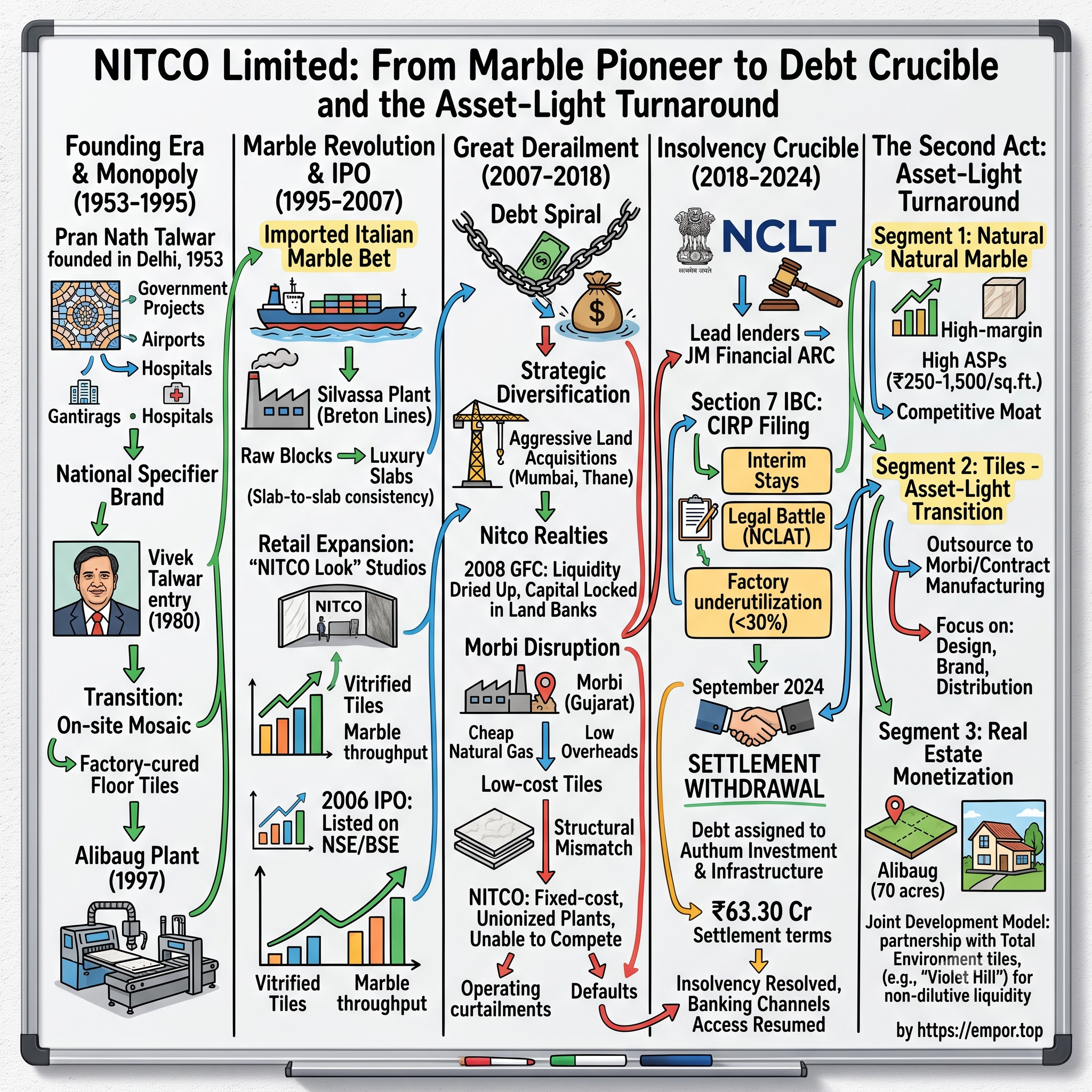
NITCO Limited: From Marble Pioneer to Debt Crucible and the Asset-Light Turnaround
I. Introduction & Episode Roadmap
On September 27, 2024, a bench of the National Company Law Tribunal in Mumbai spent a few minutes concluding a matter that had hung over a seventy-year-old Indian building-materials brand for nearly two years. Company Petition (IB)/1308(MB)2022 — an application under Section 7 of the Insolvency and Bankruptcy Code seeking to initiate corporate insolvency resolution against NITCO Limited — was disposed of as withdrawn, alongside all pending interlocutory applications.56 No resolution professional was appointed, no committee of creditors was formed, and no statutory 330-day clock ever began ticking. The petition had remained at the pre-admission stage throughout its two-year lifecycle.6
That procedural distinction is critical. NITCO is often characterized as a business that entered insolvency proceedings and successfully restructured. In reality, it stood at the threshold of the process while lenders evaluated their options, and formal admission never occurred. The eventual resolution came through a secondary debt acquisition rather than a court-supervised settlement: in April 2024, JM Financial Asset Reconstruction Company assigned NITCO's entire distressed debt portfolio — spanning underlying securities, corporate guarantees, and lender rights — to Authum Investment & Infrastructure Limited, a special-situations non-banking financial company.6 Authum subsequently executed a comprehensive debt-for-equity swap, converting ₹1,037.81 crore of unsustainable debt into 11.25 crore newly issued equity shares at ₹92.25 each. That transaction gave Authum an equity stake of roughly 50%, after which it provided fresh liquidity, stepping in as both NITCO's principal shareholder and its core working-capital financier.513
The operating enterprise that emerged from that balance-sheet restructuring presents a distinct analytical case. Publicly traded under the ticker NITCO on the National Stock Exchange and scrip code 532722 on the BSE,1920 the company manufactures and distributes floor and wall coverings across three primary segments: ceramic and vitrified tiles, processed natural marble, and mosaic. NITCO characterizes itself as the only player globally maintaining an operational footprint across all three product lines.1 Its distribution network comprises 15 regional sales offices, nine company-operated "Le Studio" flagship showrooms, 143 franchised retail outlets across India and Nepal, approximately 380 direct dealer accounts, 1,800 sub-dealers, and an export presence reaching more than forty international markets.1 For fiscal year 2026, NITCO posted revenue from operations of ₹539.71 crore, representing a 73% year-on-year increase, alongside a profit after tax of ₹34.22 crore, compared to a net loss of ₹736.22 crore in FY2025.9
A closer examination of those headline figures reveals an uneven earnings profile. The full-year net profit in FY2026 was driven almost entirely by a single transaction: in the June 2025 quarter, the company recorded a profit of ₹47.53 crore after booking ₹58.42 crore in revenue from a joint development agreement covering surplus land in Alibaug.1012 Over the remaining nine months of the fiscal year, profitability eroded, with a net profit of ₹1.00 crore in the second quarter followed by consecutive net losses of ₹11.90 crore and ₹7.73 crore in the third and fourth quarters.10 Excluding real-estate monetization, NITCO's core surfaces operations — encompassing its manufacturing assets, processing lines, and dealer channels — operated at an underlying loss throughout FY2026, followed by a consolidated net loss of ₹10.27 crore in the June 2026 quarter.11
The central question is therefore not whether NITCO avoided liquidation. Balance-sheet restructuring eliminated immediate default risk, lifting consolidated tangible net worth from negative ₹532.92 crore in March 2024 to positive ₹211.68 crore by March 2025.7 Rather, the challenge is whether a legacy brand that lost market share to Gujarat's low-cost manufacturing hub over the past fifteen years can generate an economic return above its cost of capital in surface materials — or whether its prevailing market capitalization of approximately ₹2,300 crore reflects an asset-monetization play operating under the mantle of a tile brand.16
Four structural themes define this evolution. The first is capital allocation: how an established premium specification brand leveraged its balance sheet to acquire real estate ahead of the 2008 global financial crisis. The second is cluster economics: how the rise of Morbi, Gujarat — with hundreds of agile, gas-fired, low-overhead tile producers — reset national production costs and left integrated legacy plants uncompetitive. The third is the prolonged workout cycle: Corporate Debt Restructuring in 2012, a handoff to an asset reconstruction company in 2018, facility revocation and an insolvency petition in 2022, and the eventual Authum debt-for-equity recapitalization. The fourth is the ongoing asset-light turnaround: outsourcing kiln-intensive tile manufacturing, focusing internal capital on brand equity, design, and marble processing, and monetizing surplus land holdings without re-entering commercial property development.
This account traces the company from its origins as a post-independence mosaic manufacturer, through its Italian marble expansion and 2006 initial public offering, into sustained financial distress, structural cluster competition, operating segment economics, and the strategic outlook for the restructured enterprise.
 Subscribe on LinkedIn
II. Founding Era & The Terrazzo Monopoly (1953–1995)
Consider the flooring problem of newly independent India. A country constructing airports, railway terminals, secretariats, and municipal hospitals required hard-wearing floors, yet primarily relied on cast-in-place terrazzo masons: crews that arrived on site with cement, marble chips, and grinding machines to pour and polish floors over several days. The resulting finish depended entirely on the skill of individual workers, cross-building consistency remained unpredictable, and standardized specifications did not exist.
Into that operational gap stepped Pran Nath Talwar. NITCO's corporate history traces the group's origins to 1953, when the Talwar family began manufacturing precast mosaic tiles in Delhi under the name The Northern India Tiles Corporation.13 A second partnership firm was established in 1964 at Thane, near Mumbai, and on July 25, 1966, Nitco Tiles Private Limited was incorporated to consolidate the manufacturing and marketing operations of both entities.34 The registered office was relocated from Delhi to Maharashtra in May 1973, and the company converted into a public limited entity in January 1996.34
A minor archival discrepancy illustrates the distinction between corporate heritage narratives and statutory records: the company's website dates the group's founding to 1953, statutory incorporation records date the operating entity to 1966, and credit rating agency Infomerics — writing in 2025 — describes NITCO as "established in 1966 by late Mr. Pran Nath Talwar."137 All three reflect defensible readings of the same timeline, underscoring how corporate heritage narratives and statutory legal filings often diverge in promoter-led Indian enterprises.
What the founding generation built was essentially a product substitution business. A factory-made mosaic tile solved the quality-control challenge inherent in cast-in-place terrazzo: it arrived on site pre-cured, dimensionally uniform, and matched to an approved sample. For a government architect designing a transit terminal or municipal secretariat, that consistency transformed an unpredictable on-site supervision task into a standardized purchase order. Once flooring became a specified line item, it opened the door to brand differentiation.
This dynamic created the institutional franchise NITCO leveraged for decades. The company spent forty years embedding its products into the specification habits of institutional architects, public-works departments, and commercial builders — the decision-makers who draft tender requirements and determine which materials satisfy "or equivalent" clauses. Specifier preference serves as a durable, if soft, operational asset. It takes years to establish and years to erode. However, it does not constitute a structural economic moat: it does not prevent competitors from targeting the same accounts, but merely raises their customer-acquisition hurdles.
Why a mosaic tile was a better business than it looks
While hydraulic-pressed cement and marble chips involved basic mechanical processes without modern roller kilns, glazes, or digital printing, the underlying unit economics were compelling.
A cast-in-place terrazzo contractor competed primarily on local labor costs with thin operating margins. In contrast, a factory-made mosaic tile manufacturer captured a premium through standardized batch consistency, a recognized national catalog, and the assurance that a sample approved in Mumbai would match shipments delivered across the country. Gross margins on factory tiles were structurally higher because institutional buyers were paying for risk mitigation rather than raw materials.
This dynamic reflects the economics of many durable building-materials franchises: a relatively simple manufactured product sold into a high-consequence construction decision. Flooring failures are costly to remediate once embedded in finished structures, creating an asymmetry that branded manufacturers can monetize.
This institutional orientation also explains why NITCO's commercial specification channel proved more significant than retail distribution for four decades. Institutional developers and public-works contractors order in bulk, repeat across project phases, and establish standard specifications that downstream contractors must fulfill. Securing a proprietary pattern within an institutional master specification converted individual transactions into recurring default orders.
However, that business model contained an inherent structural ceiling. Specifier preference is an operational tendency rather than an enforceable barrier. It delivers the highest pricing power when products are difficult to standardize — as mosaic was in the 1970s and imported natural marble remains today. It offers far less protection in commoditized, high-volume segments such as standard 600×600 mm vitrified ceramic tiles, where buyers can readily compare competing brands on a per-square-foot basis. NITCO's specifier franchise was strongest in product lines that would eventually mature, and least defensible in the ceramic segments poised for massive expansion.
During this period, Vivek Talwar, the founder's son, joined executive management; he continues to serve as Chairman and Managing Director.1 Management correctly anticipated that cast-in-place mosaic would gradually decline, replaced by factory-produced ceramic floor tiles at the volume end of the market and imported natural stone in premium architectural segments. NITCO elected to pursue both product categories simultaneously.
The expansion began with processing capabilities. The company established a marble processing facility at Kanjurmarg in Mumbai in 1984, followed in 1995 by the construction of a greenfield ceramic floor tile manufacturing plant at Alibaug in Maharashtra, which commenced commercial production in 1997.3 Located directly across the harbor from Mumbai, Alibaug offered immediate logistical access to the expanding western India construction corridor.
A continuous ceramic tile plant, however, introduces significant operating leverage. The core asset is a continuous roller kiln through which pressed clay bodies travel under high thermal loads. Thermal efficiency requires continuous operation, making fuel the dominant variable cost, while depreciation, plant maintenance, and labor remain largely fixed. Operated near full capacity with cost-effective gas supplies, a modern kiln generates strong cash flows; operated at low capacity utilization with rising energy costs and fixed overheads, it rapidly consumes operating capital. In 1997, that structural risk appeared manageable, but it would become a defining balance-sheet vulnerability two decades later.
By the mid-1990s, NITCO possessed a recognized brand name, an established institutional specifier network, an active marble processing division, and an integrated ceramic tile plant entering production, setting the stage for its subsequent capital-intensive expansion.
III. The Marble Revolution, Retail Expansion & The 2006 IPO (1995–2007)
At the turn of the millennium, India's natural stone trade remained highly fragmented and largely unorganized. Marble arrived in rough blocks, was sliced by local job-work saw operators, and was sold by unbranded traders who could rarely guarantee dimensional uniformity or visual consistency across successive slabs. Material wastage was high, pricing was subject to opaque negotiation, and retail buyers lacked standardized quality benchmarks.
NITCO recognized that this friction was an industrial manufacturing challenge masquerading as a trading issue. Rather than brokering unworked stone, the company moved to source rough blocks directly from quarries in Italy, Spain, Turkey, and Greece, transport them to dedicated processing facilities, and cut, resin-treat, reinforce, and polish them under factory controls—selling a standardized, branded architectural surface rather than generic raw slabs.
To execute that strategy, the company established a second marble processing unit at Silvassa in 2002, followed in 2010 by an automated processing facility equipped by Breton of Italy.3 The automated Breton installation functioned more like a precision manufacturing line than a traditional stoneyard: multi-blade gang saws sliced multi-tonne blocks into slabs of uniform thickness in a single pass, after which the slabs underwent vacuum-assisted resin impregnation to seal internal micro-fissures that otherwise cause breakage during transit and handling—a process NITCO marketed as Total Resin Treatment.5 Automated polishing lines then finished the surface to an even gloss, transforming a variable natural material into a product with precise industrial tolerances.
The commercial rationale was straightforward: natural marble is an experience good where structural defects often emerge only after installation, making standardized consistency a powerful source of pricing power. Demonstrating precision manufacturing became central to NITCO's marketing; its FY2025 annual report continued to detail the Silvassa plant's specific machinery assets—including Italian BM gang saws and Breton processing and polishing lines—because the underlying equipment is the value proposition.5
Alongside industrial processing came an expanded retail footprint. In major metropolitan markets, NITCO established company-operated showrooms under the "NITCO Look" banner, displaying tiles, marble, and mosaic borders integrated into fully styled room concepts. This was a deliberate push upmarket from volume wholesaling into architectural specification, serving as the direct forerunner to the company's modern "Le Studio" experience centers.1 The strategic logic was compelling: surface materials involve both aesthetic consumer choices and technical architect specifications, making experiential display centers far more effective at driving high-margin sales than traditional dealer catalogues.
Yet company-owned retail introduced substantial operating overhead. Flagship urban showrooms incurred prime commercial rents, absorbed working capital in slow-moving display inventory, and required specialized sales staff—creating significant fixed costs regardless of demand cycles. During industry upswings, these outlays functioned as brand equity investments; during downturns, they formed an unyielding cost structure layered over heavy manufacturing plants. NITCO ultimately carried both burdens simultaneously, explaining why its current retail model relies primarily on franchisees: out of approximately 152 branded outlets, only nine operate as company-owned Le Studio centers, while 143 function as franchised locations.1 Transitioning from owned storefronts to franchise partnerships mirrored the company's eventual shift from operating kilns to contract manufacturing—applying the same asset-light discipline across different operational divisions.
The IPO that priced perfection
NITCO's initial public offering opened for bidding on February 22, 2006, and closed on February 27, with the final prospectus dated March 6, 2006.4 The company issued 10,000,000 equity shares of ₹10 face value at ₹168 per share, raising ₹168 crore (₹1,680 million) and placing 44.9% of its post-issue equity capital in public hands.4 Book running lead managers included IL&FS Investsmart, Karvy, and UTI Bank, with UTI Bank also serving as the monitoring agency for the deployment of issue proceeds.4 Issue expenses totaled ₹11.74 crore (₹117.40 million), representing just under 7% of gross proceeds.4
The critical disclosures lay in the prospectus's "Basis of Issue Price" section, which captured the valuation dynamics of a late-cycle primary market.
At ₹168, the issue was priced at 27.36 times FY2005 earnings per share of ₹6.14 and 31.23 times its weighted-average historical EPS.4 The prospectus explicitly disclosed that the peer group average price-to-earnings ratio stood at 12.10, within a range of 7.80 to 16.40.4 NITCO was therefore priced at more than double the sector's average valuation multiple—and well above the peer group's highest multiple—even as it reported a return on net worth of 8.89% for FY2005 and a three-year weighted average of 8.62%.4 By contrast, peer data disclosed in the same filing showed market leader Kajaria Ceramics trading at 12.80 times earnings while delivering a return on net worth of 23.10%.4
In effect, the offering asked public investors to pay more than double the earnings multiple of the market leader for an enterprise generating roughly a third of that peer's return on equity. Net asset value stood at ₹69.09 per share prior to the issue and ₹112.43 post-issue, leaving the ₹168 issue price at a substantial premium to post-money book value.4 Long before external macroeconomic shocks emerged, the valuation demanded flawless execution across all capital-allocation decisions.
The prospectus outlined specific capital-expenditure targets for the proceeds: expanding ceramic floor tile capacity at Alibaug, acquiring or establishing a wall tile unit, and installing captive wind energy capacity.4 In October 2005, NITCO ordered six 1,250 kW Suzlon wind turbine generators for installation at Dhule in Maharashtra, budgeted at ₹6.31 crore (₹63.10 million) per turbine including land and civil infrastructure, to lower energy costs at its ceramic manufacturing plant.4 In total, ₹32.18 crore (₹321.81 million)—nearly a fifth of the net issue proceeds—was allocated to captive wind power.4
While mitigating power expenses represented defensible operating economics, deploying fresh equity capital into captive utilities absorbed funds that could have reinforced core distribution or product advantages. Over time, both assets unraveled: the wind turbines were eventually divested to Siva Green Energy India Private Limited, while the Alibaug tile plant they were built to power was written down and sold for scrap value.512
Notably, none of the 2006 IPO proceeds were earmarked for real estate. That balance-sheet expansion came immediately afterward—funded largely through debt.
IV. The Great Derailment: Real Estate Binge, Morbi Cluster & The Debt Spiral (2007–2018)
For an Indian industrial manufacturer owning historic land parcels across the Mumbai Metropolitan Region, property development often presents an alluring proposition. Supplying building materials to commercial developers means observing customers capture development margins that far exceed factory manufacturing returns. Having acquired legacy industrial plots decades earlier, manufacturers frequently ask why they should remain mere component suppliers rather than capturing real-estate upside directly.
NITCO pursued that logic directly. Nitco Realties was incorporated in 2007, and the company began assembling land holdings across Mumbai, Thane, and Alibaug. The financing structure proved fundamentally mismatched: long-gestation land acquisitions with multi-year payback horizons were funded through short- and medium-term bank borrowings requiring immediate debt service.
When the 2008 global financial crisis hit, developer liquidity evaporated, regulatory approvals stalled, and planned property projects failed to break ground. NITCO was left holding illiquid land parcels on which debt service compounded relentlessly. Real estate carried on leverage introduces distinct balance-sheet fragility: physical land does not mechanically depreciate or become obsolete, yet it continuously consumes cash flow as carrying costs accumulate against static book values.
Had real-estate leverage been an isolated miscalculation, NITCO might have absorbed the setback over time. However, the economics of its core manufacturing business were simultaneously being rewritten four hundred kilometres to the north.
What Morbi actually did
Morbi, located in the Saurashtra region of Gujarat, represents one of India's most consequential industrial manufacturing clusters. A government-supported cluster profile compiled under the Bureau of Energy Efficiency's SME programme recorded 459 operational ceramic units in the hub—comprising 178 wall tile, 52 floor tile, 26 vitrified tile, and 43 sanitaryware manufacturers—alongside 120 roofing tile units, collectively employing roughly 68,000 workers directly and producing approximately 5.28 million tonnes annually on a combined turnover of about ₹100 billion.17 That baseline captured the cluster in 2010–11; the region expanded substantially in subsequent years, establishing unorganized and regional producers in Morbi as the source for roughly half of India's total tile production.
The competitive threat stemmed directly from Morbi's structural cost advantage. A typical Morbi unit operated with localized clay supplies, access to piped natural gas and alternative fuels, promoter-led plant oversight, lean corporate overhead, and flexible production staffing. Crucially, access to production technology was democratized: specialized Italian machinery manufacturers sold identical continuous roller kilns and digital printing lines across the market. With capital equipment standardized, an independent entrepreneur in Morbi could establish a production line functionally equivalent to an integrated, publicly listed manufacturer while operating at a fraction of the corporate overhead.17
This established an unyielding cost-curve dynamic that integrated legacy plants struggled to counter. NITCO's Alibaug manufacturing plant carried the administrative overhead of a listed enterprise, unionized labor agreements, Maharashtra's industrial power and fuel tariffs, and the depreciation load of capital raised during its 2006 public offering. When low-cost Morbi volume flooded domestic distribution channels, wholesale tile realizations compressed nationwide, placing disproportionate margin pressure on legacy producers with high fixed costs per square metre.
NITCO's initial strategic response pointed in the right direction but proved insufficient in scale: in 2004 it began outsourcing vitrified tiles from China, and in 2006 signed a collaborative manufacturing agreement with Foshan Lungo Ceramics.3 Shifting from capital-heavy manufacturing to third-party sourcing anticipated the company's eventual operating model, but importing tiles introduced major foreign-exchange vulnerability as the Indian rupee depreciated sharply from late 2011.
The spiral
By 2011, working-capital pressure was compounding across multiple operating fronts. Regional dealers gained bargaining power from the proliferation of low-cost alternative suppliers, stretching out payment cycles. Meanwhile, imported natural marble—a high-ticket, slow-turning product line sensitive to architectural trends—absorbed substantial cash in holding inventory. As operating margins thinned, internal cash generation could no longer service the debt accumulated from land acquisitions and working-capital lines.
The mechanics of this working-capital pressure operated across three concurrent timelines. The first began when NITCO paid a European quarry for rough marble blocks, months before that stone was cut, polished, and displayed in a Mumbai showroom. The second began when it purchased gas and clay for the Alibaug kiln, weeks before finished tiles reached a regional warehouse. The third began when a dealer took delivery and deferred payment for sixty, ninety, or one hundred and twenty days. Between the initial cash outflow for raw materials and final cash collection from customers, the company funded the entire operating cycle with borrowed money.
When industry conditions deteriorated, each link in that chain tightened simultaneously. Morbi's low-cost volume compressed wholesale realization prices, eroding the operating margins required to service debt. Rupee depreciation raised the landed cost of imported marble blocks and Chinese tiles. Concurrently, regional dealers—now courted by dozens of alternative suppliers—stretched their credit terms. Every pressure point either extended the cash conversion cycle or squeezed unit spreads, compounding the need for short-term working-capital loans at escalating interest rates.
At that stage, management faced unpalatable trade-offs across every operating lever. Tightening dealer credit risked immediate market-share loss to aggressive competitors. Liquidating inventory threatened the in-stock availability that supported its premium specification brand. Running kilns at higher utilization to absorb fixed overheads generated unsold inventory that consumed additional warehouse capacity and working capital. The default response was to expand bank borrowings to bridge cash shortfalls, postponing structural adjustments while financial leverage mounted.
To address the deteriorating debt profile, lenders approved a Corporate Debt Restructuring (CDR) package in 2012.3 As India's primary pre-IBC debt workout framework, CDR allowed banks to collectively extend loan maturities, lower interest rates, and grant temporary moratoriums in exchange for promoter equity contributions and a turnaround plan. The workout provided immediate liquidity relief, but it did not resolve the fundamental operating challenge: an uncompetitive manufacturing cost structure paired with high carrying costs on non-income-generating land assets.
The prolonged distress culminated in a formal debt transfer. Commercial banks, seeking to remove non-performing exposures from their balance sheets, sold their loan portfolios. By 2018, JM Financial Asset Reconstruction Company had acquired 98% of NITCO's outstanding debt, representing an aggregate exposure of approximately ₹1,240 crore.8 On March 27, 2018, NITCO and JMFARC entered into a bilateral restructuring agreement.6 The capital structure established by that agreement included ₹50 crore of non-convertible debentures issued on February 28, 2018, carrying a 5% coupon with a bullet repayment in February 2028, alongside ₹150 crore of redeemable non-convertible preference shares issued on the same date at a 0.10% dividend rate.7
The operational covenants governing that restructuring fundamentally reshaped executive autonomy. Until the debt was resolved in full, NITCO was restricted from creating asset encumbrances, raising external debt outside the ordinary course of business, transferring fixed assets or corporate divisions, altering its board composition or shareholding structure, declaring dividends, or undertaking new capital expenditure without the ARC's prior written consent.7 Operating under those terms effectively placed the company in a contractual receivership. Constrained by creditor oversight, NITCO could neither deploy capital to defend distribution market share nor independently monetize real-estate holdings, leaving the enterprise locked in a defensive posture for the following six years.
V. The Insolvency Crucible: NCLT, JM Financial ARC, & The 2024 Settlement
The restructured facility required continuous debt service, but NITCO failed to meet its repayment obligations. On September 19, 2022, JMFARC revoked the restructuring framework for the existing facilities—excluding the non-convertible debenture and preference share tranches—and reinstated outstanding dues of ₹2,427.63 crore as immediately recoverable.6
That figure represents a pivotal inflection point in the company's financial timeline. NITCO had not drawn down ₹2,427 crore in fresh borrowing; rather, the figure represented the pre-restructuring principal balance plus years of accrued, unserviced interest and penal charges, restored to full face value after the performance-linked concessions granted in 2018 lapsed. In a single board resolution, a business generating roughly ₹300 crore to ₹400 crore in annual revenue faced an unhedged liability roughly seven times its top line. In Indian corporate debt workouts, concessions remain strictly contingent on compliance; when borrower performance falls short, conditional debt relief can revert rapidly into an acute balance-sheet claim.
On November 15, 2022, JMFARC filed Company Petition (IB)/1308(MB)2022 before the Mumbai bench of the National Company Law Tribunal, seeking to initiate the corporate insolvency resolution process against NITCO under Section 7 of the Insolvency and Bankruptcy Code.6 Life Insurance Corporation of India, another major institutional creditor, initiated separate recovery proceedings against the company.56 Concurrently, a Debt Recovery Tribunal issued a recovery certificate against NITCO for ₹73.54 crore.5
The myth: NITCO went through insolvency
In corporate narratives, NITCO is frequently described as having completed an insolvency turnaround. Statutory disclosures clarify that it did not: the company's financial statements for the fiscal year ended March 31, 2025, record that the Section 7 petition remained at the "Pre-admission / not admitted stage" throughout its pendency.6 For nearly two years, the matter appeared on tribunal cause lists without the bench ever issuing a formal admission order.
This procedural distinction was decisive for incumbent shareholders. Under Indian insolvency law, the admission of a Section 7 application triggers an immediate statutory moratorium, transfers executive authority to an insolvency resolution professional, constitutes a committee of creditors, and typically results in existing equity being written down or extinguished under a resolution plan. Because the petition was never formally admitted, executive management retained operational control, the board continued to govern, and the company's underlying land assets remained corporate property rather than entering a court-supervised creditor auction. Every subsequent element of the restructuring—from joint property development agreements to preferential equity allotments—depended on formal admission never occurring.
While public records do not detail whether the two-year pre-admission timeline stemmed from tactical litigation, tribunal scheduling constraints, or creditor negotiation strategy, the resulting outcome preserved substantial equity value relative to the historical baseline for large Section 7 filings.
The Authum reset
The ultimate resolution emerged through secondary debt markets rather than a tribunal-administered auction. On April 20, 2024, JMFARC assigned NITCO's financial assets—including all underlying rights, titles, securities, charges, and corporate guarantees—to Authum Investment & Infrastructure Limited.6 The NCLT subsequently approved Authum's substitution as the petitioning creditor in the pending insolvency proceeding.6 While the legal entity pursuing the claim changed, the underlying petition remained on the tribunal's docket.
The transaction sequence then unfolded rapidly. On September 27, 2024, the NCLT formally disposed of the Section 7 petition as withdrawn following the settlement of creditor claims.5 On October 15, 2024, LIC's one-time settlement was finalized, and NITCO secured a formal no-dues certificate from the insurer.6 On October 22, 2024, NITCO executed a comprehensive and binding restructuring agreement with Authum.6
The structural terms of that agreement, detailed in the FY2025 directors' report, comprised three primary elements: the conversion of ₹1,037.81 crore of unsustainable debt into equity via a preferential allotment, the scheduled repayment of ₹150 crore in sustainable debt, and a commitment for fresh equity capital of ₹463.24 crore.5 The preferential issue allocated 11.25 crore equity shares to Authum at ₹92.25 per share, establishing the NBFC's ownership stake at approximately 49% of expanded equity capital.813 Surviving debt obligations on the balance sheet were significantly reduced, comprising ₹150 crore of zero-coupon preference shares maturing in 2028 and ₹50 crore of 5% non-convertible debentures, according to company financial disclosures.8
Compared to the ₹2,427.63 crore claim reinstated in 2022, the implied nominal debt reduction was substantial. However, the transaction functioned primarily as a structured special-situations acquisition rather than unilateral debt forgiveness. Authum acquired the distressed debt portfolio from JMFARC at a negotiated transfer price, subsequently converting a substantial portion into equity at ₹92.25 per share during a period when NITCO's market price appreciated from roughly ₹26 to approximately ₹126.5 Through this mechanism, non-performing loan claims against a balance sheet with negative tangible net worth were converted into a controlling equity stake backed by an extensive 445-acre land portfolio.9 While the restructuring stabilized the enterprise, it resulted in significant equity dilution for existing public shareholders, who now held minority positions behind a single promoter-financier functioning simultaneously as the controlling shareholder and primary working-capital lender.
The immediate balance-sheet impact was substantial. Consolidated tangible net worth recovered from negative ₹532.92 crore in March 2024 to positive ₹211.68 crore by March 2025, while total debt fell from ₹971.13 crore to ₹285.92 crore over the same period.7
What did not get fixed
Despite the balance-sheet recapitalization, two fundamental operational challenges remained unaddressed in the FY2025 financial results.
The first was underlying operational performance. On Infomerics' consolidated reporting basis, FY2025 total operating income stood at ₹312.92 crore, generating an operating EBITDA loss of ₹34.73 crore and a net loss after tax of ₹741.15 crore.7 NITCO's FY2025 directors' report recorded consolidated revenue of ₹327.74 crore and a consolidated net loss of ₹741.20 crore, which included an exceptional loss of ₹461.85 crore following the divestment of its joint venture equity stake in Mactile India Private Limited.5 The fiscal year also absorbed approximately ₹187 crore in exceptional depreciation, reducing net fixed assets from ₹312.06 crore to ₹119.74 crore.10 Consolidated cash flow from operations was negative ₹147 crore.10 The Mactile divestment was particularly notable: it marked the formal conclusion of NITCO's strategic effort to address manufacturing cost disadvantages through an equity-owned joint venture in the Morbi ceramic cluster.
The second challenge involved credit-rating rehabilitation. While market commentary suggested that the settlement restored the company's credit standing, official surveillance records showed continued friction. On August 18, 2025—nearly a year after the NCLT petition was withdrawn—credit rating agency Infomerics reaffirmed NITCO's bank facilities at IVR D, the default grade, across ₹720.50 crore of rated debt, placing the ratings under the "Issuer Not Cooperating" category.7 Infomerics stated that despite formal information requests dispatched on June 9, July 14, July 29, and August 4, 2025, along with repeated follow-up calls, management had not submitted the requisite operational data required for ongoing surveillance.7 Management publicly maintained that the rating action did not reflect the full settlement of the Authum sustainable debt and the LIC resolution, noting that its only surviving long-term borrowing consisted of ₹50 crore in 5% non-convertible debentures maturing in 2028.
While the company's underlying debt service obligations had demonstrably diminished, the persistence of a non-cooperative default rating highlighted ongoing friction in statutory and regulatory disclosures during the initial post-restructuring transition.
VI. Business Segments & Anatomy of the Core Turnaround
Entering a NITCO Le Studio showroom reveals the outline of the restructured operating strategy. On display are large-format porcelain slabs the company did not fire, processed marble it cut and polished, and design and specification services that represent the primary value proposition. Heavy manufacturing has moved to the perimeter; brand equity, design catalogs, and dealer relationships form the operational core.
That operational model divides across three primary business activities.
Segment 1: Natural marble processing — the differentiated asset
The Silvassa facility remains NITCO's most operationally distinct physical asset. The economics of processed natural marble differ structurally from volume ceramic tiles: raw materials are naturally scarce, end-buyers consist largely of high-net-worth homeowners, luxury hospitality projects, and upscale commercial developments, and purchases are specified by architects prioritizing slab-to-slab consistency over cost per square foot. NITCO's FY2026 disclosures indicate that its marble processing business roughly tripled in scale during the year.9
Two operational qualifications contextualize that expansion. First, tripling from a depressed historical baseline does not equate to sustainable scale; management previously acknowledged that the Silvassa facility historically operated well below half its rated capacity. Second, marble processing represents the most working-capital-intensive product line in the company's catalog. Rough blocks are purchased in foreign currency at European quarries, shipped via maritime freight, held in inventory throughout cutting and resin treatment, and frequently sold to commercial developers on extended receivables terms. A marble-led expansion requires upfront cash before generating operating receipts—making access to working-capital liquidity a primary operational dependency.
Competitive barriers in the segment are real but narrow. They depend on established quarry sourcing relationships across southern Europe, automated Breton processing lines, and entrenched specification habits among commercial architects.5 While these factors do not block new market entrants, they impose meaningful capital requirements and setup time—creating an operational barrier rather than an insurmountable economic moat.
Segment 2: Tiles — the asset-light pivot
In ceramic and vitrified tiles, the operating model has inverted. Rather than defending an integrated, high-overhead manufacturing plant against low-cost Morbi producers, NITCO procures finished goods along the regional cost curve, allocating internal capital toward surface design, quality assurance, brand marketing, and dealer distribution. The disposition of the Alibaug tile facility underscored this strategic pivot: its machinery assets were reclassified as held for sale, and in the September 2025 quarter, the company reversed ₹16.50 crore of prior impairment charges after receiving a scrap buyout offer of ₹32.50 crore against an initial ₹16.00 crore estimate.12 Liquidating an integrated tile plant for roughly ₹32 crore in salvage value represented a definitive exit from captive kiln operations.
Capital allocation has concentrated instead on retail and dealer distribution. In the March 2026 quarter alone, NITCO opened fifteen new retail storefronts, including a Le Studio experience center in Kolkata, targeting an expanded network of more than 1,200 dealer partners.9 The institutional order book stood at roughly ₹347 crore from major real-estate accounts, including Prestige Estates and the Lodha Group, alongside a ₹111 crore contract from Prestige Group for tiles and marble across metropolitan markets and a ₹50 crore structured dealer agreement with Hindustan Associates detailed in the FY2025 annual report.59
Large institutional contracts, however, introduce operational trade-offs. While bulk developer orders rapidly absorb contract-manufacturing volume and reinforce brand credibility among large developers, they carry narrow gross margins, extended receivable cycles, and counterparty concentration risk tied to property-market liquidity. Relying on institutional volume to demonstrate top-line growth effectively deploys balance-sheet working capital to support market share. Although gross margins in the core surfaces business expanded from 24% to 28% in FY2026, on a core surface revenue base of ₹481 crore that margin improvement did not fully absorb fixed operational overheads—with quarterly employee expenses alone reaching ₹20.43 crore in the March 2026 quarter, or 13.41% of quarterly revenue.910
Segment 3: Real estate monetisation — the cash engine
While surfaces operations underwent restructuring, cash generation was driven primarily by land monetization.
The Kanjurmarg parcel—comprising 16,250 square meters, or roughly four acres, in Kanjurmarg East, Mumbai—was sold to the Runwal Group for ₹232 crore in August 2024.15 As of the June 2026 quarter, NITCO had received ₹143 crore as an advance, with execution of the definitive transfer agreement still pending.11 In Thane, an industrial land parcel within the Trans Thane Creek corridor was assigned to Manometer (India) LLP under a deed dated March 29, 2025, for a combination of cash and equity; management projected approximately ₹100 crore in realizable value over three to four years, structured as 80,000 square feet of built-up space or 25% of floor space index, whichever is higher.58"
The primary transaction involves the Alibaug landholding. NITCO executed a joint development agreement with Bengaluru-based developer Total Environment Building Systems across an initial 70-acre parcel, with management projecting a minimum of ₹500 crore in aggregate revenue across a three- to five-year development horizon.8 Financial statement recognition followed immediately: ₹58.42 crore in JDA revenue was booked in the June 2025 quarter, of which ₹12.78 crore had been realized in cash collections by September 30, 2025.12 In total, real-estate monetization contributed ₹58 crore to FY2026 reported revenue against an aggregate land portfolio stated at 445 acres across Maharashtra and Goa.9
The joint development structure avoids capital-intensive construction risk. By contributing land parcels in exchange for revenue- or area-sharing rights, NITCO avoids assuming project execution, municipal approvals, or retail sales risk on its own balance sheet—the specific exposures that prompted financial distress after 2007.
However, three structural constraints govern this asset-monetization strategy. First, accounting revenue recognition does not correspond directly to cash liquidity: only ₹12.78 crore of the ₹58.42 crore in recognized JDA revenue had been collected after a full quarter.12 Second, reported landholdings have varied across disclosures—shifting from 330-plus acres in earlier management filings to 445 acres across two states in the Q4 FY2026 investor presentation—without a detailed statutory reconciliation.89 Third, property sales are non-recurring. Liquidating land parcels to fund core manufacturing and distribution deficits consumes finite asset value, creating a fixed operational window for the surfaces business to reach underlying cash breakeven.
Myth versus reality
Three common assumptions regarding NITCO's corporate turnaround require clarification against statutory records.
Myth: the company emerged from insolvency. Reality: the enterprise never formally entered insolvency resolution. The Section 7 petition remained at the pre-admission stage throughout its two-year pendency before being disposed of as withdrawn.56 Because an admission order was never passed, the transaction was not governed by a court-approved resolution plan, and equity shareholders were not subordinated through a statutory cramdown. While this preserved legacy equity ownership, it also meant the company did not obtain the legal liabilities clean-slate typically conferred by a completed resolution process. Legacy claims—including a ₹170 crore Directorate General of Foreign Trade penalty contested before the Bombay High Court and a ₹73.54 crore Debt Recovery Tribunal recovery certificate—remain active legal liabilities precisely because no statutory insolvency resolution extinguished them.511
Myth: the debt is gone. Reality: while unsustainable debt was converted into equity and residual bank obligations were substantially reduced, credit facilities totaling ₹720.50 crore remained assigned a default rating (IVR D) under the "Issuer Not Cooperating" category by Infomerics through August 2025, and operating working capital continues to be financed primarily by the controlling shareholder rather than commercial banking channels.713 Deleveraging the balance sheet through a debt-for-equity exchange is structurally distinct from regaining commercial bankability.
Myth: FY2026 proved the turnaround. Reality: FY2026 demonstrated the mechanics of the balance-sheet restructuring rather than an operational recovery in core manufacturing. Top-line revenue expanded significantly, operating EBITDA turned positive, and statutory net profit reached positive territory.9 However, full-year net profit remained lower than the single-quarter gain booked in Q1 FY2026, which was generated by real-estate development income rather than product sales.1012 A building-materials enterprise demonstrates an operational turnaround when its surface manufacturing and distribution activities achieve standalone profitability—a milestone yet to be established in reported quarterly filings.
Distinguishing between these conditions defines how the enterprise is valued: an operationally resolved manufacturer with an unencumbered balance sheet and standard banking lines represents a very different asset profile than a promoter-led business operating under a default credit rating, related-party working capital, and a finite land monetization schedule.
Ownership, incentives, and the governance stress test
The post-restructuring shareholding and governance structure presents distinct analytical considerations.
Authum holds an equity stake of roughly 47% to 49%, depending on the reporting date and dilution schedule.913 Vivek Talwar was issued 2,34,10,000 convertible warrants at ₹92.25 per share in January 2025 and completed conversion of the final tranche on July 24, 2026, acquiring 55,05,935 shares for ₹38.09 crore and lifting his direct holding to 13.16%, with the broader promoter group reaching 23.96%.18 Across the entire warrant issuance, this represented approximately ₹216 crore in promoter capital committed at ₹92.25 per share. Shareholding disclosures as of July 2026 showed promoter ownership at 23.96%, foreign institutional investors at 2.10%, and domestic institutional holdings at 0.59%.2
While promoter warrant conversion at prevailing market prices demonstrates financial commitment, it is qualified by credit risk: approximately 67% of the promoter shareholding remains pledged.2 High promoter share pledging in a restructured company creates an explicit governance vulnerability by tying promoter control directly to secondary-market share price stability.
Three additional governance factors emerge from regulatory disclosures. First, related-party financing: in March 2026, the board approved—and submitted for shareholder ratification via postal ballot—working-capital and invoice discounting facilities of up to ₹75 crore from Authum for FY2027 at a 10% annual interest rate, secured against inventory and receivables, following an equivalent ₹75 crore facility in FY2025.13 The facility represents approximately 23.86% of consolidated annual turnover. Operating as both the dominant shareholder and the primary secured working-capital lender places Authum senior to public equity in the capital structure, giving it direct pricing authority over the company's operating liquidity.
Second, executive compensation design: the company granted 9,88,000 employee stock options at an exercise price of ₹25.00 against a fair value determination of ₹113.76 per option, with 50% vesting after one year and the remainder after two years, recognizing ₹6.37 crore in share-based payment costs.12 Structuring options at a steep discount to fair value functions primarily as compensation expense rather than performance alignment.
Third, regulatory compliance history: on February 28, 2025, the Securities and Exchange Board of India issued a settlement order requiring a payment of ₹49.40 lakh concerning alleged non-compliance with accounting standards across the FY2019 to FY2022 fiscal periods, which management characterized as having no ongoing material operational impact.5 In addition, secretarial audit filings noted that 4,242 promoter-held equity shares remained in physical form rather than being dematerialized, contrary to statutory listing norms.5 While individual amounts remain modest, the combination of historical accounting disputes during restructuring years and non-cooperation notices from rating agencies underscores ongoing governance friction.
In summary, while the promoter has committed equity capital and the balance sheet has been recapitalized, governance transparency surrounding credit ratings, related-party working capital, and discounted option grants remains a key consideration for investors evaluating a business trading near five times book value.16
VII. Strategic Analysis: Helmer's 7 Powers & Porter's Five Forces
Strategy frameworks are most useful when they reveal uncomfortable structural realities. Applied to NITCO, they outline an enterprise navigating severe competitive constraints.
Hamilton Helmer's 7 Powers, applied without flattery
Cornered resource — narrow but present. Helmer's test for a cornered resource requires preferential access to a coveted asset on attractive terms. NITCO's claim rests on two pillars: long-standing quarry sourcing relationships across Italy, Spain, Turkey, and Greece, and the automated Breton marble processing installation at Silvassa.35 While that automated line remains uncommon in India, an uncommon asset is not inherently cornered; well-capitalized competitors can procure equivalent machinery from the same European suppliers. The more durable barrier lies in the integrated combination of direct quarry access, automated processing capability, and entrenched architect-level specification habits. This represents a genuine but narrow advantage, and it applies strictly to the natural marble division, which accounts for a minority of total revenue.
Branding — moderate and decaying. Seventy years of architect and specifier familiarity represents a tangible historical asset. However, brand power under Helmer's framework requires the pricing power to charge a premium for an equivalent product, which depends on continuous brand investment. NITCO spent years operating under restrictive creditor covenants that effectively blocked discretionary marketing outlays.7 In contrast, market leader Kajaria Ceramics sustained aggressive mass-market advertising and strengthened dealer margins over the same horizon, expanding to roughly eight times NITCO's surface revenue while posting a 23.1% return on capital employed.14 Brand equity deteriorates without ongoing capital support, and NITCO's brand received limited marketing investment throughout its restructuring cycle.
Scale economies — negative. Scale presents the most unambiguous structural hurdle in the analysis. Kajaria describes itself as India's largest ceramic and vitrified tile manufacturer and the eighth largest globally, generating FY2026 sales of ₹4,374 crore, a 16% operating margin, and a virtually debt-free balance sheet.14 By comparison, NITCO recorded core surfaces revenue of ₹481 crore in FY2026.9 Given that scale disparity, NITCO cannot match tier-one national marketing budgets, volume-driven dealer credit arrangements, or localized freight efficiencies across multi-plant distribution hubs. Its strategic transition to contract manufacturing addresses this scale deficit, but outsourcing remains a tactical mitigation rather than a structural power.
Process power — none. Modern ceramic tile production technology—from hydraulic presses and large-format continuous roller kilns to digital glazing lines—is sold openly by European machinery manufacturers to any capitalized producer. The absence of proprietary process barriers across the industry is precisely what enabled the Morbi cluster to scale rapidly.17
Switching costs — low. Independent tile dealers can readily substitute inventory from alternative manufacturers. Similarly, retail homeowners purchasing flooring once or twice a decade face no meaningful switching barriers. Modest retention exists only through architect specification channels, and primarily within high-end imported marble.
Network economies and counter-positioning — absent. Surfaces manufacturing possesses no network effects. Regarding counter-positioning, the structural dynamic moved in reverse: Morbi's low-overhead regional units counter-positioned against integrated corporate plants, forcing NITCO to adopt their asset-light contract manufacturing model in response.
In aggregate, Helmer's framework identifies one narrow power, one decaying power, and five that are absent or negative. This does not preclude equity value creation, but it demonstrates that an investment thesis must rely on operational execution and underlying asset values rather than structural competitive moats.
Porter's Five Forces in Indian surfaces
Rivalry — extreme. Branded national manufacturers compete against hundreds of regional producers in Morbi operating with lower overheads and the operational flexibility to price finished volume at marginal cash cost during industry downturns.17
Buyer power — high. Commercial real-estate developers purchase materials in bulk, possess full price visibility across competing suppliers, and command extended credit terms. In the retail segment, homeowners readily substitute brands based on per-square-foot pricing and showroom availability.
Supplier power — moderate to high, and structural. Two primary cost drivers govern margins. Fuel—principally piped natural gas supplied by regional utility monopolies—represents the dominant variable cost in tile firing, explaining why legacy producers invested in captive wind power and why shifting to contract manufacturing transfers thermal cost volatility to third-party balance sheets. Concurrently, rough marble blocks sourced in euros expose NITCO to foreign-exchange fluctuations across an extended inventory conversion cycle, a dynamic that contributed directly to its initial financial distress during the 2011–2013 rupee depreciation.
Threat of new entrants — high in tiles, moderate in marble. Standardized roller kilns and digital glazing lines can be commissioned by any well-financed entrant. Conversely, natural marble processing demands substantial upfront working capital, specialized cutting and resin-treatment infrastructure, and established quarry access, leaving the premium architectural stone segment less crowded.
Substitutes — moderate and rising. Engineered quartz, luxury vinyl tiles, seamless micro-topping, and large-format porcelain slabs compete directly for floor and wall space. Porcelain slabs present a particularly direct threat to NITCO's core proposition, offering an engineered surface that replicates natural marble aesthetics while eliminating natural porosity and cracking at a lower installed cost.
Porter's Five Forces outlines an industry characterized by intense competitive pressures, where exceptional returns require scale, cost leadership, and financial discipline—attributes that enabled Kajaria to generate a 23% return on capital employed despite structural headwinds.14 For smaller players, operating profitability depends entirely on execution quality rather than industry tailwinds.
War-gaming the three players
Examining how these market dynamics interact reveals the forward strategic choices confronting the three primary industry participants.
Kajaria commands scale, an expansive national dealer network, a nearly debt-free balance sheet, and a 16% operating margin.14 In response to a restructured NITCO, Kajaria has little incentive to engage in direct price competition, which would erode margins across its far larger sales volume. Instead, its competitive advantage lies in channel financing: offering superior dealer credit terms, accelerated inventory replenishment, and higher volume rebates. For a competitor operating under default credit ratings and relying on related-party working capital, matching institutional credit terms across a national distribution channel remains a formidable barrier.
A Morbi manufacturer operates without significant brand overhead, focusing primarily on continuous kiln utilization. When domestic construction demand slows, regional producers either discount aggressively or pivot toward export markets, exerting downward pressure on marginal tile realizations across the domestic market.17 This dynamic reflects operational leverage rather than coordinated strategy: regional producers respond to high fixed thermal loads by maintaining volume. Consequently, competing against Morbi on manufacturing cost was structurally unviable for an integrated legacy plant, validating NITCO's strategic shift toward outsourced procurement.
NITCO's viable strategic path centers on avoiding commoditized volume competition. By outsourcing standard ceramic tiles along the regional cost curve, the company can direct its capital and management bandwidth toward product categories where scale matters least: high-end imported marble, where architect specification relationships support realization premiums, and design-focused retail showrooms, where margin is captured through curated surface concepts rather than per-unit volume.
That strategic framework is coherent, but it carries an operational vulnerability: both imported marble and premium retail distribution absorb working capital rapidly across extended cash conversion cycles. While the business model is designed to navigate cluster cost pressures, its execution remains contingent on securing sustained, cost-effective working-capital financing.
VIII. Playbook: Business & Turnaround Lessons
Diversification into a cyclical business with a different cash cycle is not diversification. NITCO's expansion into real estate appeared to offer natural adjacency: identical customer relationships, overlapping construction sites, and higher gross development margins. In reality, the underlying liquidity profiles were completely misaligned. A surfaces business converts working capital into cash over months; a property development venture converts capital into cash over years, and only if municipal approvals, capital-market liquidity, and macroeconomic cycles align. Funding illiquid land development with short- and medium-term debt sized for an operating manufacturing business is how a solvent enterprise invites insolvency. The warning signal was evident long before the downturn: balance-sheet duration was extended precisely as operating cash flows came under pressure.
Against a low-cost cluster, pivot early and pivot fully. NITCO recognized the structural shift toward outsourcing as early as 2004, when it began sourcing vitrified tiles from China.3 Over the subsequent fifteen years, however, management pursued a compromised strategy: outsourcing at the margin while defending owned manufacturing capacity, and later investing in a manufacturing joint venture that was ultimately written off for ₹461.85 crore.5 The final capitulation came when the Alibaug plant assets were written down to salvage value for scrap.12 The strategic lesson is not merely to embrace contract manufacturing; it is that a structural cost-curve disadvantage cannot be bridged through incremental operational improvements, and prolonged resistance merely compounds balance-sheet erosion. Enterprises that delay structural pivots eventually fund them with equity they no longer possess.
This dynamic extends far beyond ceramic tiles. Industrial cluster disruption rarely presents itself as an acute crisis. Instead, it emerges as a gradual, deniable compression in realization prices that management teams can attribute to transient factors for years: an unseasonal monsoon, temporary regional oversupply, or aggressive short-term discounting by competitors. By the time the disruption is acknowledged as permanent, the balance-sheet liquidity needed to retool operations has been consumed by years of defensive cash burn. Companies that navigate regional cluster disruption successfully treat early margin compression as a structural realignment, executing decisive pivots while surplus equity remains intact.
In Indian debt restructuring, procedural control is the decisive asset. The most critical outcome preserved by NITCO's promoter group between 2022 and 2024 was not operational cash flow or dealer market share; it was preventing the Section 7 insolvency petition from reaching formal admission.6 That single procedural distinction preserved the company's real-estate portfolio within the corporate entity, providing equity holders with valuable assets to monetize. For investors analyzing distressed Indian corporate turnarounds, tracking tribunal admission status, creditor concentration, and the ultimate holders of assigned debt provides far greater predictive insight into equity recoveries than examining short-term operating metrics.
An asset-light model succeeds only if the brand commands genuine channel pricing power. Decoupling a brand from capital-intensive manufacturing plants mathematically improves return on capital by shrinking the asset base. It improves economic returns, however, only if dealers and architects continue to pay a premium for the branded product. That remains the pivotal question for NITCO, and its resolution will be reflected in sustainable gross margins on contract-manufactured goods rather than nominal showroom expansion.
This distinction is critical in mid-market corporate analysis. Two fundamentally different business models frequently adopt the asset-light label. The first is a proprietary brand owner that designs unique surface collections, drives architect specifications, audits contracted manufacturing lines, and captures the spread between outsourced production costs and retail realization premiums. That enterprise generates high returns on capital because its brand equity creates tangible economic value. The second is a wholesale distributor that procures commoditized inventory from whichever regional supplier offers the lowest marginal price, distributing volume across a wholesale dealer network. That business also operates with minimal fixed assets, yet its gross margins contract immediately when market oversupply triggers price competition.
In reported annual financial statements, those two profiles can initially appear indistinguishable. What separates them is gross margin resilience through industry downturns and the pricing discipline to maintain spreads when underlying input costs fall. NITCO reported an expansion in core surface gross margins from 24% to 28% in FY2026, representing a positive operational signal.9 A single reporting period, however, does not constitute structural validation; the definitive test will occur when regional manufacturing clusters encounter excess capacity and liquidate volume at marginal cash cost.
Balance-sheet recapitalization and operational turnarounds are distinct processes, and only one can be executed in a boardroom. This represents the central operational lesson of NITCO's corporate timeline. A debt workout can be negotiated, structured, and closed through financial agreements, transforming a balance sheet almost immediately: shifting net worth from negative to positive territory and converting unsustainable debt into equity.7 That transaction reallocates corporate ownership and reduces contractual interest obligations. It does not, however, alter underlying unit manufacturing costs, restore lost customer pricing power, or persuade independent dealers to prioritize the brand over well-capitalized competitors.
Investors frequently conflate balance-sheet restructuring with operational recovery, with costly implications. That confusion leads market participants to exit viable enterprises undergoing temporary debt distress, and to misprice uncompetitive businesses following balance-sheet workouts by mistaking eliminated interest charges for underlying operating profitability. NITCO's quarterly financial progression across FY2026 provided a clear demonstration of that distinction: under an identical recapitalized balance sheet with minimal interest expense across four consecutive quarters, net profitability materialized only in the single reporting period buoyed by surplus land monetization.10
IX. The Investment Case: Bull vs. Bear & Key KPIs
The bull case
The balance sheet has undergone a genuine recapitalization. Total debt fell from ₹971.13 crore to ₹285.92 crore in a single fiscal year, lifting consolidated tangible net worth to positive ₹211.68 crore by March 2025.7 In the March 2026 quarter, interest expense dropped to ₹2.92 crore—a fraction of the debt-servicing load that once consumed operating profits entirely.10 Surviving long-term debt obligations remain low-cost and long-dated, comprising ₹150 crore in 0.10% preference shares and ₹50 crore in 5% non-convertible debentures maturing in February 2028.78 For the first time in fifteen years, executive management is no longer consumed by defensive lender negotiations.
Top-line revenue has responded. For FY2026, revenue from operations grew 73% to ₹539.71 crore, operating EBITDA recovered to positive ₹34.55 crore from negative ₹20.86 crore, and core surfaces revenue increased 54% to ₹481 crore as gross margins expanded from 24% to 28%.9 In the June 2026 quarter, despite lower consolidated revenue due to the absence of real-estate gains, tile segment sales reached ₹114.22 crore, up 25.9% year on year.11 Underlying product volume is expanding as the rebuilt retail and dealer network gains traction.
Surplus land holdings provide multi-year, non-dilutive liquidity. The Kanjurmarg transaction has yielded ₹143 crore of its ₹232 crore total consideration, the Thane industrial parcel is structured to realize approximately ₹100 crore over three to four years, and the 70-acre Alibaug joint development project is targeted to deliver a minimum of ₹500 crore over three to five years against an aggregate land portfolio stated at 445 acres.891115 Crucially, because these transactions rely on direct sales and joint development structures, NITCO avoids assuming construction or project execution risk on its own balance sheet.
Finally, the asset-light operating model offers structural capital efficiency. Sourcing ceramic tiles via third-party manufacturing eliminates captive kiln depreciation, fuel-price volatility, and plant downtime risk, reducing fixed capital requirements and theoretically allowing a branded distributor to generate superior returns on capital.
The bear case
The central challenge in the investment thesis lies in the composition of reported earnings. NITCO's FY2026 statutory net profit of ₹34.22 crore remained lower than the ₹47.53 crore recorded in the June 2025 quarter alone—a profit driven entirely by booking ₹58.42 crore in land-monetization revenue.91012 Over the subsequent three quarters of the fiscal year, earnings fell sharply to ₹1.00 crore, negative ₹11.90 crore, and negative ₹7.73 crore.10 In the June 2026 quarter, the company posted a consolidated net loss of ₹10.27 crore.11 Disclosed results indicate that the core surfaces business—despite balance-sheet deleveraging, negligible interest expense, and a 54% expansion in product revenue—has yet to demonstrate standalone operating profitability. Statutory quarterly disclosures now acknowledge that with land gains abating, the core surfaces division must generate sufficient operating profit to sustain the business independently.11
Competitive pressure from market leaders remains severe. NITCO's top line is approximately one-ninth the size of Kajaria Ceramics, which generates a 23.1% return on capital employed with an essentially debt-free balance sheet.914 NITCO cannot match the industry leader's mass-media marketing spend or dealer incentive structures. Market share gains must therefore come either from high-margin architectural niches or from price competition, which is difficult to sustain against low-cost manufacturing hubs.
Working-capital intensity presents an ongoing operational hurdle. Marble processing requires upfront foreign-currency block purchases that remain tied up across long inventory cycles, while institutional developer orders require extended receivables terms. To bridge this cash cycle, the company relies on external financing: a ₹75 crore related-party working-capital line from its controlling shareholder at 10% interest, alongside a buyer-finance debtor discounting framework with Desiderata Impact Ventures (Progcap) approved for an aggregate facility limit of up to ₹2,000 crore on August 12, 2026.1113 While the Progcap headline represents an aggregate channel-financing ceiling rather than drawn balance-sheet debt, it highlights that revenue growth remains dependent on external credit support, reflecting the negative operating cash flow of ₹147 crore reported in FY2025.10
Governance and statutory friction also warrant scrutiny: credit rating agency Infomerics reaffirmed a default-grade IVR D rating under the "Issuer Not Cooperating" category in August 2025, approximately two-thirds of the promoter shareholding remains pledged, employee stock options were granted at ₹25 against a fair value of ₹113.76, SEBI concluded a settlement regarding historical accounting disclosures between FY2019 and FY2022, a ₹170 crore DGFT penalty remains contested before the Bombay High Court, and a Debt Recovery Tribunal recovery certificate for ₹73.54 crore is outstanding.2571112 While management has addressed these matters individually, collectively they argue for a valuation discount.
Valuation multiples reflect these structural tensions. At approximately ₹93 per share in mid-August 2026, NITCO trades at a market capitalization of roughly ₹2,300 crore against a book value of about ₹18 per share—nearly five times book value—with trailing twelve-month revenue of ₹508 crore and a trailing net loss of ₹29 crore.216 By comparison, Kajaria carries a market capitalization of ₹19,696 crore, trading at roughly four and a half times NITCO's market value on eight times the revenue while delivering a 23% return on capital.14 The market is currently valuing NITCO as a special-situations asset-monetization and recapitalization play backed by Authum, rather than as an operating building-materials manufacturer on its standalone surfaces cash flows.
The risk radar that actually applies
Rather than generic macroeconomic concerns, five specific transmission mechanisms govern NITCO's financial trajectory.
Geographic demand concentration. NITCO's sales footprint, real-estate holdings, and primary developer client base are heavily concentrated across the Mumbai Metropolitan Region and western India.8915 A cyclical slowdown in regional residential launches would simultaneously dampen tile and marble demand, lengthen developer payment schedules, and compress the realizable value of the land parcels funding the restructuring.
Currency volatility across the marble book. While contract manufacturing insulates the tile segment from domestic fuel-price volatility, the marble division imports raw stone blocks denominated in euros and holds them through multi-month processing and display cycles. A sharp depreciation of the rupee increases the landed cost of unworked inventory before sales realizations can adjust—the exact operational dynamic that exacerbated the company's financial distress after 2011.
Counterparty credit risk on developer receivables. Institutional order books weighted toward large commercial and residential developers concentrate credit exposure among counterparties whose liquidity depends directly on property market cycles.9 While expanding the retail dealer network to 1,200 partners aims to diversify channel risk over time, developer receivables remain a primary working-capital exposure.
Cost of capital and related-party financing. Operating under a default credit rating while funding working capital through a controlling shareholder at 10% leaves the company's incremental financing costs determined by a related party rather than competitive commercial banking markets.713 As sales scale, working-capital requirements expand in tandem, creating a dependency where accelerating order volumes require larger financing lines.
Multi-front operational execution. Expanding retail storefronts, broadening dealer distribution, scaling marble processing throughput, and executing land-monetization agreements represent four demanding initiatives running simultaneously in an enterprise that operated under restrictive creditor covenants for over a decade.7 Management bandwidth remains finite, and achieving the FY2029 revenue targets assumes consistent execution across all four tracks.9
Conversely, technological disruption and cybersecurity represent low-probability risks in architectural surfaces. Analytical focus should center on cash-conversion cycles, gross-margin resilience, and capital structure costs.
The activist question
An analytical review of the company's public disclosures highlights three critical operational questions for executive management.
First: will management provide standalone quarterly reporting for the core surfaces division—disclosing revenue, gross margins, fixed overheads, and operating EBITDA separately from land-development gains—and outline the operational timeline for surfaces EBITDA to reach breakeven? Transparent segment disclosure is essential for market participants to evaluate manufacturing progress independently of real-estate accounting.
Second: what steps are being taken to resolve information non-cooperation notices with credit rating agencies and restore commercial investment-grade ratings, given management's public statements regarding full debt settlement?7
Third: given that Authum acts concurrently as the controlling shareholder and the secured working-capital lender at a 10% interest rate, what corporate governance mechanisms ensure arm's-length pricing, and what is the strategic roadmap for transitioning working-capital financing back to standard commercial banking facilities?13 Management has formally targeted ₹1,000 crore in revenue by FY2029 at a 30% compound annual growth rate.9 The initial benchmark for that expansion is whether top-line growth can be self-funded through operating cash flows rather than sustained through shareholder debt lines.
The three KPIs that settle the argument
1. Core surfaces EBITDA, excluding real-estate and asset-sale income. This metric represents the core operational test. Because surplus land holdings are finite, the surfaces business must eventually cover its fixed overheads and operating costs on a standalone basis under its recapitalized interest structure. The quarterly FY2026 progression—where full-year net profit was driven by a single quarter's land gain followed by operational losses—makes standalone surfaces EBITDA the primary metric to track each quarter.10
2. Natural marble revenue mix and Silvassa capacity utilization. Marble processing is the primary product line where NITCO commands differentiated processing capabilities and architectural specification relationships. An expanding marble revenue share accompanied by stable or improving gross margins indicates that high-value processing capacity is being utilized effectively. Conversely, increasing volume alongside contracting gross margins would signal price-discounting to generate turnover.
3. Working-capital cash conversion and receivable days. Rapid growth funded through extended dealer credit and developer receivables drove the company's historical financial distress. The presence of a related-party working-capital facility and an extensive channel-financing framework makes cash conversion the earliest indicator of balance-sheet stress.1113 Monitoring the timeline between recognized real-estate accounting income and actual cash receipts—illustrated by the gap between ₹58.42 crore in booked JDA revenue and ₹12.78 crore in realized collections after one quarter—will determine the true liquidity profile of the ongoing corporate transition.12
X. Epilogue & What to Watch
There is a striking image that captures NITCO's modern trajectory: along the Alibaug coastline, a continuous ceramic tile manufacturing plant commissioned in 1997 sits dismantled, sold for scrap value at roughly ₹32 crore, while a few kilometres away surveyors mark boundaries for a luxury residential plotted development on land originally acquired to support factory operations.12 The manufacturing facility built to anchor the industrial footprint has yielded to salvage realization, while the underlying land has become the primary financial engine.
What unfolds next for the restructured enterprise depends on five observable factors that will emerge across regular statutory filings.
The first is the cash execution of the Alibaug project with Total Environment: tracking realized liquidity rather than recognized accounting revenue against management's ₹500 crore multi-year target, alongside assessing whether that joint-development model is replicated across the broader 445-acre land portfolio.89 Land monetization represents the finite operational bridge funding the business transition.
The second is the quality of the retail network expansion. Adding fifteen retail locations in a single quarter while targeting an active network of more than 1,200 dealer partners represents an aggressive rollout for an enterprise that has yet to deliver sustainable standalone operating profitability in core surfaces.9 A franchise-led model preserves internal corporate capital by placing store fit-out costs on retail partners, but its long-term viability requires the brand to drive steady customer footfall and healthy unit economics for franchisees. Opening announcements are easy to generate; the operational test lies in average revenue per store and second-year partner retention.
The third is credit-rating rehabilitation. Upgrading the company's bank facilities from default status to an investment grade under active issuer cooperation would provide objective external confirmation of balance-sheet health, reopening commercial banking lines to replace related-party working capital.713 Until institutional bank financing is restored, minority equity holders remain structurally subordinate to the dominant shareholder providing secured operating credit.
The fourth is segment reporting transparency. A management team confident in an operational turnaround routinely provides disaggregated disclosures: presenting core surfaces revenue, product gross margins, administrative overheads, and operating EBITDA separately from land-development gains on a quarterly basis. Conversely, relying on consolidated net profits driven by real-estate milestones leaves public investors to disaggregate underlying manufacturing performance on their own. While both reporting approaches comply with standard accounting frameworks, consistent segment disaggregation provides the clearest view of whether core surface operations are genuinely recovering.
The fifth is institutional market engagement. NITCO participated in the CERSAIE trade fair in Bologna in 2024, hosting 179 international delegates from 67 countries, while actively pursuing commercial supply contracts with tier-one domestic developers.59 Yet institutional equity participation remains limited, with foreign institutions holding 2.10% and domestic institutional funds holding 0.59%, amid a trailing 52-week trading range spanning ₹64.00 to ₹136.80.216 Without active sell-side research coverage, carrying an uncooperative default credit rating, and operating under a dual controlling shareholder and lender, market valuation is currently driven by corporate narrative and special-situations restructuring rather than standalone operating earnings.
This dynamic points to a fundamental strategic question regarding long-term capital allocation. An enterprise holding an extensive 445-acre land portfolio, backed by a special-situations sponsor, and operating a surfaces division that does not yet cover its operating overheads faces an alternative strategic pathway: systematically monetize surplus property holdings, distribute proceeds directly to shareholders, and right-size the operating business to whatever scale it can profitably maintain.9 Management has chosen the opposite strategy: utilizing land liquidity to underwrite an ambitious operating expansion targeting ₹1,000 crore in annual revenue by FY2029.9 Those represent contrasting capital allocation models, and using non-recurring land income to absorb operational deficits represents that choice in practice.
NITCO's corporate timeline presents a classic industrial case study. The enterprise mastered the difficult challenge: establishing an enduring architectural specification brand, introducing advanced manufacturing technology to the domestic market, and securing deep institutional customer loyalty. It then extended leverage into cyclical property development, confronted an agile, low-cost manufacturing cluster it could not underprice, and spent fifteen years demonstrating that superior brand heritage cannot overcome an uncompetitive cost structure or an overburdened balance sheet. The eventual financial resolution emerged from a distressed-debt recapitalization rather than internal operating cash flows—reflecting where underlying economic value resided.
The balance-sheet recapitalization is established, the debt relief is real, and the surplus land portfolio provides tangible liquidity. The central operational question that remains is whether NITCO can generate an economic profit selling surfaces.
References
-
NITCO Corporate Story — NITCO Limited official website ↩↩↩↩↩↩↩
-
NITCO Ltd financials, shareholding and ratios — Screener.in ↩↩↩↩↩
-
Nitco Tiles Limited Final Prospectus — dated March 6, 2006 ↩↩↩↩↩↩↩↩↩↩↩↩↩↩
-
Nitco Ltd Directors' Report, FY2024-25 — India Infoline ↩↩↩↩↩↩↩↩↩↩↩↩↩↩↩↩↩↩↩↩↩↩
-
Nitco Limited rating press release — Infomerics Valuation and Rating Ltd, 2025-08-18 ↩↩↩↩↩↩↩↩↩↩↩↩↩↩↩↩↩↩
-
NITCO Limited Q4 FY26 investor presentation: revenue surges, marble business triples in scale — ScanX ↩↩↩↩↩↩↩↩↩↩↩↩↩↩↩↩↩↩↩↩↩↩↩↩↩
-
Nitco Ltd Q4 FY26 result analysis — MarketsMojo ↩↩↩↩↩↩↩↩↩↩↩↩
-
Nitco Q1 FY27 results: consolidated net loss widens to ₹10.27 crore — ScanX, 2026-08 ↩↩↩↩↩↩↩↩↩↩
-
NITCO Limited Q2 results: asset impairment reversal and ESOP implementation — ScanX ↩↩↩↩↩↩↩↩↩↩↩↩
-
NITCO Limited postal ballot for ₹75 crore related party transaction with Authum — ScanX, 2026-03 ↩↩↩↩↩↩↩↩↩↩
-
Kajaria Ceramics Ltd financials and ratios — Screener.in ↩↩↩↩↩↩
-
NITCO Limited sells 4 acre land parcel for ₹232 crore to Runwal — Square Feat India, 2024-08 ↩↩↩
-
Nitco Ltd share price, market capitalisation and key ratios — Value Research Online ↩↩↩↩
-
Morbi ceramics cluster (Gujarat) profile — SAMEEEKSHA / Bureau of Energy Efficiency SME programme ↩↩↩↩↩
-
Nitco promoter Talwar raises stake to 13.16% via ₹38 crore warrant conversion — ScanX, 2026-07-28 ↩
-
NITCO Limited stock quote and corporate profile — National Stock Exchange of India ↩
-
Nitco Ltd company information and filings, scrip code 532722 — BSE India ↩
 LinkedIn
 WhatsApp
 Reddit
 Hacker News
 Email
Email Kindle
 RSS Feed
 Spotify
 Apple Podcasts
 Amazon Music
 Audible
 YouTube