Nirlon Limited: The Story of a ₹1,831 Crore Mumbai Campus and the Three People Who Run It
I. Introduction & Episode Roadmap (≈5 min)
Drive north out of central Mumbai on the Western Express Highway on a weekday morning and, past the flyovers and the metro pillars of Goregaon East, a cluster of glass-and-concrete towers rises out of the traffic. Security guards wave in cars with corporate badges. Inside, thousands of people from multinational firms sit at desks, attend stand-ups and queue for coffee. The place is Nirlon Knowledge Park: about 23 acres and roughly 3.08 million square feet of offices.1
By the end of FY2026 the park was 99.7% occupied. Only about 8,000 square feet stood empty, roughly the size of one generous floor plate in a single tower.2 In a city where office developers fight over every acre, that is close to a full house.
Here is the twist. The company that owns this campus, a listed business on the Bombay Stock Exchange worth about ₹5,365 crore on 1 October 2026, has three employees.1 All three are key managerial personnel: a chief executive, a chief financial officer and a company secretary. Everything else, from leasing the floors to fixing the lifts to marketing the space, is outsourced.1
Those three people sit atop a business that booked ₹669 crore of revenue from operations in FY2026 and reported ₹346 crore of profit after tax.1 Strip out a one-time accounting credit on deferred tax, which we will get to, and profit was about ₹276 crore.14 There is no research lab, no inventory, no factory and no sales force. Yet the fact sheet shows return on equity of about 76% and an operating margin near 80%.3
So the first question for anyone looking at Nirlon is almost philosophical. Is this a business, or is it a building? A business is something that can grow, adapt and outcompete. A building collects rent. Both can be excellent investments, but they are priced and judged differently, and the gap between the two is where investors get hurt.
The story that follows is built around four questions.
First, is the profit growth real? A 59% jump in reported profit in one year looks spectacular. Rent, the thing that actually pays the bills, grew about 5%.1 Something else is doing the heavy lifting, and it matters whether that something repeats.
Second, what happens between FY2028 and FY2030? Roughly a third of the campus comes up for renewal in that window, and one tenant alone pays about 40% of the rent.5 A landlord with one asset and one dominant tenant is only as strong as its next lease signature.
Third, why does the company sit on about ₹288 crore of fixed deposits earning roughly 5.5% while it pays about 7.75% on more than ₹1,100 crore of bank debt?12 Shareholders asked that question out loud on the last earnings call. They did not get a crisp answer.
Fourth, are the fees paid to a related company, Nirlon Management Services, fair to minority shareholders? The auditor thought the question important enough to make it the only key audit matter in the report.1
A few structural points before the story begins. Nirlon is a standalone company. There are no subsidiaries whose economics need to be separated out, so what the accounts show is what the campus earns.1 Beyond the Goregaon park, it holds a 75% interest in Nirlon House in Worli, a small property of about 50,000 square feet that barely moves the needle.1 The controlling shareholder is Reco Berry, a Singapore company that CRISIL describes as linked to GIC, Singapore's sovereign wealth fund.5 Reco Berry is an owner, not a business segment. Its money and its board nominees shape the company's choices, but its own investments elsewhere are not Nirlon's story.
That leaves one asset, one stake, one big bank loan and three employees. The simplicity is the appeal. It is also the risk. To see how a company this small came to control something this valuable, the story has to go back to how the campus became a cash machine.
 Subscribe on LinkedIn
II. How the Campus Became a Cash Machine (2015–2023)
From yarn to yield
Nirlon was incorporated in 1958, and its corporate identification number still carries a textile-industry code, a fossil from a time when the name meant synthetic yarn rather than square feet.1 Like many old Mumbai mill and manufacturing companies, it eventually discovered that its most valuable asset was not the machinery but the land under it. The factory era ended; the company converted itself into a property licensing business, building offices on its Goregaon land and letting them out to corporate occupiers.1
The details of that transformation, and of how Reco Berry came to control the company, sit in older annual reports and takeover filings that predate the period covered here. What matters for today is the outcome: a company whose entire economic life now consists of licensing one campus.1
The building years
Look at FY2015 through the eyes of an investor, and Nirlon did not look like a cash machine at all. Its operating margin was about 20%, and customers took about 49 days on average to pay.3 Return on equity was a feeble 2.3%.3 This was a company still under construction, literally. It was spending heavily to build out the later phases of the park, and its accounts reflected a business mid-project, not one harvesting a finished asset.
The build-out peaked late in the decade. In FY2019, capital spending was so heavy that free cash flow turned negative, at roughly minus $26 million in the fact sheet's dollar terms.3 Borrowings rose from about $122 million in FY2019 to about $158 million by FY2022.3 That is the classic real-estate pattern: borrow, build, wait, then collect.
And then the collecting began. Occupancy has stayed above 90% since March 2018, CRISIL notes.5 Debtor days fell from 49 to single digits and eventually to just two.3 When a landlord's customers pay within two days, you know two things: the tenants are high-quality corporates, and the landlord holds their security deposits, so there is little room for games.
The step-up
The real inflection came in FY2022 and FY2023. Revenue grew about 21% and then about 49% in the fact sheet's dollar figures, as large leases reset and newly completed space was let.3 Operating margin climbed to about 62% by FY2023, and return on equity went from around 23% to almost 40%.3
This is the most important thing to understand about Nirlon's growth record. The five-year revenue growth rate of almost 16% a year is real, but it is a one-off staircase step, not a slope.3 Over three years, revenue grew about 5% a year. Over ten years, about 9%.3 Since the step-up, quarterly revenue growth has run in a narrow 3% to 8% band, almost exactly what you would expect from contractual rent increases.3
An investor who extrapolates the five-year number is projecting a building-completion event into the future. There is no new building under construction. Capital work in progress was about ₹7 crore at March 2026, a rounding error against a ₹1,831 crore investment property.1 Management confirmed on the Q4 FY2026 call that there are no expansion plans and no data-centre conversions in the works.2
How a licence fee works
Nirlon does not "lease" offices in the strict legal sense; it grants licences. The economics are similar. A tenant pays a fee per square foot per month. Most licences carry an escalation of about 15% every three to five years.5 Tenants sign up for four to ten years, with a lock-in of three to five years during which they cannot walk away without paying, and they hand over a security deposit equal to six to nine months of rent.5
Think of it as a gym membership written by a very careful lawyer. The member pays monthly, cannot cancel during the minimum term, prices step up at set intervals, and the gym holds a deposit in case of trouble. Nirlon's most recent rates, management said on the Q4 call, were "north of ₹185 per square foot per month" on space with about 80% efficiency.2 That efficiency figure means a tenant paying for 100 square feet gets about 80 square feet of usable floor; the rest is lobbies, lifts and corridors.
The model has a beautiful property and an ugly one. The beauty: costs are almost entirely fixed, so once the campus is full, every extra rupee of rent flows nearly straight to profit. The ugliness: growth is capped by contracts. Between resets, rent can only rise by the agreed escalator. Price power, if it exists, can only show up when leases are renewed or re-let.
Where the campus sits
Goregaon East lies on Mumbai's Western Express Highway corridor, the long north-south belt of offices that serves the city's western suburbs. Its rivals for tenants are other suburban business parks along the corridor, the Powai cluster to the east and, at the premium end, the Bandra-Kurla Complex closer to the city. Nirlon does not publish comparative rent data for these submarkets, and competition is best weighed against the company's own record, which the story takes up in Section IV.
The verdict from the build-out years is simple. Nirlon became a cash machine because it finished building, filled the buildings and reset leases to market in one concentrated burst. That burst is over. What remains is a fully let campus growing with its escalators. Which makes FY2026's 59% profit jump all the more curious.
III. The Profit Jump: Real Growth or a Tax Credit? (FY2026)
The quarter that looked impossible
In the second quarter of FY2026, Nirlon reported net profit of about $16.9 million on revenue of about $18.9 million.3 That is a net margin of 89%. For a landlord that carries more than ₹1,100 crore of debt, pays interest every month and depreciates its buildings, an 89% net margin is not a business result. It is an accounting event.
The tax rate that quarter was 15.9%, against roughly 35% in every quarter of the previous year.3 Something had happened to the tax line.
The deferred-tax remeasurement in plain terms
Companies keep two sets of books for tax: the accounting books, and the books the tax authority sees. Where the two differ, for example because buildings are depreciated faster for tax than in the accounts, a company records a "deferred tax liability": a promise to the future that it will pay more tax later.
In FY2026, Nirlon moved to India's lower corporate tax regime, at about 25.2%.14 Every rupee of future tax it had provisioned for at the old, higher rate was suddenly overstated. So the company remeasured that liability at the new rate, and the excess, about ₹69.5 crore, came back through the profit-and-loss account as a credit.1 No tenant paid more rent. No cost fell. A number on the balance sheet shrank, and profit rose by the same amount.
That is why the full-year tax rate collapsed to 7% in FY2026, and why every quarter since has shown a tax rate of about 25% to 26%.3 The 7% is a one-off. The 25% is the new normal.
Peeling the onion
Here is the worked calculation, because the whole investment case rests on it.
Start with reported profit after tax for FY2026: about ₹346 crore.1
Remove the deferred-tax credit of about ₹69.5 crore. Underlying profit is about ₹276 crore.14
Now look above the tax line. Profit before tax rose about 10%, from ₹338 crore to ₹372 crore.1
Go one step higher. Revenue from operations rose about 5%, from ₹636 crore to ₹669 crore, with licence fees up from ₹561 crore to ₹590 crore.1
So where did the extra five points of pre-tax growth come from? Mainly from interest. Finance costs fell from about ₹117 crore to about ₹108 crore as the loan was refinanced and its rate eased.12 Other income, almost all of it fixed-deposit interest, also rose from about ₹9 crore to about ₹14 crore.1
Management said profit grew 27% excluding the credit.4 That number is arithmetically true against FY2025's ₹218 crore, but it also contains the lower tax rate on current profits. Rent grew 5%. Pre-tax profit grew 10%. Everything above that came from the tax regime.
What the multiple really is
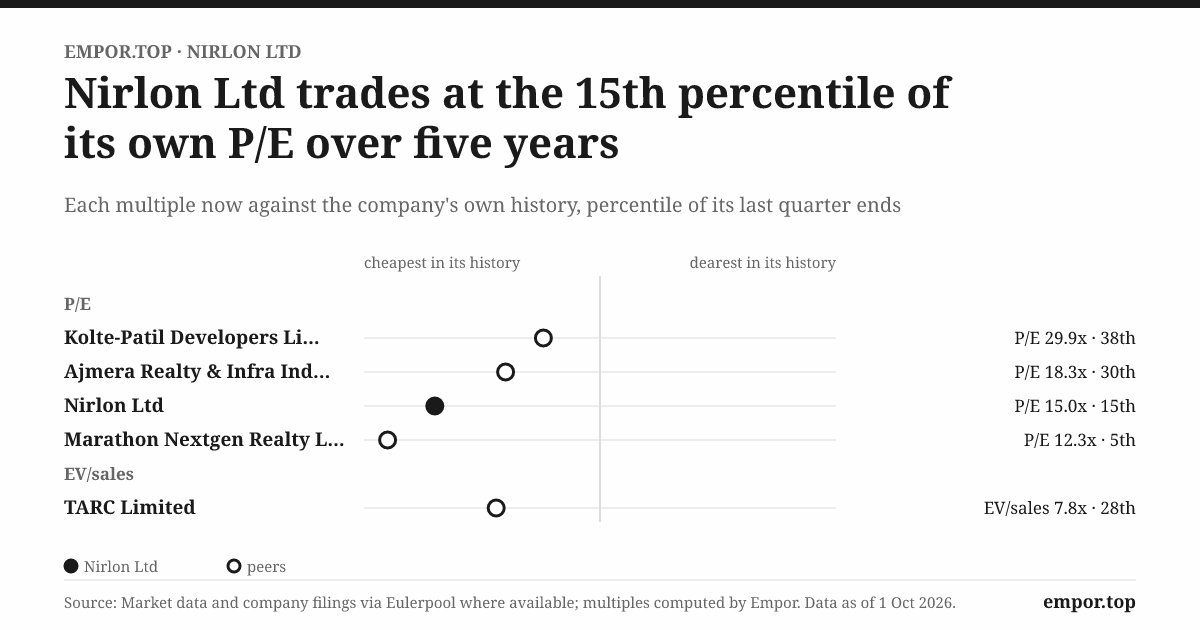
That matters because the stock's headline price-to-earnings ratio of 15.0x is calculated on trailing earnings that include the credit.3 At 15x, Nirlon looks cheap against its own five-year median of 19.1x.3 On underlying profit of about ₹276 crore and a market value of about ₹5,365 crore, the multiple is about 19x, right on the median.3 The PEG ratio of 0.5, which suggests growth is being given away, inherits the same distortion. The stock is not cheap on this measure. It is priced exactly as it usually is.
There is one genuine, lasting gain hiding in the noise. The new tax regime cuts the rate on future profits by about ten percentage points. Going forward, each rupee of pre-tax profit leaves more for shareholders than before. That is a real improvement, but it is a one-time level shift, not a growth rate. Once FY2027 laps FY2026, the tailwind is gone. The settling figure for this question is FY2027 profit after tax at the 25% rate, with no one-off.
Does the profit become cash?
A healthy landlord should turn profit into cash with ease, and over twelve years Nirlon has. Cash from operations totalled about ₹3,607 crore against net profit of about ₹1,521 crore, or 237% of profit.3 That sounds too good, and it has a simple explanation. Depreciation, about ₹56 crore a year, is charged in the accounts but costs no cash.1 So are deferred-tax charges. Receivables are tiny, at about ₹3 crore, and tenants pay against deposits, so working capital does not eat cash.1
FY2026 broke the pattern slightly. Cash from operations covered only about 68% of EBITDA, the weakest ratio in the twelve-year series.3 The most likely cause is tax. Nirlon's non-current tax assets, essentially prepaid tax and refunds it could draw on, fell from about ₹73.5 crore to about ₹3.4 crore over the year.1 When that cushion is used up, more of the tax bill gets paid in cash. The company has not spelled this out, so it remains the likeliest reading rather than a confirmed one. FY2027 cash conversion will show whether it was timing.
The falsification test lands cleanly. The claim that Nirlon's operations are high-quality survives: profit becomes cash, customers pay in two days, and there are no bad debts to speak of. The claim that the business is growing fast does not survive. It is narrowed to mid-single-digit rent growth, plus a one-time tax gift. And for a business growing only with its escalators, the real risk is not in the profit line. It is in the lease calendar.
IV. The Tenant Concentration Problem and the FY28–FY30 Reset
"No very specific discussions"
On the Q4 FY2026 earnings call, analysts did what analysts of any landlord eventually do. They asked about the big renewals. Which tenants are coming up? Have talks begun? What rents are they expecting?
The answer was careful. Management said there were "no very specific discussions" yet.2 It is a reasonable answer for leases that are still a year or more away. It is also, for a company with one campus and a handful of tenants, the answer that keeps the most important variable in the investment case out of view.
The calendar
Here is what is known. The renewal schedule is quiet in FY2027, with only a few thousand square feet due.4 Then it gets loud: roughly 326,000 square feet, then about 572,000, then about 612,000 square feet across FY2028, FY2029 and FY2030.4 CRISIL puts the exposure at about 31% of leasable area renewing through FY2029.5 One wrinkle: on the call, the first block of about 3.26 lakh square feet was described as falling in FY2026-27, while the published expiry summary puts it in FY2028.24 Either way, the window opens within about eighteen months.
Add those blocks together and roughly 1.5 million square feet, about half the campus, faces a renewal decision within four years. For a building, that is the equivalent of a software company's whole customer base coming up for contract renewal at once.
The concentration
Now overlay the tenant list. Nirlon's largest licensee pays about 40% of gross lease rentals. The top seven pay about 85%.5 Nirlon does not name its tenants in its annual report or its rating documents.
Picture what that means. If the top tenant renews at a 15% escalation, revenue steps up neatly. If it shrinks its footprint by a third, the company loses about 13% of rent overnight and has to find replacement occupiers for hundreds of thousands of square feet. If it leaves entirely, up to 40% of revenue walks out the door. The lock-in and the deposit soften the timing; they do not change the arithmetic.
What the moat is made of
It is worth arguing the competitive position in full, once.
Start with Porter's forces. Buyer power is the strongest force here, and it is high. Seven tenants pay 85% of the rent, and these are large corporates and international firms with real-estate departments, brokers and alternatives.5 Threat of new entry is low at the scale that matters: assembling 23 contiguous acres in Mumbai with approvals is extremely hard, which is the true barrier to entry. Rivalry is moderate to high: suburban parks along the Western Express Highway, the Powai cluster and the Bandra-Kurla Complex all compete for the same corporate occupiers, and Mumbai has seen steady new office supply. Substitutes include remote and hybrid work and flexible-space operators. Supplier power is low; Nirlon buys maintenance and power, but its key supplier, the property manager, is a related party, which is a governance question rather than a pricing one.
Now Hamilton Helmer's seven powers. Two plausibly apply. The first is a cornered resource: a large, finished, contiguous campus in a land-starved city. The second is switching costs: a company that has spent crores fitting out several floors, wiring them and moving thousands of employees does not relocate lightly. The others, scale economies, network effects, brand, counter-positioning and process power, are weak or absent for a single-asset landlord.
Testing the moat against the record
The best evidence for the moat is the occupancy record. Above 90% since March 2018, through the pandemic and the hybrid-work debate, and near 100% now.52 That is a long, stressful stretch to stay full.
There is also one direct test of re-letting. CRISIL notes that a vacancy of about 15% of the area was re-let.5 That shows tenants can be replaced. What the record does not show is how long the space sat empty, how much rent-free time was given, or whether the new rent matched the old. Those are exactly the variables that decide whether a re-let is a win or a quiet loss.
The weakest evidence is for pricing power beyond the escalator. Nirlon's rent growth since the FY2023 step-up has tracked contractual increases, not a rising market rent being captured.3 The 15% escalator is a negotiated term, not proof of scarcity.
Put together, the history narrows the moat claim rather than rejecting it. Nirlon has a strong location and real switching costs that keep tenants in place. It has not yet shown it can push rents above the escalators at renewal. The base case is that the 15% step is earned at renewal. The bear case is that a 40% tenant, aware of its leverage, negotiates a smaller footprint, a lower rate, or both. The KPI that settles it is rent per square foot achieved on the FY2028 cohort, and above all the status of the largest tenant's lease.
The AI and headcount question
One more risk deserves a sentence. Nirlon's tenants are corporates and international firms that fill desks with knowledge workers.15 If artificial intelligence lets those firms do the same work with fewer people, the mechanism is direct: fewer people, fewer desks, fewer square feet renewed. Nirlon does not publish a tenant split by sector, so the exposure cannot be sized. It is a slow risk, not a sudden one, but the renewal window is exactly when it would show.
The renewals will be negotiated by a company that has no leasing team of its own. Which raises the next question: who, exactly, runs the campus?
V. Three People, One Fee Contract: Who Runs the Campus?
The auditor's one worry
Every listed Indian company's annual report contains an independent auditor's report, and most of them flag a handful of "key audit matters": the areas where the auditor spent the most judgment. Revenue recognition. Impairment. Provisions.
Nirlon's auditor, SRBC & Co. LLP, flagged one. Not revenue, not valuations, not tax. It flagged the price-setting of transactions with a single related party: Nirlon Management Services Private Limited, or NMSPL.1
The contract
NMSPL shares common promoter links and directorship with Nirlon.1 It runs the campus. Under the Third Management Services Agreement, which runs from 1 April 2024 to 31 March 2027, NMSPL earns 1% of gross revenue for lease management and 2% for property management.1
In FY2026, Nirlon paid NMSPL about ₹17.7 crore for property and lease management and about ₹10.6 crore for marketing, a total of roughly ₹28.4 crore, or about 4.2% of revenue.1 Money also flowed the other way. NMSPL itself licenses space on the campus and paid Nirlon about ₹7 crore in licence fees and other charges.1 A new licence for about 7,600 square feet began on 1 October 2025 and runs to 2030 at ₹165 per square foot per month, with five rent-free months.1 Cushman & Wakefield gave an opinion that ₹160 to ₹165 was the fair range.1
Is it fair?
The case for: the amounts are small, about 4% of revenue for the entire operating function of a 3-million-square-foot campus. The terms are disclosed in full, reviewed by the audit committee and backed by an independent valuation.1 There are no loans or guarantees to related parties, and the amount NMSPL owes Nirlon, about ₹1.7 crore, carries no impairment.1
The case against is structural rather than numerical. A fee tied to gross revenue rewards size, not effort. NMSPL earns more if rents rise, which is aligned with shareholders, but it earns the same percentage whether the campus is run brilliantly or adequately, whether costs are cut or not, whether a renewal is negotiated hard or softly. There is no performance hurdle. And the NMSPL licence, priced at ₹165 against public commentary that rates on the campus are "north of ₹185", sits at the top of an independent range but below the headline rate, albeit on what may be different space.12
The real test is a date. The management agreement expires on 31 March 2027.1 Whatever replaces it, the fee percentage, any performance link, its term, will show how the board weighs minority holders against the promoter group's commercial interests, and shareholders will vote on it.
The three people
Rahul V. Sagar is the executive director and chief executive. He was paid about ₹2.96 crore in FY2026, unchanged from the year before, at 1.92 times the median employee pay, which in a three-person company is a slightly comic statistic.1 He owns about 1.48% of the company and received about ₹3.46 crore in dividends during the year, more than his salary.1 That ownership is the most meaningful alignment in the structure. A CEO whose dividend income exceeds his pay has a personal reason to care about payout policy.
Manish Parikh, the chief financial officer, was paid about ₹1.25 crore, up about 22%.1 Company secretary Jasmin Bhavsar was paid about ₹1.46 crore.1 The research record shows no variable or incentive component tied to profit or occupancy. Against ₹346 crore of reported profit, the whole top team costs less than a rounding error. Pay is not the governance issue here. The fee contract is.
On capital allocation, the record is short and clean in one sense: in the annual reports covering this period, there were no acquisitions, no new equity issued and no buybacks; share count stands at about 9.01 crore shares.1 Management said a buyback was not being considered.4 The company has not made the kind of empire-building mistakes that sink many cash-rich firms. But "did nothing wrong" is not the same as "made great choices", and the real allocation choices, discussed in the next section, are about debt and dividends.
The board and the paper trail
The board has six members. Three are independent, including the chairman, Rajinder Pal Singh, along with Anjali Seth and Chandresh Ruparel.1 Two are nominees of Reco Berry, K. Chinniah and Arjun Khullar, and they take no sitting fees.1 The sixth is the CEO. Another independent director, Sridhar Srinivasan, finished his term in September 2025.1 Half-independent is the legal floor for a company with a non-executive independent chairman, so the structure meets the rules without exceeding them.
Contingent liabilities are about ₹17.6 crore. Most is a service-tax dispute from FY2007 to FY2009, where the tribunal ruled in Nirlon's favour and the department appealed to the High Court; the rest is a fresh ₹6.8 crore income-tax demand for assessment year 2024-25 under appeal.1 Against a company earning over ₹270 crore a year, neither is material.
The auditor's statutory checklist reported no defaults on borrowings and no overdue undisputed statutory dues.1 That is the profile of a well-run shell around a good asset. What remains is to test whether the shell spends the asset's cash well.
VI. Why Sit on ₹288 Crore of Cash While Paying 7.75% on Debt?
The question on the call
Toward the end of the Q4 FY2026 call, a shareholder asked the obvious question. Nirlon was holding a large and growing pile of fixed deposits. It was also paying interest on a big bank loan. Why not use one to shrink the other? Or, if the cash was not needed, why not pay it out as a special dividend?
Management talked about sustainable dividends and the structure of the loan. It did not commit to prepayment or a special payout.2
The negative carry
Here is the arithmetic in three steps.
At March 2026, Nirlon held about ₹288 crore in fixed deposits and bank balances, up from about ₹17 crore a year earlier.1 Management said the deposits are laddered over six to twelve months and earn about 5.5%.2
At the same time, it owed about ₹1,147 crore to HSBC, at a cost of about 7.75%.12
The difference is about 2.25 percentage points. On ₹288 crore, that is roughly ₹6 to ₹7 crore a year, money lost by holding cash instead of paying down debt. Against underlying profit of about ₹276 crore, that is a few percent. Not a scandal. But not nothing, and it compounds every year the pile sits.
Management's defence
There is a reasonable case for the cash. The HSBC facility is a lease-rental-discounting loan: the bank lends against the future rent stream. Repayment begins in May 2027, at 5% a year for five years, and then about 75% of the loan falls due in a single bullet payment around FY2033.15 Prepayment terms on such loans often carry lock-ins or penalties. A company facing a renewal window in FY2028 to FY2030, with one 40% tenant, might reasonably want a liquidity buffer before amortisation starts.
CRISIL clearly values that buffer. It cited cash of about ₹294 crore at end-August 2025, plus an undrawn ₹80 crore overdraft, as a strength.5 Its AA+/Stable rating, reaffirmed in November 2025, rests on a debt service coverage ratio of about 4x and debt at about 2.05 times annual lease rentals.5
The rebuttal is that the buffer is large relative to the need. Five per cent of ₹1,150 crore is under ₹60 crore a year, less than three months of free cash flow. The bullet is seven years away. The cash looks less like a reserve against a specific risk and more like an undecided policy.
How equity shrank while profits rose
To understand Nirlon's eye-catching returns, follow the dividends.
For most of the 2010s, Nirlon paid out tiny dividends, between about 5% and 24% of profit.3 Then, in FY2022, it changed policy dramatically. That year it paid out 187% of earnings, and payouts stayed above 100% through FY2025.3 Dividends in rupees were funded partly by cash flow and partly by debt capacity, and shareholders' equity fell from about $77 million in FY2021 to about $42 million by FY2025 in the fact sheet's terms.3
This is the hidden engine behind 76% return on equity and a price-to-book of 11.6x.3 Return on equity divides profit by equity. Shrink the denominator by paying out more than you earn, and the ratio soars without any improvement in the building. It is the corporate version of a homeowner who remortgages to pay themselves a lump sum: the rent has not changed, but the return on their remaining equity looks wonderful.
The trend has since turned. In FY2026 the payout ratio fell to about 68%, profits were retained, equity grew, and debt to equity fell from about 3.2 to about 2.45.3 The dividend itself rose sharply to ₹30 a share, an interim ₹15 plus a proposed final ₹15, against ₹10 a share before.14 The dividend tripled, yet the payout ratio fell, because the base of comparison includes the tax credit.
Over twelve years, Nirlon paid out about 62% of its free cash flow as dividends, and the rest accumulated as cash.3 That is the source of the ₹288 crore.
The skeptic's view of ownership
Who receives that payout? At March 2026, the promoter group owned about 67.7%, almost all of it held from abroad. Foreign portfolio investors owned about 15.8%. Domestic banks, mutual funds and insurers together held just 0.08%. Some 28,371 shareholders held the remainder.1
That means roughly two-thirds of every dividend rupee goes to the Singapore-based controlling holder. An activist would sharpen this point. A controlling shareholder who wants steady, tax-efficient distributions may not care much about the negative carry on cash. A minority holder, especially one who pays tax on dividends at high personal rates in India, might prefer debt reduction, which raises the value of the equity without a taxable payout. These preferences do not have to align, and minority holders rely on three independent directors to weigh them.
The near-total absence of domestic institutional investors is itself a signal. It may reflect low free float and limited liquidity rather than a verdict on quality, but it means Nirlon's price is set by a small number of holders.
Comparisons the market makes
Nirlon is often compared with India's listed office REITs: Embassy Office Parks, Mindspace Business Parks and Brookfield India Real Estate Trust. REITs are legally required to distribute most of their cash and are typically more diversified across cities and assets. Nirlon has neither requirement nor diversification. Its payout policy is a choice, and that choice has swung from almost nothing to more than everything to the current two-thirds within five years.
The verdict on capital allocation is open. Payouts are generous, the balance sheet is sound, and credit quality is high. But the record shows an inconsistent policy, and the cash pile has no stated purpose. The test is the FY2027 final dividend and whether a special dividend or prepayment follows. Until then, the lessons of this story are clearer than its endgame.
VII. Playbook: Business & Investing Lessons
A landlord's moat is its tenant list. Nirlon's 23 acres in Goregaon are scarce, and its occupancy record is superb. But the asset's value lives in one licence held by one unnamed tenant who pays 40% of the rent. Investors in single-asset businesses should value the building by asking who could walk out of it, and when. Location brings tenants in. Only renewals prove they stay at a higher price.
Read profit through the tax line. A quarter with an 89% net margin was not a better building, it was a remeasured liability. Whenever profit grows far faster than revenue, go down the income statement line by line: revenue, then operating profit, then interest, then tax. The honest growth number for Nirlon was 5%, then 10%, not 59%. The most useful number in an annual report is often the one that falls the furthest between pre-tax and post-tax.
Yield is a policy, not a property. The same campus produced dividends worth 5% of profit in FY2021 and 187% in FY2022. The building did not change, the board did. When a stock is bought for income, investors are buying the board's payout habit as much as the rent roll, and that habit can be rewritten at any meeting. A ₹30 dividend with ₹288 crore earning 5.5% in the bank is a message about what the board is choosing not to do.
Fees tied to revenue reward size, not effort. NMSPL's 3% of gross revenue is modest and transparent. It is also blind to how well the campus is run. For founders, compensation that tracks the top line drives growth; for owners of a mature asset, it can quietly pay for standing still. The question to ask of any related-party fee is not "is it small?" but "what would it take for the manager to earn less?"
Leverage can be lazy or deliberate. Nirlon's 76% return on equity came less from the building and more from equity shrinking under payouts funded by a loan secured on rent. That is leverage used deliberately to return capital, and it can be sensible. Paired with an idle cash pile and no plan for it, it starts to look like leverage nobody has decided to unwind. The ratio that sounds most impressive is often the one most shaped by the balance sheet.
VIII. Analysis & Bear vs. Bull Case (≈10 min)
Two prices for one stock
Pull up Nirlon on a stock screener and you see a P/E of 15.0x. Do the arithmetic on underlying profit and you see about 19x.3 The same stock, the same price, two stories. At 15x, Nirlon looks like a bargain against its own five-year median of 19.1x. At 19x, it looks priced exactly at its history.3
The other valuation measures point the same way. Enterprise value is about 10x EBITDA.3 The dividend yield is about 2.5%.3 The fact sheet shows an FCF yield of about zero and an enterprise value equal to market value, both of which look odd for a company with ₹1,147 crore of debt and ₹40 million of free cash flow. They reflect how the data provider treats the loan and the fixed deposits in its calculation, not an absence of cash flow; Nirlon generated substantial free cash flow in FY2026.3 On a simple basis, market value plus debt minus cash puts enterprise value around ₹6,200 crore.
What does the price assume? At about 19x underlying earnings for a business growing rent at about 5% a year, the market is pricing Nirlon as a safe, bond-like stream: steady escalators, full occupancy, renewals that go through. It is not pricing a large loss of the top tenant. Nor is it pricing a big upside surprise.
The bull case
Occupancy is 99.7%, and it has stayed above 90% since 2018 through every test the market threw at offices.52 Contractual escalators of about 15% every three to five years give visible, low-risk growth.5 Credit quality is AA+/Stable.5 The tax regime change permanently lowers the tax drag on future profit. Interest costs are falling. Cash on hand gives the company options: a special dividend, prepayment, or simply a cushion through the renewal window. Management's costs are tiny. If the FY2028 cohort renews at stepped-up rents and the board puts the cash to work, shareholders get a growing dividend from a fully let, irreplaceable asset.
The bear case
Everything rests on one building. One tenant pays 40% of the rent; seven pay 85%.5 Half the campus faces renewal within four years, and management has not guided on any of it.24 The headline P/E is flattered by a one-time tax gift. There is no growth capex and no plan for new space.2 Amortisation starts in May 2027, and a 75% bullet in FY2033 will need refinancing in an unknown rate environment.15 The related-party fee carries no performance link. And the cash sits earning less than the debt costs.
Weighing the two
Both cases are coherent. The difference is in timing. The bull case is about the next year, where almost nothing can go wrong: leases are locked in and FY2027 is a quiet renewal year. The bear case is about FY2028 to FY2030, where almost everything is decided. At around 19x underlying earnings, the market already assumes the renewals go through. That leaves little room for upside if they do and real room for downside if they do not.
The risk radar
Three risks matter. Tenant renewal and office demand, including the slow-moving risk of AI-driven headcount cuts at knowledge-work tenants. Interest-rate and refinancing risk on the FY2033 bullet. And concentration, both of asset and of tenant. Currency, cyber and supply-chain risks are not material for a rupee-denominated landlord with one campus.
The KPIs that matter
Only three numbers need watching.
Occupancy and rent per square foot at renewal. Occupancy is 99.7% today, and the most recent quoted rates are north of ₹185 a month.2 Its direction over the renewal window will decide the case.
Underlying profit after tax at a normal tax rate. Recent quarters at a roughly 25% tax rate produced about $7 to $8 million of profit a quarter.3 FY2027 will set the clean baseline.
The top tenant's lease status. It is undisclosed today. Any disclosure of its renewal, reduction or exit is the single biggest event for the stock.
The verdict: Nirlon is a high-quality but fully valued, low-growth cash asset. The investment case turns on the renewals and on what the board does with the cash, not on the FY2026 profit jump.
IX. Epilogue
Tonight, on 1 October 2026, Nirlon Knowledge Park is effectively full. The rent is coming in, the tenants are paying in two days, and three people in the corporate office are watching a calendar.
The next eighteen months hold four moments that will decide the story.
The first is the FY2027 dividend, and whether it arrives with a special payout or a prepayment of debt. If the board puts the ₹288 crore to work, either by returning it or by cutting the 7.75% loan, it answers the capital-allocation question decisively. If the cash simply grows, the question gets louder.
The second is 31 March 2027, when the NMSPL management agreement expires.1 Renewed on the same 1% and 2% of revenue, it tells minority holders that the status quo is the policy. Renewed with a performance element, a lower rate or a shorter term, it tells them the board has listened. Either way, shareholders vote on it.
The third is May 2027, when the HSBC loan starts amortising.1 At 5% a year, it is manageable. But it is the first time in years the balance sheet begins to shrink by contract rather than by choice.
The fourth, and the one that matters most, is the first word on the FY2028 renewal cohort. If the largest blocks renew at a 15% escalation, Nirlon's rent steps up, its profits grow faster than the escalators for a year or two, and the current multiple looks reasonable. If a major tenant shrinks or leaves, the company faces the hardest test a single-asset landlord can face: filling hundreds of thousands of square feet in a competitive market while its debt amortises.
Each outcome maps back onto the four questions. Clean FY2027 profit settles whether growth is real. The renewal cohort settles whether the location commands pricing power. The dividend and prepayment settle the cash question. The management agreement settles the governance question.
The tension that remains is the one this story opened with. A very small company owns a very valuable thing. That is efficient, and it is fragile. It means the business cannot grow by working harder, only by its tenants deciding to stay and pay more.
X. Outro
Go back to Goregaon on a weekday morning. The cars still roll in off the Western Express Highway, the towers still fill, and 99.7% of the floors are spoken for. Up in a corner of the campus, three people manage the whole thing, a managing agent handles the rest, and a Singapore holding company collects most of the dividends.
Nirlon looks like a business on the screen and behaves like a building on the ground. Its returns are dazzling, its growth is contractual, and its fate is written in the lease-expiry schedule. Nirlon is a bet on one lease calendar, and the price already assumes it holds.
References
-
Nirlon Annual Report 2025-26 — Nirlon Limited, 2026 ↩↩↩↩↩↩↩↩↩↩↩↩↩↩↩↩↩↩↩↩↩↩↩↩↩↩↩↩↩↩↩↩↩↩↩↩↩↩↩↩↩↩↩↩↩↩↩↩↩↩↩↩↩↩↩
-
Nirlon Q4 2026 earnings call transcript — AlphaStreet, 2026 ↩↩↩↩↩↩↩↩↩↩↩↩↩↩↩↩
-
Nirlon Limited financial results (BSE 500307) — BSE India ↩↩↩↩↩↩↩↩↩↩↩↩↩↩↩↩↩↩↩↩↩↩↩↩↩↩↩↩↩↩↩↩
-
Nirlon FY26: High occupancy, steady income and tough capital allocation questions — multibagg.ai, 2026 ↩↩↩↩↩↩↩↩↩↩
-
Nirlon Limited Rating Rationale — CRISIL Ratings, 2025-11-12 ↩↩↩↩↩↩↩↩↩↩↩↩↩↩↩↩↩↩↩
 LinkedIn
 WhatsApp
 Reddit
 Hacker News
 Email
Email Kindle
 RSS Feed
 Spotify
 Apple Podcasts
 Amazon Music
 Audible
 YouTube