Ninjacart: The Supply Chain That Wants to Go Public
I. A $6 Million Round, and a Two-Year IPO Clock
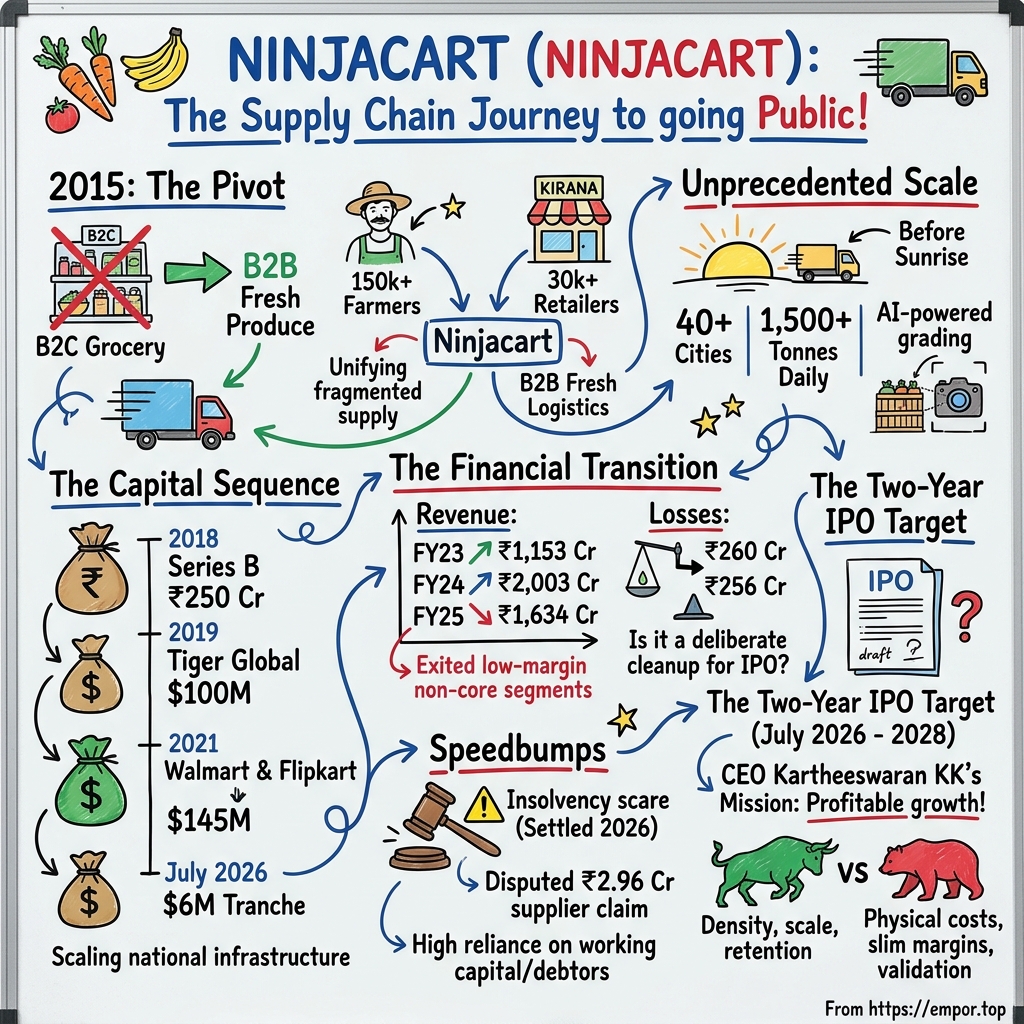
On the second day of July 2026, a Bengaluru company that had not announced a new equity round in four and a half years put out a short piece of news. Ninjacart, the fresh-produce supply chain that Walmart and Flipkart had once backed with the largest agritech cheque India had seen, said it had raised $6 million from Accel, Tiger Global and Nandan Nilekani, all of them existing shareholders.1 The sum was modest. A company that had once raised $145 million in a single sitting was now announcing a cheque about one twenty-fourth that size, and it called the money only the first tranche of a larger round whose total it did not disclose.2
What made the announcement news was not the cheque. It was what the co-founder and chief executive, Kartheeswaran KK, attached to it. Ninjacart, he said, had reached EBITDA profitability, its core business had grown threefold in a year, and the company had begun preparing for a public listing within the next two years.1
"In the last few years, profitability has been our biggest focus, while growing steadily," Kartheeswaran said.1 It is the sentence every late-stage Indian startup wanted to be able to say after the funding winter, and it carries an implicit invitation to public investors: the expensive years are behind us, and what remains is a business. The rest of this story is an attempt to test that invitation against the record.
The record does not make it easy. Six months before the round, Ninjacart had disclosed results for the year to March 2025 that ran in the opposite direction from a growth story. Operating revenue had fallen about 18.5%, to roughly ₹1,634 crore, from about ₹2,000 crore the year before, and the net loss had barely moved, at about ₹256 crore against ₹260 crore.3 The company explained the fall as a deliberate exit from low-margin and non-core segments.4 That explanation may well be right.
But it means that the headline the company wanted public investors to remember, a profitable core growing quickly, arrived alongside a group whose total sales had shrunk by about a fifth and whose losses still amounted to roughly ₹16 for every ₹100 of revenue. Both things can be true at once. Only audited accounts that split the retained business from what was exited can show how they fit together, and Ninjacart had not published FY26 revenue or profit when it made the July claims; Inc42 asked for the figures and was not given them.1
There is a further complication that a public-market investor must settle before reading any number at all: what, legally, is Ninjacart? The brand is not a company name on any exchange list. The platform belongs to 63Ideas Infolabs Private Limited, a Bengaluru company incorporated in 2015, whose terms of use say that a transaction may be contracted with 63Ideas itself or with one of its operating subsidiaries.56 A separate subsidiary, Ninjacart Services Private Limited, handles credit facilitation with partner lenders, and company-records data list Ninjacart Private Limited as another subsidiary.75
The press figures for FY24 and FY25 are attributed simply to "Ninjacart," and the public record does not establish which legal entities those figures consolidate. That matters more than it sounds. Registry data for individual entities show revenue that bears no resemblance to the group headline: a figure of about ₹1.7 lakh for 63Ideas in FY25 and about ₹85 crore for Ninjacart Private Limited in FY26, neither of which can be added together or treated as a consolidation.58 A prospective shareholder is being asked to underwrite a group whose perimeter has never been laid out in public.
Nor has the listing itself begun in any formal sense. The "Startup" label marks a stage of life, not an exchange, and in Ninjacart's case it means exactly what it says. SEBI's public-issue filings carry no draft red herring prospectus for 63Ideas or any Ninjacart entity, and SEBI's processing-status report of draft offer documents dated 9 November 2026 does not list one either.9[^10]
There is no S-1 or F-1 on the American EDGAR system under the company's names.10 The two-year clock is a management intention announced in a funding press release. It is not a filing, there is no price band, and there is no public share price or trading multiple against which to measure the company. Anyone who wants to value Ninjacart today has to work from disclosed operating evidence and a handful of dated private transactions.
That boundary sets the shape of the questions this story has to answer. The first is what Ninjacart actually built over eleven years: a defensible supply chain that farmers and shopkeepers would struggle to replace, or an expensive logistics operation that does useful work at thin margins. The second is whether the portfolio reset that cut revenue in FY25 restores growth from a healthier base or simply leaves a smaller company.
The third is whether better operating margins, however defined, ever reach cash, because EBITDA is a measure that sets aside depreciation, interest, tax and, crucially for a trading business, the cash tied up in what customers owe and what the company owes its suppliers. The fourth is whether a two-year IPO timetable is credible for a group that has not yet shown public investors its audited perimeter, its cap table or its related-party dealings.
There is also a history of dates to keep in mind. In October 2023, shortly after Kartheeswaran took over as chief executive, he said Ninjacart would be profitable in fiscal 2026.11 By December 2025 the target for company-wide profitability had moved to 2026–27, and the July 2026 claim was of EBITDA profitability rather than profit.41 A slipped target is common at this stage and not damning in itself. It does mean that the next promise, a listing by mid-2028, should be weighed by the same standard as the last one: on the evidence that arrives, not on the confidence with which it is stated.
To see why the company believes its network is worth a public listing, and why a skeptic might not, the story has to go back to the moment its founders abandoned their first idea.
 Subscribe on LinkedIn
II. The Pivot That Put Kirana Stores on the Route
In the summer of 2015, a group of Bengaluru founders launched a grocery app with a promise that now sounds like a quick-commerce pitch from a decade later: fruit and vegetables delivered to a household within sixty minutes of an order.12 The company was founded in May 2015 by Thirukumaran Nagarajan, Sharath Loganathan, Sachin Jose, Kartheeswaran KK and Vasudevan Chinnathambi, with Thirukumaran as its first chief executive.13
They ran the consumer model for about six months. By their own later account, it was neither profitable nor scalable.12 The orders were small, the delivery cost per order was high, and the business required them to win each household again and again against every other way an Indian family buys vegetables. A GSMA study of the company recorded that the founders moved away from consumers because of concerns about low margins, profitability and the long-term viability of the B2C model.14
What the founders found instead lay one step upstream. They looked at the problems of the kirana store, the neighbourhood grocer who sells most of India's fresh produce, and discovered an owner who spent three to four hours every day in the mandi, the wholesale market, buying produce in the dark and then paying again to transport it back to the shop.12 There were wholesale distributors for packaged, non-perishable groceries, but no major chain that delivered fresh produce to small retailers. So Ninjacart pivoted to selling to businesses.12
The decision was more consequential than a change of customer. A consumer delivery app competes on convenience and marketing; a business supplier competes on whether the tomatoes arrive before the shutters go up, at a price the shopkeeper believes is fair, every single morning. By 2019 the company described a daily order system in which a kirana owner placed an order on a mobile app between eleven in the morning and eight at night, and the produce arrived before eight the next morning.12
Kirana stores made up about 95% of its customers and restaurants about 4%.12 The appeal of that model is repetition. A household might order vegetables once a week if it remembers; a shop that sells produce must replenish daily, because what it does not sell spoils. Repeat replenishment gives a supplier the possibility of a predictable route, a known volume, and a forecast it can give to farmers ahead of the harvest. A consumer app has to buy its next order; a reliable supplier to a shop can earn it by turning up.
On the farm side, the founders built collection centres near growing hubs, where farmers brought produce to be checked against quality standards, weighed and packed in front of them, and the company promised payment into each farmer's bank account within 24 hours.12 They called the handling discipline a "one-touch" method: produce was meant to be handled physically once, at collection, and then moved in crates through fulfilment centres to distribution points and out to stores.12 The company claimed full traceability through RFID tags on each crate and described its forecasting as weekly, combining historical demand and market prices to tell partner farmers what to harvest.12
There was an economic argument underneath all this, and it is the argument the company still makes. Ninjacart told CII that more than 40% of the cost a customer bore for fresh produce arose in the supply chain itself, the layers of commission agents, transport and handling between the field and the shop.12 Take out enough of those layers, the thesis ran, and there would be room both to pay farmers more and to charge retailers less, with a margin left for the company in between.
That argument is a promise, not a proof, and the early record shows both its pull and its limits. Revenue rose from about ₹27 crore in FY17 to about ₹54 crore in FY18 and about ₹132 crore in FY19, a quintupling in two years.12 By late 2018 the company operated in Bengaluru, Hyderabad and Chennai, with more than 750 staff, a sourcing network of over 3,000 farmers across south India and more than 4,000 retail customers, and it said it would expand to more than ten cities and open more than 200 distribution centres.15
By 2019 it was in seven cities including Delhi, Mumbai, Pune and Ahmedabad, and claimed over 70,000 customers a month, a 99% fulfilment rate and 98% on-time delivery.12 Those are operational achievements. They are also self-reported, and none of them tells an investor whether a route earned more than it cost.
The company gave one early clue about that question, and it is worth holding on to. In the same 2019 profile, Ninjacart said it was "targeting to be city level positive in 3 out of the 7 cities by the end of 2019."12 Four years after the founding, the stated ambition was for three cities to cover their own costs, not for the company to make money. There is nothing unusual in that for a young logistics business. But it shows that profitability was a future milestone from the start, and that the company-wide target later moved to FY26–27.12114
The founders approached produce as a forecasting and routing challenge rather than a trading one, and the pivot carried a trade-off that has shaped everything since. Solving coordination with technology can produce efficiency, because better forecasts mean less waste and fuller trucks. Owning the physical movement of perishable goods means that costs, quality and timing never disappear into the software. A tomato that is bruised in a crate is a loss whether or not the app predicted demand correctly, and a truck that runs half full costs nearly as much as one that runs full.
That trade-off is visible in the way a GSMA case study described Ninjacart's economics in 2020. The service was free for farmers, and the company said it earned its revenue by taking a commission from the businesses that ordered through its platform.14 Its main operating costs were hiring up to 800 trucks a day, renting collection-centre space and hiring people on contract to load crates.14 In other words, the cost base was largely physical and largely variable, while the revenue depended on the spread between what farmers were paid and what shops would bear.
Later, the company's terms of use made clear that Ninjacart could also buy and resell produce as principal, booking the full sale value as revenue, as well as facilitating direct transactions between buyer and seller.6 Which of those two modes dominates the reported revenue matters enormously for comparing it with anyone else, and the company does not publish the split.
The founding story matters, then, not as a parable but as a description of the business Ninjacart still is. It earns trust from farmers, traders and retailers one delivery at a time, and it carries the cost of every one of those deliveries. The next question is what that network looks like today, and whether its scale has turned into something a competitor cannot copy.
III. Before Sunrise, the Network Has to Work
At about the hour a city's first buses leave their depots, a Ninjacart day is already most of the way through. The order book closes the previous evening. Produce moves through the company's collection and fulfilment network to distribution points.12
What remains, in the dark, is the final leg: delivery to a retailer, a restaurant, a reseller or, increasingly, a quick-commerce dark store that will promise a household its onions in ten minutes later that morning. If any link fails, the result is not a delayed parcel. It is a spoiled crate, a shop with gaps on its shelf, and a customer who may try another supplier tomorrow.
In July 2026 the company described the scale of that daily operation. It said it worked in more than 40 cities, moved over 1,500 tonnes of produce a day, and served more than 150,000 farmers, 30,000 retailers and 5,000 resellers.1 It also called itself the largest supplier of fresh produce to India's quick-commerce sector.1 These are large numbers for a company that started with a vegetable app, and they describe genuine operating infrastructure. A business does not move more than a thousand tonnes of perishable goods every day across dozens of cities on slides alone.
The network's scale across six years
But the most revealing figure is one that has hardly changed. In 2020 GSMA recorded Ninjacart handling about 1,600 tonnes of fresh produce a day across seven cities.14 In early 2021 Inc42 reported more than 1,400 tonnes a day, again in seven cities, serving more than 17,000 kirana stores and restaurants.13 In 2026 the company's own figure was "over 1,500 tonnes" a day, now across more than 40 cities.1 The definitions may differ from one report to the next, and tonnage is not revenue: a kilogram of imported fruit sold to a premium retailer is worth many times a kilogram of onions.
Revenue did grow in the intervening years, from about ₹967 crore in FY22 to about ₹2,000 crore in FY24 before the cut back to about ₹1,634 crore in FY25.16173 Yet the company's own volume disclosures suggest that the physical throughput of the network sits roughly where it was six years ago, spread across about six times as many cities.
That observation does not by itself reject the company's claims, but it narrows them sharply. If daily volume is flat while the footprint has grown, then the average tonnage per city has fallen, and the economics of a route, which depend on how much produce travels each truck and each crate, cannot have improved simply because the network got bigger. Any improvement in unit economics has to come from somewhere else: a richer mix of higher-value produce, better prices, less wastage, fewer and fuller trucks, or a shift toward customers such as quick-commerce chains that order large, predictable volumes.
Those are exactly the mechanisms management now cites, and the rest of this story will test them. What the tonnage tells an investor is that Ninjacart's story is no longer one of a network expanding in volume. It is one of a network trying to earn more from roughly the same volume.
Current platform terms leave each order to specify its quantity, unit price, aggregate price, delivery terms and payment terms.6 There is no standard subscription, no disclosed minimum purchase commitment and no contract length.6 A buyer who misses a payment due date faces late charges of 18% a year, and credit-based supply can require a personal guarantee.6 The relationship, legally speaking, is renewed every day.
That has two implications for the quality of the revenue. The first is that it is transactional, not recurring in any contractual sense. A kirana that relies on Ninjacart this week is free to return to the mandi next week, and a quick-commerce buyer can shift its procurement among suppliers without breaking a contract. The repetition that makes the model attractive is behavioural, not legal: shops come back because the service works.
The second implication is that the margins sit between two volatile prices. Produce prices swing with seasons, weather and local gluts; wastage depends on handling and timing; delivery density depends on how many customers sit on a route; and channel mix determines whether a tonne goes to a price-sensitive kirana or a quick-commerce chain that negotiates hard but buys predictably. Any one of these can erode a margin within a season.
Ninjacart's answer has been technology, and it has said so consistently. In 2021 it said it had invested significantly in technology platforms and supply-chain infrastructure over the preceding two years.18 In FY24 it described using artificial intelligence for quality assessment, demand prediction and pricing, and credited AI-led waste reduction in fulfilment for part of that year's improvement.1917 The claims are plausible. A supply chain that forecasts better buys less excess produce and throws less of it away, and an automated grading system can make quality disputes with farmers and buyers less frequent.
But nothing in the public record turns these tools into a separate technology business, a licensing revenue line or measurable evidence of an advantage. The company does not publish wastage rates over time, forecast accuracy, or what share of revenue its AI pricing touches. The early claim of food wastage below 1%, made in 2019, was a single self-reported figure and has not been updated in a comparable form.20 The honest reading is that technology is an operating aid inside a physical business, much as route-planning software is to a courier company, and should be valued as such.
Who else is running the same route
Ninjacart is not alone in trying to organise India's fresh-produce supply chain, and its competitors show how hard the economics are. The closest rival is WayCool, a food supply-chain company that, like Ninjacart, buys produce and other food and sells it on to retailers and businesses, and whose procurement costs make up most of its spending.21 In FY23 WayCool reported revenue of about ₹1,251 crore and a loss of about ₹686 crore, excluding a much larger non-cash charge on the fair value of its preference shares; its total expenses ran to about ₹1.56 for every rupee of revenue.21
It had promised revenue of ₹1,600 crore and operational break-even in FY24, filed its FY23 accounts about eleven months late, and, according to people cited by Entrackr, struggled to raise new money and closed several initiatives to cut costs.21 Ninjacart's own FY23 loss of about ₹326 crore on about ₹1,153 crore of revenue, roughly ₹28 of loss per ₹100 of sales, looks disciplined by comparison, but it belongs to the same family of businesses whose cost base ran ahead of what the produce could earn.17
DeHaat, the other name commonly bracketed with Ninjacart, is a less direct peer. It runs a broader agritech platform whose chief executive credited its growth to private-label products, about a quarter of revenue, and to exports of about ₹430 crore to 32 markets.22 In FY25 it reported operating revenue of about ₹3,010 crore and a headline profit of about ₹369 crore, but that profit came from a non-cash gain of about ₹576 crore on the fair value of its preference shares; without it, DeHaat lost about ₹207 crore.22 Its route to profitability runs through higher-margin inputs and private labels that Ninjacart's produce-focused model does not have.
Two lessons follow from the comparison. The first is that neither of Ninjacart's closest Indian rivals has shown audited, sustained net profit from organising produce supply at scale, so there is no proven local template for Ninjacart to follow or to be measured against. The second is that comparisons of reported revenue across these companies are treacherous. One company may book the full value of produce it resells as principal; another may book only commissions; a third may mix inputs, outputs and exports. No reliable market-share figure exists for any of them, and none of the companies publishes one on a comparable basis. Ninjacart's claim to be the largest fresh-produce supplier to quick commerce is the company's own and cannot be checked against a public industry dataset.1
That leaves the question at the heart of the network: does the network give Ninjacart an advantage competitors cannot easily reproduce? In the language of Hamilton Helmer's seven powers, the candidates are scale economies, from denser routes and fuller trucks; switching costs, if retailers or farmers become dependent on the service; and process power, the hard-won know-how of grading, forecasting and moving perishable goods reliably. The evidence for each is thin.
Scale economies would show up in falling cost per tonne as volume grows, but volume has not grown in six years. Switching costs would show up in contracts or in low customer churn, but there are no contracts, and churn is not disclosed. Process power is the most plausible of the three, because running a fresh-produce supply chain well is genuinely difficult, as WayCool's struggles show. But process power is proved by margins that rivals cannot match, and Ninjacart's margins remain negative at the net level.
The tests that would settle the matter are specific. An investor would want to know how often a retailer reorders and for how long, whether farmers sell to Ninjacart exclusively or alongside the mandi and rivals, what share of produce is wasted, how fulfilment reliability has held up as cities were added, what prices the company realises relative to wholesale markets, and whether each route and each customer type earns a positive contribution after the cost of the truck, the crates, the labour and the spoilage. None of those figures is public. Without them, the fair description of Ninjacart's network is operational competence in a fragmented market, not demonstrated pricing power and not a moat.
The question that carries forward is the one the FY25 reset made unavoidable. A route earns money when enough good orders travel along it. Ninjacart has just walked away from a fifth of its revenue. Can it keep its trucks full while it exits the business that does not pay? Before answering, it helps to understand who paid for the network in the first place, and on what terms.
IV. Walmart's Bet—and the Capital Behind the Reset
In December 2021, Flipkart published an announcement that read like a coronation. Flipkart and its parent Walmart were making a joint strategic investment of $145 million in Ninjacart, which Flipkart called the largest agritech deal in India.23 Ninjacart's then chief executive, Thirukumaran Nagarajan, said the money would build world-class teams and scalable technology platforms to organise and grow the network.23 The Walmart Foundation had already allocated $15 million in grants to the farm-livelihood programmes the partnership touched.23 For Ninjacart, the cheque brought more than money. It brought the endorsement of the world's largest grocer and of India's largest e-commerce group, whose grocery business reached 1,800 cities and towns and might, in principle, become both a customer and a channel.23
To understand what that endorsement was worth, and what it was not, the capital has to be traced from the beginning.
The early institutional money financed the pivot and the first network. In December 2018 Ninjacart closed a ₹250 crore Series B led by Accel US and Syngenta Ventures, the venture arm of the Swiss agrochemicals group, with Neoplux of South Korea, Trifecta Capital and others joining, and existing investors Accel India, Nandan Nilekani, Mistletoe and Qualcomm Ventures participating.15 The company said it had raised ₹310 crore in total by then and would use the money to expand geographically, build supply-chain infrastructure and strengthen technology.15
Four months later, in April 2019, Tiger Global put in $100 million, and Ninjacart said it would build capacity to serve a million-plus retailers and restaurants.20 The ambition in that sentence is worth measuring against what followed: in 2026 the company described its retail customer base as more than 30,000 retailers and 5,000 resellers.1 The definitions differ, since the 2019 figure was an aspiration and the 2026 figure counts active accounts, but the distance between them is the distance between a growth-capital narrative and an operating reality.
The money also arrived in a business that was learning to manage its cost base the hard way. In February 2021, ten months before the Walmart round, Inc42 reported that Ninjacart had let go of more than 200 employees across Bengaluru, Chennai, Mumbai and Hyderabad. Two senior people quoted by Inc42 said the company had been in cost-saving mode since November 2020; Thirukumaran said most departures were for performance and integrity reasons and that the company had "never had cost-cutting measures."13
Inc42 put the workforce at about 3,000 at the time and total funding at about $190 million.13 The episode is old, contested and modest in scale, so it should carry limited weight. But it shows that a cost reset at Ninjacart is not new, and that management's public framing of a hard decision has sometimes been gentler than the accounts of the people affected.
Then came Walmart and Flipkart, and in May 2022 a small round that produced the number most often quoted for the company's value. The Economic Times reported that Ninjacart had raised $9 million from STIC Investments and Mainstream Digital at a valuation of $812 million, and that the company had executed an ESOP buyback of about ₹100 crore.24 Entrackr has described the December 2021 round as valuing the company at about $815 million.2 The two references are essentially the same mark.
A price from 2022 is not a value for 2028
That $812 million figure needs careful handling, because it will hover over any IPO discussion. It was set by a $9 million cheque, roughly one-ninetieth of the stated valuation, at the top of the private-market cycle in early 2022.24 A small round extrapolated to the whole company says what one investor agreed to pay for a sliver of equity on terms that are not public. Whether those shares carried liquidation preferences, participation rights, anti-dilution protection or conversion terms that differ from ordinary common equity is not disclosed.
Indian venture rounds commonly use compulsorily convertible preference shares, and the effect of such instruments can be large; DeHaat's and WayCool's own accounts both show enormous swings from the fair value of preference shares.2221 Ninjacart's equivalent terms are not public. Until they are, the 2022 mark cannot be treated as the value of a common share that a public investor would buy.
Nor did the strategic investors necessarily price the company as a financial buyer would. Walmart and Flipkart had reasons to invest beyond return: a reliable fresh-produce supply chain is useful to a grocery business, and the farmer-livelihood programmes carried reputational value. A strategic investor may pay for access and optionality that an ordinary shareholder will never receive.
Measured against the business it priced, the 2022 valuation was a bet on a future that has not yet arrived. Converted at the exchange rates of the time, $812 million was a little more than ₹6,000 crore. Against the roughly ₹2,000 crore of revenue Ninjacart would report for FY24, the year of its peak sales, that is about three times revenue; against FY25's ₹1,634 crore, nearly four times.173 For a software platform, that would be cheap. For a business that buys and resells perishable produce, where revenue includes the full value of the goods, it is demanding, because the margin that eventually reaches shareholders is likely to be measured in low single digits of revenue rather than in tens.
A simple scenario framework shows why. Assume, for illustration only, that Ninjacart's retained business reaches revenue of about ₹2,500 crore within four to five years, modestly above its FY24 peak, and earns a sustainable operating margin of about 3% after all costs, which would be a creditable result for a produce distributor. That is roughly ₹75 crore of operating profit, perhaps ₹55 crore after tax.
Even at a generous 25 times earnings, the business would be worth around ₹1,400 crore, a fraction of the 2022 mark. A bull case, with revenue of ₹4,000 crore and a 5% margin, produces about ₹200 crore of operating profit, ₹150 crore after tax and, at 25 to 30 times, an equity value in the range of ₹3,750 crore to ₹4,500 crore, still below the 2022 price in rupees and before discounting for time and further dilution.
A bear case, with revenue stuck near ₹1,500 crore and a 1% margin, leaves a business worth little more than its working assets. The inputs are assumptions, not forecasts, and the sensitivity is overwhelmingly to margin: every additional percentage point of sustainable margin on ₹2,500 crore of revenue adds roughly ₹25 crore of operating profit. But the shape of the result is robust. To justify the 2022 valuation, Ninjacart must either grow far beyond its peak revenue while turning a long-loss-making operation into one with margins rare in Indian fresh-produce distribution, or persuade the market that its revenue is worth more than a distributor's because it is tied to quick commerce and technology.
Comparable valuations do not rescue the anchor. There is no listed Indian company that matches Ninjacart's model, customer base and economics. Its closest operating peers, WayCool and DeHaat, are private, and the public evidence about them is of losses, delayed filings or profits that rest on accounting gains.2122 Listed quick-commerce companies are Ninjacart's customers, not its peers, and their multiples price consumer platforms with very different economics; borrowing them would be the classic mistake of applying the most flattering multiple available.
When Ninjacart eventually files, its bankers will choose a peer set. A careful investor will separate direct produce-distribution peers from aspirational platforms and insist on comparing like with like: enterprise value with operating profit, equity value with net profit, on the same period and the same share count.
The enterprise-value bridge cannot be built at all. Ninjacart does not disclose its cash, its borrowings or its lease liabilities. Registry data show about ₹220 crore of charges registered against 63Ideas, including about ₹125 crore in favour of Standard Chartered and about ₹80 crore in favour of Citi, but registered charges record security granted, not the amount currently borrowed.5 Without the balance sheet, no one outside the company can say how much of any future equity value would be absorbed by debt, or how much cash the July 2026 tranche added to whatever was already on hand.
The smaller cheque and the missing cap table
That brings the story back to the $6 million. The round came after four and a half years without a disclosed equity raise and was led by existing investors rather than a new one.2 Insider-led rounds are common when a company is preparing for a larger raise or bridging toward profitability, and they can be a sign of continued conviction from shareholders who know the business best.
They can also be a sign that outside investors were not willing to set a new price. The company has not disclosed the valuation, the instrument, or the size of the full round.12 Whether the round was priced at, above or below the 2022 mark, and whether it carried protective terms, is therefore unknown, so it cannot independently validate IPO readiness.
The cap table is equally opaque. The investor roster is known in outline, from Accel, Tiger Global, Syngenta Ventures, Qualcomm Ventures, Steadview and Nandan Nilekani to Walmart and Flipkart,4 but Ninjacart does not disclose its current founder stakes, the size of its employee option pool, the effect of the 2022 buyback, any warrants or convertible instruments, or the voting and board rights attached to each investor's shares. Registry records list investor nominee directors on the board of 63Ideas, but there is not enough public information to assess whether the board includes independent directors who could challenge management.5
For a company that intends to list within two years, that leaves a long list of facts a draft offer document will have to disclose: the fully diluted share count, the classes of shares and how they convert, the founders' and investors' holdings, any shares to be sold by existing holders, and the lock-ups that will follow.
One more capital decision deserves a sentence because it is easy to overstate. In April 2024 Ninjacart made a strategic investment in Mayani, a Philippines-based agri-fisheries start-up with a network of about 144,000 farmers, through its investment arm Ninja Ventures, and it did not disclose the financial terms.16 Mayani had raised a $1.7 million seed round led by AgFunder in 2023, which suggests an investment of modest absolute size.16 The deal included supply-chain support and advice. It is a small, unpriced overseas bet, not evidence of material international growth, and no material acquisition appears in Ninjacart's public record.
Set end to end, the funding history tells a consistent story. Investors gave Ninjacart long access to growth capital, from about ₹310 crore by 2018 to well over $300 million after the Walmart round, and they did so on the strength of a large problem and a credible team.152023 What the public record does not show is how much of that capital built repeatable unit economics and how much financed an expansion that was later partly unwound. That is the question the next set of numbers forces into the open.
V. When Revenue Fell, the Loss Barely Moved
In October 2024, Ninjacart reported the best headline of its history. Operating revenue for the year to March 2024 had jumped 74%, to about ₹2,003 crore, from about ₹1,153 crore the year before, and the net loss had fallen by a fifth, to about ₹260 crore from about ₹326 crore.17 The company credited a richer mix that included premium fruit and vegetables, AI-based waste reduction in fulfilment, and expansion into tier 2 and tier 3 cities through local traders and retailers.17 "We are thrilled to report these positive numbers," Kartheeswaran said.17 A company that had crossed ₹2,000 crore of sales while shrinking its loss looked like one that had found operating leverage.
Fourteen months later, the next set of numbers told a different story. For FY25, operating revenue fell about 18.5%, to about ₹1,634 crore, while the loss stayed at about ₹256 crore.3 Ninjacart said it had chosen to discontinue select low-margin and non-core business segments.4 "FY25 was about disciplined execution and making thoughtful choices," Kartheeswaran said, adding that the choices had strengthened the company's fundamentals.4
Put the two years side by side and the puzzle is plain. If the revenue that disappeared in FY25 was genuinely low-margin, its removal should have cut costs nearly as much as it cut sales, and the loss should have stayed roughly flat. That is what happened. But if the exited segments had been losing a lot of money, the loss should have fallen sharply once they were gone, and it did not.
The arithmetic of a flat loss on lower revenue admits two readings. In the generous one, the exited business was roughly breakeven, the retained core was improving, and FY25 carried one-off restructuring costs that masked the gain. In the harsh one, the retained business was itself still losing money at about the same rate, and the FY24 growth spike had been bought with revenue that never earned its keep. The company's narrative fits the first reading. The public numbers cannot distinguish between them.
Seen as a ratio, the trajectory is more encouraging than either year alone. In FY23 Ninjacart lost about ₹28 for every ₹100 of revenue; in FY24 about ₹13; in FY25 about ₹16.173 The big improvement came in the growth year, not the reset year, and FY25 slipped back. That pattern does not fit a simple story in which cutting revenue revealed a profitable core. It fits better with a story in which FY24's scale spread fixed costs across more sales, and FY25's contraction gave some of that leverage back before the benefits of the new mix could show.
What, specifically, did Ninjacart exit? The company has not named the segments, and none of the coverage of its results identifies them.425 The pattern of earlier announcements gives some clues. In 2023, when Kartheeswaran took over, the company was talking about expanding into new segments; NDTV Profit reported then that Ninjacart had "set eyes on profitability even as it looks to expand into new segments under a new chief executive."11
The terms of Ninjacart Services describe a credit-facilitation business with partner lenders, and earlier strategy statements pointed to value-added services for farmers, including cheaper inputs through aggregated demand.2614 Which of those, if any, were cut back is not disclosed. An investor should resist the temptation to assign the revenue fall to a single cause. Without segment figures, the claim that the exits were "low-margin" is management's description of its own decision.
Two further distinctions matter here. The first is between net loss and EBITDA. EBITDA-positive does not mean net profit or cash generation.12 For a company that lost ₹256 crore in FY25, the gap between EBITDA breakeven and net profit could still be large, and its size is not disclosed.
The second is the legal perimeter: the reported figures remain unlinked to a disclosed group consolidation.3 Registry data for individual entities show very different figures, and reported FY24 revenue varies slightly by source, from about ₹2,003 crore to about ₹2,007 crore.17458 These are not signs of anything improper. Many Indian start-ups publish consolidated figures through the press and file entity-level accounts separately. But a public offering will require audited consolidated statements across a full three-year history, and until those are public, the headline figures are not an audited group income statement.
What an investor actually needs is a conversion test. How did the loss translate into cash? How much did working capital consume or release as revenue first rose and then fell? How much technology spending was capitalised rather than expensed? How large were the non-cash charges, such as share-based payments or fair-value movements on preference shares, that can make a loss look worse or better than the underlying business? And what did the retained core earn, on its own, in each year? Ninjacart does not publish its cash-flow statement, its working-capital movements, its capitalised development costs or a segment split in any of its public results.
The answers matter because a business that shrinks its revenue can release cash from working capital: receivables are collected and not replaced, inventory is run down. That can make a reset year look healthier in cash terms than in profit terms, and then reverse when growth resumes and working capital has to be rebuilt. Equally, a business that pays suppliers more slowly can flatter its cash flow at the cost of supplier trust, a subject to which this story will return.
The financial arc, then, is a change in what growth means at Ninjacart. In FY24 growth meant crossing ₹2,000 crore; in FY25 it meant shrinking to a business management describes as better. If the core is now better, what changed, and what would show that the improvement lasts? That is the claim Kartheeswaran has staked his tenure on.
VI. A Profitable Core, Still on Management's Word
Kartheeswaran KK has been part of Ninjacart since the founding team of 2015, and by October 2023 he had taken over from Thirukumaran Nagarajan as chief executive.1311 The public record does not lay out the full chronology of the handover, why it happened, or whether the company's finance leadership changed with it. What is clear is that Kartheeswaran inherited a company with about ₹1,150 crore of revenue, a loss of about ₹326 crore, a large post-Walmart cost base and a funding market that had turned cold, and that he made a public promise almost immediately.1711 Ninjacart, he said in October 2023, would turn profitable in fiscal 2026.11
The record of that promise is the first piece of behaviour by which to judge him. FY26 ended in March 2026. Ninjacart has not published FY26 revenue or profit; when it raised money in July it said it was EBITDA-profitable, and Inc42 noted that the CEO had claimed more than three years earlier that the company would be profitable in FY26.1
In December 2025, the company had already moved its target for overall profitability to 2026–27.425 In fairness to management, the FY26 promise did not specify which measure of profit it meant, and EBITDA profitability may be what was intended. But the ambiguity is itself the point. A promise that can be met by redefining the measure is a promise that tells investors less than it appears to.
What management says changed
The mechanism management describes is coherent. In December 2025 the company said its core fulfilment business, which serves retailers, traders and quick-commerce companies, was growing at more than 100% year on year and had achieved operating profitability, and that all its core business verticals were operationally profitable.425 In July 2026 it went further, claiming threefold growth in the core business over the previous year and EBITDA profitability at the company level, and naming itself the largest fresh-produce supplier to Indian quick commerce.1 The explanations offered across these statements are consistent: a better category mix, with more higher-value produce; deeper sourcing relationships with farmers; lower wastage; and supply-chain efficiencies.4252
The quick-commerce channel deserves particular attention, because it may be the most important change in Ninjacart's business since the pivot to kirana stores. A quick-commerce chain buys large, predictable volumes for a network of dark stores, demands consistent quality and grading, and needs supply every morning in every city where it operates. Those are exactly the conditions under which a well-run fresh-produce supply chain should earn better economics than it can serving thousands of small shops with variable orders: fewer drop points, larger drops, and less credit risk per rupee of sales. If Ninjacart has become a primary supplier to several of these chains, its route density could rise sharply even if its total tonnage does not.
The same channel carries the opposite risk. Quick-commerce buyers are few, large and sophisticated. They can, and do, multi-source; they negotiate hard on price; they can bring procurement in-house as they scale; and their own economics are under pressure, which they will pass back to suppliers where they can. A supplier that grows quickly with a handful of such customers gains volume and loses bargaining power.
Ninjacart does not disclose customer concentration, the share of revenue from quick commerce, or the terms on which it sells to these buyers. If a large part of the "threefold" core growth comes from two or three quick-commerce customers, the business has exchanged the fragmented risk of thousands of kiranas for the concentrated risk of a few powerful buyers. That would not make the growth worthless, but it would change what kind of business public investors are buying.
Reconciling the core with the whole
The core-growth claims also need to be reconciled with the group's falling revenue. A core business that grew more than 100% in FY26, inside a group whose total revenue had fallen by about a fifth in FY25, implies that the core was small relative to the whole before the reset, that the exited segments were large, or both.43
Neither the size of the core nor the size of what was exited has been disclosed. An investor cannot tell whether "core" means a business of ₹300 crore that doubled to ₹600 crore, or a business of ₹1,000 crore that doubled to ₹2,000 crore. The answer changes everything about how much of the old scale has been kept and how fast the company is growing on an all-in basis.
It is also worth noting what EBITDA profitability can and cannot absorb. For FY25 the group's net loss was about ₹256 crore.3 Moving from that to company-wide profitability in FY27, as management has targeted, would require an improvement of more than ₹250 crore in two years, unless the FY27 target also turns out to mean EBITDA rather than net profit. The company has not specified which measure its FY27 target refers to. It has not published an EBITDA figure, a definition of the items it excludes, or a bridge from EBITDA to operating cash flow. None of this is unusual for a private company at this stage. All of it will have to change before a listing.
How should Kartheeswaran's record be judged, then? Fairly, it has two sides. On one side, he made a hard decision in exiting revenue, which many start-up chief executives avoid because headline growth is what raises money; he has been consistent in the explanation he gives; and existing investors, who have the best information about the company's real numbers, have put new money in behind him.2
On the other side, he made a dated profitability promise that the company has not met on any measure it has published, and he has relied on unaudited operating claims and selective metrics in the period since. The 2023 ambition to expand into new segments, some of which may be among the businesses later exited, leaves an open question about strategic consistency:11 if so, the company spent capital entering businesses it then decided not to keep.
Executive pay, bonus metrics and the chief executive's current shareholding are not disclosed. The 2022 ESOP buyback shows that the company has, at least once, returned cash to employees holding options, which can be a retention tool but also uses capital that could otherwise fund the business.24 Until an offer document discloses incentives, investors will not know whether management is rewarded for revenue, EBITDA, cash generation or a listing, and the difference matters.
The public communications record is thin. Ninjacart has no earnings calls, and its key statements come in funding announcements and results press releases. That limits the comparison a public-market investor would normally make between prepared messaging and answers to hard questions. The pattern visible so far is of confident written statements and unanswered follow-ups: Inc42 asked about the IPO's size, timetable and FY26 financials, and the company did not respond before publication.1
The next two to four public appearances, whether at a further tranche of the round, at the filing of FY26 accounts, or in the run-up to any draft prospectus, are where that pattern will be tested. Investors should listen for answers on four subjects: the size of the revenue decline after exits, which segments were excluded, what happened to working capital, and whether the business generated cash.
Three measures, more than any others, will show whether profitability is scaling or resting on definitions. The first is retained-core revenue growth, reported on the same basis as group revenue, so that the core can be seen as a share of the whole. The second is operating cash flow after working capital, which reveals whether EBITDA turns into money. The third is the ageing of what customers owe Ninjacart and what Ninjacart owes its suppliers, which shows whether margins are being earned or borrowed from counterparties. That third measure has a history at Ninjacart, and it ran all the way to the insolvency tribunal.
VII. The Invoice That Reached the Insolvency Tribunal
On the last day of October 2025, two members of the National Company Law Tribunal's Bengaluru bench signed an order that no start-up preparing for a listing ever wants in its history. They admitted 63Ideas Infolabs, the parent of Ninjacart, into a corporate insolvency resolution process, declared a moratorium on claims against it, and appointed an interim resolution professional to take charge of its affairs.27 The petitioner was not a bank or a bondholder. It was Ranchpride Agrocomm, a Navi Mumbai trading company that said it had supplied almonds and other dry fruits to 63Ideas under purchase orders issued between May and December 2023 and had not been paid in full.27
The sum was small relative to Ninjacart's scale. Ranchpride claimed an operational debt of about ₹2.96 crore, made up of about ₹2.73 crore of unpaid invoices plus interest at 24% a year, and said the default had begun in late December 2023.27 For a group with more than ₹1,600 crore of annual revenue, that is a rounding error. Which is exactly why the episode matters: a company of Ninjacart's size does not normally end up in front of an insolvency tribunal over an amount it could pay from a week's sales, unless something in its processes, its cash position or its willingness to pay has gone wrong.
Two stories about the same almonds
The two sides told the tribunal very different stories, and both deserve to be heard. Ranchpride said purchase orders arrived over WhatsApp, that 63Ideas arranged its own transport to collect the goods, that deliveries were acknowledged on signed delivery challans, and that every invoice was uploaded to the GST portal without objection.27 It said 63Ideas had repeatedly acknowledged the debt and promised payment, and it filed WhatsApp messages to prove it.27
63Ideas told a different story. It said it worked in wholesale fruit and vegetables under what it called a "Bill to Ship" model: it procured goods from wholesale suppliers only when a customer had ordered them, and the supplier was instructed to deliver either to 63Ideas or directly to the end customer.27 Under that arrangement, it argued, payment fell due only once the end customer confirmed receipt through a goods-received note. It said it had paid for the orders where such notes existed, and that for the rest Ranchpride had failed to deliver at all.27 It called the claim "false, frivolous and without any basis."27
The tribunal did not accept the company's account. It found that none of the purchase orders mentioned the "Bill to Ship" model, that the model had not been raised in the company's reply to Ranchpride's demand notice, that the orders did not name any end customers, and that 63Ideas had produced no goods-received note bearing the supplier's acknowledgment.27 "Manifestly it has tried to improve its case gradually," the order said.27
It noted that 63Ideas had tried to distance itself from some invoices by alleging misfeasance by one of its own employees, the person who had arranged the transactions, and it observed that WhatsApp messages from January 2024 showed the company admitting liability to pay about ₹1.61 crore.27 On that record, the tribunal held, the delivery and documentation objections looked like afterthoughts rather than a genuine dispute that pre-dated the demand for payment.27
What happened next shows how quickly such a matter can become serious, and how quickly it can be undone. Kartheeswaran, described in the appeal papers as a suspended director of 63Ideas, challenged the admission before the National Company Law Appellate Tribunal in Chennai.28 In December 2025 the appellate tribunal put the insolvency order in abeyance on condition that he deposit ₹3.5 crore with its registry, more than the amount claimed.28 The parties then settled. The Bengaluru tribunal allowed the insolvency process to be withdrawn in April 2026, and in June 2026 the appellate tribunal dismissed the appeal as withdrawn and ordered the deposit returned.28
So the insolvency process is over, and there is no ongoing default in the record. The terms of the settlement are not public. But the order that admitted the company into insolvency remains a public document, and its findings go to the heart of what a supply chain sells.
Why a dry-fruit invoice matters to a fresh-produce IPO
The first lesson is about documentation. A business that coordinates many suppliers and many buyers, sometimes shipping goods directly from one to the other without touching them, lives or dies by its paperwork. The tribunal's finding was not that 63Ideas was dishonest; it was that the company could not produce contemporaneous documents to support the process it said it followed.
If Ninjacart's own model genuinely requires goods-received notes from end customers before a supplier is paid, then the supplier must know that at the time of the order, and the company must be able to show the notes. Neither was true in this case.27 For a company whose central claim is that it brings order and traceability to a chaotic market, that is an uncomfortable finding.
The second lesson is about what the group actually traded. The dispute concerned almonds and dry fruits, not fresh vegetables, and 63Ideas described its business to the tribunal as wholesale trading in which goods were bought only against customer orders.27 That is a reminder that the legal entity behind the brand has traded in categories well beyond the farm-to-kirana story, and that some of the revenue the company later exited may have looked like this: trading volume bought and resold at thin margins, with the counterparty risk and documentation burden that come with it. The company has not said which segments it left, so the connection cannot be proved. It is a fair question for any future offer document.
The third lesson is about working capital. Even when Ninjacart is not acting as a lender, its model creates credit exposure on both sides. Its terms allow it to supply goods on credit, creating receivables when it sells as principal.6 A separate subsidiary, Ninjacart Services, facilitates loans to customers from partner lenders, and those loans sit on the lenders' books rather than Ninjacart's.267 The distinction matters: credit from a partner bank is the bank's risk, while trade credit in a principal sale is Ninjacart's own receivable. The company does not disclose its receivables, their ageing, its bad debts, its credit-loss provisions or how concentrated its customers are.
There is also an older trail on the supplier side. Registry data list 36 overdue payments to 23 micro and small suppliers across ten MSME returns filed by 63Ideas between 2019 and 2023.5 These are disclosures the company itself filed, not accusations by suppliers. They are also historical: they do not show what the company owes today, and the amounts are not given. But taken together with the Ranchpride case, they mean that payable discipline is a genuine diligence question rather than a theoretical one. A supply chain that pays its suppliers slowly can flatter its cash flow for a while; a supply chain that gains a reputation for paying slowly loses the suppliers whose produce it needs.
Related parties belong in the same frame, in proportion. 63Ideas is named as a service provider in the Ninjacart Services terms.526 What is not public is the money that moves between them: intercompany sales and fees, loans, guarantees and balances, and whether they are priced at arm's length.
Nothing in the public record suggests misconduct in those dealings. But in a group where the brand, the parent and the operating subsidiaries are different legal entities, where the press reports group figures and the registry shows entity figures that do not reconcile, and where the parent itself was briefly in insolvency, public shareholders will need to see the related-party schedules before they can trust the consolidated accounts.
The diligence test that follows is precise. Investors should look for audited receivable and payable ageing by entity, the value of disputed invoices at each year end, credit-loss provisions and write-offs, any further insolvency or recovery proceedings, and the settlement order that closed the Ranchpride matter. If those show clean payables, modest disputes and well-provisioned receivables, the case becomes what it may well have been: an ugly but isolated failure of process over a minor trade. If they show recurring disputes or stretched payments, the lesson of the almonds becomes the lesson of the business.
VIII. Analysis & Bear vs. Bull Case
Lay the two Ninjacarts side by side. The company said in July 2026 that it operated in more than 40 cities, moved more than 1,500 tonnes a day, served more than 150,000 farmers and 35,000 retail and reseller customers, had grown its core threefold, was EBITDA-positive and was preparing for a listing.1 Its last published annual results showed revenue down about a fifth to ₹1,634 crore, a loss of about ₹256 crore, a group perimeter that has never been laid out in public, and an insolvency petition that was settled and withdrawn only months earlier.328 An investor deciding which company is the real one should ask a simple question: what evidence would change the verdict?
The bull case has a credible operational logic. Ninjacart's original thesis was that coordinating a fragmented supply chain could reduce costs and leave room for a margin.12 Retailers need produce every day, so a supplier that turns up reliably can build habits that are hard to dislodge.
Modern trade and quick commerce are growing, and both need graded, predictable, traceable supply. The company has relationships with farmers built over a decade and operating know-how in grading and routing. Its shareholder base put new money in during July.1 If route density rises with quick-commerce volumes, the margin story management tells could become visible in audited numbers.
The bear case is at least as substantial. Produce is perishable, so forecasting, handling or timing mistakes become write-offs, while trucks, crates, labour and fuel remain physical costs.
Ninjacart's own record shows that total scale can shrink quickly when less attractive business is removed, and its disclosed daily volume has stayed roughly flat for six years.141 Its closest rival lost more than half a rupee for every rupee of sales, and its best-known peer reached profit only through a non-cash accounting gain.2122 Nothing in the public record yet proves that Ninjacart's unit economics, cash conversion, market share or group transparency are good enough for public markets.
How the industry divides the margin
Michael Porter's five forces help explain why the margins in this business are so thin. Buyer power is meaningful, especially among quick-commerce chains and modern-trade retailers; supplier power shifts with seasonal availability. The threat of entry is real locally, because a regional trader with a few trucks can serve a city's retailers, though it is much lower nationally, where reliable operations across dozens of cities require the kind of infrastructure Ninjacart has spent years building. Substitutes are everywhere, since the traditional mandi system, for all its inefficiency, still moves most of India's produce. Rivalry among organised players is intense. The public evidence does not show that Ninjacart has cornered any part of this market.
On Hamilton Helmer's framework, Ninjacart's network density and process know-how remain a possible execution advantage rather than a proven moat. A filing should disclose evidence on customer retention, route economics, wastage, price realisation and farmer repeat rates.
A skeptical public-market investor would push further, with questions that a draft prospectus must answer. What revenue remains after the exits, and does EBITDA turn into operating cash flow after working capital? Are the related-party terms between 63Ideas and its subsidiaries, and any dealings with shareholders, transparent enough for public shareholders to trust the group accounts? And is the board equipped to protect minority shareholders once the founders and venture investors are no longer the only owners?
The material risks are volatile margins, working-capital strain, execution risk in replacing exited revenue, IPO credibility if disclosures remain unclear, and concentration risk if quick commerce has become a large share of the core.
These two cases collapse into a single test. The case for Ninjacart improves if growth and cash generation return together, with segment and entity reconciliations that show where the money is made. It weakens if headline core growth coexists with falling group revenue, continuing losses or deteriorating payment discipline. The company has the operational credentials of a serious business. It does not yet have the financial evidence of a durable one.
IX. Business & Investing Lessons
The founders' first decision, abandoning a sixty-minute grocery app within six months, still looks like the best one the company has made.12 They looked at their own unit economics honestly, saw a business that could not work, and went looking for the harder problem. That problem, a shopkeeper spending three or four hours at the mandi every morning, was less visible than a consumer's craving for convenience, but it was daily, necessary and unsolved.12 The lesson for founders is not that B2B beats B2C. It is that the better business may be one step upstream from the customer's screen, where the pain is chronic and the buyer has no choice but to buy again tomorrow.
The network carries a second lesson, and it is a sterner one. Ninjacart moved about 1,600 tonnes a day across seven cities in 2020, and about 1,500 tonnes a day across more than forty cities in 2026.141 Every new city added a map pin, a press-release line and a fixed cost; not every new city added the density that makes a truck pay. For investors in any logistics-heavy start-up, the footprint is the least informative number. A route is an asset only when enough good orders travel it.
The reset of FY25 offers a third. Ninjacart walked away from about a fifth of its revenue and kept its loss almost exactly where it was.3 That can be the first step of a genuine turnaround or a sign that the retained business was no better than the one it replaced, and the only thing that can tell the two apart is the cash. Founders who shrink to grow deserve credit for the courage it takes. Investors should hold the credit in escrow until the cash-flow statement arrives. Walking away from revenue can be progress, but only if the cash follows.
The dispute with a dry-fruit supplier teaches a fourth lesson that will outlast the case itself. A disagreement over whether almonds had been delivered to two end customers, and whether goods-received notes existed to prove it, led to a tribunal admitting an insolvency process against the parent company, a chief executive described in court papers as a suspended director, a ₹3.5 crore deposit and months of appellate litigation before the parties settled.2728 In a business whose product is reliability, the evidence of reliability is part of the product. In a physical business, paperwork is part of the product.
And the IPO plan carries the last lesson. Ninjacart has promised city-level breakeven by 2019, company profit by FY26 and company-wide profit by FY27, and it has now promised a listing within two years.121141 Each promise has been made with conviction; each earlier one arrived later, or in a different form, than first stated. Public markets reward companies that set targets they hit, not targets they set. A date on the calendar is not a public-market track record.
X. Epilogue
Tonight, Ninjacart stands between two documents. Behind it is the July 2026 funding announcement, which attached claims of EBITDA profitability and a two-year listing ambition.1 Ahead of it, if the plan holds, is a draft red herring prospectus that would set out, under the scrutiny of SEBI and the stock exchanges, everything the funding announcement left out. No such filing appears on SEBI's register as of November 2026.[^10] Between those two documents lie about twenty months in which the company's claims will either be converted into audited evidence or quietly revised.
The first moment to watch is the publication of Ninjacart's FY26 accounts. Indian private companies file annual financial statements with the registrar after the financial year ends, and the press routinely reports those filings once they appear. When the FY26 figures surface, they will show whether the claimed growth in the core is visible in group revenue, and whether the loss narrowed by enough to make EBITDA profitability credible. If group revenue rose and the loss shrank sharply, the reset story will have its first real support. If revenue fell again and the loss barely moved, the core-growth claims will need a very detailed explanation.
The second moment is the completion of the round. Management said more investors were expected to join the July tranche.1 The total size, the instrument and, above all, the price will say whether investors who have seen the company's internal numbers are willing to value it at, above or below the 2022 mark. A round that closes at a disclosed valuation near or above $812 million would be a vote of confidence from people with access to the books. A round that closes quietly, at an undisclosed price, or with heavily protective terms would tell its own story.
The third moment is FY27 itself, the year management has named for company-wide profitability.4 What matters is not just whether the company declares success but which measure it uses. If FY27 profitability means net profit with positive operating cash flow, it would be the first time Ninjacart had produced such a result on an audited basis, and it would transform the IPO case. If it means EBITDA again, with continued net losses and no cash-flow disclosure, the listing will be asked to carry a turnaround that has not finished.
Then there is the filing itself. A draft offer document would have to set out the group structure and the consolidation perimeter, the full cap table including preference shares and options, related-party transactions and balances among 63Ideas and its subsidiaries, contingent liabilities, litigation including the settled Ranchpride case, borrowings behind the registered charges, and three years of audited financial history. It would also reveal how much of any offering would be fresh capital for the business and how much would come from existing investors selling shares, the question that tells public buyers whose liquidity event they would be funding. Watch, too, whether the Mayani investment produces measurable business or quietly disappears from the narrative.16
Each of those moments tests the questions facing Ninjacart's IPO. Is reported growth created across the operating group? Can the reset produce profit without sacrificing too much scale? Can working capital scale without supplier disputes? Are the investor and related-party arrangements transparent enough for public shareholders? If the answers arrive together, reconciled and audited, Ninjacart's IPO will be the culmination of an eleven-year effort to make a fragmented supply chain behave like a business. If they arrive separately, partially or not at all, the listing will be another promise made ahead of the numbers. The turnaround is plausible. It is not yet proven.
XI. Outro
Somewhere on the edge of a southern Indian city, before dawn, a crate of tomatoes leaves a collection point on a hired truck. It was picked yesterday by a farmer who expects to be paid within a day, graded under a lamp by someone on a contract shift, and loaded onto a route that will end at a shop, or a dark store, whose owner expects it before the shutters rise. Ninjacart has run that journey, in one form or another, every night for eleven years.
That crate is the whole company in miniature. Ninjacart has shown it can run the route; whether the route pays remains the test. The public market will want to see that before it buys the crate.
References
-
Ninjacart Nets $6 Mn From Accel, Nandan Nilekani; Eyes IPO In 2 Years — Inc42, 2026-07-02 ↩↩↩↩↩↩↩↩↩↩↩↩↩↩↩↩↩↩↩↩↩↩
-
Ninjacart raises $6 Mn after 4.5 years, claims EBITDA profitability ahead of IPO — Entrackr, 2026-07-02 ↩↩↩↩↩↩↩
-
Ninjacart posts Rs 256-cr loss in FY25, revenue drops to Rs 1,634 cr — Business Standard, 2025-12-26 ↩↩↩↩↩↩↩↩↩↩
-
Ninjacart Battles ₹256 Crore Loss, Eyes 2026-27 Profit Breakthrough — Free Press Journal (PTI), 2025-12-27 ↩↩↩↩↩↩↩↩↩↩↩↩↩↩
-
63Ideas Infolabs Private Limited — The Company Check ↩↩↩↩↩↩↩↩
-
Ninjacart To Turn Profitable in Fiscal 2026, Says CEO Kartheeswaran KK — Planify (NDTV Profit), 2023-10-11 ↩↩↩↩↩↩↩↩
-
AgTIVE 2019: Ag-Tech Innovations for Viable Enterprise — FACE and CII, 2019 ↩↩↩↩↩↩↩↩↩↩↩↩↩↩↩↩↩↩↩
-
Exclusive: Ninjacart Lays Off 200 Employees, Cites Performance Issues — Inc42, 2021-02-23 ↩↩↩↩↩
-
Digital Agriculture Maps: 2020 State of the Sector in Low and Middle-Income Countries — GSMA, 2020 ↩↩↩↩↩↩↩
-
Ninjacart raises Rs.250 crores from Accel US & Syngenta Ventures — Ninjacart, 2018-12-12 ↩↩↩↩
-
Walmart-Backed Ninjacart Invests In Philippines-Based Mayani — Inc42, 2024-04-19 ↩↩↩↩
-
Ninjacart's Revenue Jumps 74% To INR 2,002 Cr In FY24 — Inc42, 2024-10-30 ↩↩↩↩↩↩↩↩↩↩
-
Flipkart & Walmart announce a fresh round of investment in Ninjacart — Ninjacart, 2021-12-13 ↩
-
Ninjacart's revenue jumps 74% to cross Rs 2,000 crore in FY24, loss down 20% — Economic Times, 2024-10-29 ↩
-
Ninjacart raises $100 Million funding from Tiger Global — Ninjacart, 2019-04-27 ↩↩↩
-
Waycool posts Rs 1,251 Cr revenue and Rs 686 Cr loss in FY23 — Entrackr, 2024-07-24 ↩↩↩↩↩↩
-
DeHaat Posts INR 369 Cr Profit In FY25 On Back Of Non-Cash Gains — Inc42, 2025-09-27 ↩↩↩↩↩
-
Flipkart & Walmart announce a fresh round of investment in Ninjacart — Flipkart, 2021-12-13 ↩↩↩↩↩
-
Ninjacart raises $9 million from STIC, Mainstream Digital at a valuation of $812 million — Economic Times, 2022-05-18 ↩↩↩
-
Ninjacart's pivot mirrors broader shake-up in Indian agritech — AgroSpectrum India, 2025-12-29 ↩↩↩↩
-
Ranchpride Agrocomm Pvt. Ltd. v. 63Ideas Infolabs Pvt. Ltd., CP (IB) No. 167/BB/2024 — NCLT Bengaluru, 2025-10-31 ↩↩↩↩↩↩↩↩↩↩↩↩↩↩↩
-
KK Kartheeswaran v. Ranchpride Agrocomm Pvt. Ltd., Company Appeal (AT) (CH) (Ins) No. 625/2025 — NCLAT Chennai, 2026-06-11 ↩↩↩↩↩
 LinkedIn
 WhatsApp
 Reddit
 Hacker News
 Email
 Kindle
 RSS Feed
 Spotify
 Apple Podcasts
 Amazon Music
 Audible
 YouTube