Narayana Hrudayalaya Limited: The Wall Street of Healthcare & The Global Scale Playbook
I. Introduction & Episode Roadmap (00:00 - 12:00)
Picture an operating theatre in Bengaluru at six in the morning. The city outside is still waking up, but inside the Narayana Institute of Cardiac Sciences, the first sternum of the day is already open. By the time the sun sets, that campus will have run more open-heart procedures than most Western hospitals manage in a fortnight. In the quarter ended June 2026 alone, the Bengaluru cardiac institute performed 2,137 cardiac surgeries — roughly twenty-three a day, every day, including weekends.1 Somewhere in a back office, a spreadsheet is tallying the cost of every suture used that morning.
That image — the surgical assembly line, the cost sheet, the surgeon who acts as a factory manager — is the founding myth of Narayana Hrudayalaya, and it remains largely accurate. What is less understood is that the company that image describes no longer exists in its original form.
Today, Narayana Hrudayalaya Limited is a three-country business. It runs 55 healthcare facilities in India, two hospitals in the Cayman Islands, and, since November 2025, a chain of hospitals and surgical centres across England — operating more than 5,900 beds against a total capacity of over 6,200.1
The financial year ended March 2026 illustrates why that scale matters. Consolidated operating revenue rose 44% to ₹78,960 million, and adjusted EBITDA grew 31% to ₹17,928 million. Yet reported profit after tax increased just 2.6% to ₹8,105 million.1
Revenue expanding by forty-four percent while net profit moves by only two and a half percent highlights the primary tension defining the company's current position.
That gap has a clear cause: Practice Plus Group Hospitals Limited, the British secondary-care business Narayana acquired for roughly ₹2,200 crore, funded with £150 million of debt and £45 million of equity drawn from Cayman cash.23 Narayana paid market value for a business with EBITDA margins of around nine to ten percent — compared to roughly twenty-three percent for its Indian hospitals and over forty percent in Cayman.45 It did so using leverage in a foreign currency, operating in a market dominated by a single public payer, the National Health Service.
The central analytical question is not merely how founder Devi Shetty established low-cost cardiac care in India, but a narrower and harder strategic test: does the operating system that made Indian cardiac surgery cheap actually travel? Cayman suggests it can under ideal conditions, where Narayana built from scratch in a market with minimal competition and substantial pricing flexibility. Britain presents a tougher challenge: Narayana acquired an existing cost base and sells primarily to a monopsony buyer that dictates rates.
Consider the core dilemma. Narayana's primary advantage is structural cost efficiency. A cost advantage delivers maximum margin where prices are set by competitive markets and the low-cost operator retains the difference. That advantage yields less when prices are fixed by government tariffs, as cost savings are shared with the payer and profit conversion is capped by contract. India sits in the middle — combining price-capped consumables, government scheme tariffs, private insurers, and out-of-pocket cash payors. Cayman represents the high-margin environment where cost efficiency yields maximum returns. Britain sits at the opposite end, where price caps limit margin expansion. Narayana has now deployed capital across this entire spectrum, making its consolidated margin a weighted average of three distinct operating environments.
A subtler question will dictate the company's trajectory over the next decade. Narayana is attempting a dual transition: scaling its clinical operating model across international borders while shifting up the value chain from healthcare provider to healthcare payer. Insurance operates on actuarial rather than clinical risk, making it far less forgiving of miscalculated assumptions.
The story covers several distinct phases. First, the origins: a cardiac surgeon who treated Mother Teresa and concluded that the primary barrier in Indian healthcare was financial arithmetic rather than medical capability. Second, the operational engine: rigorous process discipline and daily cost tracking, which provide a genuine operational edge despite being frequently mythologised. Third, the expansion into multi-specialty care, the December 2015 initial public offering, and a decade of execution demonstrating that bed capacity does not automatically yield high capital returns.
Next, the Cayman expansion — a highly profitable capital-allocation decision that now provides cash flow to support the UK acquisition. Then, the insurance venture, where Narayana is attempting to integrate payer and provider functions while absorbing initial underwriting losses. Finally, a stress test of the investment thesis: evaluating management's execution against past commitments, examining potential vulnerability points, and identifying the key metrics that will determine long-term success.
Throughout this evaluation, standard strategic frameworks — including Porter's Five Forces and Helmer's Seven Powers — are applied with appropriate context. Both frameworks assume businesses possess pricing power, whereas Narayana largely operates under price constraints. Examining where these analytical models strain illuminates the company's true structural profile.
A recurring theme emerges from management's conduct. Narayana's leadership maintains notable candour on earnings calls, explicitly acknowledging operational missteps and declining to offer short-term guidance in an industry accustomed to it. While executive transparency is a valuable governance trait, it is not a substitute for strategic execution.
 Subscribe on LinkedIn
II. Founding Vision & The Cardiac Assembly Line (2000–2010) (12:00 - 32:00)
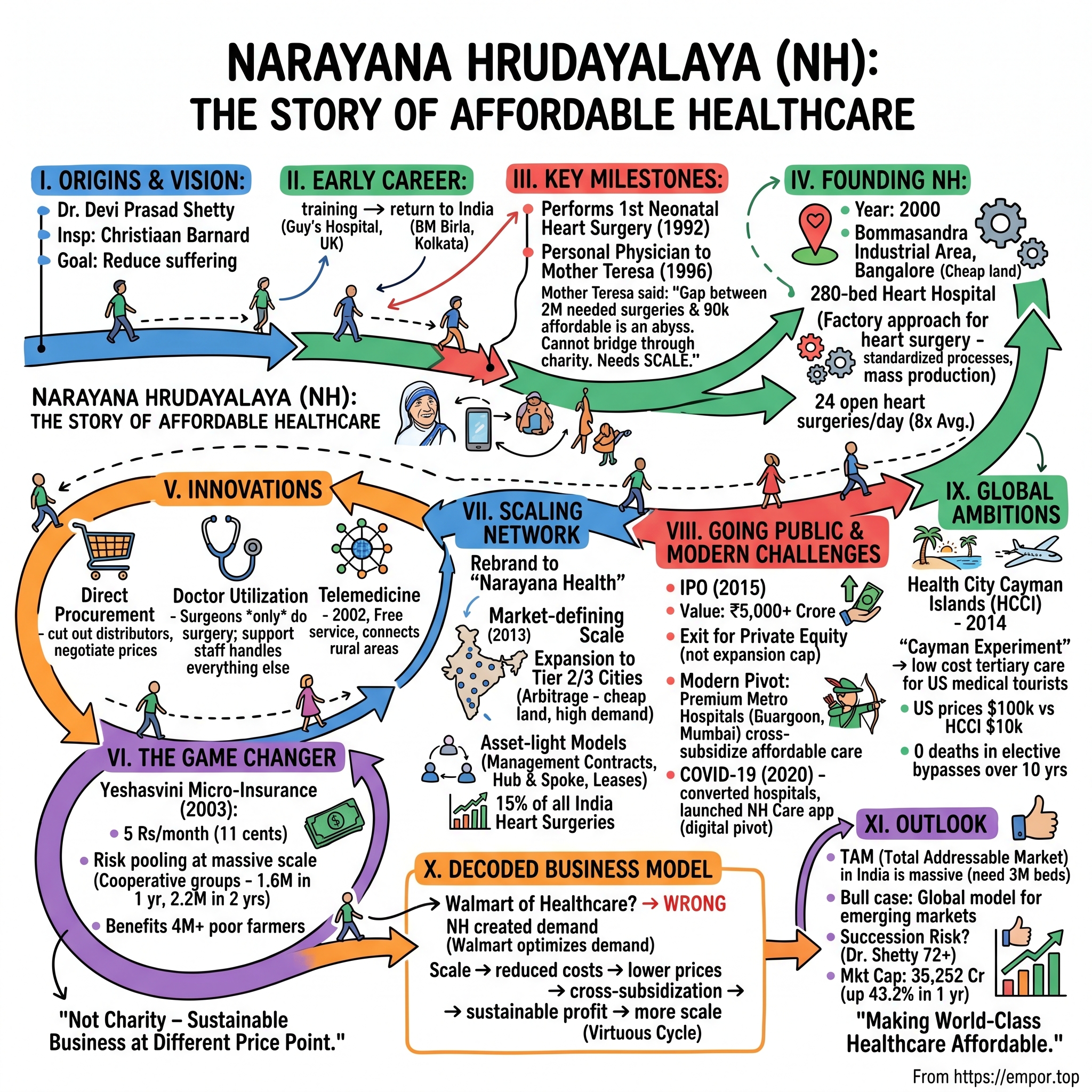
In 1996, in Kolkata, a cardiac surgeon in his early forties was called to treat Mother Teresa following a heart attack. He performed the intervention and subsequently served as her personal physician. The surgeon was Devi Prasad Shetty, who had trained at Guy's Hospital in London from 1983 to 1989 before returning to India to join B.M. Birla Hospital in Kolkata, where he performed India's first neonatal heart operation.6
While often recounted as a human-interest story, the encounter's analytical significance lies in Shetty's observation of two contrasting systems. In Britain, he had seen a national health service deliver cardiac care funded collectively; in India, he routinely saw families liquidate assets to pay for a single procedure. His core insight was not a defect in medical capability—Indian surgeons were highly skilled—but an inherited Western cost structure built around scarce patients and abundant capital. India presented the inverse: abundant patients and scarce capital.
Inverting that paradigm changed the economics entirely. If an operating theatre runs two procedures a day, fixed costs—buildings, equipment, sterilisation infrastructure, and standby teams—are amortised across two patients. Running thirty procedures daily spreads those same fixed costs across thirty patients. Clinical quality remains intact while unit costs fall dramatically. This was less a medical breakthrough than an exercise in factory utilisation, earning Shetty the moniker "the Henry Ford of heart surgery."
The mechanics warrant examination because high-volume cost reduction is straightforward in theory but difficult to execute. A hospital's cost base contains three distinct layers: 1. Fixed costs: Land, buildings, imaging equipment, catheterisation labs, power, oxygen, and sterile supply chains. 2. Semi-fixed costs: Surgical and nursing teams required to be present regardless of daily case volume. 3. Variable costs: Consumables such as sutures, valves, stents, and pharmaceuticals.
While Western hospitals typically focus cost control on variable procurement, Narayana recognised that fixed and semi-fixed layers dominate the cost of complex surgery. Attacking those top two layers required continuous throughput—starting earlier, turning over operating theatres faster, scheduling surgical teams in relays, and keeping catheterisation labs operating through meal breaks.
The result was a healthcare business operating with strict capacity-utilisation targets. Clinicians performing the same procedure multiple times daily build specialized skill—a link between high procedure volume and superior clinical outcomes widely documented in medical literature. High throughput thus supported clinical quality rather than compromising it, enabling Narayana to price procedures well below Western benchmarks without positioning itself as a low-cost brand.
Narayana Hrudayalaya Limited was incorporated in 2000.7 The flagship Bengaluru hospital opened with 225 beds alongside the Rabindranath Tagore International Institute of Cardiac Sciences in Kolkata, established that same year—a facility that grew into a 681-bed quaternary-care hospital and remains one of the group's primary profit engines.8 From its inception, Narayana operated on a dual-anchor model: Bengaluru in the south and Kolkata in the east. Twenty-six years later, these two clusters continue to generate the majority of domestic hospital revenue—with Bengaluru accounting for 37 percent of Indian hospital operating revenue in the June 2026 quarter and Kolkata contributing 25 percent.9
Three foundational design choices established during this decade continue to shape the company's trajectory:
1. Daily cost visibility as an operational discipline
Narayana pushed daily profit-and-loss statements directly to clinical teams rather than confining financial data to administrative departments. Providing surgeons with visibility into the consumable costs of their procedures created immediate operational feedback.
The modern descendant of this system is ATHMA, the group's proprietary hospital information software. Executive Viren Shetty described ATHMA as solving the internal "single source of truth" challenge, and management explicitly identifies it as a core asset supporting both the Cayman Islands turnaround and the UK expansion thesis.4 The company subsequently began licensing the software externally; by mid-2026, the platform served more than 1,500 beds outside the group.22
This competitive advantage stems not from patent protection or network effects, but from accumulated operational discipline embedded in software and workplace routine—a combination that is difficult to replicate because it requires restructuring physician compensation and staffing models. Conversely, its vulnerability lies in organizational discipline: it relies on maintaining internal reporting metrics that regulatory bodies do not mandate.
2. Capital-light facility expansion
Rather than acquiring land and developing properties outright, Narayana partnered with state governments, charitable trusts, and public-private entities to take operational control of facilities it did not own. This structure allowed bed capacity to scale ahead of balance-sheet leverage. The company continues to deploy this model; its financial year 2026 investor presentation distinguishes owned hospitals—which generated 74 percent of Indian hospital revenue in the March 2026 quarter—from operated facilities managed under lease or revenue-sharing arrangements.9
3. Structured demand creation
High-volume surgical centres require a continuous pipeline of patients. In a market where most individuals lacked financial resources for elective surgery, patient demand—rather than surgical or facility capacity—represented the primary operational constraint.
In 2003, Shetty helped launch Yeshasvini, a micro-health-insurance scheme for Karnataka's agricultural cooperatives. Members paid a nominal monthly premium—reported at roughly five rupees—in exchange for cashless surgical coverage across a statewide hospital network.10
Two decades before Narayana Health Insurance secured its regulatory licence, the group had already designed a prepaid, capitated payer mechanism to supply patient volume to its operating theatres. The formal insurance enterprise launched in the 2020s represents an internalisation of that original model, reflecting strategic continuity rather than an unaligned diversification.
A fourth cultural factor also emerged: Narayana developed under a founder who was a practising surgeon rather than a professional administrator or financier. Senior clinicians participate directly in quarterly earnings calls to address case-mix details, the chief executive is a medical doctor, and operational reporting evaluates surgical throughput with manufacturing precision. However, physician-led management can be slow to divest underperforming assets, as closing a hospital is often viewed through a clinical lens rather than a strict capital-reallocation framework—a friction evident in several historical operational delays.
Ultimately, this founding decade proved that extreme surgical throughput, disciplined procurement, and a salaried-physician model could deliver tertiary cardiac care at a fraction of Western costs while maintaining clinical standards. What it had not yet established was whether this operational playbook could generate attractive returns on capital when deployed in markets lacking Narayana's established brand, local referral networks, and anchor cardiac reputation.
III. Transition to Multi-Specialty & The Pre-IPO Scale Phase (2010–2015) (32:00 - 52:00)
In July 2010, an Indian newspaper carried a headline that now reads like a time capsule: Narayana Hrudayalaya planned to create 30,000 beds.11 The company operated roughly a tenth of that capacity at the time. It was an era of aggressive ambition, abundant private equity, and a widespread assumption in Indian healthcare that the market favoured whichever operator accumulated the largest bed count.
Sixteen years later, the group operates a little over 5,900 beds against a stated target of 7,685 by financial year 2030.19 That gap reflects a decisive strategic pivot in Indian corporate healthcare. Executive Viren Shetty addressed the expansion trajectory directly on the February 2026 earnings call, noting that early goals "used to be bed driven, which is chasing after having the largest presence and the largest number of beds all over the country," adding that the strategy "was diluting it a lot because we entered into markets where we had very little presence and recognition and we were not able to execute well."4
That acknowledgement frames the strategic realignment during the 2010–2015 period.
The multi-specialty pivot was structurally necessary. Cardiac surgery offers high clinical acuity, strong realisation, and clear brand differentiation, but it presents a growth ceiling. A cardiac-only facility addresses a narrow patient segment while keeping supporting infrastructure underutilised for broader medical needs. Narayana subsequently expanded into oncology, neurosciences, renal sciences, orthopaedics, gastroenterology, and organ transplants. By the March 2026 quarter, cardiac sciences represented 34 percent of Indian hospital revenue, oncology and gastrointestinal sciences 14 percent, renal sciences 12 percent, neurosciences 9 percent, and orthopaedics 8 percent.9 The group transitioned from a dedicated cardiac chain into a multi-specialty operator anchored by a core cardiac franchise.
The geographic expansion presented operational friction. Capitalised by private equity, Narayana established facilities across northern, western, and central India — including Ahmedabad, Jaipur, Gurugram, and Jammu. The expansion plan assumed that the operational model and brand reputation established in southern and eastern India would easily transfer to new geographic markets.
The operational economics of these newer units proved tougher than those of the flagships, yielding lower average revenue per occupied bed, slower volume ramp-ups, persistent physician recruitment challenges, and weaker local brand pull for complex, high-margin procedures.
The initial expansion model measured scale by physical beds rather than specialty case mix. Hospital profitability depends less on raw bed count than on clinical complexity: a bed occupied for routine medical observation generates vastly different unit economics than one used for complex surgical care.
Capital structure and investor exit timelines. Institutional private equity funded this expansion phase. By the time of the initial public offering, the shareholder register included JP Morgan's Mauritius vehicle, Ashoka Investment Holdings, and Ambadevi Mauritius Holding — all of which exited during the listing.14 Growth capital with fixed fund lifecycles incentivises rapid network growth, prioritizing bed additions and geographic entry over the slower process of deepening clinical specialties within existing regional hubs.
The operational consequences persisted into 2026. Commenting on the northern cluster, which registered modest revenue growth of 7 percent and 5 percent across recent periods in FY26, Viren Shetty noted: "it is no surprise to us and to the investors that North has been extremely challenging region for us. We are one of the latest entrants to this market, and it is extremely competitive."5 Evaluating the Mumbai facility — a paediatric unit operated under a trust structure — management offered a similar assessment: "Our performance in Mumbai compared to the performance of most other Mumbai operators has not been good... The fault lies with us entirely."12 The Mumbai unit reached operating breakeven in the March 2026 quarter, with management negotiating with the trust to introduce adult clinical programmes.5
This experience highlighted a fundamental economic dynamic in tertiary care: the primary unit of production is not the physical bed, but the specialised clinical team. Delivering complex tertiary procedures requires dedicated surgical units, specialized nursing, lab support, and critical-care teams with accumulated case experience. Operating a facility without those established clinical teams yields commodity general-ward economics that struggle to cover tertiary capital costs. Chief Executive Dr. Emmanuel Rupert illustrated the internal scale disparity between campuses on the Q4 FY26 earnings call, noting that while Bengaluru maintains 45 bone-marrow-transplant beds, Kolkata — the group's second flagship — operates ten, representing "around 30% of the scale of the infrastructure."5
The strategic response to this disparity was the development of a hub-and-spoke network model. Rather than equipping every regional unit as a full tertiary centre, Narayana positioned smaller regional hospitals, heart centres, and clinics as feeders into its primary campuses. Complex cases migrate inward to main hubs containing specialized equipment and senior clinical teams, while routine care remains decentralised.
This operational model creates revenue concentration, which rating agency ICRA highlights as a key credit consideration: a substantial portion of consolidated revenue and operating profit remains tied to three domestic facilities — the Bengaluru cardiac institute, Mazumdar Shaw Medical Centre in Bengaluru, and RTIICS in Kolkata — alongside the Cayman Islands operation, though geographic concentration has moderated in recent years.13 In tertiary healthcare, such concentration reflects the scale required to sustain high clinical throughput across complex specialties.
For investors, this expansion phase demonstrated management's willingness to re-evaluate capital allocation, pivot from pure bed expansion, and concentrate capital in core markets like Bengaluru and Kolkata. That refined strategy underpins the group's current ₹3,000 crore domestic capital expenditure plan. The central question entering the public market listing in 2015 was whether investors would support an operating model that intentionally capped unit pricing below market peers.
IV. Public Listing & Capital Realignment (2015–2018) (52:00 - 1:12:00)
December 2015 presented a challenging environment for an Indian healthcare offering. Global markets faced uncertainty ahead of the first U.S. Federal Reserve rate increase in nearly a decade, while domestic equity issuance remained volatile. Against that backdrop, a company whose core identity rested on charging lower prices asked institutional investors to underwrite a growth story built on affordability. That proposition contained an inherent structural challenge that shaped every subsequent year of the company's public life.
The initial public offering opened on December 17, 2015, and closed on December 21, priced between ₹245 and ₹250 per share for 24.5 million shares totaling up to ₹613.08 crore.14 The transaction was entirely a secondary offer for sale, raising no new growth capital for the company. The selling shareholders included private equity investors JP Morgan's Mauritius vehicle, Ashoka Investment Holdings, and Ambadevi Mauritius, alongside founder Dr. Devi Prasad Shetty and Shakuntala Shetty.14 Trading commenced on the National Stock Exchange and BSE on January 6, 2016.15
The structure revealed the listing's primary purpose: providing liquidity for early backers while establishing a public acquisition currency and quarterly reporting discipline. Institutional appetite was robust, with the qualified institutional buyer segment oversubscribed more than twenty-four times, whereas retail investors subscribed for less than twice their allocated quota.14
Following the listing came an operational reality rarely highlighted during IPO roadshows. A public hospital operator faces quarterly evaluation on EBITDA margin, average revenue per occupied bed (ARPOB), and return on capital employed against peers that target higher-income patient demographics. Narayana's core proposition — maintaining the industry's lowest realisation per patient — created a structural headwind for revenue and margin metrics. Consequently, the capital markets judged the company against a financial scorecard engineered for premium-priced healthcare models.
Rather than abandoning its pricing structure, Narayana responded with a focused operational overhaul driven by four key levers.
Length of stay. In hospital management, time represents the primary operational efficiency lever. Reducing a patient's stay from five days to four expands effective bed capacity by 25 percent without additional capital expenditure while reducing exposure to hospital-acquired infections. Narayana steadily reduced its average length of stay to 4.3 days in FY26 from 4.5 days in FY25.9 While external commentary often cites a 3.5-day average, official disclosures reflect this higher, measured figure.
Case mix and payor mix. A more consequential shift occurred in clinical complexity and payor composition. Rather than relying on aggressive list-price increases — which management notes run in the low-to-mid single digits annually — Narayana systematically expanded complex procedures and higher-realisation payor categories.5
Complex procedures generate substantially higher realisation per bed-day. In FY26, the group performed more than 750 robotic cardiac surgeries — including 727 at the Bengaluru cardiac campus — and 160 transcatheter aortic valve implantations, representing a 20 percent increase over the prior year.1 These high-acuity interventions expand revenue yield from existing bed capacity.
Concurrently, management adjusted its domestic payor mix away from price-capped government insurance schemes toward commercial insurance and out-of-pocket cash payors. By the quarter ended March 2026, domestic walk-in cash patients accounted for 44 percent of Indian hospital revenue, insured patients 33 percent, government schemes 18 percent, and international patients 5 percent.9 Group Chief Operating Officer R. Venkatesh cited payor-mix optimization as a key driver of average revenue per bed, explicitly confirming that in northern units the company took "a conscious call for controlling volumes on schemes" due to payment delays and reimbursement caps on pharmaceuticals.4
This strategic pivot reflects sound commercial logic, yet it also marks a structural transition from the founding model. While executive Viren Shetty emphasized that Narayana's scheme patient volume remains "the highest in the industry," the commercial trajectory favours paying customers.4 Consequently, a significant portion of recent margin expansion stems from payor mix optimization — a finite lever — rather than perpetual gains in unit cost efficiency.
That payor shift also delivers a working-capital benefit. Government insurance programs carry lower tariffs and extended payment cycles. Operating leadership attributed softer performance in northern facilities to "receivable problems in some of the scheme payors" alongside reimbursement ceilings.4 Curbing low-margin scheme exposure strengthens cash conversion; as of March 31, 2026, net receivables stood at ₹6,557 million against full-year revenue of ₹78,960 million.9 For an enterprise embarking on a ₹3,000 crore capital expenditure program, working-capital velocity is as critical as operating margin.
Physician compensation. Narayana structures clinician compensation around fixed salaries combined with performance incentives, departing from the fee-for-service model prevalent across Indian private healthcare. This model aligns clinician incentives with operational throughput while curbing unnecessary diagnostic tests or procedures. Clinician and nursing costs accounted for 28 percent of Indian hospital operating revenue in FY26, while medical consumables represented 23 percent.9 Overseas head Anesh Shetty noted that this structural cost control extends to international operations, stating that in Britain, "the doctor cost as a percentage of revenue is by far the lowest compared to peers."4 Management reports that annual attrition among senior medical staff remains stable in the high single digits.4
Portfolio pruning. The fourth lever involved capital discipline through facility rationalisation. To protect overall return metrics, Narayana progressively closed or transferred underperforming assets. For example, the group discontinued its Jammu operation in March 2025, excluding it from ongoing Indian hospital profitability disclosures.139 Divestment often creates tension within physician-led leadership teams torn between healthcare access and strict capital allocation. That balance between clinical mission and return discipline remains a defining feature of board governance, as evidenced by ongoing restructuring efforts in Mumbai.
Together, these operational adjustments expanded Narayana's Indian hospital EBITDA margin to 23.1 percent in FY26 from 20.7 percent in FY25, reaching 25.1 percent in the quarter ended March 2026 compared to 21.5 percent a year earlier.9 Achieving profit margins on par with premium healthcare chains at significantly lower average realisations provides empirical evidence for the company's operational cost advantage. It also sets up the central test of its international expansion: whether this low-cost operating model can generate outsized returns when deployed in higher-priced overseas markets.
V. The Cayman Islands Masterstroke: International Cash Cow (2014–2024) (1:12:00 - 1:35:00)
On February 25, 2014, on a stretch of scrubland at the East End of Grand Cayman — an island of roughly sixty thousand people, better known for banking secrecy than for open-heart surgery — Narayana opened a 104-bed tertiary hospital in partnership with Ascension, the largest non-profit health system in the United States.16
The strategic logic looked, at the time, like a bank shot at American healthcare. Grand Cayman is about an hour's flight from Miami. If a US employer could send a patient offshore for a joint replacement or a cardiac procedure at a third of the American price, with American-standard accreditation, in an English-speaking, common-law jurisdiction — the arbitrage would be enormous. Ascension put in the majority of the capital.
The medical-tourism-from-America thesis largely did not materialise at the scale envisioned. Employer-funded medical travel proved harder than the spreadsheets suggested: American insurers had no incentive to redirect volume offshore, patients were reluctant to fly for surgery, and the legal architecture of malpractice and follow-up care never fully resolved. What happened instead was more valuable and less glamorous: Health City became the dominant private tertiary provider for the Cayman Islands and the wider Caribbean, serving a local population with high incomes, comprehensive private insurance, and — until Narayana arrived — no local option for complex care other than a flight to Florida.
This is a pattern worth naming, because it recurs across the company's history. Narayana's biggest wins have generally come not from the strategy it announced but from the second-order opportunity it discovered while executing that strategy. It set out to industrialise cardiac surgery and ended up building a multi-specialty group. It set out to arbitrage American healthcare and ended up owning a Caribbean market. Investors evaluating the British thesis should hold that pattern in mind in both directions: the announced rationale may not be what creates the value, and the value that does get created may take longer and look different.
Then came the transaction that made the whole thing work. In January 2018, Narayana bought out Ascension's 71.4% shareholding in Health City Cayman Islands for USD 32.26 million, taking the facility to full ownership.17
Consider what that price implies. For roughly ₹200-odd crore at the exchange rates of the day, Narayana acquired majority control of an asset that, in the year ended March 2026, generated USD 178.7 million of hospital revenue.9 The commonly repeated framing that Narayana bought a minority stake understates what happened: it went from being the junior partner to owning the whole thing.
The buyer of a partner's stake in a business that is beginning to work is almost always paying for the past; the seller is almost always exiting the future. That is precisely what happened here, and it is the single highest-return capital decision in the company's history. It is also worth noting what it required: the conviction to concentrate rather than diversify, at a moment when the asset was still unproven and the partner had decided to leave.
The economics of Cayman are best understood by comparison rather than in isolation. In FY26, Cayman contributed ₹18,893 million of the group's ₹78,960 million revenue — roughly a quarter — from an operational bed base of around 165 beds against a group total above 5,900.113 Three percent of the beds; a quarter of the revenue. That is not efficiency; that is price. A Caribbean private-insurance patient pays a multiple of what an Indian scheme patient pays for the same procedure, delivered by the same operating model. Layer Narayana's Indian cost discipline onto Caribbean pricing and you get hospital EBITDA margins that analysts on the November 2025 call put at 40–43%, a characterisation Anesh Shetty did not dispute.12
It is worth pausing on why Cayman works so well, because the reasons are specific and not obviously repeatable. The island has a small, wealthy, heavily insured population with no domestic alternative for complex care. It has no price regulation of the kind that caps stent and implant margins in India. Its legal system is familiar to international insurers. And it sits at the centre of a Caribbean region where several small nations have no tertiary capability at all, so referral flow arrives without a marketing budget. Anesh Shetty's framing of the remaining opportunity is instructive precisely because it is modest: the government hospital is still larger by revenue and holds an exclusive right over an entire payor class Narayana cannot access, and another private hospital also does well — so "there is still market share to be had," but nobody at Narayana pretends it is unlimited.4
Narayana then reinvested the proceeds locally. Health City at Camana Bay, a second campus in George Town, opened on July 11, 2024, adding oncology, radiotherapy, a neonatal intensive care unit and an emergency department — part of an investment programme in the Cayman Islands that local reporting put at more than USD 300 million cumulatively.18 The effect was immediate: Cayman hospital revenue grew 27% in FY26 to USD 178.7 million, with discharges up from 2,550 to 3,170 and outpatient visits from 40,504 to 50,864.9
There is a second Cayman story that is younger, messier, and strategically more important: insurance. In January 2025 Narayana began selling health insurance policies in the open market in Cayman under the One Health banner. The book scaled far faster than expected — to an annualised premium run-rate of around USD 60 million, on Anesh Shetty's telling — and promptly ran into the oldest problem in the industry.5 Cayman insurance revenue for FY26 was USD 41.8 million; the insurance entity's EBITDA was negative USD 8.0 million, with a USD 5.1 million loss in the March quarter alone.9 The loss ratio, Anesh Shetty acknowledged, was running "approximately about 110% to 112%" — meaning claims paid exceeded premiums collected before any expenses.5 His own verdict: "for a year 1 insurance book, that's not very bad. I mean it's not great, but it's not horrible."5
Management's response was to raise prices on 30–35% of accounts from June 2026 and to purge accounts priced unfavourably.5 By the June 2026 quarter, insurance revenue had risen to USD 15.4 million with the loss narrowing to USD 3.7 million.19 Anesh Shetty has asked investors to stop separating the two: "we request people to analyze the Cayman business as one, and not disaggregate insurance and hospital... the insurance helps drive steerage into the hospital."5
That request is analytically legitimate and also convenient. It is legitimate because a payer that channels its own members into its own hospital genuinely converts an underwriting loss into hospital revenue at high incremental margin. It is convenient because it makes a loss-making unit unauditable on its own terms. The honest position is that Cayman as a whole remains the group's most profitable operation by a wide margin, that the insurance book grew faster than the underwriting discipline, and that management said so before analysts had to drag it out of them.
One risk here deserves more attention than it usually gets. A single small jurisdiction now carries roughly a third of group operating profit, and that jurisdiction regulates both of Narayana's businesses within it — hospital licensing on one side, insurance solvency and conduct on the other, with loss-ratio statistics published by the local monetary authority.5 The Cayman Islands has been a stable and welcoming host; the group's second campus would not exist otherwise. But concentration is concentration. A change in local insurance mandates, a shift in how the public payor class is allocated, or a policy decision about the government hospital's role would land directly on the group's most profitable asset, with no ability to relocate the capital. This is not a prediction. It is a reminder that the highest-return asset in the portfolio is also the least diversified.
The strategic problem with Cayman is the one nobody can solve: it is 165 beds on an island. Growth from here is single-digit, as management concedes, and the profit pool is capped by the population of the Caribbean.5 Which is exactly why Narayana went looking for a second jurisdiction — and why the money it earned in Grand Cayman ended up buying hospitals in England.
VI. Current Management, Capital Allocation & Segment Breakdown (1:35:00 - 1:58:00)
Listening to a Narayana earnings call reveals a distinct structural pattern. Rather than opening with a scripted executive overview, the February 2026 conference call began with the investor relations lead announcing that, given the group's "multiple business streams across the globe," the session would allocate thirty minutes for India and thirty minutes for the UK and Cayman before moving directly to Q&A.4
That structure serves as a governance signal. It reflects a leadership team comfortable facing direct questioning without promotional preambles, while acknowledging that the enterprise now operates three distinct regional divisions with contrasting economic profiles.
Dr Devi Prasad Shetty remains Chairman and the group's founding strategist. Having framed affordability as an engineering challenge, his personal reputation serves as a commercial asset—with credit rating agency ICRA citing the "significant brand equity of the 'Narayana Health' brand" and his national civil honours as core credit strengths.13 His perspective continues to shape public narrative; regarding the British acquisition, he described targeting "those in between"—patients excluded from charitable care but unable to afford premium private options.20
Viren Prasad Shetty, Vice Chairman, drives corporate strategy. He has routinely acknowledged operational errors on public calls—stating directly that underperformance at specific units was management's fault and admitting that the earlier bed-count expansion strategy was flawed. When asked whether Narayana would pursue further international acquisitions, he responded: "Definitely not for the foreseeable future. I think we have our hands full."4 He has outlined a specific regional density strategy, aiming for patients in core hubs like Bengaluru and Kolkata to be no "more than 25 minutes away from an NH Centre, be it a hospital or a clinic," thereby capturing a broader share of total healthcare expenditure across primary care, diagnostics, procedures, and insurance.4
His communication style contrasts with standard corporate public relations. When a long-term shareholder questioned whether related-party procurement entities enriched outside promoters, he clarified that the unit in question is a wholly owned subsidiary of the listed company, after which financial leadership offered a detailed follow-up.5 When asked if Narayana would build a standalone retail pharmacy chain to emulate domestic peers, he cited structural scale constraints rather than offering vague assurances.5 Asked if market saturation was a risk in Bengaluru amid industry-wide expansion, he offered a one-word affirmative response without elaboration.4 This approach highlights a management culture that favors direct responses over speculative guidance.
Dr Emmanuel Rupert, Managing Director and Group CEO, oversees clinical operations and signs off on financial disclosures.1 He translates corporate strategy into operational execution; his FY26 commentary framed performance around the British acquisition, operational ramp-up at Camana Bay, and the rollout of "Narayana One Health," the group's integrated healthcare delivery network.1
Sandhya Jayaraman, Group CFO, manages capital structure and financial reporting. She has maintained a pragmatic tone with capital markets, explicitly cautioning investors that return metrics will face near-term dilution during the current capital expenditure cycle, describing the integration schedule as a "work-in-progress," and advising analysts to evaluate full-quarter operational results before drawing conclusions on the British business.45
Operating leadership is divided across core business units: R. Venkatesh, Group COO, manages domestic facility operations and payor-mix optimization; Dr Anesh Shetty directs international operations, overseeing the UK integration; and Ravi Vishwanath leads the domestic integrated-care and health insurance business.4
Ownership remains concentrated, with the promoter group holding roughly 63.3 percent of equity as of June 2026, while foreign and domestic institutional investors held approximately 9.4 percent and 9 percent, respectively.21 This high insider stake gives leadership the latitude to make long-term strategic investments, though it leaves minority shareholders reliant on the founder family's capital allocation choices.
Executive compensation structures remain partially opaque. The company does not publish an explicit matrix linking executive pay directly to return-on-capital-employed (ROCE) or margin hurdles. While market observers often assume management compensation is tied to return metrics, disclosures lack the granularity to verify that claim independently. In practice, executive behavior demonstrates capital discipline through actions rather than formal targets: management refrains from providing short-term earnings guidance, avoids setting arbitrary bed-capacity goals, and explicitly warns investors of near-term return dilution during expansion phases.
Segment financial performance for FY26. Domestic Indian operations generated ₹47,974 million in revenue, representing a 10.3 percent year-on-year increase; the Cayman Islands division contributed ₹18,893 million, up 59.7 percent; and the UK operations added ₹12,992 million following consolidation on November 6, 2025.1
Operating profitability varies significantly by geography. The Indian hospital division generated ₹10,949 million in EBITDA, reflecting a 23.1 percent margin before accounting for initial drag from domestic integrated-care ventures.9 The UK business generated £10.7 million in EBITDA on £110 million in stub-period revenue—a 9.8 percent operating margin—and recorded a net loss of £1.9 million after accounting for acquisition financing costs and intangible amortisation.9 Consequently, the Cayman Islands operation generates roughly one-third of consolidated group EBITDA while contributing one-quarter of overall revenue.
This segment breakdown highlights Narayana's evolving corporate profile: India provides steady volume and margin expansion, Cayman functions as a high-margin cash generator, and the UK provides revenue scale without immediate earnings contribution. The enterprise now operates across three distinct strategic tiers—a stable domestic core, a highly profitable international asset, and an unproven turnaround project.
Capital allocation history splits into two distinct phases. Through FY25, Narayana maintained conservative balance-sheet leverage, generated high returns on capital, and accumulated cash flow from its Cayman operations that exceeded local reinvestment opportunities. The current phase began with the decision to deploy that accumulated capital into a major overseas acquisition.
Balance-sheet leverage rose following the UK transaction. As of March 31, 2026, net debt stood at ₹22,397 million—representing a net-debt-to-equity ratio of 0.49—including foreign-currency borrowings of 117 million US dollars and 150 million British pounds.1 By June 30, 2026, net debt decreased to ₹19,671 million, reducing the net-debt-to-equity ratio to 0.42.19 Leverage remains within management's internal ceiling of keeping consolidated net debt below 2.5 times EBITDA.4
Concurrently, Narayana committed approximately ₹3,000 crore toward domestic expansion—comprising six projects adding 1,535 beds across Bengaluru, Kolkata, and Raipur, with most capacity scheduled for commissioning in FY28 and FY29.9 Rating agency ICRA estimates capital expenditure of ₹700–800 crore in FY26 and ₹1,400–1,450 crore in FY27, funded through internal cash flows and debt facilities.13
Execution timing presents near-term challenges. Against a planned FY26 capital expenditure target of ₹4,240 million for greenfield developments and inorganic growth, actual outlay reached ₹1,089 million—reflecting a 74 percent shortfall against budget.9 Management attributed the delayed execution to labor shortages during election periods and municipal permitting bottlenecks, while maintaining overall commissioning timelines for FY28.5 This project delay compresses construction schedules into FY27 and FY28, coinciding with management's explicit warning that the group is "going through a phase where we will be diluting ROCE for growth."5
In summary, evaluating Narayana in 2026 requires assessing a company that has intentionally accepted lower near-term return metrics to fund a five-year domestic expansion, complete its Cayman infrastructure, and finance an overseas expansion in the UK. Whether this capital allocation strategy generates long-term economic value depends primarily on operational turnaround and margin execution within the newly acquired British assets.
VII. The Next Frontier: UK PPG Acquisition & Integrated Health Insurance (2024–Present) (1:58:00 - 2:20:00)
On October 31, 2025, Narayana announced it was buying Practice Plus Group Hospitals Limited, and Indian healthcare's most disciplined capital allocator suddenly owned a chain of British hospitals.2
The headline consideration was £188.78 million, executed through Narayana Hrudayalaya UK Ltd, a subsidiary of Health City Cayman Islands Limited — meaning the deal was legally and financially a Cayman transaction, not an Indian one.3 That structure is not a tax curiosity; it is the clearest possible statement of where the money came from and which balance sheet was being risked.
Sandhya Jayaraman later gave the cleaner numbers: £150 million of debt priced at roughly SONIA plus 200 basis points, £45 million of equity funded from Cayman's accumulated cash, and £183 million paid net of cash in the target.4 The debt carries a two-year interest-only moratorium followed by five years of equal principal repayment, is denominated in sterling, and is serviced locally — so there is no currency mismatch, though there is plenty of operating risk.45
Read structurally, this was a leveraged buyout executed by a hospital company. The Indian parent's balance sheet was largely insulated; the acquired business is expected to service its own debt out of its own cash flow. If it does, shareholders get a large new profit pool for £45 million of equity. If it does not, the loss is bounded but the group has spent its Caribbean surplus and two years of senior management attention finding out.
What Narayana bought is a specific and unusual asset: Britain's fifth-largest private hospital group and fourth-largest independent NHS provider, with roughly a dozen hospitals and surgical centres and 330 beds, concentrated in elective orthopaedics, ophthalmology and general surgery.313 The revenue base is around £250 million annualised.3 And 90%-plus of it comes from the NHS.12
That last number is the whole investment case, and the whole risk.
For readers unfamiliar with how British private hospitals actually make money, the structure is worth explaining, because it is nothing like India. The NHS is free at the point of use and handles essentially all emergency, complex and chronic care. What it struggles with is elective volume — hip replacements, cataracts, hernia repairs, knee arthroscopies: procedures that are not urgent, that can be scheduled, and that therefore queue. When the queue gets long, the NHS pays independent providers to clear it, at a nationally set tariff. Practice Plus is one of the largest such providers. Anesh Shetty's description of the asset is deliberately narrow: "we only do elective secondary care surgeries" — not a general hospital, not tertiary care, and with little of the seasonality Indian hospitals experience, since the volume variation comes from contracting relationships with individual NHS Trusts rather than from disease patterns.4
Two things follow. First, the revenue is remarkably stable — long-term, what the British call "evergreen," contracts with a government counterparty that does not default.12 Second, the price is capped by policy, not by competition, and the cost base is a British cost base: unionised, regulated, expensive relative to output. A business like that cannot earn 40% margins. The realistic question is whether it can earn low-to-mid teens instead of high single digits.
The bull mechanism, as management describes it, has two legs. First, payor mix. Private and self-pay patients in Britain pay 20–35% more than the NHS tariff for like-for-like work, and Practice Plus sits at roughly 7–8% private mix against Ramsay at 30–32% and best-in-class operators at 60–75%.12 Starting from the bottom of the industry means even modest movement is meaningful. Second, cost. Anesh Shetty's description of what he found is worth quoting because it explains why an Indian operator thought it could add value in a first-world market at all: the business "runs several interconnected systems, none of which talk to each other very efficiently. So, there is a human layer that has to not just translate and type, but sometimes even print out and retype information between one software stack and another."5 Narayana's answer is ATHMA, deployed at a scale far larger than Cayman.
Now the sceptic's case, which analysts pressed hard. When one asked why a business bought at roughly 9.2x EV/EBITDA could generate enough profit to service its debt, Sandhya Jayaraman pointed to a one-time loss at the newly opened Birmingham centre and to a repayment schedule structured around the target's cash flow.12 When another asked directly whether this was ROCE-dilutive given the NHS ceiling on profitability, Viren Shetty's answer was that the thesis "wasn't counting on the NHS share reducing materially" — that Britain's private sector is so small relative to the NHS that even a tiny shift creates significant volume for private players.4 That is a demand-side argument resting on a structural bottleneck rather than a market-share forecast, which makes it more defensible than a typical synergy story. The NHS elective waiting time for many procedures runs beyond 18 to 20 weeks, and Anesh Shetty's assessment is that it "doesn't appear that it's going to go away anytime soon."4
The record so far is mixed, and the numbers are unambiguous. In its first stub period, the UK business generated a 9.8% EBITDA margin and a net loss.9 Management had told investors the acquisition would be "EPS neutral to slightly positive"; when an analyst pointed out that the disclosed pro forma implied full-year losses, Sandhya Jayaraman attributed the distortion to one-time deal costs and held the position.4 In the June 2026 quarter, UK revenue was ₹8,257 million — up just 2.1% sequentially — at an EBITDA margin of 8.8%, down from 10.5% in the March quarter.1922 Consolidated EBITDA margin for the group fell to 18.8% from 23.9% a year earlier; profit after tax rose 5.7% while revenue rose 78%.19
Three quarters in, the British business is stable, not improving. Management has explicitly refused to guarantee it will ever reach Cayman-like profitability — "we don't think that the profitability of what the operation in the UK will ever reach where we are in Cayman because they're very different markets" — while insisting early results should appear well inside two to three years.4 That is a fair, non-promotional framing. It is also unfalsifiable for another four to six quarters, which is precisely the period in which the interest-only moratorium runs out.
The insurance moonshot is the other capital-consuming experiment, and it deserves to be sized honestly. IRDAI granted Narayana Health Insurance Limited its registration in December 2023, the first standalone health insurance licence in five years.23 The first product, Aditi, launched in July 2024 with an annual premium around ₹10,000 covering ₹1 crore for surgeries and ₹5 lakh for medical management, initially in a handful of Karnataka districts.24
The economic logic is the Kaiser Permanente flywheel: when a hospital owns the insurer, the incentive inverts. A fee-for-service hospital earns more when patients are sicker; a capitated integrated system earns more when they are not. The insurer has every reason to invest in prevention, early diagnosis and cheaper settings of care, because it keeps the savings.
Combine that with the integrated-care clinics — eleven points of presence as of March 2026, handling 581,000 patient transactions in FY26 — and you have a primary-care funnel feeding an insurance book feeding the hospitals.9 Management plans to roughly double the clinic count and extend from Bengaluru into Kolkata during FY27, and has said the clinics already generate inpatient referrals for advanced therapies and reach patients who "historically would never consider coming to Narayana."5
The scale is currently trivial and the losses are not. Gross written premium for FY26 was ₹438 million, against ₹23.7 million in FY25.9 The integrated-care and insurance entities together lost ₹674 million of EBITDA in FY26, roughly flat on the prior year.9 In the June 2026 quarter, the insurance arm wrote ₹262 million of premium and reported a loss after tax of ₹201 million on a combined operating ratio of 259% — meaning it spent ₹2.59 for every rupee of premium.22 Ratios like that are normal for a year-two insurer building distribution, and they are also exactly how insurers destroy capital when growth outruns underwriting.
Management's own posture is appropriately unconfident. Ravi Vishwanath, asked about breakeven: "it's a little bit early for us to talk about breakeven on this."4 Viren Shetty, on the same question: "there will be some amount of margin dilution going forward... too early at this point to tell when the breakeven will be achieved."4 ICRA expects losses to continue through FY27 and flags the cash burn as a monitorable.13 Notably, management has ruled out extending insurance to Britain.5
There is one more element of the British story that management has handled with more candour than most acquirers manage. Asked what would happen when Indian operating practice met British institutional culture, Viren Shetty rejected the premise that Narayana would simply impose its playbook: applying the Cayman and India templates directly to Britain, he said, "will be a disaster because the circumstances are very different, payors are very different, the way in which they operate is very different." He described the integration instead as "a collaborative learning process... And a lot of failed experiments along the way," noting that a technology rollout taking three weeks in India might take three months in Britain, and vice versa.12 The Birmingham unit — a neglected hospital that Practice Plus had itself acquired from another health system and reopened shortly before the sale — is the visible test case; management had hoped a turnaround would take about four quarters and, halfway through, described "some positive changes on the ground" without claiming victory.4
Investors should take that tone seriously in both directions. It is refreshingly free of synergy theatre. It is also an explicit statement that the acquirer does not yet know how long this takes or what it is worth.
The correct way to hold this is as an option, not an earnings line. It costs roughly ₹65–70 crore a year of EBITDA at present. If it works, Narayana becomes the only Indian hospital operator with a captive payer and a structurally different revenue model. If it does not, the company will have spent a few hundred crore learning that underwriting is a different business from surgery. The evidence available today does not settle it either way.
VIII. Competitive Landscape, Economics & Helmer's 7 Powers (2:20:00 - 2:40:00)
Evaluating Narayana properly requires accepting an uncomfortable premise: it operates in a market where it deliberately chooses not to compete on the dimension that most directly drives reported margins.
The Indian battlefield. Apollo Hospitals is the scale incumbent, with the largest bed footprint, higher metro realisations, and two adjacent businesses — retail pharmacy and a consumer digital front end — that Narayana has explicitly declined to build. Asked why there is no Apollo-style branded pharmacy chain, Viren Shetty responded that Narayana's pharmacies exist strictly to satisfy internal hospital and clinic demand, adding that the group lacks "sufficient scale at which it makes sense" for white-label retail.5 Max Healthcare leads the industry in operating margin, concentrating in the National Capital Region with ultra-premium realisations and high profitability per bed. Fortis Healthcare and Medanta occupy the high-end super-specialty tier. As Viren Shetty acknowledged, the competitive intensity of Delhi-NCR represents precisely the environment where Narayana has struggled most.5
The broader industry backdrop remains favorable. A July 2026 outlook from credit rating agency ICRA projects Indian hospital revenue to expand 13 to 15 percent in financial year 2027 and 15 to 17 percent in financial year 2028. The report anticipates average revenue per occupied bed to grow by 6 to 8 percent, with operating margins holding between 22 and 24 percent — following a 2026 financial year in which sample hospital operators achieved 18 percent revenue growth, a 24.1 percent operating margin, and 63.5 percent occupancy.25 Measured against those benchmarks, Narayana's domestic revenue growth of 10.3 percent in financial year 2026 lagged behind the industry average,1 even as its domestic hospital EBITDA margin of 23.1 percent remained roughly in line.9 The company is expanding its Indian core more slowly than peers while delivering sector-average margins at below-average prices — two facts that together define its underlying position.
Applying Hamilton Helmer's Seven Powers, three strategic levers warrant serious analysis, while one is largely absent.
Process Power represents the company's primary strategic claim and its most credible asset. Under Helmer's framework, process power requires an operational advantage embedded within organizational routines that improves with practice and cannot be duplicated merely by a competitor deciding to copy it. Narayana's operational model — built around salaried physicians, granular tracking of consumables, rapid surgical throughput, proprietary software, and shorter lengths of stay — meets those criteria.
Viren Shetty offered a measured perspective on this capability: "It's not core competency, every hospital is supposed to do that, but we'd like to believe that we do it far better than most. And how it manifests itself is in the almost close to what the industry is able to get on the India levels of EBITDA at a realization that... is far, far lower."4
Matching peer margins at significantly lower patient prices provides empirical evidence of an underlying cost advantage. However, the critical test of this advantage remains the British acquisition. If the same operational discipline cannot expand a 9 percent margin over three years in a market that management describes as containing substantial operational slack, process power may prove far more geographically bounded than assumed.
Scale Economies are present but modest. Bulk procurement across more than 6,000 beds alongside a centralized formulary secures favorable pricing — with management pointing to "a very large purchasing network" negotiating directly with equipment manufacturers.5 Nevertheless, scale economies in tertiary healthcare face structural limitations compared to other industries, because clinical labor — the largest cost component — does not scale down in cost with size, while regulatory price ceilings in India already cap the margins on major medical implants.
Counter-Positioning represents an intriguing prospective power rather than an established capability. A hospital system that underwrites its own insurance introduces a structural model that traditional incumbents cannot copy without cannibalizing their existing businesses: standalone hospital chains seek to maximize billing per admission, whereas standalone health insurers cannot directly manage clinical delivery costs. Neither incumbent type can easily mirror an integrated payer-provider structure. While this fits classic counter-positioning theory, it becomes a structural power only when the combined enterprise operates profitably — and with the insurance division generating a 259 percent combined operating ratio, the model remains an unproven strategic experiment rather than an established competitive power.22
Branding warrants analytical skepticism. The Narayana brand commands high patient trust across Karnataka and West Bengal, but maintains limited brand equity in Delhi or Mumbai — a geographic disparity that directly explains why its northern cluster has underperformed. The brand operates regionally rather than nationally, and it does not confer pricing power in the Helmer sense, given that the company's core strategic commitment is charging below-market tariffs.
Porter's Five Forces Analysis
Buyer power is high and expanding. In India, state welfare schemes dictate procedural tariffs, government regulators cap prices on stents and implants, and commercial insurers negotiate reimbursement rates aggressively. In Britain, over 90 percent of Practice Plus revenue depends on a single monopsony buyer — the National Health Service — that establishes fixed tariffs. That structure leaves little room for price negotiation, explaining why British operating margins cannot easily match domestic Indian levels. Rating agency ICRA explicitly highlights regulatory pricing interventions as an ongoing credit risk for the group.13
Supplier power remains moderate. Medical device manufacturers retain pricing power over complex diagnostic and surgical equipment. However, Narayana's procurement volume and centralized formulary mitigate that leverage, while government price caps on high-volume medical consumables have effectively shifted bargaining power from medical suppliers to state regulators rather than to hospital operators.
Threat of substitutes remains low. Tertiary surgical care requires specialized physical infrastructure, sterile operating environments, and multidisciplinary clinical teams. While digital health platforms and artificial intelligence alter patient triage and diagnostics, they do not replace surgical intervention. Management frames its internal technology investments — such as using artificial intelligence for clinical anomaly detection and intensive-care risk scoring — as an integral operational initiative designed to defend its existing hospital franchise rather than a standalone venture.5
Competitive rivalry is intense and expanding rapidly. Leading private healthcare chains are adding bed capacity simultaneously across major Indian metros, with more than 900 of Narayana's planned domestic beds concentrated in Bengaluru, where competitors are also expanding. Asked on an earnings call whether the market could absorb this industry-wide expansion, Viren Shetty responded affirmatively, stating: "There is room for growth in these markets."4 Whether regional demand can sustain margins across all expanding operators remains a central question for domestic healthcare investors.
A fundamental strategic divergence separates Narayana from its primary domestic competitor. Apollo Hospitals addressed the margin constraints of hospital operations by building adjacent, capital-light, high-margin enterprises — including retail pharmacy chains, diagnostic networks, and a digital consumer portal — to capture out-of-hospital spending and cross-subsidize clinical operations. Narayana explicitly rejected that model, retaining retail pharmacy strictly as an internal hospital fulfillment function.5 Instead, Narayana seeks to manage patient health risk by integrating primary-care clinics with health insurance underwriting. Where Apollo monetizes routine consumer transactions between hospital admissions, Narayana attempts to manage capitated healthcare risk. Both strategies represent attempts to move beyond standard bed-based economics, but Apollo's model remains the only approach proven at scale within the Indian market.
Barriers to entry remain high for tertiary care but are declining in outpatient services. Developing a greenfield tertiary hospital requires years of construction and substantial capital commitment. However, emerging venture-backed "payvider" startups are introducing asset-light, standardized-pricing outpatient models that overlap with Narayana's integrated-care network. Addressing this emerging competition, Viren Shetty characterized these startups as "almost a cost-free R&D" for the industry, arguing that their marketing efforts validate the integrated-care concept and enhance the value of Narayana's integrated network.5 While that perspective reflects confidence in the group's physical hospital infrastructure, it also highlights the competitive risk as new entrants target primary and preventive care.
IX. Bear vs. Bull Case & Skeptical Investor Stress Test (2:40:00 - 2:55:00)
Imagine an activist investor building a position in the summer of 2026 and drafting the letter. They would have plenty to work with. Here is a company that has, in the space of eighteen months, taken on sterling debt, entered a market it had never operated in, launched two insurance businesses from scratch, committed ₹3,000 crore to Indian construction, and watched its consolidated margin fall by more than five percentage points. Every one of those decisions has a defensible rationale. Together they describe a business that has stopped optimising and started betting.
What would the letter actually attack?
Attack one: you have become three unrelated companies. Narayana now runs a mass-market Indian tertiary chain optimised for volume, a boutique Caribbean hospital-plus-insurer optimised for price, and a British elective-surgery contractor optimised for throughput against a public tariff. Different payors, different regulators, different currencies, different labour markets. Management's own answer — first thirty minutes for India, second thirty for the rest — is an admission that no single analyst framework covers the company. The counter-argument is that the underlying operating system is common and the geographies are precisely how you diversify away from Indian regulatory risk. Both are true. The question is whether senior attention is a scarcer resource than capital, and Viren Shetty's "we have our hands full" suggests it might be.4
Attack two: the British deal was priced for a turnaround you have not yet demonstrated. At around 9.2x EV/EBITDA with £150 million of acquisition debt, the deal only creates value if margins move. Three quarters in, the margin has gone from 10.5% to 8.8% sequentially, and the business posted a net loss after financing and amortisation.922 Management's defences — deal costs, the Birmingham centre's start-up losses, "it's been about three months" — are individually reasonable and collectively unverifiable.4 The moratorium expiry in late 2027 is the natural deadline: from then, principal repayments begin and the asset must fund itself.
Attack three: the insurance venture is a hospital company underwriting risk. A 259% combined ratio in India and a 110%-plus loss ratio in Cayman are the two data points, and they arrived in the same year.522 The Cayman episode is the more instructive: management set out to grow the book, succeeded faster than planned, and discovered the accounts it won were mispriced. The remediation — repricing a third of the book, exiting unfavourable accounts, slowing new client addition — is textbook and was disclosed promptly.5 But it demonstrates that Narayana's underwriting capability lagged its distribution capability, which is the classic way new insurers get hurt.
Attack four: disclosure and reporting cadence. An analyst asked directly for pro forma entity-level financials for the three businesses; Sandhya Jayaraman declined and offered an IR call instead.4 Another asked why results come so late in the reporting window; she conceded it was "work-in-progress."4
A third had to reconcile a ₹10–12 crore discrepancy in the reported UK net loss between two slides in the same deck, and separately found a depreciation figure that did not match Practice Plus's own annual report — explained by the carve-out of three legal entities and a re-accounting of lease charges with the statutory auditors.45
None of these is a red flag on its own. Together they describe a finance function absorbing a cross-border acquisition faster than its reporting infrastructure has caught up. Investors should expect at least another two quarters of restated and reclassified UK numbers, and should be slow to draw trend conclusions from data that is still being re-based.
Attack five: the accounting judgments deserve a look. FY26 EBITDA carried ₹760 million of one-time acquisition costs, and PAT absorbed a ₹510 million exceptional item from India's new labour code.9 The group carries ₹13,906 million of goodwill and ₹8,456 million of right-of-use assets on the March 2026 balance sheet.9 The UK is reported both pre- and post-IFRS lease accounting because, as the CFO put it, the lease charges are "a substantial number" — the difference between £8.7 million and £12.5 million of FY26 EBITDA.9 Investors following the group should default to the post-IFRS figure, which is what consolidates, and treat the pre-IFRS number as management colour.
Attack six: who holds management accountable? With the promoter group at roughly 63.3% and institutional holders splitting the rest fairly evenly between foreign and domestic funds, no outside shareholder or coalition can force a change of course.21 In practice this means the market's only lever is the share price and the cost of capital. That is a perfectly normal structure for an Indian promoter-led company, and it has real advantages — this business would never have built Cayman on a three-year public-market horizon. But an investor should be clear-eyed that if the British acquisition disappoints, the correction will come from management's own judgment rather than from external pressure. The evidence that they exercise such judgment is genuine: they abandoned the 30,000-bed ambition, they discontinued underperforming units, and they say in public that the North is losing to better-resourced competitors. The evidence that they act quickly is thinner — Mumbai took years.
What would settle each argument. The bull case is falsified if British EBITDA margin is still in the eight-to-ten range when principal repayments begin, or if Indian margin gains stall once the payor-mix shift is exhausted. The bear case is falsified if the private-payor share of British revenue starts climbing from its current high-single-digit base while cost per case falls, and if the Indian insurance combined ratio moves decisively toward the low hundreds as the book matures. Neither of those is a matter of opinion. Both will be visible in disclosed numbers within about two years.
The bull case, stated at its strongest. Narayana has three independent earnings engines that do not require each other to work. India is compounding margin through case mix and technology on a bed base it has barely expanded — Viren Shetty's boast that Narayana is "the only listed group that has not added a single bed from the time of listing and still been able to deliver revenue and margin growth" is a genuinely striking claim about capital efficiency, and it is about to be tested as 1,900 new beds arrive.5 Cayman throws off hard-currency cash at margins that fund experiments no purely Indian operator could afford. The UK, if it moves even modestly on payor mix and cost, converts a £250 million revenue base into a materially larger profit pool without additional capex — Sandhya Jayaraman's argument that it is "a leveraged buyout" of "an asset light model" and will not be ROCE-dilutive in the medium term is coherent.4 And the insurance arm, if it survives its underwriting adolescence, gives Narayana something no Indian hospital chain has: control of its own demand.
The bear case, stated at its strongest. Every one of those engines is currently either decelerating or losing money. India grew 10.3% in FY26 against an industry growing 18%.125 Cayman's growth is, by management's own admission, no longer sustainable at recent rates because the island is finite.5 The UK is flat and unprofitable at the net line. The insurance businesses lose money in both geographies.
Consolidated margin compressed from 25.0% to 22.7% on an adjusted basis in FY26 and to 18.8% in the June 2026 quarter.119 Net debt has risen to fund an acquisition and is about to rise further to fund ₹3,000 crore of Indian construction, into a market where every competitor is adding beds simultaneously.
ICRA has spelled out the trigger: net debt to operating profit sustained above 2.0 times would pressure the rating, as would delayed ramp-up at new domestic units or delayed integration of the UK business.13 The agency reaffirmed [ICRA]AA (Stable) in January 2026 and processed a change in rated limits in March 2026, so the credit is currently comfortable — but the direction of travel is toward more leverage, not less, and the agency has explicitly named any further debt-funded acquisition as an event risk.1326
Myth versus reality, because three consensus beliefs about this company deserve correction.
Myth: Narayana is the cheapest-care hospital and that is its whole identity. Reality: the company has spent six quarters deliberately shifting toward insured and self-pay patients and away from low-tariff government schemes, and toward robotic and high-acuity procedures. Average revenue per occupied bed rose from ₹15.9 million in FY25 to ₹17.9 million in FY26 and ₹19.2 million in the June 2026 quarter.922 Affordability remains the brand; mix improvement is the margin engine. Investors should not assume the two are the same thing, and should watch what happens to margins when the mix shift exhausts itself.
Myth: the Cayman success proves the model exports. Reality: Cayman was a greenfield build in a market with no incumbent tertiary provider, a wealthy insured population, and no price regulation. Britain is a brownfield purchase, in a mature market, with a monopsony buyer and an inherited cost base. These are not the same experiment, and management does not claim they are.
Myth: the insurance business is a Kaiser Permanente in the making. Reality: it wrote ₹438 million of premium in FY26 across a handful of Karnataka districts.924 It is a credible strategic idea at an immaterial commercial scale, currently costing the group roughly ₹65–70 crore a year.
The risk radar, restricted to what actually bites. Regulatory pricing intervention in India is the largest structural threat and has precedent; ICRA names it explicitly as a constraint on margins.13 NHS tariff policy is the equivalent threat in Britain, with the added feature that a single counterparty determines roughly 90% of Practice Plus revenue.12
Execution risk on ₹3,000 crore of construction is elevated given FY26's capex shortfall.9 Refinancing risk on the sterling facility is modest today but real from the end of the moratorium. Cybersecurity and data-privacy risk rises mechanically as the group centralises clinical records across three jurisdictions on one platform — the same consolidation that creates the efficiency creates the exposure.
Cost inflation is the quiet one. Construction costs are roughly 60% higher than five years ago on Viren Shetty's estimate, which raises the capital intensity of every new bed and lengthens payback — and it is the reason the current expansion is more capital-hungry per bed than anything Narayana built in its first two decades.5
What is not a material risk today: artificial intelligence disintermediating tertiary surgery, or demand for complex care in India weakening. Both are frequently listed and neither is operative here.
X. Epilogue & Playbook Lessons (2:55:00 - 3:05:00)
Return, for a moment, to that Bengaluru operating theatre at six in the morning. The surgery being performed there today is more likely to be robotic than it was five years ago. The patient is more likely to be insured and less likely to be on a government scheme. The software recording the case was written by the company's own engineers, and a version of it is being installed in a hospital outside Birmingham. The theatre is still running early, still running hard, still counting sutures.
Twenty-six years after a surgeon decided that the barrier to heart surgery in India was arithmetic rather than medicine, the company he founded operates on three continents, underwrites insurance in two countries, writes its own hospital software, and carries sterling debt. The founding insight survived contact with scale. Whether it survives contact with Britain remains the central open question.
What makes Narayana genuinely compelling as a business case study is that it is executing an experiment few companies ever attempt: taking a operational edge forged under extreme resource scarcity and testing whether it holds under relative abundance. The customary direction of travel in global commerce is the reverse — developed-market enterprises exporting brand capital into emerging economies. Here, an Indian operator is exporting an operational methodology into a first-world healthcare system, based on the thesis that Western healthcare is expensive not because it is superior, but because its operators were never forced to make it affordable. That thesis is economically coherent. It is also unproven, and the empirical verdict will arrive gradually through quarterly margin data rather than headline announcements.
Four lessons travel beyond this company.
First, measurement is strategy. Narayana's durable advantage rests neither on proprietary technology nor on prime real estate, but on the organizational habit of making daily costs visible to clinicians at the operating-theatre level. That operational discipline is now encoded in software and exported internationally. It remains difficult for competitors to replicate not because the concept is secret, but because implementation requires restructuring physician compensation and workflow incentives.
Second, geographic arbitrage can fund innovation that home markets cannot support. The Cayman Islands operation earns dollar revenue at Caribbean prices while leveraging Indian cost discipline. That spread has funded a second Caribbean campus, financed the British acquisition, and absorbed the initial underwriting losses of two health insurance ventures. Yet that same structure creates geographic concentration: a single island jurisdiction generates roughly one-third of group EBITDA, meaning any regulatory shift in Cayman healthcare or insurance policy directly impacts the group's most profitable asset.
Third, social mission and financial returns can coexist, but the commercial trade-offs are real. Narayana demonstrated that serving a mass-market patient base is compatible with industry-standard operating margins. Simultaneously, recent margin expansion was driven in part by a deliberate reduction in lower-tariff government scheme patients. Both operational facts represent two sides of the same strategic evolution.
Fourth, the primary risk of geographic dispersion is managerial rather than purely financial. Narayana's leadership has candidly acknowledged that northern Indian units underperformed due to late entry and intense local competition, and that initial execution in Mumbai was a self-inflicted misstep. Those challenges occurred in domestic markets with familiar regulatory and cultural frameworks. The British acquisition operates under entirely different labor laws, payor dynamics, and institutional cultures while representing roughly one-third of consolidated revenue.
The counterweight is that management exhibits clear awareness of these boundaries. The decision to rule out further near-term international acquisitions, the focus on deepening capacity in core hubs like Bengaluru and Kolkata, and the explicit commitment that domestic expansion retains primary call on corporate capital indicate an organization aligned around its operational limits. Whether that discipline holds when attractive target assets emerge remains to be seen.
The KPIs that matter. Stripping away narrative noise leaves three key operational metrics that will determine the investment outcome.
1. UK EBITDA margin, quarter by quarter. This represents the most informative metric across the group. The UK margin stood at 8.8 percent in the June 2026 quarter, declining from 10.5 percent in March.22 The strategic rationale for the £188.78 million acquisition depends entirely on management's ability to expand that figure. If margins move toward the low-to-mid teens over the next four to six quarters, process power is validated internationally and the group will have acquired a substantial long-term profit stream. If margins remain stagnant through the conclusion of the debt moratorium, the transaction will have traded balance-sheet flexibility for a leveraged, lower-return asset.
2. India ARPOB alongside India hospital EBITDA margin. Average revenue per occupied bed reached ₹19.2 million in the June 2026 quarter compared to ₹17.6 million a year earlier, while the domestic hospital margin expanded to 24.8 percent from 20.6 percent.22 Evaluating these metrics together is critical: expanding realisations combined with expanding margins confirms that case-mix optimization and high-acuity surgical strategies are delivering genuine yield. Conversely, rising realisations with flat margins would indicate simple price increases without operational leverage. Furthermore, as the 1,900-bed domestic expansion begins commissioning in FY28, initial margin dilution will materialise — with management explicitly cautioning that new-facility startup drag will begin landing from late FY27.5
3. Combined operating losses across integrated-care and health insurance operations. Domestic integrated care and insurance ventures generated an EBITDA loss of roughly ₹674 million in FY26, alongside a negative USD 8.0 million EBITDA in the Cayman insurance entity.9 These figures represent the group's strategic option premium. Absorbing controlled startup losses is acceptable; sustaining escalating cash burn while premium expansion outpaces underwriting discipline is not. Financial progress will be indicated by whether loss ratios and combined operating ratios trend toward structural breakeven as policy books mature, or whether geographical expansion continuously resets the underwriting curve.
Beyond bed additions, facility counts, and clinical milestones, these three metrics define the group's economic trajectory.
Ultimately, they examine three facets of a single underlying question: Can an operational cost advantage forged under resource scarcity be successfully transferred to markets governed by fixed tariffs? Can cost discipline continue to compound once initial payor-mix gains are fully realized? And can an organization with twenty-six years of clinical execution master the distinct discipline of underwriting actuarial risk? The answers will emerge methodically across future financial disclosures.
References
-
Press Release for the quarter and financial year ended March 31, 2026 — Narayana Hrudayalaya Limited (NSE filing), 2026-05-22 ↩↩↩↩↩↩↩↩↩↩↩↩↩
-
Narayana acquires UK-based Practice Plus Group Hospitals for ₹2,200 crore — Business Standard, 2025-10-31 ↩↩
-
Narayana Hrudayalaya Acquires UK-Based Practice Plus Group Hospitals for £188.78 Million — Angel One, 2025 ↩↩↩↩
-
Transcript of Earnings Call for the quarter ended December 31, 2025 (Q3 FY26) — Narayana Hrudayalaya Limited (BSE filing), 2026-02-24 ↩↩↩↩↩↩↩↩↩↩↩↩↩↩↩↩↩↩↩↩↩↩↩↩↩↩↩↩↩↩↩↩↩↩
-
Transcript of Q4 FY26 Earnings Conference Call, May 26, 2026 — Narayana Hrudayalaya Limited (NSE filing), 2026-06-02 ↩↩↩↩↩↩↩↩↩↩↩↩↩↩↩↩↩↩↩↩↩↩↩↩↩↩↩↩↩↩↩↩↩↩
-
Dr. Devi Prasad Shetty: The Visionary Cardiothoracic Surgeon Who Championed Affordable Healthcare — PubMed, 2024 ↩
-
Devi Shetty, Founder of Narayana Hrudayalaya Hospital — NPR, 2011-12-08 ↩
-
Rabindranath Tagore International Institute of Cardiac Sciences, Kolkata — Narayana Health ↩
-
Investor Presentation, Q4 FY26 and FY26 — Narayana Hrudayalaya Limited (NSE filing), 2026-05-22 ↩↩↩↩↩↩↩↩↩↩↩↩↩↩↩↩↩↩↩↩↩↩↩↩↩↩↩↩↩↩
-
Narayana Hrudayalaya to create 30,000 beds — Business Standard, 2010-07-28 ↩
-
Transcript of Earnings Call for the quarter ended September 30, 2025 (Q2 FY26) — Narayana Hrudayalaya Limited (BSE filing), 2025-11-24 ↩↩↩↩↩↩↩↩
-
Narayana Hrudayalaya Limited: Ratings reaffirmed — ICRA, 2026-01-19 ↩↩↩↩↩↩↩↩↩↩↩
-
Narayana Hrudayalaya IPO Date, Price, Details — Chittorgarh, 2015 ↩↩↩↩
-
Narayana Hrudayalaya Ltd IPO 2015 Price, Date, Review and Key Insights — Business Standard ↩
-
Health City Cayman Islands Grand Opening a Success — Ascension, 2014-03 ↩
-
Narayana Hrudayalaya completes acquisition of HCCI — Business Standard, 2018-01-13 ↩
-
Health City at Camana Bay officially opens doors — Cayman Compass, 2024-07-12 ↩
-
Press Release — Q1 FY27 Results, quarter ended June 30, 2026 — Narayana Hrudayalaya Limited (BSE filing), 2026-07-31 ↩↩↩↩↩
-
Narayana Health expands its global footprint with acquisition of UK-based Practice Plus Group Hospitals — Narayana Health, 2025-10-31 ↩
-
Narayana Hrudayalaya Ltd. Latest Shareholding Pattern — Trendlyne ↩↩
-
Narayana Health Q1 FY27 slides: India hospitals surge amid insurance losses — Investing.com, 2026 ↩↩↩↩↩↩↩↩↩
-
Narayana Health gets Irdai nod to launch health insurance business — Business Standard, 2024-01-05 ↩
-
Narayana Health Insurance launches its first insurance product 'Aditi' — Business Standard, 2024-07-01 ↩↩
-
Strong demand and 6-8% rise in ARPOB to support healthy revenue growth of 13-15% in FY2027 — ICRA Research, 2026-07-30 ↩↩
-
Narayana Hrudayalaya Limited: Change in Limits — ICRA, 2026-03-24 ↩
 LinkedIn
 WhatsApp
 Reddit
 Hacker News
 Email
 Kindle
 RSS Feed
 Spotify
 Apple Podcasts
 Amazon Music
 Audible
 YouTube