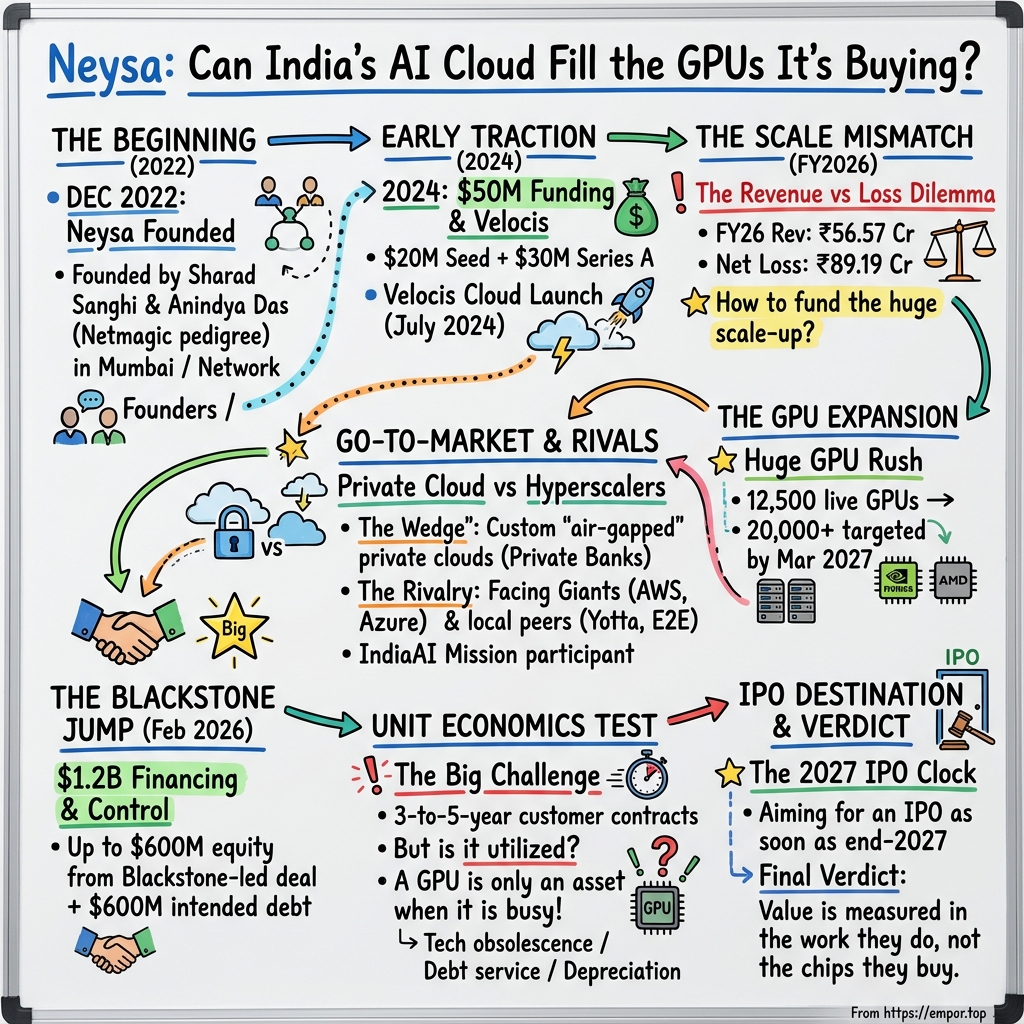
Neysa: Can India’s AI Cloud Fill the GPUs It’s Buying?
I. Twelve Thousand GPUs, and the Bill for Twenty Thousand
In the middle of October 2026, Sharad Sanghi sat down with The Economic Times and described a company that, by the numbers he chose, had become one of the largest independent AI compute operators in India. Neysa, he said, had 12,500 graphics processing units live, and it expected to have more than 20,000 before the end of March 2027.12
He talked about a possible cluster of 9,216 NVIDIA Vera Rubin GPUs, a similar-sized cluster built on AMD's Helios systems, and another 8,000 NVIDIA Blackwell chips that the company was considering ordering before the year was out. He talked about building data centres of its own. And he talked about a stock-market listing that could come as early as the end of 2027.2
Put that next to the other half of the ledger and the picture changes shape. In the financial year that ended in March 2026, Neysa Networks Private Limited reported revenue of about ₹56.57 crore, which is roughly $6.5 million, and a net loss of about ₹89.19 crore.3
Eight months earlier, in February 2026, Blackstone and a group of co-investors had announced up to $600 million of equity for the company, and Neysa had said it intended to raise another $600 million of debt, subject to documentation.45 A business whose entire annual revenue would not cover the price of a few racks of top-end servers was now planning a capital programme of up to $1.2 billion, a sum close to two hundred times its most recent year's sales.
That gap is the story. It is not, by itself, a scandal or a warning. Infrastructure businesses always spend before they earn: a toll road is paved before the first car pays, and a power plant is built before it sells a single unit. What separates a good infrastructure investment from a ruinous one is not whether the spending comes first.
It is whether the demand that will repay it is real, contracted and priced to cover the asset's whole cost before the asset wears out. For a GPU cloud, that last condition carries unusual force, because the asset is not concrete or steel. It is a chip whose commercial appeal can fade within a few years as each new generation arrives faster, cheaper per unit of work, and more desired by the very customers who are renting today's model.
Five questions will carry this story from Neysa's founding to its proposed listing. The first is whether demand is contracted, in the sense that a lender or a public investor would recognise, or merely discussed. The second is whether each GPU can earn back its cost, including power, hosting and financing, before its economics decay.
The third is whether Neysa's pitch of local, flexible and closely managed service can hold off providers with vastly greater scale, including the global hyperscalers and better-capitalised Indian rivals. The fourth is what Blackstone's arrival as the controlling investor means for the company, its discipline and its future public shareholders. The fifth is whether the initial public offering Sanghi now talks about is an execution milestone or a moving target.
The company's financial record is short enough to hold in a sentence, and that brevity is itself a finding. Neysa reported zero statutory turnover in the year to March 2024, its first full year of operation.6 In the year to March 2025, filed accounts show revenue of about ₹21 crore and a net loss of about ₹55 crore.7 In the year to March 2026, revenue rose to about ₹57 crore and the loss widened to about ₹89 crore.3
Read the second and third years together and a striking relationship appears. Revenue rose by about ₹35 crore. The loss grew by about ₹34 crore. Almost every extra rupee of sales arrived with almost an extra rupee of loss. The ratio is improving, because the loss was about two and a half times revenue in the earlier year and about one and a half times in the later one, but the business has not yet shown that more customers make it less unprofitable in absolute terms.
The figures from the two most recent years are summaries drawn from the accounts Neysa filed with the corporate registry, not the full audited statements with their notes, and that limits what they can reveal. They do not show how much of the loss is depreciation on hardware that has already been paid for, how much is interest, how much is staff and sales cost, and how much is cash actually leaving the company.
Those distinctions matter a great deal for a capital-heavy business, because a loss driven by depreciation on busy GPUs means something very different from a loss driven by idle hardware or expensive sales effort.
So the episode begins with a discipline that runs all the way through it. Announced funding is not cash in the bank. Planned GPUs are not installed GPUs. Installed GPUs are not busy GPUs, busy GPUs are not paid-for GPUs, and paid-for GPUs are not profitable GPUs until the customer's money has covered the power bill, the rent on the data hall, the interest on the loan and the slow erosion of the hardware's worth. Neysa has given the public a great deal of information about the first two of those stages, and very little about the rest.
There is a reason the company's story has moved so quickly. India's government, through the IndiaAI Mission, decided to subsidise access to advanced computing for domestic researchers and startups, and created a channel through which local GPU providers could sell capacity to the state.8 Banks and other regulated institutions want to run AI models on data they are not willing or permitted to send abroad.
Global model builders want capacity close to India's large user base. Each of those trends is real. None of them, on its own, tells an investor that Neysa in particular will collect enough cash from its particular customers to repay its particular hardware. That is the test the rest of this story applies.
The cast is small and the timeline is compressed. A founder who spent nearly three decades building one of India's best-known data-centre businesses decided to start again. Within three years he had raised about $50 million from venture investors, launched a GPU cloud, signed on customers whose names include some of the country's largest financial institutions, and then persuaded the world's largest alternative asset manager to commit hundreds of millions of dollars.
The question is not whether that is impressive. It plainly is. The question is whether the business underneath the momentum can produce returns that a public shareholder, buying in at the end of the run, will actually share.
 Subscribe on LinkedIn
II. The Netmagic Founder Starts Again
Sharad Sanghi had already done this once. Long before cloud computing had a name in India, when most companies still kept their servers in a back room, he built Netmagic, a business that offered data-centre space and managed hosting to companies that wanted their computers looked after by someone else.
He stayed for more than 27 years. Japan's NTT Data acquired the company in 2016, and Sanghi remained at its head, finally resigning as managing director and chief executive in June 2023.9 By the time he left, the business he had started as an Indian upstart had become part of one of the largest data-centre operators in the world.
That background explains why investors took his calls. A founder who has spent decades negotiating power contracts, managing cooling failures at three in the morning, and selling enterprise customers on letting a third party run their infrastructure has a head start that a young software founder simply does not. He knows what a service-level agreement costs to honour. He knows how long enterprise procurement takes, and he knows that a bank's information-security team can kill a deal that the business side has already approved. Those are not small advantages in an industry where execution failures are physical and expensive.
But the Netmagic record is evidence of operating ability, not a forecast of Neysa's returns. Netmagic's core business was colocation and managed hosting, where the asset, a building with power and cooling, lasts for decades and the customer's servers are typically the customer's own capital. Neysa's model is different in a way that matters.
It buys the expensive, short-lived part of the stack itself, the GPUs, and rents them out. The experience transfers well on power, sites, operations and enterprise sales. It transfers less well on the central risk of a GPU cloud, which is the pace at which the chips lose their commercial value.
Neysa Networks was incorporated in Mumbai in December 2022, although both the company and the Competition Commission of India describe it as having been founded in 2023, the year Sanghi left NTT.610 His co-founder was Anindya Das, a former Netmagic colleague who became the company's chief technology officer, and the Silicon Valley entrepreneur BV Jagadeesh joined as a co-founder and chairman.911
The company's first annual return shows a tiny private company in its earliest form: equity capital rising from 10,000 to 100,000 shares, 80,246 compulsorily convertible preference shares issued to investors, and a January 2024 transfer of 500 shares from Das to Sanghi.6 At that stage, the company had no turnover at all.
The money came quickly. Neysa raised a $20 million seed round in early 2024, and in October of that year it announced a $30 million Series A, co-led by its existing investors NTT Venture Capital, Z47, formerly Matrix Partners India, and Nexus Venture Partners.129 The company said the new money would help it scale its AI infrastructure, advance research and development, and prepare the launch of what it called a generative AI acceleration cloud.12
The investors' enthusiasm was not subtle. Avnish Bajaj of Z47 said Neysa had more demand than any company he had seen at a similar stage.12 That is a striking claim from a venture investor, and also exactly the kind of claim a venture investor has every incentive to make about a portfolio company in the week it raises money.
The product that turned the plan into something customers could touch was Velocis, which launched in July 2024 and became generally available by the time of the Series A, offering on-demand access to high-performance computing.129 It was, in essence, a way for a company to rent time on powerful GPUs without buying them, with Neysa handling the hardware, networking and software layers that make a cluster usable for training and running AI models.
TechCrunch's account of the Series A filled in the commercial picture. Neysa had 55 employees, about a dozen paying customers and six large proofs of concept. Seventy per cent of its customers were on private clusters, dedicated hardware set aside for one client, and thirty per cent used the shared public cloud.9
That 70-30 split is the earliest and perhaps the most revealing operating fact about the company. From the start, Neysa's customers mostly wanted their own dedicated machines rather than a slice of a shared pool. That makes Neysa look less like a pure cloud and more like a specialist that builds and runs private GPU environments on behalf of clients.
Such a business can earn steadier revenue, because a dedicated cluster is usually reserved for a fixed term. It also ties Neysa's capital to individual customers' plans, which means a single large client's change of heart can leave a lot of specialised hardware without a home.
Sanghi was candid even then about where the business was heading. He told TechCrunch that the next fundraise would be an order of magnitude larger than anything Neysa had raised so far, that the company planned to enter global markets, and that it would raise debt to fund its growing need for GPUs and other infrastructure.9
In other words, the $50 million of venture money was never meant to be the capital base of the business. It was the money needed to prove that customers would come, so that much larger pools of equity and debt could be raised to buy the hardware they would use.
Each round, then, should be read for what it bought. The seed and Series A bought a team, a platform, a first fleet of GPUs and a set of customer relationships. They did not buy proof of the economics.
By the end of the year that included the Series A, Neysa had still not recorded meaningful revenue, and when revenue did arrive in the following financial year, it came with a loss more than twice its size.7 That is not unusual for a company at this stage. It does mean that, by the time the large money arrived, the evidence that Neysa could earn a return on a GPU was still mostly in the future.
One more fact from those early interviews deserves to be carried forward. Explaining why customers should choose Neysa over a global provider, Sanghi said that the company's software was built on open-source components, so that there was no lock-in for clients.9 It was a selling point aimed at buyers who had been burned by proprietary cloud contracts. It was also, read from an investor's chair, a promise that customers could leave. That tension, between what helps win a customer and what helps keep one, sits at the heart of the competitive question that follows.
When Velocis became generally available, the technical question of whether Neysa could build and run a GPU cloud had largely been answered. The commercial question had not. Who would pay reliably for this computing power, for how long, at what price, and with what obligation to keep paying if a newer chip or a cheaper provider came along?
III. The Private Cloud Pitch Meets the Hyperscalers
In a May 2026 interview with Fortune India, Sanghi described the kind of customer he thinks Neysa is built for. A large private bank, he said, had wanted an air-gapped private cloud, a set of machines physically cut off from the public internet and from other customers, configured to its own security requirements.
The global hyperscalers, in his telling, could not provide it in the form the bank wanted.13 It is a vivid story, and it captures the pitch precisely. Neysa is not trying to beat Amazon Web Services, Microsoft Azure or Google Cloud at being Amazon, Microsoft or Google. It is trying to win the customers for whom those giants' standardised products are an awkward fit.
To see why a customer might choose Neysa, it helps to see what Neysa actually sells. At the simplest level, it rents GPU time by the hour. Its public price list shows an NVIDIA H100, the workhorse chip of the last AI cycle, starting at $4.39 an hour, and an H200 at $4.72 an hour.14 A customer willing to commit for 36 months can reserve an H100 for about $1,780 a month, which works out to roughly $2.44 an hour if the chip runs around the clock, a discount of nearly half from the starting hourly rate.14
Above that sit bare-metal servers, where the customer gets an entire machine without a virtualisation layer; managed Kubernetes, the software that orchestrates containerised workloads across many machines; and a wider AI platform with tools for training, deploying and securing models.15 Add the private clusters that most early customers chose, and Neysa's offer ranges from a pay-as-you-go rental to something closer to an outsourced AI data centre.
The customer list is the strongest public evidence that this offer resonates. Neysa's website names or features HDFC Bank, PhonePe, Justdial, Fractal, BharatGen, CaratLane, FSS, Juspay and the Indian Institute of Science, among others.15 That is a credible roster: India's largest private bank, a dominant payments app, a well-known AI services firm and a government-backed language-model consortium. In February 2026, the company said it was also in discussions with coding companies and with global AI firms including Perplexity, OpenAI and Anthropic.11 And in October, Sanghi said banking and financial services were leading Neysa's enterprise demand.2
The trouble is that a logo is not a revenue line. Neysa does not disclose how much any customer pays, what share of revenue its largest client or its top five clients represent, how long they have been customers, whether any have left, or how much each has expanded its spending over time. A bank that runs one small pilot cluster and a bank that rents a thousand GPUs on a five-year contract look identical on a website.
Talks with global AI laboratories are talks. For an investor, the air-gapped bank story demonstrates product capability and management's understanding of a real need. It does not demonstrate retention, pricing power or the share of Neysa's revenue that comes from customers for whom the hyperscalers are genuinely unsuitable.
Now put the competitors in proportion. The global hyperscalers are not merely larger than Neysa. They operate at a scale that lets them negotiate with NVIDIA as peers, build their own custom chips, and offer AI computing as one service among hundreds that a customer already buys. They are also not standing still in India.
Microsoft chose Yotta Data Services as its exclusive Azure AI partner in India in 2025, under a three-year agreement that Yotta expected to generate about $240 million of revenue.16 In other words, the hyperscaler that a bank might reject for sovereignty reasons is already finding ways to deliver its services through a local operator's data centres.
Yotta itself is the rival that best frames Neysa's ambitions. Backed by the Hiranandani group, which has deep roots in real estate and power, Yotta told investors in October 2025 that it had 8,192 NVIDIA H100 GPUs operating and generating revenue, with more on the way, and could install tens of thousands more.16 It also owns its land and buildings, with 53 megawatts of live IT capacity and a land bank that it said could eventually support more than 890 megawatts.16
Earlier, when it was empanelled under the IndiaAI Mission in February 2025, Yotta said it would provide more than half of the Mission's advanced GPU compute capacity, committing more than 9,200 GPUs in phases.8 Neysa, by contrast, was reported to be running somewhere between 1,200 and about 2,000 GPUs as late as February 2026.1117 Yotta was, in short, both a far larger GPU operator than Neysa when Blackstone arrived and a vertically integrated one, owning the power and buildings that Neysa still rents.
The listed comparison is E2E Networks, an Indian cloud provider that trades on the National Stock Exchange and has turned itself into a GPU-led business. By the September 2026 quarter, E2E was reported to have about 5,100 GPUs in service, including 1,024 of NVIDIA's Blackwell B200s.18 That quarter, it reported revenue of about ₹224 crore, more than five times the level of a year earlier, and an operating margin before depreciation of about 77%, while swinging to a net profit of about ₹73 crore.19
In a single quarter, E2E generated roughly four times the revenue Neysa reported for an entire year. Neysa's live GPU count is now larger than E2E's, by Sanghi's account, but most of that fleet came online after the year for which Neysa's revenue is known, so the comparison cannot yet be made on equal terms.
The IndiaAI Mission deserves to be understood correctly, because it is easy to mistake it for a protected market. The government built a programme to buy compute capacity from private operators and make it available, at subsidised rates, to Indian researchers and startups. Neysa joined as an empanelled provider in September 2025.2011 That gave it a channel to a new kind of buyer. It did not give it a moat.
Yotta is a far larger supplier to the same programme, E2E sells into it too, and, according to Yotta's own investor material, the Mission's three-year contracts priced H100 capacity at about $1.60 an hour.16 That is two-thirds of Neysa's 36-month reserved list price. A government programme that buys at competitive tender is a source of volume. It is not, on that evidence, a source of premium pricing.
It is worth running the textbook frameworks here, because they clarify the economics rather than decorate them. In Michael Porter's terms, buyers hold considerable power: a bank or an AI laboratory can compare quotes from several providers, split its workloads among them, or eventually build its own capacity.
Suppliers hold even more: NVIDIA sells the chips that everyone needs, sets the cadence of new generations, and has its own relationships with the largest clouds. The threat of new entrants is real because the main barrier is capital, and capital, as Neysa's own fundraising shows, has been plentiful for AI infrastructure. Substitutes include the hyperscalers, on-premises clusters and, increasingly, more efficient models that need less compute for the same task.
Hamilton Helmer's seven powers are a sterner test, because each one demands evidence that an advantage is both real and defensible. Neysa has no demonstrated scale economy over Yotta or the hyperscalers. It has no exclusive resource: the GPUs it buys are available to its rivals, and none of the reviewed evidence shows privileged allocation. There is no visible network effect, and the brand, though growing, is not yet the reason customers buy.
The only power with a plausible claim is switching costs. A bank that has had Neysa build an air-gapped cluster to its security team's specification, integrated it with its own systems, and certified it with its regulators will not move that workload lightly. Yet Sanghi's own pitch of no lock-in cuts against that power, and Neysa publishes no retention figures that would show it in action.9
So the history leaves the moat claim intact but unproven, and in one respect narrows it. Customisation, data control and close managed service are plausible wedges into a market that the giants serve imperfectly. Evidence that the wedge produces higher prices than rivals, lower churn, or a larger share of each customer's spending over time is not public.
The claim that Neysa can beat the hyperscalers should be revised to something more modest and more testable: that Neysa can win specific regulated and sovereign workloads, where its service and configuration matter more than price. The figures that would confirm that revised claim, once Neysa reports them, are revenue retention among its largest customers and realised price per GPU-hour compared with the IndiaAI benchmark.
That leads to the question that will carry the next part of the story. Neysa now says it has sold capacity on more than 12,000 GPUs to end customers.2 Which of those commitments are firm enough, long enough and well-priced enough to justify the next tranche of hardware?
IV. The Contract That Has to Carry the GPU
Neysa's price list offers reserved capacity for as long as 36 months.14 Sanghi has gone further in conversation, telling Fortune India that the company's long-term client contracts typically run three to five years, and that lenders would be shown those contracts when Neysa borrowed against them.13
Those two facts, a reservation term and a lending plan, are the hinge of the whole business. If a GPU is bought against a customer's firm commitment to pay for most of its useful commercial life, Neysa is something close to an infrastructure lessor with a technology layer on top. If it is bought in the hope that customers will come, Neysa is a speculator in a rapidly depreciating asset.
The economic chain is simple to state and hard to execute. Neysa buys or finances a GPU server. It finds a data hall with enough power and cooling to run it, which for the newest chips is no small thing, because a rack of modern AI servers can draw as much electricity as dozens of homes. It installs the server, connects it with fast networking to its neighbours so that a customer can train a model across hundreds of chips at once, and layers its software on top.
Then it has to keep that server busy at a price that covers its costs and collect the cash before the economics of the hardware decay.
A rough sum shows how tight the arithmetic can be. Suppose the up to $1.2 billion of new equity and debt, plus the $50 million raised earlier, were spread across the 20,000 GPUs Neysa plans to run. That is a little over $60,000 of capital for each chip, a figure that has to cover not only the processor but its share of the server, networking, storage and installation, as well as the company's losses along the way. Now set that against what a GPU can earn.
At Neysa's own 36-month reserved list price for an H100, a chip rented every hour of every day for a year earns about $21,000. At the roughly $1.60 an hour that the IndiaAI Mission paid for H100s under Yotta's contract, it earns about $14,000.1416 Even at full utilisation and before paying for anything else, a GPU would need three to four and a half years of revenue just to equal the capital raised for it. Newer chips cost more and rent for more, so the ratio may differ by generation, but the shape of the problem does not change.
That is why contract length is not a detail. A three-year contract at reserved pricing comes close to covering the capital cost of a chip only if the chip is fully used and the contract is honoured to the end. A five-year contract gives more room.
A contract of a year or less, which Yotta told investors was the duration of the majority of its own H100 deals, leaves the operator carrying the risk that the second, third and fourth years of a chip's life will be rented at a lower price, or not at all.16 Sanghi's description of three-to-five-year contracts, if it is accurate across most of Neysa's fleet, would mark a meaningful difference from at least one large rival's disclosed mix.
He went further in October. Neysa, he told The Economic Times, buys about 90% of its GPUs against long-term contracts, and it had sold capacity on more than 12,000 GPUs to end customers.12 If both statements hold, Neysa has effectively pre-sold almost its entire live fleet, which would be a strong answer to the first of this story's questions. The difficulty is that the claim is management's alone, and none of the details that would make it bankable are public.
Neysa does not disclose the minimum payment commitments in those contracts, whether customers can cancel or reduce their reservations, what prices they pay, when the reserved capacity started earning, or how concentrated the commitments are. A contract under which a customer can walk away with three months' notice is very different from one under which it must pay for five years whether it uses the chips or not, and both could be described in an interview as a long-term contract.
The financial results, so far, do not settle the matter either way. Revenue of about ₹57 crore in the year to March 2026 is consistent with a fleet that was small for most of that year. Neysa was reported to have between 1,200 and about 2,000 GPUs live in February 2026.1117 Two thousand H100-class chips, rented continuously at around $2 an hour, would generate about $35 million a year, or roughly ₹300 crore; Neysa's reported revenue was about a fifth of that.
But the fleet was still being installed during the year, prices vary by chip, and some capacity may have been running proofs of concept. Without disclosed figures for average GPUs in service, utilisation and realised price, the revenue cannot be decomposed, and the gap cannot be interpreted as either idle hardware or a ramp in progress.
What can be said is that the step from February to October was enormous. If Sanghi's figures are right, Neysa went from perhaps 2,000 live GPUs to 12,500 in about eight months, a six-fold increase.172 That is either a remarkable feat of procurement and installation or a figure whose definition, live, contracted, delivered or installed, deserves careful reading.
The numbers that matter for an investor, and that any future offer document would need to show, are distinct: GPUs contracted, GPUs delivered, GPUs installed and accepted by customers, and GPUs actually earning revenue. In an industry where chip deliveries slip and data-centre power arrives late, those four figures can diverge for months.
A useful benchmark comes from E2E Networks, which reports publicly. In the quarter to September 2026, E2E earned about ₹224 crore of revenue on a fleet of roughly 5,100 GPUs, along with its older cloud business.1918 Annualised, that is around ₹17 lakh of revenue per GPU a year, or about $20,000, which is in the same range as a chip rented around the clock at reserved list prices.
E2E's management attributed the jump to Blackwell GPUs, better utilisation and higher average realisation, and kept depreciation at about a third of revenue.1918 For Neysa, the comparable test in the year to March 2027 will be blunt. If 12,500 live GPUs are genuinely contracted and busy, revenue should rise by far more than the tripling Sanghi had forecast in February.11 If revenue rises only three-fold, the fleet will either have come online late in the year or be earning much less per chip than its rival.
Then comes the financing. Sanghi told Fortune India that the planned $600 million of debt would most likely take the form of term loans with a typical five-year tenure, backed by the client contracts Neysa would share with lenders.13 That is a sensible structure in principle: lend against the cash flows of a signed contract, and let the loan run off as the contract pays. It is also where a subtle mismatch can creep in. A five-year loan against a three-year contract leaves two years in which the loan still needs servicing but the customer has no obligation to stay.
A five-year loan against a GPU whose market rental price halves in its third year forces the borrower to re-rent the chip at a price that may no longer cover the instalment. The published material on Neysa does not say how much debt has been drawn, at what interest rate, against what collateral, with what amortisation schedule or with what covenants. Nor has any Indian rating agency published a rationale for Neysa Networks that would describe how lenders view the risk.21
Technology risk makes this concrete rather than abstract. NVIDIA has moved from the H100 to the H200 to the Blackwell generation in roughly two years, and Sanghi himself is now discussing Vera Rubin and AMD Helios systems for 2027.2 Each step offers more computing power per dollar, which is wonderful for customers and corrosive to the rental value of the previous generation.
Yotta's investor presentation assumes an eight-to-ten-year useful life for its NVIDIA GPUs.16 That is an accounting choice, and a generous one by the standards of the pace just described. If Neysa adopts a similar assumption, its depreciation charge will look low and its reported profits flattering in the early years, while the true economic question, whether a 2025 chip will still earn a worthwhile rent in 2030, is pushed into the future.
The point can be made with an illustration rather than a forecast. Imagine 20,000 GPUs, financed partly by $600 million of debt and costing about as much as the $1.2 billion package. In a weak case, where the fleet is 55% utilised at about $1.75 an hour, the business earns under $170 million a year, perhaps $90 million after power, hosting and staff, and that does not cover depreciation if the hardware's economic life is four years.
In a middle case, at 75% utilisation and $2.20 an hour, revenue approaches $290 million and earnings before depreciation perhaps $190 million, which roughly covers depreciation over six years but leaves little for interest. Only in a strong case, at 85% utilisation, $2.60 an hour and an eight-year life, does the fleet produce a comfortable profit after financing. Those inputs are assumptions chosen to show sensitivity, not Neysa's figures. They make one point plainly: the difference between a profitable GPU cloud and an unprofitable one lies almost entirely in utilisation, price and chip life, the three numbers Neysa does not publish.
Currency adds a quieter layer of risk. Neysa's price list is in US dollars, although it says customers can be billed in rupees or dollars.14 Its GPUs are bought from American chipmakers, almost certainly in dollars, while much of its power and rent is paid in rupees. The company does not disclose how much of its revenue, costs or debt is in foreign currency, or whether it hedges. A rupee contract signed today for a GPU bought in dollars carries a currency bet across its whole term.
None of this means Neysa's contracts are weak. It means their strength is unproven in public. The figures that would settle it are specific: utilisation by GPU generation, contracted capacity and its remaining duration, realised revenue per GPU-hour, and cash contribution per GPU after power, hosting and interest. Until those appear, the 90% claim is a management statement, and the unit economics remain a hypothesis. That uncertainty is exactly what a new controlling shareholder would have had to price when it decided how much to pay.
V. Blackstone Takes the Control Seat
On February 16, 2026, Blackstone announced that it would lead funding of more than $1 billion for Neysa. Blackstone and its co-investors committed up to $600 million of equity, and Neysa said it intended to secure a further $600 million of debt, subject to documentation, to help deploy more than 20,000 GPUs in India.45 Blackstone described the goal as building India's leading AI infrastructure platform, and SiliconANGLE reported that the planned fleet would amount to about a third of India's AI-optimised data-centre GPUs.417 Within a day, Neysa was being called India's newest unicorn.22
The headline compressed a more interesting history. A month earlier, in January 2026, The Economic Times had reported that Blackstone had finalised a structured investment in Neysa: an initial $50 million to $75 million for a significant minority stake, with contractual rights to raise its holding to control if Neysa achieved defined performance milestones. That deal reportedly valued Neysa at about $300 million.23
Before it, after the Series A, the company had been valued at roughly $120 million to $130 million.2322 Then came February, and a reported valuation of $1.4 billion, which Inc42 described as an enterprise valuation citing The Economic Times sources.245 Neither Blackstone nor Neysa confirmed the figure. Entrackr noted that the company had not commented on its valuation.22
How should an investor read a price that quadrupled in about a month? Carefully, and as a price rather than a verdict. The January structure, a small initial cheque with rights to control tied to milestones, is the kind of arrangement an investor uses when it wants exposure to a promising business but does not yet trust its numbers enough to commit fully. The February announcement may be the same deal described at its full potential size, the milestone-linked tranches added together, or it may be a renegotiated transaction.
The public record does not reconcile the two. What it does suggest is that Blackstone's equity is not a single cheque already sitting in Neysa's bank account. Sanghi called the package a war chest to be drawn down as demand materialises, and in October Neysa's own framing was that Blackstone would become the majority owner only after it had invested the full $600 million, which had not yet happened.112
That matters for valuation. If $1.4 billion is a post-money figure that includes up to $600 million of fresh equity, the value placed on the business as it stood before the money arrived would be closer to $800 million. If it is an enterprise value, it should include debt and exclude cash, but most of the debt had not been documented when the figure was reported.
If parts of the $600 million arrive only when milestones are met, the price paid for each share may differ from tranche to tranche, and the headline valuation describes a future state that has to be earned. In every reading, the reported $1.4 billion is the value of the company if it executes, priced by an investor with rights and protections that a future public shareholder will not receive.
Those protections are worth naming even where their exact terms are unknown. Neysa's earliest investors held compulsorily convertible preference shares carrying a nominal 0.01% dividend, the standard Indian instrument for venture capital.6 Such shares typically carry liquidation preferences, which return investors' money before ordinary shareholders receive anything in a sale, along with anti-dilution protection and special consent rights.
Neysa does not publish the terms of its preference shares, the size of any employee option pool, the existence of any warrants, or a fully diluted share count. Entrackr reported that the founders held about 43% of the company after the Series A.22 What they own after Blackstone's investment, and how much of the company is held as preferred rather than ordinary equity, is not disclosed. Any headline valuation divided by an assumed share count would therefore be guesswork.
The Competition Commission's filing set out who was buying. Two Singapore-registered Blackstone vehicles, BCP Asia II Topco V and Asia II Topco XIV, proposed to acquire a controlling stake. Alongside them, 360 ONE's private equity fund, TVS Shriram Growth Fund 4, Nexus Ventures, Anchorage Capital's scheme, Sanghi himself and a subsidiary of the Ontario Teachers' Pension Plan would each take minority stakes.10
The Commission approved the acquisition in May 2026.25 The list tells its own small story. Sanghi was an investor in his own company's round, which is a meaningful signal of alignment. Nexus, an existing backer, chose to put in more money. The early investors NTT Venture Capital and Z47 were not named, which may simply mean they did not participate in the new primary issue; the filing does not say whether any existing holders sold shares.
The filing's description of Neysa's purpose is revealing too. With the transaction, the company said, Neysa would focus on delivering the execution layer of sovereign compute in alignment with the IndiaAI Mission, offering performance certainty and data assurance to enterprises, hyperscalers and global AI laboratories.10
The phrase "hyperscalers and global AI labs" marks a shift. The Neysa of 2024 sold mostly private clusters to Indian banks, researchers and startups. The Neysa described to the regulator in 2026 also wanted to rent capacity to the giants it had once been positioned against, and to the model builders who are among the largest and most price-sensitive buyers of GPU time in the world.
That shift changes the capital-allocation question. A cloud product built for a few dozen enterprise clients can grow at the pace of its sales team. An infrastructure platform aiming for a third of a country's AI computing has to secure power, buildings, chips, debt and customers all at once, and any one of them arriving late can strand the others.
Sanghi has said Neysa is exploring building its own data centres, though it rents space for now, and that construction could take about 24 months from land acquisition.2 He has also spoken of expanding to Malaysia and later Japan and Europe, and of hoping to use the data centres of AirTrunk, the Asia-Pacific operator Blackstone owns, once Blackstone has a majority.112
That last hope is where governance becomes concrete. A controlling shareholder that also owns the data centres its portfolio company would rent creates a related-party relationship. It may be a genuine advantage, giving Neysa access to scarce powered capacity at fair terms. It may also, in a future listed company, become a channel through which value moves between the controlling holder and minority shareholders.
Neysa publishes no related-party note, no description of board composition after the transaction, no executive compensation and no information on how management's incentives are tied to returns rather than to scale. The company's 2024 annual return records no penalties against the company or its directors, which is reassuring as far as it goes, but it is a statutory form, not an audited set of accounts with its notes.6
Is there evidence that Blackstone overpaid? No defensible answer is possible, because the final price, the share count and the instrument terms are not public, and because a controlling investor with milestone rights is paying for a very different security from the one a public investor will buy. What can be said is that Blackstone's structure, as reported in January, was designed to make Neysa prove its demand before the bulk of the capital and control changed hands.
That is disciplined. Whether the discipline survives the excitement is the question to watch. If capital continues to be released only against signed demand and measured utilisation, Blackstone will have added a governor to the engine. If GPU orders run ahead of customer proof because the money is available and the market is hot, the new owner will have added fuel.
There is also a point about alignment that cuts both ways. Blackstone is a private-equity investor. Its returns depend on buying well, building value and eventually selling, whether to another investor or to the public. An IPO is one of the ways it can turn its stake into cash. That does not make an IPO a bad thing for the business, and it does not imply that the timing will be wrong. It does mean that future public shareholders should assume that the most informed seller in any listing will be the controlling holder, and judge the offer accordingly.
The capital question, in the end, reduces to one test. Before a lender advances a rupee and before a shareholder funds a GPU, what must be true of the contract behind it? It must last at least as long as the loan, oblige the customer to pay whether it uses the capacity or not, be priced to cover the chip's full cost, and come from a customer who can still pay in year four. Neysa's management has described contracts that might meet that test. The public has not yet seen one.
VI. From “Maybe” to a 2027 IPO Clock
In May 2026, Sanghi told Fortune India that an IPO was a possibility for Neysa in the next 24 to 36 months, after the company had executed on its plans.13 It was a careful answer, the kind a chief executive gives when he wants to signal ambition without committing to a date. Five months later, speaking to The Economic Times, the framing had tightened. Neysa was preparing for a possible listing that could come as early as the end of 2027, alongside plans for new NVIDIA and AMD systems and data centres of its own.12
It would be easy to read that change as a broken promise or a sign of overreach. Neither reading is fair on the evidence. The two statements are months apart, both are framed as possibilities, and a listing at the end of 2027 would come only about five months before the start of the 24-to-36-month window that the earlier answer described. What changed was the emphasis. In May, the IPO was the reward for execution. In October, it had become part of the plan's timetable, sitting beside the chip orders and the data-centre build as one more milestone to hit.
That shift raises a fair question about message discipline. Between February and October, the company's reported live GPU count went from about 2,000 at most to 12,500,172 and the number of chips it was considering ordering for 2027 grew to include whole new clusters of Vera Rubin and Helios systems.2 A management team that is accelerating its capacity plans, its geographic ambitions and its listing timetable at the same time is either seeing demand that justifies all three, or telling a story that runs ahead of its audited results. The way to tell the difference is to watch which of those plans become measurable.
Here the record is short but not empty. In February 2026, Sanghi said Neysa expected to at least triple its revenue in the following financial year, the year ending in March 2027.11 That is a concrete, public, testable target, and the earliest one the company has set. If Neysa reports revenue of roughly ₹170 crore or more for that year, it will have met it.
Given that Sanghi now describes a live fleet more than six times larger than the one he described in February, a mere tripling would itself raise questions about how much of that fleet is earning. The company's next set of filed accounts will therefore be the first real test of whether its public statements and its financial results move together.
The GPU roadmap invites the same discipline. More than 20,000 GPUs before March 2027 is a specific number with a specific date.2 So is 12,500 live in October. A credible management team will either hit those numbers or explain, with figures, why it chose not to, for instance because customers delayed deployments or because it decided to wait for a newer chip.
A less credible one will simply move to the next, larger number. Neysa's history is too short to know which kind it is. What it does show is a team that has, so far, raised the money it said it would raise and launched the product it said it would launch, which is more than many infrastructure startups manage.
As of mid-November 2026, Neysa has not filed a draft red herring prospectus or any other offer document, and no Neysa issue appears among the public-issue filings listed by the Securities and Exchange Board of India or among the upcoming issues on the National Stock Exchange.2627
That means none of the disclosures that a prospectus would force into the open, audited financial statements with their notes, a formal list of risk factors, litigation, related-party transactions, executive pay, the full capital structure, the split between fresh shares and shares sold by existing investors, and the intended use of the money, are yet available. Nor is there any public-market valuation history, because there is no market for Neysa's shares.
The absence of a filing is not evidence of a problem. It is simply the stage the company is at. But it should shape how every IPO statement is read. Until a draft prospectus exists, the 2027 timetable is a management aspiration, and the company retains full freedom to move it. When a filing does arrive, it will be the first document in Neysa's history that management cannot shape entirely to its own message, because Indian securities law requires it to disclose the uncomfortable facts alongside the attractive ones.
For a listener trying to judge management's credibility, the test is behavioural rather than rhetorical. Does capital deployment follow customer commitments, or precede them? Does the guidance become more measurable over time, with utilisation and contracted capacity reported alongside GPU counts? When plans change, as they will, does management explain the change with results, or simply restate the destination? Those questions matter more than whether the listing happens in December 2027 or a year later. A company that discloses well and misses a date is a better public-market candidate than one that hits a date with a thin story.
There is a deeper reason to watch the timetable closely. In AI infrastructure, the window in which public investors are willing to pay a premium for growth may be shorter than the life of the chips being bought. A company that lists while enthusiasm is high can raise capital cheaply and reward its private investors handsomely.
A company that lists after a correction in GPU rental prices, or after a wave of new capacity has pushed utilisation down across the industry, faces a much harder audience. That gives every holder of private shares an incentive to list sooner. It gives public investors a matching reason to insist that the audited results, not the calendar, decide when the story is ready.
So the IPO clock is ticking in public, but it is not yet a clock that anyone can audit. What the market will eventually need is not a date but a set of numbers that make the date credible. Which brings the story to the bull and the bear, and to what would have to be true for Neysa to deserve the price its owners have already put on it.
VII. What Would Prove the Bull Case?
Picture two investors reading the same file on Neysa. One sees an India-focused AI cloud with a founder who has built this kind of business before, a client list led by some of the country's most demanding financial institutions, a model built around private and sovereign deployments that the global giants serve awkwardly, and the backing of the largest alternative asset manager in the world.
The other sees a company that lost more money than it earned in each of its first three years, competing against hyperscalers with effectively unlimited capital, a vertically integrated local rival that owns its power and land, and a profitable listed operator, while buying the fastest-depreciating asset in modern technology with borrowed money. Both readings rest on facts. The work is to decide which facts carry more weight, and which new facts would settle the argument.
The bull case, given its strongest form, runs like this. Demand for AI computing in India is at an early stage and growing very fast. Sanghi estimated in February 2026 that the country had only 50,000 to 60,000 GPUs, and argued that the number could grow thirty-fold within two or three years.11 Even if that estimate proves wildly optimistic, the direction is not in doubt. Regulated buyers, especially banks, insurers and government bodies, need that capacity inside India and often inside environments they control.
The government is encouraging the build-out, both through the IndiaAI Mission and through a tax holiday for data centres announced in the Union Budget for 2026-27 that runs until 2047.28 Neysa's customer contracts, by management's account, run three to five years, and the company says almost all its GPUs are bought against them.131 Its founder knows how to run data centres. And its new owner can supply not only capital but, potentially, powered data-centre space in other countries. In this telling, Neysa is building a sovereign AI utility at the moment the country needs one, and its losses are simply the cost of building ahead of revenue.
The bear case, given equal force, runs differently. Hyperscalers are already reaching India's regulated market through local partners, as Microsoft's exclusive arrangement with Yotta shows.16 Yotta has greater scale and owns the power and buildings that Neysa rents; E2E Networks has reported profits on its GPU fleet.1619 Neysa's losses widened in each year on record.73 It discloses nothing about customer concentration, retention or utilisation. The debt it intends to raise has not been documented publicly, and no rating agency has published a view on it.21 Its chips face a new generation within two years. In this telling, Neysa is a well-run company in a structurally difficult business, where the winners are the chip supplier and the owner of the cheapest power, and everyone in between earns a thin and volatile spread.
The two cases converge on a single dividing line: commercial proof. Neysa's record so far is richer in technical capability and announced capacity than in evidence of recurring revenue, positive contribution margin or cash in the bank. That is not a criticism of a three-year-old company. It is a statement about what has and has not been established.
The price already on the table
It helps to set the reported $1.4 billion valuation against what comparable businesses fetch. On trailing revenue of about $6.5 million, $1.4 billion is more than two hundred times sales. If Neysa triples its revenue in the year to March 2027 as Sanghi forecast, the multiple on that year's sales would still be about seventy times.11 Revenue multiples are crude tools for a business whose revenue is about to change by an order of magnitude, but they make the point that the price is a bet on the fleet that is coming, not on the business that exists.
The closest priced comparison is Yotta, whose parent set out terms in October 2025 for a proposed US listing through a merger with Cartica Acquisition Corp, a listed special-purpose acquisition company. That proposed transaction implied an enterprise value of about $4.2 billion, including about $1 billion of debt, for a company that had reported revenue of about $95 million in the year to March 2025 and projected about $495 million of revenue and $365 million of earnings before interest, tax, depreciation and amortisation in the year to March 2027.16
On those projections, the deal valued Yotta at roughly eight times forward revenue and eleven times forward operating earnings before depreciation, but at more than forty times the revenue it had actually reported. Yotta's projections, it should be noted, were its own, prepared for a transaction, and its own material showed that about $713 million of its $727 million annual revenue pipeline sat in preliminary discussions with a probability of 25% or less.16 Yotta is therefore a useful aspirational comparison rather than a direct one: it is larger, owns its infrastructure, has a longer operating record, and has a colocation business that Neysa lacks.
E2E Networks is the closest direct operating peer, a listed Indian GPU cloud that sells to many of the same customer types, including the IndiaAI Mission, which accounted for roughly 13% to 15% of its revenue in the September 2026 quarter.19 Its value lies less in a multiple than in a proof point.
E2E has shown that an Indian GPU cloud can report operating margins before depreciation in the seventies and positive net profit once its fleet is busy and its prices hold.19 It has also shown, through a reported ₹1,000 crore multi-year arrangement with an Indian sovereign AI company running to June 2029, that some customers will commit for several years.1918 That is the kind of disclosure Neysa would need to match.
Now reconcile the comparable view with the operating illustration. If Neysa's fleet of 20,000 GPUs eventually reached the middle case sketched earlier, at 75% utilisation and $2.20 an hour, it might earn something like $190 million a year before depreciation. At Yotta's implied multiple of about eleven times, that would support an enterprise value around $2 billion, from which perhaps $600 million of debt would be subtracted, leaving equity worth about $1.4 billion, almost exactly the reported price. In the strong case, the same arithmetic yields an equity value well above $2 billion; in the weak case, far below $1 billion, and possibly a write-down of the fleet.
In other words, the reported valuation already embeds roughly the middle outcome: the full fleet built on schedule, three-quarters of it busy, prices holding close to today's reserved list rates, and a useful life long enough to keep depreciation manageable. It does not leave much room for disappointment, and the time and further capital needed to reach a mature fleet would reduce the value today further still. These are illustrative calculations from assumed inputs, not a valuation of Neysa, but they show what a buyer at $1.4 billion is implicitly believing.
The public market might eventually price Neysa above or below any such range for reasons that have nothing to do with the value of the business. A listing of India's first pure-play AI cloud could attract scarcity demand from investors who want exposure to the theme and have few alternatives. A small free float, if the controlling holder sells only a modest stake, could exaggerate price moves in both directions. Momentum and narrative could carry the price well above what the cash flows justify for a while. None of those forces changes what a GPU earns in a year.
The skeptical investor's test can be made specific. What portion of the planned 20,000 GPUs has signed minimum commitments, and how many are actually earning revenue? What share of revenue comes from the top five customers? How much does each GPU contribute after power, hosting, depreciation and interest? Neysa publishes none of these figures. The three measures that would settle most of the underwriting question remain contracted capacity, utilisation and revenue per GPU-hour by chip generation, and operating cash flow against net loss and infrastructure spending.
The credit and governance gaps remain diligence questions. No Indian rating agency has published a rationale on Neysa Networks, and key ownership and financial details remain undisclosed.21 For a private company, none of that is unusual. For a company that intends to borrow $600 million and list within about a year, each of those items becomes a diligence question that a future prospectus will have to answer.
The judgment, weighed once, is this. Neysa may well have a real wedge in customer control, data sovereignty and close local service, and its founder and investors have given it the means to pursue that wedge at scale. It has not yet shown, in public, that the wedge produces better prices, longer retention or higher utilisation than its rivals achieve. Until it does, the bull case rests on product claims, customer names and announced capacity, and the bear case rests on the absence of the numbers that would refute it.
VIII. Business & Investing Lessons
Go back to the contrast that started the story. In 2024, Neysa raised about $50 million across a seed round and a Series A.12 In 2026, Blackstone and its co-investors committed up to $600 million of equity, while Neysa said it intended to raise another $600 million of debt.42 The company's leaders began to speak of fleets measured in tens of thousands of chips and data centres of their own. Between those two moments lies a set of lessons that belong to this company and its particular bet, and that apply far beyond it.
The first lesson is that a demand wave is not a moat. Sanghi's air-gapped bank is a perfect illustration of a customer the hyperscalers served badly and Neysa served well.13 But a wave of AI demand lifts every provider at once, including Yotta, E2E and the global clouds that are finding local partners to reach the same customers.
The bank matters to Neysa's value only if it stays, pays and expands, and only if the next bank chooses Neysa for reasons a rival cannot copy. For founders, the lesson is to build the evidence of retention as carefully as the product. For investors, it is that rising demand is a reason to look harder at a company's share of it, not a reason to look away. A rising tide floats every rented boat.
The second lesson is that a GPU becomes an asset only when it is busy. Neysa's twelve and a half thousand live GPUs are the most impressive number it has published, and the least informative, because the number that turns them into value, how many hours each one is rented and at what price, has never been disclosed. A fleet is counted in chips. A business is counted in chip-hours sold.
The third lesson is that debt follows contracts, but contracts must survive the hardware. Sanghi's plan to borrow on five-year terms against three-to-five-year customer contracts is a sound idea in outline.13 It becomes prudent only when the loan's term, the customer's term, the customer's right to cancel and the chip's commercial life align. Neysa's lenders, and eventually its shareholders, will need to see all four clocks, not just the first.
The fourth lesson is that founder experience is a head start, not a forecast. Sanghi's decades at Netmagic, and its sale to NTT, earned him a hearing from investors who would never have listened to an unknown founder asking for a billion dollars.9 That credibility is a real asset, and it has already been converted into capital. But Netmagic rented buildings that lasted decades; Neysa rents chips that may be superseded in two years. The skills transfer; the economics do not automatically follow. A great infrastructure operator who enters a faster, more capital-hungry business has to earn confidence again, on the new business's terms.
The fifth lesson is that a bigger capital base raises the standard of proof. When Neysa had $50 million, a mistake in deploying capital would have cost a few clusters. With up to $1.2 billion, the same mistake can cost a fleet. Blackstone's commitment expanded the opportunity, but it also raised the consequences of being wrong and the scrutiny the company deserves. That is the quiet irony of a large private round: it is celebrated as validation, when it is better understood as a much larger exam, with the marks to be published in the next few sets of accounts.
IX. Epilogue
Tonight, in mid-November 2026, Neysa stands at the most consequential point in its short life. Its leaders say 12,500 GPUs are live and more than 20,000 are expected by March 2027, while they weigh further chip orders, company-owned data centres and expansion into Malaysia.222 They have also told journalists that a listing could come as early as the end of 2027.1 Blackstone, approved by the competition regulator in May as the proposed controlling investor, has not yet invested its full commitment.252 The pieces are moving fast, and very few of them have yet been measured.
The next moments that will decide the story are already on the calendar. The first is the end of March 2027, the date by which Neysa expects to pass 20,000 GPUs. Hitting that number on schedule would show that the company can buy, power and install hardware at a pace few Indian operators have matched. Missing it, with a clear explanation tied to customer timing, would be survivable. Missing it with no explanation would weaken every other forward-looking statement the company makes.
The second moment is the filing of the accounts for the year to March 2027. That is when the forecast Sanghi made in February, at least a tripling of revenue, meets the record.11 It is also when the gap between GPUs live and GPUs earning will start to show in the numbers, because a fleet of more than twelve thousand busy chips should produce revenue far above three times last year's.
If revenue leaps, and the loss narrows or turns, the contracted-demand story will have its first financial support. If revenue merely triples while losses widen again, the market will be entitled to ask how many of those chips are working.
The third moment is the documentation of the debt. When Neysa signs its loans, the terms will reveal how lenders see the business: the interest rate, the amortisation schedule, the collateral, and above all whether the loans are tied to specific customer contracts with specific durations. Lenders tend to be more sceptical than equity investors, and the price at which they lend will be the first independent market signal on Neysa's contracted cash flows.
The fourth moment is the one Sanghi has pointed to most often: an offer document. Until Neysa files a draft prospectus, its IPO remains commentary.
When it files, the document will have to disclose what the company has never published: audited statements with their notes, utilisation and customer concentration if they are material, related-party dealings with its controlling shareholder, the terms of its preference shares, the size of its employee option pool, the split between new shares and shares sold by existing holders, and the use of the money raised. That filing will give public investors their first comparable view of the business.
Each outcome maps onto one of the questions that has run through this story. The local-service wedge will be tested by whether the customers named on Neysa's website show up as large, durable revenue lines. The unit economics will be tested by utilisation and price per GPU-hour. The match between debt and contracts will be tested by the loan documents. And the discipline of the new controlling ownership will be tested by whether Blackstone's remaining capital is released against proven demand or ahead of it.
What remains, tonight, is the tension the story began with. Neysa has the means to build one of India's largest AI clouds. Whether it can earn more than it costs remains unproved. The GPUs are arriving. The proof has not.
X. Outro
A single server rack in a rented data hall somewhere in India holds eight GPUs, humming behind a locked cage and drawing power every second of the day. To an engineer, it is a product, ready to train a bank's fraud model or answer a million questions in Hindi. To an accountant, it is an asset worth whatever was paid for it. To an investor, it is something more uncomfortable: a sum of capital that started losing value the day it was switched on, and that has to earn its way back before the next generation of chips makes it ordinary.
In the end, value is measured in the work the GPUs do.
References
-
Cloud Unicorn Neysa Eyes 2027-End IPO, Plans New Nvidia and AMD Chips and Own Data Centres — The Economic Times, 2026-10-15 ↩↩↩↩↩
-
AI Cloud Firm Neysa Targets IPO by End of 2027, Plans GPU Expansion and Own Data Centres — CXO Digital Pulse, 2026-10-15 ↩↩↩↩↩↩↩↩↩↩↩↩↩↩↩↩↩↩↩
-
Neysa Networks Private Limited: Filing-Derived Financial Summary, FY2026 — The Company Check ↩↩↩
-
Blackstone Leads Funding of Over $1 Billion to Neysa to Work Towards Building India’s Leading AI Infrastructure Platform — Blackstone, 2026-02-16 ↩↩↩↩
-
Neysa Secures $1.2 Bn Led by Blackstone to Expand GPU Capacity in India — Analytics India Magazine, 2026-02-16 ↩↩↩
-
Abridged Annual Return (Form MGT-7A), FY2024 — Neysa Networks Private Limited ↩↩↩↩↩
-
Neysa Networks Private Limited: Filing-Derived Financial Summary, FY2024–FY2025 — SensiBook ↩↩↩
-
Yotta Empaneled in India AI Mission to Accelerate AI Adoption with Advanced GPU AI Cloud Services — Yotta, 2025-02-17 ↩↩
-
India’s Neysa Bags $30M to Compete with Global AI Hyperscalers — TechCrunch, 2024-10-21 ↩↩↩↩↩↩↩↩↩
-
Summary under Regulation 13(2): Proposed Acquisition of a Controlling Stake in Neysa Networks — Competition Commission of India, 2026 ↩↩↩
-
Neysa: Sharad Sanghi’s Big AI Compute Bet — The Ascendants, 2026-02-17 ↩↩↩↩↩↩↩↩↩↩↩↩
-
Neysa Raises $30M Series A to Scale and Accelerate Gen AI Adoption — Neysa, 2024-10-22 ↩↩↩↩↩
-
Neysa Considering a Possible IPO in the Next 24–36 Months, Says CEO Sharad Sanghi — Fortune India, 2026-05-30 ↩↩↩↩↩↩↩
-
Investor Presentation: Proposed Business Combination of Cartica Acquisition Corp and Nidar Infrastructure (Yotta) — Yotta Data Services, 2025-10 ↩↩↩↩↩↩↩↩↩↩↩
-
Blackstone-Led Investor Group to Provide Up to $1.2B for Indian AI Cloud Provider Neysa — SiliconANGLE, 2026-02-16 ↩↩↩↩↩
-
E2E Networks Q2 FY27: AI Compute Demand Drives Fourfold Revenue Growth — uAnalyze, 2026-10-18 ↩↩↩↩
-
E2E Networks Swings to ₹73 Cr Profit in Q2, Revenue Jumps 411% YoY — Inc42, 2026-10-16 ↩↩↩↩↩↩↩
-
AI Cloud Startup Neysa Joins IndiaAI Mission, Eyes Global Growth and Fresh Fundraise — Business Standard, 2025-09-18 ↩
-
Gen AI Startup Neysa Turns Unicorn After Blackstone-Led $1.2 Bn Funding — Entrackr, 2026-02-16 ↩↩↩↩
-
Blackstone Finalises Structured Investment in AI Cloud Startup Neysa — Elets CIO, 2026-01-20 ↩↩
-
Neysa to Raise $1.2 Bn in Blackstone-Led Round at $1.4 Bn Enterprise Valuation — Inc42, 2026-02-16 ↩
-
CCI Approves Acquisition of Shareholding in Neysa Networks Private Limited — Press Information Bureau, 2026-05-20 ↩↩
-
All Upcoming Issues (IPO) — National Stock Exchange of India ↩
-
AI Infra Startup Neysa to Raise $1.2 Billion via Debt and Equity for Data Centres Growth — Angel One, 2026-02-16 ↩
 LinkedIn
 WhatsApp
 Reddit
 Hacker News
 Email
 Kindle
 RSS Feed
 Spotify
 Apple Podcasts
 Amazon Music
 Audible
 YouTube