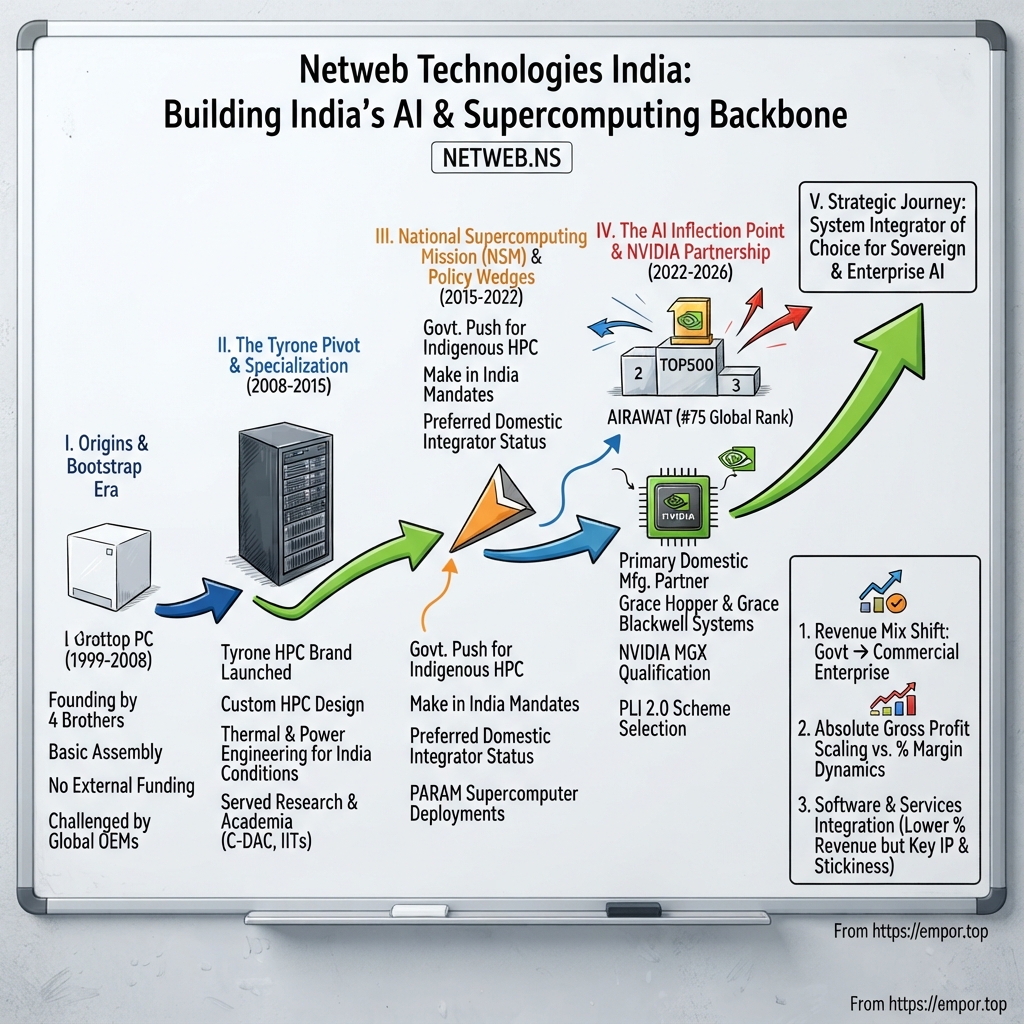
Netweb Technologies: Building India's AI & Supercomputing Backbone
I. Introduction & Episode Roadmap
In May 2023, the semi-annual TOP500 ranking of the world's fastest supercomputers featured its familiar lineup of American, Japanese, and Chinese systems at the summit. Positioned at 75 was an entry that attracted modest international attention but significant notice in New Delhi: AIRAWAT, an AI-focused system deployed at the Centre for Development of Advanced Computing (C-DAC) in Pune, which became the highest-ranked Indian machine on the list.1 India's Press Information Bureau issued a statement highlighting the placement as evidence of domestic progress in AI infrastructure.1
What made the entry noteworthy was not merely the rank, but the builder. AIRAWAT was not integrated by global original equipment manufacturers such as Dell, HPE, Lenovo, or Atos. Instead, it was designed and assembled by Netweb Technologies India Limited, a Delhi-NCR firm established in 1999, run by four brothers, and — at that time — a private enterprise operating without external equity funding.
Two months later, in July 2023, Netweb listed on the NSE and BSE.[^2] Market demand was exceptionally strong, with the initial public offering subscribed roughly 90 times.2 Indian public markets, long accustomed to valuing software services and consumer internet platforms, gained their first listed pure-play in domestic AI and high-performance computing hardware.
Financial expansion accelerated following the listing. Revenue rose from ₹4,450 million in FY23 to ₹7,241 million in FY24, and reached ₹11,490 million in FY25 — representing a roughly 59% year-on-year increase in the final period.[^4]3 Profit after tax expanded along a similar trajectory, moving from ₹469 million to ₹759 million and then to ₹1,145 million over those three fiscal years.[^4]3 For a hardware integration business operating in a market that historically relies on imported computing equipment, these figures stand out.
This performance raises a central strategic question: How did a self-funded white-box PC assembler, founded the same year Infosys listed on NASDAQ, become NVIDIA's primary domestic manufacturing partner in India for Grace Hopper and Grace Blackwell systems?4[^7] More critically for public equity investors, the key issue is whether Netweb has established a durable, defensible franchise, or simply captured a well-timed position within a supplier's broader ecosystem.
The evidence suggests a nuanced picture. Netweb possesses established engineering capabilities in a high-performance computing segment where domestic capacity was previously minimal. At the same time, the company integrates systems where a single global component provider controls most of the bill of materials. Furthermore, its customer base has historically been concentrated in government and public-sector entities, with the top ten accounts accounting for well over half of total revenue.5 The investment thesis rests on how effectively Netweb navigates this structural tension.
To understand the business, it helps to establish its core operational role. Netweb operates as a system integrator. It does not design silicon or fabricate microprocessors. Instead, it sources complex components — processors, accelerators, memory, and interconnects — and integrates them into functional, thermally stable, and reliable computing clusters tailored to customer workloads. While hardware assembly may sound straightforward, the engineering required to convert raw components into a synchronized supercomputer represents the primary value-add of an integrator.
The key economic challenge for any system integrator is value capture: what share of total system value accrues to the integrator versus the component manufacturers supplying the high-cost silicon inside the chassis? Netweb's financial statements reflect this dynamic, showing margin structures that differ considerably from top-line revenue growth rates. Subsequent sections examine this financial trade-off in detail.
The narrative follows a structured roadmap across several key themes: - First, the bootstrap period — two decades of developing Linux clusters for Indian research institutes and the foundational capabilities built during that phase. - Second, the policy framework — how the National Supercomputing Mission and "Make in India" procurement directives created opportunities for domestic integrators, alongside the customer concentration risks involved. - Third, the AI inflection point — AIRAWAT, the public listing, NVIDIA MGX qualification, and selection under the PLI 2.0 scheme. - Fourth, the business model — analyzing the economics of integrating systems where high-cost graphics processing units dominate the bill of materials. - Fifth, corporate governance, management execution, and capital allocation history. - Sixth, the competitive landscape evaluated through strategic frameworks including Porter's Five Forces and Helmer's 7 Powers. - Seventh, a rigorous assessment of the bull and bear investment cases. - Finally, the broader implications for domestic hardware manufacturing.
The analysis maintains an independent perspective, examining management's narrative against disclosed execution, financial results, and competitive benchmarks.
The story begins in an environment where India's technology sector prioritized software services while relying on global supply chains for hardware infrastructure.
 Subscribe on LinkedIn
II. Origins & The Bootstrap Era: White-Boxes, Linux Clusters, and the Tyrone Pivot (1999–2008)
In September 1999, Infosys had just become the first Indian company to list on NASDAQ. Tata Consultancy Services and Wipro were scaling offshore delivery centers, and the Y2K remediation wave was channeling foreign currency into Bangalore, Hyderabad, and Chennai. The prevailing tech sector playbook was clear: write software for Western clients, bill in dollars, and avoid competing with global hardware manufacturers.
Against that consensus, four brothers in Delhi's National Capital Region incorporated a company to pursue hardware assembly. Netweb Technologies India Limited was founded in 1999 by Sanjay Lodha, who became Chairman and Managing Director, alongside Navin Lodha, Vivek Lodha, and Niraj Lodha.5 The initial business focused on basic assembly: custom x86 servers running Linux, entry-level workstations, and storage boxes sold to small laboratories, regional internet service providers, and mid-sized enterprises that could not justify the cost of systems from IBM or Sun Microsystems.
Two aspects of this founding era shaped the company's trajectory. First, 1999 represented a difficult moment to launch an Indian hardware venture compared to software services, where capital efficiency and dollar revenue created rapid wealth for peers. Second, the founders built the business entirely through internal cash flow for more than two decades, operating without venture capital, private equity, or strategic investment. This financial structure dictated operational strategy: without equity financing, the business had to remain cash-flow positive, constraining large speculative capital expenditures.
The competitive landscape presented steep structural hurdles. Global original equipment manufacturers including IBM, Sun Microsystems, Hewlett-Packard, and Compaq dominated the enterprise server category with established brands, global purchasing scale, extensive service networks, and captive financing arms. Local white-box builders competed almost exclusively on price, an unsustainable position against suppliers with superior cost structures.
Recognizing the limits of generic white-box assembly, the founders altered their strategy. In 2008, Netweb established an in-house hardware brand, Tyrone, shifting focus from standard office servers toward high-density, custom-chassis high-performance computing (HPC) systems.5
This transition required distinct engineering capabilities. Standard business server assembly involves mounting uniform components into stock enclosures. By contrast, integrating an HPC cluster requires linking dozens or hundreds of compute nodes to operate as a single system. This demands specific engineering for interconnect topology, power delivery, and thermal control. Densely packed processor racks running continuous workloads generate heavy thermal output; failing to dissipate that heat triggers system throttling and extends computational execution times.
In India, operating conditions created unique engineering requirements. Ambient temperatures across much of the country remain high for extended periods, and electrical grid power in the 2000s experienced frequent instability. Furthermore, research institutions often housed systems in facilities not originally designed as data centers. Building chassis and thermal envelopes tailored to those environmental conditions provided a distinct value proposition over standard global SKUs.
Early adopters of these systems included prominent scientific and academic institutions across India, such as C-DAC, IIT Delhi, IIT Bombay, IISc Bangalore, and eventually national defense and space research agencies.5 These buyers operated under strict budget constraints but maintained precise technical specifications. Operating in this environment required integrators to meet exact performance metrics under challenging physical conditions.
What the hard years actually taught
Serving budget-constrained institutional buyers forced a disciplined approach to system design. While funded Western research facilities could manage thermal loads by investing in specialized cooling infrastructure and redundant power systems, Indian academic labs in the late 2000s required vendors to deliver thermal and electrical stability within the existing infrastructure.
Over fifteen years, this environment fostered specialized operational competencies: designing high-density racks that dissipate heat in unconditioned rooms, configuring power systems to absorb grid fluctuations, writing cluster-management software for institutions lacking dedicated system administrators, and providing rapid on-site maintenance.
This installation footprint also built long-term institutional relationships. In public sector procurement, an incumbent with an established track record across academic departments maintained a practical advantage during technical evaluations. By the early 2020s, Netweb had established a functional presence across India's research computing ecosystem.
The falsification: what twenty years of niche focus actually produced
The conventional narrative suggests that Netweb's early focus on high-performance computing created an immediate structural moat. A close examination of the company's financial timeline provides a more measured perspective.
Founded in 1999, Netweb reached ₹4,450 million (roughly ₹445 crore, or under $55 million) in annual revenue by FY23.[^4] Generating under $55 million in revenue after twenty-four years of operation indicates that the early HPC focus did not produce rapid compounding growth.
Instead, the historical record demonstrates that Netweb operated within a modest market sustained by limited academic research budgets. Total Indian expenditure on high-performance computing remained a minor fraction of overall enterprise IT spending throughout the 2010s. The niche remained defensible largely because the market size was too small to attract aggressive competition from major global OEMs.
Consequently, the multi-decade bootstrap period built specialized domain capability rather than a market-dominating franchise. The company developed practical expertise in thermal engineering, cluster integration, systems software, and institutional credibility within public research sectors. These capabilities provided the necessary prerequisite for larger opportunities, but their commercial value depended on a substantial expansion of the domestic addressable market.
Furthermore, these competencies were developed on smaller systems for academic clients. Adapting those integration processes to meet the volume requirements and strict uptime SLAs of large enterprise buyers represented a distinct operational challenge that remained untested at the time of the company's public listing.
That operational context set the stage for subsequent growth, driven by key government initiatives aimed at expanding domestic supercomputing capabilities.
III. The National Supercomputing Mission & Policy Wedges (2015–2022)
In 2015, the Government of India launched the National Supercomputing Mission (NSM), a multi-year initiative designed to build and network indigenous supercomputers across national academic and research institutions. The stated objective went beyond purchasing faster computing hardware; it aimed to establish domestic capabilities across design, assembly, and systems software.
For Netweb, this initiative represented a pivotal regulatory catalyst. While public procurement programs generate demand, the NSM — when combined with the Public Procurement (Preference to Make in India) Order — introduced an explicit eligibility threshold that favored domestic integrators.
How the wedge worked
The Public Procurement Order established local-content minimums for public-sector purchases. Suppliers failing to meet these thresholds faced disadvantages or outright exclusion from government tenders. Global original equipment manufacturers (OEMs) shipping finished servers from overseas facilities were forced to either restructure their supply chains or accept non-compliant bids.
Having physically assembled systems in India for fifteen years, Netweb met the local-content requirements under its standard operating model. The regulatory shift directly aligned with the company's existing footprint.
This policy alignment provided a clear regulatory advantage during this growth phase. While Netweb demonstrated technical competence relative to domestic peers, its competitive positioning against global vendors like Dell and HPE in public tenders was heavily reinforced by local assembly mandates.
Nevertheless, system integration required practical engineering. Netweb secured and executed several NSM contracts, deploying systems within the PARAM supercomputer family, including PARAM Ananta at IIT Gandhinagar and PARAM Porul at NIT Tiruchirappalli.5 Delivering operational supercomputers requires capabilities beyond tender compliance. Netweb developed direct-to-chip liquid cooling systems, circulating coolant directly across cold plates mounted on microprocessors rather than relying exclusively on forced-air cooling. As processor thermal output rose throughout the 2010s with higher power densities and emerging AI workloads, liquid cooling became essential for maintaining system stability.
What the NSM deployments actually demanded
Executing these supercomputing contracts demanded tight multi-disciplinary integration. A PARAM-class system connects high-density compute nodes via low-latency interconnects to process parallel workloads. The integration requires synchronized design across interconnect topology, physical node placement, power distribution, and thermal management. Because final contract payouts depended on passing standardized benchmark acceptance tests, systems had to achieve verified operational performance targets before full revenue recognition.
Netweb also developed custom software environments to manage cluster operations. Without workload scheduling, job queuing, system monitoring, and automated provisioning, physical hardware cannot function as a unified supercomputer. Netweb built its proprietary Tyrone Cluster Manager software suite to address these operational requirements. Although it generated minimal direct license revenue, the software stack represented core operational intellectual property rather than routine hardware assembly.
This engineering scope differentiated Netweb from standard electronics contract manufacturers, which assemble products according to client specifications. In NSM deployments, Netweb designed physical layout architectures, thermal containment envelopes, and system orchestration software.
The falsification: is an indigenization mandate a moat?
A critical strategic question is whether government indigenization mandates constitute a durable competitive moat.
Company disclosures indicate clear structural limitations. In the pre-IPO period, Netweb's top ten customers generated more than half of consolidated revenue — reaching into the high-fifties percent range — with C-DAC and public research agencies accounting for the majority of large contract wins.5 This concentration reflects customer dependency rather than a diversified market position.
This buyer concentration introduced revenue volatility. Public procurement follows lump-sum contract disbursements, where project milestones or budget delays directly shift quarterly revenue recognition. Additionally, policy-driven preference remains controlled by the buyer. The Indian government retains the ability to adjust local-content thresholds, expand vendor qualification criteria, modify tender specifications, or incentivize foreign OEMs to establish domestic manufacturing. Furthermore, public tenders utilize lowest-qualified-bidder (L1) auctions, which inherently compress operating margins among qualified participants.
Consequently, the indigenization mandate functioned as a time-limited access advantage rather than a permanent structural moat. The policy provided market access that Netweb could not have secured through global scale alone. The long-term value of this access depends on Netweb converting policy-backed deployments into proprietary software assets, expanded manufacturing scale, and private-sector market share. The key performance indicator for this transition is the proportion of revenue derived from commercial enterprise clients versus government entities.
Prior to 2022, Netweb attempted to broaden its commercial base by developing private cloud, hyper-converged infrastructure, and enterprise storage products. Despite these offerings, government and institutional clients continued to generate the majority of total revenue at the time of the public listing.5 Expanding private-sector revenue remains a central strategic objective for the company.
By late 2022, the rapid expansion of enterprise AI workloads created unprecedented global demand for high-density GPU computing clusters — aligning directly with the specialized integration capabilities Netweb had developed over the preceding two decades.
IV. The Sovereign AI Boom, NVIDIA Partnership, and the IPO (2022–2026)
The generative AI expansion triggered by ChatGPT's release in late 2022 transformed high-performance computing from a specialized discipline into a commercial imperative. The engineering challenges of packing accelerators densely into racks, managing massive power loads, and dissipating intense thermal output shifted to the center of enterprise IT infrastructure strategy.
Having focused on high-density custom integration since 2008, Netweb occupied an advantageous operational position as demand accelerated.
AIRAWAT
The first major proof point arrived in May 2023 at C-DAC Pune. AIRAWAT — the AI Research, Analytics and Knowledge Assimilation Platform — entered the TOP500 supercomputer rankings at 75th, making it the highest-ranked Indian system on the global list.1 The platform recorded a benchmark throughput of 13,170 teraflops, alongside an AI compute performance figure cited between 410 and 610 AI petaflops depending on precision and configuration; government communications emphasized the international ranking over specific throughput metrics.1
The strategic significance of AIRAWAT lay less in immediate contract revenue than in its role as a validated technical reference. In enterprise infrastructure sales, demonstrating operational scale and reliability presents a formidable barrier; an independently verified TOP500 placement provided tangible proof of system stability. This credential gave Netweb essential market standing as it sought deeper partnerships with global component suppliers like NVIDIA and targeted enterprise data center deployments.
Evaluating AIRAWAT requires distinguishing between technical validation and commercial impact. A TOP500 placement measures performance on specific mathematical benchmarks, evaluating how effectively interconnects, cooling systems, and compute nodes operate in unison. It does not measure commercial margins, contract profitability, or routine workload efficiency. Furthermore, a 75th-place ranking meant seventy-four global machines were faster, reflecting a meaningful domestic milestone rather than global market dominance.
For investors, AIRAWAT served primarily as an institutional credential. It demonstrated technical execution at an internationally recognized threshold, opening doors to broader enterprise and partner ecosystems. However, technical credentials do not inherently generate recurring revenue; commercial value depended on converting that deployment baseline into ongoing customer orders over subsequent fiscal periods.
The IPO
Netweb leveraged this operational momentum when it went public in July 2023. The initial public offering, priced at ₹500 per share, raised approximately ₹6,310 million (₹631 crore), comprising a fresh capital issue of roughly ₹2,060 million (₹206 crore) and an offer for sale of about ₹4,250 million (₹425 crore).[^2]6 Market demand resulted in the issue being subscribed approximately 90 times.2
Two structural details of the offering warrant examination. First, the majority of proceeds accrued to selling shareholders rather than the company's balance sheet, making the transaction primarily a liquidity event for early owners rather than an operational capital injection. Second, ₹2,060 million in fresh capital provided a modest buffer against the heavy working capital demands of a hardware integration business expanding at over 50% annually, indicating that sustained expansion would require tight cash-flow management.
The 90-fold subscription reflected market structure and asset scarcity. In mid-2023, Netweb represented the sole listed pure-play in domestic AI hardware integration on Indian exchanges, concentrating investor demand for AI infrastructure exposure into a single issue.
The offering coincided with a broader surge in global market interest in AI infrastructure. By executing the listing during this window, management secured capital and public liquidity at a favorable point in the market cycle. Evaluating the business requires distinguishing between market sentiment during the listing period and the underlying economics of the enterprise.
The NVIDIA relationship
Netweb's addressable market expanded significantly through subsequent strategic partnerships. Across 2023 and 2024, the company qualified to locally design and manufacture systems based on NVIDIA's MGX modular architecture, and in March 2024 announced Make in India server lines built around the NVIDIA Grace Hopper GH200 Superchip.4 Industry coverage highlighted the agreement as positioning Netweb to manufacture domestic sovereign AI systems.[^7]
NVIDIA's MGX architecture provides a standardized modular reference framework. Rather than requiring integrators to design unique mechanical and thermal layouts for every accelerator configuration, MGX establishes a common structural foundation upon which partners build customized server variants. This approach allows integrators to deploy diverse server configurations while reducing individual engineering cycles.
For Netweb, qualifying under MGX delivered three primary operational advantages: it compressed product development timelines, established formal standing within NVIDIA's partner hierarchy during a period of tight global GPU allocations, and permitted marketing under Netweb's proprietary Tyrone Camarero brand rather than operating as an unbranded contract assembler.
The product portfolio subsequently expanded into the Grace Blackwell architecture, encompassing GB200-class multi-node cluster systems for enterprise data centers, alongside a compact Tyrone Camarero Spark desktop platform built on NVIDIA's GB10 Grace Blackwell system. This desktop form factor targeted enterprise research labs seeking local model development capabilities prior to committing to large data center cluster deployments.
This commercial expansion introduced a distinct customer profile compared to earlier supercomputing projects. While National Supercomputing Mission buyers consisted primarily of public research institutions spending government grants, the enterprise AI customer base includes private GPU cloud providers, corporate enterprises, and data center operators. These commercial clients operate with faster procurement cycles, prioritize delivery timelines and operational support, and are not bound by public-sector local-content mandates.
This shift presents both opportunities and competitive risks. Selling to commercial buyers removes regulatory protection, requiring Netweb to win contracts strictly on product performance, delivery timelines, and total cost of ownership. In this segment, the company competes directly with established global vendors such as Dell and HPE, which possess broader balance sheets and global brand equity.
Distinguishing between broad market demand and durable market share remains essential. Rapid revenue expansion during periods of industry-wide hardware shortages does not isolate competitive differentiation. The true test of Netweb's franchise strength will occur as global GPU availability normalizes, allowing commercial buyers to select vendors freely without supply constraints.
PLI 2.0
Alongside its architectural partnerships, Netweb secured selection under the Indian government's Production Linked Incentive (PLI) Scheme 2.0 for IT Hardware, a program featuring a total budgetary allocation of ₹170,000 million (₹17,000 crore) designed to expand domestic server, laptop, and PC manufacturing. PLI 2.0 provides tiered cash incentives on incremental domestic production over a multi-year timeframe.
The economic implications of PLI 2.0 contain an inherent structural tension. While the scheme offers financial incentives that bolster operating margins, eligibility extends across qualified domestic and international manufacturers alike. The policy incentivizes global OEMs such as Dell, HPE, and Lenovo, as well as contract manufacturers, to expand assembly operations within India. Consequently, the same policy framework that supports Netweb's production economics actively encourages global competitors to establish local manufacturing footprints, potentially eroding Netweb's regulatory preference over time.
A rigorous evaluation of Netweb's NVIDIA partnership reflects this dual reality. Qualification delivers real operational and time-to-market advantages over non-partner domestic assemblers. However, the arrangement is non-exclusive, managed by a component supplier that also sells directly and through major global OEMs, and subject to periodic renewal. Qualification represents privileged access rather than an exclusive moat. A key risk to this position would be the qualification of additional domestic MGX manufacturing partners in India, whereas a key validation of durability would be sustained enterprise contract wins against global OEMs without relying on local-content procurement mandates.
This structural evolution highlights a critical dynamic behind top-line expansion: the impact of high-cost GPU integration on the company's underlying operating economics.
V. Business Segment Architecture, Revenue Mix & Unit Economics
Understanding Netweb's financial performance requires analyzing the structural relationship between top-line revenue growth and gross margin percentages. During periods of rapid revenue expansion driven by AI infrastructure deployments, gross margin percentages can contract even as absolute profitability expands — an operational dynamic central to the company's unit economics.
The enterprise operates across five distinct product and service segments:
                  ┌─────────────────────────────────────────┐
                  │    NETWEB TECHNOLOGIES REVENUE MIX      │
                  └────────────────────┬────────────────────┘
                                       │
        ┌──────────────────────────────┼──────────────────────────────┐
        ▼                              ▼                              ▼
┌───────────────┐              ┌───────────────┐              ┌───────────────┐
│ AI Systems &  │              │  HPC Systems  │              │ Private Cloud │
│ Workstations  │              │  & Supercomp. │              │    & HCI      │
│  (~15-25% Revenue)           │  (~30-40% Revenue)           │  (~20-25% Revenue)
└───────┬───────┘              └───────┬───────┘              └───────┬───────┘
        │                              │                              │
        │                              │                              │
        ▼                              ▼                              ▼
┌───────────────┐              ┌───────────────┐              ┌───────────────┐
│ High Density  │              │ Enterprise    │              │ Software &    │
│ Storage (HPS) │              │ Servers/Net.  │              │ Stack Services│
│ (~10-15% Revenue)            │ (~10-15% Revenue)            │  (<5% Revenue) │
└───────────────┘              └───────────────┘              └───────────────┘
AI systems and enterprise workstations represent the primary revenue growth driver. This segment encompasses high-density accelerator platforms built on NVIDIA architectures, where average selling prices significantly exceed conventional enterprise servers — a single multi-GPU node can cost as much as an entire rack of standard compute nodes. Driven by sovereign and commercial AI investments, the segment's revenue contribution expanded rapidly from a low-teens share in FY24.
High-performance computing provides the operational baseline. Serving academic, defense, and government research centers, HPC contracts generate lumpy quarterly revenue but deliver relative multi-year predictability tied to public research allocations.
Private cloud and hyper-converged infrastructure, marketed under the Tyrone Skylus brand, addresses domestic enterprise data center deployments. This offering targets organizations seeking to avoid unpredictable public cloud egress fees and maintain compliance with local data residency mandates for steady-state workloads.
High-performance storage serves a critical technical function alongside compute infrastructure. Training large language models requires frequent petabyte-scale checkpoint writes to prevent computational progress loss during node failures. Integrating high-throughput storage ensures continuous accelerator utilization while preventing competitor entry into client data centers.
Software and services — including the Tyrone Enterprise Stack, cluster orchestration, container management, and system monitoring — contributes under 5% of consolidated revenue. Despite its modest financial footprint, this segment represents key intellectual property for long-term customer retention.
The GPU pass-through problem
The economic structure of Netweb's AI systems segment is governed by component cost dynamics.
In high-density AI servers, advanced graphics processing units and integrated superchips account for 70% to 80% of total system bill of materials. Netweb procures these high-cost components from global silicon suppliers and integrates them into custom chassis with specialized cooling, power distribution, and cluster software.
Integrator margins in this hardware category function closer to an absolute dollar value-add per chassis — reflecting fees for system design, thermal integration, testing, and support — rather than a fixed percentage markup on component costs. Consequently, as high-priced GPUs represent a larger share of delivered systems, overall revenue expands rapidly while gross margin percentages compress. A product mix heavily weighted toward GPU nodes can reduce reported gross margins from mid-twenties percentages (typical of standard HPC configurations) toward mid-teens levels, even as absolute gross profit, EBITDA, and net profit increase.
Evaluating this performance requires tracking absolute gross profit per system and in aggregate rather than relying solely on margin percentages. Concurrent growth in absolute gross profit alongside top-line revenue indicates stable integration economics. Conversely, stagnating absolute gross profit during revenue expansion signals underlying pricing pressure.
This cost structure also highlights a structural risk: an integrator deriving the vast majority of system value from third-party silicon risks operating primarily as a hardware assembly and distribution channel. Mitigating this risk depends on expanding higher-margin software and orchestration services, which introduce customer switching costs and differentiate integrated platforms from commodity hardware.
What the segment mix is really telling you
Netweb's evolving revenue mix illustrates a broader strategic transition. The company is migrating from government-backed HPC deployments — where local-content procurement rules and long-standing institutional relationships provided structural advantages — toward commercial enterprise AI systems, where unit revenues are higher, percentage margins are tighter, and competition from global OEMs is direct.
While this shift opens access to expanding enterprise budgets, it alters the company's operational profile from a protected niche integrator into a participant in a capital-intensive, supplier-dominated market.
Furthermore, software and services remains the sole segment with margin structures decoupled from silicon procurement costs. Management disclosures position software primarily as an attach feature to support hardware sales rather than a standalone revenue engine, indicating that software currently serves to protect hardware margins rather than drive independent growth.
Working capital: the quieter problem
Rapid revenue growth introduces substantial working capital requirements arising from mismatched cash flow cycles.
Silicon vendors — particularly dominant GPU suppliers during periods of global supply allocation — enforce strict payment terms, frequently requiring prompt settlement or advance letters of credit. Conversely, Netweb's institutional and public-sector customers operate on extended payment cycles, with days sales outstanding often ranging between 90 and 150 days.
During periods of rapid expansion, this timing asymmetry requires Netweb to fund expensive component inventory and receivables months prior to customer cash collection. Consequently, operating cash flow can diverge significantly from reported net profit, placing demands on balance sheet liquidity.
Additionally, component inventory carries depreciation risk during rapid technology transitions. Holding inventory of prior-generation accelerators during architecture shifts presents financial exposure that is disproportionately larger for a specialized integrator than for diversified global OEMs capable of reallocating stock across multiple geographic markets.
Maintaining financial stability through these working capital cycles depends directly on disciplined capital allocation and balance sheet management by executive leadership.
VI. Management, Governance & Capital Allocation Record
Family-controlled Indian manufacturers occupy a distinct position in institutional investors' evaluations, raising familiar structural questions around related-party transactions, executive depth, succession planning, and minority shareholder alignment.
Netweb remains a closely held family enterprise. The promoter group retained a 75.45% stake following the IPO — effectively the regulatory ceiling under Indian listing rules requiring a minimum 25% public float.5 Four brothers lead the company: Sanjay Lodha serves as Chairman and Managing Director, while Navin, Vivek, and Niraj Lodha serve as Whole-time Directors overseeing supply chain, technical assembly, engineering, and plant operations.5
The case for the alignment
The primary argument for high promoter ownership centers on long-term incentive alignment. Holding three-quarters of the equity ties the controlling family's financial outcomes directly to multi-year enterprise value rather than short-term earnings management. This structure differs markedly from professionally managed firms where executive compensation is tied to short-dated equity vesting schedules.
The company's historical capital allocation reflects operational conservatism. For twenty-four years, Netweb funded its growth through retained earnings, operating without private equity dilution prior to its 2023 listing.5 Rather than diversifying into real estate, financial investments, or software services, the founders consistently reinvested capital into server design and hardware integration. The historical record reveals no pattern of speculative expansion outside its core technical focus.
Capital deployment following the IPO followed a similar pattern. The ₹2,060 million (₹206 crore) fresh capital issue was earmarked for expanding high-performance computing manufacturing capacity in Faridabad, Haryana — including surface-mount technology line automation — alongside working capital augmentation.[^2]6 Raising capital to build automated capacity within an existing core competency demonstrates focused reinvestment rather than aggressive acquisitions or speculative ventures.
However, high ownership concentration presents an inherent structural trade-off. Because a 75.45% promoter stake represents the regulatory ceiling, the public float remains at the regulatory minimum.5 A limited public float can amplify stock price volatility and constrain the influence of institutional shareholders advocating for independent governance oversight or expanded professional management depth. Under this ownership structure, minority investors depend almost entirely on the controlling family's strategic execution and governance standards.
The case for caution
A comprehensive evaluation requires examining potential governance and operational constraints.
The company's Red Herring Prospectus disclosed an administrative risk note: an inability to trace original educational qualification certificates for certain promoter directors, relying instead on formal sworn affidavits.5 While missing legacy documentation is common in private family enterprises, it highlights historical record-keeping practices that differed from public corporate standards — a distinction that becomes increasingly relevant as the business scales.
A more significant operational consideration is management depth. Core executive authority and P&L decision-making remain concentrated within the founding family, supported by a thin layer of non-family professional managers.5 While a four-brother leadership team operated efficiently when annual revenue stood at ₹4,450 million (roughly ₹445 crore), managing a business that reached ₹11,490 million (roughly ₹1,149 crore) presents different operational demands. Expanding automated manufacturing facilities, managing high-stakes supply allocations with global semiconductor partners, and servicing enterprise customers require broader organizational infrastructure.
Concurrently, the company has not published a formal succession framework or professional CEO transition plan. In a controlled enterprise where key executive positions are held by siblings of the same generation, succession planning remains an unaddressed long-term variable.
On financial oversight, auditor reports have remained clean, containing no material qualifications or adverse CARO observations.7 Maintaining clean audit reports establishes compliance with regulatory baselines, though it represents a standard reporting requirement rather than a unique operational distinction.
Evaluating management execution requires observing performance across complete industry cycles. With a public listing track record of approximately three years, Netweb has demonstrated rapid top-line expansion during an unprecedented global AI infrastructure surge. Assessing long-term management execution will require observing how leadership navigates periodic demand cycles, supply chain disruptions, or shifting customer allocations.
Finally, the company's capital allocation track record in managing external funds remains brief. The Faridabad plant represents Netweb's first major capital expenditure funded via public capital markets rather than internal cash generation. Evaluating capital allocation discipline depends on whether this facility meets construction timelines, stays within budgeted expenditure, and achieves target utilization rates in upcoming fiscal periods.
This operational and governance profile leads directly to the core competitive question: who is entering this market, and how defensible is Netweb's position as global hardware vendors and domestic competitors expand their local footprint?
VII. Strategy, Competitive Landscape & Structural Moats
When an Indian commercial bank or enterprise evaluates options for deploying an AI training cluster in 2026, three distinct vendor categories compete for the contract. Understanding the structural dynamics and trade-offs among these three groups defines the core competitive landscape for domestic hardware integrators.
The domestic market context has expanded significantly. The government's IndiaAI Mission — a national program with a budget allocation exceeding ₹100,000 million (₹10,000 crore, or approximately $1.2 billion) — finances compute capacity, datasets, and application development, with a major portion dedicated to establishing GPU infrastructure within India. In parallel, a private infrastructure expansion has accelerated, with players such as Yotta Data Services, Tata Communications, Reliance Jio, Larsen & Toubro, and E2E Networks deploying GPU cloud capacity. Stringent data residency requirements for regulated financial and defense sectors further reinforce demand for onshore infrastructure.
While addressable market demand is expanding rapidly, the critical strategic question centers on which category of vendor will capture the resulting economic value.
Global Tier-1 OEMs — including Dell Technologies, Hewlett Packard Enterprise, Lenovo, Supermicro, and Cisco — command global component purchasing scale, mature enterprise service networks, captive financing options, and established corporate brand equity. Their historic vulnerability in the Indian market stemmed from lower local-content compliance and limited custom configuration flexibility. However, both constraints are addressable, and the Production Linked Incentive (PLI) 2.0 scheme was explicitly designed to encourage these global players to establish domestic assembly.
Domestic EMS and contract manufacturers — such as Dixon Technologies, Kaynes Technology, and local assembly operations affiliated with Foxconn and Wistron — possess high-volume manufacturing scale and process discipline that surpass Netweb's current capacity. While these contract manufacturers historically lacked high-performance computing (HPC) systems engineering expertise and deep relationships within sovereign research institutions, acquiring engineering talent is strategically more accessible for large EMS players than building high-volume manufacturing scale is for specialized integrators. This dynamic makes contract manufacturers a significant long-term competitive threat.
Netweb occupies an intermediate position between these two forces: offering higher systems-engineering depth than traditional contract manufacturers, while providing greater local configuration flexibility than global Tier-1 OEMs, despite operating at a fraction of their global scale.
7 Powers, applied honestly
Cornered Resource — moderate and conditional. Early qualification as an NVIDIA MGX local manufacturing partner in India represents a tangible commercial asset. In a supply-constrained accelerator market, component allocation functions as the primary operational bottleneck, and holding qualified partner status determines whether an integrator can commit to firm delivery schedules. However, a cornered resource in Hamilton Helmer's framework requires an asset that competitors cannot replicate or acquire. NVIDIA partner status is non-exclusive and granted at the supplier's discretion, as NVIDIA's strategic interest lies in expanding its network of domestic manufacturing partners rather than restricting distribution to a single vendor. Consequently, partner qualification represents a head start rather than a durable lock.
Counter-Positioning — moderate. Netweb can engineer custom liquid-cooled chassis tailored to the precise structural and thermal constraints of a client's facility on flexible domestic delivery timelines. Conversely, global Tier-1 OEMs optimize operational models for standardized, high-volume catalog SKUs, making low-volume custom engineering organizationally inefficient for them to pursue. This creates a genuine counter-positioning dynamic, as matching Netweb's flexibility imposes organizational friction on global incumbents. However, this advantage applies primarily to bespoke institutional installations rather than the standardized, rack-scale architectures that increasingly dominate enterprise AI infrastructure, where standardized reference designs diminish the premium placed on custom chassis design.
Process Power — present, but constrained by scale. Over two decades of high-density cluster integration, thermal engineering, and proprietary software development — embodied in the Tyrone Cluster Manager stack — represent accumulated operational expertise that domestic competitors cannot quickly copy. Nevertheless, process power traditionally compounds through manufacturing volume; Netweb's total production volume remains modest compared to global hardware manufacturers.
Scale Economies — negative. Netweb faces a structural cost disadvantage on component procurement relative to global OEMs such as Dell, HPE, and Lenovo. These global competitors purchase microprocessors and accelerators in volumes that command favorable pricing tiers and volume rebate structures. In a hardware integration business where high-cost silicon accounts for up to 80% of the bill of materials, procurement scale represents the primary determinant of unit cost structures, preventing smaller integrators from competing purely on price.
Switching Costs — modest today, but represent the primary strategic swing factor. Hardware integration alone generates low customer switching costs, as subsequent procurement tenders remain open to competing vendors. Meaningful lock-in requires embedded cluster-management software, proprietary workload scheduling, and deep operational integration. Consequently, expanding the software and services segment — currently contributing under 5% of revenue — represents the critical factor in establishing long-term customer retention.
Branding and Network Economies — non-existent. Neither corporate brand equity nor network effects provide material strategic protection for hardware integrators in this segment, where purchasing decisions are driven by technical specifications, delivery timelines, and price.
Myth versus reality
Three prevailing market assumptions regarding Netweb warrant critical examination against disclosed operational realities.
Myth: Netweb represents a direct proxy for NVIDIA's growth in India.
Reality: Netweb operates as a downstream customer of NVIDIA whose operating margins are governed by NVIDIA's component pricing and allocation policies. In a hardware value chain where the silicon supplier captures the majority of economic value, an integrator's financial exposure is asymmetric: Netweb benefits from growing accelerator demand but remains vulnerable to supplier pricing power and supply allocation constraints. Investing in a system integrator reflects exposure to a competitive assembly layer rather than a leveraged position in chip architecture.
Myth: Make in India procurement preferences constitute a permanent moat.
Reality: Local-content directives provide a policy-driven eligibility advantage in public-sector procurement. However, policy frameworks such as PLI 2.0 actively incentivize foreign OEMs and domestic contract manufacturers to establish local assembly lines, directly expanding the pool of qualified domestic bidders. While government preference has generated substantial historical revenue, treating regulatory preference as a durable moat overlooks policy design intended to broaden domestic competition.
Myth: The enterprise AI transition automatically drives gross margin expansion.
Reality: Deploying high-density GPU clusters expands absolute gross profit while compressing gross margin percentages and increasing working capital requirements. Because high-cost GPUs dominate system costs, top-line growth absorbs capital in component inventory and receivables. Long-term value creation depends on generating returns on invested capital that exceed the cost of funding this expansion cycle.
Evaluating these factors does not diminish Netweb's operational execution; rather, it clarifies the enterprise's position within a supplier-dominated hardware ecosystem.
Porter's Five Forces
Supplier power: extremely high. Supplier concentration represents the primary structural feature of the AI hardware integration sector. Key silicon providers control high-value accelerators, determine pricing tiers, manage global allocations, and define baseline reference architectures. Integrators operating with high component concentration retain limited pricing leverage, with gross margins largely dictated by supplier pricing decisions.
Buyer power: high in public procurement, moderate in private enterprise. Public-sector procurement relies on lowest-bidder (L1) auction formats designed to minimize vendor margins among qualified bidders. Conversely, commercial enterprise buyers evaluate broader criteria — including delivery timelines, customized thermal design, and ongoing technical support — making the transition toward private enterprise clients central to protecting gross margins.
Threat of substitutes: low to moderate. The principal alternative to purchasing dedicated on-premise GPU clusters is leasing infrastructure from public cloud providers. While cloud leasing suits intermittent workloads, substitution is constrained by strict data residency mandates, sovereign defense security requirements, and the superior long-term unit economics of high-utilization, continuous model training.
Threat of new entrants: moderate and rising. While high-density thermal engineering and cluster integration impose technical entry barriers, manufacturing incentives under PLI 2.0 reduce financial barriers for new domestic entrants and contract manufacturers seeking to build assembly capabilities.
Competitive rivalry: high and intensifying. As global Tier-1 OEMs establish domestic assembly facilities to satisfy local-content regulations, competition is shifting toward procurement scale and unit pricing — dimensions where global players maintain structural advantages.
In summary, Netweb occupies a favorable position within an expanding domestic market, supported by engineering capabilities and early partner qualifications. However, maintaining this position over the medium term depends on converting policy-backed market access into proprietary software capabilities and enterprise customer relationships before regulatory advantages erode.
VIII. The Investment-Story Spine: Bull vs. Bear Case & Material Risks
Why this company wins from here
The demand backdrop is not speculative. India has committed public funding to AI compute through the IndiaAI Mission alongside its ongoing supercomputing programs, while domestic enterprises and cloud service providers independently expand GPU infrastructure. Netweb does not need to stimulate demand; it must capture market share from already funded procurement programs. This positions the company in a more favorable demand environment than standard IT infrastructure vendors face.
The NVIDIA relationship is a genuine head start. Building GH200 and GB200-class systems domestically requires reference architecture access, component allocations, and formal engineering qualification — technical milestones that domestic contract manufacturers cannot easily replicate quickly.4[^7] Across upcoming product cycles, this qualification allows Netweb to commit to system configurations and delivery schedules that unaligned domestic competitors cannot match.
Capacity expansion addresses the primary operational bottleneck. The Faridabad facility, funded through public offering proceeds and equipped with automated surface-mount technology lines, expands total assembly capability.[^2] In an environment characterized by strong demand and constrained component availability, expanded manufacturing capacity translates directly into execution bandwidth and revenue potential.
PLI 2.0 supports cash generation. Direct production-linked incentives on incremental local assembly improve gross cash flows over the duration of the scheme — representing a tangible, if time-bound, financial tailwind.
What could break the case
The pass-through trap. The gross margin contraction associated with high-cost GPU integration is not merely an accounting quirk. If operating expenses expand alongside top-line revenue while gross profit scales strictly with unit delivery volume, rapid revenue expansion can yield weak operating leverage. The primary operational risk stems from an aggressive fixed-cost expansion — such as new manufacturing facilities and higher headcount — executing alongside a GPU-heavy product mix, compressing both gross and operating margins simultaneously.
Allocation dependency. Netweb relies on a single silicon provider for the primary high-value components in its AI platforms — a vendor whose customer base includes global hyperscalers with significantly greater purchasing power. If component allocations favor global Tier-1 OEMs or cloud hyperscalers during industry supply shortages, Netweb's deployment timelines face delays regardless of order book commitments. This reliance represents an external risk over which executive management retains minimal control.
Foreign OEM localization. As global OEMs such as Dell, HPE, and Lenovo qualify domestic assembly lines under PLI 2.0, the regulatory preference that historically favored domestic integrators in public procurement will diminish. Under those conditions, Netweb must compete directly on corporate brand equity, global service networks, and unit pricing against competitors possessing superior global scale. This structural shift represents a core long-term risk and directly reflects the policy's design to foster broader domestic competition.
Working capital requirements. Sustained negative operating cash flows during high-growth periods — driven by strict supplier payment terms alongside extended collection cycles from public-sector clients — could necessitate external debt or equity financing. Expansion that absorbs working capital faster than it yields operating cash flow requires continuous financing, rendering the primary capital raised during the public listing a finite buffer.
Customer concentration. Having the top ten client accounts account for well over half of total revenue means a delay or cancellation in a single major project can create quarterly earnings volatility.5 Revenue derived from public tenders remains inherently cyclical and milestone-dependent.
Technology transition inventory risk. With accelerator product cycles turning over approximately every year, an integrator carrying inventory of prior-generation processors during an architectural transition faces substantial inventory write-down risks on high-cost components. Accelerated product release schedules amplify this inventory exposure.
The activist's stress test
A critical investment assessment of Netweb centers on four operational questions:
First, the quality of top-line growth: evaluating whether absolute gross profit expands proportionally alongside revenue growth, or whether the company is primarily routing higher pass-through component volumes at diminishing dollar margins per system. This distinction separates specialized engineering integrators from lower-margin hardware distributors.
Second, cash conversion efficiency: determining whether operating cash flows match reported net income across full business cycles, or whether reported profits remain locked in receivables and component inventory.
Third, the durability of public-sector market share: assessing whether tender win rates and operating margins hold as foreign OEMs and contract manufacturers qualify domestic assembly lines under PLI 2.0.
Fourth, management and governance depth: examining whether an executive structure led by four founding promoters holding a 75% equity stake can build the professional management depth necessary to govern a significantly larger enterprise during rapid operational scaling.
The current risk radar
Netweb's supply chain exposure extends beyond direct component vendors to global semiconductor bottlenecks, including advanced foundry packaging capacity at Taiwan Semiconductor Manufacturing Company (TSMC). Because packaging limits govern global accelerator output, international supply constraints directly determine Netweb's physical assembly volume. Consequently, geopolitical stability in East Asia remains a foundational factor in Netweb's operational risk profile. Concurrently, interest rate dynamics impact working capital costs more severely for capital-intensive integrators than for asset-light businesses. Finally, operational execution risks remain active at the new Faridabad facility, where commissioning automated assembly lines while expanding high-density system deliveries requires precise operational management.
Weighing it
Synthesizing these strategic considerations provides a clear analytical perspective on the investment thesis.
The primary bullish argument — that domestic AI infrastructure demand is fully funded, substantial, and backed by state initiatives — remains solid. Demand expansion is driven by broader macroeconomic and policy forces rather than Netweb's internal execution alone.
Conversely, competitive moat assertions appear less defensible upon detailed examination. Public-procurement preferences are structurally time-bound, while supplier qualifications represent an operational lead rather than an exclusive franchise lock. Furthermore, specialized thermal and systems engineering capabilities developed on smaller academic installations are undergoing their first operational test at enterprise scale. Netweb occupies an advantageous market position, but one whose competitive duration remains limited unless translated into proprietary software assets and enterprise customer lock-in.
Financial margin and working capital dynamics represent the most critical analytical considerations. These structural pressures stem directly from component pricing and mismatched supply chain payment terms, operating independently of broader market sentiment. An enterprise expanding top-line revenue at high double-digit rates can still impair return on capital if working capital requirements exceed incremental gross profit generation. While historical disclosures do not indicate value destruction, this dynamic remains the primary structural vulnerability of the business model.
Ultimately, Netweb presents an established engineering enterprise operating in an expanding market, maintaining a competitive position dictated by global component suppliers and public procurement policies, financed through a working-capital-intensive balance sheet. Evaluating the investment thesis depends on tracking measurable operational indicators over upcoming reporting cycles.
The three KPIs that matter
Monitoring the company's multi-year progression requires tracking three primary operational key performance indicators across upcoming quarterly disclosures:
1. Absolute gross profit growth and gross profit per system alongside AI revenue contribution. This metric distinguishes healthy pass-through dynamics from underlying price commoditization. Expanding revenue accompanied by growth in absolute gross profit indicates stable integration economics, whereas expanding revenue alongside flat gross profit signals margin erosion.
2. Cash conversion cycle duration and days sales outstanding. These figures indicate whether revenue expansion is self-funding. A lengthening cash conversion cycle during high-growth quarters serves as an early indicator of balance sheet liquidity constraints.
3. Commercial private-enterprise revenue share. This metric provides the direct measure of whether regulatory procurement preferences are being successfully converted into a defensible commercial enterprise franchise.
IX. Epilogue & Playbook Lessons
Consider the company's position in 2008. The four founding brothers running a modest server assembly business in Delhi decided to stop selling generic white boxes and pivot toward high-density systems for scientific computing. The addressable market was tiny, institutional research budgets were severely constrained, and volumes were low. Global hardware giants ignored the niche entirely — which proved to be the primary reason the domestic assembler survived its formative years.
Fifteen years later, the core operational capability developed in that niche — packing high computational density into server racks and managing severe thermal loads — emerged as the central engineering challenge of a global artificial intelligence infrastructure buildout. Netweb did not anticipate the generative AI surge decades in advance. Rather, the company had established specialized integration capabilities that positioned it favorably when market demand shifted.
That outcome underscores the first strategic lesson: long-term niche survival is an unpredictable growth strategy. For every enterprise that scales out of a constrained sector, dozens remain limited by their original market boundaries. The lesson is not simply to target small niches, but that accumulated operational expertise carries latent strategic optionality. However, building capability over twenty-four years to reach ₹4,450 million (roughly ₹445 crore) in revenue represents an extended gestation period. Strategic optionality occasionally yields substantial returns, but it remains a low-probability path to enterprise scale.
The second lesson highlights the integrator's structural dilemma. When a dominant component supplier controls up to 80% of the system bill of materials, an integrator risks functioning primarily as an assembly channel. Over time, capital markets tend to value pure hardware assembly at modest multiples. Escaping that dynamic requires developing proprietary orchestration software, delivering customized thermal engineering, or embedding deep service layers that increase customer switching costs. Netweb maintains functional strengths in custom engineering and institutional service relationships, but its software and services segment continues to contribute under 5% of consolidated revenue. The speed at which Netweb expands higher-margin software and proprietary services will determine whether it evolves into a defensible technology enterprise or remains a high-beta assembly proxy tied to vendor supply cycles.
The third lesson concerns the dual nature of industrial policy. Local-content procurement mandates under the National Supercomputing Mission provided Netweb with initial market access that it could not have secured against foreign competitors on global scale alone. Yet regulatory advantages are inherently transitional. The Production Linked Incentive scheme that supports domestic manufacturing economics is simultaneously designed to attract global original equipment manufacturers to set up assembly operations inside India. Viewing policy-driven preference as a permanent moat misinterprets government objectives, which prioritize domestic manufacturing capacity rather than individual corporate market share.
Netweb established legitimate hardware integration capabilities in an Indian technology sector historically dominated by software services, placing the firm in an advantageous position as demand for domestic AI infrastructure accelerated. However, the company has yet to prove that its market standing can withstand the eventual reduction of regulatory advantages and direct domestic competition from well-capitalized global OEMs. Validating the long-term investment thesis requires tracking gross profit expansion, working capital conversion efficiency, and commercial private-enterprise contract wins across upcoming fiscal cycles, rather than relying on recent top-line revenue growth.
The operational credentials are established and the supercomputing placements are public. The core strategic question is how effectively Netweb executes when competing on future enterprise tenders as regulatory shields thin and global competition intensifies.
References
-
India's AI Supercomputer AIRAWAT Ranks 75th in Global TOP500 List — Press Information Bureau, Government of India, 2023-05-24 ↩↩↩↩
-
Netweb Technologies IPO Subscribed Over 90 Times on Final Day — Moneycontrol, 2023-07-19 ↩↩
-
Quarterly Financial Results & Earnings Presentations — Netweb Technologies India Ltd ↩↩
-
Netweb Technologies Launches Make in India NVIDIA Grace Hopper Superchip Servers — Business Standard, 2024-03-04 ↩↩↩
-
Netweb Technologies IPO Detail & Red Herring Prospectus Summary — Chittorgarh IPO Portal ↩↩↩↩↩↩↩↩↩↩↩↩↩↩
-
Netweb Technologies Official Investor Relations Portal — Netweb Technologies India Ltd ↩↩
 LinkedIn
 WhatsApp
 Reddit
 Hacker News
 Email
Email Kindle
 RSS Feed
 Spotify
 Apple Podcasts
 Amazon Music
 Audible
 YouTube