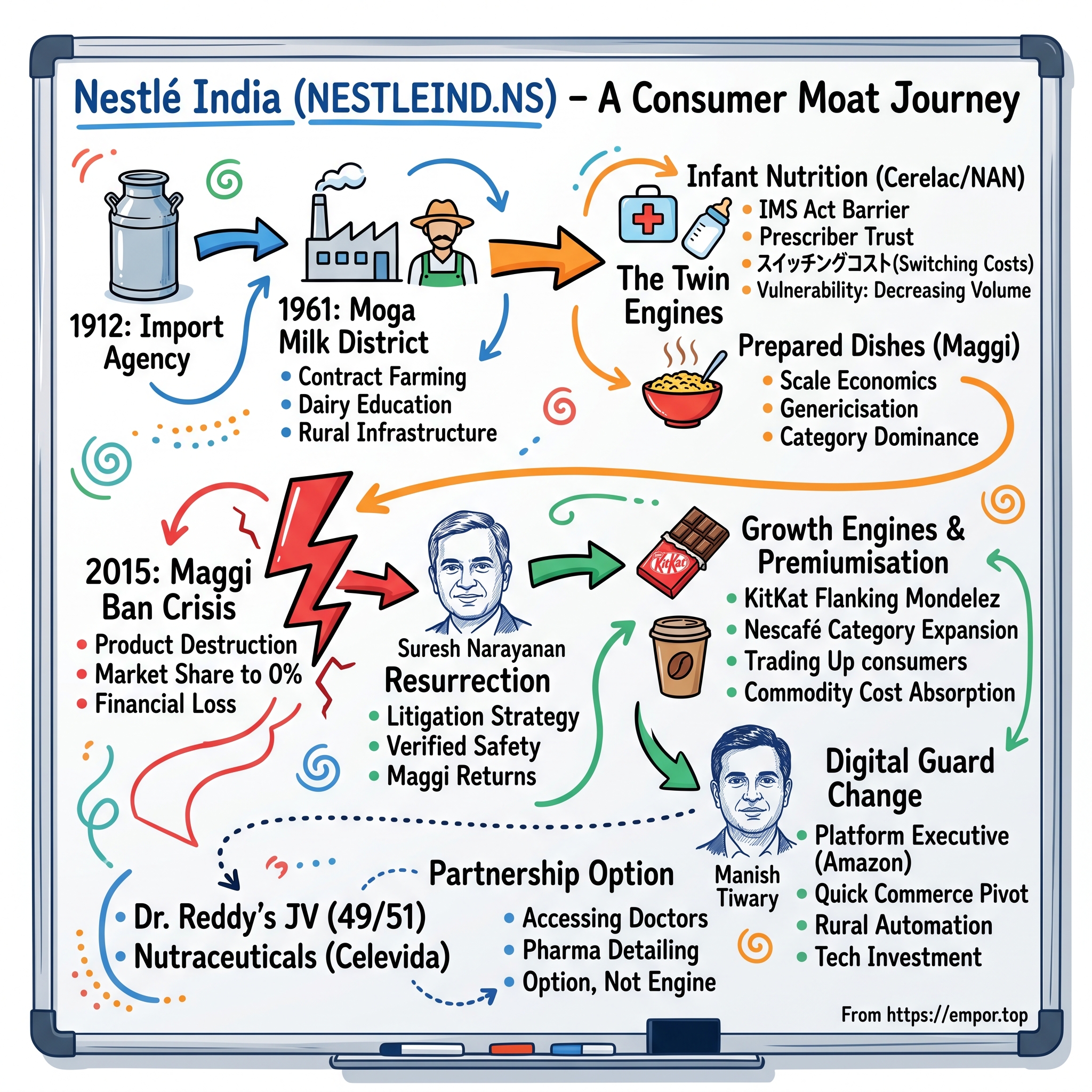
Nestlé India: The Alchemy of India's Ultimate Consumer Moat
I. Introduction & Episode Roadmap
On the evening of July 21, 2026, the finance team at Nestlé India's Gurugram headquarters is in the quietest and most anxious phase of the corporate calendar. The trading window closed on July 1. The board convenes tomorrow, July 22, to approve the results for the quarter ended June 2026.1 Nine brokerages have already published their guesses. They range from revenue growth of twelve percent to twenty-three percent — a spread wide enough to drive a truck through, which tells you something important right at the outset.2
That spread is the whole story in miniature. Nestlé India is one of the most-studied, most-owned, most-expensive consumer stocks on the National Stock Exchange, and the professionals who cover it for a living still cannot agree within a factor of two on what its top line just did. This is not a company that behaves like a bond.
The scale, first. Nestlé India traded at roughly ₹1,446 per share on July 20, 2026, giving it a market capitalisation of about ₹2.79 lakh crore — call it $32 billion.3 It earned a return on capital employed of roughly 84% and a return on equity of about 73% in the financial year ended March 2026.3 Those are not typos. A business that generates eighty-four paise of operating profit per rupee of capital employed is, in the language of finance, barely using capital at all. It is closer to a toll booth than a factory.
And yet the FY26 story is more complicated than the headline ratios suggest. Full-year sales rose about 14.6% to roughly ₹23,155 crore, but operating margin actually fell, from about 24% to about 23%.3 The year split cleanly into two halves that looked like different companies: first-quarter profit down thirteen percent, second-quarter profit down twenty-four percent as milk, coffee and cocoa costs tore through the P&L — then a third quarter with profit up forty-six percent and a fourth quarter up twenty-seven percent, with the March quarter posting the highest domestic sales in the company's history and an EBITDA margin of 26.3%.456
What happened in between was not a management masterstroke. It was a tax cut. India's GST Council collapsed its rate structure on September 22, 2025, and packaged foods — instant noodles, chocolate, coffee — dropped into the 5% slab.7 Nestlé India passed the benefit through, cutting the price of a twelve-pack of Maggi from ₹120 to ₹116 and taking roughly thirty percent off a 45-gram jar of Nescafé Classic.8 Demand responded. This is worth holding onto as you read: the single best thing that happened to this business in FY26 was authored in North Block, not in Gurugram.
What this story is really about. The narrative arc runs from a colonial import agency in 1912, through a milk-collection experiment in Punjab in 1961 that made Nestlé an agricultural institution before it was a consumer one, to the near-death experience of the 2015 Maggi ban, the 2024 shareholder revolt over royalties paid to the Swiss parent, the infant-nutrition sugar controversy that arrived the same month, and the August 2025 handover to a chief executive whose formative years were spent not in FMCG at all, but running Amazon India.
Along the way this piece will do three things a promotional write-up would not. It will test the "unassailable moat" claim segment by segment rather than assert it. It will correct several figures that circulate widely in Indian investor commentary and are simply out of date — the capex programme, the balance sheet, the segment mix, and a cost-savings initiative that appears not to exist under the name everyone uses. And it will be explicit about which numbers Nestlé India actually discloses and which ones the market has quietly invented.
Start where the company started: with milk.
 Subscribe on LinkedIn
II. Swiss Heritage & The Punjab Milk Revolution (1912–1980)
On November 15, 1961, at a collection point in rural Punjab, Nestlé's newly built factory at Moga received its first delivery of fresh milk. The quantity was 511 kilograms. It came from four villages.9
Sixty-five years later, that same network collects more than 1.3 million kilograms a day at the seasonal peak, from over 110,000 farmers, through 2,815 village collection centres spread across roughly 30,000 square kilometres.9 The compounding is almost absurd — but the more interesting question is why a Swiss condensed-milk exporter ended up in the business of teaching Punjabi farmers about cattle husbandry in the first place.
The import era, and its abrupt end. Nestlé's Indian relationship began in 1912 under the name The Nestlé Anglo-Swiss Condensed Milk Company (Export) Limited — a trading entity that imported finished product and sold it.10 For nearly five decades that was the entire business model. Condensed milk and infant food arrived by ship, moved through agents, and reached a thin sliver of urban and institutional demand. There was no factory, no supply chain, no Indian operation in any meaningful sense.
Independence in 1947 and the licence-permit regime that followed made that model untenable. Import substitution was not a preference of Indian economic policy in the 1950s; it was the policy. Foreign exchange was rationed. If you wanted to sell in India, you manufactured in India — and increasingly, you sourced in India too. Nestlé formed an Indian company and, at the government's request, established its first factory at Moga, Punjab, in 1961 with an explicit brief: develop the local milk economy.1011
The Moga problem. This was not a favour. Punjab in 1961 was a wheat-and-cotton economy with a dairy sector that barely deserved the term. Yields were low, herds were small, animals were poorly fed, and there was no cold chain — milk that wasn't consumed within hours simply spoiled. A factory built to process milk in that environment was a factory built next to a supply that did not exist.
So Nestlé built the supply. The company introduced what it called Agricultural Services: advisers who worked with farmers on dairy husbandry and animal nutrition, on improved yields and irrigation, on scientific crop management, and — crucially — on helping farmers get bank loans to buy more animals.11 Nestlé put in chilling infrastructure, guaranteed offtake, and paid on a schedule. Over decades Moga became what the company describes as a prosperous milk district, and the model was replicated across Punjab, Haryana and Rajasthan.
Two roads to the same place. This is where the comparison to Amul matters, and where most retellings get lazy. India's other great dairy story took the cooperative route: farmers owned the processing, the brand, and the surplus, and the Gujarat Cooperative Milk Marketing Federation coordinated it. Nestlé took the corporate route: the company owned everything, and the farmer's participation was contractual — an assured buyer at an assured price with technical support thrown in.
Neither model is morally superior and both worked. But they produce different competitive assets. Amul's model produced an emotional national brand with genuine farmer ownership and enormous political durability. Nestlé's produced something narrower and, from an investor's standpoint, more transferable: a proprietary, deeply-embedded rural procurement organisation, with decades of relationship capital, that could later be pointed at things other than milk.
That last point is the one worth carrying forward. When Nestlé India talks today about reaching roughly 216,000 villages,12 it is not building that capability from scratch. It is running consumer goods down pipes that were originally dug to bring milk in. The direction of flow reversed; the relationships did not.
What it bought, and what it cost. The candid assessment is that the Moga model produced three things. It gave Nestlé a genuine cost and reliability advantage in dairy inputs, insulated from spot-market volatility in a way that a pure buyer is not. It gave the company extraordinary political and regulatory standing — a foreign multinational that had visibly built rural livelihoods for six decades is a much harder target than one that merely imports and sells. And it created an operating discipline in agricultural sourcing that later became the template for coffee and other inputs.
What it cost was optionality and speed. A company organised around fixed rural processing assets in North India was slow to build a national manufacturing footprint. Nestlé India today operates nine factories, with a tenth under construction — a modest number for a company of this revenue scale, and a structural reason its logistics costs to eastern and northeastern India have historically been high.10
The dairy foundation also set up the segment that would become the company's profit engine and, eventually, its reputational vulnerability. Because the same Moga factory that processed Punjab's milk produced the first Indian batch of Cerelac on September 15, 1975.13
III. The Ultimate Moat: Infant Nutrition and the IMS Act
Picture the transaction. A new mother in a district hospital in Nagpur is handed a slip of paper by a paediatrician the family has trusted for a decade. On it is a brand name. She will not see an advertisement for that brand. She will not encounter a promotional offer, a free sample, a display stand, or an influencer post. She will not comparison-shop, because in the entire category there is nothing to comparison-shop against — no competitor is permitted to market to her either.
She buys what the doctor wrote down. And she keeps buying it, because the one product category in the Indian grocery basket where no rational parent experiments is the one they are feeding a six-month-old.
That is the Milk Products & Nutrition segment, and understanding why it works the way it does is the single most important analytical task in this business.
The legal architecture. The Infant Milk Substitutes, Feeding Bottles and Infant Foods (Regulation of Production, Supply and Distribution) Act, 1992 — universally called the IMS Act — is one of the strictest pieces of marketing law on the Indian statute books.14 It bans advertising of infant milk substitutes, feeding bottles and infant foods outright. It bans free samples. It bans promotional material of every description: booklets, leaflets, posters, cot tags, stickers, clinic cards, prescription pads. It bans using the health care system as a promotional channel. It bans any claim that formula is equivalent or superior to breast milk. A 2003 amendment, effective January 1, 2004, extended the promotion ban to foods marketed for children up to two years of age and closed the remaining loophole by prohibiting company sponsorship of health care professionals and health organisations.15 Violations are criminal offences carrying imprisonment.14
The economic mechanism, in plain terms. Marketing law is normally thought of as a constraint on incumbents. Here it functions as a wall around them. Consider what a well-funded new entrant would ordinarily do to attack a category: buy awareness, sample aggressively, discount to trial, and build a brand in eighteen months. The IMS Act deletes every one of those moves. It does not merely make them expensive; it makes them illegal.
What remains as a route to the shelf? Two things. Distribution — being physically present in pharmacies and general trade across a country of this size. And clinical credibility — being the brand that paediatricians, hospital nutritionists and neonatal units already know, trust and have used for decades. Both of those take a generation to build, and neither can be bought with a marketing budget.
The result is a category where the passage of time is itself the barrier to entry. Nestlé arrived early, built the relationships when building them was still permitted, and has spent the decades since inside the institutional memory of Indian paediatric practice. Abbott, Danone and Amul compete, and compete seriously, but they compete against a rival that the regulation freezes in place at the top.
A necessary caveat on the numbers. Investor commentary routinely cites market shares of roughly 96–97% for Cerelac in infant cereal and 66% for the Lactogen and NAN formula franchise. Those figures circulate very widely. They are also, as far as this research could establish, not disclosed by Nestlé India in any filing, annual report or investor presentation, and they do not trace to a named research house. Treat them as folklore with a plausible directional message rather than as facts. What is documented is that the company's nutrition portfolio — Cerelac, Nangrow, Ceregrow, Lactogrow and the NAN range — occupies the category comprehensively.16 The absence of hard disclosure is itself a small governance observation: for a segment this central, more granularity would be welcome.
The segment is shrinking as a share of the business — and that is the real news. Here the story departs sharply from the standard telling. Milk Products & Nutrition was once roughly half of Nestlé India's revenue. In FY25 it was about 38%. In FY26 it fell to 33.4% of turnover, at ₹7,716 crore, growing just 0.7% while volumes actually declined about 2% to roughly 122,958 tonnes.17
Read that again, because it undercuts the whole "impregnable fortress" framing. The most legally protected, highest-switching-cost segment in the portfolio grew less than one percent in a year when the company overall grew nearly fifteen. The company attributed the pressure to rising milk prices and higher packaging and transportation costs, and said the segment showed "resilience" with better performance later in the year.17 That is management's framing. The observable fact is a volume decline.
There are benign explanations — India's birth cohort is flattening, urban breastfeeding rates are rising, and the base is enormous. There is also a less comfortable one: a legally protected near-monopoly with declining volumes is a business whose moat protects a shrinking pond. The moat is real. Its strategic value depends entirely on what happens to the water level.
April 2024: the trust shock. Into this arrived the Swiss investigative NGO Public Eye, working with the International Baby Food Action Network. Their report examined 114 Cerelac products sold across Africa, Asia and Latin America and found that 106 of them — 93% — contained added sugar, while the same brand sold in Switzerland, Germany, France and the United Kingdom contained none.18 For India specifically, the report found that all fifteen Cerelac variants analysed contained added sugar, averaging about 2.7 grams per serving.[^19]
The charge was not illegality. It was double standards — that a Swiss company was selling a nutritionally inferior formulation to babies in poorer countries because it could. In a market as politically sensitive about food, children and foreign multinationals as India, that framing was radioactive.
The escalation was fast. On April 19, 2024, the Consumer Affairs Ministry asked the FSSAI to investigate Cerelac's composition.19 Inspections of Nestlé's Indian sites followed. Nestlé India's response was to hold the compliance line — the then-CMD stated publicly on April 29 that added sugar levels were within FSSAI's permissible limits, and the company noted it had reduced added sugars in its Indian baby-food range by up to 30% over the preceding five years, with sugar content declared on-pack.2021
The regulatory question closed on December 13, 2024, when Health Minister J.P. Nadda informed the Lok Sabha that no violation had been found in the sugar content of Nestlé's baby foods.22 Legally, Nestlé won.
But watch what the company actually did. On October 25, 2024 — six weeks before the parliamentary all-clear, and with the outcome still uncertain — Nestlé India announced no-refined-sugar Cerelac recipes, timed to the brand's fiftieth Indian anniversary. Of a 21-variant range, 14 moved to no-refined-sugar formulations, with seven on shelf by end-November and the rest following.13[^24]
This is the most revealing management decision in the recent history of the company, and it cuts both ways. The charitable reading: management understood that in infant nutrition, being technically compliant is worth nothing if mothers stop trusting you, and moved decisively to protect the asset rather than litigating in public. The sceptical reading: the company described the reformulation as the culmination of a three-year initiative, which raises the obvious question of why a three-year project happened to land six months after an NGO report rather than on its own schedule.
Both readings can be true. What is not in dispute is that the episode demonstrated the category's peculiar risk profile. The IMS Act keeps competitors out — but it also means Nestlé cannot advertise its way out of a trust problem. The wall works in both directions.
The reputational risk did not end there. In November 2025 a further report renewed scrutiny of added sugar in Cerelac across African markets, keeping the issue alive globally even though the Indian regulatory file is closed.23 And in January 2026, when Nestlé conducted a precautionary infant-formula recall in Europe over a supplier ingredient, Nestlé India moved within days to confirm no affected batches existed in India, since all Indian infant formula is made locally.24 The speed of that clarification tells you how sensitive this franchise now is to headline contagion.
The other half of the business had already learned that lesson the hard way.
IV. Prepared Dishes & The Maggi Dynasty (1982–2014)
To appreciate what Nestlé attempted in 1982, you have to appreciate how strange the proposition was.
India in the early 1980s was a country where food carried enormous cultural weight and almost no convenience. Meals were cooked, from raw ingredients, usually by women, usually over an hour or more. Regional cuisines were fiercely specific. The idea of a wheat-flour noodle block from a factory, boiled in two minutes, seasoned from a foil sachet, and eaten as a snack — not a meal, not part of any tradition, not from anyone's grandmother's kitchen — had no precedent and no obvious demand.
Nestlé India launched Maggi 2-Minute Noodles into that market in 1982.25
The pivot that made it work. The initial instinct was the obvious one: sell convenience to the time-pressed working mother. It did not land well enough. Indian mothers of that era did not particularly want to be told that a factory could do their job in two minutes, and the guilt-adjacent positioning worked against the product.
So the company changed the target. Maggi was repositioned toward children — the after-school snack, the thing you eat at four in the afternoon when you are hungry and dinner is hours away. The two-minute claim stopped being a labour-saving pitch to adults and became a promise of near-instant gratification to kids.25 The mother's role shifted from user to gatekeeper, and the pitch to her became simpler: it is fast, it is easy, and your child will actually eat it.
That worked, and it worked so completely that it produced one of the rarest outcomes in branding: genericisation. In large parts of India, "Maggi" does not mean a brand of instant noodles. It means instant noodles. Roadside stalls across the country sell "Maggi" that may or may not be Nestlé's product. Competitors do not merely fight a market leader; they fight a word.
The economics underneath the culture. Prepared Dishes & Cooking Aids grew into the second-largest segment, at 31.5% of FY26 turnover, up from about 24% a decade earlier.17 The unit economics are the mirror image of infant nutrition. Where Cerelac earns its margin through irreplaceability, Maggi earns its margin through scale.
The mechanics are worth spelling out for readers who do not live in FMCG. A packet of instant noodles is wheat flour, palm oil, salt and a seasoning sachet. The raw materials are commodities available to anyone. The manufacturing is not technologically hard. What is hard — brutally, capital-intensively hard — is buying wheat and palm oil at national scale, running high-throughput lines at very high utilisation, and then physically getting a ₹14 product into several million shops profitably. Nestlé today reaches roughly 5.3 million retail outlets.12 The cost of servicing that network is enormous in absolute terms and trivial per packet at Maggi's volumes. A challenger with one percent of the volume pays roughly the same fixed cost per shop visit and cannot recover it.
The scale itself is worth pausing on. India is Maggi's single largest market in the world.26 The company reported roughly 5.7 billion Maggi servings a year in FY2025-26.12 That is not a national brand; it is closer to national infrastructure.
Where it stood on the eve of the crisis. By 2014, secondary market estimates placed Maggi at roughly 80% of the Indian instant noodles market, facing ITC's Sunfeast YiPPee!, Hindustan Unilever's Knorr, and 日清食品 Nissin Foods' Top Ramen.25 No primary or company source confirms the 80% figure, and it should be read as an approximation rather than a measurement — but even discounted, it describes something close to category ownership.
Dominance of that degree creates a specific and underappreciated fragility. When one brand is ninety percent of a category's mindshare, it also absorbs one hundred percent of the category's blame. There was no diversification of reputational risk. Any food-safety event involving instant noodles in India would, by definition, be an event involving Maggi.
In the summer of 2015, one arrived.
V. The Near-Death Experience: The Great Maggi Ban of 2015
The detail that captures the scale of what happened is this: Nestlé India had to burn its own product in cement kilns, because there was nowhere else in the country to destroy 37,000 tonnes of noodles.27
The trigger. It began quietly and much earlier than the public remembers. In March 2014, authorities in Uttar Pradesh detected monosodium glutamate in samples labelled "No added MSG." Nestlé requested referral testing. In April 2015, a referral laboratory in Kolkata reported lead levels above permissible limits — with one initial Uttar Pradesh sample reading 17.2 parts per million against an FSSAI limit of 2.5 ppm. Nestlé's own testing contradicted the finding.2827
Regulatory dispute became national panic within weeks. On June 5, 2015, the FSSAI ordered the recall of all nine approved variants of Maggi instant noodles and oats masala noodles, declaring the product unsafe and hazardous for human consumption.2928 State after state banned it. Retailers stripped shelves. Television ran lead-poisoning segments in prime time. A brand that had spent thirty-three years becoming a synonym for a food category became, in a fortnight, a synonym for contamination.
The financial carnage. For the quarter ended June 2015, Nestlé India reported a net loss of ₹64.4 crore — its first quarterly loss in roughly two decades. Net sales fell about twenty percent to ₹1,934 crore from ₹2,419 crore, and the company took an exceptional charge of ₹451.66 crore for stock withdrawal losses.3031 The recalled inventory carried an estimated market value of around ₹320 crore; incineration alone cost roughly ₹20 crore.27
But the P&L understates it. Maggi's market share went to zero — not down, to zero, because the product was illegal to sell. An entire segment of the business, roughly a third of revenue, simply ceased to exist for five months.
Enter the crisis manager. Nestlé moved Suresh Narayanan into the managing director's chair effective August 1, 2015, and designated him Chairman and Managing Director on October 29 that year.32
Narayanan was an unusual choice and, in retrospect, an inspired one. Born in Bengaluru, he studied economics at the Delhi School of Economics and had initially aimed for the Indian Administrative Service before Hindustan Lever recruited him off campus. He spent his early career at Hindustan Unilever and Colgate-Palmolive before joining Nestlé in 1999 as executive vice-president for sales in India. He then spent more than a decade abroad in progressively harder postings: Nestlé Indochina, then managing director of Nestlé Singapore from 2008 to 2010 — for which the Singapore government awarded him a Medal of Commendation — then Chairman and CEO of Nestlé Egypt and head of the North East Africa region through the Arab Spring, then Chairman and CEO of Nestlé Philippines.32
In other words, Nestlé did not send a marketer. It sent someone who had run consumer businesses through political revolution and currency collapse, and who happened to be Indian, to a crisis that was simultaneously regulatory, judicial, political and emotional.
The strategy: litigate the process, not the panic. The instinct in a consumer trust crisis is to launch a reassurance campaign. Narayanan largely did not — not first. The company's central judgment was that no amount of advertising could restore trust while the state's own regulator maintained the product was poisonous. The problem had to be solved in court.
So Nestlé attacked the procedure. On June 11, 2015, it filed a judicial review petition in the Bombay High Court, arguing that the tests underpinning the ban had been run at laboratories that were not NABL-accredited — the Indian national accreditation standard for testing labs — and pointing to the product's safety approvals in other jurisdictions.28
On August 13, 2015, the Bombay High Court struck down the ban as arbitrary and a violation of natural justice, citing improper procedure and the use of non-accredited laboratories. Critically, the court did not simply hand the product back. It permitted reintroduction subject to fresh testing at three NABL-accredited laboratories, in Punjab, Hyderabad and Jaipur, within six weeks.2827
That condition was the actual victory. Had the court merely lifted the ban, Nestlé would have returned to shelves under a permanent cloud of "the company got off on a technicality." Instead it returned with a court-supervised, independently verified clean bill of health. On October 16, 2015, all three mandated laboratories confirmed lead content well within permissible limits across ninety samples spanning six variants.2833 A subsequent CFTRI analysis submitted to the Supreme Court cleared all twenty-nine samples tested on April 11, 2016.28
The comeback. Maggi returned to shelves on November 9, 2015, with production resuming at all five plants by November 30.2827 The relaunch leaned on the verification story rather than on brand nostalgia, which was the correct call — the asset that needed rebuilding was safety confidence, not affection.
The scar tissue. Here is where the popular retelling turns triumphalist and the evidence does not support it. Maggi came back, but it did not come all the way back. Recovery to roughly fifty-five percent share took until mid-2016. Narayanan himself, reviewing the decade in June 2025, put Maggi at "over 60%" of the Indian instant noodles market — meaningfully below the pre-crisis level.34 Independent market research places Nestlé in the 55–60% band.35
The share went somewhere. ITC's Sunfeast YiPPee! used the five-month vacuum to convert trial into habit, and by May 2026 the brand had crossed ₹1,000 crore in sales at roughly a 22% share — with Maggi still nearly three times its size, but no longer alone.36 Estimates of YiPPee!'s share vary widely across sources, from the mid-teens to nearly thirty percent, so precision here is unavailable. The structural point survives the imprecision: a near-monopoly became a duopoly with a long tail, and it did so in five months.
The permanent lesson for investors is about the nature of the asset. Distribution and manufacturing scale, once lost, come back quickly — Nestlé's shelf space returned within months. Consumer habit, once broken, does not fully return at all. Roughly twenty points of category share transferred permanently on the basis of a regulatory action that was subsequently overturned in court. Being right, in consumer goods, is not the same as being whole.
Narayanan spent the following decade rebuilding — and taking the company's turnover from about ₹8,100 crore in 2015 to roughly ₹20,100 crore by FY25.34 While he did, the other half of the portfolio was quietly becoming the growth engine.
VI. Confectionery & Powdered Beverages: Premiumization & Commodity Headwinds
In FY26, the segment that grew fastest at Nestlé India was not the legally protected infant-nutrition fortress and not the noodle brand that defines a category. It was chocolate — up 33% in value and 25% in volume, lifting Confectionery to roughly 19% of turnover from about 13%.17
That is an extraordinary result in a category Nestlé does not lead. Mondelez's Cadbury has owned the Indian chocolate consumer for generations. Nestlé's position has always been a flanking one, built on two specific brands with specific jobs: KitKat, which owns the wafer-chocolate format and the break-time occasion, and Munch, which competes at the entry price point where volume lives.
A quiet milestone. India is now Nestlé's largest KitKat market in the world, up from roughly tenth a decade ago.37 The number is worth dwelling on because it says something non-obvious about Indian consumption. Chocolate in India was historically a gifting and festival product, sold in boxes at Diwali. The shift to everyday, single-serve, impulse consumption at price points a student can afford is what made a market of this size possible — and KitKat's format, a snack that happens to be chocolate rather than a chocolate that happens to be a snack, was unusually well-suited to it.
Beverages: the coffee position. Powdered and Liquid Beverages, anchored by Nescafé, delivered what management described as high double-digit growth in FY26.17 Nescafé holds more than half of India's instant coffee market against Hindustan Unilever's Bru at roughly 30–32%, and reached its highest-ever household penetration in India in FY26, selling around 13.2 billion cups.3712
The strategic significance here is larger than the segment's size. India is structurally a tea market. Coffee penetration has been rising for two decades and is still low. This is one of the few genuinely under-penetrated large categories in the Indian grocery basket, and Nestlé sits at the top of it with a brand that has been building distribution since long before the current café culture existed. Growth here does not require taking share; it requires the category to keep expanding, which it has.
Premiumisation — the mechanism and its limits. Both segments have been the primary vehicles for what management calls premiumisation: moving consumers from Nescafé Classic to Nescafé Gold, adding Vietnamese Latte and Iced Cappuccino variants, expanding the KitKat range beyond the base bar.12 The logic is straightforward. In a price-sensitive market, you cannot repeatedly raise the price of the entry product without destroying volume. But you can introduce a better product above it and let consumers trade up voluntarily.
Management has framed premiumisation as expanding fastest in urban markets and larger towns, with quick commerce as the enabling channel — because a premium coffee that a kirana store will not stock can be delivered from a dark store in ten minutes.38 That is a genuinely new mechanism rather than a repackaged one, and it is testable: if premiumisation is real, mix-driven gross margin should improve even in quarters when input costs are flat.
A widely circulated claim holds that Nestlé India's premium portfolio has compounded at 16% a year since 2015. That figure appears in investor commentary but could not be traced to a company disclosure in this research. Treat it as unverified.
The commodity vice, and how it actually gets managed. FY25 and FY26 delivered a textbook input-cost shock. Cocoa spiked to unprecedented levels on West African crop failure; coffee prices climbed on supply shortfalls; milk prices rose domestically. The consequence showed up immediately in Nestlé India's first-half FY26 results: EBITDA margin fell to about 21.7% in the June 2025 quarter, a three-year low, with profit down 13.4%, and the September quarter was worse, with profit down about 24%.439
Management's stated response was to absorb costs rather than follow peers into price increases, prioritising volume over near-term margin.40 Whether that is discipline or necessity depends on your view of the demand curve, but the evidence favours discipline: Nestlé India visibly held price while margin compressed for two consecutive quarters, then benefited disproportionately when volumes accelerated.
By the March 2026 quarter the vice had loosened. Management noted coffee prices moving lower on a favourable Vietnamese crop and an incoming Brazilian one, cocoa softening on improved supply and moderated demand — but milk prices strengthening and expected to stay elevated through the summer lean season, and wheat affected by unseasonal April rains that delayed the harvest and hurt both quantity and quality.41 That is an unusually specific and non-promotional set of comments, and its candour is a mild positive signal on management communication.
A myth worth correcting. Indian investor commentary frequently attributes Nestlé India's cost discipline to an internal programme called "Project SHIELD," often with a specific count of thousands of margin-improvement projects since 2016. This research could find no source associating that name with Nestlé India. What the company has actually described in FY26 is a "structural efficiency programme" using technology to eliminate non-value-adding costs, which management said delivered the highest operational cost savings in the company's history — and which, notably, it said it reinvested into advertising, digital and consumer activation rather than banking as margin.42
That reinvestment choice is visible in the numbers. Advertising and promotional spend in the March 2026 quarter rose more than fifty percent year-on-year, and the company still expanded EBITDA margin to 26.3%.5 Spending aggressively into a demand upturn while margins improve is the behaviour of a management team that believes the volume response is durable. It is also the behaviour that makes the following year's comparison difficult. Both things are true.
Which brings us to the person who made that call — and who had been in the chair for barely eight months when he made it.
VII. The Digital Guard Changes: Manish Tiwary (2025–Today)
On July 31, 2025, Suresh Narayanan closed out a 26-year Nestlé career and stepped down as Chairman and Managing Director of Nestlé India.[^45] He left behind a company roughly two and a half times the size he had inherited, a Maggi franchise resurrected from a legal death sentence, and a personal reputation as one of the most respected operators in Indian consumer goods.
The person Nestlé chose to follow him had never worked at Nestlé.
Who Manish Tiwary is. Tiwary took over as Chairman and Managing Director on August 1, 2025.[^45] His career divides cleanly in two. He spent roughly twenty years at Unilever, across sales, marketing and general management, working in India, the Gulf and North Africa — a conventional and rigorous FMCG apprenticeship. Then he left for Amazon, where he ran the India consumer business as Country Manager for more than eight years.43
That second act is the entire point of the appointment. Running Amazon India through the second half of the 2010s and into the 2020s meant operating at the epicentre of every disruption now reshaping Indian consumer goods: the shift of discovery from shelf to search, the economics of last-mile delivery in dense cities, the data infrastructure of demand forecasting, and the arrival of quick commerce as a genuinely new retail format rather than a funding-driven curiosity.
Nestlé India did not hire a food executive with digital exposure. It hired a platform executive and gave him a food company. That is a deliberate statement about where the board believes the next decade's difficulty lies.
The mandate, and the early evidence. The channel numbers explain the urgency. E-commerce accounted for about 8.5% of Nestlé India's sales through the first nine months of FY25.44 By FY26 it reached roughly 12.5% of domestic sales, with online channels growing 97% during the year.38 Within e-commerce, quick commerce — the ten-minute delivery model run by Blinkit, Zepto and Swiggy Instamart — has become the dominant sub-channel.
For readers unfamiliar with why quick commerce matters strategically rather than just commercially: a traditional kirana store carries limited shelf space and stocks what turns over fastest, which structurally favours entry-price mass products. A dark store serving a two-kilometre radius has different economics — it can carry the long tail, because it aggregates demand from thousands of households rather than one neighbourhood. That is why Tiwary has framed quick commerce specifically as the channel that extends premium products beyond metro cities into larger towns.38 It is not just a faster way to sell Maggi. It is the first channel in India that makes a ₹755 jar of Nescafé Gold viable in a Tier-2 city.
On the operating side, the company has scaled a retailer platform called NesMitra, deployed automated replenishment and what it describes as touchless demand forecasting, and rolled out rural distribution automation.1242 Tiwary told analysts in July 2026 that technology investment was being stepped up to strengthen operations.45
How much of this is real yet? Enough to take seriously, not enough to declare won. The 97% online growth and the jump from 8.5% to 12.5% of sales are genuine and large. The GST-driven demand surge, however, makes FY26 a poor year for isolating management's contribution — the tax cut lifted the whole category, and separating channel execution from a national fiscal stimulus is not possible from outside. The honest test comes in FY27 and FY28, once the GST base effect washes out.
Incentives. Tiwary's direct shareholding in Nestlé India is nominal, which is standard for a professional multinational manager and worth stating plainly: he is an employee of the group, not an owner of the subsidiary. His disclosed remuneration ratio to the median Nestlé India employee stood at 134:1.46 The specific composition of his performance-linked incentives — the weightings across volume growth, margin retention and capital efficiency — is not disclosed. That is a genuine gap. For minority shareholders in a 62.76%-controlled subsidiary, knowing precisely what the chief executive is paid to optimise would be materially useful.
The capex story, corrected. This is where widely repeated investor commentary is most out of date, and where the correction changes the investment picture meaningfully.
The frequently cited "₹4,200 crore capital expenditure programme" was announced in July 2023 as a spend-by-2025 commitment.47 Management subsequently escalated it, describing in February 2024 an unprecedented cycle of roughly ₹6,500 crore through 2025.48 Both figures are now historical.
What matters is what happened next: capex has sharply normalised. FY26 capital expenditure was roughly ₹820 crore, against nearly ₹3,900 crore across the prior two years combined — falling from about 10% of revenue in FY25 to under 4% in FY26.49 This, more than any operating improvement, is the largest driver of the step-change in free cash flow. A company that spent heavily to build capacity ahead of demand is now harvesting it.
The physical assets from that cycle are real. Nestlé India laid the foundation stone for its tenth factory — and its first in eastern India — at Khordha, Odisha, on April 3, 2025, with a Phase 1 investment of roughly ₹900 crore, dedicated to prepared dishes and cooking aids.5051 The strategic rationale is logistics: Nestlé's manufacturing has been concentrated in the north, west and south, which makes serving eastern and northeastern India expensive in both freight and delivery time. As of July 2026 the plant remains under construction with no company-confirmed commissioning date; trade press estimates around 800 jobs and a roughly two-year build, implying 2027.51 Separately, the Sanand facility in Gujarat received a ₹1,100 crore KitKat capacity expansion announced in February 2025.52
For investors the read is nuanced. The capacity is in place or arriving, which supports the current volume surge. But a company harvesting a completed capex cycle is flattering its free cash flow in a way that is not repeatable — annual capex guidance still exceeds ₹2,000 crore.49 FY26's cash generation should be understood as a cycle position, not a new normal.
The same instinct — buy the capability, do not build it — showed up in a deal signed sixteen months before Tiwary arrived.
VIII. The Nutraceutical Option: The Dr. Reddy's JV
Nestlé Health Science owns some of the most recognised clinical nutrition brands in the world: Nature's Bounty, Osteo Bi-Flex, Ester-C, the Resource and Optifast ranges, Peptamen. In India, until recently, most of them were effectively invisible.
The reason is instructive. These are not products a consumer discovers on a shelf. They are recommended — by a physician managing a diabetic patient, a hospital dietitian feeding a post-surgical case, a nephrologist prescribing renal nutrition. Selling them requires a medical detailing force: representatives who visit doctors, understand clinical literature, and build prescriber relationships over years. Nestlé India, for all its 5.3 million retail outlets, had almost none of that. Its distribution genius runs through grocers, not clinics.
Dr. Reddy's Laboratories has exactly the opposite asset base.
The deal. On April 25, 2024, the two companies announced a definitive agreement to form a joint venture in health-science nutraceuticals for India and other agreed territories.53[^57] The structure gave Dr. Reddy's 51% and Nestlé India 49% — notably, Nestlé accepted minority control, which is uncharacteristic for the group and signals that it valued the partner's channel more than its own governance preference.
The vehicle was incorporated on March 14, 2024 as Dr. Reddy's Nutraceuticals Limited and renamed Dr. Reddy's and Nestlé Health Science Limited on June 13, 2024. The transaction closed on August 1, 2024, with Nestlé India subscribing roughly ₹705.6 crore of equity and Dr. Reddy's about ₹734 crore, headquartered in Hyderabad.5453
Each side licensed brands into the venture. Nestlé contributed its global clinical and wellness portfolio; Dr. Reddy's contributed Celevida, Antoxid, Rebalanz, Kidrich-D3 and Becozinc — established Indian nutrition and OTC names with existing prescriber recognition.53
Why the structure is smart, and what it costs. The alternative paths were both worse. Building a medical detailing organisation from scratch would have taken five to seven years and produced an unproven asset. Acquiring an Indian nutraceutical company outright would have meant paying a control premium in a sector trading at rich multiples, and integrating a business Nestlé India has no operating experience running.
The JV route buys immediate access to a distribution capability that money cannot quickly build, at a defined capital cost, with the partner carrying operational responsibility. Because Nestlé India holds 49%, the venture is equity-accounted — its result flows through a single line rather than consolidating revenue, which keeps the parent's reported margins undistorted by a lower-margin business in its build phase.
That accounting treatment cuts both ways. It also means minority shareholders in Nestlé India get very little visibility into how the venture is actually performing. The JV's revenue for the year ended March 2025 was around ₹315 crore per third-party data; its FY26 revenue, profitability, and Nestlé India's share of its result could not be verified from any disclosed source in this research.55 For a ₹705 crore investment, that is thin.
Early product evidence. The venture has begun to ship differentiated products rather than just redistributing existing ones. In May 2026 it launched Celevida GLP+, a whey-protein-isolate-based nutrition product designed for patients on GLP-1 and GIP therapies for type 2 diabetes and obesity.56 The commercial logic is sharp: GLP-1 drugs cause rapid weight loss that includes muscle mass, creating a genuine clinical need for protein supplementation among exactly the patient population a pharma detailing force already visits. India's GLP-1 market was projected at $82 million in 2024 and above $1 billion by 2033 — and India's semaglutide patent expiry has made it one of the world's most competitive generic obesity-drug markets.56
Sizing the thing honestly. At a few hundred crore of revenue against a parent doing ₹23,000 crore, this is not material to near-term earnings and will not be for years. It is an option, not an engine. What makes it worth the section is the strategic shape: Nestlé India acquired a route to the Indian doctor for roughly ₹705 crore, and the Indian doctor is the gatekeeper for both the medical-nutrition boom and — as the IMS Act guarantees — for infant nutrition. Those two prescriber networks overlap considerably.
If the venture works, Nestlé India will have deepened the very relationship that underwrites its most protected franchise. If it does not, the capital at risk is roughly three percent of a single year's revenue. That asymmetry is the argument for the deal, and it is a reasonable one.
Time to put the whole machine on the bench.
IX. Playbook: Business, Capital Allocation, & Moat Analysis
Applying Helmer's 7 Powers. Hamilton Helmer's framework asks a specific question: what conditions allow a business to sustain returns above its cost of capital against competitors who would very much like to take them? Nestlé India presents an unusually clean case study because different segments run on entirely different powers.
Scale economies are the engine of Maggi and, increasingly, Nescafé. The mechanism has already been described — fixed distribution costs amortised across volumes no challenger can match. The evidence supporting it is the 5.3 million-outlet network and the roughly 520,000 outlets added since April 2023.1238 The vulnerability is that quick commerce partially neutralises it: a startup selling through Blinkit rents national reach by the transaction rather than building it over decades.
Switching costs are the infant-nutrition story, and they are among the strongest in Indian consumer goods — not because switching is technically hard, but because the perceived cost of being wrong about a six-month-old's food is effectively infinite.
Branding operates in a specific and measurable way here: it determines who can pass through input-cost inflation without losing volume. Nestlé India's FY26 behaviour actually tested this in reverse — it chose not to raise prices during the cocoa and coffee spike, absorbing margin instead.40 That is a management choice about volume priority, not evidence of weak pricing power, but it does mean the power went unexercised at the moment it mattered most.
Process power is the Moga inheritance: six decades of accumulated know-how in running direct agricultural procurement at scale in rural India. It is genuinely hard to replicate because it is embodied in relationships and institutional routine rather than in equipment. Its practical value showed up inversely in FY26, when rising milk costs still compressed the nutrition segment — process power reduces volatility, it does not eliminate exposure.
Cornered resource is where the outline's framing needs adjusting. The IMS Act is not a cornered resource in Helmer's sense, because Nestlé does not own it and it applies equally to everyone. It is better understood as a regulatory barrier that converts incumbency into a durable asset. The distinction matters analytically: a cornered resource is something you hold, while this is a rule that happens to advantage whoever arrived first. If Indian regulation ever liberalised infant-nutrition marketing, the wall would come down for Nestlé too — and it is the incumbent with the most to lose.
The remaining two powers are largely absent. There are no meaningful network economies in packaged food, and counter-positioning — the power that lets an insurgent do something the incumbent cannot copy without damaging itself — is a power aimed at Nestlé, not held by it. Every clean-label, low-sugar, millet-based challenger brand in India is running exactly that play.
Porter, briefly. On the five forces: buyer power is rising, and this is the most important change in the competitive structure. Historically Nestlé faced millions of fragmented kiranas with essentially no negotiating leverage. It now increasingly faces three or four quick-commerce platforms with real data, real scale and real appetite for margin. Supplier power is moderate and commodity-driven. Substitutes are abundant but individually weak. Rivalry is intense in confectionery, moderate in noodles, and structurally suppressed in infant nutrition. New entry is easy in snacking and near-impossible in infant nutrition. The composite picture is a company whose average competitive position is excellent and whose marginal competitive position is deteriorating at the channel level.
The 2024 royalty rebellion. In April 2024, Nestlé India's board proposed raising the general licence fee paid to Société des Produits Nestlé S.A. from 4.5% to 5.25% of net sales, phased at 0.15 percentage points a year over five years from July 1, 2024, and put it to shareholders as an ordinary resolution by postal ballot.57
Proxy adviser IIAS recommended against. The stated objection was not that royalties are illegitimate — they are standard in multinational subsidiary structures — but that the proposal came without a transparent cost-benefit case and would widen the gap between Nestlé India's royalty burden and that of comparable listed subsidiaries.58
In May 2024 the resolution failed, with 57.17% of votes cast against. Among public non-promoter shareholders, roughly 70.8% voted no.5958
The arithmetic deserves a moment. Nestlé S.A. holds 62.76% of Nestlé India.3 A promoter with that stake can normally pass an ordinary resolution alone. It could not here, because as the counterparty it was a related party and abstained — leaving the outcome entirely in the hands of minority shareholders, who used it. This is the single most consequential piece of Indian corporate-governance regulation in the story, and it is worth understanding: related-party-transaction rules did not just give minorities a voice, they gave them the only voice.
The board then accepted the verdict and moved a resolution to continue at the existing 4.5%, which shareholders approved at the July 8, 2024 AGM with 99.54% in favour.60[^65] The rate has remained at 4.5%, with FY26 royalty payments of ₹1,024.5 crore, up 13.91% on the prior year purely because sales grew.61
The activist stress test. A sceptical investor would press on four points, and each deserves a straight answer.
First, is the royalty itself justified? At 4.5% of net sales, Nestlé India paid over ₹1,000 crore in FY26 — roughly 29% of net profit — to its parent for brand and technology access. Whether that is fair value or value transfer is genuinely unknowable from outside, because the company does not publish a cost-benefit analysis. That opacity is the legitimate grievance, and it is unresolved.
Second, will the parent find another route? This is the sharpest version of the bear case on governance, and it cannot be dismissed. Royalty is one of several channels through which a controlling parent can extract economics; transfer pricing on imported inputs, management service fees and shared-cost allocations are others, and they attract far less shareholder scrutiny because they do not require a vote. The evidence to date does not show such a shift — the FY26 disclosure recorded no material modification to related-party terms.61 But "no evidence yet" is a weaker statement than "cannot happen," and this is a permanent item on the monitoring list.
Third, the disclosure gap. Nestlé India does not publish segment revenue in rupees for three of its four segments in readily accessible form, does not disclose infant-nutrition market share, does not break out realised internal growth versus pricing the way its Swiss parent does for global results, and does not disclose the JV's financial contribution. For a company at eighty times earnings, the informational return per rupee of market cap is low.
Fourth, was the capex cycle disciplined? Here the company earns credit. It announced a programme, escalated it transparently, built the assets, and then stopped — capex fell to under 4% of revenue in FY26 rather than drifting into empire-building.49 That is the behaviour minority shareholders should want, and it happened.
Capital allocation and the balance-sheet myth. Nestlé India is routinely described as "completely debt-free." That was not accurate for FY25. The company carried short-term borrowings and disclosed higher finance costs on borrowing taken to meet temporary operational cash-flow needs.39 During FY26 it repaid ₹730 crore of short-term borrowings and built cash from about ₹76 crore to ₹1,321 crore, moving from a net debt position to net cash of roughly ₹897 crore.4962 Residual borrowings of about ₹444 crore remain, against equity of roughly ₹4,000 crore — a debt-to-equity ratio near 0.09 and an interest cover above thirty.3
So: effectively unlevered today, genuinely so, but the "always debt-free" framing is a myth. It was a company with modest borrowings twelve months ago.
The working capital improvement was more impressive than the debt repayment. Inventory days fell from 52 to 41, and the cash conversion cycle went from positive 26.9 days to negative 5.6 days.49 A negative cash conversion cycle means Nestlé collects from customers before it pays suppliers — customers fund the business. This, combined with the completed capex cycle, is why free cash flow per share moved from ₹5.17 in FY25 to ₹21.95 in FY26.49
Returns, stated accurately. The outline's claim of ROIC exceeding 100% reflects the pre-capex-cycle Nestlé India. The FY26 reality is ROCE of about 84% and ROE of about 73% — still exceptional, still among the highest of any large listed Indian company, but lower than the historical peak precisely because the company spent several thousand crore building factories.3 That decline is not deterioration. It is what happens when a capital-light business chooses to add capital. Whether it was worth it will be visible in the volume growth those factories support over the next three years.
One accounting note investors should register: FY26 reported net profit was ₹3,545 crore including an exceptional net credit, against roughly ₹3,499 crore on a clean basis — growth of 7.0% or 9.1% depending on the treatment.363 Neither is wrong; be consistent about which you use. Separately, the FY26 special dividend of ₹2 per share was funded from ₹741 crore reclassified into retained earnings following an NCLT-sanctioned Scheme of Arrangement — a balance-sheet reorganisation, not operating cash generation.64
X. Risk Radar & Investor Stress Test
Every risk in this business ultimately runs through one of three channels: what Nestlé pays for inputs, what consumers believe about its products, and who controls the shelf. Here is how each actually works.
Commodity and sourcing exposure. Material costs ran at roughly 44.8% of sales in FY26.63 That is the mechanical sensitivity: a ten percent move in the input basket, unmitigated, is worth roughly 4.5 points of operating margin. The FY26 first half demonstrated this precisely, with margin falling to a three-year low as cocoa, coffee and milk all rose together.4
What makes the exposure structural rather than cyclical is climate. Cocoa's price surge originated in West African crop failure driven by weather and disease. Coffee's followed shortfalls in Brazil and Vietnam. Wheat in India was hit by unseasonal April 2026 rains that delayed the harvest and reduced both quantity and quality.41 Nestlé's dairy procurement network provides real insulation on milk but none whatsoever on cocoa or coffee, which are imported at world prices. If crop volatility is now the baseline rather than the exception, margin volatility follows it, and the smooth 23–24% operating margin the market has priced becomes a range rather than a line.
Reputational and regulatory fragility. The Cerelac episode showed how quickly a compliance-correct position can become a commercial problem. Nestlé won the regulatory argument and reformulated anyway — which is the correct read of the risk: the binding constraint is public trust, not the rulebook.
That fragility remains live. In June 2026 the FSSAI issued a notice to Nestlé India over an alleged insect in a Maggi packet, sourced from a viral social media post. The company denied it, described the account as unverified, and submitted quality logs and laboratory findings.65 The stock fell about 3.2% in a day on what was, at that point, an unsubstantiated social media claim.65 Nothing further has emerged.
That reaction function is the risk in a single data point. A company trading at eighty times earnings on a reputation for safety has an asymmetric response to safety headlines — trivially small allegations move the stock meaningfully, because the market correctly understands what 2015 cost. Add to this the direction of Indian food regulation, which is moving toward tighter labelling on high-fat, sugar and salt products and greater scrutiny of ultra-processed foods, and a portfolio built on noodles, chocolate and sweetened beverages is squarely in the path.
The channel power shift. This is the most underappreciated structural risk and deserves the most careful explanation.
For seventy years, Nestlé's relationship with Indian retail was overwhelmingly favourable. Millions of individually powerless kirana stores bought through distributors on terms Nestlé largely set. No single retailer mattered, so no retailer had leverage.
Quick commerce inverts this. When 12.5% of domestic sales flow through online channels and quick commerce is the dominant portion of that, a small number of platforms control a rapidly growing share of volume.38 Those platforms know exactly what sells, at what price, in which pincode — data Nestlé historically owned exclusively and now shares. They have launched private-label products in adjacent categories. And they operate at negative or thin margins, which creates persistent pressure to extract better terms from suppliers.
The mechanism by which this hurts is not dramatic. It is a slow grind: higher listing and visibility fees, deeper promotional participation, more frequent price benchmarking. Nestlé's operating margin does not collapse; it erodes a few tens of basis points a year in a way that is hard to attribute and easy to explain away.
The counter-argument, which management has made explicitly, is that quick commerce is net accretive because it opens premium products to towns that traditional retail cannot serve.38 Both effects are real. Which dominates is genuinely unresolved, and it is the most important open question about this company's margin structure over the next five years.
Competitive intensity, honestly assessed. ITC's Sunfeast YiPPee! is the durable threat in noodles, and its playbook is instructive: localised flavour profiles, aggressive Tier-2 and Tier-3 pricing, and now millet-based variants aimed directly at the health-conscious shift.35 ITC has one structural advantage Nestlé cannot copy — it is an Indian conglomerate with its own agri-sourcing arm and no royalty outflow to a foreign parent, which means it can fund a share war for longer at a given price point.
In confectionery, Nestlé is the challenger, not the incumbent, and its 33% FY26 growth came off a small base against a Mondelez position built over decades. In beverages, the competition is less about Bru than about the entire out-of-home café ecosystem redefining what Indian consumers expect coffee to taste like.
The valuation risk, which is a risk in its own right. Nestlé India traded at a price-earnings multiple of roughly 78–81x in July 2026, against a peer median near 25x.366 A multiple that high does not merely reflect quality; it prices in years of uninterrupted execution. It also means the stock can fall substantially on news that changes nothing about the underlying business — and that a single disappointing volume quarter carries far more price consequence than the earnings impact justifies.
None of these risks is likely to be individually fatal. The realistic bear scenario is not catastrophe. It is a company that keeps compounding at a perfectly respectable rate while the multiple normalises, producing years of flat returns from an excellent business.
XI. The Bull vs. Bear Case & What to Watch
The bull case.
Distribution reach still has runway, and it is the most concrete part of the case. Nestlé India reached roughly 216,000 villages in FY26 and about 5.3 million retail outlets, having added approximately 520,000 outlets since April 2023.1238 The RUrban programme, launched in 2019 and accelerated in 2025, reached roughly 209,050 villages in FY25 against 28,240 rural distribution touchpoints.34 The company states it now reaches two out of every three Indian households.12
Why this matters more than it sounds: rural India's constraint on packaged-food consumption has historically been availability rather than affordability. A ₹5 Maggi pack is affordable almost everywhere; it simply was not present everywhere. Every incremental village converted is a permanent addition to the addressable base, and it is the least speculative growth driver in the entire thesis — it depends on logistics execution rather than on consumer behaviour change.
The FY26 volume inflection was real, not merely arithmetic. The December 2025 quarter delivered the strongest volume growth in nearly five years, and the March 2026 quarter produced the highest domestic sales in company history with volume-led growth across Maggi, KitKat and Nescafé.6741 Three of four product groups delivered double-digit volume-led growth. For a company whose bear case for three years was "growth is price, not volume," this is the direct rebuttal — and it arrived alongside expanding margins and a fifty-percent increase in advertising spend, which is the hardest combination to fake.
Category expansion has genuine headroom. India as Nestlé's largest KitKat and Maggi market globally, with coffee penetration still low and confectionery growing at 33%, describes a portfolio positioned in categories that are expanding rather than being fought over.3726
The cash flow inflection is structural, partly. Negative working capital plus a completed capex cycle produced the free-cash-flow step-change described earlier. The working-capital improvement should persist; the capex holiday will not.
The bear case.
The GST effect makes FY26 an unreliable base. This is the most important bear point and it is not adequately discussed. Nestlé India's H2 FY26 acceleration coincided almost exactly with GST 2.0 taking effect on September 22, 2025, which cut the tax on its core categories and which the company passed through as price reductions.78 Analysts estimated a 200–250 basis point volume lift from the pass-through alone.8 By H2 FY27, that becomes a base effect working in reverse. A company whose best year in a decade was substantially enabled by a one-time fiscal change faces an arithmetic problem twelve months later.
The nutrition segment's decline is the deepest structural concern. Volumes in the highest-margin, most-protected segment fell about 2% in FY26 while the company grew nearly 15%.17 If the moat protects a segment that is structurally shrinking as a share of the business, then the qualitative case for the premium multiple weakens even as the quantitative results improve. The market has not obviously priced this.
Valuation leaves no margin for error. At roughly eighty times earnings and a triple-digit premium to peer medians, the stock requires sustained execution simply to hold its multiple.66 Sell-side positioning reflects the tension: Goldman Sachs maintained a Neutral rating even while raising its target after Q4 FY26, while PL Capital upgraded to Accumulate.68 When the two most common views on an excellent business are "neutral" and "accumulate" rather than conviction, the disagreement is about price, not quality.
The health backlash is a slow structural headwind. Indian consumer preference is shifting toward clean-label, low-sugar and traditional-grain products. The Cerelac reformulation demonstrated Nestlé can respond, but reformulating an infant cereal is easier than reformulating the fundamental proposition of instant noodles and chocolate.
The parent-subsidiary tension is unresolved rather than settled. The royalty vote was a governance win for minorities. It did not change the underlying reality that a 62.76% owner has interests that do not perfectly align with the other 37.24%, and that most channels of economic transfer do not require a shareholder vote.
The two KPIs that matter most.
Rather than a long dashboard, two metrics carry most of the signal.
First: domestic volume growth, tracked separately from pricing. This is the master variable. Nestlé India does not publish a Nestlé S.A.-style split of realised internal growth versus pricing, so investors must infer it from management's qualitative language on the quarterly release and the segment volume tonnage the company does disclose for its nutrition business. The specific question to hold: as the GST base effect fades through FY27, does volume growth stay in high single digits or double digits, or does it revert to the low-single-digit, price-led pattern that characterised FY24 and FY25? Everything in the bull case rests on this.
Second: gross margin against the cocoa, coffee and milk input basket. This tests whether pricing power and the structural efficiency programme are real or whether the company is simply a passive taker of commodity cycles. The specific behaviour to watch is what happens when input costs fall: if gross margin expands and stays expanded, Nestlé is retaining the benefit and the pricing power thesis holds. If margin merely tracks inputs both directions, it is a commodity processor with an excellent brand, which is a different and less valuable thing.
A third worth monitoring more loosely is e-commerce and quick commerce as a percentage of domestic sales — not for the growth rate, which will be high regardless, but as the leading indicator of the channel-power shift. Rising share with stable margins would settle the most important open question in the story.
XII. Epilogue & Outro
The single most instructive thing about Nestlé India is that its two defining assets were both built by accident, under duress, at the request of somebody else.
The dairy network at Moga exists because a protectionist government told a Swiss exporter it could no longer import. The company's most durable competitive advantage in infant nutrition exists because Indian legislators, acting to protect breastfeeding, banned the marketing tools that would have let challengers attack an incumbent. Neither was strategy. Both were constraints that Nestlé absorbed and, over decades, converted into structure.
That is the transferable lesson, and it is more interesting than "great brands compound." The moat here is not the Nestlé name — the name was worth precisely nothing in June 2015, when a regulator declared the company's flagship product hazardous and the brand's ubiquity meant it absorbed the entire category's blame. What proved durable was the harder, less glamorous stuff: a procurement organisation that could not be bought, a distribution network that took sixty years to lay down, an institutional position inside Indian paediatric practice that regulation had frozen in place, and a management response in 2015 that correctly identified the fight as judicial rather than promotional.
What is genuinely uncertain is whether the next decade rewards those same assets. Manish Tiwary's appointment is the board's answer to that question, and it is a candid one: it concedes that the skills that rebuilt this company after 2015 are not obviously the skills required to navigate a world where a meaningful share of volume moves through three delivery apps with their own data and their own ambitions. Whether a platform executive can run a food company better than a food executive can learn platforms is an unresolved experiment, and FY26 — with its fiscal tailwind and its harvested capex cycle — was too favourable a year to judge it by.
The results due on July 22, 2026 will begin to answer it. Consensus expects profit around ₹830 crore on revenue growth in the high teens.2 What matters is not the beat or the miss. It is the composition: how much of the growth is volume, how much is the tax cut still working through the base, and whether the nutrition segment stopped shrinking.
Six and a half decades after 511 kilograms of milk arrived at a factory gate in Punjab, the question facing Nestlé India is the same one it faced then. Not whether the brands are strong — they are — but whether the company can keep building the unglamorous infrastructure underneath them faster than the market changes shape around it.
References
-
Nestle India Q1 FY27 results schedule out — Upstox, 2026-07 ↩
-
Nestle India Q1 preview: PAT may rise 34%; strong volumes to aid topline — Business Standard, 2026-07-20 ↩↩
-
Nestle India Ltd — key financials, ratios and shareholding — Screener.in ↩↩↩↩↩↩↩↩
-
Nestlé India Q1 FY26: Profit falls 13.4% to ₹647 crore — HDFC Sky, 2025-07 ↩↩↩
-
Nestle India Q4 FY26 Results: Net Profit Jumps 27% to ₹1,111 Crore, EBITDA Margin 26.3% — Univest, 2026-04-21 ↩↩
-
Nestle India Q2 FY26 Results: Profit Falls 23.6%, Revenue Rises — India Infoline, 2025-10 ↩
-
Nestle India to pass on GST rate cut benefits to consumers — Business Today, 2025-09-22 ↩↩
-
Nestle India cuts prices, passes GST benefits to consumers: Chairman Manish Tiwary — Storyboard18, 2025-09 ↩↩↩
-
The Nestlé Blueprint for India's Next Food Boom — Business of Food, 2026-06-09 ↩↩↩↩↩↩↩↩↩
-
50 Years of CERELAC in India: Nestlé India announces introduction of no-refined-sugar recipes — Nestlé India, 2024-10-25 ↩↩
-
The Infant Milk Substitutes, Feeding Bottles and Infant Foods (Regulation of Production, Supply and Distribution) Act, 1992 — India Code ↩↩
-
IMS Act 1992 and Amended Act 2003 — provisions summary — Food Safety Standard ↩
-
Nestlé Nutrition Products — Ceregrow, Nangrow, Lactogrow — Nestlé India ↩
-
Nestle India Posts Strong Q4 FY26 Profit, Milk and Nutrition Segment Loses Ground — Outlook Business, 2026-06-10 ↩↩↩↩↩↩
-
How Nestlé gets children hooked on sugar in lower-income countries — Public Eye, 2024-04-17 ↩
-
Consumer Affairs Ministry asks FSSAI to probe composition of Nestlé's Cerelac baby cereals sold in India — India Retailing, 2024-04-19 ↩
-
Added sugar in Cerelac is within FSSAI's permissible limits: Nestlé India CMD — Business Today, 2024-04-29 ↩
-
Statement on Cerelac: we adhere to strict regulations and standards set by the Indian government — Nestlé India, 2024 ↩
-
No violation in Nestlé baby food sugar content, J.P. Nadda informs Lok Sabha — Business Today, 2024-12-13 ↩
-
Nestlé faces scrutiny as report finds added sugar in Cerelac baby cereals across Africa — Dairy Business MEA, 2025-11-20 ↩
-
Nestlé India statement on European infant formula recall — Onmanorama, 2026-01-14 ↩
-
India is largest market for Maggi noodles; 6 billion servings sold in FY24 — Business Standard, 2024-06-18 ↩↩
-
Maggi noodles safety concerns in India — overview of recall, testing and destruction ↩↩↩↩↩
-
FSSAI order on Nestlé India — Food Safety and Standards Authority of India, 2015-06-05 ↩
-
Maggi mess: Nestlé sees first loss in two decades — Business Standard, 2015-07-29 ↩
-
Nestlé posts Rs 64.40 crore loss in Q2 as Maggi ban takes toll — Business Standard, 2015-07-29 ↩
-
Profile: Suresh Narayanan, Chairman and Managing Director — Nestlé India ↩↩
-
MAGGI Noodles tested by three laboratories have been cleared — Nestlé India, 2015-10 ↩
-
Nestlé India turnover grew 2.5-fold in last decade post Maggi crisis — Outlook Business, 2025-06-03 ↩↩↩
-
India Instant Noodles Market Size & Share Analysis — Mordor Intelligence ↩↩
-
ITC's Sunfeast YiPPee! crosses ₹1,000 crore in sales — Multibagg, 2026-05-27 ↩
-
India becomes largest market for KitKat globally for Nestlé — Outlook Business ↩↩↩
-
Nestlé India pivots to quick commerce and rural expansion for volume-led growth — Adgully, 2026 ↩↩↩↩↩↩↩
-
Nestlé India share price fall: key drivers in FY26 — Multibagg ↩↩
-
Nestlé India absorbs costs for volume, ignoring peers' price hikes — Whalesbook ↩↩
-
Nestlé India reports record domestic sales in Q4 FY26 — Indian Retailer, 2026-04 ↩↩↩
-
Nestlé India reinvests cost savings into advertising, digital and consumer activation — BestMediaInfo, 2026-06-08 ↩↩
-
Manish Tiwary to be Managing Director of Nestlé India; Suresh Narayanan to retire next year — Storyboard18, 2024-10 ↩
-
Nestlé drives 33% e-commerce growth with RURBAN strategy, now 8.5% of total sales — Storyboard18, 2025-02-05 ↩
-
Nestlé India raising tech investment to bolster operations: Manish Tiwary — Business Standard, 2026-07-03 ↩
-
Nestlé India pays ₹1,024.5 crore royalty to parent company as FY26 sales cross ₹23,000 crore — AgriMoon, 2026-06 ↩
-
Nestlé India to invest Rs 4,200 crore by 2025 to ramp up capacity — Business Today, 2023-07-28 ↩
-
Nestlé India is investing Rs 6,500 crore till 2025 on an unprecedented capex cycle: CMD — Business Today, 2024-02-08 ↩
-
Nestlé India reports Q4 growth: what investors should note — Whalesbook, 2026-06-10 ↩↩↩↩↩↩
-
Hon'ble CM of Odisha Shri Mohan Charan Majhi carries out groundbreaking of Nestlé's tenth factory — Nestlé India, 2025-04-03 ↩
-
Nestlé India expands to Eastern India with ₹900 crore Khordha factory — India Infoline, 2025-04 ↩↩
-
Nestlé India announces ₹1,100 crore investment to expand KitKat production at Sanand factory — Angel One, 2025-02-01 ↩
-
Nestlé India and Dr. Reddy's to form joint venture to take health science nutraceutical portfolio to consumers across India — Nestlé India, 2024-04-25 ↩↩↩
-
Stock exchange communication for acquisition of shares of JV company — Nestlé India, 2024-07-24 ↩
-
Dr. Reddy's and Nestlé Health Science Limited — company profile and financials — Tracxn ↩
-
Dr Reddy's–Nestlé Health Science launch nutrition product for patients on obesity drugs — Business Today, 2026-05-07 ↩↩
-
Nestlé India shareholders vote against hiking royalty payment to parent — Business Standard, 2024-05-18 ↩
-
Majority shareholders reject Nestlé India's royalty hike proposal to Swiss parent — Business Today, 2024-05-18 ↩↩
-
Nestlé India shareholders reject increase in royalty payment to parent group — Reuters, 2024-05-18 ↩
-
Nestlé India shareholders approve continuation of payment of royalty at existing rate to parent — Upstox, 2024-07-09 ↩
-
Nestlé India's royalty payment to parent rises 14% to ₹1,024 crore in FY26 — Business Standard, 2026-06-06 ↩↩
-
Nestlé India delivers blockbuster Q4 FY26: profit soars 25.8% YoY, revenue up 23% — Goodreturns, 2026-04-21 ↩
-
Nestlé India FY26 results: net profit hits ₹3,545 crore as Q4 sales rocket 23% — Adgully, 2026-04-21 ↩↩
-
Nestlé India declares ₹2 special dividend, record date July 10 — ScanX, 2026 ↩
-
Nestlé India denies Maggi FSSAI notice allegation — Republic World, 2026-06-12 ↩↩
-
Nestlé India Ltd — valuation ratios and peer comparison — Value Research Online ↩↩
-
Nestlé India Q3 FY26 results: profit jumps 46% as tax cuts boost demand — Business Standard, 2026-01-30 ↩
-
Nestlé India Q4 FY26 result update: strong volume-led growth continues, upgrade to Accumulate — PL Capital, 2026-04 ↩
 LinkedIn
 WhatsApp
 Reddit
 Hacker News
 Email
Email Kindle
 RSS Feed
 Spotify
 Apple Podcasts
 Amazon Music
 Audible
 YouTube