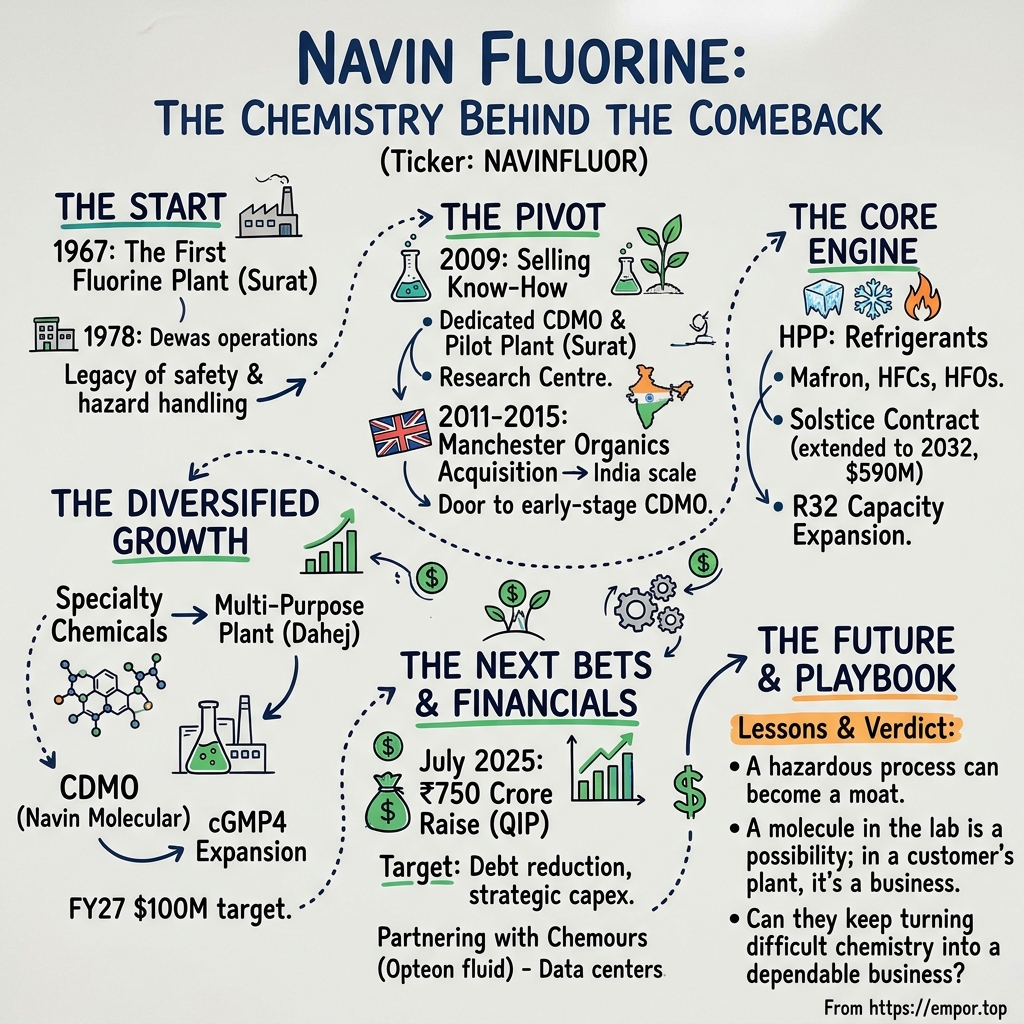
Navin Fluorine: The Chemistry Behind the Comeback
I. The Refrigerant Maker at a Record
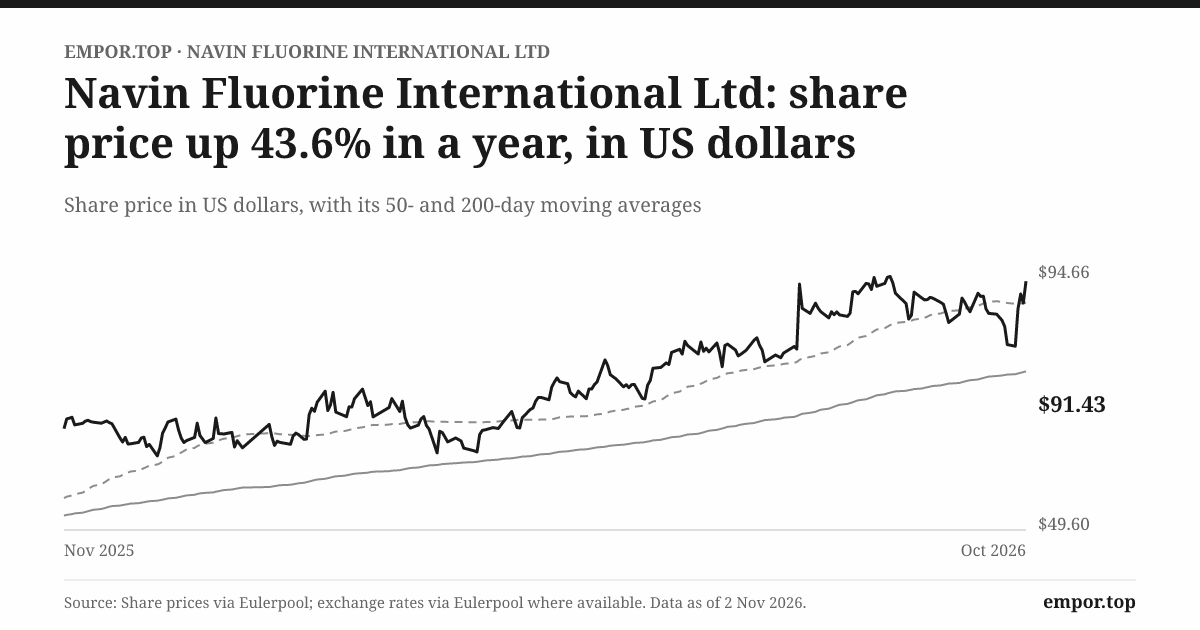
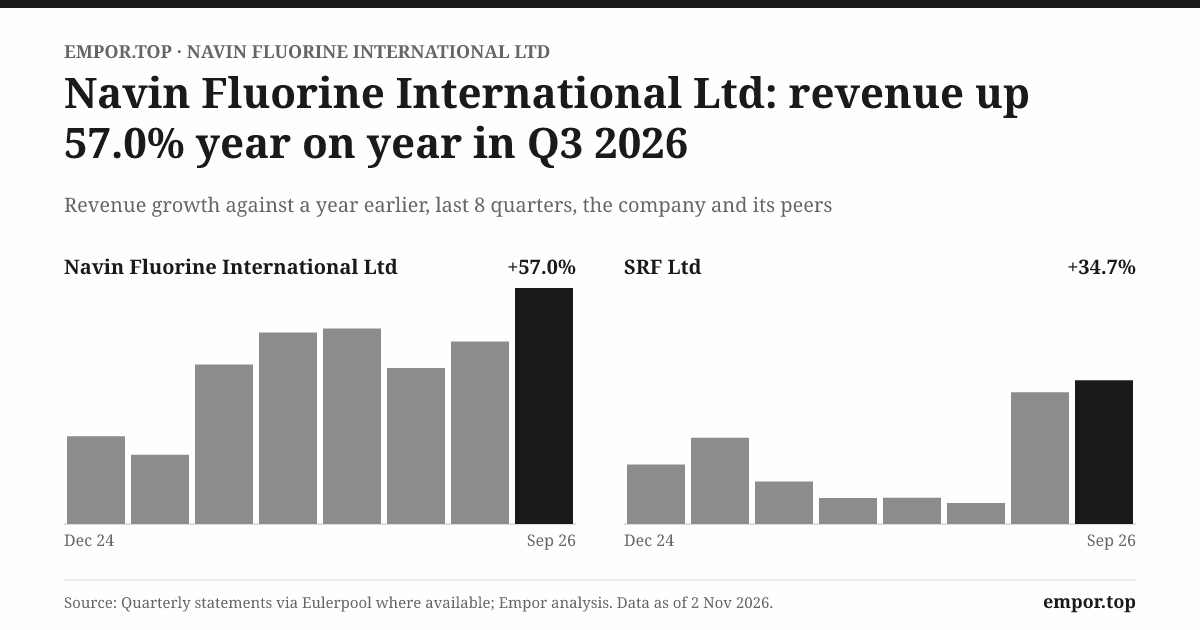
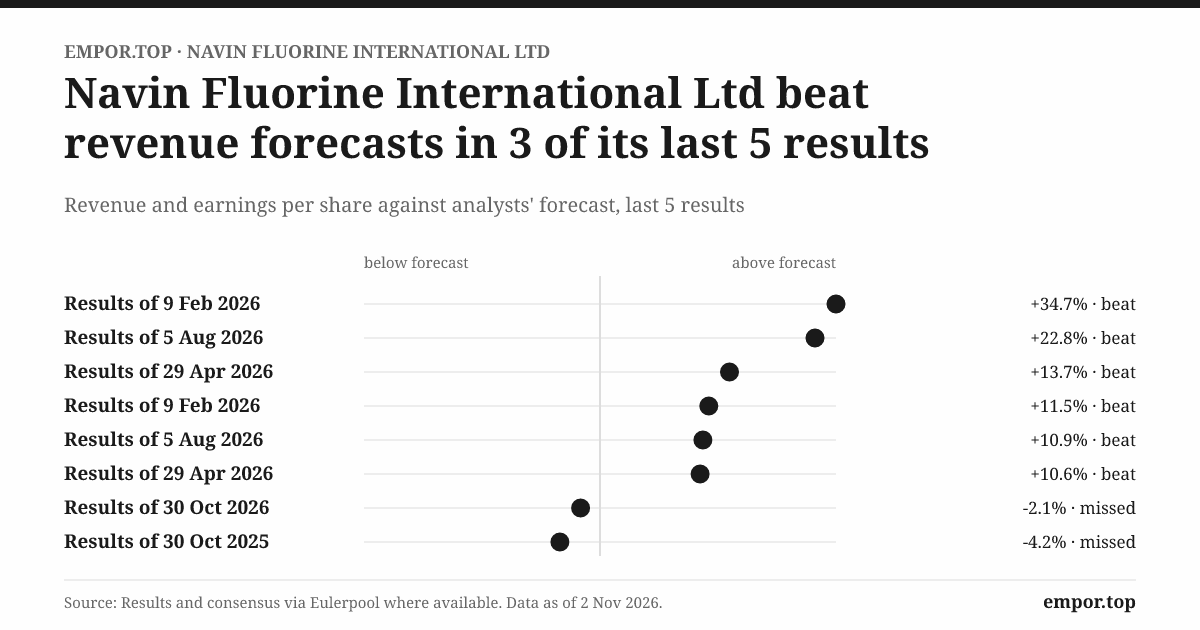
On the afternoon of October 30, 2026, Navin Fluorine International put out its second-quarter numbers, and they were the kind that make a chemicals analyst read the page twice. Revenue for the three months to September came in at ₹1,191 crore, up 57% on the same quarter a year earlier.1 Profit after tax climbed 81% to ₹269 crore.2 All three of the company's businesses grew, not just one hot product line carrying the rest. And the shares, which had spent much of 2023 and 2024 being marked down as a busted growth story, were trading within about 1% of their 52-week high, valuing the company at roughly ₹43,000 crore.
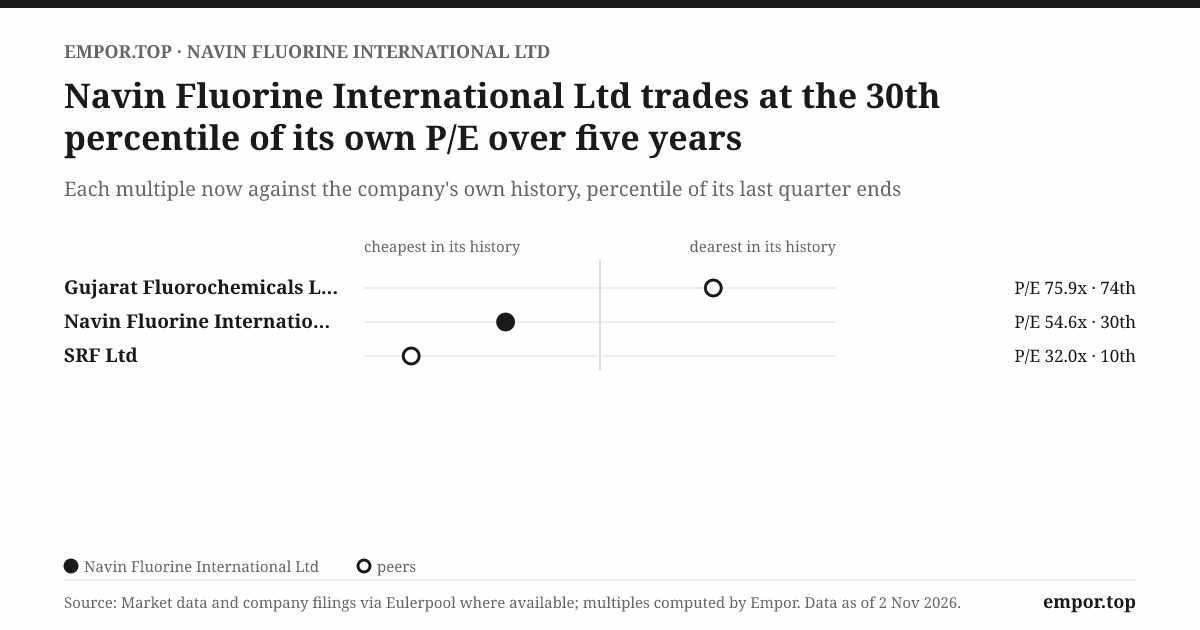
That is a lot of money for a business that, in its own telling, started out in 1967 making refrigerant gas and hydrofluoric acid in Surat.3 It is also a lot of money relative to what the business currently earns. At about ₹8,680 a share, investors were paying close to 55 times the last twelve months of earnings, which means that for every ₹100 put into the stock, the company was earning a little under ₹2 of profit. That multiple was actually below the stock's own five-year median of about 61 times, which tells you something important about Navin Fluorine before the story has said a word about chemistry: the market has been paying a premium for this company for a long time, and it has been asking the same question the whole while. Is this a cyclical chemicals maker having a very good run, or a business whose earning power has genuinely stepped up?
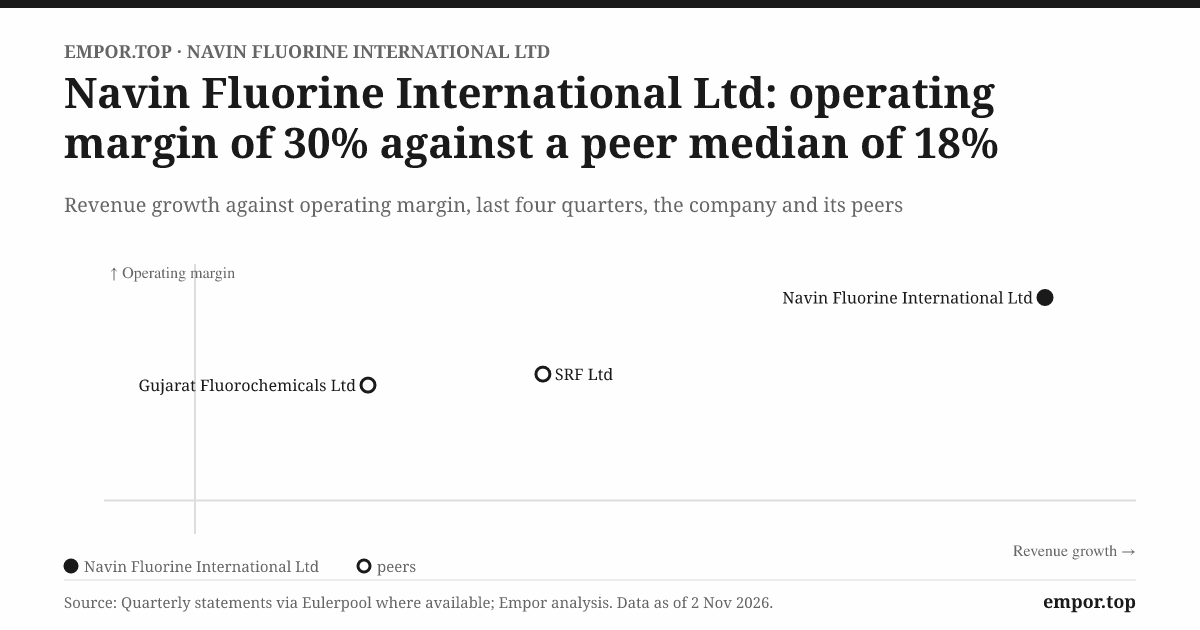
The quarter offered evidence for both readings. On the side of a real step-up, operating margin, measured as operating profit over revenue, reached about 30.6% in the September quarter, against 27.6% a year earlier and roughly 15% two years before that.1 Management's preferred measure, EBITDA margin, was 34.2% for both the quarter and the first half.2 Profit was growing faster than sales, which is what happens when a factory that is already paid for starts running fuller and selling at better prices. On the side of caution, the growth rate was already decelerating against its own tougher comparisons: the quarter's revenue was only about 14% higher than the June quarter in dollar terms, and the year-on-year jump was flattered by a base that had itself been recovering from a slump.
So what exactly is this company? Today Navin Fluorine runs three businesses that share a common root in fluorine chemistry but sell to very different customers. The largest is what it calls High Performance Products, or HPP: refrigerant gases, hydrofluoric acid, inorganic fluorides and the newer low-warming-potential gases that cooling companies now need. HPP brought in about ₹1,615 crore in the year to March 2026, roughly half of group revenue.3 The second is Specialty Chemicals, which makes fluorinated intermediates for agrochemical and industrial customers, about ₹1,152 crore or a third of revenue.3 The third, and the one most often credited with the premium valuation, is CDMO, contract development and manufacturing for pharmaceutical companies, which booked about ₹546 crore, or about one sixth of revenue.3 In the September quarter the three grew 49%, 58% and 78% respectively, to roughly ₹604 crore, ₹348 crore and ₹239 crore.1
That mix matters because the conventional story about Navin Fluorine, the one told in brokerage notes and on business television, tends to be a CDMO story: an old refrigerant maker reinventing itself as a pharma partner. The numbers say something more nuanced. The refrigerant engine is still the largest, and it was the engine that did a great deal of the lifting in FY26. Specialty Chemicals and CDMO are growing faster, but from smaller bases, and both depend on a handful of customer programs whose names and terms the company does not publish.
Four questions run through the rest of this story. Can the refrigerant business keep earning well as the world changes which gases it is allowed to put into air conditioners? Can the CDMO business turn technical ability into recurring commercial supply, rather than a pipeline of promising projects? Can the very large investment program now under way, financed partly by fresh equity and partly by debt sitting in a subsidiary, earn more than it costs? And, flowing from all three, what does a price of 55 times earnings actually assume?
One quarter cannot settle any of them. The rebound was broad and the margin step-up was real in the reported numbers, but the durable answers will come from capacity utilisation, customer demand and cash returns over the next two or three years. To understand why those three things carry so much weight, it helps to go back to where the fluorine first came from: a hazardous acid, a plant in Gujarat, and a family business group deciding to make something few Indian companies wanted to handle.
 Subscribe on LinkedIn
II. The First Fluorine Plant
Fluorine is the most reactive element in the periodic table. It will bond with nearly anything, often violently, and the most common industrial way to harness it runs through hydrofluoric acid, a chemical so dangerous that a splash on the skin can do deep damage before the victim feels much pain. To make it, you react fluorspar, a mineral of calcium fluoride, with sulfuric acid in a kiln, collect the gas and handle it with materials and procedures that tolerate no carelessness. Once you have the acid, though, a whole family of products opens up, from the refrigerant gases that cool homes and cars to the fluorinated building blocks used in medicines and crop chemicals.
That was the business Navin Fluorine entered in 1967, when it began making hydrofluoric acid, refrigerant gases and inorganic fluorides at Surat in Gujarat.[^4] The company grew up inside the Mafatlal group, one of the old Gujarati textile-and-industry houses, and the Mafatlal family still controls it today; but the listed company's economics, not the wider group's history, are the story here. A second site followed at Dewas in Madhya Pradesh, where operations began in 1978.[^4]
Think about what that early plant represented. India at the time was a closed, licence-driven economy where industrial capacity was scarce and imports were difficult. A refrigerant maker that could produce its own hydrofluoric acid controlled the most dangerous and most important input in its own chain. That is what chemists call backward integration: instead of buying the hard part from someone else, you make it yourself, so your costs and your supply are in your own hands. The refrigerant gases went out under the Mafron brand to the people who serviced refrigerators and air conditioners, while the inorganic fluorides went to industrial users.3
For decades this was a steady, unglamorous business. Refrigerant prices rose and fell with supply and the weather; fluorspar prices rose and fell with Chinese mining policy; and the company's job was to keep a hazardous plant running safely and profitably through it all. But that work deposited something valuable, something that does not appear on a balance sheet. Every year that Surat ran without catastrophe was a year of accumulated knowledge about how to contain corrosive gases, how to run high-pressure reactors, how to train operators and how to document the procedures that regulators and, later, multinational customers would audit.
This is the first place where the popular story needs to be checked. It is tempting to say that a half-century of fluorine chemistry is itself a moat, a barrier that keeps competitors out. The record does not support that strong version. India has other capable fluorine producers, notably Gujarat Fluorochemicals and SRF, and multinational customers can and do buy from Chinese, European and American suppliers. What the long history plausibly gives Navin Fluorine is a smaller, more defensible asset: a reputation and an internal skill base for handling dangerous chemistry at scale, which makes it a credible supplier when a customer needs someone to do exactly that. Whether that credibility translates into pricing power is a separate question, and one the company's financial record answers only partly.
The founding legacy also explains the shape of today's business. Because Navin Fluorine started with hydrofluoric acid, it can feed its own downstream plants, the refrigerants, the specialty intermediates and some of the pharmaceutical chemistry, with fluorine it makes itself. In the September 2026 quarter, management credited part of HPP's sequential growth to better refrigerant pricing and higher hydrofluoric acid volumes.2 The old plant's core product is still a profit driver, nearly sixty years later.
Yet the company that management describes today is a long way from the one that started in Surat. A refrigerant maker sells a commodity: a gas whose specification is fixed by standards, sold to many buyers who can switch suppliers when prices diverge. Somewhere along the way, Navin Fluorine's leaders decided that the skill of handling fluorine safely was worth more than the gas itself, and that they could sell that skill to customers who needed a particular molecule made a particular way. That decision, more than any plant, is what investors are paying a premium for today.
III. When the Company Started Selling Know-How
In 2009, Navin Fluorine set up a dedicated contract research and manufacturing business and built a pilot plant to go with it, then established a research centre at Surat.[^4] To an outsider, a pilot plant does not look like much: a room of glass-lined reactors, small stainless-steel vessels, a control panel and a few chemists in lab coats running reactions at kilograms rather than tonnes. But for a company that had spent four decades making refrigerants by the cylinder, it was a different way of thinking about what a chemical company sells.
A refrigerant plant makes one thing in enormous quantities for whoever will buy it. A pilot plant makes many things in small quantities for one customer at a time. The customer, often a drug or agrochemical company, arrives with a molecule it wants to make and a route on paper. The supplier's chemists work out whether that route can be run safely and cheaply, change it where it cannot, and produce first small and then larger batches, each of which the customer tests. If the molecule succeeds in clinical trials or in the field, the order grows from kilograms to tonnes, and the supplier who solved the process problems is the natural choice to make it at scale. If the molecule fails, the work stops.
That is the commercial bet behind the pivot. A customer who has spent years qualifying a supplier, auditing its plant, validating its process and filing that process with regulators, does not switch lightly. Each molecule that reaches commercial supply could become a multi-year revenue stream, sold on terms a refrigerant buyer would never accept. And because fluorine chemistry is hazardous and specialised, the pool of suppliers able to run the hardest steps is smaller than for ordinary chemistry.
The money Navin Fluorine spends on this capability is real but not enormous. In FY26 the group spent about ₹49 crore on research and development, roughly 1.5% of revenue, down from about ₹55 crore and 2.3% of revenue the year before.3 The parent company's capital spending on plant and equipment was about ₹184 crore, around 8% of its own revenue, with separate project spending in the subsidiary on top.3 Those ratios are modest next to a drug developer and respectable for a chemicals manufacturer; what they show is that this is a manufacturing business that does research, not a research business that manufactures. The decline in R&D intensity in FY26 is partly the arithmetic of a fast-growing denominator, but it is still worth watching, because a company that is selling know-how has to keep renewing it.
The harder test is whether the strategy changed the economics of the business. The answer from the record is: eventually, and not smoothly. Through the 2010s, as specialty and contract work grew, Navin Fluorine's operating margin rose from under 10% in FY15 to the low twenties by the end of the decade.4 That was a genuine improvement. But the new strategy did not remove cyclicality. In FY24, revenue slipped slightly, operating margin fell to about 14.8% and net profit dropped by more than a quarter.[^6] That was also the year the company's plant base swelled: property, plant and equipment rose by about a third, while each rupee of assets generated noticeably less revenue than the year before.[^6] FY25 brought only a partial recovery, to an operating margin of about 17.8%.[^6]
That two-year trough deserves more weight than it usually gets in the celebration of FY26. It was the period in which Navin Fluorine had already been a specialty and CDMO company for well over a decade, so it is a fair test of whether those businesses had made the group resilient. They had not, at least not enough. A business shaped like this one is exposed to every classic chemicals headwind at once: softer gas prices, customers working down their inventories, and new plants that carry depreciation and fixed costs before they carry sales. The asset build-up of FY24, arriving just as revenue stalled, is the clearest of those signatures in the company's own numbers. The lesson is not that the pivot failed; the FY26 rebound shows it did not. The lesson is that diversification into customer-specific chemistry reduced one kind of risk, dependence on a commodity gas, while adding others: project timing, customer concentration and the cost of building ahead of demand.
There is a scene worth holding onto from that 2009 pilot plant. Somewhere in it, chemists were running a reaction that, if it worked, might one day become a tonnes-a-year order and, if it did not, would become a line in a lab notebook. Every claim management makes today about its pipeline is a version of that scene, multiplied. The question that matters for an investor is not whether Navin Fluorine can do difficult chemistry. It clearly can. The question is how reliably it converts difficult chemistry into commercial supply, and what evidence the company provides that it is doing so. That question had its first serious answer two years after the pilot plant opened, when Navin Fluorine went shopping in England.
IV. Manchester: Buying a Door into the CDMO Market
In May 2011, Navin Fluorine announced that it had bought a 51% stake in Manchester Organics, a small British fine-chemicals company, for £4.335 million, with a route to buying the rest.5 For a company of Navin Fluorine's size at the time, it was a modest cheque. It was also, strategically, one of the more interesting things the company had done.
Manchester Organics was not a big manufacturer. Its value lay in what it did at the very front of the drug-development process: early-stage synthesis, custom chemistry for researchers, and a list of contacts among the European and American pharmaceutical and biotech companies whose molecules might one day need commercial supply.6 Navin Fluorine, by contrast, was strong at the back end: large reactors, hazardous chemistry, low-cost manufacturing in India. The logic of the deal was to join the two ends. Customers would meet the company in Manchester, where chemists would develop the molecule at small scale; as the project matured and volumes grew, the process would transfer to India, where Navin Fluorine could produce it at scale and at lower cost.6
Picture the sales problem this solved. A biotech in Boston or Basel deciding whom to trust with an early molecule wants a supplier its scientists can visit, whose chemists speak the same scientific language and whose quality standards are familiar. A plant in Gujarat, however capable, is a harder first conversation. A laboratory in Manchester is an easier one. Navin Fluorine was buying a front door.
The stake grew to full ownership by 2015.6 The platform that followed kept building on the same design. Navin Fluorine added current good manufacturing practice, or cGMP, capacity at Dewas, the regulated plant standard that pharmaceutical customers require for drug ingredients. In 2023 the CDMO business was brought together under the Navin Molecular brand, and the company has since invested in a new cGMP plant, cGMP4, whose story unfolds when the company turns to CDMO.6 Manchester Organics still appears in the group: in FY26 the parent paid it about ₹15 crore in fees for services, a small but continuing intra-group flow.3
So was the price sensible? The arithmetic of the deal itself is simple. Paying £4.335 million for 51% implies a value of roughly £8.5 million for the whole company at the time.5 Beyond that, the public record runs thin. The 2011 coverage did not publish Manchester Organics' revenue or profit at the time of purchase, and Navin Fluorine has not reported a separate return on the investment since. Comparable private deals for small British contract-chemistry firms rarely disclose their terms. That leaves no reliable way to say whether the price was cheap or dear against peers.
What can be said is narrower and more honest. The acquisition logic has held up: fifteen years on, Manchester remains part of how the CDMO business finds and develops projects, and the CDMO business has grown into a substantial segment. That is evidence of continued strategic use. It is not, by itself, evidence of a high return on the original purchase price, because so much of the CDMO value created since 2011 came from capital spent later, in India, on plants and people. A skeptic would say that a cheap door is only valuable if what lies behind it is profitable, and that for most of the 2010s CDMO was a small business inside a refrigerant company.
There is a deeper point here about capital discipline. Navin Fluorine's record on acquisitions is short, and this one was small, which limits the damage it could have done and also limits what it proves. A company that has made one small, apparently useful acquisition in fifteen years has not shown it is a skilled acquirer; it has shown it is a cautious one. That caution is worth noting because the much larger capital decisions of the last five years, the multi-hundred-crore plants and the equity raise, went into building rather than buying. Those decisions will be judged the same way Manchester should be: not by whether the logic was clever, but by whether the cash came back.
Before those decisions, though, there is the business that still pays most of the bills. Manchester gave Navin Fluorine a door to drug companies. The refrigerant business, meanwhile, was quietly signing one of the most important contracts in the company's history with a very different kind of customer.
V. HPP: The Refrigerant Engine Meets Its Next Transition
On the October 2026 earnings call, executive chairman Vishad Mafatlal told analysts that Navin Fluorine had extended its supply contract for hydrofluoroolefins, or HFOs, with Solstice Advanced Materials by four years, to December 2032, adding about US$180 million of potential revenue.2 With the extension, the company put the total value of the agreement at about US$590 million over eleven years.1 For a business whose entire group revenue in FY26 was about ₹3,314 crore, roughly US$380 million, that is a very large single relationship.
To see why the contract matters, it helps to understand the product. Air conditioners, refrigerators and car cooling systems work by pumping a gas that absorbs heat when it expands and gives it up when it is compressed. For decades the industry used gases that damaged the ozone layer, then replaced them with hydrofluorocarbons, or HFCs, which spare the ozone but trap heat in the atmosphere thousands of times more powerfully than carbon dioxide. The world has agreed to phase HFCs down over the coming decades. The replacement candidates are HFOs, molecules that break down in the atmosphere within days rather than years and therefore warm the planet far less, and lower-impact HFCs such as R32, which is now the standard gas in many new home air conditioners.
That shift is the opportunity and the threat in Navin Fluorine's largest business. The opportunity is that new gases need new plants and new process know-how, which favours suppliers that already handle fluorine safely and can make complex molecules to a customer's specification. The threat is that each regulatory step shrinks the market for the older gases, so a refrigerant maker that does not move with the transition finds its biggest product slowly regulated away.
How the refrigerant engine makes money
HPP's economics run in a particular order. First come price and volume: refrigerant gas prices swing with supply, especially from China, and with demand, which depends on air-conditioner sales and therefore on summer heat and housing. Next comes the cost of inputs, above all fluorspar and sulfuric acid for the hydrofluoric acid that feeds everything else. Then comes capacity utilisation: a refrigerant plant has heavy fixed costs, so every extra tonne sold through an already-built line adds disproportionately to profit. Finally there are export mix and regulation: in FY25 about 71% of group revenue came from exports, which means currency and foreign demand shape results as much as Indian weather.[^6]
FY26 showed how those levers combined. HPP revenue rose about 34% to ₹1,615 crore.3 Across the group, revenue rose about 41% while raw-material costs rose about 32%, employee costs about 4% and other expenses about 14%.3 In plain terms, the company sold a lot more without its costs keeping pace, and much of that came from firmer refrigerant pricing and fuller plants rather than from a new pharmaceutical franchise. That is a useful correction to the popular narrative. The FY26 margin leap was not simply a CDMO story; the old gas business, the one investors had been told was the boring part, did a great deal of the work. It also means part of the FY26 margin rests on refrigerant pricing that can turn, as it did in FY24.
Management's language on the October call was consistent with that reading. Managing director Nitin Kulkarni said HPP growth came from higher volumes and better realisations, and that the pricing environment for HFCs "remains firm," with realisations improving sequentially.2 CFO Anish Ganatra said the incremental growth from new R32 capacity was beginning that quarter, with "full ramp up possibly in the next quarter."2 The new HFC capacity, approved in FY26 at a cost of about ₹237 crore, carries a stated peak revenue potential of ₹600 to 825 crore a year, so each rupee of plant is supposed to generate roughly three rupees of annual sales at full use.3 That ratio is a target, not a result. It depends on the plant running near capacity at today's prices, and refrigerant prices have a history of not staying where they are.
The contract, read closely
The Solstice extension is the strongest single piece of evidence for the claim that HPP has durable customer relationships. A large global refrigerant company chose to lock in Navin Fluorine as a manufacturing partner for HFOs through 2032, which is a vote of confidence in its process capability and reliability. Combined with the broader record that seven of Navin Fluorine's ten largest customers had relationships averaging more than ten years as of FY25, the extension makes the case for customer retention in this segment real.7
But the contract also reveals the limits of that retention. On the call, ICICI Securities analyst Sanjesh Jain did the arithmetic that many listeners were doing. The original seven-year portion of the deal, about US$410 million, worked out to roughly US$58 million a year. The four-year extension, at US$180 million, works out to about US$45 million a year.2 Ganatra's answer was structural rather than numerical: pricing is a pass-through mechanism, the agreement is now an eleven-year contract rather than a seven-year one, and "this contract is going to guarantee us larger volumes."2 He did not reconcile the lower annual value.
There are innocent explanations. Pass-through pricing means the contract value moves with input costs, so a lower expected value could reflect lower assumed raw-material prices rather than worse terms for Navin Fluorine. But the exchange is revealing in another way. When a single customer is large enough that the renewal terms of its contract become the subject of an analyst's first question, that customer has bargaining power. In FY26, three customers each accounted for at least 10% of group revenue, with sales of roughly ₹545 crore, ₹391 crore and ₹342 crore, about 38.5% of the total combined.3 The year before, only one customer crossed the 10% line.3 Navin Fluorine does not name them or say which segment each sits in, so no one outside the company can tell how much of HPP's growth depends on one buyer. But the scale of the HFO contract and the scale of the largest customer are in the same neighbourhood, and an investor should hold that possibility in mind.
How does HPP compare with India's other fluorine companies? Gujarat Fluorochemicals reported FY26 consolidated revenue of about ₹4,996 crore, and SRF reported group revenue of about ₹15,416 crore.8[^11] Those are scale markers, not market shares. Gujarat Fluorochemicals also sells fluoropolymers and battery chemicals, and SRF's revenue includes packaging films and technical textiles, so neither number is a clean comparison with Navin Fluorine's ₹3,314 crore across three segments. What the comparison does show is that Navin Fluorine is not the largest fluorine company in India. It competes against bigger, well-capitalised rivals who can also build R32 and HFO capacity, and against Chinese producers whose pricing sets the global ceiling.
So where does that leave the claim that HPP is defensible? The history narrows it rather than rejecting it. The refrigerant business has survived nearly sixty years and several regulatory transitions, and the long contract shows that a major customer values its process capability. That is real. But the FY24 downturn shows that HPP earnings fall when refrigerant prices fall, the contract renewal shows a large customer negotiating from strength, and the company does not publish utilisation, plant-level margins or price realisations that would let investors see whether its returns hold through a down cycle. Management even declined, on the October call, to give a hydrofluoric acid utilisation figure when asked directly.2 The defensible version of the claim is that HPP is a well-run, integrated refrigerant business with a valuable anchor customer, exposed to the cycle and to that customer's leverage. The KPI that would confirm or falsify it is HPP's margin through the next downturn in refrigerant prices, which the company does not report separately by segment.
The refrigerant engine pays the bills. But the customers who buy fluorinated building blocks for crop chemicals are a different kind of buyer, and the next business shows a different side of the same bargaining problem.
VI. Specialty Chemicals: More Molecules, Same Customer Test
At Dahej, on the Gulf of Khambhat, Navin Fluorine runs multi-purpose plants: production lines designed to switch from one molecule to another as orders change, the chemical equivalent of a kitchen that can cook a different menu each week. In FY26 and into FY27 the company worked to debottleneck those plants, squeezing more output from existing equipment by fixing the slowest steps, while reporting strong growth in both established molecules and new ones.1 On the October call, Ganatra described Specialty Chemicals as running at about a ₹350 crore quarterly rate and said the first two multi-purpose plants would "far exceed" their rated capacity by year-end.2
The numbers back the momentum. Specialty Chemicals revenue rose about 44% in FY26 to roughly ₹1,152 crore, about a third of group sales, and rose another 58% year on year in the September 2026 quarter to about ₹348 crore.31 After the agrochemical destocking that hurt FY24, that is a sharp turnaround.
The business model sits between HPP and CDMO. A customer, typically an agrochemical or industrial company, needs a fluorinated intermediate: a building block that goes into a herbicide, fungicide or performance material. Navin Fluorine's chemists develop or adapt a manufacturing route, prove it in the pilot plant, then scale it up in a multi-purpose plant. Because these intermediates are often made under long-term supply arrangements tied to a customer's product, they are stickier than refrigerant gas. Because they are also made in campaigns, batches run for a period and then switched, revenue can lurch as customers build or run down inventory.
Why might Navin Fluorine win these projects? The plausible answer is the same one that underpins HPP: decades of handling hazardous fluorine chemistry and access to captive hydrofluoric acid could give it an advantage over a general chemicals maker.
The trouble is proving that advantage with the company's own numbers. Navin Fluorine does not disclose segment margins in the detail an investor would need, molecule-level profitability, contract lengths, renewal rates or the identity of its specialty customers. So the claim that its hazardous-chemistry skills create a cost or switching-cost advantage is plausible but unproven by its own disclosure. What the evidence shows is that customers are buying more, not what they are paying relative to alternatives.
And there is a direct signal that winning a project does not guarantee good pricing. In FY26, management reported pricing pressure in crop-protection chemistry, driven by competition in its customers' own end markets.3 That is the mechanism investors should understand. An agrochemical company selling a herbicide competes against generic producers, many of them in China. When those generic rivals cut prices, the agrochemical company squeezes its suppliers. Navin Fluorine can be the best fluorination partner in the world and still have its price set by a farmer in Brazil choosing between two branded and generic products. Supplier power, in other words, is capped by the customer's own competition.
Concentration adds a second layer. The three customers who each accounted for at least 10% of FY26 group revenue might come from any of the three segments, and the company does not say.3 It would be wrong to assume they are all specialty customers. But the structure of the business, a modest number of large programs for a modest number of large agrochemical and industrial companies, means buyer power is a persistent feature. When a customer accounts for a big share of a plant's output, it knows the supplier needs the volume.
The next test is in the commissioning record. Ganatra said on the October call that a large specialty project called Nectar was expected to reach about 60 to 65% of its peak output in FY27, with the balance in FY28.2 If that ramp happens on schedule, at margins near the group average, it would support the claim that Navin Fluorine's specialty growth comes from durable customer programs. If it slips, or if the extra volume comes with lower prices, it would suggest that FY26 and FY27 were helped by a campaign upswing and a recovering agrochemical cycle rather than a permanent step-up.
The verdict for Specialty Chemicals, then, is that the segment has real scale and real customer-linked growth, and that its claimed edge in difficult chemistry is plausible but not demonstrated in disclosed economics. The KPIs to follow are repeat orders, plant utilisation and realised margins, all of which the company describes qualitatively more than it measures publicly. The same tension, between technical capability and commercial proof, sits at the heart of the business that most excites investors.
VII. CDMO: From a Molecule in a Lab to a Commercial Supply Contract
In December 2025, the first phase of cGMP4, Navin Fluorine's newest regulated pharmaceutical plant, began commercial supplies.3 For the CDMO business this was a milestone of a particular kind: a plant built to drug-industry standards, inspected and qualified, shipping product that would end up in medicines. Ten months later, on the October 2026 call, management said the second phase, a further investment of about ₹125 crore, would be operational by the end of FY27, and that both phases were dedicated to Fermion, a pharmaceutical-ingredients customer.2
That detail is worth pausing on. A dedicated plant means that a single customer's product line runs through it. That is good news for visibility, because the customer has committed enough volume to justify specialised equipment. It is also a concentration of risk, because the plant's economics now depend heavily on one buyer's drug selling well and on that buyer's continued willingness to source from Navin Fluorine.
The scale of ambition is clear from the numbers. CDMO revenue grew about 59% in FY26 to roughly ₹546 crore, and about 78% year on year in the September 2026 quarter to around ₹239 crore.31 Management has set a target of US$100 million of CDMO revenue for FY27, which at current exchange rates is a little over ₹900 crore.3 Ganatra said the first two phases of cGMP4 together carry a peak revenue potential of about ₹900 to 1,000 crore a year by FY28 or FY29, "close to 3x of the capital."2
The ladder from lab to plant
To understand where those numbers could stall, imagine a molecule's journey through a contract manufacturer. It begins as an early-stage project: a few grams or kilograms made for a customer still in clinical trials, often in a place like the Manchester laboratory. The pharmaceutical customer pays for development work, but volumes are tiny and most molecules at this stage will never become approved drugs. If the molecule advances, the next rung is qualification: the supplier produces validation batches under regulated conditions, the customer audits the plant, and the process is written into regulatory filings. Then comes scale-up, moving the process into larger vessels without changing the product's quality. Only then, if the drug is approved and sells, does the supplier reach commercial supply, the rung where the real revenue lies.
Revenue can stall at every step. A drug can fail in trials. A regulator can delay approval. A customer can split supply between two manufacturers, or bring production in-house once volumes are large enough. Commercial demand can come in below forecast. For an investor, the crucial measure is the conversion rate, how many early projects become commercial products and how quickly, and Navin Fluorine does not publish it. Nor does it publish the number of commercial molecules, the share of CDMO revenue from repeat orders, or a retention series for CDMO customers specifically. The broader company figure, seven of the top ten customers averaging more than ten years of relationship, is encouraging, but it covers all three segments and includes the long-standing refrigerant and specialty relationships.7
The phrasing on the October call is a good example of why that distinction matters. Asked about progress toward the FY27 target, Ganatra said "we are at the striking distance of our $100 million target in terms of order book visibility," and, pressed on whether it had come early, said "it is actually on time."2 The key words are "order book visibility." An order book is a list of expected orders, not booked revenue, and visibility is a degree of confidence, not a delivery. On the reported numbers, the September quarter's ₹239 crore, repeated for four straight quarters, would come to about ₹950 crore, right around the target; but CDMO revenue is lumpy, because it moves with the timing of campaigns and shipments. Management's framing is consistent with hitting the target; it is not proof that it will be hit.
Ganatra's "on time" answer is, in effect, a claim that the target has not drifted. That matters. A company whose targets drift every quarter tells you it does not know its own business; one that holds a number and then reports against it gives investors a fair test. The test will come with FY27 results in spring 2027.
Testing the CDMO claim against the company's own record
Here the historical record supplies a useful humbling. Navin Fluorine has been in contract research and manufacturing since 2009.[^4] For most of the following decade, the business was small, and CDMO did not prevent the FY24 downturn. It became a meaningful segment only recently, after a long period of building capability. That record does not reject the claim that CDMO is a value driver now; the FY26 growth is genuine. It does narrow the claim. Technical capability, which Navin Fluorine has demonstrated for fifteen years, did not by itself produce rapid commercial growth. What changed was a handful of customer programs reaching commercial scale, including at least one large enough to justify dedicated plants.
That makes the cGMP4 economics an option rather than a certainty. If the plant reaches high utilisation on Fermion's product and the third and later phases fill with other customers' molecules, the stated potential of ₹900 to 1,000 crore a year would roughly double CDMO revenue from its FY26 level and lift the group's return on capital. Ganatra said the company would trigger a further phase only once utilisation reached 70 to 80%, which is a sensible discipline if adhered to.2 If, on the other hand, one customer's drug disappoints, the dedicated plant becomes a stranded asset with little alternative use.
So the verdict on CDMO is the most delicately balanced in the story. It is the fastest-growing segment and a credible future driver of value. But a pipeline is not a business, and peak capacity potential is not revenue. The evidence that would confirm the claim is the FY27 revenue figure against the US$100 million target, the share of CDMO revenue from customers other than the largest, and the return on the cGMP4 investment once it is full. Building plants like cGMP4 also requires capital, and the way Navin Fluorine raised and deployed that capital is the next part of the story.
VIII. The ₹750 Crore Raise and the Capital Behind the Growth
In July 2025, Navin Fluorine sold 16,02,564 new shares to institutional investors at ₹4,680 each, raising ₹750 crore through a qualified institutional placement.7 The stated uses included paying down debt at Navin Fluorine Advanced Sciences Ltd (NFASL), its subsidiary, and funding strategic capital spending.7 In hindsight the timing was not ideal for existing shareholders: the stock trades today at about ₹8,680, so the institutions that bought in the placement have nearly doubled their money in fifteen months. The dilution was small, roughly 3% of today's shares, but at today's price those shares would have raised closer to ₹1,400 crore.
That is the hindsight view, and it is unfair to management, who could not know that FY26 would bring a 130% jump in profit. The more useful question is what the raise reveals about how Navin Fluorine funds growth, and where the risk sits.
The answer starts with a distinction that confuses many readers of the company's accounts. Navin Fluorine reports two sets of numbers. The consolidated accounts treat the parent and its subsidiaries as one business, eliminating sales and loans between them. The standalone accounts show the parent company on its own, with its subsidiaries as investments and counterparties. For most purposes the consolidated view is the right one. But when a parent guarantees a subsidiary's debt, the standalone view shows where the legal obligation lies.
In the consolidated accounts, the group's borrowings stood at about ₹1,226 crore at the end of FY26, down from about ₹1,441 crore a year earlier, with almost all of it sitting at subsidiary level; the parent itself had almost no borrowings.3 In the standalone accounts, the parent had provided a corporate guarantee of about ₹1,629 crore for NFASL's obligations, was owed about ₹157 crore by NFASL, had a ₹50 crore inter-corporate deposit with it and held ₹450 crore of NFASL preference shares.3 The parent also sold about ₹297 crore of goods to NFASL during the year, about 13% of its own revenue, and bought about ₹124 crore from it.3 Navin Fluorine describes these transactions as being on normal commercial terms and at market rates.3
None of that is hidden; it is all disclosed. But it changes how an investor should think about risk. The parent's shareholders own the whole group, and the subsidiary carries the debt for much of the new plant. If those plants run full and profitably, the subsidiary pays down its debt, the guarantee shrinks and the structure is merely a tidy way to finance projects. If a project disappoints, the guarantee means the parent is on the hook. Capital allocation at Navin Fluorine is therefore a group-level question, not a subsidiary-level one, and the guarantee is the thread that ties the two together.
Twelve years of cash
The long cash record tells a story the profit-and-loss statement does not. Over the twelve years from FY15 to FY26, Navin Fluorine earned about ₹3,130 crore of net profit and generated about ₹3,048 crore of cash from operations, a conversion of about 97%.34 That is a healthy sign: the company's reported profits are, over time, turning into real cash, and there is no evidence of a persistent gap between earnings and collections.
But over the same twelve years, after paying for new plants and equipment, cumulative free cash flow was about minus ₹650 crore, while the company paid about ₹591 crore in dividends.34 In other words, everything the operations produced, and more, went back into the ground as capital spending, and the dividends were funded in part by borrowing and equity. That is not a criticism in itself. A company in a heavy investment phase should be spending more than it generates, if the investments earn good returns. The point is that the case for Navin Fluorine rests on those returns materialising. The cash has already been spent; the payback is still largely in the future. Return on invested capital, which fell to single digits in FY24 and FY25, recovered to about 18% in FY26 and about 22% over the latest twelve months, which is the first real evidence that the spending is starting to pay.3
Working capital tells a more reassuring story than a casual reading suggests. Gross trade receivables rose to about ₹762 crore at the end of FY26 from about ₹591 crore a year earlier, which might look alarming.3 But they rose because sales rose. Debtor days, the average time customers take to pay, improved from a peak of about 100 in FY23 to about 85 in FY26, and about ₹674 crore of the receivables were not yet due at the year-end.3 Only about ₹7 crore were more than a year old, and almost all of that was already provided for.3 The collections picture is healthy. The one receivable that deserves a second look is the parent's ₹157 crore due from its own subsidiary, which carries no allowance and which disappears in the consolidated accounts.3
The people allocating the capital
Who decides how this money is spent? The Mafatlal family has controlled the company throughout its history, and Vishad Mafatlal, the executive chairman, represents the promoter group, which owned about 27% of the company in September 2026.9 That stake has drifted down from about 30% in FY21, partly through the dilution from the placement.49 Foreign portfolio investors held about 23% and domestic institutions about 29%, and the company had about 145,000 shareholders on its July 2026 record date.910
The day-to-day running of the business belongs to Nitin Kulkarni, who became managing director in June 2024 for a five-year term.11 Kulkarni is not a stranger to the company. He spent seven years earlier in his career at Navin Fluorine heading business development, then more than a decade as executive director at OC Specialty, with earlier roles at the Aditya Birla Group, including the fluorochemicals maker Tanfac, and at Hindustan Unilever's Lakmé business; he holds a master's degree in organic chemistry from the University of Mumbai.11 That is a chemist-turned-commercial-manager's résumé, which suits a company whose central challenge is turning technical work into sales. His tenure so far has coincided with the recovery, the placement, the NFASL debt reduction and the capacity projects. It is too short to judge him through a full cycle.
Pay is the place where governance shows itself most plainly. In FY26 Vishad Mafatlal received about ₹17.06 crore and Kulkarni about ₹12.47 crore, together roughly 4.4% of the year's profit.3 Mafatlal's pay rose 73% on the previous year.3 In a year when profit rose 130%, a large pay rise is defensible on a strict performance basis. Shareholders were not unanimous, however. At the August 2026 annual meeting every resolution passed, but about 7% of votes cast opposed Mafatlal's reappointment, and among public institutional investors the opposition was about 11%.10 That is not a revolt. It is a measurable minority of professional investors signalling discomfort with a promoter-chairman's reappointment and pay, and it should be read alongside the fact that the promoter group's own stake is now under 30%. The auditor's opinion was unmodified, and the audit committee consists of independent directors.3
The credit market's view has improved. In September 2025, CARE Ratings reaffirmed Navin Fluorine's long-term rating at AA with a stable outlook, citing its established market position, diverse products, customer relationships and CDMO opportunities, while naming project execution, capital spending needs, customer concentration, raw-material exposure and industry cyclicality as constraints.12 In August 2026, CARE upgraded the long-term rating to AA+ with a stable outlook.[^16] The upgrade signals that lenders see the balance sheet as stronger after the placement and the earnings recovery. But the constraints CARE named a year earlier are the same ones this story keeps circling.
So the verdict on capital is a qualified one. The placement and the subsidiary debt reduction were sensible financing moves that strengthened the balance sheet. The group's twelve-year cash record shows reliable profit-to-cash conversion but heavy, still-unproven reinvestment. And the parent's guarantees and intra-group balances mean that investors in Navin Fluorine are underwriting the subsidiary's projects, whatever the consolidated accounts look like. The test is whether utilisation and free cash flow rise as the company plans capital spending of about ₹700 crore for FY27.2 One of the smallest projects in that program has drawn some of the largest headlines.
IX. One New Market, One Smaller Bet
In May 2025, Chemours, the American chemicals company, announced that Navin Fluorine would manufacture its Opteon two-phase immersion cooling fluid, a product designed to cool the servers inside data centres.[^17] In an era when every listed company seems to want an artificial-intelligence angle, this one arrived with a ready-made story: AI chips run hot, data centres need better cooling, and a fluorine chemist in Gujarat would make the liquid that keeps them running.
The technology is worth explaining because it is genuinely clever. In two-phase immersion cooling, servers are submerged in a tank of specially designed fluid. As chips heat up, the fluid touching them boils at a low temperature, carrying heat away as vapour. The vapour rises, hits a cooled coil at the top of the tank, condenses back into liquid and falls back down. It is a closed loop that removes heat far more efficiently than blowing air over hot components, and it needs a fluid that boils at just the right temperature, does not conduct electricity and does not damage the equipment. Fluorinated chemistry is one of the few ways to make such a fluid.
The fit with Navin Fluorine is real. It makes complex fluorinated molecules, and it handles the hazardous chemistry needed to produce them. The structure of the deal also limits its risk. In FY26 the project was described with estimated capital spending of about US$14 million, of which Chemours would contribute about US$5 million.3 By the October 2026 call, the capital figure for Navin Fluorine's part was about ₹120 crore, with about 35% funded by the customer, and management targeted commissioning by the end of the third quarter of FY27, with purchase orders for delivery in the fourth quarter.2
The schedule has slipped, though. The project had originally been expected earlier. Asked about the delay on the October call, Ganatra said it was "a conscious choice rather than anything else between the partners," linked to selecting the process route for the initial capacity.2 That may well be true; choosing a better process is a legitimate reason to wait. But it is an explanation investors should file and revisit when the plant either ships product on the new schedule or does not.
More important is the question of scale. Even at full capacity, this is a small project next to the refrigerant, specialty and CDMO businesses. Ganatra said on the call that it would take about 15 months after commissioning to gauge market adoption, and that talking about a final capital plan was premature.2 Management has spoken of a longer-term ambition in advanced materials, but until there are customer orders, a full plant and reported revenue, that ambition is a target to revisit, not a forecast to price.
The strategic relevance and the commercial proof are two different things. A customer-funded plant built for a respected partner is evidence that Navin Fluorine can win advanced-materials work. It is not evidence that immersion cooling will become a scaled AI revenue stream, still less that it will earn attractive returns. Data-centre operators have several cooling technologies to choose from, so a qualified fluid is a ticket to compete, not a guarantee of share. Navin Fluorine's own CDMO record is the right base rate for how long a promising technical capability can take to become a business. If the Chemours fluid follows that pattern, it will matter to investors around the end of this decade, not next quarter.
Which brings us back to where the CDMO business began, and to what the whole journey teaches.
X. Playbook: Business & Investing Lessons
Go back to 2009 and the pilot plant at Surat, where a handful of chemists ran small reactions for customers who might or might not order more. Then follow the line forward: the Manchester laboratory, the cGMP plants at Dewas, the multi-purpose lines at Dahej, the dedicated cGMP4 phases, the Chemours fluid plant. Nearly six decades after the first refrigerant left Surat, Navin Fluorine had grown to about ₹3,314 crore of revenue in FY26, with refrigerants and related products still the largest business.3 What does that journey teach?
The first lesson is that a hazardous process becomes a moat only when customers trust you to run it at scale. Fluorine chemistry is dangerous, and for decades Navin Fluorine's ability to handle it safely was simply a cost of doing business. It became a competitive asset when customers chose to rely on its safety record and process discipline, as the refrigerant contract and dedicated pharmaceutical plants show. Investors should note the order of events. The capability came first; the commercial value came decades later, and only when specific customers chose to rely on it. The test of whether the moat holds is not the safety record alone but the price customers are willing to pay and how often they come back, neither of which the company measures in public. The broader lesson for founders is that dangerous work can be a barrier to entry, but only if someone downstream values the danger being managed.
The second lesson is that a molecule in the lab is a possibility, and a molecule in a customer's plant is a business. Navin Fluorine's CDMO growth came only after customer programs reached commercial scale. Investors in any contract manufacturer should resist valuing the pipeline as if it were revenue. The only numbers that count are commercial molecules, repeat orders and the return on the plants built to make them. Everything before that is an option, and options expire.
The third lesson is that growth capex is a promise made with cash. Navin Fluorine's long cash record shows that it spent more on new plants than operations generated. It raised equity, guaranteed its subsidiary's debt and committed to roughly ₹700 crore of further spending in FY27. Every one of those decisions is a promise that the plants will fill. The investor's job is not to admire the size of the capacity program but to track whether utilisation and returns on capital follow, year by year, and to remember that a parent's guarantee turns a subsidiary's problem into a shareholder's problem.
The fourth lesson is that a premium multiple turns execution into the product. At around 55 times earnings, the market is not paying for what Navin Fluorine earned last year; it is paying for what the new capacity is supposed to earn. The new HFC capacity and the first two cGMP4 phases could add substantially to current revenue. If those potentials arrive on time and at good margins, the multiple will look reasonable in hindsight. If they arrive late or at thinner margins, the gap between promise and delivery will show up in the share price before it shows up in the accounts. For a company priced this way, the thing being sold to investors is not chemicals. It is the reliability of execution.
Those four lessons point toward one final reckoning: what would it take for the bull case to be right, and what would show it is failing?
XI. Analysis & Bear vs. Bull Case
Put two years side by side. FY24 was a deep downturn; FY26 brought a sharp recovery in margins and profit.3[^6] Over ten years, revenue has compounded at about 17% a year.34 The same company, under mostly the same management, produced both outcomes within three years. Any honest analysis has to explain both.
The bull case runs as follows. The refrigerant business has a long-term HFO contract running to 2032 and new R32 capacity coming into service just as the cooling industry shifts toward lower-warming gases, which gives visibility on its largest revenue line. The company's long relationships and decades of fluorine expertise support growth in specialty and CDMO, where customers who qualify a supplier tend to stay. The FY27 growth is broad-based rather than reliant on a single product, the balance sheet has been strengthened by the placement and the subsidiary debt reduction, and the credit rating has been upgraded. Return on capital has recovered to around 20%, so the heavy investment of recent years is starting to earn. And at about 55 times earnings, the stock trades below its own five-year median, suggesting that by its own historical standards the market is not unusually exuberant.
The bear case is just as grounded in the record. FY24 proved that earnings and margins can fall fast when refrigerant prices, agrochemical demand and new-plant costs all turn at once, and nothing in the business model has eliminated those exposures. Three customers made up nearly 40% of FY26 revenue, which gives them leverage, and the HFO contract extension's lower annual value is at least consistent with a large buyer negotiating hard. The new capacity, much of it financed through a subsidiary that the parent guarantees, will depress returns if demand or project conversion disappoints. The first two phases of cGMP4 are dedicated to a single customer. And a P/E of about 55 means an earnings yield below 2%, so the share price already assumes that most of the new capacity fills profitably.
The forces and the powers
The industry structure explains why both cases are plausible. Start with buyer power, which is the decisive force here. Navin Fluorine sells to large multinationals, refrigerant majors, agrochemical companies and pharmaceutical groups, who buy in big volumes, can qualify alternative suppliers given time, and in the refrigerant case negotiate contracts large enough to move the whole group's results. The concentration figures make buyer power high. Rivalry is significant: in India, Gujarat Fluorochemicals and SRF are larger, well-capitalised and able to build similar capacity, and globally Chinese producers set prices in refrigerants and many intermediates. Supplier power is moderate; the company makes its own hydrofluoric acid, but fluorspar and other raw materials come from global markets and moved costs sharply in past cycles. The threat of substitutes is regulatory: each step in the refrigerant transition makes some products obsolete, which is both a risk to legacy HFCs and the reason the company is building R32 and HFO capacity. The threat of new entrants is the force most favourable to Navin Fluorine, because building hazardous fluorine plants, earning regulatory approval and winning multinational qualification takes years and capital.
Through Hamilton Helmer's lens of durable competitive powers, the strongest candidate is switching costs, specifically in CDMO and parts of specialty chemicals, where a customer's regulatory filings name the supplier's process and changing supplier means repeating validation. The company's long customer relationships are consistent with that power. But Navin Fluorine does not disclose switching-cost evidence directly: no retention rates by segment, no data on lost programs, no price realisation series. Process power, the hard-to-copy operational know-how built over decades, is plausible given the hazardous chemistry, but it is hard to separate from ordinary competence when rivals with similar histories exist. Scale economies are limited, since Navin Fluorine is smaller than its leading domestic competitors. There is no network effect, no brand power in the consumer sense, and no cornered resource; the HFO contract is a valuable relationship, not an exclusive right to a market. The honest conclusion is that the company's moat rests on switching costs and process know-how that are plausible and partially evidenced, against a backdrop of strong buyer power and capable rivals.
The valuation comparison sharpens the picture. On market-data readings, SRF traded at about 30 times earnings, PI Industries at about 27 times and Gujarat Fluorochemicals at about 78 times.131415 Those numbers come from a different data source and the companies have different business mixes, so they are context, not a like-for-like series. What they suggest is that the market is paying Navin Fluorine a premium over diversified chemical groups, but less than for the peer most associated with high-growth fluorine and battery materials. Investors are valuing Navin Fluorine as a growth company, not as a cyclical chemical maker.
What would show the case is failing
Three numbers matter more than all the others. The first is segment revenue and margin after commissioning: whether HPP, Specialty and CDMO keep growing, and at what margins, once the new R32, multi-purpose and cGMP4 capacity is running. The latest reading is a group EBITDA margin of about 34% in the first half of FY27, above management's own long-term guidance of 30%, which Ganatra said on the October call the company would not change.2 That management is holding a 30% long-term guide while reporting 34% is a useful signal: the people closest to the business are not assuming today's margins are permanent. The second is CDMO commercial revenue against the US$100 million FY27 target, a target management describes as within striking distance on order-book visibility. The third is free cash flow and return on invested capital alongside receivables and working capital: return on capital has risen to about 22% over the latest twelve months, and the company reported net operating working capital of about 70 days at the half-year.23
A skeptic's question cuts across all three. If Navin Fluorine is winning through a technical moat, where are the public measures of utilisation, repeat orders, price realisation and customer retention? The company reports growth generously and the underlying unit economics sparingly. That is not unusual in Indian specialty chemicals, and it is not evidence of a problem. But it means investors are asked to infer the moat from the results rather than see it measured. Until those measures appear, the claim that Navin Fluorine wins because of a durable advantage remains intact but unproven, supported by the recovery and the long contracts, and limited by FY24, customer concentration and the lack of disclosed economics.
XII. Epilogue
Tonight Navin Fluorine's share price sits near a record, with three businesses growing, a strengthened balance sheet and a share price near its high. It also sits in the middle of the largest build-out in its history, with a series of near-term moments that will decide whether this is a durable step-up or a strong cycle priced as one.
The first comes this quarter. Management said full ramp-up of the new R32 capacity would come in the December quarter.2 If HPP holds its sequential growth with firm HFC prices, the case that the refrigerant engine has stepped up will strengthen. If refrigerant prices soften as new capacity arrives across the industry, the FY24 pattern, where price falls hit just as fixed costs rose, will be the one to watch for.
The second comes around the turn of the year, when the Chemours immersion-cooling plant is due to be commissioned and its first products delivered against purchase orders in the fourth quarter of FY27.2 On-time delivery would turn a delayed announcement into a working plant; a further slip would add weight to the skeptic's view of advanced materials as a story ahead of its numbers.
The third is the full-year FY27 result, expected in spring 2027. That is where the US$100 million CDMO target meets reported revenue, where the second phase of cGMP4 should be operational, and where the roughly ₹700 crore capex plan shows up in the cash flow statement.2 A CDMO business at or above the target, a stable or falling NFASL debt load, and free cash flow positive after capital spending would answer three of the story's four questions in the company's favour. A miss on CDMO, with debt rising and free cash flow negative, would answer them the other way.
Beyond that, the Solstice contract's extension years will reveal whether its lower implied annual value was simply pass-through arithmetic or a sign of customer leverage, and the next annual report's customer concentration figures will show whether the three large customers grow more or less important. The parent's guarantees and intra-group balances deserve the same scrutiny each year: a falling guarantee would show the subsidiary standing on its own.
The central tension remains. Navin Fluorine has proven it can do difficult chemistry and has recently proven it can earn well from it. It has not yet proven that the new capacity, financed with shareholders' money and guaranteed by the parent, will earn as well as the old. Until those plants fill and the cash comes back, the growth thesis is plausible, and it is still being tested.
XIII. Outro
In 1967 a plant in Surat began reacting a dull grey mineral with sulfuric acid to make one of the most dangerous chemicals in industry, and turning that into refrigerant gas.[^4] Nearly sixty years later the same element sits at the centre of a business with ₹3,314 crore of annual revenue, making gases for air conditioners, building blocks for crop chemicals, ingredients for medicines and, soon, a liquid to cool data centres.3
Fluorine was the company's first product and remains its continuing question. It bonds with almost anything, and it has to be handled with great care. Navin Fluorine's history is the long conversion of that care into things customers will buy. Its next chapter will decide whether the company can do it again, at a scale and a price that justify what investors are now paying for it.
References
-
Q2 and H1 FY27 Investor Presentation — Navin Fluorine International / NSE, 2026-10-30 ↩↩↩↩↩↩↩
-
Navin Fluorine International Q2 FY27 Earnings Call Transcript — Stock Analysis, 2026-10-30 ↩↩↩↩↩↩↩↩↩↩↩↩↩↩↩↩↩↩↩↩↩↩↩↩
-
Navin Fluorine International Limited — Annual Report 2025–26 — FinancialFilings, 2026 ↩↩↩↩↩↩↩↩↩↩↩↩↩↩↩↩↩↩↩↩↩↩↩↩↩↩↩↩↩↩↩↩↩↩↩↩↩↩↩
-
Annual Report 2020–21 — Navin Fluorine International Ltd, 2021 ↩↩↩↩↩
-
Navin Fluorine Acquires 51% Stake in UK Firm — Moneycontrol, 2011-05-04 ↩↩
-
Manchester Organics and Navin Fluorine — Navin Molecular ↩↩↩↩
-
QIP Placement Document — Navin Fluorine International / NSE, 2025-07-10 ↩↩↩↩
-
Shareholding Pattern: Navin Fluorine International — NSE ↩↩↩
-
Voting Results and Scrutinizer's Report — Navin Fluorine International / NSE, 2026-08-06 ↩↩
-
Navin Fluorine Appoints Nitin Kulkarni as MD — Board Stewardship, 2024-06-04 ↩↩
-
Rating Rationale: Navin Fluorine International Limited — CARE Ratings, 2025-09-11 ↩
-
Gujarat Fluorochemicals Share Price and Market Data — Upstox ↩
 LinkedIn
 WhatsApp
 Reddit
 Hacker News
 Email
 Kindle
 RSS Feed
 Spotify
 Apple Podcasts
 Amazon Music
 Audible
 YouTube