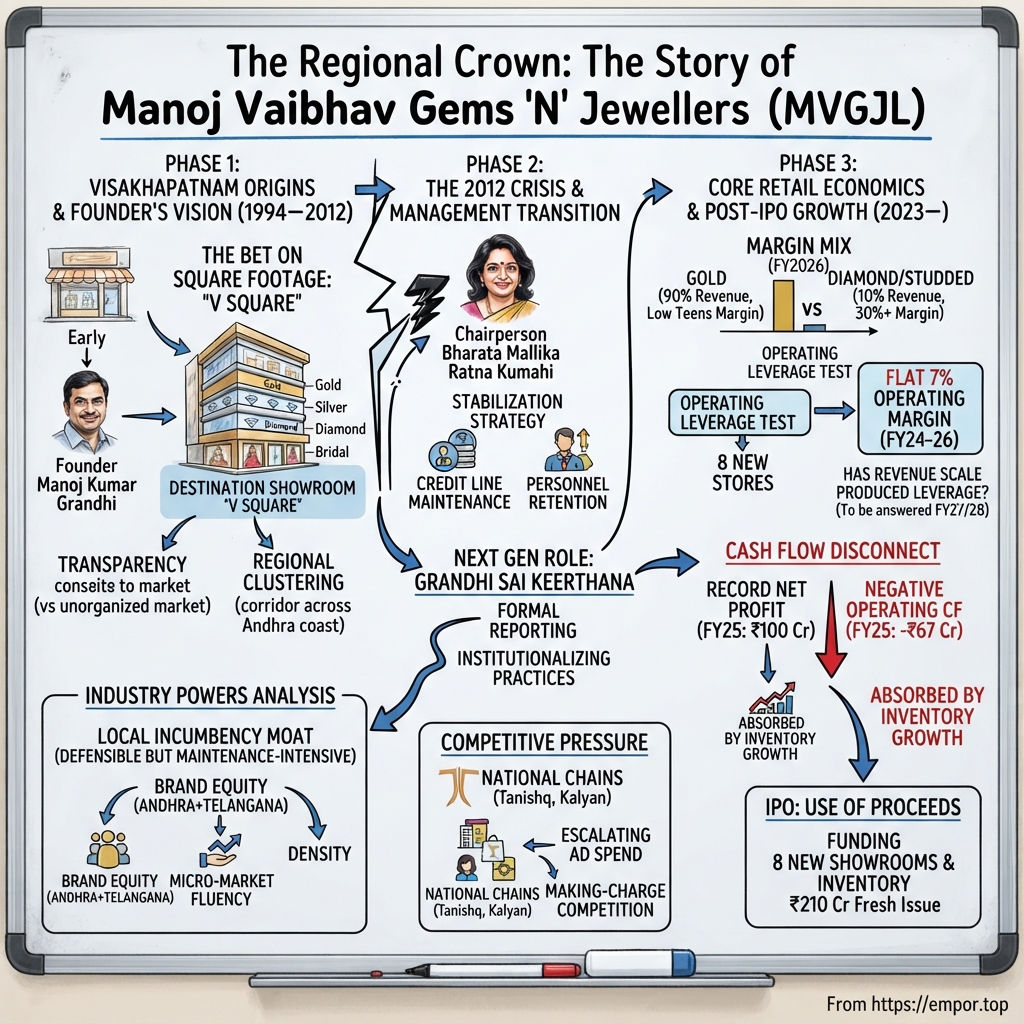
Manoj Vaibhav Gems 'N' Jewellers: The Regional Crown of Andhra's Retail Gold Empire
I. Introduction & Episode Roadmap
There is a particular kind of Saturday morning in Visakhapatnam in the weeks preceding wedding season. The heat has not yet peaked. A family—spanning three or four generations—drives to a specific building they have visited for decades, the same one the bride's mother visited when she was getting married. They spend four hours inside. They are served food. They deliberate over a vaddanam—the heavy waist belt anchoring a South Indian bridal trousseau—debating design, weight in grams, and making charges. Hours in, a purchase worth several lakh rupees is finalized, driven primarily by trust in a brand name.
Across coastal Andhra Pradesh, that name is often Vaibhav.
This is the story of Manoj Vaibhav Gems 'N' Jewellers Limited, which trades on India's National Stock Exchange under the symbol MVGJL and on the BSE under scrip code 543995.34 The company is not a household name in Mumbai or Delhi and has never run national television campaigns featuring Bollywood celebrities. Yet in the fiscal year ended March 2026, it generated roughly ₹2,744 crore in revenue—about $330 million—almost entirely from showrooms across two states, with a significant share originating from regional towns.610
That contrast highlights a core dynamic in Indian retail. The national narrative around Indian jewellery retail often focuses on large players: Titan's Tanishq as the category-defining brand, Kalyan Jewellers as the pan-India challenger, and Malabar Gold and Joyalukkas as Gulf-backed expansionists. Beneath that layer sits a quiet model: regional chains that dominate localized coastal corridors. Vaibhav Jewellers serves as a clear case study of this regional density model in South India, alongside Thangamayil in Tamil Nadu and Senco Gold in eastern India.
The company also represents a family business shaped by a critical turning point. Founder Manoj Kumar Grandhi built the enterprise from a single Visakhapatnam storefront in the 1990s into a destination-retail network. Following his murder in 2012, his widow, Bharata Mallika Ratna Kumari Grandhi—a philosophy and psychology graduate without prior corporate operating experience—assumed the role of Chairperson and Managing Director, a position she maintains.810 Their daughter, Grandhi Sai Keerthana, serves on the board and holds an executive operating role.11 As of the June 2026 shareholding filing, the promoter group retains a 74.27% equity stake.10
Regional concentration and family leadership through crisis define the company's operating profile. However, evaluating the business requires testing management assertions regarding micro-market moats, customer retention, and store returns against the public financial record. That record highlights notable challenges, including periods of negative operating cash flow, a related-party customer-advance structure dismantled prior to the initial public offering, a balance sheet reliant on gold metal loans that has seen limited deleveraging, and an ongoing GST demand under appeal.[^5]12
The roadmap for this analysis spans several key areas.
The narrative begins in the 1990s with the Grandhi family's pivot from textiles to gold and their decision to establish large-format destination stores rather than standard high-street shops. It examines the operational impact of the founder's death in February 2012 on supplier credit terms, bank facilities, and key personnel retention, along with management's subsequent stabilization strategy. The focus then turns to retail unit economics: why jeweler profitability depends heavily on making charges rather than bullion prices, how gold metal loans function as essential inventory financing, and why top-line growth has frequently coincided with cash outflows.
The capital markets assessment reviews the October 2023 public listing, the intended use of proceeds, and performance across three years of post-IPO financial disclosures. A competitive analysis tests regional margin resilience against national expansion by Tanishq and Kalyan into markets like Vijayawada and Tirupati using Porter's Five Forces and Hamilton Helmer's Seven Powers frameworks. The analysis concludes with core bull and bear arguments, potential activist pressure points, and the key financial metrics that determine the company's long-term thesis.
Throughout each section, claims are continuously evaluated against disconfirming financial data to ensure an objective assessment.
The analysis starts at the company's origins: with a decision to build large-scale retail jewellery stores in Andhra Pradesh.
 Subscribe on LinkedIn
II. Visakhapatnam Origins & The Founder's Vision (1994–2012)
The Grandhi family did not begin in precious metals. Their commercial roots run back through Eluru, a mid-sized town in the coastal delta of Andhra Pradesh, and through textiles—the classic Indian trading apprenticeship focused on inventory management, seasonality, credit cycles, and customer price sensitivity. That background proved foundational. Textile trading in regional India demonstrates that while products may be fungible, customer relationships are not—a principle embedded in Vaibhav's subsequent operating strategy.
Manoj Kumar Grandhi launched Vaibhav Jewellers in Visakhapatnam in the mid-1990s, operating initially from a showroom measured in hundreds of square feet rather than thousands.8 Visakhapatnam at the time was an industrial port city—anchored by steel manufacturing, shipbuilding, and refining—with a growing salaried middle class. The local jewellery landscape mirrored much of urban India: fragmented independent goldsmiths, opaque purity standards, unstandardized pricing, and customer retention tied strictly to family relationships spanning generations.
The market opportunity Grandhi identified rested on transparency rather than luxury positioning. By offering explicit clarity on purity standards, daily gold rates, and labor charges, the firm sought to win market share from unorganized competitors—targeting newly urban, salaried buyers who lacked established goldsmith relationships.
The bet on square footage
The strategic pivot separating Vaibhav from local competitors occurred around 2007–08, when Grandhi constructed a flagship showroom in Visakhapatnam under the "V Square" banner at a scale exceeding tens of thousands of square feet—a format without local precedent.8
Conventional retail logic dictated minimizing floor space to reduce rent and security risks, given jewellery's high value density. Vaibhav's departure from that model reflected behavioral rather than standard real estate considerations. South Indian wedding purchases operate as multi-hour, multi-generational family events involving complex decision-making dynamics across extended family networks. Creating a destination retail environment—with dedicated floors for gold, silver, bridal collections, and diamonds, alongside private consultation areas and hospitality—kept buying parties on-site throughout the selection process.
The secondary effect was geographic draw. A destination store of that footprint attracted customers across an entire district rather than an immediate neighborhood, forming the foundation of the company's micro-market density strategy.
Clustering before sprawling
Vaibhav's early expansion strategy prioritized regional concentration over rapid geographic spread. Rather than expanding into major metropolitan centers such as Chennai, Bengaluru, or Hyderabad, the firm deepened its footprint along the Andhra coast, opening locations in Visakhapatnam, Gajuwaka, and Kakinada.8 Regional retail failures often stem from premature entry into unfamiliar markets lacking brand equity, where distinct local design preferences lead to inventory stagnation.
Regional design preferences represent a critical merchandising factor. South Indian bridal jewelry demands specific regional variations, such as the vaddanam (bridal waist belt), kasu haram (coin necklace), and intricate temple motifs. While national chains rely on centralized merchandising teams to estimate regional preferences, localized retailers can align inventory more precisely with regional demand, mitigating inventory write-downs—a dynamic analyzed further in subsequent sections.
The falsification pass: 1994–2012
A critical examination of the founder's growth phase reveals structural trade-offs that depart from a simple story of organic expansion. Developing large-format jewellery showrooms requires substantial working capital, as inventory carrying costs far exceed real estate expenditures. Funding large store formats in the mid-2000s—prior to establishing institutional banking credit lines—required reliance on high-cost debt and customer advance schemes, wherein buyers paid monthly installments toward future purchases. While providing low-cost float during growth phases, these advance schemes functioned structurally as unsecured retail deposits, later attracting scrutiny from Indian regulators and public market underwriters.
Company pre-IPO disclosures indicate that these customer advance structures required formal reorganization before the listing.[^5] This transition is examined in detail in the next section covering the company's post-2012 restructuring.
A second timing factor involves regulatory policy. Mandatory Bureau of Indian Standards (BIS) hallmarking—the purity certification regime driving organized market share gains—was not enforced across India until 2021. For most of Vaibhav's early growth period, its purity transparency guarantees relied entirely on brand marketing and customer word-of-mouth rather than state enforcement. Consequently, store payback periods during this era exceeded the 18-to-24-month horizon currently cited by management for new openings.2 Modern retail unit economics reflect a post-regulatory market environment as much as an early operational playbook.
The empirical assessment shows that Grandhi's core model—combining large-format destination retail, regional geographic density, and purity pricing transparency—established a defensible regional franchise. However, early expansion was heavily reliant on informal financing structures within an unstandardized regulatory environment.
Following the founder's death in February 2012, the firm's focus shifted rapidly from expansion to operational and financial stabilization.
III. The 2012 Crisis & Management Transition
Every family business carries an unpriced operational risk: what happens when the founder is suddenly gone.
For the Grandhi family, that moment arrived in February 2012, when Manoj Kumar Grandhi was murdered during a business trip to Bengaluru.8 He died without a formal corporate succession plan. In an enterprise built on personal networks, he represented the firm's credit lines, supplier relationships, procurement expertise, and brand identity simultaneously.
The mechanics of retail jewellery made this disruption particularly acute. Jewellers operate extensively on credit: bullion banks extend metal loans, wholesalers ship high-value consignments on trust, and customers deposit cash months ahead of planned purchases. In an unlisted family firm, counterparties underwrite the individual entrepreneur as much as the balance sheet. Following the founder's death, bank credit committees restricted lending lines and wholesalers tightened payment terms. Simultaneously, competitors moved aggressively to recruit store managers who held key customer relationships.
The widow who ran the company
Bharata Mallika Ratna Kumari Grandhi assumed the role of Chairperson and Managing Director.810 A graduate in philosophy and psychology, she took leadership without prior corporate operating experience in store operations, bullion bank negotiations, or gold procurement.
Rather than attempting to replicate her husband's expansionist style, her management approach focused on operational stabilization: reassuring key counterparties, retaining critical personnel, and institutionalizing previously informal practices.
The immediate priorities were maintaining bank credit lines and retaining store managers and procurement personnel—the primary repositories of institutional knowledge. Beneath the company's internal branding motto, "VAIBHAV is Relationships, By Design," lay concrete operational tactics: expanding customer gold savings schemes to convert single purchases into recurring monthly visits, offering doorstep service in semi-urban Andhra Pradesh, and systematically transitioning customer loyalty from the founder to the corporate brand.
Transferring customer and creditor trust from an individual founder to an institution determines whether a family enterprise survives such a crisis. Vaibhav's ongoing presence, continued store expansion, and retained market share in coastal Andhra demonstrate operational continuity. However, the financial record reveals that this transition carried tangible trade-offs.
The second generation
Grandhi Sai Keerthana, the founder's daughter, joined the board and assumed executive operational responsibilities, focusing on inventory digitization, structured merchandising, marketing discipline, and the formal reporting architecture required for a public listing.11 She subsequently became a central figure in presenting the company's strategy to institutional investors.
This evolution reflects a broader pattern in Indian family retail: the founding generation establishes the commercial footprint, the successor generation stabilizes the enterprise through crisis, and subsequent leadership professionalizes operations to attract capital market financing. Vaibhav completed this trajectory over three decades.
The falsification pass: 2012–2022
Evaluating the transition narrative against the empirical record highlights several operational and structural constraints.
First, store network expansion slowed markedly between 2012 and 2017. Capital that might otherwise have funded new showrooms was redirected toward debt reduction and balance-sheet repair to reassure lenders. While prioritizing solvency over expansion protected the firm from a potential liquidity crisis, it coincided with a period when organized jewellery chains were rapidly consolidating market share across South India. By deferring store additions during these years, Vaibhav slowed the buildout of its micro-market network density.
Second, historical governance practices present notable caveats. The customer gold savings schemes central to customer retention originally involved advance collections routed through promoter-linked entities, including a promoter Hindu Undivided Family (HUF) structure. Placing customer advance funds within promoter-controlled vehicles created clear conflict-of-interest risks for a firm preparing for an initial public offering. This practice was formally discontinued in June 2022, prior to filing the draft prospectus.[^5]
Investors evaluate this historical structure through two distinct lenses. A favorable interpretation views the restructuring as standard pre-IPO hygiene, where an unlisted family enterprise voluntarily eliminated legacy practices to meet public market governance standards. An alternative interpretation notes that the timing—months before filing—suggests regulatory and market requirements, rather than an internal governance review, prompted the change.
The evidence indicates that the practice was disclosed and remediated prior to listing, and quarterly regulatory filings alongside independent board oversight reduce the likelihood of recurrence. Nevertheless, this history qualifies the management record: it demonstrates operational resilience during crisis and recent compliance with public market standards, rather than a multi-decade track record of institutional capital stewardship. Investors monitoring governance quality can track related-party transaction disclosures in annual reports, auditor notes, and the structure of future customer deposit programs.2
Third, key-person risk remains concentrated within the promoter group. The promoter family retains a 74.27% equity stake while simultaneously holding the Chairperson, Managing Director, and key executive positions.10 While operational systems and reporting protocols have reduced individual reliance compared to 2012, voting control and strategic direction remain strictly concentrated within the family.
Having stabilized operations and navigated the leadership transition, the enterprise faced the structural question that defines jewellery retail: how to generate sustainable margins on a commodity whose base price is publicly quoted in real time.
IV. Core Retail Economics & The Micro-Market Playbook
At the center of the retail jewellery business lies a fundamental dynamic that frequently leads to analytical misjudgments: jewellers do not generate meaningful profit on raw gold.
Gold functions as a globally quoted commodity. A shopper in Rajahmundry can check the prevailing spot rate on a smartphone while standing inside a showroom. Retailers buy metal at near-market prices and resell it at equivalent market rates. Margin generation resides almost entirely in the labor and design required to transform raw bullion into finished ornaments. In Indian retail, this is unbundled and billed explicitly as the making charge, calculated either as a percentage of metal value or as a fixed per-gram fee.
Consequently, the appropriate operational model is not that of a commodity trader, but rather a specialized manufacturer of ornamental services that must warehouse high-value raw material to display its offerings. Inventory sitting in display cases represents a necessary carrying obligation rather than the primary driver of profitability.
This structural reality shapes the company's financial profile.
The mix, and why the small segment matters most
Gold jewellery accounts for approximately nine-tenths of total revenue, generating gross margins in the low teens. Diamond and studded jewellery represents only about one-tenth of sales, but yields gross margins exceeding 30%. Silver articles and accessories contribute negligible top-line volume, serving primarily as promotional foot-traffic drivers during festival and gifting seasons.
This margin disparity reflects a structural pricing dynamic. Unlike gold, diamonds are not standardized commodities. Two stones of identical carat weight can vary substantially across cut, color, and clarity—attributes that retail shoppers cannot easily benchmark in real time. Product complexity provides pricing power. Expanding the proportion of high-margin studded jewellery represents the primary profit lever for Indian jewellers.
However, financial disclosures reveal limited progress on this front. Vaibhav's reported operating margin remained static at approximately 7% over six fiscal years—recording 7% in FY2020, 6% in FY2021 and FY2022, and 7% in each fiscal year from FY2023 through FY2026.6 Margin stability maintained through 15%-plus annual revenue growth, an initial public offering, and eight showroom additions demonstrates that revenue scale has not produced operating leverage. This trend indicates that higher-margin diamond sales have failed to reach critical mass, or that regional market defense costs have offset gross margin gains. Consequently, bullish assumptions regarding near-term margin expansion remain unreflected in historical operating performance.
What a showroom actually costs
Capital requirements for new showrooms are driven primarily by inventory costs rather than real estate build-outs. A regional Vaibhav showroom spanning several thousand square feet requires initial inventory stocking valued in the tens of crores of rupees, depending on store tier and metal volume.2 While management targets a new-store payback period of 18 to 24 months,2 this metric functions as an operational guidance figure rather than an audited disclosure.
Store payback timelines remain sensitive to baseline gold valuation assumptions and localized cannibalization. Within a geographic clustering framework, opening proximate showrooms involves an explicit operational trade-off: accepting incremental sales cannibalization in exchange for regional market control and marketing efficiency. Net store productivity is reflected in same-store sales growth metrics.
Company inventory turnover averages between 2.5 and 3.0 times annually, indicating that display inventory sits for four to five months prior to sale.2 This turnover rate aligns with industry benchmarks for regional destination formats and serves as a key indicator of working-capital discipline.
The gold metal loan, explained plainly
Inventory financing relies heavily on specialized credit instruments known as Gold Metal Loans (GMLs).
Under traditional commercial credit, stocking ₹30 crore of inventory requires securing rupee loans at prevailing working-capital interest rates. If bullion prices drop 15%, the liquidation value of that inventory contracts to ₹25.5 crore while the ₹30 crore principal liability remains fixed, creating an unhedged directional exposure to commodity markets.
By contrast, a Gold Metal Loan provides physical metal directly from bullion banks at lower interest rates, typically in the mid-single digits.2 Retailers receive bullion denominated in grams, sell finished ornaments, and settle credit obligations in physical gold or at market prices fixed at the point of customer sale. Matching metal-denominated assets with metal-denominated liabilities insulates operating margins from commodity price fluctuations, locking in making-charge revenues.
This structure carries two primary balance-sheet implications. First, GML financing offers lower borrowing costs alongside a natural commodity hedge. Second, headline debt metrics for jewellery retailers differ structurally from industrial corporate debt. Vaibhav's total borrowings stood at approximately ₹491 crore as of March 2026, compared to ₹400 crore a year prior and ₹485 crore in March 2023.6 The majority of this debt represents metal-backed working capital deployed directly into saleable showroom inventory.
However, the risk mitigation provided by GML facilities depends entirely on hedging coverage. Any unhedged inventory or outright bullion purchases funded through conventional rupee debt expose the enterprise to commodity market movements. During the sustained gold price rally of 2024–26, unhedged positions boosted reported asset values and revenues; conversely, market downturns generate inventory write-downs. Furthermore, total borrowings expanded by approximately ₹90 crore in FY2026 despite the prior deployment of public equity capital, indicating that the balance sheet continues to expand to fund inventory growth rather than deleverage.
Geography as product
Vaibhav's retail footprint forms a continuous corridor across coastal Andhra Pradesh—including Visakhapatnam, Kakinada, Rajahmundry, Eluru, Vijayawada, and Guntur—extending into Rayalaseema at Tirupati and neighboring Telangana, including Hyderabad.18 Following its post-IPO expansion program, the store network operates in the low twenties by showroom count.12
Regional design fluency translates directly into balance-sheet efficiency. Detailed knowledge of micro-market preferences—such as specific bridal weight profiles favored in Guntur versus Visakhapatnam—reduces slow-moving stock and accelerates inventory turnover. In a working-capital-intensive business model, inventory velocity determines whether expansion can be funded organically or requires external capital.
This dynamic leads directly to the core financial debate surrounding the company's cash generation.
The falsification pass: does growth produce cash?
While top-line expansion of 15% alongside 7% operating margins and a 74% promoter stake suggests consistent cash generation, financial statements demonstrate persistent cash conversion challenges.
Operating cash flow stood at negative ₹12 crore in FY2021 before recovering to a positive ₹9 crore in FY2022 against ₹44 crore in net profit. Cash generation strengthened to ₹69 crore in FY2023 and ₹60 crore in FY2024—the only periods of robust cash conversion in recent years. However, in FY2025, despite generating ₹100 crore in net profit, operating cash flow turned negative at ₹67 crore. In FY2026, operating cash flow recovered modestly to ₹26 crore on net profit of ₹115 crore.6
Across this period, cumulative net profit substantially outpaced cumulative cash flow from operations, with capital absorbed primarily by inventory expansion. Total inventory value rose to approximately ₹1,317 crore in March 2025 from ₹1,081 crore a year earlier—an increase exceeding ₹230 crore that accounts for the cash drain in FY2025.13
This working-capital intensity stems from three distinct factors. First, stocking eight post-IPO showrooms required upfront inventory allocations prior to revenue generation. Second, rising bullion prices increased the nominal cost of maintaining baseline physical stock.
However, the third factor poses structural risks: inventory growth outpacing sales growth signals declining turnover rates, indicating potential merchandising mismatches or overstocking ahead of consumer demand. The FY2026 recovery to ₹26 crore in operating cash flow against ₹115 crore in net profit represents a conversion rate below 23%, occurring after the primary showroom buildout had concluded.
Empirical evidence contradicts management assertions that store growth is fully self-funding. While cash absorption may abate following expansion pauses, FY2026 results show only partial cash recovery, leaving the self-funding capacity of the model unverified.
This ongoing capital requirement motivated the firm's transition to public equity markets in 2023.
V. The 2023 IPO & Capital Deployment Pass
In September 2023, a company that had spent nearly three decades answering to a family, a handful of bankers and the goldsmiths of coastal Andhra put itself in front of institutional investors for the first time.
The IPO opened for subscription in late September 2023 at a price band that settled at ₹215 per share, raising ₹270.20 crore in total — comprising a fresh issue of ₹210.00 crore and an offer for sale of ₹60.20 crore.[^5]57 The shares listed on both the NSE and BSE in early October 2023.45
The structure of that split is the first thing an investor should read. Roughly 78% of the money raised was fresh capital going into the company, with the remaining ₹60.20 crore going to selling shareholders. For a promoter family that retained a controlling position afterward, that is a comparatively restrained cash-out — this was not an exit dressed as a fundraising. It was, primarily, a working-capital and expansion raise, which is the honest description of what a jeweller needs public money for.
What the money was for
The stated use of proceeds was straightforward and, refreshingly, not padded with acquisition ambition: funding capital expenditure and inventory for eight new showrooms across Andhra Pradesh and Telangana, plus general corporate purposes.[^5]5
Note the phrasing — capital expenditure and inventory. Most retail IPO prospectuses talk about store capex. A jeweller has to say the quiet part out loud, because the fit-out is a fraction of the cost and the gold is the rest. When Vaibhav said it was raising ₹210 crore to open eight stores, a meaningful share of that was always going to end up sitting in display cases rather than producing returns immediately. That is the honest reading of the FY2025 cash flow discussed above: the negative operating cash flow was in significant part the IPO doing exactly what the prospectus said it would do.
The deployment record
By FY2026 the company had completed the expansion programme funded by the IPO — the eight showrooms were built and stocked, taking the network from the low teens at filing into the low twenties.12 The push extended into satellite Tier-3 and Tier-4 towns in Andhra Pradesh where national chains have thin or no direct presence, and into Telangana, including the Hyderabad market.1
So: did it work?
The revenue answer is yes, arithmetically. Revenue moved from ₹2,025 crore in FY2023, the last full year before listing, to ₹2,148 crore in FY2024, ₹2,382 crore in FY2025, and ₹2,743 crore in FY2026 — a compound rate in the mid-teens across the post-IPO period, with FY2026 alone up around 15%.610 Net profit followed a similar path, from ₹72 crore in FY2023 to ₹115 crore in FY2026.6 Return on capital employed sat at 16% in FY2026.6
The margin answer is no. As established, operating margin did not move. Eight new stores, three years, a meaningfully larger revenue base, and the operating margin ended exactly where it started. For a business model whose bull case rests on regional scale economies and mix shift, that is the most direct falsification available, and it is drawn entirely from the company's own reported numbers.
There is an important caveat in the other direction. New stores drag margins during their ramp — they carry full rent, staff and inventory cost against sub-scale revenue. A company that opened eight stores in three years should be expected to show flat consolidated margins even if mature-store economics improved. Which means the flat-margin observation does not by itself prove that the model lacks operating leverage; it proves that the leverage, if it exists, has been consumed by expansion and has not yet surfaced. FY2027 and FY2028 — the first years in which the post-IPO cohort should be fully mature and no comparable opening wave is underway — are when that question gets answered honestly. If margin is still 7% with a mature network, the scale-economies claim is dead.
What management says, and what analysts push on
The live version of the story shows up on quarterly calls, and the pattern in the FY2024–FY2026 cycle is consistent enough to be diagnostic.
Management's prepared remarks have centred on three themes: micro-market density as the structural advantage, customer gold savings schemes as the engine of repeat footfall, and a gradual increase in the diamond and studded share of revenue as the path to better economics. Analysts, in Q&A, have pushed on precisely the three places where those claims are weakest — same-store sales growth separated from new-store contribution, inventory turn during periods of sharp gold price appreciation, and a dated timeline for the diamond mix shift rather than a directional aspiration.
Two things in management's responses are worth flagging as analytical facts rather than colour.
The first is the admission, made in the context of defending the home market, that advertising and promotional spend has had to rise as national chains have entered Andhra towns. That is management confirming, in its own words, that the local brand moat has a price. A moat you have to pay an escalating toll to maintain is a real moat, but it is a depreciating one, and it shows up in exactly the line item that would otherwise have delivered the operating leverage discussed above. This is the juxtaposition that matters: the "regional brand equity" claim and the "rising ad spend to defend territory" admission belong in the same sentence, because the second bounds the first.
The second is the handling of the diamond mix question. Management has consistently described the shift as a priority and consistently declined to put a hard date or target percentage on it. Read charitably, that is appropriate caution in a category where consumer adoption in Tier-3 towns is genuinely slow and where lab-grown diamonds have introduced real pricing uncertainty. Read sceptically, a strategic priority that never acquires a measurable target is a priority that cannot be held to account. The FY2026 mix — still around a tenth of revenue, roughly where it has been — suggests the sceptical reading deserves at least equal weight.
On the credibility question generally: the narrative across calls and annual reports has been consistent, which is worth something. Management has not swung between strategies, has not announced non-core diversifications, and has stuck to a single geographic story. Vague answers on quantified targets are a legitimate criticism; strategic incoherence is not one that the record supports.
The falsification pass: regulatory and tax drag
The clean story of post-IPO execution ran into administrative friction in June 2026, when the company disclosed a GST order from the Visakhapatnam authorities confirming a tax demand of approximately ₹2.92 crore together with an equivalent penalty of ₹2.92 crore — roughly ₹5.84 crore in aggregate — relating to input tax credit disallowances covering FY2022 through FY2025. Management indicated it would appeal.12
Proportionality matters here. Against ₹115 crore of annual net profit, ₹5.84 crore is not a solvency event and, if the appeal succeeds or the penalty is reduced, may be substantially less. This is not a scandal.
But it is a data point about a specific thing: the administrative maturity of a regional family business scaling into a listed multi-state operator. Input tax credit disputes in the jewellery trade typically arise from documentation and supplier-compliance gaps rather than from aggressive tax positions — which is to say, they are usually a process failure rather than an intent failure. The company also carries residual legacy assessment disputes stretching back to earlier assessment years, the ordinary administrative sediment of an Indian regional issuer.2
The honest weighing: this does not falsify the execution claim, but it does narrow the "flawless deployment" version of it to something more modest — a company that has built out its stores on plan while accumulating the compliance friction typical of fast-scaling regional operators. The thing to watch is frequency, not magnitude. One ITC order under appeal is noise. A pattern of them across successive assessment years, or an adverse appellate outcome that establishes a method the authorities can apply to later periods, would indicate a systemic process weakness in a business where the working capital is the company.
Capital raised, stores built, compliance friction absorbed. The harder question is what happens when the big players decide these towns are worth fighting for.
VI. Industry Structure, Competitive Benchmarking & Powers Analysis
In 2015, a typical Tier-2 Andhra Pradesh town such as Rajahmundry featured a jewellery market dominated by family-run storefronts, unhallmarked inventory, and cash transactions. A single Vaibhav showroom could capture market share simply by offering certified purity and transparent daily pricing boards. A decade later, that competitive landscape has shifted. Traditional independent shops remain, but national operators such as Tanishq and Kalyan Jewellers have entered these regional hubs, supported by localized television advertising featuring prominent Telugu film stars.
This evolution highlights the central strategic challenge facing regional jewellers across South India.
The industry backdrop
India's retail jewellery industry represents an estimated $80 billion market undergoing a structural migration from unorganized family goldsmiths to organized corporate chains, with organized share estimated at between 50% and 60% and continuing to rise.9 Three primary catalysts drive this transition: mandatory Bureau of Indian Standards (BIS) hallmarking, which established enforceable purity standards; the Goods and Services Tax (GST) framework, which increased compliance requirements for cash operations; and shifting consumer demographics, as younger buyers increasingly favor established corporate brands over inherited relationships with independent goldsmiths.
While this structural shift creates a sector-wide growth tailwind, market share vacated by unorganized goldsmiths does not automatically flow to incumbent regional players. Instead, capital deployment, promotional budgets, and store expansion speed dictate market share acquisition. Across those capital-intensive dimensions, regional operators face competition from national chains with significantly larger balance sheets.
The field
Titan / Tanishq. As the category-defining brand within the Tata Group, Tanishq benefits from strong brand equity, national design scale, and favorable capital access. While higher making charges and centralized inventory planning can leave Tanishq less tailored to hyper-local bridal design preferences, its balance sheet allows individual regional locations to operate through extended ramp-up periods to gain market presence.
Kalyan Jewellers. Kalyan represents a direct competitive challenge due to its South Indian origins, deep regional merchandising experience, and localized customer acquisition network. Kalyan's franchise-led expansion model enables new showroom additions with lower direct capital commitments, contrasting with Vaibhav's balance-sheet-funded inventory model.
Thangamayil Fine Jewellery. Operating a single-state density strategy in Tamil Nadu, Thangamayil serves as a direct operational benchmark. Its ability to maintain margins and cash conversion under national chain encroachment provides a baseline for evaluating single-state retail models.
Senco Gold. Operating primarily in eastern India, Senco offers a reference case for regional jewellers expanding beyond their home geographies while attempting to preserve operating returns.
Malabar Gold & Diamonds and Joyalukkas. Backed by Gulf operations, these deep-pocketed regional contenders maintain aggressive expansion programs across South India, prioritizing market share growth.
Seven Powers, honestly applied
Applying Hamilton Helmer's Seven Powers framework clarifies the durability of Vaibhav's strategic position:
Branding — moderate, and geographically bounded. The Vaibhav brand commands customer trust across coastal Andhra Pradesh, built over three decades of operation. This local reputation enables steady customer retention and reduces price sensitivity on making charges. However, brand equity remains geographic rather than aspirational, providing limited pull outside Andhra Pradesh and Telangana.
Process power — plausible, but unverified in public financials. Decades of operating experience in localized merchandising, regional bridal sizing, and customer savings scheme administration constitute valuable institutional knowledge. However, for process power to manifest clearly on the balance sheet, it should generate premium operating margins or superior inventory velocity relative to peers. Vaibhav's steady 7% operating margin suggests that any localized process advantage is currently absorbed by defensive marketing expenditures rather than converted into margin expansion.
Scale economies — weak. Regional procurement volume offers limited leverage compared to national bullion purchasing scale. In advertising efficiency, national competitors amortize media campaigns across hundreds of showrooms, whereas regional chains bear higher per-store promotional costs across smaller networks.
Counter-positioning — moderate. Vaibhav competes by offering lower making charges and deeper regional customization than national chains using standardized pricing structures. A national operator lowering making charges in specific regional markets risks damaging its broader price architecture or introducing visible regional price discrimination. However, national competitors can narrow this gap over time through targeted regional promotional offers.
Switching costs, network effects, and cornered resources — absent. Retail jewellery features negligible customer switching costs. Beyond active participation in monthly gold savings schemes, consumers face no structural barriers to purchasing from competing showrooms. Network effects do not apply to individual retail purchases, and raw bullion procurement offers no proprietary supply or exclusive distribution rights.
This evaluation reveals a retailer operating with a localized brand presence and a specialized operational model, defending its market position against competitors backed by superior scale and lower financing costs.
Porter's five forces
Supplier power — high. Bullion supply terms are set by international metal market dynamics and bullion banking syndicates providing metal loan facilities. Retailers operate as price-takers on raw metal inputs, with limited opportunity for vertical integration.
Buyer power — medium to high. Indian gold consumers track daily metal rates closely, allowing direct comparison of making charges across competing showrooms within the same micro-market. Local brand trust mitigates, but does not eliminate, price sensitivity.
Threat of new entrants — asymmetric. Capital requirements, inventory costs, and regulatory compliance present high entry barriers for unorganized independent startups. Conversely, established national chains encounter low barriers when entering Tier-2 and Tier-3 markets, leveraging existing procurement, capital, and brand infrastructure to open new locations.
Threat of substitutes — low, with emerging segment risks. Cultural demand for physical gold in South Indian weddings and household wealth accumulation remains resilient. However, financial investment vehicles—including gold ETFs and sovereign gold bonds—compete for investment-oriented gold demand. In the high-margin studded category, lab-grown diamonds introduce pricing uncertainty for natural diamond inventory.
Rivalry — high and intensifying. Competition among organized national chains, expanding regional operators, and established local jewellers remains intense, driven primarily by promotional spending and making-charge pricing adjustments that constrain operating margins.
In aggregate, jewellery retail remains a structurally demanding industry. The central investment question is whether a regional operator can generate consistent returns on capital within these structural constraints. Vaibhav's reported return on capital employed of 16% in FY2026 demonstrates ongoing capital efficiency under current market conditions.6
VII. Investment Story Spine, Bear vs. Bull Stress Test & 3 Essential KPIs
Every investment case can be compressed into two sentences: why this wins, and what breaks it. Here they are, stated as plainly as possible, and then tested.
Why it wins. Vaibhav is the incumbent organised jeweller in a cluster of Andhra Pradesh towns that are getting richer and formalising, with three decades of local trust, regionally precise bridal merchandising that national chains approximate rather than nail, a working-capital model financed by cheap metal-linked bank credit, and a store-opening playbook it has now demonstrated eight times with public money.
What breaks it. The entire business sits in essentially one state, its product has no switching costs, its competitors have several times its capital and advertising scale, its operating margin has not improved in six years of growth, and it converts a minority of its reported profit into cash.
Both sentences are true. The work is in weighing them.
The activist's line of attack
Imagine a sceptical investor building the short-side or agitation case. Where would they aim?
Cash conversion first, and hardest. The attack writes itself from the company's own filings: FY2025 delivered ₹100 crore of net profit and negative ₹67 crore of operating cash flow, and FY2026 delivered ₹115 crore of profit and only ₹26 crore of operating cash flow.6 A sceptic would argue that reported earnings in this business are substantially a function of inventory accounting in a rising gold market, and that the true owner economics are closer to the cash line than the profit line. The defence — that this was a deliberate expansion investment funded partly by the IPO — is legitimate for FY2025. It is thinner for FY2026, when the opening programme was complete. If FY2027 shows a third consecutive year of weak conversion, the defence fails and the sceptic is right.
Borrowings that will not come down. Debt stood at ₹467 crore in FY2020 and ₹491 crore in FY2026, despite an equity raise in between.6 A bull says this is metal-linked working capital that scales with the business and is naturally hedged. A bear says the company raised ₹210 crore of fresh equity and six years later is carrying more debt than it started with, which means the capital structure is permanently working-capital-hungry and equity holders are funding inventory rather than compounding.
Concentration of control. Seventy-four percent promoter ownership with family members in the Chairperson-MD and senior executive seats, at a company that had to dismantle a promoter-linked customer-advance structure months before listing.[^5]10 There is no evidence of recurrence, and the promoter has declared its shares unencumbered.14 But minority shareholders have no mechanism to force change if capital allocation deteriorates, and the free float is small enough that price discovery is thin.
The valuation as evidence, not as recommendation. The market has been assigning this business a single-digit earnings multiple.6 That is worth noting not as a signal of cheapness but as information: the market is pricing either the cash-conversion problem, the concentration risk, the competitive squeeze, or the small-float illiquidity. An investor's job is to determine which of those the discount is for and whether it is right, not to assume the discount is an error.
The bear case, mechanism by mechanism
Single-state exposure. The overwhelming majority of revenue comes from Andhra Pradesh, with Telangana a smaller and newer contribution. There is no geographic hedge. An agricultural bad year in the delta districts, a regional economic shock, a state-level policy disruption, or simply a weak wedding calendar hits the entire revenue base simultaneously. Diversified national chains absorb this; Vaibhav cannot.
Margin compression from encroachment. This is the most probable bear path and it does not require anything dramatic. It requires only that Tanishq and Kalyan keep opening stores in AP towns and keep advertising, and that Vaibhav keeps matching. Every rupee of incremental defensive advertising and every basis point of making-charge concession comes straight out of a 7% operating margin that has no cushion. The mechanism is visible in the numbers already, in the form of margins that did not expand through three years of 15% growth.
Gold price as a double-edged variable. Rising gold flatters revenue per unit and inventory carrying value, which has helped the recent reported numbers. It also suppresses volume — Indian consumers postpone or downsize purchases when prices spike — and raises the rupee cost of restocking. A sharp sustained drawdown would do the reverse: better volumes, but inventory written down and a revenue line that shrinks even as grams sold rise. Neither direction is straightforwardly good, and investors should resist reading any single year's revenue growth as a demand signal without knowing the gold price path.
Lab-grown diamonds. The studded category is where the entire margin-expansion thesis lives. It is also the category facing the most genuine pricing disruption in a generation. If lab-grown stones compress natural-diamond retail pricing in Tier-2 and Tier-3 India, the high-margin optionality shrinks precisely as the company is trying to lean on it.
The bull case, mechanism by mechanism
Being the incumbent when a market formalises is a genuinely good place to stand. The unorganised trade in coastal Andhra still holds share, and the customer leaving a family goldsmith for the first time in a Tier-3 town is more likely to walk into the large, established local name she has known for twenty years than into a chain that arrived last quarter. Vaibhav gets first look at that migration in its own towns. That is not a permanent advantage, but it is a durable one for as long as the migration lasts.
The diamond mix lever is real even if slow. Moving studded revenue from roughly a tenth to fifteen percent would, on the gross-margin differential described earlier, add meaningful points to consolidated margin without requiring a single new store. It is the highest-return use of management attention available. The question is execution, not arithmetic.
Density has compounding advantages that national players cannot buy quickly. Advertising in Telugu-language regional media covers the entire footprint because the footprint is contiguous. Inventory can be rebalanced between nearby stores when a bridal set sells in one town and sits in another. Store managers are recruited from a talent pool that already knows the brand. None of these are dramatic, and together they are worth a few points of return that a chain spread across fifteen states does not capture in any one of them.
Returns on capital are adequate. Sixteen percent ROCE in a working-capital-heavy, low-margin, competitive industry is a respectable outcome, and it is the strongest single piece of evidence that the operating model works.6
Weighing it
Here is the calibrated view the evidence supports.
The moat claim survives, but in a smaller form than the narrative suggests. Vaibhav has a local incumbency advantage — brand trust plus merchandising precision plus density — that is real, that is defensible in its home towns for now, and that is maintenance-intensive. It does not have a structural moat in the Helmer sense, because there are no switching costs, no network effects and no cornered resource, and its scale economics run the wrong way against its largest competitors. Anyone describing this as a durable franchise with pricing power should be asked to explain the flat margin line.
The management-quality claim survives in a narrowed form too. The 2012 transition is genuine evidence of resilience and the post-crisis stabilisation was competently executed. But the record also includes a five-year growth pause, a pre-IPO related-party cleanup that coincided with the filing, and an inability so far to convert growth into either margin or cash. This is a capable operating family that has not yet demonstrated listed-company capital stewardship over a full cycle, because it has only been listed for one.
The growth claim is intact and the least contested part of the case. Revenue has compounded in the mid-teens, stores have been built roughly on plan, and demand in the footprint is real.
What would change the view in either direction is narrow and specific, which is what makes this trackable.
The three KPIs that matter
Not a dashboard. Three things, because three is what an investor can actually follow quarter after quarter.
1. Cash flow from operations relative to EBITDA. This is the master metric for this company, and it is the one that would settle the central argument. Reported profit in a jeweller can be manufactured by stocking stores; cash cannot. The specific question to ask each year: with the IPO-funded store programme complete, is the business converting a healthy majority of its operating profit into cash, or is inventory continuing to absorb it? Two consecutive years of strong conversion would confirm that FY2025 was an investment year. A third weak year would establish that the model structurally does not generate owner cash, and would change the character of the investment entirely.
2. Same-store sales growth. Total revenue growth in an expanding chain tells you almost nothing, because opening stores grows revenue by definition. SSSG strips that out and answers the only question that matters about competitive position: are existing Vaibhav customers in existing Vaibhav towns still coming, and still spending, now that Tanishq and Kalyan are on the same street? It is the purest available read on whether the local brand advantage is holding or eroding. Watch it especially through festive and wedding quarters, and watch it relative to what Kalyan and Titan report for their South India operations — Vaibhav growing slower than the national players in Vaibhav's own home market would be the clearest possible signal that the moat is failing.
3. Diamond and studded jewellery as a share of revenue. The single largest available margin lever, currently stalled around a tenth of revenue. Sustained movement toward mid-teens would validate the mix-shift thesis and should show up in gross margin within a year. No movement, year after year, means the margin story is rhetoric and the business should be understood as a structurally 7%-margin operation for the foreseeable future.
Those three, tracked over the next several years, resolve nearly everything contested in this story.
VIII. Playbook: Business & Investing Lessons
Strip away the specifics of gold retail and coastal Andhra Pradesh, and several transferable business lessons remain.
Density beats sprawl—but only within the footprint where brand equity holds. Vaibhav's central strategic discipline lay in refusing to expand prematurely into unfamiliar territory. Capital was deployed to deepen the coastal Andhra cluster rather than to open isolated showrooms in cities like Bengaluru, where the brand lacked existing equity. The economic logic is clear: brand trust is geographically bounded and costly to establish from scratch, whereas incremental stores within a core market inherit localized consumer trust at minimal incremental cost. The counter-lesson is equally significant: geographic discipline inherently constrains total addressable market size. An enterprise that expands primarily where its brand already resonates faces a finite growth runway, and fully penetrating its core market ultimately re-exposes the business to the geographic expansion challenge it deferred. Senco's ongoing transition from a regional operator to a national network serves as a live test of whether such expansion can be executed without eroding operating returns.
Surviving a key-person crisis is an operational-systems challenge disguised as a leadership transition. The primary insight from the company's 2012 leadership disruption is not merely personal resilience, but institutional continuity. The enterprise survived because counterparty trust was systematically transferred from an individual founder to institutional processes. These operational mechanisms were pragmatic: retaining store managers who held frontline customer relationships, securing ongoing credit facilities with bullion banks, and formalizing monthly savings schemes to institutionalize customer footfall. Founder-dependent enterprises must be evaluated on whether these institutional safeguards are established before a crisis occurs.
Working capital, not reported margin, dictates growth capacity in inventory-intensive retail. This principle applies across multiple working-capital-heavy sectors, including specialized distribution, automotive retailing, and building materials supply. Any enterprise requiring substantial upfront inventory stocking can report double-digit revenue and net profit growth while generating negative operating cash flow for extended periods. The company's fiscal 2025 financial performance provides a clear case study: record net profit combined with negative operating cash flow, as capital was absorbed by unsold inventory on display. In working-capital-intensive business models, inventory turnover and cash conversion serve as primary indicators of underlying economic health, rendering income statement metrics incomplete on their own.
Volume categories generate customer footfall; high-margin categories fund enterprise expansion. Standard gold offerings attract family purchasing parties through the door, while higher-margin diamond and studded collections generate discretionary operating profit. Any retailer operating primarily in a transparently priced commodity category must establish adjacent, less commoditized product lines where price discovery is less direct, or accept structurally constrained operating margins and ongoing exposure to competitors with lower borrowing costs. The operational corollary—defining Vaibhav's current positioning—is that identifying a margin-expansion lever is far simpler than executing it. A product mix-shift strategy that fails to alter revenue composition over multiple fiscal years remains an operational target rather than an established competitive advantage.
IX. Epilogue & Outro
Three decades separate a single Visakhapatnam storefront from a publicly listed chain generating roughly ₹2,744 crore in annual revenue across two states—a trajectory shaped by an early large-format store strategy, a sudden founder transition, a period of financial stabilization, and an initial public offering that funded eight new showrooms.68
Stripped of narrative, Manoj Vaibhav Gems 'N' Jewellers remains a competently managed regional incumbent in a structurally demanding industry. The business delivers mid-teens revenue growth and a respectable 16% return on capital employed, but it has yet to demonstrate that top-line expansion generates consistent owner cash flow or operating leverage. It maintains a localized brand advantage without a structural economic moat, led by a tested promoter family with concentrated equity control and a brief track record as a listed enterprise, competing against national chains with far superior balance sheets.
Over the next 12 to 24 months, three variables will determine the trajectory: first, whether operating cash flow converts effectively now that the store buildout is complete; second, whether same-store sales growth in coastal Andhra Pradesh holds up as national chains increase regional media spending; and third, whether the expansion into Telangana—where brand equity is significantly lower than in Visakhapatnam—yields returns comparable to the home base, or marks the geographic boundary of the regional model.
The broader lesson Vaibhav illustrates is a familiar one in Indian retail. The migration from unorganized goldsmiths to organized corporate chains represents a substantial growth opportunity, but formalization does not grant exclusive gains to regional incumbents. Instead, market transition invites well-capitalized national competitors directly into regional corridors. Vaibhav established early micro-market density and customer familiarity. Whether local incumbency can withstand aggressive national expansion remains the central open question—one that will ultimately be decided on the cash flow statement rather than in marketing narratives.
References
-
Manoj Vaibhav Gems 'N' Jewellers Limited Official Investor Relations Portal — Vaibhav Jewellers ↩↩↩↩
-
Manoj Vaibhav Gems 'N' Jewellers Limited Annual Report 2024-25 — Vaibhav Jewellers, 2025-06-30 ↩↩↩↩↩↩↩↩↩
-
NSE India Official Stock Quote and Corporate Filings for MVGJL — National Stock Exchange of India ↩
-
BSE India Official Company Profile and Filings (Scrip Code: 543995) — Bombay Stock Exchange ↩↩
-
Manoj Vaibhav Gems 'N' Jewellers IPO Overview and Listing Details — Chittorgarh, 2023-10-03 ↩↩↩
-
Financial Ratios, Balance Sheet, Cash Flow and Screener Data for MVGJL — Screener.in ↩↩↩↩↩↩↩↩↩↩↩↩↩
-
Manoj Vaibhav Gems 'N' Jewellers IPO Opens Today: Price Band, GMP, and Issue Details — Financial Express, 2023-09-22 ↩
-
Manoj Vaibhav Gems 'N' Jewellers Company History and Board Profile — Moneycontrol ↩↩↩↩↩↩↩↩
-
Andhra Pradesh Retail Jewellery Industry Overview and Competition Report — Economic Times, 2024-01-15 ↩
-
Manoj Vaibhav Gems 'N' Jewellers Ltd share price, financials and shareholding pattern — Groww ↩↩↩↩↩↩↩
-
Grandhi Sai Keerthana, Manoj Vaibhav Gems 'n' Jewellers Ltd: Profile and Biography — Bloomberg ↩↩
-
Manoj Vaibhav Gems 'N' Jewellers — Visakhapatnam GST order confirming tax demand and penalty, June 2026 — ScanX Stock Market News, 2026-06 ↩↩
-
Manoj Vaibhav Gems N Jewellers Ltd — Quarterly and annual financial statements — Trendlyne ↩
-
Manoj Vaibhav Gems promoter declares no encumbrance on shares — ScanX Stock Market News ↩
 LinkedIn
 WhatsApp
 Reddit
 Hacker News
 Email
Email Kindle
 RSS Feed
 Spotify
 Apple Podcasts
 Amazon Music
 Audible
 YouTube