MV Electrosystems: The Propulsion Bet
The Railway Order That Arrived Before the Profits
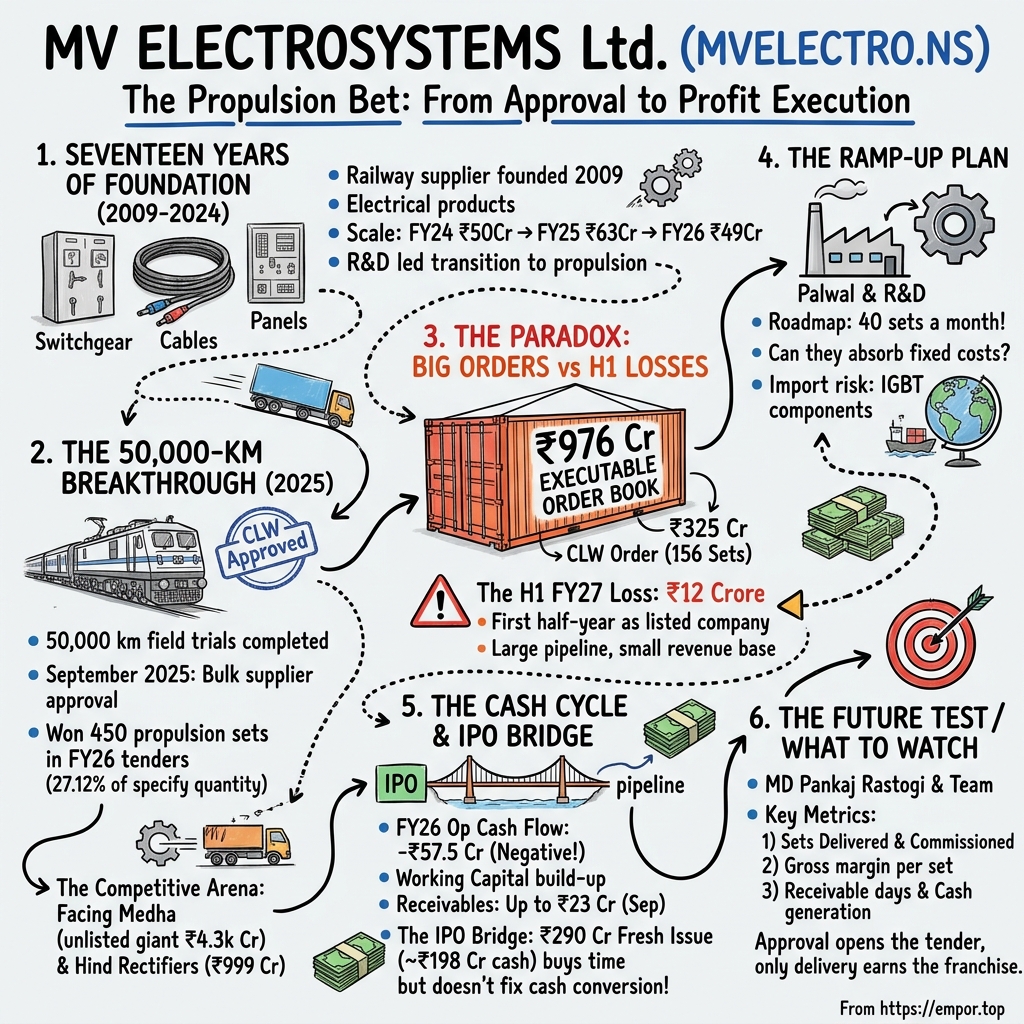
On the morning of November 16, 2026, a short disclosure went to India's stock exchanges. Chittaranjan Locomotive Works, the Indian Railways factory in West Bengal that builds electric locomotives, had issued a letter of acceptance to MV Electrosystems for 156 propulsion sets, worth about ₹325 crore, to be delivered between April 2027 and January 2028.1 For a company that had listed barely three months earlier, it was the kind of announcement that makes a stock chart jump and an investor relations team exhale.
The awkward part arrived four days before it. On November 12, the same company had reported its first half-year as a listed business. Revenue for the six months to September 30 had risen to about ₹32 crore from about ₹26 crore a year earlier, which sounds like progress until the next line: the half-year loss had widened to about ₹12 crore, from about ₹3 crore.2 One order was worth roughly ten times what the company had sold in the previous six months. The company was still losing money on what it did sell.
That mismatch is the whole story in miniature. MV Electrosystems has spent years developing something few Indian companies of its size attempt: the power electronics that take electricity from the overhead wire and turn it into controlled motion in a locomotive. It has won the railway's approval to supply that equipment in bulk. It has, by its own count, an order book that at the end of September contained 557 propulsion sets it could execute, worth about ₹976 crore including the maintenance attached to them.3 Against that, the company sold about ₹49 crore of goods in the whole of FY26.4 The order book is roughly twenty times last year's revenue.
There is a temptation, with a company like this, to read the order book as the destination. It is closer to the starting line. An order from Indian Railways is a promise to buy if the supplier delivers on time, to specification, and through commissioning on the track. Between the letter of acceptance and the money in the bank sit sourcing of imported semiconductors, assembly, factory testing, dispatch, installation, field commissioning, and the railway's own payment process. Every one of those steps costs money before it earns any.
So this episode asks three questions, and keeps asking them. The first is what actually changed when MV won approval to sell propulsion systems in bulk, and whether that approval is an advantage or simply a ticket to compete. The second is whether the company can scale from a few dozen sets to hundreds without swallowing more cash than its new shareholders gave it. The third is how much of the eventual profit Indian Railways, the overwhelmingly dominant buyer, will allow any supplier to keep.
Before the story begins, a word on what exactly is being examined. MV Electrosystems Ltd is a standalone operating company, incorporated in 2009, and its filings show no subsidiaries whose results need to be consolidated.4 There is no parent group whose numbers blur the picture and no web of overseas affiliates. The revenue, the losses, the inventory and the order book all belong to one business, which makes the analysis cleaner and the risk more concentrated. What investors own here is a single bet on a single product line inside a single customer.
The stock market has already made its own guess about how the bet will turn out. The shares, sold to the public at ₹425 in August, traded near ₹833 on November 17.[^5] That price was set before the company had shown it could build propulsion sets at volume and sell them at a profit. Whether the market is early or simply right depends on the next eighteen months. To see why, it helps to go back to the company that existed before propulsion became its defining wager.
 Subscribe on LinkedIn
Seventeen Years Before the Propulsion Breakthrough
Long before anyone talked about MV Electrosystems in the same breath as locomotive propulsion, it was a railway electrical supplier of a familiar Indian type: a company that made the switchgear, control panels, cable protection and interconnect products that go into rolling stock and railway installations.4 These are not glamorous products. They are the boxes, harnesses and connectors that a train needs and a passenger never sees, sold through tenders and purchase orders to the railway's production units and to the contractors that serve them.
Businesses of that kind can be steady, but they rarely become large on their own. The products are specified by the customer, the tenders are competitive, and the supplier's main weapons are reliability, approval status and price. A company that wants to break out of that position has two broad choices. It can buy its way into bigger product lines, or it can build its way in. MV chose to build. The filings describe a trajectory driven by internal research and development, product approvals, factory facilities and working capital, with no acquisition program to speak of.4 There is no purchase price to benchmark, no goodwill to write down, and no question of whether management overpaid for someone else's technology. The question instead is whether it spent wisely on its own.
The financial record the company published for its IPO is short. The audited, comparable figures cover three years.4 In FY24 the company sold about ₹50 crore of goods and earned a thin profit of well under a crore. In FY25 revenue climbed to about ₹63 crore and profit roughly doubled, though still to only about ₹1.4 crore.4 Then in FY26 revenue fell back to about ₹49 crore, a decline of about 21%, and the company swung to a loss of about ₹12.7 crore.5
Those numbers need a careful reading. FY25 looks like the good year, but a closer look shows how thin that profit was. Other income, mostly items outside the core business, came to about ₹2 crore that year, against pre-tax profit of about ₹2.4 crore.5 In plain terms, almost all of FY25's profit came from outside the factory. The core operations were barely breaking even in the best year of the published record. That matters because it means the FY26 loss was not a fall from a high, profitable plateau. It was a slide from roughly break-even into a meaningful operating loss.
This is, then, a young public-company story rather than the tale of a proven compounder that happens to have listed late. The filings do not establish a longer record of sustained growth or of profitability through a full railway spending cycle. Indian Railways' capital budgets have risen and fallen over the decades, and suppliers that look healthy in a spending boom can look very different in a pause. MV's investors do not have the history to know how this business behaves through that kind of cycle.
What the three years do show is a company in transition. The older product lines kept the lights on, while the engineering team worked on something that could change the size of the business entirely. The FY26 numbers capture the cost of that transition at its most uncomfortable point: spending had risen in anticipation of propulsion volumes, but those volumes had not yet arrived.
The capital history fits the same pattern of a privately funded engineering effort that eventually needed public money. Before the IPO, the company raised capital through private placements, issued bonus shares in 2023, converted compulsorily convertible preference shares into equity, and completed another private placement on August 25, 2025.4 Promoters and promoter-affiliated companies also lent the business money interest-free to fund development, loans the company later repaid.4 That is a common path for Indian engineering firms: the founders' balance sheets carry the business through years when banks would rather not.
It is also worth noticing what the older business was not. It was not a commodity cable maker competing only on price, nor a contract assembler building to someone else's design. The switchgear, panels and interconnect lines taught the company how to pass railway inspection regimes, how to bid in tenders and how to live with a customer whose purchase orders arrive on the railway's timetable rather than the supplier's. Those habits would matter once the stakes rose. A company that has spent years filling tender forms, managing inspection visits and waiting for production-unit payments has at least learned the rhythm of the customer, even if it has not yet learned to make the rhythm profitable at scale.
The older products also gave the propulsion effort something less visible: a revenue base that paid part of the engineering bill. A pure propulsion start-up would have had no sales to absorb overheads while it developed and trialled its system. MV had tens of crores of annual revenue from established lines, thin as their margins were. That subsidy had limits, and FY26 showed them, but it is part of why a company of this size could attempt a product normally associated with much larger firms.
The investor question that comes out of this history is simple to state. MV was a small, modestly profitable railway supplier that decided to become a propulsion company. The new product could transform the economics of the old business, or it could absorb the old business's cash and attention for years before paying off. The answer turns on a test that took place far from any factory floor, on railway track, over tens of thousands of kilometres.
The 50,000-Kilometre Test
Imagine being the engineer responsible for a prototype locomotive propulsion system on its first long run. The equipment has passed every bench test in the factory. Now it is bolted into a working locomotive, hauling real loads through Indian heat, dust, monsoon humidity and voltage fluctuations on the overhead line. The railway is not interested in whether the design is elegant. It wants to know whether the train keeps moving, every day, without the equipment failing.
MV's prototype ran 50,000 kilometres in field trials, roughly the distance of a trip around the equator and a quarter more.4 In September 2025, Chittaranjan Locomotive Works approved the company for commercial supplies of its propulsion system.4 For a supplier of MV's size, that approval was a threshold moment, and understanding why requires a short detour into how Indian Railways buys safety-critical equipment.
Indian Railways does not hand a large tender to a newcomer simply because its prototype works. New suppliers start in what is known as the developmental category. A vendor in that category can bid, but its share of any tender is capped, in MV's case, at 20% of the quantity.4 The cap is the railway's insurance policy. If a new supplier's equipment fails in service, only a fraction of the fleet is exposed, and the established vendors can cover the rest. Graduating from that category to approved bulk-supplier status removes the ceiling and lets a company compete for the larger share of each tender.
That is what the 2025 approval did for MV. In the tenders that followed, the company won 450 propulsion sets across procurements by three production units: Chittaranjan Locomotive Works, Banaras Locomotive Works and Patiala Locomotive Works. Those 450 sets represented about 27% of the net quantities those units were procuring in FY26.4 For a company whose revenue the year before had been about ₹63 crore, winning more than a quarter of the specified locomotive propulsion procurement was a striking result.
It is worth slowing down on what that 27% does and does not mean. It is a share of particular tenders, issued by three factories, in one fiscal year. It is not a share of India's entire locomotive propulsion market, still less a durable share that will repeat automatically next year. Tender procurement is lumpy. A supplier can win a large share of one round and a much smaller share of the next, because each tender is a fresh contest on price, delivery capacity and the buyer's view of risk. One good year proves that the railway was willing to buy from MV in volume. It does not prove that the railway will keep doing so at the same share, or at the same price.
The incumbents in the room
The competitive field also deserves a careful description, because it is easy to make MV sound like a lone insurgent against foreign giants. The company names its rivals more precisely. Medha Servo Drives, an established unlisted Indian supplier, has long been one of the principal domestic makers of propulsion equipment for Indian Railways. Hind Rectifiers is the listed peer the prospectus names, though the filing noted that its own comparable propulsion approval was still pending at the time.4
The scale comparison is sobering. In the prospectus peer table, MV's FY26 revenue was about ₹49 crore. Hind Rectifiers reported revenue of about ₹999 crore, roughly twenty times larger, and Medha's FY25 revenue was about ₹4,300 crore, close to ninety times MV's.4 Those are not companies that will be dislodged by one approval. Medha in particular has years of installed equipment in service, an established maintenance organisation, and a long record with the same production units MV is now selling to.
What MV has, by contrast, is proof that it can design and validate a working system and a buyer that has shown it is willing to add another qualified vendor. That is valuable. Indian Railways has strong reasons to want more than one or two propulsion suppliers: competition on price, protection against any single vendor's production problems, and a policy push toward domestic engineering. Each of those reasons helps a new entrant win business. Each also limits how much that entrant can charge once it is in.
Qualification is not the same as a franchise
Here the story needs an honest verdict. The approval and the tender wins are concrete evidence that MV's technology works well enough for the railway to buy it at scale. That is a real achievement, and many small engineering companies never get there. But certification is not commercialization. The approval did not hand MV pricing power, guaranteed repeat orders, or proof that it can deliver profitably. It handed the company permission to compete in a market where the customer sets the rules, chooses among multiple vendors, and can re-award quantities in every tender.
The company's own earlier history offers a useful test of how quickly technical milestones turn into money. MV spent years developing its propulsion system, and during that period the business remained small and, by FY26, loss-making.5 The milestone came in September 2025. In the year that included it, revenue fell. That does not mean the approval was worthless. It means the gap between an engineering result and a financial result was long in MV's own record, and there is no reason to assume it will now close instantly.
The forward evidence that would turn qualification into something more durable is specific. Repeat tender awards in FY27 and FY28 at shares similar to the first round would show the railway considers MV a regular supplier rather than an experiment. Stable or rising price realisation per set would show that MV is not buying share by underbidding. And warranty performance as hundreds of sets enter service would show whether the 50,000-kilometre prototype result holds across a fleet. None of those signals can be read yet.
The approval, in other words, answered the engineering question. It opened a commercial one. To understand that commercial question, it helps to look inside what MV actually sells and how the railway pays for it.
Inside a Propulsion Set—and the Railway Tender
Think of an electric locomotive as a very large, very heavy electric car with a twenty-five thousand volt extension cord. The electricity comes down from the overhead wire through the pantograph on the roof. It arrives as high-voltage alternating current, which is useless to the traction motors in that form. The propulsion system's job is to transform it, convert it, and feed it to the motors in exactly the amount and frequency needed to start a heavy train smoothly, haul it up a gradient, hold a steady speed, and slow it down again.
MV's propulsion set does this with a family of power electronics. Converters turn the incoming power into a form the motors can use. Control units decide, many times a second, how much power each motor gets. Displays and driver interfaces let the crew see what the system is doing.4 If the converters are the muscles, the control software is the nervous system. A good analogy is the difference between a light switch and a dimmer: older locomotive technology was closer to the switch, while modern propulsion behaves like an extremely precise, high-power dimmer that can also send energy back to the wire when the train brakes.
That precision is why railway approval matters so much. A failure in a propulsion converter does not just inconvenience a passenger. It can strand a freight train on a busy main line, block traffic behind it, or create electrical hazards. The railway keeps watching failure rates after approval. For a new entrant, those barriers are expensive and slow to clear. Once cleared, they become one of the few defensible assets the entrant has, because a would-be competitor must pay the same price in time and money.
The commercial path is less glamorous than the engineering, and more important for investors. A production unit such as Chittaranjan issues a tender specifying the number of propulsion sets, the technical standard, delivery schedule and terms. Approved vendors bid. The railway awards quantities, often splitting them among several suppliers. The winning vendor then engineers the order to the specific locomotive configuration, sources components, assembles and tests the equipment in its factory, ships it, and supports its installation and commissioning in the locomotive.
Payment follows that path, not the order date. In MV's case, the company has said that some propulsion sales carry payment terms tied to commissioning, which means the railway pays after the equipment is installed and running rather than when it leaves the factory.5 The company does not disclose its typical collection timeline across the business. For a supplier with limited working capital, that gap between dispatch and payment is where profits can quietly turn into borrowed money.
Some revenue continues after delivery. Propulsion orders usually come bundled with annual maintenance contracts. Some of the prospectus examples have three-year contracts, and a MEMU order, for the electric multiple units that carry suburban and regional passengers, carries five years of maintenance.4 That gives MV a tail of service revenue attached to each installed set, and it means the order book number includes both equipment and future maintenance. What the company does not disclose is how much of its revenue overall is recurring in this way, or what minimum purchase commitments, if any, sit behind the orders.4 It would be a mistake to treat MV as a subscription business. It is a project-and-tender manufacturer with a modest maintenance tail.
Who holds the leverage
The customer concentration figure tells the bargaining story in one number. Indian Railways, counting its different units as one customer, made up about 77% of MV's FY26 revenue, up from about 68% in FY24.4 The direction matters as much as the level. As propulsion becomes the main business, the dependence on one buyer is rising, not falling.
That buyer has unusual power. It writes the specifications, approves the vendors, sets the tender rules, decides how many suppliers to qualify, and splits quantities among them. It can delay tenders, cancel them, or re-issue them. It can impose liquidated damages for late delivery, and the prospectus lists delivery penalties and cancellation among MV's disclosed risks, even as the company says it has had no contract terminated for default.4 It has a policy interest in widening the domestic vendor base, which is precisely what let MV in, and the same policy can let the next entrant in after it.
None of this makes the railway an unreasonable customer. It pays, its demand is backed by a national capital budget, and it values reliable suppliers. But in a negotiation between a ₹49 crore company and one of the world's largest railway networks, there is no doubt which side sets the price. Qualification gives MV access to the room. It does not give MV control of the table.
The parts MV does not make
The supply side has its own concentration. A propulsion converter depends on high-power semiconductors, chiefly IGBTs, the insulated-gate bipolar transistors that switch large currents on and off thousands of times a second. They are, roughly speaking, the valves of the electrical system, and only a handful of manufacturers worldwide make them at the quality and ratings that locomotive traction requires. MV imports many of these and other propulsion components. As propulsion became a larger part of its business, imported materials jumped to about 19% of revenue in FY26 from about 3% in FY25.4
The prospectus is candid about what that means. Certain propulsion components have long lead times, minimum order quantities and limited approved suppliers.4 In practical terms, MV has to place orders months before it needs the parts, commit to quantities set by the supplier rather than by its own schedule, and pay in foreign currency. In FY26 the company spent about ₹13 crore in foreign exchange and earned none, and it reported no currency hedging.5 A weaker rupee raises its costs on contracts whose selling prices were fixed at the tender. A supplier delay can push back a delivery schedule that carries penalty clauses.
So the full picture is a manufacturer squeezed from both ends: a dominant buyer on one side, a narrow set of global component makers on the other. Approval and installed equipment may help MV qualify for repeat work and maintenance. But buyer concentration, multi-vendor procurement and imported long-lead parts all limit the case for a moat. The test of whether MV can earn a return in that position is operational, and management has set out exactly how it plans to pass it.
The Plan to Reach Forty Sets a Month
Every manufacturing ramp has a slide like this one. In the investor presentation covering the half-year to September 30, 2026, management laid out a delivery roadmap: roughly 50 propulsion sets to be delivered by the third quarter of FY27, followed by a planned production rate of about 40 sets a month.3 Management said material for about 40 sets was already available and that long-lead components had been ordered for what came next.3 Management also described the order book as executable.3
A little arithmetic shows how ambitious that is. If 557 sets are worth about ₹976 crore including maintenance, the order book values each set at roughly ₹1.75 crore on average. The new Chittaranjan order works out to a little over ₹2 crore per set.1 Forty sets a month is 480 a year. At something like ₹1.75 crore per set, that is in the region of ₹800 crore of annual propulsion revenue, set against total company revenue of about ₹49 crore in FY26.4 This is not a forecast. It is a way of showing that the roadmap asks the business to grow more than tenfold within a couple of years, built on a product it had only recently begun shipping in volume.
Even the nearer milestone is large relative to the company's history. Fifty sets at the order book's average value would be worth in the region of ₹85 to ₹90 crore, which is more than MV sold in the whole of FY26, delivered in roughly the first nine months of FY27. The company said it had material in hand for about 40 sets at the end of September, which suggests the first batch is not waiting on components. Whether it is waiting on assembly capacity, testing or the railway's locomotive schedule is the question the next two quarters will answer.
The plan is testable, which is to its credit. Management has named a number for a specific quarter and a run rate after it. Investors will be able to see whether roughly 50 sets went out the door by the end of December, and whether monthly output then approaches 40. Few things build credibility like a target met on time, and few things erode it like a target quietly dropped.
The cost of getting ready
The recent results show why the target matters so much. In FY26, revenue fell about 21% to roughly ₹49 crore. In the first half of FY27 it improved to about ₹32 crore, but the half-year loss widened to about ₹12 crore.2 More sales, bigger loss. That pattern is the signature of a company that has built cost ahead of volume.
The cost lines bear this out. Employee expense rose to about ₹13.8 crore in FY26 from about ₹9.6 crore a year earlier, a jump of more than 40% in a year when revenue fell by a fifth.5 Headcount reached 208 by March 31, 2026, and 284 by May 31, 2026, including 78 contract workers.54 Raw-material costs stayed near ₹38 crore even as sales shrank, which means each rupee of revenue carried more material cost than before.5 Research and development, counting both engineering salaries and other spending, rose to about 18% of revenue, up from about 11% in FY25.4 Put those together and the operating loss before depreciation and interest came to about a fifth of revenue: for every ₹100 of sales, the company lost about ₹21 before paying for its machines and its debt.4
Management's explanation is coherent. Staff and manufacturing capacity were added in advance of propulsion production, so the fixed costs of that capacity were spread across too few sets to be absorbed. And some inventory had been bought during the development phase, at higher cost than volume purchasing would later allow, so the material cost of early deliveries ran high.34 Both stories are typical of a ramp. Factories built for 40 sets a month are expensive when they produce four.
But an explanation is not proof. The fact that the first half of FY27 stayed loss-making despite higher revenue tells investors that the under-absorption had not yet reversed by September. The company does not disclose gross margin per propulsion set, which is the single number that would show whether each set, once the factory is full, earns more than its materials and direct labour. Without it, the investor is asked to believe that the losses are the cost of scaling rather than evidence of a structurally thin margin on tendered equipment.
Where the money is going
The company also built physical capacity. It set up a new research and development centre and facilities in Palwal, in Haryana, as part of the propulsion push.3 The filings do not disclose total capital expenditure as a share of revenue, but the rise in fixed assets and capital work in progress points in the same direction as the hiring: investment ahead of commercial scale.5
The stated purpose of the IPO's fresh money was long-term working capital, the cash needed to buy components, carry inventory and wait for customers to pay.4 That is an honest description of where a ramp like this consumes money, and it frames how the post-IPO cash balance should be read. It is funding for the climb, not evidence that the business generates cash on its own.
The evidence that would settle the question is quarterly and specific. Sets delivered and revenue recognised each quarter will show whether the roadmap is on track. Gross margin per set, if the company chooses to disclose it, would show whether volume cures the cost problem. Repeat orders and on-time commissioning would show whether the railway is satisfied with what it receives. For now, the plan is management's. The proof has to come from the factory, and from a place investors watch even more closely than the factory: the cash cycle.
The Order Book Meets the Cash Cycle
On March 31, 2026, the last day of FY26, MV Electrosystems had about ₹1.8 crore in cash and cash equivalents.5 For a company with more than 200 employees, a growing factory and a rising order book, that is close to the bottom of the tank. Six months later, on September 30, cash equivalents stood at nearly ₹198 crore.2 Nothing in the business had changed that much in between. What changed was the shareholder register.
To understand why the company needed that money, follow the cash through FY26. The company reported a loss after tax of about ₹12.7 crore. Its operating cash flow, the money actually generated or consumed by running the business, was negative by about ₹57.5 crore.5 Cash went out at more than four times the rate the loss alone would suggest. The gap was working capital: money tied up in goods not yet sold and claims not yet collected.
The biggest single draw was a category called other current assets, which absorbed about ₹18 crore.5 Inventory also grew sharply, reaching about ₹67.5 crore by year-end.5 That is more inventory than the company's entire FY26 revenue, stockpiled components and work in progress for propulsion sets that had not yet been sold. The company attributes the build-up to propulsion development and production preparation.4 Two items worked the other way: collections of earlier receivables released about ₹4.2 crore, and suppliers extended about ₹3.4 crore of extra credit as payables rose.5 Those helped. They came nowhere near closing the gap.
The arithmetic makes the problem plain. A company that must buy imported semiconductors months ahead, build inventory before deliveries, and then wait for commissioning before being paid will consume cash in proportion to its growth. The faster the ramp, the bigger the hole, at least until the first large batches are delivered, commissioned and paid for. Growth, in this model, is a cash cost before it becomes a cash source.
The receivable that waits for the locomotive
Receivables are the second half of the story. At the end of FY26, MV's trade receivables were about ₹10.4 crore, down from about ₹14.6 crore a year earlier.5 Of those FY26 receivables, about ₹5.5 crore related to propulsion sales, where payment can fall due only on commissioning.5 In other words, more than half of what customers owed at year-end depended on the propulsion equipment being installed and working in a locomotive, a step the railway controls, not MV.
The ageing of those balances was reassuring at March. Almost all of the receivables were less than six months old, with only a small residue older than a year, and the provision for expected credit losses was tiny.5 Indian Railways is a slow payer in many suppliers' experience, but it is not a customer that defaults.
The trend in collection time is less comfortable. Receivable days, the average number of days it takes to collect a sale, rose from 76 in FY24 to 93 in FY26.4 And by September 30, 2026, trade receivables had more than doubled from the March level to about ₹23 crore.2 Some of that rise reflects higher half-year revenue and the shift toward propulsion deliveries. The company did not publish an ageing schedule or unbilled-revenue detail with its half-year results, so investors cannot yet tell how much of the September balance is fresh billing and how much is equipment waiting for commissioning.
What the IPO bought
The IPO is the bridge across all of this. The draft prospectus went to SEBI in November 2025, the red herring prospectus followed on July 23, 2026, and the final prospectus was dated August 3, 2026.647 The offer was a fresh issue of about 6.8 million shares at ₹425 each, which raised about ₹290 crore for the company itself rather than for selling shareholders. Before listing, the company split its shares from a face value of ₹10 to ₹5.4 The stock began trading on the NSE and BSE on August 6, 2026.7
That money changed the company's position overnight. A business that ended March with less than ₹2 crore of cash now has a cushion large enough to fund several quarters of inventory build and slow collections. It did not, however, clear the debt. Borrowings stood at about ₹56 crore at September 30, up from about ₹50 crore at March, and about ₹41 crore of the September figure was due within a year.25 Lease liabilities, mainly for premises, were a separate obligation of about ₹4.4 crore.2 The debt includes a machinery loan of ₹7 crore from Bajaj Finance at a floating rate of about 9.5%, along with working-capital facilities secured on current assets and backed by the promoters' personal guarantees and collateral over manufacturing assets.54 FY26 interest cost was about ₹3.5 crore, and the debt-service coverage ratio was negative.5 No credit rating agency has published a view on the company; the company says it obtained no rating during FY26, and CARE's role in the IPO is as monitoring agency for the use of proceeds, which is not a credit opinion.54
Two smaller balance-sheet details round out the picture. In the first half of FY27 the company booked about ₹1.6 crore of other income in the second quarter alone, at a time when it was holding most of the IPO money, and an investment property of about ₹10.5 crore that sat on the March balance sheet had gone by September.25 The company does not disclose the source of that income in its half-year statements, but the timing is a reminder that, for a while, interest on unspent IPO cash will flatter reported results in the same way other income propped up FY25. It should be read as treasury income, not operating progress.
The other detail is the bank guarantees. At March 2026, the company's contingent liabilities were about ₹3.5 crore, almost all of it bank guarantees, with a small GST demand alongside.5 Railway suppliers routinely post performance and security guarantees when they win orders, and those guarantees consume banking limits. As the order book grows from a few dozen sets to hundreds, the guarantees needed to support it will grow too. That is one more way in which scale ties up financial capacity before it produces cash, and one more reason the IPO money is a bridge rather than a destination.
The sequence explains why the IPO was necessary and what it cannot do. It extended the runway. It did not change how the business converts deliveries into cash. Picture the risk concretely. A batch of propulsion sets is built and shipped in a given quarter. The railway's commissioning schedule slips by two months because the locomotives they go into are delayed. During those two months, MV has already paid for the IGBTs in foreign currency, paid its engineers and assembly staff, paid interest on its working-capital lines and paid its suppliers. The revenue may be booked. The cash is not in the bank. Multiply that by forty sets a month, and a modest commissioning delay becomes a significant drain.
The central operating test, then, is whether propulsion deliveries begin to reduce inventory and turn commissioning-dependent receivables into cash at a pace faster than new working capital is consumed. If inventory and receivables keep growing faster than propulsion revenue, the IPO cash will be spent waiting for the railway. If they grow more slowly, the business will be showing the first signs of self-funding. That test will be run under the leadership of a particular engineer, whose record and incentives deserve their own look.
A Technical Managing Director, and a Pay Vote During Losses
Pankaj Rastogi is the kind of managing director that engineering companies often promote at their moment of transition. He is an engineer who led MV's research and development before being appointed managing director in October 2025, just after the railway approved the company's propulsion system for commercial supply.45 The timing tells its own story. The person most closely associated with building the product became the person responsible for turning it into a business.
He also had skin in the game before the public arrived. Rastogi held about 4.47% of the company before listing.4 Promoters and the promoter group together held about 77% before the IPO, and that fell to about 58% by September 30, 2026, as new shareholders came in.43 At the same date, foreign institutions held less than half a percent and domestic institutions about 8%.3 Promoter Rahul Dhawan, a whole-time director, remains part of the board, and the company does not identify a separate chief executive below the managing director.5
The finance function is run by chief financial officer Ajay Kumar, whose FY26 salary was about ₹36 lakh, up from about ₹21 lakh in FY25.5 He is responsible for managing the company's cash needs as it scales. That is a demanding brief for any CFO, let alone one in a company only three months into public life.
Rastogi's appeal to investors is easy to state. A managing director who understands the converters, the control software and the field-trial data is well placed to diagnose technical problems during a ramp and to argue the company's case with the railway's engineers. The limitation is just as clear. Building a system that passes 50,000 kilometres of trials is a different skill from running a factory at 40 sets a month on tight tender margins. His technical contribution is proven. His operating record at scale is not yet established, because there has not yet been scale to operate.
The pay proposal
On November 17, 2026, the company sent shareholders a postal ballot asking them to approve revised remuneration for Rastogi. The proposal set an annual salary of about ₹1.49 crore plus a target-linked incentive of up to ₹2 crore, with terms that would allow the pay to be made as minimum remuneration even if profits were inadequate.8 In FY26, his recorded remuneration as managing director was about ₹53 lakh.5 Dhawan, by comparison, received about ₹8.4 lakh in each of the last three years.5
There are reasonable arguments for the proposal. A company trying to scale a complex engineering product needs to retain and motivate its technical leader, and a target-linked incentive, if the targets are meaningful, ties pay to delivery. Indian company law allows minimum remuneration during loss years precisely so that companies in transition can still pay their managers.
There are equally reasonable questions. The proposal comes while the company is loss-making and has not yet shown that its ramp produces positive margins. The ballot's description of the incentive matters enormously: if the targets are set on sets delivered or revenue booked, they reward volume, which is not the same as rewarding profitable, collected revenue. An investor would want to know whether the targets include gross margin per set, operating cash flow or receivable days. A salary nearly three times what he was paid in FY26, a year in which he served as managing director only from October, plus a potential incentive larger still, also sits awkwardly beside a half-year loss of about ₹12 crore. The vote was still pending on November 17.
The record investors can check
The filings also contain specific trust questions, which deserve to be described precisely rather than dramatised. The FY26 auditor issued an unmodified opinion, meaning the accounts were found to present a true and fair view, but added an emphasis of matter: the company had not provided for interest payable on delayed payments to micro and small enterprise suppliers, as the MSME Act requires.5 The annual report's own disclosure says no such interest was accrued or unpaid at year-end.5 The prospectus separately records delayed payments to MSME vendors and delayed statutory remittances, and says no vendor had claimed statutory interest as of its date.4 The auditor's statutory report also noted cash losses of about ₹13.7 crore in FY26, after none in FY25.5
The prospectus records one more item that a governance-minded investor will notice: a request to waive recovery of director remuneration paid in FY23 and FY24, along with some delayed corporate filings. The company said no regulatory penalty had been imposed.4 It also discusses allegations in a complaint concerning regulatory and labour matters, and sets out the company's responses.4 These are allegations, not findings. No regulator or court is disclosed as having adjudicated them. They are worth knowing because they speak to the administrative discipline of a company that is now accountable to public shareholders.
Related-party dealings have been shrinking but are still present. Purchases from promoter-affiliated companies fell to about 7% of the cost of goods sold in FY26, from about 37% in FY25, while related-party sales were about 5% of revenue.54 The company rents space to IBoard India and pays rent to promoter-group company MV Mobility for a temporary raw-material shed, and the amounts are small.5 There are no disclosed royalties or brand fees.4 The FY25 purchase level, more than a third of material costs, was large enough that continued disclosure matters.
Shareholders have so far shown little appetite for confrontation. At the September 2026 annual general meeting, all five resolutions passed. On the resolution to adopt the FY26 financial statements, 8 votes from public non-institutional shareholders were cast against, out of about 18.6 million votes in total.9 That is a whisper of dissent, not an organised challenge.
The best way to judge management will be by its words over time. The company posted the recording of its first-quarter call, held on August 27, 2026, alongside its public-issue documents.10 The first-quarter presentation laid out the propulsion opportunity and the production plan.11 The half-year call is scheduled for November 18, 2026.12 The useful exercise is to compare what management said in August about deliveries, margins and losses with what it reports in November and then February. If the explanations stay consistent and the numbers converge toward them, credibility builds. If targets drift and explanations change, that will be the more important signal. Either way, the deeper question is not whether management is capable but whether the market structure lets any capable supplier earn a durable return.
Why MV Could Win—and Why the Railway Can Keep the Profit
Picture the tender room from the railway's side. A production unit needs several hundred propulsion sets for its locomotive programme. It has a long-standing domestic incumbent with years of fleet data, a large listed electrical company seeking approval, and a newly approved small supplier with impressive field trials and a hungry balance sheet. The railway's interest is not in making any one of them rich. It wants reliable equipment, delivered on time, at the lowest defensible price, from enough vendors that no single failure can halt production. That calculation gave MV a meaningful share of the specified quantity in FY26.4 The question for investors is whether it will keep giving MV a share, and on what terms.
Start with the buyer, because the buyer decides almost everything. Indian Railways, MV's dominant customer, controls the terms; its monopsony power points against supplier profitability.4
Next, rivals. The much larger incumbents have purchasing power on semiconductors, a broader engineering bench, established maintenance networks and the ability to absorb a bad tender round.4 MV's competitors are not complacent foreign multinationals waiting to be disrupted. They are domestic companies that know the same customer intimately.
Suppliers are the third pressure. Imported IGBTs and other propulsion components come from a narrow group of global makers with long lead times and minimum order quantities, and MV relies on these imported components.4 A small buyer of specialised semiconductors has little leverage over their price.
The threat of new entrants is the one force that runs in MV's favour, but only partly. The approval process, prototype trials and warranty obligations make entry slow and costly, which protects existing approved vendors. But the railway's own policy favours expanding the domestic vendor base, and Hind Rectifiers is seeking comparable approval.4 The barrier that MV climbed is high. It is not a wall, and the railway has an interest in helping others climb it.
Substitutes are a smaller concern in the near term. Electric traction is the railway's direction of travel, and there is no obvious replacement for power electronics in an electric locomotive. Technology shifts within propulsion, new semiconductor materials or new control architectures could still demand continued engineering and re-approval, which favours companies that keep investing in R&D.
Where an edge might come from
Hamilton Helmer's seven powers framework asks a sharper question: what lets a company earn returns above its cost of capital for a long time? Run MV through it and most of the powers are absent or unproven.
Scale economies currently work against MV, because its incumbents are many times larger. Network effects do not apply to locomotive equipment. Brand matters only in the narrow sense of reputation with the railway's engineers, which MV is still building. Cornered resource would require something rivals cannot get, and MV's approval is something rivals have and others can obtain. Counter-positioning, where an incumbent cannot copy a newcomer without damaging its own business, does not fit; Medha has no reason not to compete on price.
Two powers are worth examining more closely. The first is switching costs. The maintenance tail creates some switching costs.4 But it does not lock the railway into MV for the next tender. The buyer can award new locomotives' propulsion to any approved vendor, and multi-vendor fleets are normal practice. Switching costs here protect the maintenance revenue, not the equipment revenue.
The second is process power: the accumulated know-how of designing, testing and producing reliable traction electronics. MV's in-house development and field validation suggest a genuine engineering capability.4 Process power, however, shows up as superior cost or quality over time, measured in lower failure rates and better margins than rivals. MV's operating losses show it has not yet demonstrated process power.4
The honest verdict is that MV has a credible opening and no established moat. Its ability to earn a premium return once qualified remains unproven.
Two futures for the same factory
The best case runs like this. Domestic engineering and proven field performance earn MV repeat tender shares close to its first-round result. As volumes climb, the factory and R&D base built in FY26 are absorbed across hundreds of sets, gross margins rise, and the maintenance tail builds a modest annuity. MV becomes a recognised second or third supplier with a stable share, the way many domestic railway suppliers have settled into durable positions once qualified.
The bear case starts from the same facts and draws a different conclusion. Pricing remains tender-driven and the lowest bidder keeps winning. The vendor base expands as Hind Rectifiers and possibly others gain approval. Medha defends share by pricing aggressively. Material costs rise with the rupee, commissioning delays stretch receivables, and the company never reaches the positive unit economics its ramp requires. In that version, the order book is real but the profit is captured by the buyer, the semiconductor suppliers and the lenders.
There is optionality around the edges, and it should be sized honestly. MEMU propulsion, for the electric multiple units that carry suburban passengers, has a development order for six trainsets and could become a second growth path if it progresses to bulk approval.4 The company also sells smaller products such as hotel-load converters, which power a train's lighting and air conditioning, and fault-locator equipment.4 These are worth watching only once they produce repeat revenue. The MEMU programme in particular is a fresh instance of the developmental-category climb the locomotive programme took years to complete.
The 557-set order book is backlog, not a moat. A moat would mean repeat demand at a price that leaves a profit. The way to test which one MV has is to watch delivery rate, gross margin per set, collections on commissioning and repeat awards. Those are also, as it happens, exactly the things the stock price has already started to assume.
The Price of a Story That Has Not Yet Earned Its Margins
By November 17, the shares were trading near twice the IPO price, giving the company a market value of about ₹2,273 crore.4[^5] Somewhere in between, the market decided that the propulsion story was worth a great deal more than the IPO investors had paid for it. It did so before the company had shown a single profitable quarter as a public business.
A market value of about ₹2,273 crore against FY26 revenue of about ₹49 crore means investors are paying roughly forty-six rupees for every rupee of last year's sales.[^5]4 A price-to-earnings ratio is meaningless, because there are no earnings to divide by.[^5] The quoted price-to-book ratio was about 27.[^5] That figure deserves a footnote of its own in the reader's mind. Working backward, it implies a book value of only about ₹83 crore, which is closer to the company's pre-IPO balance sheet than to its position after raising about ₹290 crore of fresh equity. Adding the IPO money to the book would bring the multiple down sharply, to something in the mid-single digits after allowing for the half-year loss. Either way, the market is paying a substantial premium to the capital in the business.
What the price assumes
The only way to justify a valuation like this is to look past FY26 to what the order book could become. If MV were to deliver at the planned run rate, propulsion revenue alone could reach several hundred crore a year, a scale at which a market value of about ₹2,273 crore would look far less stretched, provided the business earned a reasonable margin on that revenue. That is what the price appears to assume: not just that the deliveries happen, but that they happen profitably and that the cash comes back.
There is no own-history valuation series to compare against, because the company has been public for barely three months. The peer comparison is imperfect too. Hind Rectifiers is a listed peer, but it is about twenty times MV's size with a broader product range, and Medha, the most direct propulsion competitor, is unlisted, so there is no market price to compare against.4 The market, in effect, is pricing MV on its own projected future rather than against any reliable benchmark.
The believer and the skeptic
The bull case is not frivolous. MV's approved technology and tender wins have established its technical and commercial opening, and it added a ₹325 crore order from Chittaranjan.41 The order book is many times current revenue. The IPO removed the immediate risk of running out of cash. And Indian Railways' push toward domestic engineering creates room for more than one Indian propulsion supplier. If all of that converts, today's price will look like an early bet on a rare domestic capability.
The bear case is equally serious. The recent record contains two loss-making periods back to back: FY26 and the first half of FY27.52 The FY26 operating margin was deeply negative. Cash conversion has been poor, with operating cash flow far worse than reported losses.5 The company depends on one government buyer that has every incentive to keep prices tight and suppliers plentiful. And the valuation assumes a scale-up that the factory has not yet demonstrated. In that reading, price appreciation since the IPO reflects enthusiasm for a theme, defence and railway indigenisation, rather than any evidence of execution.
An activist looking at MV would push on a few specific points. The first is capital allocation. The company's disclosed investments have been in R&D, working capital and facilities, all directly tied to the propulsion strategy, and there is no acquisition history to question.4 That is a clean record, but it is also a short one, and it has not yet produced a return. The second is pay: a sharp increase in managing-director remuneration, with minimum-pay protection, while the company is losing money.8 The third is disclosure. The company does not publish gross margin per set, propulsion revenue separately from older products, or a recurring-revenue share, which are the numbers an outside investor most needs to judge the ramp. Asking for those disclosures costs management nothing if the story is as good as the price implies.
Of everything in this company's reports, three measures matter most. The first is propulsion sets delivered and commissioned each quarter, the purest test of whether the factory can do what the roadmap says. The company's latest guidance points to about 50 sets by the third quarter of FY27.3 The second is gross margin per set, which tells whether each delivery earns its keep once the factory is full. The company does not yet publish it, and the operating margin of about negative 21% in FY26 is the closest available proxy.4 The third is cash conversion, including receivable days, which rose from 76 to 93 over the three years to FY26 and is moving in the wrong direction.4
Price appreciation does not validate any of those. A stock that has doubled since listing has rewarded early buyers. It has not proved that the business can earn a return on the ₹290 crore it raised. The operating case still needs positive contribution margins, lower working-capital intensity and a return on new capital that exceeds its cost. The next evidence arrives quickly: the half-year call on November 18, the third-quarter delivery target, and then the monthly run rate, collections and repeat tenders through FY28. Before turning to what to watch, it is worth pausing on what MV's story already teaches.
What a Railway Approval Can—and Cannot—Buy
Go back to that prototype locomotive grinding through its 50,000 kilometres of trials.4 Every kilometre was a small act of faith by the engineers who designed it and the promoters who funded it with interest-free loans when the business was too small to borrow its way forward.4 It worked. The railway approved it. And within a year of that approval, the company had posted its worst financial result in the published record, with operating cash flow negative by about ₹57.5 crore.5 That is not a contradiction. It is the lesson.
The first lesson is that in railway equipment, approval opens the tender; only delivery earns the franchise. MV's approval moved it out of the developmental category and into bulk tenders, and the first round produced a quarter of the quantity in play. But the railway can re-award that share in every tender, and it will do so based on what MV delivers, not on what it once proved on a test track. The approval is the entry fee. The franchise, if there is one, will be built set by set over years of on-time delivery and low failure rates. For founders in any market with a single dominant buyer, the point generalises: certification gives a seat at the table, not a share of the meal.
The second lesson is that an order book is a promise of work, not a measure of cash. MV's 557 executable sets look like a fortress of future revenue.3 Yet the company ended FY26 with less than ₹2 crore in the bank, and its receivables doubled in the first half of FY27 as deliveries began.52 Every order in the book must be financed through component purchases, assembly, dispatch, commissioning and the railway's payment cycle before it becomes money. For investors, the habit worth building is to ask, every time a backlog figure is announced, how much working capital it will consume before it returns a rupee.
The third lesson is about timing: build capacity ahead of demand only when the margin and commissioning evidence can catch up. MV hired and built in FY26 on the reasonable assumption that propulsion volume was coming. The headcount grew from 208 to 284 in two months in 2026, and employee costs rose more than 40% in a year when revenue fell by a fifth.54 If the ramp arrives on schedule, that decision will look prescient. If it slips, the same decision becomes the source of the losses. Pre-building capacity is a bet that the demand will show up on time and at a price that covers the new costs. For a supplier to a buyer that controls both timing and price, it is a bet with an unusually wide range of outcomes.
The last lesson concerns the money that made all this possible. The IPO cash is the most visible change in MV's position, and the easiest to misread. A company that raised about ₹290 crore has a cushion, not a business model.4 The difference will show up when the cushion begins to shrink: if it shrinks because inventory is turning into commissioned sets and collected cash, the model is working; if it shrinks because inventory and receivables keep piling up, the company is simply spending its runway. A balance sheet repaired by new shareholders is only as strong as the cash cycle that follows.
The Next Four Quarters Decide the Case
Tonight, MV Electrosystems sits between two clocks. One is the delivery schedule in its new Chittaranjan order, which begins in April 2027 and runs to January 2028 for 156 more sets.1 The other is management's own production timetable: about 50 sets by the end of December 2026, then roughly 40 a month.3 If the second clock runs on time, the first will be easy to meet. If it slips, the new order adds pressure to a factory that is already ramping.
The first moment to watch arrives immediately. The half-year call is set for November 18, 2026.12 That is where analysts can test the explanations offered so far: why losses widened in the first half, how many sets have been delivered and commissioned, what material cost looks like on the newer batches, and how the ₹325 crore order was priced relative to the earlier ones. Concrete answers will matter more than confident ones.
The second moment is the third-quarter result, likely in February 2027. It will show whether roughly 50 sets have been delivered by December, and whether revenue and gross margin moved in the way the roadmap implies. A target met is the beginning of a track record. A target missed with a clear explanation and a revised date is survivable. A target missed and quietly replaced would be the more worrying outcome.
The third moment is the year-end and beyond, as the company tries to reach the planned monthly run rate. Here the decisive test is not revenue but the balance sheet. If receivables and inventory grow more slowly than propulsion revenue, operating cash flow will improve and the IPO money will last. If they grow faster, the company will be using new shareholders' capital to finance its customer's payment cycle.
There is a fourth, quieter moment that will matter as much as any results day: the next round of locomotive propulsion tenders from the production units. The first round's roughly quarter share gave MV an opening. The second will show whether that was the railway's considered view of a new supplier or a one-time opening. A similar share at a similar price would be the strongest evidence yet that MV has become a regular vendor. A sharply lower share, or a similar share won only by cutting price, would suggest the railway is using MV to discipline the incumbents rather than to build a long-term partner. Either outcome would tell investors more about the durability of the business than any delivery target.
Running through all four is the comparison between what management says and what it reports. The public record is too short to establish how this business behaves through a railway spending cycle or across several tender rounds. The next four quarters will not provide that history either. They will show whether the company can do what it has promised, in the order it promised, and that is the most any investor can learn this early.
The Train Still Has to Leave the Factory
Picture a finished propulsion set on the factory floor in Palwal, crated and ready to ship. It has passed its tests. The railway's order sits in the file. The engineers who designed it had already proved its predecessor on the track. And yet the most important journey the set will make has barely begun: from factory to locomotive, from locomotive to commissioning, from commissioning to an invoice the railway pays.
Somewhere on the railway network, the locomotive that set will go into is still being built. When it rolls out, the propulsion set will be invisible to everyone who rides behind it. The driver will notice only that the train starts smoothly and pulls hard up the gradient. The railway will notice only whether it fails. And MV's shareholders will notice only one thing: whether the payment for it arrives, and whether that payment is larger than everything it cost to build.
The order that arrived on November 16 is real, and so is the loss that preceded it. What makes MV Electrosystems unlike a simple railway-capex story is that the bet is on its own technology, built in-house over years and now asked to earn money at a scale it has never reached. MV has earned the right to compete; the return remains unproven.
References
-
Letter of Acceptance from Chittaranjan Locomotive Works — NSE, 2026-11-16 ↩↩↩↩
-
Unaudited Results for Quarter and Half Year Ended September 30, 2026 — NSE, 2026-11-12 ↩↩↩↩↩↩↩↩↩
-
Investor Presentation Q2 & H1 FY27 — NSE, 2026-11-16 ↩↩↩↩↩↩↩↩↩↩↩
-
Red Herring Prospectus — MV Electrosystems Ltd, 2026-07-23 ↩↩↩↩↩↩↩↩↩↩↩↩↩↩↩↩↩↩↩↩↩↩↩↩↩↩↩↩↩↩↩↩↩↩↩↩↩↩↩↩↩↩↩↩↩↩↩↩↩↩↩↩↩↩↩↩↩↩↩↩↩↩
-
Annual Report 2025–26, including Auditor's Report, CARO Annexure and Related-Party Notes — MV Electrosystems Ltd, 2026 ↩↩↩↩↩↩↩↩↩↩↩↩↩↩↩↩↩↩↩↩↩↩↩↩↩↩↩↩↩↩↩↩↩↩↩↩↩↩
-
MV Electrosystems Limited Prospectus filing — SEBI, 2026-08-03 ↩↩
-
Postal Ballot Notice on Managing Director Remuneration — MV Electrosystems, 2026-11-17 ↩↩
-
Scrutinizer's Report and AGM Voting Results — NSE, 2026-09-30 ↩
-
Q1 FY27 Investor Call Recording and Public Issue Documents — MV Electrosystems ↩
 LinkedIn
 WhatsApp
 Reddit
 Hacker News
 Email
 Kindle
 RSS Feed
 Spotify
 Apple Podcasts
 Amazon Music
 Audible
 YouTube