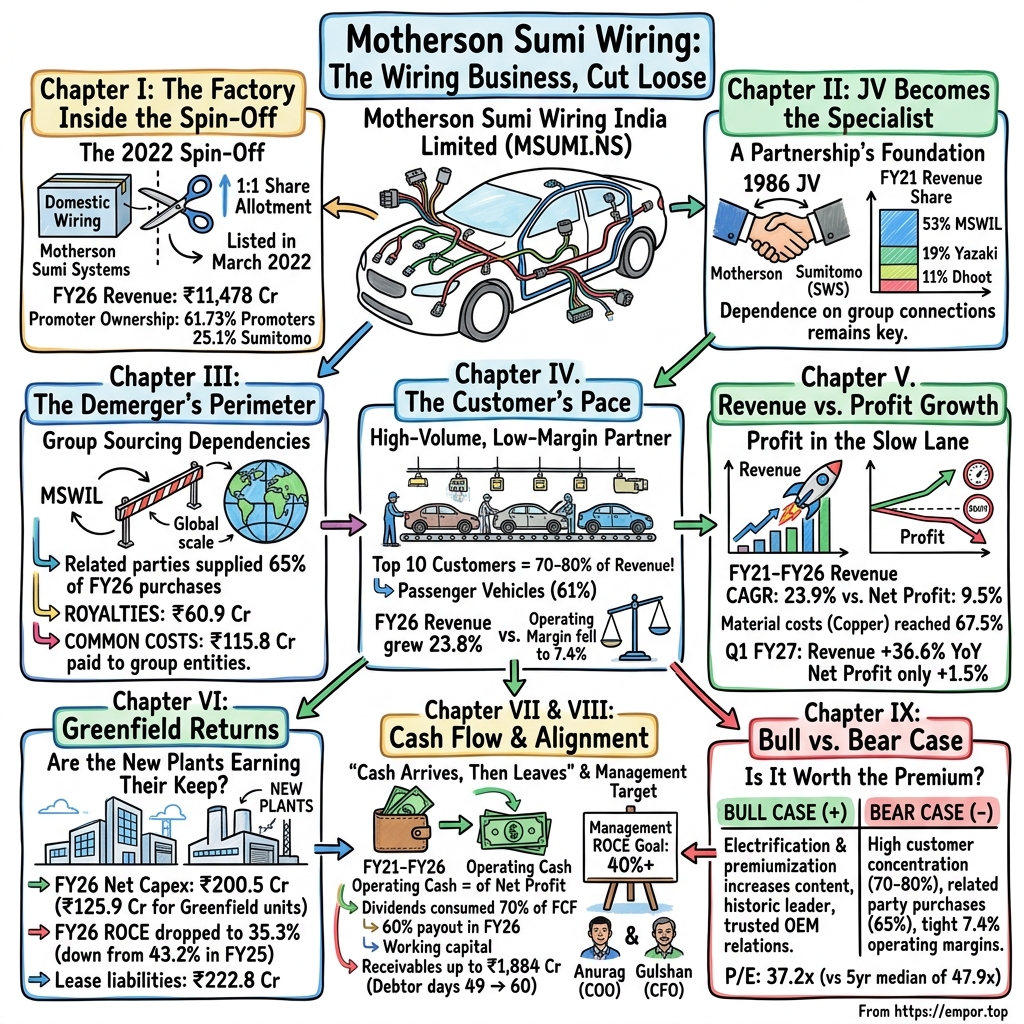
Motherson Sumi Wiring India: The Wiring Business, Cut Loose
I. The Factory Inside the Spin-Off
Pull the trim panels off almost any car built in India and you find it running behind the dashboard, under the carpet and through the doors: the wiring harness. It looks like a mess of coloured spaghetti. It is nothing of the kind.
A harness is a bundle of wires, connectors and terminals, each cut to a precise length, crimped to a precise fitting and taped into a precise shape. It carries battery power to the starter motor, the signal from the brake pedal to the tail lamp, and the chatter between sensors, screens and control units.
If the skeleton of a car is its chassis and the heart is its engine, the harness is its nervous system. Nobody buys a car because of it. Nobody can drive a car without it.
Every one of those bundles is also, in a sense, a small piece of handwork. Robots can cut and crimp wire, but a great deal of harness assembly still means people routing wires across large boards, clipping connectors and checking circuits. That is why, at the end of March 2026, the company in this story counted 5,079 employees and another 58,060 production associates and workers on its shop floors.1 More than sixty thousand people, in other words, building nervous systems for other companies' vehicles.
That company is Motherson Sumi Wiring India Limited, known to the market as MSWIL, and it came into being as a listed company through a corporate separation rather than an initial public offering. In January 2022 the old Motherson Sumi Systems split off its domestic wiring-harness business.
Shareholders of the parent did not have to buy anything: for every share of the parent they held, they were allotted one share of the new wiring company.2 Overnight, a business that had lived as one division inside a sprawling global auto-components group had its own share price, its own board and its own results.
Four years on, that business is no longer small. In the year to March 2026, which Indian companies call FY26, MSWIL reported revenue of ₹11,478 crore, about $1.3 billion, and profit after tax of ₹625 crore.1 Those numbers would make it a meaningful company on almost any stock exchange in the world.
But look at the share register and the boundary of the business blurs. The promoter group, the founders' side of the shareholding, owned about 62% of MSWIL at the end of March 2026, and about the same share was still on file at the end of September.13
Inside that bloc sit two names that matter more than any others: Samvardhana Motherson International Limited, the renamed former parent, and 住友電装 Sumitomo Wiring Systems, the Japanese harness maker that has been Motherson's partner for four decades. Sumitomo Wiring Systems alone holds 25.1%.14
So the obvious question about this spin-off has a less obvious answer. Did the demerger reveal the value of a focused wiring business that had been hidden inside a conglomerate? Or did it hand public investors a fast-growing supplier whose economics still run, in large part, through its former parent and its Japanese partner?
The answer this story arrives at is that it did a little of both. The spin-off gave the business a clear listed identity, but it did not give it an independent supply chain. The partners who own most of it also sell it most of what it buys, license it technology, share its costs and lease it space.1 That is not proof of anything improper. It is, however, the single most important fact for an outside shareholder to understand.
There is one more boundary to draw before the story begins. MSWIL is not Samvardhana Motherson International, the global group with factories across Europe, the Americas and Asia, a string of acquisitions and a far larger revenue base. MSWIL has no subsidiaries.1 It makes wiring harnesses in India for vehicles built and sold mostly in India. When headlines talk about "Motherson" buying a company in Germany or Japan, they are not talking about this listed company.
The stakes, then, are specific. Can MSWIL turn the steady rise in electrical content per vehicle into profit growth, not only sales growth? Can it restore margins that have slipped as it has grown? And can it show public shareholders that the economics flowing to and from its related parties work in their favour?
The route to those answers runs from a joint venture signed in 1986, through a group reorganisation and a demerger, to a company that is now growing revenue far faster than profit. It begins with a partnership between an Indian wire trader and a Japanese industrial house.
 Subscribe on LinkedIn
II. A Joint Venture Becomes the Domestic Wiring Specialist
The Motherson story starts with a family business and a name that carries its own origin myth. Vivek Chaand Sehgal founded the group in the mid-1970s with his mother, and the company's name, a play on "mother's son", has been repeated in Indian business lore ever since.2 It turned to wiring for vehicles at the moment when India's car industry was about to change.
That change had a name: Maruti. In the early 1980s the Indian government partnered with スズキ Suzuki to build a small, affordable car for Indian families, and the arrival of Japanese manufacturing standards forced every supplier around it to raise its game. A young harness maker could either learn Japanese quality systems or get left behind.
Motherson chose to learn. In 1986 it formed a joint venture with Sumitomo Wiring Systems, part of Japan's 住友 Sumitomo group, around automotive wiring.2 The bargain was simple in outline and deep in effect. The Indian partner brought local relationships, local labour and a willingness to build factories close to car plants. The Japanese partner brought harness design know-how, materials science, manufacturing discipline and a seat at the table with Japanese carmakers that were becoming the backbone of Indian vehicle production.
To understand why that bargain mattered, it helps to understand how a harness business actually works. A carmaker decides to build a new model. Long before the first car rolls off the line, it chooses a harness supplier, and the supplier's engineers work with the carmaker's engineers to design a harness for that exact vehicle, down to which variant gets heated seats and which gets a bigger touchscreen.
Then the supplier builds tooling, sets up assembly boards and starts delivering harnesses on the carmaker's schedule, often several times a day, in the sequence in which cars are coming down the line.
That way of working has a geographic consequence. Harnesses are bulky, specific to each variant and needed in a precise order, so they are hard to ship across oceans on a just-in-time schedule. Harness makers therefore tend to build their assembly plants close to the car plants they serve, and to staff them heavily. A supplier that already has factories next to every major customer, and thousands of trained workers in them, holds an advantage that cannot be bought with a single cheque.
Revenue, in other words, follows the carmaker's production. MSWIL recognises revenue when goods are delivered, and it books volume rebates and returns as adjustments to that revenue.1 There is no subscription, no long backlog published to shareholders and, in the company's own disclosures, no stated standard contract length or minimum purchase commitment.1 If a model sells well, the supplier ships more. If a model is discontinued, the supplier's line for that model goes quiet.
Over the decades that followed the joint venture, this model made the Motherson–Sumitomo wiring business the largest player in India's domestic harness market. How large is a question best answered with a date attached. A 2022 analyst report estimated that in FY21, the predecessor business held about 53% of India's domestic wiring revenue, against about 19% for Yazaki India, the local arm of Japan's 矢崎総業 Yazaki Corporation, and about 11% for Dhoot Transmission.5
That is a commanding position, more than its two nearest rivals combined. It is also a five-year-old estimate made by an outside analyst, not a current league table published by the company.
MSWIL does not disclose its own market share, its contract durations, its customer retention rates or how many new programmes it has won or lost in a given year.1 The strongest honest reading is that the business entered the 2020s with a large installed position, not that it holds a proven, permanent moat.
The partnership's fingerprints are all over today's share register. Samvardhana Motherson International holds 33.43% of MSWIL and Sumitomo Wiring Systems holds 25.1%.14 Between them they hold well over half the company, and their ties to it go far beyond ownership. They supply components and raw materials, provide technical support, share common services and, in the case of the Motherson side, lease manufacturing facilities.1
That combination is the source of both the business's strength and the investor's discomfort. A Japanese partner with global harness technology and an Indian partner with factories near every major carmaker is a hard combination for a newcomer to match. But the same relationships that built the business also sit inside its cost base, as royalties, shared costs and purchases.
So when the group decided, in 2020, to carve the domestic wiring business out into its own listed company, it was promising focus. The question was whether focus could also mean clarity: whether an outside shareholder, looking at this new company's accounts, would be able to see where the value was made and who kept it.
III. The Demerger's Promise—and Its Perimeter
On July 3, 2020, the Motherson group announced a reorganisation that was complicated even by the standards of Indian corporate restructurings. The domestic wiring-harness business would be demerged from Motherson Sumi Systems into a new company, while the rest of the business would be combined with Samvardhana Motherson International, the promoter vehicle that held several group assets.6 Shareholders did not like the complexity on day one: the parent's shares fell more than 9% on the news.6
The logic, as the group explained it, was that domestic wiring and the global components empire were different businesses. One was an Indian, labour-intensive, programme-by-programme supplier to Indian carmakers, with modest capital needs. The other was a global acquirer of mirror, bumper and module businesses, carrying debt and integrating companies across continents.2 Putting them in one stock meant investors could not price either cleanly.
The reorganisation needed regulators to sign off. In May 2021 the Competition Commission of India approved the proposed combination.7 Court and shareholder approvals followed, and the demerger became effective on January 5, 2022.1 The wiring company listed at the end of March 2022.8
What exactly did they receive? Here the boundary needs drawing carefully, because it is easy to blur. Shareholders got the Indian domestic wiring-harness business, its factories, its customers and its people. They did not get the old group's global acquisitions, its international plants or its group-wide scale. When the group bought a company abroad after the reorganisation, that was the group's story, not MSWIL's.
Nor did shareholders get a business that buys its inputs at arm's length from strangers. In FY26, related parties supplied 65% of everything MSWIL purchased, up slightly from 64% the year before.1 Goods bought from jointly controlled entities alone came to about ₹5,243 crore, with a further ₹216 crore from other related parties.1
For context, MSWIL's whole bill for materials was roughly two-thirds of its ₹11,478 crore revenue. The overwhelming majority of the copper, connectors, terminals and components inside its harnesses came, directly or indirectly, through companies linked to its controlling shareholders.
Traffic in the other direction is small. Sales to related parties were only 2% of revenue.1 MSWIL sells to independent carmakers. It buys from its family.
Then there are the payments that are not for goods at all. In FY26, MSWIL paid ₹60.9 crore in royalties, up from ₹54.5 crore the year before, and reimbursed ₹115.8 crore of common costs to jointly controlled entities, up from ₹104.2 crore.1 It also bought services from related parties worth about ₹181 crore across the two categories the company discloses.1
Set those numbers beside the business's profit and they stop looking like footnotes. Royalties and common-cost reimbursements together came to roughly ₹177 crore, or about 1.5% of revenue. MSWIL's operating profit, at a 7.4% margin, was roughly ₹850 crore. Those two lines alone equalled about a fifth of operating profit. In a business where every percentage point of margin is fought over, that is a large number.
There is a balance-sheet side to the relationship too. At the end of March 2026, MSWIL owed its jointly controlled entities ₹1,108 crore in trade payables, and another ₹60.9 crore to other related parties.1 Compared with the purchases from those entities, that balance works out to roughly two and a half months of supply.
Put plainly, the related parties are not just suppliers; they are also extending MSWIL a large amount of trade credit, which flatters its working capital and its cash flow. That is useful when it is there. It is also a dependency.
The company's defence is clear and consistent. It says goods transactions with related parties are based on price lists and terms available to third parties, that other transactions are on normal commercial terms and market rates, and that support services are priced at arm's length.1 Its auditor gave an unmodified opinion on the FY26 accounts.1 Shareholders have approved the material transactions when asked.1
None of that is evidence of misconduct, and this story makes no such claim. The issue is verifiability. An outside shareholder cannot see the price lists. MSWIL does not publish a transaction-level comparison showing what it pays its related parties for a given component against what an unrelated supplier would charge, nor a reconciliation that ties royalties, common costs, leases and purchases to the benefits they buy. The shareholder is asked to trust the process rather than inspect the outcome.
That process is being tested right now. For FY27, MSWIL sought shareholder approval for material transactions with Samvardhana Motherson International covering raw materials and components, support services, leases and management fees.19 It is a live governance moment. Approval would not prove the terms fair, and a vote against would not prove them unfair. What would help is disclosure good enough that the vote could be informed by numbers rather than assurances.
So the demerger did create a real operating company, with its own customers, its own factories and its own accounts. But its supplier perimeter is unusually connected to the people who control it. That leaves the next question: what does all that scale actually buy when the company turns around and sells to India's carmakers?
IV. The Customer's Production Line Sets the Pace
Picture the morning a carmaker changes its production plan. A new compact SUV is selling faster than forecast, so the plant adds a shift. A top-trim variant with a larger screen and more sensors is outselling the base model, so the mix changes. A facelift is coming in three months, with a new lighting signature and two extra cameras.
For the harness supplier, every one of those decisions lands on its own shop floor within days. More cars mean more harnesses. A richer mix means longer, heavier, more complex harnesses with more circuits. A facelift means engineering changes, new boards, new tests. The supplier does not set the pace. The customer's production line does.
That is the economic engine of MSWIL in one image. Revenue depends on how many vehicles its customers build, which models they build and how much wiring each one needs. Profit depends on what it costs to make those harnesses, chiefly copper and other materials, then labour, then factories and automation, and on how fully and how quickly carmakers agree to pay for higher costs.
Who are those carmakers? MSWIL does not name them or say how much any one of them buys. Its ratings agency, CRISIL, says the top ten customers account for roughly 70–80% of revenue.4 Passenger vehicles make up about 61% of sales, with the rest spread across commercial vehicles, two-wheelers and off-road vehicles such as tractors and construction equipment.4
That spread matters, but it should not be oversold. Trucks, motorcycles and tractors give MSWIL more than one end market, yet all of them are Indian vehicle markets that tend to rise and fall with the same domestic economy. CRISIL lists exactly that, cyclicality in the auto industry and concentration in the domestic market, as constraints on the company's credit profile.4 This is a business with many customers, but one country and one product.
The segments do behave differently at the margin. A motorcycle harness is short and simple; a tractor or construction machine needs wiring tough enough for dust, vibration and water; a truck harness is long and heavy. Each segment has its own cycle, driven by rural incomes, freight demand or infrastructure spending, and in a good year they can cushion a weak one in cars. But with passenger vehicles supplying close to two-thirds of revenue, the car cycle is the one that sets MSWIL's year.4
The competition is clear enough. CRISIL and analysts name Yazaki India, Dhoot Transmission, 古河電気工業 Furukawa Electric and Spark Minda among MSWIL's rivals.45 Yazaki is the global giant of the harness world, and its Indian subsidiary has its own long-standing relationships with carmakers.10 Dhoot is an Indian specialist with deep roots in two-wheelers. Spark Minda is a diversified Indian auto-components group that makes harnesses alongside other products.
How the shares split today is not public. The historical 53% lead is no guide to whether it has widened, held or narrowed since.5
That gap matters because the bull case rests on a particular kind of advantage. In theory, harness suppliers enjoy strong switching costs. A harness is designed for a specific vehicle, and a carmaker that has qualified a supplier for a model, approved its parts, tested its quality and built logistics around its deliveries has little reason to switch mid-life. Changing supplier for a running model would mean requalification, new tooling and risk on the production line. Those are real frictions.
But switching costs only protect a supplier for the life of a programme. When the carmaker designs the next model, it can invite bids again. It can split work between two suppliers. It can use the threat of a rival to push price. MSWIL does not disclose its retention rate across model changes, how often its customers dual-source, or a record of wins and losses.1
So the switching-cost argument is plausible, but unproven in the company's own numbers. The fairest version is that MSWIL has a strong incumbent position on the programmes it already serves, not demonstrated pricing power over its customers.
Electrification is where the story gets interesting, and where it is easiest to get carried away. An electric vehicle has a high-voltage harness linking battery, inverter and motor, carrying far more power than anything in a petrol car, alongside all the usual low-voltage wiring. Modern cars of every kind also carry more electronics: driver-assistance cameras, larger screens, connected features. More electronics means more circuits, which means more wire and more value per vehicle for the harness maker.
A simple analogy helps. Think of a petrol car's wiring as the electrical system of a house: lots of thin cables carrying modest current to lights and switches. An electric car adds something closer to a substation, thick, heavily insulated cables carrying hundreds of volts between the battery and the motor, with shielding, special connectors and safety requirements to match. The house wiring does not disappear. The substation is added on top.
MSWIL says it is developing new harness architectures to handle rising electrical and electronic content, and investing in production automation for both combustion and electric vehicles.1 CRISIL counts premiumisation and a higher share of SUVs, which tend to carry more features, among the company's growth drivers.4
The catch is that rising content does not automatically mean rising profit for the incumbent. Value per vehicle can go up while the carmaker still chooses who supplies it, and still negotiates the price.
Some next-generation vehicle architectures aim to simplify wiring by grouping electronics into zones, which could shift value from long harnesses toward control units and shorter, smarter connections. Electrification is therefore relevant to MSWIL's core, not a separate business. Who captures the extra value still depends on design wins and contract terms that the company does not publish.
Now set that theory against what actually happened in FY26. Revenue rose 23.8%.1 That is exactly the kind of growth content-per-vehicle and scale should produce. Yet materials rose faster, from about 65.2% of revenue to about 67.5%, and operating margin fell from 8.6% to 7.4%.1
The breakdown is revealing. Materials alone took about 2.3 percentage points more of every rupee of sales. Operating margin fell by only about 1.2 points. So the rest of the cost base, labour, factory overheads and everything else, actually got a little lighter relative to sales as volumes rose. Operating leverage did show up. It was simply swamped by the cost of what goes into the harness.
That is the central test for the whole thesis. If content per vehicle and scale are real advantages, and if carmakers truly value their leading harness supplier, why did a year of very fast growth leave the company with thinner margins? The answer lies in a metal, a timetable and a negotiating table, and it is the subject of the next chapter.
V. Revenue Accelerates; Profit Stays in the Slow Lane
When MSWIL closed its books for FY26, the headline was the kind companies like to frame. Annual revenue had passed ₹10,000 crore for the first time.1 The fourth quarter had grown faster still, with sales up about a third on the year before.1
The line underneath was less festive. Operating profit for the year rose about 1.2%.1 Net profit rose a little over 3%.1 A company that had just added nearly a quarter to its sales had added almost nothing to its operating earnings.
This is not a one-year accident. Stretch the lens across five years and the same pattern appears. From FY21 to FY26, revenue compounded at about 24% a year in rupees, while net profit compounded at about 9.5%.1 Operating margin drifted down from about 13% in FY21 to 7.4% in FY26, and net margin from about 10% to 5.4%.1
Some of that early decline has an innocent explanation. FY21 was a strange, pandemic-shaped year, and the business as it looked before the demerger may not be strictly comparable with the stand-alone company afterwards. But the trend has continued well after the demerger settled. Since FY23, revenue has grown about 18% a year and net profit about 9%.1 The gap between growth and profit has not closed. It has persisted.
Why? Start with copper. A wiring harness is, at its most basic, copper wire wrapped in insulation, joined by copper-alloy terminals. Copper is priced globally on the London Metal Exchange, and when that price rises, a harness maker's cost rises almost immediately. MSWIL itself points to copper and LME exposure, and to the timing of price recovery from customers, among the reasons for the margin squeeze.1
Price recovery is where the timetable comes in. Carmakers generally agree to pass through changes in metal prices, but not instantly. Many arrangements reset prices periodically, using an average of past metal prices. In a rising copper market, the supplier pays today's price and gets reimbursed later, at yesterday's. That lag can squeeze margins for a while even if the supplier eventually recovers every rupee.
There is a subtler arithmetic effect too. If a supplier passes copper through at cost, without a markup, then higher copper prices raise revenue and raise costs by the same amount in rupees. Profit in rupees stays where it was, but margin as a percentage falls, because the denominator got bigger.
Some of MSWIL's margin decline may be this kind of optical compression rather than lost economics. The company does not publish a split of its revenue growth between volume, mix, content and metal pass-through, which is precisely the disclosure that would let an investor tell the difference.
There is a currency thread running through the same cost base. MSWIL's sales are almost entirely domestic, and its exports are negligible, but it imports a great deal: in FY26 its foreign-exchange outgo was about ₹1,959 crore, against inflows of barely ₹6 crore.1 At the end of March 2026, it carried unhedged payables in dollars, yen and euros, with the yen exposure the largest of the three.1
The company says its major customers have arrangements to pass on the impact of import exchange rates, and it estimates that a 1% move in currencies would shift pre-tax profit by about ₹5 crore.1 So currency is a smaller lever than copper. But it works the same way: costs move first, recovery follows, and the margin absorbs the gap in between.
Then there is the negotiating table. Labour costs in India have risen, and MSWIL employs a very large workforce. Wage increases, unlike copper, do not usually come with an automatic pass-through clause. Recovering them means persuading carmakers to accept a price increase, and carmakers, especially ones that buy at the scale of MSWIL's top customers, push back hard.
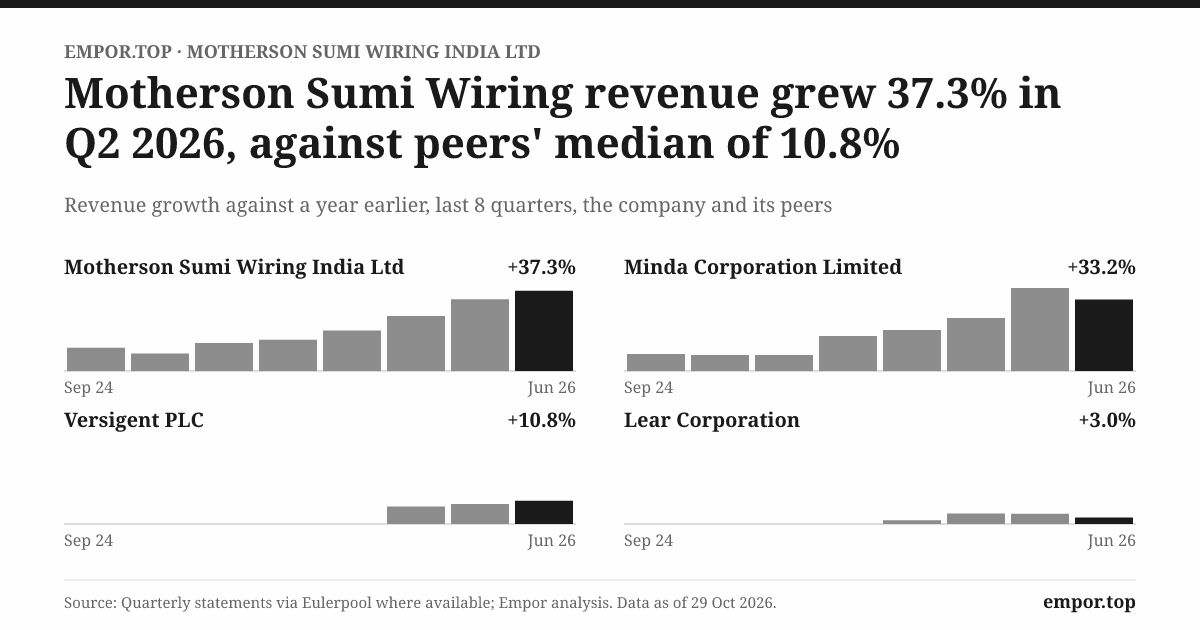
Did the squeeze ease in the newest numbers? As of today, October 29, 2026, the latest reported quarter is the June 2026 quarter, the first of FY27. Revenue in that quarter rose roughly 37% from a year earlier.11 Net profit rose just 1.5%, and net margin fell to 4.3%.11 Operating margin in the quarter was below 6%, the lowest of any quarter in more than three years.11
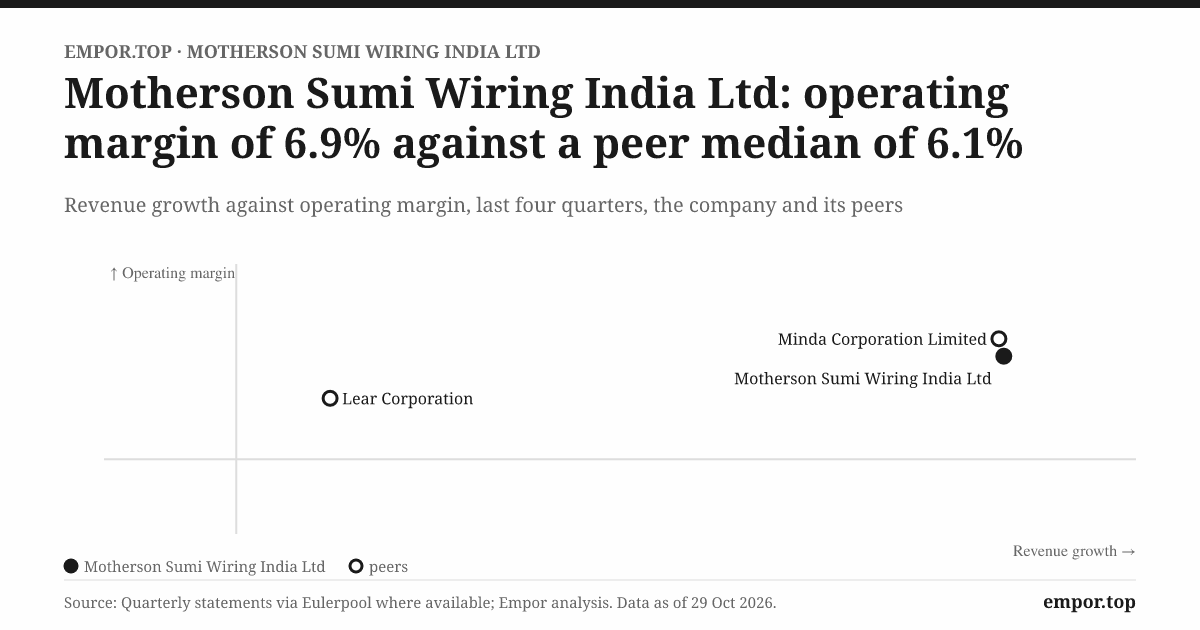
The quarterly path matters more than any single point on it, because it shows direction. Through the middle of 2025, operating margin hovered around 8%. It then slipped quarter by quarter to below 6% in June 2026.11
Four consecutive readings, each lower than the last, while revenue growth climbed from the mid-teens to the high thirties.11 That is not noise around a stable level. It is a trend, and it has been running in the wrong direction for a year.
In other words, growth accelerated and profit conversion got worse. The trend that defined FY26 not only continued into FY27, it intensified. The whole problem fits in one sentence: in the latest quarter, the company sold over a third more and earned about the same.
It is worth setting this against what outsiders expected not long ago. In October 2025, CRISIL said it expected MSWIL's operating profitability to sit at 11–12% over the medium term.4 Even measured generously, before depreciation, FY26 margins were around 9%, and at the operating-profit level they were 7.4%.1
CRISIL's figure was a rating agency's expectation, not management guidance, and it is now a year old. But it shows how far the business has drifted from what a careful outside observer thought it could earn. That is a demanding benchmark, and so far the company has moved away from it, not toward it.
The results calls are where the live version of this story gets told, and the April 2026 call on the Q4 FY26 numbers and the Q1 FY27 call that followed are the ones to read side by side.1213 Four questions decide whether the squeeze is temporary: how much of the copper move has been passed through, how wage increases will be recovered, when margins are expected to normalise and whether more capacity will be needed. The answer that matters most will not come in a prepared remark. It will come in the numbers, quarter by quarter.
The falsifier, then, is simple to state. If margins recover sequentially over the next few quarters, while revenue keeps growing, the operating-leverage story is alive: the squeeze was timing, and the scale is paying off. If another year passes with sales outrunning operating profit, the growth thesis narrows to something smaller. MSWIL would then be a reliable, growing supplier, but one that passes most of the value of rising content on to its customers and its suppliers.
There is one more factor that shapes the margin, and it is the one under management's most direct control: the new factories it has been building to keep up with all that growth.
VI. The New Plants Have to Earn Their Keep
Any harness maker growing at a quarter a year runs into the same physical limit: floor space. Harness assembly needs long boards, large teams and space for testing and sequencing deliveries. When orders rise, the supplier needs more lines, often in new buildings close to new car plants. So the period of fastest growth in MSWIL's history has also been a period of building.
In FY26, net capital expenditure came to about ₹200.5 crore, up from about ₹171 crore the year before, and roughly ₹126 crore of it went into greenfield units, new factories built from bare land.1 That spending landed squarely inside the ₹200–220 crore range CRISIL had been told to expect.4 On the narrow question of whether management spent what it said it would, the record is clean.
What all that spending buys is a different question. A new plant brings depreciation from the day it starts, rent if the building is leased, and a workforce that has to be hired and trained before it is fully productive. Revenue arrives only as carmakers ramp up the models the plant serves. For a while, then, a new factory tends to depress margins before it lifts them.
Some of that pattern may be visible in the record. Return on capital employed, a measure of how much operating profit the business earns on the capital tied up in it, fell from 43.2% in FY25 to 35.3% in FY26.1 Five years earlier, in FY21, the same measure had been above 65%.1
The return is still high by the standards of most manufacturers, which is a mark of how little capital a harness business needs. But it has been falling, and the latest leg of the fall coincides with the latest burst of building.
Labour is the other side of the capacity story. With more than sixty thousand people across employees and production associates, MSWIL generated roughly ₹18 lakh of revenue per person in FY26.1 That is a reminder of how hands-on harness making still is, and of why wage inflation bites. Every rupee added to the daily wage is multiplied across a workforce the size of a small town.
The company does not publish a comparable headcount history, so it is impossible to say from its disclosures whether output per worker has been rising.1 That is the number automation is supposed to move, and the one that would show whether the new plants are more productive than the old.
Alongside capacity, MSWIL is spending on capability. Research and development came to ₹47.7 crore in FY26, about 0.42% of turnover, with none of it capitalised.1 The company says it is continuing its work on harness architectures and production automation.1
Those are sensible things for a harness maker to work on. They are also hard to value. MSWIL does not quantify how much revenue comes from new architectures or electric-vehicle programmes, nor what returns its automation projects earn. A research budget of under half a percent of sales is modest for a company whose bull case depends on rising technical content.
That modesty partly reflects the arrangement with its partners: much of the deep harness technology sits with Sumitomo Wiring Systems, and MSWIL pays royalties for it.1 Technical ambition, in this case, is not yet proven commercialisation, and a good part of the technology is rented rather than owned.
The balance sheet, at least, is not a worry. At the end of March 2026, MSWIL's borrowings were tiny, about ₹10.4 crore, and its cash exceeded those borrowings by about ₹56 crore.1 Lease liabilities, which are not ordinary debt but are a real obligation, came to about ₹223 crore.1
Even counting leases, net debt was about ₹167 crore, or roughly 0.16 times a year's operating cash earnings before depreciation.1 The company says it met all its loan covenants, and CRISIL describes its liquidity as strong.14
That is a business funding its expansion out of its own pocket. There has been no equity raising: the company reports no private placement or qualified institutional placement in FY26.1 It has no subsidiaries and, in FY26, made no acquisitions.1 Whatever the wider Motherson group has bought around the world, MSWIL's growth has been built plant by plant in India.
Still, the leases deserve a second look. Some of MSWIL's manufacturing space is leased from related parties, and leases are part of the FY27 related-party approval.1 So the question of whether new capacity pays off is tied to the question of what MSWIL pays its own group for the buildings it runs in.
What would settle the capacity question? Plant-level utilisation, the share of each new plant's capacity that is actually in use, and incremental operating profit by facility. MSWIL does not publish either. Without them, an investor cannot tell whether the falling return on capital reflects plants still ramping, which should reverse, or a permanently lower return on newer, more automated capacity, which would not.
One comparison puts the building programme in proportion. FY26 depreciation was about ₹216 crore, almost exactly the size of that year's capital spending.1 Net of wear and tear, in other words, the asset base grew far more slowly than sales, which rose by nearly a quarter.1 That is a tribute to how capital-light harness assembly is, and part of why return on capital remains high. It also suggests that some of the growth is being carried by leased space and by sweating existing plants harder, both of which have limits.
The capex record establishes that management is building, on budget, without borrowing. It does not yet establish that the building creates value. And the most visible place to look for that value is not the factory at all, but the cash that flows out of it.
VII. The Cash Arrives—Then Leaves
Profit is an opinion; cash is a fact. The old accounting saying is a useful lens for a business like MSWIL, because a harness maker's profits are only as good as the carmakers' willingness to pay its invoices and the suppliers' willingness to wait for theirs.
Over the six years from FY21 to FY26, the business reported cumulative net profit of about ₹3,163 crore. Over the same years, it generated about ₹2,649 crore in cash from operations, roughly 84% of that profit.1
That is not a perfect conversion rate, but for a company whose sales nearly tripled in the period, it is a reasonable one. Fast-growing manufacturers have to put money into inventory and receivables before they get it back, and some lag between profit and cash is the normal price of growth.
The year-by-year path was bumpy. In some years operating cash ran close to earnings before depreciation; in others it fell to less than half.1 That unevenness is what working capital does in a business tied to customer schedules and metal prices, and it is why the six-year view is more honest than any single year.
Where did the cash go? After paying for new plants and equipment, the business produced about ₹1,828 crore of free cash flow over those six years.1 It paid out about ₹1,282 crore as dividends, around 70% of that free cash.1
Dividends began after the listing, in FY23, and the payout has generally sat around half of profits, rising to 60% in FY26.1 In FY26 that meant roughly ₹375 crore of cash leaving the company for shareholders, the majority of it, given the share register, going to the promoter group and its two great partners.13
That is a sensible policy for a business that needs relatively little capital, as long as the cash is really surplus. The test is whether paying it out competes with the needs of a company that is growing at 20% to 35% a year. And FY26 is where that test became visible.
FY26 itself shows how the arithmetic worked. Free cash flow for the year was roughly ₹550 crore, enough to cover the dividend with something to spare, even after the receivables build.1 The margin of safety, however, owed a great deal to the jump in payables, which is the line that would reverse first if suppliers asked to be paid sooner.
Follow the cash through FY26. Before any changes in working capital, the business generated about ₹1,062 crore of operating profit plus non-cash charges such as depreciation.1 Then growth took its share. Trade receivables, money owed by customers, absorbed about ₹641 crore. Inventory absorbed another ₹448 crore. Against that, the company owed its own suppliers about ₹797 crore more than a year earlier, which put cash back.1 After tax, operating cash flow came to about ₹761 crore.1
Notice the shape of that. Customers and stock together took more than a thousand crore. Suppliers handed most of it back by being paid later. And those suppliers are largely companies linked to the controlling shareholders. The working-capital cushion that kept FY26 cash flow healthy rests, in good part, on the patience of the controlling shareholders' businesses.
The treasury tells the same story from another angle. A year before, at the end of March 2025, the company had held about ₹237 crore across cash and bank deposits; by March 2026 that had fallen to about ₹69 crore.1 Interest income dropped accordingly, from about ₹12 crore to about ₹3 crore.1
Other income as a whole was a rounding error against pre-tax profit of ₹822 crore, so the profit line barely noticed.1 The cushion, though, had been spent: a year of fast growth, new plants and a higher dividend had drawn the company's cash pile down to a thin layer.
The receivables build is the number to watch. Trade receivables rose to about ₹1,884 crore at the end of March 2026, from about ₹1,244 crore a year earlier, a jump of more than half while sales rose by about a quarter.1 Measured in days of sales, the time it takes the average customer to pay rose from 49 days to 60.1
That sounds alarming until one opens the ageing schedule, and then it sounds less so. Of the ₹1,884 crore, about ₹1,746 crore, or roughly 93%, was current and not yet due.1 Only about ₹13 crore was overdue by less than six months, and only about ₹6 crore by more than six months.1
A sliver, under ₹1 crore, was classified as credit-impaired and fully provided for, and there were no disputed or unbilled receivables.1 The company says its standard terms run from 30 to 90 days.1
So this is not a picture of customers refusing to pay. It is a picture of a lot of recent invoices, which is what one would expect after a quarter in which sales grew about a third. Debtor days at 60 are also roughly where they were in FY21, before they fell into the 40s.1 The jump may prove to be timing.
It may also be something more. A larger share of sales going to customers on longer terms, or a mix shift toward segments that pay more slowly, would show up the same way at first. MSWIL does not break down receivables by customer or segment, so the only way to tell is to watch whether debtor days fall back as growth normalises.
There is a simple operating test here. If debtor days ease back toward 50 and operating cash keeps pace with earnings over the next couple of reporting periods, the FY26 receivables surge was a growth-related timing effect, and the dividend remains comfortably covered. If debtor days keep climbing while margins stay thin, the company will be funding its customers, its expansion and its dividend from a shrinking profit pool, and something will have to give.
Which brings the story to the people who decide what gives.
VIII. A ROCE Promise Meets a Margin Problem
Most listed Indian companies have a recognisable face: a founder on television, a managing director quoted in every results story. MSWIL is different. It is run more like a business unit than a celebrity company, and its leadership reflects that.
The operating leader is Anurag Gahlot, a whole-time director and chief operating officer.1 He is the person whose job is to make the plants run, the deliveries arrive in sequence and the costs come down.
Finance changed hands during FY26: Mahender Chhabra stepped down as chief financial officer in June 2025, and Gulshan took over the role in July 2025.1 A new CFO arriving in the middle of a margin squeeze inherits the hardest question the company faces, and every results call since has served, in part, as an introduction to investors.
Above the managers sit the owners, and here it is important to separate two kinds of alignment. The first is ownership. The promoter group holds about 62%, led by Samvardhana Motherson International and Sumitomo Wiring Systems.13 They own most of the company and suffer most if its value falls. In that sense, alignment is strong.
That alignment is complicated by the related-party sourcing and fees described earlier in the story. A rupee that moves from MSWIL's profit into a related party's revenue is not entirely lost to the promoters, but it is lost to the 38% of shareholders outside the promoter group.
The second kind of alignment is management incentives. In February 2026, shareholders approved by postal ballot an employee stock option scheme, the Motherson Sumi Wiring India ESOP 2025, allowing up to 15.5 million options.114
Against a share base that was enlarged by a one-for-two bonus issue allotted in July 2025, that is a modest pool.1 It ties some employees' rewards to the share price. Whether it ties them to the right thing, profit per share rather than revenue growth, depends on vesting conditions that matter more than the headline.
Outside the promoter bloc, the owners are a mix of professionals and households. At the end of March 2026, mutual funds held about 15% of the company, foreign portfolio investors nearly 10% and insurers about 2%, while individuals held roughly 9.5%.1 By the end of September, the company counted 889,765 public shareholders.3
Many of them did not choose to buy a wiring company at all; they inherited it from the demerger and stayed. They are, in a very literal sense, the minority this story keeps returning to, and their only levers are the vote on related-party resolutions and the decision to sell.
The bonus issue needs one sentence of care. Because one new share was issued for every two held in July 2025, the share count rose by half without any new money coming in.1 Per-share figures before and after that date are not comparable unless adjusted for it. The underlying test is still earnings per share on the enlarged base, which over the last twelve months came to under one rupee.11
Now hold management's own stated goal up against the record. At its investor meet in September 2025, the company pointed investors toward a return on capital employed above 40%.15 It has since repeated that ambition when pressed on margins and capacity.13 That is a good kind of target: it focuses on returns, not just growth, and it implies capital discipline.
But in FY26, the year after the goal was set out, return on capital employed came in at 35.3%, down from 43.2%.1 Operating margin fell. Return on equity fell from about 36% to about 29%.1 The first quarter of FY27 then delivered the widest gap yet between sales growth and profit growth.11 On the evidence so far, the company is moving away from its own target, not toward it.
What would it take to get back above 40%? In practical terms, four things. The new plants would have to fill up, so that the same fixed costs are spread over more harnesses. Customers would have to pay for higher copper and wage costs promptly.
Productivity on the shop floor would have to rise faster than wages, which is what the automation spending is meant to deliver. And capital would have to stay lean: no more capacity than the order book justifies, and working capital back to its earlier discipline.
Each of those is measurable. A credible plan would come with numbers attached: utilisation at the new plants, the share of cost increases recovered and the lag, labour productivity. Investors comparing the September 2025 investor meet, the Q4 FY26 call and the Q1 FY27 call should look for whether those numbers appear, and whether they stay consistent from one meeting to the next.121513 A target repeated without the mechanics is a hope. A target explained with the mechanics is a plan.
The formal governance record is orderly. The FY26 auditor's opinion was unmodified.1 Independent directors declared their independence and all attended their February 2026 meeting.1 The auditor certified managerial remuneration as compliant with company law.1
Claims against the company not acknowledged as debt, mostly customs, service-tax and GST disputes, came to about ₹38 crore, with a few crore more in workmen's claims, and the company judges an outflow possible rather than probable.1 For a business of this size, those are small. There have been no securities-market penalties in the past three years.1
Votes tell a bit more. Scrutinisers' reports on the ESOP ballot and on the 2026 annual meeting show how much support and how much dissent each resolution drew.1416 With the promoter group holding more than three-fifths of the votes, approval is never really in doubt on ordinary resolutions; on related-party resolutions, where interested promoters cannot vote, the minority's voice carries real weight. Even then, approval establishes consent, not fairness.
Put the skeptic's question plainly, as an activist investor would. Do the related-party transactions leave outside shareholders better off? The answer, and the answer to the margin question, will shape whether the market's current price for this business is generous or fair.
IX. Analysis & Bear vs. Bull Case
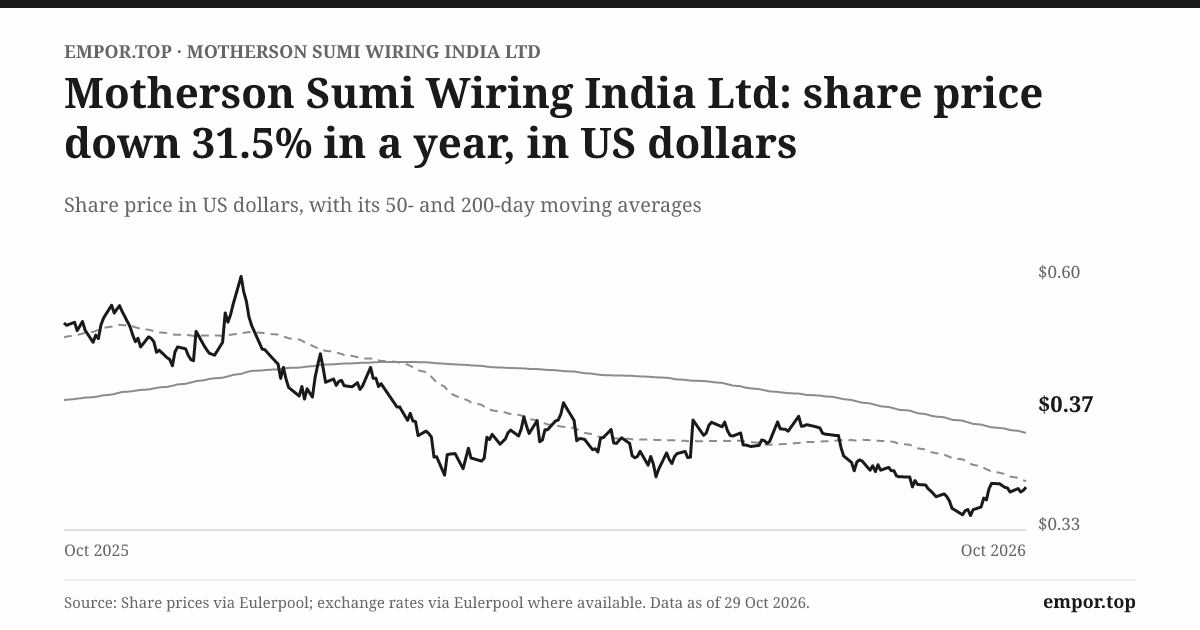
On October 29, 2026, MSWIL's shares closed at about ₹35.22.17 That is roughly a third below their 52-week high of about ₹52.30, and close to the year's low of about ₹32.89.17 The whole company is valued at about ₹23,400 crore.17
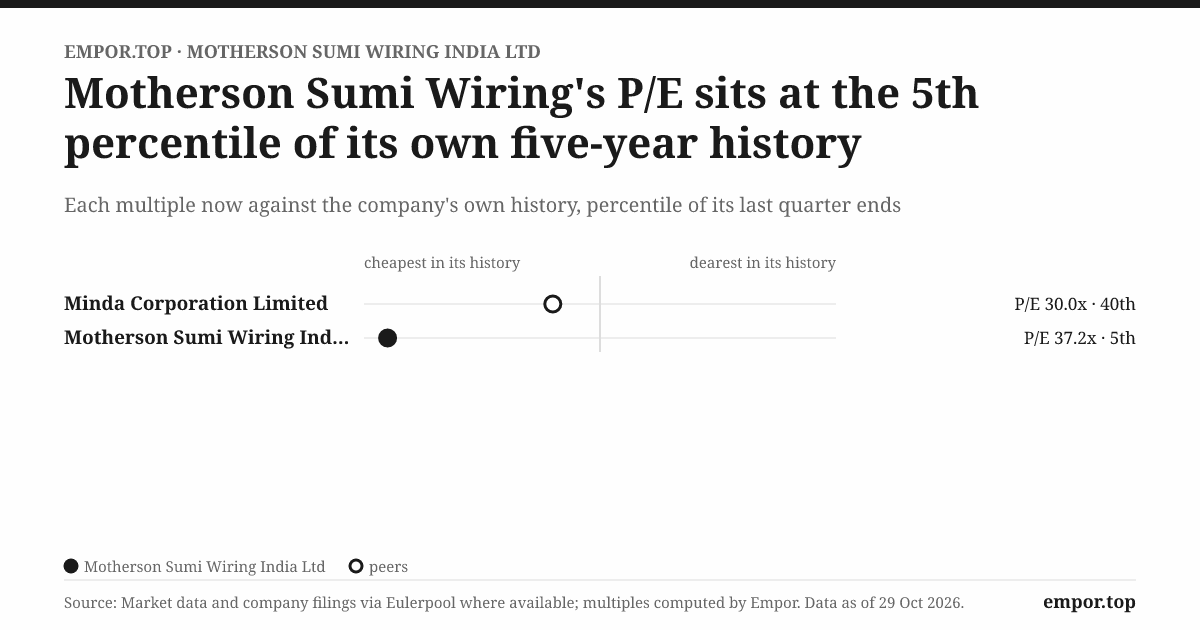
At that price, investors pay about 37 times the last twelve months' earnings.1117 Against the company's own history, that looks like a discount: over the past five years, the median price-to-earnings multiple has been nearly 48.17 Measured on enterprise value, the business trades at about 22 times earnings before interest, tax, depreciation and amortisation.17 Turn the price-to-earnings multiple upside down and the earnings yield is about 2.7%: for every ₹100 invested, the company currently earns about ₹2.70.
That is a price for growth, not for the present. It assumes that today's thin margins are a trough and that earnings will grow substantially faster than they have recently. A business with a 7.4% operating margin and a 5.4% net margin does not usually command 37 times earnings unless investors believe the margins will widen and the growth will last.1 So the real question is whether the evidence supports those beliefs.
The bull case is not hard to build. India is still a young car market, with vehicle ownership well below that of richer economies, and every new vehicle needs a harness. Cars are getting more electrical with every generation: more screens, more sensors, more driver-assistance features, and, increasingly, electric drivetrains with high-voltage wiring. Premiumisation and the shift toward SUVs raise content further.4
MSWIL enters that future with decades-old relationships with India's leading carmakers, a historical domestic share that was larger than its next two rivals combined, the technical backing of one of the world's biggest harness makers, and new capacity being built without debt.145 If margins merely return to where they were a couple of years ago, earnings could grow far faster than sales for a while.
The bear case is just as clear. MSWIL makes one product, for one country's vehicle industry, which is cyclical.4 Its top ten customers account for 70–80% of revenue.4 Related parties supply 65% of its purchases, and royalties and common costs consume a fifth of operating profit.1 Margins have been falling for five years, and fell faster in the latest quarter.111 Its return on capital is still high, but has dropped sharply. And the stock still trades at a premium multiple.
Lenders, who care about survival rather than upside, side broadly with neither camp. In October 2025, CRISIL reaffirmed MSWIL's long-term rating at AA+ with a stable outlook and its short-term rating at A1+, among the strongest grades an Indian manufacturer can hold.4 It credited the market position, the carmaker relationships, the spread of customers and the strength of the parentage, and it expected cash accruals of more than ₹500 crore in each of FY26 and FY27.4
On FY26 the business cleared that bar comfortably, with net profit plus depreciation of roughly ₹840 crore.1 The credit view, in short, is that this is a very safe company. Safety, however, is not the same as a high return, and the rating says nothing about whether the equity is cheap.
A structured look at the industry helps decide which case has more weight, and here it is worth running the full analysis once. Start with the buyers. India's carmakers are few, large and sophisticated, and MSWIL's ten biggest customers buy most of its output. Their bargaining power is high, which is the most important single fact about the industry's economics.
The suppliers come next. Copper is a global commodity with a price MSWIL cannot influence. Beyond copper, MSWIL's supply chain is dominated by its own related parties, which gives those parties a structural influence over its costs that an ordinary supplier would not have. Supplier power, in this case, is high and unusually concentrated.
Rivalry is real but orderly. Yazaki, Dhoot, Furukawa and Spark Minda compete for programmes, and global giants can follow their home-country carmakers into India.4510 Rivalry tends to play out at the moment of each new model's sourcing decision, which is exactly where pricing gets set.
The threat of new entrants is tempered. A newcomer would need to win qualification from carmakers, build plants close to their factories, train thousands of workers and prove it can deliver in sequence without stopping a production line. That takes years. Finally, there is no substitute for a harness at the level of the whole vehicle, but changes in vehicle architecture, from long point-to-point wiring toward zonal designs, can shift where the value sits.
Read together, those forces describe an industry where incumbents are hard to dislodge but have limited power to set prices. That is consistent with MSWIL's actual record: durable revenue, thin and falling margins.
Hamilton Helmer's "seven powers" framework asks a narrower question: what, if anything, lets a company earn persistently higher returns than its rivals? Two of the seven powers plausibly apply. The first is scale economies. As the biggest harness maker in India, MSWIL should be able to spread engineering, purchasing and overheads across more volume.
The evidence is mixed: non-material costs did fall as a share of sales in FY26, but the advantage did not show up in overall margins. The second is switching costs, which apply within a vehicle programme but reset at each new model.
Two other powers are borrowed rather than owned. MSWIL's technology largely comes through Sumitomo Wiring Systems under licence, and its purchasing scale is partly the group's. Those are valuable, but they are what Helmer would call cornered resources held by someone else, and MSWIL pays for access to them through royalties and shared costs.
None of the remaining powers, network effects, counter-positioning, brand or process power, has strong evidence here. Process power, the hard-to-copy operational excellence that トヨタ Toyota made famous, may exist inside MSWIL's factories, but it does not show up in its margins.
So the moat argument narrows. The historical record supports scale and qualification advantages that make MSWIL hard to replace. It does not support the stronger claim that MSWIL can price its products above its costs in a way its customers must accept. The company does not publish current market share, price realisation, customer retention or programme wins, so even the narrower claim rests on an incumbent position estimated half a decade ago.5
A little arithmetic shows how much rides on margins. Net margin was about 7.7% in FY24 and 5.4% in FY26.1 Had FY26 sales been earned at the FY24 net margin, profit would have been more than 40% higher, and today's price would represent about 26 times those earnings rather than 37.
That is the gap the market appears to be pricing in: not heroic growth, but a return to the profitability the company itself delivered only two years ago. Whether that return happens is the whole question.
Stress-test the valuation with that conclusion in mind. The discount to the five-year median multiple is real, but the median was set when margins were higher and returns stronger. A lower multiple for a business with lower margins is not obviously a bargain; it may simply be the market catching up with the economics.
On the other side, if margins do recover to something closer to their FY24 levels, today's earnings understate the company's earning power, and the multiple on recovered earnings would look much less demanding.
So the decision rests on three measures. The first is operating margin, which was 7.4% in FY26 and fell below 6% in the first quarter of FY27.111 It tells an investor whether content growth and scale are converting into profit.
The second is return on capital employed, at 35.3% in FY26 and falling.1 It tells whether the new plants are earning their keep. The third is debtor days and the cash conversion that depends on them, at 60 days in FY26 and rising.1 It tells whether the growth is turning into cash.
The disconfirming evidence sits right beside the thesis. A year ago, CRISIL expected operating profitability of 11–12% in the medium term.4 Today, the company sits several points below that. If the next two reporting periods show margins rising and the new plants contributing, the bull case gains real support. If they show the opposite, the premium multiple will be very hard to defend. The market, at today's price, is betting on the first outcome while the latest numbers point to the second.
X. Business & Investing Lessons
Picture the results day for FY26 again. A record year of sales, more than a fifth higher than the year before. A margin that fell. A footnote showing that two-thirds of what the company bought came from its own family. The record and the warning arrived in the same document, and that collision is where MSWIL's lessons live.
The first lesson comes from that growth-and-profit split. For a whole year, sales rose about 24% and operating profit about 1%.1 Every harness was ordered, built and delivered, and the factories were busier than ever.
Yet the value of all that work went to copper producers, to workers whose wages rose, to customers who paid for higher costs only after a delay, and to related parties whose bills rose in step with sales. For founders and investors in any supplier business, the takeaway is that volume and value are different things, and only one of them pays dividends. A full order book can still be a thin-margin business.
The second lesson comes from the demerger. In January 2022, the group drew a neat line around the domestic wiring business and gave it a stock symbol. The line made the business easier to see. It did not make the business less connected; its related-party dependencies crossed the new boundary as easily as they had crossed the old internal one.
Spin-offs are often celebrated for unlocking hidden value, and sometimes they do. But an investor in a spin-off must ask what the new company still needs from the old one, and on what terms. A spin-off clarifies the boundary; it does not erase the dependencies.
The third lesson comes from the cash. The dividend has been sustainable because the business needs relatively little capital and because suppliers, mostly the group's own, have extended it generous credit. If carmakers slow their payments or those suppliers tighten theirs, the cash that funds the dividend shrinks quickly. A dividend is only durable when the factory and the customer both pay on time.
The fourth lesson concerns the technology. MSWIL's most important know-how arrives through a licence from its Japanese partner.1 That arrangement has given an Indian harness maker access to world-class engineering for four decades, and it is a large part of why carmakers trust it.
It also means the most defensible part of the business is not wholly owned by the listed company. When a moat is licensed, the toll is paid every year, and it grows with the castle. Borrowed power is still power, but the lender sets the rent.
The last lesson is about moats. MSWIL's incumbent position is real, but its pricing power remains unproven.
But dominance in volume is not the same as dominance in price, and a supplier's moat should be measured by what its customers keep buying and what they pay for it. MSWIL's record proves the first and leaves the second unproven. For a supplier, the moat is what the customer keeps buying, and what the supplier gets paid to make.
XI. Epilogue
Tonight, MSWIL stands at an awkward point in its story. Its sales are growing faster than at any time since the listing. Its margins are the thinnest they have been. Its shares sit close to their lowest level of the year, still priced for a recovery the latest numbers have not yet delivered.1117 The next chapter will be written in a few short documents: the coming quarterly results, the ones after that, and the FY27 annual report next summer.
Each will answer one of the story's three central questions.
The first is margins. If the next quarter shows operating margin rising from its June low while revenue keeps growing, the content-and-scale thesis gains its first real evidence in more than a year.
It would suggest that the copper and wage squeeze was a matter of timing, and that carmakers are paying for what MSWIL makes. If growth again outruns operating profit, the thesis shrinks. MSWIL would remain a solid, growing supplier, but the case for paying a premium for its earnings would lose its foundation.
The second is the new plants. If greenfield capacity starts to lift return on capital without a sharp rise in lease obligations, the building programme is earning its place. If returns keep falling while the plants ramp up, investors will need to ask whether the new, more automated capacity earns less than the old, and whether the 40%-plus return goal remains realistic.15
The third is cash. If debtor days ease back from 60 and operating cash keeps pace with earnings, the FY26 receivables surge will look like what the company's ageing schedule suggests: lots of fresh invoices from a period of fast growth. If debtor days keep climbing, the cash story changes, and with it the comfort around the dividend.
Running beneath all three is the related-party question. FY27's material transactions with Samvardhana Motherson International, covering materials, services, leases and management fees, will be voted on and then reported.19
The most useful thing management and the controlling shareholders could do for outside investors is not to win the vote, which is likely, but to explain the economics in enough detail that the vote means something. A clear reconciliation of what MSWIL pays its related parties and what it gets in return would do more for the stock's credibility than any growth target.
None of these questions will be settled in a single quarter. All of them will be visible within a year. And the tension at the heart of this story, between a business that is clearly growing and one that has not yet shown it can keep the value of its growth, is the one those results will either resolve or deepen.
XII. Outro
Go back to the harness behind the dashboard. Thousands of wires, each one cut, crimped and routed by hand or machine, each one carrying a signal or a current that the car cannot run without. Its genius is that every connection works together, and its fragility is that one bad joint can stop the whole vehicle.
MSWIL is built the same way. Its wires run outward to India's carmakers, inward to its more than sixty thousand workers, and back, over and over, to the two shareholders who created it.
It is a focused domestic champion and a node in someone else's network at the same time. Its task, from here, is to prove that its place in the vehicle and its place in the group both carry value to the people who own its shares, not only to the people it is connected to.
References
-
Annual Report 2025–26 — Motherson Sumi Wiring India Limited, 2026 ↩↩↩↩↩↩↩↩↩↩↩↩↩↩↩↩↩↩↩↩↩↩↩↩↩↩↩↩↩↩↩↩↩↩↩↩↩↩↩↩↩↩↩↩↩↩↩↩↩↩↩↩↩↩↩↩↩↩↩↩↩↩↩↩↩↩↩↩↩↩↩↩↩↩↩↩↩↩↩↩↩↩↩↩↩↩↩↩↩↩↩↩↩↩↩↩↩↩↩↩↩
-
Information Memorandum — Motherson Sumi Wiring India Limited via BSE India, 2022-03-24 ↩↩↩↩
-
Corporate Filings: Shareholding Patterns — NSE India, 2026-09-30 ↩↩↩↩
-
Ratings reaffirmed at 'Crisil AA+/Stable/Crisil A1+' — CRISIL Ratings, 2025-10-01 ↩↩↩↩↩↩↩↩↩↩↩↩↩↩↩↩↩↩↩
-
Motherson Sumi Wiring India Annual Report Analysis — Systematix, 2022-08-18 ↩↩↩↩↩↩
-
Motherson Sumi shares tank over 9% after group restructuring announcement — Business Standard, 2020-07-03 ↩↩
-
CCI approves proposed combination involving the Motherson group reorganisation — Press Information Bureau, 2021-05-27 ↩
-
Motherson Sumi Wiring India marks its trading debut — India Infoline, 2022 ↩
-
Corporate Filings and Announcements: FY27 related-party transaction disclosure — NSE India ↩↩
-
Yazaki India Private Limited rating rationale — CRISIL, 2023-12-26 ↩↩
-
Q1 FY27 Results Presentation — Motherson Sumi Wiring India Limited, 2026 ↩↩↩↩↩↩↩↩↩↩↩
-
Transcript of the investor call on Q4 FY26 results — Motherson Sumi Wiring India Limited, 2026-04-28 ↩↩
-
Analyst Call Transcripts, including Q1 FY27 — Motherson Sumi Wiring India Limited ↩↩↩
-
Result of Postal Ballot on ESOP Scheme — NSE India, 2026-02-28 ↩↩
-
Transcript of Presentation at Investor Meet 2025 — Motherson Sumi Wiring India Limited, 2025-09-05 ↩↩↩
-
Stock Exchange Disclosures — Motherson Sumi Wiring India Limited ↩
 LinkedIn
 WhatsApp
 Reddit
 Hacker News
 Email
 Kindle
 RSS Feed
 Spotify
 Apple Podcasts
 Amazon Music
 Audible
 YouTube