Morepen Laboratories: The CDMO Breakout and the Cash It Has Yet to Prove
The Quarter Morepen Changed Scale
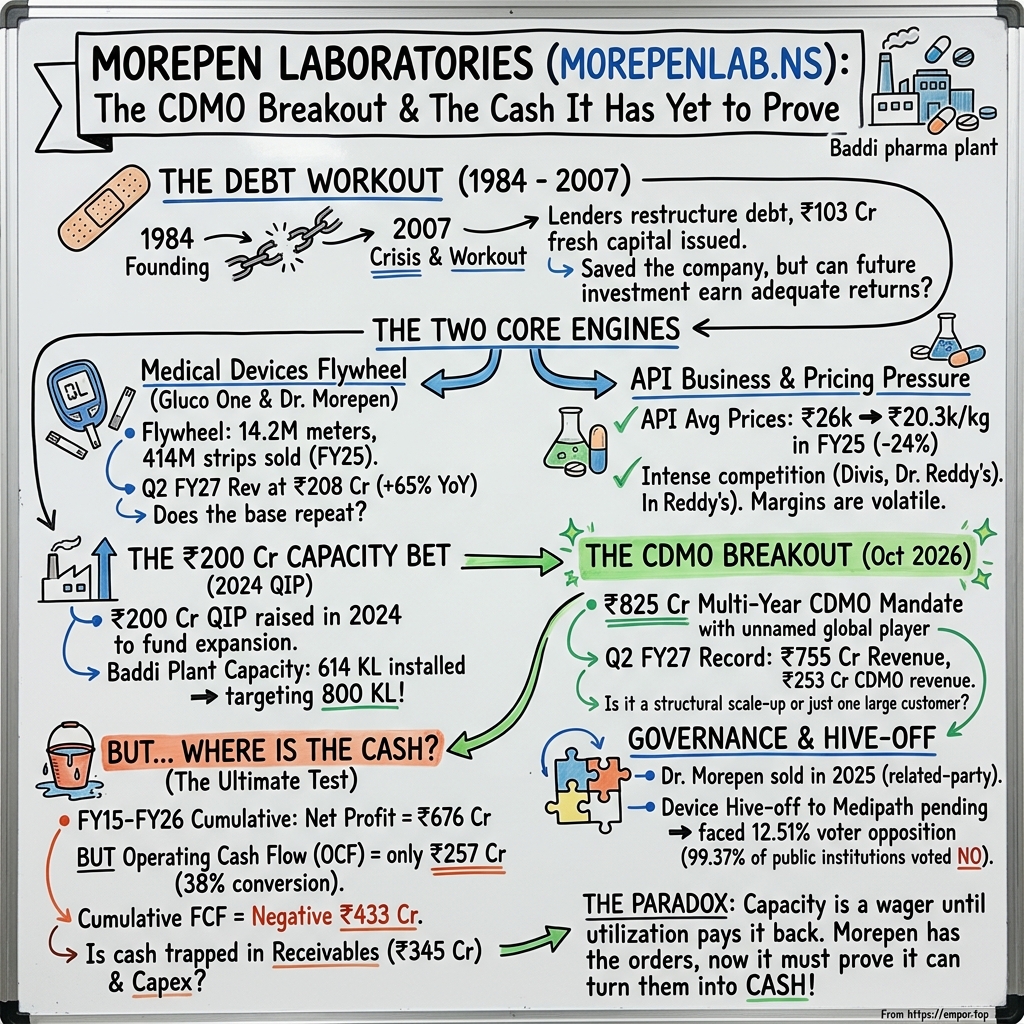
In the foothills of Himachal Pradesh, in the pharmaceutical belt around Baddi, Morepen Laboratories has spent the past two years filling buildings with steel. The things that matter in an active-ingredient plant are reactors: big jacketed vessels, measured by how many litres they hold, in which a drug's chemistry is cooked, cooled, filtered and dried. By October 2026 the company said its installed reactor capacity had reached 614 kilolitres, that the first phase of its expansion had finished ahead of schedule, and that the next phase would take it towards 800 kilolitres by the second quarter of the 2028 financial year.1 For a mid-sized Indian drugmaker, that is a lot of steel. The question this story keeps asking is who is paying to fill it, and whether that payment shows up as cash.
The answer, for now, is mostly one customer whose name the company does not publish. In its results for the quarter to September 2026, the second quarter of its 2027 financial year, Morepen reported sales revenue of about ₹755 crore and EBITDA of about ₹132 crore, its second record quarter in a row.1 The engine was a business that barely registered in the company's story a few years ago: contract development and manufacturing, or CDMO, in which Morepen makes a chemical to another drug company's specification rather than selling its own catalogue. CDMO brought in about ₹253 crore in that single quarter, and about ₹311 crore across the first half of the year, against what Morepen described as an ₹825 crore multi-year mandate from a global pharmaceutical customer.1
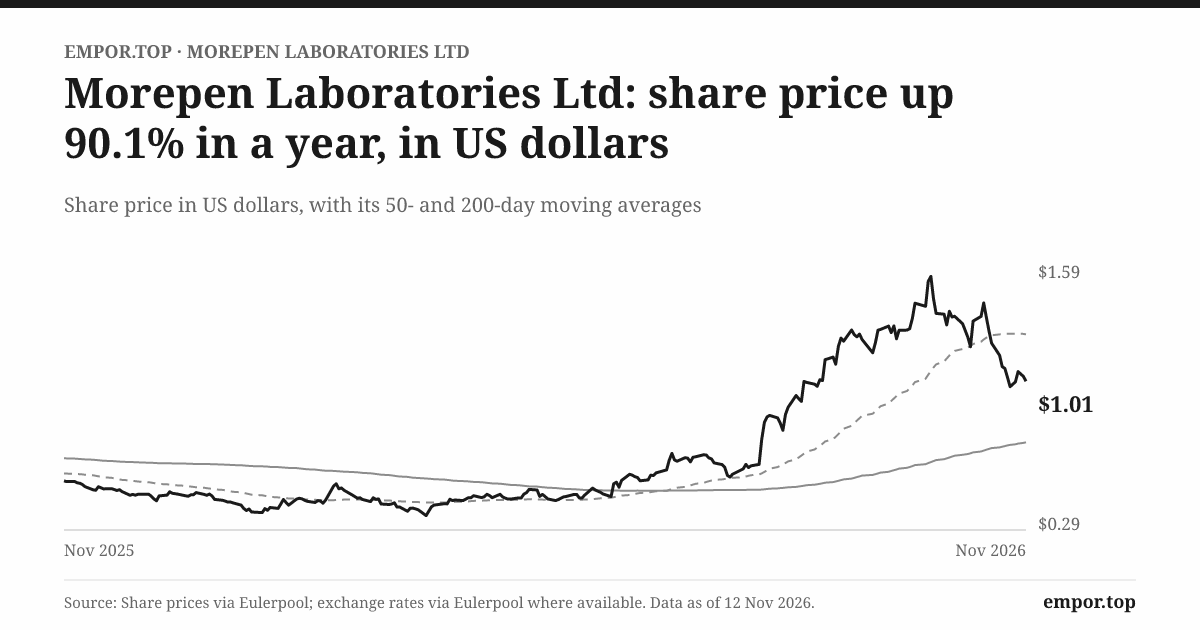
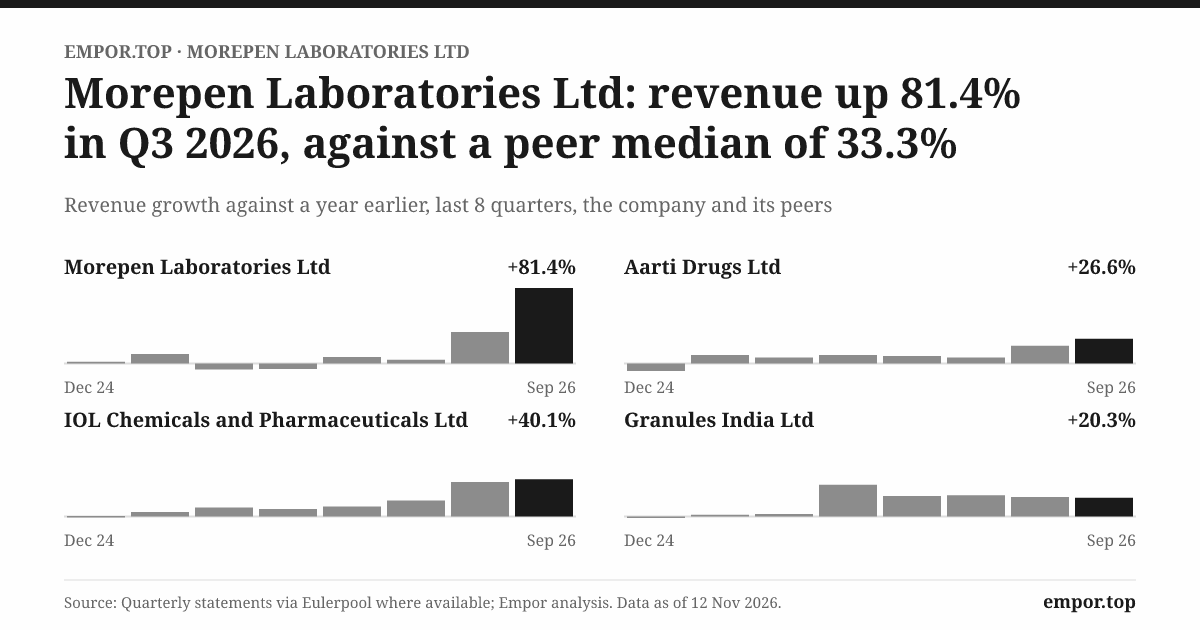
To feel the size of that jump, put it beside the year that came before. In the year to March 2026 Morepen's consolidated sales were roughly ₹1,800 crore and its full-year EBITDA came to something like ₹170 crore.2 One quarter in late 2026 delivered close to three-quarters of that whole year's EBITDA. Revenue in the quarter was up by about four-fifths on a year earlier, and net profit had more than doubled.3 Morepen's share price, which spent part of the past twelve months near ₹34, touched about ₹147 at its peak and stood near ₹95 on 12 November 2026, giving the company a market value of about ₹5,100 crore.3 Something changed, and the market noticed.
There is a small accounting wrinkle worth clearing away before the story gets going. The company's press release speaks of ₹755 crore of sales revenue; the results Morepen filed with the exchange show about ₹746.5 crore of revenue from operations for the same quarter.13 The difference is one of presentation, the kind that arises when a release groups income lines differently from the statutory format. For comparisons across years this story leans on the filed statements, because those are the numbers that line up with the annual reports.
The stakes are clearer once the quarter is set against the decade. Over ten years Morepen's revenue compounded at about 14% a year, a genuinely strong record for a company that, as the next section shows, once needed its lenders' forbearance to survive.24 But the five-year record is cooler. Revenue grew at under 9% a year from FY21 to FY26, and net profit went slightly backwards over the same span.2 In FY26 itself revenue was flat and net profit fell by about a fifth.2 The cash record is colder still. Across the twelve years to March 2026, the company booked about ₹676 crore of net profit but generated only about ₹257 crore of cash from operations, and after capital spending its free cash flow was negative by roughly ₹433 crore.24 It paid no dividends at all in that time.
So the record quarter arrives carrying three questions, and they run through every section that follows. Can the CDMO growth repeat, from more than one customer and for more than a couple of quarters? Can growth, at last, turn into cash rather than into receivables, inventory and plant? And will a restructuring of the medical-device business, which has needed repeated extensions and drew a pointed vote from institutional shareholders, preserve value for the public owners of the listed company?
A word on boundaries, because Morepen is a group and the group is not the listed company. Morepen Laboratories Limited is the company listed on the National Stock Exchange. It consolidates subsidiaries, most importantly Morepen Medipath, in which it held 51% by May 2026.5 Dr. Morepen Limited, the over-the-counter and consumer-health company that carried the Dr. Morepen brand, ceased to be a subsidiary on 31 July 2025.6 When this story talks about Morepen's economics, it means the listed company's consolidated accounts. When the boundary moved, the comparison moves with it, and that matters later.
The verdict on the opening scene is simple enough to state now and hard enough to prove that the rest of the story is needed. The step-up is real and financially material. But Morepen does not name the CDMO customer, and it does not publish the mandate's minimum purchase commitments or its exact duration. A promising change in the evidence is not yet proof of a durable new base. To see why the company's history argues for patience, go back to the moment when Morepen's survival depended on its bankers.
 Subscribe on LinkedIn
The Debt Workout Behind the Comeback
Morepen was founded in 1984 and grew up as a maker of active pharmaceutical ingredients, the powdered chemistry that becomes a tablet once a formulator adds binders and fillers and presses it.7 Over the following two decades it built a name in anti-allergy molecules, became known as a large producer of the antihistamine loratadine, and branched into branded health products and diagnostics.78 The founder, Sushil Suri, built the company in the image of the Indian generic boom: make molecules cheaply and well, sell them to drugmakers at home and abroad, and use the cash to push into brands closer to the consumer.
The expansion outran the money. By the mid-2000s Morepen had borrowed heavily and raised public deposits, and liquidity had grown tight enough that the company could no longer service its obligations on the original terms.9 What followed was a corporate debt restructuring, the formal mechanism Indian banks used to rework the loans of a viable but overstretched borrower. In 2007 lenders agreed to stretch out repayment schedules, and Morepen issued about ₹103 crore of fresh capital to them as part of the settlement, effectively converting a piece of what it owed into ownership.97 The Economic Times reported at the time that the company had partly settled its bank debt.9 A trace of that era survived into the 2026 annual report: an NCLT order cancelled about 5.06 million shares and Morepen paid about ₹5.7 crore to fixed-deposit holders, a process still being worked through at the March 2026 year-end.2
Why does a 2007 debt workout belong in a story about a 2026 contract-manufacturing boom? Because it is the clearest evidence that Morepen's history is not one of uninterrupted compounding. The company that investors see today is a company that was repaired. Lenders accepted less than they were promised, on a slower clock, so that the business could keep running. Repair of that kind buys time and room. It does not, on its own, prove that the next round of investment will earn its keep.
The decade after the restructuring shows both the room and the volatility. Revenue grew strongly through the late 2010s and the pandemic years, with growth above 30% a year in FY21 and FY22.2 Profit was much less steady. Net profit fell by about three-fifths in FY23, more than doubled in FY24, rose again in FY25 and fell by about a fifth in FY26.2 On the standardized operating line, margin peaked at roughly a quarter of revenue in FY24 and fell to under 5% in FY26; EBITDA, a steadier gauge that strips out depreciation and some below-the-line items, stayed closer to a tenth of sales across those years, which suggests the FY24 operating figure flattered the underlying run rate.2 Either way, the direction into FY26 was down. This was a business whose earnings moved with molecule prices, input costs and product mix, not one gliding on a fixed track.
It would be easy to read the debt line in FY26 as a rerun of the old crisis. It is not. Consolidated borrowings were about ₹208 crore at March 2026, roughly double the year before, against shareholders' equity many times larger; debt was about a sixth of equity.2 The debt note lists unsecured term loans at interest rates between about 7.3% and 9.25%, maturing between 2026 and 2029, guaranteed personally by the managing director, plus small vehicle loans.2 A ₹99 crore working-capital loan from the previous year had been repaid by the year-end, and the report does not identify a covenant breach or refinancing event.2 Separately, in 2024, the company raised ₹200 crore of equity through a qualified institutional placement, a story of its own a few sections on.8 The 2007 problem was whether Morepen could pay its lenders. The 2026 problem is whether new borrowing and new equity are building something that pays its own way.
That is the lesson the workout carries forward. Financial recovery gave Morepen a second act and the freedom to grow. But the cash record of the second act, with operating cash a little over a third of reported profit across twelve years, says growth has so far been funded from outside the business as much as from within it.2 The next test is whether that changes. Before getting to the reactors, though, it helps to understand the part of Morepen that most people in India would actually recognize: a small plastic meter on a kitchen counter.
The Meter on the Kitchen Counter
Picture a kitchen in a mid-sized Indian city. On the counter, next to the pressure cooker, sits a glucose meter the size of a deck of cards. Someone in the house has diabetes, and every morning they prick a finger, touch a drop of blood to a thin test strip, slide the strip into the meter and read a number. The meter was bought once. The strips are bought again and again, because each one works only once. That simple asymmetry, a one-time device and a recurring consumable, is the oldest trick in the razor-and-blade playbook, and it is the heart of Morepen's device business.
Morepen sells meters under the Gluco One and Dr. Morepen names, along with blood-pressure monitors, nebulizers and other home-health devices.210 On the call for the fourth quarter of FY25, management said it had about 14.2 million glucose meters installed and had sold about 414 million strips in that year, and the company reported medical-device revenue of roughly ₹496 crore for FY25.10 Divide those two figures, crudely, and the installed base worked out to around 29 strips per meter per year. That is the arithmetic the investor should sit with. A diabetic who tested once a day would use more than ten times that. Some meters are in drawers, some households test sporadically, and some buyers have switched to a rival's strips. The 14.2 million figure counts meters ever placed; it is not a count of active users.10
That distinction, between installed meters and repeat buyers, is where the case for a moat lives or dies. A meter is valuable to Morepen only if its owner comes back for Morepen strips. The company does not publish retention rates, the number of active users, the strip attach rate per meter over time, or the economics of each device sold. Nor does it publish a reliable current market share. Home diagnostics in India is a contested market, with global names such as Roche's Accu-Chek, Abbott and others selling alongside a growing crowd of domestic brands and online sellers. Without a primary source, calling Morepen the leader would be a guess, and this story does not make it.
What can be said is that the business is large and, lately, growing fast. Device revenue in the quarter to September 2026 was about ₹208 crore, up about 65% on a year earlier.1 The FY26 annual report identified blood-glucose monitoring revenue of about ₹459 crore for the year, a slightly lower base than the FY25 device figure, though the two numbers do not measure exactly the same basket of products.2 A quarter of ₹208 crore, if it held, would put the device business on an annual pace well above anything it has reported before. One quarter is not a pace, but it does establish that devices are a meaningful current revenue stream, not a speculative novelty sitting on the side of an API maker.
Step back and the group's portfolio comes into focus. Morepen makes APIs, which are sold mainly to other drugmakers. It sells formulations and consumer-health products. It sells medical devices and the testing consumables that go with them. And it now runs a CDMO business making chemistry to order.2 The annual report aggregates all of this into a single pharmaceuticals segment, which means an investor cannot cleanly see the profit each piece earns.2 That opacity matters, because the pieces have very different economics. A strip sold to a returning user should carry a much better margin than a kilogram of a commodity API. Without segment profits, nobody outside the company can prove it.
The history of the device business itself offers a mild test of the flywheel claim. A razor-and-blade model that is working should show consumable sales rising faster than, or at least alongside, the installed base, and revenue that holds up even in years when fewer new devices are sold. Morepen's FY26 blood-glucose revenue came in a little below the FY25 device total, in a year when group revenue was flat, which is not what a strongly compounding consumable stream would look like, though the different product baskets make the comparison loose.210 The 65% jump in the September quarter points the other way.1 Taken together, the record neither confirms nor rejects the flywheel. It narrows the claim to this: Morepen has built distribution and a large base of devices, and whether that base behaves like a subscription is the thing still to be shown. The figure that would settle it, strips sold per active meter over several years, is one the company could publish and does not.
There is a second reason device economics deserve attention, and it is not about competition at all. Morepen has proposed to transfer its medical-device business into Morepen Medipath, the subsidiary in which it now holds 51%.5 If that hive-off goes ahead, the question of who owns the device business's future cash flows shifts from a simple one, the listed company's shareholders, to a layered one: the listed company's 51% share, on terms and at a valuation that Morepen has not yet published. That governance thread returns later in the story.
The verdict on the kitchen-counter business is that the installed base and the recurring strips offer a plausible distribution and repeat-purchase advantage, and the quarter's growth gives that idea some recent support. But the disclosed evidence does not establish retention, market share, device-level economics or a durable cost edge. A meter is only a moat if the customer comes back for strips, and Morepen does not show how often they do. For the moment the case is credible but incompletely proven.
The device business is the consumer face of Morepen. The industrial face, the one that pays for the reactors, tells a harder story. It begins with a selling price that refused to go up.
The API Price That Wouldn't Move
On the call for the fourth quarter of FY25, in May 2025, Morepen's management walked analysts through a problem that every bulk-drug maker in India knows well. Over two years the average selling price the company realized on its APIs had fallen from about ₹26,000 a kilogram to about ₹20,300, a drop of roughly 24%.10 At the same time, raw-material costs had risen, and the domestic market had been slow to accept higher prices.10 Squeeze a business from both ends like that, and the middle, which is the margin, gets thin. Within a year the company's FY26 operating margin had fallen to under 5%.2
To see why the squeeze happened, it helps to understand how an API business works. An active ingredient is the chemical that actually does something in a medicine: the molecule that blocks a histamine receptor, lowers cholesterol or relaxes an airway. Morepen makes these molecules in batches in its reactors, through multi-step chemical reactions, and sells the finished powder to companies that turn it into tablets and capsules. Its economics depend on a handful of things: how much demand there is for each molecule, whether customers have qualified Morepen as a supplier, how full the plant runs, what the starting chemicals cost and what price the buyer will pay. Most of Morepen's portfolio consists of established, off-patent molecules, sold in a market where the buyer usually has options.11
That last point is the crux. Pharmaceutical buyers qualify suppliers carefully, because a change of API source can require regulatory filings and testing. That creates some friction, and friction is a kind of advantage. But qualification does not corner demand. A formulator that sells a large-volume generic will typically qualify more than one API source precisely so that no single supplier can hold it to ransom on price. Suppliers, meanwhile, face volatile input costs, many of them imported, and exposure to the rupee. When the price of key intermediates rises and the buyer can switch to another qualified vendor, the supplier eats the difference. The 24% fall in realization is what that structure looks like in a bad stretch.
Morepen is not small, but neither is it big. Its FY26 consolidated sales were about ₹1,800 crore across all its businesses.2 Divi's Laboratories, the most celebrated Indian API and custom-synthesis company, reported consolidated revenue from operations of roughly ₹9,400 crore for FY25, more than five times Morepen's entire group.12 Aurobindo Pharma, Dr. Reddy's Laboratories, Sun Pharmaceutical, Granules India and Neuland Laboratories all compete in overlapping API or custom-manufacturing markets, each with a different mix of products and customers. These comparisons are about scale, not unit economics; no clean league table of API market share by molecule exists in the public record, and total-pharma market shares say nothing about any one API. But scale matters in this business. Larger rivals buy inputs in bigger lots, spread regulatory and quality costs over more output, and can afford to run lower margins for longer when a molecule's price falls.
Here the investor meets one of the company's own claims. In its 2024 QIP documents Morepen described leadership positions in a handful of products, including molecules such as loratadine and montelukast.8 Leadership in a product is a real thing; making a large share of the world's supply of an antihistamine takes process know-how and years of customer relationships. But leadership is not the same as pricing power. Within a year of that capital raise, the company's own management was describing a 24% fall in realized API prices over two years.10 If six product leaderships could not hold the average price, then whatever advantage they confer works through volume, reliability and customer access rather than through the ability to set the price. That is a narrower moat than the word "leadership" implies.
The independent cross-check points in the same direction. Infomerics, which rated Morepen's long-term bank facilities IVR A-/Stable in August 2025, credited the company's market position, product diversity, comfortable financial profile and promoter experience.11 In the same rationale it listed as constraints the company's moderate scale, its exposure to API margin pressure and raw-material price volatility, its dependence on legacy APIs and regulatory risk.11 A credit analyst is paid to worry about the downside, but the list reads like an independent description of the price squeeze management itself described.
So what does Morepen's API business actually have? The evidence supports a narrow version of the advantage thesis. Decades of process experience, a portfolio of established molecules and qualified supply relationships help the company win and keep business. They do not, on the record, protect it from price competition, input inflation or mix swings. The history falsifies the broad claim of pricing power and leaves the narrow claim, competence and access, intact but modest. What would change that verdict is disclosure Morepen does not currently give: molecule-level volumes and price realization over several years, the number of new customers added and the rate of repeat orders. The test is whether realized prices hold when input costs next rise.
That is also why the company went looking for a different kind of chemistry business. If selling a catalogue of standard molecules into a crowded market keeps margins thin, one way out is to make something to order for a customer who values reliability more than the last rupee of price. To build the capacity for that, Morepen went to the equity market.
The ₹200 Crore Bet on More Capacity
In the first week of August 2024, Morepen opened a qualified institutional placement, India's quick route for a listed company to sell new shares to large investors without a full public offer.8 The company sold about 36.8 million shares at ₹54.37 apiece, raising ₹200 crore, at a 5% discount to the floor price that the regulator's formula had set.13 The pitch was capacity expansion, working capital and growth.8 It was a decision with a cost attached. Existing shareholders were diluted by about 6.7%, and they were diluted at a price below where the formula said the stock was worth, in exchange for capital that management promised to put to work.13
The alternative was more debt, and given the company's history the choice of equity has a logic. A business with weak cash conversion that funds expansion entirely with loans is a business that can find itself, a few bad quarters later, back in front of its bankers. Equity costs more in the long run, because new shareholders share in every future rupee, but it does not have to be repaid on a schedule. In that sense the QIP was a conservative decision for a company with a 2007 in its past.
The question is what the money bought, and how quickly. On an investor call in November 2024, management described a project timeline of 18 to 24 months and said it aimed to complete deployment of the proceeds by FY26; it put roughly ₹123 crore of the raise towards capital expenditure.14 By the March 2026 year-end, about ₹18.7 crore of the QIP money was still unutilized, parked in debt mutual funds.2 That is not a scandal, it is a modest overrun on a deployment schedule, but it is worth recording because the promises of 2024 are now the measuring stick for the management of 2026. Most of the money had been spent, and some of it had not.
Meanwhile the capital spending ran well beyond the QIP. In FY26 alone, cash spent on additions to property, plant and equipment, construction in progress and intangibles came to about ₹135 crore, about 7.5% of sales.2 Research and development spending, counting both capital and revenue items, nearly doubled to about ₹38 crore, roughly 2% of sales.2 Headcount rose from 1,814 to 1,919 employees and workers.2 The company was not harvesting a mature business. It was building.
And then, at last, the building had a customer. The October 2026 release reported that commercial CDMO supplies had scaled and that the first phase of the expansion, to 614 kilolitres, had been completed ahead of schedule.1 For the first time, the capacity bought with the 2024 money could be linked, in a reported number, to a revenue stream that had not existed at that scale when the shares were sold. QIP investors who paid ₹54.37 were sitting, in November 2026, on shares worth about ₹95.3
But a share price is not a return on capital, and here the long record intrudes. Morepen's twelve-year cash record remains the constraint.2 Those cash figures imply capital spending over the period of close to ₹700 crore, nearly three times what the business generated in operating cash. Operating cash flow over the period was only 38% of cumulative net profit.2 The difference came from borrowings, from the QIP and from shareholders' patience. Capacity growth at Morepen has not, so far, demonstrated self-funding economics.
There is a temptation, in a story like this, to reach for an acquisition benchmark and ask whether the company overpaid for growth. The record does not support that framing. Morepen did not make a major acquisition at a premium in this period; it raised equity, built plant and rearranged subsidiaries. The right benchmark is simpler and harsher: does the new capacity earn more than the capital it consumed? On FY26 numbers, it did not yet. Return on capital employed was about 9% and return on equity under 8%, below what most investors would accept as the cost of equity for a volatile mid-cap drugmaker.2 On the last twelve months to September 2026, with the two record quarters included, return on equity had risen to about 14% and return on capital employed to about 16%.3 That is a real improvement, and it is almost entirely the work of two quarters.
The verdict on the bet is that the investment now has a tangible commercial signal, the CDMO ramp and the commissioned plant, which it lacked a year ago. But FY26 cash generation remained weak, some of the proceeds were still unspent and the return-on-capital case awaits several quarters of sustained utilization, margins and cash receipts. Capacity is a wager until utilization pays it back. Which brings the story to the order that is supposed to do the paying.
The Order That Could Rebase the Company
The announcement itself was thin on detail and heavy with consequence. The mandate began producing revenue in the first half of FY27: about ₹58 crore in the June quarter and about ₹253 crore in the September quarter.1 For Morepen, a single program delivering a third of a quarter's sales is not a side business. It is a rebasing.
Contract manufacturing differs from selling standard APIs in ways that matter to the investor. When Morepen sells loratadine, it sells a known molecule to anyone who wants it, at whatever the market will bear. When it runs a CDMO program, it makes a specific chemical, often an advanced intermediate or an ingredient for a newer drug, to a customer's process and quality specifications. The work may involve development, scale-up and qualification before commercial supply begins, and once a supplier is embedded in a customer's regulatory filings, switching costs rise. Think of the difference between selling bread off the shelf and becoming the bakery that makes a restaurant chain's signature loaf to its recipe. The second relationship can be much stickier, and the margins better, as long as the chain keeps selling the sandwich.
That conditional is everything, and it is where disclosed fact and management framing have to be pulled apart. The ₹825 crore figure is a mandate, a description of the work the customer has indicated, not recognized revenue and not, as far as Morepen has disclosed, a guaranteed minimum purchase. The customer remains unnamed, and the contract's key terms, including its duration, renewal provisions and margins, remain undisclosed.1 It is possible that the ₹311 crore of the first half represents an unusually concentrated front-loading of a contract whose deliveries will be smoother later. It is also possible that the program will grow. From the outside, the two cannot be told apart.
The broader disclosure picture makes the concentration hard to size. Morepen's FY26 business-responsibility report does not name customers or quantify the share of revenue from its top five or top ten, and it does not identify any customer above 10% of revenue.2 What it does show is a company that sells about half its products through dealers and distributors, with the top ten dealers accounting for about 29% of dealer sales.2 Against that dispersed base, a single CDMO customer contributing about a third of quarterly revenue is a concentration of an entirely different order, and the company's own reporting does not yet quantify it.
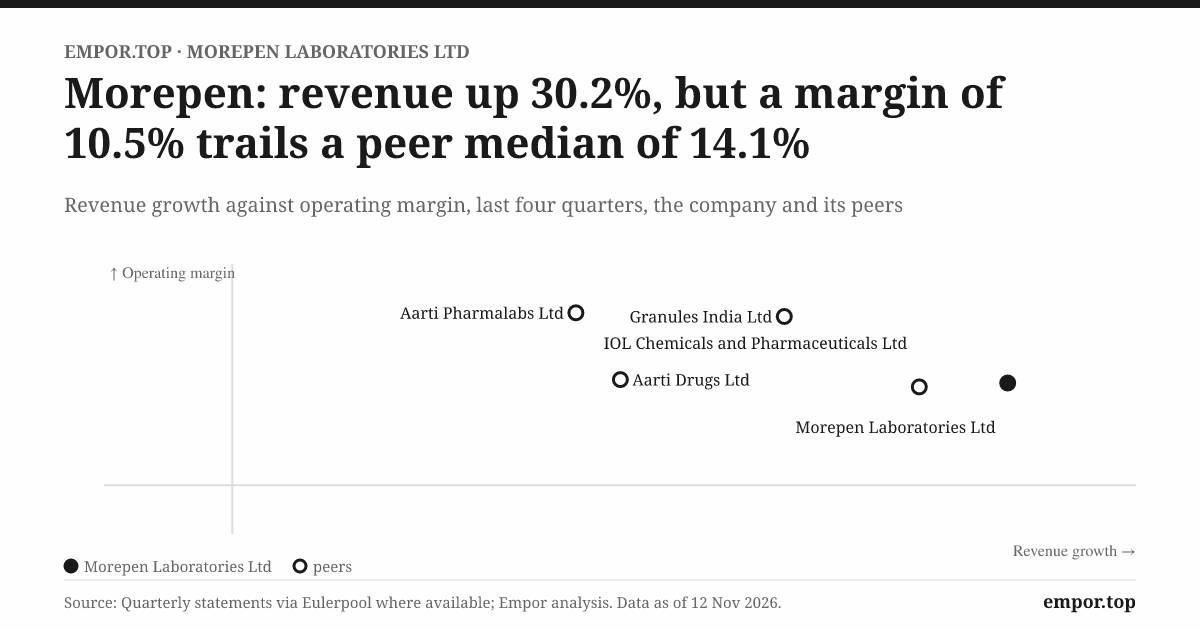
What about the margin? Morepen's release put the quarter's EBITDA margin at about 17.5%.1 On the filed statements the operating margin was about 15%, against under 5% for FY26 as a whole.32 A jump of that size in one year almost certainly reflects the CDMO mix and better utilization of new plant, which is the kind of operating leverage the bulls hoped for. But the company does not publish a margin bridge that separates mix from utilization, pricing, input costs and currency, so the attribution is an inference rather than a disclosed fact.
The earlier calls offer a useful baseline for management's tone. On the FY25 fourth-quarter call, before the CDMO ramp, management discussed API price pressure and device volumes.10 The language was that of a company working through a difficult pricing cycle and pointing to new businesses as the way out. Eighteen months later, the release describes record quarters and completed capacity.1 The narrative arc is consistent: management said diversification would come and it came. What has not changed is the level of disclosure about the concentrated new business, and that is what an analyst would press on any call. Questions about the customer's identity, the contract term, whether the September quarter included catch-up deliveries, and what share of the new capacity the program occupies remain open in Morepen's published material.
Peers show both that the category exists and how long it takes to earn a reputation in it. Divi's built a large custom-synthesis business over decades, working with major innovator drug companies, and Neuland has built a sizeable custom-manufacturing segment alongside its generic APIs. Indian bulk-drug makers as a group have been pushing into CDMO work, attracted by the idea of longer relationships and better margins than the commodity API market offers.15 Their success proves that an Indian API maker can become a trusted contract manufacturer. It does not establish Morepen's position, its customer stickiness or its economics, all of which rest at the moment on one disclosed program in its first year of commercial scale.
It is worth doing the simple arithmetic a careful listener would do in their head. If the September quarter's CDMO revenue were repeated for four consecutive quarters, the program alone would deliver more than ₹1,000 crore in a twelve-month period, which is more than the entire ₹825 crore mandate.1 That cannot be squared with a multi-year contract of that size unless the mandate is extended, enlarged or joined by other programs. Read the other way, if ₹825 crore is the whole of the work and ₹311 crore has already been delivered in six months, then the remaining ₹514 crore spread over the rest of the contract implies quarterly CDMO revenue well below the September level. Either the mandate is growing, which Morepen has not said, or the September quarter was unusually heavy, which Morepen has not said either. The investor cannot know which, and that uncertainty is the single most important number missing from the story.
Morepen's earlier growth spurts did not prove to be a new floor.2 Those surges came in a different period, from the existing API and device businesses, and they did not prove to be a new floor. The CDMO program is a different mechanism, with a contract behind it rather than a demand spike, which is a real reason to give it more weight. But the record is a reminder that a sharp rise in Morepen's revenue has not, in the past, reliably signalled a durable rise in its earnings power.
The verdict is that the contract is already material and plausibly changes the business mix. Its durability and economics remain unproven; key contract terms and realized margins are undisclosed. A mandate is a promise of work, not proof of cash. The thing that would confirm the shift is not another record quarter. It is repeat CDMO sales from more than one program, operating margins that hold for several quarters, and cash collected from the customer. That last item, collection, is where Morepen's record is weakest.
The Profit That Stayed on the Balance Sheet
Every reported profit takes a journey before it reaches the bank. A sale is booked, and the customer owes money: a receivable. Raw materials are bought ahead of the next batch: inventory. A new reactor is installed: plant. Only what is left after those three detours turns up as cash a shareholder could, in principle, be paid. At Morepen, for twelve years, the detours have swallowed most of the journey.
The headline numbers are stark. From FY15 through FY26, Morepen recorded about ₹676 crore of net profit and about ₹257 crore of operating cash flow, a conversion rate of 38%.24 After capital spending, free cash flow over the period was about minus ₹433 crore, and dividends paid were zero.2 Cash on the balance sheet did rise, from about ₹9 crore at the end of FY14 to about ₹92 crore at the end of FY26, but that increase came from outside capital, not from the business funding itself.2 To put it plainly: for every ₹100 of profit Morepen reported over twelve years, about ₹38 arrived as operating cash, and more than all of that was spent on plant.
Some of that gap is normal for a growing manufacturer. A company whose sales rise every year will usually need more working capital every year, because receivables and inventory grow with sales. But the trend in Morepen's working capital tells a story of a business needing ever more capital to produce each rupee of revenue. In FY15 the cash conversion cycle, the number of days between paying suppliers and collecting from customers, was negative: Morepen was effectively being financed by its suppliers, paying them long after it was paid.2 By FY26 the cycle had widened to about 53 days.2 Days payable fell from more than 120 to about 100, inventory days rose from 55 to almost 90, and debtor days rose from 55 to 67, having peaked at 77 in FY18.2 Each of those moves ties up cash. Together, they explain why a profitable company kept needing outside money.
FY26 shows the mechanism in close-up, even if it does not reconcile the entire twelve-year gap. The consolidated cash-flow statement reported operating cash of about ₹33 crore.2 On the standalone statement, higher receivables absorbed about ₹50 crore and other loans, bank balances and current assets absorbed about ₹76 crore, with a release of inventory partly offsetting the drain.2 Add about ₹135 crore of capital spending and the year's free cash flow was deeply negative.
Then there are the receivables themselves, which deserve to be examined rather than labelled. Gross trade receivables reached about ₹345 crore at March 2026, up from about ₹295 crore a year earlier.2 Almost all of the balance was classified as considered good, and the undisputed good receivables were overwhelmingly under six months old; only small amounts were older.2 The allowance for doubtful debts was under ₹1 crore.2 By that table, Morepen's customers are not obviously failing to pay. But the table does not settle the question. Disputed and credit-impaired balances exist, if small, and about ₹11 crore of receivables arose from business restructuring.2 More importantly, the cash-flow statement shows that the growing balance absorbed real money. A clean ageing profile is consistent with customers paying on time; it is also consistent with a business giving longer terms to grow sales.
The new CDMO program raises the stakes. A single large customer on contract terms can be a superb payer, or it can be one that dictates terms. If Morepen's quarterly CDMO revenue runs at the September level and the receivables balance balloons with it, the record quarter will have converted into a large IOU from one customer. If collections track sales, the program becomes the first part of Morepen's business to prove that growth can fund itself.
The verdict on cash is that the weak long-run conversion is a central constraint on the investment case, not a footnote. The FY26 ageing profile does not show a large undisputed long-overdue balance, but rising receivables and working-capital use mean the new growth must prove it can turn into cash. Three numbers tell an investor most of what they need to know from here: CDMO sales and the operating margin alongside them; cash from operations divided by net profit, which across twelve years read about 38% and in FY26 was lower still; and receivables growth set against debtor days, which stood at 67 in FY26. If the first rises while the other two stay where they are, the profit is staying on the balance sheet again.
Cash is one way value can leak from a listed company. The way the company draws its own boundary is another, and in 2025 Morepen redrew it.
The Sale That Changed the Group Boundary
On 31 July 2025, Morepen told the exchange that Dr. Morepen Limited had ceased to be its subsidiary.6 Dr. Morepen was the consumer-facing arm whose name sat on the company's over-the-counter products and was closely associated with the family's brand in Indian homes. The listed company had sold shares in it to promoter-related parties for about ₹30.65 crore, taking its stake below the level of control.62 With that sale, Dr. Morepen's results stopped being consolidated, and in FY26 Morepen recorded an exceptional gain of about ₹25.8 crore associated with the loss of control.2
The accounting consequence is the first thing an investor should absorb. Comparisons between FY25 and FY26 straddle a moved boundary: part of FY26 included Dr. Morepen and part did not, and the profit in FY26 included a one-time gain that came from selling a piece of the group, not from making or selling medicines. The governance consequence is the second. When a listed company sells a business to parties related to its controlling shareholders, the minority owner's question is not whether the sale was legal, but whether the price was fair. The filings disclose the price. They do not, on their own, establish that it was fair, because the public record does not include an independent valuation or the full economics of the business sold. This story does not assume the price was too low. It notes that the evidence needed to judge it, a valuation and the transaction terms, has not been published.
The ongoing relationship with related parties is measurable, and measured it is modest. In FY26 consolidated related-party transactions included about ₹49 crore of inventory sales, about ₹13 crore of goods and services received, about ₹2 crore of business-support services sold and a little over ₹2 crore of expense reimbursements.2 At year-end related parties owed Morepen only about ₹0.2 crore, while Morepen owed related parties about ₹11.5 crore, a balance that had reached almost ₹18 crore during the year.2 The inventory sales were about 2.7% of consolidated revenue.2 The company describes these transactions as in the ordinary course of business and at arm's length.2
There is one number that looks larger. The business-responsibility report puts related-party sales at about 8% of sales and related-party purchases at 0% of total purchases.2 The two measures use different bases, the BRSR's percentage likely capturing a standalone sales figure and a broader set of related entities, so the 8% figure and the 2.7% figure are not contradictory so much as differently framed. Either way, related-party trade is a minor share of the business, not a hidden channel for most of it.
The bigger issue is the device business, because it is a bigger business. Morepen has proposed to transfer its medical-device operations into Morepen Medipath. In May 2026, after a rights issue and the sale of 9 percentage points of Medipath to Anubhav Suri, Morepen's holding in Medipath stood at 51%.5 That transfer of Medipath shares is separate from the proposed transfer of the device business itself, which remains pending.52 The hive-off has needed repeated extensions of its timeline, and the valuation at which the device business would move, the consideration Morepen would receive and the eventual ownership of the device company have not been disclosed.216
At the annual general meeting in September 2026, shareholders were asked to approve another extension. The resolution passed. But about 12.5% of valid votes cast opposed it, and the public institutions that voted, the mutual funds, insurers and foreign investors that tend to read terms closely, cast about 99.4% of their votes against.16 Promoter votes were not cast on that resolution, as is normal for a transaction in which they are interested.16 In a company where promoters hold about 36% and do not vote, a vote in which institutions rejected the item almost unanimously is not background noise. It is a specific signal of discomfort with the terms or the process of a restructuring that touches the group's related parties.
Put yourself in the seat of a skeptical minority investor reading that scrutinizer's report. The questions would be concrete. Who receives the device assets? What consideration comes back to the listed company, and is it supported by an independent valuation? Who controls Medipath after the transfer, and how might the 49% held outside Morepen change? What protections apply to Morepen's minority shareholders if Medipath later raises capital or sells stakes? How will related-party approvals be handled when the economics are finalized? Morepen's disclosures do not yet answer them.
The verdict on the boundary is that the filings quantify related-party sales and disclose the Dr. Morepen price, but they do not establish that the price was fair, and the device hive-off's valuation, consideration and post-transfer ownership remain the crucial unanswered terms. The institutional vote makes the process a live governance issue. It also matters for the earnings story, because the Dr. Morepen gain was not the only item outside operations that flattered FY26.
The Currency Gain in the Margin Story
FY26 was a weak year at the operating line and a less weak year at the bottom line, and the difference lay in two items that had nothing to do with making medicines more profitably. Other income came to about ₹21 crore, of which about ₹18 crore was foreign-exchange gains.2 The Dr. Morepen gain also lifted the bottom line.2 Reported profit before tax was about ₹120 crore; before the exceptional item it was about ₹94 crore, and the currency gain alone was close to a fifth of that.2 Strip out both, and Morepen's operating earnings in FY26 were thinner still than the headline net profit decline suggested.
The exposure comes from the shape of the business. On a standalone basis Morepen exported about ₹651 crore of goods in FY26 and imported about ₹602 crore, and imported materials made up about 62% of the raw materials it consumed.2 Revenue from the United States was about ₹121 crore and from the rest of the world outside India about ₹682 crore.2 At first glance exports and imports look like they cancel out. They do not, at least not neatly. Imports are paid and exports are collected at different times, in different currencies and for different products. A rupee that weakens between the date Morepen books an export sale and the date it is paid generates a gain; a rupee that strengthens generates a loss. Similar totals reduce the net exposure; they do not eliminate the timing or the mix risk.
The annual report records no hedging or foreign-exchange risk-management policy, and Morepen recognizes exchange differences in profit and loss.2 That is a statement about what the company discloses, and it should be read as such; it does not prove there is no informal currency management. But it means that the ₹18 crore gain of FY26, and the ₹10 crore of the year before, were effectively a function of where the rupee went, and could as easily have been losses.2
Against that background, the September 2026 quarter's improvement looks more solid, because it appears in operating profit rather than other income. The operating margin on the filed statements rose to about 15%.3 Export activity was large, with first-half exports of about ₹654 crore, more than the whole of FY26's standalone exports, so the rupee still matters to the quarter's numbers.1 Whether future reporting attributes the gain to CDMO mix, utilization, pricing, input costs or currency will tell investors how durable it is. Two quarters cannot establish a margin floor; the FY24 to FY26 swing showed how fast Morepen's margins can move in the other direction.
One legal overhang has eased. At the March 2026 year-end Morepen's standalone contingent liabilities totalled about ₹335 crore, dominated by a GST demand of about ₹317 crore including interest and penalty, more than the company's entire FY26 profit before tax.2 On 14 October 2026 the Himachal Pradesh High Court quashed the show-cause notice behind that demand.17 That materially reduces the disclosed exposure. A court's order is not always the last word in Indian tax disputes, since the authorities can appeal, so the finality of the matter depends on what the tax department does next; but the largest single contingent item in the accounts is, for now, gone.
The verdict is that Q2's operating improvement is stronger evidence than any currency gain, but exchange exposure, API pricing and mix remain important swing factors, and the absence of a disclosed hedging policy means currency can add to or subtract from earnings without warning. Who decides how to manage those risks, and how the company spends what it earns, brings the story to the family at the top.
The Suris' Test Is What Happens Next
Sushil Suri led Morepen for more than four decades, through the expansion years, the debt workout and the long rebuild. The FY26 annual report identifies him as chairman and managing director.2 On 1 July 2026 Sanjay Suri, a director, became managing director as well, while Ajay Sharma serves as chief financial officer; the company does not designate a chief executive.2 Leadership, in other words, remains firmly in the founding family's hands, and the strategy of the past two years, the QIP, the reactors, the CDMO push and the device hive-off, is theirs.
The family's stake is substantial. Promoters held about 35.65% of the company at September 2026, the same proportion as in March, and the public held the rest, spread across more than 440,000 shareholders.1819 Pinfold Overseas was a 7% public holder at March 2026.19 Foreign institutional ownership rose to about 3.4% by September 2026 from about 1.5% in June, and domestic institutions held about 1.7%, up from about 1.3% in March.20 Those institutional moves are portfolio flows following the record quarters, not a change in control, and they are still small: institutions as a whole own about a twentieth of the company. That arithmetic matters for the AGM vote. The institutions that voted almost unanimously against the hive-off extension are a small part of the register, which is why their objection was a signal rather than a veto.
Promoter ownership is alignment evidence. A family with more than a third of the equity has a strong interest in the share price. It is not proof of good governance, because a controlling family's interests can diverge from minority holders' in exactly the kind of related-party restructuring the device hive-off represents.
Pay is moderate in scale. Sushil Suri received about ₹2.75 crore in FY26 and Sanjay Suri about ₹1.73 crore, and their remuneration moved in opposite directions year on year, in a year when net profit fell by about a fifth.2 Together that is under 5% of FY26 net profit. The annual report also discloses about ₹2.3 crore paid to relatives of key managerial personnel and about ₹13 crore to "other related persons".2 That last figure should not be read as executive pay without a fuller breakdown, which the company does not give; it is a category label, not a salary.
Four of six directors were independent non-executives in FY26, and the auditors gave unmodified opinions on the accounts; the CARO annexure flagged no material inventory discrepancy or loan default, and the auditor noted that advance income-tax dues outstanding for more than six months had been paid before signing.2 Those are bounded reassurances. A clean audit opinion says the accounts follow the rules. It does not say the capital was well spent or that related-party terms were generous to minorities.
The fair test of management credibility is promises against outcomes. In 2024 the Suris promised to deploy QIP money into capacity over 18 to 24 months, finishing by FY26.14 The company says the first phase of capacity was completed ahead of schedule and commercial supplies had scaled, while a small portion of proceeds remained unspent at the deadline.12 That is a better record than many capacity stories in Indian pharma. Against it sit the twelve-year cash record, a profit decline in FY26 cushioned by an exceptional gain and a currency gain, and a device restructuring that has needed repeated extensions and drew near-unanimous institutional dissent.216 The credibility case is not yet established, and it is not refuted either. It is being written, quarter by quarter, by what the new capacity earns and how the device terms are disclosed.
Which leaves the question the market is answering every day: what price is it paying for that unwritten record?
Analysis & Bear vs. Bull Case
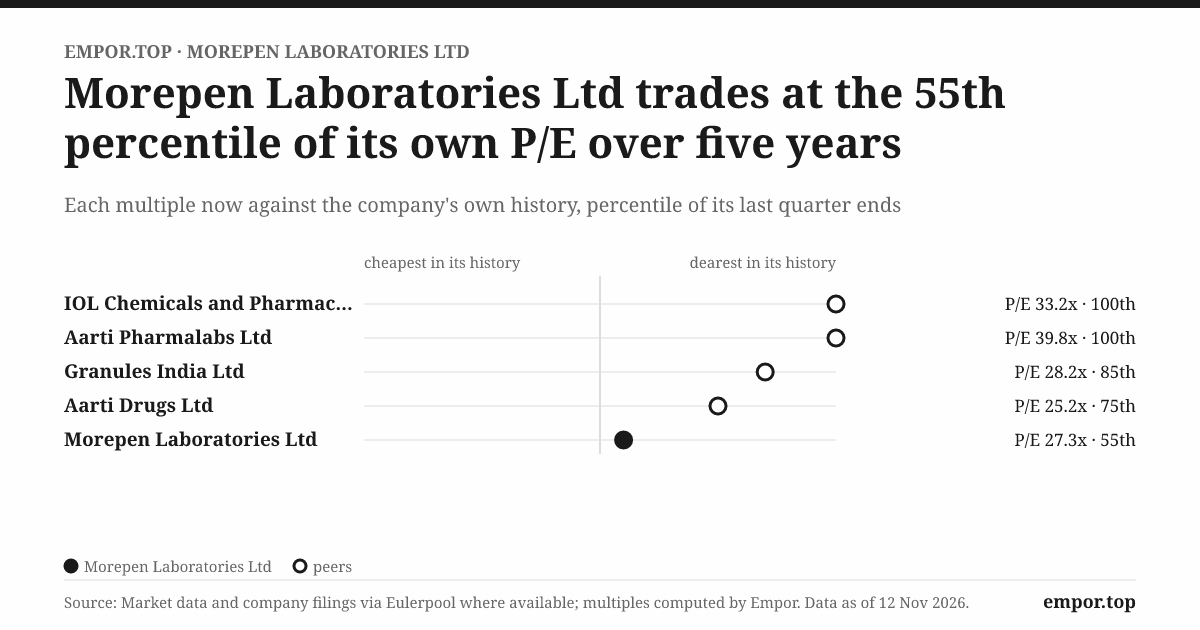
On 12 November 2026, Morepen traded at about 27 times its last twelve months' earnings, almost exactly its own five-year median of about 26.5 times.3 On enterprise value it was about 17 times EBITDA, and it traded at about 3.7 times book value.3 Its free-cash-flow yield was effectively zero.2 Its earnings yield, the inverse of the P/E, was about 3.7%.3 These are the coordinates. The interesting part is what they imply.
A P/E near the company's five-year median looks, at first, like a market treating Morepen as it always has. But the earnings in the denominator are no longer the earnings of the past five years. They include two record quarters. If the market is paying its usual multiple for a much larger earnings base, it is implicitly betting that the new base persists. The PEG ratio of under 1 reflects the same thing: the growth rate behind it is the recent jump, not the five-year profit record, which was slightly negative.32 The stock's history is a warning about how violently that bet can be revised. Its one-year volatility was about 59%, and over five years it had suffered a peak-to-trough fall of about 65%.3
Peer comparisons are of limited use. Granules India traded at about 29 times earnings in mid-November and Aarti Pharmalabs at about 38 times in late October, but those are snapshots on different dates of businesses with different mixes, so they do not price Morepen's particular blend of APIs, devices and one large CDMO program.2122 What can be said is that Morepen's multiple is not out of line with Indian API and custom-manufacturing names, and that its cash profile is weaker than its earnings profile suggests.
The case for the upgrade
The bull case rests first on the CDMO business. Contract manufacturing adds a potentially higher-value line to a commodity API base: the customer pays for reliability and process capability, the relationship can last for years, and switching costs rise once a supplier is embedded in a drug's regulatory file. The mandate is material, the capacity is commissioned, and the September quarter's operating margin was about three times FY26's.132 If a second and third program follow, Morepen becomes a different company with a different multiple.
The second bull pillar is the device business. Its installed base is large, and device revenue grew by about two-thirds in the September quarter.110 A recurring-consumable model, if retention holds, is exactly the kind of business that justifies a premium multiple.
The third is reinvestment. R&D nearly doubled in FY26, and the company says capacity is heading to 800 kilolitres, which could support new products and customer programs.12
The case against
The bear case answers each pillar. The CDMO ramp rests on one unnamed customer whose contract commitments, duration and margins are not disclosed, and customer concentration remains unquantified.12 Morepen has never before had to show it can win a second CDMO program at this scale. The device case remains unproven, and the hive-off leaves ownership of its future economics unresolved.216 The reinvestment case runs into the cash record: operating cash over twelve years was 38% of profit, and free cash flow was minus ₹433 crore; FY26 returns on equity and capital employed were below a reasonable cost of capital.2
The forces acting on the industry explain why the bear case has weight. Buyer power in APIs is high, because the supply base is fragmented and formulators qualify multiple vendors; Morepen's own 24% decline in realized prices is the evidence.10 Supplier power is meaningful, because most of Morepen's raw materials are imported and input prices have risen faster than selling prices.210 Rivalry is intense, with far larger players including Divi's, Aurobindo, Dr. Reddy's, Sun, Granules and Neuland in overlapping markets.12 The threat of new entrants is moderated by regulatory approvals and qualification, which create some friction, though not enough to stop the price decline. In home diagnostics, the threat of substitution is real: rival strips, newer continuous glucose monitors and online sellers all compete for the same finger-prick.
Hamilton Helmer's seven powers offer a sharper lens on what Morepen might actually own. Scale economies are not in its favour; peers are many times larger. Network economies do not apply. Counter-positioning is absent; Morepen is doing what other Indian API makers are doing, moving into CDMO.15 Switching costs are the most plausible power, in two places: in CDMO, once a supplier is written into a customer's regulatory filing, and in devices, where a meter nudges its owner back to the matching strip. Both are real in principle and unproven in Morepen's published numbers. Branding exists in the consumer market through Dr. Morepen and Gluco One, though the Dr. Morepen company is no longer a subsidiary, which complicates who owns that brand's value. Cornered resources and process power, the kind of manufacturing know-how that produces structurally lower costs, would show up as stable margins through a price cycle, and Morepen's margins have not been stable. The honest summary is that Morepen has the beginnings of switching-cost power in two businesses and no proven power elsewhere.
Infomerics' A-/Stable rating predates the CDMO ramp, so it describes the old Morepen rather than judging the new one; its assessment of the old Morepen was accurate.11
The verdict weighs the two sides rather than leaving them side by side. The bull case has a real new data point, rapidly growing CDMO supplies and higher operating leverage. The bear case has the longer record: volatile margins, weak cash conversion, customer opacity and a governance-sensitive restructuring. The history does not reject the upgrade thesis; it narrows it. Morepen has shown it can win a large program and build capacity on time. It has not shown it can repeat the win, hold the margin or collect the cash. Valuation sits near the company's own norm, but that norm is now being applied to a larger and less proven earnings base. The test is specific: several quarters of CDMO sales and operating margin, paired with operating cash moving towards net profit and receivables growing no faster than sales. If margins rise and cash does not, the thesis remains incomplete.
Lessons from the Baddi Plant
The first lesson comes from Morepen's 2007 debt workout.97 It bought the company a second act. It did not tell anyone whether that second act would earn its capital. A debt workout can buy a second act; it cannot write the ending. For founders, the point is that survival is a starting line. For investors, it is that a recovered company's past distress is context, not evidence about its future returns.
The second lesson sits on the kitchen counter. Morepen's large installed base of glucose meters is a remarkable feat of distribution.10 But many meters are used far less than daily, and the company does not publish how many users come back. A meter is only a moat if the customer comes back for strips. Installed base is a vanity number until retention turns it into a recurring one.
The third lesson belongs to the CDMO mandate. The program is material, but its terms and cash conversion remain unproven.1 The investor's job is to watch the promise convert, line by line, into revenue, margin and collections.
The fourth lesson is written in steel. Morepen's latest capacity build extends a long record of expansion funded from outside the business.213 Capacity is a wager until utilization pays it back, and a company that has never funded its own expansion is betting that this time the plant will pay for itself.
The paradox that ties these together is Morepen's own. The company has restarted its growth more than once. Each restart was real. None yet has financed itself.
Epilogue
Tonight, in November 2026, Morepen stands at an inflection, not a resolution. The record quarter and recent developments have sharpened the question of what happens next.1317 What happens next will be decided by a handful of moments, each of which can confirm or undermine the story the September quarter told.
The first comes with the December-quarter results early in 2027. If CDMO revenue holds near the September level, the program looks like a steady-state supply relationship. If it falls back towards the June quarter's level, the September figure will look like a concentrated delivery, and the ₹825 crore mandate like a lumpy contract rather than a new floor. Investors will also look for anything new about the program: a customer disclosure, a contract term, an indication of whether a second CDMO customer has been won. Each of those would move the story from one program to a business.
The second moment is the next balance sheet. The FY27 half-year accounts showed whether receivables had grown faster than sales, whether debtor days had improved from 67 and whether operating cash had finally approached net profit. The March 2027 annual report will show whether cash conversion rises above its twelve-year average of 38% while CDMO grows. If it does, Morepen will have answered the question its history has posed for over a decade. If receivables swell with the new customer's business and operating cash stays thin, the record quarter will have converted mostly into a balance-sheet asset.
The third moment is the device restructuring. Sometime before the extended deadline, Morepen will have to publish the hive-off's valuation, the consideration flowing to the listed company and the governance terms for Medipath. Minority shareholders, and the institutions that voted almost unanimously against the latest extension, will read those terms closely.16 Fair, independently valued terms would remove a governance discount. Terms that move device economics away from public shareholders without clear compensation would confirm it.
The fourth is the margin bridge. Each quarterly report from here will either attribute margin gains to CDMO mix and utilization, which would support the upgrade, or reveal them to depend on API price recovery, raw-material relief, currency gains or one-off items, which would leave the old volatility in place.
And beyond all of these is the path to 800 kilolitres, targeted for the second quarter of FY28.1 More capacity is only good news if the first 614 kilolitres are earning their keep. Several quarters of rising operating margin and rising cash conversion would support the case for a durable upgrade. Growth accompanied by rising receivables and weak operating cash would leave it unproven, no matter how many records the quarterly releases announce.
Outro
Back in Baddi, a new reactor vessel waits for its next batch. Somewhere in the plant, an unnamed customer's program runs through the steel that 2024's shareholders paid for: 614 kilolitres installed, 800 planned.1 Over twelve years the company behind it reported about ₹676 crore of profit and collected only about ₹257 crore of operating cash.2 The reactors are the most hopeful thing Morepen has built in a long time. They are also the most expensive way it has ever asked shareholders to trust that the cash will follow.
Morepen has earned another chance to scale. It still has to show that its plant can turn a customer's order into cash for its shareholders. At Morepen, the next record quarter matters less than the cash that follows it.
References
-
Q2 FY27 Results and Business Update — Morepen Laboratories, 2026-10-27 ↩↩↩↩↩↩↩↩↩↩↩↩↩↩↩↩↩↩↩↩↩↩
-
Annual Report FY2025–26 — Morepen Laboratories, 2026 ↩↩↩↩↩↩↩↩↩↩↩↩↩↩↩↩↩↩↩↩↩↩↩↩↩↩↩↩↩↩↩↩↩↩↩↩↩↩↩↩↩↩↩↩↩↩↩↩↩↩↩↩↩↩↩↩↩↩↩↩↩↩↩↩↩↩↩↩↩↩↩↩↩↩↩↩↩
-
Integrated Filing and Results, Q2 FY27 — NSE, 2026-10-27 ↩↩↩↩↩↩↩↩↩↩↩↩↩↩
-
Morepen Medipath Share Transfer Disclosure — Morepen Laboratories, 2026-05-20 ↩↩↩↩
-
Cessation of Dr. Morepen as subsidiary — Morepen Laboratories, 2025-07-31 ↩↩↩
-
Preliminary Placement Document, QIP — Morepen Laboratories, 2024-08-01 ↩↩↩↩↩
-
Morepen Lab partly settles debt from banks — The Economic Times, 2007-06-05 ↩↩↩↩
-
Q4 FY25 Earnings Call Transcript — Morepen Laboratories, 2025-05-17 ↩↩↩↩↩↩↩↩↩↩↩↩
-
Divi's Labs clocks all-time high on posting Q4 results — Business Standard, 2025-05-19 ↩↩
-
QIP Allocation and Issue Price Disclosure — Morepen Laboratories, 2024-08-05 ↩↩↩
-
Investor Conference Call Transcript — Morepen Laboratories, 2024-11-12 ↩↩
-
From APIs to innovation: India's bulk drug makers ramp up CDMO bets — Mint, 2025-11-29 ↩↩
-
AGM Voting Results and Scrutinizer Report — Morepen Laboratories, 2026-09-26 ↩↩↩↩↩↩
-
Interim / Quarterly Report Q2 FY27 — Morepen Laboratories, 2026-10-27 ↩↩
-
Morepen Laboratories shareholding data — Plenitude Connect ↩
 LinkedIn
 WhatsApp
 Reddit
 Hacker News
 Email
 Kindle
 RSS Feed
 Spotify
 Apple Podcasts
 Amazon Music
 Audible
 YouTube