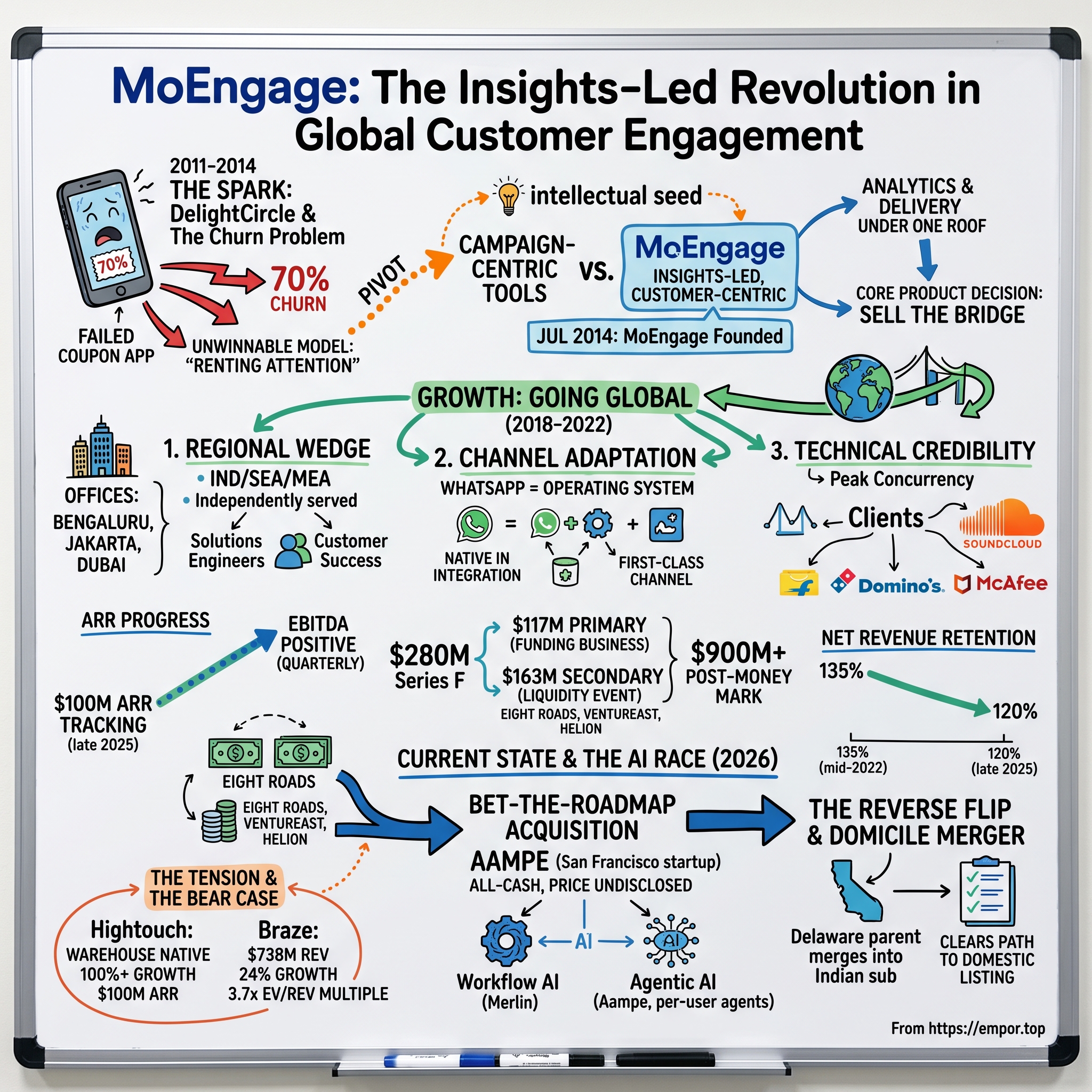
MoEngage: The Insights-Led Revolution in Global Customer Engagement
I. Introduction & Episode Roadmap
On December 16, 2025, a Bengaluru-headquartered software company that most consumers have never heard of announced that investors had put $180 million into it — just six weeks after they had already put in $100 million. The combined $280 million was labelled a Series F. The headline number was enormous by the standards of Indian enterprise software. And the most interesting fact about it was buried three paragraphs down: of that $180 million, roughly $123 million never touched the company's bank account. It went to existing shareholders and employees selling their stock. Only about $57 million was primary capital that funded the business.1
That single detail is the right place to begin an underwriting of MoEngage, because it tells you what this round actually was. It was not, in the main, a growth financing. It was a liquidity event — a carefully engineered pre-IPO cleanup in which early venture funds took money off the table, 259 current and former employees tendered roughly $15 million of shares, and a new cohort of crossover investors bought their way onto the register before a public listing.2 The company was priced in that transaction at "well over" $900 million post-money.1 Whether $900 million is a sensible estimate of what this business is worth is a separate question from the fact that someone paid it, and the distance between those two questions is what this piece is about.
The business itself is genuinely good, and the story behind it is genuinely improbable. MoEngage was founded in July 2014 by two IIT Kharagpur computer science classmates, Raviteja Dodda and Yashwanth Kumar, out of the wreckage of a failed mobile coupon app.3 Twelve years later it processes engagement for more than 1,350 consumer brands across 75 countries — SoundCloud, McAfee, Flipkart, Kayak, Domino's, Deutsche Telekom, Travelodge, Loblaw — reaching more than two billion consumers a month.2 It was tracking toward roughly $100 million in annualised recurring revenue during 2025 and told investors it expected to turn EBITDA-positive that quarter.1 It has about 820 employees across 15 offices.45 In January 2026 it obtained National Company Law Tribunal approval to merge its Delaware parent into its Indian subsidiary — the "reverse flip" — clearing the corporate path to a listing on India's exchanges.6 In June 2026 it spent cash acquiring a San Francisco agentic-AI startup called Aampe.5
Here is the tension that runs through all of it.
MoEngage sits in one of the most crowded, best-capitalised, most rapidly re-architected categories in enterprise software. Its closest public comparable, Braze, generated $738.2 million of revenue in the fiscal year ended January 31, 2026 — more than seven times MoEngage's ARR — grew 24.4%, and trades at an enterprise value of roughly $2.9 billion, about 3.7 times revenue.7[^8] Klaviyo, larger and faster-growing still, trades at roughly 3.5 times revenue.8 Meanwhile a warehouse-native challenger called Hightouch crossed $100 million of ARR in 2025 — the same scale as MoEngage — growing more than 100% in each of the last two years, and was valued at $2.75 billion in April 2026.9 So the same category contains a business at MoEngage's revenue scale priced at three times MoEngage's mark, and public businesses many times MoEngage's size priced at a fraction of MoEngage's revenue multiple.
Those facts cannot all be reconciled by "the market is efficient." They can only be reconciled by asking what each price is paying for: growth rate, gross margin structure, architectural position, and the terms attached to the shares. That is the work of this piece.
The road runs through: the 70% churn problem that killed the founders' first company and gave them their second; the architectural bet that analytics and delivery belonged under one roof; a genuinely excellent go-to-market wedge into markets that American software companies could not be bothered to serve properly; the structural gross-margin headache that comes from touching telecom and WhatsApp traffic; a capital structure with six preferred rounds stacked on top of common shareholders and no published cap table; a domicile migration undertaken on the theory that Indian public markets will pay more than American ones — a theory that two recent Indian SaaS listings have already partially falsified; and a bet-the-roadmap acquisition of an AI company whose price the buyer declined to disclose.
It starts with an app nobody came back to.
 Subscribe on LinkedIn
II. The Spark: DelightCircle and the Early Pivots (2011–2014)
In 2011, Raviteja Dodda co-founded a company called Pipal Tech Ventures, whose product was a mobile-first local offers and coupon network called DelightCircle.103 The pitch was of its moment. Indian smartphone penetration was inflecting, offline retailers had no digital shopfront, and a mobile app that pushed nearby discounts to nearby consumers seemed like an obvious bridge. Dodda and Yashwanth Kumar had been classmates in the 2006–10 B.Tech computer science cohort at IIT Kharagpur, had experimented with SMS marketing ventures as students, and reunited around the idea.3
DelightCircle worked, in the narrow sense that matters least. It acquired users. Marketing spend produced downloads, downloads produced installs, and installs produced a growth chart that looked defensible for about four weeks. Then came the number that ended the company and started the next one: roughly 70% of installed users either never returned or uninstalled the app within the first 30 days.3
It is worth sitting with what that means operationally, because it is not merely a bad statistic — it is a structurally unwinnable business model. If 70% of acquired users are gone in a month, then every rupee of marketing spend buys an asset that mostly evaporates before it can be monetised. The company is not building a user base; it is renting attention, repeatedly, at a price that never amortises. You can fix this in exactly two ways: acquire users more cheaply, which competition prevents, or get more of them to come back, which requires knowing who they are and why they left.
The founders tried the second path, and ran into the tooling. In 2012 and 2013, doing behavioural retention properly meant assembling a pipeline by hand. You exported user event logs from your app. You loaded them into a separate analytics product. You looked at funnels and drop-off points. You manually constructed a cohort — "users who added an offer to their wallet but did not redeem it within 48 hours." Then you exported that cohort as a list and handed it to an entirely different system, an email service provider or a push-notification vendor, which sent the message hours or days later with no knowledge of what the user had done in the interim.
The diagnosis the founders arrived at is the intellectual seed of the whole company, and it is sharper than the usual founding-myth platitude. The tools of the era were, in their framing, campaign-centric rather than customer-centric.3 A campaign-centric system is organised around the marketer's calendar: here is a message, here is a list, send it Tuesday. A customer-centric system is organised around the individual's behaviour: this person just did something, what should happen next, right now. The first is a broadcast model inherited from desktop email marketing. The second is what a mobile app actually requires, because on a phone the window between intent and abandonment is measured in minutes.
Inc42, reviewing the company's history, framed the same realisation from the other end: the bottleneck at DelightCircle "was not growth, but sustainability" — spend produced short-lived activity spikes followed by steep drop-offs.11
The pivot decision has a quality worth noting, because it recurs in how this management team allocates capital later. Faced with a failing consumer app and a missing piece of infrastructure, the founders did not try to patch the app. They abandoned it and went to build the missing infrastructure — moving from a business with terrible unit economics and no defensibility to one with recurring revenue and embedded switching costs. Dodda left Pipal Tech in June 2014; MoEngage was founded in July 2014.103
The early institutional history contains a detail worth correcting against the popular retelling. MoEngage was accepted into the Alchemist Accelerator, an enterprise-focused programme, in its first year.3 Its genuine early backer was Helion Venture Partners, which seeded the company and then led a $4.25 million Series A in September 2015 alongside Exfinity Ventures and angels including Snapdeal's Kunal Bahl and Rohit Bansal and TaxiForSure's Raghunandan G.10 Ventureast, sometimes described as a founding-era investor, in fact arrived later, co-leading the $9 million Series B in December 2018. The distinction matters when assessing returns: Ventureast's roughly 10x blended outcome in the 2025 secondary was earned on a 2018 entry price, not a 2014 one.1
The first customer was TaxiForSure, followed by Gaana, ShopClues and Snapdeal.1110 By September 2015 the company claimed its SDK was profiling around 20% of India's smartphone users.10 That claim, made to a reporter and never audited, is the first instance of a pattern that persists to this day: MoEngage's most impressive figures are self-reported, and there is no filing anywhere that tests them.
III. The Insight-Led Paradigm Shift: Moving Beyond Pure Delivery (2014–2018)
The martech landscape MoEngage entered in 2014 was cleanly, and profitably, divided into two halves that did not speak to each other.
On one side sat the analytics companies — Mixpanel, Amplitude, Google Analytics. They were excellent at description. They could show you that 40% of users dropped out between the cart and the payment screen, that Tuesday cohorts retained better than Saturday cohorts, that a particular onboarding step was leaking. What they could not do was act. An analytics product tells you the building is on fire; it does not carry water.
On the other side sat the delivery companies — Twilio, SendGrid, Urban Airship, and the push-notification vendors. They were excellent at transmission. They could move enormous volumes of messages reliably at low cost per unit. What they could not do was understand. A delivery product is a pipe; it has no opinion about who should receive what, and no memory of what happened when the last message arrived.
Every serious mobile company in 2014 was therefore employing engineers to build a bridge between the two — a bespoke, brittle, permanently out-of-date integration layer whose only purpose was to translate "what we learned" into "what we send."
MoEngage's core product decision was to sell the bridge as the product. The SDK embedded in a client's mobile app streams behavioural events in real time; the same platform that ingests those events also owns the segmentation engine, the journey logic and the outbound channels. A user abandons a cart, and the decision about whether to message them, through which channel, with what content, and at what moment can be made and executed inside one system with no export step and no latency gap.
Explaining why this is more than a convenience is important, because "we put two products in one box" is a weak moat on its own. The real economics are these. First, it collapses time-to-value: a customer integrating one SDK and one schema, rather than stitching three vendors, goes live in weeks instead of quarters, which materially lowers the total cost of ownership and shortens sales cycles. Second, and more durably, it changes what the vendor knows. A delivery-only vendor sees sends and opens. A unified vendor sees the entire behavioural graph — every screen, every purchase, every dormancy — and can therefore optimise on outcomes the pipe vendors cannot even measure. Third, it deepens the integration surface, which is the same thing as raising the exit cost. Which points to the artificial intelligence layer.
MoEngage introduced Sherpa, its proprietary optimisation engine, in late 2016 — considerably earlier than the company's more recent AI positioning implies, and a point in its favour rather than against it.12 The first capability shipped was Intelligent Time Optimization: rather than sending a push notification at 7pm because a marketer picked 7pm, the system learned each individual's historical activity pattern and delivered at the moment that person was most likely to be holding their phone. Sherpa subsequently expanded to three decisions — whom to target, what message and channel to use, and when to deliver — plus predictive and recency-frequency-monetary segmentation, recommendations and anomaly detection.12
The customer-side evidence MoEngage published for Sherpa was a 45% lift in engagement rate at the travel booking company Cleartrip.12 This is the appropriate moment to be precise about what such a number is and is not. A single named customer result, published by the vendor, chosen by the vendor, with no disclosure of the baseline, the measurement window, or whether a holdout group was used, is marketing evidence. It is not operating proof. Genuine operating proof for an optimisation engine would be a systematic, cross-cohort disclosure of incremental conversion against control — which no vendor in this category, public or private, publishes. Braze does not. Klaviyo does not. MoEngage should not be judged more harshly than its peers for this, but the reader should not mistake case studies for evidence of a durable technical edge either.
The genuinely hard part of the 2014–2018 period was not the machine learning. It was the plumbing. Ingesting behavioural events from millions of concurrent mobile users, writing them to a store that can be queried on arbitrary attributes fast enough for a marketer to build a segment interactively, and doing so without the SDK degrading the client's app performance or draining the user's battery, is a serious distributed-systems problem. The engineering team under Kumar had to make the standard trade-offs — what to precompute versus what to compute at query time, how long to retain raw events, how to shard by customer. MoEngage today reports processing on the order of four billion messages daily.11 Its rival CleverTap made the same problem the centre of its marketing, building and promoting a purpose-built database it calls TesseractDB.13
That both companies chose to compete on the data layer tells you where they believed the defensibility lived. It also tells you exactly where they are now most exposed — because the bear case in Section IX is precisely that the customer's data warehouse, not the vendor's database, is becoming the system of record.
IV. Going Global: GTM Execution and Regional Localization (2018–2022)
By 2018 MoEngage had a working product and a strategic problem: the natural customers for a mobile-first engagement platform were global, but the natural competitors for those customers were American, better capitalised, and already installed in the accounts.
Attacking Salesforce Marketing Cloud, Adobe's Marketo and Campaign products, or a fast-rising Braze in North American enterprise accounts would have been a capital-intensive war of attrition fought on the incumbents' terms — long sales cycles, expensive field sales, procurement processes designed around vendors the buyer's CIO had already heard of. MoEngage had raised $9 million.
So it went where the incumbents were not paying attention. The wedge was India, Southeast Asia and the Middle East — markets that were mobile-first by default, growing far faster than the West, and served by US software vendors through remote sales teams operating from San Francisco or London on the wrong side of a ten-hour time difference.
Three things made the wedge work, and they are worth separating because only two of them are durable.
The first was physical presence. MoEngage put offices, solutions engineers and customer success staff on the ground in Bengaluru, Jakarta and Dubai. In enterprise software this is less glamorous than it sounds and more decisive than it looks. A consumer internet company running a lunchtime promotional push to twenty million users does not want to file a support ticket that will be read eleven hours later. Local presence converts a software vendor into an operational partner, and it is the single most common reason a regional buyer chooses a regional vendor over a better-known global one. It is also, importantly, a replicable advantage — an incumbent with more money can hire the same people in the same cities, and several have.
The second was channel adaptation, and this is the more genuinely differentiated piece. In the markets MoEngage targeted, the American default channel hierarchy is inverted. Email is largely ignored. SMS is expensive and plagued by fraud and carrier friction. WhatsApp is the operating system of daily communication, commerce and increasingly banking. A platform that treats WhatsApp as a first-class channel — with template management, conversational flows, transaction notifications and cart recovery built natively rather than bolted on — is not offering a feature; it is offering the only channel that reaches the customer. Vendors built around email-first assumptions arrived at this late and awkwardly.
The third was scale credibility with regional consumer giants. Serving high-volume consumer internet platforms during peak concurrency — the dinner rush for a food delivery company, a flash sale for a marketplace — is a technical reference that compounds. It is also where MoEngage's architecture investment paid its return: you cannot win those accounts on price, only on not falling over.
The funding history through this period tracks the expansion in a disciplined, unspectacular way. A $9 million Series B in December 2018 co-led by Matrix Partners India and Ventureast. A $25 million Series C in February 2020 led by Eight Roads Ventures with F-Prime Capital participating. A $32.5 million Series C1 in July 2021 with Eight Roads and Multiples Alternate Asset Management. A $30 million Series D in December 2021 led by Steadview Capital. Then the largest of the era: a $77 million Series E in June 2022 led by Goldman Sachs Asset Management and B Capital.14
The Series E announcement contains the two most useful operating disclosures MoEngage has ever made public, and they deserve to be recorded precisely because of what has happened to them since. At that point the company reported ARR growth of 105% year over year, and net revenue retention above 135%.14 Headcount was above 650.14
Those are outstanding numbers. A business compounding revenue at 105% with 135% net retention is one where existing customers alone grow the top line by more than a third annually before a single new logo is signed. It is the profile that justifies a premium multiple.
Hold those two figures. In Section V and Section VI they become the measuring stick against which the current business — and the current $900 million price — has to be assessed, because both have moved substantially, and in the same direction.
V. The Economics of Customer Engagement & The Competitive Landscape
Start with what MoEngage's revenue actually is, because the geographic composition has changed more than the narrative around the company has.
As of late 2025, more than 30% of revenue came from North America, approximately 25% from Europe and the Middle East, and approximately 45% from India and Southeast Asia.41 Roughly 60% of revenue came from traditional enterprises and 40% from internet-native companies.4 Inc42 reports enterprise customers at around 70% of revenue and net revenue retention at 120%.11
Two observations follow immediately. First, the "emerging markets specialist" framing is now only half true. North America is the largest single geography, which means MoEngage is increasingly competing on the terrain it originally and sensibly avoided — against Braze, Klaviyo, Salesforce and Adobe, with higher customer acquisition costs and longer sales cycles. Dodda's own explanation for why this works is that the growth is coming from displacement: "A large part of our growth is driven by migrations of enterprise customers from Salesforce Marketing Cloud and Adobe Experience Cloud," he told TechCrunch in June 2026, adding that the company had recently signed three to four multimillion-dollar annual contract value deals with Salesforce switchers.5 That is a credible mechanism — rip-and-replace of legacy suites is a real and large motion in martech — but three or four deals is an anecdote, not a trend, and the company has not disclosed win rates, average contract values or Western cohort retention.
Second, and more importantly, net revenue retention has fallen from above 135% in mid-2022 to approximately 120%.1411 This is the single most consequential operating fact in the entire underwriting, and it is worth being explicit about why.
Net revenue retention measures what a cohort of existing customers spends this year versus last, including expansion, downgrades and churn. At 135%, the installed base is a growth engine: it throws off 35 points of growth annually with zero sales cost. At 120%, it throws off 20. The 15-point decline means the company must now source proportionally more of its growth from new logos, which are the expensive kind. It also means either that customers are expanding less aggressively — plausible, as consumer internet clients in India and Southeast Asia moved from land-grab spending to discipline — or that churn and downgrades increased, or both. MoEngage has not disaggregated it, and until a filing exists nobody outside the company can.
For calibration: Braze reported a trailing-twelve-month dollar-based net retention rate of 109% as of January 31, 2026.7 MoEngage at 120% is meaningfully better than the public benchmark. That is a real point in its favour. The direction of travel is the concern, not the level.
Growth has decelerated on the same arc. From 105% in the year to mid-2022, to "about 40% year-over-year last year" as reported in November 2025, to a stated target of roughly 35% compound annual growth over the following three years.1441 A 35% three-year target is a good number in absolute terms and a modest one relative to the company's own history. It is also, notably, a target rather than a result.
Revenue quality, and what cannot be seen
ARR is the headline metric in this category, and it is worth being careful about what MoEngage's version of it contains. A customer engagement platform's contract typically bundles a subscription — priced on monthly tracked users, event volume or feature tier — with a usage component tied to messages actually delivered. The subscription is genuinely recurring. The usage component is recurring in the sense that it repeats, but it flexes with the customer's own marketing budget, which flexes with the customer's business. A food delivery platform that cuts promotional spending in a downturn does not churn; it simply sends fewer messages, and the vendor's revenue falls without a single logo being lost.
This matters because MoEngage's customer base is concentrated in exactly the sectors where that flex is largest: consumer internet, e-commerce, fintech, food delivery and travel. The company has never disclosed the split between subscription and usage revenue, nor contract duration, nor the proportion of revenue under multi-year commitment. Those three disclosures would do more to establish the durability of the $100 million than any growth figure, and none of them exist.
Customer concentration is similarly opaque. MoEngage reports more than 1,350 brands, which sounds like healthy diversification, but averages mislead in enterprise software.2 Braze, a useful proxy for the shape of these books, disclosed that 333 of its 2,609 customers — under 13% — carry ARR at or above $500,000.7 If MoEngage's distribution is similar, a modest number of large accounts carries a disproportionate share of revenue, and the loss of a handful would be material. Whether any single customer exceeds 5% or 10% of revenue is not disclosed.
The sales-efficiency picture is inferential rather than observed. What can be said is that headcount grew from above 650 in mid-2022 to roughly 800 by late 2025 while revenue grew substantially faster, which is consistent with improving efficiency.144 What cannot be said is anything precise about customer acquisition cost, payback period, or how those metrics differ between the Indian and Southeast Asian base — where MoEngage sells with local teams into a receptive market — and the North American expansion, where it is displacing incumbents through longer cycles with more expensive salespeople. Given that North America is now the largest revenue geography, the blended CAC almost certainly rose.4 By how much is a question only a filing answers.
Sizing the reachable market honestly
The category TAM figures that circulate for customer engagement — usually built by summing marketing automation, customer data platforms, mobile messaging and personalisation into a number in the tens of billions — are close to useless for underwriting, because they include budget MoEngage cannot address at its current product, price point and distribution.
A more disciplined frame starts from what the company actually sells: cross-channel engagement software to consumer-facing brands with meaningful mobile app user bases, at contract values that make an enterprise sales motion economic. That excludes the long tail of small businesses, which is Klaviyo's territory and requires a self-serve motion MoEngage does not run. It excludes B2B marketing automation, a different buyer and product. It excludes the pure delivery spend that flows to carriers and Meta, which is cost of goods, not addressable software budget.
What remains can be bounded from the revenue of the companies competing for it. Braze at $738 million, Klaviyo at $1.23 billion, Bloomreach above $260 million, CleverTap and MoEngage near $100 million each, Insider undisclosed but well capitalised, plus the undisclosed but substantial Salesforce Marketing Cloud and Adobe Experience Cloud lines.7818 The disclosed portion of that set alone approaches $2.5 billion, and the incumbents' undisclosed lines are plausibly several times that. So the reachable market is large enough that MoEngage's roughly $100 million is a small share of it — meaning the growth case does not require inventing new budget, only taking existing budget from named competitors.
That is the encouraging reading. The sobering one is that taking budget from Salesforce and Adobe is precisely what every other well-funded competitor in the list is also attempting, with more capital in Insider's case and more scale in Braze's and Klaviyo's. Market share gains in this category are won account by account through displacement, and each displacement is a multi-month engineering project the customer must be persuaded to fund. MoEngage's three or four recent Salesforce switches are evidence the motion works; they are not evidence it scales at a rate that turns $100 million into $500 million.5
The gross margin question
MoEngage has never disclosed its gross margin. This is not a minor omission; for a business in this category it is arguably the most important undisclosed number, and the reason is structural.
A pure software company sells access to code. Its cost of revenue is hosting and support, and gross margins of 78–85% are normal. A customer engagement platform that also carries the message is different, because some portion of what it bills is a pass-through to a telecom aggregator or to Meta.
The scale of that pass-through drag is visible in the public comparables. Braze, which does carry messaging volume, reported GAAP gross margin of 67.1% in fiscal 2026, down from 69.1% the prior year — nearly 200 basis points of compression in a single year.7 Klaviyo, whose mix is more email-weighted, ran 74.7% in calendar 2025.8 Twilio, which is essentially all pass-through communications infrastructure, ran 48.9%.15 The spectrum from 75% to 49% is precisely the spectrum from software to pipe, and every CEP sits somewhere on it depending on how much traffic it resells.
MoEngage's exposure is skewed toward the most expensive and most volatile end of that spectrum, because WhatsApp is its signature channel. And WhatsApp economics have been actively deteriorating for vendors. Effective July 1, 2025, Meta changed WhatsApp Business Platform billing from a per-24-hour-conversation model to a charge on each delivered template message, priced by category and country.[^17] Marketing-category messages are the most expensive and, per Meta's documentation, do not qualify for volume discounts — the specific mechanism by which a large aggregator would normally earn a spread.[^17] Rates vary enormously by market, from under a cent per marketing message in India to over twelve cents in Germany.[^17] And Meta has said it will begin charging for service messages and in-window utility templates from October 1, 2026, ending a category of free traffic.[^17]
Read that against MoEngage's business. Its heaviest volumes sit in the cheapest markets, which caps the absolute rupees available to mark up. Its fastest-growing revenue is in the expensive markets, where the underlying cost per message is ten times higher. Volume discounts are unavailable on exactly the message category marketers most want to send. And Meta unilaterally repriced the input twice in eighteen months.
The strategic response available — and the one the company describes pursuing — is to separate the software subscription from the delivery, letting clients contract directly with carriers and Meta so that pass-through revenue never enters MoEngage's income statement. This genuinely protects reported gross margin. It also shrinks reported revenue, and it surrenders the aggregation economics. It is a margin-quality decision, not a value-creation one, and an investor should want to see the gross margin line and the revenue line together before applauding it. Neither is public.
Building the peer set
Constructing a comparable set for MoEngage requires separating three groups that are routinely conflated.
The direct operating peers are the mobile-first, cross-channel customer engagement platforms selling to B2C brands with consumption-influenced enterprise contracts. CleverTap is the sharpest of these and the most instructive. Founded in 2013, India-rooted, at roughly the same ARR scale as MoEngage — approaching $100 million — it raised a $105 million Series D in 2022 led by CDPQ at a valuation of roughly $775 million, and acquired the US-and-Europe-focused Leanplum in May 2022 in a cash-and-stock deal whose price was not disclosed.1613 CleverTap had 1,200 customers at that point and had raised $76.6 million to date; Leanplum had raised $131.2 million.13 The comparison is uncomfortable for the MoEngage bull case: a company at the same revenue scale, pursuing the same geographic strategy, was marked at $775 million in the 2022 bull market against MoEngage's $900-million-plus mark in late 2025.
WebEngage occupies the tier below — the most India-native platform, with rupee billing, local support and native WhatsApp, serving 850-plus consumer brands, on roughly $32.7 million of total funding and a reported revenue run rate around $20 million. It is not a threat to MoEngage's enterprise accounts. It is a permanent source of price pressure in mid-market deals, which matters for blended pricing.
Insider, the Istanbul-founded challenger, is the best-capitalised direct competitor by a wide margin: a $500 million Series E led by General Atlantic announced in November 2024, more than $772 million raised in total, and a $2 billion valuation established in 2023, operating in 28 countries.17 Insider's ARR is not disclosed; third-party estimates circulating at around $150 million originate from self-reported databases and should not be relied upon. What can be relied upon is the capital position: Insider has raised roughly two and a half times what MoEngage has, in the same segment, targeting overlapping accounts.
Bloomreach provides the cleanest private datapoint in the category because it actually published one. In February 2026 it announced it had surpassed $260 million in ARR, with record net new ARR in 2025, its strongest quarter ever in Q4, positive free cash flow for the year, and more than 1,400 brands — nearly half of which now use at least one of its AI agents.18 It was valued at $2.2 billion in 2022 on $422 million raised.18
The public benchmarks are Braze and Klaviyo, and the discipline here is to state the basis precisely. Braze's fiscal 2026 (ended January 31, 2026) revenue was $738.2 million, up 24.4%; GAAP gross margin 67.1%; GAAP net loss $131.3 million; non-GAAP operating income $28.5 million; 2,609 total customers of which 333 carry ARR at or above $500,000; trailing net retention 109%.7 At a share price of $26.19 on July 20, 2026, equity value was approximately $2.95 billion, and enterprise value approximately $2.89 billion after net cash — about 3.7 times trailing revenue on an enterprise-value basis.[^8] Klaviyo's calendar 2025 revenue was $1,234.0 million, up 31.6%, at 74.7% gross margin with a GAAP net loss of $31.8 million; at $18.17 per share its equity value was roughly $5.44 billion and enterprise value roughly $4.57 billion, about 3.5 times trailing revenue.8
Note the ordering carefully, because it is the opposite of intuition: Klaviyo grows faster than Braze, at seven points higher gross margin, with a smaller loss — and trades at a slightly lower enterprise-value-to-revenue multiple. Whatever the public market is currently rewarding in this category, it is not simply growth.
The set that must be excluded, and the reasons, are as instructive as the inclusions. Salesforce, Adobe and Oracle compete in every MoEngage deal but do not disclose standalone revenue for these product lines, so no multiple can be computed and none should be implied. Twilio is a communications infrastructure business at 48.9% gross margin and 13.7% growth — a useful illustration of pass-through economics, not a valuation comparable.15 Hightouch, discussed in the bear case, is not a direct operating peer at all: it is a warehouse-native activation layer with a different architecture, a different buyer conversation and a growth rate more than double MoEngage's, and using its $2.75 billion valuation as a comparable would be exactly the error of applying the highest available multiple to a business that has not earned it.9
VI. The Megaround Era & Restructuring: The "Reverse Flip" & Series F (2022–2026)
Anatomy of the Series F
The Series F is universally reported as $280 million. Before that number is used as an anchor for anything, it needs to be taken apart, because the headline substantially overstates what the company received.
The first tranche closed in November 2025: $100 million, led by returning investor Goldman Sachs Alternatives and co-led by new investor A91 Partners, structured approximately 60% primary and 40% secondary — so roughly $60 million of new money into the business and $40 million to selling shareholders.4
The second tranche closed on December 16, 2025: $180 million, led by two new investors, ChrysCapital and Dragon Funds, with Schroders Capital participating alongside existing holders TR Capital and B Capital.2 Of that, approximately $123 million was secondary and approximately $57 million was primary.1 Within the secondary component sat an employee tender of roughly $15 million covering 259 current and former employees — the company's second such programme.2 The institutional sellers were the early venture funds: Eight Roads Ventures, Helion Venture Partners, Matrix Partners, and Ventureast, the last of which realised roughly a 10x blended return on its 2018 entry.21
So the arithmetic that matters: of $280 million of announced Series F, approximately $117 million was primary capital that funded the company, and approximately $163 million was a change of ownership among shareholders. Total primary capital raised across the company's entire history stands at approximately $307 million.1
This is not a criticism of the structure — it is a sensible and common pre-listing manoeuvre that clears aged venture funds off the register, rewards employees whose options had no market, and seats crossover investors who will support an IPO book. But it changes what the round tells you. A round that is 58% secondary is substantially a price discovery event among shareholders, not a referendum on how much capital the business needs. And the identity of the buyers matters: ChrysCapital, Dragon Funds and Schroders Capital are the kind of investors who buy into Indian companies twelve to twenty-four months ahead of a domestic listing. They are pricing an expected IPO, which makes their entry price partly a function of what they expect a later buyer to pay — a very different exercise from valuing the cash flows.
What the $900 million mark does and does not establish
MoEngage was priced at "well over" $900 million post-money in the December tranche.1 Media reporting following the CEO's subsequent interviews has placed it in the $800–850 million region, which is itself a useful reminder of how imprecise private marks are.6 Set against roughly $100 million of ARR, the headline sits near nine times ARR.
Four reasons that figure cannot be carried forward unchanged into a public-market view.
First, the securities are not the same instrument. The investors who paid the $900 million mark bought preferred stock. MoEngage has issued at least six lettered preferred series — A through F, plus a C1. Standard terms in Indian and US venture financings of this vintage include a liquidation preference ranking ahead of common stock, anti-dilution protection, board or observer rights, consent rights over major corporate actions, and frequently a contractual right to force or participate in a listing. None of MoEngage's actual terms are public. What is knowable is that approximately $307 million of primary capital has been invested, and that in a downside scenario preferred holders would in the ordinary course recover their capital before common shareholders receive anything. A preferred share with downside protection is worth more than a common share with none. Applying the price of the protected instrument to the entire equity, including unprotected common, systematically overstates the company's value. Without the actual terms, the size of that overstatement cannot be quantified — but its direction is not in doubt.
Second, the secondary shares traded at a different price from the primary shares. This is normal — secondary buyers typically pay a discount to the concurrent primary round, reflecting the fact that they are buying older, sometimes converted, sometimes common-equivalent stock without new-money rights. Reporting on the November tranche indicated a blended valuation materially below the primary headline.19 When a single round contains two prices for the same company, the higher one is not "the valuation." It is the price of the most protected security.
Third, the capitalization cannot be built. There is no published share count. There is no disclosed option or RSU pool, though the existence of two employee tender programmes confirms a meaningful pool exists. There is no disclosure of warrants, convertible instruments, or side letters. There is no statement of voting rights or of founder shareholding. Until a filing exists, any "market capitalization" for MoEngage is an implied figure derived from a per-share price applied to an unknown denominator. It is also worth stating plainly that total equity value and free float are entirely different things: in a listing that includes a large offer-for-sale component — the norm for Indian venture-backed IPOs, and the obvious structure given how many funds still hold stock — the float would be a fraction of the equity value, with the rest locked or held by insiders.
Fourth, enterprise value cannot be reliably calculated. MoEngage's cash balance is not disclosed. Its debt and lease obligations are not disclosed. Roughly $307 million of primary capital has been raised over twelve years against a business that has run at or near breakeven recently and at a loss before that, so the cash position is plausibly substantial — but "plausibly substantial" is not a number. Any comparison of a MoEngage equity-value multiple against Braze's or Klaviyo's enterprise-value multiple is therefore not apples to apples, and the gap runs in MoEngage's disfavour, since a net-cash company's EV multiple is lower than its equity multiple.
The statutory financials, and their limits
The one audited window into MoEngage is the India entity, and it is a partial one. MoEngage India Private Limited reported operating revenue of ₹311.5 crore in FY24, up 27.2% from ₹244.8 crore in FY23, against total expenses of ₹326.9 crore, producing a net loss of ₹15.4 crore. Total assets stood at ₹80.7 crore.20
These are standalone figures for the Indian subsidiary of a group whose parent was, at that time, a Delaware corporation. They capture neither the group's consolidated revenue nor its consolidated economics, and inter-company transfer pricing means the Indian entity's margin is an artefact of arrangement as much as of performance. Roughly $37 million of India-entity revenue against a group tracking toward $100 million of ARR is not a contradiction; it is a reminder that the audited number and the announced number are measuring different things.
The reverse flip changes this. Once the Delaware parent merges into the Indian company, consolidated group accounts become filable in India, and the gap between press-release ARR and audited revenue closes. That is one of the underappreciated consequences of the restructuring: it makes the company legible.
Understanding the reverse flip
Like most Indian software companies raising dollars in the 2010s, MoEngage placed its parent entity in Delaware. The logic was practical: US incorporation was what American and global venture funds understood, simplified preferred-stock mechanics, eased IP holding, and made an eventual Nasdaq listing straightforward.
By the mid-2020s the calculation inverted, and on January 12, 2026 the Bengaluru bench of the National Company Law Tribunal approved the amalgamation of MoEngage Inc., the Delaware parent, into MoEngage India Private Limited — the US entity ceasing to exist without winding up, with all assets, liabilities and operations transferring to the Indian company.6 MoEngage had been in discussions with advisers and bankers about an IPO since at least the prior year.6
The costs of such a move are real and, for MoEngage, undisclosed. Peers provide the scale. Groww's reverse flip from the US carried a tax charge of roughly ₹1,340 crore.21 Razorpay's cost roughly ₹1,200–1,245 crore in India plus a reported several hundred million dollars in the US.21 PhonePe's move from Singapore reportedly cost around ₹8,000 crore. The mechanism is that share swaps in these mergers can crystallise capital gains for holders, and accumulated tax losses may not survive the restructuring. MoEngage is a smaller company than any of those and would carry a proportionally smaller bill, but the company has not disclosed a figure, and the absence of disclosure is itself a diligence item.
The strategic case for enduring that cost is the premise that Indian public markets will pay more for a profitable, high-growth Indian software company than American markets will. It is a reasonable premise. It is also, as of mid-2026, a premise with evidence running against it, which Section IX takes up directly.
Management, judged by behaviour
Dodda and Kumar have run this company for twelve years without a founder split, a headline governance failure, or a publicly reported down round. Through 2021 and 2022, when peers raised at ruinous multiples and hired into growth that did not arrive, MoEngage raised comparatively modest amounts — $32.5 million, then $30 million, then $77 million — and did not appear in the 2023 layoff cycle in a way that generated coverage. Headcount moved from above 650 in mid-2022 to roughly 800 in late 2025 and about 820 after the Aampe acquisition: growth of well under 30% over three years while revenue grew far faster.1445 That is genuine operating leverage, achieved deliberately.
They have also been comparatively careful in what they claim. Dodda's framing of the Series F was that the capital removes time pressure — "It gives us the opportunity not to have an urgency with regard to going IPO" — with a listing targeted in "a couple of years" depending on market conditions.1 Reporting following his subsequent interviews put IPO readiness around mid-2027.6 That is a management team declining to commit to a date it does not control, which is the correct posture and rarer than it should be.
The candour has limits worth naming. The company disclosed 135% net revenue retention when it was 135% and has not issued a comparable disclosure since; the 120% figure reached the public through a third party.1411 It publicises ARR milestones and does not publicise gross margin. It announced the Aampe acquisition without a price. It describes itself as EBITDA-positive on an adjusted, quarterly basis without publishing the reconciliation. None of this is unusual for a private company, and none of it is misconduct. But an investor should notice that the disclosure set has become more selective as the numbers have become more mixed, and should treat the next filing — not the next press release — as the first real test.
Governance: what the record shows and what it does not
Two governance-relevant facts are actually on the record, and both cut in useful directions.
The first is the pattern of insider selling. Across the two Series F tranches, approximately $163 million of stock changed hands, with Eight Roads Ventures, Helion Venture Partners, Matrix Partners and Ventureast among the sellers, alongside 259 employees tendering roughly $15 million.214 The benign and probably correct reading is that this is exactly what a company should do before listing: retire aged fund positions that would otherwise overhang the stock, and give long-tenured employees a first taste of liquidity so that the IPO is not their only exit. The question a filing must answer is whether the founders sold, and how much. Employee and early-fund selling is housekeeping. Founder selling ahead of a listing is a different signal, and the disclosure to date does not distinguish between them.
The second is the composition of the new register. ChrysCapital, Dragon Funds and Schroders Capital are late-stage crossover investors whose economics depend on a listing occurring at or above their entry price, and whose holding periods are shorter than a founder's.2 Their interests and those of eventual public shareholders overlap substantially at the moment of pricing and diverge afterwards. That is not a criticism; it is the standard structure of a pre-IPO round, and it is why the identity of the marginal buyer matters when interpreting a private mark.
Everything else in the governance file is unknown. Founder shareholding and any special voting arrangements: not disclosed. Board composition, and how many seats are held by preferred investors versus independent directors: not disclosed. Executive compensation and the size and vesting of management equity: not disclosed. Related-party transactions: not disclosed. Whether any investor holds consent rights that could constrain the company's strategy or the timing and terms of a listing: not disclosed. There is no reported litigation or regulatory action of consequence, but "none reported" for a private company is a much weaker statement than a clean legal-proceedings section in a prospectus, because the reporting obligation that would surface such matters does not yet apply.
The correct posture is to treat each of these as an open item rather than a resolved one. Absence of disclosure is not evidence of absence of problems, and a company that has been well governed by a stable founding team for twelve years still has to demonstrate that its governance is built for outside shareholders rather than for a cooperative group of venture funds who all know each other.
VII. The AI Arms Race & The Aampe Acquisition (June 2026)
Every marketing automation platform built before 2024, including MoEngage's, rests on the same interaction model: a human marketer draws a flowchart. If the user abandons a cart, wait two hours, send a push notification; if unopened after twenty-four hours, send an email; if the user is in the high-value segment, apply a discount.
This model has a hard ceiling, and Dodda named it precisely: "Personalization has a ceiling. It's made of human bandwidth."22 A marketing team can maintain perhaps dozens of journeys and hundreds of segments. It cannot maintain millions. So every user is treated as a member of a group, and the personalisation is only ever as granular as the segments a human had time to define.
Aampe's proposition was to remove the human from the decision loop entirely. Founded in 2020 and headquartered in San Francisco with a team distributed across fourteen countries, it assigns a dedicated autonomous agent to each individual end user — co-founder Paul Meinshausen's formulation is "one agent per user, not one model per segment."235 Marketers supply content, objectives and guardrails; each user's agent decides what to send, through which channel, at what time and at what frequency, and learns from every outcome. The underlying methods are reinforcement learning techniques — Thompson sampling and multi-armed bandits — combined with causal and semantic learning.22 The company reports operating hundreds of millions of such agents, processing more than 200 billion decisions per week.22
Explained plainly: a traditional system is a set of rules written in advance by someone who has never met you. An agentic system is a small program that watches only you, tries things, notices which ones worked, and adjusts — and there is one of them for every customer.
MoEngage announced the acquisition on June 24, 2026, having been reported the previous day.235 The deal was all-cash. The price was not disclosed. A source told TechCrunch it was "worth tens of millions of dollars," and that is the extent of what is public — any specific figure circulating for this transaction is unsupported.5
What can be assessed is the reference frame. Aampe had raised approximately $28 million across three rounds, including an $18 million Series A in December 2024 led by Theory Ventures, with Peak XV Partners and Z47 also on the register.245 It had more than 30 customers across the US, Europe and Asia-Pacific, with ARR up roughly 150% over the prior year, and counted Swiggy, Grab, Taxfix and ZenBusiness among its clients.5 Approximately 20 employees joined MoEngage, taking group headcount to about 820.5 All three founders — Meinshausen, Schaun Wheeler and Sami Abboud — joined to lead the agentic decisioning effort.23
Judging the transaction honestly requires holding two things at once.
The case for it is strong. Aampe had customers in production at exactly the kind of high-volume consumer platforms MoEngage serves, growing 150%, with a team that had spent five years on a problem MoEngage would otherwise have needed years to attack. On a base of $28 million raised, "tens of millions" is an outcome that is respectable for the sellers without being a distressed capitulation, which usually indicates a negotiated strategic sale rather than a rescue. And MoEngage had the currency: it had just raised $117 million of primary capital and had explicitly flagged acquisitions as a use of proceeds.2 Buying a category-defining capability with cash you raised for that purpose, from a seller with real traction, is textbook capital allocation.
The case for caution is equally real. The price is undisclosed, so return on capital cannot be assessed at all. Acqui-hires of 20 people into an 800-person organisation have a well-documented failure mode in which the acquired team's technology is absorbed but its founders depart before the integration is complete — and here all three founders are the thesis. Aampe's technology assumes the platform can act autonomously on live customer traffic, which is a substantial trust ask for regulated enterprise buyers in banking and telecom, precisely MoEngage's stated 60% traditional-enterprise base.4 And competitively, MoEngage is not first: Bloomreach disclosed in February 2026 that nearly half its 1,400-plus brands were already using at least one AI agent, more than doubling year over year.18 Braze, Klaviyo and Insider are all shipping agentic capabilities. The claim that this acquisition makes MoEngage the first major player to replace manual campaign setup with autonomous agents is not supported by the record; the defensible claim is that it makes MoEngage credibly competitive in a race everyone is running.
Structurally, the acquisition slots beneath MoEngage's existing AI stack. Sherpa, launched in 2016, is the underlying optimisation engine.12 Merlin AI, introduced more recently, is the generative and workflow layer — combining large language models with campaign performance data to generate copy, visuals and test variants, with custom workflow agents marketers can build and audit, and an MCP server exposing MoEngage data to external tools.25 Aampe supplies the missing bottom layer: per-user decisioning. MoEngage's framing is that workflow agents serve the marketer while decisioning agents serve each individual user, and that owning both constitutes an "Agentic Customer Engagement Platform."22
That is a coherent architecture. Whether it converts into pricing power, higher net retention, or displacement wins against Braze and Salesforce is an empirical question with no answer yet. The first evidence would be net revenue retention reversing its decline. That number will not be visible until MoEngage files.
VIII. Playbook: Business & Investing Lessons
Lesson 1: Wedge where the incumbent is indifferent, not merely where it is absent. MoEngage's regional strategy worked not because India and Southeast Asia were empty — Salesforce and Adobe sold there — but because those markets were structurally unattractive to serve well from San Francisco. Smaller contract values, harder support economics, a channel mix built around WhatsApp, and time zones that made real-time operational support impossible. Incumbents rationally deprioritised them. The lesson generalises: the durable wedge is not an unserved market but a market the incumbent is economically disinclined to serve properly. The corollary is the harder half. Wedges expire. MoEngage now draws over 30% of revenue from North America, where none of the original advantages apply, and it is competing on the incumbents' terms with a fraction of their sales capacity.4
Lesson 2: The system that acts eventually eats the system that only observes. Pure analytics products describe; engagement platforms decide and execute. Over a decade the value in this stack has migrated steadily toward whoever sits closest to the action, because that is where measurable business outcomes are produced and therefore where budget accumulates. But the same logic is now running one layer beneath MoEngage. If the customer's warehouse becomes the system of record and an activation layer executes directly from it, the party closest to the action is no longer the platform that owns the database. Every company that has ever eaten an adjacent layer should assume something is preparing to eat it.
Lesson 3: Domicile is a capital allocation decision with a calculable price. The reverse flip is a wager that the multiple differential between Indian and US listing venues exceeds the one-time restructuring and tax cost. That is a genuinely quantitative decision, and peers show the cost side can run into thousands of crores.21 What makes it unusual is that the benefit side is the least stable variable in the calculation: multiples move. A company that begins a two-year restructuring to capture a valuation premium may complete it into a market that no longer offers one.
Lesson 4: Buy the paradigm, but price it and keep the people. MoEngage chose to buy per-user agentic decisioning rather than build it, using cash raised months earlier for that stated purpose — the correct instinct when a capability is a step change rather than an increment, and when the target has production customers rather than a research paper.25 The two conditions that make it work are that the price is disciplined and the founders stay. Only the second is currently verifiable.
Lesson 5: Read the round, not the headline. The most transferable analytical habit in this entire story is disaggregating $280 million into $117 million of primary capital and $163 million of secondary.14 A round that is majority secondary tells you about shareholder liquidity and pre-IPO positioning; a round that is majority primary tells you about the company's capital needs and growth plans. They are different events wearing the same label, and the press release will not distinguish them for you. The same discipline applies to the valuation attached to such a round: when secondary shares and primary shares in a single transaction clear at different prices, the headline figure describes the most protected security, not the company.
Lesson 6: Own the input, or accept that someone else sets your margin. MoEngage built its differentiation on WhatsApp at a moment when WhatsApp was cheap, under-served by Western vendors, and dominant in its markets. That was a correct read of consumer behaviour. What it did not come with was any control over the input's price. Meta changed the billing model in July 2025, excluded the most commercially important message category from volume discounts, and scheduled a further expansion of paid traffic for October 2026.[^17] A company whose signature capability runs on a channel owned by a single supplier has built its distribution on rented land. The lesson is not that MoEngage should have avoided WhatsApp — the channel was the right bet and there was no alternative. It is that a business in this position should be judged on how quickly it converts a channel advantage into something the supplier cannot reprice: proprietary decisioning, workflow lock-in, or data assets that survive a channel shift.
Lesson 7: Capital efficiency is a strategy, not a virtue. Reaching roughly $100 million of ARR on approximately $307 million of primary capital, with adjusted profitability, put MoEngage in a position where the timing of its listing is a choice rather than a necessity — which is precisely what Dodda described when he said the round removed the urgency to go public.1 Compare that with peers who raised multiples more and must now list, or sell, on someone else's schedule. Restraint during the 2021 boom, when raising more was easy and fashionable, is what purchased that optionality four years later. The cost of the same discipline is equally real: MoEngage is now outspent by Insider on sales capacity and by Braze on research and development, and the Red Queen problem in this category is that standing still is expensive too.177
IX. Analysis: Porter's 5 Forces, 7 Powers, & Bear vs. Bull
Where the power actually is
Applying Helmer's framework usefully means being honest about which powers MoEngage has, which it is claimed to have, and which it does not.
Switching costs — strong, and the genuine core of the moat. Adopting MoEngage means embedding an SDK in production mobile applications, mapping a custom event schema, instrumenting user properties across the app, and building journeys, templates and segments on top. Replacing it means redoing all of that, migrating historical behavioural data whose format is vendor-specific, rebuilding every journey, and re-validating deliverability — while the existing system runs in parallel and revenue-generating campaigns cannot stop. The evidence that this is real switching cost rather than asserted switching cost is retention itself: 120% net revenue retention means the average customer not only stays but spends more.11 Customers do not expand into vendors they are trying to leave.
Scale economies — moderate, and weaker than the narrative suggests. Distributing infrastructure cost across four billion daily messages is real leverage.11 But the claim that scale buys materially cheaper messaging is undercut by the economics of the most important channel: Meta's documentation states marketing-category WhatsApp messages do not qualify for volume discounts.[^17] On the dominant channel in MoEngage's core markets, the volume advantage largely does not exist. And at roughly $100 million of ARR against Braze's $738 million and Klaviyo's $1.23 billion, MoEngage is not the scale player in its own category — it is a mid-sized participant.78
Cornered resource — early, and not yet established. The Aampe acquisition brought a specific team and a specific approach to per-user decisioning.23 Whether that constitutes a cornered resource depends on whether the team stays and whether the approach proves defensible. Reinforcement learning applied to message selection is not an exotic technique; the defensibility, if any, lies in operating it reliably at hundreds of millions of agents. That is an engineering asset, and engineering assets erode. Calling this a power today is premature.
Counter-positioning — absent, and worth naming as absent. MoEngage does not have a business model that incumbents cannot copy without damaging themselves. Braze can serve emerging markets; Salesforce can build WhatsApp support; anyone can open a Jakarta office. MoEngage's regional advantage is an execution lead, not a structural trap for competitors. Execution leads are defended by continuing to execute, which is expensive and permanent.
On Porter's forces, the two that bind hardest are rivalry and supplier power. Rivalry is intense and unusually well funded: Insider has raised over $772 million, Bloomreach $422 million, Braze and Klaviyo are public with billions in market value, and CleverTap competes at identical scale on price.171878 Supplier power is the underappreciated one. Meta is a monopoly supplier of the WhatsApp channel and has repriced it twice since July 2025, with a further change scheduled for October 2026.[^17] A vendor whose signature channel is controlled by a single company that can unilaterally change its cost base has less pricing autonomy than its gross margin will ever reveal. Buyer power is moderate and rising as procurement functions mature. The threat of substitution is where the real bear case lives.
The skeptical case
The architecture is being attacked from underneath. MoEngage's foundational bet — that the vendor should own the customer data store because analytics and delivery belong together — is exactly what warehouse-native competitors are contesting. Their argument is that duplicating customer data into a vendor's proprietary database creates cost, latency, governance and compliance problems, and that the data should stay in Snowflake, Databricks or BigQuery as a single source of truth, with activation layered on top. That argument is now winning commercially. Hightouch crossed $100 million in ARR in 2025 with more than 100% revenue growth in each of the prior two years, was named a Leader in the 2026 Gartner Magic Quadrant for Customer Data Platforms in its first appearance, and raised $150 million in April 2026 led by Goldman Sachs Alternatives and Bain Capital Ventures at a $2.75 billion valuation.9 Read that against MoEngage: identical ARR, roughly three times the growth rate, roughly three times the valuation, and a thesis that treats MoEngage's core asset as a liability. Notably, Goldman Sachs Alternatives is a lead investor in both. That is what a genuine architectural contest looks like from the inside.
The growth and retention trend both point the wrong way. ARR growth of 105% in 2022, roughly 40% in the year to late 2025, and a 35% three-year target thereafter; net revenue retention above 135% in 2022 and approximately 120% now.144111 Neither figure is bad. Both are worse than they were, and a valuation at nine times ARR is a valuation that requires them to stop deteriorating.
The margin structure is undisclosed and structurally pressured. No gross margin has ever been published. The nearest public analogue, Braze, compressed 200 basis points in a single year to 67.1%.7 MoEngage's channel mix is more pass-through-heavy than Braze's, its heaviest volumes are in the lowest-priced markets, and its input cost is set unilaterally by Meta.[^17]
"Profitable" is doing a lot of work. The claim is adjusted EBITDA positive on a quarterly basis.41 Adjusted EBITDA excludes stock-based compensation, and for a company that has run two employee tender programmes, stock compensation is not a rounding error. It excludes depreciation and amortisation — and after the Aampe acquisition it will exclude acquisition-related amortisation too. For scale, Braze reported non-GAAP operating income of $28.5 million in fiscal 2026 and a GAAP net loss of $131.3 million in the same year.7 The distance between those two numbers is what "adjusted" can conceal. A single adjusted-positive quarter at $100 million of ARR is a genuine milestone and it is not the same as durable free cash flow generation.
The India premium thesis has already been tested, and it did not pass cleanly. The strategic justification for the reverse flip is that Indian markets pay more. Two Indian software listings in the first half of 2026 provide direct evidence. Amagi, a SaaS company, listed in January 2026 at a valuation of ₹7,966 crore — roughly $885 million, remarkably close to MoEngage's private mark — and its shares opened at ₹317–318 against an issue price band topping out at ₹361, a listing-day discount of roughly 12%.26 Fractal Analytics, valued at ₹15,480 crore, listed at a 2.7% discount.26 Neither was a disaster, but neither delivered the premium the thesis promises. Meanwhile the global backdrop has compressed: median public SaaS enterprise-value-to-revenue multiples stood at roughly 3.3x as of March 31, 2026, down from 4.9x at the end of 2025.27 MoEngage may still list well. But it is executing a costly restructuring to capture an arbitrage that has narrowed since the decision was made.
The constructive case
The retention number is genuinely good and the switching costs are genuinely real. 120% net revenue retention against Braze's 109% means MoEngage's installed base is expanding faster than that of the category's public benchmark.117 That is the single hardest metric to fake and the one most predictive of long-duration revenue.
The displacement motion is the highest-quality growth available. If Dodda's account is accurate — that a large part of growth comes from enterprises migrating off Salesforce Marketing Cloud and Adobe Experience Cloud, including three or four recent multimillion-dollar ACV wins — then MoEngage is taking share from the largest budgets in the category rather than competing for greenfield spend.5 Displacement wins tend to be stickier and larger than new-category wins, because the buyer has already been through one painful migration and will not lightly do another.
Capital efficiency is real and unusual. Approximately $307 million of primary capital raised over twelve years to reach roughly $100 million of ARR with adjusted profitability is a materially better ratio than most of the peer set.1 Insider has raised more than $772 million; Bloomreach $422 million.1718 Braze has never posted a GAAP profit.7 A company that reaches this scale without incinerating capital has proven something about its operating discipline that no press release can.
Operating leverage is visible in the headcount. Growing from 650-plus employees in mid-2022 to roughly 820 in mid-2026 — about 26% — while revenue grew multiples of that is the signature of a business whose costs do not scale with its revenue.145 That is precisely the pattern that produces expanding free cash flow at scale.
Optionality on agentic decisioning is not zero. If per-user agents demonstrably outperform segment-based campaigns on conversion, the vendor that owns both the decisioning layer and the execution channels is well positioned, and MoEngage now owns both.22
What a scenario framework produces
No public filing exists, so what follows is an explicitly illustrative framework built from disclosed operating evidence, offered as a range with its assumptions visible rather than as a number.
Anchor on roughly $100 million of ARR entering 2026, and use a five-year horizon to a maturity point.1
In a downside case, competitive pressure from warehouse-native activation and better-funded rivals compresses growth to roughly 18–20% annually, taking revenue to approximately $230–250 million by 2031, with mature free cash flow margins limited to around 10% by continued sales investment and pass-through drag. Valued at a mature-software multiple of roughly 3x revenue — near where Braze and Klaviyo trade today — that implies a terminal equity value near $700–750 million, which discounted back five years at a 14–15% cost of capital for an illiquid, single-product, emerging-market-weighted software business lands in the region of $360–390 million of present value.
In a base case, the company achieves something close to its stated 35% target for three years and then decelerates, reaching roughly $370–400 million of revenue by 2031 with free cash flow margins maturing toward 15%. At 3.5–4x forward revenue the terminal value approaches $1.3–1.6 billion, discounting to roughly $670–830 million today.
In an upside case, agentic decisioning drives net revenue retention back above 130%, Western displacement scales, and growth holds near 38–40%, producing revenue above $500 million by 2031 at 20% free cash flow margins. At a growth-adjusted 5x revenue, terminal value approaches $2.6 billion and present value approaches $1.3–1.4 billion.
The honest reading of that range — roughly $360 million to $1.4 billion, centred somewhere in the $650–850 million region — is that the $900 million private mark sits at or slightly above the upper end of the base case. It is not absurd. It is not conservative either. It embeds successful execution on the Western expansion, stabilisation of net revenue retention, and margin discipline against a deteriorating channel-cost environment, and it prices essentially none of the downside that a 15-point retention decline and a $2.75 billion architectural challenger might reasonably imply.
The sensitivities that dominate are, in order: the exit multiple, which alone swings the answer by more than 50%; the growth rate, where the difference between 20% and 35% compounds to roughly $150 million of 2031 revenue; and the mature free cash flow margin, which is unknowable without a gross margin disclosure. Dilution is a further, unquantifiable haircut — future primary issuance, the existing option pool, and any IPO fresh issue all sit between this value and a per-share outcome, and none of those are disclosed.
Reconciling this against the comparable view: at roughly nine times ARR, MoEngage is marked at approximately two and a half times the enterprise-value-to-revenue multiple of Braze (3.7x) and Klaviyo (3.5x).[^8]8 A premium is defensible — MoEngage grows faster than Braze and retains better than Braze. Two and a half times is a large premium for a company one-seventh Braze's size, with undisclosed gross margins, in a category where the fastest-growing asset is attacking its architecture. The market may still pay it, for reasons that have nothing to do with business value: IPO scarcity in Indian technology, a constrained free float, domestic institutional demand for a rare listed Indian SaaS champion, and the momentum that attaches to an AI narrative. Those forces are real and they move prices. They are not value.
The three metrics that settle it
Net revenue retention. It went from above 135% to approximately 120%.1411 If a filing shows it stabilising at or above 120%, the switching-cost moat is intact and the base case holds. If it has continued toward 110%, MoEngage is converging on Braze's retention profile without Braze's scale, and the premium is not supportable.
Gross margin, disclosed and trended. The first credible disclosure is the most informative number MoEngage will ever publish. Above 70% and stable would mean the software-versus-pass-through separation worked and the business belongs in Klaviyo's cohort. Below 65% and falling would mean the WhatsApp economics are winning and the correct comparison drifts toward Twilio's 48.9%.158
Free cash flow against sales efficiency. Adjusted EBITDA is a claim; free cash flow after stock compensation and capitalised development is the reckoning. The specific thing to watch is what North American expansion costs — sales and marketing as a percentage of revenue, and whether new-cohort payback lengthens. Braze spends 44% of revenue on sales and marketing and still loses money on a GAAP basis. If MoEngage's Western push drives it toward that ratio, the profitability milestone reverses.
The catalysts that will force these into the open are a draft red herring prospectus, which would be the first audited consolidated view of the group post-flip; the first full year of Aampe integration, visible in retention and in any pricing change; and the FY26 and FY27 statutory filings for the now-merged Indian entity.
The diligence items that cannot be assessed at all today deserve listing rather than assuming away: the full preference stack and any participation or ratchet terms; founder shareholding and voting arrangements; board composition and independence; related-party transactions; executive compensation and equity incentives; the tax cost of the reverse flip; the cash balance; the Aampe purchase price and any earnout; customer concentration; and contract duration. The absence of disclosure on each of these is not evidence that the answer is benign. It is evidence that nobody outside the company knows.
X. Epilogue & Outro
The arc from an app that 70% of its users abandoned within thirty days to a platform reaching two billion consumers a month for 1,350 brands across 75 countries is a genuinely good story, and the strategic decisions along the way were mostly right.32 Building the plumbing rather than patching the app. Unifying analytics with execution when the market sold them separately. Attacking through markets the incumbents could not be bothered to serve properly. Raising modest rounds through the era when modest rounds were unfashionable, and arriving at roughly $100 million of ARR having consumed about $307 million of primary capital — a ratio most of the peer set cannot approach.1
What comes next is a different kind of test, and the company is meeting it at an awkward moment. The wedge that built the business has expired on its own success: North America is now the largest revenue geography, which means MoEngage is competing where it once declined to compete, against opponents with more money and installed relationships.4 The two operating metrics that most justify a premium — growth and net revenue retention — have both moved down from their 2022 peaks.1411 The channel that made the company distinctive is priced by a supplier that has changed the terms twice since July 2025 and will change them again in October 2026.[^17] And the architectural premise beneath the whole product is being contested by a company at identical revenue scale, growing three times as fast, valued at three times as much.9
Against that, the company has done the two things a pre-IPO business ought to do. It bought the capability it could not build fast enough, from a seller with production customers, using cash raised for that stated purpose.52 And it restructured its corporate domicile to make itself listable in the market where its brand and its customers are — accepting an undisclosed one-time cost to do so.6
The final irony is in the arbitrage itself. MoEngage undertook the reverse flip on the premise that Indian public markets would pay a premium for a profitable, high-growth Indian software company. In the six months since the NCLT approved that merger, the two most comparable Indian software listings both opened below their issue prices, and global software multiples compressed by roughly a third.2627 The company may still list at or above its private mark; Indian IPO scarcity, a small float, and an AI narrative can carry a price a long way past a valuation range. But it will be listing into a market that has already begun asking the questions this piece has asked — about gross margin, about retention, about what "adjusted" excludes — and those questions are settled by filings rather than by funding announcements.
MoEngage spent twelve years building a business whose central proposition is that you cannot manage what you cannot measure. It is about to be measured.
References
-
Weeks after raising $100M, investors pump another $180M into hot Indian startup MoEngage — TechCrunch, 2025-12-16 ↩↩↩↩↩↩↩↩↩↩↩↩↩↩↩↩↩↩↩
-
MoEngage Secures Additional $180 million in Series F Funding; Completes Liquidity Event for Employees & Investors — PR Newswire, 2025-12-17 ↩↩↩↩↩↩↩↩↩↩↩↩
-
Story of MoEngage, founded by KGPians Raviteja Dodda and Yashwanth Kumar — IIT KGP Alumni Foundation India ↩↩↩↩↩↩↩↩
-
Goldman Sachs doubles down on MoEngage in $100M round to fuel global expansion — TechCrunch, 2025-11-04 ↩↩↩↩↩↩↩↩↩↩↩↩↩↩↩
-
India's MoEngage bets that the future of marketing is millions of AI agents — TechCrunch, 2026-06-23 ↩↩↩↩↩↩↩↩↩↩↩↩↩↩↩
-
IPO-Bound MoEngage Gets NCLT Nod For Reverse Merger — Inc42, 2026 ↩↩↩↩↩↩
-
Braze Reports Fiscal Year and Fourth Quarter 2026 Results — Braze Investor Relations, 2026-03-24 ↩↩↩↩↩↩↩↩↩↩↩↩↩
-
Klaviyo, Inc. (KVYO) Form 10-K for fiscal year 2025 and market quote data — Financial Modeling Prep / SEC EDGAR, filed 2026-02-10 ↩↩↩↩↩↩↩↩
-
Hightouch Raised $322 Million Across Six Rounds — How the Company Skyrocketed to a $2.75 Billion Valuation — Adweek, 2026 ↩↩↩↩
-
MoEngage Raises $4.25M Series A Led By Helion Venture Partners — TechCrunch, 2015-09-14 ↩↩↩↩↩
-
The Economics Of Retention: How MoEngage Built A Defensible Moat In A Crowded Market — Inc42, 2026 ↩↩↩↩↩↩↩↩↩↩↩↩
-
Introducing Sherpa by MoEngage, to Bring Digital Marketing Into an Autopilot Mode — MoEngage Blog ↩↩↩↩
-
Europe's Leanplum acquired by retention marketing platform CleverTap — TechCrunch, 2022-05-20 ↩↩↩
-
MoEngage Raises $77 Million in Series E Funding Led by Goldman Sachs Asset Management and B Capital — PR Newswire, 2022-06-01 ↩↩↩↩↩↩↩↩↩↩↩↩
-
Twilio Inc. Form 10-K for fiscal year 2025 — SEC EDGAR, filed 2026-02-24 ↩↩↩
-
CleverTap doubles valuation with $105M Series D round — YourStory, 2022-08 ↩
-
Turkish martech unicorn Insider raises $500M Series E led by General Atlantic — Tech.eu, 2024-11-01 ↩↩↩↩
-
Bloomreach Surpasses $260 Million in Annual Recurring Revenue, Fueled by Adoption of Loomi AI Agentic Platform — Bloomreach, 2026-02-24 ↩↩↩↩↩↩
-
MoEngage raises $100 Mn from Goldman Sachs and A91 Partners — Entrackr, 2025-11-05 ↩
-
MoEngage Financials — Revenue, P&L & Cash Flow — Inc42 DataLabs, accessed 2026-07-21 ↩
-
Reverse Flip: Razorpay Restructures To Cut Tax, Groww Might Pay $70 Mn In Tax — Inc42 ↩↩↩
-
MoEngage Acquires Aampe to Build the Agentic CEP, Powered by 1:1 Agentic Decisioning — MoEngage Blog, 2026-06 ↩↩↩↩↩
-
MoEngage Acquires Aampe to Bring 1:1 Agentic Decisioning to B2C Marketing Teams — PR Newswire, 2026-06-24 ↩↩↩↩
-
Aampe Raises $18 Million To Scale Personalisation With Agentic AI — Forbes, 2024-12-10 ↩
-
Introducing Merlin AI: MoEngage's Generative AI Engine — MoEngage Blog, updated 2025-05-22 ↩
-
Indian Startup IPO Tracker 2026 — Inc42, accessed 2026-07-21 ↩↩↩
-
SaaS Valuation Multiples: 2015-2026 — Aventis Advisors, 2026 ↩↩
 LinkedIn
 WhatsApp
 Reddit
 Hacker News
 Email
Email Kindle
 RSS Feed
 Spotify
 Apple Podcasts
 Amazon Music
 Audible
 YouTube