Miko AI Robotics: The Consumer Robotics Survival Story
I. Introduction & Episode Roadmap (15 Minutes | 0:00 – 0:15)
Consumer robotics is one of the great venture-capital killing fields of the last decade. Anki, which sold millions of Cozmo and Vector robots and raised something on the order of $200 million, ran out of money and shut down in 2019. Jibo, the "social robot" that graced magazine covers, was sold for parts, its servers eventually switched off with an on-screen goodbye. Mayfield Robotics killed its Kuri home robot before it ever shipped at scale. Sphero quietly retreated from consumer toys toward the education market. The pattern was so consistent that it hardened into an investment axiom: building an emotional, conversational companion robot for children is a business that incinerates cash faster than any subscription can refill the tank, because you are paying for expensive sensors, motors, and chips up front and hoping to earn it back on software you have not yet proven anyone will pay for.
Against that backdrop, the survival of Miko is genuinely interesting. The company — operated by the Indian legal entity RN Chidakashi Technologies Private Limited and tagged here under the lifecycle category "Startup" rather than any stock exchange — was founded in Mumbai in 2015 and has, on its own telling, shipped its robots into more than 140 countries and onto the shelves of North American Costco warehouses.1 It is not a public company. There is no DRHP, no S-1, no prospectus. Everything an outside underwriter can know comes from company material, funding disclosures, Indian corporate-registry filings, counterparties, security researchers, and the press. That is the evidence this story is built on, and where it runs out, the honest answer is "not disclosed."
To grasp how unusual survival is here, it helps to sit with the specific corpses. Anki — arguably the most capable consumer-robotics company of its generation, maker of Cozmo and Vector — raised roughly $200 million, sold more than 1.5 million robots, and booked something close to $100 million of revenue in 2017, and it still collapsed in April 2019 when a financing round fell through at the last minute and the company laid off its entire staff overnight.2 Jibo, the MIT-pedigree "first social robot for the home," raised over $3.5 million on Indiegogo and a further ~$73 million from venture investors before its novelty wore off and its business failed, its servers eventually powered down.3 Kuri met the same end. The recurring post-mortem was blunt and consistent across every case: these products were fun for a while, then the tricks got old, and no company found a use-case durable enough to justify the hardware cost. That is the exact disease Miko claims to have cured — and the reason an underwriter should meet the claim with more skepticism, not less.
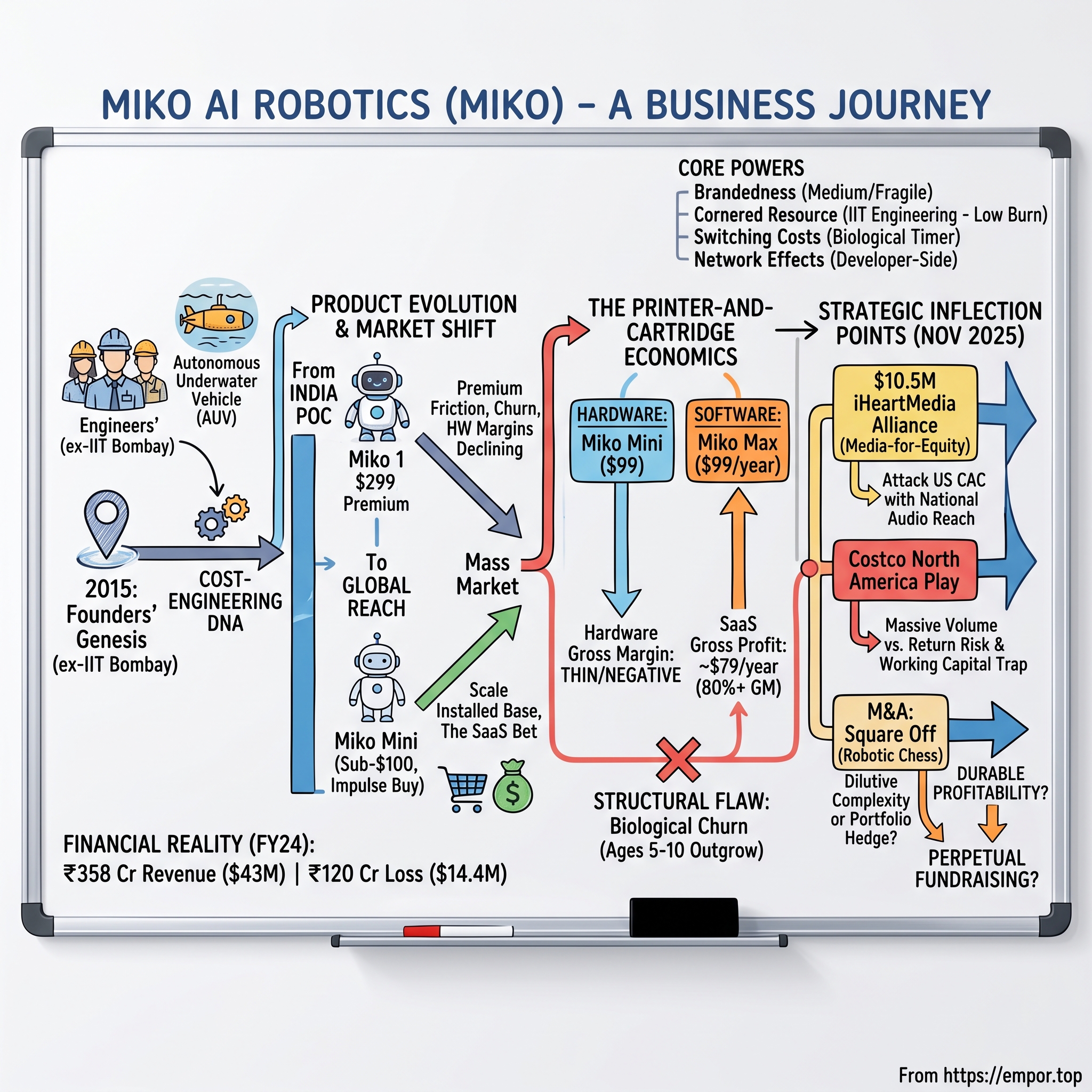
The pivot that frames the modern company came in November 2025, when Miko announced a $10.5 million round led by the American audio giant iHeartMedia — a deal structured as much around distribution and content as around cash, folding iHeart's kid-safe audio into the robots and pointing iHeart's promotional machine at Miko's punishing US customer-acquisition problem.1 To understand why a radio conglomerate ended up on a Mumbai robotics cap table, the roadmap runs as follows: how three IIT Bombay engineers went from building military-grade autonomous underwater vehicles to designing kid-safe companions; how the product evolved from a $299 premium gadget toward a sub-$100 impulse buy engineered to sell software subscriptions; how a "media-for-equity" alliance became the answer to a brutal marketing math problem; and, underneath all of it, whether the financials — revenue from operations of roughly ₹358 crore (about $43 million) in FY24 against a net loss of about ₹120 crore (about $14.4 million) — can ever bend toward durable profitability rather than perpetual fundraising.4
A word on what "Startup" means in this analysis and why the discipline of a pre-IPO underwriting applies. The label is a lifecycle marker, not an exchange; Miko has not filed a DRHP, RHP, or prospectus, and it may be years from one. That absence is precisely why the temptation to treat private-market signals — a $550 million private mark, a headline-grabbing strategic investor, a Costco shelf — as proof of value must be resisted. Those are pricing and narrative signals generated by a handful of negotiating parties, not the verdict of a liquid market pricing freely-tradable common stock against audited results. The job here is to build, from the fragmentary public record, the closest thing to a real diligence file: what the business plausibly earns, what the private rounds actually priced (and on what terms), what comparable businesses reveal about the category's economics, and whether the operating model can mature into cash generation before the money runs out. The company has survived the graveyard. Whether it has escaped it is the question.
 Subscribe on LinkedIn
II. The Founders' Genesis: Underwater Robotics & the "Space of Consciousness" (20 Minutes | 0:15 – 0:35)
The origin story does not begin with toys. It begins underwater. Sneh Vaswani, Prashant Iyengar, and Chintan Raikar met at the Indian Institute of Technology Bombay, where they worked together on autonomous underwater vehicles — robotic submersibles built for applications tied to the Indian Navy and the oil-and-gas industry, the kind of high-precision, multi-sensor engineering done on student budgets under real performance constraints.5 That crucible matters to an underwriter for a specific reason: it establishes that the founding team's core competence is genuine embedded-systems and robotics engineering, not toy design or consumer marketing. When they later claimed to have built a moving, sensing, camera-equipped companion robot cheaply, the claim was credible because the résumé was real. It also foreshadows the company's chronic weakness — engineers who can build hardware are not automatically the people who can solve customer-acquisition economics.
In January 2015 the three founded the company under the name emotix, later fronted by the consumer brand Miko.5 The legal entity, RN Chidakashi Technologies, carries a deliberate philosophical signature: "Chidakashi" is a Sanskrit term rendered by the founders as "the space of consciousness." The naming is not merely decorative marketing; it encodes the founding thesis. Vaswani and his co-founders argued that the smartphone-and-tablet era had handed children a passive, isolating, screen-addicted default that generated real parental guilt, and that a physical, mobile, conversational robot could convert that passive consumption into something active, social, and embodied. Sneh Vaswani took the CEO role, Prashant Iyengar became CTO, and Chintan Raikar became COO — a division of labor that has held remarkably stable for a decade, which is itself a governance data point in a category where founder churn is common.5
The thesis is emotionally resonant, and resonance is exactly what an independent analyst should interrogate. "Healthy screen alternative" is a compelling story to a guilty parent, but it is a claim about consumer behavior, and the durable version of it requires evidence that children stay engaged and parents keep paying — not merely that the pitch lands at the point of purchase. In the early years the company did the sensible qualitative work: raising seed capital in India's then-nascent hardware ecosystem, and consulting child-development psychologists and educators to shape how an AI-native companion should speak to a five-year-old.5 That grounding gave Miko a defensible product-safety narrative later. What it did not yet prove — and what the next decade of financials would test — was whether an emotional bond with a plastic robot could survive the one force no amount of engineering can defeat: a child growing up.
It is worth being precise about what the founding advantage actually was, because it shaped everything that followed. Building an autonomous underwater vehicle on a student budget forces a specific engineering culture: you cannot afford aerospace-grade components, so you learn to hit a demanding performance bar — navigation, sensing, control — with cheap parts and clever software. That is, almost exactly, the core competence a company needs to build a $99 robot that still feels alive. The cost-engineering DNA is genuine, and it is the most credible single reason Miko outlasted better-funded Western rivals: Anki and Jibo built beautiful machines in high-cost geographies with high-cost teams, while Miko built adequate machines with a low-cost Indian engineering team that could iterate cheaply. An underwriter should credit this as a real, if narrow, structural edge — a cost-of-R&D advantage — while noting its limits. Cheap, excellent hardware engineering does not solve distribution, does not solve churn, and does not solve the marketing math that actually kills consumer-robotics companies. The founders' great strength sits on the supply side of the business; the graveyard is filled with companies that died on the demand side.
The behavioral read on management, this early, is cautiously positive on two counts and reserved on a third. The two founders-as-builders signals are strong: the trio has stayed intact and in role for a decade — Vaswani as CEO, Iyengar as CTO, Raikar as COO — which in a category defined by founder burnout and fire-sales is itself evidence of resilience and alignment; and they repeatedly demonstrated a willingness to change the product radically rather than defend a sunk design. The reservation is that a founder-engineer's instinct is to solve problems with better products, and Miko's central problem — that its customers biologically expire — is not a product problem. Watching whether this team can act like commercial operators (ruthless on unit economics, disciplined on cash) rather than like engineers (perfecting the machine) is a thread that runs through the entire underwriting.
III. The Product Evolution: Scaling from India to 140+ Countries (25 Minutes | 0:35 – 1:00)
The product line reads like a controlled experiment in finding the price at which the business actually works. Miko 1, launched around 2016–2017, was the local proof of concept: an India-focused companion with simple three-wheel mobility and heavily localized Indian trivia and conversation, positioned as India's "first companion robot."5 Its job was narrow but essential — to prove that upper-middle-class Indian parents would pay real money for hardware pitched as alternative learning rather than a toy. Miko 2, in 2018, was the global bridge: stronger conversational AI, localized accents for the US, UK, and Middle East, a built-in camera, and facial recognition, all of which opened the door to international retail trials and moved the company from a domestic curiosity toward an export product.
The product cadence was funded by a long, incremental ladder of venture rounds, and the shape of that ladder is itself informative. Emotix raised an early seed of about $2 million around 2018 (with IDG Ventures India and YourNest among the backers), a pre-Series A of roughly ₹13 crore, and then a Series A of about $7.5 million in August 2019 led by Chiratae Ventures and YourNest, topped up again in October 2020 — small, closely-spaced rounds characteristic of a hardware company that had to keep proving itself before each new check.6 The step-change came with a larger round of about $29 million announced in 2021, anchored by IIFL (about $6 million), Chiratae (about $4 million), IvyCap (about $3 million), and YourNest (about $2.1 million), issued as thousands of preference shares — capital that funded exactly the premium Miko 3 push into global retail.7 One small but real diligence flag surfaces here: this $29 million round is labeled inconsistently across sources — described by some as Series B and by others as Series C — a reminder that private-company round nomenclature is marketing, not accounting, and that headline "Series X" labels should never be leaned on without the underlying share terms.
Miko 3, launched in 2021 into the pandemic toy boom, was the premium leap — an expressive robot with a higher-resolution display, active tracking and mobility, multilingual capability, and a parents' dashboard, retailing in the roughly $199–$299 band.8 This is where the strategic tension became visible in the numbers rather than the narrative. At $299, Miko 3 was a high-friction luxury purchase, and it exposed the category's fundamental disease: once a child finished the built-in content, engagement decayed, churn on any add-on content rose, and parents balked at spending more on a device they had already paid a premium for. A $299 robot that a seven-year-old ignores after four months is not a platform; it is an expensive paperweight, and the resale and returns dynamics that follow are corrosive to a hardware startup's working capital.
The pandemic timing deserves an honest caveat, because it flatters the early-traction story in a way an underwriter must discount. Miko 3 launched into 2021's extraordinary conditions: locked-down families, guilt about screen time at an all-time high, and stimulus-inflated discretionary budgets aimed squarely at anything that could occupy a child at home. A premium children's gadget could hardly have had a more favorable tailwind, and a portion of Miko 3's momentum should be read as a one-time demand pull rather than proof of durable, full-price demand. The subsequent decision to abandon the premium tier and race to a sub-$100 device is, read this way, not merely a growth strategy but a tacit admission that full-price demand normalized sharply once the tailwind faded. That is not a criticism — recognizing it and acting is exactly what good operators do — but it means the "product-market fit at $299" claim should be treated as period-specific, not structural.
The consequential decision was the Miko Mini, launched in late 2023 to attack the price barrier directly. Management stripped out the large screen, re-optimized the chassis, pushed the richer visual interactions and setup onto a companion smartphone app, and repositioned the device as a voice-first robot at a mass-market price point — targeted around $99, and observed in North American retail at times below that, with Costco listings seen in the roughly $60–$80 range on promotion.9 The strategic logic is sound and worth stating plainly: $99 (or less) sits inside the holiday impulse-gift zone, and the entire purpose of the cheaper device is not to make money on hardware but to maximize the installed base of robots that can, in theory, be converted to recurring software revenue. The Mini is a customer-acquisition instrument disguised as a product.
The move to a companion-app model carries a subtle strategic trade the bull narrative tends to skip. Offloading the rich visual experience to a parent's smartphone lets Miko cut the most expensive component — the screen — and hit the price point, but it partially surrenders the very thing that differentiated the category in the first place: a self-contained, screen-free device the child interacts with directly. A voice-first robot tethered to a parent's phone for its best experiences is, from a skeptic's chair, one step closer to being a smart speaker with a cute shell — and smart speakers are a commoditized, near-zero-margin business dominated by Amazon and Google. Miko is betting that physical presence, motion, and a child-safe walled garden preserve enough differentiation to keep the premium subscription alive even as the hardware simplifies. That is a plausible bet, but it is a bet, and it moves the company's defensibility further onto the software and content layer and further away from the hardware — which raises the stakes on whether the software actually retains.
The reach claims — 140-plus countries — are real in the sense of distribution footprint, but an underwriter should separate footprint from economic penetration.1 Selling into 140 countries via marketplaces and distributors is not the same as having a paying, retained subscriber base in 140 countries. The most important thing the product evolution reveals is a company deliberately walking its hardware margin down toward zero — or below it — on a bet that software will catch the falling revenue. That bet is the whole business, and it is examined next.
IV. Business Model Under the Hood: The Printer-and-Cartridge Economics (25 Minutes | 1:00 – 1:25)
The cleanest way to understand Miko is the printer-and-cartridge, or console-and-games, model: sell the machine cheap (or at a loss) and make the money on what the machine consumes. Selling a Miko Mini around $99 — after global shipping, retailer margin, returns reserves, and a bill of materials that still includes real sensors, a camera, a speaker, motors, and compute — leaves thin, zero, or negative hardware gross margin.9 Management treats that as a feature: hardware is a distribution channel, and the enterprise value is supposed to live in the software.
That software is Miko Max, the subscription priced at $14.99 per month or $99 per year, which unlocks the dynamic library of stories, coding games, STEM puzzles, shows, and the personalized learning and emotional-tracking layer.10 Software subscription gross margins in this kind of content-and-cloud business are plausibly in the 80%-plus range, so the arithmetic of the whole company reduces to a single variable: the attach rate and retention of Miko Max against the installed base of devices. Here the public evidence forces a sober reading. In FY24, Miko's subscription income did grow explosively in percentage terms — from roughly ₹1 crore to about ₹29 crore, an almost thirty-fold jump — but that ₹29 crore (about $3.5 million) was still only around 8% of total revenue from operations, with product sales of roughly ₹329 crore (up 46%) doing the overwhelming majority of the work.4 The SaaS engine is real and accelerating, but as of the last disclosed year it was a small minority of the business. The thesis that Miko is "really a software company" is, on the evidence, still a forward-looking claim rather than a present fact.
It is worth walking the unit economics slowly in plain language, because the entire investment case lives inside a single cohort's arithmetic and the public disclosures do not do this math for the reader. Picture one Miko Mini sold at, say, $80 through Costco. After Costco's wholesale margin, the company might net a materially smaller figure per unit; against a bill of materials that still includes a camera, speaker, motors, compute, and a battery, plus international freight and a returns reserve, the hardware contribution on that unit is thin at best and can be negative. So the sale, on its own, does not make money — it plants a device in a home. The device only becomes a good investment if that household attaches Miko Max and keeps paying.
At $99 a year with ~80% gross margin, each retained subscriber year throws off roughly $79 of gross profit; the pricing pyramid also nudges toward the annual plan, which both improves cash timing and hides churn behind a once-a-year renewal decision. If the average household stays subscribed for, generously, two years before the child ages out, the lifetime software gross profit is on the order of $150 — from which the company must still subtract the hardware loss, the cost of acquiring the customer, app and cloud infrastructure, content revenue-shares, and support. Whether that leaves a healthy contribution margin per cohort is the whole question, and the honest answer from the public record is that it cannot be computed from outside, because Miko discloses neither attach rate, nor churn, nor CAC. What the ₹29 crore subscription line does tell us is that, in aggregate, the software money is still small relative to the installed base implied by ₹329 crore of hardware — which suggests the attach rate, or the retention, or both, still have a long way to travel before the model inverts into a software business.
The platform layer is genuinely clever and lowers content cost. Rather than write every educational experience in-house, Miko built a B2B2C content ecosystem in which third-party intellectual-property owners — names the company has associated with the platform include Disney, Paramount, Da Vinci Kids, Oxford University Press, and other kids'-content brands — port games and shows onto the device, with Miko taking a share of subscription revenue.11 This is the right structural choice: it converts a portion of R&D into a variable, revenue-shared cost and enriches the library that justifies the subscription. But it is worth noting what it is not — it is not yet a true developer network effect at the scale of an app store, and the marquee brand names are licensing relationships that can be renewed, repriced, or walked away from.
The structural flaw sits underneath all of it, and management cannot engineer it away: the target demographic is roughly ages five to ten, and children age out. Unlike enterprise SaaS, where a well-served customer can renew for a decade, or Netflix, where the household never outgrows the service, Miko faces an absolute biological expiration on every subscriber. A child who bonds with the robot at five is, on the company's own age-band logic, likely to abandon it within twelve to twenty-four months. That means Miko must continuously acquire fresh cohorts of five-year-olds just to stand still, which puts permanent upward pressure on marketing spend and permanent downward pressure on lifetime value. The entire investment case turns on whether attach rate and per-subscriber margin can rise faster than that churn drags them down — and on whether the acquisition cost of each new cohort can be pushed low enough to make the math close. That is precisely the problem the iHeartMedia deal was designed to solve.
There is one partial mitigant worth crediting fairly, and one reason it is only partial. Because children are born continuously, Miko's addressable pool of five-year-olds refills every year — the "market" does not deplete the way a niche enterprise TAM can. In that sense the outgrow problem is less a shrinking market than a permanently leaky bucket: the top-of-funnel never runs dry. But a leaky bucket is expensive to keep full, and it changes the character of the business in a way public-market investors should price carefully. A company with low churn compounds — each year's acquisition adds to a growing, retained base, and marketing can eventually shrink as a share of revenue. A company with structurally high, biologically-enforced churn does not compound the same way; a large share of every year's marketing spend goes simply to replace the customers who aged out, not to grow. This is the mathematical reason the consumer-robotics graveyard exists, and it is why the single most important number Miko could ever disclose is not revenue growth but net revenue retention. Revenue can grow briskly for years on new-customer volume while the underlying per-cohort economics quietly fail to close — which is, more or less, the Anki story, a company that reached ~$100 million of revenue and still could not fund itself.2
V. The $10.5M iHeartMedia Alliance & The Costco North America Play (20 Minutes | 1:25 – 1:45)
By 2024 and into 2025, the global funding environment for consumer hardware had gone cold, and Miko's capital picture became genuinely complicated — complicated enough that an underwriter has to hold two seemingly contradictory facts at once. On one hand, the company's earlier Series D capital arrived in modest tranches; reporting placed a late-2024 Series D infusion at roughly $15.8 million from IvyCap Ventures and others, hardly a war chest for a business burning ₹120 crore a year.14 On the other hand, in August 2025 Miko's board passed a special resolution to raise as much as ₹1,325 crore (about $155 million) by issuing 22,465 preference shares at ₹5.9 lakh each to a single US-based non-profit, the AMDG-PAX Foundation, at a post-money valuation of roughly $550 million — nearly a 2.7x step-up.12 These two facts do not sit comfortably together, and the discrepancy is itself a diligence flag: a board-approved authorization to issue preference shares is not the same as cash in the bank, the identity and motive of a non-profit writing a nine-figure check into a loss-making robotics company warrant scrutiny, and the terms attached to those preference shares — liquidation preference, conversion, anti-dilution — are not public. The $550 million is a stated price on a specific security sold to a specific buyer; it is not a proven value for the common equity, and it should not be carried forward as though it were.
It is against that murky capital backdrop that the November 2025 iHeartMedia round reads as strategically coherent rather than merely opportunistic. The $10.5 million led by iHeartMedia was small in dollar terms, but its logic was "media-for-equity."1 Instead of raising pure cash and immediately burning it on Google and Meta ads — the classic path by which consumer-hardware companies convert equity into other companies' advertising revenue — Miko traded equity and a content partnership for access to iHeart's promotional reach. iHeartMedia's pitch is that it touches the vast majority of American media consumers monthly across radio, podcasts, and events; the deal folds iHeart's kid-safe audio and storytelling into Miko devices while, in principle, positioning Miko as a household name through national audio inventory.1 If it works, it attacks the single hardest number in the whole model — US customer-acquisition cost — with a currency (equity) that does not deplete the cash runway.
The skeptical read matters just as much. "Media-for-equity" values are notoriously soft: promotional airtime is priced at rate-card values that rarely reflect the true incremental customers delivered, and an audio impression is a weak, unmeasurable acquisition channel compared with a targeted digital ad you can attribute to a checkout. The deal could plausibly move brand awareness while doing little for measured, paid conversion. And a strategic investor's incentives are not a public shareholder's: iHeart benefits from content placement and a brand association whether or not Miko ever earns an attractive return on the equity it handed over.
The mechanism deserves one more layer of scrutiny, because media-for-equity is a structure with a well-documented dark side that has burned other consumer companies. In the classic version, a media owner "invests" by committing to run advertising it would otherwise struggle to sell, valuing that unsold inventory at full rate card and taking real equity in exchange. The startup books a splashy round and a burst of impressions; the media company converts perishable, low-marginal-cost inventory into an ownership stake in a growing brand. The asymmetry is that the media company bears almost no cash cost, while the startup gives up permanent equity for a benefit — awareness — that may or may not convert into paying, retained subscribers. For a business whose core disease is unmeasurable, high-churn customer acquisition, receiving a large slug of unmeasurable, top-of-funnel audio reach is not obviously the right medicine: it can inflate trial and returns without improving the retained-cohort economics that actually determine value. None of this means the iHeart deal is bad — brand-building genuinely matters in a trust-driven children's category, and preserving cash is real. But the honest framing is that Miko has swapped a known dilution cost for an unproven and hard-to-measure acquisition benefit, and whether that trade created value will only be visible in a metric — blended CAC and cohort retention — that the company does not currently disclose.
The concurrent Costco launch in North America is the other edge of the same sword.13 Costco delivers immediate, enormous volume and a credibility halo — being on a Costco pallet is a genuine distribution achievement for a small robotics company. But Costco's economics are brutal for a thin-margin hardware maker: aggressive wholesale pricing that compresses already-slim margins, and, most dangerously, Costco's famously liberal return policy. For an impulse-purchased children's robot, post-holiday returns can spike, and returns do not merely erase the sale — they strand inventory, consume working capital, and can turn a strong-looking Q4 into a cash-draining Q1. The very channel that proves demand can, if return rates run hot, be the thing that breaks the balance sheet.
Consider how the working-capital trap actually springs, because it is the specific mechanism that kills hardware companies and it is invisible in a revenue chart. To stock Costco for a holiday season, Miko must order inventory months ahead from Chinese assembly, paying suppliers in cash well before any robot sells. That cash is now frozen in product on a pallet. If the season sells through, the cash comes back with a margin and everyone is happy. But an impulse-bought children's robot is exactly the kind of product that generates elevated post-holiday returns — the child loses interest by mid-January, and Costco's no-questions policy makes returning it frictionless. Returned units come back as cash refunds Miko effectively bears, plus inventory that may not be economically resellable. So a company can report a strong Q4 revenue number and then, one quarter later, face a cash outflow from refunds against product it already paid to manufacture — a double hit to liquidity precisely when a loss-making company can least absorb it. This is not hypothetical hand-wringing; it is the canonical failure mode of consumer hardware, and it is why inventory turnover and the Q1-after-holiday returns rate belong at the very top of the KPI list for anyone underwriting Miko. The Costco relationship is simultaneously the company's biggest distribution win and its most acute balance-sheet risk, and the two cannot be separated.
VI. M&A & Capital Allocation: The Square Off Case Study (20 Minutes | 1:45 – 2:05)
In October 2022, at a moment when its own losses were widening, Miko acquired a 70% majority stake in Infivention Technologies, the maker of Square Off — automated, AI-powered robotic chessboards that physically move the pieces.14 Reporting at the time indicated Miko planned to invest around $12 million into the business and that existing Square Off investors were given a full exit, with the two companies talking publicly about a combined revenue ambition north of $100 million the following year.15 The strategic thesis was legible: bolt a physical-robotic board-game capability onto the Miko ecosystem, and in doing so extend the age envelope upward toward teenagers and adults — a direct hedge against the "outgrow" churn problem that defines the core companion business.
As capital allocation, though, the deal deserves a hard stress test, because the timing and the focus cost are the issues, not the concept. A smart robotic chessboard is a novel product, but it addresses a niche, premium hobby market — connected chess sets sit well above $200 — with its own separate manufacturing supply chain, its own developer environment, and its own marketing motion. Miko bought that complexity at exactly the moment its core business was undertaking the most important transition in its history: the wrenching shift from the premium Miko 3 to the mass-market Miko Mini, which demanded scale, focus, and above all cash preservation. Spending management attention and roughly $12 million of scarce capital on a tangential niche while the flagship pivot was underway is the kind of decision that looks visionary if the integration compounds and looks like a distraction if it does not.
The honest verdict, from the public record, is that the returns are unproven. Financial terms beyond the headline stake were not fully disclosed, Square Off's contribution to consolidated revenue has not been separately broken out in reporting available here, and the "expand the age range" logic — while real in theory — has not visibly shown up as a durable answer to churn in the company's disclosed metrics.414 An independent underwriter should therefore treat Square Off not as validated strategy but as an open question: a plausible portfolio hedge that may yet integrate into the platform, or a focus-diluting bet made under financial pressure. It is a marker to watch, and a data point on how this management team allocates capital when its core business is under strain.
There is a sharper way to frame the opportunity cost, and it cuts to how public-market investors should read management's capital instincts. Roughly $12 million was, at the time, a very large sum relative to Miko's own annual losses and its incremental fundraising — it was on the order of what the company was raising in an entire venture round.7 Deploying that much scarce capital and, more importantly, a meaningful share of a small executive team's attention into a second hardware business with its own supply chain, its own developers, and its own go-to-market, at the exact moment the flagship needed a wholesale repricing and relaunch, is the kind of decision that reveals a founder-led company's priorities under pressure. The generous interpretation is portfolio thinking: hedge the churn problem by owning products for older users, and buy proven robotics IP cheaply during a downturn. The skeptical interpretation is classic founder over-reach: a technically exciting acquisition that scratched an engineering itch while the boring, essential work of fixing core unit economics went comparatively underfunded. The public record does not resolve which reading is correct, but the pattern — acquiring adjacent complexity during a cash-sensitive core transition — is exactly the sort of behavior a future prospectus's risk factors and related-party disclosures would need to illuminate, and exactly the sort a disciplined underwriter files under "watch closely."
VII. Porter's 5 Forces & Hamilton Helmer's 7 Powers Analysis (20 Minutes | 2:05 – 2:25)
Frameworks are only useful where they clarify the economics, so the point of this section is to separate the powers Miko can genuinely evidence from the ones that are, so far, mostly rhetoric.
Hamilton Helmer's 7 Powers
Counter-Positioning (real but contestable). Miko's sharpest claim is that it occupies a position incumbents structurally cannot copy: toy giants like Mattel, Hasbro, and Lego sell static objects that lose engagement, and tech giants like Apple, Amazon, and Google sell passive screens, whereas Miko sells an interactive, physically animated "healthy screen alternative." The counter-positioning is philosophically clean, but its strength depends entirely on whether the "healthy alternative" claim survives contact with data — engagement retention and, increasingly, child-safety scrutiny (see Section IX). A counter-position built on a trust narrative is only as strong as the trust.
Switching Costs (weak-to-medium, with a fuse). Emotional and data lock-in exist: the robot accumulates a child-specific memory and learning path that a fresh device would not have. But this is capped by the aging problem — switching costs that expire on a biological timer are not durable moats. The customer does not switch to a competitor so much as exit the category entirely.
Network Effects (weak). The only plausible network effect is indirect and developer-side: a larger installed base makes it marginally more attractive for content owners to port to the platform, enriching the library. This is genuine but modest, and it is not the strong, direct network effect that protects a marketplace or social platform. Content partners are licensors, not a locked-in ecosystem.
Cornered Resource (overstated). The bull case cites elite, low-cost IIT Bombay engineering talent as a cornered resource. Access to strong, comparatively inexpensive Indian robotics and AI talent is a real cost advantage, but it is not cornered — it is available to every other startup and every multinational R&D center in India. It lowers burn; it does not exclude competitors.
Scale Economies (weak). Software R&D amortizes across global volumes, which helps, but Miko's hardware manufacturing scale is trivial next to the toy majors, so it enjoys none of the procurement or manufacturing scale advantages that protect incumbents.
Brandedness (medium, and now fragile). "Miko" as a trusted parental-safety shield — COPPA and GDPR compliant — is a meaningful asset in a category where trust is the purchase driver. But brandedness in children's products is asymmetric: it takes years to build and one incident to break, which makes the 2026 privacy controversy discussed below directly threatening to this power.
Process Power (medium). Coordinating Indian R&D, Chinese assembly, and global logistics into 140-plus countries is a real operational competence, but it is a competence many consumer-hardware firms possess, not a proprietary process advantage.
Porter's 5 Forces
The competitive structure is unforgiving. Threat of substitutes is extremely high: a cheap tablet loaded with free YouTube Kids or a low-cost learning app does much of what parents actually want, at a fraction of the price. Buyer power is high: parents are price-sensitive and cancel subscriptions the moment a child loses interest, and the annual plan makes churn a once-a-year cliff. Supplier power is medium: core sensors and chips are commoditizing, but logistics and shipping costs are volatile and periodically punishing for a hardware importer. Threat of new entrants is medium: software is easy to clone, but the combination of low-cost hardware, kinetic motion, and international child-safety certification is a real barrier. Rivalry is high, against both niche premium players (Embodied's Moxie, before its own difficulties; Wonder Workshop's Dash) and the ambient pressure of every general-purpose device.
The net picture from the frameworks: Miko has assembled several medium-strength, early-stage powers, but not yet a single dominant, durable moat — and the two it leans on hardest, brand trust and counter-positioning, are the two most exposed to the risks in Section IX. It is instructive that the failed cohort — Anki, Jibo, Kuri — could have checked several of the same boxes: strong counter-positioning against static toys, medium switching costs from a bonded device, real engineering talent. They failed anyway, because none of those powers is strong enough to overcome extremely high substitution and high buyer power in a category where the customer's engagement decays on a timer. The frameworks, applied honestly, do not describe a business with a proven moat; they describe a business assembling plausible-but-unproven advantages against a competitive backdrop that has already killed several better-funded attempts. Whether Miko's specific combination — lowest-cost hardware engineering plus a content platform plus a distribution-and-media alliance — finally clears the bar the graveyard could not is the empirical question the financials will decide, not the frameworks.
VIII. Financial Reality, Valuation Comps, & Management Credibility (15 Minutes | 2:25 – 2:40)
Start with the numbers, stated as precisely as the public record allows. In FY24, RN Chidakashi's revenue from operations rose about 58% to roughly ₹358 crore (about $43 million), with total income around ₹367 crore once other income is included; the year prior (FY23) revenue from operations was roughly ₹225 crore.4 The bottom line moved the wrong way as the top line grew: net loss widened to about ₹120 crore (about $14.4 million) in FY24 from about ₹108 crore in FY23.4 The composition matters more than the headline. Product sales of about ₹329 crore did the heavy lifting; subscription income, the supposed engine of enterprise value, was about ₹29 crore — growing fast off a tiny base, but still under a tenth of revenue.4 The candid reading is that Miko in FY24 was a fast-growing, loss-making hardware company with a promising but still-embryonic software line, not yet the software company its strategy narrative describes.
On price versus value, discipline is essential. The only recent valuation anchor is the roughly $550 million post-money implied by the August 2025 preference-share authorization to AMDG-PAX Foundation.12 That figure is a market observation about the price of a specific preferred security sold to a single, unusual buyer — not a proven value of the whole company's common equity, and not something to multiply against revenue and call a verdict. Preferred shares in Indian venture rounds typically carry liquidation preferences and conversion and anti-dilution terms that public common shareholders would never receive; none of those terms are disclosed here, which means the gap between the headline $550 million and the value that would accrue to future public common holders is unknown and potentially large. A back-of-envelope multiple — roughly $550 million against ~$43 million of FY24 revenue, about 13x sales — is therefore an implied private mark on preferred stock, not an enterprise-value multiple, and it should be treated as a data point about sentiment, not intrinsic worth. Enterprise value cannot be reliably computed: cash, debt, lease obligations, and how much of the ₹1,325 crore authorization was actually funded are not public.
The reason the preferred-versus-common distinction is not a technicality is worth making concrete, because it is exactly the trap that catches investors who carry a private mark forward. Every venture round from the $7.5 million Series A onward was issued as preference shares — the $29 million round alone allotted nearly 16,000 preference shares at a defined issue price, and the AMDG-PAX authorization contemplated 22,465 more.712 Preference shares typically sit ahead of common stock in a sale or wind-down: a "1x liquidation preference," the market standard, means the preferred holder gets its money back first before common holders — the founders and employees — see a rupee. In a company that has raised well over $100 million across its life and is valued privately at $550 million, the stack of money that must be repaid ahead of common could be large relative to the common's residual claim, especially in any outcome below the top private mark. So the same company can be "worth $550 million" to the last preferred investor and considerably less per share to common holders if the exit is anything short of a home run. When Miko eventually files to go public, the conversion of all that preferred into common — the terms, the ratios, any accrued dividends or ratchets — will be one of the most important sections of the prospectus, and until it exists, any per-share value derived from the $550 million headline is an estimate resting on undisclosed terms. This is the single most important reason the private mark is a price, not a value.
A transparent intrinsic framing has to be scenario-based and humble. The value of Miko rests on four variables the public record does not yet pin down: the Miko Max attach rate against the installed base; net revenue retention against the aging-out churn; the true, fully-loaded contribution margin of a Mini-plus-subscription cohort after returns and channel costs; and the cost of acquiring each new cohort, especially net of the iHeart media value. In an optimistic path, subscription mixes up toward and past a majority of revenue, gross margin lifts into software territory, and the consolidated business crosses into positive free cash flow at some multiple of current scale. In a pessimistic path, hardware stays the majority, churn caps LTV, and every rupee of growth requires a rupee of marketing, so losses persist and financing needs recur. The spread between those paths is wide enough that any single valuation number is false precision; the responsible output is a range whose width is dominated by the attach-rate and churn assumptions.
To make the scenario logic usable rather than vague, it is worth stating what each path would require and roughly imply, in directional terms only. A durable-profitability path would need the subscription mix to climb from ~8% of revenue toward, say, a third or more within a few years — which requires both a materially higher attach rate on each device sold and enough retention that subscribers persist beyond a single annual renewal. If that happens on a revenue base several times today's, blended gross margin lifts meaningfully and operating leverage finally appears, because the fixed content and platform R&D amortizes over a much larger paying base; at that point a business doing, hypothetically, a few hundred million dollars of revenue with a rising software mix could plausibly justify something in the neighborhood of the current private mark on fundamentals rather than on narrative. A muddle-through path — continued brisk hardware-led revenue growth but a subscription mix that stalls in the low teens and churn that keeps LTV thin — supports far less: the company keeps growing and keeps losing money, and its value converges toward that of a low-margin consumer-electronics distributor, well below a software multiple. A failure path is the category's default, where returns and cohort economics never close, financing gets harder, and a down-round or wind-down follows the Anki template.
The essential discipline is that none of these is a forecast; the point is that the entire difference between them is driven by two numbers Miko does not disclose — attach and retention — which means anyone asserting confidence about Miko's intrinsic value is, whether they admit it or not, asserting confidence about metrics they cannot see. The honest posture is a wide range with those two sensitivities explicitly flagged as the swing factors.
The comparable view has to be built carefully and honestly, and most of the work is deciding who is not a peer. There is no clean public peer that is a global children's companion-robot company with a subscription model — the closest historical analogs (Anki, Jibo, Sphero's consumer line) are instructive precisely because they failed, which is a comp on the category's economics rather than a multiple to apply. Aspirational comps — profitable subscription-software or consumer-platform companies — are the wrong reference class because Miko carries hardware cost of goods, returns risk, and biological churn that pure software does not; applying a software SaaS revenue multiple to a business that is ~92% hardware today would be exactly the analytical error this kind of underwriting exists to prevent. Kids'-content and edtech subscription businesses (the Duolingo-for-kids or streaming-for-kids archetype) are a partial read on the software line only, and even then an imperfect one, because those businesses do not subsidize a money-losing physical device to acquire each user. Consumer-electronics hardware companies are a better read on the hardware line and its thin margins, but they miss the subscription optionality entirely.
The intellectually honest construction is therefore a sum-of-the-parts intuition rather than a single multiple: value the hardware revenue like the low-margin, working-capital-intensive electronics business it currently is, value the subscription revenue like the high-margin recurring stream it is becoming, and let the blend shift as the mix shifts — while weighting heavily the sober base rate that this category has produced far more zeros than winners. Any headline "13x sales" comparison collapses these two very different revenue types into one number and should be discarded on sight.
It is also worth naming the survivorship and selection bias that will distort the comparable conversation the moment Miko approaches a listing. Bankers pitching an IPO will reach for the handful of consumer-subscription and AI-hardware winners as comps, not the graveyard, because the winners support a higher multiple. An independent underwriter should insist on the opposite starting point: begin with the base rate of the category (dominated by failures and modest outcomes), and require specific, disclosed operating evidence — attach, retention, cohort contribution — before migrating any part of the valuation toward the winners' multiples. Absent that evidence, the burden of proof sits with the bull case, not the bear.
Putting the two views together — the reconciliation the discipline demands — the question is what the ~$550 million private mark actually embeds, and the answer is a great deal of the optimistic path taken on faith. To justify that price on fundamentals rather than sentiment, a buyer has to underwrite years of brisk revenue growth, a decisive shift in mix toward high-margin subscription, retention strong enough to overcome biological churn, gross margins climbing out of hardware territory, and an eventual crossing into free-cash-flow generation — in a category whose base rate is failure. The market (here, a single strategic non-profit and, separately, iHeart) may well pay above a central intrinsic range for reasons that have nothing to do with business value: scarcity of AI-native robotics assets, the narrative appeal of an emotionally resonant "healthy screen" story, a strategic buyer's non-financial motives, and the simple fact that private marks are negotiated between a willing issuer and a single willing buyer rather than discovered in a liquid market. Those forces are real and they set prices, but they are not evidence of durable earning power. When and if Miko lists, the public market will re-price the same business against free-float dynamics, momentum, and — eventually — the unforgiving arithmetic of whether it can actually make money. The gap between the private mark and what a public common share is worth is therefore not a rounding error; it is the whole analytical problem, and it will only close as the undisclosed operating metrics become disclosed.
On management credibility, the behavioral record is mixed and worth judging on actions rather than adjectives. The positives are substantive: a stable founding trio for a decade in a high-churn category, which is itself rare and speaks to alignment and staying power; a hard, correctly-reasoned pivot from premium to mass-market hardware that required abandoning a product the team had lavished engineering on; a creative, cash-preserving turn toward media-for-equity rather than reflexively burning VC dollars on ads; and, when confronted with a child-safety controversy in early 2026, a reasonably fast operational response in shipping a conversational-AI off switch and leaning on COPPA compliance and third-party safety audits.16
The concerns are equally substantive: the Square Off capital allocation during a cash-sensitive pivot; the opacity around the $155 million authorization and the identity, motive, and terms of its non-profit buyer; the initial denial-then-remediate posture on the data-exposure allegation, which is a pattern public-market investors watch for because it speaks to candor under pressure; and a founder stake reported around 16.03%, implying heavy dilution across a long ladder of rounds and a cap table now dominated by outside preferred holders whose economics may diverge sharply from future common shareholders.17 The founders' low equity has not yet produced governance friction — no activist push, no boardroom coup — which the company attributes to the founders' irreplaceable technical role, but low founder ownership is a double-edged fact: it can align founders with all shareholders, or it can leave a thinly-owned management team steering a company whose preferred investors hold most of the economics and much of the control. None of this is disqualifying, but all of it is diligence — the kind of thing a real filing, with its governance, related-party, and risk-factor disclosures, would have to make explicit, and none of which should be presumed benign simply because it is not yet visible.
IX. The Investment Spine: Bull vs. Bear Case & Current Risk Radar (15 Minutes | 2:40 – 2:55)
The Bull Case
The bull case is a leverage story, and its internal logic is genuinely coherent — the reason to take Miko seriously rather than dismiss it as the next Anki. First, the iHeart CAC arbitrage: if national audio reach genuinely drives US brand awareness and pushes blended customer-acquisition cost sharply down, the single worst number in the model improves without burning cash, and the media-for-equity structure means growth stops requiring proportional cash outlays.1 The deep point is that Miko's two biggest structural problems — high CAC and thin hardware margin — are both problems of the US go-to-market, and both are being attacked with non-cash instruments (iHeart's inventory, Costco's volume) rather than with the venture dollars that killed its predecessors. Second, the SaaS tipping point: the $99-and-below Mini scales the installed base to a size where even a modest attach rate produces a subscription base large enough to tip revenue mix past 50% software, dragging consolidated gross margin up and the whole company toward net profitability — the subscription line's near-thirty-fold FY24 growth is at least directional evidence that conversion is happening, off a base so small that continued high-percentage growth is plausible for several years.4 Third, the exit: a toy or media conglomerate — a Mattel, a Hasbro, or an iHeart-adjacent strategic — acquires Miko for an instant, fully-formed AI-native software platform and a low-cost robotics R&D lab, valuing it as an interactive platform rather than a hardware vendor. The iHeart relationship makes at least one credible strategic acquirer easy to name, and for a company that may never IPO cleanly, a trade sale is arguably the more realistic base-case exit.
The unifying thread of the bull case is that Miko does not need to win the consumer-robotics category outright; it needs only to prove its cohort economics close and then be bought by someone who wants the platform.
The Bear Case
The bear case is that the category's gravity reasserts itself, and it is strengthened by the fact that everything in it has already happened to someone. The churn cliff: the outgrow problem proves insurmountable, Miko runs on a treadmill of perpetually re-acquiring five-year-olds, and marketing spend never stops rising, so the SaaS mix never reaches escape velocity; the subscription line grows in absolute terms but stays a minority of revenue forever, and the company remains a loss-making hardware business wearing a software story. The Costco return trap: heavy post-holiday returns of impulse-bought Minis wipe out retail margin and lock working capital in stranded inventory, converting a strong selling season into a cash crisis — the precise mechanism detailed in Section V, and the classic way a hardware company with a great Q4 dies in Q1.13 The capital grind: with no demonstrated path to profitability, the small iHeart cash and whatever was actually funded of the AMDG-PAX authorization run down, and the company faces a dilutive down-round or worse — the exact ending that consumed Anki, which reached ~$100 million of revenue and still could not close a round when the market turned.2 The bear case does not require Miko to be badly run; it requires only that the category's base rate hold, which is a sobering default given that the company's own strategy — walking hardware margin to zero to chase software attach — is precisely the bet its dead predecessors also made.
Material Risk Radar
The most acute and most current risk is child-safety and privacy, and it has escalated well beyond the earlier academic concern. Security researchers publishing through Kaspersky's Securelist documented serious vulnerabilities in a Miko robot: low-entropy device identifiers that could be enumerated to expose a child's data, city, phone number, and a parent's email; a video-calling flow whose weak authorization could let an attacker obtain a token and start a video conversation with a child using only a guessable robot ID; authentication tokens issued even on incorrect credentials; a brute-forceable six-digit OTP enabling account hijacking; and unsigned firmware updates that could, in principle, allow arbitrary superuser commands — with the vendor reported to have remediated the issues between March and August 2023.18 That was the warning shot. The direct hit came later: in early 2026, US Senators Marsha Blackburn and Richard Blumenthal publicly alleged that Miko had left a publicly accessible database containing thousands of the toys' audio responses to children, organized by cloud provider and language; Miko denied any breach.19 On February 16, 2026, under that political pressure, Miko announced an on/off toggle for conversational AI across Miko 3 and Miko Mini — shipping disabled by default on new devices — while emphasizing COPPA compliance and annual third-party AI-safety evaluations.16 For a company whose two strongest competitive powers are brand trust and its counter-position as the safe alternative to screens, government scrutiny and a data-exposure allegation strike directly at the moat. A single high-profile incident could permanently damage parental trust; that this is now a live regulatory and reputational event, not a hypothetical, is the most important thing on the risk radar.
Two structural risks round it out. Inventory and working-capital lockup: coordinating Indian software, Chinese assembly, and North American retail requires accurate demand forecasting, and over-ordering into a holiday that misses is the classic hardware killer. And open-source AI disruption: as capable, free multimodal models proliferate, a parent can increasingly approximate a companion experience on a cheap tablet running a kid-safe assistant, pressuring the premium of dedicated robotic hardware over time. This last risk is subtle but real: Miko's differentiation increasingly rests on the software and the walled-garden safety layer, and those are exactly the things a commoditizing AI stack threatens to replicate cheaply. The physical robot — motion, presence, a face — may prove to be the durable moat, or it may prove to be an expensive shell around software that anyone can now build.
Finally, a set of public-market-readiness diligence items belongs on the radar not because any is known to be a problem, but because their absence from the public record is not evidence of safety. Before a listing, an underwriter would need to see: the full cap table and the conversion, liquidation-preference, and anti-dilution terms attached to each preference-share class; the identity, motive, and any side letters governing the AMDG-PAX Foundation's stake; board composition and whether any independent directors balance founder and preferred-investor control; related-party dealings, including any between the founders, Square Off/Infivention, and the parent; executive compensation and equity incentives; the use of any IPO or primary proceeds; the accounting treatment of returns, inventory, and capitalized software; and the formal risk factors, which for this company would necessarily foreground child-safety, data-privacy, and regulatory exposure. None of these is disclosed today, and a disciplined reader treats each as an open question to be answered by a future filing — not as a box that can be assumed ticked. The early-2026 Senate scrutiny is a reminder that at least one of them, data privacy, is already a live regulatory matter rather than a theoretical one.19
X. Epilogue & Key Takeaways for Investors (10 Minutes | 2:55 – 3:10)
Miko's decade is, above all, a survival story in a category defined by death, and survival was earned by reading consumer friction correctly: walking hardware price down toward the impulse-buy threshold, building a content platform on other people's IP, and refusing to fund growth by simply setting VC cash on fire in an ad auction. That is genuine operating discipline, and it distinguishes Miko from the graveyard of Anki and Jibo. But surviving the graveyard is not the same as reaching durable profitability, and an underwriter judging this business before any real filing should hold three things in front of everything else.
The KPIs that would confirm or falsify the underwriting are, first and above all, Miko Max attach rate and churn — the single most important indicators of whether this is a software company in the making or a hardware company with a subscription garnish; the FY24 subscription line at ~8% of revenue is the baseline that must climb, and climb faster than the installed base ages out. Second, the true LTV-to-CAC ratio, computed with the iHeart media value honestly discounted rather than booked at rate card, because that ratio is the whole question of whether growth creates or destroys value. Third, inventory turnover and returns rates, especially the post-holiday Q1 after each Costco season, because that is where a hardware business either recycles cash cleanly or drowns in stranded product.
The catalysts and reckonings to watch are concrete: whether the AMDG-PAX authorization actually funds and on what terms; whether the iHeart partnership produces measurable US conversion rather than mere awareness; how the child-safety scrutiny resolves, since the trust moat is the asset most exposed; and, eventually, whether any of this produces the sustained free cash flow that a public market — unlike a private preferred round — will ultimately demand. A private mark of $550 million and a splashy media-for-equity deal are pricing and narrative signals; they are not proof of value, and the distinction is the entire point.
The final lesson Miko offers is the one its own history keeps teaching: in consumer robotics, winning is not about building the most complex, luxurious machine. Anki and Jibo built beautiful machines and died. Winning is about converting a physical product into a recurring, high-margin software utility before the cash runs out. Miko has done more than any of its dead predecessors to make that conversion. Whether it has done enough — enough attach, enough retention, enough margin, before enough churn and enough returns — is the question a future prospectus will finally have to answer, and that no amount of narrative can settle in advance.
References
-
Robotics startup Miko raises $10.5 Mn led by iHeartMedia — Entrackr, 2025-11-07 ↩↩↩↩↩↩↩
-
Robotics startup Anki shuts down after burning through almost $200 million — VentureBeat, 2019-04-29 ↩↩↩
-
Anki, Jibo, and Kuri: What We Can Learn from Social Robots That Didn't Make It — IEEE Spectrum, 2019 ↩
-
Miko — Funding, Revenue & Investors / FY24 financials — Inc42, 2025 ↩↩↩↩↩↩↩↩
-
Three IIT graduates have created India's first robot buddy for kids — Quartz India, 2018 ↩↩↩↩↩
-
Chiratae and YourNest lead $7.5 Mn Series A round in Emotix — Entrackr, 2019-08 ↩
-
Robotics startup Miko raises $29M from IIFL, Chiratae, IvyCap, others — Venture Intelligence, 2021 ↩↩↩
-
Miko Mini AI Powered Kid-Safe Robot (Costco listing/pricing) — Costco ↩↩
-
Which Subscription Plans are Available for Miko Max? — Miko Help Center ↩
-
Miko Announces Premium Kids' Content Partnerships Just In Time For Holidays — PR Newswire, 2021-11-16 ↩
-
Exclusive: Robotics startup Miko to raise $155 Mn at $550 Mn valuation — Entrackr, 2025-08-25 ↩↩↩
-
Miko Robotics acquires majority stake in AI chess startup, Square Off — TechCrunch, 2022-10-06 ↩↩
-
Robotics startup Miko acquires 70% stake in Square Off — YourStory, 2022-10 ↩
-
Robot Toy Maker Miko Announces Enhanced Parental Control After Lawmakers' Criticism — The AI Insider, 2026-02-17 ↩↩
-
Miko Technologies — Company Profile, Funding & Shareholding — Tracxn, 2026 ↩
-
Vulnerabilities in an AI robot for kids — Securelist by Kaspersky, 2025 ↩
-
AI toy maker Miko exposed thousands of responses to kids, senators say — NBC News, 2026 ↩↩
 LinkedIn
 WhatsApp
 Reddit
 Hacker News
 Email
Email Kindle
 RSS Feed
 Spotify
 Apple Podcasts
 Amazon Music
 Audible
 YouTube