Mangalam Cement: The Story of a Birla Cement Maker Betting on Debt to Outgrow a Capacity Glut
I. Introduction & Episode Roadmap (5 min)
The quarter an accountant wrote
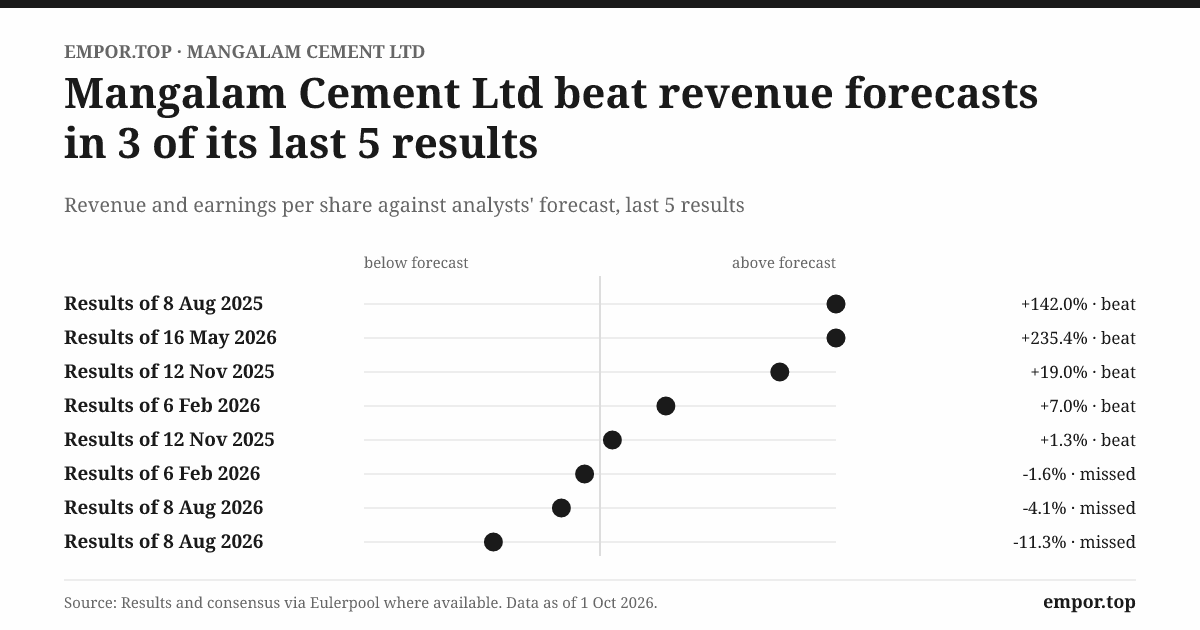
In May 2026 Mangalam Cement reported the best quarter in its recent history. Net profit for the three months to March came to about $7.1 million, more than three times the figure a year earlier1. A casual reader of the headline would have pictured kilns running hot in Kota, trucks queuing at the gate and cement prices firming across Rajasthan and Uttar Pradesh.
The reality sat one line lower in the income statement. That quarter's tax rate was minus 400.8%1. The company did not pay tax; the tax line paid the company. Meanwhile the operating margin, the profit the plant itself earned on each rupee of sales, was a fairly ordinary 6.9%1. The kilns had a decent quarter. A note in the accounts had a spectacular one.
That gap between the headline and the kiln is the doorway into this story.
The headline and what sits under it
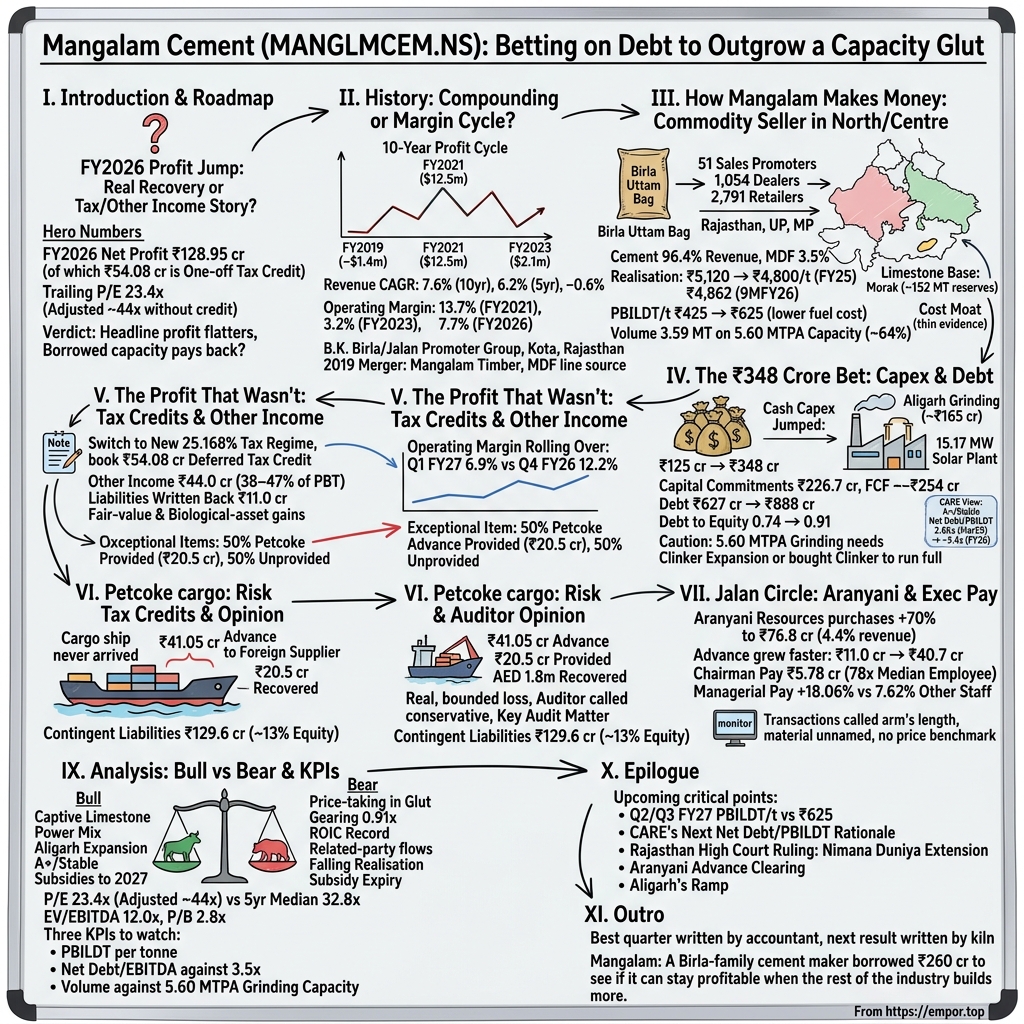
For the full year to March 2026 (FY2026), Mangalam reported net profit of ₹128.95 crore1. Of that, ₹54.08 crore was a one-off deferred-tax credit, booked when the company switched to India's new 25.168% tax regime so it could use its accumulated minimum-alternate-tax (MAT) credit1. Strip that out, apply a normal tax charge, and the profit falls to roughly ₹75 crore.
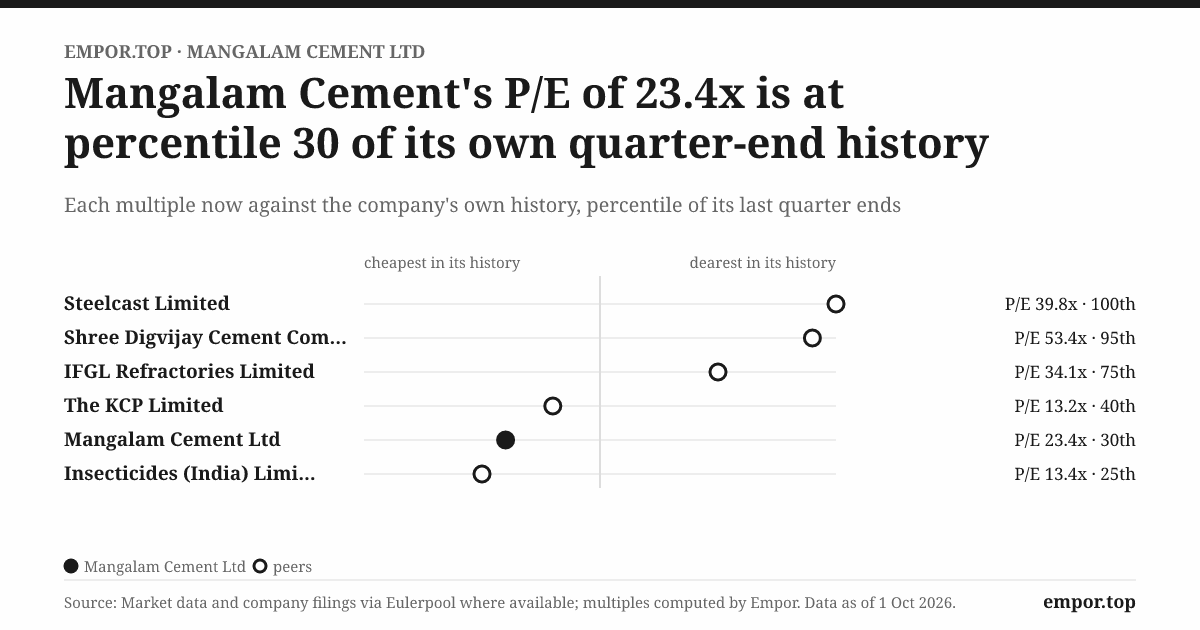
The difference matters for anyone looking at the share price. At ₹977 on 1 October 2026, the stock trades at about 23 times trailing earnings4. That looks like a discount to its own five-year median of about 33 times. On the earnings without the tax credit, it is closer to 44 times. One reading says the stock is cheap against its own history; the other says the market is already paying up for a recovery that has not yet proven itself.
What kind of company this is
Mangalam Cement is a listed, standalone company: no subsidiaries, no joint ventures, no associates1. It belongs to the B.K. Birla group, run by the Jalan branch of the family, and describes itself, as does its rating agency, as a professionally run group company2. In FY2026 it sold 3.59 million tonnes of cement and booked ₹1,758 crore of revenue1. The stock market values it at about ₹2,687 crore4.
Everything in this story belongs to that listed entity. Group companies, family holding vehicles and the wider Birla universe appear only where money flows between them and Mangalam, and then only as counterparties.
Four questions
This episode is built around four questions, and each section is a piece of evidence for one or more of them.
First, profit quality. Is the FY2026 recovery real, or mainly a tax credit and other income?
Second, funding. Mangalam has just spent heavily on capacity and borrowed to do it. Can it fund the build-out without stretching its debt past the point where its credit rating comes under pressure?
Third, the family circle. A Jalan-linked supplier is selling the company more each year and receiving a growing cash advance, while the chairman's pay rises faster than everyone else's. Is that worth more scrutiny than it gets?
Fourth, cost position. India is adding cement capacity at a pace the industry has rarely seen. Is Mangalam's cost base strong enough to survive the price competition that follows?
The short version of the answer, which the rest of the story tests: the headline profit flatters the business, and the real verdict depends on whether capacity bought with borrowed money pays for itself. To see why, start with the long record, because cement companies are best judged across a full cycle, not a single year.
 Subscribe on LinkedIn
II. Where Mangalam Sits: A Short History That Still Matters (6 min)
A family company in Kota
Kota sits on the Chambal river in south-eastern Rajasthan, a city now better known across India for its coaching factories for engineering aspirants than for heavy industry. Some 60 kilometres away, at Morak, Mangalam's plant sits on its own limestone. The company held its 50th annual general meeting in August 20263, which makes it a contemporary of the generation of private cement makers that grew up in India's licence-and-quota era.
The ownership has not changed hands in any meaningful way. The B.K. Birla promoter group, today led at the company by chairman and whole-time director Anshuman Vikram Jalan, has controlled it throughout1. There has been no takeover, no private-equity episode and no change of control. That continuity is worth noting because it means the record that follows belongs to one ownership regime. Whatever the business did well or badly, the same family was in charge.
A profit line that swings like a pendulum
Look at Mangalam's profits over a decade and the first impression is motion sickness. The company lost money in FY2016 and again in FY2019, when it posted a net loss of about $1.4 million1. Two years later, in FY2021, it earned about $12.5 million1, the peak of the post-pandemic construction boom, when cement prices rose and costs had not yet caught up. By FY2023 profit had shrunk to about $2.1 million1, as fuel costs spiked after Russia's invasion of Ukraine.
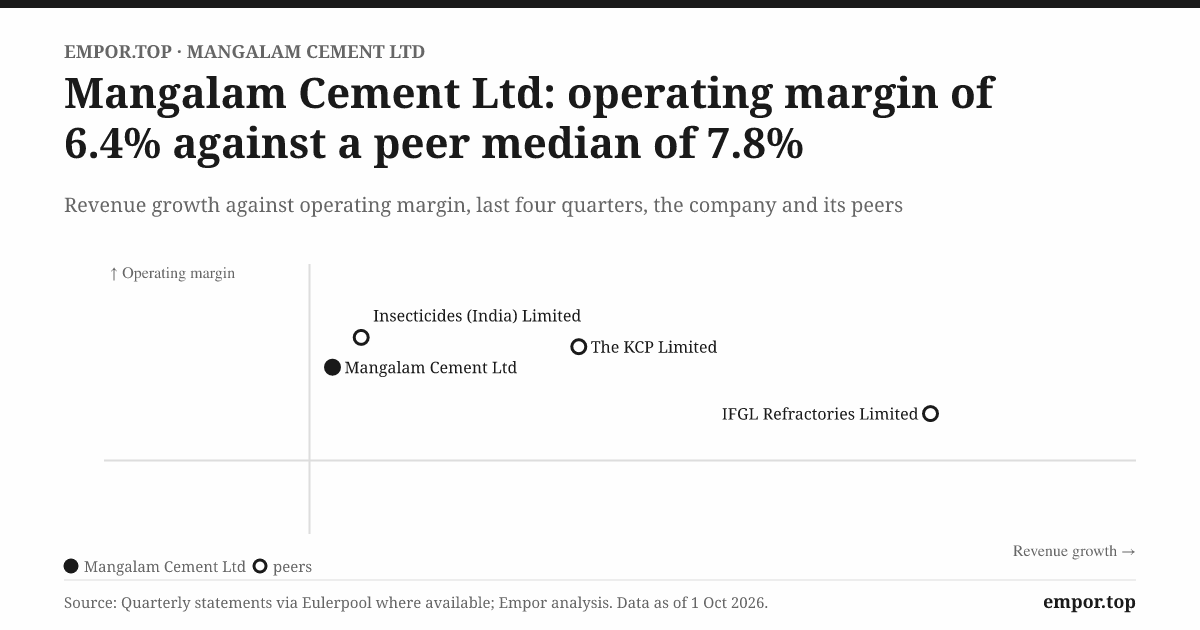
The operating margin tells the same story more cleanly. It reached 13.7% in FY2021, fell to 3.2% in FY2023 and recovered to 7.7% in FY20261. A company whose margin can quadruple and then fall by three-quarters in a few years is not compounding. It is riding a cycle.
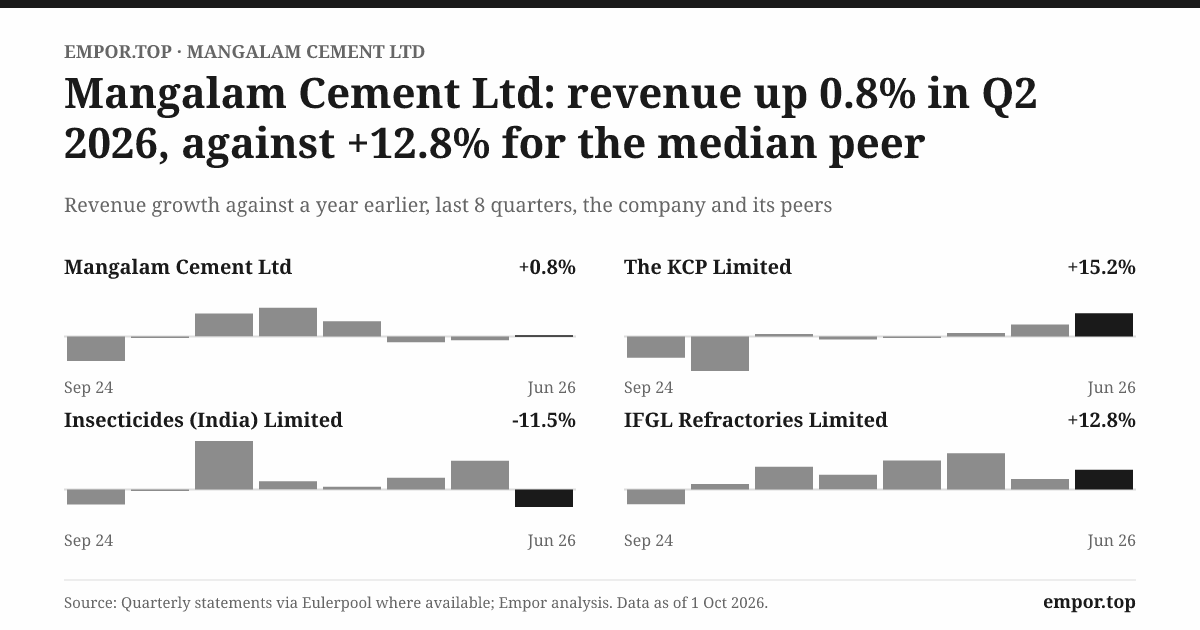
Revenue is steadier, but slow. Over ten years it grew about 7.6% a year in rupees; over five years, about 6.2%; and over the last three years it shrank slightly, by about 0.6% a year1. In dollar terms FY2026 revenue sat below the FY2023 peak. Growth is decelerating, not accelerating.
The only structural event
The one structural change in the company's recent history was the merger of Mangalam Timber Products, a group company that made medium-density fibreboard (MDF). The National Company Law Tribunal approved the scheme in November 2021, with an appointed date of 1 April 20191. That merger is why a cement company sells wood-fibre boards today, and why ₹19.9 crore of its land and buildings still sit in the old company's name on the title deeds1.
There is no acquisition record beyond that. Mangalam has not bought rival plants or bolted on grinding units through M&A. Its capital has gone into its own plants. So the yardstick for its capital allocation is not deal prices against peers but a simpler one: does the money it spends earn more than the money costs to borrow?
The equity record
Mangalam has not raised fresh equity in recent years. Its share count stood at 2,74,97,298 shares of ₹10 each in both FY2025 and FY2026, and the company reported no public issue, preferential allotment or private placement in FY20261. Its annual report for FY2026 does not set out any earlier history of rights issues, warrants or buybacks. For shareholders, the key point is that growth has been funded by retained cash and debt, not dilution.
What the record says
On the return the business earns on its capital, the record is sobering. Return on invested capital has ranged from under 1% in its worst years to a peak of about 11% in FY20211. Only twice in twelve years did it clear 9%. For most of the decade the business earned returns at or below what a lender charges it for credit.
So the base rate is single-digit revenue growth and profit that follows the cycle. FY2026's recovery is a recovery inside that pattern, not a break from it. Any claim that the company has become more resilient has to explain the loss years of FY2016 and FY2019 and the collapse of FY2023, all under the same management. To understand why the margin swings so wildly, look at what Mangalam actually sells and who sets its price.
III. How Mangalam Makes Money: Selling a Commodity in the North and Centre (14 min)
A bag of Birla Uttam
Follow a single 50-kilogram bag of Birla Uttam cement. It leaves the packing plant at Morak, rides a truck along Rajasthan's highways and lands in a dealer's godown in a district town. A mason buying it to build a house extension in eastern Rajasthan or western Madhya Pradesh does not know which kiln burned the clinker. He knows the brand, the dealer and, above all, the price per bag.
Mangalam reaches that mason through 51 sales promoters, 1,054 dealers and 2,791 retailers2. It sells two kinds of cement, Portland pozzolana cement (PPC), made by blending clinker with fly ash, and ordinary Portland cement (OPC), under the Birla Uttam and Mangalam ProMaxX brands2. Its markets are mainly Rajasthan, Uttar Pradesh and Madhya Pradesh2.
Almost all cement
In FY2026, cement brought in about ₹1,695 crore, or 96.4% of revenue1. MDF boards, the legacy of the timber merger, contributed about ₹62 crore, or 3.5%1. MDF is a footnote in the economics. Nothing in the filings suggests management sees it as a growth engine, and the story treats it accordingly.
Every sale is made at a point in time. There are no long-term supply contracts, no recurring fees and no customer that accounts for 10% or more of revenue1. Buyers are many and small. That is good for credit risk, and it shows: debtor days were just 8 in FY20261. But it means the company has no contractual protection when prices fall.
The price is set elsewhere
How much Mangalam earns per tonne depends mostly on prices it does not control. CARE Ratings reported that the company's realisation, the average price it got per tonne, fell from about ₹5,120 in FY2024 to about ₹4,800 in FY20252. In the first nine months of FY2026 it was about ₹4,862, nearly flat on a year earlier2.
Yet operating profit per tonne, which CARE measures as PBILDT (profit before interest, lease rentals, depreciation and tax), rose from about ₹425 to about ₹625 over the same comparison2. With prices flat, that ₹200 improvement did not come from pricing power. CARE attributed it to lower fuel costs2. In plain terms, the margin recovery came from cheaper coal and petcoke, not from the company being able to charge more.
That is the most important single fact about how Mangalam makes money. It is a price-taker. When fuel is cheap, margins expand. When fuel is expensive or a rival cuts prices, they shrink. Nothing in the record shows Mangalam holding price while its neighbours cut.
What a ton of cement costs to make
Cement manufacturing, simplified: quarry limestone, crush it, heat it with clay in a kiln at about 1,450°C to make clinker (grey marbles that are the active ingredient), then grind the clinker with gypsum and, for PPC, fly ash, to make cement. The three big cost buckets are raw materials (mainly limestone), energy (fuel for the kiln and electricity for the grinding mills) and freight (cement is heavy and cheap, so moving it far erodes margins fast).
Mangalam's advantage, where it has one, sits in the first two buckets. Its captive Morak mine meets about 90% of limestone needs and holds roughly 152 million tonnes of proven reserves, according to CARE2. It also generates much of its own power: a 35 MW captive power plant, 13.65 MW of wind, 11 MW of waste-heat recovery (power made from the kiln's exhaust heat) and a 15.17 MW solar project under way21.
The cracks in the cost position
The cost advantage has holes. Morak limestone alone is not high-grade enough for the whole mix. The company trucks higher-grade limestone about 350 km from its Gagrana mine in Nagaur and buys some on the open market, both at a higher cost2. Every tonne that travels 350 km by road eats into the margin that captive limestone is supposed to protect.
The company tried to secure a new source. It bid for the Nimana Duniya Extension limestone block, a 408-hectare parcel, and paid ₹7.03 crore upfront1. On 31 December 2025 the Rajasthan government rejected the bid, and Mangalam challenged the rejection in the Rajasthan High Court1. Until that case is resolved, the long-term limestone supply plan has an open question at its centre.
A second support has a sell-by date. State subsidies and tax rebates, which CARE lists as a strength, run on an eligibility window that ends in 20272, and must be repaid with interest and penalty if their conditions are breached1. Part of today's cost position is borrowed from government incentive schemes, and it expires soon.
The capacity wave
The demand side is just as testing. Mangalam's own management, in its discussion of the industry, noted that India added about 65 million tonnes a year of cement capacity in FY2026 and expects about 250 million tonnes more by FY20311. Mangalam's entire grinding capacity is 5.60 million tonnes a year1. Every year, the industry adds more than ten Mangalams.
Most of that capacity is being built by large national players. In the north and centre, Mangalam competes with UltraTech, the Aditya Birla group's cement giant; Shree Cement, whose home is also Rajasthan; JK Lakshmi; Dalmia Bharat; Heidelberg Materials' Indian arm; and the regional plants absorbed by the larger groups in recent consolidation. Against these names Mangalam is small, and CARE explicitly lists its "modest scale" and geographic concentration as rating constraints2.
The moat, argued once
It helps to put this in a standard framework, and to argue it here only once.
Through Michael Porter's five forces: buyer power is diffuse (no large customers) but real, because the mason and the dealer switch brands on price. Supplier power is moderate: captive limestone and power blunt it, but imported fuel and outside high-grade limestone keep it alive. The threat of new entrants is low for a greenfield player, given the cost of a kiln and the need for a limestone lease, but expansion by existing rivals is the real threat. Substitutes are minimal. Rivalry is intense and getting worse as capacity floods in.
Through Hamilton Helmer's seven powers: scale economies are weak, because Mangalam is a sub-scale regional player. Network effects and switching costs are absent. Counter-positioning does not apply. Brand is real but regional and does not command a durable price premium, as the falling realisations show. Process power is unproven. The one plausible power is a cornered resource: the Morak limestone reserves, which secure decades of supply near the plant. But a cornered resource only creates power if it lowers costs below rivals', and the 350-km haul from Gagrana shows it does not fully do so.
The verdict: Mangalam has a reasonable cost position in its home region, a favourable trade mix (more sales through dealers to retail buyers, who pay better than large project customers) and captive limestone. That is enough to survive in a normal market. Evidence that it is strong enough to win in a glut rests largely on CARE's statements, such as utilisation of about 80% in FY2025, above the industry average2. It is a moat in the shape of a shallow ditch.
And the company has just made a large, debt-funded bet that it can sell much more cement into that crowded market.
IV. The ₹348 Crore Bet: Where Did the Capex Go? (12 min)
A sudden change of pace
For years Mangalam's capital spending was modest. In FY2025 it spent about ₹125 crore on fixed assets, roughly 7.5% of revenue1. Then, in FY2026, cash capex jumped to about ₹348 crore, close to 20% of revenue1. In a single year, the company spent almost three times as much as the year before and more than four times its annual depreciation of about ₹81 crore1.
That is not maintenance. That is a company choosing to grow.
What is named
The annual report names two projects: a grinding expansion at Aligarh in Uttar Pradesh, and the 15.17 MW solar plant1. CARE puts the Aligarh project at about ₹165 crore2. A grinding unit near the market makes sense: it lets the company ship clinker to Aligarh and grind it into cement close to buyers in western UP, cutting the freight bill on the finished product.
Capacity after the Aligarh expansion is 5.60 million tonnes a year of grinding1, up from the 4.4 million tonnes CARE cited earlier2. FY2026 sales of 3.59 million tonnes therefore work out to about 64% of the new capacity.
What is not named
Here is where the numbers stop adding up. Beyond the cash already spent, the company carried about ₹226 crore of capital advances (money paid to suppliers for equipment not yet delivered) and about ₹227 crore of capital commitments not yet provided for at March 20261. The named projects, Aligarh at ₹165 crore and a solar plant, do not obviously account for all of it. The annual report does not say where the rest is going.
That matters because of a constraint deeper in the plant. In FY2026, Mangalam produced 2.66 million tonnes of clinker1. Its clinker capacity is about 2.67 million tonnes a year2. The kilns are effectively full.
Here is the arithmetic, in plain terms. A tonne of PPC cement needs roughly two-thirds of a tonne of clinker, with fly ash and gypsum making up the rest. With clinker capped at about 2.67 million tonnes, Mangalam can make roughly 3.5 to 4 million tonnes of cement, depending on the blend. Its grinding capacity is now 5.60 million tonnes. To fill that grinding capacity, it needs either more kiln capacity or clinker bought from someone else, which brings the margin of that rival's kiln into Mangalam's costs.
So the question that decides whether this capex earns its keep is a simple one the company has not publicly answered: is the undisclosed spending a clinker expansion? If it is, the mismatch narrows and the investment becomes coherent. If not, much of the new grinding capacity will sit idle or run on purchased clinker.
How it was paid for
The money did not come from operations. Cash from operations fell to about ₹94 crore in FY2026, only about 43% of EBITDA1, compared with a long-run norm closer to 85–100%. Working capital absorbed about ₹136 crore: inventories took ₹43 crore, receivables ₹15 crore and a fall in payables ₹77 crore1. The company does not break down why payables fell so sharply.
With capex near ₹348 crore and operating cash under ₹100 crore, free cash flow was roughly minus ₹254 crore1. The gap was filled with debt. Mangalam took about ₹156 crore of new long-term loans, repaid about ₹75 crore, and added about ₹164 crore net of short-term borrowing1. Total debt, including leases, rose from about ₹627 crore to about ₹888 crore1. Debt to equity rose from 0.74 to 0.911.
The mix is the uncomfortable part. Short-term borrowings now make up about two-thirds of total debt, and the current ratio is 0.721, meaning short-term liabilities exceed short-term assets. Long-lived plant is being funded substantially with money that has to be rolled over within a year. That works as long as banks keep rolling it.
And the company has asked shareholders for more room. At the August 2026 AGM, they approved raising the borrowing limit from ₹2,000 crore to ₹3,000 crore73. A limit is not a plan, but nobody raises a limit they expect never to approach.
What the rating agency sees
CARE Ratings reaffirmed Mangalam at CARE A+/Stable for long-term facilities and A1+ for short-term ones on 26 March 20262. It described the capex as "largely debt-funded". At March 2025, net debt to PBILDT stood at 2.66 times, and CARE expected around 2.5 times. Its downgrade trigger is net debt to PBILDT above 3.5–3.6 times on a sustained basis2.
On FY2026 closing figures, net debt of about ₹880 crore set against the company's EBITDA of about ₹261 crore gives roughly 3.4 times1. That is a rough calculation; CARE adjusts its numbers, and its own FY2026 figure is not yet out. But it puts the company within touching distance of the trigger, not comfortably below it.
CARE's comfort rests on expected gross cash accruals of ₹210–250 crore a year over two years, against repayments of ₹75–85 crore2, plus adequate liquidity. Those projections need the operating margin to hold.
The skeptic's stress test
A skeptical investor would point to the long-run record first. Over the twelve years to FY2026, cumulative cash from operations of about ₹1,704 crore was about 320% of cumulative net profit1. That looks strong, but it largely reflects heavy depreciation in a capital-intensive business. Free cash flow over the same twelve years was only about ₹304 crore, and cash on the balance sheet grew by about ₹182 crore1. After dividends, very little cash was left for debt reduction over a decade.
Then add the return record. Only twice in twelve years has return on invested capital exceeded 9%1. In FY2026 it was about 8%1. A company that has rarely earned more than its cost of debt is now borrowing heavily to grow. The burden of proof sits with the new capacity: it must earn a better return than the old assets have.
The verdict on this section: the investment phase is real, the funding is stretched but not broken, and the key operational question, clinker, is one the company has not answered in its filings. The next question is whether the earnings that are supposed to repay this debt are as strong as the headline suggests.
V. The Profit That Wasn't: Tax Credits, Write-backs and Other Income (11 min)
A note in the accounts
Every Indian company carrying unused minimum-alternate-tax credit faced a choice when the Income-tax Act 2025 offered a lower-rate regime. Mangalam chose to move to the new 25.168% regime and use its MAT credit, and in doing so it recognised a deferred-tax credit of ₹54.08 crore1. That one accounting decision explains much of the headline jump in FY2026.
Here is the worked calculation. Profit before tax in FY2026, after exceptional items, was about ₹94 crore1. At a normal effective rate, tax would have been about ₹19 crore, leaving profit of roughly ₹75 crore. Reported profit was ₹128.95 crore1. The ₹54 crore difference is the tax credit. In other words, roughly 42% of reported FY2026 profit came from a change in tax regime, not from making or selling cement.
Other income: the second leg
The tax credit is not the only cushion. Other income, money earned outside the cement business, was about ₹44 crore in FY20261. That was between 38% and 47% of profit before tax, depending on whether exceptional items are included1. In FY2025 it was even higher, at about 87% of profit before tax1.
Some of this other income is ordinary: interest on deposits of about ₹13 crore. Some is not repeatable. Liabilities written back, old payables the company decided it no longer owed, contributed about ₹11 crore in FY20261, after about ₹28 crore in FY2025, of which about ₹24 crore was a land-tax liability written back1. Fair-value gains and profits on selling investments added about ₹12 crore. A revaluation of biological assets, the trees in the timber operation, added about ₹6 crore1.
None of these are signs of wrongdoing. They are accounting gains that will not recur at the same level each year, and they come on top of an operating business whose margin is modest.
The treasury puzzle
There is also an odd feature in how the balance sheet is managed. CARE counted about ₹240 crore of liquid balances at December 2025: fixed deposits, mutual funds and cash2. The fact sheet shows about ₹228 crore of cash and short-term investments at March 20261. At the same time, debt stood at about ₹888 crore.
Holding cash and borrowing at the same time is common in Indian mid-caps, partly for liquidity comfort and partly because some deposits are pledged as margin money. But borrowing at, say, 8–9% while earning less on deposits costs money. It also means part of the "other income" in profit is simply interest the company earns on cash it could have used to repay loans.
Where the operating improvement is real
None of this means FY2026 was hollow. The operating margin rose from 4.7% to 7.7%1. Operating profit per tonne rose by about ₹200, according to CARE2. The company's own EBITDA rose to about ₹261 crore from about ₹218 crore1. Something in the business did improve, and the evidence points to fuel costs falling.
But the improvement has already reversed. In the quarter to June 2026 (Q1 FY2027), revenue was flat on a year earlier, while operating profit fell about 43%1. The operating margin dropped from 12.2% to 6.9%1. Net profit fell 44%1. Every quarter after June 2025 has run at an operating margin between about 5.7% and 6.9%1. The strong June 2025 quarter now looks like the exception, not the new normal.
The exceptional item
FY2026 also carried an exceptional charge of about ₹21.8 crore1. Most of it, about ₹20.5 crore, was a provision against a failed petcoke purchase, which gets its own section next. The rest was about ₹1.2 crore for the impact of India's new labour codes1. The petcoke charge pulled profit down, so the tax credit and the exceptional item partly offset each other. But they are not the same kind of thing: one is a real cash loss, the other an accounting gain.
Clean receivables
One part of the earnings is clean. Trade receivables were about ₹37 crore at March 2026, about 8 days of sales, and the expected-credit-loss charge was only about ₹0.56 crore1. A retail-led cement business collects quickly, and Mangalam does.
A correction on dividends
One figure in the standard data needs fixing. Some data providers show FY2026 dividends paid as about $6.2 million, a 42% payout. The company's cash-flow statement shows ₹4.12 crore paid in both FY2025 and FY2026, which is ₹1.50 a share1. That is about 3% of FY2026 net profit, not 42%. Shareholders approved the same ₹1.50 dividend for FY2026 at the August 2026 AGM67. Mangalam remains a company that pays out very little.
The verdict
The recovery is part real and part flattering. The operating margin and per-tonne profit did improve, but underlying profit is closer to ₹75 crore than ₹129 crore, and the margin has since rolled over. The claim of a recovery is narrowed, not rejected. The test is the next two quarters: operating profit per tonne in Q2 and Q3 FY2027 against the ₹625 benchmark, measured before other income and tax credits.
One of the items that reduced FY2026 profit, however, raises a different question: about risk control rather than accounting.
VI. The Petcoke Cargo That Never Arrived (6 min)
A ship that did not dock
Petroleum coke, or petcoke, is a by-product of oil refining, a black, high-energy fuel that many Indian cement kilns burn instead of coal. Mangalam buys it abroad. In this case, it paid a foreign supplier an advance of about ₹41.05 crore for a cargo destined for Kandla, the port on Gujarat's coast1. Loading was completed. The cargo never arrived1.
The company has since recovered AED 1.8 million and is pursuing proceedings in Dubai1. In FY2026 it provided for half the advance, about ₹20.5 crore, as an exceptional item1. The auditor called the provision "conservative" and made the petcoke advance one of three key audit matters1.
Why it matters
A ₹41 crore advance is about 2% of revenue, and the provision is a one-time hit. On its own, it does not threaten the company. But it raises a question about controls. Paying a large sum upfront to an overseas supplier before goods are delivered, without hedging the currency, is a risk that a commodity buyer of Mangalam's size should manage tightly. The advance was also unhedged: the rupee weakened from about 85.6 to about 94.7 per dollar over FY20261, and the company booked a net exchange loss of about ₹2.3 crore, up from almost nothing the year before1.
The other half of the advance, about ₹20.5 crore, remains unprovided. If the Dubai proceedings fail, that is the size of the next possible charge.
The audit record
The broader audit record is reassuring. The auditor's opinion was unmodified, with no qualification1. The CARO report, a statutory checklist auditors complete under the Companies Act, reported no fraud and no default on borrowings1. The key audit matters, besides petcoke, were inventory valuation and uncertain tax and duty positions1, routine for a cement company.
The one housekeeping item: title deeds for about ₹19.9 crore of land and buildings inherited from the timber merger are still in Mangalam Timber Products' name1. Five years after the tribunal approved the merger, the paperwork is not finished.
The legal tail
Contingent liabilities, claims the company disputes and has not recorded as debts, were about ₹130 crore at March 2026, down from about ₹160 crore a year earlier1. That is about 13% of equity. The main items are income tax (about ₹57 crore), excise duty (about ₹22 crore), a fly-ash price differential (about ₹19 crore) and limestone royalty (about ₹16 crore)1.
These are typical of an Indian manufacturer with a long history. They are not small, but they are falling, and none appears existential.
The verdict
The petcoke episode is a real, bounded loss. It is not evidence of systemic failure, and the auditor's report and CARO are otherwise clean. But it shows that a weaker rupee and imported fuel together are a live cost risk, and that the company's control over supplier advances is a weak point. That theme of advances to suppliers comes back in the next section, closer to home.
VII. The Jalan Circle: Aranyani, Vidula and the Chairman's Pay (9 min)
A supplier in the family
Note 43.7 of the annual report, the related-party note, lists the companies connected to Mangalam's directors and managers. One of them is Aranyani Resources Private Limited, described as an enterprise over which a key managerial person has significant influence1.
In FY2026, Mangalam bought about ₹76.8 crore of raw material from Aranyani, up about 70% from ₹45.3 crore the year before1. At the same time, Mangalam's advances to Aranyani for raw-material supply rose from about ₹11 crore to about ₹40.7 crore at year end1, after a ₹20 crore refund during the year. The note does not say what material Aranyani supplies.
Putting it in proportion
The purchases are about 4.4% of revenue. Under SEBI's listing rules, a related-party transaction is material if it exceeds 10% of turnover, or about ₹176 crore for Mangalam. Aranyani is well under that line. The directors' report says all related-party transactions were at arm's length and that none was material1.
So the arrangement is legal, disclosed and small. The concern is narrower: the advance outstanding grew far faster than the purchases. Money moving from a listed company to a promoter-linked company before goods are delivered is the kind of flow minority shareholders should watch, especially at a company that has just lost ₹20 crore on another supplier advance. The company has not published what Aranyani sells or how its prices compare with the market, so outsiders cannot test the arm's-length claim.
Other family ties
There are smaller related flows. Vidula Consultancy Services, another related company, received about ₹2.4 crore of rent in FY2026, and holds a security deposit of about ₹4.1 crore and a rent advance of about ₹2.0 crore1. In FY2025 it bought assets from Mangalam for about ₹11 crore1. The company also made about ₹0.4 crore of CSR-related purchases from Mignonette Creations and gave about ₹0.13 crore to the Anshuman and Vidula Jalan Foundation1.
Each is small. Together they show a company whose orbit includes several Jalan-linked entities, which is common among Indian family firms and is exactly why disclosure quality matters.
The people at the top
Anshuman Vikram Jalan is chairman and whole-time director, the face of the promoter family at the company1. Yaswant Mishra is executive director and chief financial officer, on the board since February 20251, which puts the CFO inside the boardroom rather than reporting to it. In May 2026 the company appointed Pankaj Kumar as joint president for operations1, a sign that management is adding operational depth as the plant footprint widens.
The filings say little about the personal backgrounds or management styles of these leaders, and the company does not hold publicly documented investor calls that would reveal how they frame strategy. For an outside investor, their record has to be read from the numbers: a margin cycle, a capex surge and a growing related-party flow.
The pay
Jalan was paid about ₹5.78 crore in FY2026, up about 23%1. That is 78 times the median employee's pay of about ₹7.4 lakh1. Mishra received about ₹2.68 crore, up about 9%1. Managerial pay overall rose about 18%, against about 7.6% for other employees and about 3.8% for the median1.
Part of the chairman's pay is commission, which rose from about ₹0.70 crore to ₹0.90 crore1, linked to profit. The FY2026 profit included the tax credit, so it is fair to ask whether commission was calculated on a profit flattered by an accounting decision. The filing does not say. Each non-executive director received about ₹10 lakh of commission1. The estate of the late Vidula Jalan still has about ₹1.72 crore of remuneration payable1.
For a company with a market value under ₹2,700 crore and underlying profit near ₹75 crore, the chairman's pay is substantial: roughly 8% of underlying profit going to the top two executives.
Board and votes
The board has eight members: two executives, two non-executive directors who are not independent, and four independents1. Two of the non-independents, Nand Gopal Khaitan and Gaurav Goel, were reclassified from independent on 10 September 20241, typically because long-serving directors exceed tenure limits. Two independents left in FY2025 and three joined1.
At the 50th AGM on 21 August 2026, shareholders passed all eight resolutions, including the higher borrowing limit7. Reported support for the special resolutions ranged from about 99.1% to 99.99%7. There was no visible dissent.
Who owns it
The promoter group held 40.00% at March 2026, or 1,09,99,620 shares, with no pledge1. Corporate bodies held about 20%, resident individuals about 25%, foreign portfolio investors about 7% and mutual funds about 4%1. Institutional ownership is thin, which is one reason governance questions draw little public challenge.
Promoter holding has risen in recent years: reports put it at about 37.8% in December 20246, and the company has issued no new shares, so the increase came from purchases. On 24 March 2026, about 10 lakh shares changed hands within the promoter group at about ₹818 a share, roughly ₹82 crore, according to press reports, with Aditya Birla Real Estate and Pilani Investment reported as sellers5. Total promoter holding was unchanged.
Capital allocation
Mangalam has paid out little. Dividends were between about 2% and 9% of profit for most of the last decade1, and the ₹1.50 dividend gives a yield of about 0.2%4. The company has kept cash for reinvestment. That is defensible only if the reinvestment earns more than the debt costs, which brings us back to the return record.
The verdict
The Aranyani arrangement is small against revenue and below the regulator's materiality threshold. But the material is not named, no price benchmark is published and the advance grew faster than purchases. The case is "monitor", not "problem", and it remains open only because the company does not say what Aranyani supplies. The executive pay is high for the company's size and rose faster than staff pay, but shareholders have not objected. With the evidence on the table, the lessons come next.
VIII. Playbook: Lessons From a Commodity Operator (6 min)
"In cement, the margin is the weather and the balance sheet is the umbrella."
In FY2021 Mangalam earned a 13.7% operating margin. Two years later it earned 3.2%, under the same management, in the same plants. Nothing about the company changed. The weather did: fuel prices, rival capacity, demand. A commodity producer cannot control the weather, so what it can control is whether it can survive bad weather without being forced to sell assets or equity. Founders and investors in any commodity business should judge management less by the best year and more by the balance sheet going into the worst one. Mangalam's umbrella is smaller today than it was two years ago.
"A tax credit is not a business."
The quarter that produced a minus 400.8% tax rate made Mangalam's best headline in years. It said nothing about whether cement was more profitable. Investors who screen on price-to-earnings ratios saw a stock trading below its historical multiple; investors who read the tax note saw one trading near 44 times underlying earnings. The general lesson: when the line that moved most is the one furthest from the customer, discount it.
"Capacity without clinker is just a bigger grinder."
Aligarh expanded Mangalam's ability to grind cement to 5.60 million tonnes a year. Its kilns can feed perhaps two-thirds of that. In cement, the kiln is the expensive, permit-heavy, hard part; the grinder is the easy part. A grinding expansion is only as valuable as the clinker that feeds it. For any manufacturer announcing capacity, ask which stage of the process is actually the bottleneck.
"Ask what a supplier sells before you ask what it costs."
Aranyani's sales to Mangalam rose 70%, the advance rose almost fourfold, and the annual report does not name the material. Arm's-length pricing can only be judged against a market price, and a market price requires a named product. Related-party disclosure that hides the product is technically complete and practically uninformative. The lesson for minority shareholders anywhere: the first diligence question on a related-party supplier is "what?", not "how much?".
"Cash on the balance sheet next to short-term debt is a choice."
Mangalam held about ₹240 crore of liquid balances while carrying about ₹888 crore of debt, two-thirds of it short-term. That may be prudent liquidity management. It may also be a way to report interest income while paying higher interest elsewhere. Either way it is a decision, not an accident, and it is the kind of decision that tells investors how management weighs safety against return.
IX. Analysis: Bull vs. Bear, and the KPIs That Decide It (12 min)
A price war and a share price
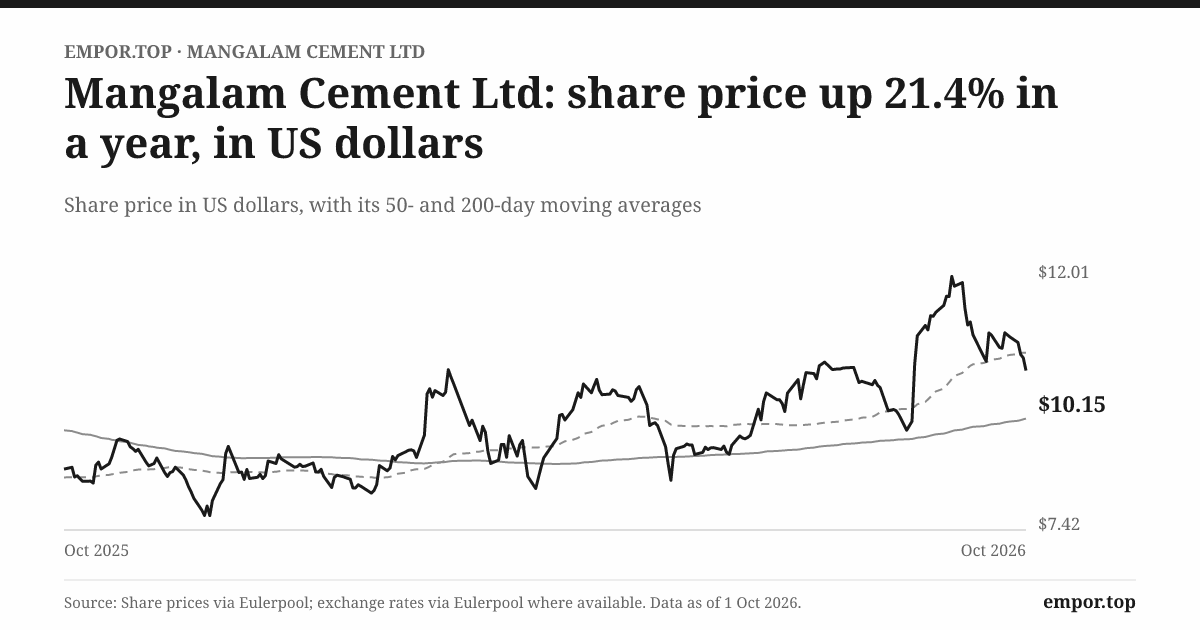
Picture the next two years in Rajasthan and Uttar Pradesh. New kilns from the national majors come online; their owners need volume to cover their debt; dealers find bigger discounts on offer. Into that market, Mangalam brings new grinding capacity and a heavier balance sheet. On 1 October 2026 its shares traded at about ₹977, about 12% below the 52-week high of ₹1,1114. Over five years the stock suffered a peak-to-trough fall of about 48%4. The market has been reminded more than once that this is a cyclical stock.
What the price implies
On headline numbers the stock looks cheaper than its history: about 23 times trailing earnings against a five-year median near 334. Price to book is about 2.8 times, EV/EBITDA about 12 times, and return on equity about 12%4. The free-cash-flow yield is negative, about minus 4.5%4, because of the FY2026 capex.
But the trailing earnings include the tax credit, worth about ₹19.7 a share. Without it, trailing EPS is about ₹22 and the P/E about 44 times14. On that basis the stock is not cheap against its history; it is expensive. The market is pricing in a recovery that holds and capex that earns, not the current run-rate.
How that compares with peers matters, but this story does not quote peer multiples it cannot source to a filing. What can be said is that larger national peers have historically commanded premium multiples for scale and balance-sheet strength, and a sub-scale regional producer usually trades at a discount to them, not a premium.
The bull case
The bull case rests on assets that are real. Captive limestone with about 152 million tonnes of reserves2. A power mix that combines captive thermal, waste-heat recovery, wind and soon solar2. A new grinding unit at Aligarh close to a large, growing UP market. A stable A+ rating reaffirmed in March 20262. Subsidies still running until 20272. A trade-heavy sales mix, which tends to support better realisations. Utilisation of about 80% in FY2025, above the industry average, per CARE2.
If fuel stays cheap, Aligarh ramps well and the undisclosed capex turns out to be a clinker expansion, Mangalam could grow volume meaningfully, push per-tonne profit back above ₹600 and grow into its debt.
The bear case
The bear case is the record. Mangalam is a price-taker in a market where capacity is rising faster than demand. Its return on invested capital has cleared 9% only twice in twelve years. Gearing has risen to 0.91 times, with two-thirds of debt short-term. Realisations fell in FY2025 and have not recovered. The subsidies expire in 2027. The related-party supplier flow is growing and hard to verify. And the latest quarter, June 2026, showed operating profit down about 43%.
If prices fall in the capacity wave, Mangalam faces the same squeeze it did in FY2023, this time with more debt.
Weighing them
The bull case rests largely on assets and promises; the bear case rests on the company's own historical record. The record is longer and more consistent. The fairest conclusion is that Mangalam's cost position is good enough to remain profitable through a normal cycle, but there is no evidence it is strong enough to gain share profitably against national players in a glut. The claim that the capex will lift returns is unproven, and the next three to six quarters will test it.
The risk radar
Only five risks are material.
Regional price competition: the capacity wave lands in Mangalam's home markets, and as a price-taker it cannot avoid it.
Fuel and the rupee: imported coal and petcoke drive costs, and the rupee's fall over FY2026 makes them dearer.
Refinancing: with two-thirds of debt short-term, a tightening of bank credit would hit Mangalam quickly.
Limestone supply: the Nimana Duniya Extension case and the long haul from Gagrana define the cost of the raw-material mix.
Execution at Aligarh: the new capacity must be filled, and filled with clinker the company does not yet have spare.
Technology disruption is not a material risk here. No software replaces cement.
Three KPIs to watch
First, operating profit per tonne (PBILDT per tonne). It was about ₹625 in the first nine months of FY2026, up from ₹4252. The June 2026 quarter's margin suggests it has since fallen. This is the single best gauge of whether the recovery is real.
Second, net debt to EBITDA against CARE's 3.5 times trigger. It was 2.66 times at March 20252 and roughly 3.4 times on FY2026 closing figures. Direction: rising.
Third, volume against 5.60 million tonnes of grinding capacity. FY2026 sales were 3.59 million tonnes, about 64% of capacity1. Direction: capacity up faster than volume.
The cost position and the moat were argued in Section III; nothing here changes that verdict. What changes it is what happens next.
X. Epilogue (4 min)
Where the company stands tonight
On the first evening of October 2026, Mangalam Cement is a company caught between two versions of itself. One is the version in the annual report's headline: profit up almost threefold, a stable A+ rating, new capacity in Uttar Pradesh and a borrowing limit raised to ₹3,000 crore. The other is the version in the notes: a tax credit doing much of the work, a margin that fell back in the June quarter, kilns running full, and debt that has risen by about ₹260 crore in a year.
Both are true. The next few months will decide which one dominates.
The moments that decide it
The September and December 2026 quarters come first. If per-tonne operating profit holds near ₹600, measured before other income, the FY2026 improvement was real and the earnings can carry the debt. If it falls toward ₹400, the June quarter was a warning, not a blip, and the profit question tips firmly against the company.
CARE's next rationale is the second moment. If the agency's own calculation of net debt to PBILDT for FY2026 comes in below 3 times, the funding question is answered for now. If it approaches 3.5 times and the outlook moves to negative, the cost of borrowing will rise just when the company needs to roll over most of its debt.
The Rajasthan High Court's ruling on the Nimana Duniya Extension block is the third. A win secures better-grade limestone and eases the cost question. A loss leaves the company trucking stone 350 km for the foreseeable future.
The fourth is quieter. If the ₹40.7 crore advance to Aranyani clears through deliveries in FY2027, the related-party question shrinks. If it grows again, it becomes a question shareholders should put to the board.
The fifth is Aligarh's ramp, and with it, whether Mangalam announces a clinker expansion to feed the new grinders.
The tension that remains
Mangalam's recovery may be real, but it is smaller than the headline. The company has made a sensible bet in a hard market and funded it with debt at the moment when the industry is adding capacity fastest. That is either the right time to invest, before demand catches up, or the worst time, when prices fall. The company's own history offers no guarantee either way.
XI. Outro (3 min)
Go back to that March 2026 quarter, the one with the minus 400.8% tax rate. It was the best quarter in years, and it was written by an accountant, not a kiln. The kilns at Morak did their usual, decent work; a note on tax regimes did the rest.
The next result will be written by the kilns. Their clinker capacity is full, their limestone comes partly by truck from 350 km away, their fuel arrives by sea priced in a weakening rupee, and the cement they make sells into a market where rivals are adding capacity many times Mangalam's size each year. Whatever the next annual report says, its most honest number will be the profit per tonne before anything else is added.
Mangalam is a Birla-family cement maker that borrowed ₹260 crore in a year to find out whether it can stay profitable when the rest of the industry builds more.
References
-
Annual Report 2025-26 — Mangalam Cement Limited, 2026-05-16 ↩↩↩↩↩↩↩↩↩↩↩↩↩↩↩↩↩↩↩↩↩↩↩↩↩↩↩↩↩↩↩↩↩↩↩↩↩↩↩↩↩↩↩↩↩↩↩↩↩↩↩↩↩↩↩↩↩↩↩↩↩↩↩↩↩↩↩↩↩↩↩↩↩↩↩↩↩↩↩↩↩↩↩↩↩↩↩↩↩↩↩↩↩↩↩↩↩↩↩↩↩↩↩↩
-
Press Release, Mangalam Cement Limited — CARE Ratings, 2026-03-26 ↩↩↩↩↩↩↩↩↩↩↩↩↩↩↩↩↩↩↩↩↩↩↩↩↩↩↩↩↩
-
Mangalam Cement Ltd share price and financials — Screener ↩↩↩↩↩↩↩↩↩
-
Mangalam Cement Promoter Group Swaps ₹82 Cr Shares — Whalesbook, 2026-03 ↩
-
Mangalam Cement FY26 Profit ₹129 Cr, ₹1.50 Dividend Approved Amid Dispute Provision — Whalesbook, 2026-05 ↩↩
-
Mangalam Cement Ltd shareholders approve dividend, boost borrowing limits — Whalesbook, 2026-08 ↩↩↩↩
 LinkedIn
 WhatsApp
 Reddit
 Hacker News
 Email
Email Kindle
 RSS Feed
 Spotify
 Apple Podcasts
 Amazon Music
 Audible
 YouTube