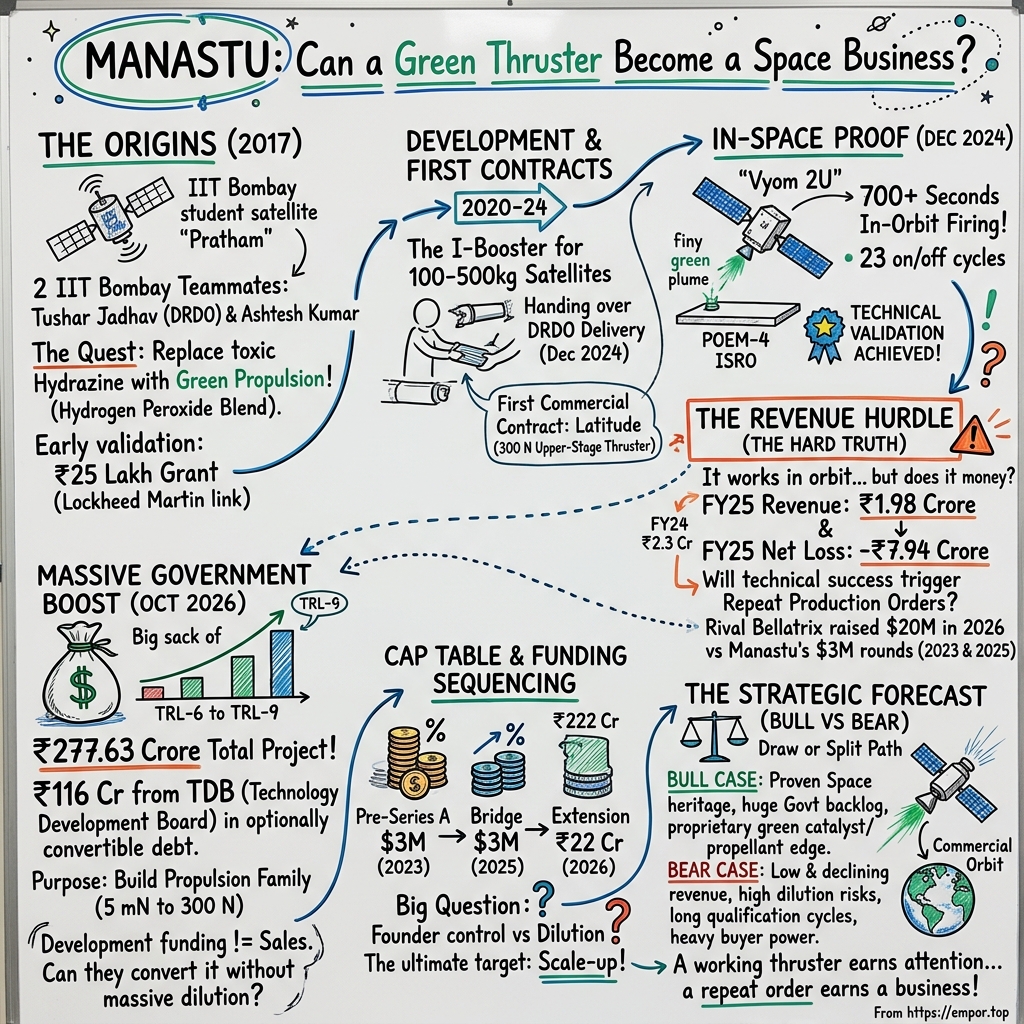
Manastu: Can a Green Thruster Become a Space Business?
I. The Thruster That Has to Earn Its Orbit
On the last day of 2024, about 350 kilometres above the Earth, a small thruster the size of a coffee flask woke up aboard a spent rocket stage and pushed. The platform it was bolted to weighed about 1,408 kilograms, and a thruster producing roughly one newton of force, about the weight of a small apple held in the palm, turned the whole structure by 24 degrees.1 Over the following ten weeks the same device fired again and again, accumulating, by the company's count, about 700 seconds of burn time, including a single continuous run of 360 seconds and more than 20 restarts, before the platform was steered down into the Indian Ocean in April 2025.1 For the engineers in Navi Mumbai who had spent nearly a decade on the chemistry behind that push, it was the moment their work stopped being a laboratory claim and became a piece of flight history.
Then the thruster fell silent, and the harder part began. A propulsion system that has worked once in orbit is a credential. It is not yet a business. A business begins when a satellite builder chooses that thruster for its own spacecraft, signs a purchase order, pays for it, flies it, and then comes back for the next one. Between a successful demonstration and a repeat order lies a long, unglamorous stretch of qualification paperwork, integration reviews, delivery schedules and price negotiations, and plenty of technically excellent hardware companies have run out of money somewhere along it.
The company at the centre of this story is Manastu Space Technologies Private Limited, an unlisted Indian private company incorporated in Maharashtra in 2017.2 It designs and builds propulsion systems for satellites and the upper stages of launch vehicles, and it makes its own propellant, a hydrogen peroxide blend it calls MS289, intended to replace hydrazine, the toxic fuel that has dominated small spacecraft thrusters for half a century.3
Because Manastu is private, there is no share price to watch, no trading multiple to compare, and no exchange-reported shareholding pattern to read. Nor has it filed a draft prospectus: neither the Securities and Exchange Board of India's public-issue filings nor the National Stock Exchange's register of offer documents carried a Manastu filing as of mid-November 2026.45 Anyone weighing the company as a future public listing has to work from what it has chosen to say, what its counterparties have said about it, and the slim financial statements it files as a private company.
Those statements are where the tension starts. In the year to March 2025, the same twelve months in which Manastu handed a propulsion system to India's defence research agency and flew its thruster in orbit, its revenue fell to about ₹1.98 crore, down roughly 12% from ₹2.3 crore the year before, and its net loss widened to about ₹7.94 crore.26 Put the two numbers side by side and they say something stark: for every rupee the company brought in from customers, it lost about four. Total expenses rose to roughly ₹9.8 crore, about two and a half times the previous year, while the loss more than quadrupled from about ₹1.8 crore.6
None of that is unusual for a deep-technology hardware company at this stage. Spending ahead of revenue is how a propulsion supplier gets to the point where a satellite maker will trust it. The question is whether that spending is building toward something customers will pay for repeatedly, or whether it is building a technical showcase that keeps needing new capital to stay alive.
Three questions follow the company through every stage of its life so far, and they shape everything that comes after. The first is commercial: will technical validation, which Manastu has genuinely achieved, turn into repeat business with paying customers? The second is financial: can the company fund the long climb from prototypes to production without diluting its existing owners to a sliver? The third is competitive: does Manastu have an edge that a better-funded rival cannot simply replicate? In October 2026 the Indian government raised the stakes on all three by agreeing to back a ₹277.63 crore propulsion programme with ₹116 crore of convertible debt, a project more than a hundred times the size of the company's latest annual revenue.7
So this is the story of a thruster that has already earned its place in orbit and now has to earn its place on a balance sheet. To understand why two young engineers took on a problem this capital-hungry, it helps to go back to a university satellite and the fuel nobody wanted to touch.
 Subscribe on LinkedIn
II. Two IIT Bombay Teammates Choose the Harder Problem
In September 2016, a small satellite called Pratham rode to orbit aboard an Indian Polar Satellite Launch Vehicle. It had been built by students at the Indian Institute of Technology Bombay, and two of the people who had spent years on it were Tushar Jadhav, who had served as the project's manager, and Ashtesh Kumar, who had led its onboard computer systems.3 A student satellite is a strange apprenticeship. It teaches the whole chain of spacecraft engineering, from power budgets to thermal design to the bureaucratic choreography of getting a payload accepted by a launch agency, and it does so on a budget that forces improvisation. Pratham's work also gave the team repeated access to India's space agency, ISRO, where they could see how professional spacecraft were put together.8
What the two founders noticed was propulsion. Most small satellites either have no ability to change their orbit at all, or carry hydrazine thrusters. Hydrazine is energetic and dependable, but extremely toxic, and fuelling a spacecraft that uses it requires technicians in sealed protective suits.9 In 2011 European chemicals regulators added hydrazine to their candidate list of "substances of very high concern," which raised the risk that its use would eventually be restricted, and the European Space Agency began funding work on less toxic replacements.9 For a small-satellite builder, hydrazine's handling costs and safety rules are a tax on every mission. A propellant that was safe to store and load, and still delivered enough push, could lower that tax for everybody.
Jadhav brought a particular kind of experience to the problem. Before returning to IIT Bombay, he had been a scientist at the Defence Research and Development Organisation, India's state defence research agency, and he resigned that post to go back to the institute.8 Kumar, a mechanical engineering graduate of 2017, had worked for close to three years on a green propulsion concept developed under Professor Arindrajit Chowdhury at the institute before the company was formally created.8 The company's own timeline puts the start of research and development in 2016 and the formal founding in 2017, with Jadhav as chief executive and Kumar as chief technology officer.3 Those roles have not changed since: the two founders remain the company's only listed directors.2
There is a small, revealing detail in Kumar's account of how he got there. He had applied to about five universities in the United States and Europe for further study and been rejected by all of them.8 The company, in other words, began partly as a second choice that became a vocation, which is a more common origin for durable businesses than founding myths usually admit.
By October 2019, when Kumar sat down with IIT Bombay's student magazine, Manastu was still a team of about eight people with backgrounds in mechanical, aerospace and chemical engineering and nanotechnology, and it was, in his words, still in the product development phase.8 He drew a distinction in that interview that turned out to be the governing idea of the company's next seven years: building something a customer will buy is a different discipline from developing a research prototype. A prototype has to work once, under the eyes of the people who built it. A product has to work every time, for strangers, at a price they accept, delivered on a date they can plan around.
What was the product, exactly? A satellite propulsion system is less a single device than a small plumbing network. It has a tank that holds the propellant under pressure, valves and feed lines that meter it out, a catalyst bed that makes the propellant decompose into hot gas, and a nozzle that turns that gas into thrust, all controlled by electronics that talk to the satellite's computer.
Manastu's propellant, MS289, is a mixture of hydrogen peroxide, ethanol, water and stabilising additives; the company's own technical paper describes it as roughly 53% hydrogen peroxide and 12% ethanol by weight, with water added to make it less sensitive to accidental ignition.10 The catalyst that breaks the mixture down is a ceramic designed to run at about 1,400°C.11 The company's marketing describes the propellant as "safer than common salt", which is the kind of line that makes a strong first impression and deserves to be read as a marketing line rather than a toxicological finding.3
The early milestones were the kind that a young deep-technology company collects before it has customers. In 2018 Manastu won a ₹25 lakh grant from the India Innovation Growth Programme, a scheme backed by India's Department of Science and Technology, Lockheed Martin and the Tata Trusts.3 It was named among the top ten start-ups at the International Astronautical Congress in Bremen that year, and in 2019 it collected a special prize at a Japanese government and JAXA start-up competition in Tokyo and a "Dare to Dream" award from DRDO.312 It also lists a collaboration with Shell's start-up programme on fuel chemistry.3
These honours deserve a proportionate place in the story. A ₹25 lakh grant bought runway and an outside endorsement at a time when both were scarce, and the Lockheed Martin association lent credibility with people who would never have read a technical paper. But awards are judged by panels, not by procurement departments. They tell an investor that knowledgeable people found the idea plausible; they say nothing about whether a satellite operator would switch suppliers, how much it would pay, or how often it would reorder. The founders' credentials, and the early recognition, explain why Manastu got a hearing. The next question was whether anyone would hand it a real contract with real money attached, and the first serious answer came from Jadhav's old employer.
III. The DRDO Handover Came Before the First Commercial Bet
On 11 December 2024, Jadhav and Kumar stood beside DRDO’s chairman, Samir V. Kamat, and handed over a propulsion system called iBooster.13 It was the end of a programme that had started four years earlier, when Manastu won a contract under DRDO's Technology Development Fund, a scheme that pays private companies, especially small ones, to develop technologies the defence establishment wants.313 The system was built to manoeuvre satellites weighing between 100 and 500 kilograms, the class that covers many earth-observation and communications spacecraft, and to handle three jobs: raising a satellite to its working orbit, keeping it there against the drag of the thin upper atmosphere, and bringing it down safely at the end of its life.13
On paper the iBooster is a cluster of four one-newton thrusters, fed by the company's own propellant, delivering a total impulse of 14,000 to 20,000 newton-seconds and weighing 15 to 20 kilograms when fuelled.14 Total impulse is the number that matters most to a satellite operator, because it measures how much velocity change the system can deliver over its life, which translates directly into how many years a satellite can hold its orbit or how far it can move. Manastu says the design was meant to "match or exceed" hydrazine's performance.14 DRDO later described Manastu as the developing agency and said the project's technical objectives had been completed and the system handed over.[^15]
That handover matters more than any of the earlier prizes, and it is worth being exact about why. A Technology Development Fund contract is a development contract with a demanding customer. Manastu had to meet specifications written by engineers who would actually use the system, pass reviews, and deliver hardware on a schedule. That builds discipline and know-how that no competition panel can replicate. It also gave Manastu its first clearly named government customer: when the Indian Space Promotion and Authorisation Centre, the regulator for private space activity, compiled its industry catalogue, it listed DRDO, the French company Latitude and the defence innovation programme iDEX as Manastu's key customers.12
But a development contract is not a production contract. The handover proves Manastu could build what DRDO asked for. It does not show that DRDO, or the satellite programmes it supports, has ordered iBooster units for operational spacecraft, and no such order has been announced. The financial record makes the point sharply. The handover fell in the same financial year as the revenue decline.6 Whatever money flowed from the DRDO programme, it did not show up as a step change in the income statement, either because development funding is recognised differently from product sales or because the sums were small. The company does not disclose the contract's value, and it does not break down revenue by customer.
The commercial test came from France. In 2022 Manastu signed what it calls its first commercial contract, with Latitude, a French launch-vehicle company, for a product called GP-LAM: a 300-newton thruster designed for the upper stage of a rocket.315 GP-LAM is a different animal from the small satellite thrusters. Three hundred newtons is roughly three hundred times the push of the thruster that flew on POEM-4, and the job is different too: an upper-stage module has to separate cleanly from the rest of the rocket, circularise or adjust its orbit, tidy up after dropping off multiple rideshare satellites, and then deorbit itself so it does not linger as debris.15 The datasheet promises a specific impulse of 250 seconds at the start of life, a total impulse of 150,000 newton-seconds and continuous firing of up to 500 seconds.15
The Latitude contract mattered because it signalled that Manastu's ambitions extended beyond small satellites, toward launch vehicles and orbital transfer vehicles, where each unit carries more value. It was also the first evidence that a foreign company, with no national-security reason to favour an Indian supplier, would pay for Manastu's engineering. Latitude's own endorsement on Manastu's website is telling in a way the company may not have intended. It reads: "The Best Price For the System."11 Price is a fine reason to win a first order. It is a weaker foundation for a lasting relationship, because a customer who chose a supplier on price can leave for a cheaper one.
What the public record does not contain is almost everything an investor would need to value that contract. Manastu discloses no contract value, no delivery milestones, no backlog and no margin. And the product's own maturity rating is a warning sign. Space engineers use a nine-step scale called the technology readiness level, or TRL, to describe how far a technology has progressed, from a basic principle on paper at level one to a system proven through successful mission operations at level nine. On Manastu's own website in 2026, four years after the Latitude contract was signed, GP-LAM is still listed at TRL 5, meaning it has been validated in a relevant ground environment but has not flown.11 The first commercial contract, in other words, is still a development programme.
The way satellites and rockets are bought explains why. Propulsion is not a component that can be swapped in late. It shapes the mass budget, the power budget, the safety case for fuelling at the launch site, and the software that controls the spacecraft's attitude. A builder that chooses a thruster designs around it early, then has to qualify the entire system through vibration, thermal-vacuum and firing tests before anyone will insure the launch. A successful demonstration opens the door to that process; it does not shorten it much. That is why the next step in Manastu's story was so important. It needed independent evidence that its hardware worked in space, and then it needed evidence that customers would pay to use it.
IV. Seven Hundred Seconds in Orbit, Then the Commercial Test
The thruster flew on POEM-4, the spent fourth stage of PSLV-C60, which stayed in orbit after releasing the two SpaDeX satellites on 30 December 2024.1 POEM is one of the more quietly useful ideas in India's space programme. Instead of letting the last stage of a rocket become debris, ISRO turns it into a short-lived orbiting laboratory with power, attitude control and telemetry, then rents space on it to universities and start-ups that need flight time. On this mission it carried 24 experiments, and one of them was Manastu's Vyom 2U, a compact propulsion module built for satellites of up to about 100 kilograms.110
The first firing came on New Year's Eve. Manastu's technical team later reported that the burn set the platform turning at about half a degree per second around its vertical axis before the platform's own control system stabilised it.10 The company's public account, carried by the Press Trust of India, described the same event as tilting the 1,408-kilogram platform by 24 degrees with a single newton of thrust.1 For a start-up that had never flown hardware, both versions describe the same essential fact: the thruster ignited in vacuum, produced measurable force, and the spacecraft responded.
POEM-4 completed 1,152 orbits before it was brought down into the Indian Ocean in early April 2025; at its last power-up on 13 March, Manastu said, every component still reported as operational.1 The company and PTI reported longer cumulative firing time.1
The Fine Print in the Flight Record
Here the story needs a careful reading, because the company's own engineers told it slightly differently. In a paper presented at the Small Satellite Conference in Utah in August 2026, eleven Manastu authors, led by Kumar and Jadhav, reported "over 620+ seconds" of cumulative firing across 23 on-off cycles.10 The gap between 620 and 700 seconds may simply reflect different counting rules, such as whether to include short pulses or partial burns. The more important disclosure is a single sentence in the paper's abstract: because the platform's inertial properties were not precisely known, "direct thrust measurement in orbit was not possible."10 Instead, the team reconstructed thrust and efficiency by combining motion data from the platform's sensors and pressure and temperature telemetry with ground tests of an identical flight model on a thrust stand.10
That is a candid and entirely normal admission for a rideshare experiment. A thruster bolted to a 1,400-kilogram rocket stage it does not control is a passenger, not the master of the vehicle, and a passenger cannot weigh the bus. But it changes what the flight proves. It proves that the system survived launch, that the propellant stayed stable in storage, that the catalyst ignited reliably across many cycles, and that the valves, heaters and electronics kept working for more than two months. It does not independently prove the headline performance figures, which still rest on ground testing.
The paper reports up to 1.1 newtons of thrust and a specific impulse of about 250 seconds at the start of life, and about 0.67 newtons and 238 seconds at the lower tank pressure deliberately chosen for flight.10 Specific impulse is the propulsion engineer's version of fuel economy, measuring how long a unit of propellant can produce a unit of thrust. Those reconstructed figures are consistent with Manastu's stated ambition to match or exceed hydrazine's performance,14 but because they rest on ground testing, any customer comparing suppliers will want to see them confirmed on its own test stand.
It is also worth noticing who else was on that rocket stage. Bellatrix Aerospace, a Bengaluru propulsion company and Manastu's closest Indian rival, flew its own one-newton green monopropellant thruster, Rudra, on the same POEM-4 mission. Bellatrix reported a 60-second firing that rotated the platform by about 80 degrees, and called it the company's third successful propulsion firing in orbit, after earlier flights of Rudra and its Arka electric thruster on PSLV-C58 in January 2024.16 The comparison is not a performance contest; the two firings were different experiments, and neither company published independently verified thrust curves. But it punctures any notion that Manastu's flight made it uniquely qualified. By the end of January 2025, India had at least two start-ups that could say their green chemical thrusters had worked in space, and Bellatrix had said so first.
From Flight Heritage to a Purchase Order
The milestones that matter after a demonstration come in a sequence, and each is harder than the last. First comes technical operation in orbit, which Manastu has achieved. Then comes qualification: a customer's engineers must satisfy themselves, through their own test campaign, that a particular unit will survive their particular launch and mission profile. Then comes acceptance, the point where a customer takes delivery and integrates the hardware. Then production repeatability, which means building the twentieth unit to the same standard as the first. Only after all that does revenue arrive in a form that recurs. The POEM-4 flight was the first step on that staircase, and it is a real one, since "flight heritage" is the phrase that satellite builders look for on a datasheet. The company's 2023 investor announcement had promised a test flight "in the coming year," and it delivered roughly on that timeline.17 On this specific promise, management did what it said it would do.
The business model, as far as the public record reveals it, is the sale of mission-specific propulsion systems, along with the propellant they burn. Manastu's catalogue now runs from Sharanga, a tiny thruster producing one to ten millinewtons for cubesats of up to 50 kilograms, through Vyom 2U and the four-thruster iBooster, up to the 300-newton GP-LAM.1511 Each product is sold into a mission, configured for that mission and delivered against that mission's schedule. The ladder is logical. Sharanga offers about 400 newton-seconds of total impulse, enough for a cubesat to trim its orientation and nudge its orbit; Vyom 2U, rated at one newton and about 1,600 newton-seconds, is sized for satellites from six to twenty-four standard cubesat units; iBooster's 14,000 to 20,000 newton-seconds suits spacecraft of several hundred kilograms; and GP-LAM's 150,000 newton-seconds belongs on a rocket stage.111415 Each step up the ladder means a larger, more valuable unit, but also a new qualification campaign, and only the second rung has flown. That model has predictable consequences. Revenue will be lumpy, rising when a batch of units ships and falling when it does not. Qualification cycles will be long, because every new customer wants to test the hardware on its own terms. And a large share of value may be paid on milestones, which exposes the company to delays it does not control, such as a customer's satellite slipping a launch window.
What Manastu does not publish is precisely what would let an outsider turn that model into numbers. It does not disclose unit prices, gross margins, the share of revenue that comes from repeat customers, its order backlog or its payment terms. The reported revenue, about ₹2 crore a year in each of the last two reported years, is consistent with a handful of development contracts and small hardware sales rather than a production line.6 At that scale, a single contract can move the annual figure by tens of percent in either direction, which is probably why revenue fell in the same year the company achieved its two biggest technical milestones.
Who buys from Manastu, then, and how much bargaining power do they have? The named customer list is short: DRDO, Latitude and iDEX, the defence ministry's start-up programme, under whose banner the Sharanga micro-thruster went through qualification testing at IN-SPACe's facility in Ahmedabad in 2025.123 Around those anchors sits a ring of softer relationships. Manastu's website quotes TakeMe2Space, an Indian start-up building orbital computing platforms, describing a move toward "a long term strategic partnership" on attitude and orbit control; it quotes the chief executive of Akashalabdhi saying Manastu supplied thrusters for that mission's re-entry phase; and in March 2026 it highlighted press coverage reporting that the GATIsat satellite platform would use its propulsion.1118 The company also says it signed memoranda of understanding with satellite manufacturers in 2024 and was selected in 2026 as a propulsion partner under IN-SPACe's satellite-bus-as-a-service programme.3
In October 2026 Manastu added Axelspace, a Japanese satellite maker, through a memorandum to explore integrating its propulsion into Axelspace spacecraft and to assess an in-orbit demonstration. The company's own description of that agreement was unusually precise, and admirably so: it was a first step to "explore and assess," and "not a confirmed launch, a flight contract or a completed integration."19 That sentence could serve as a caption for much of the commercial pipeline. Memoranda, partnerships and endorsements show that Manastu is in the right conversations. They do not show orders, and the company does not report how many of these relationships have produced paid units, at what value, or whether any customer has come back for a second batch. Revenue concentration is undisclosed, but with three named customers and about ₹2 crore of annual sales, it would be surprising if one or two accounts did not dominate.
Buyers in this market have considerable leverage. Satellite builders can, and routinely do, qualify more than one propulsion supplier, and government buyers such as DRDO and ISRO set procurement terms rather than accept them. A small supplier with thin revenue needs each order more than each customer needs that supplier. The leverage begins to shift only when a supplier's hardware is designed into a satellite platform that is then built in volume, because requalifying a different thruster is expensive and slow. That is the position Manastu needs to reach, and the GATIsat and TakeMe2Space relationships are the closest public hints of it, but no volume, value or duration has been disclosed for either.
The competitor with the clearest public footprint is Bellatrix. Founded in 2015, two years before Manastu, it sells both green chemical thrusters and Hall-effect electric thrusters, which use electricity to accelerate ionised gas and offer far higher fuel efficiency at much lower thrust.20 In March 2026 it announced a $20 million pre-Series B round led by Cactus Partners, bringing its total funding to about $31 million, and said it would spend the money expanding manufacturing to fulfil what its co-founder called a "multi-million-dollar backlog."2021 It has opened a US subsidiary, signed a memorandum with an unnamed US satellite manufacturer, and works with Astroscale Japan and NewSpace India Limited, ISRO's commercial arm.21
Its founders had earlier said that ISRO and DRDO were their top customers and that they were confident of reaching $25 million in revenue by FY27.22 Manastu's equivalent rounds were $3 million in 2023 and $3 million in 2025.1723 Bellatrix's backlog claim and revenue target are its own assertions, not audited facts, and money does not by itself win propulsion contracts. But funding buys test stands, production lines, field engineers and the ability to absorb a delayed payment, all of which matter to a satellite builder deciding which young supplier will still be around in five years. Inc42 has also named Dhruva Space, a satellite-platform company, among Manastu's competitors; in practice Dhruva is as much a potential customer as a rival.24
Does Manastu have a moat, then, in the sense a long-term investor means it, a structural reason that its returns cannot be competed away? The candidate sources of advantage are real. It formulates its own propellant, makes its own high-temperature ceramic catalyst, and runs its own test facilities, which IN-SPACe lists as including a vacuum chamber, a high-altitude test rig for thrusters from millinewtons up to ten newtons, a ground test facility for thrusters up to 300 newtons, and propellant and catalyst development labs.12 That vertical integration means Manastu controls the most chemistry-sensitive parts of the system, can iterate faster than a company buying catalyst from outside, and accumulates know-how that is genuinely hard to copy from a datasheet. Flight experience on POEM-4 adds a layer of qualification evidence that a newcomer would need years to match.
Set against the standards of lasting competitive advantage, though, the evidence is thin. There is no public sign of switching costs, because no customer has yet built a production satellite line around Manastu's thrusters. There is no sign of superior pricing power; the one customer quote about price says Manastu was cheap. There is no data on customer retention, because there is not yet a base of repeat customers to retain. And the most similar rival has flight heritage of its own, a broader product range and more capital. In the language of Hamilton Helmer's seven powers, Manastu's best claim is a form of process power, the accumulated know-how in propellant and catalyst formulation, and perhaps an early counter-positioning against hydrazine incumbents. Neither has yet shown up in margins or customer behaviour. The edge is early and plausible, not proven.
That leaves one number to watch above all others, and it is not a firing duration. It is revenue by product and customer, and specifically repeat orders: the moment a satellite builder that has already flown a Manastu thruster orders more of them for a production run. Until that happens, the POEM-4 flight remains what it already is, an important credential waiting to be cashed. And the cost of waiting was about to get much larger.
V. A ₹277 Crore Programme Changes the Funding Question
On 26 October 2026, the Technology Development Board, a funding body under India's Department of Science and Technology, announced that it had signed an agreement with Manastu to provide ₹116 crore of support for a propulsion programme with a total project cost of ₹277.63 crore.7 The aim was to develop "a scalable, integrated green propulsion system for satellites and launch vehicles across the 5 mN to 300 N thrust class," taking the technology from TRL-6 to TRL-9, which means from a prototype demonstrated in a relevant environment to a system proven in actual missions.7 The money would come as optionally convertible debt under the government's new Research, Development and Innovation Fund.7 On the same day, Manastu announced the Axelspace memorandum.19
To grasp the scale, set the programme beside the business. In the last reported year Manastu's revenue was about ₹2 crore and its total expenses about ₹9.8 crore, and its balance sheet carried total assets of about ₹38 crore.6 The announced project costs roughly 140 times the company's annual revenue and about seven times everything on its balance sheet. Even the government's ₹116 crore share is about twelve years of current spending. This is not a top-up for an existing business; it is a programme designed to create a much larger one.
The breadth of the effort explains part of the cost. The thrust range in the announcement spans five orders of magnitude, from the five millinewtons of a cubesat attitude thruster to the 300 newtons of an upper-stage engine. That covers the full Manastu catalogue and then some, along with the feed systems, catalysts and integration work for each. It is tempting to read that range as a set of revenue lines. It is not. Today, only Vyom 2U has flown, iBooster has been delivered to a single development customer, Sharanga has been through qualification testing, and GP-LAM remains at TRL 5. The project describes what the company hopes to be able to sell, not what it currently sells.
The structure of the money deserves equal care. Optionally convertible debt is neither a grant nor ordinary equity. TDB's own description of the scheme lays out the template: support for projects at TRL 4 and above, collateral-free long-term loans at a "nominal" interest rate, with tenures up to fifteen years and a repayment moratorium, and up to 20% of the sanctioned debt convertible into equity at a pre-agreed discount, with the government's equity stake capped at 25% of a company's shareholding.25 The same document says the board funds up to 50% of a project's requirement and expects the balance to come from the company or private investors.25 Manastu's ₹116 crore covers about 42% of its project cost, comfortably within that ceiling. Manastu was already on the board's list of approved projects by April 2026, alongside other space companies such as Dhruva Space, Agnikul Cosmos and GalaxEye, so the October signing was the formal agreement, not the first approval.25
The fund itself explains why the cheque was so large. The Union Cabinet approved the Research, Development and Innovation scheme on 1 July 2025 with an outlay of ₹1 lakh crore over six years, intended to pull private companies into research they would not finance on their own, and the Prime Minister launched it that November.25 The Technology Development Board was appointed one of its second-level fund managers with an initial allocation of ₹2,000 crore.25 Manastu's ₹116 crore is therefore close to a twentieth of the board's first tranche of money, committed to a company with about ₹2 crore of annual revenue. That is a deliberate policy bet on capability rather than a lender's judgment about a borrower's cash flows, and it should be read that way: the government is underwriting the technology's strategic value to India, which is a different question from whether the business will earn a return for its shareholders.
Those are the scheme's general terms. The specific terms of Manastu's agreement have not been published: not the interest rate, the drawdown schedule, the milestones that release each tranche, the conversion price or discount, the covenants, or what happens if milestones slip.7 Nor has the company said how much, if any, has been drawn. That matters because a debt commitment that is released only against technical milestones behaves very differently from cash in the bank. A commentary on the announcement by the policy newsletter The Policy Edge made the same point from another angle, observing that the release did not say how the rest of the project would be financed.26
The Arithmetic of the Missing ₹160 Crore
That unanswered question is the heart of this chapter. If the government provides ₹116 crore of a ₹277.63 crore project, roughly ₹160 crore has to come from somewhere else. Add up every equity round the company has disclosed since its founding, from a ₹1.44 crore rights issue in 2020 through the 2023 and 2025 rounds of about ₹25 crore and ₹26 crore each to the ₹22 crore reported in 2026, and the total is around ₹75 crore.224 To finish the funded programme as designed, Manastu will need to raise, over the life of the project, roughly twice as much outside capital as it has raised in its entire history, unless revenue grows fast enough to fund part of it, or the project is phased, scaled back or stretched out. Each of those paths has consequences for existing shareholders, which is where the story turns next.
The burn rate sharpens the timing. A net loss of ₹7.94 crore in the year to March 2025, on expenses of about ₹9.8 crore, implies an operating cash need of very roughly ₹7 to 8 crore a year at that scale, before any capital spending.26 The company has not published a readable cash-flow statement, so the split between operating losses, equipment purchases and any development costs capitalised onto the balance sheet is not public, and neither is year-end cash. The direction is clear, though.
Expenses rose about two and a half times in a single year while revenue fell, which is the signature of a company deliberately building capacity ahead of demand.6 Headcount tells the same story, if blurrily: the IN-SPACe catalogue recorded about 50 employees, provident-fund records cited in a registry profile showed 54 in September 2025, the company's website speaks of "a team of a hundred," and Inc42's database put it at 105 in late 2026.12236 Whichever count is right, the payroll alone is many times the revenue. A funded programme of the size TDB has backed would push spending far higher still.
How should management be judged on its capital allocation so far? Through behaviour rather than rhetoric, the record has real strengths. The founders have kept the company focused on propulsion for nearly a decade rather than chasing fashionable adjacent markets. They have repeatedly found outside capital: a defence development contract, two venture rounds, an extension, and now a commitment larger than the average project the new government fund had approved by April 2026, when 22 companies shared about ₹2,192 crore of sanctioned support.25 They delivered iBooster and flew Vyom 2U within the timelines they had signalled to investors. And in the Axelspace announcement they described a memorandum as exactly what it was. No acquisition or other major deployment of capital outside the core business appears in the company's history.
There are also patterns that a public-market investor would want explained. The company's broader ambitions, including in-orbit refuelling, satellite life extension and a "fuel station in space," have featured in its pitch since at least 2023, and IN-SPACe lists de-orbiting, in-space refuelling and life-extension services among its offerings, yet there is no public evidence of revenue from any of them.1712 The website's own tagline still promises "debris collision avoidance systems."11 These may be reasonable long-term options, but they are not businesses yet, and they compete for the same scarce engineering time as the thrusters that need to reach production.
Readiness claims have also shifted with the audience. In August 2025 coverage of the bridge round described the company as aiming to move "from TRL-8 to TRL-9," while the 2026 government programme starts at TRL-6, a difference best explained by the fact that each product sits at its own level: Vyom 2U is TRL 8, iBooster and Sharanga TRL 7 and GP-LAM TRL 5.2711 Neither statement is false, but a single company-wide readiness level flatters the least mature products and understates the work still ahead.
The deeper question about this programme is whether public money is bridging a gap to proven demand or building capacity before demand exists. The government's rationale is strategic: reducing reliance on imported propulsion and building domestic capability in a critical part of the space supply chain.7 That rationale can be entirely valid while still leaving the commercial case unproven. If customers were already waiting for these systems, one would expect to see orders, backlog or at least letters of intent announced alongside the financing. None was. If the funders, public or private, were to ask for a single piece of evidence before releasing the next tranche of capital, it should not be another readiness-level milestone. It should be a customer-backed production order with a disclosed value, paired with audited figures showing how the money already spent has been used. Readiness levels measure whether the hardware works. Purchase orders measure whether the business does.
The capital to fill the gap, meanwhile, was already arriving in small, complicated pieces.
VI. New Money Arrives Before the Cap Table Becomes Clear
Four days after the government announcement, the startup news site Inc42 reported, from filings with India's Ministry of Corporate Affairs, that Manastu had raised ₹22 crore, about $2.3 million, from Gandhi Securities and Investments, the Thacker Legacy Trusts and a group of angel investors, in what looked like a further extension of its Series A round.24 The filing gave the purpose of the money in the boilerplate familiar from such documents: "research & development, growth, expansion, marketing and general corporate activities."24 Two details in the report were more revealing than the headline. The company intended to raise a further ₹9.2 crore from Capital-A, its lead investor in 2025, but that tranche had not been confirmed and the round's size could still change. And Manastu had issued ₹2.5 crore of compulsorily convertible preference shares to Aakash Chaudhry, a founder of the Aakash test-preparation business, which were later cancelled.24 The company has not explained the cancellation.
Small as they are, those details describe the way Manastu has always raised money: in modest tranches, from a shifting mix of angels, family offices and smaller venture firms, with each round described by a slightly different name. Following the sequence from the start shows a company that has been consistently able to find capital, and consistently unable, or unwilling, to raise it in one large, priced round.
The registry record begins with a rights issue of about ₹1.4 crore in February 2020, money raised from existing shareholders while the DRDO contract was getting under way.2 The first substantial outside money came in 2023, in a $3 million pre-Series A round. Even the basic facts of that round are reported inconsistently. Manastu's own timeline says it was led by Capital 2B, BIG Capital and E2MC.3 The Indian Angel Network announced that it had participated actively, with individual investors including KRS Jamwal of Tata Industries, Jaideep Mehta, Sanjiv Bajaj and Nitin Zamre, and Entrepreneur India's report described the round as led by IAN.1728
Inc42 headlined the IAN news as Manastu bagging "another" $3 million in less than two months, implying two tranches, while its later reporting counts a single $3 million round in 2023.623 The registry shows a June 2023 allotment of about ₹25 crore, which is consistent with one round of about $3 million.2 The investors were buying into a pitch that promised savings of up to 30% per satellite for operators, which is a company projection rather than a measured result, and the pitch itself varied: the 2023 announcement called the system "60% affordable," while the current website says "50% Affordable."173
The next round came in August 2025: another $3 million, about ₹26 crore, led by Capital-A, which described it as its first investment in the space sector, with Capital 2B, IAN, E2MC, the Bhagnani family office and other angels following on.2927 Manastu calls it a "bridge to Series-A"; most of the press called it an extended Series A.323 At the time, Inc42 reported that the company aimed to complete its full Series A by mid-2025, a target it had already passed by the time the bridge closed.23 More than a year later, the 2026 money was again described as an extension. The full, conventionally priced Series A round that the 2025 coverage anticipated has not been announced.
The slow pace is not explained by a drought of money for Indian space companies. Inc42 reported that funding for Indian spacetech start-ups rose about 94% in 2025, to roughly $157 million from $81 million the year before, and in March 2026 Bellatrix alone raised $20 million in a single round.20 Investors were writing cheques for propulsion. Manastu's rounds have simply been smaller, and its largest new backer is the government. That does not prove investors doubt the company, since a founder may choose small tranches to avoid selling equity at a low price before a milestone. But it means the public record offers no private-market price signal strong enough to anchor a valuation.
None of these rounds came with a disclosed valuation. That is the most important single fact about Manastu's capital history, and it is worth dwelling on what it means. A round size is not a valuation. Knowing that investors put in ₹22 crore says nothing about whether they bought 5% of the company or 25%. Without the price per share, the number of shares outstanding before and after, and the terms attached to the securities, an outsider cannot tell whether the 2025 and 2026 rounds were priced above the 2023 round, flat to it, or below it. A sequence of bridge and extension rounds is often a sign that a company and its investors have not agreed on a price for a larger round, or that the investors want to see one more milestone first. It is also sometimes simply how small Indian deep-technology companies raise money. The public record does not settle which applies here.
The securities themselves matter as much as the price. Indian venture investors typically buy compulsorily convertible preference shares rather than ordinary shares. These usually carry a liquidation preference, meaning that in a sale or wind-down the investors get their money back before ordinary shareholders receive anything, and often anti-dilution protection that adjusts their conversion ratio if a later round is priced lower. A future public investor would buy ordinary shares that carry none of these protections. Until Manastu's preference-share terms are published, which would normally happen in a draft prospectus, it is impossible to say how much of the company's eventual value is effectively spoken for by earlier investors' protections, or how the ₹116 crore of convertible government debt would rank alongside them.
For Manastu, the convertible portion could be as much as about ₹23 crore, roughly the size of the most recent private round, and would convert at a discount to a price yet to be disclosed.25 The rest would remain debt, carrying a nominal interest rate and eventually requiring repayment, with the scheme naming a promoter buy-back or a strategic or block sale as exit routes for the board's equity.25 Whether Manastu's agreement follows that template exactly has not been disclosed.
The programme's roughly ₹160 crore funding gap would likely require substantial new equity if revenue remained near ₹2 crore.76 On any plausible valuation, raising twice as much as the company has raised in its entire history would materially reduce the stakes of today's shareholders, founders included, unless the programme is restructured or revenue grows much faster than it has.
The founders' own position is unknown. Jadhav and Kumar lead the company and are its only two directors, and the registry profile shows no independent directors on the board.2 Their current shareholdings, any options or other equity incentives, and their salaries are not disclosed in public material. For a private company that is normal; for a company that might one day ask public investors for money, it is a gap that a draft prospectus would have to fill. It is equally important not to guess. India's listed-company concept of a "promoter" holding, with a percentage reported every quarter, has no equivalent here until a filing creates one. The documents that would reveal the structure already exist on the Ministry of Corporate Affairs register: the annual return listing every shareholder and share class, and the allotment returns recording each issue of shares, each conversion and each cancellation. Those, not press releases, are where the fully diluted picture lives.
What can be said with confidence is this. Manastu has attracted a steady flow of private money and a large public commitment, which is a meaningful signal that knowledgeable investors and a government technical board believe in the engineering. But the amount raised is not a valuation, the securities sold are not the same as the shares a public investor would buy, and the size of the remaining funding requirement means the ownership pie is likely to be cut many more times before anyone outside the company can buy a slice. With the engineering credible, the financing partly secured and the ownership opaque, the investor's question comes down to whether the business at the end of all this spending is worth what it will cost.
VII. Analysis & Bear vs. Bull Case
Picture the two documents side by side. On one side, a conference paper describing Manastu’s successful orbital test.10 On the other, its latest income statement showing about ₹2 crore of revenue and an ₹8 crore loss.6 Both are true, and an investor has to decide which one describes the future.
The bull case starts with genuine achievement. Manastu has flown hardware, delivered a system to a demanding government customer and signed a development contract with a foreign launch company that had no political reason to choose an Indian supplier.
On top of that technical base, it now has a government financing commitment toward a programme intended to take a full product family through to flight-proven status, on potentially cheaper terms than venture equity if the scheme template applies.25 If the global push away from hydrazine continues, and if Indian satellite builders keep multiplying under the country's opening of the space sector, a safe, domestically made, flight-proven propulsion family could become a standard component.
The bear case starts with the money. The latest accounts remain weak despite the company's two biggest milestones.6 The company discloses no repeat orders, no backlog, no margins and no customer concentration. Its first commercial product has been in development for four years and has not flown.11 Bellatrix has its own flight heritage, more capital and a claimed multi-million-dollar backlog.1621 And the government programme still leaves about ₹160 crore to be found, roughly twice what the company has raised since it was founded.72
What the Price Would Have to Believe
There is no share price and no disclosed private valuation, so there is no market price to test. What can be done is to ask what a valuation would have to assume, and build a transparent range around it.
Start with the latest accounts: a small, loss-making business with about ₹38 crore of assets.6 Cash, borrowings and the drawn portion of the government facility are not public, so an enterprise value, the value of the operating business independent of how it is financed, cannot be reliably calculated, and any headline number would be an equity value resting on unknown share counts. The bear scenario therefore begins near the balance sheet. If the funded programme advances technically but production orders never materialise, Manastu's value lies in its test facilities, its propellant and catalyst know-how, its flight heritage and its team, which a larger aerospace company or satellite maker might buy for a figure related more to replacement cost than to earnings. In that outcome, later investors' liquidation preferences would absorb much of the value before ordinary shareholders saw any.
A central scenario requires several things to go right. Suppose the programme succeeds, and by the early 2030s Manastu sells propulsion systems into a few Indian and foreign satellite lines, plus a steady stream of upper-stage modules, for revenue of perhaps ₹150 to ₹250 crore a year. That is a hundredfold increase from today, but it is the scale the ₹277.63 crore programme implicitly targets. What margin could such a business earn? The most useful listed reference point is not a space start-up but a precision-engineering supplier. MTAR Technologies, a Hyderabad manufacturer that builds components for space, nuclear, clean-energy and defence customers, earned EBITDA of about ₹121 crore on revenue of about ₹676 crore in the year to March 2025, a margin near 18%, and net profit of about ₹53 crore, under 8% of revenue.30
MTAR is a much larger, diversified build-to-print manufacturer, not a direct peer, but it shows what Indian aerospace hardware looks like once it has matured: respectable, not spectacular, margins. If a mature Manastu earned a net margin of 8% to 12% on ₹200 crore of revenue, it would make roughly ₹16 to ₹24 crore a year. Capitalised at 25 to 35 times earnings, a generous range that assumes continuing growth, that business might be worth roughly ₹400 to ₹850 crore at that future date. Discounted back six years at the 20% to 25% annual return a venture investor would demand for this level of risk, the present value falls to roughly ₹100 to ₹300 crore, and that is the value of the whole company, before the dilution required to raise the ₹160 crore still missing.
The arithmetic is illustrative, not a forecast, and its sensitivities are what matter. Every year of delay in reaching production cuts the present value by roughly a sixth to a fifth at those discount rates. A lower margin, say the 5% net level that companies selling mostly to government buyers sometimes accept, halves the outcome. A bull case, in which Manastu's propulsion becomes a default choice for a large class of Indian small satellites and wins several foreign launch-vehicle programmes, could push mature revenue well past ₹300 crore and the present value comfortably higher. The range is wide because the business is early. The honest conclusion is not a number but a relationship: today's company is worth what the programme can turn into, discounted heavily for the probability and timing of that turn, and diluted by the capital needed to make it.
Comparable companies do not narrow the range much. The only direct operating peer with a visible financial footprint is Bellatrix, which shares the same customer type, product category and geography; it is private, and has disclosed round sizes but no valuation.20 Sweden's ECAPS, whose ammonium-dinitramide monopropellant the European Space Agency once called the most mature European replacement for hydrazine, is the obvious international reference, but it is part of the Swedish Space Corporation group rather than a standalone company with its own market price.9
Large listed propulsion makers in the United States and Europe are aspirational category leaders whose multiples reflect decades of flight heritage and diversified defence revenue, and applying them to a company with ₹2 crore of revenue would be meaningless. A future Indian listing would probably be measured against listed defence and aerospace component makers such as MTAR. Any premium the market then paid over the arithmetic above would be a scarcity premium, a reflection of how few ways public investors have to own India's space supply chain, and it would say much more about market appetite than about Manastu's business value.
How big is the prize? Inc42, citing industry projections, put the satellite propulsion market on course to grow about 17.6% a year to around $4.7 billion by 2031.24 Figures like that describe a category, not a reachable market. Much of that spending goes into large geostationary and government satellites whose builders use established, often in-house, propulsion suppliers, and into electric propulsion that Manastu does not sell.
The market Manastu can realistically reach with its present products is narrower: chemical propulsion for small and medium satellites built in India and by a handful of foreign partners, plus upper-stage modules for small launch vehicles. Even a modest share of that narrower market could support revenue many times today's ₹2 crore, but every rupee of it would be contested by Bellatrix, by foreign green-propulsion suppliers and by satellite builders' option to keep using hydrazine or switch to electric thrusters. The share Manastu wins will depend less on the size of the category than on how many satellite platforms design its thrusters in over the next few years.
Michael Porter's five forces help explain why margins may stay modest even if the technology succeeds. Buyer power is potentially high, because a few large spacecraft programmes, many of them government-run, decide which suppliers get qualified. Rivalry is real and growing: Bellatrix domestically, and established international propulsion suppliers that sell green and hydrazine systems worldwide.
Substitutes are strong, because electric propulsion, which Bellatrix also sells, offers far better fuel efficiency for missions that can tolerate low thrust, and hydrazine remains legal and familiar in most of the world; Europe's chemicals regulators put it on their candidate list of substances of very high concern in 2011, a step that raised the risk of future restriction rather than imposing a ban.9 The barrier to new entrants is the most favourable force for Manastu: testing infrastructure, propellant chemistry and flight qualification take years and tens of crores to replicate. Supplier power, including dependence on specialised valves, high-purity hydrogen peroxide and ceramic precursors, cannot be judged without the audited notes the company has not published.
The risks that could break the thesis are mostly about time and money rather than physics. Qualification and delivery delays would stretch the burn. Customer concentration could turn a single cancelled programme into a revenue collapse. Milestone billing on development contracts can leave receivables unpaid for long periods. Dilution and the conversion terms of the government debt will determine how much of any success reaches today's shareholders. Currency matters too, because the Latitude contract and the Axelspace relationship point to euro- and yen-linked business and foreign hardware purchases, but the company discloses no currency breakdown or hedging policy. And the absence of disclosed litigation is not the same as the absence of disputes: a registry profile records no court cases, but a signed auditor's report with its required annexure on legal and statutory matters would be the proper source.2
A short scorecard captures what would settle the debate. First, annual revenue by product and customer, showing whether sales are coming from production units rather than development fees. Second, repeat production orders or a disclosed backlog, the clearest proof that a customer has committed beyond a trial. Third, cash burn set against the government programme's drawdowns and milestones, which will show whether public money is being converted into qualified products on schedule.
If Manastu does one day file a draft prospectus, the document will have to answer questions that no press release has touched. It will show how much of any offering is fresh money for the company and how much is existing investors selling, which in turn reveals who is cashing out and who is staying. It will set out the use of proceeds, which, given the programme's funding gap, would probably be dominated by the propulsion project and working capital. It will list related-party transactions, which the company does not currently disclose in any public form, the founders' pay and equity awards, the lock-up periods for early investors, the full terms of the preference shares and the government debt, and the formal risk factors, contingent liabilities and litigation that the auditors have identified. Until then, the absence of those disclosures is a list of diligence questions, not evidence that the answers are benign.
Investors who care about governance face the limits of a private company's disclosure. There are no earnings calls in which management answers hard questions, no shareholder votes, no published remuneration report and no current cap table. The best available evidence is how management's claims have held up against outcomes. On flight testing and the DRDO delivery, they held. On the Series A timeline and the progress of the first commercial product, they slipped. On marketing claims such as "safer than common salt" and affordability percentages that change between documents, they were looser than an engineering paper would allow. And on the Axelspace memorandum, the company was more careful than most of its peers would have been. That mixed record is typical of a young company. A public-market investor would need it to become a consistent one.
VIII. Playbook: Business & Investing Lessons
Kumar's 2019 distinction between a research prototype and a sellable product turned out to be a map of the company's next seven years. In that interview the company was eight people in a laboratory.8 By 2025 it had flight heritage.1 By late 2026 it had a government-backed programme worth more than ₹277 crore.7 Yet its revenue in the last reported year was still about ₹2 crore.6 The distance between those numbers is where the lessons live.
The first lesson is the one Manastu's own story teaches most plainly: a working thruster earns attention; a repeat order earns a business. The POEM-4 flight changed how satellite builders, journalists and government funders talked about the company, and rightly so. It did not change the income statement. For founders in deep technology, the trap is to treat each technical milestone as if it were commercial progress, because the milestone is visible, celebrated and easier to achieve. For investors, the discipline is to keep two ledgers, one for what the technology has proven and one for what customers have paid, and never let a strong entry in the first stand in for an empty line in the second.
The second lesson concerns size. A big programme is not a big market share. The government-backed project is a statement about what the government and the company hope to build, and about how strategically India values indigenous propulsion. It is not evidence that satellite builders will buy the result. When a development budget is a hundred times current revenue, the burden of proof shifts to demand: who has committed to buy, how many units, at what price, and when. Public funders and private investors alike should tie disbursement to that evidence, not only to readiness levels.
The third lesson belongs to the space business in particular. Qualification is the toll booth, not the destination. Every customer wants to test a supplier's hardware on its own terms before it will risk a satellite, and a successful flight on someone else's platform shortens that process only a little. GP-LAM, still at TRL 5 four years after its first commercial contract, illustrates the wait.311 Companies that understand this plan their cash around the length of the toll booth queue, not the date of their first demonstration. Those that do not run out of money while waiting at the gate.
The fourth lesson is about capital. When a business needs years of engineering before revenue, the structure of its funding is part of the product. Manastu's choice of instruments, from small rights issues to preference-share rounds, bridges and extensions, and now convertible government debt, will shape who owns the company when it finally sells propulsion in volume. A cancelled preference-share allotment, an unconfirmed tranche and an undisclosed conversion discount may sound like footnotes.2425 For anyone who eventually buys ordinary shares, they are the terms of the deal.
Finally, credit where it is due. The founders have taken Manastu from a university satellite project to a system delivered to DRDO and hardware flown in orbit, on a fraction of the capital its main rival has raised. That is a substantial achievement. The final judgment, though, rests on whether paid orders, disclosed terms and a cap table that a public investor can read follow.
IX. Epilogue
Tonight Manastu stands at an unusual point for a company of its size. It has proved its hardware and secured substantial public backing, but commercial proof and much of the programme’s funding remain ahead.67 The next few moments will decide which side of that ledger defines it.
The first is the most mundane and the most important: the company's annual financial statements for the year to March 2026, which, under India's filing calendar for private companies, should by now be on file at the corporate registry. They will show whether revenue recovered after the dip in 2025, how much cash the company burned, whether development costs are being capitalised, and how much money remained before the 2026 extension and the government agreement. A revenue figure meaningfully above ₹2 crore, earned from product deliveries rather than development fees, would be the first sign that flight heritage is turning into sales. Another flat year would confirm that the business is still running on engineering contracts and investor capital.
The second is the government money itself. The ₹116 crore may be released in stages, tied to milestones in the TRL-6-to-TRL-9 programme. Each drawdown will show the project advancing; each delay will show it stretching. The conversion terms will determine whether the Technology Development Board becomes a shareholder, and at what discount, and the repayment schedule will determine how much of Manastu's future cash flow is pledged to public creditors. If those terms ever appear in a filing, they will be among the most important pages in it.
The third moment, the one that would change the story, is a named customer deployment beyond DRDO and Latitude with an order value attached: GATIsat, TakeMe2Space or Axelspace moving from partnership language to a production purchase order for multiple units, with a delivery date. That is the event that would turn Manastu from a funded programme into a supplier. If it comes alongside the government's drawdowns, the funding question becomes far easier, because private investors will pay more for a business with customers than for a business with a roadmap.
And then there is the other possible future. The programme could advance technically, milestone by milestone, while revenue stays small, losses climb with the larger engineering team, and each new tranche of capital is raised in another modest, unpriced extension. In that world the company would keep making genuine engineering progress, keep winning respectful press coverage, and keep transferring ownership from today's shareholders to tomorrow's, while the moment of commercial proof recedes. Neither outcome is visible yet. What is visible is the test: whether the next thruster that leaves the stand in Navi Mumbai is going to a customer who has paid for it, and who intends to pay again.
X. Outro
On New Year's Eve 2024, Manastu's thruster flew in orbit, and a company that had been a laboratory became a space company.1 That burn proved the chemistry worked. It did not prove that anyone would keep buying it.
Manastu's story is the oldest one in hardware, told in a place where it is unusually expensive to tell: the distance between a demonstration and a habit. The next test is whether customers order again and investors fund an orbit that can pay for itself.
References
-
Manastu Space tests its green thruster for total of 700 seconds onboard POEM-4 — The Week/PTI, 2025-04-17 ↩↩↩↩↩↩↩↩↩
-
Manastu Space Technologies Private Limited: company profile, financial summary, directors and funding — The Company Check ↩↩↩↩↩↩↩↩↩↩↩
-
Public Issues: filings — Securities and Exchange Board of India ↩
-
Corporate Filings: Offer Documents — National Stock Exchange of India ↩
-
Manastu Space Financials: Revenue, P&L and Cash Flow — Inc42 Datalabs, 2026-10-30 ↩↩↩↩↩↩↩↩↩↩↩↩↩↩↩
-
TDB-DST signs agreement with Manastu Space for ₹116 crore RDI support to advance indigenous green propulsion technology — Press Information Bureau, 2026-10-26 ↩↩↩↩↩↩↩↩↩↩
-
Start Up – Manastu Space – Ashtesh Kumar — Insight, IIT Bombay, 2019-10-14 ↩↩↩↩↩↩
-
Considering hydrazine-free satellite propulsion — European Space Agency, 2013-11-14 ↩↩↩↩
-
In-Orbit Demonstration of the Vyom-2U: A Green Monopropellant-Based Propulsion System Onboard ISRO's PSLV C60 POEM-4 — Small Satellite Conference, 2026-08 ↩↩↩↩↩↩↩↩
-
Manastu Space: Green Propulsion Systems for Satellites & Space Missions — Manastu Space ↩↩↩↩↩↩↩↩↩↩
-
Nurturing the Indian Space Ecosystem: Manastu Space Technologies, pp. 26–27 — IN-SPACe ↩↩↩↩↩↩
-
Manastu Space hands over green propulsion system to DRDO — The Week/PTI, 2024-12-11 ↩↩↩
-
Hat-trick in Space with Successful Green Propulsion Firing — Bellatrix Aerospace, 2025-01-01 ↩↩
-
IAN Invests In Manastu Space's $3 million pre-Series A round — IAN Group, 2023-10-26 ↩↩↩↩↩
-
Manastu Space inks pact with Japan's Axelspace to explore green propulsion integration — ThePrint/PTI, 2026-10-26 ↩↩
-
Bellatrix Aerospace Nets $20 Mn To Scale Satellite Propulsion Commercially — Inc42, 2026-03-28 ↩↩↩↩
-
Bellatrix Raises $20M For In-Space Propulsion Tech — Payload, 2026-03-30 ↩↩↩
-
Bellatrix Aerospace's Green Revolution: The Push For Clean Satellites — Inc42, 2024-11-14 ↩
-
Manastu Nets $3 Mn To Advance Green Propulsion — Inc42, 2025-08-12 ↩↩↩↩
-
Exclusive: Manastu Space Raises ₹22 Cr In Ongoing Funding Round — Inc42, 2026-10-30 ↩↩↩↩↩↩↩
-
Research, Development and Innovation (RDI) Scheme: TDB as Second-Level Fund Manager — Technology Development Board, 2026 ↩↩↩↩↩↩↩↩↩↩
-
Government Backs Indian Space-Tech Firm's Green Propulsion System With ₹116 Crore — The Policy Edge, 2026-10-26 ↩
-
Spacetech startup Manastu Space raises $3 Mn led by Capital A — Entrackr, 2025-08-12 ↩↩
-
Manastu Space Raises $3 million in Pre-Series A Funding — Entrepreneur India, 2023-10-27 ↩
-
Manastu Space Raises USD 3 Million to Advance Sustainable Satellite Propulsion — Entrepreneur India, 2025-08-12 ↩
-
MTAR Q4FY25 Earnings Result: Revenue and PAT Recorded Significant Growth — Angel One, 2025-05-23 ↩
 LinkedIn
 WhatsApp
 Reddit
 Hacker News
 Email
 Kindle
 RSS Feed
 Spotify
 Apple Podcasts
 Amazon Music
 Audible
 YouTube