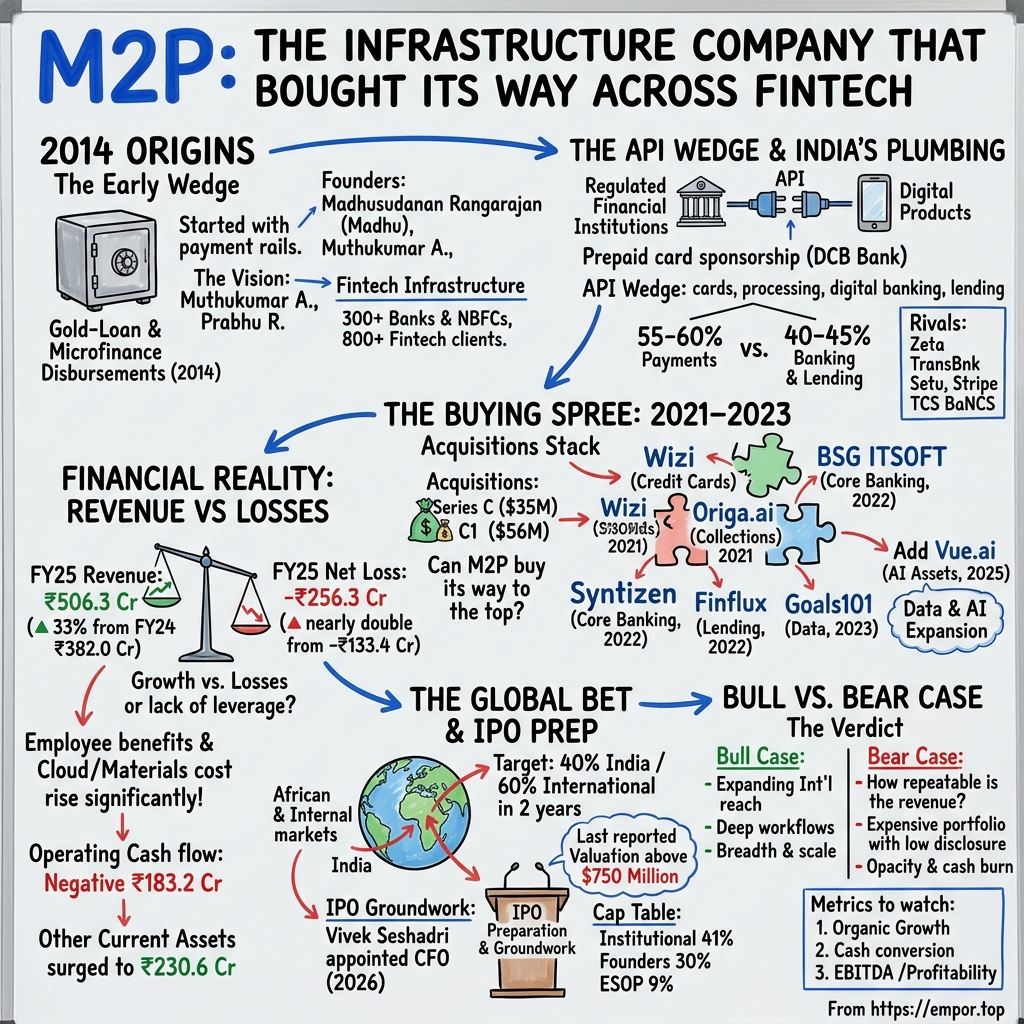
M2P: The Infrastructure Company That Bought Its Way Across Fintech
I. From Gold-Loan Payments to a $750 Million Question
In 2015, a gold-loan customer in South India would walk into a branch, hand over a necklace or a pair of bangles, and walk out with cash. Gold-loan lenders had always worked this way, and it was expensive. Cash had to be counted, guarded, moved and reconciled, and every rupee handed over the counter was a rupee the lender could not easily trace once it left the building. That year a small Chennai company called M2P Solutions offered lenders including Muthoot and IIFL another route: disburse the loan digitally, onto a card or into an account, and let software do what the cash drawer used to do.[^1] It was a narrow problem with an unglamorous customer. It was also the first time M2P sat in the middle of a financial transaction and made money from making it work.
M2P Solutions Private Limited was incorporated on 14 November 2014.[^1] Twelve years later, almost to the day, it presents itself as something much larger than a disbursement tool. It says it serves hundreds of banks and lenders and more than 800 fintech businesses across more than 30 markets.1 In September 2024 it raised ₹850 crore in a round led by Helios Investment Partners at a valuation the company put above ₹6,550 crore, a little under $800 million at the time.12 In April 2026 it hired a group chief financial officer with an explicit brief to prepare the company for public markets.3 What began as plumbing for gold-loan lenders has become a bid to be the plumbing for a large share of emerging-market finance.
The stakes of that ambition can be put in one question. When a company connects banks to the products their customers use, does it become essential infrastructure that customers cannot remove without pain, or does it stay a collection of projects, products and acquired platforms that customers can swap out when a cheaper or better vendor arrives? Infrastructure in the first sense earns durable, rising margins because the cost of leaving is high. Infrastructure in the second sense is a services business with an API on the front, and it trades accordingly. Everything else in M2P's story, from the acquisitions to the losses to the IPO preparations, comes back to which of those two businesses it really is.
The company was built by three founders. Madhusudanan Rangarajan, known universally as Madhu, is the chief executive and the public voice of the business. Muthukumar Ayyakkannu and Prabhu Rangarajan co-founded it with him, and all three sit on its board.4 They are not celebrities in the way some Bengaluru founders are; the company's reputation was built in Chennai, among bank technology teams and lending operations managers, rather than among consumers. That matters for how the story should be read. A business-to-business infrastructure company is judged by whether the institutions it serves keep paying it, and the founders' track record has to be measured in contracts and margins rather than in brand recognition.
Four questions run through the account that follows. First, can M2P's growth become operating leverage, meaning that each additional rupee of revenue costs less to earn than the one before? Second, how much of its revenue repeats, through licences, contracted fees and transaction volumes that recur month after month, and how much depends on one-off implementations or pass-through flows? Third, did a burst of acquisitions between 2021 and 2023 build a coherent platform, or a portfolio of products that share a logo but not a technology or a customer base? Fourth, and most specific to a company that has not yet listed, what can an outside investor actually see, and what remains hidden behind private-company disclosure?
The early record gives reasons for both optimism and caution. Revenue rose from about ₹42 crore in FY21 to about ₹506 crore in FY25, a scale-up few Indian software businesses manage in four years.5 But FY25 also brought a net loss of about ₹256 crore, nearly double the previous year's, and the reported revenue line fell in FY24 before recovering.5 A business that serves 800 fintechs and hundreds of banks, and loses about half a rupee for every rupee it books, is not yet showing pricing power. Customer counts measure reach. Private valuations measure what a particular investor paid on a particular day for a particular security. Neither establishes the economics a public shareholder would buy.
The first tension in the story arrived early. Once lenders were using M2P to move money, they wanted more than payments. They wanted cards, then lending software, then onboarding and identity checks, then core banking systems that keep the ledger itself. M2P had to decide whether to build each of those layers from scratch, slowly, or buy companies that already had them. It chose to do both, and the choice defines the company that is now preparing to ask public investors for their money.
 Subscribe on LinkedIn
II. The API Wedge Meets India’s Financial Plumbing
The second scene in M2P's timeline is less dramatic than a gold loan but more important. In 2015 the company launched its first prepaid-card programme under a bank identification number sponsored by DCB Bank.[^1] For a listener outside payments, the mechanics deserve a sentence. Every card in the world carries a number whose first digits identify the bank that issued it and stands behind it. A startup cannot issue cards on its own; it needs a licensed bank to sponsor the programme, lend its regulatory standing and settle the money. What the startup can do is build everything around that licence: the software that creates the card, loads it with money, authorises each swipe, checks the customer's identity, flags fraud and reconciles the books at the end of the day.
That division of labour is M2P's business in miniature. A lender that wants to issue a card, move funds to a borrower, verify who a customer is and reconcile thousands of transactions faces two bad options on its own. It can ask its core-banking vendor to build the feature, which is usually slow and expensive, or it can assemble its own engineering team, which is slower and more expensive still for a mid-sized NBFC. M2P offered a third option: a set of application programming interfaces, the standardised software connections that let one system ask another to do something, behind which sat card processing, payment rails and compliance workflows already wired into partner banks. The regulated institution stays central, because it holds the licence, the deposits and the regulatory responsibility. M2P supplies the machinery.
The company sometimes describes this as banking-as-a-service, and Madhu has called M2P the world's largest provider of it, a claim that rests on breadth rather than any disclosed market-share measure.1 The more precise description is a layer between licensed institutions and the digital products they want to launch. Fintechs such as card issuers and neo-banks use M2P to reach a bank; banks use M2P to reach products they could not build quickly themselves.
From that wedge, the product map widened in a recognisable sequence. Prepaid cards led to credit-card processing. Disbursement and collection flows led to lending software that manages a loan from origination to repayment. Onboarding needs led to digital identity checks. And at the bottom of the stack sat core banking, the ledger system that records every account and balance. By FY24, according to a Jefferies estimate, payments contributed about 55% to 60% of revenue and banking and lending software contributed about 40% to 45%, with roughly 60% of the business in India and 40% abroad.5 Those are broker estimates, not company segment disclosures, and M2P does not publish revenue by product. The estimate is still useful because it corrects an easy assumption. The acquired businesses in lending and core banking were not equal contributors to the whole; payments remained the larger pool, and the newer layers added breadth around it.
How M2P charges for each layer shapes how durable its revenue is. Jefferies describes a model that combines transaction fees, take rates and platform licensing.5 A transaction fee or take rate rises with volume: if a fintech partner's cardholders spend more, M2P earns more. A licence fee is closer to a subscription. A mix of the two can be attractive, because licences give a floor and usage gives upside. But M2P does not disclose contract lengths, minimum commitments, the share of revenue that recurs, or how much any single customer contributes. Without those, the listener has to judge the revenue model from its behaviour over time, and that behaviour, as later sections show, includes a year in which reported revenue fell.
There is also a subtler issue hidden inside the payments revenue. M2P's largest cost line, which its filings call cost of materials, includes technology and cloud costs and co-branding payments to card partners.6 When a card programme pays a partner a share of interchange or programme fees, the company can book the gross fee as revenue and the partner's share as cost, or it can book only its net share. Which treatment applies depends on contract terms that M2P does not publish. The distinction matters because a rupee of gross card revenue that is mostly passed through to a partner is worth far less than a rupee of software licence revenue, and the two can sit side by side in the same revenue line.
The competitive field is crowded and layered rather than head-to-head. In India, Zeta sells modern card-processing and core-banking software to large banks. TransBnk, OneStack and Setu compete for pieces of the API and transaction-banking layer. Internationally, Stripe has built card issuing and treasury products for fintechs. At the core of a bank, M2P meets incumbent platforms such as Infosys Finacle and TCS BaNCS, which have decades of installed base and the kind of procurement relationships that make a chief technology officer reluctant to switch. None of these rivals publishes revenue on a basis that allows a clean like-for-like comparison, and no credible market-share figures exist for this fragmented field. That leaves the customer counts as the main evidence of reach.
Those counts are worth treating with care. In February 2024, Prabhu described the customer base as more than 300 banks, more than 100 NBFCs and more than 800 fintechs.7 Seven months later, the company's own Series D announcement described it as more than 200 banks, more than 300 lenders and more than 800 fintech engagements.1 The categories shifted between the two descriptions, and "engagements" is a softer word than "clients". Neither version says how many of those institutions generate meaningful revenue, how many are pilots, or how many have left. A count of logos tells the listener how many doors M2P has opened. It says nothing about how many rooms behind those doors it fills, or how often the occupants renew.
The real moat test for an infrastructure company is integration depth. When a bank runs its credit-card programme on M2P's processor, the switching cost is real: migrating millions of cards to a new processor is a multi-quarter project with regulatory risk and customer-service risk. When a fintech uses M2P only as an API gateway to a sponsor bank, the switching cost is lower, because a rival can offer the same bank connection. The measures that would distinguish the two cases are product usage per customer, implementation time, renewal rates, pricing changes at renewal and customers' ability to run two vendors at once. M2P publishes none of them. The integration value is real; whether it amounts to lock-in remains unproven.
What M2P's early years did establish is that APIs made it useful. The harder question was whether it could expand its footprint fast enough by building alone, at a moment when venture capital was suddenly cheap and plentiful.
III. The 2021 Funding Boom Becomes a Buying Spree
For most of its first six years, M2P was a modestly funded company. Its first institutional cheques arrived in 2020: a seed round of about $1.3 million and a $4.5 million Series A led by Beenext.[^1] Then the global fintech boom reached Chennai. A $10 million Series B came in 2021, followed in October 2021 by a $35 million Series C led by Tiger Global and, in January 2022, a $56 million Series C1 from Insight Partners and MUFG.[^1] Within about two years, a company that had raised under $6 million had raised more than $100 million. The money arrived with a clear expectation. Investors in that cycle rewarded breadth and speed, and they were buying the idea of a full-stack financial infrastructure company built for emerging markets.
M2P spent much of that capital on acquisitions. In August 2021 it bought Wizi, a credit-card platform, and Origa.ai, a collections technology business.[^1] In June 2022 it bought three more: BSG ITSOFT, which brought core-banking software; Syntizen, which brought digital identity and onboarding; and Finflux, which brought loan-management software.[^1] In December 2023 it added Goals101, a transaction-intelligence company that uses data and machine learning to help banks understand card spending and design offers.[^1]7 Each deal had an obvious job. Wizi extended card issuing into credit. Origa filled the back end of the lending cycle, where borrowers fall behind and lenders need to recover. BSG ITSOFT gave M2P a ledger, the system of record that every other banking product depends on. Syntizen handled the step at which a new customer proves identity. Finflux ran the loan book. Goals101 turned transaction data into marketing and risk tools.
Laid end to end, the deals sketch a coherent ambition. A bank or lender could, in principle, buy from one vendor everything from onboarding a customer to issuing a card, lending money, collecting repayments and keeping the ledger. That is the strategic logic, and it is the right logic for a company trying to become hard to remove. Each additional product a customer uses adds another integration that would have to be unwound if the customer left.
The difficulty is that strategic logic and commercial proof are different things, and the public record supplies mostly the first. M2P has not published the purchase price for most of these deals. Multiples, a private-company data service, lists Syntizen at about $12 million and Goals101 at about $30 million, but those are third-party estimates rather than company disclosures.8 The company has not published what revenue each acquired business brought with it, how fast those businesses have grown since, how many of their customers overlapped with M2P's, or how much revenue now comes from selling an acquired product to an existing M2P client. Those are the numbers that would show whether a cross-sell engine is working. A list of acquisitions is not that evidence.
There is some indirect evidence about the cost of integration, and it points in a sobering direction. In FY24, the consolidated accounts carried an impairment charge of about ₹11.7 crore, up from about ₹1.5 crore the year before.9 An impairment is an admission, in accounting language, that an asset is worth less than the company paid or recorded for it. M2P does not say which asset was written down, and ₹11.7 crore is small against a balance sheet with about ₹174 crore of intangible assets at March 2025.5 It does not prove that any acquisition failed. It does show that at least part of the carrying value on the balance sheet was not holding up.
Two pieces of later testimony are more telling. In April 2026, Madhu told Mint that the company had spent roughly 18 months consolidating its acquired assets.10 Eighteen months of consolidation, more than two years after the last of the 2022 deals closed, is an admission that buying capabilities and turning them into one product are separate tasks, and that the second took longer than the first. It also helps explain why costs rose so sharply in FY25: unifying technology stacks, migrating clients and retaining acquired engineers costs money before it saves any.
The capital-allocation verdict therefore has to be narrow. M2P used boom-era capital to buy strategic capabilities that, on paper, turn a payments connector into a broader banking stack. The company has not disclosed enough to show whether those purchases earned their cost of capital, and the record does not support the conclusion that it overpaid either. The phrase that fits is unproven integration, not failed roll-up. What would settle it is a disclosure that has not yet appeared: acquired-business revenue and gross profit, client migration progress, the number of customers using two or more product lines, and any further impairments.
The acquisitions changed what M2P could sell. They also changed what it cost to run, and by FY25 the cost of that expansion was showing up plainly in the losses.
IV. Revenue Rebounds; Losses Widen
The FY25 accounts that M2P filed with the Registrar of Companies told two stories at once. Revenue from operations rose about 33%, from about ₹382 crore to about ₹506 crore, recovering from a decline the year before.56 And the net loss nearly doubled, from about ₹133 crore to about ₹256 crore, while the loss before interest, tax, depreciation and amortisation widened to about ₹223 crore.5 Put simply, M2P spent roughly ₹1.55 for every rupee of revenue it earned in FY25, up from about ₹1.38 a year earlier.69 Growth had returned, but costs had grown faster.
Before interpreting that, the revenue figures need a warning label. Publicly reported numbers for M2P vary by source and by legal entity. The Jefferies consolidated series puts FY24 revenue at about ₹382 crore. Mint's April 2026 coverage cites a figure of about ₹487 crore. The FY25 standalone accounts of the parent company, M2P Solutions alone, differ again.510 A group with subsidiaries in several countries and several acquired businesses can report quite different totals depending on which entities are consolidated, how intercompany sales are eliminated and when an acquisition enters the group. Those numbers should not be blended into a single growth rate. The comparison here uses one consistent consolidated series throughout.
On that basis, the shape of M2P's revenue history is striking. Revenue rose from about ₹42 crore in FY21 to about ₹194 crore in FY22 and about ₹441 crore in FY23, then fell about 13% to ₹382 crore in FY24 before rebounding to ₹506 crore in FY25.5 The four-year compound growth rate is about 87%, which sounds like a rocket. But acquisitions inflated the early years, the base was tiny, and the one year of contraction is a reminder that a high historic compound rate is not a mature growth rate. FY25's 33% was a recovery, not a continuation of the trend.
The year revenue fell and the business got better
The more revealing puzzle is what actually happened in FY24. A revenue decline usually signals a weaker business. M2P's FY24 looks different once costs are put beside revenue. In FY23, the cost of materials, the line that carries technology, cloud and co-branding costs, was about ₹365 crore on revenue of about ₹441 crore. In FY24 it fell to about ₹156 crore to ₹160 crore on revenue of ₹382 crore.95 Subtract one from the other and a rough measure of gross profit, what the company kept after its most direct costs, rose from about ₹75 crore in FY23 to about ₹225 crore in FY24. The company lost about ₹59 crore of revenue and gained roughly ₹150 crore of gross profit.
The most likely explanation, though M2P has not spelled it out, is that FY23's revenue included a large volume of low-margin flows, the sort of gross card or programme revenue that is largely passed on to partners, and that this flow shrank or was restructured in FY24. That reading is consistent with the EBITDA loss narrowing in FY24, from about ₹109 crore to about ₹88 crore, even as revenue fell.9 It also carries a warning for anyone valuing the company on a revenue multiple. If a large part of a year's revenue can disappear without hurting gross profit, then revenue is the wrong yardstick and gross profit is closer to the right one.
Apply the same lens to FY25 and the rebound looks less comforting. Revenue rose by about ₹124 crore, but the cost of materials roughly doubled, from about ₹160 crore to about ₹325 crore.56 The rough gross-profit measure fell from about ₹222 crore to about ₹181 crore. In other words, FY25 added revenue that cost more to deliver than it brought in at the gross level, and the proxy gross margin dropped from close to 58% to about 36%. M2P has not disclosed how much of the FY25 increase came from cloud and infrastructure, how much from co-branding payments and how much from product costs tied to new markets, so the precise driver cannot be isolated. But the direction is clear: FY25's growth was lower-quality revenue than the headline suggests.
Below the gross line, employee costs rose about 24%, from about ₹251 crore to about ₹311 crore, including about ₹40 crore of non-cash share-based payments.56 That is a slower rise than revenue, which on its own would be a mild sign of leverage. Combined with the collapse in gross margin, it was not enough. Total costs rose about 49% to roughly ₹786 crore.6
Management's explanation and the clock it started
M2P's management does not dispute the losses. Its explanation is that they were deliberate. In April 2026, Madhu told Mint that the company had accelerated spending on people, infrastructure and local presence in new markets, that its last two quarters had been profitable, and that he expected FY27 to start profitably.10 That is a coherent story: invest ahead of revenue in international offices, compliance and cloud capacity, then harvest the operating leverage as those markets mature.
The difficulty is that M2P has made profitability claims before, and the annual accounts did not bear them out. In February 2024, Prabhu told the Press Trust of India that M2P had achieved break-even in 2023.7 The FY24 accounts, covering April 2023 to March 2024, showed a net loss of about ₹133 crore and an EBITDA loss of about ₹88 crore.9 It is possible that the break-even claim referred to a narrower measure, a single quarter, or a particular part of the business; the interview did not define it. But the episode narrows how much weight the 2026 claim can bear. A claim of profitable quarters, without a stated definition, audited support or a reconciliation to annual results, is a promise to show the bridge, not proof of a turnaround.
A little arithmetic shows how far the business has to travel. Strip out the cost of materials, and M2P's FY25 cost base, covering people, offices, depreciation and everything else, came to roughly ₹460 crore.6 At FY25's proxy gross margin of about 36%, the company would need revenue of nearly ₹1,300 crore just to cover that base, about two and a half times what it booked, and that assumes the cost base stops growing. If gross margin recovered to FY24's level of close to 58%, the break-even revenue would fall to roughly ₹800 crore, within reach of a few years of healthy growth. The path to profitability therefore runs less through headline revenue than through gross margin. Whether M2P can return to FY24's mix, keep its people costs roughly flat and still grow is the single most important operating question in the business, and it is one only the next audited accounts can answer.
Headcount offers a partial cross-check. Provident-fund records show about 1,064 employees at M2P Solutions in May 2026, though that figure covers only the Indian parent, not overseas subsidiaries or acquired entities.4 Set against employee costs of about ₹311 crore for the group in FY25, the number hints that a meaningful part of the payroll sits outside the parent company, in the international and acquired businesses. That is consistent with management's account of building local presence abroad, and it is also a reminder that the costs of expansion are spread across entities whose individual accounts are hard to see.
What would make the "investment phase" explanation testable is an audited consolidated bridge that separates organic growth from acquired growth, shows gross margin by product or region, identifies one-off integration and market-entry costs, and reports profit by geography. Until that exists, a widening loss can be explained as investment or as structural, and outside investors have no way to tell which. The cash-flow statement, though, offers a few clues of its own.
V. The Cash Question Hides in Other Current Assets
A loss-making company eventually lives or dies by cash rather than by accounting profit, and M2P's cash record has one puzzling feature. Across FY21 to FY25, the group reported cumulative net losses of about ₹571 crore, but cumulative operating cash outflow of only about ₹203 crore.5 The business burned far less cash running itself than its income statements implied. For a period, that was reassuring. Then, in FY25, operating cash outflow jumped to about ₹183 crore in a single year, close to the total of the previous four years combined.5
The historical gap has a partly innocent explanation. Over those five years, M2P recorded about ₹107 crore of share-based payment expense and about ₹114 crore of depreciation and amortisation.5 Both reduce accounting profit without requiring cash to leave the bank in that period. Share-based payments are paid in stock, not money, though they cost existing shareholders through dilution. Depreciation and amortisation spread the cost of assets already paid for, including the intangible assets created by acquisitions, across later years. Together those non-cash charges account for roughly ₹221 crore of the ₹368 crore difference between losses and operating cash burn. The rest came from working capital and other items that M2P does not break out in the publicly available summary.
FY25 is where the puzzle sharpens. Trade receivables, the money customers owed M2P, fell from about ₹201 crore to about ₹148 crore, even as revenue rose.5 On its own that is a healthy sign; it suggests customers were paying faster or that a backlog of billing had been collected. Trade payables, the money M2P owed its own suppliers, nearly doubled from about ₹57 crore to about ₹108 crore, which also helps cash in the short term.5 Both movements should have cushioned the cash outflow. Yet operating cash flow was sharply negative.
The candidate explanation sits in a line that rarely makes headlines: other current assets. That balance rose from about ₹38 crore to about ₹231 crore in FY25.5 An increase of nearly ₹193 crore in a single year is larger than the entire operating cash outflow. What it contains matters enormously, and M2P has not published the breakdown. Other current assets can include advances to suppliers, prepaid expenses, tax credits awaiting refund, security deposits, unbilled revenue and, in payments businesses, balances connected to settlement or programme funds. Some of those are timing differences that reverse. Some, such as unbilled revenue, are earnings booked before an invoice is sent and before the customer has agreed to pay. Some may be money held on behalf of partners. Each has a very different implication for the quality of FY25's revenue and the true rate of cash burn.
The question of debtor quality stays open for the same reason. M2P does not publish an ageing schedule for receivables, an unbilled-revenue schedule, its provisions for doubtful debts or any customer-level overdue balances. The rise in receivables from about ₹81 crore in FY23 to about ₹201 crore in FY24, in a year when revenue fell, deserves an explanation that the public record does not provide.5 The FY25 fall is encouraging, but without knowing whether some of those balances moved into other current assets as contract assets, it cannot be read as a clean improvement.
The balance sheet at March 2025 looked comfortable on a snapshot basis. The group held about ₹172 crore in cash and equivalents and about ₹223 crore in other bank balances, roughly ₹395 crore in total, against borrowings of about ₹53 crore.5 That reflects the Series D primary capital raised in late 2024. But a snapshot is not a runway. If FY26 burned cash at anything like FY25's rate, the cushion would have shrunk by roughly half within a year. In June 2025 M2P raised about ₹30 crore more in equity, led by Avatar Growth Capital, and in August 2026 it took on about ₹100 crore of debt financing from Alteria Capital, a venture-debt lender.54 A company comfortable in its cash position does not usually need venture debt eighteen months after a large equity round. Venture debt is not a red flag in itself, since many growth companies use it to extend runway cheaply, but it is a signal that cash needs remained live through 2026. M2P has not disclosed the facility's interest rate, maturity, security or covenants, and those terms will matter in any public offering.
The company has also issued small amounts of unlisted debt: a debenture-trustee report lists two M2P Solutions debt securities with issue sizes of ₹3 crore and ₹5 crore.11 Their size is immaterial, but they confirm that M2P has used several sources of financing beyond equity, and no public credit rating for the company exists to give an independent view of that debt.
The evidence that would settle the cash question is specific. It is the FY25 consolidated cash-flow statement with its working-capital reconciliation, the note that breaks down other current assets, and the borrowing and lease schedules, followed by FY26 accounts that show whether cash conversion improved as management says profitability did. Until those are published in a form outside investors can read, the cash burn should be judged by the FY25 figure, not by the more forgiving five-year average.
With the balance-sheet explanation incomplete, attention turns to the company's newest bet, which combined a purchase with a promise about where the platform goes next.
VI. An AI Asset Purchase Tests the Platform Thesis
In March 2025, reports surfaced that M2P had agreed to buy the business of Mad Street Den, a Chennai-founded artificial-intelligence company best known for its Vue.ai platform.1213 The structure was unusual. Because Mad Street Den was domiciled outside India, the deal was reported as an asset purchase rather than a takeover of the company: M2P would take over its intellectual property, customer contracts and employees, rather than its corporate shell.12 Moneycontrol reported a cash-and-stock deal valued at about $10 million to $15 million, with the proceeds going largely to cover staff costs and liabilities.12 Entrackr's sources described it as a distress sale.13 M2P's own timeline records the acquisition in June 2025.[^1]
The word distress is worth pausing on, because it shapes how the deal should be read. Mad Street Den had raised more than $50 million from venture investors, including a $30 million round in January 2023 from Alpha Wave and Peak XV.13 Two years later its business changed hands for perhaps a quarter of that, with much of the consideration absorbed by obligations to employees and creditors. For M2P, that could be shrewd buying: a team of machine-learning engineers and a working product at a fraction of the cost of building them. For the listener, it is also a reminder of how quickly AI software valuations can collapse when revenue does not follow the technology, which is exactly the test M2P's own AI ambitions now face.
Benchmarking the price against software acquisition multiples would be tempting and misleading. A $10 million to $15 million price means little without knowing the revenue Vue.ai brought with it, its gross margin, how many customers stayed after the transfer, what liabilities M2P assumed, and how the price split between cash and M2P stock. M2P has disclosed none of those. If the consideration included M2P shares, it also diluted existing shareholders at whatever internal value M2P placed on its own stock. FY25's share-based payment expense rose to about ₹40 crore, but the accounts do not identify recipients, so it is impossible to say whether any of it relates to retaining Mad Street Den's employees.5
The strategic fit is plausible. Banks and lenders want to personalise offers, automate document checks, score credit and detect fraud, all tasks where machine-learning tools help. Vue.ai's capabilities in data handling and automation could, in principle, sit across M2P's card, lending and core-banking products. The Series D announcement listed enhancing the technology stack with AI and data capabilities as one of the uses of the new capital.1 Goals101, bought in December 2023, already brought transaction intelligence into the group.[^1] Put together, the two deals suggest M2P wants an intelligence layer on top of its plumbing, which is where software margins tend to be richest.
But capability is not commercialisation, and the company's own history argues for caution. The 2021 to 2023 acquisitions widened the stack, yet M2P has not quantified their commercial conversion, and Madhu's own account of an 18-month consolidation period describes work on integration rather than results from it.10 An AI product layered onto a platform that is still being unified faces the same test, only harder: banks are cautious buyers of AI tools that touch credit and compliance decisions, and pilots in this field often take a long time to become contracted revenue. Mad Street Den's own history, of a well-funded AI business whose value fell faster than its technology improved, is the most direct evidence available about how this category converts.
So the conclusion is that the Vue.ai purchase is a strategically sensible option, not evidence of an AI growth business. The proof will come in measures M2P does not yet report: the number of financial-institution customers using AI products, attach rates against the existing client base, revenue from those products, and any measurable cost savings in M2P's own operations. Technical capability alone will not settle it.
The integration work, old and new, now meets a more public test. M2P has begun building the finance function a listed company needs, and that brings a different kind of scrutiny.
VII. IPO Groundwork Raises the Disclosure Bar
On 22 April 2026, M2P announced that Vivek Seshadri, previously chief financial officer of Hitachi Payment Services, would join as group CFO.314 The remit was broad: finance, investor relations, capital strategy and mergers and acquisitions across the group.14 The appointment came with an unusually frank framing. Madhu told Mint that a public listing was the likely path for the company, but that it was at least a couple of years away.10 The hire, in other words, was not the start of an IPO timetable. It was the start of building the systems an IPO would demand.
The background matters for what Seshadri inherits. Hitachi Payment Services runs ATMs, card acceptance and payment processing for Indian banks, a business that lives on thin margins, large volumes and exacting reconciliation. That is a relevant apprenticeship for a company whose cost of materials doubled in a year and whose other current assets ballooned without public explanation. The question is whether the new finance function brings sharper capital discipline as well as better reporting, because both will be tested at once. Public investors will want consolidated accounts that reconcile cleanly across years, and they will want evidence that the next acquisition or market entry is judged against a return threshold rather than a product map.
Who owns the company, and what the owners actually hold
Ownership is the first thing a prospective public investor asks about, and the answer is only partly visible. Jefferies gives a single snapshot of the capitalisation table: institutional funds hold about 41%, the founders about 30%, an employee stock-option pool about 9%, and angels and individuals the rest.5 Founder ownership at that level is meaningful. It suggests the three co-founders still have a large personal stake in long-term value, and it means they would remain influential shareholders after a listing even with further dilution.
But a single snapshot is not a cap table. M2P has not published a fully diluted share count, the terms of its investors' preference shares, vesting schedules for the option pool, or any executive's individual awards. Those gaps matter more than they might seem. Venture investors in India typically hold compulsorily convertible preference shares that carry rights common shareholders do not: liquidation preferences that return their money first in a sale, anti-dilution protection if a later round is priced lower, and sometimes board seats or veto rights over major decisions. Whether M2P's investors hold any of these, and on what terms, has not been disclosed. The FY25 accounts show issued equity capital jumping from about ₹1.2 crore to about ₹541 crore, a change that may reflect conversion of preference shares or another restructuring, but M2P has not published the explanation.5 Before a listing, such instruments usually convert into ordinary shares, and the conversion terms decide how much of the company each holder ends up with.
The funding history also needs to be read instrument by instrument. The September 2024 Series D was announced as ₹850 crore, or about $100 million, but about $70 million of it was primary capital paid into the company and roughly $30 million was secondary, meaning existing shareholders sold stock to new ones.2 Secondary proceeds went to the sellers, not to M2P's bank account. The round was also described as a "first close", and the headline valuation of over ₹6,550 crore was the company's own characterisation.1 Multiples records the valuation as $701 million and Inc42 converted it at about $751 million; the differences reflect exchange rates and whether the figure is read from primary or secondary pricing.89 Earlier reporting had described talks for a raise at up to $900 million.15 Against the roughly $650 million post-money reported for the Series C1 in early 2022, the Series D was an up round, but only modestly so for a company whose revenue had more than doubled over the same period.15 The market, in effect, paid a lower multiple of revenue in 2024 than it had in 2022.
Dilution through employee equity is the other half of the capital picture. The option pool of about 9% is a meaningful slice of the company, and share-based payment expense of about ₹40 crore in FY25 equalled roughly 8% of revenue.5 Employee stock is a sensible way for a cash-hungry company to pay engineers, and it aligns staff with long-term value. But it is a real cost to shareholders even though no cash leaves the bank, which is why any adjusted profit measure that excludes it flatters the business. When M2P presents profitability in a prospectus, the version that counts will be the one that charges stock compensation as the expense it is.
A further small round in June 2025, of about ₹30 crore led by Avatar Growth Capital, was reported by Jefferies alongside a valuation of about ₹6,600 crore.5 A ₹30 crore cheque is a small transaction to extrapolate across a whole company, and it should be read as confirmation that one investor was willing to buy at roughly the 2024 price, not as a new market test.
Behaviour over time, and what the record cannot show
Judged by behaviour rather than words, management's record has a clear through-line and a significant miss. The through-line is strategic consistency: from 2015 onwards M2P has kept building financial infrastructure, from payments into cards, lending, identity and core banking, and from India into international markets. The founders did not chase consumer lending or a flashy app. The miss is cost leverage. Costs rose much faster than revenue in FY25, after an earlier claim of break-even that the annual accounts did not reflect.79 Madhu's candour about the 18-month consolidation and accelerated spending is to his credit; it is more useful to investors than a claim that everything went to plan. But his statements that recent quarters were profitable and that FY27 would begin profitably now form the clearest test of guidance discipline the company has set itself.10
A private company is not obliged to publish much of what a public investor would want, and M2P publishes little beyond what the law requires of it. Related-party transactions with founders, investors or affiliates, senior management pay, customer concentration, receivables ageing, the auditor's annexures, debt covenants and a full dilution schedule are not visible in its public disclosures. M2P is the parent of a group that includes Conflux Technologies, BSG Itsoft, Syntizen Technologies, Livquik Technology and FF Payments Tech, among others, so intercompany flows matter to understanding where profit and cash really sit.4 One court case appears in company-registry data, filed by M2P itself, but its subject is not public.4 None of these gaps is evidence of a problem. All of them are diligence items that an offer document would have to answer.
As of mid-November 2026, no such document exists in public. M2P does not appear in SEBI's list of draft offer documents under processing, nor among the National Stock Exchange's public offer documents.1617 Those lists do not reveal whether a confidential pre-filing is under way, a route SEBI permits, but every public account of the company describes preparation rather than a filed prospectus.3 When a draft red herring prospectus does appear, it will turn the questions above into specific, auditable answers: the split between fresh issue and offer for sale, who receives the money, how the proceeds will be used, the lock-ups on existing holders and the formal risk factors.
Seshadri's brief includes capital strategy and M&A. The test for the new finance function is whether it changes how M2P chooses its next markets and products, because the company's most ambitious bet, the one it is spending most heavily on, lies outside India.
VIII. The Global Bet Meets a Fragmented Competitive Map
M2P's international story did not begin with its recent push. In 2020, the company launched in the Middle East and North Africa, with a regional headquarters in Abu Dhabi.[^1] By February 2024 it described a direct presence in 27 markets; by September 2024, more than 30.71 The lead investor in the 2024 round, Helios Investment Partners, is a private-equity firm focused on Africa, and the company said a share of the new capital would go to building its international franchise, particularly in Africa, alongside Southeast Asia and the Middle East.1 In April 2026, Madhu told Mint that international markets were close to 40% of FY26 revenue and that he wanted the mix to shift to 40% India and 60% international within about two years.10
The 40% figure is not new. Jefferies estimated a 60:40 India-to-international split for FY24, and Multiples cited international revenue at 40% of the total at the time of the Series D.58 So international business is already material, not a speculative side project. But the share appears to have held roughly steady for about two years, which means the overseas business has grown roughly in line with India rather than faster. The goal of reaching 60% within two years is an ambition, and achieving it would require international revenue to grow much faster than the domestic business, or the domestic business to stall.
A detail in the FY25 filings adds a wrinkle. Reported export-service income was only about ₹5.7 crore.6 That does not contradict the 40% figure, because international revenue earned by overseas subsidiaries is booked in those subsidiaries, not as exports from India. It does mean that the international revenue sits in entities whose individual accounts are not readily available, so the margin on that business, the currencies it is earned in and the capital tied up in it cannot be seen from outside.
Why the market is real, and why winning it is expensive
The opportunity is genuine. Banks, lenders and fintechs across Africa, the Gulf and Southeast Asia face the same problem Indian lenders faced in 2015: they want to issue cards, digitise lending and launch digital accounts, but their core systems are old and local vendors are thin. An India-built stack, refined at Indian price points and Indian transaction volumes, can be cheaper than European or American alternatives. That is a credible reason a mid-sized Kenyan or Emirati bank might choose M2P.
Still, the addressable market should be read with restraint. The broad category, every bank and lender in emerging markets that might one day modernise its cards, lending or core systems, is enormous and largely meaningless for valuation. The reachable market at M2P's present scale is much smaller: mid-sized banks, NBFCs and fintechs in the countries where it already has teams, partner banks and regulatory approvals, buying the specific products it can implement today, at prices that leave room for a margin after local costs. Large tier-one banks, which spend the most, are also the buyers most likely to stay with incumbents or build in-house. Every extra point of share M2P wins in that reachable market will come from a named rival that will respond on price, on bundling or by hiring away implementation teams.
The competition, however, changes with each layer and each country. In fintech infrastructure, M2P meets Indian peers such as Zeta, TransBnk, OneStack and Setu, some of which also sell abroad. In payments and card issuing, Stripe is a global presence with a far larger balance sheet and brand. In core banking, Infosys Finacle and TCS BaNCS have decades of installed base across exactly the emerging markets M2P is targeting. None of these is a direct equal across the whole stack, and reliable market shares or comparative revenues by region are not available. The more useful exercise is to ask how the economics of competition work.
Porter's five forces point to strong buyer power. Banks are sophisticated purchasers with procurement teams, long evaluation cycles and established alternatives, and they can split work across vendors. The threat of substitutes is real, because large banks can build in-house or ask their core-banking vendor to extend its product. Rivalry is intense in a fragmented field. Supplier power is moderate: sponsor banks and card networks are essential partners, and co-branding payments to partners already sit among M2P's largest costs.6 Barriers to entry are mixed. Regulation and integration create friction for newcomers, but they do not by themselves lock in customers.
Hamilton Helmer's 7 Powers framework asks which, if any, durable advantages M2P might hold. Switching costs are the clearest candidate: once a bank's card portfolio or loan book runs on M2P's systems, migrating away is costly and risky. But that power has to be evidenced in retention data, and M2P publishes none. Scale economies could emerge if a single multi-tenant platform serves many banks at falling marginal cost, but FY25's falling gross margin points the other way. Network effects, brand, process power and cornered resources have little direct evidence. At present, the powers are hypotheses.
The cost mechanism behind international growth explains much of the FY25 losses. Entering a new country means hiring local sales and implementation teams, satisfying local regulators and data-residency rules, sometimes obtaining licences, and running pilots before the first contract pays. Management itself said this spending ran ahead of revenue.10 That pattern depresses margins for several years. It creates value only if each new-market cohort of customers matures into recurring, profitable business. Currency and regulatory exposure add complexity; M2P does not disclose its exposure by currency, its hedging policy or its profitability by country.
The proof the international thesis needs is a set of regional disclosures: revenue growth and gross margin by geography, renewal and retention rates, implementation costs, customer concentration in each region and cash conversion. If the overseas share rises while margins recover, the expansion thesis strengthens. If growth requires continued acquisitions and heavy local spending without visible retention or margin improvement, it weakens. Put together with the valuation, the evidence so far frames the core debate.
IX. Frameworks and Bull vs. Bear Case
Place two numbers side by side. In September 2024, investors valued M2P at more than ₹6,550 crore.1 In FY25, the year that followed, the company earned about ₹506 crore in revenue and lost about ₹256 crore.5 On revenue, the private mark was about 13 times. Multiples, on its own basis, computes 13.0 times, using $701 million against $54 million of revenue.8 Against the rough gross-profit measure of about ₹181 crore, the multiple was about 36 times. A growing platform with uncertain unit economics was priced as if its economics were already settled.
What the private mark assumes
Price is not value, and the private mark is a price. It was set in a round that was partly secondary, for securities that may carry protections public shares will not, by an investor with a strategic interest in Africa that a public shareholder may not share.21 Those features can justify paying more for a private preference share than a public investor would pay for an ordinary share. So the first step is to ask what the business might be worth on its operating evidence alone.
Building an enterprise value starts with the balance sheet. At March 2025 M2P held about ₹395 crore of cash and bank balances against about ₹53 crore of borrowings, a net cash position of roughly ₹340 crore.5 Subtracting that from the ₹6,550 crore equity value gives an enterprise value in the region of ₹6,200 crore, or roughly 12 times FY25 revenue. That bridge is approximate. The equity value and the balance sheet are six months apart, lease liabilities are not separately disclosed, the cash may include restricted balances, and the August 2026 venture debt changes the picture again. Enterprise value cannot be calculated precisely from what M2P publishes.
Listed comparisons put that multiple in perspective. Multiples' own peer set shows Alfa Financial Software, a British lending-software vendor, at about 3.9 times enterprise value to revenue, IRESS, an Australian financial-software company, at about 2.2 times, and Intellect Design Arena, the Indian banking-software maker that is perhaps the closest listed operating peer by geography and customer type, at about 1.9 times.8 Those businesses are profitable, slower-growing and differently mixed, which is why they trade lower. They are context rather than a direct answer, and excluding high-multiple outliers such as asset-management service platforms is deliberate, because their recurring, regulated fee streams are not comparable to M2P's mix of transaction fees and implementation work. The gap remains striking. To justify a multiple four to six times that of its closest listed peers, M2P must grow far faster for far longer and reach comparable or better margins.
A simple scenario framework shows what that means. Assume a 14% annual cost of capital, a level that reflects an Indian, loss-making, private technology business; a 25% tax rate once profitable; and value measured six years out, at FY31, then discounted back. In a bear case, revenue grows about 15% a year to roughly ₹1,170 crore by FY31, operating margins reach only about 10%, and the market pays about 18 times earnings; today's value would be somewhere around ₹800 crore. In a base case, revenue grows about 25% a year to roughly ₹1,930 crore, operating margins reach about 18%, and the market pays about 25 times earnings; today's value comes out at about ₹3,400 crore, before further dilution from the option pool and any new capital. In a bull case, revenue grows about 35% a year to roughly ₹3,060 crore, margins reach about 22%, and the market pays about 28 times earnings; today's value is about ₹7,300 crore. These are illustrative ranges, not estimates of a price, and they are highly sensitive: each percentage point of terminal margin moves the base case by several hundred crore, and a lower cost of capital lifts every scenario.
The reveal is that the 2024 private mark sits close to the bull case. It embeds, roughly, six years of growth above 30% a year, a gross margin that recovers well above FY25's level, operating margins above 20%, and no major setback in retention or competition. It also assumes that revenue is the right base. If a meaningful share of M2P's revenue is low-margin pass-through, as the FY23 and FY25 cost patterns suggest, then every revenue-based scenario overstates value, and the multiples should be read off gross profit instead.
A future IPO could still price above or below any such range. Scarcity of listed Indian fintech-infrastructure names, strong demand in India's primary market, a small free float and the narrative appeal of a global banking-software company could all push a price higher. A weak tape for recent fintech listings, or a filing that reveals customer concentration or poor cash conversion, could push it lower. None of those forces change what the business is worth; they change what someone pays for it on a given day.
The two cases, side by side
The bull case is coherent. M2P began with real payment use cases, earned its place inside regulated institutions, and expanded into adjacent workflows where switching costs are naturally higher. It serves a broad, reported customer base across many markets, has institutional backing, and has a management team that has stayed consistent in strategy for over a decade. If more products per customer deepen integrations, revenue per relationship could rise without proportionate cost, and the international business, already about 40% of revenue, gives it a larger addressable market than most Indian peers. Management says the profitability turn has already begun.10
The bear case currently has more disclosed evidence behind it. M2P publishes no retention rate, recurring-revenue share, customer concentration or margin by product, so the claim that breadth is becoming durable economics cannot be tested. FY25 losses widened sharply, the proxy gross margin fell, and operating cash outflow jumped to about ₹183 crore.5 The 2023 break-even claim did not appear in annual results.79 The acquisitions have not been shown to produce cross-sell, management describes an 18-month consolidation, and the AI purchase came out of another company's distress. The company has needed fresh equity and venture debt since the Series D, and the private valuation is priced near the bull case.
A skeptical public-market investor would want straightforward answers. What percentage of FY25 revenue was organic and recurring? What did each acquisition add in revenue and gross profit? What makes up the ₹231 crore of other current assets? Which customers can, and do, run a second vendor alongside M2P? And what audited evidence supports the claim of profitable quarters? None of these questions is hostile. Each is something a prospectus should answer, and each answer would move the valuation range.
Three measures would most directly confirm or falsify the case. The first is organic revenue growth by product and geography, which separates real demand from acquired and pass-through revenue. The second is operating cash flow, reconciled to working capital and other current assets, which shows whether reported profits, when they come, turn into cash. The third is EBITDA and net profit against revenue growth, with acquired-product contributions identified, which shows whether operating leverage is real. The case improves if M2P shows renewal-led growth, profitable international cohorts and acquisition cross-sell. It deteriorates if costs keep outrunning revenue, customer economics remain opaque, or the profitability timetable slips without a quantified recovery plan.
X. Business & Investing Lessons
Go back to that gold-loan branch in 2015. The cash drawer was a problem the lender could feel every day, and M2P was paid because it removed a cost and a risk that showed up on a balance sheet.[^1] A decade later, the company sells a product map that runs from identity checks to core banking. The distance between those two pictures holds most of the lessons M2P has to offer.
The first lesson is that a workflow wedge can travel. M2P did not begin by selling a platform; it began by solving one specific money movement for one unglamorous type of lender, then used that position inside the transaction to sell the software around it. Start where money has to move, then earn the right to own the software around it. The digital gold-loan disbursement and the first DCB Bank card programme were not side stories. They were the reason banks let M2P inside their systems at all, and every later product depended on that access.
The second lesson is that a platform is measured in use, not logos. M2P's customer counts changed categories between interviews and press releases, from 300 banks and 100 NBFCs in early 2024 to 200 banks and 300 lenders later that year, and none of the versions said how many of those institutions paid meaningfully or renewed.71 A customer count is reach; renewal and revenue per customer are the relationship. For founders, that means the metric worth publishing is the one a rival cannot copy by signing pilots. For investors, it means treating any count without a retention figure attached as a marketing statistic.
The third lesson is that acquisitions buy time, not integration. Between 2021 and 2023 M2P bought six businesses to fill the gaps in its stack, and in 2026 its chief executive described a year and a half spent consolidating them.[^1]10 The deal closes on signing day; the return arrives when customers use the combined product. The lesson for companies tempted to buy their way across a market is that each acquisition starts a second, longer project, and the capital raised for the purchase rarely covers the cost of the integration.
The fourth lesson is that growth investment needs a clock. FY25's losses were explained as deliberate spending on people, infrastructure and new markets, and the explanation may be right.10 But the same company had described itself as break-even in 2023, and the annual accounts disagreed.79 A planned loss is still a promise to show the bridge. The investors who backed M2P in 2024 bought that promise. Public investors will want to see the bridge drawn in audited numbers before they buy it at a similar price.
The fifth lesson belongs to every company on the road from private to public. M2P's most important numbers, such as the breakdown of other current assets, the terms of its preference shares, its related-party flows and its debt covenants, sit in documents an outsider cannot read. Before the IPO, the notes are part of the product. A company that wants a public-market multiple must sell its disclosure as carefully as it sells its software, because the market prices what it cannot see as risk.
XI. Epilogue
Tonight, M2P stands between two versions of itself. One is a twelve-year-old infrastructure company that has scaled revenue roughly twelvefold in four years, operates in more than 30 markets, holds a reported private valuation near $800 million and has just appointed a CFO to prepare it for public life.513 The other is a company whose last audited year showed revenue growing more slowly than costs, a gross margin in decline, a sharp rise in cash burn, an unexplained surge in other current assets, and a profitability claim not yet visible in its annual accounts.56 Both versions are true. The next eighteen months will decide which becomes the headline.
The first decisive moment is the filing of the FY26 consolidated accounts with the Registrar of Companies, which covered April 2025 to March 2026, the period in which management says the business turned profitable in its final quarters.10 If those accounts show a narrowing loss, a recovering gross margin and operating cash flow moving toward break-even, the investment-phase story gains its first audited support. If they show another year of losses near FY25's scale, the 2026 guidance joins the 2023 break-even claim as a statement the accounts did not confirm, and the gap between the private mark and the operating evidence widens.
The second moment is FY27 itself, which Madhu said should begin profitably.10 The first half of that year is already under way. Because M2P is private, there will be no quarterly results to test it; the evidence will arrive only with the FY27 annual filing or in an offer document. The August 2026 venture debt from Alteria shows that capital needs remained part of the picture well into the year.4
The third moment concerns geography. Management's target of a 60% international mix within roughly two years will show up, if it arrives, in the share of revenue from overseas subsidiaries.10 The question is not only whether that share rises but whether it rises with margins. Regional revenue and margin disclosure will reveal whether expansion abroad is creating operating leverage or simply a longer and more expensive investment cycle.
The fourth moment is the one that settles the acquisition question: product-level disclosure showing how many customers use more than one M2P product, and what the acquired businesses now contribute. If cross-sell is real, it will show in rising revenue per customer and in the gross-profit line. If it is not, the platform will remain a portfolio.
And then there is the filing itself. A draft red herring prospectus, if and when it appears, would replace estimates with audited group economics, a full capitalisation table, the terms of every preference instrument, related-party schedules, litigation and the formal risk factors. It would also reconcile the differing revenue bases that have floated around the company for two years. It would make every question in this story concrete.
The tension that remains is simple to state and hard to resolve. M2P may be assembling the software layer that banks across emerging markets need, and if so, its breadth will eventually look like a moat. But its case to public investors depends on proving that customers pay repeatedly, that the acquired products earn their keep, and that growth can fund itself rather than requiring the next round of capital.
XII. Outro
Picture the transaction that started it all once more. A borrower in Tamil Nadu pledges a gold chain, and instead of a stack of notes crossing the counter, the loan lands on a card in seconds, routed through a sponsor bank, authorised by software, reconciled before the branch closes.[^1] Nobody in that branch thinks about M2P. That is the point. Infrastructure succeeds when it disappears into the act of a lender offering a financial product to a customer who never learns the name of the company underneath.
M2P has spent a decade, and several hundred crore of investors' money, trying to become the connective tissue of finance across dozens of markets. It has assembled the breadth. What it has not yet shown is the depth: the renewals, the rising revenue per customer, the cash that comes back. Its defining test is whether that tissue becomes indispensable, and profitable, before the next layer of technology makes it easier to replace.
References
-
M2P Fintech raises Rs. 850 Crores in Series D Financing led by Helios Investment Partners, valuation surpasses Rs. 6,550 Crores — M2P Fintech, 2024-09-24 ↩↩↩↩↩↩↩↩↩↩↩↩
-
M2P Fintech raises over $100 Mn in primary and secondary funding — Entrackr, 2024-09-24 ↩↩↩
-
M2P Fintech appoints Vivek Seshadri as CFO, begins IPO groundwork — The Economic Times, 2026-04-22 ↩↩↩↩
-
Indian FinTech Coming of Age, pp. 135–137 — Jefferies, 2026-07-14 ↩↩↩↩↩↩↩↩↩↩↩↩↩↩↩↩↩↩↩↩↩↩↩↩↩↩↩↩↩↩↩↩
-
M2P Fintech’s losses widens over 90% in FY25; revenue crosses Rs 500 Cr — NEWSx, 2026-03-17 ↩↩↩↩↩↩↩↩↩↩
-
We are revolutionising the way financial transactions are optimised: M2P Fintech's Prabhu Rangarajan — PTI via The Week, 2024-02-05 ↩↩↩↩↩↩↩↩
-
M2P Fintech Revenue, Valuation, Funding & Investors — Multiples ↩↩↩↩↩
-
M2P Fintech’s FY24 Loss Stagnant At INR 133 Cr — Inc42, 2025-03-04 ↩↩↩↩↩↩↩↩↩
-
M2P Fintech brings in CFO Vivek Seshadri as IPO groundwork begins — Mint, 2026-04-22 ↩↩↩↩↩↩↩↩↩↩↩↩↩↩
-
Quarterly Compliance Reports for the Quarter Ended March 31, 2025, p. 28 — Catalyst Trusteeship, 2025-06 ↩
-
M2P Fintech to acquire Chennai-based AI startup Mad Street Den — Moneycontrol, 2025-03-04 ↩↩↩
-
M2P Fintech to acquire Mad Street Den in distress sale — Entrackr, 2025-03 ↩↩↩
-
M2P Fintech Hires CFO Vivek Seshadri for IPO Push — Whalesbook, 2026-04-22 ↩↩
-
M2P Fintech on its way to raise USD 80 million — The Paypers ↩↩
-
Processing Status of Draft Offer Documents — SEBI, 2026-11 ↩
 LinkedIn
 WhatsApp
 Reddit
 Hacker News
 Email
 Kindle
 RSS Feed
 Spotify
 Apple Podcasts
 Amazon Music
 Audible
 YouTube