LTM Limited: The Scale of Tier-1, the Soul of Tier-2
I. Introduction & Episode Roadmap
On March 17, 2026, a fresh Certificate of Incorporation arrived from India's Ministry of Corporate Affairs, and with a single administrative stroke one of the most awkwardly hyphenated brands in global technology services quietly ceased to exist.1 "LTIMindtree" — the linguistic scar tissue of a four-year corporate marriage — became, simply, LTM Limited. The ticker on the National Stock Exchange stayed familiar: LTM. The tagline was new and slightly self-conscious: "It's time to Outcreate," under a positioning the company christened "The Business Creativity Partner."2
Strip away the marketing vocabulary and the rebrand posed a genuinely interesting question, the kind that keeps strategists and long-term investors arguing. Can you engineer a company that captures the scale advantages of a Tier-1 IT services giant while retaining the cultural agility of a Tier-2 specialist? Or does bolting two distinct corporate souls together simply produce something stuck in the middle — too big to be nimble, too small to dominate?
Consider the raw dimensions. LTM ended fiscal 2026 with revenue of $4.76 billion, more than 87,000 employees spread across roughly 40 countries, and an order book that pulled in $6.6 billion of new deals in a single year.34 It is, by any measure, a titan. And it is a controlled titan: Larsen & Toubro — the Mumbai-headquartered engineering and infrastructure conglomerate that builds ports, refineries, weapons systems, and metro lines — owns roughly 68.5% of the equity.5 LTM is not a scrappy founder-led story. It is the asset-light, high-margin services arm of one of India's most powerful industrial houses.
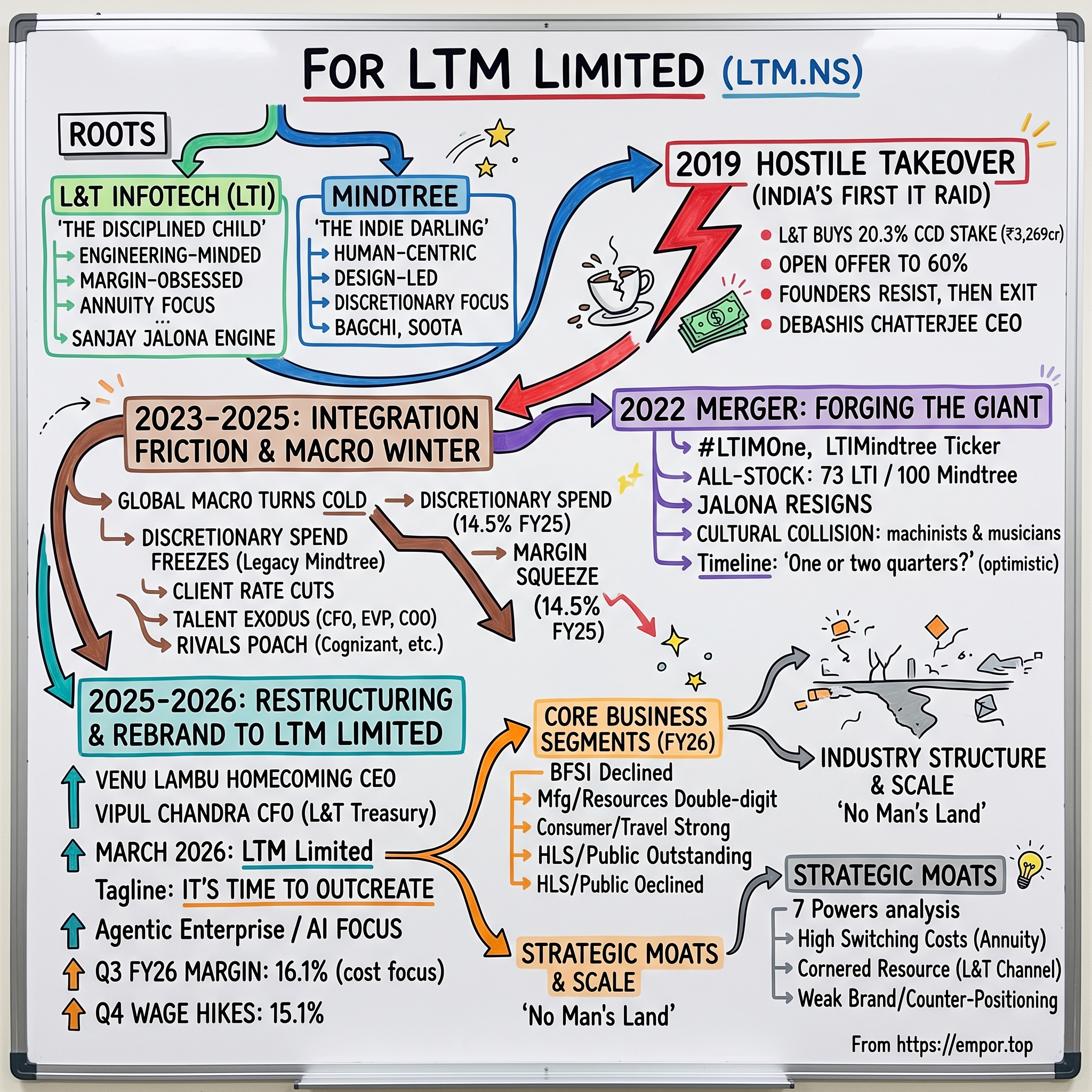
But it wasn't always one company, and that is where the story earns its drama. LTM is the fusion of two organizations that could hardly have been more different in temperament. L&T Infotech (LTI) was the disciplined, engineering-minded child of a heavy-industry conglomerate — process-driven, margin-obsessed, at home in the unglamorous world of enterprise software and manufacturing systems. Mindtree was the indie darling of India's IT boom — design-led, human-centric, fiercely proud of its independence, and built by founders who spoke the language of empathy and craftsmanship rather than quarterly utilization rates.
How those two came to share a balance sheet is a story that runs through a coffee tycoon's financial collapse, India's first genuinely hostile takeover in the IT sector, a war of words fought in the business press, an all-stock merger, a brutal macroeconomic winter, a bruising exodus of senior talent, and finally a restructuring under a CEO who had once left the company himself.
It is worth pausing on why this particular story is instructive well beyond India. The global IT services industry is, at its core, a business of arbitrage and trust — arbitrage because it moves work to where skilled engineers cost less, trust because clients hand over the systems that run their payroll, their trading desks, and their supply chains. Neither of those is a technology moat. What actually differentiates one vendor from another is a bundle of soft things: domain knowledge, delivery reliability, relationship depth, and the ability to attract and retain people who could just as easily work somewhere else. That makes consolidation in this industry uniquely fraught. When a manufacturer buys a rival, it acquires factories that stay bolted to the floor. When an IT services firm buys a rival, it acquires an org chart and hopes.
There is also a governance dimension that a Western investor might find unusual and that deserves to be named early rather than treated as background. LTM is a listed company in which a single industrial promoter controls roughly two-thirds of the shares. That structure confers real benefits — patient capital, immunity from takeover pressure, and a captive channel into one of the world's larger engineering project portfolios. It also means that minority shareholders are, in practice, passengers. Strategy is set with the parent's interests firmly in view, the free float is thin, and the questions an activist would normally press are unlikely to translate into board seats. Whether that is a feature or a risk depends entirely on how well L&T allocates capital on its subsidiary's behalf — a track record we will examine.
Here is the roadmap. We start with the dual roots — the two founding cultures. We move to the dramatic 2019 raid that put Mindtree in L&T's hands. We examine the 2022 merger mechanics and the cultural collision that followed. We sit through the integration friction and margin compression of the macro winter. We assess the 2025–2026 restructuring and rebrand under CEO Venu Lambu. Then we turn analytical: the business segments, the competitive structure, the moats, the bull and bear cases, and the handful of numbers that actually matter for anyone trying to underwrite this company's future. Let's begin at the beginning — with two companies that had no idea they would one day be forced to become one.
 Subscribe on LinkedIn
II. The Dual Roots: L&T Infotech & Mindtree
To understand why merging LTI and Mindtree was so hard, you have to feel how different the two places were to work in — the corporate equivalent of arranging a marriage between a precision machinist and a jazz musician.
First, how this business actually makes money. Before the personalities, a plain-English detour, because the economics of IT services are less obvious than they look. An Indian technology services firm essentially rents out trained engineers to large enterprises abroad. Revenue is a function of three things: how many billable people you have, what fraction of them are actually working on a paying project at any given moment (utilization), and what you charge per hour or per outcome (realization). Cost is dominated by salaries. The margin, therefore, is the thin spread between what a client pays for an engineer's day and what that engineer costs — multiplied across tens of thousands of people.
That structure produces two important consequences. The first is that revenue growth has historically been close to linear with headcount: to grow 15%, you hired roughly 15% more people. The second is that margin is exquisitely sensitive to a handful of levers — the mix of junior to senior staff (the "pyramid"), how many people sit idle on the bench, how much work is done offshore in India versus expensively onshore at the client's site, wage inflation, and the rupee-dollar exchange rate. This is why an IT services company can miss a margin target by 100 basis points for reasons that have nothing to do with whether its clients love it. Keep this machine in mind; every strategic decision in this story eventually shows up as a change in one of those levers.
Work also comes in two flavors that matter enormously to the rest of the narrative. There is annuity business — multi-year application maintenance, infrastructure management, run-the-systems work. It is unglamorous, predictable, and sticky. And there is discretionary business — new projects, digital transformations, redesigns. It is higher-priced, more exciting, and the first thing a nervous CFO cancels. LTI's book leaned annuity. Mindtree's leaned discretionary. Hold that thought.
L&T Infotech: the conglomerate's disciplined child. Larsen & Toubro spun up its software arm in 1996, at a moment when Indian industrial houses were beginning to notice that their engineering brethren in Bangalore — Infosys, Wipro, TCS — were generating enviable margins by exporting programming talent to the West. The intellectual force behind the diversification was A.M. Naik, the formidable L&T chairman who spent decades turning a Danish-founded engineering firm into a sprawling Indian conglomerate. Naik's instinct was that L&T's deep relationships with industrial clients — the people who bought turbines, built factories, ran refineries — could be leveraged into a high-margin, asset-light services business. You didn't need a steel mill to write SAP code; you needed engineers who understood how steel mills actually worked.
That heritage stamped LTI's DNA permanently. Its strongholds were the industrial verticals — manufacturing, energy, and above all Banking, Financial Services & Insurance (BFSI), where core banking transformation and enterprise resource planning work rewarded methodical, process-disciplined delivery. LTI was never the flashiest name on the pitch deck, but it ran a tight ship.
The company's defining chapter arrived with Sanjay Jalona, an Infosys veteran who took the helm in 2015 and took LTI public in July 2016. Jalona was a builder of sales engines. Under him, LTI became known for punching above its weight — posting organic growth rates that regularly embarrassed larger rivals and holding operating margins in the mid-to-high teens, roughly 17–19%, a level that made LTI a Street favorite. He preached "exponential" thinking and cultivated a culture that was ambitious, structured, and unapologetically metrics-driven. If you wanted to understand LTI, you looked at the operating margin line and the growth rate, and both were usually excellent.
Mindtree: the indie darling. Now cross the aisle. In 1999, ten IT professionals — the best-known among them Ashok Soota and Subroto Bagchi, both departing senior roles at Wipro, alongside colleagues with roots at firms like Lucent — founded Mindtree with a mission statement that could double as a poem: "Welcome to possible." Where LTI was engineered, Mindtree was cultivated. The company built a reputation for being design-led and horizontal rather than hierarchical, famous for what it called "emotional intelligence" in hiring, for campuses that felt more like design studios than delivery factories, and for a brand that leaned into human warmth.
Mindtree's commercial footprint reflected that personality. Its native strengths were in travel and hospitality, media, retail, and — crucially — the digital customer-experience work that boomed as enterprises scrambled to modernize their consumer-facing technology. This was discretionary, project-based, creative work: building the app, reimagining the booking flow, designing the digital storefront. It was higher-beta than LTI's steady application-maintenance annuities — more lucrative in a boom, more exposed when budgets tightened. That distinction, seemingly technical, would later become the fault line along which the merged company's margins cracked.
The people behind the personalities. It is worth dwelling on the founders, because their temperaments explain the ferocity of what came later. Ashok Soota was already a veteran of stature when he left — he had run Wipro's information technology business and was among the most senior figures in the Indian software industry, someone who could have retired comfortably and instead chose to start over at an age when most executives are consolidating. Subroto Bagchi was a different creature entirely: a writer as much as an executive, author of books on entrepreneurship and leadership, a man who gave himself the internal title of "Gardener" — his job, as he described it, being to tend the growth of the company's people rather than to command them. That is not corporate whimsy for its own sake; it was a genuine statement about where Bagchi believed the value in a services firm resided. When he later characterized L&T's approach as treating a carefully cultivated institution like a piece of property to be traded, he was not merely being dramatic. He was describing, from his vantage point, a category error.
Contrast that with the operating philosophy on the other side. A conglomerate that builds nuclear-grade pressure vessels and defense systems has an institutional worldview shaped by tolerances, schedules, and audits — a world in which process discipline is not bureaucracy but the difference between a bridge that stands and one that doesn't. Neither worldview is wrong. They are simply optimized for different failure modes. And when they were eventually forced to share a single management system, each side experienced the other's virtues as vices: the engineers saw indulgence, and the designers saw suffocation.
Here is the strategic punchline that made the eventual combination so tempting on paper: the two companies barely overlapped. LTI owned the industrial, back-office, keep-the-lights-on end of enterprise IT. Mindtree owned the consumer-facing, design-forward, change-the-experience end. One was a margin machine; the other was a growth-and-culture story. On a spreadsheet, they looked like two puzzle pieces cut to fit. In human terms, they were about to discover how hard it is to fuse a machinist and a musician — and the fusion would begin not with a courtship, but with a raid.
III. India's First Hostile IT Takeover: The 2019 Raid
The Indian IT industry had spent two decades cultivating an image of genteel, founder-led capitalism — companies built by professionals, governed by consensus, insulated from the brawling world of leveraged buyouts and boardroom ambushes. In 2019, Larsen & Toubro shattered that image, and the trigger was a tragedy brewing in an entirely different industry: coffee.
The coffee crisis. V.G. Siddhartha, the founder of Cafe Coffee Day, had been one of Mindtree's earliest and most important financial backers, sitting on a 20.32% stake — the single largest holding in the company. But Siddhartha's retail empire was drowning in debt, and by early 2019 he faced acute liquidity distress. He needed cash, urgently, and his most sellable asset was his Mindtree stake. The founders' problem was arithmetic: the promoter group collectively held only around 13.3%, far too little to control the company's fate and nowhere near enough capital to buy Siddhartha out themselves and keep the shares in friendly hands.
The raid. In March 2019, L&T moved with the decisiveness of a conglomerate that had done its homework. It signed a definitive share purchase agreement to acquire Siddhartha's entire 20.32% stake at ₹980 per share — a transaction worth roughly ₹3,269 crore.6 That single purchase tripped the wire of India's takeover code: acquiring that large a block obligated L&T to launch a mandatory open offer to public shareholders for an additional 31% of the company. L&T also signaled it would mop up shares from the open market to march toward control. There was no negotiated blessing from the board, no friendly handshake with the founders. It was, in the vocabulary that would dominate the next three months, a hostile takeover — the first of real consequence in Indian IT.
The founders' resistance. Mindtree's leadership fought back with the tools they had, which were mostly moral and rhetorical. Co-founder Subroto Bagchi dramatically returned from a government advisory role, casting himself as the defender come home to protect the company's soul. The founders framed the bid in emotional terms — a "gold-standard" institution being treated like a piece of real estate, a creative culture at risk of being crushed under industrial machinery. The board floated the idea of a share buyback as a defensive maneuver to shore up the founders' relative position. But the defense was structurally hollow: SEBI's regulations constrained what a buyback could achieve, and L&T's capital and momentum were simply overwhelming. The open offer, when it came, was oversubscribed, a clear signal that public shareholders were happy to take L&T's money.7
Did L&T overpay? This is where the neutral lens matters. At ₹980 per share, the deal valued Mindtree at a full-looking multiple — richer than mid-tier peers of the era but a discount to the Tier-1 giants. The bullish reading, which time has largely vindicated, is that L&T was buying something it could not build: a genuinely digital-native capability with almost no client overlap with LTI, acquired with the conglomerate's own strong balance sheet rather than expensive debt. The skeptical reading — and it is the one worth holding onto — is that in a people-based business, you are paying a premium for assets that walk out the door every evening. Whether ₹980 was disciplined or dear would depend entirely on how many of those people stayed. Many, in the end, did not.
The tragic coda. The human story behind the trigger ended in the worst possible way. On the evening of July 29, 2019 — barely a month after L&T completed its acquisition — V.G. Siddhartha went missing from a bridge over the Netravati river near Mangaluru; his body was recovered from the water a day and a half later.17 A letter attributed to him, addressed to his board and the Coffee Day family, spoke of pressure from lenders and tax authorities and contained the line, "My intention was never to cheat or mislead anybody, and I have failed as an entrepreneur."17 It is a sobering reminder that the elegant chain of corporate causation — distressed shareholder sells block, acquirer triggers open offer, control changes hands — began with a founder in genuine desperation. Boardroom strategy and personal catastrophe are not always separable.
Completion. By June 2019, L&T had assembled roughly a 60% controlling stake, and the resistance was over.[^8] The founders exited. To run Mindtree as an independent, L&T-controlled listed entity, the parent installed Debashis Chatterjee, a Cognizant veteran, as CEO. For the moment, Mindtree remained its own company with its own ticker — a captured indie under new ownership. But the logic of consolidation was already ticking, and within three years L&T would decide that owning two IT companies was one too many.
IV. Forging the Giant: The 2022 Merger & Cultural Collision
For three years after the takeover, L&T ran a curious portfolio: two separately listed IT services companies, LTI and Mindtree, operating as sister entities under the same parent. It was, in hindsight, a holding pattern. The pandemic-era digital demand spike lifted both — every enterprise on earth was suddenly desperate to modernize its technology — and the strong tailwind papered over the strategic question of why L&T needed two overlapping public vehicles competing for the same talent pool and, occasionally, the same deals.
The announcement. On May 6, 2022, the answer arrived. The boards announced an all-stock merger of LTI and Mindtree to create "LTIMindtree," at a swap ratio of 73 LTI shares for every 100 Mindtree shares.[^9] The combined entity would vault into the ranks of India's largest IT firms — routinely described as the country's fifth-biggest — and give L&T a single, scaled software champion instead of two mid-sized ones.
The strategic logic. On paper it was elegant. The verticals were complementary: LTI's manufacturing, energy, and BFSI depth slotted alongside Mindtree's retail, consumer, travel, and communications-media-technology strengths, with minimal cannibalization. And there was a scale argument that genuinely mattered in the industry's economics. The most lucrative contracts in IT services — the "mega-deals" worth $100 million or more, often born from vendor-consolidation exercises where a client fires ten suppliers and hands the work to two or three survivors — require balance-sheet heft, deep benches of people, and the credibility of size. A sub-$3 billion company rarely makes the shortlist. A $4-billion-plus company does. The merger was, in essence, a bet that scale would buy a seat at the table where the biggest deals get decided.
The immediate human cost. But strategy has casualties, and the first was significant. Sanjay Jalona — the architect of LTI's celebrated growth engine and one of the most respected operators in the sector — declined to lead the merged company and resigned.[^9] For a services firm, losing your best salesperson-in-chief at the very moment you are trying to prove you can win bigger deals is not a footnote; it is a warning. Debashis Chatterjee, already running Mindtree, was named CEO of the unified firm. The combined company would be steered by the executive who came in with the acquired side, not the acquirer's growth legend.
The #LTIMOne problem. Management branded the integration effort "#LTIMOne," and the hashtag captured both the aspiration and the difficulty. Two things had to be fused. The first was culture — LTI's top-down, engineering-driven conglomerate hierarchy against Mindtree's collaborative, flat, design-first ethos. These were not cosmetic differences; they governed how people were promoted, how incentives were paid, how decisions got made, and how proud employees felt about where they worked. The second was plumbing — two entirely separate delivery platforms, operating models, and internal systems that had to be standardized into one architecture without disrupting clients mid-project. Integration of this kind is invisible when it goes well and catastrophic when it doesn't. The merger cleared both the Mumbai and Bengaluru benches of the National Company Law Tribunal, closed and took legal effect on November 14, 2022, with a record date of November 24 to determine which Mindtree shareholders would receive LTI stock.819
The timeline management set, and what it revealed. Here is a detail worth logging in the credibility ledger, because it becomes the standard against which the next three years should be judged. In October 2022, on the eve of the merger becoming effective, management publicly expressed hope that integration would be substantially complete within one or two quarters.[^26] Contemporary analysis was more cautious: commentators flagged near-term concerns about client overlap management, senior attrition risk, and the difficulty of harmonizing two distinct operating models — precisely the issues that would dominate the next several years.[^24]20 The gap between "one or two quarters" and what actually unfolded is not a matter of interpretation. It is the clearest single piece of evidence that this management team's initial integration planning was materially optimistic. That does not make them dishonest; ambitious timelines are endemic to deal-making. But it does mean an investor should apply a discount to forward-looking integration and synergy claims from this company until a few are delivered on schedule.
The giant was born. Almost immediately, the weather turned.
V. Integration Friction, Churn, and the Macro Winter (2023–2025)
Timing, in mergers as in comedy, is everything — and LTIMindtree's timing was cruel. The ink on the amalgamation was barely dry when the global macroeconomic climate that had powered the pandemic digital boom went cold. Interest rates climbed, recession fears spread, and corporate technology buyers did the thing they always do when nervous: they froze discretionary spending. And discretionary digital projects — the reimagine-the-app, redesign-the-experience work — were precisely legacy Mindtree's specialty. The merger had, with unfortunate precision, doubled down on the most cyclical corner of the business right before the cycle turned.
To appreciate how sharply this reversed the setup, recall the machine described earlier. During the pandemic boom, every lever ran in the company's favor: demand exceeded supply, so pricing firmed; utilization was high because nobody sat on the bench; and clients were commissioning new projects faster than vendors could staff them. Wage inflation was the only headwind, and growth outran it. When the cycle turned, the levers reversed almost simultaneously. Discretionary projects were cancelled or paused, which meant engineers hired for them had nothing to bill against. Utilization fell. Clients, sensing the shift in bargaining power, launched consolidation exercises specifically to extract rate reductions. And the wage increases already committed to during the boom still had to be paid. This is why IT services margins move so violently: several independent levers tend to move together, in the same direction, at the same time.
The margin squeeze. The financial evidence of the strain showed up in the operating margin, the number that had been LTI's pride. Historic LTI margins near 18% compressed to 14.5% by fiscal 2025 — a stark fall driven by a toxic combination: duplicate cost structures that integration hadn't yet eliminated, the overhead of the integration itself, and pricing pressure as clients used vendor-consolidation deals to squeeze rates.9 For a company whose entire investment appeal had rested on best-in-class profitability, watching margins slide into the mid-14s was the single most damaging development of the period. It converted a growth-and-margin darling into a "show me the recovery" story.
The talent exodus. Worse, the people started leaving — and not just the rank and file. Over roughly an 18-month stretch, LTIMindtree bled senior leadership at a rate that alarmed analysts. CFO Vinit Teredesai departed. Chief Marketing Officer Paresh Vankar left. Chief Operating Officer Nachiket Deshpande — later brought back into a President role and put in charge of the new AI services group — would ultimately resign as Whole-time Director and President effective October 31, 2025.10 Executive vice presidents from the global sales organization walked, too. In a services business, senior salespeople carry client relationships in their heads and their phones; when they leave, the accounts often wobble, and sometimes they follow.
Rivals smelled blood. Reporting from the period described competitors — Cognizant, Persistent Systems, Coforge among them — actively circling LTIMindtree's accounts and poaching its sales leaders during the vulnerability window that integration had opened.[^13] A merger is a moment of maximum internal distraction, and the competition treated it as an open hunting season.
The analyst calls. The most revealing evidence of the strain came on the earnings calls, where analysts pressed management on "deal leakage" — the fear that senior exits were dragging clients out the door with them — and on whether the cultural integration was quietly failing. Management's narrative shifted in a way worth noting for anyone assessing credibility. Early on, the exits were framed benignly as "role rationalization" — the natural trimming of duplicate senior roles that any merger produces. Later, the framing grew more candid: management acknowledged that cultural integration and, tellingly, the alignment of sales incentives had taken materially longer than planned. That evolution — from tidy euphemism to admission — is the kind of thing a skeptical investor files away. It suggests the initial synergy timeline was optimistic, and that the human side of the deal was harder than the spreadsheet implied.
Myth versus reality. Three consensus narratives from this period deserve fact-checking. Myth one: the merger destroyed value. Reality: it compressed margins badly and cost the company senior talent, but the combined entity kept growing revenue through the winter and ended fiscal 2026 with record bookings and an all-time-high cash position of $1.63 billion — hardly the profile of a value-destroying deal.3 The damage was to profitability and reputation, not solvency. Myth two: the exits were all about culture. Reality: culture mattered, but so did simple arithmetic — a merger genuinely creates duplicate senior roles, and some of the departures were people who correctly read that there was no longer a job for them at their level. Attributing every exit to cultural failure overstates the case; attributing none of them to it, as management initially tried, understated it. Myth three: margin compression was purely macro. Reality: the industry did face a discretionary-spending downturn, but LTI standalone had run at 17–19% before the merger, and peers of comparable size did not fall as far as fast. A meaningful share of the compression was self-inflicted integration cost, which is both the bad news and, for anyone underwriting a recovery, the good news — self-inflicted costs are the kind you can actually remove.
By late fiscal 2024 and into fiscal 2025, management pivoted to a defensive-offense posture: on its October 2024 call it described deliberately rationalizing smaller clients to focus resources on winning a larger share of the big vendor-consolidation deals, increasingly wrapped in AI.[^14] It was a reasonable strategy, but it was also an admission that the firm was optimizing for survival and share-of-wallet rather than the exuberant organic growth of the old LTI. The company that emerged from the winter needed new leadership to close the chapter — and it found that leadership in a familiar face.
VI. The Venu Lambu Era & Rebranding to LTM Limited (2025–2026)
There is a particular kind of corporate homecoming that signals something about a company's self-diagnosis. When a board reaches past the obvious internal successors and past the outside superstars to bring back someone who had left during the hard years, it is making a statement: we need someone who understands what we broke.
The transition. On January 24, 2025, LTIMindtree announced that Venu Lambu would join as CEO (Designate) and Whole-time Director, based in London, to succeed the retiring Debashis Chatterjee.11 Lambu was not a stranger. He had served as President and Executive Director at the company from 2020 to 2023, running global markets — the sales engine — before departing at the height of the integration turbulence to become CEO of Randstad Digital. Now, after two years away, he was returning to run the whole thing.
The prodigal's qualifications. The symbolism was deliberate and, on its face, shrewd. Lambu carried more than 30 years in technology and services, and — crucially — he had lived inside both halves of the company's DNA. He knew the "Mindtree soul" that the founders had fought to protect, having led the market-facing side through the merger. But he had also operated at scale, both inside the merged entity and at a global staffing-and-digital firm. He was, in the board's framing, the bridge: someone who could speak to the heritage culture while executing at the size L&T demanded. Whether that bridge holds is one of the open questions of this story — an executive who left during the friction is now responsible for proving the friction is behind them.
The rebrand. Lambu's most visible early move was symbolic housekeeping. On February 11, 2026, the board approved dropping the hyphenated "LTIMindtree" name in favor of LTM Limited, and the change took legal effect with a fresh Certificate of Incorporation on March 17, 2026.21 Alongside it came the new positioning — "The Business Creativity Partner," the "It's time to Outcreate" tagline, and heavy emphasis on the "Agentic Enterprise" and AI.2
The strategic rationale deserves scrutiny rather than applause. Internally, the hyphenated name had reportedly preserved factional identities — the "ex-LTI" and "ex-Mindtree" tribes — long after the legal merger. A single unified brand is a way to declare the integration phase officially over and to stop employees from litigating which heritage they belong to. Externally, one clean brand simplifies marketing and lowers the friction of selling a single identity to clients. That is all sensible. But a name change is a lagging indicator of integration, not a leading one. Renaming the company does not, by itself, align a sales-incentive plan or standardize a delivery platform; it announces that management believes those harder things are largely done. The neutral question is whether the plumbing actually matches the paint.
Reading the operating evidence, not the rhetoric. The fairest test of the Lambu era so far is what the quarterly numbers did while the branding changed. They improved, and by more than the annual average suggests. By the third quarter of fiscal 2026, EBIT margin had reached 16.1% — a jump of 230 basis points from 13.8% in the same quarter a year earlier — on revenue of $1.208 billion, up 6.1% year over year.18 Profit grew far faster than revenue, which is the arithmetic signature of a cost program working rather than a demand boom arriving. Utilization stood at a taut 86.9% excluding trainees, and headcount had climbed to 87,958 with net additions resuming.18 Encouragingly for the concentration bears, top-five client dependence had fallen to 24.0% from 27.9% a year prior, while the count of clients billing more than $20 million annually rose to 47 from 39 — evidence that the account base was broadening at the top end even as the largest relationships shrank in relative terms.18
Then came the fourth quarter, and with it the annual wage hike, and margin gave back nearly a point to 15.1%.3 That sequence is the single most useful thing to understand about this company right now. The 16.1% print proved the cost machine can deliver; the 15.1% print proved that wage inflation still eats a large share of the gain every year. Sustained margin expansion in this industry is not a one-time restructuring event but an annual race against salary increases — and LTM has now shown it can run that race, without yet showing it can win it decisively.
The management bench. Two appointments frame the current leadership's posture. Alongside Lambu sits CFO Vipul Chandra, appointed effective April 25, 2024, replacing the departed Vinit Teredesai.12 Chandra's résumé is a signal in itself. He joined L&T in October 2013 as Head of Treasury in Corporate Finance, and before that spent 1995 to 2013 at Citibank, ultimately as Managing Director heading corporate sales and structuring.13 A parent-group treasury veteran in the CFO chair is L&T's way of wiring financial discipline and capital-allocation alignment directly from the conglomerate into its listed subsidiary. Lambu's own compensation, meanwhile, leans heavily on long-term equity tied to constant-currency revenue growth and EBIT-margin expansion — an incentive structure that tells you exactly what the board is asking him to fix. The question is whether he can. To answer it, we need to understand the machine he now runs.
VII. Core Business Segments, Industry Structure, and Economic Drivers
Picture the revenue of LTM not as a single river but as several tributaries, each fed by a different industry's fortunes, each with its own temperature. Understanding which tributary is running hot and which is running dry is the whole game in IT services.
The vertical mix. The company organizes its revenue by client industry, and the shape of that mix reveals both its inheritance and its vulnerabilities. Banking, Financial Services & Insurance remains the largest single vertical — historically in the mid-30s as a share of revenue, and the legacy LTI stronghold where core-banking transformation work lives. But BFSI has also been the trouble spot: in fiscal 2026 the segment actually declined meaningfully, weighing on the whole company, as large financial clients pulled back and a top account reset its spending.3 When your biggest vertical shrinks, everything else has to sprint just to keep the total moving forward.
The rest of the portfolio did the sprinting. Manufacturing & Resources — the vertical most directly tied to parent L&T's global industrial relationships — grew at a double-digit clip. Technology, Media & Communications, home to high-tech and SaaS clients, is the highest-beta segment: it carries the richest discretionary digital work and swings hardest with the tech spending cycle. Consumer Business, Travel & Retail — legacy Mindtree's heartland — posted strong growth, up around 20% in fiscal 2026. And the smaller Healthcare, Life Sciences & Public Services vertical was the standout, growing roughly 38% off a base near 7% of revenue.3 The pattern tells a clear strategic story: with BFSI stalled, LTM's growth in fiscal 2026 came from deliberately diversifying away from its single largest dependency — a defensive strength, but also a reminder of how much rides on the financial-services recovery it is still waiting on.
Why BFSI matters more than its percentage suggests. It is tempting to treat a vertical as just a revenue slice, but banking and financial services occupies a special position in this business, and it is worth understanding why. Financial institutions are the most technology-intensive non-technology companies on earth. A large bank runs thousands of applications, many written decades ago in languages few people still learn, all of which must keep processing payments flawlessly while being gradually modernized. That produces exactly the kind of long-duration, high-switching-cost, deeply embedded work that IT services firms treasure. It also produces cyclicality: bank technology budgets swell when rates and profits are healthy and contract sharply when they are not, and financial institutions are among the most aggressive practitioners of vendor consolidation — periodically cutting their supplier list from twenty firms to five and forcing brutal price concessions from the survivors.
So when LTM's BFSI vertical declined in fiscal 2026 while the rest of the portfolio grew, two readings were available. The charitable one is cyclical: a large client reset its spending, the cycle will turn, and the relationship remains intact. The uncharitable one is competitive: the account was lost or materially reduced in a consolidation exercise, which would mean a permanent step down in the base rather than a pause. Management has framed it closer to the former, describing the top-client situation as a reset whose recovery lags the pace of the decline.3 For an outside investor, the discriminating evidence is simple and observable: if BFSI returns to growth within a few quarters, the cyclical reading was right. If it flatlines while peers' banking verticals recover, it was competitive. That is a test worth waiting for rather than pre-judging.
Geographically, the company remains heavily anchored in North America, which supplies roughly 72% of revenue, with Europe — growing faster, above 20% in fiscal 2026 — at around 15%.3 That North American concentration is a double-edged inheritance: it is the world's richest IT-spending market, but it also means U.S. corporate budgets and the dollar-rupee rate move LTM's results more than any macro variable in India.
The "No Man's Land" of scale. Now zoom out to the industry structure, because LTM's central strategic problem is a matter of size, and it sits in an uncomfortable spot. At the top of the market are the Tier-1 giants — TCS at roughly $29 billion in revenue, Cognizant near $19 billion, Infosys around $18 billion, HCLTech about $13 billion, Wipro near $11 billion. These behemoths command the multi-billion-dollar vendor-consolidation deals through sheer scale and bench depth. At the other end are the fast-growing mid-tier agilists — Persistent Systems around $1.3 billion, Coforge near $1.1 billion — nimble, specialized, and growing at rates their larger rivals envy.
The AI question, in plain terms. Layered on top of this structural map is a genuinely novel disruption, and it is worth explaining without jargon. For thirty years, the Indian IT model rested on a simple trade: a client needed a hundred engineers to maintain an application, and it was cheaper to rent those hundred engineers from Bangalore than to hire them in Boston. Generative AI attacks that trade at its root. If a coding assistant lets thirty engineers do what a hundred did, the client does not need to rent a hundred anymore — and the vendor whose revenue is priced per engineer-hour has just watched its own product become more efficient at its own expense. This is the rare disruption that hurts you because it works.
The industry's answer, which LTM articulates as well as anyone, is to stop selling hours and start selling outcomes: charge for the business result rather than the headcount, and use AI to widen the margin on that result instead of shrinking the invoice. On its April 2026 call, management described client AI spending as moving through three phases — traditional long-term IT contracts, modernization projects, and a newer category of AI transformation work that starts as discrete projects before settling into ongoing operational engagements.14 That is a coherent theory. It is not yet a proven one. The honest position is that nobody — not LTM, not TCS, not Accenture — has demonstrated at scale that outcome-based AI revenue can replace linear headcount revenue dollar for dollar. Investors underwriting this sector are underwriting a transition whose destination is genuinely unknown, and any company claiming certainty about it should be discounted accordingly.
LTM, at roughly $4.5–4.8 billion, sits in between, trying to invent a category: large enough to be institutionally credible and to bid on $100-million-plus deals, but supposedly agile enough to dodge the bureaucratic inertia of the giants. The bullish framing calls this "the best of both." The bearish framing calls it "no man's land" — too small to win on scale against TCS, too big to out-sprint Persistent, and therefore at risk of competing on price alone. Which of those is true is not a matter of branding; it is a matter of whether LTM can grow faster than the giants while holding margins the mid-tier players would envy. So far, the evidence is mixed, which is exactly why the moat question matters.
VIII. Strategic Moats: The Hamilton Helmer 7 Powers Assessment
IT services is a famously moat-poor industry. The core product — smart people renting their time — is available to any competitor willing to hire and train, and clients are sophisticated, cost-conscious, and forever entertaining rival bids. So the honest exercise is not to manufacture a moat where none exists, but to assess, power by power in Hamilton Helmer's framework, where LTM has real defensibility and where it is merely competent.
Scale Economies (Moderate, double-edged). LTM's size is genuinely an asset at the top of the funnel: its $4.5-billion-plus scale is the ticket that gets it into mega-deal RFPs that are simply closed to sub-$2-billion players. It won six $100-million-plus deals in fiscal 2026, which a Persistent or Coforge could not credibly pursue.4 But scale in this industry is a weak moat, because the true giants have far more of it. LTM lacks the enormous bench of TCS or Infosys to absorb margin shocks, cross-subsidize price wars, or ride out a demand air-pocket. Its scale is enough to qualify, not enough to dominate.
There is also a subtlety about how scale actually converts into wins. Getting onto the shortlist for a $100-million deal requires size, but winning it requires something scale alone does not confer: domain credibility, a delivery model the client believes will survive the transition, and usually a willingness to take on risk in the pricing. LTM's six nine-figure wins in fiscal 2026 suggest it clears the first hurdle reliably and the second often enough to matter. What the disclosed data cannot tell an outsider is the win rate — how many such deals it pursued to land six — and that ratio, not the absolute count, is the real measure of whether scale is producing competitive advantage or merely producing expensive bid teams.
Switching Costs (High — the strongest real power). This is where the durability actually lives. Once LTM embeds itself in a client's enterprise applications, manages its cloud hosting, and signs multi-year application-maintenance contracts, ripping it out becomes expensive, risky, and disruptive. Institutional knowledge accumulates; the vendor becomes woven into how the business runs. The company's deliberate push into long-term managed services — as opposed to one-off discretionary projects — is, in Helmer's terms, a conscious effort to convert flighty project revenue into sticky annuity revenue. It is the most credible moat in the portfolio, and notably it is the LTI side of the heritage, the annuity machine, that supplies it — an irony given that the merger's growth thesis leaned on Mindtree's more switchable discretionary work.
Cornered Resource (Strong, via the L&T parent). LTM's most distinctive advantage is not a technology or a patent; it is a parent. Larsen & Toubro runs some of the largest industrial and infrastructure projects on earth, and those projects are a captive incubator and sales channel for LTM's smart-manufacturing, IoT, and engineering-software services. No independent mid-tier rival has an in-house conglomerate feeding it industrial digital work. The same parentage is also a governance guardrail: L&T's ~68.5% promoter stake makes LTM effectively immune to the kind of hostile raid it once launched on Mindtree, and it guarantees cheap, patient access to capital.5 The flip side — explored in the bear case — is that a controlling industrial parent can also be a source of overhead and slow decision-making.
Brand (Transitioning, unproven). The rebrand to LTM is an explicit attempt to convert fragmented brand equity into a single institutional identity. But brand in enterprise IT is a weak power at the best of times — CIOs buy on capability, references, and price, not on taglines — and LTM's brand is mid-transition, its "Business Creativity Partner" positioning still more aspiration than reputation. This is a power to watch, not to bank.
Process Power and Network Economies (Essentially absent). Completeness requires naming the two powers LTM does not have. Process power — a way of operating so refined that rivals cannot copy it even knowing how it works — is hard to claim in an industry where delivery methodologies are published, certified, and taught. LTM's delivery is competent; it is not inimitable. Network economies are simply the wrong shape for this business: an additional LTM client does not make the service more valuable to existing LTM clients. Recognizing the absence matters, because it means the company cannot expect its advantages to compound on their own. Every year's competitive position has to be re-earned through sales execution and delivery quality.
Counter-Positioning (Weak and fading). Here is the strategic poignancy. Legacy Mindtree's whole edge was counter-positioning: it competed against the lumbering giants precisely by being creative, flat, and culturally distinctive — a company the big guys structurally could not imitate without abandoning their own model. As LTM scales and absorbs standard L&T corporate controls, that counter-positioning erodes. The very act of becoming a disciplined $4.8-billion institution dissolves the "we're the anti-giant" advantage that made Mindtree special. LTM is trading a differentiated identity for institutional scale — and if the scale doesn't deliver, it will have given up the one thing that made half of it unique. That trade is the crux of the investment debate.
IX. The Investor Playbook: Bull vs. Bear Case, Valuation, & Risk Radar
Every investment case has a spine — the single question on which the whole thesis pivots. For LTM, it is this: can the company bridge the gap to true Tier-1 economics, restoring EBIT margins toward the 16–17%-plus band while growing at least in line with the industry, or is it structurally trapped as a lower-margin consolidator, forever explaining why it isn't quite there? Let's war-game both sides, then stress-test them.
The bull case. The optimistic story runs on three engines. First, unified execution: with the rebrand closing the integration chapter and Venu Lambu's homecoming aligning the sales organization, the unified go-to-market wins a rising share of mega-deals — and the fiscal-2026 order inflow of $6.6 billion, up 10%, with six consecutive quarters of bookings above $1.5 billion, is offered as early proof the engine is humming.4 Second, margin recovery: operating margin expanded from 14.5% in fiscal 2025 to 15.4% in fiscal 2026, a 90-basis-point gain management attributes substantially to its "Fit for Future" cost program, and the bull case extrapolates the climb back toward the historic 17–18% band as duplicate real estate, delivery platforms, and administrative functions are finally consolidated.314 Third, the AI and GCC opportunity: LTM is positioning to help clients build and run Global Capability Centers — the in-house offshore units multinationals are setting up in India — acting as a strategic hybrid partner rather than a commodity labor-arbitrage vendor, and layering on agentic-AI platforms (branded BlueVerse, with tools like AgentIQ and partnerships including Salesforce and Uniphore) to move up the value chain.14
The bear case. The pessimistic story attacks each engine. On culture: the loss of Mindtree's talent-centric identity may drive persistent structural attrition — even at a reported 13.3%, the risk is in the premium digital segments where client-satisfaction depends on keeping the best people, and where the standardized L&T operating model may be actively corrosive.3 On positioning: the "no man's land" trap — unable to beat TCS on price and scale or Persistent on nimbleness — could condemn LTM to structural growth stagnation, always a step behind on both dimensions. On governance: heavy-handed conglomerate oversight from an industrial parent whose instincts were formed building refineries may slow local decision-making in an AI landscape that rewards speed. And the margin bull case has a hole: the fiscal-2026 recovery to 15.4% was real, but Q4 margins slipped to 15.1% as wage hikes bit, and on the April 2026 earnings call management framed roughly 16% as the achievable level while it reinvests in AI — a notably more modest ceiling than the 17–18% the bulls are underwriting.314
The GCC question, examined honestly. One pillar of the bull case deserves more scrutiny than it usually receives, because it is simultaneously the industry's biggest opportunity and its biggest threat wearing the same costume. A Global Capability Center is an offshore unit that a multinational owns and staffs directly in India, rather than outsourcing the work to a vendor. Over the past decade, hundreds of large enterprises have built them — and every engineer sitting in a client's own Bangalore center is, by definition, an engineer not being billed by LTM. GCCs are structurally a disintermediation of the traditional IT services model.
The industry's response, which LTM shares, is to get paid for helping clients build and run the very centers that compete with it — providing the setup, the recruiting, the delivery methodology, and often the managed operations underneath. It is a clever pivot: if clients are going to build captives regardless, better to be the architect than the casualty. But investors should be clear-eyed about the economics. Helping stand up a GCC is typically a shorter-duration, advisory-flavored engagement, and the ongoing managed-services annuity attached to it may be thinner than the classic outsourcing contract it replaced. Whether GCC-related work is genuinely accretive to LTM's revenue and margin, or merely a graceful way of harvesting fees while a structural channel erodes, is not yet visible in disclosed numbers — the company does not break out GCC revenue separately. Treat it as an interesting option, not as demonstrated growth.
The peer comparison that matters. Set LTM against the two ends of the market it straddles. Against the Tier-1 giants, its growth has not been conspicuously better — mid-single-digit dollar growth in fiscal 2026 is respectable in a soft market but does not constitute the share-gain story the agility thesis promises. Against the mid-tier specialists, its margin profile at 15.4% is competitive but its growth rate is not: the nimble players have generally been compounding faster off smaller bases, which is precisely what the "no man's land" critique predicts. The most favorable comparison for LTM is on stability: it has a stronger balance sheet, deeper client relationships, and vastly more mega-deal capacity than the mid-tier, and it is more focused and less bureaucratic than the giants. That is a real position — but it is a position built on being reasonable at everything rather than dominant at anything, and reasonable is not usually what generates outsized long-term returns. The bull case requires LTM to eventually be better than the average of its two reference groups, not merely between them.
The activist stress test. A skeptical long/short investor would press on several points. The BFSI reset — the company's largest vertical declining while it waits for a top client's spending to recover — is a concentration wound, not just a cyclical dip. Client concentration is real: the top five clients contributed roughly 27% of revenue and the top ten around 34% as fiscal 2026 opened, so the loss or retrenchment of a single top-five technology or banking account is a material earnings event, not a rounding error.15 The related-party dimension deserves a look too: how much of the celebrated "L&T channel" is genuinely competitive, arm's-length work versus captive parent spending that flatters the growth optics? And the credibility ledger is mixed — this is a management team that has, over three years, revised its integration narrative from "one or two quarters" to a multi-year admission of difficulty. Analysts noticed: at least one brokerage moved to a more cautious stance after Q4 FY26, framing the story as "navigating growth after top clients reset."16 None of these is fatal. All of them are reasons the bull case is a hypothesis, not a fact.
Porter's five forces, briefly. The industry structure is not kind. Buyer power is high — clients are large, sophisticated, and run competitive bids. Rivalry is intense across both the Tier-1 and mid-tier flanks. The threat of substitution is now existential and novel: generative AI that reduces the billable hours needed for coding and maintenance directly attacks the linear headcount-to-revenue model on which all of these firms were built. Supplier power (i.e., talent) ebbs and flows with the labor cycle. Only the barrier to entry at scale offers comfort — you cannot conjure an 87,000-person delivery organization overnight. LTM's moats, such as they are, sit almost entirely on the switching-cost and cornered-resource pillars; the rest of the field is a fair fight, and increasingly an AI-disrupted one.
The second-layer diligence. A few overlays that do not fit neatly into bull or bear but are material. On the balance sheet, LTM is exceptionally conservative — essentially net cash, with $1.63 billion in cash and investments at an all-time high and no meaningful refinancing risk in an era when cost of capital has punished leveraged businesses.3 That is a genuine comfort and, for a services company with no capital intensity to speak of, it also raises the fair question of what the cash is for: with no large acquisitions announced and dividends the primary return channel, a growing cash pile in a low-capex business is idle capital, and shareholders are entitled to ask whether it should be deployed or returned. On the ownership side, the thin free float that follows from a 68.5% promoter stake means institutional flows can move the share price more violently than fundamentals justify in either direction — a technical fact worth separating from business performance. On personnel, the churn at the top has continued into the current chapter: the departure of the President leading the AI services group in late 2025 removed the executive most associated with the company's largest-ever contract win and its flagship AI platform launch, which is the kind of key-person concentration that looks harmless until it isn't.10 And on disclosure, LTM's quarterly reporting is broadly in line with Indian IT peers — client-bucket counts, utilization, attrition, vertical growth — but it does not break out revenue by service line or disclose the profitability of individual verticals, which means outside analysts cannot independently verify where margin is actually earned. That is standard for the industry; it is still a limitation on how confidently anyone outside the company can model it.
What would falsify each case. Good analysis names its own exit conditions. The bull case breaks if margin fails to hold above 15.5% across a full year once wage hikes are absorbed, or if order inflow growth decelerates below revenue growth — the latter being the earliest reliable signal that the sales engine is losing rather than gaining share. The bear case breaks if BFSI returns to growth while the diversified verticals sustain double-digit expansion, and if the company demonstrates a second consecutive year of margin gain, which together would show the recovery is structural rather than a one-time cost harvest. Neither case has yet been resolved. Fiscal 2026 was, on the evidence, a year of genuine operational improvement layered on top of an unresolved growth question.
The KPIs that matter. Amid the noise, three numbers carry most of the signal for tracking this company: - Operating (EBIT) margin, and specifically whether it can sustainably breach and hold the 16% threshold — the single cleanest test of whether integration synergies are real or perpetually "coming." - Constant-currency revenue growth versus the industry average — the test of whether the unified sales engine is actually winning share or merely riding the tide. - Top-client and BFSI trajectory — whether the top-five concentration keeps easing and, crucially, whether the reset banking-and-financial accounts return to growth, which is the difference between a company that has diversified by strength and one that has diversified by necessity.
Everything else — attrition, utilization, headcount, order inflow — is context. Those three tell you whether the thesis is working.
X. Epilogue & Durable Business Lessons
Step back from the quarterly noise and the LTM story resolves into something larger than one Indian IT company — a case study in the peculiar physics of merging businesses whose only real assets are human.
The first durable lesson is the human-capital paradox. In a technology-services business, the assets go home every evening, and some of them do not come back. L&T paid a full price for Mindtree and acquired, on paper, a digital-native capability with almost no client overlap. But a meaningful slice of what it bought — the founders, the culture, and over the following years a procession of senior leaders — walked out the door. Hostile takeovers of people-heavy businesses are high-wire acts: the premium you pay for talent can evaporate if the talent decides the new owner isn't for them. The deal may still prove financially sound, but the friction was not a bug in the execution; it was a feature of the asset class.
The second lesson is the limit of spreadsheets. On the model, the LTI-Mindtree combination was close to flawless — complementary verticals, negligible overlap, obvious scale benefits. In reality, aligning sales incentives, standardizing delivery architectures, and reconciling two proud cultures took the better part of four years and, along the way, compressed the merged company's margins from the high teens to the mid-14s. Synergy is easy to underwrite and brutally hard to realize, because the hardest variables — how people feel, whom they trust, why they stay — never appear in the accretion analysis.
The third lesson is the power, and the limit, of a single brand. Hyphenated marriages of convenience like "LTIMindtree" are useful transition vehicles; they let two organizations coexist while the harder integration grinds forward. But they also preserve the tribal identities they paper over. True scale eventually demands a singular name, and the move to LTM Limited is the company's declaration that the transition is complete. Whether the paint matches the plumbing — whether a unified brand sits atop a genuinely unified operating machine — is the question the next several years will answer.
There is a fourth lesson, less often stated, about the strategic cost of buying culture rather than building it. L&T did not acquire Mindtree for its contracts alone; the stated logic was that Mindtree possessed a digital-native, design-led capability that LTI could not generate internally. But capability of that sort is not a machine you can install. It is an emergent property of how a particular group of people work together, and it exists only as long as the conditions that produced it persist. By imposing conglomerate governance, standardized delivery, and a unified brand — all individually defensible decisions — the acquirer systematically dismantled the conditions that made the acquired capability distinctive. This is not a criticism of any single choice. It is the structural dilemma of buying a culture: the integration that unlocks the scale synergies is the same integration that dissolves the thing you paid a premium for. Acquirers in people-based industries face this trade constantly and rarely resolve it well.
That is the open verdict on which LTM now trades. It has the scale to sit at the table where the biggest deals are decided and, in its L&T parentage, a genuinely rare structural advantage. It also carries a diluted culture, a concentrated top-client book, a stalled largest vertical, and an AI wave that threatens the very billing model the whole industry was built on. The company promised the scale of Tier-1 and the soul of Tier-2. The scale is measurable and real. The soul, and whether it survived the merger it was born from, is what long-term investors will be watching for.
References
-
LTIMindtree Company Rebrands to LTM Limited, Adopts 'Business Creativity Partner' Positioning — InvestyWise, 2026 ↩↩
-
LTIMindtree unveils new identity, to be renamed LTM Limited; board approves — Business Standard, 2026-02-11 ↩↩↩
-
LTM Q4 2026 slides: revenue climbs 8%, stock falls on margin concerns — Investing.com, 2026-04 ↩↩↩↩↩↩↩↩↩↩↩
-
LTIMindtree Introduces New Brand Identity and Positioning — LTM Limited (company press release), 2026 ↩↩↩
-
LTM promoter declares no encumbrance on 68.52% equity shares — ScanX, 2026-04 ↩↩
-
L&T's journey to acquire Mindtree: A timeline of the first hostile takeover in Indian IT — Moneycontrol, 2019-06-27 ↩
-
Hostile takeovers: understanding the acquisition of Mindtree by L&T Infotech — iPleaders, 2019 ↩
-
LTI and Mindtree to Start Operating as a Merged Entity From November 14, 2022 — Business Wire, 2022-11-14 ↩
-
LTIMindtree's FY25 Revenue up 7% in INR — Business Wire, 2025-04-23 ↩
-
Nachiket Deshpande resigns as Whole-time Director and President of LTIMindtree — Deccan Herald, 2025-10 ↩↩
-
LTIMindtree appoints Venugopal Lambu as CEO (Designate) — Business Standard, 2025-01-24 ↩
-
LTIMindtree appoints Vipul Chandra as CFO — Business Standard, 2024-03-07 ↩
-
LTIMindtree Appoints Vipul Chandra as Chief Financial Officer — LTM Limited (company press release), 2024 ↩
-
Earnings call transcript: LTM Ltd Q4 2026 strong revenue growth, stock dips — Investing.com, 2026-04-23 ↩↩↩↩
-
LTIMindtree Q1 FY26 presentation slides: Revenue grows 5.2% YoY, margins improve — Investing.com, 2025-07 ↩
-
LTM Q4FY26 Result Update: Navigating growth after top clients reset, Downgrade to HOLD — Prabhudas Lilladhar via Trendlyne, 2026-04-23 ↩
-
Cafe Coffee Day's VG Siddhartha's death: What went terribly wrong? — Business Today, 2019-08-05 ↩↩
-
LTIMindtree Q3 FY26 presentation: Revenue up 6.1%, EBIT margin expands to 16.1% — Investing.com, 2026-01 ↩↩↩
-
LTI-Mindtree merger receives NCLT approval with record date of November 24, 2022 — ICICIdirect, 2022-11 ↩
-
LTI Infotech and Mindtree merger gets nod, will become India's 5th-largest IT firm — Moneycontrol, 2022-11-14 ↩
 LinkedIn
 WhatsApp
 Reddit
 Hacker News
 Email
Email Kindle
 RSS Feed
 Spotify
 Apple Podcasts
 Amazon Music
 Audible
 YouTube