LMW Limited: Can the Machine Maker Outgrow the Textile Cycle?
I. The Order Book After the Bust
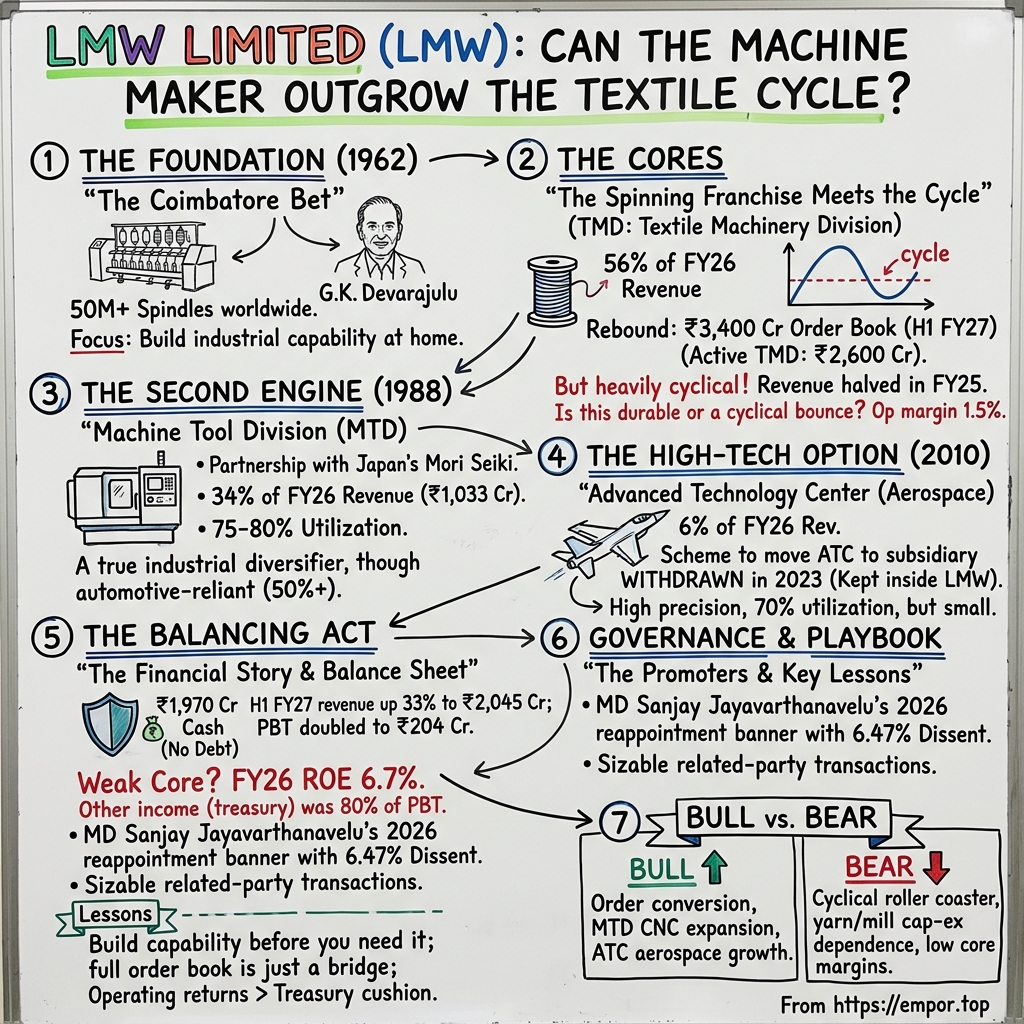
On 22 October 2026, LMW's management sat down with analysts and delivered a number that would have been hard to imagine two years earlier. The textile machinery division, the business that has defined the company for six decades, was carrying an order book of about ₹3,400 crore, of which roughly ₹2,600 crore was described as active, meaning orders from customers who were ready to take delivery rather than merely holding a place in the queue.1 For a company whose biggest business had just lived through one of the sharpest contractions in its history, that was the sound of the phone ringing again.
The contraction had been brutal. In the year to March 2024, LMW's textile machinery division turned over about ₹3,440 crore. A year later the figure was about ₹1,716 crore, a little under half.2 There was no single dramatic event behind the collapse, no factory fire or lost lawsuit. Spinning mills across India simply stopped buying. Yarn prices and mill margins had turned, the post-pandemic rush to add capacity had run its course, and a business that sells machines to people who make yarn discovered, once again, that its customers' bad year becomes its bad year with almost no delay. In the year to March 2026, textile turnover slipped further, to about ₹1,675 crore.3
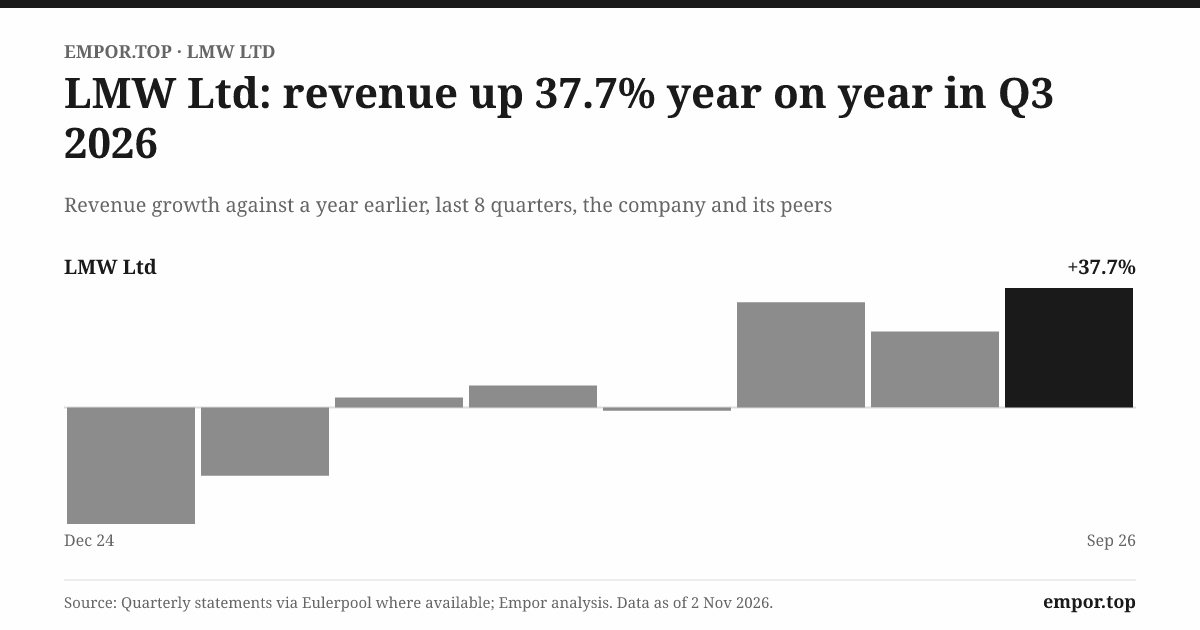
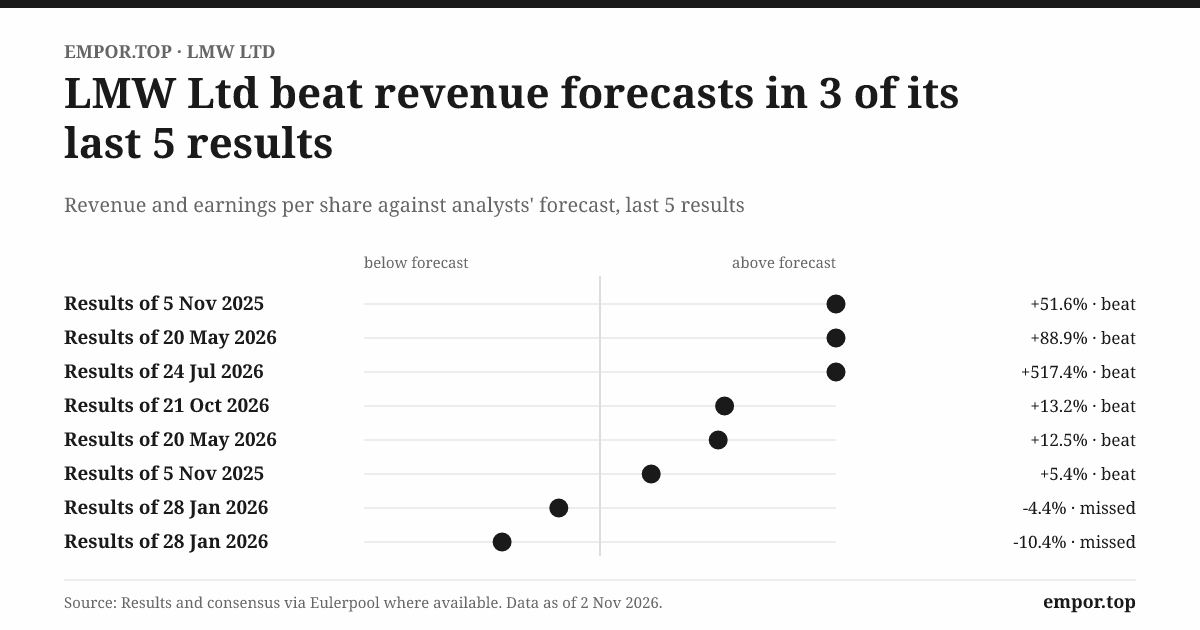
Now the recovery is visible in the results. In the six months to September 2026, consolidated revenue rose about 33% from a year earlier to roughly ₹2,045 crore, and profit before tax more than doubled, from about ₹93 crore to about ₹204 crore.1 The September quarter alone showed revenue up by more than a third and an operating margin of a little over 6%, the best quarterly reading since late 2023.1 It is tempting to read those numbers and declare the cycle turned.
The longer record argues for patience. Measured from the peak year to March 2023 through the year to March 2026, LMW's revenue shrank by about 12% a year, and net profit by about 30% a year.3 A 33% rebound off a base that low is welcome, but it is also what a cyclical bounce looks like. The order book is a promise of future dispatches. It is not yet proof that those dispatches will carry healthy margins, and LMW's history contains more than one moment when full order books and thin profits coexisted.
The stakes are unusual because the company itself is unusually safe. LMW has no borrowings at all, and a rating agency counted roughly ₹1,970 crore of cash and cash equivalents across the group at March 2026, alongside large holdings of investments.4 This is not a business that will be pushed into distress by a bad year. The problem is the opposite one. For the twelve months to September 2026, its return on equity was about 6.7%, and in the year to March 2026 its operating margin was a thin 1.5%.3 The market, meanwhile, values the company at about ₹17,000 crore, roughly 97 times its trailing earnings. A company priced like a compounder is currently earning returns closer to those of a bank deposit.
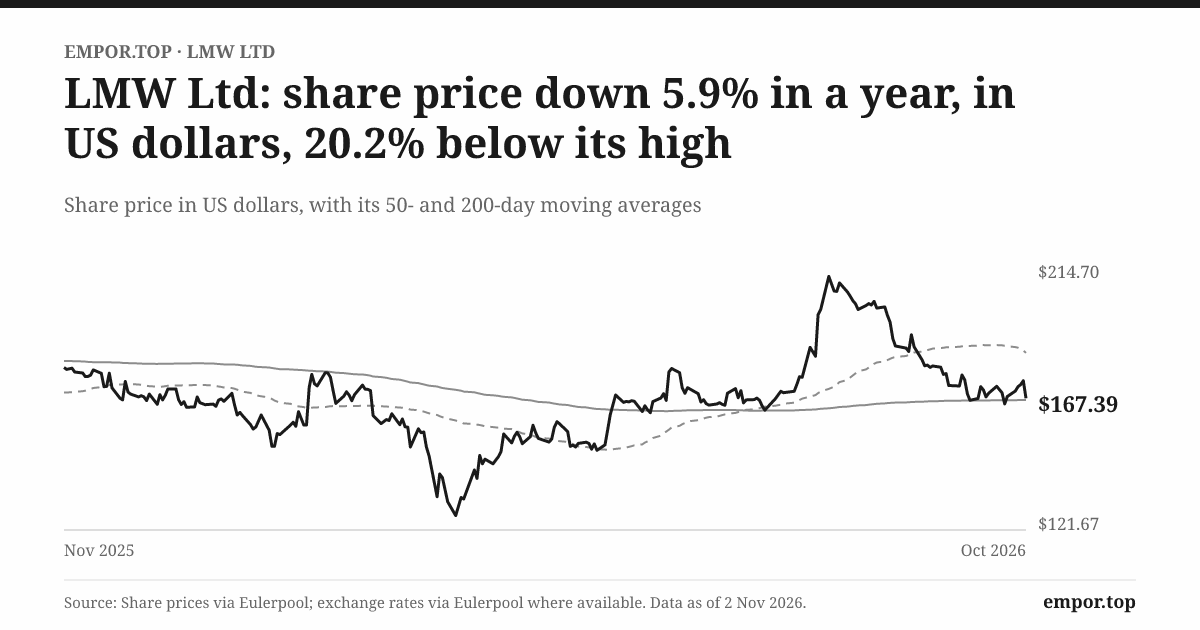
The share price has been trying to make up its mind. Over the past year it has traded as high as about ₹20,000 and as low as about ₹12,000, and it sits today roughly a fifth below its peak.5 That is a swing of two-thirds from bottom to top within twelve months, for a company with no debt and a cash pile larger than many of its listed peers are worth. Investors are not arguing about whether LMW will survive. They are arguing about what it will earn, and every quarterly result moves the argument one way or the other.
That gap is the question this story is built around. What has to change for a company with a global machinery footprint, a full spinning-mill product range and a fortress balance sheet to earn returns that match the price investors are paying for it?
There are three tests. The first is whether the textile rebound lasts long enough, and converts profitably enough, to restore the core franchise's earning power. The second is whether the two adjacent businesses LMW built over the decades, machine tools and aerospace components, can grow large enough to change the shape of the company rather than merely decorate it. The third is whether a family-led management team with a deeply conservative balance sheet can turn that conservatism into better operating returns, rather than letting treasury income quietly fill the gap.
Each test has a history. To understand why LMW is so exposed to one industry's investment cycle, and why it ended up with a second and third business at all, the story has to start in Coimbatore, in 1962, with a decision to make the machines rather than buy them.
 Subscribe on LinkedIn
II. The Coimbatore Bet on Making the Machines
In the early 1960s, Coimbatore was already one of India's great cotton towns. Mills ringed the city, drawing on cotton from the surrounding districts and labour from the villages. What those mills could not easily get was the machinery itself. Spinning frames, cards and combers came largely from Europe, which meant foreign exchange, long lead times and, when something broke, a long wait for parts and engineers who might be on another continent.
G.K. Devarajulu, a Coimbatore industrialist remembered locally as a nationalist and philanthropist, laid the foundation for an answer in 1962.6 The company he started, Lakshmi Machine Works, was incorporated that year to supply Indian textile mills with modern spinning technology.3 The name tied it to the family's existing textile interests, the Lakshmi Mills group, and that origin mattered. The founders were not engineers selling an abstract product to a market they had studied from afar. They were mill people who knew exactly what it cost when a spinning line sat idle waiting for a part.
The logic of the bet was simple to state and hard to execute. If India was going to build a large textile industry, it would need machinery made close to the mills, priced in rupees and backed by service engineers who could reach a factory in hours rather than weeks. Building that capability meant mastering precision casting, machining and assembly in a country where industrial skills were scarce and imports tightly controlled. It was the kind of project that only makes sense if you believe the market will be there for decades.
The early decades were shaped by the India of licences and import controls. A machinery maker with domestic capacity had a natural shelter, because foreign equipment was expensive and slow to obtain. That shelter would not last forever. When India opened its economy in the 1990s, mills gained easier access to European and later Chinese machinery, and LMW had to compete on product and service rather than on the difficulty of importing. Its continued leadership through that opening is one of the better pieces of evidence that its position was earned rather than merely protected.
The market did arrive. Over the following decades, LMW grew from a domestic supplier into the dominant Indian maker of spinning machinery. By 2012, its then leadership said the company had serviced the industry with the installation of more than 34 million spindles in India alone.6 A spindle is the basic unit of spinning capacity, the rotating shaft on which fibre is twisted into yarn, so a mill's size is usually described by how many it runs. Tens of millions of spindles meant that a very large share of Indian yarn was being spun on machines from one Coimbatore company.
What made LMW distinctive was the completeness of the range. A spinning mill is a sequence of machines, each preparing the fibre for the next. The blow room opens and cleans the raw cotton bales. Carding machines untangle the fibres into a soft rope called sliver. Draw frames and combers straighten and refine it. Speed frames thin it into roving, ring frames twist it into yarn, and winders wind the finished yarn onto packages that weavers and knitters can use. LMW set out to make all of it, from blow room to winder, so a mill owner could buy an entire line from a single supplier and call a single service team when something went wrong.7
That full-line ambition is the founding mission still visible in the company today. It created a platform that later generations would extend, first into machine tools and later into aerospace components, because a company that has learned to cast, machine and assemble complex precision equipment has skills that travel. It also tied LMW's fortunes to one question it could not control: how willing were spinning mills to invest in new capacity in any given year?
The family has stayed at the centre throughout. Sanjay Jayavarthanavelu, the founder's grandson, joined the board in 1993, became managing director in 2010 in succession to his father, D. Jayavarthanavelu, and was appointed chairman in October 2012.6 He still leads the company today, which gives LMW an unusual continuity: the same family, and for the past sixteen years the same executive, has steered it through every cycle of the modern era.
A complete product range is a strength only if it wins orders and supports profitable service over the years. The real question about the founding bet is not whether LMW built the machines. It plainly did. The question is whether building them gave LMW an economic edge strong enough to survive the moments when nobody wants to buy them.
III. The Spinning-Machine Franchise Meets the Investment Cycle
Picture the owner of a mid-sized spinning mill in Tamil Nadu or Gujarat, looking at two numbers. The first is the price at which the mill can sell yarn. The second is what it costs to buy cotton. When the gap between them is wide, the mill makes money on every kilogram, and every idle bay in the factory looks like lost profit. That is when the owner calls LMW and orders a new line, or replaces twenty-year-old ring frames with faster, more automated ones. When the gap narrows, the old machines keep running, the expansion plan goes back in the drawer and the phone at LMW stays quiet.
That single decision, repeated across thousands of mills, sets LMW's textile order flow. The economics of the sale follow from it. A machinery order is a large, lumpy commitment tied to a customer's expansion or modernisation plan. LMW describes its customer arrangements as fixed-price contracts, and it generally recognises revenue when products are dispatched from the factory.3 It does not publish typical contract lengths, minimum purchase commitments or the share of revenue that recurs each year. So the order book is the best forward signal investors get, and it is a signal about intent, not about cash already earned.
The franchise in the good years
The case for LMW as a franchise rests on three things. The first is breadth: as the founding story showed, it can equip a mill end to end. The second is the installed base. Every machine LMW has sold over six decades is a relationship, because the mill's engineers know how to run it, its spare parts come from Coimbatore, and when the time comes to replace or expand, the familiar supplier starts with an advantage. The third is the aftermarket. Machines wear out components long before they wear out entirely, so an installed base generates a stream of parts and service work that does not depend on mills buying new capacity.
That aftermarket shows up in the numbers. In the September 2026 quarter, textile machinery sales were about ₹639 crore, up about 38% from a year earlier, and management said spares made up about 25% of the division's sales, with domestic machinery at about 67% and exports at about 8%.1 That split tells two stories at once. A quarter of textile revenue coming from parts is a meaningful cushion, the kind of revenue that keeps flowing in a downturn because mills still have to keep their existing machines running. But two-thirds coming from domestic machinery means the division remains overwhelmingly a bet on Indian mill investment, with exports a small supplement rather than a diversifier.
How strong is LMW's position at home? It is routinely described as the domestic leader, and an older broker estimate from 2015 put its share of Indian spinning-machinery revenue near 63% in the year to March 2014.7 That figure is more than a decade old, and LMW does not publish a current market share, retention rate or win rate against rivals. What can be said is that the company faces serious, named competition. Switzerland's Rieter, Germany's Trützschler and Switzerland's Saurer are global specialists with deep technology and strong positions in individual machine categories. Kirloskar Toyota Textile Machinery, a joint venture involving Japan's 豊田自動織機 Toyota Industries, competes in India on ring frames and related equipment.8 Chinese manufacturers add price pressure in export markets. A mill owner choosing a new line has real alternatives, and can buy different stages from different suppliers if the price is right.
Buyer power is also shaped by the customer base. No single customer accounted for 10% or more of LMW's revenue in either of the past two years, and the company describes a large, unrelated customer base across geographies.3 That protects LMW from losing one giant account. It does not protect it from all its customers making the same decision at the same time, which is exactly what happens when yarn economics turn. Thousands of small buyers who can all defer purchases together hold a form of collective power that no concentration statistic captures.
There is a quieter dimension to the franchise that matters more each year: keeping the product current. Spinning machinery has steadily become a computer business wrapped in cast iron. Modern frames carry sensors on every spindle, automated doffers that replace full yarn packages without a worker, and software that lets a mill manager see which machine is drifting out of tolerance before it ruins a batch of yarn. Artificial intelligence is not a substitute for a ring frame, because yarn still has to be physically twisted, but it raises the bar for what a mill expects its machines to report and control. A supplier that falls behind on automation and monitoring risks becoming the budget option rather than the default choice.
LMW's spending on that race is modest. Research and development expense was about ₹59 crore in the year to March 2026, roughly 1.9% of standalone revenue, up from about 1.7% the year before.3 That is a respectable figure for an Indian capital-goods maker, but it is small in absolute terms next to the engineering budgets of European specialists whose entire business is textile machinery. Meanwhile, LMW's permanent workforce shrank from about 3,627 people to about 3,506 over the year to March 2026, even as revenue grew.3 Fewer people producing more output is a sign of tighter cost control after a downturn. It is also a reminder that the recovery is being run with a lean organisation, which helps margins if demand holds and strains delivery if it surges.
What the bust revealed
The strongest test of the franchise claim is not a good year. It is the last two years. If LMW's installed base and aftermarket made it a resilient franchise, the downturn should have been cushioned. Instead, textile turnover halved in a single year and then fell a little further.23 Spares and service did not prevent the collapse; at best they kept it from being worse.
Nor was this the first time. LMW's consolidated revenue fell about 13% in the year to March 2017, about 42% in the year to March 2020 and about 37% in the year to March 2025.3 Three serious contractions in under a decade is not bad luck. It is the shape of the business. Even more telling is what happened in the good years. Across the twelve years from March 2015 to March 2026, LMW's best annual operating margin was below 9%.3 A franchise with real pricing power usually earns fat margins at the top of its cycle. LMW, at its peaks, earned respectable single-digit ones. Crisil captured the swing neatly: it put LMW's EBITDA margin, which counts profit before depreciation, at about 9.5–10.5% in the years to March 2023 and 2024, then about 4.5–6.5% in the two years that followed.4
The working-capital record during the bust adds texture. As textile demand slowed, inventory days rose from about 70 in the year to March 2024 to about 106 by March 2026, which means machines and components sat in the warehouse longer before being sold.3 LMW partly offset that by taking longer to pay its own suppliers. That is a reasonable response to a downturn, but it is not the behaviour of a company that dictates terms to its market.
So the history narrows the franchise claim rather than rejecting it. LMW is a strong specialist with genuine breadth, an installed base that keeps it relevant to mill owners, and an aftermarket that contributes about a quarter of textile sales. What the evidence does not support is a moat strong enough to insulate earnings from the mill investment cycle. The cycle sets the year; the franchise influences how LMW does within it.
That is why the current order book matters so much, and also why it should be read carefully. The ₹2,600 crore active portion represents demand that is ready to convert, which would be more than a year of textile turnover at last year's depressed pace.1 If it converts at improving margins, the division's earning power begins to recover. If it converts at margins squeezed by input costs and competitive pricing, LMW will have a bigger top line and the same old problem. Management itself kept a note of caution on the October call, describing the order position as healthy but textile demand as something to be watched rather than assumed.1
The test the listener should carry forward is simple to state. Can parts, service and the breadth of the product line cushion the next pause in mill capex better than they cushioned the last one? LMW's leadership seems to have reached its own answer to a version of that question decades ago. Rather than rely on the spinning franchise alone, it went looking for a second engine.
IV. The 1988 Decision to Build a Second Engine
By the late 1980s, LMW had spent a quarter of a century learning how to cast iron, machine it to fine tolerances and assemble it into equipment that ran around the clock in dusty mills. It had also lived through enough textile cycles to know what happens to a single-industry machinery maker when its customers stop spending. In 1988, it made its most consequential strategic move since the founding. It partnered with Japan's 森精機 Mori Seiki, one of the world's leading makers of computer-controlled machine tools, to set up a Machine Tool Division and enter CNC manufacturing.9
It helps to be clear about what a CNC machine tool is, because it is a very different product from a spinning frame. A machine tool is a machine that makes parts for other machines. A lathe spins a metal bar and cuts it into a shaft; a milling machine moves a cutter across a block of metal to carve out a gearbox housing. CNC stands for computer numerical control, which means the machine follows a programme rather than the hands of an operator, so it can cut the same complex part thousands of times to within a fraction of a hair's width. Car engines, tractor axles and pump bodies are made with machines like these.
The choice made sense for reasons that went beyond diversification for its own sake. LMW already used machine tools heavily in its own factories, so it understood the product as a customer. Its foundry and machining skills transferred directly. And the customers were different: not spinning mills, but automotive suppliers and general engineering shops whose investment cycles do not move in lockstep with yarn prices. A partnership with a Japanese leader gave it technology and credibility that would have taken decades to build alone. This was a deliberate step into adjacent engineering capability, not a sudden leap into an unrelated business.
Nearly four decades later, the division makes turning centres, which are the CNC descendants of the lathe, machining centres, which descend from the milling machine, and turn-mill centres that combine both functions in one setup.9 LMW claims an installed base of more than 40,000 machines.9 That base matters for the same reason the spindle count matters in textiles: familiarity, service relationships and a steady flow of repeat orders from customers who have standardised their shop floors on one brand.
When the second engine carried weight
For most of its life, the machine-tool business was a useful supplement. In the last two years it became something more. In the year to March 2026, while textile turnover slipped again, machine-tool turnover rose about 22% to roughly ₹1,033 crore and contributed about a third of LMW's revenue.3 That was the first full year in which the diversification argument was tested under real stress, and it largely held: one engine sputtered and the other accelerated.
The customer mix explains both the opportunity and the limit. Machine tools serve automotive, auto-component and general-engineering buyers, and management said on the October call that automotive still accounted for a little over half of demand.1 That is a meaningful concentration of its own. Indian automotive production has been strong, and the push by global manufacturers to add supply chains outside China, the so-called China-plus-one strategy, has encouraged component makers to invest in capacity. But auto is also a cyclical industry, and a machine-tool business half dependent on it has merely swapped one cycle for another, albeit a cycle that does not always turn at the same moment as textiles.
On the October call, management described demand as strong, said utilisation was running at about 75–80% of capacity and talked about adding capacity to meet it.1 Analysts pressed on the details, and the answers were more measured than the headlines. When one questioner asked about a newly announced unit, management clarified that it was an existing facility being ramped up rather than a greenfield plant.1 That is a sensible way to add capacity, because it is cheaper and faster than building from scratch, but it also means the expansion is incremental rather than transformational.
There is also a competitive question that the growth numbers can hide. India's machine-tool market is crowded with imports from Japan, Taiwan, Germany and China, and with fast-growing domestic rivals such as Jyoti CNC Automation, a younger, more focused machine-tool maker that the market also prices at a steep multiple of its earnings.[^10] A buyer setting up a new automotive line can choose among dozens of credible suppliers, and machine-tool prices are set in a global market. LMW's advantage lies in its long record, its service network and the trust of customers who have run its machines for decades. Those are real, but they are the advantages of an incumbent, and incumbents in machine tools have to keep earning them with every new model.
What the company does not yet show is how profitable the machine-tool business is at this scale over a full cycle. Utilisation in the high seventies is healthy, and the revenue growth is real. But capacity additions earn their keep only if the new output sells at margins above the cost of the capital tied up in it, and LMW's most recent annual capital spending of about ₹73 crore was well below its depreciation charge of about ₹113 crore.3 In plain terms, the company has been spending less on new equipment than its existing equipment wears out on paper each year. That has protected cash during the downturn. It also means any serious growth push will require a step-up in investment whose returns are not yet demonstrated.
The verdict on the second engine is the most positive in this story, with a clear boundary. Machine tools are LMW's most established diversification: a business with a long record, a broad customer base and a recent demonstration that it can grow when textiles do not. That is real evidence, not management rhetoric. But it remains roughly a third of revenue, it carries its own automotive cycle, and the next proof points are specific: whether utilisation holds as capacity rises, whether segment margins improve with volume and whether the expansion earns more than it costs.
If machine tools were the patient diversification that worked, the third business is the one that still has to prove itself. It is also the one where LMW's board changed its mind in public.
V. The Aerospace Business That Stayed Inside LMW
In July 2023, LMW filed a short notice with the stock exchanges that reversed a plan its board had approved two years earlier.10 In 2021, the company had proposed moving its Advanced Technology Centre, the aerospace components business, into a separate wholly owned subsidiary called LMW Aerospace Industries. Now it was withdrawing the scheme. The aerospace business would stay inside the listed parent.
To understand why that small filing matters, it helps to know what the Advanced Technology Centre does. It began as a dedicated facility in 2010, built to make precision components for the aerospace industry.11 Aircraft parts are a world away from spinning frames in their demands. A bracket in a wing or a component in an engine must be made to exacting tolerances from difficult materials, including titanium, aluminium alloys and composites, which are layered fibre materials that are light and strong but hard to work. The heat treatment, surface finishing and inspection processes that follow, known in the industry as special processes, must each be certified by aerospace customers and regulators before a supplier can ship a single part.11
That certification hurdle is the industry's moat and its trap. It keeps out casual entrants, because qualification takes years and the paperwork is relentless. But it also means a new supplier can spend a long time certified and capable before the orders arrive in volume, because aircraft programmes move slowly and airframers are reluctant to switch away from proven vendors. Certification establishes that a company can make the part. It does not establish that anyone will buy enough of them to make money.
Qualification, then commercialisation
The original 2021 plan was to transfer the ATC business to LMW Aerospace Industries in exchange for about ₹90.88 crore of compulsory convertible debentures, a form of instrument that would eventually convert into the subsidiary's shares.10 This was an internal restructuring, moving a business from one pocket of the group to another, not an acquisition of an outside company. There was no purchase premium and no outside seller, so there is no deal multiple to benchmark against industry peers. The logic of such schemes is usually to give a fledgling business its own balance sheet and identity, which can make it easier to bring in partners or investors later.
Two years later, the board reassessed the business case and withdrew the scheme.10 The company did not frame the withdrawal as a failure, and it was not one in any financial sense: nothing was written off and no value left the company. But it does show a management team willing to reverse a formal plan rather than push it through for the sake of consistency. That is a behaviour worth noting, because it bears on the governance question that comes later in this story.
Keeping aerospace inside LMW also kept its results visible within the parent's reporting. By the year to March 2024, the ATC business had reported a turnaround to profitability, a milestone for a unit that had spent its early years in the investment phase.12 In the year to March 2026, it grew about 16% and contributed about 6% of LMW's revenue.3 In the six months to September 2026, its turnover rose to about ₹135 crore from about ₹97 crore a year earlier, growth of roughly 39%.1
Those numbers move the aerospace story out of the category of technical novelty. Revenue is growing at a healthy clip, the business has reported profits, and the October call put its utilisation at about 70%.1 What they do not do is make aerospace material to the group's earnings. At roughly 6% of revenue, even rapid growth in ATC changes LMW's overall mix only slowly.
The October call showed both sides. Analysts asked repeatedly about the next phase. The CFO said a further investment of about ₹150 crore in ATC remained in planning and had not yet been commissioned, and declined to give a date for when it would be.1 That is an honest answer, and a cautious one, but it leaves outsiders with no published timeline and no revenue target against which to judge the investment. For a business that took more than a decade from its founding facility to a reported turnaround, the conversion rate from capability to profit has been slow, and that record should temper expectations of how quickly new capacity will pay off.
It is worth asking what kind of customers sit behind that growth. Aerospace component suppliers in India typically work for global airframers and engine makers, either directly or through their tier-one suppliers, and on long-running programmes where a part, once qualified, can be ordered for many years. That is the attraction: a stickier, longer-cycle revenue stream than either textiles or machine tools. LMW does not name its aerospace customers or disclose its order backlog for the business, so outsiders cannot judge how concentrated the revenue is or how many years of work are contracted. For a unit whose bargaining position depends on a handful of very large buyers, that missing detail matters.
The right way to hold the aerospace story is as optionality, and to keep it in proportion. The capability is real, the certifications are real and the sales are growing. But the future value depends on converting aircraft programmes and new capacity into dependable profits, and the planned ₹150 crore investment is roughly the size of a full year of the business's current revenue. Until that capacity is running and producing returns, ATC is a promising small business inside a large one.
Which raises the obvious question. If textiles are recovering, machine tools are growing and aerospace is expanding, why did LMW earn so little last year, and how much of what it did earn came from making machines at all?
VI. A Rebound With Two Different Earnings Stories
The October call opened on a high note, with first-half revenue and profit before tax both sharply higher.1 Read quickly, it looked like a business snapping back to health. Read slowly, it raised a question that has followed LMW through the whole downturn: which part of the profit came from the factories, and which part came from the bank?
Start with the apparent contradiction in the annual numbers. In the year to March 2026, consolidated revenue grew about 10%, to roughly ₹3,210 crore.3 That sounds like recovery. Yet over three years, revenue and profit were still shrinking at double-digit annual rates, because the year to March 2023 had been a post-pandemic peak, and the collapse of the year to March 2025 had wiped out much of it.3 A 10% gain from a deep trough leaves the company well below where it stood three years earlier. Both statements are true; they just measure from different points on the cycle.
The divisions told different stories inside that total. Textile machinery remained the largest business but was still shrinking in the year to March 2026. Machine tools and aerospace grew faster, and the foundry, which makes castings largely for LMW's own needs, stayed small.3 By the first half of the current year, the growth had broadened, with textiles rebounding alongside the other two.1
The treasury inside the machine maker
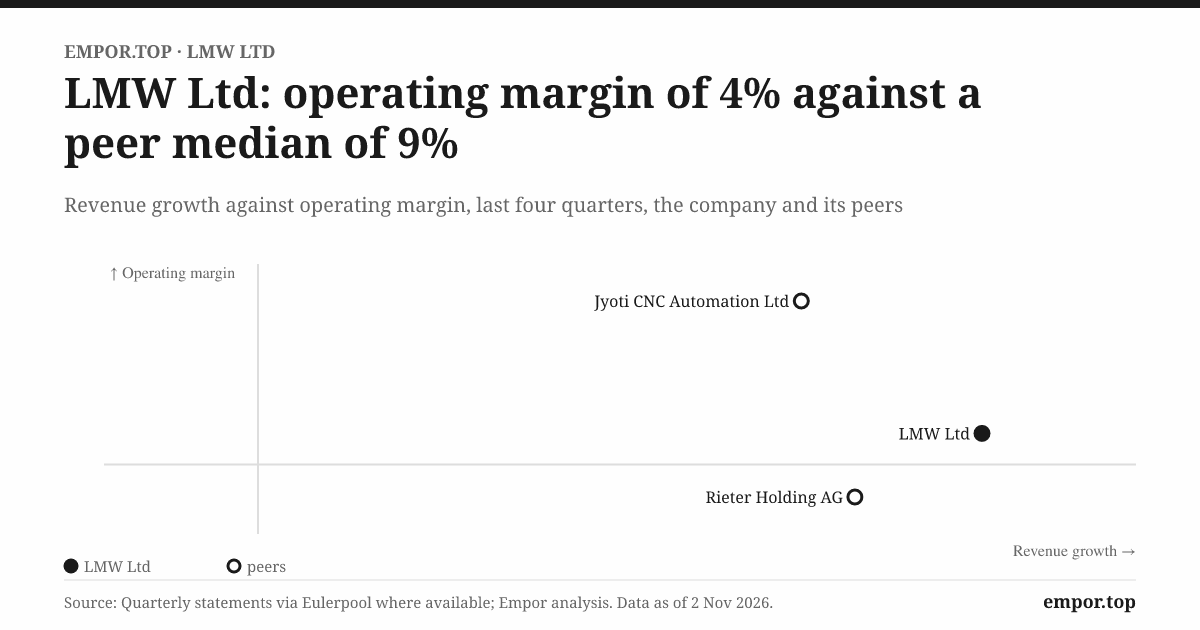
Now the harder part. LMW's operating margin in the year to March 2026 was about 1.5%. For every ₹100 of sales, it kept about ₹1.50 as operating profit after paying for materials, staff, depreciation and overheads.3 Yet the company reported profit before tax of about ₹182 crore. The gap was filled by other income of about ₹146 crore, which was roughly 80% of pre-tax profit.3 In the previous year, the pattern was similar: other income of about ₹125 crore against pre-tax profit of about ₹151 crore.3
Where does that other income come from? Mostly from the cash pile. In the year to March 2026, about ₹88 crore was interest income, about ₹23 crore came from gains on redeeming or selling investments, about ₹16 crore from foreign-exchange gains and about ₹16 crore from net gains on selling assets.3 At March 2026, the parent alone held about ₹137 crore of cash, about ₹870 crore of other bank balances, about ₹338 crore of current investments and about ₹736 crore of non-current investments, largely bank fixed deposits and mutual funds.3 Put together, that is more than ₹2,000 crore of financial assets, roughly an eighth of the company's market value.
There is nothing improper about earning interest on idle cash. It is what a prudent company should do with money it does not need. But it changes how the earnings should be read. In the worst of the downturn, LMW was essentially two businesses under one roof: a machinery maker earning almost nothing at the operating level, and a treasury earning a steady return on a large deposit base. Reported profit blended the two, which made the core look healthier than it was. Some of the other income is also inherently variable. Currency gains depend on where the rupee goes, and LMW reports no derivative hedging; it estimates that a 5% move in exchange rates would change profit by about ₹6 crore.3 Gains on selling assets do not recur by design.
The quarterly pattern through the trough shows how thin the operating cushion became. In the June 2024 quarter, LMW recorded an operating loss, and over the next two years it slipped into an operating loss once more and barely broke even in several other quarters, while pre-tax profit stayed positive throughout because of the treasury.3 Effective tax rates bounced between about 18% and more than 50% from quarter to quarter, which is what happens when small operating profits meet large, differently taxed investment gains. None of that is a sign of accounting aggression; it is simply what a machinery company with a bank attached looks like when the machinery side goes quiet.
The first half of the current year is the first sign that the operating engine is catching up. The September quarter's margin was a real improvement,1 and it means the doubling of pre-tax profit owes more to the factories than last year's numbers did. Whether that holds depends on whether the order book converts at those margins.
Following the cash
Profit is an opinion; cash is a fact, as the old accounting saying goes. Over the twelve years from March 2015 to March 2026, LMW generated about ₹2,084 crore of operating cash flow against about ₹2,277 crore of net profit, a conversion rate of about 92%.3 For a capital-goods maker that has to hold inventory and extend credit, that is respectable. Over the same period, free cash flow, meaning operating cash minus capital spending, was about ₹571 crore, and dividends absorbed about ₹524 crore of it, also about 92%.3 In other words, LMW has paid out almost everything its operations freed up, and its growing cash pile has come largely from the treasury income on money accumulated in earlier years.
The year-by-year pattern is far bumpier than the average suggests. In the year to March 2026, operating cash flow was about ₹177 crore against profit of about ₹131 crore, so cash beat profit.3 But the same year saw trade receivables at the parent rise to about ₹297 crore from about ₹184 crore, as customers took longer to pay or larger orders were billed close to year-end.3 The ageing of those receivables deserves a brief look. About half was not yet due, but about ₹18 crore was more than a year overdue, and the company increased its expected credit-loss allowance by about ₹9.6 crore, after reversing allowances the year before.3 Actual bad-debt write-offs remained tiny, and LMW reports no significant concentration with a single customer. That is a watch item, not an alarm, but it is a reminder that a recovering order book can come with looser payment discipline from customers who are themselves only just recovering.
What the balance sheet does establish is resilience. LMW carries no borrowings, its contingent tax claims are small, and its auditor gave an unmodified opinion on the latest accounts.3 Crisil rated the group AA with a stable outlook in August 2026, citing the market position, product diversity and debt-free balance sheet, while naming textile cyclicality and raw-material price volatility as the main constraints.4 This is a company that can wait out almost any downturn.
The problem is that waiting is not the same as earning. Resilience and returns are different virtues, and LMW has had plenty of the first and too little of the second. The operating measures that will tell the difference are now clear: whether the textile order book converts into dispatches at recovering margins, whether machine-tool capacity earns more than it costs, and whether aerospace sales turn into meaningful segment profit. Each of those depends on decisions made by a small group of people at the top of the company, which is where the story turns next.
VII. The Promoter Family's Next Five Years
On 25 July 2026, the scrutiniser counting the votes from LMW's 63rd annual general meeting filed a report that, on its face, contained no surprises.13 Shareholders had approved the reappointment of Sanjay Jayavarthanavelu as managing director for another five years, running from April 2027. The resolution passed comfortably. But about 6.47% of the valid votes cast had gone against it, and a separate resolution reappointing whole-time director M. Sankar drew about 5.31% dissent.13 In a company where the promoter group alone controls almost a third of the votes, those numbers are worth pausing on.
The man at the centre of that vote has spent most of his adult life inside LMW. The founder's grandson, Sanjay Jayavarthanavelu, has led the company through the 2017 slowdown, the pandemic collapse, the post-pandemic boom and the bust that followed.6 Few listed Indian industrial companies have had such continuity at the top. That continuity is both the case for confidence and the reason for scrutiny, because a leader who has been in charge for sixteen years owns the record in full.
The ownership structure frames how accountability works. As of September 2026, the promoter group held about 30.8% of the shares, foreign portfolio investors about 5.4%, domestic institutions about 9.5% and the broader public the rest, spread across about 30,857 shareholders.14 The promoter stake had slipped from about 31.1% in March 2025 after the Lakshmi Mills Company, a family-linked entity, sold a small block of shares in the market in May 2025; otherwise ownership has been stable.1415 There are no promoter pledges, no warrants and no outstanding employee stock options, and the company has only about 1.07 crore shares in issue. A single share trades for more than ₹15,000.14
A 30.8% stake is large enough to give the family a deep, long-term interest in the company's value, and small enough that the family cannot carry ordinary resolutions without support from outside shareholders. That is the context in which the dissent should be read. A 6.47% vote against is not a rejection, and it is not unusual in India for institutional investors to oppose some executive resolutions as a matter of policy. But it is a signal that a portion of the outside holders were not comfortable, and the most likely sources of that discomfort are visible in the annual report.
Pay, performance and the affiliates
The first is pay. Managerial remuneration in the year to March 2026 was about ₹20.9 crore, up from about ₹12.3 crore the year before.3 Reported standalone profit after tax actually fell, from about ₹238 crore to about ₹154 crore, but that comparison is misleading because the earlier year included a one-off gain of about ₹132 crore from selling investments in subsidiaries.3 Stripping out exceptional items, standalone profit rose from about ₹107 crore to about ₹167 crore.3 So the pay rise did coincide with better underlying profit. The issue is scale: managerial remuneration equal to roughly an eighth of pre-exceptional profit is a large share for a company whose return on equity was in single digits, and it is the kind of ratio that draws a proxy adviser's attention.
The second is related-party dealings. LMW sits inside a web of family-linked companies, and it does a lot of business with them. In the year to March 2026, purchases of goods from related parties were about ₹354 crore and services received about ₹186 crore, while sales of goods to related parties were about ₹48 crore.3 Purchases and services together amounted to roughly 17% of consolidated operating income, a material slice of the company's cost base. The company states that these transactions are priced on a cost-plus basis and benchmarked against what it charges unaffiliated customers.3 That may well be accurate. The difficulty is that the company reports other related parties in aggregate, which does not let an outside reader trace costs and balances to each affiliate individually. At March 2026, LMW owed related parties about ₹145 crore and was owed about ₹41 crore.3
There is no evidence in the filings of the classic abuses: the listed company has not borrowed from the promoter group or guaranteed its debts, and the auditor's report raises no related-party qualification.3 But an activist looking at LMW would ask a simple question. If about one rupee in six of the company's revenue flows out to affiliates as purchases and services, and the company is earning a 1.5% operating margin, how confident can minority shareholders be that the pricing of those flows is not part of the margin problem? Full affiliate-by-affiliate disclosure would answer that question. Its absence does not prove anything, but it leaves the question open.
The board structure offers some counterweight. LMW had an independent majority on its board, which in principle gave outside directors the votes to challenge pay, related-party terms and capital decisions.3 Whether they do so is not something the filings reveal; Indian boards rarely publish dissenting notes, and LMW's are no exception. Succession is the other open question. The managing director's new term will run into the early 2030s, and the company does not publish a succession plan beyond the reappointments shareholders approved.13 For a family company in its third generation of leadership, continuity is the default, and the default has served LMW's survival well. It has not, on its own, delivered the returns the current share price assumes.
The capital record
The capital-allocation record is more reassuring on what LMW has avoided than on what it has achieved. The company has not chased large acquisitions, has not issued equity to fund growth and has not taken on debt.3 The one significant structural plan of recent years, the aerospace transfer, was withdrawn rather than forced through, as the July 2023 filing showed.10 And LMW has paid out most of its free cash flow as dividends over the past twelve years rather than letting it pile up for vanity projects.
But conservatism has a cost. The cash pile has grown largely from interest on interest, and the core business has earned thin returns through the downturn. LMW's overseas subsidiaries add a further caution: LMW Global FZE, the overseas subsidiary, turned over about ₹184 crore in the year to March 2026 and lost about ₹29.5 crore, while the Chinese subsidiary roughly broke even on turnover of about ₹130 crore.3 International scale, on this evidence, has not yet translated into international profit.
The new tests for management are therefore specific: the returns on the planned ₹150 crore aerospace investment once commissioned, and on the machine-tool capacity now being ramped. On the October call, analysts pushed on exactly these points, asking about textile margins, aerospace timelines, overseas subsidiary losses, machine-tool utilisation and order demand.1 Management's answers were consistent and measured, describing demand as strong in machine tools, improving in textiles and promising in aerospace, but they offered few hard targets. That is a reasonable posture for a cyclical business that has been burned by forecasting before. It also means investors are asked to trust the family's judgement rather than measure it against published goals.
The family's long-term stake, the debt-free balance sheet and the willingness to reverse the aerospace plan all count in management's favour. The dissent, the jump in pay and the opacity of affiliate dealings count against. The record leaves the governance case intact but unproven: there is no sign of misconduct, but there is also not enough disclosure for outside shareholders to verify that the company is run with their returns as the first priority. Which brings the story to the question every investor ultimately has to answer: at today's price, what has to go right?
VIII. Analysis & Bear vs. Bull Case
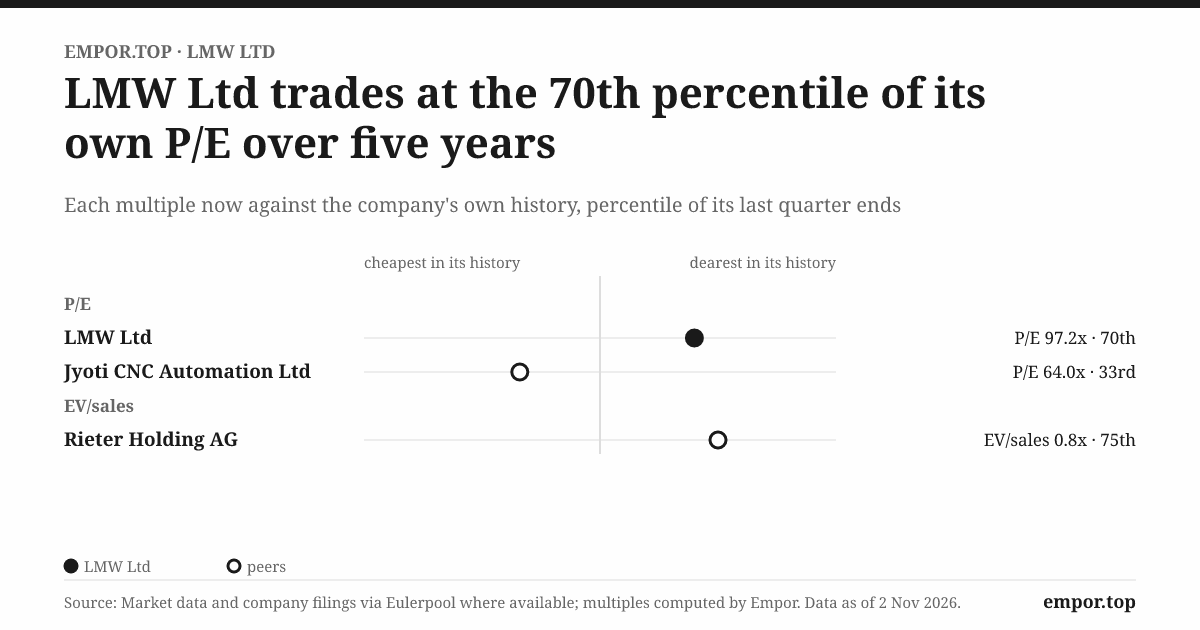
Here is the puzzle in one sentence. The market values LMW at about 97 times its trailing earnings, well above its own five-year median of about 68 times, even though its latest return on equity is about 6.7% and its free cash flow yield, the cash the business generates relative to its market value, is about 0.1%.3 Investors are paying a growth-company price for a business whose recent returns look like a utility's on a bad day. Either the market sees something the trailing numbers do not, or it is paying for a recovery that has not yet been delivered.
Some of the gap is arithmetic. Earnings in the trailing period are depressed, and price-to-earnings ratios balloon at the bottom of a cycle because the denominator shrinks. If LMW's profits returned to the levels of the years to March 2023 and 2024, the multiple on today's price would look much less extreme. That is the essence of the bull case. But the market is not only pricing a return to the old peak. At about 5.8 times book value and about 46 times enterprise value to EBITDA, the market is pricing a company that earns well above its cost of capital across the cycle, which LMW has not demonstrated in recent history.3
The peer comparison is imperfect but instructive. Jyoti CNC Automation, a listed Indian machine-tool maker with a more focused business, traded at about 64 times earnings at the start of November 2026.[^10] Rajoo Engineers, a smaller plastics-machinery company, traded at about 22 times in a recent reporting window.16 Neither is a like-for-like comparison: their product mix, margins and growth profiles differ materially from LMW's. But they show that LMW's multiple sits at the very top of the Indian machinery range, priced more richly than a pure-play machine-tool growth story even though most of LMW's revenue still comes from textile machinery.
The industry around the franchise
Michael Porter's five forces help frame why LMW's core business earns what it does. Buyer power is the dominant force. Spinning mills are numerous and fragmented, so no single one can dictate terms, but collectively they control the timing of demand, and they can defer purchases whenever yarn economics weaken. That collective power to wait is what turns a modest slowdown in mill profits into a halving of LMW's textile turnover. Rivalry is real: Rieter, Trützschler, Saurer and Kirloskar Toyota compete for the same mills, and Chinese manufacturers press on price in export markets.8 Supplier power matters too: LMW buys steel, castings and, increasingly, electronics and drive systems. Crisil names raw-material price volatility as one of the company's main constraints, while the availability of electronic components has been a recurring concern for deliveries.41 The threat of new entrants is low, because building a full-line spinning-machinery capability takes decades, and the threat of substitutes is limited, because there is no practical way to spin yarn without spinning machinery. The industry structure, in short, protects LMW from new competitors but not from its customers or its existing rivals.
Hamilton Helmer's 7 Powers framework asks a sharper question: what, specifically, allows LMW to earn persistent returns above its cost of capital? The candidates are process power, the accumulated know-how of decades of making precision equipment; a form of scale economy in domestic manufacturing and service; and switching costs from the installed base, since a mill standardised on LMW machines has trained staff and stocked spare parts for them. Each of these plausibly exists. None is proven by the record. If switching costs were strong, LMW's share of mill spending would be visible and stable, and its margins at the peak of the cycle would be higher. The company does not publish current retention, discounting or share-shift data, and its best operating margins over twelve years stayed below 9%.3 On the evidence, LMW has the powers of a respected specialist, not the powers of a business that can set its own price.
The two cases
The bull case runs as follows. The active order book converts over the coming quarters at margins that keep improving from the September quarter's level, and the textile division recovers toward its former earning power.1 Machine tools remain an established second engine, already a third of revenue and exposed to a different end-market.1 Aerospace adds a third leg as it grows and the planned investment is commissioned.1 With no debt and more than ₹2,000 crore of financial assets, LMW can fund all of it internally, and operating leverage, the tendency of profits to rise faster than sales when fixed costs are spread over more volume, does the rest.
The bear case is the history this story has been tracing. Textile machinery still provided about 56% of revenue in the year to March 2026, and its demand is set by the mill investment cycle, which has produced three deep contractions in under a decade.3 Even at the top of those cycles, operating margins stayed in single digits. Raw-material and electronics availability can pressure both delivery schedules and margins just as the order book is being converted. The machine-tool engine is half dependent on automotive demand, which is cyclical in its own right. Aerospace is small, and its expansion has no published timeline. And through the downturn, treasury income did much of the work in reported profits, which means the headline earnings multiple overstates what the machinery business is actually earning.
A skeptical long-short investor would put the challenge bluntly. Strip out the cash and investments, and the market is paying something like ₹15,000 crore of enterprise value for a machinery business that earned operating profit in the low tens of crores in its last full year.3 Even if that business returns to its old peak margin on today's sales, the valuation assumes a growth path that the company has not guided to and that its own history does not support. The cash-rich thesis does not rescue that argument, because cash buys resilience, not returns: a ₹2,000 crore deposit earning bank rates cannot justify a 97 times multiple, however safe it makes the company.
A simple piece of arithmetic shows what the price assumes. Suppose LMW's revenue climbed all the way back to its last peak, roughly ₹4,600 crore in the year to March 2024, and its operating margin returned to about 8%, close to the best it has managed in twelve years.123 That would produce operating profit of around ₹370 crore. Add treasury income at last year's level, take out tax at a normal rate, and net profit would land somewhere near ₹380–400 crore. Against today's market value of about ₹17,000 crore, that is still a multiple in the low-to-mid forties. In other words, even a full return to the old peak, which the company has not promised, would leave LMW valued well above most Indian industrial companies. The market is not only betting on recovery. It is betting that the next peak will be higher than the last one.
The bull would answer that cyclical businesses always look expensive at the bottom, and that the order book is evidence the bottom has passed. Both arguments have merit. What settles them is not a debate but a short set of numbers.
Three measures matter most. The first is conversion of the active textile order book into dispatches and, crucially, into textile segment margin, with the latest signs being the active order book and improving group margin.1 The second is machine-tool utilisation and segment profit as capacity rises, building on current high utilisation and strong demand.1 The third is aerospace revenue, utilisation and returns after the new investment is commissioned, with the business growing and the investment still in planning.1 At this valuation, execution on all three has little room to disappoint.
IX. Playbook: Business & Investing Lessons
The 1988 machine-tool move and the 2023 aerospace reversal, thirty-five years apart, contain most of what LMW has to teach.
The first lesson is that capability is built before it is needed. LMW’s machine-tool move came long before anyone could have predicted that machine tools would carry the company through a textile bust. Engineering capability compounds slowly and invisibly. For founders, the point is that the most valuable diversification often grows out of what a company already knows how to make. For investors, it is that such capability is easy to undervalue in a good year and only shows its worth when the main business stalls. At LMW, the second engine was built in 1988 and finally carried real weight in 2026.
The second lesson cuts the other way. A second engine must carry weight before it changes the investment case. Machine tools now provide about a third of LMW’s revenue and grew strongly while textiles shrank, which makes them a genuine counterweight. Aerospace, after more than fifteen years since its dedicated facility opened, provides about 6%. Certifications are entry tickets, not income. A company can be fully qualified to make aircraft parts and still be a rounding error in its own results, and LMW’s aerospace story is a reminder that the time from technical milestone to material profit is measured in decades, not quarters. The quotable version: in aerospace, the certificate is the cost of admission, not the prize.
The third lesson belongs to this company’s current moment. A full order book is a bridge, not a destination. LMW’s textile division is now carrying an order book larger than a year of recent sales. That is a powerful signal of demand. But an order is a mill’s intention to buy at a price agreed in a different market; the margin is earned only when the machine is built, dispatched and paid for, with steel, electronics and labour bought at whatever they cost by then. Investors who treat an order book as earnings in waiting forget that LMW’s best years have rarely produced margins that would justify paying for the orders in advance.
The fourth lesson is the one LMW’s balance sheet teaches most clearly: cash buys time, and returns tell you what the time was worth. LMW’s financial strength meant that the worst downturn in years never threatened the company’s survival. But when other income covers about four-fifths of pre-tax profit, the balance sheet is no longer just a cushion. It is a mask over the operating return. The founder-led companies that compound for generations use their financial strength to win share or invest in the downturn; the ones that merely survive use it to report profits.
The fifth lesson is about judgement. Withdrawing the aerospace transfer scheme was a course correction, and course corrections deserve credit, because most organisations push ahead with plans rather than admit they no longer make sense. But a reversal is only the first half of a good decision. The second half is what happens next, and at LMW that is a ₹150 crore investment with no commissioning date. Changing your mind is a skill; being right the second time is the result.
X. Epilogue
Tonight, LMW stands at an awkward and interesting point. Its textile division has more orders than it has had in two years. Its machine-tool factories are running at three-quarters capacity or more and being expanded. Its aerospace unit is growing quickly and planning its next investment. And yet, in the same October call that delivered those numbers, management still described textile demand as something to watch rather than bank on, just as it had in July, and still could not say when the new aerospace capacity would be commissioned.117
The next two reporting periods will begin to settle the question that opened this story. The December and March quarters are when the active order book should show up as dispatches. If revenue rises and the textile margin rises with it, LMW will have shown that its recovery is more than a bounce, that the franchise can convert demand into profit rather than just volume. If revenue rises while margins lag, held back by input costs, competitive pricing or the strain of a fast ramp-up, the order book will have proved to be what skeptics feared: a promise of activity, not of returns.
The machine-tool expansion has its own clock. Management has cited automotive demand and China-plus-one investment as the forces behind it. If utilisation stays high as capacity grows and segment profit rises in step, the second engine becomes a genuine pillar of the group. If the automotive cycle turns while new capacity is coming on stream, LMW will learn that diversifying away from one cycle can mean importing another.
Aerospace's moment will be the commissioning of the planned ₹150 crore investment. Until a date is set and the new capacity starts producing, the business remains what it has been: a growing, capable unit too small to move the group. After it, the question becomes whether the added revenue arrives at a margin that justifies the spend.
Each of those outcomes will also show up somewhere less glamorous: the working-capital lines. If the recovery is healthy, receivables and inventory should rise roughly in line with sales and then convert into cash. If customers are stretching payments to fund their own expansion, or finished machines start piling up waiting for dispatch, the cash flow statement will reveal it before the profit and loss account does. For a company that paid out almost all its free cash flow in dividends over a decade, the quality of that cash matters as much as the quantity of orders.
There is a quieter watch item too. LMW Global FZE turned over about ₹184 crore last year and lost about ₹29.5 crore.3 Overseas scale that loses money is not diversification; it is a cost. Whether that subsidiary narrows its losses as textile exports recover will say a good deal about whether LMW can compete outside India on profitable terms.
And over all of it hangs the valuation. At about 97 times trailing earnings, the market has already paid for much of the recovery. If operating returns, cash conversion and earnings climb toward their former peaks, the multiple will compress naturally as profits rise. If they do not, the gap between price and performance will become harder to ignore. The tension that remains is the one that has defined LMW for sixty years: a company that has always been able to build the machine, waiting to learn whether this cycle will let it build the returns.
XI. Outro
In Coimbatore, the cotton town where it all began, LMW still makes machinery for mills in India and around the world.
That is the achievement. The challenge is different. Building the machine was the first act; making the business compound is the second, and it has not yet been written. LMW has proved it can endure the textile cycle. What makes its story distinctive is that its next chapter depends on proving it can outgrow it.
References
-
Q2 FY27 analyst meet transcript — LMW Limited, 2026-10-22 ↩↩↩↩↩↩↩↩↩↩↩↩↩↩↩↩↩↩↩↩↩↩↩↩
-
Annual Report 2025–26 — LMW Limited, 2026 ↩↩↩↩↩↩↩↩↩↩↩↩↩↩↩↩↩↩↩↩↩↩↩↩↩↩↩↩↩↩↩↩↩↩↩↩↩↩↩↩↩↩↩↩↩↩↩↩
-
LMW Limited rating rationale — Crisil Ratings, 2026-08-07 ↩↩↩↩
-
LMW Limited equity quote — National Stock Exchange of India, 2026-11-02 ↩
-
LMW 50 years of fortitude — Indian Textile Magazine, 2012-11-01 ↩↩↩↩
-
Lakshmi Machine Works: Initiating Coverage — Nirmal Bang, 2015-02-06 ↩↩
-
Textile Machinery Market: Demand & Supply Dynamics — Aras, 2025 ↩↩
-
Withdrawal of scheme of arrangement — LMW Limited, 2023-07-31 ↩↩↩↩
-
63rd AGM scrutinizer's report and voting results — LMW Limited, 2026-07-25 ↩↩↩
-
Shareholding pattern as of 30 September 2026 — LMW Limited, 2026-09-30 ↩↩↩
-
Shareholding pattern as of 31 March 2025 — LMW Limited, 2025-03-31 ↩
 LinkedIn
 WhatsApp
 Reddit
 Hacker News
 Email
 Kindle
 RSS Feed
 Spotify
 Apple Podcasts
 Amazon Music
 Audible
 YouTube