Linde India: The Gas Business, the Growth It Lost, and the Value Still in Dispute
I. More Revenue, Less Profit
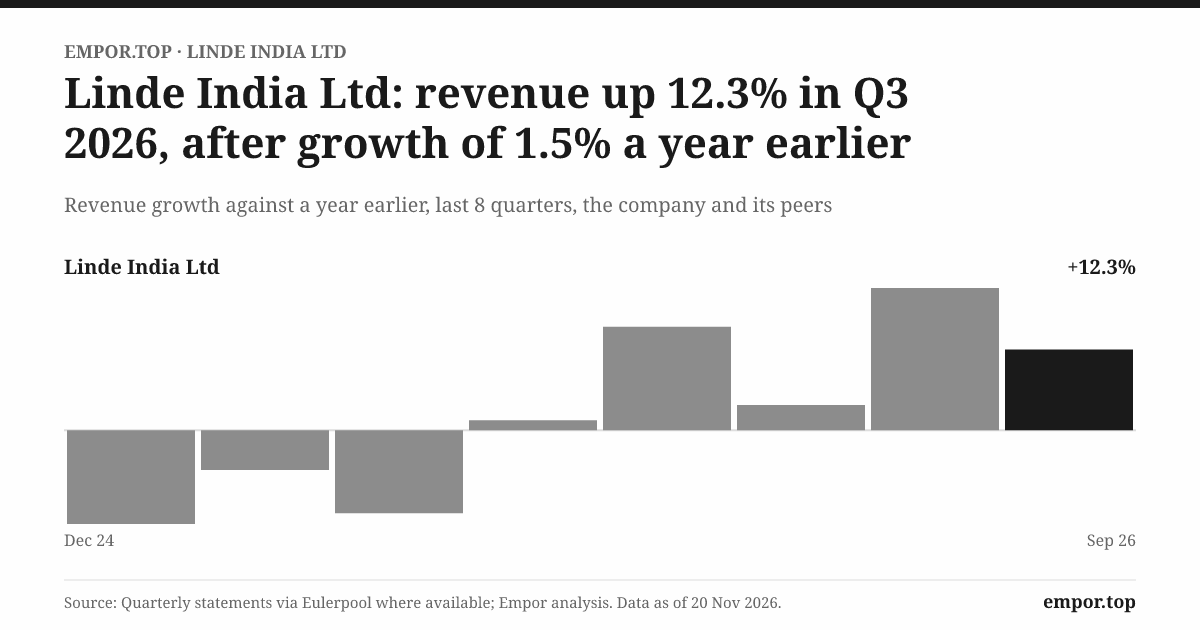
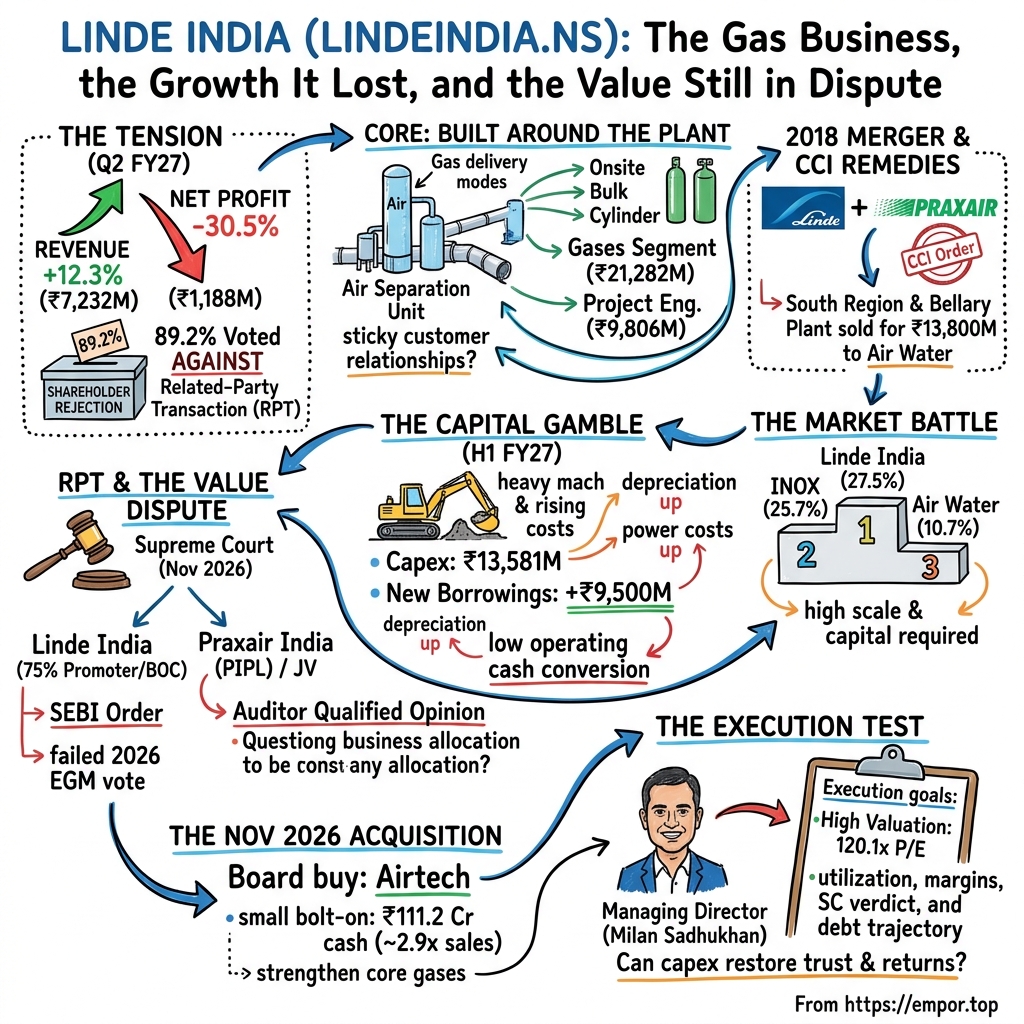
On 3 November 2026, the board of Linde India met and approved a set of numbers that did not agree with each other. In the three months to September, the company sold ₹7,232 million of gases, equipment and engineering work, 12.3% more than in the same quarter a year earlier.1 Over the same three months, the profit left for shareholders fell to ₹1,188 million from ₹1,710 million, a drop of almost a third.1 The business was getting bigger and earning less.
That would be an ordinary puzzle for an industrial company in the middle of a building programme, if it were the only puzzle. It was not. Eight months earlier, on 5 March 2026, Linde India's shareholders had gathered for an extraordinary general meeting with a single serious piece of business: a resolution asking them to approve the company's related-party transactions for the 2025–26 financial year. The votes came back with a margin that looks more like a referendum than a corporate ballot. Of the votes cast, about 89% were against.2 The resolution failed.
Put the two moments side by side and the shape of this story appears. One is about economics: whether a company that has spent heavily on new plants can turn those plants into growth that pays. The other is about entitlement: who gets to own the business those plants serve. In most companies those are separate questions. At Linde India they are tangled together, because the company does not operate alone. It is a listed subsidiary inside one of the largest industrial-gas groups in the world, and its public shareholders have spent years arguing that some of the value they thought they owned has been routed elsewhere.
Start with the boundary, because everything that follows depends on it. Linde India is 75% owned by The BOC Group Limited, which is itself part of Linde plc, the group formed when Linde AG and Praxair combined in 2018.34 Linde plc is a global giant. Linde India is not Linde plc. Its revenue, its plants, its customers and its profits are its own, reported separately and listed separately in Mumbai, where the shares have traded on the BSE since 1992 and on the National Stock Exchange since 1999.5 Inside India the group also owns Praxair India Private Limited, a fellow subsidiary that is not listed and whose results do not flow to Linde India's public holders.4 When this story talks about market share, plants or profits, it means the listed company unless it says otherwise. That distinction is not pedantry. It is, in a sense, the whole dispute.
The minority shareholder who voted no in March was not voting against oxygen. Linde India sells something industrial India cannot do without: oxygen for steel furnaces and hospital wards, nitrogen for blanketing chemicals and preserving food, argon for welding and metal-making. It builds and runs air separation plants, and it designs and sells such plants to other customers. The question that shareholder was asking was narrower and sharper. When the group finds the next big customer in India, which company gets the contract?
So three questions frame the story. The first is whether the new plants will earn their cost. Linde India has been spending at a pace it has not seen in years, borrowing for the first time in a long while to do it, and the latest quarter shows costs racing ahead of revenue. The second is how much of the Indian opportunity belongs inside this listed company at all, given an arrangement that divides new business with Praxair India by geography and other rules. The third is whether today's profit pressure is a passing feature of an investment cycle, the familiar dip before new capacity fills up, or a sign that the underlying economics are weaker than the share price assumes.
The record gives a surprising amount to work with. The company reports two segments, gases and project engineering, and their economics are very different. The related-party dispute has passed through the market regulator, an appeals tribunal and into the Supreme Court of India, which issued an order on 6 November 2026, just over two weeks before this story was written.6 The auditor qualified its opinion on the company's 2024–25 accounts because of it.4 And the next test, what the new assets actually earn, is already visible in the quarterly cost lines.
To understand why any of this matters, though, it helps to start with what Linde India physically does, and why a gas supplier can become almost part of a customer's factory.
 Subscribe on LinkedIn
II. A Company Built Around the Plant
Picture a steel works at three in the morning. The blast furnace and the oxygen converter do not care what time it is. They need a continuous, enormous flow of oxygen, and if that flow stops, production stops with it. A few hundred metres from the furnace sits a different kind of plant: a cluster of compressors, heat exchangers and a tall insulated column, humming without pause. It pulls in ordinary air, cools it until it turns liquid at temperatures below minus 180 degrees Celsius, and lets the components boil off one by one, the way a distiller separates alcohol from water. Oxygen comes off at one point in the column, nitrogen at another, argon at a third. Pipes carry the gas straight into the customer's works.
That is an air separation unit, and it is the machine at the heart of Linde India. The company's roots go back to 1935, when it began life in what was then Calcutta, and it spent most of its history inside the orbit of Britain's BOC group, before the German Linde group, which bought BOC in 2006, gave it the Linde name.5 The old history matters only for one reason. This was never a start-up selling a new idea. It was an established supplier of a commodity, and its value has always rested on infrastructure, technical skill and location rather than on invention. The 2024–25 annual report disclosed no research and development spending at all.4 Linde India's edge, if it has one, is engineering and operations, not patents.
There are three ways to sell the same gas, and they behave like three different businesses. The first is onsite supply, the plant beside the steel works. The supplier builds or runs an air separation unit at or near the customer and delivers by pipeline. This is where relationships become sticky. Once a plant has been built for a specific customer, connected to its processes and sized to its demand, replacing the supplier means building a new plant or ripping out the old one. The second is merchant bulk: liquid gas made at a central plant, loaded into cryogenic tankers and driven to hospitals, fabricators, pharmaceutical units and smaller factories that do not need their own plant. Here the economics depend on how full the producing plant runs and how far the trucks must drive, because liquid oxygen is cheap to make and expensive to haul. The third is packaged gas: cylinders, filled and distributed, sold in small quantities to welders, laboratories and clinics, with more handling and more competition.53
Across all three, two variables decide the money. One is proximity, because transport is a large share of delivered cost and a supplier close to the customer wins on price. The other is utilisation. An air separation plant is mostly a fixed cost: the capital to build it and the electricity to run its compressors. A plant running near capacity spreads those costs over many tonnes; a plant running half-empty does not. That is why a new plant can lower profits before it raises them. The depreciation and the power bills arrive before the volumes do.
The scale of the gas business shows up in the segment accounts. In the year to March 2026, gases, related products and services produced ₹21,282 million of segment revenue and ₹6,419 million of segment profit.3 That is a margin of about 30% at the segment level. It is the economic core of the company: roughly two-thirds of revenue and more than four-fifths of segment profit.
The second segment is a different animal. Project engineering designs, supplies, tests, erects and commissions plants for others, both cryogenic air separation units and non-cryogenic systems.5 In the same year it generated ₹9,806 million of revenue and ₹1,188 million of segment profit, a margin of about 12%.3 This is not recurring revenue. It is order-driven work that depends on customers deciding to build, which means it rises and falls with industrial capital spending. A good year in engineering can flatter the top line without saying much about the durability of the gas franchise. That point will matter when we get to the latest quarter, where most of the revenue growth came from exactly this lumpier side.
There is one more piece in the consolidated accounts. Linde India includes its share of profit from two joint ventures, which sit outside the two operating segments.3 One of them supplies manpower: at 31 March 2025 the company had only 256 permanent employees on its own rolls, while a further 1,339 non-permanent workers were employed through a joint venture that provides manpower services to Linde India and other group companies.4 It is a small detail with a large implication. Even the workforce of the listed company is, in part, shared with the wider group.
So how strong is the customer relationship, really? The onsite model gives good reasons to believe it can be durable. A customer with a dedicated plant has high switching costs and a reason to renew. But a sophisticated investor would want the numbers that prove it: average contract length, take-or-pay minimums, pricing formulas that pass through power costs, renewal rates, the share of revenue that is contractually recurring. Linde India does not publish them.43 The company describes onsite plants and renewals as long-lived relationships; it does not quantify them. The moat may be real, but it is only partly visible from the outside.
And there is a second, stranger limit. The customers may stay with the plant, but the plants and the customers have not always stayed with this listed company. Twice in recent history, the map of what Linde India owns was redrawn from above. The first time, the pen was held by India's competition regulator.
III. The Merger That Redrew the Map
In September 2018, a decision about two foreign companies landed on the desk of an Indian regulator, and it was about to change the shape of an Indian listed company that had no say in the matter. Linde AG of Germany and Praxair of the United States had agreed to merge into what would become the world's largest industrial-gas company. Every major competition authority had to approve. In India, the Competition Commission of India looked at the two groups' local businesses and did not like what it saw.
The concern was straightforward. In India, Linde and Praxair were not small foreign brands; they were among the leading suppliers of tonnage gases, the large volumes piped to steel mills and big industrial sites. The Commission estimated that in selected regional tonnage markets, the combined parties would hold around 55–60% of tonnage oxygen and nitrogen and 35–40% of argon.7 Putting them together, in the Commission's view, would widen their lead over everyone else and reduce the competitive tension that keeps prices honest. Those percentages describe the merging parties in specific markets before any remedy. They are not Linde India's market share today, and they should not be read that way.
The Commission approved the merger, but with a price. It directed the parties to divest certain Indian businesses to an independent buyer.78 For Linde India, that meant selling part of itself.
Watch how the remedy travelled through the listed company. The core of it was a package known as the south-region divestment business. It included a large onsite air separation plant at Bellary in Karnataka with a capacity of 1,800 tonnes a day, serving the JSW Steel complex, along with cylinder-filling operations at Hyderabad and Chennai.9 In August 2019, Linde India's board approved the sale of that business to Air Water India, part of Japan's エア・ウォーター Air Water group, for ₹13,800 million on a cash-free, debt-free basis.10 The deal completed later that year, with the Commission having approved Air Water as the buyer.1011
The money was real, and it was large. ₹13,800 million arrived in the listed company, which is why its 2019 accounts carried a huge exceptional gain and why its balance sheet suddenly turned almost debt-free.9 But the business that left was also real. An 1,800-tonne-a-day onsite plant beside one of India's biggest steel complexes is precisely the kind of sticky, pipeline-connected relationship that makes onsite supply valuable. Linde India swapped a long-lived customer position for a cheque.
What the company did with the cheque says something too. For the next few years, much of it simply sat. Cash and short-term investments climbed through 2020 and 2021 as profits accumulated on top of the divestment proceeds, and borrowings that had stood at roughly ₹1,200 crore before the remedy shrank to almost nothing.94 Dividends stayed modest. A cash-rich balance sheet is comfortable, but for a capital-intensive business it is also a sign of a company that has not yet found the next set of plants to build. That search, when it finally came, would turn the vault back into a construction site, and it would run straight into the question of which regions Linde India was allowed to build in.
There was a second, smaller piece of the remedy, and its ending says something about how these assets live and die. Linde India held 50% of Bellary Oxygen Company, known as Belloxy, a joint venture that ran an 855-tonne-a-day air separation unit supplying JSW Steel.1112 The Commission's order required that stake to go as well. In practice, the plant's gas-supply contract with JSW expired on 14 November 2021, and the joint venture sold the air separation unit and related assets to JSW Steel itself, handing over possession with closing documents signed the next day.12 The joint venture was then to be liquidated. In other words, the customer bought the plant. It is a useful reminder that the switching costs of onsite supply run both ways: when a contract ends, a big enough customer can decide to own the machine itself.
Meanwhile, the change of parent set off a familiar sequence in Indian capital markets. Because control of Linde India's promoter had changed at the global level, an open offer to public shareholders followed in 2018.13 Then, in early 2019, the promoter tried to delist Linde India entirely, offering to buy out the minority and take the company private.5 India's reverse book-building process lets shareholders set the price at which they will tender, and the price that emerged was one the promoter would not pay. It rejected the discovered price and the delisting failed.514
That failure deserves more weight than it usually gets. If the delisting had succeeded, the group could have reorganised its Indian businesses however it liked, because there would have been no public shareholders to object. Because it failed, Linde India remained a listed company with a controlling shareholder owning 75% and a minority owning the rest, sitting next to an unlisted sister company, Praxair India, in the same industry and the same country.143 Two companies under one parent, chasing the same customers, one with public shareholders and one without. That arrangement needed rules about who would get what.
So the merger was not just a change of name on the parent's letterhead. It shrank Linde India's footprint through mandated disposals, turned a debt-laden balance sheet into a cash-rich one, and then left it sharing a market with a fellow subsidiary. In a business where location and customer proximity decide who wins, the question of which opportunities accrue to Linde India and which to its related parties is not a governance footnote. It is a question about the size of the business. Before following that dispute, though, it is worth asking how strong the business left behind actually is.
IV. How Much of the Moat Is Visible?
Imagine you are the procurement head of a large refinery planning a new unit. You need a reliable supply of nitrogen and oxygen for the next fifteen years. You will not choose your supplier the way a household chooses a mobile plan. You will run a tender, invite the big names, compare the price per tonne, the power efficiency of each design and the supplier's record of keeping plants running. You will probably ask at least two of them to sharpen their pencils against each other. Once you sign, you are bound together for a long time. Before you sign, you hold most of the cards.
That scene captures the tension at the centre of the industrial-gas business. Buyers are powerful before a contract and captive after it. The question for Linde India is how much it benefits from the second phase while surviving the first.
Start with scale. A 2025 industry report by Frost & Sullivan, prepared for a regional competitor's share offering, estimated that in the year to March 2024 Linde India held about 27.5% of the Indian industrial-gas market, ahead of INOX Air Products at about 25.7% and Air Water India at about 10.7%, with Air Liquide and regional suppliers such as Ellenbarrie making up much of the rest.15 Treat those figures with care. They are a consultant's estimate, not audited company data, and they cover the broad market rather than the narrow regional tonnage markets the competition regulator examined in 2018. They also show something the "market leader" label tends to hide. Linde India is first, but barely. INOX Air Products, an Indian company built by the Jain family's INOX group in partnership with Air Products of the United States, is within about two percentage points.15 And Air Water India, the buyer of Linde India's southern business, now holds a meaningful position built partly on assets that Linde India used to own.1015
Leadership by a nose in a market with a strong rival is not the same thing as dominance. So the right question is not "who is biggest?" but "what keeps returns high?" Work through the forces one at a time.
The first is buyer power, and it is substantial. The largest customers are steel mills, refineries, chemical plants and glassmakers. They are sophisticated, they buy in huge volumes, and they can run competitive tenders. When CRISIL last rated the company in November 2021, it named exactly this as a constraint: Linde India's revenues were concentrated in steel and other metallurgical industries, which tied its fortunes to one cyclical sector.16 The company does not disclose how much of its revenue comes from its top five or top ten customers, nor whether any single customer exceeds 10% of revenue.4 Its annual report does disclose the share of sales going through dealers and distributors, about 4% of the total, which tells you that the overwhelming majority of sales goes direct to customers, but not who they are.4 For an investor, that is a gap: the concentration risk is known to exist but cannot be sized.
The second force works in Linde India's favour: switching costs. An onsite plant built beside a customer's works is expensive to replace, and the cost of an outage is far higher than the price of the gas. A steelmaker is not going to swap suppliers to save a few percent if the risk is a stopped furnace. This is the genuine strength of the model. But the Belloxy ending shows the limit.12 Switching costs protect a supplier during a contract. At renewal, a big customer has options, including doing it themselves.
The third force is input cost, and here the key word is electricity. An air separation plant is essentially a giant set of compressors, and power can be the single biggest operating expense. If a supplier can pass power costs through to customers under contract formulas, the risk is contained. If it cannot, or only with a lag, margins swing with power prices. Linde India does not publish how much of its revenue is under pass-through contracts. The latest quarter suggests that power is now the variable that matters most.
There is a quieter cost exposure as well, and it runs through the currency market. In FY2024–25, Linde India used about ₹3,100 million of foreign exchange while earning only about ₹324 million, a gap that reflects imported equipment, royalty and group services priced abroad.4 The company says it hedges these exposures, including with derivatives, and its net foreign-exchange result that year was a small gain.4 The point is not that currency is a crisis; it is that a building programme sourced partly from overseas, and partly from the parent group, makes the rupee one more input cost that customers do not automatically absorb.
The fourth force is rivalry and substitutes. Gas is gas: an oxygen molecule from INOX is the same as one from Linde. What differs is reliability, location, plant efficiency and price. In merchant and packaged markets, where no pipeline locks in the customer, competition is open and regional players can undercut on delivery distance. The fifth, the threat of new entrants, is limited by capital: building air separation capacity requires hundreds of crores and the engineering skill to run it safely. That barrier protects incumbents, but it also means the incumbents themselves must keep spending heavily to grow.
Now put those forces against the margins. The gas segment's margin was about 30%, against about 12% for project engineering.3 The gas segment's margin is respectable for a commodity product and suggests that installed infrastructure and onsite relationships do protect returns. But it is a segment margin before head-office costs and tax, and it comes from a business whose return on capital employed was about 16% in the latest full year, falling to under 11% on the latest twelve-month figures as new assets were added.31 That is a good industrial business, not an extraordinary one.
The most honest verdict is that Linde India's moat is plausible but not proven from the outside. The company has scale, technical depth, a heritage of running plants, and a parent with global engineering capability. Onsite contracts can make it hard to dislodge. But the evidence that would turn plausibility into proof (customer retention rates, contract lengths, price realisation, the share of costs passed through) is not published. The history that is visible includes a large onsite position given up under regulatory order, a joint-venture plant bought out by its own customer, and a close rival nearly its size.
That leaves the forward evidence as the real test. An investor should watch gas-segment margin, plant utilisation and price realisation, rather than a market-leadership label. And that test has just become urgent, because over the past two years Linde India has made the largest bet on new capacity in its recent history.
V. The Cash Went Into Capacity
After the 2019 divestment, Linde India's balance sheet looked like a vault. By March 2024, the standalone company held ₹9,788 million in cash and cash equivalents.4 That money was earning interest in bank deposits, and other income was a meaningful supplement to operating profit. In the year to March 2025, the company earned ₹678 million of other income against profit before tax of ₹6,065 million.4
Then the vault emptied. By March 2025, standalone cash had fallen to ₹1,454 million, and the company explained the decline chiefly as investment in capital spending.4 At that date it still had ₹8,136 million of capital commitments to execute, mainly for new air separation plants.4 The money was going into steel, pipes and cold boxes. In the six months to September 2026, Linde India spent ₹13,581 million on property, plant, capital work in progress and intangible assets.1 To put that in perspective, half a year of capital spending was close to half of the company's entire annual revenue.
Here is the puzzle. The company has been spending like a business preparing for rapid growth, but the growth has not yet arrived in the long-run numbers. Over the three years from FY2023 to FY2026, revenue grew at about 0.3% a year, essentially flat.34 Net profit did better, compounding at about 7.8% a year over the same period, because margins widened as the company moved away from low-margin work and as the gas business priced well.34 That profit improvement is real, and it is worth noting what drove it in the latest full year. Other income fell to ₹182 million in FY2026 from ₹678 million the year before, while profit before tax rose to ₹7,335 million.34 So FY2026 earnings growth came from operations, not from interest on cash. That is a point in the bull case's favour.
But the bear case gets its turn in the latest quarter, and the cost lines tell the story with unusual clarity. In the September 2026 quarter, revenue rose about 12% while net profit fell about 30%.1 Where did the money go?
Begin with the segments. Gas-segment revenue was only slightly higher than a year earlier, so most of the top-line growth came from project engineering, the lumpier, lower-margin side.3 Meanwhile gas-segment profit fell to ₹1,601 million from ₹2,159 million, a drop of more than a quarter.3 The core franchise was selling about the same and earning much less.
Now look at the costs. Power and fuel expense rose to ₹1,283 million from ₹415 million, roughly tripling in a year.1 That increase of about ₹870 million on its own is larger than the entire drop in gas-segment profit. Depreciation rose to ₹675 million from ₹564 million, which is what happens when new plants enter service and start being written down.1 Finance costs rose to ₹158 million from ₹31 million, the first real interest bill in years.1 Add those three together and the profit decline is more than explained.
The power line is the one that demands an explanation, and the company's quarterly disclosures do not give a detailed one. A tripling of power cost on roughly flat gas sales suggests one of a few things: new plants consuming electricity before their volumes have ramped up, a shift from buying gas from others to producing it in-house, or higher electricity tariffs not yet passed through to customers. Each has a different meaning for investors. The first is the classic commissioning dip and should fade as utilisation rises. The second could be neutral or positive if purchase costs fell elsewhere. The third would point to weaker pricing power. Linde India does not break the change down, which means investors cannot yet tell a temporary investment-cycle effect from a deterioration in unit economics. The answer will arrive in the gas-segment margin over the next few quarters.
The cash flow tells the same story from another angle. Over the nine years from FY2017 to FY2026, Linde India generated operating cash of about ₹4,308 crore against net profit of about ₹3,304 crore, a conversion rate of about 130%.43 That is a strong record, helped by large depreciation charges, which reduce profit without consuming cash, and by working capital that has often been negative, meaning suppliers effectively financed part of the business. In the year to March 2025, depreciation and amortisation alone came to ₹2,138 million.4
But cumulative cash conversion is not the same as self-funding expansion. In the six months to September 2026, operating activities generated ₹7,672 million before tax, while capital spending consumed ₹13,581 million.1 The company also paid ₹1,025 million in dividends.1 The gap had to be filled somehow, and it was filled with debt. During that half-year, Linde India drew ₹9,500 million in borrowings, leaving ₹9,250 million of long-term and ₹250 million of short-term debt on its September balance sheet, and paying about ₹130 million of interest on a rupee term loan.1
For a company that reported no outstanding debt at March 2025, that is a meaningful change.4 The scale is not alarming: ₹9,500 million is roughly one year of operating cash generation, and against equity of more than ₹40,000 million the leverage is modest.13 The company has disclosed no covenant or refinancing pressure. There is also no current independent credit view: Linde India asked CRISIL to withdraw its rating in 2021, and the company says it has no bank facilities requiring one.174 Solvency is not the question. The question is whether the expanded asset base will earn adequate returns.
The ratios suggest the returns have not yet caught up. Asset turnover, the revenue earned for each rupee of assets, has drifted from about 0.57 three years ago to about 0.44 in FY2026, because the asset base has grown while revenue has not.3 Return on invested capital on the latest twelve months is under 9%.1 Those numbers are what a capex cycle looks like in the middle: the assets are on the books, the revenue they will produce is not.
Working capital adds a small note of caution to an otherwise strong cash record. Linde India has long run with negative working capital, collecting from customers faster than it pays suppliers, which is part of why its cash conversion has looked so good. But debtor days, the time customers take to pay, rose from about 57 in FY2025 to about 73 in FY2026.3 That is well below the 121 days of FY2020, so it is not a collapse.3 Beneath the averages, about ₹153 million of receivables at March 2025 were more than three years old, and the company more than doubled its allowance for doubtful debts that year, to about ₹132 million from about ₹60 million.4 None of that threatens the business. It does mean that the cash cushion from slow-paying customers is thinner than it was, at exactly the moment the company needs every rupee for plants.
The dividend tells you how the board weighs those claims. Linde India kept paying through the expansion, handing out roughly a fifth of FY2026 profit, and it paid the ₹1,025 million dividend in the same half-year in which it drew down ₹9,500 million of debt.1 There is nothing improper in that: the payout is low, and a company confident in its plants can reasonably borrow against them. But it means that, for now, some of the borrowing is effectively funding the dividend, and about three-quarters of every rupee paid out goes to the promoter.
So the verdict is clear but provisional. The investment is real, and the company is building rather than harvesting. But it is now spending more than it earns from operations, borrowing to fill the gap, and seeing new costs hit its core margin before new revenue arrives. The test is simple to state: whether commissioned capacity lifts utilisation and cash generation enough to cover capital spending, dividends and the new interest bill. That test, though, assumes the new plants will serve customers that belong to Linde India. And that is precisely what its minority shareholders have been disputing.
VI. The Business Shared With Praxair India
The extraordinary general meeting on 5 March 2026 was, on paper, a routine compliance exercise. Linde India asked its shareholders to approve related-party transactions with Praxair India for the 2025–26 financial year, worth about ₹417.7 crore.18 The promoter, as a related party, could not vote its 75% on the resolution. That left the decision to everyone else: mutual funds, foreign portfolio investors, insurers, retail holders. They voted it down, with about 89% of the votes cast against.2
It is rare in India for public shareholders to reject a controlled company's resolution so decisively. To understand why they did, you have to go back to the arrangement that sits at the heart of the dispute.
After the global Linde–Praxair merger and the failed delisting, the group had two Indian companies in the same business: Linde India, listed, and Praxair India Private Limited, unlisted and wholly within the group.14 Both were subsidiaries of the same parent; in the language of Indian accounting, they were fellow subsidiaries. Rather than have them compete, the group set rules. Under a joint-venture agreement between the two companies, new onsite and merchant business is allocated according to incumbency, geography, technology and competitiveness.53 The geographic part was the most striking. As minority investors later described it, new business in Eastern, Northern and Western India went to Linde India, excluding industrial bulk business in Maharashtra, while Praxair India took South India, Central India and that Maharashtra bulk business.19
Think about what that means for a listed company in an industry where location is destiny. Some of India's fastest-growing industrial corridors lie in the south and centre. Under the allocation, if a new steel plant, refinery or electronics fab chose to build there, the onsite contract would go, by default, to the unlisted sister company. Linde India's public shareholders could find themselves owning a smaller slice of India than they had assumed. Minority investors raised a further concern, that business tied to the emerging hydrogen value chain had been given to Praxair India without a proper valuation.19
Management's account deserves to be heard in full, because it is not frivolous. The company has said its transactions with related parties are in the ordinary course of business and at arm's length, and that the geographic allocation was mutually agreed and commercially sensible, avoiding wasteful duplication within one group.4 It argues that its dealings with Praxair India are profitable: it has said its margin on related-party transactions with Praxair India averaged above 30%, and that the share of its related-party transactions with Praxair India fell from about 27.9% in FY2021 to about 15.8% in FY2025.4 On that reading, the relationship is shrinking and profitable, not a channel for leaking value.
The size of the related-party relationship is not in dispute. In FY2024–25, related parties accounted for about a third of Linde India's purchases and about an eighth of its sales.4 The company bought ₹2,986 million of goods and services from fellow subsidiaries, made ₹2,357 million of capital purchases from them, and paid ₹610 million in royalty for the use of the Linde name and technology.4 Those are large numbers for a company of this size. The capital purchases matter particularly: when a listed subsidiary buys plant and equipment from its own group during a building programme, the price it pays affects the return on every new plant.
Consider how this looks from the minority shareholder's chair. The group designs much of the technology, supplies some of the equipment, licenses the brand, provides support services, shares the workforce through a joint venture, and also owns the sister company that receives part of India's new business. At each of those junctions, the price is set between two entities controlled by the same parent. Each transaction may well be fair on its own. The difficulty is that the listed company's return depends on all of them at once, and the minority has no seat at the table where the prices are agreed. That is why the rules about which transactions need shareholder approval are not technicalities here. They are the only mechanism through which public holders get a say.
The regulator's view was different from management's. In July 2024, the Securities and Exchange Board of India issued an order that turned on two points.20 The first was arithmetic. Indian listing rules require shareholder approval for "material" related-party transactions, and materiality is judged against a threshold. Linde India had measured each contract separately; SEBI said all transactions with the same related party in a year should be added together. Once aggregated, several relationships crossed the materiality threshold and should have gone to shareholders.
The difference is not academic. Under the company's contract-by-contract reading, a stream of individually modest dealings with one sister company could stay below the threshold indefinitely and never reach a shareholder vote. Under SEBI's reading, the whole relationship is measured together, so a large and growing commercial partnership must be put to the independent holders. One reading leaves the controlling group to judge its own dealings; the other hands that judgment to the minority. The second point was deeper. SEBI treated the geographic and product allocation itself as a related-party transaction, because carving up future business could redirect opportunities from the listed company to its sister. It directed that the business foregone and received under the arrangement be valued, with the National Stock Exchange appointing a registered valuer to do it.2019
The company appealed. The Securities Appellate Tribunal heard the case, and on 5 December 2025 it dismissed the appeal.2122 Linde India had argued that the rules allowed aggregation only of transactions within a single contract; the tribunal rejected that reading and held that all transactions with one related party in a financial year must be aggregated.22 It also upheld SEBI's conclusion that the allocation arrangement was itself a related-party transaction.22 Linde India took the matter to the Supreme Court, which admitted its appeal but did not stay the tribunal's ruling.46 Then came the March 2026 vote.
The conflict escalated over the valuation. According to minority investors, the valuation report commissioned under SEBI's order had not been made public, and on 1 April 2026 the company asked the Supreme Court to stop SEBI from acting on it while the appeal was pending.23 On 6 November 2026, the Supreme Court dismissed that interlocutory application.6 The appeal itself remains pending, but the court declined to freeze the regulator's hand on the valuation in the meantime. In its September 2026 results, the company said it could not presently estimate the financial effect of the proceedings.3
The auditor's response marks how serious this has become. For FY2024–25, Linde India's statutory auditor issued a qualified opinion, the formal signal that it could not conclude the accounts were fairly stated in every material respect, because the effect of SEBI's related-party proceedings was indeterminate.4 Separately, it included an emphasis of matter drawing attention to the SEBI-directed valuation of business foregone and received.4 The distinction matters. An emphasis of matter says "look at this"; a qualification says "we cannot sign off on this part." For a large, profitable, foreign-controlled industrial company, a qualified audit opinion is unusual.
Neither side's best argument settles the case. Management's 30% margin on Praxair India dealings says that what Linde India sells to its sister is profitable. It says nothing about what Linde India did not get to sell to third parties in the south and centre of India because the allocation sent those customers elsewhere. The falling share of transactions with Praxair India says the relationship is getting smaller; it does not say whether the business Praxair India received was worth more than the business Linde India received. The only thing that could test those claims is the valuation the regulator ordered: an independent number for business foregone and business received. Until it is disclosed and tested, the size of the problem is unknown.
That is the investor's real exposure. If the valuation shows the allocation was roughly balanced, the dispute becomes a procedural lesson about aggregation, painful but not economically damaging. If it shows that Linde India gave up materially more than it received, the consequences could include compensation, a renegotiated allocation, or regulatory action that changes which company gets the next big contract. Given that the court declined to block the valuation process, the next regulatory and corporate disclosures could change the status of this story quickly. Against that backdrop, Linde India's newest strategic move looks almost modest.
VII. A Small Acquisition, a Large Test
On 13 November 2026, a week after the Supreme Court order, Linde India told the stock exchanges that its board had agreed to buy Airtech Cryogenic Gases.24 The target was a small producer of industrial gases with a 133-tonne-a-day air separation unit. The estimated price was ₹111.2 crore in cash, and the company described the purpose as strengthening its core gases business.24 Completion depended on conditions being met, and the deal was pending at announcement.241
Put the deal in scale first, because scale is the most important thing about it. Linde India's market value on 20 November 2026 was about ₹59,351 crore.1 The Airtech price is about 0.2% of that. A 133-tonne-a-day plant is less than a tenth of the size of the 1,800-tonne-a-day Bellary unit that Linde India gave up in 2019.924 Airtech is a bolt-on, not a transformation.
Then the valuation. Airtech reported turnover of about ₹29 crore for nine months.24 Annualising that gives roughly ₹39 crore of yearly sales, which puts the price at about 2.9 times annualised revenue. Is that expensive? It is a screening number, not a verdict. Industrial-gas assets are valued on the long-lived cash flows of their plants, and a sales multiple says little without the margin. Airtech is a young company; nine months of turnover does not establish normalised earnings or cash flow, and the disclosure does not give the target's profit margin. No closely comparable Indian transaction multiple is available to benchmark it against. On the published evidence, there is no basis to say Linde India overpaid, and equally no basis to call it a bargain.
The strategic logic is easier to read. Buying a working plant is faster than building one, and a small regional producer can bring merchant customers and local liquid-gas distribution with it. After years in which the competition regulator forced Linde India to sell assets, this is the company adding them. The direction has reversed: from disposal under order to growth by capital spending and acquisition.
There is a faint irony in the timing. Seven years earlier, the competition regulator had made Linde India sell a plant more than ten times Airtech's size because its group was too strong in Indian tonnage gases. Now, with the group's share redistributed among Air Water India, INOX Air Products and others, the company is buying back capacity one small plant at a time, for about ₹111 crore, against the ₹1,380 crore that the south-region business fetched. Small deals like this are easier to integrate and less likely to trouble regulators. They are also, by their nature, too small to replace what was given away.
But Airtech also raises the question the previous section left hanging. If Linde India is buying merchant capacity, where is that capacity, and does the allocation with Praxair India govern which customers it may serve? The company's disclosure frames the acquisition as core reinforcement. Investors would want to know how it fits within the geographic arrangement that the regulator is now valuing.
The honest conclusion is that Airtech matters as a signal more than as a number. It cannot change the group's economics today. The capital-allocation test that matters is the internal programme behind it, the ₹13,581 million spent in a single half-year, and whether that money shows up as gas-segment profit and free cash flow.1 That test falls on a management team that has itself been almost entirely replaced in the past year.
VIII. Who Has to Deliver the Returns?
When the September 2026 results were released, the signature at the bottom belonged to Milan Sadhukhan, Managing Director.1 He had been in the job for less than a year. Linde India announced his appointment in late December 2025, effective 1 January 2026, for a three-year term subject to shareholder approval.25 He came from inside the Linde group's finance function, where he served as Head of Finance for ASEAN and South Asia, with more than 25 years in finance roles across Asia and the United Kingdom.25 His predecessor, Abhijit Banerjee, who had led the company since 2019, resigned with effect from 31 December 2025 to take on expanded responsibilities within Linde plc.25 The 2024–25 annual report had proposed Banerjee's reappointment through June 2028; he left more than two years early.4
The finance office turned over too. Chief Financial Officer Neeraj Jumrani resigned in December 2025, days after the appeals tribunal ruled against the company, with his departure effective in February 2026.26 Ajay Kumar Sah served as interim CFO and was in that role at the March 2026 meeting.2 In August 2026, the board appointed Vikash Dokania as CFO, effective 15 September 2026; he came with experience including Coca-Cola India.27 So the managing director and the chief financial officer who will answer for the capex programme and the related-party dispute both took their posts in 2026, after the major decisions had been made.
That matters for how to judge management. A new team cannot be credited with the plants its predecessors commissioned, nor fully blamed for an allocation agreed years earlier. But it inherits both, and it is the team that will now decide how much to explain. Pay offers little guidance either. The 2024–25 annual report recorded remuneration of ₹32.49 million for Banerjee, including ₹5.45 million of performance-linked pay, and noted that managerial remuneration rose about 19% in FY2024 while other permanent employees' pay rose about 8%.4 That figure describes the previous managing director. Current executive pay terms will appear in the next annual report.
The ownership structure cuts both ways. The BOC Group's 75% stake has been unchanged since 2018, and no promoter shares are pledged.42 A controlling owner with a long horizon and no financial distress is a source of stability; it is also, through the royalty, the capital purchases and the shared workforce, a counterparty on many of the company's most important transactions. Institutional ownership outside the promoter is thin: at March 2025, mutual funds held about 6% and foreign portfolio investors under 3%.4 Those are the holders who, along with retail investors, voted down the March resolution.
How should an investor assess credibility from here? Not by tone, but by outcomes. The questions that management will have to answer in coming results are specific: why power and fuel costs tripled in a quarter, when the new plants will reach economic utilisation, what return on capital the expansion is designed to earn, how quickly the new debt will be repaid, and what the court-backed valuation of business foregone and received concludes. A credible answer would come with numbers that can later be checked against results. A general assurance that transactions are at arm's length and that the plants are strategically sound would not move the debate, because shareholders rejected the resolution to approve related-party transactions in March.
Execution, not reputation, is the evidence that will count.
A skeptical activist would put the case to the board in blunt terms. Why should public shareholders fund a capital programme without knowing which regions and customers the new plants may serve? Why should the valuation of business foregone and received not be published once the court has declined to block it? Why are equipment purchases from the group, and the royalty, not benchmarked publicly against third-party prices? And what return on capital does the board require from new air separation plants, and will it report against that hurdle? None of these questions needs a court to answer. Each could be answered in an annual report. Whether the new management team chooses to answer them will say as much about governance as any ruling. If reported gas-segment margins recover, if post-capex free cash flow turns positive, and if debt begins to fall, the new team will have earned trust on its record. If not, the failed vote and the qualified audit opinion will remain the defining facts of its first year. Which brings us to the question every shareholder must answer at today's price.
IX. Analysis & Bear vs. Bull Case
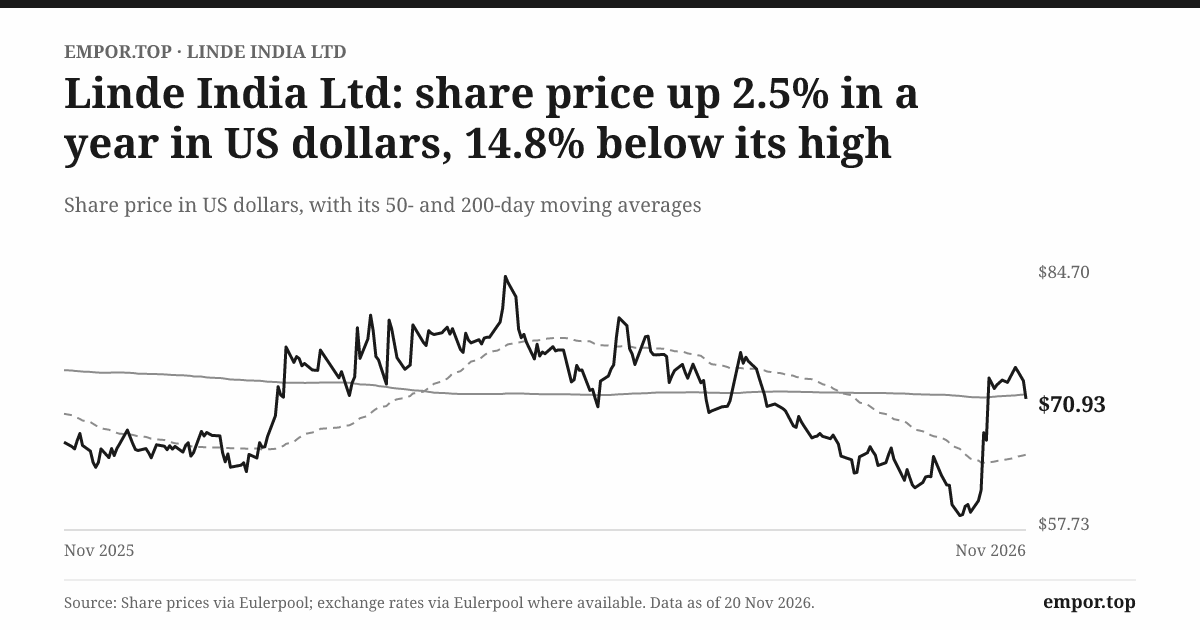
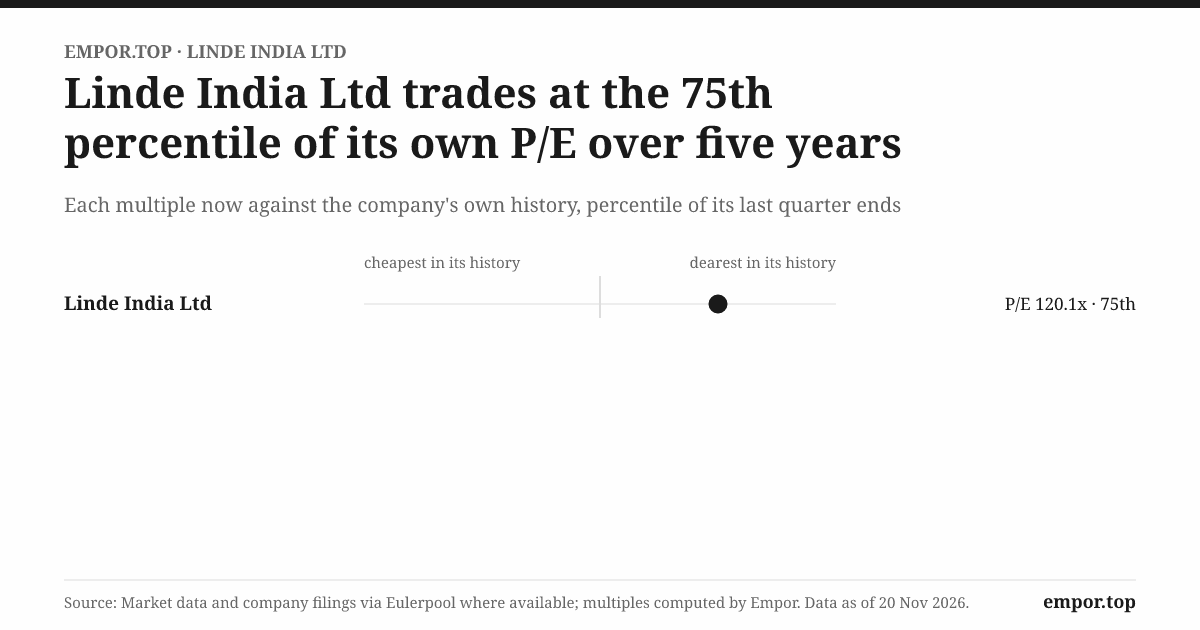
On 20 November 2026, Linde India shares closed at ₹6,572.1 At that price, investors were paying about 120 times the company's last twelve months of earnings, which came to about ₹58 a share.1 That is above the stock's own five-year median of about 111 times.1 In plain terms, the market is paying a slightly richer multiple than usual for a company whose quarterly profit just fell by almost a third. The shares sit about 16% below their 52-week high, so some optimism has already come out of the price, but the multiple still says investors expect a great deal.1
What does a 120-times multiple assume? An earnings yield of under 1%. For that to make sense to a long-term buyer, earnings have to grow strongly and for a long time: the new plants must fill up, the gas margin must recover, and the value of future Indian business must largely accrue to this listed company. The stock is priced less as a slow-growing gas supplier and more as a scarce, listed, Linde-branded play on India's industrial build-out. The analysis has to ask whether the evidence supports that.
The spine of the case is simple. Linde India wins if new capacity lifts utilised gas volumes and cash returns, while related-party arrangements become transparent and defensible. It disappoints if costs absorb growth, or if the economics of the next wave of Indian demand accrue elsewhere in the group.
Run the moat through Porter's five forces once, in full. Buyer power is high: large steel, refining and chemical customers tender competitively, and CRISIL's warning about concentration in steel and metallurgy points to a buyer base that is both powerful and cyclical.16 Supplier power, mostly from electricity providers, is now visibly important, as the tripling of power cost in a single quarter shows.1 Rivalry is real: INOX Air Products sits within a couple of points of Linde India in estimated share, and Air Water India and Air Liquide are credible players.15 Substitutes are few, since there is no alternative to oxygen in a converter, but customer self-supply is a real option, as JSW Steel showed when it bought the Belloxy plant.12 New entrants face high capital barriers, which protect incumbents but force them to keep investing.
Hamilton Helmer's 7 Powers framework sharpens the picture. Linde India has some scale economies in that larger plants and denser distribution networks lower costs per tonne, but at roughly equal size with INOX, scale is not a decisive advantage. It has switching costs in its onsite business, the strongest of its powers, though the duration and renewal record of those contracts are not disclosed. It has a measure of brand and process power from the Linde name and engineering heritage, but it pays royalty for the brand and relies partly on group technology, which means part of that power sits with the parent rather than the listed company.4 It has no network effects and no counter-positioning. Cornered resources, the most interesting category, are where the dispute bites: the right to serve certain regions is a kind of cornered resource, and the allocation agreement has handed part of it to Praxair India.19
The segment split does analytical work here. Gases are the franchise: about 30% segment margins on the larger share of revenue. Project engineering is a cyclical order book at about 12% margins.3 In the latest quarter, revenue growth came mostly from engineering while gas-segment profit fell.3 A headline revenue increase driven by the lower-quality segment, combined with a profit decline in the higher-quality one, is the opposite of what the multiple needs.
The bull case at its best runs like this. Over nine years, the company converted profit into cash at about 130%, a sign of real underlying economics.4 It holds the leading estimated share of a growing market.15 It has long-established customer relationships and onsite plants that are hard to displace. FY2026 profit growth came from operations rather than from interest income.3 And it is in the middle of building capacity that, once filled, could produce genuine operating leverage: the fixed costs are already showing up, so the extra volume should carry a high incremental margin. On this view, the September quarter is the trough of a capex cycle, and the market is looking through it.
The bear case at its best is just as concrete. Revenue over three years has been essentially flat.3 The auditor qualified its opinion on the latest audited accounts.4 Public shareholders rejected the related-party resolution by almost nine to one.2 The company has borrowed ₹9,500 million after years without debt, and its free cash flow, negative in FY2025 and barely positive in FY2026, cannot fund the programme.13 Return on invested capital has fallen below 9%.1 And the regulator's valuation could reveal that some of the growth the multiple assumes belongs, by agreement, to an unlisted sister. On this view, investors are paying a premium multiple for a business whose best future opportunities may not be fully its own.
A simple piece of arithmetic shows how much the price asks of the business. If Linde India doubled its earnings per share, the shares at today's price would still trade on about 60 times those doubled earnings. Investors buying at 120 times are therefore not paying for the recovery of one bad quarter. They are paying for years of compounding beyond it, and for confidence that the compounding happens inside this listed company rather than next door.
The bear case has to concede one thing. Gas-segment revenue still grew a little, and overall revenue grew double digits.3 The business is not shrinking. The bull case has to concede that the profit decline came from the core franchise, not from a one-off.
Three indicators will tell investors which story is unfolding. The first is gas-segment profit margin, about 30% for FY2026 and well below that in the September quarter as segment profit fell by more than a quarter.3 Its recovery, or not, is the cleanest read on utilisation and pricing. The second is post-capex free cash flow and net debt: net borrowings went from nil to about ₹9,500 million in a half-year, and their trajectory will show whether the plants pay for themselves.1 The third is the resolution and disclosure of the SEBI and joint-venture valuation, which will show how much of India's growth this company actually owns.6
The risks follow from mechanisms rather than from a checklist. A downturn in steel would hit volumes because of concentration in metallurgy. Higher electricity prices would compress margins unless contracts pass them through. Commissioning delays or slow ramp-ups would leave depreciation and interest running ahead of revenue. A ruling against the company could change how future opportunities are allocated, or require compensation. And at 120 times earnings, there is little room for any of these to go wrong.
A final word on comparisons. It is tempting to set Linde India's multiple against other listed Indian companies in nearby industries, but there is no directly comparable listed Indian industrial-gas peer with a clean multiple to benchmark against. INOX Air Products is unlisted. The useful comparison is therefore with Linde India's own history and with what its multiple assumes, not with a peer group that does not exist.
X. Playbook: Business & Investing Lessons
Go back to the steel works at three in the morning, and the plant humming beside it. Linde India's story yields a handful of lessons that belong to this company and few others.
The first comes from the onsite plant. It is the best thing about the business: a customer with a plant on its doorstep is unlikely to risk an outage to save a few rupees. But the contract economics remain hard to see, and Belloxy showed that even an onsite relationship can end with the customer buying the machine. A plant beside the customer can make a supplier hard to replace; it does not make the contract economics visible.
The second comes from the 2018 merger remedy, which showed how a parent's deal can redraw a local subsidiary's map, even when the listed company's shareholders have no say in it. For anyone who owns a subsidiary of a multinational, the lesson is to read the parent's deals as events in your own company's life.
The third comes from the cash flow statement. Linde India's strong long-run cash conversion did not prevent the current expansion from outspending operations and requiring new borrowing. Cash conversion is not the same as distributable cash when new capacity consumes more than operations generate.
The fourth is the one this company will be remembered for. A regional allocation in a joint-venture agreement proved more consequential to minority shareholders than any single contract on the books. The regulatory dispute, qualified audit opinion and shareholder vote showed that, in a controlled company, related-party rules are part of the business model, not a footnote.
For founders and investors more broadly, the deeper lesson is about trust. Industrial gas is a business built on reliability: customers stake their production on supply that never stops. Linde India has earned that trust from its customers over ninety years. The trust of its own shareholders is a separate account, and right now it is overdrawn. A strong industrial franchise earns trust twice: from customers who rely on its supply, and from shareholders who fund its assets.
XI. Epilogue
Tonight, Linde India stands in an unusual place. Its plants are running, its order book is producing revenue, its balance sheet is carrying debt for the first time in years, and its most important strategic question is in a Supreme Court that has just declined to pause the regulator's valuation of its most important strategic agreement.6 Each of the next moments will move a different part of the story.
The first moment is the gas segment's results over the coming quarters. Capacity announcements will not settle anything; segment revenue and segment profit will. If the tripling of power cost proves to be the price of commissioning new plants, gas-segment margins should start climbing back toward the 30% the business earned in FY2026 as volumes fill the new capacity.31 If margins stay depressed while volumes grow, it will suggest that pricing has not kept pace with costs, and the bull case loses its strongest pillar.
The second moment is the full-year cash flow for FY2027, which will arrive with the next annual results. A single good quarter will not prove anything. What matters is operating cash, capital spending, free cash flow and debt repayment seen together. If capital spending starts to fall as the plants complete, and operating cash rises as they fill, the borrowing will look like a bridge.1 If spending continues and the debt keeps rising, the company's financial model will have changed.
The third moment is the legal one, and it carries the greatest uncertainty. The final outcome of the Supreme Court appeal on transaction aggregation, and the valuation of business foregone and received under the Praxair India allocation, will determine whether the dispute is a procedural lesson or a reallocation of value. If the valuation is published and shows a roughly fair exchange, the audit qualification could be resolved and the governance discount could narrow. If it shows a material imbalance, the questions shift to compensation, renegotiation and whether the allocation survives at all.
The smaller moments matter too. Investors will want to see whether the Airtech acquisition closes and whether later filings show its contribution. And they will want to see whether management's explanations of power costs, utilisation and the return the expansion is meant to earn grow more specific with each set of results or stay general.
That is the tension that remains: a company building for a growth it has not yet shown, in a market whose best opportunities it may not fully own.
XII. Outro
Return to the September quarter and the March vote: revenue rose, profit fell, and public shareholders rejected the related-party resolution. The two moments look unrelated. They are not. Both ask the same question: when Linde India invests, who captures the return?
Picture the plant beside the customer's works. That continuity is what Linde India sells, and its customers have reason to trust it. The company's shareholders are waiting for a different kind of continuity: a clear, unbroken line from the plants they paid for to the profits they own. Linde India sells an essential flow of gas. Its investment story depends on whether it can show, just as clearly, where the value of that flow goes.
References
-
Q2 and H1 FY27 results — Linde India Limited, 2026-11-03 ↩↩↩↩↩↩↩↩↩↩↩↩↩↩↩↩↩↩↩↩↩↩↩↩↩↩↩↩
-
EGM minutes and shareholder voting results — Linde India Limited, 2026-03-05 ↩↩↩↩↩
-
Integrated Filing (Ind AS), Q2 FY27 results, segment information and notes — National Stock Exchange of India, 2026-11-03 ↩↩↩↩↩↩↩↩↩↩↩↩↩↩↩↩↩↩↩↩↩↩↩↩↩↩↩↩↩
-
Annual Report 2024–25 — Linde India Limited ↩↩↩↩↩↩↩↩↩↩↩↩↩↩↩↩↩↩↩↩↩↩↩↩↩↩↩↩↩↩↩↩↩↩↩↩↩
-
Supreme Court order, Linde India Ltd v. SEBI — 2026-11-06 ↩↩↩↩↩
-
Competition Commission order on Linde–Praxair combination — CCI, 2018-09-06 ↩↩
-
CCI directs Linde, Praxair to divest stake in certain firms — Business Standard, 2018-09-18 ↩
-
Linde India shoots up after board OKs divestment — Business Standard, 2019-08-14 ↩↩↩
-
Air Water India acquires Linde India's south region divestment business — gasworld ↩↩
-
Linde India JV completes sale of plant to JSW Steel — Indian Chemical News ↩↩↩↩
-
89th AGM Notice and Annual Report 2024–25, shareholding and company information — Linde India Limited ↩↩↩
-
Market Overview of the Industrial Gases — Frost & Sullivan, 2025-06 ↩↩↩↩↩
-
Linde seeks shareholder approval for RPT with Praxair — Business Standard, 2026-02-11 ↩
-
Linde India's minority investors have been fighting firm for 5 years — ThePrint ↩↩↩↩
-
Announcement of SAT order dated 5 December 2025 — Linde India Limited via NSE, 2025-12-10 ↩
-
SAT upholds SEBI order against Linde India, says all related party deals must be aggregated for materiality — LiveLaw ↩↩↩
-
Linde India's minority investors cry foul after firm asks SC to stay SEBI action on key valuation report — ThePrint, 2026 ↩
-
Airtech acquisition disclosure under Regulation 30 — Linde India Limited via NSE, 2026-11-13 ↩↩↩↩↩
-
Linde India appoints Milan Sadhukhan as MD — Business Standard, 2025-12-29 ↩↩↩
-
Linde India CFO resigns amid regulatory turmoil — Business Today, 2025-12-08 ↩
-
Linde India Limited announces chief financial officer changes — MarketScreener, 2026 ↩
 LinkedIn
 WhatsApp
 Reddit
 Hacker News
 Email
 Kindle
 RSS Feed
 Spotify
 Apple Podcasts
 Amazon Music
 Audible
 YouTube