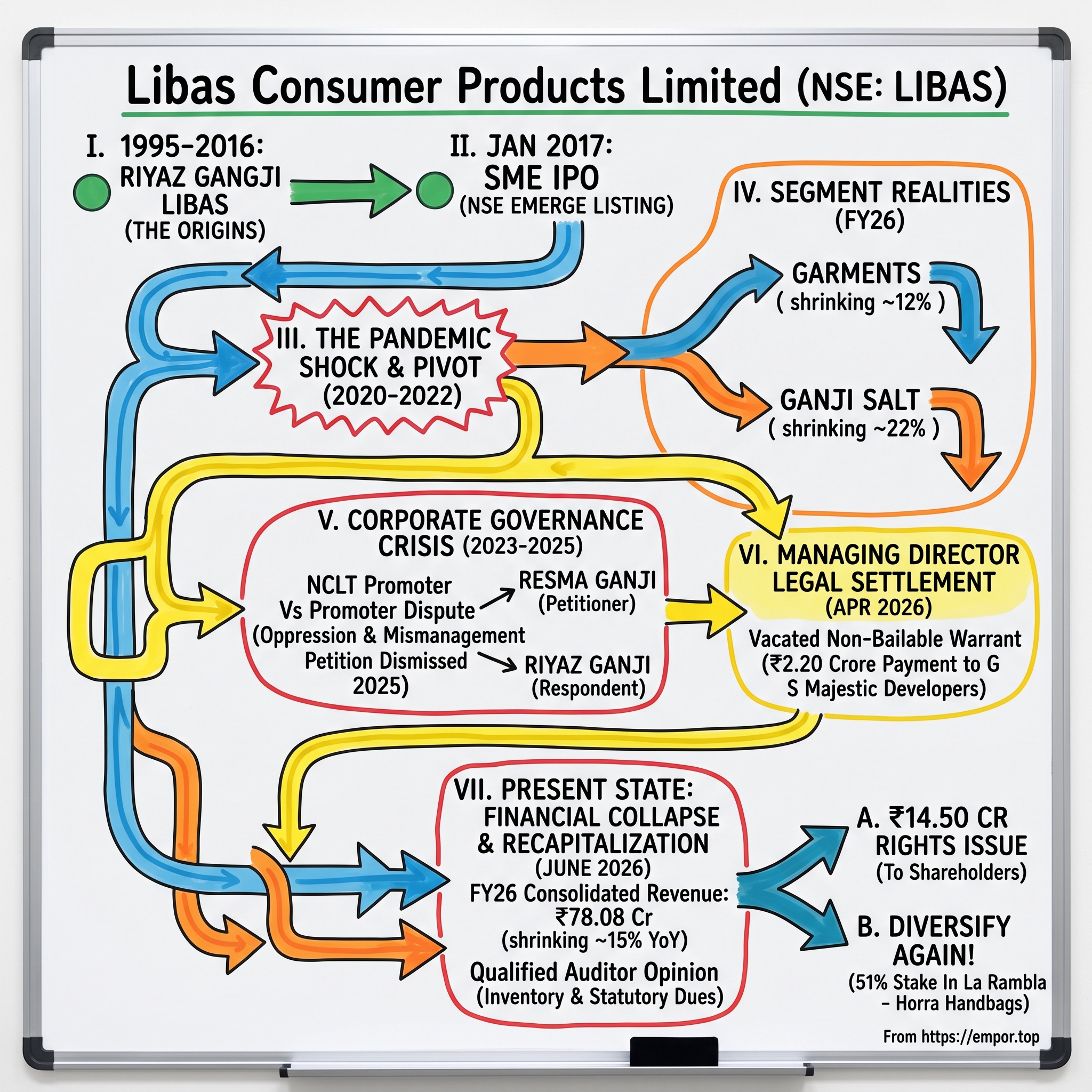
Libas Consumer Products: From Bespoke Runway to Himalayan Rock Salt
I. Intro & Episode Roadmap: The Dual Realities of Indian Fast-Fashion SME Listings (10 Minutes)
Start with the picture that should not make sense. A Mumbai couturier who built his name draping Bollywood actors, cricketers and politicians in bespoke sherwanis is, in the summer of 2026, running a rock-salt processing plant in Bharuch, Gujarat, importing bulk mineral salt from Egypt, packaging bamboo-fibre underwear on the side, and asking his public shareholders for another ₹14.50 crore of cash while the stock changes hands at roughly ₹11 — a fraction of the ₹68 at which it was sold to the public in early 2017.12 That is not a metaphor. It is the literal operating reality of Libas Consumer Products Limited, a micro-cap listed on the National Stock Exchange's Emerge platform under the ticker LIBAS, and it is the puzzle this story exists to underwrite.
Before a single number is analysed, a warning has to be posted at the entrance, because it is the fastest way for a careful investor to lose money on the name. There are two Libases, and they are not the same company. The first is Libas Consumer Products Ltd. (NSE: LIBAS), the listed entity at the centre of this account: a business founded in the couture tradition of Riyaz Eqbal Ganji, incorporated in 2004, that reported roughly ₹78.08 crore of consolidated revenue in the year ended March 2026 and now carries a market value of around ₹29 crore.1 The second is Libas — the premium ethnic-wear brand led by Sidhant Keshwani, an entirely unrelated, venture-backed private fast-fashion company that raised ₹150 crore from ICICI Venture's IAF Series 5 fund and reported about ₹609 crore of revenue in FY25.34 The private brand has captured almost all of the cultural and commercial mindshare attached to the word "Libas." The listed micro-cap trades on a name it can no longer fully own. Confusing the two — treating the private brand's growth, funding or valuation as though it accrued to the public ticker — is the single most expensive mistake available in this situation, and it is one that superficial screening will invite.
That collision of the two Libases is also the cleanest possible entry into the theme of this episode: the dual reality of Indian small-and-medium-enterprise listings. India built a set of junior exchange boards — the NSE Emerge and BSE SME platforms — to let micro-enterprises that were far too small for the main board raise a few crore of public capital and gain the discipline and prestige of a listing. The design intent was benign: institutionalise a good small business, give it currency for acquisitions and succession, and widen the pool of investable companies. The lived reality is more complicated. These boards are thinly traded, lightly followed and governed with a lighter touch than the main exchange, which means that when a listed micro-enterprise takes an operating shock, the public shareholder who wandered in for the growth story discovers he is holding an illiquid instrument in a company where oversight is sparse and cash can drain quickly. Libas Consumer Products is a case study in exactly that failure mode.
So the roadmap. This is not the company's investor-relations department talking, and there is no prospectus to summarise — Libas is already listed, so the relevant document set is nine years of SME filings, annual reports, board outcomes and a tribunal order, read as a diligence record rather than a marketing one. We will trace the arc from elite bespoke tailoring, through a 2017 SME IPO that raised modestly and institutionalised a boutique, into a pandemic-driven panic pivot toward commodity salt; segment by segment we will ask which businesses actually make money and which merely make revenue; we will sit with the governance wreckage of a promoter divorce that migrated into the National Company Law Tribunal, and with a non-bailable warrant against the managing director that was vacated only after a ₹2.20 crore settlement; we will read the auditor's qualified opinion as the operating confession it is; and we will end with the June 2026 rights issue and a fresh diversification into handbags, then stress-test the whole edifice through Helmer's 7 Powers and Porter's Five Forces before laying out the handful of metrics that will confirm or falsify any bull case. Throughout, price and value are held apart: the ₹29 crore the market assigns to the equity is a quoted price on an illiquid board, not an appraisal, and we will reason toward value from the operating evidence rather than carry the tape forward unchanged.
 Subscribe on LinkedIn
II. From Runway to Retail: The Origins of Riyaz Gangji Libas (1995–2016) (20 Minutes)
Every fashion house begins as a person, and this one began as Riyaz Eqbal Ganji. From the mid-1990s, working out of Mumbai with his wife Reshma Riyaz Ganji, Ganji built "Libas" into a recognisable name in Indian bespoke couture — sherwanis, designer wedding suits, lehengas and Indo-Western fusion wear made one commission at a time for a clientele that skewed toward celebrity, wealth and the wedding season. The corporate vehicle that would eventually list, Libas Designs Limited, was incorporated in 2004, but the brand equity it monetised was older, rooted in a decade of dressing weddings in a country that treats the wedding as the single most important discretionary purchase a family makes.5 The strategic instinct was sound in the narrow sense: the Indian bridal and wedding-wear market is enormous, culturally non-negotiable and unusually recession-resistant, because a family that will economise on almost anything will still spend on the clothes worn at a daughter's or son's wedding.
The problem was never the demand; it was the shape of the supply. Bespoke couture is, economically, the opposite of a scalable business, and understanding why is the key to everything that came later. A custom-tailored sherwani carries a fat gross margin on each piece — the customer is paying for design, craftsmanship and status, not for cloth — but that margin is trapped inside a production model that cannot be industrialised. Every garment consumes designer attention, skilled hand-embroidery and weeks of a craftsperson's time, so revenue rises only as fast as you can add master tailors and designer hours, which is to say slowly and expensively. The output is inherently low-volume. Worse, the model is a working-capital trap: cash goes out early to buy premium fabric and commission embroidery, and it comes back late, after long fitting and delivery cycles, with slow-moving inventory of expensive, idiosyncratic pieces sitting on the books in between. A boutique couturier is, in balance-sheet terms, a business that is perpetually short of cash even when it is profitable per garment, because the capital is locked in fabric, work-in-progress and unsold premium stock.
This is the bottleneck that separates a designer label from an apparel company, and it is worth naming the contrast precisely, because the contrast defines the ceiling on the whole enterprise. Consider the organised ready-to-wear players that dominate India's ethnic-wear economy. Vedant Fashions, the owner of Manyavar, built a franchise on standardised celebration wear produced at scale, sold through a large network of exclusive outlets, with the design cost amortised across hundreds of thousands of near-identical units and the inventory risk pushed largely onto franchisees. FabIndia industrialised artisanal-looking apparel through a managed supply chain and a national store footprint. Those companies earn their returns from process, standardisation and distribution — from doing the same thing a million times at declining unit cost. A bespoke house does the opposite: it does a different thing every time, at a unit cost that never declines, and its quality is inseparable from the continued personal involvement of the designer whose name is on the door. That last point is the quiet killer. In a couture business, the founder is not a manager of the asset; the founder is the asset. The skill, taste and celebrity relationships live in one person's head and reputation, and they do not transfer to a spreadsheet, a factory or a successor. For a public-market investor, that is key-person risk in its purest form, and it is a structural feature, not a temporary one.
By 2016, then, Libas Designs occupied a genuinely difficult position: a respected brand with real margins per piece, real celebrity association and real cultural relevance, chained to a production model that could not grow volumes, could not free up its working capital, and could not be separated from its founder. It had reached the natural ceiling of a boutique. What it did next — go to the public markets — was the first of several decisions that reveal how the company's leadership thinks about capital, and it is where the listed story properly begins.
III. Going Public on the Emerge Platform: The January 2017 IPO (20 Minutes)
The decision to list, when it came, was not the classic growth-capital story that the phrase "IPO" usually implies. Libas Designs did not go public to fund a national roll-out or a category-defining expansion; it went public, in the SME sense, to institutionalise a boutique — to convert a family couture house into a listed company with audited accounts, a board, a currency of tradable shares and the reputational halo of an exchange listing. That is a legitimate use of the Emerge platform, which exists precisely to give small, real businesses a first taste of public capital and public discipline. But it also tells you the ambition was modest from the outset. This was a small business raising a small amount to tidy up its structure, not a scale story.
The mechanics bear that out. The offering was made under the name Libas Designs Limited, opened for subscription on 27 December 2016 and closed on 30 December 2016, with listing on the NSE SME (Emerge) platform on 9 January 2017.5 The company issued 20,00,000 (two million) fresh equity shares of ₹10 face value at a price of ₹68 per share, raising approximately ₹13.6 crore gross — a genuinely tiny capital raise, of the scale a single mid-market apparel factory might spend on one production line.5 Sarthi Capital Advisors acted as book-running lead manager and Choice Equity Broking as market maker, the latter role being a structural feature of SME listings, where an appointed market maker is obliged to provide two-way quotes precisely because organic liquidity is so thin.5 The stated intent of the proceeds ran along the lines any boutique would cite: expanding retail presence, strengthening working capital and supporting marketing — the working-capital emphasis being the tell, given the cash-trapped nature of the underlying couture model described above.
Here the public-market reality check begins, and it is a reality specific to the SME boards rather than to Libas alone. An Emerge listing confers the form of being a public company without much of the substance of a liquid one. Trading volumes on these counters are frequently negligible; a stock can go days with barely any shares changing hands, the bid-ask spread can be punitive, and the presence of a mandated market maker is itself an admission that natural buyers and sellers are scarce. For a retail investor, this has a hard consequence that is easy to miss in the excitement of a subscription: the price you see quoted is not a price at which you can necessarily transact size. Illiquidity cuts both ways — it can produce violent upward moves on trivial buying, and it can trap a holder who wants out, because there is no one on the other side. Libas's post-listing history is a case study in the downside version of that volatility. The ₹68 issue price of January 2017 has, by mid-2026, become a market price of roughly ₹11, a decline on the order of 84% over nine years, through which the company's equity value has compressed to around ₹29 crore.12 An investor who bought the IPO to own a piece of a celebrity couture house has, in the interim, watched that house become a salt importer, and watched the quoted value of the stake fall by more than four-fifths.
It is worth pausing on what that price decline does and does not tell us, because conflating the two is the error this entire genre of analysis is meant to avoid. A four-fifths fall in an illiquid micro-cap is a fact about price formation on a thin board as much as it is a verdict on the business — a handful of forced sellers into no bids can mark a stock down brutally regardless of intrinsic worth. But in this instance the price decline is not merely a liquidity artefact; it is broadly corroborated by the operating record that follows, which is one of shrinking revenue, thinning margins, governance turmoil and a qualified audit. When the tape and the fundamentals point the same way, the tape is usually telling the truth. The more interesting question — the one the rest of this story exists to answer — is what happened between the institutionalised boutique of 2017 and the distressed commodity-diversified micro-cap of 2026. The hinge was a global pandemic.
IV. The Pandemic Shock and the FMCG "Himalayan" Pivot (2020–2022) (30 Minutes)
In March 2020, the single most concentrated demand shock imaginable hit the single most concentrated business imaginable. India's COVID-19 lockdowns did not merely slow the wedding-and-celebration economy; they switched it off. Weddings were postponed or shrunk to a dozen attendees, social gatherings were banned, physical retail was shuttered, and the bespoke-couture business — which depends entirely on people commissioning expensive garments to be seen in at large public events — lost its reason to exist overnight. For a diversified apparel company this would have been a severe cyclical blow; for a boutique whose revenue is almost wholly discretionary, seasonal and event-driven, it was existential. The core business did not decline. It halted.
What the company did next is the decision that defines its modern identity, and it deserves to be examined not as a triumph of reinvention but as a revealing act under duress. In 2020, Libas Designs Limited renamed itself Libas Consumer Products Limited, a change of name explicitly signalling a change of nature: away from pure apparel, toward a basket of consumer products.1 And the flagship of that new basket was, of all things, salt. Under the "Gangji Salt" brand, the company began packaging and distributing Himalayan pink salt, black salt and white rock salt, establishing a processing and manufacturing unit in Bharuch, Gujarat, and — in the arbitrage at the centre of the whole scheme — importing bulk raw rock salt from Egypt to process and sell into industrial and retail channels across India, with imports described at roughly ₹8–10 crore in scale.6 Alongside the salt, management launched further consumer lines: "KNG" organic bamboo-fibre innerwear and customisable jute bags, framed as a sustainability-minded consumer basket.
Management's stated rationale was de-risking. The argument, on its face, is coherent: fashion is seasonal, discretionary and, as 2020 had just demonstrated, catastrophically exposed to a demand shock, whereas table salt is a daily-use, non-discretionary FMCG staple whose consumption barely moves with the economic cycle. Pivoting some of the company's footprint into a stable, everyday consumable would, in theory, smooth the revenue line and reduce the terrifying dependence on the wedding calendar. Reframed in the language of the moment, salt was sold as a health-and-wellness play, riding a pandemic-era consumer interest in "natural," "pink" and "mineral" salts as premium alternatives to ordinary iodised table salt. On paper, a designer whose runway had gone dark had found a defensive, counter-cyclical income stream.
But an underwriter has to separate the rationale from the economics, and the economics of this pivot are far less flattering than the narrative. The first problem is competence. Running an industrial bulk-commodity operation — importing mineral salt by the shipload from Egypt, clearing it through customs, processing it at a plant in Gujarat, and distributing it against entrenched national players — is a completely different business from designing wedding couture in Mumbai. It requires logistics muscle, commodity-procurement discipline, freight and currency-risk management, industrial process control and a low-cost distribution machine. None of these is a capability a bespoke fashion house possesses, and none is acquired quickly. A high-margin designer trying to run low-margin bulk logistics is not diversifying its strengths; it is entering a business in which it has no advantage against incumbents who have spent decades building exactly the capabilities it lacks.
The second problem is the nature of the market it entered. Retail edible salt in India is not an open field; it is one of the most thoroughly branded, distribution-dominated FMCG categories in the country, anchored by Tata Salt — a brand so entrenched it is effectively synonymous with the product — alongside Tata Consumer's broader portfolio and regional and commodity players operating at a scale that dwarfs a single Bharuch unit. Salt is a category where the winners win on distribution reach, plant scale, procurement cost and brand trust built over generations. A new "Gangji Salt" from a Mumbai couturier has no structural edge on any of those dimensions. And the "health-and-wellness" premium framing, while real, is a niche that attracts every opportunistic entrant precisely because it looks defensible — pink Himalayan salt in particular became a crowded, margin-eroding shelf as dozens of importers chased the same trend. What looked like a defensive staple was, on closer inspection, a low-margin, capital-intensive commodity business with severe logistical overhead, bulk-price exposure and dependence on industrial contract renewals — the mirror image of the high-margin, capital-light designer business it was meant to balance.
A word on market size is warranted here, because the pivot was sold implicitly on the vastness of the addressable market, and vastness is the most seductive and least useful number in investing. Yes, the Indian edible-salt market is enormous — every household buys salt — and the "premium," "natural" and mineral-salt sub-segment was growing. But the category total addressable market is not the market Libas can actually reach, and the gap between the two is where value is won or lost. The reachable market for a single Bharuch processing line with no national distribution, no brand trust and no procurement scale is a thin sliver of that TAM: a few industrial buyers within logistical range of the plant, and whatever retail shelf a small importer can rent against Tata Salt's omnipresence. Converting even a fraction of the category TAM into Libas revenue would require exactly the distribution reach, brand and cost position the company does not possess and cannot cheaply build, and every rupee of share it did win would be contested immediately by incumbents who can out-price and out-distribute it. The ₹24.60 crore the salt business actually generated in FY26 — and, more tellingly, its 21.6% contraction — is the real signal of the reachable market; the enormous category TAM is noise that flatters a pitch deck and tells an underwriter nothing about what this specific company, at its present scale and capability, can durably capture.2
The bamboo innerwear and jute bags reinforce the read rather than complicating it. These are small experimental lines, and their strategic significance lies less in their revenue — which is immaterial — than in what their existence signals: a management team, jolted by an existential shock, reaching in several directions at once for anything that might produce a saleable consumer product, without an obvious organising logic connecting couture, commodity salt, bamboo underwear and jute bags beyond the word "consumer." That is not a portfolio; it is a scramble. And the honest way to characterise the 2020 pivot is precisely that: not a considered de-risking of a fashion franchise, but an operational panic in which a boutique whose core had gone dark diversified into whatever it could, in businesses where it held no advantage. The de-risking language is the rationalisation applied afterward. The behaviour underneath it is the tell.
V. Segment Realities: Garments vs. Gangji Salt (20 Minutes)
Strip away the narrative and look at what the two engines actually produce, because the segment numbers settle several arguments at once. In the year ended March 2026, the garment business generated ₹53.47 crore of revenue, down from ₹60.52 crore in FY25 — a decline of roughly 11.7%. The rock-salt business generated ₹24.60 crore, down from ₹31.39 crore, a contraction of about 21.6%.2 Two things jump out immediately. First, six years after the celebrated pivot, garments still drive the clear majority of the company's revenue — roughly two-thirds of the ₹78.08 crore total — which means the "consumer products" reinvention has not displaced the fashion business so much as sat beside it as a smaller, second line. Second, and more damning, both engines are shrinking at once. The pivot was justified as a diversification that would smooth revenue; instead, in FY26, the company got the diversification without the smoothing, as the salt business fell faster than the garments it was supposed to stabilise. When both of your uncorrelated bets go down together, you do not have a hedge; you have two problems.
Look closer and the economic mismatch between the two segments becomes the real story. The garment business carries the high gross margins characteristic of designer apparel — the pricing power of couture is genuine — but it drags a specific and dangerous liability: inventory. Fashion inventory is perishable in the commercial sense, going stale as styles date and pieces age, and premium bespoke stock is the worst kind, because it is idiosyncratic and hard to liquidate. High gross margins on the pieces that sell can be quietly devoured by write-downs on the pieces that do not, and — as the auditor's later qualification makes explicit — Libas is carrying garment inventory that is genuinely old and of uncertain saleability. A high-margin business that cannot clear its stock is not as high-margin as its gross line suggests.
The salt business has the opposite profile and an equally unattractive one. Its gross margins are structurally low, because it is a commodity: the product is undifferentiated, the buyer can substitute freely, and pricing is set by the market rather than by the brand. It is capital-intensive relative to its returns, requiring a processing plant, working capital tied up in bulk imported raw material, and a distribution effort against entrenched incumbents. It is exposed to commodity-price swings in the underlying rock salt and to freight and currency costs on the Egyptian imports, and its industrial revenue depends on the renewal of bulk supply contracts that can be lost to a cheaper bidder at the next cycle. So the company has assembled a portfolio in which one segment has good margins but bad inventory economics, and the other has bad margins and heavy capital and logistics overhead. Neither is a business with a durable structural advantage, and the FY26 contraction in both suggests neither has found a defensible position in its market.
The causal link to value is where this lands. A public-market investor is not paying for revenue; he is paying for the durable cash a business can generate after it has funded its own working capital and reinvestment. On that test, the garment segment's cash generation is compromised by ageing inventory it must eventually write down, and the salt segment's cash generation is compromised by thin margins on a capital- and logistics-heavy operation. The blended result — a company doing ₹78 crore of revenue while earning a net profit of just ₹0.21 crore in FY26 and slipping into a quarterly loss by the fourth quarter — is exactly what you would predict from two structurally weak segments running at once.12 Revenue of ₹78 crore that converts to essentially no profit is not a scale problem that growth will fix; it is a quality problem embedded in the economics of both segments.
It is worth grounding those two segments against the businesses an investor might be tempted to use as comparables, because the comparison is where the temptation to overpay usually starts, and where the discipline of a genuine peer set has to be applied. The instinct is to reach for the category leaders — Vedant Fashions (Manyavar) in ethnic wear, Tata Consumer Products in salt — because they are the visible, well-analysed names in Libas's two markets. That instinct should be resisted, because neither is a true operating peer; both are aspirational category leaders whose economics are the opposite of Libas's. Vedant Fashions runs a high-gross-margin, franchise-led, asset-light celebration-wear model that earns operating margins in the tens of percent and, precisely because of those economics, trades at a rich enterprise-value-to-EBITDA multiple that reflects a durable brand and a scaled distribution moat Libas does not have. Applying a Vedant-style multiple to Libas would be the single most misleading thing an analyst could do — it would import a franchise economic that Libas has never demonstrated. Tata Consumer, similarly, is a diversified large-cap staples company whose salt business benefits from national scale, procurement cost and the most trusted brand in the category; its multiple reflects a portfolio and a balance sheet that have nothing to do with a sub-scale Bharuch salt line. The honest peer set for Libas is not these leaders at all but the broad population of loss-making-to-barely-profitable micro-cap apparel and commodity SMEs on the Emerge and BSE SME boards, which typically trade — when they are profitable — at low single-digit to low-teens earnings multiples, and often below book value when they are not, precisely because the market prices their lack of durable advantage. Libas belongs in that second group, and a comparable-based valuation has to start there, on an earnings and book-value basis, in rupees, on a roughly ₹29 crore equity value — not by borrowing a category leader's multiple the underlying economics cannot support.
VI. Corporate Governance & Matrimonial Crosswinds: The NCLT Showdown (2023–2025) (25 Minutes)
If the operating story is one of weak economics, the governance story is one of a company whose leadership was, for two years, at war with itself in a way that leaked directly into the corporate machinery. In June 2023, Reshma Ganji — promoter, co-founder and former managing director, and Riyaz Ganji's wife — filed a petition before the Mumbai Bench of the National Company Law Tribunal under Sections 241, 242 and 244 of the Companies Act, 2013, alleging oppression and mismanagement against the company and its directors, Riyaz Ganji among them.7 For a listed company, a promoter-versus-promoter oppression petition is close to the reddest flag in the governance vocabulary, because it means the people who control the business are accusing each other, in a court of law, of running it improperly at the expense of shareholders. Sections 241–242 are the specific statutory route through which minority or aggrieved shareholders allege that a company's affairs are being conducted prejudicially; that one promoter invoked them against the other put the company's internal conflict into the public legal record.
The substance of the allegations, in the genre such petitions belong to, ran to the familiar catalogue: exclusion of a co-promoter from strategic decision-making, unauthorised board actions and the diversion or mishandling of company resources. What made this case distinctive — and, ultimately, what defined the tribunal's disposal of it — was that the corporate dispute was downstream of a personal one. The Ganjis' professional partnership and their marriage were unravelling together, and the corporate-oppression petition was, in the tribunal's eventual characterisation, an extension of a matrimonial dispute into the corporate forum rather than a genuine grievance about the conduct of the company's affairs as against its shareholders.
On 13 June 2025, after roughly two years, the NCLT Mumbai Bench dismissed the petition.7 The reasoning is important, and it cuts in two directions at once. The tribunal found no evidence that the company's affairs had been conducted in a manner prejudicial to its interests or oppressive to the petitioner, noted that Reshma Ganji had herself stepped back from the managing-director role, and characterised the matter as fundamentally a personal and matrimonial dispute that had escalated into corporate litigation.7 For the company, the dismissal is genuinely exculpatory on the narrow legal question: a tribunal examined the allegations of siphoning and mismanagement and did not find them made out, which removes the most serious interpretation of the affair — that public shareholders were being actively defrauded. An investor should give that finding its due weight and not assume wrongdoing the tribunal expressly declined to find.
But the dismissal does not make the episode costless, and reading it as a clean bill of health would be a mistake. Consider what the two years actually cost. The senior leadership of a ₹78-crore company — a business already grappling with a shrinking core, a difficult commodity pivot and thin margins — spent that period locked in litigation against itself, which is management bandwidth and board attention diverted from an operation that could ill afford the distraction. The corporate brand, already diluted by the "two Libas" confusion, absorbed the reputational cost of a public promoter feud playing out in a tribunal. And, structurally, the episode exposed the deepest governance vulnerability of the whole enterprise: it is a founder-controlled micro-cap in which the controlling family's personal relationships and the company's corporate governance are not cleanly separated, so that a marital breakdown could migrate straight into the boardroom and the courtroom. The tribunal cleared the specific allegations; it could not clear the underlying condition, which is that public minority shareholders are along for the ride on whatever happens in the promoters' personal lives. That is a permanent feature of the ownership structure, not a resolved event.
The governance concern did not end with the tribunal. In April 2026, a separate matter surfaced that sharpens the picture: a non-bailable warrant had been issued in connection with Riyaz Ganji, and it was vacated by the Bombay High Court on 22 April 2026 — disclosed to the exchange on 24 April — only after consent terms were signed and a ₹2.20 crore settlement was paid to a counterparty, G S Majestic Developers Pvt. Ltd.8 The company's framing was that the settlement was a full-and-final resolution allowing the managing director to continue his duties without legal encumbrance, and the underlying dispute's precise nature was not detailed in the disclosure. But an investor cannot wave away the fact pattern: a sitting managing director of a listed company faced a non-bailable warrant serious enough to require a multi-crore settlement to clear, in a company whose entire market value is under ₹30 crore. In a business this small, a ₹2.20 crore cash outflow to resolve a promoter's legal exposure is not a footnote; it is a material use of scarce capital, and it belongs on the same governance ledger as the NCLT feud.
VII. Present State & Financial Reality Check: FY26 Declines & The June 2026 Rights Issue (25 Minutes)
Bring the numbers into one place and the present state of the business is unambiguous. Consolidated revenue fell to ₹78.08 crore in FY26 from ₹91.91 crore in FY25, a decline of about 15%.1 Net profit collapsed from ₹2.64 crore in FY25 to ₹0.21 crore in FY26 — a business that was barely profitable becoming a business that is, for practical purposes, not profitable at all.1 The trajectory within the year is worse than the annual figures suggest: in the fourth quarter of FY26, revenue fell 45.31% year on year to ₹17.14 crore, and the company posted a consolidated net loss of ₹0.63 crore against a ₹1.51 crore profit in the same quarter a year earlier, with the operating margin swinging to roughly negative 11%.2 A company does not exit a year on a note like that unless something in the operating base is deteriorating rather than merely cycling. The FY25 comparison itself was already weak — consolidated net profit for the March 2025 quarter had fallen more than 80% year on year — so the FY26 collapse is a deterioration stacked on an existing decline, not a single bad quarter against an otherwise healthy run.9
Layered on top of the shrinking numbers is the auditor's verdict, which is where a diligence reader should linger, because a qualified opinion is a professional's formal statement that he could not satisfy himself the accounts are clean. The company's statutory auditors issued a qualified opinion whose components read as a catalogue of a business under financial strain.[^10] The first and most consequential qualification concerns inventory: the auditors flagged an inability to verify the physical condition, the aging and the ultimate saleability of old garment stock, some of it reported to be three to four years old.[^10] This is the inventory time-bomb foreshadowed earlier. Fashion inventory that old is, by any commercial standard, of highly doubtful value, and the auditor's inability to verify its saleability is a polite way of saying its carrying value on the balance sheet may be fiction. If that stock has to be written down toward its true recoverable value, the write-down could exceed the company's entire thin net profit and push it decisively into losses — the balance sheet, in other words, may be carrying an unrealised loss that the income statement has not yet recognised.
The second cluster of qualifications concerns statutory compliance, and it is arguably the more revealing about liquidity. The auditors pointed to outstanding, unpaid statutory dues — professional tax, tax collected at source, GST and TDS among them — the kind of obligations a solvent, well-run company simply pays on time because they are not optional.[^10] When a company starts falling behind on its statutory tax remittances, it is almost always a symptom of cash stress: the money that should have gone to the government has been used elsewhere because it was needed elsewhere. Alongside this, the auditors noted a failure to make proper provision for long-term employee gratuity liabilities — an under-recognition of a real future obligation that flatters current reported profit by leaving a cost off the books. Taken together, the qualifications describe a company whose reported near-break-even profit is arguably generous: adjust for the aged inventory that may be overvalued and the gratuity liability that is under-provided, and the underlying economics look worse than the headline ₹0.21 crore profit.
It is against this backdrop — shrinking revenue, a fourth-quarter loss, a qualified audit and evidence of cash stress — that the board's capital plan has to be read, and the read is uncomfortable. On 2 June 2026, the board approved a rights issue to raise up to ₹14.50 crore, to be accompanied by an increase in the company's authorised share capital from ₹28 crore to ₹40.60 crore, with an e-voting window for shareholder approval running from 10 June to 9 July 2026.6 A rights issue asks existing shareholders to put in fresh cash in proportion to their holdings. The obvious and important question is why a company whose stock trades near ₹11 — down roughly 84% from its issue price — is asking its retail base for more money, and what that money is for. The generous reading is recapitalisation: the company needs cash to clear its statutory arrears, fund working capital and stabilise the balance sheet, and a rights issue is a legitimate way to get it. The sceptical reading is that a business generating essentially no profit and burning credibility is turning to the only capital source still available to it — its own captive, illiquid shareholder base — because external capital on reasonable terms is not on offer to a micro-cap in this condition. Both readings can be true at once, and both should worry an investor, because a rights issue into a falling, illiquid stock carries real subscription risk: if shareholders decline to participate, the raise falls short, the cash does not arrive, and the arrears remain unpaid.
The rights issue also introduces the dilution question that sits at the centre of any equity story, and here the specifics matter. The authorised-capital increase to ₹40.60 crore contemplates the creation of up to 12,600,000 new shares of ₹10 face value — headroom well in excess of the ₹14.50 crore immediate raise, which is the kind of authorisation that gives a board latitude to issue further equity later.6 For existing holders, a rights issue is only non-dilutive if they subscribe their full entitlement; those who cannot or will not participate are diluted, and in a shareholder base of roughly 21,000 accounts on an illiquid SME counter, many retail holders will not participate.1 The promoter family, meanwhile, holds only about 31.55% of the company — a notably low promoter stake for an Indian SME, where controlling families typically hold far more — which means the founders themselves own less than a third of the equity they are asking the other two-thirds to refinance.1 That low promoter holding is a double-edged fact: it means less concentrated founder control than usual, but it also means the promoters have less of their own capital at stake in the outcome than a typical SME promoter, and it raises the question of who, exactly, is expected to fund the rights issue if the promoters are not writing the majority of the cheque.
Building the capital structure carefully from the public record clarifies both the dilution and the valuation, and it also exposes how little precision is available even for a company that is already listed. The equity is valued at roughly ₹28.7 crore at a share price near ₹10.9, which implies an ordinary-share count on the order of 2.6 crore shares of ₹10 face value — a figure to treat as implied rather than exact, since the exchange snapshot gives the market capitalisation and price directly but not a clean, current fully diluted share count.1 Against that sits stated net worth consistent with a book value near ₹32.3 per share and total borrowings of about ₹13.22 crore, which means that, unlike a typical software or consumer-tech pre-IPO candidate, there is no complex overhang of preferred stock, convertible notes, SAFEs, warrants or a large option pool to unwind — the capital structure is the plain vanilla of an SME: common equity, a modest bank borrowing, and now a proposed rights issue on top.1 The unusual feature is the float. With the promoter family holding only about 31.55%, roughly two-thirds of the shares sit in public hands, an atypically high free float for an Indian SME, spread across some 21,000 shareholder accounts.1 That wide float has a paradoxical effect on an illiquid board: it means the register is dominated by small, dispersed retail holders with little ability to coordinate or to hold management accountable, which is a governance weakness dressed as public ownership, and it means the rights issue depends for its success on the willingness of thousands of small holders — not a few anchor institutions — to send fresh cash into a falling stock.
Value, as distinct from that ₹29 crore price, has to be built from the operating evidence, and the honest output is a wide range rather than a number. Take the disclosed base: about ₹78 crore of revenue that has been shrinking, two structurally weak segments, and near-zero net profit. A transparent scenario frame makes the sensitivities visible. In a stabilisation scenario — revenue holding near ₹75–80 crore and the company eventually earning a normalised net margin of, say, 3–5%, roughly the ceiling a no-moat sub-scale apparel-plus-commodity business might reach if it fixed its inventory and held salt margins — that is ₹2.3–4 crore of sustainable earnings, which at the low-single-digit-to-low-teens multiple such a business commands brackets an equity value of roughly ₹20–45 crore, straddling today's price and implying the market is already paying for successful stabilisation rather than distress. In a deterioration scenario — continued revenue decline, a forced write-down of the aged garment inventory, and the salt segment failing to hold margin — normalised earnings turn negative, and the relevant benchmark becomes not an earnings multiple but the net realisable value of the assets, which the qualified audit suggests could be materially below stated book. In an optimistic scenario — the handbag mix and any premiumisation lift blended net margin toward 6–8% on modestly growing revenue — earnings could reach ₹5–7 crore and support an equity value well above the current price, but this scenario requires precisely the operational competence the company has not yet demonstrated. The range is deliberately wide because the inputs are genuinely uncertain, and the width is itself the finding: the current ₹29 crore price sits in the middle of that range, which means the market is neither pricing imminent collapse nor pricing a turnaround, but something like a coin-flip — a valuation that embeds an assumption of stabilisation the operating record has not yet earned. What it does not embed, and what an enterprise-value bridge would require, is any reliable figure for a normalised free-cash-flow base; with the company barely at break-even and its working capital distorted by doubtful inventory, an EV/EBITDA or DCF-style computation would be false precision dressed as rigour, and it is more honest to say that enterprise value cannot be reliably calculated here than to manufacture one.
And then, simultaneously, the company proposed to diversify yet again. Alongside the rights issue, the board approved acquiring a 51% equity stake in La Rambla Lifestyle Private Limited — an e-commerce handbag business incorporated in 2018 that operates the "Horra" brand of handbags, slings, clutches and laptop bags — for up to ₹1.5 crore in cash, to be executed in tranches under a shareholders' agreement, with no regulatory approvals required.10 La Rambla is a genuinely tiny target: its FY25 turnover was reported at just ₹136.66 lakh, or about ₹1.37 crore.10 The strategic framing was, once again, "multi-engine growth" and long-term stakeholder value. The behavioural read is harder to ignore. A company that has not stabilised either of its two existing segments, that is carrying a qualified audit and unpaid statutory dues, and that is simultaneously asking shareholders for rescue capital, is at that very moment committing scarce cash to buy control of a third, sub-₹1.5-crore-revenue business in a fourth product category. Whatever the merits of handbags as a category, the timing — diversifying into accessories while the core is on fire and the balance sheet is being passed the collection plate — is the same pattern that produced the salt pivot: reach for a new product line rather than fix the existing ones. Capital allocation, more than any single number, is how management reveals its judgement, and this sequence reveals a management that responds to distress by adding businesses rather than repairing them.
VIII. Skeptical Investor Stress Test: Helmer's 7 Powers and Porter's 5 Forces (20 Minutes)
A story this messy benefits from a disciplined framework, because frameworks force the question of whether any of the company's positions are actually defensible or merely present. Take Hamilton Helmer's 7 Powers first — the seven structural sources of durable competitive advantage — and test Libas against each. The verdict, bluntly, is that the company possesses none of them, and walking through why is more instructive than the conclusion.
Scale economies — declining unit cost with size — are absent in both segments. The Bharuch salt plant is microscopic beside Tata Consumer's salt operations or the large regional producers; at ₹24.60 crore of salt revenue, Libas has none of the procurement, plant or distribution scale that lets a salt major undercut it, so it is the high-cost producer in a commodity, which is the worst place to stand. The couture division, by its nature, has negative scale economics: unit cost does not fall with volume because every garment is bespoke. Network effects — where each additional user makes the product more valuable to others — are simply irrelevant to both selling salt and selling clothes; there is zero. Counter-positioning — a new business model incumbents cannot copy without damaging their own — describes nothing Libas does; there is no novel, self-protecting model here, only conventional businesses run sub-scale. Switching costs are effectively zero on both sides: a shopper can buy a different brand of salt or a different designer's outfit with no penalty whatsoever, so there is nothing locking a customer in.
Brand is the power Libas ought, in theory, to have, and its evisceration is the most telling part of the analysis. Riyaz Ganji's couture name carried real brand equity in a narrow celebrity niche. But brand as a Helmer power requires that the name command a durable price premium the competition cannot replicate — and the Libas name has been catastrophically diluted, both by the diversification into commodity salt and bamboo underwear (which associate the name with the opposite of luxury) and, decisively, by the "two Libas" confusion, in which Sidhant Keshwani's far larger private fast-fashion brand has captured the cultural and financial mindshare attached to the word.34 A brand you must share with a bigger, better-funded, unrelated company that is out-marketing you is not a moat; it is a liability. Cornered resource — preferential access to a coveted asset — comes closest to describing the dependence of the couture business on Riyaz Ganji's personal design talent and celebrity relationships, but that is key-person risk dressed as an advantage: a "resource" that can walk out, retire or be distracted by litigation is not a durable corporate asset, and the same person's legal entanglements have already cost the company cash and attention. Process power — proprietary operational excellence embedded in the organisation — is contradicted directly by the evidence, since a company whose auditors cannot verify its inventory and which is behind on its statutory dues manifestly does not possess superior, hard-to-replicate operational processes; the qualified audit is process weakness in writing. Seven powers, seven absences. Libas is, in Helmer's terms, powerless — a competitor with no structural protection against the forces bearing down on it.
Porter's Five Forces tell the complementary story from the outside in, mapping the pressure those absences leave the company exposed to. The threat of new entrants is high to the point of being permanent: both apparel and commodity-salt packaging have low barriers to entry — anyone with a design sense can start a label, and anyone with a supplier and a packaging line can sell salt — so there is a constant stream of new competition and no structural gate to keep it out. The bargaining power of buyers is extreme, which is the direct consequence of zero switching costs and abundant substitutes: customers can instantly switch brands, trade down to unbranded goods, or simply buy Tata Salt, and that power sits entirely with them. Competitive rivalry is fierce on both fronts, pitting a sub-scale player against category heavyweights — Manyavar/Vedant Fashions and a crowded field of designers in ethnic wear, Tata Consumer and entrenched regional producers in salt — with Libas lacking the scale, distribution or differentiation to compete on cost or to command a premium. The bargaining power of suppliers bites specifically on the salt business, where dependence on imported Egyptian raw material exposes the company to commodity prices, freight and currency, and where it has no scale leverage over its suppliers. And the threat of substitutes is total in the sense that the products themselves are substitutable to their core — one salt for another, one outfit for another. Put the two frameworks together and they agree: this is a business operating in structurally unattractive markets, from a structurally weak position, with no identifiable source of durable advantage. That is not a cyclical diagnosis that a good year would cure; it is a structural one.
IX. Risk Radar & Key KPIs to Track (15 Minutes)
Translate the structural diagnosis into the specific things that could go wrong next, because for a company in this condition the risks are not abstract — several are live and near-term. The first is working-capital and liquidity starvation, and it is the risk on which everything else hinges. The company entered FY26 with about ₹13.22 crore of borrowings against a market value under ₹30 crore, a qualified audit citing unpaid statutory dues, and a fourth-quarter operating loss.12 The rights issue is the designated fix, but it is not a certainty: raising ₹14.50 crore from a shareholder base holding a stock down 84% from issue, on an illiquid board, is a real subscription risk. If the rights issue undershoots — if retail holders decline to throw good money after bad — the company may be left unable to clear its GST, TDS and other statutory arrears, which can escalate into penalties, interest and, in the worst case, coercive recovery action. The single most important thing to watch in the second half of 2026 is therefore the actual subscription outcome of the rights issue and the subsequent settlement of the flagged statutory dues.
The second risk is inventory obsolescence, and it is the one most likely to convert a break-even company into a loss-making one on paper. The auditor's inability to verify the saleability of three-to-four-year-old garment stock is a standing invitation to a write-down.[^10] Ageing fashion inventory does not improve; it decays toward scrap value, and at some point either the company sells it at a steep discount (crushing margins) or it writes it off (crushing profit). Either way, the day of reckoning on that inventory has not yet hit the income statement, and when it does — through a discount-liquidation or a write-down — it can wipe out the company's remaining thin net margin in a single reporting period. Watching inventory days and the carrying value of stock across the next few results is the way to see this coming.
The third risk is strategic distraction, which is less a discrete event than a chronic condition of the management. A leadership team that responds to a burning core by acquiring a handbag business, importing Egyptian salt and launching bamboo underwear is a team whose attention is spread across four categories, none of them yet stabilised.10 Every rupee and every hour spent standing up the La Rambla/Horra acquisition is a rupee and an hour not spent fixing the garment inventory problem or turning the salt plant cash-positive. The risk is not that any single new venture fails — most are too small to matter on their own — but that the pattern of perpetual diversification prevents the company from ever concentrating enough resource to fix anything, so that it remains a collection of sub-scale, sub-competitive lines indefinitely.
That points to the three KPIs an analyst should actually track, each mapped to a specific fork in the story. First, inventory days outstanding in the garment segment: is the old stock being liquidated (falling inventory days, even at the cost of margin) or is it sitting and aging toward a forced write-off? This is the cleanest single readout of whether the balance sheet is being cleaned up or is quietly accumulating a loss. Second, a statutory-compliance and audit-qualification score: are the unpaid professional tax, TCS, GST and TDS dues being cleared, is the gratuity provision being properly funded, and — the acid test — does a future audit remove the qualifications? Resolution of the qualified opinion would be the strongest available evidence that the company has stabilised; its persistence would confirm ongoing cash stress. Third, gross margin by segment, and specifically whether Gangji Salt can hold any margin at all against bulk-commodity deflation and freight/currency swings on its imports. If the salt segment's margin cannot be sustained, the entire rationale for the pivot collapses, and the segment becomes a capital sink to be exited rather than an engine to be grown. Those three metrics, tracked over the next several quarters, will confirm or falsify any turnaround thesis faster than the share price will.
X. Playbook & Core Investing Lessons: The Bull and Bear Synthesis (20 Minutes)
Assemble the evidence into the two cases, and be honest that they are not evenly matched. The bear case is the base case, and it barely requires imagination because it is largely a description of the present. The niche bespoke-garment segment is in structural decline, shrinking 11.7% in FY26 and chained to a founder-dependent, working-capital-hungry, unscalable production model. The commodity rock-salt segment, the celebrated diversification, is shrinking faster still — down 21.6% — in a market where the company has no scale, no cost advantage and no brand power against entrenched incumbents. The audit is qualified on inventory saleability and unpaid statutory dues, signalling both a possible unrecognised balance-sheet loss and live cash stress. The company is diluting shareholders through a rights issue into an 84%-off stock while simultaneously buying into a fourth product category. Governance has absorbed a two-year promoter oppression battle and a managing-director non-bailable warrant settled for ₹2.20 crore. And through Helmer and Porter, the business has no durable advantage in structurally unattractive markets. The bear case does not need a catalyst; it is the trajectory the company is already on.
The bull case exists, but it must be labelled honestly for what it is: a speculative, low-probability turnaround, not an investment thesis grounded in demonstrated economics. Its most concrete plank is arithmetic rather than operational — the stock trades at roughly ₹11 against a stated book value near ₹32, so an investor is buying the equity at about a third of its accounting net worth, which offers a theoretical margin of safety if that book value is real.1 The trouble, of course, is that the audit qualification aims directly at whether it is real: aged inventory of doubtful saleability and under-provided liabilities are precisely the items that make a stated book value overstated, so the discount to book may be compensation for the risk that book is fiction rather than a genuine bargain. The operational bull case layers on hope: that the La Rambla/Horra handbag acquisition pivots the company toward higher-margin e-commerce accessories with better economics than either couture or commodity salt; that the rights issue succeeds, recapitalises the balance sheet and clears the statutory arrears; that with the NCLT dispute dismissed and the warrant settled, management can finally focus; and that the salt business stabilises rather than continuing to contract. Each of those is possible. But notice that the bull case is a chain of contingent events, every link of which must hold, in a company with no structural advantage and a management track record of diversifying rather than fixing. A thesis that requires four unlikely things to go right in sequence is a lottery ticket, not an underwriting.
The playbook lessons are where a story like this earns its keep, because Libas is a nearly pure specimen of several classic ways capital gets destroyed. The first and largest is the danger of drastic diversification outside the circle of competence. A high-fashion couturier deciding to run industrial bulk logistics for imported rock salt is the textbook version of a company leaving the one thing it might be good at to enter businesses where it has no edge, driven by panic rather than by strategy. The de-risking rationale sounded prudent; the execution destroyed value because competence does not transfer between designing wedding wear and running a commodity import-processing-distribution chain. When a company under stress reaches into an unrelated business, the burden of proof is on it to show why it will win there, and "our core stopped working" is not that proof.
The second lesson is about promoter alignment and the way personal life leaks into corporate governance in founder-controlled companies. The Ganji divorce did not stay in the family; it became a two-year NCLT petition that consumed management bandwidth, and it sat alongside a managing-director warrant that cost the company ₹2.20 crore to resolve. The lesson for a public-market investor is that in a tightly held micro-cap, you are underwriting not just a business but a family, and the separation between the promoters' personal affairs and the company's governance may be far thinner than the org chart implies. The third lesson is the illiquid-SME trap itself: junior boards offer the excitement of ground-floor exposure to small companies, but they pair it with light governance oversight, thin liquidity that can trap a holder, and balance sheets where cash constraints escalate faster than a distant shareholder can react. The market maker's mandated quotes are a reminder, not a remedy — the natural buyers are few, and when sentiment turns, the exit is narrow. Libas is what that trap looks like when it closes.
There is one further lesson embedded in the "two Libas" confusion that opened this story, and it is the most useful of all for an investor screening Indian names. The genuinely interesting pre-IPO fashion company carrying the "Libas" name is not the listed micro-cap at all; it is Sidhant Keshwani's private, ICICI-Venture-backed ethnic-wear brand, growing revenue to ₹609 crore in FY25 — though even that business swung to a ₹16.5 crore loss as it spent on offline expansion, a reminder that the private brand's scale is not yet the same as private-brand profit.34 The listed LIBAS ticker offers the name without the growth; the private Libas offers the growth without a listing. An investor who conflates the two — who buys the cheap public ticker imagining he is buying into the fast-growing private brand — has made a category error that no amount of financial analysis will rescue. The discipline of establishing exactly which company a ticker represents, and refusing to let a shared name import an unrelated story, is the quiet lesson underneath all the others here.
XI. Outro (5 Minutes)
Libas Consumer Products travelled a long way to arrive at the summer of 2026 — from dressing celebrities in bespoke couture on Mumbai runways to importing Egyptian rock salt, packaging bamboo underwear and, at the last, reaching for a stake in a handbag brand while passing the collection plate to shareholders whose stock has lost more than four-fifths of its value. Told as narrative, it has the shape of a picaresque. Told as underwriting, it is a compact, almost clinical demonstration of how capital gets destroyed: a business with no structural advantage, jolted by an exogenous shock, diversifying in panic into markets where it cannot win, its governance entangled with its promoters' personal disputes, its accounts qualified by its own auditors, and its balance sheet leaning on the only capital source it has left. The ₹29 crore the market assigns to the equity is a price on a thin board; the value question — what durable cash this collection of sub-scale businesses can actually generate — the operating evidence answers pessimistically, and the discount to book is more plausibly a discount for the risk that book is overstated than a margin of safety.
The larger reflection is about the terrain rather than the single company. India's SME boards are a real and worthwhile piece of market infrastructure, and most of the businesses on them are neither frauds nor disasters. But they demand a specific kind of diligence — one that reads filings as a record to be interrogated rather than a story to be enjoyed, that separates a shared brand name from a shared business, that treats a qualified audit and unpaid statutory dues as the loud warnings they are, and that never mistakes an illiquid quote for a value it can actually realise. The three metrics to watch from here — whether the rights issue funds and clears the arrears, whether the aged inventory is liquidated or written off, and whether the salt segment can hold any margin — will settle the empirical question over the next several quarters. Until they do, Libas stands as a cautionary tale about capital allocation under duress, and about the particular hazards of the junior boards where small companies go to become public and, sometimes, to come quietly apart.
References
-
Libas Consumer Products Ltd — financials, market cap, promoter holding, book value, borrowings (consolidated) — Screener.in, accessed 2026-07-10 ↩↩↩↩↩↩↩↩↩↩↩↩↩↩
-
Libas Consumer Products Q4 FY26: Profit Plunges Into Loss Territory Amid Revenue Collapse (segment revenue, Q4 figures) — MarketsMojo, 2026 ↩↩↩↩↩↩↩
-
Ethnic-wear brand Libas secures ₹150 crore funding from ICICI Venture's IAF Series 5 fund — India Infoline (IIFL), 2025 ↩↩↩
-
Inside Libas' Fast-Fashion Playbook: How Sidhant Keshwani Is Building India's Zara for Indian Wear (FY25 revenue ₹609 crore) — Open The Magazine, 2025 ↩↩↩
-
Libas Designs IPO — Date, Price (₹68), Lot Size, Issue Size, Listing (NSE SME), Lead Manager & Market Maker — Chittorgarh, 2017 ↩↩↩↩
-
Libas Consumer Products approves rights issue up to ₹14.50 crore and authorized capital increase to ₹40.60 crore — ScanX (Trade), 2026 ↩↩↩
-
NCLT Dismisses Oppression & Mismanagement Petition (Reshma Ganji vs Libas Consumer Products & directors), 2025-06-13 — HDFC Sky, 2025 ↩↩↩
-
Libas Consumer Products Settles Legal Dispute with ₹2.20 Crore Payment, Court Vacates Non-Bailable Warrant — ScanX (Trade), 2026 ↩
-
Libas Consumer Products consolidated net profit declines 81.91% in the March 2025 quarter — Business Standard (Capital Market), 2025 ↩
-
Libas Consumer to acquire 51% stake in La Rambla Lifestyle (Horra handbag brand) for ₹1.5 crore — ScanX (Trade), 2026 ↩↩↩
 LinkedIn
 WhatsApp
 Reddit
 Hacker News
 Email
Email Kindle
 RSS Feed
 Spotify
 Apple Podcasts
 Amazon Music
 Audible
 YouTube