LG Electronics India: The Appliance Aisle, the Parent, and the ₹5,000 Crore Bet
I. The Parent Sold Shares. The Company Got No Cash.
On the morning of October 14, 2025, the shares of LG Electronics India Limited began trading on the National Stock Exchange and the BSE, and within minutes they were worth far more than buyers had paid only days earlier.1 The final offer price had been set at the top of a ₹1,080 to ₹1,140 band, and the issue was large by any Indian standard: about ₹11,607 crore of stock, one of the biggest public offerings the country's market had seen.2 By the close of the first session the shares stood roughly 48% above the issue price.1 Sovereign and pension money had queued up before the retail book even opened, with funds from Abu Dhabi and Norway reported among the early buyers.3 It looked like the classic story of a fast-growing company tapping the public market to fund its next chapter.
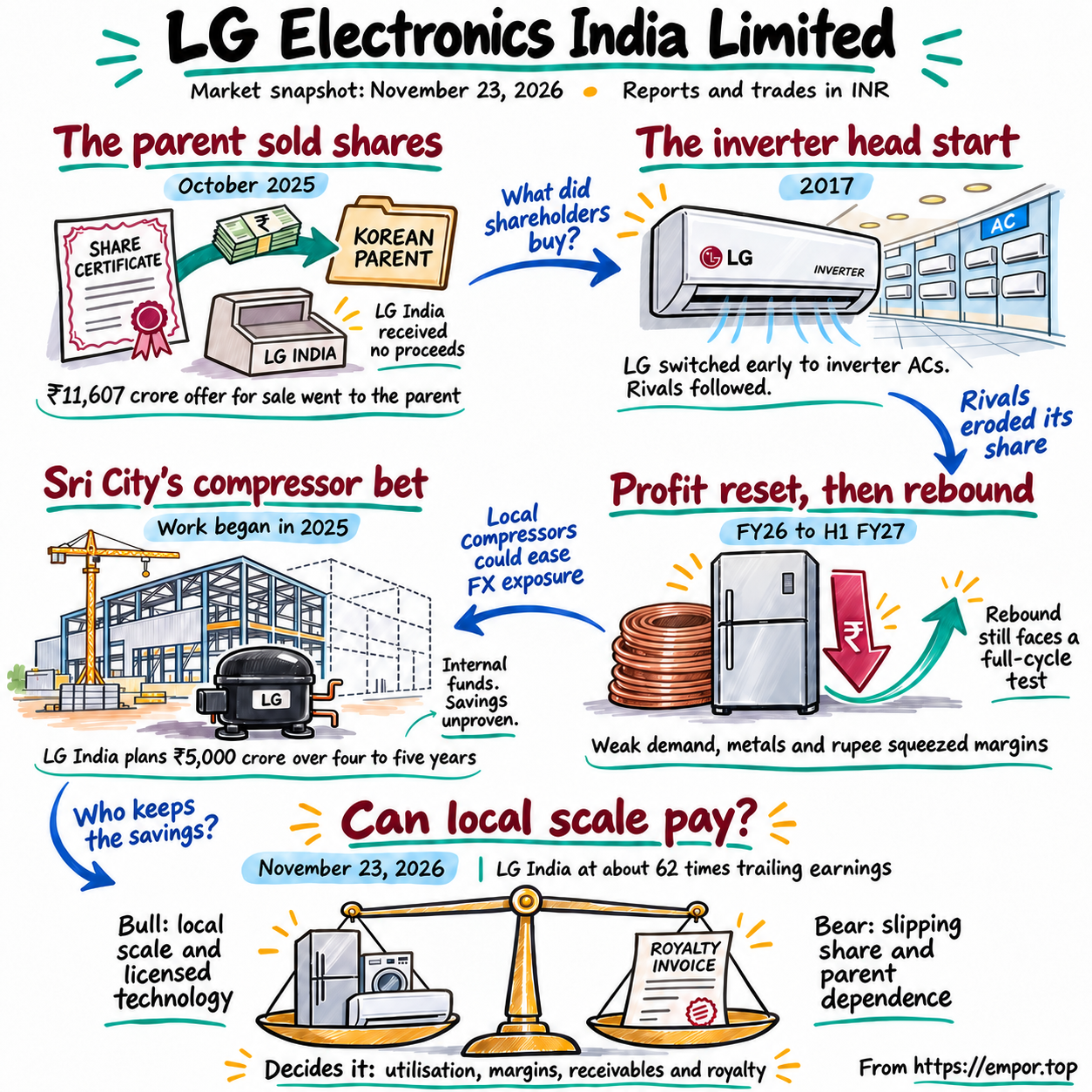
It was not that story at all. Every one of the shares sold that week came from a single seller: LG Electronics Inc., the Seoul-based parent known in Korea as LG전자. The entire issue was an offer for sale, which meant the parent sold part of its existing holding to new investors, and the Indian company itself received nothing.4 Not one rupee of the ₹11,607 crore landed in the bank account of the business that makes the refrigerators in Greater Noida and the washing machines in Pune. When the dust settled, the parent still owned 85% of the company, and the public owned 15%.4
That is the first oddity a new shareholder in LG Electronics India has to sit with. This is a listed company in which the public is a small passenger, the controlling shareholder has just converted a slice of its Indian subsidiary into cash, and the subsidiary's own funding plans rest on what it can generate from selling appliances. It is a useful way to read the IPO: less a growth company raising capital than a global parent putting a market price on one of its most valuable overseas businesses, and banking part of that value.
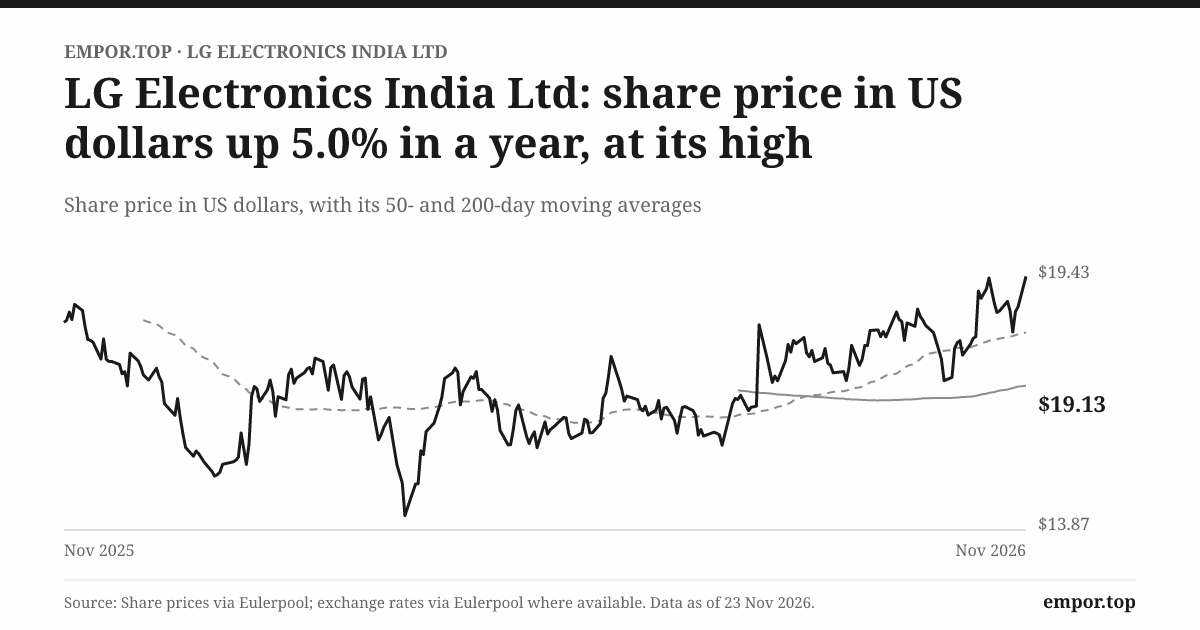
Thirteen months later, the market has rewarded the people who bought. On November 23, 2026 the shares closed at ₹1,777.50, about 56% above the IPO price, and less than 1% below their 52-week high.5 At that price the company was valued at roughly ₹1.19 lakh crore, and the stock traded at about 62 times its last twelve months of earnings.56 For a business that sells fridges and air conditioners, that is a multiple usually reserved for companies investors believe can compound for a long time.
The arithmetic of the listing shows who has done well so far. At the ₹1,140 offer price, the whole company was valued at roughly ₹77,000 crore. Today the same shares are valued at more than half as much again. The new public shareholders have captured that gain on their 15%. The parent has captured it on the 85% it kept, a stake now worth roughly ₹1 lakh crore at market prices, while it also banked the cash from the 15% it sold. For LG Electronics Inc., the IPO turned an internal asset into a priced, liquid and partly monetised one, and showed its own investors in Seoul what its Indian business was worth on a public market.
Then, on November 25, 2026, the parent filed another notice. LG Electronics Inc. said it planned to sell up to 2% of the company, a little more than 1.35 crore shares, by December 31, 2026, so that the listed company would move toward the minimum public shareholding that Indian rules require.7 At recent prices that is a block worth roughly ₹2,400 crore. It is the same pattern as the IPO: another sale by the parent, not a fund-raise by the company. If it completes, the parent's stake will fall to 83%, still overwhelming control.78
So what exactly did public investors buy? They bought a minority share of a profitable, debt-free Indian consumer-durables leader whose economics are tied to its parent in ways that matter: the brand on the door, the technology inside the compressor, the components shipped from group factories, and the board that sets the terms. Four questions run through the story that follows. Can LG India defend its leadership in categories where shoppers can walk across the aisle to Samsung or Haier? How much of its edge belongs to the parent, and what does the parent charge for it? Will the ₹5,000 crore factory rising at Sri City earn its cost? And does a price of about 62 times earnings leave any room for a business whose profits, as FY26 showed, can fall sharply in a bad year?
A trading record of barely thirteen months cannot answer the last question on its own, because the stock has never lived through a full earnings cycle as a public company. To judge what the public owns, it helps to go back to the decision that made LG a manufacturer in India rather than an importer, and to the bet, two decades later, that defined its modern reputation.
 Subscribe on LinkedIn
II. The First Big Bet Was to Build in India
In the mid-1990s, India's consumer electronics market looked very different. Liberalisation had opened the door to foreign brands, but many of them treated the country as a place to sell products designed and made somewhere else. LG's choice was to put down roots. In 1997 it set up its first Indian manufacturing facility at Greater Noida, on the industrial edge of Delhi, and seven years later, in 2004, it added a second plant at Ranjangaon near Pune in Maharashtra.4 Those two factories, one serving the north and one the west, are still the backbone of the company's production today.49 Owning the factories turned LG from a brand that shipped boxes into India into a business that employed Indian engineers, worked with Indian component suppliers and could keep its shelves stocked when demand spiked. It also put LG's cost base in rupees for a large part of what it made, which is the same logic, three decades later, behind the newest plant.
The decision mattered because appliances are heavy, bulky and price-sensitive. A refrigerator is mostly air and steel; shipping it across oceans costs money and time, and import duties add more. A company that builds locally can price more aggressively, respond faster when a heat wave lifts demand for air conditioners, and tailor products to the quirks of Indian homes: voltage fluctuations, hard water, dust, very hot summers, and kitchens where a refrigerator may have to cope with frequent power cuts. LG's Indian business grew by doing exactly that, adapting global products to local conditions and building the distribution and service network needed to reach households far beyond the metro cities.4
The product range widened as the network grew. The early staples were refrigerators, washing machines and televisions. Over time LG India added room air conditioners, water purifiers, microwaves, commercial air conditioning for offices and shops, and display products such as monitors and digital signage.4 By the time of the IPO, the business was organised into two broad segments. Home Appliances and Air Solution covers the fridges, washers, air conditioners and purifiers. Home Entertainment covers televisions, audio and monitors.9
It is important to be precise about what this listed company is, because the LG name invites confusion. LG Electronics India Limited is one entity: two plants, its own sales and service organisation, and 3,835 permanent employees at March 2026, up from about 3,693 a year earlier.94 The research laboratories in Korea, the global sales figures and the tens of thousands of LG group employees elsewhere do not belong to it. Nor does the listed company hold a portfolio of acquired businesses: at March 2026 it had no subsidiaries, associates or joint ventures.9 Its growth has come from building factories, launching products and expanding the sales network, not from buying rivals. That makes the story unusually clean to follow, because what the company reports is what the company does.
It also makes the boundary between the Indian business and its parent the central fact of the investment case. Local production, local product adaptation and a national service network are genuine Indian assets, built over almost three decades. The technology inside the products and the brand on their fronts, however, sit with the parent, and the Indian company licenses them. LG India reports research and development spending of only about ₹125 crore in FY26, roughly half a percent of revenue, because the heavy research happens in Korea.9 A manufacturer that adapts and assembles is valuable. It is a different thing from a manufacturer that invents.
That distinction would be tested most sharply in one category. In 2017, LG India made the boldest product decision in its Indian history: it walked away from regular fixed-speed split air conditioners, which at the time still made up most of what Indians bought, to bet the business on inverter models.10 Whether that call created a lasting advantage, or simply put LG early into a market everyone else would later crowd into, is the question at the heart of LG's competitive story.
III. The Inverter Bet Won a Market, but Not a Permanent Lead
Picture an Indian appliance showroom in the summer of 2017. Rows of split air conditioners line the walls, most of them the familiar fixed-speed type, which works like a light switch: the compressor runs at full blast until the room is cold, shuts off, then roars back to life when the temperature drifts up. The inverter models sit at a premium, and their pitch is subtler. An inverter compressor works more like a car's accelerator than a light switch. It slows down once the room is cool and keeps humming at low power, which uses much less electricity over a long, hot season. The catch was the price tag, which was meaningfully higher, in a market where most buyers looked first at what they paid on the day.
That January, LG told the trade it was moving toward high-end, energy-efficient air conditioners and would focus on inverter technology.10 It went further than most rivals were willing to: it stopped selling the regular fixed-speed split models that still formed the bulk of the market. It was a decision to give up volume today in exchange for a position in what LG believed the market would become. Tightening energy-efficiency rules helped make the case. By August 2017 inverter sales were already swelling ahead of new efficiency norms, as buyers and retailers anticipated the change.11
The forecast proved right. By FY25, inverter models made up roughly 80% of air conditioners sold in India, so the segment LG had bet on became the market.4 For a technology call, that is about as clean a vindication as it gets.
What happened next is the more revealing part. LG's offline value share in inverter air conditioners, meaning its share of rupee sales through physical stores, eased from about 25.5% in FY22 to 18.7% in FY26.49 The market LG had helped create kept growing, but competitors poured in. Voltas, the Tata-group air-conditioning brand, Japan's ダイキン Daikin, Blue Star, and Havells' Lloyd brand all built or expanded inverter ranges once the direction was clear.4 Being first gave LG credibility and a head start. It did not give it a lock on the market.
How an appliance company actually earns
To judge what that share drift means, it helps to understand how this business makes money. LG India is overwhelmingly a product company. In FY25, product sales were about 96% of revenue from operations, and services such as installation, repairs, annual maintenance contracts and warranty work were under 3%.4 Most of those products go to trade partners, from national electronics chains to regional distributors and dealers, who then sell them to households. There is a recurring element, because a household that buys an LG air conditioner may pay for maintenance or repairs later, but the bulk of revenue arrives one appliance at a time, when a family replaces a fridge, moves into a new flat, or decides this is the summer it finally gets an AC.
The two segments are very different in size. In FY26, Home Appliances and Air Solution produced about 74% of revenue and roughly ₹1,774 crore of segment earnings before interest and tax. Home Entertainment produced about 26% of revenue and about ₹827 crore of segment EBIT.9 Put those figures side by side and a second fact emerges. Appliances and cooling are the engine, delivering about two-thirds of segment profit, at a segment margin of roughly 10%. Televisions and displays earned nearly 13% on their sales, a richer margin from a smaller base.9 For a shareholder, that means the investment case is mostly a bet on fridges, washers and air conditioners, while the TV business, often written off as a commodity battlefield, is quietly pulling its weight.
The war game in the aisle
Now walk the showroom the way a buyer does. Next to the LG refrigerators stand 삼성전자 Samsung Electronics' models, the closest broad-line competitor in almost every category LG sells. Whirlpool and 海尔 Haier are serious contenders in fridges and washing machines. In cooling, the shelf belongs as much to Voltas, Daikin, Blue Star and Lloyd as it does to LG.4 A customer can compare features, energy ratings and prices in a single visit, or on a phone, and switching brands costs almost nothing. There is no contract to break and no data to migrate. The next fridge can come from anyone.
Against that backdrop, LG's positions are impressive. In the first half of calendar 2025, LG's offline value share was about 30% in refrigerators against Samsung's roughly 24%, and about 34% in washing machines, nearly double the next competitor's 17%.4 In FY26, LG reported shares of about 29% in refrigerators, about 32% in washing machines and about 26% in televisions.9 These are category shares through physical retail, not a share of the whole Indian appliance market, and online channels are measured separately, but they establish LG as a leader in the categories that matter most to its revenue.
The harder question is whether those positions are a moat or a lead. The record over the longest span available gives a measured answer. From FY22 to the first half of FY25, LG's offline share eased in refrigerators, washing machines and inverter air conditioners, while its television share held broadly steady.4 The FY26 figures show further easing in several categories.9 None of that is a collapse. LG still leads. But a company with unassailable pricing power would not be giving up a few points of share each year to rivals who sell through the same stores to the same customers. The history narrows the moat claim: LG has strong brand recognition, the broadest product range, two factories and a national service network, and those things make it hard to dislodge. They have not stopped rivals from taking ground.
The economic forces around the business explain why. Consumers have real power, because they can compare brands easily and, in a tight month, simply delay replacing an old fridge. The trade has power too. LG's top five customers accounted for about 55% of FY25 revenue and its top ten for about 67%.4 Those customers are the large distributors and retail chains that stand between LG and households, not end buyers, so this is channel concentration rather than dependence on one contract. It has eased somewhat, with the largest single customer falling from about 20% of revenue in FY23 to about 17% in FY25, and LG did not lose any top-ten customer in FY23 to FY25.4 But a chain that controls shelf space and display placement can always ask for better margins or promotional support, especially when Samsung is offering the same.
Entry into the market is hard but not closed. Building brand awareness, factories and a service network across India takes years and serious capital, which protects incumbents against newcomers. Yet the incumbents themselves are numerous and well funded, and each has expanded into the categories it once left to others. On the supply side, LG India relies on a few concentrated inputs: three domestic steel makers, two suppliers for most of its specialised plastics, a single supplier for most of the internally grooved copper tubes used in air conditioners, and several Chinese motor suppliers.4 That concentration gives those suppliers leverage and exposes LG to disruption if any one falters.
The 2017 air-conditioner move was a display of real strategic judgment. Management read the regulatory and technology trend early and committed. The later share drift is the counterweight: early commitment opened the market but did not lock up its profits. The way to follow this franchise, then, is not to watch share in isolation. Share gained through discounting would look the same on a market-share chart as share gained through better products, but it would mean something very different for profits. The test is share together with price realisation and segment margins.
And that brings the story to its most uncomfortable question. If shoppers can switch, retailers can push back and rivals can match products, what happens to a market leader when demand weakens and the cost of copper and aluminium rises faster than it can raise prices? FY26 supplied the answer.
IV. A Record Quarter Followed by a Profit Reset
The festive season in India is when appliance makers earn their year. Diwali, the wedding calendar and generous retail promotions pull millions of households into stores to replace a television or buy a first washing machine. In late 2025, LG India entered that season as a newly listed company, carrying the expectations of investors who had just bid its shares up by almost half. Then, once the lights came down, the post-festive months turned quiet.
In the third quarter of FY26, the three months to December 2025, revenue fell year on year and the business's operating profit nearly vanished. EBITDA margin dropped to about 4.8%, and profit after tax fell to roughly ₹90 crore.12 Management explained the quarter with three forces: subdued consumer demand after the festive rush, higher prices for copper and aluminium, and pressure from a weaker rupee that raised the cost of imported components.12 For a company that sells metal boxes full of copper tubing and imported electronics, all three pushed in the same direction.
The currency piece deserves a moment, because it is built into how LG India operates. At March 2026, the company's unhedged dollar trade payables, the money it owed foreign suppliers, were about US$160 million, against only about US$19 million of dollar trade receivables from export customers.9 That imbalance means a weaker rupee raises what LG owes far more than what it is owed. In FY26 the company booked about ₹161 crore of net losses on foreign-currency transactions and translation, almost four times the roughly ₹41 crore of FY25.9 It uses forward contracts to dampen the effect, but they provide an economic hedge rather than a complete shield, and CRISIL names currency volatility alongside commodity prices as one of the constraints on its rating.913 An appliance maker that imports a large share of its components is, in effect, running a permanent short position on the rupee.
The rhythm of a seasonal business
That quarter is easier to understand once the business's rhythm is clear. Air-conditioner and refrigerator sales depend heavily on summer heat, so the January-to-June period tends to be strong for cooling. Televisions and washing machines lean on the festive and wedding seasons. Retailers stock up before peaks and destock afterwards, so a quarter's revenue can reflect channel inventory as much as consumer demand. Promotions shift sales and cash between quarters. And because factories, salaries and advertising costs do not fall as fast as revenue, a weak quarter hurts profits disproportionately. That effect, operating leverage, works beautifully in a boom and painfully in a slump.
The effect is visible across the full year. FY25 had been a record: revenue of about ₹24,367 crore and profit after tax of about ₹2,003 crore, with an operating margin of about 11.5%.9 FY26 revenue was nearly flat at about ₹24,605 crore, but profit after tax fell to about ₹1,685 crore and the operating margin slipped to about 8.9%.9 In other words, LG sold roughly the same amount in FY26 as in FY25 and kept about one-sixth less profit. Weak demand at the wrong moment, commodity inflation, rupee depreciation and the cost of new sales and marketing pushes absorbed the difference.914 The fourth quarter of FY26 showed the same tension. Sales grew about 8%, but profit fell about 8% from a year earlier.15
A careful reader should notice one more element in those profits. FY26 other income was about ₹328 crore, around 14% of profit before tax, and most of it was interest on bank deposits.9 That income is real, but it comes from LG India's cash pile, not from selling appliances. Strip it out and the operating business earned less than the headline profit suggests, which matters when judging how much margin the products themselves generate. The rest of other income was a mix of interest on income-tax refunds and gains on currency derivatives, neither of which says much about how many fridges LG sold.9 As Sri City consumes cash over the next few years, that interest line will shrink, so some of the support it gave reported profit in FY26 will fade just as the factory's own costs begin to arrive.
One data trap is worth flagging. Some commercial data services record LG India's FY25 profit before tax and net profit as zero, along with a zero entry for the June 2025 quarter. Those values conflict with the company's own filings, which report FY25 profit after tax of about ₹2,003 crore.9 The filings are the right basis, and the zeros are an artefact of the data rather than anything the company did.
The rebound, and what it does not yet prove
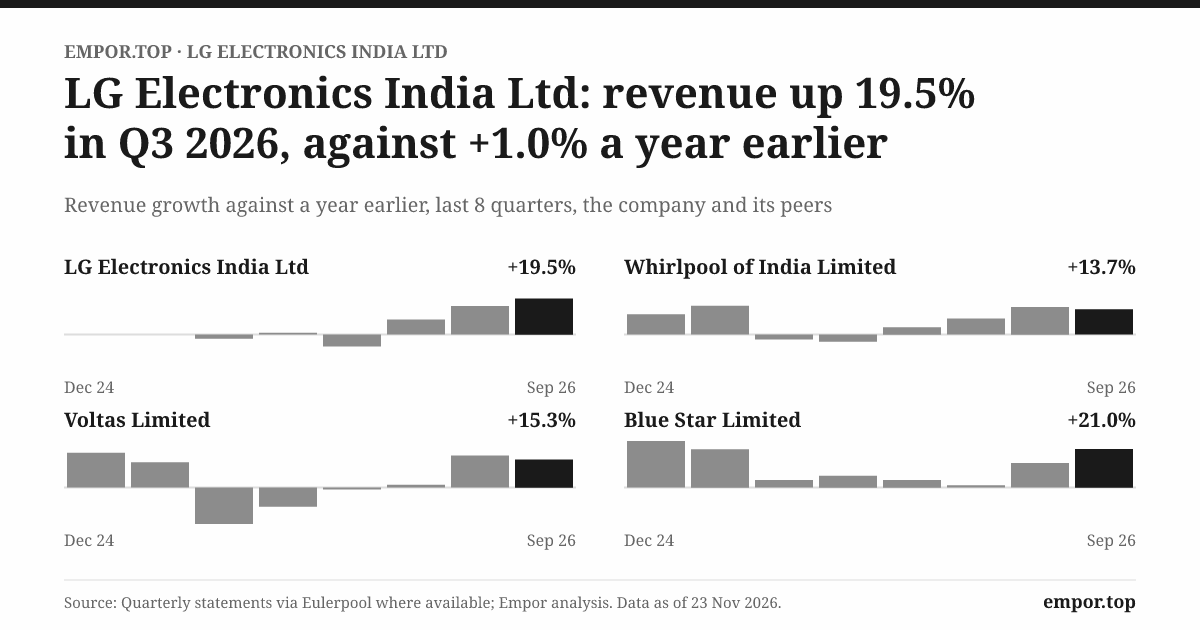
Then the cycle turned. In the first half of FY27, the six months to September 2026, revenue grew about 17.5% year on year, EBITDA about 28% and profit after tax about 26.5%.616 The second quarter alone was stronger still. Revenue rose about 19.5% and EBITDA about 28%, with margin widening by about 0.6 of a percentage point to roughly 9.5%, even though commodity and currency costs were still running against the company.16 Management credited the improvement to higher volumes and a richer mix of premium products.17
The prepared remarks and the analyst questions across four calls tell a consistent story with a sharpening edge. On the Q3 FY26 call, management's explanation was cyclical: demand, metals and the rupee.12 By the fourth-quarter call in May 2026, with FY26 closed, the conversation had turned toward recovery and the investment programme.18 By the Q2 FY27 call in November, management was willing to put specific dates on that capacity and to name the mechanism through which it expected savings. Management said local compressor production would reduce dependence on imported and third-party compressors, and with it the company's exposure to foreign-exchange swings.17 That progression, from describing a problem to giving a dated plan to address part of it, is the kind of behaviour investors should want. It is also a set of promises that can be checked.
The verdict on the profit reset is reasonably clear. FY26's decline had identifiable, mostly external causes, and LG did not lose its footing in the market while profits fell. FY25 looks, in hindsight, like a year when several favourable forces lined up at once. The first half of FY27 is a genuine rebound, with profit growing faster than revenue as operating leverage swung back in LG's favour. But two strong quarters are not a cycle. The fact that profit could drop by about a sixth on flat sales is the strongest evidence that this is a cyclical, margin-sensitive business, and nothing in two quarters of recovery changes that.
The rebound restores the growth question. It also raises a second one, which the profit numbers alone cannot answer: how much of LG India's product advantage, and how much of its cost base, sits outside the listed company altogether?
V. The Logo on the Fridge Comes with a Royalty Bill
At the close of FY26, LG India's accounts recorded a line that most Indian appliance makers never have to write. The company paid about ₹460 crore in royalty to LG Electronics Inc. for the right to use the LG brand and the group's technology.9 At the same time, it kept buying finished products and components from the parent and its affiliates.9 The logo on the fridge door is the most visible asset in the business. It is also, in a literal sense, rented.
That is the heart of the relationship. LG India sells into an Indian market, through Indian distributors, out of Indian factories, but much of what makes its products competitive comes from the group. Its own prospectus said the company relies heavily on LG Electronics and other group companies for product technology and research.4 The royalty is the price of that reliance, and at about 1.9% of FY26 revenue, it is a meaningful one, equivalent to more than a quarter of the year's profit after tax.9
The flows between the two companies run in both directions, but not evenly. Only about 3.8% of FY26 sales went to related parties, so LG India does not depend on the group to buy its products. On the purchasing side the picture is very different: about 19.7% of the company's purchases came from related parties.9 One in every five rupees LG India spent on purchases went to group companies. So the revenue line is mostly independent. The cost line is not.
The board has broad permission to continue that pattern. In a postal ballot whose results were announced in April 2026, shareholders approved dealings with the parent of up to ₹7,250 crore for FY27, covering purchases, sales, royalties, fixed assets, services and warranty charges.19 That figure is a ceiling, not a bill. It authorises the company to transact up to that amount and says nothing about what it will actually spend. But it does show how large the parent relationship could become relative to a company with about ₹24,600 crore of annual revenue.
The royalty is where small changes have large consequences. Because LG India's net margin is only around 7%, a royalty of about 1.9% of revenue already absorbs a large slice of what the business keeps. If the rate were to rise by even half a percentage point, the extra cost would be equivalent to roughly a fourteenth of FY26 profit, with no change in a single product, factory or customer. The opposite is also true: a stable royalty in a growing business becomes a smaller burden over time. That is why the rate, and the rules for changing it, matter more to minority shareholders than almost any other line in the related-party note.
The tax settlement that cleared one cloud
There was also good news inside that relationship. Transfer pricing, the rules governing the prices that group companies charge each other across borders, is where disputes between parents and subsidiaries usually surface, because tax authorities in each country want the profits booked on their side. LG India had a contingency of about ₹315 crore linked to royalty payments, under a mutual agreement procedure between the Indian and Korean tax authorities. In January 2026, an advance pricing agreement settled the matter. It eliminated that ₹315 crore contingency and reduced other covered transfer-pricing contingencies by about ₹172 crore.9 That matters because it gives LG India and the tax authorities an agreed framework for pricing certain dealings with the parent, removing one recurring source of dispute.
Who keeps the savings
The filings do not show that the relationship is harmful. The company describes its related-party transactions as conducted in the ordinary course and at arm's length, and the auditor issued a clean opinion.9 The parent's brand and technology are, on most evidence, a big part of why LG India leads its categories, and CRISIL counts them among the company's rating strengths.13 A skeptical minority investor would still ask a few pointed questions.
The first is who decides where products are sourced. When LG India can choose between buying a component from a group factory abroad and making it locally, the decision affects both its margins and the parent's. The second is who keeps the savings when local production becomes cheaper. If Sri City makes compressors at a lower cost than imports, the benefit can flow to LG India's margins, to lower prices for consumers, or, through a higher royalty or transfer price, back to the group. The third is what the actual FY27 figures will show: the royalty amount, the scale of parent purchases and the balances owed in each direction. Those numbers, not the approval ceiling, are the honest test.
None of these questions has a damning answer today. They are simply the questions that come with owning a minority stake in a subsidiary whose most important intangible assets belong to someone else. The relationship is both a moat and a dependency. The next bet LG India is making is whether a new factory can reduce what that dependency costs, while the parent still controls the technology inside it.
VI. Sri City Is the Test of Whether Local Scale Pays
Sri City is an industrial city carved out of scrubland on the Andhra Pradesh side of the Tamil Nadu border, north of Chennai. It is where LG India has chosen to place its largest bet since it built its first factories. In 2025, before the IPO, the company began work on a new plant there, with a planned investment of about ₹5,000 crore over four to five years.2013 The factory is designed to make air conditioners and, critically, compressors, the heart of every air conditioner and refrigerator.2017
On the Q2 FY27 earnings call in November 2026, management put dates on that plan. Compressor production at Sri City was due to begin in the third quarter of FY27, meaning the three months to December 2026, and air-conditioner production around January 2027, with later capacity to follow in phases.17 The compressor line is planned to add about 2 million units of annual capacity.17 For a company that has spent much of its history making its products in Noida and Pune, it is a third leg for the business, and the first in the south.
Why compressors are the point
The interesting part of Sri City is not the square footage. It is what the factory is meant to replace. A compressor is to an air conditioner what an engine is to a car: the most valuable and technically demanding component, and one that LG India has largely bought rather than made. Many of those compressors come from outside the company, including from group companies and from abroad, and they are priced in foreign currency. When the rupee weakens, as it did in FY26, each imported compressor gets more expensive in rupee terms, and LG must either raise prices, at the risk of losing share to rivals, or accept a thinner margin.
Management says local production will help address that exposure.17 The logic is sound, and it connects directly to the FY26 profit squeeze. But it is a forecast. No cost saving from Sri City has yet been reported, because the lines had not started production when the company last reported results. Saying the factory will lower costs is a claim. Showing lower costs in audited margins will be the proof.
It is worth placing the investment beside the IPO. The public offering raised nothing for the company, so the factory is not being funded with new shareholders' money. It is being paid for out of LG India's own cash and internal accruals, as CRISIL noted when it reaffirmed the company's top credit rating.13 The spending is already visible. In FY26, cash spent on property, plant, equipment and intangible assets reached about ₹1,172 crore, more than double the roughly ₹532 crore of FY25, and nearly 5% of revenue compared with about 2% the year before.94 The pace continued into FY27, with about ₹870 crore of capital spending in the second quarter alone.16 This is a company shifting from maintaining its factories to building new ones.
Exports and a speculative side bet
Sri City also feeds a growing ambition to export. On the same call, management described expanding the number of countries it sells to from about 50 to 68, and growing its Essential Series, a range designed for value-conscious buyers, in new markets.17 That is an encouraging direction. But the number of countries a product reaches says little about its economics. What matters is how much export revenue contributes, at what margin, and whether exports soak up Sri City's capacity in years when Indian demand is soft. Those figures are what investors should ask for, and the company has not yet broken them out in a way that answers the question.
A further, more speculative ambition is Vehicle Solutions. LG India has said it plans to bring the parent's automotive components capabilities, such as in-vehicle displays and electronics, into India.17 It is an intriguing option, because India's automotive market is large and increasingly electric. It is also only an idea at this stage: there is no disclosed revenue, investment budget or return target for the business, so it belongs in the story as a possibility, not as part of the value.
What is missing from the Sri City story is as telling as what is in it. LG India is not buying a competitor or paying a premium for someone else's factory. There is no acquisition multiple to benchmark and no goodwill to write down later. The capital-allocation test is simpler and more demanding: will a ₹5,000 crore organic investment earn a return that justifies its cost, compared with what that money could have done otherwise?
The early record is encouraging but incomplete. Management has committed capital, set a timetable and named the mechanism by which it expects the factory to pay off. The first-half rebound is encouraging. What has not happened yet is the part that decides the outcome: commissioning on time, ramping up utilisation, and showing in the margins that locally made compressors cost less than imported ones. Factories have a way of revealing whether their business case was conservative or optimistic only after the concrete has set.
LG India's supply chain for some key components is concentrated.4 Every additional critical component made in its own plant reduces the number of single points of failure that a shipping disruption, a border dispute or a sudden tariff could expose. That resilience does not show up as a line in the accounts, but it is part of what the ₹5,000 crore is buying. The risk runs the other way too: a compressor plant is a large fixed cost, and if Indian demand stalls in the years Sri City is ramping, its idle capacity will weigh on margins exactly when the business can least afford it.
A ₹5,000 crore build-out on internal funds is only as safe as the cash machine behind it. That raises the question of whether LG India's profits turn into cash reliably, or whether some of them stay tied up with the trade partners who sell its products.
VII. The Cash Is There; It Has to Come Back from the Channel
At March 31, 2026, LG India's balance sheet held about ₹4,476 crore of cash and cash equivalents, mostly in bank balances and short-term deposits.9 It had no loans from lenders.9 For a company about to pour thousands of crore into a new factory, that is a comfortable position. But one number on the same balance sheet had been climbing for two years. Trade receivables, the money owed by distributors and retailers for products already delivered, had reached about ₹2,825 crore.9
Start with the reassuring part. Over the four years from FY22 to FY25, LG India reported about ₹4,031 crore of net profit and generated about ₹5,788 crore of cash from operations, about 1.4 rupees of operating cash for every rupee of accounting profit.214 After capital spending, free cash flow over those four years was about ₹4,416 crore.214 That is the signature of a business whose earnings are real: it collects from customers, holds inventory sensibly and pays suppliers on normal terms, so that profit shows up in the bank account rather than just on paper.
Where did that cash go? Not, for the most part, into the cash pile. In the three years to FY24, the company's financing outflows totalled roughly ₹7,000 crore, at a time when it had no bank debt to repay and its lease payments were only a few hundred crore a year.214 For a company then wholly owned by LG Electronics Inc., that is cash returned to its sole shareholder before the public arrived. Some commercial data sets record LG India's dividends over those years as zero, which does not square with financing outflows of that size; the company's own cash-flow statements are the better guide. The point for a new investor is not that the parent did anything improper. It is that the parent has historically decided how much of LG India's cash stays in India, and it still controls the board that will make those decisions in future.
Where the cash got stuck
FY26 told a more nuanced story. Operating cash flow was about ₹1,721 crore against profit after tax of about ₹1,685 crore, so the company again turned its profit into cash.9 But that headline conceals a tug of war inside working capital. Rising receivables absorbed about ₹456 crore of cash during the year, offset partly by lower inventory and higher payables to suppliers.9 FY25 had been weaker still, with operating cash flow below profit as inventory and receivables both soaked up cash.9 Cumulatively the record is strong, but in any single year the channel can take a meaningful bite.
The trend is what deserves attention. Trade receivables rose from about ₹1,797 crore at March 2024 to about ₹2,361 crore a year later and about ₹2,825 crore at March 2026.9 Over those two years, receivables grew by more than half, while FY26 revenue grew only about 1%. In plain terms, LG India's trade partners are holding on to its money for longer, or LG is offering them more generous terms to keep products moving, or the timing of year-end sales has shifted. Each explanation has different implications. The company does not break down how much of the increase reflects each cause.
The credit quality of those receivables, for now, looks sound. LG India had some long-dated balances, including about ₹13 crore more than three years old in the higher-risk category, against a loss allowance of about ₹15 crore in that schedule.9 Actual write-offs of trade receivables in FY26 were only about ₹1.6 crore, and the company recorded a small net reversal of allowances across receivables and other assets.9 There is no sign of a wave of bad debts. The concern is not that customers are failing to pay. It is that a growing pile of money sits with the channel, which is precisely where an appliance maker's bargaining power is weakest.
A strong balance sheet with one large shadow
In other respects, the balance sheet is a fortress. LG India had no loans or borrowings from lenders during FY26.9 The ₹459 crore labelled "total debt" in its capital-management disclosures consists entirely of lease liabilities for warehouses, offices and similar premises, not funded borrowing.9 CRISIL reaffirmed its top AAA/Stable rating in December 2025, citing the company's market position, diversified portfolio, strong financial profile and parental links, while naming intense competition, raw-material volatility and foreign-exchange exposure as constraints.13
The shadow is the tax dispute book. At March 2026, LG India carried about ₹2,799 crore of claims against it that it does not acknowledge as debt, the great majority of them income-tax demands, with smaller amounts for GST, sales tax, excise, customs and other claims.9 To put that in proportion, it is more than three-fifths of the company's cash balance and well above a full year of FY26 profit. Management says it expects these demands to be deleted or substantially reduced, and the timing of any cash outflow cannot be estimated.9 Indian tax disputes often take years to resolve and many are reduced on appeal, so management's view may well prove right. But the claims are material, unresolved and outside the company's control, and any investor sizing up the balance sheet should keep them in view.
One accounting judgment also deserves a mention. LG India's auditor singled out the estimates for discounts and rebates on revenue as a key audit matter, the area of the accounts requiring the most judgment, while issuing an unmodified opinion.9 That makes sense for a business selling through trade partners, where schemes, volume incentives and promotional support are negotiated constantly and can be settled months after a sale. It also links back to the receivables question. When the balance between gross sales, rebates owed to the channel and cash collected shifts, the reported revenue and the cash that actually arrives can drift apart for a while. Nothing in the filings suggests a problem, but it is the part of the accounts most sensitive to how hard LG is pushing its channel.
The cash engine is real, and it can fund Sri City without borrowing. What cash generation alone cannot settle is whether today's share price gives public investors enough protection, in a company where the parent controls both the economics around the business and the votes inside it.
VIII. The Parent Still Holds the Votes—and the Valuation Is Not Cheap by Default
The shareholding pattern LG India filed for the quarter ended September 30, 2026 reads like a portrait of the company's structure. LG Electronics Inc. held 85%. Foreign portfolio investors held about 2.6%. Domestic institutions, mostly mutual funds, held about 8.8%. Everyone else, individuals and other investors, held about 3.6%, spread across some 819,344 public shareholders.8 Hundreds of thousands of owners, together holding less than a sixth of the company.
The ownership mix has shifted modestly in the short time since listing. In December 2025, foreign portfolio investors held about 3.0% and domestic institutions about 7.2%; by September 2026, foreign ownership had dipped and domestic institutions, particularly mutual funds, had increased their holdings.228 Thirteen months is far too short to call that a trend, but it suggests that Indian fund managers have been more willing than foreign investors to keep adding at these prices. No promoter pledge appeared in the September filing.8
The IPO created a liquid public stake. It did not change who controls the company. When it sells another 2% by December, as it said it plans to on November 25, it will remain firmly in control at 83%.7 For outside investors, the more practical effect is liquidity. A public float of 15% in a company of this size is already substantial, and adding roughly another eighth to it will make the shares easier to trade and give index funds and large institutions a little more room to buy. It also adds supply. Each parent sale is a reminder that the controlling shareholder is, at the margin, a seller of the stock, even as it remains the company's most important owner.
The people running the company
Day to day, the business is run by two executives sent from the group. Hong Ju Jeon has been Managing Director since January 2023, which means he led the company through its pre-IPO preparation, its listing and its FY26 profit reset.94 Dongmyung Seo, who joined the Indian company in December 2021, serves as whole-time director and Chief Financial Officer, the executive whose fingerprints are on the balance sheet discipline, the working-capital numbers and the investor calls.9 It is a typical arrangement for a Korean multinational's overseas subsidiary: leadership rotated in from the parent, with deep group loyalties and a mandate shaped in Seoul as much as in Noida.
Their pay is modest by global standards and has not jumped with the stock. In FY26, Jeon received about ₹5.90 crore and Seo about ₹4.37 crore, broadly flat on the previous year, even though profit fell.9 The annual report lists salary and commission separately from performance incentives, reports no performance-incentive amount for the year, and says stock options are not applicable.9 That cuts both ways. Pay is not obviously excessive, but it is also not visibly tied to the listed company's share price or returns.
It would be a mistake to treat the parent's 85% as evidence that management's interests line up with those of minority shareholders. That stake belongs to LG Electronics Inc., not to the executives running the Indian company, and the FY26 report says the non-executive directors held no shares in the company.9 Half of the six-member board was independent at March 2026.9 The parent's interest and the minority's interest overlap most of the time, since both benefit when LG India sells more and earns more. They can diverge on exactly the questions raised by the royalty and sourcing: who captures the value created in India.
Shareholders have so far raised only mild objections. In the spring 2026 postal ballot, about 1.5% of votes cast opposed Seo's reappointment, and only about 0.01% opposed the large parent-transaction authorisation.19 Since the parent's own 85% stake would not vote on its own related-party approval, that near-unanimous result reflects the minority's view. It is a small but visible governance signal, not evidence of any dispute.
What the price assumes
That brings the story to the valuation. At about 62 times trailing earnings and about 4.4 times sales, LG India is priced like a business investors expect to grow strongly and for a long time.5 The multiple has no listed history to compare against: with barely thirteen months of trading, there is no five-year median P/E to tell investors what "normal" looks like for this stock.
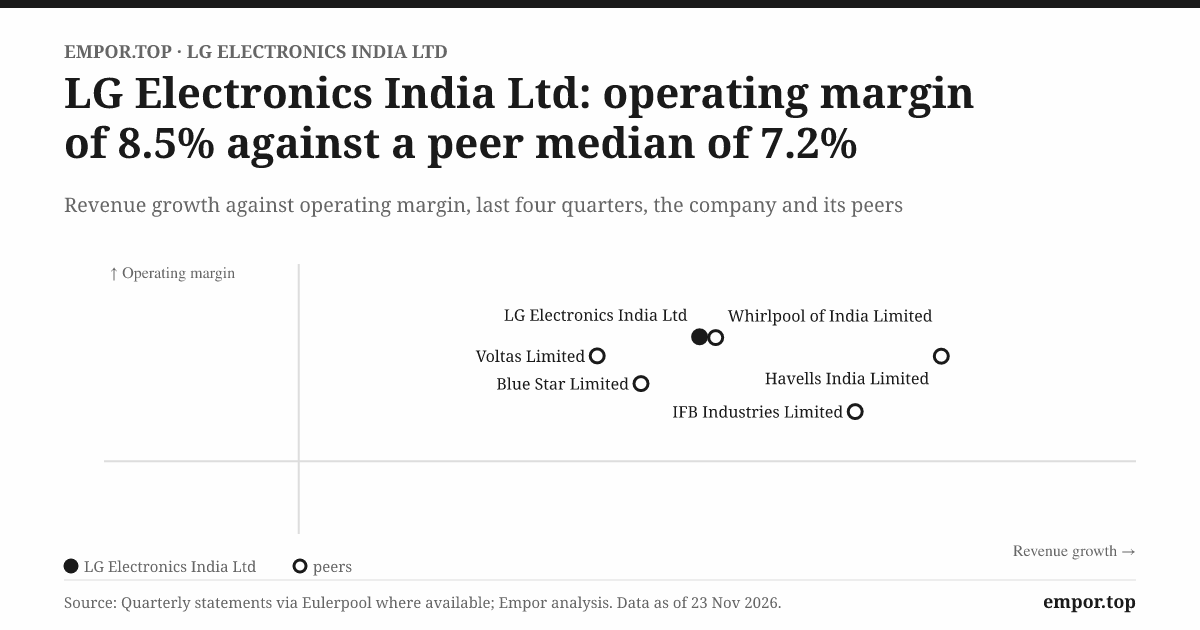
Peers provide only rough context. In a consumer-durables screen in late September 2026, Havells traded at about 42 times earnings, Voltas at about 82 times and Blue Star at about 63 times, with LG India at about 64 times on that date.23 Those comparisons predate the latest prices and involve businesses with different mixes. Havells is dominated by wires, switches and fans; Voltas and Blue Star are concentrated in cooling. They suggest LG India sits within the range Indian investors pay for branded durables, not at an extreme. They do not suggest it is cheap.
Set that multiple against the record. Over the three years to FY26, revenue grew about 7% a year and profit about 8% a year, with the FY26 slowdown dragging the averages down.9 A multiple in the sixties implies that investors expect growth well above that pace to last for years. The first half of FY27 points in that direction. The three-year record does not yet.
There is a simpler way to see the expectation embedded in that price. At about 62 times earnings, a buyer today receives an earnings yield of roughly 1.6%, meaning each ₹100 of share price is backed by about ₹1.60 of annual profit. The company itself earns more than that by leaving its cash in a bank deposit, which is part of why other income makes up such a noticeable share of its profit. A shareholder accepting so thin a current yield is, by definition, paying for profits that do not yet exist: years of growth fast enough to make today's multiple look reasonable in hindsight. That is not unusual for India's branded consumer companies, which have often traded at rich multiples for long periods. It does mean the margin of safety lies almost entirely in the future rather than in the present numbers.
The balance of the case is now clear. LG India owns a strong operating franchise, a parent controls much of the economics around it, and the price asks future growth to arrive on time. The question is whether the evidence, weighed as a whole, supports that ask.
IX. Analysis & Bear vs. Bull Case
Put two exhibits side by side. The first is the FY26 category table: LG led in refrigerators, washing machines and televisions.9 The second is the trend line behind it: four years in which LG's share edged down in fridges, washers and inverter air conditioners while rivals expanded.49 Both exhibits are true. The investment case depends on which one turns out to describe the future.
The case for LG India
The bull case begins with breadth. Few companies in India combine LG's product range, local adaptation, manufacturing bases, distribution network and after-sales service across so many categories.4 Its leadership spans fridges, washing machines and televisions, with a strong presence in air conditioners. The Home Appliances and Air Solution division supplies about three-quarters of revenue and around two-thirds of segment EBIT, so the core engine is broad and profitable.9
The recovery is the second leg. First-half FY27 revenue and EBITDA growth, with margins rising despite commodity and currency headwinds, suggests that operating leverage and premium mix are back.616 India's appliance market is far from saturated: air conditioners, washing machines and larger refrigerators are still absent from many households, so the long-term demand runway is real.
The third leg is the balance sheet. LG India's cash, lack of lender debt and record of converting profit into cash give it the means to fund Sri City and survive a bad year without stress.913 Add the parent's technology pipeline, which gives the Indian company access to research it could never fund alone, and the bull case describes a well-armed market leader in an underpenetrated market.
The case against
The bear case starts in the same showroom. Customers have broad choice and low switching costs, the company's customer concentration sits with powerful trade channels, and LG's share has slipped in several categories.49 Samsung, Whirlpool, Haier, Voltas, Daikin, Blue Star and Lloyd keep the competitive pressure visible in every category LG sells.
FY26 is the second exhibit for the bears. It showed that operating margins can compress sharply in a single year when demand fades and commodities and the rupee move against the company.9 The first half of FY27 is a strong rebound, but it is not a full cycle, and the next soft season will test it.
The third exhibit is capital and claims. Sri City's returns are unproven, working capital has absorbed more cash, and the ₹2,799 crore of tax claims remain unresolved.9 Above all of this sits the parent relationship. Related-party purchases and royalty leave meaningful economics with LG Electronics Inc., and the parent controls the terms.9
Run the business through the classic framework of competitive forces and the picture is consistent. Rivalry is intense, because several well-funded brands sell similar products through the same stores. Buyer power is high at two levels: households can compare and delay, and the large distributors and chains that account for most of LG's revenue can bargain over terms. Supplier power is moderate but real, because critical inputs such as copper tubes, specialised plastics and motors come from a handful of sources. The threat of new entrants is limited by the cost of brand building, service networks and factories. The threat of substitutes is mostly about timing, since a household can keep an old fridge running for another year or two instead of replacing it.
Hamilton Helmer's seven sources of lasting advantage, the "7 Powers", sharpen the point. LG India has some scale economies in manufacturing and distribution, but rivals with comparable scale exist, so the cost advantage is not unique. It has a strong brand, but that brand is licensed from the parent, which charges for it, and shoppers still switch readily on price and features. There are no network effects, little switching cost and no cornered resource the competition cannot access; rivals buy the same compressors and the same steel. Counter-positioning was arguably LG's power in 2017, when it committed to inverters while others defended fixed-speed volume, but that advantage faded once competitors copied the move. Process power, the hardest-won form of advantage, may exist in LG's factory and service operations, but it is not visible in the numbers. The honest verdict is that LG India's moat is credible but narrow. It rests mostly on brand, breadth and scale, and the share record shows it has not translated into durable pricing power.
Three measures matter more than any others. The first is category share together with price realisation: LG's offline share is easing in several categories, so the question is whether it stabilises without discounting. The second is segment EBIT margin; its direction will reveal whether the FY27 rebound reflects pricing strength or simply volume. The third is Sri City utilisation and the return on the capital invested there, which has not yet produced a reading. Alongside these sits one check: whether receivables grow faster than revenue.
Management's credibility can be tested against its own words. On the latest call, it gave specific production dates and named the foreign-exchange and sourcing savings it expects local compressors to deliver.17 That is concrete, and concreteness is the beginning of accountability. The follow-through is simple to monitor: whether the savings appear in audited margins and working capital.
The valuation question cannot be closed with a target. At around 62 times earnings, the market price assumes the FY27 recovery is the beginning of a long run of growth rather than the bounce of a cyclical business. LG India's short public history leaves its through-cycle multiple unknown. The coming results will decide which.
A skeptical activist looking at LG India would focus less on the factories than on the governance of the cash. Before listing, the parent decided how much of that cash came home to Korea. Now that minority shareholders exist, an activist would want a stated dividend policy, a clear rule for how royalty rates may change, and segment and export disclosure detailed enough to show where returns are earned. None of those asks is hostile to the parent. Each would make the relationship more legible to the 819,000 shareholders who own the other 15%, and how the board responds over the next few years will say a good deal about what it means to be a minority owner here.
Playbook: Business & Investing Lessons
Go back to the 2017 showroom one last time. LG walked away from the fixed-speed split air conditioners that most Indians were buying, staking its cooling business on inverters before the category turned.10 Within eight years, inverters made up roughly 80% of the market, and LG's call had been proven right.4 And yet LG's share of the inverter market it helped create fell from about 25.5% to about 18.7% over the following four years.49 That arc holds the first lesson, and the others follow from it.
A good forecast can open the market; it cannot hold the market for you. LG's 2017 bet bought it a head start, a reputation for technology leadership and a place at the front of the shelf when the market shifted. It did not stop Voltas, Daikin, Blue Star and Lloyd from following once the direction was obvious. For founders, the lesson is that being right early is the price of admission, not the prize. For investors, it is that a company's best-known strategic decision is evidence of judgment, not proof of a moat. The proof is what happens to share and margins after rivals catch up.
A famous logo is an asset with a maintenance bill. The LG brand and the group's technology are a large part of why households trust LG India's fridges and televisions. They are also licensed, and the Indian company paid about ₹460 crore for them in FY26 while buying a fifth of its inputs from group companies.9 For anyone owning a minority stake in a subsidiary, the lesson is to separate the asset from the ownership of the asset. A business that rents its most valuable intangible is only as profitable as the terms of the lease allow.
Factories are promises written in concrete. Sri City may become the most important decision of LG India's public life. A ₹5,000 crore investment funded from the company's own cash, it is designed to replace imported compressors and reduce currency risk.1317 But a factory does not earn its cost on the day it opens. It earns it through years of high utilisation, lower unit costs and disciplined working capital. Until those show up in the accounts, the most expensive asset on the balance sheet is a well-argued intention.
Profits do not arrive until the channel pays. LG India's cumulative record of turning profit into cash is strong, yet receivables grew by more than half in two years while FY26 sales barely moved.9 In a business that sells through distributors and retailers, the channel is where bargaining power is tested and where cash can quietly get stuck. Investors who watch only earnings miss half of the scorecard. The other half is how quickly the trade pays its bills.
Epilogue
Tonight, LG India stands at an interesting point. Its shares are close to their highest level since listing, the recovery from FY26 is underway, and its parent has announced another sale before year-end.57 The cash is in the bank and the concrete is poured at Sri City. What remains is a set of near-term events that will decide whether the recovery is the start of something durable.
The first is the factory. If the Sri City lines start on schedule and ramp quickly, FY28 margins will be a fair test of management's savings claims.17 If the dates slip, or the plant runs well below capacity, the ₹5,000 crore investment will start its life as a drag on returns rather than a lift.
The second is the full year. The first half of FY27 was strong, but appliance makers are judged on the whole cycle. Whether revenue and profit keep growing through the December and March quarters will tell investors whether the FY26 reset was an interruption or a warning.
The third is the relationship with the parent, measured not in authorisations but in actual numbers. The FY27 annual report will show what LG India paid in royalty, how much it bought from group companies and what balances it owed. If Sri City reduces costs, those disclosures will reveal how much of the saving stayed in India. The completion of the promoter's 2% sale will add a further layer: more shares in public hands, and a slightly larger audience watching those numbers.
The fourth is the balance sheet. Receivables have grown much faster than sales, and the tax claims remain unresolved.9 A company spending heavily on a new factory should not also be quietly lengthening the credit it extends to distributors. Watching receivables against revenue, and any movement in the tax disputes, will show whether the expansion is being funded cleanly.
Vehicle Solutions remains a distant possibility. It will deserve attention when it becomes reported revenue with disclosed investment and returns. Until then it is a story, not a business.
The proof points ahead are operational and measurable: factory start-up, utilisation, margins, cash conversion and related-party spending. The recovery is promising. It is not yet settled.
Outro
The October 2025 IPO captured the arrangement: a company built in India over almost three decades, while the cheque went to Seoul and the parent kept an 85% stake, along with the brand and technology inside every product.48
That is what makes LG Electronics India unlike a standalone appliance maker: it has a genuine Indian consumer franchise, but its most valuable advantages remain bound to a parent that controls the terms.9 The fridge is made in India; the logo is rented. The question public shareholders now face is whether the Indian company can turn a borrowed global advantage into returns they can see in their own accounts.
References
-
LG Electronics India Shares End 48% Higher Over IPO Price — Mint, 2025-10-14 ↩↩
-
LG Electronics India IPO: Company Sets Price Band at Rs 1,080–1,140 for Rs 11,607 Crore Issue — The Economic Times, 2025-10-01 ↩
-
LG India Unit's IPO Said to Attract Abu Dhabi, Norway Funds — Bloomberg Law, 2025 ↩
-
Red Herring Prospectus — LG Electronics India Limited, 2025-09-30 ↩↩↩↩↩↩↩↩↩↩↩↩↩↩↩↩↩↩↩↩↩↩↩↩↩↩↩↩↩↩
-
Unaudited Financial Results for the Quarter and Half-Year Ended September 30, 2026 — LG Electronics India Limited via NSE, 2026-11-05 ↩↩↩
-
Intimation Regarding Proposed Sale of Shares by Promoter — LG Electronics India Limited via NSE, 2026-11-25 ↩↩↩↩
-
Shareholding Pattern for the Quarter Ended September 30, 2026 — LG Electronics India Limited, 2026-10 ↩↩↩↩↩
-
Annual Report FY2026 — LG Electronics India Limited, 2026-07-29 ↩↩↩↩↩↩↩↩↩↩↩↩↩↩↩↩↩↩↩↩↩↩↩↩↩↩↩↩↩↩↩↩↩↩↩↩↩↩↩↩↩↩↩↩↩↩↩↩↩↩↩↩↩↩↩↩↩↩↩↩
-
LG Moves Towards High-End, Energy-Efficient ACs — The Economic Times, 2017-01-06 ↩↩↩
-
Inverter AC Sales Swell Ahead of New Energy Efficiency Rules — Business Standard, 2017-08-07 ↩
-
Quarterly Results and Earnings Call Materials — LG Electronics India Limited ↩↩↩
-
Rating Rationale: LG Electronics India Limited — CRISIL Ratings, 2025-12-26 ↩↩↩↩↩↩↩
-
LGE India Announces Its Q4 FY26 Results — LG Electronics India Limited, 2026-05-21 ↩
-
LG Electronics India Reports 8.2% Fall in Q4 Profit Despite Sales Growth — Business Standard, 2026-05-21 ↩
-
Q2 FY27 Investor Presentation — LG Electronics India Limited, 2026-11-05 ↩↩↩↩
-
Transcript of Q2 FY27 Earnings Call — LG Electronics India Limited, 2026-11-06 ↩↩↩↩↩↩↩↩↩↩↩
-
Transcript of Q4 FY26 Earnings Call — LG Electronics India Limited via NSE, 2026-05-22 ↩
-
Postal Ballot Results — LG Electronics India Limited via NSE, 2026-04-02 ↩↩
-
IPO-Bound LG Electronics India Begins Work on New $600 Million Plant — The Economic Times, 2025 ↩↩
-
Annual Report FY2025 — LG Electronics India Limited, 2025 ↩↩↩
-
Shareholding Pattern for the Quarter Ended December 31, 2025 — LG Electronics India Limited, 2026-01 ↩
-
Consumer Durables Stocks Screener — Financial Express, 2026-09-25 ↩
 LinkedIn
 WhatsApp
 Reddit
 Hacker News
 Email
 Kindle
 RSS Feed
 Spotify
 Apple Podcasts
 Amazon Music
 Audible
 YouTube