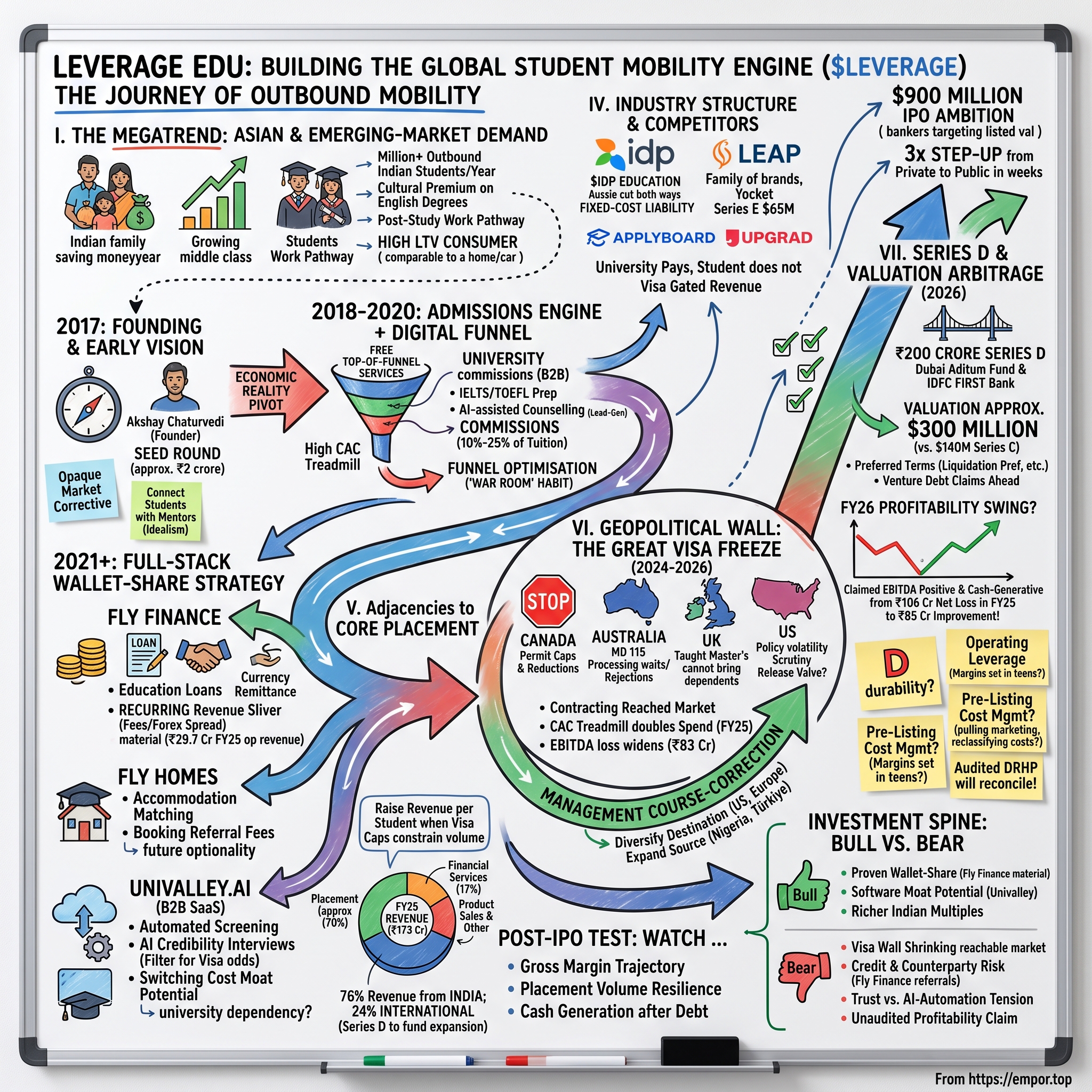
Leverage Edu: Building the Global Student Mobility Engine
I. Introduction & Episode Roadmap
In the first half of 2026, the business of sending students across borders looked like a business in retreat. IDP Education, the Australian-listed company that for two decades was the closest thing the industry had to a blue chip, had lost roughly nine-tenths of its market value from its peak, trading around A$2.04 a share and carrying a market capitalisation near A$573 million — a fraction of the multi-billion-dollar franchise it once was.1
The cause was not a scandal or a fraud. It was arithmetic. Governments in the four destinations that matter most — Canada, Australia, the United Kingdom, and, increasingly, the United States — had spent two years shrinking the number of student visas they were willing to issue, and IDP's placement and English-testing volumes fell with them. In the six months to December 2025, IDP's revenue slipped 4.5% to A$462.2 million while net profit collapsed roughly two-thirds to A$22.7 million.2 Canada IELTS testing volumes, by the company's own account, fell 81%, and US volumes fell 62%.1 This is what a structural headwind looks like when it hits a company with a large fixed-cost base: the revenue erodes at the top while the overhead stays, and the profit falls faster than the sales.
Against that backdrop, a Delhi-headquartered startup made a claim that sounded almost defiant. In late May 2026, reporting surfaced that Leverage Edu, an eight-year-old study-abroad platform founded by Akshay Chaturvedi, was finalising a Series D round of about ₹200 crore — a little over $20 million — split between primary equity led by Dubai's Aditum Fund and venture debt from IDFC FIRST Bank, at a valuation of roughly $300 million.3 That valuation would more than double the roughly $140 million the company carried after its 2023 Series C.3 Weeks earlier, Inc42 had reported that Leverage Edu was already talking to domestic and international bankers about an initial public offering of ₹2,000–3,000 crore, chasing a listed valuation north of $900 million within twelve to eighteen months.4 The company said its revenue had grown 112% to ₹375 crore in the year ended March 2026, that it had turned EBITDA-positive, and that it had generated cash while doing so.3
The core question
The question this episode tries to answer is not whether those headline numbers are impressive — they are — but whether they describe a durable business or a well-timed narrative. How does a study-abroad platform double revenue and reach the threshold of profitability during the single worst regulatory environment the international-education industry has seen in a generation, at the very moment its largest listed peer is being repriced downward by exactly those forces?
Either Leverage Edu has built something structurally different from IDP, or it is riding a private-market financing cycle and an Indian IPO window that reward growth stories more than the underlying economics currently justify. The honest answer, as the evidence below shows, contains elements of both — and separating the part that is a real, defensible business from the part that is narrative and financing cycle is the entire job of the analysis that follows.
Roadmap
The roadmap follows the money and the risk. It starts with the megatrend — why an emerging-market family will spend a decade's savings to send one child abroad, and why that makes a student one of the highest-value consumers a company can acquire. It turns to the founding of Leverage Edu in 2017 and the pivot that set its economics. It maps the value chain and the named competitors, because in this industry the university, not the student, ultimately pays. It examines the vertical-integration play — Fly Finance, Fly Homes, and the Univalley.ai software layer — that is meant to raise revenue per student when visa caps constrain the number of students. It walks through the geopolitical wall of 2024–2026 in detail, because it is simultaneously the bear case and the reason the private round exists. And then it does the underwriting: what a $300 million private mark actually means, what a $900 million IPO ambition would embed, and whether the claimed swing to profitability reflects operating leverage or pre-listing cosmetics.
 Subscribe on LinkedIn
II. The Megatrend: Outbound Student Mobility & The Emerging Market Middle Class
Every durable consumer business rests on a demand curve that does not depend on the company's cleverness, and for the study-abroad industry that curve is outbound student mobility from Asia. India crossed the threshold of more than a million students studying abroad in a single year during the mid-2020s, a number driven by three structural facts that no single government policy can quickly reverse: a young population, a domestic higher-education system that cannot expand seats fast enough to absorb aspirational demand, and a cultural premium on an English-language degree that opens a post-study work pathway in a high-income economy.
The same forces are visible one demographic step behind India — in Nigeria, in parts of Southeast Asia, and in the Gulf's expatriate populations — which is why a Dubai fund leading Leverage's Series D is not incidental.3 The megatrend is not "India"; it is the emerging-market middle class discovering that a foreign degree is the single most reliable ladder from a domestic salary to a global one. That is a multi-decade demographic story, and it is the reason capital keeps flowing to this sector even in a down year.
The highest-LTV consumer in an emerging market
What makes this demand commercially interesting is not its size but its intensity per household. A family sending a child abroad is not making a $500 purchase; it is committing to an outlay that typically runs from $50,000 to well over $150,000 across two to three years once tuition, living costs, flights, insurance, and exam preparation are added together. In the language of consumer economics, an international student is one of the highest lifetime-value customers an emerging-market business can hope to touch — comparable in wallet terms to a first home or a car, but concentrated in a two-to-three-year window and layered with distinct, monetisable sub-decisions.
Count the discrete transactions inside a single student journey: test preparation, counselling and application, the university commission itself, an education loan, the currency transfer that moves tuition abroad, foreign-exchange on living costs, off-campus housing, insurance, and sometimes a bank account or SIM in the destination country. A company that captures the relationship early — at the point a seventeen-year-old and their parents first sit down to consider options — has a claim on that entire chain, and each additional service it can attach amortises the marketing cost of winning the student in the first place. That is the prize Leverage Edu is really chasing, and it explains why the company keeps expanding into adjacent services rather than staying a pure admissions agent. It is also why the right unit of analysis for this business is not "students placed" but "revenue captured per acquired student," a metric this analysis returns to repeatedly.
The trust problem and why fragmentation is both moat-opportunity and warning
The historical obstacle was trust, distributed across a deeply fragmented market. For decades the business was run by tens of thousands of local "mom-and-pop" agents operating out of small offices in Indian and Nigerian cities. Their incentives were opaque: an agent paid a commission by a specific set of universities had every reason to steer a student toward the school that paid best rather than the school that fit best, and families had no way to audit the advice. Fees were unclear, the process was offline and paper-heavy, and outcomes were uneven.
That fragmentation is both the opportunity and the warning, and it is worth holding both halves at once. It is an opportunity because a trustworthy, tech-enabled operator can consolidate a chaotic market and earn the trust premium that fragmentation destroys. It is a warning because the low barrier to entry that produced tens of thousands of agents has not disappeared — anyone with a laptop, a handful of university tie-ups, and a storefront can still hang a shingle, which puts a permanent ceiling on how much pricing power any single platform can accumulate. The megatrend is real and durable; the question the rest of this story asks is whether Leverage Edu can convert a genuine tailwind into a defensible franchise rather than merely a larger, better-capitalised version of the same commoditised agency model. A rising tide that lifts every boat is not, by itself, a moat.
Category TAM versus the reachable market
It is tempting, with a demand story this large, to reach for the biggest number — a million-plus outbound Indian students, hundreds of billions of dollars of annual education and living spend across all destinations — and to imply that a company growing at triple digits is merely scratching a vast surface. That framing should be resisted. The category TAM and the market a company can actually reach at its present product, price point, geography, and distribution are very different quantities. Leverage's reachable market today is the subset of students who (a) target the specific destination corridors where it has university relationships and marketing presence, (b) fall into the price and profile band its counsellors and Experience Centers serve, and (c) can actually obtain a visa in the current regime. The visa freeze does not shrink the category TAM in the abstract; it shrinks the reachable market directly, by removing the third condition for a large share of would-be students. And the reachable market is contested by Leap, upGrad Abroad, ApplyBoard, and tens of thousands of local agents simultaneously, so any market-share assumption has to be set against named, well-funded competitors bidding for the very same students rather than against an empty category. A disciplined view treats the megatrend as the reason the reachable market can grow over time, not as evidence that current growth has a long, uncontested runway.
III. The Founding Story: Akshay's War Room (2017–2020)
Leverage Edu was founded in 2017 by Akshay Chaturvedi, alongside co-founders Aman Arora and Digvijay Gagneja, and its first external capital was a modest seed round of around ₹2 crore that same year.5 The origin insight was the one every founder in an opaque market eventually stumbles on: that the advice students were receiving about where to study was systematically distorted by the person giving it. If the counsellor's income depends on which university writes the cheque, the counsel is not neutral. Chaturvedi's early framing of Leverage was as a corrective to that conflict — a platform that would connect students with mentors and structured guidance rather than with a single agent's book of paying schools.
The pivot that set the economics
That founding idealism collided quickly with the industry's economics, and the collision produced the pivot that actually defines the company. A pure mentorship marketplace is a nice product and a poor business: students are reluctant to pay meaningfully for advice, and the willingness-to-pay sits with the counterparty. The money in study-abroad flows from universities, which pay recruiters a commission — typically a slice of the first year's tuition — for every enrolled student.
So Leverage moved toward the place where the economics lived, becoming a direct-placement operator that earns university commissions, and built a digital funnel to feed it. The funnel's logic is straightforward: offer free or low-cost top-of-funnel services — test preparation for IELTS and TOEFL, initial AI-assisted counselling, scholarship discovery — to attract high-intent students cheaply, then convert them into placements that universities pay for. Free counselling is a customer-acquisition cost dressed as a product. This is the same structural move that defines most modern consumer-internet businesses: give away the top of the funnel, monetise the transaction at the bottom, and win on the efficiency of the conversion in between.
Judging the founder through behaviour, not mythology
The culture Chaturvedi cultivated became part of the company's founding mythology: an obsessive, real-time orientation toward the applicant funnel, a "war room" habit of watching where students dropped off between enquiry and enrolment. That reputation is useful for recruiting and for press, but an underwriter should be careful to separate a founder's energy from a company's moat. Obsessive funnel management is table stakes in performance-marketing-driven businesses, not a durable advantage; it lowers cost per acquisition at the margin but does not create switching costs or pricing power.
The more consequential fact from these early years is who backed the company and how the cap table formed. Blume Ventures and DSG Consumer Partners anchored Leverage's institutional backing alongside a set of angels, and that early capital — rather than any single product feature — is what gave the company the balance sheet to buy digital demand aggressively and outspend the fragmented offline agents on reach.35 It is worth flagging, as a governance note for any future filing, that the company retains a three-founder team in the senior operating roles nearly a decade in — Chaturvedi as chief executive, with his co-founders in technology and operations leadership — which is a mark of stability but also concentrates control, and the terms of founder equity, voting rights, and any dual-class structure are exactly the disclosures a public-market investor will need before a listing and which are not public today.
By the end of its first act, Leverage had established the shape it still has: a marketing-led admissions engine monetised through university commissions, with founders who understood that the real game was widening the set of things a single acquired student could be sold. Everything the company has done since — the "Fly" financial-services stack, the housing product, the university software — is a logical extension of that early recognition that the placement commission is only the first of many claims on a very high-LTV customer.
IV. The Battle for the Student: Industry Structure & Named Competitors
To judge Leverage's competitive position, start with who pays and how much. The core admissions transaction is a business-to-business commission: universities in the United States, the United Kingdom, Canada, and Australia pay recruiters a share of a student's first-year tuition, conventionally in the range of 10% to 25% depending on the institution's desperation for enrolments and the recruiter's leverage. On an international tuition bill of roughly $30,000, that implies something like $3,000 to $7,500 for each successfully enrolled student.
This single fact governs the entire industry's structure. Because the university pays and the student does not, the recruiter's customer is the institution, and the student is closer to inventory being matched to demand. It also means the recruiter's revenue is gated twice — first by whether the student is admitted, and then, crucially in this era, by whether the student is granted a visa. A placement that clears admissions but fails at the visa stage earns nothing while having consumed the full acquisition and counselling cost. In a normal year that gap is a manageable leakage; in the 2024–2026 environment it became the defining risk to the whole model, and it is the reason the industry's economics turned so sharply negative so fast.
IDP Education: the incumbent, and why scale cut both ways
At the top of the market sits IDP Education, the incumbent this episode opened with. IDP built its position on high trust, high touch, and a genuinely scarce asset — a co-ownership stake in the IELTS English-language test — supported by a global network of well over a hundred physical offices.1 That physical footprint was long treated as a moat, and in a trust-driven, once-in-a-lifetime decision it partly is.
But a large fixed-cost network is a moat only while volumes are rising. When the four destination governments tightened visas simultaneously, IDP's overhead became a liability rather than a barrier: revenue fell 4.5% in the December 2025 half while profit fell roughly two-thirds, and destination-level IELTS volumes cratered — Canada down 81%, the United States down 62% — leaving the company to cut costs into a shrinking base.12 The lesson for anyone underwriting Leverage is not that IDP is doomed but that scale in this industry is pro-cyclical: it amplifies both the upside of a boom and the pain of a freeze. A moat that only works in good weather is not a moat; it is operating leverage wearing a moat's clothes.
Leap: the competitor that most resembles Leverage
The competitor that most resembles Leverage is Leap. Leap operates a family of brands — LeapScholar for admissions, LeapFinance for lending, and, through acquisition, GeeBee and Yocket — and has raised well over $200 million in equity since 2019, including a $65 million Series E in January 2025 led by funds managed by UK-based Apis Partners, with Owl Ventures, Jungle Ventures, and Peak XV participating.6[^7] Leap reported revenue of roughly ₹203 crore in FY24, materially ahead of Leverage at the same moment, and it moved into lending earlier and more directly, taking education-loan exposure closer to its own balance sheet rather than acting purely as a referrer.7
That distinction matters for the analysis that follows: Leap and Leverage are converging on the same full-stack ambition from different directions, and Leap's head start in financing is a competitive fact, not a footnote. It also means the two companies are competing for the same capital, the same students, and eventually the same public-market investors — and Leap has raised more, earlier. The old habit of listing Yocket as a separate rival is now outdated; Yocket sits inside Leap, which is itself a sign of how quickly this market is consolidating and how thin the differentiation between platforms has become.
The CAC treadmill and Leverage's "phygital" counter
Beyond the two front-runners, upGrad Abroad and the Canada-focused ApplyBoard compete for the same high-intent students, largely on the axis that dominates any performance-marketing business: customer acquisition cost. When several well-funded players bid for the same search keywords and the same college-fair leads, CAC rises for everyone and the underlying admissions margin compresses. This is the treadmill every aggregator in this space runs on, and it is visible directly in Leverage's own FY25 accounts, where advertising and marketing spend roughly doubled to about ₹59.8 crore.2
Leverage's counter to this commoditisation is what the company calls its "phygital" model — a network of physical "Experience Centers," including in India's tier-2 and tier-3 cities, meant to graft the reassurance of a traditional storefront onto a tech-enabled backend. Strategically the logic is sound: it addresses the trust deficit that pure-digital players cannot, and it reaches families outside the metros where the next wave of demand lives, often at a lower CAC than bidding for national search terms. But it must be clear-eyed that physical centres reintroduce exactly the fixed-cost, pro-cyclical exposure that is currently punishing IDP. The Experience Center is a bet that trust converts at a high enough rate, and at a low enough incremental cost, to justify the overhead — a bet that is only visibly winning while volumes hold up, and that has not yet been tested through a full downturn on Leverage's own smaller base.
V. The Full-Stack Student LTV: Fly Finance, Fly Homes, & Univalley.ai
The strategic pivot that matters most is easy to state and hard to execute: if government policy caps the number of students you can place, the only way to keep growing is to raise the revenue you earn per student. This is the entire intellectual core of Leverage's growth-during-a-freeze story, and it is why the company has spent years transforming itself from an admissions marketplace into what it markets as a full-stack student-mobility platform.
What the revenue mix actually shows
The evidence that this is more than a slide is visible in the FY25 revenue mix, which is the single most useful disclosure available. Of ₹173 crore in FY25 operating revenue, student-placement services still contributed the majority at about ₹120.6 crore, or roughly 70%; the "Fly" financial-services business contributed about ₹29.7 crore; product sales (largely test-prep and related) about ₹21.2 crore; and other sources the remainder.2 Notably, about 76% of revenue was still generated in India and only 24% internationally — a reminder that despite the "global platform" language, the monetisation is still heavily domestic, and the international expansion the Series D is meant to fund is a plan, not yet a proven revenue base.2
This mix is the honest map of where the company is versus where it says it is going. Placement remains the engine; financial services is the credible second act; housing and software are still early. An underwriter should weight each segment by what the numbers support, not by the prominence it receives in a pitch.
Core admissions: the engine and its cost bottleneck
Core admissions under the Leverage Edu brand remains the top-of-funnel engine and the largest revenue line, and it is also the most exposed to the twin pressures described above: rising marketing CAC as rivals bid up demand, and the human-counsellor cost required to convert high-stakes decisions. This is the segment that most needs the AI-counselling investment the company says the new capital will fund, precisely because human counsellors are the cost bottleneck that caps admissions margins.
It is worth flagging the tension embedded here, because the bear case lives in it. Automating counselling lowers cost, but over-automating a once-in-a-lifetime family decision risks the very conversion and trust that justify the Experience Centers. The company is, in effect, trying to use software to cheapen the most human part of its funnel while simultaneously spending on physical trust-building — two strategies pulling in opposite directions, reconciled only if the AI genuinely handles the routine while humans are reserved for the moments that convert.
Fly Finance: the adjacency that is already material
Fly Finance is the segment that makes the full-stack thesis financially real today. Launched around 2021, it helps students secure education loans from partner banks — IDFC FIRST Bank, the same institution providing Leverage's venture debt, is a lending partner — and handles the cross-border remittance of tuition and living costs.3 The economics are attractive on paper: a referral commission on each arranged loan, plus a recurring spread on the currency transfers a student makes repeatedly across a multi-year degree.
Because these fees attach to a student the company has already acquired for the admissions business, they amortise a customer-acquisition cost that has already been paid, which is the textbook definition of improving lifetime value. At roughly ₹30 crore, or about 17% of FY25 revenue, this is no longer a rounding error, and its share of the mix is exactly what a rising-per-student-revenue thesis predicts.2 The remittance component is the more attractive half from a quality standpoint: a loan referral is a one-time event, but tuition and living-cost transfers recur across the degree and even into the post-study period, giving Fly Finance a sliver of genuinely recurring, transaction-linked revenue rather than pure one-shot commissions.
The critical caveat is that a referral model earns a slice of someone else's risk-taking. Leverage matches students to lenders; the lenders own the credit. That is capital-light and high-margin in good times, but it means the revenue line is only as durable as the banks' appetite to lend. If education-loan delinquencies rise and partners tighten underwriting, the commission pool shrinks regardless of how many students Leverage sources — a dependency the company does not control. This is the structural difference from Leap, which took more of the lending onto itself and therefore owns more of both the upside and the risk.7 Capital-light is safer in a downturn but also cedes the fattest part of the financial-services margin to the balance-sheet lender; it is a deliberate risk-return choice, not obviously the winning one.
Revenue quality: how much of this is recurring?
Step back and test the durability of the revenue itself, because a valuation is only as good as the quality of the cash flows underneath it. The uncomfortable truth is that the large majority of Leverage's revenue is transactional and one-time. A placement commission is earned once, when a student enrols, and is never earned again from that student. Test-prep and product sales are similarly one-shot. Even much of Fly Finance — the loan-referral half — is a single event tied to the same enrolment. The genuinely recurring sliver is the remittance-and-forex flow, which repeats across a degree, and any future subscription revenue Univalley might generate from universities. That means Leverage does not yet have the annuity-like quality that public markets reward with high multiples; its FY26 revenue is overwhelmingly the sum of individual, non-repeating transactions, and each year's growth must be re-earned from a largely fresh cohort of students.
This has two implications for the underwriting. First, growth is inherently harder to sustain in a transactional model than in a subscription one, because there is no installed base compounding quietly in the background — the funnel has to be refilled every year, which is precisely why marketing is the largest discretionary cost and why cutting it is the easiest way to flatter short-term profit. Second, the revenue carries channel and geographic concentration risk that a filing would need to expose: a heavy dependence on paid digital acquisition, on a specific set of destination corridors, and on university partners whose commission rates the company does not control. The single most valuable improvement Leverage could make to its revenue quality — as distinct from its revenue quantity — is to grow the recurring, transaction-linked financial-services and software lines faster than the one-time placement line. Whether it is actually doing so is the question the segment mix will answer over the next two or three years.
Fly Homes and Univalley.ai: optionality, not yet proof
Fly Homes, the student-accommodation matching service, is best understood as future optionality rather than a material contributor today. Matching students with off-campus housing in London, Sydney, or Toronto can earn booking-referral fees, and it deepens wallet share at a natural point in the student journey. But there is no public evidence that it yet moves the revenue needle, and it should be weighted accordingly — a sensible extension of the wallet-share logic that has not yet earned its way into the numbers.
The same discipline applies to Univalley.ai, the business-to-business software layer sold to universities and partner counsellors, though its strategic significance is potentially larger than any other adjacency. Its pitch is genuinely interesting from a moat perspective: it automates applicant screening and runs automated "credibility interviews" designed to filter for students likely to satisfy visa requirements, which helps universities protect the visa-approval ratings that the 2024–2026 crackdowns made existential. If Univalley works, it is the one part of the Leverage stack that could create real switching costs, because a university that wires its admissions workflow into a vendor's software does not casually rip it out. That is the difference between a service a student consumes once and a system an institution depends on — the difference, in Helmer's terms, between no power and genuine switching-cost power.
But "if it works" is doing heavy lifting. There is no disclosed metric on Univalley's university count, revenue, or retention, and until there is, it belongs in the optionality column, not the proven-moat column. The honest summary of the full-stack strategy is that one adjacency — Fly Finance — has crossed into material, the housing and software layers are credible but unproven theses about where per-student revenue can go, and the entire premium a $900 million valuation would demand rests disproportionately on adjacencies that are either young or not yet disclosed.
VI. The Geopolitical Wall: The Great 2024–2026 Visa Freeze
No part of this story can be underwritten without confronting the regulatory wall directly, because it is simultaneously the reason IDP has been repriced and the reason a skeptic should discount any straight-line extrapolation of Leverage's growth. The freeze is not a single event but a coordinated tightening across the four destinations that account for most of the industry's economics, and each destination tightened for its own domestic-political reasons — housing shortages, migration politics, concern about diploma-mill abuse — which is precisely why the trend is unlikely to reverse quickly. When a policy is driven by domestic housing and migration politics, no amount of student demand from India or Nigeria will reverse it on the timeline a growth-stage company needs.
Canada, Australia, and the United Kingdom
Canada moved first and hardest. Ottawa introduced a cap on new study-permit applications, and the numbers have ratcheted down every year since: the 2026 target is roughly 408,000 study permits issued — of which only about 155,000 are for genuinely new arrivals, with the rest extensions — which is around 7% below the 2025 target of 437,000 and roughly 16% below the 2024 target of 485,000.[^9] The one meaningful relief valve is that, from January 2026, master's and doctoral students at public institutions are exempted from the attestation-letter requirement and effectively from the cap, which nudges the mix toward higher-value graduate students and slightly favours platforms that can source them.[^9]
Australia followed with a processing regime rather than a hard cap. Ministerial Direction 115, in force from mid-November 2025 and replacing the earlier MD 111, ties visa-processing speed to how much of an institution's enrolment allocation has been filled, with the government setting a national planning level around 295,000 new commencements for 2026.8 In practice, students bound for lower-tier or over-quota providers face processing waits of nine to twelve weeks or outright rejection, while top-tier institutions clear in weeks — a system that surgically suppresses exactly the vocational and lower-tier volumes that many agents relied on for easy commissions.8
The United Kingdom's blow was narrower but severe where it landed: from January 2024, taught master's students were barred from bringing family dependents, and dependent grants subsequently fell roughly 87% from their mid-2023 peak, gutting demand from precisely the mature Indian and Nigerian students for whom bringing a spouse was part of the calculus.9 Each of these measures targeted a different slice of the funnel, and together they removed a meaningful fraction of the total addressable pool of visas that the entire industry monetises.
The United States sits in a different but not comforting category. It is the corridor Leverage is leaning into as a substitute for the collapsing Commonwealth destinations, and its sheer scale and the strength of its universities make it a rational place to redirect demand. But the US is precisely where the release valve is least reliable, because student-visa scrutiny, the future of post-study Optional Practical Training, and the broader politics of immigration are all contested and can shift with an administration rather than with a multi-year legislative process. A platform that offsets Canadian and British weakness by concentrating on the US is trading a set of known constraints for a source of policy volatility it cannot forecast. That is a defensible move given the alternatives, but it means the diversification story reduces the concentration in any one collapsing corridor while adding exposure to a corridor whose rules can change abruptly — mitigation, not immunity.
How the freeze shows up in Leverage's own accounts
The operational consequence for a company like Leverage is that the acquisition funnel became violently volatile. Under the old regime, admission was a reasonable proxy for revenue; under the new one, a student can be counselled, prepared, and admitted, and then rejected at the visa stage — wasting the entire accrued acquisition cost with nothing to show for it.
This is why the FY25 economics looked the way they did. Advertising and marketing spend roughly doubled to about ₹59.8 crore, and commissions to selling agents rose about 2.6x to ₹51.2 crore, yet the EBITDA loss still widened to about ₹83 crore — an EBITDA margin near negative 47% — because the company was spending harder to fill a funnel that was leaking at the far end.2 That single year is the clearest available picture of how the freeze translates into a study-abroad platform's income statement: more spend, more commissions, and a wider loss, all at once. It is also the baseline against which the FY26 profitability claim must be judged, because the swing from that ₹83 crore EBITDA hole to a claimed surplus is the crux of the whole investment case.
Management's course-correction — genuine, but not a cure
Management's course-correction is the part of this section that reads as genuine strategic response rather than spin, and it deserves credit. Leverage shifted its destination mix toward markets the freeze had not hit — pushing the United States, Ireland, and continental Europe — and expanded its source markets by opening in places like Nigeria and Türkiye, diversifying away from a UK-and-Canada concentration that had become a single point of failure.
Diversification of this kind is exactly what a well-run operator should do, and it is a plausible partial explanation for how Leverage grew while IDP shrank: IDP's revenue was anchored to IELTS and to the specific corridors that collapsed, whereas a younger, more marketing-nimble player with a smaller base could redirect spend toward corridors still open and grow off a low denominator. But underwriters should hold two facts together. First, redirecting demand mitigates the freeze; it does not neutralise it, because the total pool of visas is smaller than it was, and a smaller pool means more platforms fighting for each student. Second, the US corridor Leverage is leaning into carries its own policy risk — student-visa and post-study-work rules there are themselves contested — and a further tightening in the US would remove the release valve the company is currently relying on. The visa wall is the dominant variable in this entire investment, and any valuation that does not haircut for it is not underwriting; it is hoping.
VII. Valuation Arbitrage: The Series D Bridge to a ₹2,000+ Crore IPO
Now the underwriting proper. Begin with the operating trajectory, because everything else is a claim layered on top of it.
The trajectory, and the swing that decides everything
Revenue from operations grew from about ₹90.6 crore in FY24 to ₹173 crore in FY25 — a 91% increase — and the company says it reached ₹375 crore in FY26, up 112%.23 That is a genuinely steep growth curve, and it is the single strongest fact in the bull case. But the profit line tells a more complicated story. In FY24 the company lost about ₹68 crore; in FY25 the net loss widened to about ₹106 crore even as revenue nearly doubled, because marketing and agent commissions scaled faster than revenue.2 Then, in FY26, the company claims it flipped to EBITDA-positive and cash-generative, with roughly an ₹85 crore improvement in its bottom line.10 The entire pre-IPO equity story rests on the durability of that single-year swing, so it deserves the most skeptical reading in this piece.
Consider the mechanics. FY25 carried an EBITDA loss of about ₹83 crore on ₹173 crore of revenue.2 For FY26 to be EBITDA-positive on ₹375 crore of revenue, the company had to convert an ₹83 crore EBITDA hole into a surplus while revenue grew by roughly ₹202 crore. That is arithmetically possible with strong operating leverage — if the incremental ₹202 crore of revenue carried a very high contribution margin and fixed costs held — and the Fly Finance mix shift helps, because referral and remittance revenue should carry higher margins than commission-heavy placements.
But the same headline can be produced by less durable means: pulling back on the very marketing spend that drove FY25 growth, timing the recognition of high-margin financial-services revenue, capitalising or reclassifying costs, or benefiting from one-off items ahead of a listing. Crucially, "EBITDA-positive" is not "profitable." EBITDA excludes the interest on the new venture debt from IDFC FIRST Bank, any depreciation and amortisation, and — critically for a company running physical Experience Centers — lease-like financing costs. A company can be EBITDA-positive and still burning cash after debt service and capital needs. Because there is no audited filing yet, none of these possibilities can be excluded, and the company's own framing — a claimed, un-audited swing timed to a fundraising and IPO narrative — is exactly the pattern a public-market investor is trained to distrust. The right posture is not to disbelieve the number but to treat it as unproven until an audited DRHP reconciles gross margin, operating expense, working capital, debt service, and capital expenditure into a genuine free-cash-flow statement.
Reading the Series D as a price, not a value
Now the capital structure. The Series D is about ₹200 crore, of which only a portion is primary equity — the rest is venture debt — struck at a valuation of roughly $300 million, up from roughly $140 million at the 2023 Series C.3 Three cautions follow immediately.
First, a $300 million "valuation" set by a small primary equity cheque plus debt is a price observation on a sliver of the company, not a market-clearing value for the whole. Aditum led the equity; the round's headline valuation reflects the terms one lead investor accepted for a minority preferred stake, not what a diversified pool of public buyers would pay for common shares. Extrapolating a small primary round to a whole-company value is precisely the error the discipline warns against.
Second, the preferred terms are not public, and they matter enormously. Late-stage private rounds routinely carry liquidation preferences, anti-dilution ratchets, and participation or conversion rights that protect the new money on the downside — protections that public common shareholders will not enjoy. A $300 million post-money with even a standard 1x liquidation preference stacked above common is not the same as $300 million of common-equivalent value, and until the conversion mechanics are disclosed, carrying the headline mark forward as if preferred and common were economically identical would be a basic error. A strategic Gulf-based investor may also be paying partly for regional access and footprint rather than for pure financial return, which can inflate the mark relative to what a purely financial buyer would pay.
Third, the round mixes equity and debt, and debt is not valuation — it is a claim ahead of every equity holder that must be serviced out of the very cash flow the EBITDA-positive claim is meant to demonstrate. The presence of venture debt in a "valuation round" is itself a small tell that the company is managing dilution carefully ahead of a listing.
The cap table that cannot yet be built
The capitalisation itself cannot be reconstructed with any precision from public sources, and that absence should be stated plainly rather than papered over. There is no disclosed fully diluted share count, no public schedule of the employee option pool, no detail on founder-versus-investor voting rights, and no clarity on how the various preferred series convert into common at a listing. Even the total-funding figure is inconsistent across sources — reporting around the Series D cites roughly $90 million raised to date, coverage of the FY25 financials implies closer to $70 million pre-round, and Tracxn's database shows a materially lower cumulative equity figure — a discrepancy that itself argues for withholding confidence in any headline market-capitalisation math until a filing arrives.325
The practical consequence is that any "implied market cap" for Leverage Edu today is a rough, preferred-inflated private mark, and the gap between total equity value and the free float that would actually trade after an IPO is entirely unknown. Total equity value and free float are different questions, and inventing either from the current record would be false precision. These are not pedantic gaps; they are the exact line items a DRHP exists to fill, and their absence is why every number in this section carries a wide error bar.
The 3x step-up, the peer anchor, and a scenario range
That brings the analysis to the IPO ambition: a ₹2,000–3,000 crore issue combining fresh capital and an offer for sale, with bankers reportedly targeting a listed valuation above $900 million.4 Hold the two numbers next to each other. The private market priced the company at roughly $300 million weeks before the IPO chatter targeted roughly $900 million — a threefold step-up with no disclosed change in the business between the two marks other than the passage of a few months and the retention of bankers.
Some of that gap is legitimate: an IPO sells common shares into a deeper, more competitive pool of buyers, and Indian public markets have at times paid richer revenue multiples for growth-stage technology names than late private rounds do. The presence of an offer-for-sale component also signals that existing shareholders intend to sell into that demand, which is a normal feature of Indian listings but also worth noting — insiders monetising at the IPO price is information about where they think value sits relative to price. But a 3x re-rating from private to public, in an industry whose listed bellwether is trading near multi-year lows, is a demand-and-narrative bet, not a value calculation.
To see the disconnect, anchor on the peer. IDP Education, with many times Leverage's revenue, a co-owned English test, and a global office network, carried a market capitalisation of roughly A$573 million — on the order of $380–430 million — in the same period.1 If a $900 million valuation for Leverage were achieved, the market would be paying more than twice IDP's equity value for a company a fraction of its size, on a revenue base of about $45 million and a profitability claim that is one year old and unaudited. That gap can only be justified on growth — and it is worth being explicit that this is an equity-value-to-equity-value comparison, not a mixing of an equity multiple with an enterprise-value multiple, because a clean enterprise-value bridge for Leverage cannot be built without disclosed cash, debt, and lease figures.
A transparent scenario frame makes the sensitivities explicit rather than pretending to precision:
- Bull scenario. Revenue continues to compound briskly toward and past ₹1,000 crore over the next several years, Fly Finance's high-margin mix keeps expanding, Univalley gains real university adoption, and EBITDA margins settle durably in the teens. In that world a valuation approaching the IPO ambition becomes defensible on a growth multiple — though still richer than the listed peer, and dependent on the visa environment stabilising rather than deteriorating.
- Base scenario. Growth decelerates toward the 30–50% range as the visa freeze caps volumes and marketing costs stay elevated, profitability is thin but real, and the financial-services mix improves blended margins gradually. Here a value materially closer to, or modestly above, the $300 million private mark looks more honest than the $900 million ambition.
- Bear scenario. A further US tightening, a credit pullback that chokes Fly Finance, and the profitability swing proving to be pre-listing cost management rather than operating leverage. In that case the sustainable value sits below the private mark, and the IPO either prices down or is postponed.
The output is deliberately a wide range, because the two variables that dominate it — the durability of the margin swing and the trajectory of visa policy — are both unresolved. Reconciling the intrinsic and comparable views, the prospective $900 million valuation embeds high sustained growth, a durable double-digit margin, expanding high-quality financial-services revenue, and a visa environment that stops getting worse. The market may still clear above a central range for reasons that have nothing to do with the business — IPO scarcity, a hot listing window, constrained free float, and momentum — but those are pricing forces, not value, and conflating the two is exactly the mistake this exercise exists to avoid.
A back-of-envelope intrinsic check
It is worth grounding the range in a transparent, deliberately rough intrinsic sketch rather than leaving it entirely to multiples — with the caveat that any such exercise on a company this early is a framework for thinking, not a valuation. Take the claimed FY26 base: roughly ₹375 crore of revenue, or about $45 million, with EBITDA hovering just above breakeven. Suppose the business compounds revenue at a healthy but decelerating pace over the next four to five years — the base scenario's 30–50% tapering toward the low double digits — and matures into a durable EBITDA margin somewhere in the low-to-mid teens as the higher-margin financial-services mix grows and admissions gains some operating leverage. On plausible tax, reinvestment, and dilution assumptions, and discounting at a cost of capital appropriate to a small, single-country, policy-exposed growth company (which is high — the visa and credit risks are real and largely undiversifiable), the intrinsic range that falls out sits closer to the private mark than to the IPO ambition, with the upper end only approaching $900 million in the bull path where growth stays high and margins expand faster than the transactional revenue model usually allows. The point of the sketch is not the midpoint — it is the sensitivity: the valuation is extraordinarily levered to two inputs, the terminal margin and the growth-persistence, and small, honest changes in either swing the answer by hundreds of millions of dollars. Any single "target" would be false precision dressed as analysis.
An enterprise-value framing has to be stated with the same humility. A clean EV bridge requires disclosed cash, debt, and lease-like obligations, and Leverage has now added venture debt whose size and terms are not public, alongside Experience Center leases that a filing would capitalise. Until those are disclosed, enterprise value cannot be reliably calculated, and the only defensible comparison is equity value to equity value — which is why the IDP anchor above was drawn on a market-cap-to-market-cap basis rather than on an EV multiple that would silently mix the two.
Public-market readiness: the diligence items a filing must resolve
A private company is not held to a listed company's disclosure standard, and the gaps in Leverage's public record are therefore not evidence of anything wrong — but they are the precise items a public-market investor must see resolved before a listing, and their absence should be logged as diligence, not waved through as safety. Several stand out. Governance and control: the founder-led team holds concentrated operating control nearly a decade in, and the founder and investor voting rights, any differential share classes, and board independence are undisclosed. Related-party texture: IDFC FIRST Bank appears in this story twice — as the venture-debt provider funding the round and as a lending partner whose loans Fly Finance refers students toward — and while there is nothing improper on the public record, a filing will need to lay out the commercial terms of that dual relationship so investors can judge whether the financing and the referral economics are arm's-length. Incentives and selling: the reported offer-for-sale component means existing holders intend to sell into the IPO, and the identity, size, and lock-up terms of that selling — none yet public — bear directly on how much stock actually floats and on what insiders signal about price versus value. And the accounting itself: the FY26 profitability claim rests on management's own framing, and the audited revenue-recognition policies, the treatment of agent commissions and marketing, and the formal risk factors will only exist when a draft prospectus does. None of these is a red flag today. All of them are reasons the honest posture toward Leverage's headline numbers is patient skepticism rather than either credulity or dismissal.
VIII. Deep Analysis: Hamilton Helmer's 7 Powers & Porter's 5 Forces
Frameworks earn their place only when they sharpen the economics, so use them as a discipline rather than a checklist.
Helmer's 7 Powers
Hamilton Helmer's 7 Powers asks what, if anything, would let Leverage sustain returns that competitors cannot compete away. The most credible power is counter-positioning. Leverage — like Leap — attacks the incumbent's cost structure by using free online test-prep and AI counselling as low-CAC lead generation, a model the physical-network incumbents cannot fully copy without cannibalising the office overhead that justifies their premium. That is a real and observable advantage; it is visible in the fact that Leverage grew while IDP shrank. But counter-positioning against the old incumbent says nothing about the new entrants attacking Leverage on the same axis, and here the power is weaker: Leap counter-positions against Leverage just as effectively, so the benefit is shared across a cohort rather than captured by one firm. Counter-positioning that everyone in your weight class also enjoys is a category advantage, not a company moat.
Scale economies are moderate and mostly prospective. The B2B software layer, Univalley.ai, has high fixed development cost and low marginal cost to serve additional universities, which is the classic software scale curve — but only if it achieves adoption, which is unproven. The admissions business has weaker scale economics: more students require more counsellors and more marketing spend, so the variable-cost curve does not flatten as dramatically as a pure-software story would imply. The company's own FY25 accounts, where commissions and marketing rose roughly in step with revenue, are the evidence that admissions has not yet found meaningful scale leverage.2
Switching costs are the sharpest illustration of the two-sided nature of this business. For students they are effectively zero — families consult multiple agents simultaneously and owe loyalty to none — which permanently caps B2C pricing power. For universities using Univalley's workflow, switching costs could be moderate to high once admissions operations are wired into the software, and this is the single most important place to watch, because it is the only mechanism in the entire stack that could convert Leverage from a commoditised recruiter into an embedded infrastructure provider. The whole "premium versus IDP" case, in Helmer's language, ultimately reduces to whether Univalley earns switching-cost power.
Brand and trust are developing but not yet a power in the strict sense. In a once-in-a-lifetime decision, brand is the ultimate moat, and IDP spent decades building it, whereas Leverage is buying brand equity through Experience Centers and marketing. Bought brand is real but rented until retention proves it has stuck — and in a business where each customer transacts essentially once, retention is hard to demonstrate, because there is little repeat purchase to observe. The nearest proxy is referral: whether satisfied families send siblings and friends at a low CAC. That data is not public.
Porter's 5 Forces
Porter's Five Forces explains why the admissions core will always be a hard place to earn excess returns. The bargaining power of suppliers — the universities — is very high, because they control both admission and the commission rate; if a university cuts commissions, recruiters comply or lose the relationship, and recruiters have little countervailing leverage individually. The bargaining power of buyers — students — is also high, because they shop across agents for the best scholarship, loan rate, or fee and bear no switching cost.
When both your supplier and your buyer hold power, the intermediary in the middle is structurally squeezed, which is the deep reason the industry runs on volume and thin economics rather than pricing power. The threat of substitutes is moderate and rising: direct-to-university digital applications are getting easier, and every improvement in universities' own admissions technology chips at the agent's reason to exist. The threat of new entrants is high at the low end — starting a local agency requires almost nothing — even though replicating a full-stack fintech-and-housing platform is genuinely hard.
The synthesis of both frameworks is consistent and sobering: the admissions engine sits in a structurally unattractive position that no amount of execution fully escapes, and the entire investment case for a premium valuation rests on the adjacencies — Fly Finance's wallet-share capture and Univalley's potential switching costs — doing the work that the core cannot. That is a coherent strategy, but it means the bull case is a bet on the newest, least-proven parts of the company, not on the part that already generates 70% of revenue.
IX. The Investment Spine: Bull vs. Bear Case
The disciplined way to hold a pre-IPO company is to state honestly why it might win and why it might lose, and to weight each by the evidence rather than the narrative.
Why Leverage wins
The bull case for Leverage Edu is not fantasy; it is grounded in three observable facts. First, the full-stack wallet-share thesis is already partly proven — Fly Finance contributed a real ₹30 crore, roughly 17% of FY25 revenue, and financial-services and remittance income is structurally higher-margin and more recurring than one-time placement commissions, so a rising financial-services mix should improve blended economics even if placement volumes stay flat.2 This is the most important fact in the entire bull case, because it is the one piece of the growth-through-a-freeze story that shows up in audited-adjacent segment numbers rather than in a pitch.
Second, the software optionality is genuine — if Univalley.ai achieves adoption, it is the one asset in the portfolio that could create durable switching costs and reprice the whole company from "agent" to "infrastructure," and its visa-compliance angle is well-timed to a moment when universities are desperate to protect approval ratings. Third, the Indian public-market context is real — if Leverage can list into a domestic market that pays richer multiples for growth-stage technology than the ASX pays IDP, it can raise cheap capital to fund exactly the international and financial-services expansion that widens its lead over the fragmented offline field. The through-line of the bull case is that constrained volume forces the company to monetise each student more intensively, and that discipline, if it holds, produces a better business than the boom-era version would have.
Why Leverage loses
The bear case is equally grounded and, on today's evidence, at least as weighty. First and most important is the geopolitical wall: the total addressable market is defined by how many visas the four destinations issue, and that number is shrinking, not growing, with the durability of the decline rooted in destination-country domestic politics that no recruiter can influence.[^9]89 A company cannot indefinitely out-execute a contracting market; diversification of source and destination markets slows the bleed but does not repeal it.
Second is credit and counterparty risk in the very vertical the bull case leans on. Fly Finance earns a referral slice of lending it does not own, so a rise in education-loan delinquencies or a tightening of bank underwriting would compress the commission pool regardless of how many students Leverage sources — the high-margin growth engine is hostage to third-party risk appetite. Third is the trust-versus-automation tension: the company plans to scale AI-led counselling to cut the human-counsellor cost that caps admissions margins, but families making a $100,000 life decision want reassurance, and over-automation risks the conversion rates and net-promoter scores that justify both the margins and the Experience Centers.
And running underneath all three is the profitability question: the swing to claimed EBITDA-positivity is one year old, unaudited, and conveniently timed, and until a filing reconciles it to free cash flow after debt service and capital needs, the bear is entitled to treat it as narrative.210
The stress test that matters
The stress test that matters most sits at the intersection of the bear points. Imagine the visa freeze deepens with a US tightening in 2026–2027, marketing CAC stays elevated because Leap and others keep bidding, and lenders pull back on student credit. In that world, the volume line stalls, the high-margin Fly Finance line stalls with it, and the FY26 profitability that was engineered partly by pulling marketing suddenly has to be defended by spending to hold share — reversing the very swing the IPO was sold on. That is not the likeliest scenario, but it is entirely plausible, and it is the scenario a $900 million valuation implicitly assumes away.
The balanced conclusion is that Leverage is a well-run company executing a coherent strategy inside a genuinely hostile market, whose fair value is a wide range anchored nearer its private mark than its IPO ambition, and whose eventual public valuation will be decided as much by IPO-window sentiment, free-float scarcity, and momentum as by the business itself — forces that move price without touching value. The post-listing test writes itself: watch three things above all — gross-margin trajectory as the Fly Finance mix grows, placement-volume resilience through the visa freeze, and cash generation after debt service. The first quarter or two of audited public reporting will confirm or falsify the underwriting far more decisively than any pre-IPO claim.
X. Business & Investing Lessons
Three durable lessons fall out of the Leverage Edu story, useful well beyond this single company.
The first is about share of wallet as a response to constrained volume. When an external macro force — a visa cap, a regulatory ceiling, a shrinking end market — caps the number of transactions you can do, vertical integration into adjacent high-value services is often the most effective, and sometimes the only, path to continued growth. Leverage's move from admissions into financing, remittances, housing, and software is a clean case study: the placement business could not grow through the freeze, so the company grew the revenue attached to each placement instead. The investing corollary is to watch which adjacency is actually material — here, financial services — and to discount the ones that are still slideware, because founders under growth pressure have every incentive to present optionality as traction.
The second lesson is trust is local, scale is digital, and the businesses that win high-friction, high-value consumer markets are usually the ones that reconcile the two rather than choosing between them. Leverage's "phygital" model — digital lead generation feeding physical Experience Centers — exists because in emerging markets a family will not wire a decade of savings on the strength of an app alone, but neither will a purely offline agent achieve the reach or cost structure to consolidate a fragmented market. The tension is permanent: the physical layer that builds trust is also the fixed cost that turns pro-cyclical against you in a downturn, exactly as IDP's office network did. The investor's job is to judge whether the trust the physical layer buys converts at a rate that justifies its cost across a full cycle, not just in a boom.
The third and most important lesson is the trap of adjusted profitability before a listing. The most consequential number in this entire story is the claimed swing from a ₹106 crore net loss in FY25 to EBITDA-positivity in FY26, and the most consequential analytical act is to refuse to take it at face value.210 There is a world of difference between profitability produced by durable operating leverage — high-margin revenue scaling over a stable cost base — and profitability produced by capital-management maneuvers timed to a fundraise: pulling marketing, deferring investment, leaning on the EBITDA definition to exclude debt service and lease costs, or recognising favourable one-offs. Both produce the same headline; only one survives contact with an audited free-cash-flow statement and a public market that will re-test it every quarter.
The single discipline that protects a public-market investor here is to insist that "EBITDA-positive" is not "cash-generative after everything that matters," to identify the one or two KPIs that would confirm or falsify the underwriting — sustained gross-margin expansion as the Fly Finance mix grows, and volume resilience through the visa freeze — and to wait for the DRHP that turns a claim into a reconciled fact. Price can run ahead on the strength of a growth narrative and an IPO window; value will be settled later, by whether the engine Akshay Chaturvedi built actually throws off cash when the market stops paying for the story.
References
-
Down 90%, what is going on with IDP Education shares? — The Bull, 2026 ↩↩↩↩↩
-
Leverage Edu posts Rs 106 Cr loss on Rs 173 Cr revenue in FY25 — Entrackr, 2026 ↩↩↩↩↩↩↩↩↩↩↩↩↩↩↩
-
Exclusive: Leverage Edu set to raise over $20 Mn Series D at $300 Mn valuation — Entrackr, 2026-05-26 ↩↩↩↩↩↩↩↩↩
-
Exclusive: Leverage Edu Taps Bankers For ₹2,000 Cr-3,000 Cr IPO — Inc42, 2026-04 ↩↩
-
Leverage Edu — Company Profile, Team, Funding & Founders — Tracxn, 2026 ↩↩↩
-
Study abroad platform Leap bags $65M in Series E funding led by Apis Partners' funds — YourStory, 2025-01-29 ↩
-
Leap — 2026 Company Profile, Team, Funding, Competitors & Financials — Tracxn, 2026 ↩↩
-
Australia's Student visa processing 2026: Ministerial Direction 115 — Study Australia, Australian Government, 2025-11 ↩↩↩
-
Tough government action on student visas comes into effect — UK Home Office / GOV.UK, 2024-01-01 ↩↩
-
Leverage Edu revenue rises 112% to ₹375cr in FY2026 — NewsBytes / Inc42, 2026 ↩↩↩
 LinkedIn
 WhatsApp
 Reddit
 Hacker News
 Email
Email Kindle
 RSS Feed
 Spotify
 Apple Podcasts
 Amazon Music
 Audible
 YouTube