LEAP India: The Pallets That Keep Coming Back
I. The IPO That Bought a Bigger Next Chapter
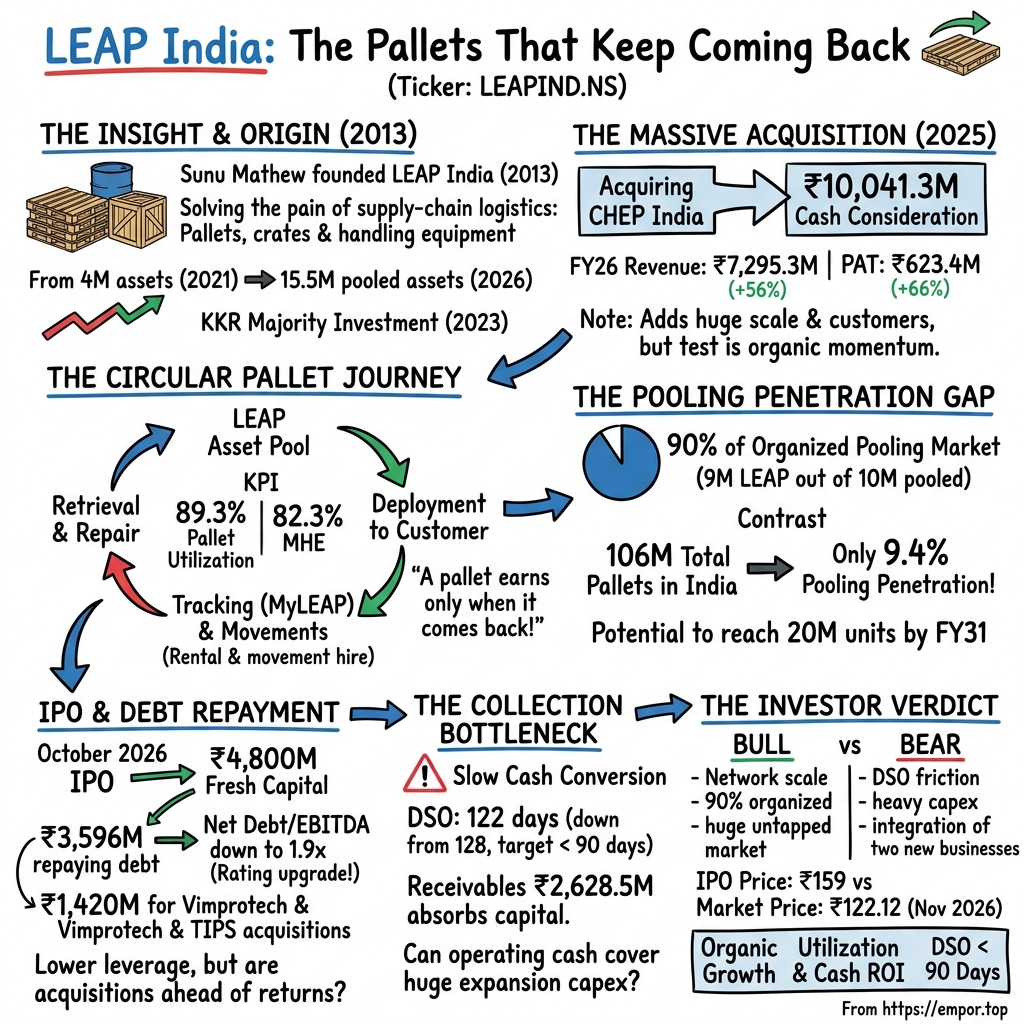
In the last week of October 2026, barely ten weeks after its shares began trading, LEAP India did two things that pointed in opposite directions. On the earnings call for its second quarter as a listed company, management told analysts that ₹3,596 million of the fresh money raised in the IPO had already gone to repaying debt.1 And on the day its quarterly results came out, the company told the stock exchanges it had agreed, through wholly owned subsidiaries, to buy two more businesses: a plastics manufacturer called Vimprotech and an automotive crate-pooling operation called Total International Packaging Solutions, or TIPS, for a combined ₹1,420 million.23
One move took weight off the balance sheet. The other put weight back on. Both made sense on their own. Together, they framed the question every new shareholder in LEAP now has to answer.
The fresh issue had raised ₹4,800 million when LEAP listed on the National Stock Exchange and BSE on 14 August 2026.41 Roughly three-quarters of it went straight to the lenders. That is about the plainest use an IPO can have: a company swapping borrowed money, with its interest bill and its covenants, for equity. Within weeks the company was able to tell investors that net debt had fallen to about 1.9 times EBITDA, down from 4.4 times a year earlier.1
Then came the two deals. Neither is large. Together the two targets reported about ₹650 million of revenue in FY2026, which is under a tenth of what LEAP itself booked that year.35 But they arrived at a moment when LEAP's own house was not fully in order. Its customers were still taking about four months on average to pay their bills. Its capital spending plan for the year was close to half of its expected revenue. And the reported growth that had carried it to the IPO was tangled up with an earlier, much bigger acquisition whose contribution the company has never neatly separated out.
So the stakes are simple to state and hard to settle. LEAP India owns a pool of about 15.5 million pallets, crates, containers and pieces of handling equipment, which it rents out to the companies that make and move India's goods.2 The bull story says that pool is a network: the bigger and denser it gets, the more useful each pallet becomes, and the more times each one can be rented before it wears out. The bear story says it is a capital machine that needs feeding, one that turns accounting profit into receivables and capital spending faster than it turns either into cash. The IPO bought LEAP a bigger next chapter. Whether that chapter compounds value depends on whether the network can generate its own fuel, and whether the company can grow without letting slow collections and new acquisitions consume what the listing just gained.
Before going further, a matter of boundaries. The company listed in India is LEAP India Limited, together with its wholly owned subsidiary TARON Material Handling Equipments.6 Above it sits a parent, Vertical Holdings II Pte. Ltd., which held 35.11% of the shares at the end of September 2026, within a total promoter holding of 55.64%.7 The parent is an owner, not an operator. Nothing in the story that follows treats the parent's money, assets or other investments as LEAP's own, and when the parent pumped capital into LEAP before the listing, that was financing, not revenue.
There is one more tension worth putting on the table at the start, because it runs through every chapter. LEAP and its management like to describe the company as holding roughly 90% of India's organized pallet-pooling market, an estimate drawn from a Frost & Sullivan study commissioned for the IPO.26 The number is impressive, and it is probably right in the sense it intends. But the same study estimates that only about 9.4% of all pallets in India were pooled in FY2026.2 That means LEAP dominates a sliver. The other nine-tenths of the market is not held by a rival LEAP could beat in a price war. It is held by habit: cheap wooden pallets bought once and thrown away, or pallets that factories own and manage themselves. Leadership of a small slice is a great place to start from. It is not the same as owning the whole road.
The stock market, for its part, had cooled on the story by mid-November. Shares that were sold at ₹159 in the IPO closed at ₹122.12 on 16 November 2026, about 23% below the offer price.8 Investors who bought at listing are already asking what new owners of any capital-heavy business eventually ask: not how big the asset base can get, but what each additional rupee in that base earns.
To understand why that question is so pressing, and why the answer is still open, the story has to go back to the beginning, to a man who had already spent years watching pallets move around India for someone else.
 Subscribe on LinkedIn
II. The Founder Who Knew the Pooling Business
Picture a soft-drinks bottling plant in the middle of summer. Crates of bottles come off the line, get stacked on wooden pallets, are wrapped, and roll onto trucks bound for a distributor's warehouse two states away. From there, the goods go out to wholesalers and on to shop shelves. The bottles get sold. The pallets, though, stay behind somewhere along the chain, in a warehouse corner, on a loading dock, sometimes broken, sometimes borrowed by someone else, often simply lost. The bottler has to buy more. It has to track the ones it owns, send trucks to fetch them, pay people to repair them, and write off the ones that never come home.
Multiply that scene across every factory, warehouse and distribution centre in a country whose organized retail and modern logistics were growing quickly, and the hidden cost becomes obvious. Every company moving physical goods needs something to carry them on. Almost none of them wants to be in the business of owning, tracking and retrieving that something.
The fix is pooling. Instead of every company buying its own pallets, one specialist owns a giant shared pool and rents them out. The customer takes what it needs, pays for the days it uses them or the trips they make, and hands them back. The specialist does the dull, difficult work of collecting, inspecting, repairing and redeploying. Think of it as a library for the objects that hold up supply chains: the value is not in any single book, but in a system that makes sure the right book is on the right shelf when someone asks for it, and that it gets returned.
The model is old and proven elsewhere. CHEP, part of the Australian-listed Brambles group, built a global business on blue pallets and pooled containers, and it ran operations in India for years.9 Sunu Mathew spent part of his career inside that business and had helped build CHEP's Indian operation before leaving to start his own.1011 That background matters more than any line on a résumé. Pooling looks simple from a distance and turns out to be a business of a thousand tiny operational decisions: where to put a depot, how quickly a truck must collect pallets before they vanish, what a damaged pallet costs to repair versus replace, which customers' supply chains loop back neatly and which scatter assets across the country. A founder who had seen those decisions up close knew where the money leaked out. He also knew, from the inside, how a pooling company could win a customer that had always bought its own pallets.
Mathew incorporated LEAP in 2013.6 The company has since been led by him throughout; at the time of its IPO filing he was Chairman, Managing Director and Chief Executive Officer.65 What he built is not, in essence, a technology company or a manufacturer, even though it now owns factories' worth of plastic and wood. It is an operations company whose product is availability: a promise that when a customer's truck backs up to the loading dock, the pallets will be there, and that afterwards someone will come and get them.
Building a pool requires money long before it produces any. Every pallet is bought up front and earns its keep in small daily slices over years. That is why LEAP's history is, to a large extent, a history of raising capital. By 2021, when the company raised about $34 million in a funding round, it was reported to manage around 4 million assets.12 In 2023 KKR announced that it had acquired a majority stake in LEAP, describing it as a leading pallet-pooling platform.11 That moment marks the start of the scale-up chapter: the period in which the company went from a growing challenger to a business big enough to buy its old teacher.
The capital kept coming after that. In FY2024 and FY2025, LEAP's parent subscribed to two rounds of compulsorily convertible preference shares worth a combined ₹4,830 million, money that went into the pool and into the acquisitions that followed.6 These were capital transactions with an owner, not sales to a customer, and they belong on the financing side of LEAP's story only.
By September 2026, the pool had grown to about 15.5 million assets, nearly four times the 2021 figure.212 Some of that came from buying assets and some came from buying a company, but the direction is unmistakable. Over little more than a decade, a founder-led start-up assembled one of the largest shared pools of supply-chain equipment in India.
Scale is not the same as returns, though, and here the record is shorter than the history. LEAP's earliest comparable consolidated financial statements date to FY2023, and the company has not published a longer audited series that would show how each generation of pallets performed over its life.6 Investors can see that the pool grew. They cannot yet see, cohort by cohort, whether the pallets bought in 2017 or 2021 paid back their cost with a margin to spare. The history supports a claim about execution: this team knows how to build and run a big physical network. It does not, on its own, prove that each new asset earns an attractive return.
The biggest single test of that question arrived at the start of 2025, when the student bought the school.
III. CHEP's Assets Move Across the Line
For years, CHEP had been the name that defined pallet pooling in India, the way Xerox once defined photocopying. In January 2025, LEAP completed the purchase of CHEP India.6 In April 2025 the acquired business was merged into LEAP itself.6 For Mathew, the symmetry was hard to miss. For shareholders, the more useful question was what exactly had been bought, at what price, and how much of what followed was the acquisition rather than LEAP.
Start with why the deal made strategic sense. Pooling is a business in which density matters. A depot that serves twenty customers in one industrial corridor can collect, repair and reissue pallets more cheaply than a depot that serves five. A customer is more likely to sign up if the pooler can collect assets from wherever its goods end up, which is easier with a wide network. CHEP India brought customers, pallets and containers, and operating sites in the same market LEAP already served.69 Combining the two did not just add volume. In principle, it filled in gaps on the map, increased the odds that a pallet dropped at a customer's distributor could be picked up by a truck already passing by, and removed the company's most experienced competitor from the field.
The price was substantial for a company of LEAP's size. The offer document records cash consideration of ₹10,041.3 million.6 Of the purchase price, ₹1,610.9 million was assigned to customer-relationship intangibles, an accounting acknowledgement that a large part of what LEAP paid for was not wood and plastic but the contracts and habits of the companies already using CHEP's pool.6 Those intangibles are amortized over time, which partly explains why the depreciation and amortization line in LEAP's profit and loss is so heavy.
Was it a good price? Here a careful reader has to resist the temptation to answer from the headline. A ₹10 billion cheque for a business is cheap or expensive only relative to what that business earns and what its assets are worth. LEAP's filings supply a pro forma view of FY2025, showing roughly how the combined company would have looked had CHEP been owned for the whole year, but the company does not present a standalone deal multiple, CHEP India's own pre-acquisition profit, or a post-deal return on the purchase price.6 Without those, claims that LEAP got a bargain, or overpaid, are guesses. What can be said is that the cash price was more than twice LEAP's own FY2025 revenue, that the parent subscribed ₹3,330 million of preference shares in the same fiscal year, and that by the first half of FY2026 net debt stood at about 4.4 times EBITDA.61
The more important consequence for investors lies in the growth figures. Revenue from operations rose from about ₹2,534 million in FY2023 to about ₹4,665 million in FY2025.6 Then, in FY2026, it jumped to about ₹7,295 million, an increase of 56%, while profit after tax rose 66% to about ₹623 million.5 Those are spectacular numbers for a company about to sell itself to public investors. They are also not what they appear to be at first glance.
FY2025 included CHEP India for only the last three months, from January to the end of March. FY2026 included it for the whole year. So a large part of the 56% jump is not growth in the usual sense, not customers renting more pallets or new customers signing up, but the arithmetic of consolidating an acquired business for twelve months instead of two or three. The company publishes reported results and the FY2025 pro forma information, but it does not publish a clean bridge splitting FY2026 revenue growth into acquired and organic components.65 Even the comparison with FY2025 pro forma figures is imperfect, because a merged network is not simply two old businesses added together: once customers, depots and prices are combined, the line between what was acquired and what was grown blurs.
Here is where the narrative most people would repeat, that LEAP more than doubled sales between FY2024 and FY2026, needs a correction. It did, in reported terms. But a significant share of that came from buying CHEP. A better gauge of the underlying engine comes from the first half of FY2027, the first period in which both years contain the merged business. Revenue from operations in that half rose about 18.6% from a year earlier, and profit after tax rose about 42%.2 That is healthy growth for a business of this kind, and far closer to the true organic pulse than the 56% figure. It is also a third of the headline rate.
There is a second reason the deal matters, one that carries forward into everything else. Integration can create value in ways that do not show up immediately. If former CHEP customers start renting LEAP's containers or material-handling equipment, if overlapping depots are closed, if combined density cuts the cost of collecting a lost pallet, then the acquired assets should earn more under LEAP than they did under CHEP. The evidence that would settle it is incremental cash return on the acquired assets: how much more cash the combined company generates per rupee of capital than the two separate businesses would have. That figure is not disclosed.
So the verdict on CHEP is a narrower one than either cheerleaders or skeptics would like. The deal clearly gave LEAP meaningful operating scale and customer relationships. By the company's estimate, it also left LEAP with a near-monopoly position within organized pooling. It makes the company's historical growth hard to read and leaves the return on a ₹10 billion purchase unproven. The next two acquisitions, announced in October 2026, will be judged against the same unanswered test.
To see why returns on assets are so central to this business, it helps to slow down and follow a single pallet on its journey.
IV. A Pallet's Second and Third Life
Imagine a pallet leaving one of LEAP's 27 fulfilment centres on a weekday morning.2 It has been inspected, maybe repaired, and stacked with dozens of identical siblings on a truck. By afternoon, it is at a customer's factory, perhaps a maker of packaged foods or consumer appliances. There it gets loaded with cartons, shrink-wrapped and sent out to a distributor. From the distributor, it travels to a retailer's warehouse, or a modern-trade store, or an e-commerce hub. At each stop, it is one of thousands of identical platforms moving goods through India's supply chain. Then, at the end of the line, it gets unloaded and set aside. And it waits to be collected.
That moment of waiting is where the economics of pooling are won or lost. If LEAP's trucks collect the pallet promptly, it comes back to a depot, gets checked for damage, is fixed if necessary, and goes out again, earning another round of rent. If it sits in a corner for months, or gets taken by someone who did not rent it, or breaks beyond repair, it earns nothing while still costing money. A pallet's first life pays for its purchase. Its second and third lives, and many more after that, are where the profit is.
LEAP earns money from this loop in two main ways, and the distinction matters. The first is per-day rent: a customer that keeps pallets on site, holding goods in storage, pays a daily charge for each asset it has.61 The second is movement hire, in which LEAP charges for each trip as assets travel through a customer's supply chain from origin to destination.1 Rent rewards assets that sit with customers. Movement hire rewards assets that circulate, and gives LEAP responsibility for picking them up at the far end. Management has pointed to the conversion of customers from static rental to movement hire as one of its growth levers, because it deepens the relationship and puts more of the supply chain inside LEAP's system.1 It also means LEAP takes on more of the retrieval risk, so the economics of movement hire depend heavily on how well the network can find and recover assets.
The business has two broad income streams. In the second quarter of FY2027, asset-pooling income from pallets and containers was about ₹1,759 million, and income from material-handling equipment, the machinery used to lift and shift loads inside warehouses and plants, was about ₹393 million.2 The pooling side is the heart of the company, at more than four-fifths of that combined income. The company presents these as income lines, not as separate segments with their own profit, so it is not possible to say from the disclosures which of the two earns the better margin.
Every step of the loop, deployment, tracking, retrieval, repair, redeployment, is both part of the service and a source of cost. Trucks cost money. Depots cost rent. Repair crews cost wages. And assets that disappear, or are damaged beyond repair, are a direct loss. Interestingly, part of the damage problem shows up in an unexpected place. On the Q2 call, management explained that some of what LEAP books as "other income" is actually the scrap value of assets broken beyond economic repair.1 In the first half of FY2027, other income was about ₹148 million, against profit before tax of about ₹568 million.2 That is not trivial, and it means the line is partly the salvage tail of the pallet's life rather than pure treasury income.
The reported operating metrics are strong. In September 2026, pallet utilization, the share of the pallet pool out with customers earning rather than sitting idle, stood at 89.3%.2 Material-handling equipment ran at 82.3% and containers at 73.7%.2 For a pool that big, having nine in every ten pallets out at work is a striking number. It suggests demand is keeping up with additions and that the company is not stuffing its depots with idle wood and plastic. The gap with containers is just as telling: roughly a quarter of them were not earning on that measure, a reminder that not every asset class in the pool is equally in demand, and that buying ahead of demand has a cost.
The network that supports this loop is broad. LEAP reports more than 11,000 customer touchpoints, the factories, warehouses and destinations where its assets are delivered or collected.2 With more than 1,100 customers by the second quarter, and 85 added during the first half of FY2027, the pool is spread across a wide base of businesses.1
There is a digital layer too. LEAP tracks its assets and offers customers an interface, MyLEAP, through which they can see and manage their holdings.2 It is tempting to call this a software moat. That would go too far. Tracking tools help with visibility, billing and control, and they likely reduce losses and make collection more efficient. But the company does not publish asset-loss rates, retrieval costs per pallet or customer-retention data broken down by MyLEAP use, so there is no evidence that the software itself keeps customers from leaving or lets LEAP charge more. Digital tracking is best treated as part of operating competence rather than as an independent advantage.
The deeper question remains. How long does a pallet last, how many trips does it make, and what cash return does it earn over that life? The company does not disclose asset life by cohort, average cycles per pallet, or cash returns on asset additions. Investors are left to infer these from utilization, revenue and capital spending in aggregate. And that aggregate is worth thinking about. Management expected about ₹4,500 million of capital spending in FY2027, with ₹2,130 million already spent in the first half.1 Against a revenue guide of around ₹9,200 million, that is close to half of every rupee of sales going back into new assets.1 In the second quarter, EBITDA margin was 50.8%.2 Put those two figures next to each other and a sobering picture emerges: if the full year looks like the second quarter, nearly all the cash the business makes before interest, tax and working capital is being reinvested in more pallets.
That can be exactly right for a growing network, if each new pallet earns well. It is a disaster if they do not. High utilization says demand for the pool is strong. It does not say each new asset pays back. That depends on retrieval, repair cost, pricing and, crucially, whether customers pay on time, which, as later chapters show, is still a problem.
The pallet's loop explains how LEAP makes money from a single asset. The next question is how big the market for that loop really is, and how much of it LEAP already owns.
V. Ninety Percent of a Market That Is Still Small
Put the company's own market chart on the screen. India, by the estimate LEAP's materials cite from Frost & Sullivan, had about 106 million pallets in use in FY2026.2 Of these, about 10 million were in pooling systems, and about 9 million of those belonged to LEAP.2 Nine out of ten. If ever there were a chart designed to make a newly public company look unassailable, this is it.
Now look at the rest of the chart. Around 82 million of the country's pallets were low-quality or one-way pallets, the cheap wooden platforms bought for a single shipment and abandoned at the destination.2 Another roughly 8 million were good-quality pallets owned by companies outside any pool.2 Pooled pallets, LEAP's and everyone else's, made up only about 9.4% of the total.2
So both statements are true at once. LEAP dominates organized pallet pooling in India, and organized pallet pooling is a small corner of India's pallet use. The headline 90% describes a share of the niche, not a share of the market for the thing LEAP sells, which is moving goods on reusable platforms. Neither number should be read without the other.
Who else is in the niche? Before 2025, the obvious answer was CHEP. Since January 2025, CHEP's Indian business has belonged to LEAP.6 The offer document identifies other pooling players in the Indian market but does not provide a like-for-like public comparison of their size, utilization or economics.6 None of them is listed in a way that would let investors compare returns. In practice, the main competitor to LEAP is not another pooler. It is the status quo.
That is the heart of the competitive war game. LEAP's real rival is a factory manager who has always bought cheap wooden pallets for single use, because they are simple, require no contract and involve no relationship with a rental company. To win that manager over, LEAP has to offer something better: pallets that are stronger and standardized, so goods are damaged less often; a predictable cost per trip rather than a capital purchase; less clutter at the destination; less management time spent chasing assets. The pitch is solid. It is also a pitch that must be made one customer at a time, and the customer can always walk back to the old habit.
How could scale protect LEAP? The mechanism is network density. A pooler with assets and depots across the country can deliver and collect more cheaply, offer pallets in more places at short notice and absorb seasonal peaks better than a smaller rival. LEAP's 27 fulfilment centres and 11,000-plus touchpoints are the physical evidence of that network.2 The bigger the network, the cheaper each collection, so the larger player can price below what a newcomer could afford while still earning more. That is a real and plausible advantage against other poolers.
But it is weaker against the alternatives. A customer comparing LEAP with a one-way pallet is not comparing two networks. It is comparing a service fee with a cheap, disposable product. Network density lowers LEAP's costs, which helps, but it does not change the fact that the customer can keep buying cheap pallets if the service price creeps too high. In the language of competition, LEAP has strong power against direct rivals and limited power against substitutes.
The customer data tells the same story in a different register. In FY2025, LEAP's ten biggest customers accounted for about 34% of revenue, down from about 39% a year earlier.6 One customer exceeded 10% of revenue in each of FY2023, FY2024 and FY2025.6 That level of concentration is not alarming for a business-to-business service company, and the direction is healthy: the base is broadening as the company grows. But it means a handful of large shippers carry enough weight to negotiate on price and payment terms, and the slow collections described in the next chapter suggest some of them use that weight.
Management also reports churn below 0.5%, which, if it means what it sounds like, would be extraordinary evidence of stickiness.2 Investors should hold the figure lightly until the company spells out its definition: whether it counts customers or revenue, over what period, and whether a customer that sharply reduces its rented pool still counts as retained. A churn figure that measures only complete departures can coexist with significant shrinkage among customers who stay. As a company-reported indicator, it is encouraging. As proof of switching costs, it is incomplete.
Then there is the forecast. The study LEAP cites projects the pooling market growing from about 10 million to about 20 million units by FY2031, an annual growth rate of about 14.9%.2 That is a forecast, not demand already realized, and forecasts commissioned for IPOs tend to lean toward ambition. The underlying logic is credible: organized retail, e-commerce, quick-commerce, food processing and modern warehousing all reward standardized, reusable pallets, and penetration below one in ten leaves a long runway. But penetration has to actually move. The test for LEAP is not whether the pooled market can double, but whether the pooled share of total pallet use rises over the next few years while LEAP keeps its utilization and its prices.
The verdict here is one of leadership with a ceiling yet to be tested. LEAP appears to be the dominant organized pooler in India, and network density gives it a cost and availability edge that a new pooling rival would struggle to match. The 90% claim is true for the niche it describes. It is not a claim to control India's pallets, and most of the opportunity, and most of the competition, sits in the nine-tenths outside the pool.
A large addressable market is exciting only if customers pay for what they use. That is where LEAP's story runs into its most practical problem.
VI. Growth Meets the Collection Desk
On the second-quarter earnings call in late October 2026, the conversation took a turn that management could not have enjoyed. Analysts pressed on receivables. Days sales outstanding, the average number of days it takes customers to pay, had come down from 128 at the start of the fiscal year to 122 by September.1 The company had introduced a new SAP system and was centralizing the purchase-order process, and still only six days had come off.1 Management acknowledged that 122 days remained too high and repeated its target: below 90 days by the end of FY2027.1
Four months to get paid is a long time for a business that bills in small daily increments. It means that, at any given moment, the company is carrying about a third of a year's revenue as money owed. To understand why that matters, it helps to start with how LEAP's profits turn into cash.
On paper, the business converts profit into cash extremely well. In FY2026, cash flow from operations was about ₹2,683 million, more than four times profit after tax of about ₹623 million.5 The reason is not mysterious. A pooling company spends heavily on pallets up front, then charges a portion of that cost against profit each year through depreciation. In FY2026, depreciation, amortization and impairment came to about ₹2,043 million.5 That charge reduces reported profit without costing any cash in the year it is booked, because the cash went out when the pallets were bought. Add it back, and operating cash flow looks rich.
Management also reports a figure it calls "cash PAT," roughly profit plus non-cash charges, which reached about ₹1,566 million in the first half of FY2027 against reported profit of about ₹425 million.2 That figure is useful as a rough sense of earning power before reinvestment, but it is not cash flow from operations: it ignores the money absorbed by receivables, inventory and other working capital. And the gap between those two measures is exactly where the receivables problem lives.
In FY2026, rising trade receivables absorbed about ₹748 million of cash, the single largest drain on working capital.5 Other financial assets and inventory absorbed more, partly offset by higher payables and other liabilities.5 In other words, of the cash LEAP's operations generated before working capital, a meaningful slice ended up as unpaid bills. Receivables stood at about ₹1,992 million at the end of FY2025, about ₹2,623 million a year later and about ₹2,629 million at the end of September 2026.62 The fact that the balance barely moved in the first half while revenue grew is genuine progress. It is not yet a transformation.
Why are collections so slow? The answers on the call were specific, which is to management's credit. Many customers require a purchase order for each billing, and the process of matching invoices to customer-specific purchase orders delays payment even when the customer has no objection to the charge.1 That is a common problem for companies selling to large Indian corporates, whose procurement systems can hold invoices hostage over paperwork. It is also partly self-inflicted: a business that bills small amounts for daily rent across thousands of locations generates a lot of invoices, and a lot of chances for mismatch.
There is one accounting subtlety worth knowing. LEAP classifies unbilled receivables, revenue that has been earned but not yet invoiced, as trade receivables once its right to payment is unconditional and only the invoicing remains.6 That is standard accounting practice, but it means part of the receivables balance represents work LEAP has not yet billed, which naturally takes longer to collect. Receivables reported to banks differed from the books, partly because bank submissions excluded unbilled amounts and were made before the financial close.6 Neither point suggests anything improper. Both suggest the receivables figure needs careful reading.
Is customer credit quality a worry? LEAP has not disclosed a major customer failure, a large write-off, or an unusual credit term granted to a specific customer.6 LEAP's biggest customers are large businesses, and concentration has been falling. The problem looks more like friction than risk: money that will come in, but slowly. Friction still costs real money, though. Every extra month of receivables is cash LEAP must fund with either borrowings or equity, and until the IPO, that meant borrowings at a meaningful interest rate.
The scale of the prize is easy to estimate. If LEAP brought DSO from 122 days to below 90 on a revenue base of roughly ₹9,200 million, the arithmetic implies something on the order of ₹800 million of cash released, more than half the price of the two October acquisitions.1 That is the case for taking the target seriously. The case for skepticism is the pace so far: six days in six months. Hitting the target means taking more than 30 days off in the following six months, five times the pace of the first half. Possible, perhaps, with new systems settling in. But it is a management commitment still to be demonstrated, and the next two quarterly results will reveal whether the improvement shows up as cash actually collected or merely as faster invoicing.
The result is a business that is cash-generative before growth but cash-hungry once growth and collections are counted. That combination is what made LEAP's debt so heavy before the listing, and it is why the IPO mattered as much as it did.
VII. The IPO Pays Down Debt and Raises the Bar
The prospectus LEAP filed with the Registrar of Companies on 12 August 2026 set the final price at ₹159 a share.4 The issue paired a fresh issue of ₹4,800 million, whose proceeds went to the company,41 with an offer for sale, in which existing shareholders sold part of their holdings to public investors and took the money themselves.4 It is a distinction worth keeping in mind. The fresh issue made LEAP stronger. The offer for sale made some existing owners richer, which is a normal part of any sponsor-backed listing, but did nothing for the company's balance sheet.
A pooling company must buy its assets before it can rent them, and carry its customers' slow payments. Growth therefore consumes capital twice: once in the pallets, and again in receivables. LEAP had funded that growth, including the CHEP acquisition, with owner capital and borrowings. Before the IPO, net debt had reached about 4.4 times EBITDA.1
The credit rating reflected that balance. In February 2026, India Ratings affirmed LEAP's bank facilities at IND A/Stable, assessing it together with TARON on a consolidated basis.13 That is a solid investment-grade rating in India, but one that left room for improvement.
By the time of the Q2 call, about three-quarters of the ₹4,800 million fresh issue had gone to repay debt.1 Management described leverage afterwards as about 1.9 times net debt to EBITDA and about 0.48 times debt to equity.1 In October 2026, the company reported that India Ratings had upgraded its long-term facilities to IND A+/Stable and its short-term rating to IND A1+, after the fresh issue and the debt repayment.12
That is a clean and visible improvement. A business that had carried leverage above four times EBITDA now carries less than half of that. Interest costs should fall. Refinancing pressure has eased. Lenders now see a better-capitalized borrower.
Two refinements prevent the improvement from being overstated. First, LEAP still has meaningful borrowings. At the end of September 2026, the balance sheet showed about ₹7,253 million of borrowings, split roughly evenly between current and non-current, and separately about ₹1,102 million of lease liabilities.2 Against that, the company held about ₹1,816 million in cash and about ₹1,100 million in investments.2 Borrowings and lease liabilities are different things: the first is money owed to lenders, the second the accounting value of future rent commitments. Both are claims on cash, but they behave differently, and the 1.9 times figure management quotes refers to net debt.
Second, the presence of large current borrowings, about ₹3,471 million due within a year, means LEAP will be refinancing or repaying a substantial amount in the near term.2 The Q2 materials disclose no covenant breach or refinancing difficulty, but they also do not present the full maturity schedule.2 With an upgraded rating, rolling that debt should be easier and cheaper. It remains a fact of life for a company that has to keep buying pallets.
The real question raised by the IPO is not whether it improved the balance sheet. It clearly did. The question is whether the improvement will last. On the Q2 call, management said it expected capital spending on asset growth to be funded from operating cash flow, with broader cash-flow coverage, including acquisitions, expected later.1 That is the right ambition, and it is also the claim on which the entire capital story now rests.
Run the rough arithmetic. If LEAP generates something like the ₹2,683 million of operating cash flow it produced in FY2026, plus growth, and spends around ₹4,500 million on capital assets in FY2027, operating cash flow will not fully cover asset purchases unless it rises sharply or receivables are collected much faster.51 Add ₹1,420 million of acquisition consideration and the gap widens.3 The cash and investments left over after the IPO provide a buffer, but a buffer is not a self-funding business. If collections do not improve, and capital spending stays at current levels, borrowings will drift back up.
The rating upgrade supports the view that LEAP's credit quality has improved. It says nothing about whether the incremental capital earns more than its cost. That distinction matters because the IPO raised the bar in a specific way: LEAP no longer has the excuse of an over-leveraged balance sheet holding it back. From here, whether the company can fund its expansion is a test of the business itself.
And within weeks of easing the balance sheet, LEAP chose to expand the business in a new direction.
VIII. Two New Businesses, One Capital-Allocation Test
The second-quarter call was the first time investors heard management explain the two deals in its own words. The presentation framed them neatly. One was about manufacturing integration: owning the factory that makes the plastic products LEAP buys. The other was about extending the pooling model into a specialized corner of the automotive supply chain.12 Both were structured as slump sales, in which LEAP's wholly owned subsidiaries buy the business undertakings as going concerns for a lump-sum price, rather than buying the shares of the companies that own them.3 That structure is common in India and usually lets the buyer take the operations it wants without inheriting the seller's entire corporate history.
Start with TIPS, the smaller and more obviously strategic of the two. Total International Packaging Solutions runs a pool of roughly 250,000 crates and trays used in automotive supply chains, together with regional warehouses that serve them.3 Car and component makers move vast numbers of parts between suppliers and assembly lines in returnable crates designed for specific components. It is pooling, but with tighter specifications and a more closed loop than the general pallet business. For LEAP, buying TIPS for ₹400 million is a way into an adjacent segment with an established customer base, without building a crate design and retrieval system from scratch.3 It fits the core model almost exactly: own the asset, rent it, collect it, repeat.
Vimprotech is a different kind of bet. It makes plastic packaging and material-handling products, and it designs and produces its own molds.3 At ₹1,020 million, it is the larger of the two purchases by a wide margin.3 The logic management offered is vertical: LEAP buys a large volume of plastic pallets and containers from third-party suppliers, and owning a manufacturer could reduce that dependence, give it more control over design, and capture some of the margin it currently pays to others.13 In theory, that is sensible. Plastic assets are a growing share of what pooling companies buy, and a pooler that can make its own products to its own specifications might lower its cost per asset and get new designs into the field faster.
In practice, it changes the shape of the company. LEAP has been a service business that buys physical things. With Vimprotech, it becomes, in part, a manufacturer. Manufacturing has different economics: factory utilization, raw-material prices tied to petrochemicals, order books, inventory. It also creates a familiar temptation. A manufacturer inside a pooling company can be judged on how cheaply it supplies the parent, or on how much it sells to outsiders, and those two goals can pull in opposite directions.
Size the transaction honestly. Together, the two businesses were bolt-ons, not transformations, and should not be allowed to carry the narrative weight of the core pooling business.35 But neither are they trivial. The combined consideration of ₹1,420 million is more than half of what LEAP generated from operations in a full year, and about 40% of the fresh IPO money that went to repaying debt.351
Benchmark what is disclosed. ₹1,420 million against ₹650 million of revenue is about 2.2 times sales. That is a screening ratio and nothing more. A manufacturer with thin margins at 2.2 times sales could be expensive; a crate-pooling business with pooling-style margins at the same multiple could be cheap. The acquisition announcement does not disclose the targets' profits, their debt, or the condition and age of the assets being bought, so there is no basis for calling the price attractive or rich.3 Investors are being asked to trust the company's judgment on price, which is a big ask from a company that has been public for about three months.
Management pointed to several synergies: lower dependence on third-party suppliers, margin improvement, cross-selling to existing customers and more in-house production.1 Every one of these is plausible. None of them has yet happened. The way to treat them is as targets, to be measured in later filings through achieved savings, utilization of the acquired crate pool and the cash contribution of both businesses after integration costs.
And then there is the question a skeptical investor would ask, which is less about these particular deals than about their timing. Why acquire now? Collections are still slow. The core business is adding assets at a pace that consumes most of what it generates. The CHEP integration, whose returns have never been laid out, is less than two years old. In that context, buying two more businesses, one of them in a different line of activity, looks less like the next step of a carefully sequenced plan and more like a company using its freshly cleaned balance sheet to expand while it can.
There is a respectable counter-argument. Small, adjacent deals that strengthen supply and extend the pool are the sort of thing a dominant pooler should do, and buying them before rivals or suppliers consolidate them may be cheaper than building later. TIPS in particular looks like a natural extension. The verdict depends on what the next few years show: whether the acquired crate pool runs at high utilization, whether Vimprotech's output lowers LEAP's asset costs in a way that shows up in margins, and whether post-deal cash contribution justifies ₹1,420 million of capital that could otherwise have paid down more debt or bought more pallets for the core pool.
Capital allocation, in the end, is a test of the people doing the allocating. And because LEAP is now a public company, those people can be judged against a public record, even if that record is still very short.
IX. The Founder's Promise Meets the Public Record
When Sunu Mathew presented the second-quarter results in late October 2026, he did something new for him: he spoke to an audience that would hold him to his words quarter after quarter. For more than a decade, LEAP's founder had answered to private owners who sat on the board and saw the numbers every month. Now he was answering to analysts, institutional funds and public shareholders, who would compare each quarter's commentary with the last.
The ownership structure explains why his position remains secure even with public owners. At the end of September 2026, promoters held 55.64% of LEAP, including the 35.11% held by Vertical Holdings II.7 Foreign institutional investors held 19.27% and domestic institutions 8.57%.7 That leaves control firmly with the promoter group, which is common for Indian listings of sponsor-owned companies. The alignment argument is straightforward: owners with more than half the company have every reason to want its value to grow. The governance argument is subtler: a controlling shareholder can also make decisions, on acquisitions, on financing, on related-party dealings, that minority investors cannot block.
Mathew's own pay offers little cause for concern. In FY2025 he received about ₹20 million in remuneration, roughly ₹2 crore, and was eligible for a performance bonus.6 For the founder and chief executive of a business with more than ₹7,000 million of annual revenue, that is modest. What the company does not publish is a multi-year series showing how his pay has moved with profit, cash flow or returns, so investors cannot yet judge whether pay is linked to the measures that matter most for this business, such as collection days or return on assets.
The related-party record also needs to be read accurately. Before the IPO, the parent, Vertical Holdings II, put large amounts of capital into LEAP through compulsorily convertible preference shares: ₹1,500 million of Series H in FY2024 and ₹3,330 million of Series I in FY2025.6 That money went into the company's balance sheet. It was not revenue, and the parent did not generate any of LEAP's sales. The company also paid about ₹10 million of interest in FY2024 on compulsorily convertible debentures held by Packaging Holding LLP.6 The offer document states that related-party transactions were on terms equivalent to arm's-length, and it discloses no royalty or brand fee flowing to the parent.6 That is a cleaner picture than many sponsor-owned Indian companies present, and a point in LEAP's favour.
There have been changes in the senior team around the listing. The offer document named Ravi Kuckian as chief financial officer.6 By the time of the second-quarter call, the CFO introduced was Rajeshan Alle.1 A CFO change in the run-up to or just after an IPO is not unusual, and the company has not suggested any dispute. It does mean that the person now responsible for the collections target, the capital spending plan and the integration accounting is relatively new to the role at LEAP.
One governance detail is small but telling. During FY2026, the board met 11 times, and director Hardik Shah attended one of those meetings; the notice for the July 2026 annual general meeting nonetheless proposed his reappointment.5 Patchy attendance by a non-executive director is not unheard of, but in a newly public company it is exactly the sort of detail an investor should note, because it signals how actively the board oversees management.
The financial statements carry no obvious red flags. The offer document reported no audit qualifications or emphasis-of-matter paragraphs for FY2023 to FY2025.6 At the end of March 2025, the company reported contingent liabilities of about ₹71 million for disputed income-tax matters and about ₹19 million for indirect-tax matters.6 Against LEAP's scale, those claims are modest. They deserve watching for resolution, not alarm.
The more interesting record is the one now being built. LEAP held its first earnings call as a listed company on 1 September 2026, and its second in late October.141 Those two calls are the start of a public track record against which management can be measured. The targets on the table are concrete: revenue of about ₹9,180 to ₹9,200 million for FY2027, capital spending of about ₹4,500 million, and receivable days below 90 by the end of the fiscal year.1 That is to management's credit. Vague guidance is easy to meet. Specific guidance can be missed, and the company has chosen to give investors numbers they can check.
The Q2 call also showed something about management's style under pressure. When analysts pushed on the DSO figure, management did not deflect. It acknowledged that 122 days was too high, explained the purchase-order obstacle, and repeated the target.1 That is the right response. It is also, so far, a statement rather than a result.
So the verdict on management is necessarily provisional. Founder continuity is real, and the founder's deep knowledge of the pooling business is a genuine asset. Majority promoter ownership aligns control with long-term ownership. The related-party picture is relatively clean. But the public record is two quarters long, there is no history of guidance against outcomes, no record of shareholder voting on contested resolutions, and no evidence yet of how management behaves when a target is missed. The next two results calls, covering the third quarter and the full fiscal year, will be the first real tests of credibility: did DSO fall below 90, did revenue meet guidance, did the acquisitions begin to contribute?
That brings the story to the question every investor ultimately has to answer: at today's price, what does the market seem to be assuming, and does the evidence support it?
X. Analysis & Bear vs. Bull Case
On 16 November 2026, LEAP's shares closed at ₹122.12.8 Investors who had bought in the IPO three months earlier at ₹159 were sitting on a loss of about 23%.84 In the space of a single quarter, the market had moved from paying an IPO price for the story to marking it down while waiting for the proof. To understand why, it helps to lay out the strongest version of each side and then put them against each other.
The case for the network
The bull case begins with the pool itself. LEAP owns and manages about 15.5 million assets across a national network of fulfilment centres and touchpoints, built over more than a decade and enlarged by the purchase of the only other pooler with real scale. Nine in ten of its pallets were out with customers in September 2026. More than a thousand customers use it, the largest of them carry a falling share of revenue, and the company says very few leave. The organized pooling market it dominates covers less than a tenth of India's pallets, and the forces pushing toward standardized, reusable equipment, organized retail, modern warehousing, e-commerce and the formalization of logistics, are all still running. If pooling penetration doubles, LEAP is the company best placed to capture that growth.
The financial case adds operating leverage. Second-quarter EBITDA margin was about 51%, and the first-half rise in profit after tax, about 42%, more than doubled the rise in revenue.2 The IPO cut net debt sharply, the rating was upgraded, and interest costs should fall. If collections improve, a large amount of cash will be released, and the company will be able to fund asset growth from its own operations. In that world, the market today is underpricing a dominant network at the start of a long runway.
The case against the capital machine
The bear case starts from the same facts and reads them differently. Strong margins at the EBITDA level are not the same as strong returns on capital. LEAP's FY2027 capex plan is roughly equal to its EBITDA at the second-quarter margin, so almost all the cash the business generates before interest and tax is being reinvested. Customers still take about four months to pay. Reported growth in FY2026 was inflated by the CHEP consolidation, and the underlying rate since then, nearly 19% in the first half of FY2027, is good but nowhere near the headline. The company has just committed another ₹1,420 million to two acquisitions, one of which takes it into manufacturing. In that world, the reported profit is real, but the cash return on capital that a shareholder can take home is thin, and the growth requires continual reinvestment that may never let free cash flow catch up.
Both stories can be told from the same filings, which is why the competitive structure deserves a careful look.
Start with the five forces that shape any industry's profits. Buyer power is meaningful. One customer has exceeded a tenth of revenue in each of the last three years for which LEAP has disclosed the data, the top ten were about a third of revenue in FY2025, and the slow payment behaviour of large corporate customers is direct evidence that they hold the stronger hand in commercial terms. Supplier power looks moderate: pallets and containers are made by many manufacturers, though the company does not disclose supplier concentration, and its decision to buy Vimprotech implies management sees enough dependence to want to reduce it. The threat of new entrants is lower than in most industries, because a newcomer would need to buy millions of assets and build a national retrieval network before it could match LEAP's availability, and would earn poor returns while doing so. Rivalry within pooling is limited, since CHEP India now belongs to LEAP and the remaining poolers are, on available evidence, much smaller. The threat of substitutes is the force that matters most. One-way wooden pallets and customer-owned pallets make up the vast majority of the market, and every customer can choose them instead. This single force puts a ceiling on how much LEAP can charge.
Hamilton Helmer's framework of seven sources of lasting advantage sharpens the picture. Scale economies are the clearest power: a denser network lowers the cost of every delivery, collection and repair, and LEAP's network is far larger than any other pooler's in India. A modest network effect is present too, though not in the social-media sense: each additional customer increases the number of places where pallets can be dropped off and collected, which makes the service more valuable for everyone else. Some switching costs exist, because a customer whose supply chain is built around LEAP's pallets, tracking and collection would face disruption in moving away, though the company does not publish retention data robust enough to quantify them. A cornered resource is arguably present in the acquired CHEP customer relationships, to which LEAP assigned about ₹1.6 billion of value when it bought CHEP India, but those relationships are contracts, not exclusive rights. There is little evidence of brand power, counter-positioning or process power that a determined rival could not eventually replicate.
Put together, LEAP's advantage is real but specific. It is a scale and density advantage against other poolers, sufficient to make the organized pooling market extremely hard to contest. It is not a pricing advantage against the alternative of doing without pooling, and the company does not publish peer-level return or retention comparisons that would prove a deeper moat. The 90% share describes a fortress in a small territory; the territory's growth is a forecast, not yet a fact.
Then there is the valuation. LEAP's offer document stated that there were no suitable listed comparable companies in India or globally that matched its business and scale.6 That leaves investors without a natural yardstick. Global pooling businesses exist, but none is listed in India, and differences in size, maturity and market structure make direct comparison misleading. One market-data provider showed a trailing price-to-earnings ratio of about 76 on 16 November.15 Vendor ratios vary with the earnings period used, and for a company whose profit has been reshaped by an acquisition and an IPO, any single multiple should be read with care. What is clear is that, even after a 23% fall from the offer price, the market is paying a price that assumes substantial earnings growth for years to come. A valuation like that requires sustained organic growth and rising cash returns, neither of which yet has a long public record behind it.
The question is therefore not whether LEAP is a good business. On the evidence, it is: dominant in its niche, operationally strong, and with a long potential runway. The question is whether it is a good enough business, in cash terms, to justify the reinvestment it demands and the price the market still puts on it.
Three measures will settle that more than any other. The first is organic revenue growth, shown separately from acquisitions; the latest clean reading is roughly 19% for the first half of FY2027, and the direction is what matters. The second is utilization paired with returns on new assets; pallet utilization stood at 89.3% in September 2026, and the test is whether it holds as the pool grows and whether cash return per asset follows. The third is collection days, together with cash from operations after asset capex; DSO was 122 days in September 2026, down from 128, and the target is below 90. If all three move in the right direction, the bull case strengthens. If any one stalls, the capital-machine story becomes harder to dismiss.
XI. Playbook: Business & Investing Lessons
Go back to the pallet sitting at the end of a supply chain, in the corner of a distributor's warehouse, waiting for LEAP's truck. Everything about this company, the IPO, the acquisitions, the valuation, ultimately depends on what happens to that pallet next.
The first lesson is that a pallet earns its keep only when it comes back. LEAP's 15.5 million assets and 89.3% utilization matter only insofar as they produce repeated use; the company has not yet published asset life, cycles per pallet or cash returns by cohort. For founders, the lesson is that in an asset-sharing business, the product is not the asset. It is the loop. For investors, it is that a growing asset count is a promise of revenue, not a measure of it.
The second lesson is that a market share is only as wide as its denominator. LEAP's 90% share of organized pallet pooling is a genuine achievement, but that market still holds fewer than one pallet in ten in India. For founders, the lesson is that dominating a category does not mean you have won the market: it means you have earned the right to fight for it. For investors, the lesson is to ask, whenever a company claims market leadership, leadership of what, measured against what, and who it has not yet persuaded.
The third lesson is that growth borrows from the future. The IPO eased LEAP's debt, but its expansion still requires capital ahead of the cash it will eventually produce, while customers take months to pay. That gap must be filled by lenders, shareholders or faster collection. The discipline a capital-heavy business needs is not the discipline to stop growing. It is the discipline to grow only as fast as each new asset proves it can pay its way.
There is a final, quieter lesson in the story of the founder who bought his old employer's business. Knowing an industry deeply, its costs, its customers, the places where money leaks out, can be a more durable advantage than any single strategic insight. Mathew's understanding of pooling built the network. Whether that same understanding can now be translated into consistent returns for public shareholders is the question the next few quarters will start to answer.
XII. Epilogue
Tonight, LEAP India stands at an interesting point. Its balance sheet is lighter after the IPO, but two acquisitions remain unproven. The pool is bigger than ever, and the pallets are, for the most part, out working.
The next moments that will decide the story are already on the calendar. The third-quarter results, due in early 2027, will be the first real check on whether the collection drive is working: if DSO has fallen well below 122 days and cash from operations has risen faster than revenue, the target of sub-90 days by year end will start to look achievable. If it has stalled near 120, the market will draw its own conclusions about the gap between management's ambition and its delivery.
The full-year FY2027 results will then answer several questions at once. Did revenue land near the ₹9,180 to ₹9,200 million guidance?1 Did capex come in around ₹4,500 million, and was asset growth funded from operating cash flow as management said it expected?1 How much did the acquired businesses contribute, and how did their margins look once part of LEAP? And, crucially, will the company begin to separate organic growth from acquired growth in its reporting, so that investors can see the pulse of the core business without the noise of consolidation?
There is one other thread to follow, though it should be kept in proportion. LEAP incorporated a subsidiary in Saudi Arabia in December 2025 and one in the United Arab Emirates in July 2026, and management described its Gulf expansion as phased, with conversations under way with potential customers.15 That is optionality, not a business yet. It also introduces currency exposure and a new set of execution demands into a company whose domestic agenda is already full. Until the Gulf operations report material revenue, they are best treated as a small bet with a long fuse.
Each outcome would mean something specific for the central questions of this story. If collections improve, organic growth holds near current levels and the acquisitions contribute cash, LEAP would be on its way to proving that its network funds itself, and the bull case of a dominant pooler with a long runway would gain real support. If collections stall and capex keeps outrunning cash, leverage will begin creeping back, and the IPO will look in hindsight like a one-time reset of a business that structurally consumes more than it generates. And if the acquisitions disappoint, the question will shift from whether LEAP can run a network to whether it can allocate capital.
The tension that remains is the one this story began with. LEAP has built something genuinely hard to replicate: a national network for the humblest objects in commerce. What it has not yet shown, publicly and over time, is that it can make the same asset work more times, collect its bills faster and earn a return high enough to justify the next addition to the pool.
XIII. Outro
Somewhere in India tonight, a truck is backing up to a warehouse dock to collect a stack of pallets. They have done their job, carrying cartons from a factory to a distributor, and now they are going home. At a depot, someone will check them for cracks, replace a broken board or a damaged corner, and stack them again for the morning.
That is where this story started, in the week LEAP repaid its lenders and signed for two more businesses, and it is where it ends. Every acquisition, every rating action, every share price move rests on this small, repetitive loop. LEAP's promise to investors is to keep that loop working.
References
-
Q2 FY27 Earnings Conference Call Transcript — LEAP India Limited, 2026-10-27 ↩↩↩↩↩↩↩↩↩↩↩↩↩↩↩↩↩↩↩↩↩↩↩↩↩↩↩↩↩↩↩↩↩↩
-
Q2 FY2027 Investor Presentation and Press Release — LEAP India Limited, 2026-10-26 ↩↩↩↩↩↩↩↩↩↩↩↩↩↩↩↩↩↩↩↩↩↩↩↩↩↩↩↩↩↩↩
-
Acquisition of Business Undertaking by Wholly Owned Subsidiaries of the Company (Vimprotech and Total International Packaging Solutions) — LEAP India Limited, 2026-10-26 ↩↩↩↩↩↩↩↩↩↩↩↩
-
Annual Report 2025–26 — LEAP India Limited, 2026 ↩↩↩↩↩↩↩↩↩↩↩↩↩
-
Draft Red Herring Prospectus — LEAP India Limited, 2025-08-29 ↩↩↩↩↩↩↩↩↩↩↩↩↩↩↩↩↩↩↩↩↩↩↩↩↩↩↩↩↩↩↩↩
-
Shareholding Pattern as at 30 September 2026 — LEAP India Limited, 2026 ↩↩↩
-
Supporting the Logistics Movement — Business Standard, 2017-01-22 ↩
-
KKR Acquires Majority Stake in Leading Pallet Pooling Platform LEAP India — KKR, 2023 ↩↩
-
LEAP India Raises $34 Million in Funding — The Economic Times, 2021-08-04 ↩↩
-
India Ratings Affirms LEAP India's Bank Loan Facilities at IND A/Stable — India Ratings, 2026-02-03 ↩
-
Q1 FY2027 Earnings Call Transcript — LEAP India Limited, 2026-09-01 ↩
 LinkedIn
 WhatsApp
 Reddit
 Hacker News
 Email
 Kindle
 RSS Feed
 Spotify
 Apple Podcasts
 Amazon Music
 Audible
 YouTube