Kusumgar: The Armor and the Airframe — India's High-Tech Fabric Empire
I. Introduction & Episode Roadmap
Picture a paratrooper stepping out of a transport aircraft at 30,000 feet — higher than the cruising altitude of most commercial jets, in air so thin and cold that unprotected human tissue begins to fail. He falls silently through the dark for tens of thousands of feet, then, at a precise altitude, a canopy blooms above him and he begins to glide, steering himself across as much as thirty kilometres of hostile terrain to a target he was never supposed to be able to reach. The thing keeping him alive is not a weapon or an engine. It is fabric — a few kilograms of engineered synthetic cloth, woven and coated to tolerances that would embarrass a garment mill, stitched into a system that has to work the very first time, every time.
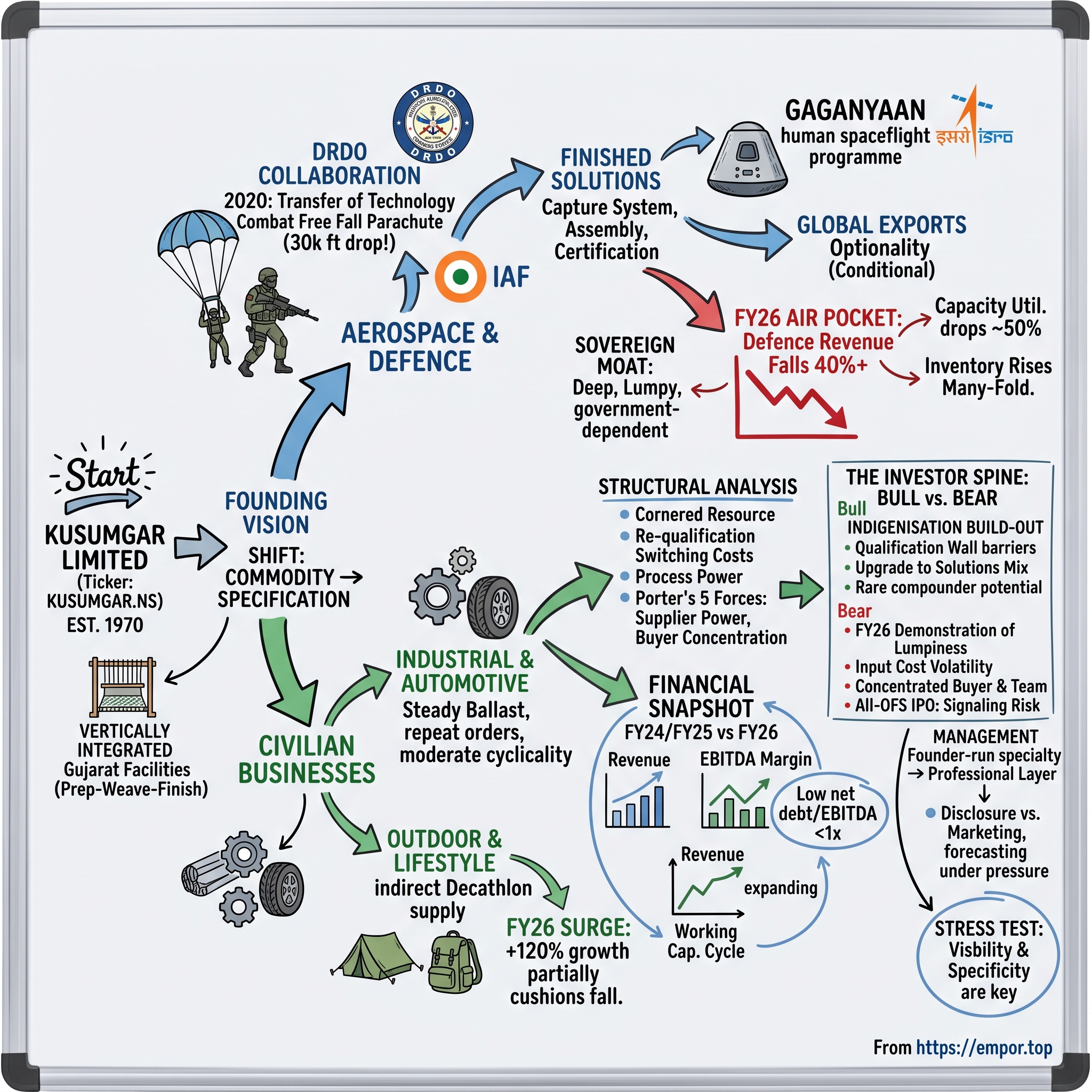
For a growing share of India's most demanding airborne and space missions, that fabric is made by a company most investors had never heard of until the summer of 2026: Kusumgar Limited, a Mumbai-headquartered manufacturer of "woven, coated and laminated synthetic fabrics" that it prefers to call, more grandly, engineered fabrics.1 The company acquired transfer of technology from India's Defence Research and Development Organisation (DRDO) to manufacture the Combat Free Fall parachute system — the one designed for jumps up to 30,000 feet and glides up to thirty kilometres — in an agreement announced in February 2020.6 It has also positioned itself, by its own account, as an industrial partner on the re-entry parachute story for ISRO's Gaganyaan human spaceflight programme.10 And it sells performance fabrics that end up inside outdoor gear for global brands in the orbit of Decathlon.5
That is the seductive version of the story, and it is the version the company told the market as it went public. The financial snapshot underneath it is genuinely unusual for a business that sits in a sector — Indian textiles — that public investors have spent decades learning to avoid. Revenue climbed from roughly ₹468 crore in FY24 to ₹779 crore in FY25, an eye-catching leap.4 EBITDA margins have run in the mid-to-high twenties — 28.18% in FY24, 24.18% in FY25, and 27.15% in FY26 — while return on capital employed has sat above 24%.5 Those are not commodity-mill economics. They are closer to the economics of a specialty chemicals or precision components company that happens to weave.
But there is a crack in the snapshot, and any honest telling has to start with it rather than bury it. In FY26, revenue did not keep climbing. It fell — to roughly ₹692 crore, down about 11% — and the decline was concentrated exactly where the bull case lives, in defence.5 The company's marquee Aerospace & Defence Fabrics segment contracted by more than 40% in a single year, capacity utilisation dropped to around 50%, and the working capital cycle stretched dramatically as inventory piled up.5 So the very first analytical question this episode has to hold in tension is: is Kusumgar a rare Indian technical-textiles compounder with a sovereign-grade moat, or a lumpy, government-dependent job shop that happened to catch one very good defence year and then gave part of it back?
The strategic paradox sharpens the question. When Kusumgar came to market, it did so not to raise money for the company but to sell shares belonging to its promoter family. The ₹650 crore initial public offering was structured as a 100% Offer For Sale — every rupee went to the selling shareholders, and not one rupee of primary capital entered the company's treasury.2[^3] For a business that management describes as riding a multi-year defence-indigenisation super-cycle, choosing to have the founding family sell down rather than fund a capacity step-change is a decision that deserves scrutiny, not applause.
A word on posture before we go further, because it shapes everything that follows. This is not the company's investor-relations department, and it is not a short-seller's dossier either. Kusumgar makes genuinely impressive products and earns genuinely impressive returns, and it would be dishonest to pretend otherwise. But a paratrooper's life depending on your fabric is a fact about the product, not a fact about the stock, and the two get conflated constantly in the way defence businesses are marketed to retail investors. The discipline throughout this piece is to separate what the company has proven — audited margins, a documented DRDO transfer, a real listing at a real price — from what it has merely asserted — the depth of its space role, the smoothness of the coming super-cycle, the durability of a moat that just sprang a leak. Where the evidence is strong, we will say so plainly. Where it is thin or the marketing runs ahead of the disclosure, we will say that too. The goal is to leave a sophisticated long-term investor able to build their own view, not to hand them a conclusion.
Here is the roadmap for how we will pull this apart. First, the genesis — how a 1970 textile venture in Mumbai talked itself out of the commodity trap. Second, the physics and economics of technical textiles, and why weaving a parachute has more in common with process engineering than with fashion. Third, the sovereign moat: DRDO, combat parachutes, and Gaganyaan, and how much of it is real versus asserted. Fourth, the actual segment economics — including the FY26 air pocket. Fifth, a management and governance audit built around that all-OFS IPO. Sixth, the competitive structure through Helmer's 7 Powers and Porter's Five Forces. And finally, the investor spine: why this business might win from here, what would break the case, and the two or three numbers worth watching. Let us begin where every good moat begins — with someone deciding not to compete on price.
 Subscribe on LinkedIn
II. Genesis & The Pivot: From Synthetic Looms to Engineered Materials
In 1970, the year Kusumgar traces its founding to, India was not a country where you started an ambitious materials-science company. It was a country of the License Raj, where the state rationed the right to manufacture, imports were throttled, and the textile sector — the industry that had literally clothed the freedom movement — was a crowded, protected, politically sensitive thicket of mills spread across Bombay, Surat, and Ahmedabad. Into this world stepped Yogesh Kantilal Kusumgar, a young man with a bachelor's degree in textile technology from Bombay University and, evidently, a low tolerance for the business he had trained for.1
It is worth sitting inside that moment for a beat, because the pivot it eventually produced is the entire reason this company is interesting. The Bombay of the early 1970s was a textile town in the way Detroit was a car town — the mills were the economy, the culture, and the politics all at once, and they were also, increasingly, a trap. The great composite mills that had defined the city were sliding toward the confrontation that would culminate, a decade later, in the catastrophic Bombay textile strike that hollowed out the industry. A young technologist watching that slow-motion decline had every incentive to conclude that competing head-on in mass-market cloth was a losing hand no matter how well you played it. The interesting founders of that generation were the ones who asked not "how do I make cloth cheaper?" but "how do I make cloth that cannot be bought on price at all?" That question is the seed of every specialty business, and it is the question Kusumgar spent the next five decades answering with looms and chemistry.
The textile trade he entered was structurally miserable, and anyone with a technical eye could see why. Plain-woven fabric — the stuff of shirts, saris, and bedsheets — is about as close to a pure commodity as a manufactured good gets. The yarn is bought from someone else, the loom is bought from someone else, the design is dictated by fashion or by the buyer, and the only variable a mill really controls is cost. That means price wars, thin margins, and violent exposure to the swings of raw-yarn prices, which themselves ride on cotton harvests and, for synthetics, on crude oil. A mill can run beautifully for two years and be underwater in the third through no fault of its own. It is the kind of business where the smartest operators spend their careers running very hard just to stay in place.
The pivotal insight — and it is the one that makes the entire modern Kusumgar story legible — was that the same looms, in the hands of people willing to obsess over specification rather than fashion, could make something the market could not easily commoditise. The move was away from apparel and toward engineered fabrics: filament synthetics, high-tenacity polyester, nylon-based woven structures, and eventually the coated and laminated constructions where the real value hides.1 The distinction matters and it is worth slowing down on. An apparel weaver competes on how cheaply it can make cloth a customer already knows how to specify. An engineered-fabric maker competes on whether it can make cloth to a specification the customer often cannot make themselves — a fabric that must hold a defined air permeability, a defined tensile strength, a defined weight per square metre, and survive a defined temperature range. Once you are selling to a specification, the buyer stops asking "who is cheapest?" and starts asking "who can actually pass the test?"
There is a deeper reason the specification game is so much better than the price game, and it is worth naming because it recurs at every stage of this story. When you compete on price, every improvement you make is immediately competed away — you invent a cheaper process, your rival copies it, and the savings flow to the customer, not to you. Commodity businesses run on a treadmill where the reward for winning is the right to keep running. When you compete on specification, the improvements accumulate into you. Every hard fabric you learn to make, every test you learn to pass, every coating recipe you perfect becomes a capability the next customer has to take or leave, and one that a new rival has to rebuild from scratch. Value compounds instead of leaking. The choice between those two games is the most consequential decision a materials company ever makes, and Kusumgar made it early and never looked back.
That reframing is the whole ballgame, and Kusumgar spent decades building the industrial muscle to answer the second question. It is worth being precise about corporate lineage here, because the marketing and the paperwork tell slightly different stories. The Kusumgar family's textile enterprise dates its origins to 1970, but the specific listed entity that came to market in 2026 carries a more recent corporate history, having been reorganised and renamed from an earlier private company ahead of the offering.8 For an investor this is a small but real caution flag: the "50-year heritage" in the pitch is the family's, and the audited financials that matter for valuation are those of the specific consolidated entity you are actually buying.
What the company built over those decades was a vertically integrated manufacturing base — not a single loom shed but a chain of processes under one roof. Across six facilities concentrated in Gujarat, Kusumgar performs preparatory processing, weaving, dyeing, printing, finishing, coating, and lamination.8 Each of those verbs is a place where a competitor could be beaten or beaten by, and owning all of them is how you control the one thing that turns a fabric from a commodity into a qualified product: consistency. A defence buyer does not want a fabric that passes once; it wants a fabric that passes identically on the ten-thousandth metre as on the first. Integration is how you promise that.
The B2B industrial work of the 2000s — the automotive tapes, the filtration media, the rubber-reinforcement fabrics, the belting — mattered less for its glamour than for its cash. Boring, repeatable industrial orders throw off the working capital and the operating cash flow that let a company afford the thing defence demands and industrial does not: patience. A military qualification cycle can run for years before a single commercial metre ships, and you cannot fund years of testing on hope. You fund it on the dull profits of industrial fabric. That is the quiet strategic logic of the early Kusumgar: use the commodity-adjacent industrial business as the cash engine that pays for the multi-year climb into defence — a climb that only makes sense if the physics at the top is genuinely hard. So let us go look at the physics.
III. The Physics & Economics of Technical Textiles
Here is a thought experiment that separates technical textiles from ordinary ones. Take a shirt fabric and a parachute fabric and put them under a microscope of requirements. The shirt has to look right, feel right, survive a wash, and cost as little as possible. The parachute canopy has to do something far stranger: it has to be almost weightless — some canopy fabrics run as light as 20 to 30 grams per square metre, roughly the heft of a sheet of tissue — and yet, when a falling body yanks it open, it must arrest that fall by catching air with just the right controlled leakage. Too airtight and the opening shock could injure the jumper or tear the canopy; too porous and it will not decelerate at all. It must hold this behaviour at sub-zero temperatures, under ultraviolet punishment, after being packed under compression for months. The shirt is a fashion problem. The parachute is a physics problem with a human life as the error term.
Let us make that concreteness even more tangible, because the numbers on a technical fabric are genuinely alien to anyone who thinks of cloth as a soft, forgiving thing. Engineers describe these fabrics in the vocabulary of precision manufacturing: grams per square metre for weight, denier or dtex for the fineness of the individual filament, tensile and tear strength measured in newtons, and air permeability measured as the volume of air that passes through a defined area at a defined pressure. A parachute designer specifies all of these simultaneously and demands that they hold together, because they trade off against one another in nasty ways. Make the yarn finer to save weight and you risk strength; weave tighter to gain strength and you change the air permeability that governs how the canopy opens; add coating for durability and you add weight and stiffness. Hitting all the targets at once, repeatably, across thousands of metres and a range of temperatures, is less like tailoring and more like holding several dials steady while someone shakes the table. The reason so few companies can do it is not secrecy alone; it is that the process window is genuinely narrow.
This is why the economics diverge so violently, and it is the single most important idea in the whole Kusumgar thesis. Apparel and basic textiles are a low-barrier, fashion-driven business where operating margins in the high single digits to low teens are the norm, because anyone with a loom can enter and price is the only weapon. Technical textiles built to specification are a different animal: barriers are high, the buyer values passing the test far above saving a rupee, and margins in the mid-twenties and above become achievable and — this is the key word — defensible. Kusumgar's own numbers sit squarely in that second world, with EBITDA margins in the 24–28% band across recent years, well above the roughly 20% that even a strong industrial-textiles peer like Garware Technical Fibres tends to earn.512 The margin premium is not magic; it is the financial signature of selling specifications instead of cloth.
But we should be careful not to let the romance of the physics do the analytical work. A high margin tells you the product is hard to make; it does not by itself tell you the demand is durable or the customer is loyal. To understand the moat you have to understand the qualification wall, and it cuts both ways. On the way in, it is a fortress. A fabric destined for a parachute, a ballistic vest, or a space capsule cannot simply be sold on a spec sheet. It has to be tested — drop-tested, environmentally cycled, sometimes flight-tested — under regimes that can take years before a supplier is cleared to ship commercially. During those years the supplier spends money and earns nothing. A competitor who wants to undercut Kusumgar on an already-qualified programme faces the same multi-year gauntlet with no guarantee of winning at the end, which is precisely why incumbents in qualified defence positions are so hard to dislodge. Price undercutting is close to meaningless when the buyer's real question is "have you passed?" and the answer for a new entrant is "not for another five years."
There is a second, subtler consequence of the qualification wall that the financial statements express as a number most investors gloss over: the working-capital intensity of the model. Because qualification is slow and orders arrive in irregular tranches tied to government budget cycles, a company like Kusumgar cannot run the tidy just-in-time flow of a consumer-goods maker. It has to hold specialised raw yarns, work-in-progress, and finished inventory against orders whose timing it does not fully control. In a good year that inventory converts smoothly to cash; in a stalled year it sits, and the money sits with it. The qualification wall that keeps competitors out is therefore inseparable from a balance sheet that carries more inventory and receivables than a commodity mill would — a structural feature, not a management failing, but one that turns nasty precisely when demand pauses. We will see the sharp end of this in FY26.
The coating and lamination layer is where much of the proprietary value concentrates, and it is worth explaining in plain terms because it is easy to hand-wave. Weaving gives you the base cloth; the chemistry laid onto and into that cloth gives it its actual super-powers. A polyurethane or specialty coating can make a fabric flame-retardant, or water-repellent while still breathing, or resistant to the infrared and radar signatures that make camouflage and stealth gear work, or capable of insulating a soldier at Himalayan altitudes. These are recipes — combinations of chemistry, process temperature, tension, and finishing that are refined over many production runs and are not written down anywhere a competitor can buy them. This is the part of the business that most resembles a specialty-chemicals process, and it is the reason two companies can own identical looms and produce fabrics of wildly different value.
The uncomfortable flip side of the qualification wall — the part the bull case tends to skip — is that it makes the business lumpy and rigid. If a programme's specification takes years to lock, then a programme's cancellation, delay, or budget reallocation also lands with years of lead time to absorb, and there is no quick pivot to a different customer. A qualified defence fabric line cannot be redeployed overnight to sell to the apparel market; it was engineered for one buyer's test. High switching costs protect you when orders are flowing and strand you when they stop. That structural rigidity is not a footnote — it is the mechanism that produced FY26's air pocket, and it is where the sovereign-moat story runs into the sovereign-customer risk. To see both at once, we have to look at the specific programmes that made Kusumgar's name.
IV. The Sovereign Moat: DRDO, Combat Parachutes, & Gaganyaan
On February 24, 2020, Kusumgar announced the move that reframed how the market would eventually see it. The company had acquired transfer of technology from DRDO to manufacture the Combat Free Fall parachute system — a system that lets paratroopers exit at up to 30,000 feet and glide as far as thirty kilometres to their target, operating in both the high-altitude-high-opening and high-altitude-low-opening profiles that special forces use to insert undetected.6 Managing Director Siddharth Kusumgar framed it in the language of national self-reliance: "We have always been focused on building strong capabilities within India to support our defense establishment and reduce dependence on imports."6 The company noted it had already collaborated with DRDO for years before the formal transfer — which matters, because these relationships are not won in a single tender; they are the accumulated product of a long apprenticeship.6
To understand why a technology transfer like this is more than a press release, you have to understand the specific way the Indian defence-textiles market had worked, and how policy was changing it. For decades, high-end defence textiles — the specialised parachute and protective fabrics — were often imported or supplied by a narrow set of foreign vendors, because the domestic industry could not clear the qualification bar. DRDO's laboratories, including its Aerial Delivery Research and Development Establishment, developed the designs; the question was always who could manufacture them to standard at scale inside India. A transfer of technology answers that question by handing a qualified private manufacturer the design and the know-how, in exchange for domestic production. For the manufacturer, it is close to being handed the keys to a walled garden: you are not competing to invent the parachute, you are being licensed to build a design the state itself validated.
It helps to understand who sits on the other side of that transfer. DRDO is not a monolith; it is a federation of specialised laboratories, and the one that matters for parachutes is the Aerial Delivery Research and Development Establishment in Agra, the institution that has designed India's military parachutes and aerial-delivery systems for decades. When an establishment like ADRDE develops a system, the design intellectual property is the state's; the bottleneck is industrial. Somebody has to be able to actually manufacture the thing to the exact standard the laboratory validated, at the volumes the armed forces need, inside the country. That manufacturing capability is scarce, and it is exactly what a private firm spends years earning the right to provide. The relationship that culminates in a transfer of technology is less a transaction than a graduation: the state spends years watching whether a vendor can hold the tolerances before it hands over a design on which soldiers' lives depend. Kusumgar's years of prior collaboration with DRDO were that apprenticeship.6
The vertical move that follows is the strategically interesting one, and it is the difference between a good business and a much better one. There is a world of difference between selling a roll of parachute-grade fabric to whoever assembles the parachute, and assembling and delivering the certified, life-critical parachute system yourself. The first is a component sale; the second captures the integration, the certification, and the accountability — and the margin that comes with all three. Moving from "Aerospace & Defence Fabrics" (the cloth) to "Aerospace & Defence Solutions" (the finished, qualified system) is Kusumgar climbing its own value chain, and it extends into heavy-drop territory as well: the large, multi-canopy fabric architectures used to air-drop cargo and vehicles weighing several tonnes. Each rung up that ladder raises the barrier a competitor must clear, because now they must qualify not just a material but an assembled, human-rated system.
Then there is Gaganyaan — the crown jewel of the pitch and, appropriately, the place where an independent analyst should be most careful. India's human spaceflight programme requires a re-entry deceleration system: a choreography of parachutes that must slow a crew module from a screaming re-entry velocity to a survivable splashdown, deploying drogue chutes to stabilise the capsule before the main canopies open. It is one of the most unforgiving fabric-engineering problems on Earth, because the failure mode is the death of astronauts. Kusumgar presents itself, in its offering materials, as an industrial partner associated with fabrics and parachute systems for the Gaganyaan re-entry module.10 That association, if it holds up in the way the marketing implies, is a genuinely rare credential — the kind of thing no competitor can simply buy.
But precision matters here, and the neutral posture demands it. The public record around Gaganyaan's parachute system prominently features ISRO and DRDO as the developers and testers of the drogue and main parachute systems, with qualification tests conducted as recently as early 2026.11 Where exactly a private supplier like Kusumgar sits in that chain — as a qualified fabric supplier, a component manufacturer, or a system-level partner — is the sort of claim an investor should want to see substantiated in the company's own filings rather than inferred from a slogan. The honest framing is this: Kusumgar's DRDO combat-parachute transfer is well documented, and its space association is real enough to be worth something, but the precise depth and exclusivity of the Gaganyaan role is a management representation that carries more weight the more it is corroborated by primary programme documentation.
The heavy-drop dimension deserves its own moment, because it is the most physically dramatic thing in the catalogue and the least understood. When an air force needs to deliver an armoured vehicle, a field gun, or tonnes of supplies to a forward position with no runway, it does not land — it drops. The load rolls out the back of a transport aircraft on a platform, and a cluster of enormous parachutes has to arrest a multi-tonne mass and set it down intact and upright. The fabric architecture for that job is a different engineering problem from a personnel canopy: the loads are colossal, the canopies work in coordinated clusters, and the failure mode is not one life but an entire delivery smashing into the earth. Building the fabric systems for heavy-drop platforms capable of delivering loads measured in tonnes is another rung on the same ladder — higher barrier, higher stakes, higher value capture — and it keeps Kusumgar close to the parts of the defence supply chain that are hardest to substitute.
Wrapping all of this is the policy tailwind, which is genuine and does not depend on any single company's spin. India's push for defence indigenisation — the "Make in India" architecture and the Ministry of Defence's positive indigenisation lists, which progressively bar the import of items that can be sourced domestically — has been deliberately engineered to move demand from foreign suppliers to qualified Indian ones.[^15] The mechanism is worth understanding because it is unusually direct. A positive indigenisation list does not merely encourage domestic sourcing; it forbids the import of listed items after a stated date, forcing the armed forces to buy from a qualified Indian vendor or go without. For any company already sitting on the right side of the qualification wall when its products land on such a list, that is close to a legislated demand transfer — the competition from imports is not out-competed, it is switched off by policy. India's broader technical-textiles ambition, expressed through the National Technical Textiles Mission, points the same way, aiming to grow domestic capability in exactly the high-performance categories Kusumgar occupies.[^15] For a company that spent years and rupees clearing the qualification wall, that policy is a demand pump pointed straight at its own front door. The catch — and it is the same catch that runs through this entire business — is that a company whose growth is pumped by government policy also lives or dies by government budgets and procurement timing. Which brings us, finally, to the numbers, and to the year the pump stalled.
V. Segment Economics & Materiality Breakdown
If the previous section was the recruiting poster, this one is the medical chart, and the two do not entirely agree. The cleanest way to see Kusumgar is to stop treating it as "a defence company" and start treating it as four different businesses sharing a set of looms, each with its own customer, cycle, and personality. In FY26 those four businesses split the roughly ₹692 crore of revenue in a way that immediately complicates the tidy narrative.5
Start with Aerospace & Defence Fabrics — the specialised camouflage, ballistic, protective, and extreme-climate cloth sold to the defence ecosystem. In FY26 this was still the single largest segment at roughly a third of revenue, but it got there by falling hard: the segment contracted by more than 40% year-on-year, and the collapse in the company's government-facing revenue — from something like ₹267 crore in FY25 to roughly ₹102 crore in FY26 — is the proximate reason total revenue went backwards.5 This is the single most important fact in the entire Kusumgar story, and it detonates the outline's implied picture of defence as a smoothly rising primary value engine. Defence here is not a steady compounder; it is a large, high-margin, and violently lumpy order stream at the mercy of procurement timing.
Aerospace & Defence Solutions — the finished parachute systems and assembled products that represent Kusumgar's climb up the value chain — contributed roughly a fifth to a quarter of FY26 revenue.5 This is the segment the equity story wants you to fixate on, because it is where the sovereign moat and the fattest margins live. It is also, precisely because it is finished-system defence work, the segment most exposed to the same procurement lumpiness that gutted the fabrics line. A high-quality business with a low-visibility order book is still a low-visibility order book.
There is a subtlety here that an investor should hold onto: "fabrics" versus "solutions" is not just a revenue label, it is a statement about how much of the value chain Kusumgar captures on a given order. When it sells defence fabric, it is a component supplier to whoever assembles the final article, and it books the margin on the cloth. When it sells a defence solution, it books the margin on the cloth and the conversion, the assembly, and the certification — a fatter slice of a bigger number. The strategic ambition, stated across the company's materials, is to shift the mix toward solutions over time.5 That is a sensible ambition and a real margin lever. But it also concentrates the business ever more tightly on the single lumpiest customer set in the whole portfolio, which means the mix-shift that raises the ceiling on good years also lowers the floor on bad ones. You cannot have the upside of being a system integrator to the Ministry of Defence without the downside of depending on the Ministry of Defence's calendar.
The two civilian segments are where the FY26 story gets more interesting than the headline decline suggests. Industrial & Automotive Fabrics — the high-tenacity tapes, filtration media, and rubber-reinforcement cloth — contributed roughly a quarter of revenue and behaves like what it is: moderately cyclical B2B work tied to industrial and auto production, the steady cash ballast we met in the company's history.5 And Outdoor & Lifestyle — the performance fabrics that flow into outdoor and sports gear associated with global brands like Decathlon — did something remarkable in a down year: it grew by more than 120%.5 One important nuance the bull pitch tends to blur is that Kusumgar's Decathlon exposure is largely indirect — it supplies fabric to the fabricators who serve Decathlon rather than contracting with the brand itself, which affects both pricing power and the durability of the relationship.5
Put those four together and a very different portrait emerges than "defence super-cycle." What actually happened in FY26 is that a surge in low-and-mid-margin civilian fabric partially cushioned a cliff-edge fall in high-margin government defence work. That mix shift is why revenue fell about 11% while EBITDA margin actually rose to 27.15% — a counter-intuitive result that deserves a plain-English explanation rather than applause.5 Margins can improve in a bad revenue year for benign reasons (better product mix, disciplined pricing) or for worrying ones (the high-fixed-cost defence lines running at low utilisation while a favourable one-off mix flatters the ratio). Given that capacity utilisation reportedly fell to around 50% in FY26, an investor should treat the resilient margin with respect but not with romance.5
The raw-material end of the chain adds another layer the segment map does not show. The high-tenacity nylon, aramid, and specialty polyester at the base of these fabrics are not commodities you buy from anyone; the best grades come from a concentrated global set of chemical majors, and aramid in particular — the fibre family behind ballistic and heat-resistant applications — is dominated by a handful of Western and Japanese producers. That gives Kusumgar a supplier base it does not control on price or, in a tight market, on availability, and it means the company's input costs ride partly on global petrochemical and specialty-fibre cycles that have nothing to do with Indian defence budgets. When those input costs spike and the output is sold under a fixed-price government contract, the squeeze lands directly on the margin. It is one more reason the resilient FY26 margin should be read as a snapshot, not a promise.
The balance-sheet mechanics of that year are the part a skeptical investor should stare at longest, because they are where lumpiness stops being an abstraction. As the government orders dried up, inventory did not — it ballooned, reportedly rising many-fold year-on-year, and the working-capital cycle stretched from a matter of days to roughly ninety days.5 In plain terms: the company kept making things (or holding raw materials and work-in-progress) that customers were not yet taking, and cash that would normally be circulating got trapped on the shelf. That is the classic fingerprint of a business whose production runs ahead of an order book it does not fully control. It is survivable — leverage remained moderate, with net debt to EBITDA under 1x — but it is the opposite of the serene, cash-generative compounder the margin line alone might suggest.8
So what does the segment map actually tell an investor? Three things. First, the return ratios are real and impressive — RoCE around 24.76% and RoE around 25.82% in FY26 — and they reflect a genuinely high-value-add finishing business rather than a commodity mill.5 Second, those ratios were considerably higher in FY24 and FY25 (RoE was flattered by a much smaller equity base before profits accumulated), so the trend is one of normalisation from an unusually high base, not acceleration.5 Third, and most important, the quality of the business and the volatility of the business are two separate facts, and Kusumgar scores high on the first and uncomfortably high on the second. Which makes the capital-allocation choices of the people running it — and the way they chose to go public — the natural next thing to interrogate.
VI. Capital Deployment, Management Audit, & The ₹650 Crore OFS IPO
Every IPO is a story the sellers tell, but the structure of an IPO is a fact the sellers reveal, and Kusumgar's structure spoke loudly. When the company listed in July 2026, the entire ₹650 crore offering was an Offer For Sale.2[^3] Not a single rupee of primary capital flowed into the company. Every rupee flowed out to the selling shareholders — the promoter family that, before the issue, controlled roughly 90.48% of the equity through Managing Director Siddharth Yogesh Kusumgar, Sapna Siddharth Kusumgar, and a family HUF, alongside founder Yogesh Kantilal Kusumgar.38 To understand whether that is a red flag or a rational choice, you have to hold two readings side by side.
The charitable reading, which management would offer, is that an all-OFS structure is a sign of strength, not weakness. The company generates enough operating cash to fund its own expansion, carries only moderate debt, and therefore does not need to dilute existing shareholders by issuing new stock. On this view the OFS is simply how a founding family achieves liquidity and satisfies the public-float requirements of a listing, while the business keeps compounding on internal accruals. There is real support for this: Kusumgar's historical capacity additions in weaving, coating, dyeing, and finishing have indeed been funded largely from operating cash flow rather than from equity raises, and the balance sheet came to market without the leverage that would force a capital call.8
The skeptical reading is the one an activist would press, and it is not easily dismissed. The company chose to bring its family shareholders liquidity in the immediate aftermath of a down year — FY26 revenue and profit both fell — and at a valuation the market was clearly willing to pay up for, given the defence halo. If the multi-year indigenisation super-cycle is as powerful as the pitch insists, the moment to raise primary capital and pour concrete for a capacity step-change is now, while demand is supposedly inflecting up. Choosing instead to sell existing shares transfers the upside of that alleged super-cycle from the company's future to the family's present. A sophisticated investor is entitled to ask which signal to believe: the bullish narrative in the prospectus, or the promoters' revealed preference to take ₹650 crore off the table rather than reinvest it.
There is a third reading worth putting on the table, because reasonable people land on it: that the OFS-versus-primary debate is somewhat overblown for a company this cash-generative. If Kusumgar genuinely funds its capex from operating cash flow and carries little debt, then raising primary equity would simply pile idle cash onto the balance sheet and depress returns on equity — the very ratios the bulls admire. On this view, letting the family sell down while the business self-funds is the return-maximising choice, not a warning. The honest resolution is that both things can be true at once: the structure is defensible for a self-funding company, and the timing — cashing out immediately after a down year into a story-driven valuation — is exactly what a promoter would do if they privately believed the near-term outlook was more uncertain than the prospectus implied. An investor cannot know which motive dominates. What they can do is refuse to treat the all-OFS structure as the positive signal the sell-side sometimes spins it into, and weigh it as the genuinely ambiguous data point it is.
The market, for its part, was in no mood for skepticism on listing day. The IPO was priced at ₹419 per share at the top of a ₹398–₹419 band, drew an overall subscription of about 135.8 times, and pulled in ₹193.95 crore of anchor demand before it even opened to the public.47 The stock then debuted on July 15, 2026 at ₹569 on the NSE — a 36% premium — valuing the company at roughly ₹6,338 crore at listing, against a post-issue P/E in the low-to-mid forties on FY26 earnings.74 That is a rich multiple for a business that had just posted an 11% revenue decline, and it tells you the price on offer was underwritten by the story — sovereign moat, space, indigenisation — far more than by the trailing numbers. When a stock lists at forty-plus times the earnings of a down year, the buyers are paying for a recovery and a re-acceleration they have not yet seen.
It is worth pausing on the people, because a founder-run specialist is ultimately a bet on a small number of minds. Yogesh Kantilal Kusumgar, the founder, was a textile technologist by training who made the defining strategic choice of the whole enterprise — to abandon the price game for the specification game — and then spent fifty years compounding capability rather than chasing scale.1 His son Siddharth Yogesh Kusumgar, the Managing Director, is the figure most associated with the modern pivot into defence and aerospace; it was Siddharth who fronted the DRDO combat-parachute transfer and articulated the import-substitution mission in language that reads more like a policy statement than a sales pitch.6 Alongside him, Ankur Kothari serves as Executive Director and CEO, giving the company a professional-management layer over the family core.8 What you cannot yet judge from the outside is the quality of their communication under pressure, because until July 2026 there were no public shareholders to answer to. The generational handoff from a founder who built the moat to a son now monetising it, with a professional CEO in between, is the human structure an investor is actually buying — and it is one whose accountability has never been tested by a public market.
On management itself, the record is genuinely mixed and should be read as such. On the credit side, the leadership team — Siddharth Kusumgar as Managing Director, with Ankur Kothari as Executive Director and CEO — has a defensible operating history: they navigated the multi-year DRDO qualification climb, executed the move from fabric into finished systems, and built a vertically integrated manufacturing base funded without reckless leverage.68 The technology-acquisition track record is disciplined; the company bought capability (the DRDO transfer, proprietary coating processes) rather than chasing splashy overseas M&A. These are the behaviours of operators who understand their own moat.
On the debit side sit the questions any diligent investor should keep open. Governance concentration is high — this is a family-controlled business with promoter-dominated ownership and family members in the key operating and board seats, which raises the standard related-party and key-person questions that come with founder-run companies.8 Disclosure of the precise depth of the marquee relationships (especially the exact Gaganyaan role) is thinner than the marketing warmth around them. And the FY26 working-capital blowout is a real execution question: a management team that lets inventory balloon and utilisation halve when a lumpy customer pauses is a team whose forecasting and production discipline will be tested again the next time defence orders go quiet. None of this is disqualifying. All of it is why the moat has to be examined structurally, not taken on trust — which is exactly what the frameworks are for.
VII. Competitive Moats & Structural Analysis
War-gaming a moat means asking not "does this company have advantages?" but "what specifically would a well-funded, rational competitor have to do to take this business away, and how long would it take them?" Hamilton Helmer's 7 Powers is a useful discipline here precisely because it forces you to name the mechanism rather than wave at the vibe of a moat. Kusumgar has, at most, three powers that genuinely bind, and it is worth being strict about which.
The strongest is Cornered Resource. The DRDO transfer of technology for the Combat Free Fall system, the accumulated defence qualifications, and whatever certified role the company holds in the Gaganyaan re-entry work are assets a competitor cannot simply purchase or out-spend into existence.610 They were conferred by the state, earned over years of testing, and in several cases are exclusive by design — the state does not hand the same transfer of technology to five vendors. This is the closest thing Kusumgar has to a true fortress, and it is real. The important caveat is that a cornered resource granted by a sovereign customer can, in principle, be re-granted, re-tendered, or diluted by that same customer, so its durability is a function of policy continuity as much as of Kusumgar's own actions.
The second real power is Switching Costs, though it is better named the re-qualification cost. Once a fabric or a parachute system is qualified into a defence programme, swapping it out forces the buyer to re-run the multi-year drop-testing and safety-certification gauntlet on a new supplier — an expense of time, money, and risk that procurement agencies avoid unless forced.6 This is a genuine lock-in, but note its shape: it locks in an incumbent position on an active programme, not the company as a whole. It does nothing to smooth the gaps between programmes, which is exactly why switching costs and revenue lumpiness coexist so awkwardly in this business.
The third is Process Power — the coating chemistries, the air-permeability weaving techniques, and the lamination recipes refined over decades of production runs.1 This is real but it is the softest of the three, because process advantages, unlike a sovereign transfer of technology, can in principle be reverse-engineered or independently developed by a determined rival with enough runs and enough patience. It raises the wall; it does not make it infinite.
Two powers that the bullish framing might claim, an independent read should largely deny. Counter-Positioning is only weakly present: it is true that India's large commodity-and-industrial textile champions are structurally ill-suited to low-volume, ultra-precise defence runs — their scale is their disadvantage here — but that is really just a description of Kusumgar occupying a niche too small and too fiddly for giants to bother with, which is a different and more fragile thing than a competitor being unable to copy Kusumgar without destroying their own business. And Kusumgar has essentially no Scale Economies, Network Economies, or Branded power in the Helmer sense; this is a small company by revenue, roughly a fifth to a half the size of a peer like Garware Technical Fibres, selling to buyers who care about certification, not brand.12
Porter's Five Forces sharpens the same picture from the outside in. The threat of new entrants is genuinely low, and this is Kusumgar's best structural feature — the testing cycles, security clearances, and coating-technology capital intensity form a barrier measured in years. Substitutes are also low: there is no non-textile way to make a parachute, a camouflage net, or a flexible space-recovery canopy, so the product category itself is safe. But the other three forces are less flattering. The bargaining power of buyers is high and concentrated — when your most valuable customer is the Ministry of Defence, it dictates terms, timing, and often price, and FY26 showed exactly how much damage a single concentrated buyer can do simply by pausing.5 The bargaining power of suppliers is moderate but real, because the specialised high-tenacity nylon and aramid yarns at the base of these fabrics come from a narrow set of global producers, exposing Kusumgar to input-price and availability swings it cannot fully control. And competitive rivalry, while low in Kusumgar's specific qualified niches, is not zero: it competes selectively with Garware Technical Fibres domestically and global specialists internationally, and the civilian outdoor and industrial segments — the ones that grew in FY26 — are considerably more contestable than the defence lines.1213
It helps to hold Kusumgar against the two peers most often invoked in the same breath, because the comparison is clarifying rather than flattering. Garware Technical Fibres is the natural yardstick — a larger, diversified maker of technical cordage, nets, and fibres with a genuinely global customer base and a long record of steady, if less spectacular, margins in the region of twenty percent.12 Garware's virtue is exactly what Kusumgar lacks: diversification across many customers and geographies, which smooths the ride even if it caps the peak margin. SRF, meanwhile, is a different beast entirely — a multi-billion-rupee diversified chemicals-and-materials conglomerate for which technical textiles are one division among fluorochemicals, specialty chemicals, and packaging films; its technical-textiles business is a cash cow embedded in a far larger, more cyclical whole.13 Seen against these two, Kusumgar's distinctiveness is sharp: it is smaller, more concentrated, higher-margin, and more exposed to a single sovereign customer than either. That is the profile of a specialist, and specialists trade at a premium when their niche is compounding and at a discount when their niche stalls. The market, on listing day, was pricing the former.
The synthesis an investor should carry away is this: Kusumgar's moat is real but narrow and lumpy. It is deep exactly where the programmes are active and exclusive, and shallow everywhere else — between programmes, in the civilian segments, and against the possibility that its single most powerful customer changes its budget or its mind. A narrow-and-deep moat can produce wonderful economics for years and still deliver a stomach-churning ride. Whether you find that acceptable depends on which case you weight more heavily, which is where the spine of the investment finally has to be laid bare.
VIII. The Investor Spine: Bull vs. Bear Case & Stress Test
The bull case is coherent and, in its best form, does not rest on hype. It runs like this. India is in the early innings of a structural defence-indigenisation build-out, and government policy is actively transferring demand from foreign suppliers to qualified domestic ones like Kusumgar.[^15] The company sits behind a qualification wall that takes competitors years to scale, holds a cornered resource in its DRDO transfer, and is climbing from selling fabric to selling finished, higher-margin systems — a mix shift that should lift blended margins over time. Its economics are already exceptional for the sector, with mid-twenties EBITDA margins and mid-twenties returns on capital, and its DRDO-qualified systems carry genuine export optionality to friendly nations seeking cost-competitive tactical drop systems.5 If even a fraction of that plays out, the FY26 dip looks like a procurement-timing pothole on a long upward road, and a business with these returns compounding on internal cash is a rare thing in Indian textiles.
The bear case is equally coherent and, uncomfortably for the bulls, is grounded in facts that have already happened rather than fears that might. FY26 is exhibit A: revenue fell about 11%, the flagship defence-fabrics segment contracted more than 40%, government revenue more than halved, capacity utilisation dropped to roughly 50%, and inventory ballooned while the cash cycle stretched toward ninety days.5 That is not a hypothetical risk about lumpy government revenue — it is a demonstration of it. Exhibit B is the all-OFS IPO: the promoters chose to sell ₹650 crore of stock into a defence-halo valuation rather than raise a rupee to fund the capacity expansion that a genuine super-cycle would demand, which is at minimum an odd tell.2 Exhibit C is input risk: the petroleum-derived and specialty yarns at the base of the product are volatile, and in fixed-price government contracts a lag in passing through cost spikes squeezes exactly the margins the whole thesis depends on. Exhibit D is concentration on both sides — a heavy reliance on the Ministry of Defence as a customer and on a small founding family for leadership continuity.
The activist's stress test tightens the screws further. A skeptical long/short investor would note that the market paid a low-to-mid-forties multiple for a business coming off a declining year, meaning the price already embeds a recovery and re-acceleration that the trailing numbers do not support — the setup for disappointment if defence orders stay slow.47 They would flag the governance concentration and the related-party surface area that comes with a 90%-family-owned company now selling down.8 They would press on the gap between the warmth of the Gaganyaan marketing and the specificity of the disclosure. And they would point to the FY26 working-capital blowout as evidence that management's production discipline and demand-forecasting are not yet proven across a full lumpy cycle. None of these is a smoking gun; together they are a coherent short thesis that says "wonderful niche, dangerous entry price and cycle timing."
There is a live version of this debate worth imagining, because it is the one that will actually play out on the company's earnings calls now that it is public. Management will be asked, quarter after quarter, the same two questions: when do the defence orders come back, and how confident are they in the timing? The tell to listen for is specificity. A management team with genuine order-book visibility answers with programmes, delivery schedules, and named milestones; a team without it answers with the macro — the size of India's defence budget, the length of the indigenisation list, the excitement around space. On a business this lumpy, vague answers about the addressable market are not reassurance, they are the absence of reassurance. Equally, watch how they narrate the FY26 miss when they are eventually forced to. A candid team will explain it as what it was — a concentrated customer's procurement pause that stranded inventory — and lay out what they are doing differently on production planning. A team that blames the environment, or waves the miss away as noise, is telling you something about how the next stumble will be handled. There is no transcript history to check this against yet; the newly listed company has no back catalogue of calls to hold today's story against tomorrow's. That absence is itself a diligence fact: public investors are underwriting a management communication style they have not yet seen tested by a hostile quarter.
So where is the balance of evidence? The most intellectually honest answer is that Kusumgar is a high-quality niche business wearing the valuation of a high-growth secular one, and the distance between those two things is the entire risk. The quality is not in doubt — the margins, the returns, the qualification barriers, and the DRDO relationship are real and rare. What is genuinely unproven is the durability and smoothness of growth: whether the defence order stream re-accelerates and steadies, whether the solutions mix-shift and export optionality convert from possibility into revenue, and whether management can run the balance sheet more tightly through the next order gap than it did through the last one. A credible bull needs those to break its way. A credible bear only needs FY26 to be a preview rather than an aberration. The reader does not need to be told which will happen; the reader needs to be told exactly what to watch to find out first.
IX. Key Metrics, Risk Radar, & Lasting Playbook Lessons
If you can track only a handful of numbers on Kusumgar, track these three, because they map directly onto the three fault lines in the thesis. The first is the Aerospace & Defence revenue contribution and its year-on-year direction — not just the level but the trajectory of the defence fabrics and solutions segments together. This single metric will tell you whether FY26's collapse in government revenue was a one-year procurement pause or the start of a structurally lumpier and lower plateau. The bull case cannot survive a second consecutive year of defence contraction; the bear case cannot survive a sharp, sustained defence rebound. Watch it above all else.
The second is EBITDA margin held against capacity utilisation. The margin alone can mislead — it rose in FY26 even as the business shrank and utilisation fell to around 50%.5 The signal to watch for is margin and utilisation rising together, which would mean the high-fixed-cost defence lines are filling back up and the quality of the earnings is improving, versus margin propped up by a favourable civilian mix while the expensive defence capacity sits idle. Two companies can print the same 27% margin and have completely different futures depending on which of those is true.
The third is the qualification-to-commercialisation pipeline — the count of newly qualified defence and space systems actually moving from the testing phase into funded, active procurement orders, and, critically, the conversion of the working-capital-heavy inventory build back into cash. This is the metric that reveals whether the sovereign moat is generating a widening stream of real orders or a growing pile of qualified capabilities waiting on budgets that never quite arrive. A moat that produces certifications but not cash flow is an engineering achievement, not yet an investment.
The material risk radar for this specific business is short and concrete, and it deliberately excludes the macro risks that do not bite here. Procurement-timing and budget-reallocation risk at the Ministry of Defence is the dominant one, and FY26 proved it is not theoretical.5 Input-cost risk on specialised high-tenacity nylon, aramid, and coating polymers is real, amplified by fixed-price government contracts that limit pass-through. And export-licensing risk under India's defence-export control regime (the SCOMET framework) sits directly on top of the "global export optionality" that forms part of the bull case — the same sovereign relationships that create the moat can also gate the ability to sell abroad. Geographic concentration is a quieter overlay worth noting: all six manufacturing facilities sit in Gujarat, which means a regional disruption would hit the entire production base at once.8
One overlay deserves a closer look because it is doing quiet work in the bull case: export optionality. The pitch holds that DRDO-qualified systems could be sold to friendly nations seeking cost-competitive tactical drop and parachute systems, opening an addressable market far larger than India's own procurement. The logic is sound in the abstract — a system good enough for the Indian armed forces is, by construction, good enough for many others, and India has been actively courting defence exports as a strategic goal. But the same sovereign relationship that creates the moat also polices the exit. Defence exports from India run through the SCOMET control framework and require government clearance, which means Kusumgar cannot simply sell its most valuable products abroad on commercial terms; it needs the state's permission, transaction by transaction, and that permission is granted through the lens of foreign policy, not commercial opportunity. Export optionality is therefore real but conditional — a call option whose strike price is written by the government. An investor should value it as upside that may arrive, not as a base-case engine, and should discount any management framing that treats a large global market as if it were freely addressable.
The durable lessons in the Kusumgar story outlast any view on the stock, and they are worth stating plainly because they generalise. The first is the power — and the peril — of the niche defence monopoly: choosing a small, mission-critical, high-qualification corner of a market can produce returns a giant commodity business will never see, but it hands your revenue calendar to a single sovereign customer whose budget you do not control. The second is the value of upgrading along the value chain: Kusumgar's climb from raw-fabric weaver to chemical processor to certified-system assembler is the clearest illustration in this story of how a company manufactures its own moat one rung at a time, and it is the part of the strategy most within management's control. The third is the double-edged nature of the sovereign moat itself: partnering with the state's research institutions turns national policy into corporate advantage, but it also means your fortunes rise and fall with a customer who answers to a budget cycle and an election calendar, not to a purchase order. And there is a fourth lesson, quieter than the others but arguably the most useful for a public-market investor: the difference between a great business and a great stock is the price, and the price of a defence-and-space story is set by narrative long before it is set by cash flow. Kusumgar listed at a rich multiple on the earnings of a year in which it shrank, which means the market has already paid, in advance, for a recovery it has not yet observed. That does not make it a bad investment; it makes it a demanding one, where the burden of proof sits with the future rather than the past. The most valuable habit a reader can take from this story is the discipline to keep asking, quarter after quarter, whether the qualifications are turning into orders and the orders into cash — and to let that evidence, rather than the undeniable romance of parachutes and re-entry capsules, drive the conclusion.
Kusumgar has built something genuinely hard to replicate. Whether that translates into steady compounding or lurching lumpiness is a question the next few defence order cycles — not the last one good year, and not the marketing — will answer.
References
-
Draft Red Herring Prospectus (DRHP) — SEBI / Kusumgar Limited, 2025-09-27 ↩↩↩
-
Kusumgar IPO ₹650 Cr OFS, Engineered Fabrics for Defence & Aerospace — IndiaIPO, 2026-07-07 ↩
-
Kusumgar IPO 2026: OFS issue, FY26 dip, 44.8x P/E — Multibagg, 2026-07-06 ↩↩↩↩
-
Kusumgar IPO (8-10 July) Analysis — Equity Research India, 2026-07-05 ↩↩↩↩↩↩↩↩↩↩↩↩↩↩↩↩↩↩↩↩↩↩
-
Kusumgar, DRDO partner on free-fall combat parachutes — Textile Technology Source, 2020-02-24 ↩↩↩↩↩↩↩↩↩
-
Kusumgar Share Price Lists at 36% Premium — Sahi, 2026-07-15 ↩↩↩
-
Kusumgar IPO Details & Analysis — Anand Rathi, 2026-07-06 ↩↩↩↩↩↩↩↩↩↩
-
Kusumgar Financial Profile & Peer Benchmarking — Screener.in, 2026-07-01 ↩
-
Gaganyaan Human Spaceflight Mission Partner Overview — Indian Space Research Organisation, 2024-02-27 ↩↩↩
-
DRDO Transfer of Technology and Gaganyaan Parachute Qualification — Defence Research and Development Organisation, 2026-02-19 ↩
-
Garware Technical Fibres Limited Financial & Operating Peer Comparison — Screener.in, 2026-06-30 ↩↩↩↩
-
SRF Limited Technical Textiles Business Segment Analysis — Screener.in, 2026-06-30 ↩↩
 LinkedIn
 WhatsApp
 Reddit
 Hacker News
 Email
Email Kindle
 RSS Feed
 Spotify
 Apple Podcasts
 Amazon Music
 Audible
 YouTube