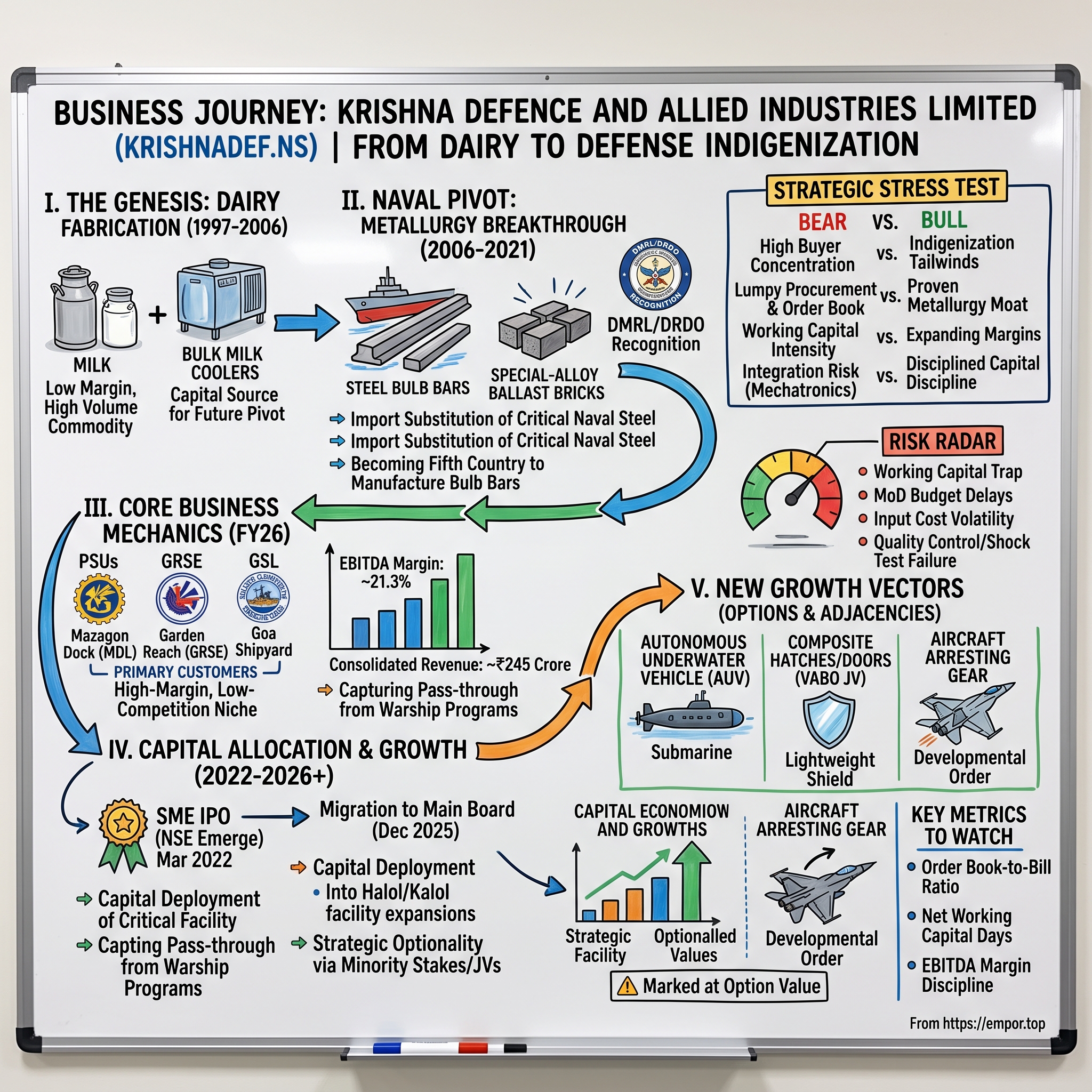
Krishna Defence and Allied Industries: From Dairy Fabrication to Naval Indigenization
I. Introduction & Episode Roadmap
Picture a workshop floor in Kalol, a dusty industrial town an hour north of Vadodara in Gujarat. For most of its life this shed did something profoundly unglamorous: it bent sheets of stainless steel into milk cans and bulk coolers for dairy cooperatives, the kind of vessels that clank on the backs of trucks bringing milk to collection centers across Western India. It was a business of pennies — high volume, low margin, zero mystique. And yet, walk that same floor today and you would find furnaces running controlled quenching cycles on asymmetric steel profiles destined for the pressure hulls of Indian Navy warships, alloy bricks so dense they let naval architects trim a frigate's center of gravity by centimeters, and a developmental order for the arresting gear that yanks a fighter jet to a halt on a carrier deck.
That is the improbable arc of Krishna Defence and Allied Industries Limited (KRISHNADEF.NS), and it is the reason this story is worth telling. The company sits at the intersection of two things investors love to romanticize and often misjudge: a genuine niche monopoly, and a national policy tailwind. India has spent the last decade pushing "Atmanirbhar Bharat" — self-reliant India — into its defense procurement, banning imports of item after item to force domestic substitution. Krishna is a textbook beneficiary. It occupies metallurgical crevices too small for steel giants to bother with and too specialized for generic fabricators to enter, and it has spent nearly two decades earning the certifications that make those crevices defensible.
The numbers tell a story of acceleration. Consolidated revenue reached roughly ₹245 crore in FY26 (year ended March 31, 2026), up about 29% year on year, with EBITDA rising nearly 70% to around ₹52 crore and margins expanding to 21.3% — a level more than five percentage points above the prior year.1 Net profit, including the share of associates, climbed about 86% to roughly ₹41 crore.1 Rewind two years and the company earned that kind of profit margin on a fraction of the base: FY24 revenue was near ₹106 crore at a 14.5% EBITDA margin.2 The order book stood at about ₹103 crore and the tender pipeline at ₹221 crore as of March 31, 2026.1
Here is the core thesis, stated plainly and then interrogated for the rest of this piece: Krishna is a play on defense indigenization capturing high-margin, low-competition metallurgy niches where global defense majors are locked out by policy and domestic steel behemoths find the batch sizes too small to care. That is the bull case in one sentence. The neutral investor's job is to ask what actually backs it — approved-vendor status, real process know-how, a multi-year warship-building cycle — and what could break it: a concentrated government buyer, lumpy procurement, a stretched working-capital cycle, and the unproven leap from steel into mechatronics and electronics.
Here is the roadmap. We start with the origin in dairy fabrication and the decision to walk away from a business the founders understood toward one they did not. We trace the naval pivot — the metallurgy breakthrough on bulb bars, the DMRL appreciation, and the slow accumulation of technology licenses. We open up the core business mechanics: what a bulb bar is, why a ballast brick matters, and how shipyard order cycles pass through to Krishna's shop floor. We follow the capital-markets journey from an ₹11.89 crore SME listing to the main board, and test management's credibility against its own promises. We size the optionality — autonomous underwater vehicles, composite hatches, aircraft arresting gear — without letting the speculative tail wag the cash-generating dog. And we close with a structured strategic analysis and an honest bear-versus-bull stress test. Let's begin where every good origin story does: with a small business that had no reason to become what it became.
 Subscribe on LinkedIn
II. The Genesis: From Milk Cans to Military Grade Metallurgy (1997–2006)
In 1997, a partnership firm called M/s Krishna Industries opened its doors in Gujarat with an unremarkable mandate: make dairy equipment.3 Stainless-steel milk cans, bulk milk coolers, the occasional milking machine — the humble plumbing of India's white revolution. Gujarat was the right place for it. The state is home to Amul and a dense web of dairy cooperatives, and every cooperative needs vessels to store, cool, and transport milk. If you wanted to fabricate stainless steel and sell it to a captive local customer base, you could do worse than the outskirts of Vadodara.
But dairy fabrication is a commodity trap, and it is worth dwelling on why, because the escape from that trap is the whole point of this company. Making a milk can requires no proprietary technology. Any workshop with a rolling machine, a welder, and a supply of stainless sheet can do it. That means the market is crowded with regional fabricators competing on price, and price competition in a product with no differentiation grinds operating margins down to the mid-single digits. Worse, the working capital dynamics are unforgiving: you buy steel, you fabricate, you sell to cooperatives that pay on their own schedule, and you finance the gap. There is no pricing power because there is no scarcity — the customer can always find another shop that will shave the quote. This is the definition of a red ocean, and Krishna was swimming in it.
The founders' insight, which crystallized in the mid-2000s, was less a flash of genius than a clear-eyed reading of asymmetry. On one side sat their existing business: easy to enter, impossible to defend, structurally low-return. On the other side sat Indian defense manufacturing, which had the opposite profile — brutally hard to enter, but for exactly that reason enormously profitable for anyone who got in. India in that era imported a staggering share of its defense hardware, from rifles to warship steel, and the procurement system was choked with bottlenecks and single-vendor dependencies on foreign mills. The barriers that made defense so hard to enter — years of qualification, military testing, certification overhead — were precisely what would protect margins on the far side. If commodity dairy work was a red ocean with no walls, defense metallurgy was a blue ocean surrounded by walls, and Krishna decided the walls were the point.
The first concrete pivot came in 2006, when the company developed shipbuilding steel bulb bars for naval applications and, notably, secured recognition from the Defence Metallurgical Research Laboratory (DMRL) in Hyderabad for indigenizing them.3 We will unpack what a bulb bar actually is shortly; for now, the significance is directional. A milk-can maker had figured out how to roll and heat-treat a warship-grade steel profile that India had previously bought from European and Russian mills. That is a discontinuous leap in the difficulty and defensibility of the work — and, crucially, in the buyer. The customer was no longer a price-sensitive cooperative; it was the Indian Navy and its shipyards, buyers who care about certification and reliability far more than about squeezing the last rupee.
The genuinely instructive lesson here is about financing. The company did not raise venture capital to fund its defense R&D and certification odyssey. It used the cash-turnover engine of the legacy dairy business — low-margin, but high-velocity and self-funding — to bankroll entry into a high-barrier, long-gestation industry. The dairy operation became the unglamorous cash cow that paid for the expensive, slow-maturing bet on defense metallurgy. For founders and investors alike, that is the transferable pattern: a boring legacy business is not always a drag; sometimes it is the balance sheet that funds the interesting one. The question that hangs over the next fifteen years is whether the bet paid off — and to answer that, we have to follow Krishna into the strange, closed world of naval steel.
III. The Naval Pivot: Import Substitution & DRDO Partnerships (2006–2021)
To understand why Krishna's naval pivot mattered, you have to understand the problem it solved for the Indian Navy — and that problem was, at bottom, a geopolitical vulnerability hiding inside a steel section. For decades, the specialized hull-stiffening profiles that give a warship its structural spine, along with the low-magnetic alloys and ballast materials that keep it balanced and stealthy, were imported from European and Russian mills. Every warship the Navy built carried a dependency on foreign suppliers whose delivery schedules, prices, and willingness to sell were subject to forces entirely outside Indian control. A delayed shipment of hull steel could push out a frigate's construction timeline; a geopolitical rupture could choke the supply entirely. Indigenizing that steel was not a cost-saving exercise. It was strategic insurance.
The metallurgical breakthrough is what earned Krishna its seat at the table. Producing a warship-grade bulb bar is not like rolling a beam for a building. The steel must meet exacting yield-strength and shock-resistance standards — a naval hull has to absorb the shock of a nearby explosion and flex without fracturing — and the asymmetric profile has to be formed through a multi-stage rolling process, then subjected to controlled quenching and stress-relieving heat treatment so the internal metallurgy behaves under battle conditions. Getting the heat-treatment recipe right is a matter of years of iteration; the parameters are effectively trade secrets, discovered through trial and error rather than read out of a textbook. When DMRL — the DRDO laboratory whose entire mandate is defense metallurgy — issued Krishna an appreciation certificate for the indigenized bulb bar, it was the technical stamp that converted an import-dependent supply chain into a domestic capability.3 The company would later be recognized with a Defence Technology Absorption Award for pioneering domestic bulb-bar production, with India cited as only the fifth country in the world able to manufacture them.7 That claim deserves a neutral caveat — "fifth country" is a company-promoted framing rather than an independently audited league table — but the underlying achievement, indigenizing a previously imported warship steel section, is real and certified.
What turned a single product win into a repeatable engine was the decision to institutionalize the relationship with DRDO's laboratory network. India's Defence Research and Development Organisation runs a Transfer of Technology (ToT) system: its labs develop a technology, then license private manufacturers to produce it at scale.[^10] Krishna leaned into this, entering licensing agreements to manufacture a widening menu of niche defense items.3 The catalog reads like a tour of India's harshest operating environments: improved space-heating devices — the bukhari stoves that keep troops alive at high-altitude posts in Ladakh and Siachen — along with containment vessels and specialized hardware for extreme-climate deployment. Each item is individually small. Collectively they built something more valuable than revenue: a track record as a laboratory-to-factory partner that DRDO could trust, which is the currency that gets you the next license.
There is a nuance worth flagging on the metallurgy partnerships, because narratives get simplified. Alongside DRDO's labs, the company has described working with the Steel Authority of India Limited (SAIL) on indigenized steel, and Managing Director Ankur Shah has framed Krishna's role as evolving "from component supplier to design-technology partner" — contributing design inputs, material innovation, and advanced fabrication rather than just bending metal to spec.5 The company also secured DNV and ABS classification-society certifications for its shipbuilding steel sections and has been pursuing further approvals from BV, LRS, and IRS to open international commercial shipbuilding markets.5 Certifications are the moat's building blocks here, and Krishna has been methodically stacking them.
The corporate structure evolved in step with the ambition. The partnership firm was reconstituted into a private limited company, and in December 2021 it converted into a public limited company — the standard grooming that precedes a run at the capital markets.3 By the close of 2021, a milk-can maker from Gujarat had become a certified, single- or two-vendor supplier of warship metallurgy to the Indian Navy, with a portfolio of DRDO technology licenses and a public-company shell ready to raise money. The obvious next question for any investor is: what exactly does this business sell, to whom, and why can't someone else just do it? That is where the mechanics get interesting.
IV. Core Business Mechanics: Naval Metallurgy, Bulb Bars, & Shipyard Economics
Start with the object at the heart of the story, because if you understand the bulb bar you understand the business. Imagine the inside of a warship's hull. The outer steel plate is the skin, but skin alone would buckle under the pressure of the sea and shatter under the shock of an explosion. So naval architects weld a lattice of stiffening ribs to the inside of the plate — think of the ribs of a ship's skeleton. A bulb bar is one of those ribs, but with a peculiar cross-section: a flat strip of steel with a rounded bulb of extra material along one edge, giving it an asymmetric profile. That bulb concentrates strength and stiffness exactly where the rib needs to resist bending, without adding the weight of a symmetric beam. The result is a rib that is lighter for the stiffness it provides — and on a warship, every kilogram you save low in the hull is a kilogram you can add higher up as weapons, sensors, or armor. When a shock wave from a near-miss explosion hits the hull, well-made bulb bars let the structure flex and absorb the energy instead of cracking. That is why the metallurgy is unforgiving and why the Navy cares who makes them.
Now the economics of who does the work. Krishna's revenue is overwhelmingly a defense story — the defense sector contributed roughly 94% of revenue in FY25, with legacy dairy and food equipment shrunk to a small remainder.2 Within defense, the naval metallurgy franchise is the profit engine: shipbuilding steel sections (the bulb bars), special-alloy steel ballast bricks, special-steel welding wire and electrodes for underwater hull joints, and armored steel profiles for vehicles.2 The dairy and kitchen-equipment business persists as a modest, cash-generative contributor that helps cover overhead — the same self-funding role it has always played, now dwarfed in economic weight. A third bucket, homeland security and specialty items — vehicle barriers, tire killers, multipurpose launchers, space-heating and containment hardware — rounds out the mix at the margin.3
The ballast brick deserves its own moment because it captures how Krishna makes money from problems most people never think about. A warship needs weight distributed low in the hull to stay stable and upright — ballast. You could use ordinary steel or concrete, but space inside a hull is scarce and precious. Krishna's answer is a special high-density alloy brick that packs more mass into less volume, letting naval architects place precise weight exactly where the ship's balance requires it, in tighter spaces than conventional ballast would allow.7 The company delivered its first order of these special-alloy ballast bricks to the Indian Navy in 2021.3 It is a small product with an outsized moat: the buyer is the Navy, the spec is exacting, and the alternative suppliers are few.
The manufacturing complexity is the moat's physical form. Producing these profiles requires specialized multi-stage rolling, controlled quenching, and stress-relieving heat-treatment cycles — capital equipment and process know-how accumulated over nearly two decades. To meet growing shipyard demand, the company expanded manufacturing capacity for shipbuilding steel sections at its Halol facility, with the added capacity becoming operational in April 2025, and in FY26 it commissioned a dedicated bulb bars and welding consumables line and acquired an additional 50,000 square feet at Halol.12 Both Gujarat plants — at Kalol and Halol, near Vadodara — carry ISO 9001:2015 accreditation across dairy, kitchen, and defense manufacturing.3
Then there is the demand engine, which is elegant in its simplicity. Krishna does not have to win warship programs; it just has to be the approved vendor when its customers win them. The primary customers are India's PSU defense shipyards — Mazagon Dock Shipbuilders (MDL), Garden Reach Shipbuilders & Engineers (GRSE), and Goa Shipyard (GSL) — plus the Ministry of Defence and the Navy directly.3 When GRSE or MDL land a multi-ship program — next-generation corvettes, Project 17A frigates, and the like — that program cascades down into demand for hull steel profiles, ballast bricks, and welding consumables, and an approved Krishna captures that pass-through. The company's fortunes are therefore geared to the Navy's construction cycle, which is precisely the kind of multi-year, budget-backed demand that makes a niche supplier's revenue visible several years out.
Which raises the question every investor asks: why doesn't a real steel company just take this business? The answer is a study in why scale is sometimes a disadvantage. Integrated giants like JSW Steel, Tata Steel, and Jindal Steel & Power are built to run continuous casting lines producing millions of tons of commodity steel. A naval bulb-bar order might be hundreds of tons — a rounding error that would require them to interrupt a high-tonnage line, retool for a custom profile, run bespoke heat-treatment cycles, and shoulder years of certification overhead, all for a batch too small to move their needle. The economics simply do not work; the opportunity cost of disrupting a commodity line dwarfs the prize. From the other direction, small generic fabricators lack the DMRL/DRDO technical clearance, the classification-society certifications, and the heat-treatment infrastructure to qualify at all. Krishna lives in the gap: too specialized for the giants, too certified for the minnows.
The peer set that investors reach for — PTC Industries in titanium and alloy castings, Paras Defence & Space Technologies in defense optics and electronics, Dynamatic Technologies in aerospace structures, Premier Explosives in propellants — is instructive precisely because none of them is a direct competitor. They are fellow travelers in India's defense-indigenization theme, each with its own niche and its own moat, rather than rivals bidding against Krishna for the same bulb-bar tender. That thin direct competition is the source of Krishna's pricing power, and it is also the setup for the harder questions we turn to next: how the company has been financed, how management has behaved, and whether the moat survives contact with the balance sheet.
V. Capital Allocation, The SME-to-Mainboard Journey, & Management Playbook
Every family business eventually faces the moment when the founders decide whether to keep it private and slow or open it to outside capital and accelerate. For Krishna, that moment came in March 2022. The company launched a small SME initial public offering on NSE Emerge — 30,48,000 equity shares at ₹39 per share (a ₹37–39 band, ₹10 face value), raising ₹11.89 crore, with the issue open from March 25 to March 29, 2022, and proceeds earmarked for working capital and general corporate purposes.4 By the standards of India's defense boom this was a tiny raise, the kind of sum a single mid-sized order might now generate. But the size is the point. Krishna did not need a war chest; it needed a modest liquidity cushion and the discipline and visibility of being a listed company. (A note on the record, because outlines circulate loosely: the IPO priced at ₹39, not the higher figures sometimes repeated; the raise was genuinely small.)
What happened next is the part of the story that earns management the benefit of the doubt. The company took SME capital and deployed it at high returns rather than lighting it on fire chasing scale. Revenue compounded from roughly ₹60 crore around the listing to ₹106 crore in FY24 and about ₹195 crore in FY25, at an EBITDA margin that climbed from 14.5% in FY24 to 15.6% in FY25 and then vaulted to 21.3% in FY26.12 That margin trajectory is the single most important behavioral tell in the whole story. Revenue growth alone can be bought with price cuts and loose credit; margin expansion alongside revenue growth means the incremental business is higher-quality — more naval metallurgy, less commodity work — and that the moat is translating into pricing, not just volume. Net profit followed, roughly ₹22 crore in FY25 and about ₹41 crore in FY26.12
The people behind this are a promoter family, and their alignment is the governance backbone of the case. Ankur Ashwin Shah serves as Managing Director and is the driving promoter, alongside family members and promoter entities.45 Shah's public framing is consistent and, importantly, testable: on the FY25 results he called it "a redefining year" and told the market the company was "confident of achieving growth of 30–40% CAGR over the next 3–5 years," a line he softened only slightly to "30% plus for the next few years" on the FY26 update.12 A neutral reading notes both the consistency (the narrative has not lurched) and the fact that FY26's ~29% revenue growth landed just under the lower bound of that guidance even as profit growth blew past it — a reminder that the margin story has so far outrun the top-line story. High promoter ownership — reported in the vicinity of 60% — provides strong alignment with long-term equity compounding, though investors should verify the exact figure in current shareholding disclosures rather than take any round number on faith.6
The capital-markets trajectory culminated in the migration from NSE Emerge to the main board, which took effect at the end of December 2025.6 Graduating from the SME platform to the main board is more than a cosmetic upgrade. It widens the eligible shareholder base to domestic institutions, improves liquidity, and invites broader analyst coverage — including from the defense-focused PMS funds that have chased India's indigenization theme. The rare and creditable part of Krishna's version is that it made this journey without the serial-dilution spiral that afflicts many SME graduates, which raise equity at every turn and watch promoter alignment erode. Here the promoter skin in the game stayed high and the scaling was funded substantially from operating cash flow.
Capital deployment has skewed toward the high-margin core: dedicated machining bays, heat-treatment furnaces, and fabrication capacity, plus the Halol expansion. The more interesting move is how management is acquiring new technology — not by building it alone or buying it outright, but through minority stakes and joint ventures that cap the cash at risk. The company formed a JV with the Netherlands' VABO Composites, holding 51%, to bring lightweight composite doors, hatches, and superstructures to Indian naval vessels; took a 20% stake in marine and shipbuilding design partner Conceptia Software Technologies; and lifted its holding in Waveoptix Defence Solutions from 25% to 40%.2 This is a deliberate playbook: buy optionality on new technology curves — composites, design software, defense optics — with small checks rather than betting the balance sheet. It is capital-efficient, and it is also a governance area to watch, because a lattice of associates and JVs can obscure consolidated economics and invites the question of whether every minority stake truly earns its place. So far the reinvestment has been prudent and the leverage restrained. The real test is whether the new bets become businesses — which brings us to the growth vectors.
VI. New Growth Vectors: AUVs, Composites, & Aircraft Arresting Gear
Here is where discipline matters most, because this is the section where defense stories go to inflate. The correct framing is a sizing principle: the speculative, high-tech projects should be valued as options — real upside, but not yet cash flows — and they must not be allowed to crowd the cash-generating bulb-bar and ballast-brick core out of an investor's mental model. With that guardrail set, the three new vectors are genuinely interesting, precisely because each one is a logical extension of capabilities Krishna already has rather than a leap into the unrelated.
The most ambitious is the autonomous underwater vehicle. Krishna has positioned itself in what Shah describes as India's largest AUV project, contributing design inputs, material innovation, and advanced fabrication in collaboration with the Navy and DRDO.5 The strategic logic is that an AUV — an uncrewed submarine for sub-surface reconnaissance and mine countermeasures — needs a pressure hull that can survive the deep, and pressure-hull metallurgy is exactly Krishna's home turf. The company is trying to stack a higher-margin layer of defense electronics, propulsion, and control software on top of its existing sub-sea structural capability. That is the appeal and the risk in a single sentence: the metallurgy is a real edge, but the electronics-and-software integration layer is a capability Krishna has not yet proven at scale, and it is a very different discipline from rolling steel.
The composites vector runs through the VABO JV. Modern warships — especially fast-attack craft and stealth frigates — are in a permanent war against weight and radar signature. Every steel hatch, door, and superstructure panel that can be swapped for a fire-resistant composite saves weight and can reduce the vessel's radar and magnetic signature. By taking majority control of the JV with a Dutch composites specialist, Krishna is importing a technology it does not natively possess while keeping control, and it is eyeing export markets in Southeast Asia and the Middle East for composite doors and hatches once international maritime approvals are in hand.5 The neat part is defensive as well as offensive: composites are, in the long run, a substitute threat to Krishna's own steel hatches, so co-developing them internally hedges the company against its own disruption.
The third vector is aircraft arresting gear, and it is the clearest signal of ambition to climb the value chain. Arresting gear is the system of cables and energy-absorbing machinery that catches a fighter jet's tailhook and drags it to a stop in a couple of hundred meters, whether on a carrier deck or at a shore air station — mission-critical mechanical engineering that India has historically imported. Krishna secured a developmental design-and-manufacturing order in partnership with DRDO for such systems, a product previously imported.1 Winning a developmental order is not the same as winning a production contract or booking recurring revenue — "developmental" means exactly what it sounds like — but it moves Krishna's self-image from structural-steel supplier toward mission-critical systems integrator. Whether it can execute that transition without margin dilution or R&D write-offs is an open, unproven question, and an honest investor holds it as such.
Two adjacent proof points suggest the core keeps advancing even as the options develop: in FY26 the company expanded its armored steel profile range from 17 to 26 variants and added AS9100D (aerospace quality) and IRS certifications.1 The pattern across all of it is consistent — extend from proven metallurgy into higher-value adjacencies, buy hard technology through JVs and stakes rather than from scratch, and let certifications open new doors. It is a coherent strategy. The task of any rigorous analysis is to stop admiring the coherence and start stress-testing it, which is exactly what the strategic framework demands next.
VII. Strategic Analysis: 7 Powers, Porter's 5 Forces, & Investment Spine
Strip away the narrative energy and ask the cold question: does Krishna actually have a durable competitive advantage, or does it merely have a good few years riding a policy wave? Hamilton Helmer's 7 Powers is a useful scalpel here, because it forces you to name the specific mechanism of any advantage rather than wave at "moat."
The strongest claim is Process Power. The heat-treatment parameters and asymmetric rolling techniques that make a warship-grade bulb bar are not documented know-how you can buy; they are the residue of nearly two decades of trial and iteration, embedded in the plant and its people. Process power is real but it is also the kind of advantage that erodes if a determined, well-capitalized entrant is willing to spend years catching up — so the question is not whether it exists but how deep the head start runs. Adjacent to it sits a Cornered Resource of moderate-to-high strength: the DRDO ToT licenses and the certified-vendor status with naval dockyards. These are genuinely scarce and access-controlled, though they are granted by a government that could, in principle, qualify a second source.
The most investor-relevant power is Switching Costs, and here the mechanism is unusually concrete. A warship is designed by naval architects around specific, pre-certified component specifications. Once a bulb bar or ballast brick from an approved vendor is baked into a ship class's design and has passed military-grade shock testing, swapping it out means re-certification and re-testing — expensive, slow, and risky. The Navy has little incentive to disturb a qualified supplier mid-program. That is why single-source status, once earned, tends to persist across a construction cycle. Finally, Counter-Positioning: the large steelmakers cannot economically retool continuous-casting lines for small-volume naval profiles, and the small fabricators lack the clearances — the same structural gap described earlier, now named as a power. Krishna sits in a position its larger and smaller potential competitors cannot profitably copy without abandoning their own business models.
Run the same reality through Porter's Five Forces and the picture sharpens, including its weak spots. Bargaining power of buyers is high — this is the single biggest structural vulnerability. The customer base is concentrated in the Ministry of Defence and a handful of PSU shipyards, and a concentrated buyer with budget authority has pricing leverage; single-source status mitigates margin compression but does not eliminate the buyer's oversight. Threat of new entrants is low, gated by the multi-year qualification lag, stringent testing, and capital intensity. Bargaining power of suppliers is moderate — specialty-alloy mills have some leverage, but raw-material pass-through and indexation clauses in naval contracts protect gross margins when they function as intended. Threat of substitutes is low in the near term — hull integrity specs mandate steel bulb bars and alloy ballast — with the honest caveat that composites are a long-run substitute Krishna is co-developing precisely so it captures the shift rather than being disrupted by it. And competitive rivalry is low to moderate, given how thin the direct-competitor field is.
So, the investment spine — why Krishna wins from here, and what falsifies the case. The bull thread is that structural demand is locked into a multi-year warship-construction cycle, the indigenization mandate keeps expanding the addressable market as more items are banned from import, the execution track record is now several years long, margins are expanding rather than eroding, and the TAM is widening through composites and AUVs. The evidence for that thread is not just management rhetoric: it is the certified-vendor status, the margin expansion to 21.3%, the DMRL and classification-society approvals, and the peer-comparison point that no one is directly bidding against Krishna's core products.17
The bear thread is equally grounded. Working capital is intensive because specialized alloys must be stocked and PSU customers pay slowly, so revenue growth does not automatically become free cash flow. PSU shipyard construction schedules slip, making order execution lumpy. Raw-material spikes in nickel and ferro-alloys can outrun contract indexation. And the leap into complex electronics and mechatronics — AUVs, arresting gear — is exactly the kind of adjacency where a metallurgy company's edge does not transfer and where over-extension shows up as write-offs. The most concrete near-term tension is the order book itself: the unexecuted order book was about ₹103 crore as of March 31, 2026, down from ₹269 crore a year earlier, even as revenue grew — a decline in forward visibility that the ₹221 crore tender pipeline may or may not replenish, and one of the more important things to watch.12 A durable moat and a shrinking book can coexist for a while; they cannot coexist forever. Which is the perfect cue for a proper stress test.
VIII. Bear vs. Bull Stress Test & Critical Risk Radar
Put on the hat of a skeptical long/short investor who has seen a hundred small-cap defense stories run up on narrative and give it all back on a single missed quarter. What would that investor attack first? Almost certainly the working-capital trap. Naval metallurgy demands that Krishna carry heavy inventory of expensive specialty alloys, and its customers — government shipyards — are structurally slow payers. The result is a long cash-conversion cycle, plausibly in the range of five to six months of net working capital, which means that every rupee of growth ties up capital before it returns cash. A company can grow revenue and profit impressively on paper while its free cash flow lags badly, and the FY26 disclosure that the company parked liquid reserves in fixed deposits is reassuring on liquidity but does not resolve the underlying intensity of the cycle.1 The skeptic's sharpest line: show me the cash, not just the P&L.
The second line of attack is customer concentration, and it is not a hypothetical. Krishna's revenue is geared almost entirely to the Ministry of Defence's budget allocations and the Indian Navy's warship deployment schedules.2 That is a bull point when budgets rise and a bear point the instant they wobble. A slowdown in warship order awards, a shift in procurement priorities, or a bureaucratic delay in a single large program flows directly into Krishna's order-book conversion. The declining unexecuted order book flagged earlier is exactly the metric through which this risk would first become visible, which is why it belongs at the center of the diligence, not the periphery.
The third and most subtle attack targets execution risk in technology scaling. Can a company whose DNA is steel fabrication credibly deliver complex mechatronics like aircraft arresting gear and the electronics-and-software stack of an autonomous underwater vehicle? The honest answer is that it has not proven it yet. Developmental orders and design-partner roles are early-stage signals, not revenue, and the history of manufacturing companies reaching up the value chain into systems integration is littered with cost overruns and quiet write-offs. The bull says these are cheap options with asymmetric upside, acquired largely through JVs that cap the downside. The bear says complexity is where margins go to die, and that a steel company's genuine edge — process power in metallurgy — simply does not transfer to software integration. Both can be right depending on execution, and the neutral posture is to give the core full credit while marking the new vectors at option value, not terminal value.
Now the current risk radar, kept to what is genuinely material. MoD budget and procurement delays are the dominant swing factor: bureaucratic approval lags make quarterly revenue and order intake lumpy, so investors should expect volatility around any single reporting period rather than smooth compounding. Input-cost volatility in specialty steel, nickel, and chromium can compress gross margins whenever contract indexation lags a price spike — the pass-through clauses help, but only with a delay and only when contracts contain them. Quality control and shock-test failures carry a tail risk out of proportion to their probability: any metallurgical defect in a batch destined for an active naval hull could trigger vendor disqualification or severe penalties, and in a single-source niche, disqualification is close to an extinction-level event for that product line. This is the flip side of the moat — the same exacting standards that keep competitors out would punish Krishna mercilessly for a lapse.
Balancing the ledger honestly: the bull case rests on demonstrable, certified capability, a real policy tailwind, and expanding margins that suggest genuine pricing power rather than bought growth. The bear case rests on the classic small-cap defense hazards — concentrated government buyer, cash trapped in working capital, lumpy execution, and an unproven climb into higher-complexity systems, all wrapped in a valuation that has, at times, priced in a great deal of future success. Neither case is speculative hand-waving; both are anchored in the same set of facts, read with different weights. That is precisely why the metrics you choose to watch will tell you which case is winning.
IX. Key Metrics, Playbook Lessons, & Epilogue
If you are going to track this company with three numbers rather than thirty, choose them for signal, not comfort. The first is the order book-to-bill ratio and tender-pipeline conversion — the rate at which that ₹221 crore tender pipeline converts into firm, executable orders, measured against annual revenue.1 This is the leading indicator of everything: forward visibility, the health of the underlying warship cycle, and whether the recent dip in the unexecuted book was a timing artifact or a trend. A book-to-bill drifting comfortably above 1.0x says the demand engine is refilling faster than Krishna can execute; a book stuck below it says growth is borrowing from the future.
The second metric is net working capital days and the cash-conversion cycle — specifically, receivable days from MDL and GRSE and inventory-holding periods for specialty alloys. This is the metric that translates the income statement into reality. If Krishna can grow revenue while holding or improving its working-capital days, the profits are real and self-funding; if the days keep stretching as revenue climbs, the company is effectively lending its growth to the government at zero interest, and the impressive net-profit figures will not show up as cash. The third is EBITDA margin discipline — whether margins hold above the high-teens-to-20% range as the product mix shifts toward composite hatches, AUVs, and systems where Krishna's cost position is unproven.1 Margins are the scoreboard for whether the moat and the mix-shift thesis are intact; a sustained slide would signal either commoditization creeping into the core or dilution from the new bets.
Zoom out, and the durable lessons of this story are broader than one small-cap. The first is about escaping red oceans: Krishna's whole trajectory is a case study in fleeing commoditized manufacturing by solving hard, low-volume, high-specification problems for a government buyer — trading the crowded shallows of milk cans for the walled harbor of naval steel. The second is the indigenization premium: in an emerging-market defense sector, the durable moat is not physical capacity but vendor approval and technical certification. Anyone can, in principle, build a furnace; almost no one can get through years of military qualification and emerge as an approved single source. The third is capital discipline on the SME exchange — the genuinely rare pattern of an SME-platform graduate that scaled operations, kept promoter skin in the game high, migrated to the main board, and did it without diluting shareholders into oblivion at every step.
So here is the epilogue, and it resists a tidy bow. Krishna Defence traveled a road almost no one would have charted for it: from a Gujarat workshop stamping milk cans for dairy cooperatives to a certified supplier of the steel spine, the ballast, and increasingly the systems of India's blue-water navy. The metallurgy moat is real and certified; the policy tailwind is real and, for now, strengthening; the margin expansion is real and suggests genuine pricing power rather than bought volume. And yet the case is not closed. A concentrated government buyer, a hungry working-capital cycle, a shrinking near-term order book, and an unproven leap into electronics and mechatronics are not footnotes — they are the live questions on which the next several years turn. The company has earned the right to be taken seriously. Whether it has earned the valuation the market periodically assigns it is a separate question, and one the three metrics above will answer far more honestly than any narrative — including this one — ever could.
References
-
Krishna Defence & Allied Industries reports strong Q4 and FY26 performance with profit and revenue growth — ScanX, 2026 ↩↩↩↩↩↩↩↩↩↩↩↩↩↩
-
Krishna Defence & Allied Industries Limited Reports H2 & FY25 Performance Highlights — PR Newswire, 2025-05-21 ↩↩↩↩↩↩↩↩↩↩
-
Corporate Profile — Krishna Defence and Allied Industries Limited (KDAIL) ↩↩↩↩↩↩↩↩↩
-
Krishna Defence and Allied Industries Limited to launch Rs 11.89 crore SME IPO — ThePrint / ANI, 2022-03-24 ↩↩
-
Interview with Mr. Ankur Shah, Managing Director of Krishna Defence & Allied Industries — India Strategic ↩↩↩↩↩
-
Krishna Defence And Allied Industries Limited — Equity Quote & Disclosures, National Stock Exchange of India (NSE) ↩↩
-
India, 5th country in the World to manufacture Bulb Bars — Defence Technology Absorption Award, KDAIL ↩↩↩
 LinkedIn
 WhatsApp
 Reddit
 Hacker News
 Email
Email Kindle
 RSS Feed
 Spotify
 Apple Podcasts
 Amazon Music
 Audible
 YouTube