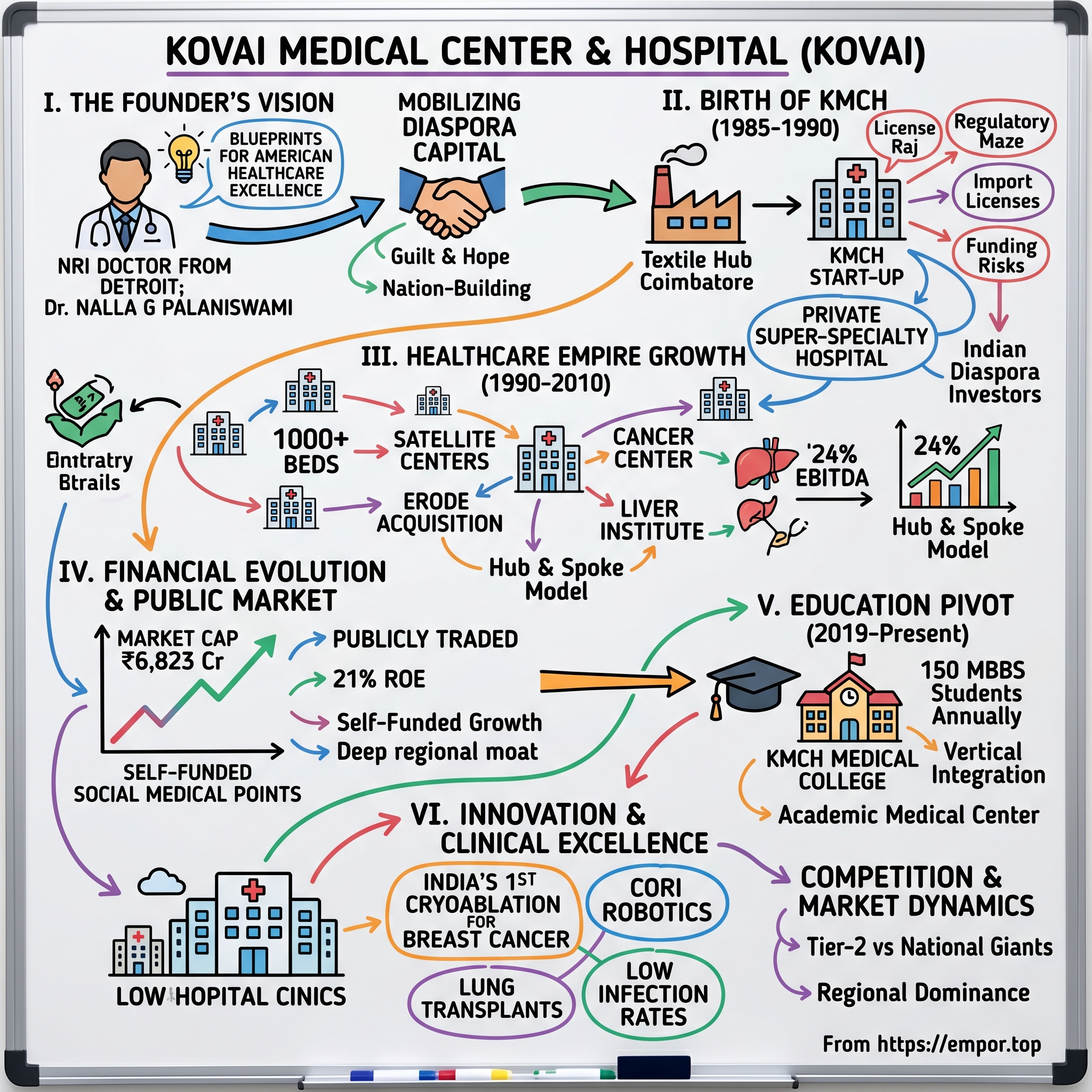
Kovai Medical Center and Hospital (KMCH): The Regional Healthcare Fortress
I. Introduction & Episode Roadmap
On the evening of January 15, 2026, the Vice President of India stood on a stage on Avinashi Road in Coimbatore to cut the ribbon on a building unfamiliar to most of the Indian investment community. The event marked the opening of the KMCH Institute of Neuro Sciences, a new outpatient block, and a postgraduate medical institute—a roughly ₹120 crore expansion on a campus that has grown almost continuously for thirty-six years.89 Inside, the facility houses a biplane neurovascular cathlab, an AI-driven neuroradiology suite, and an ultrafast 3T MRI system that the company describes as the first installation of its kind outside China.2
None of this was unveiled during an analyst call. Management issued no investor presentation, offered no commentary walking sell-side analysts through the return profile of the new block, and hosted no Q&A on payback periods. Kovai Medical Center and Hospital Limited does not hold quarterly earnings calls. Its investor relations page posts annual reports, quarterly financial results, shareholding patterns, and board outcomes—and nothing else.16 For a company that generated ₹1,585.6 crore in operating revenue and ₹244.5 crore in profit after tax in FY26, this remains an unusual posture.1
It is also central to understanding the business. KMCH is a single-city hospital operator that has spent nearly four decades ignoring standard Indian healthcare strategies—avoiding private equity funding, national brand roll-ups, metro land-banking, and investor roadshows—while delivering financial returns that larger consolidators envy.
Consider the scale at the close of FY26. Operating revenue rose 15.65% to ₹1,585.6 crore, bringing total income to ₹1,613.9 crore with non-operating revenue included.12 Earnings before interest, taxes, depreciation, and amortization (EBITDA) reached ₹467.1 crore, which the managing director reported as a 29% margin, alongside a 15% net profit margin.2 Earnings per share rose to ₹223.41 from ₹190.95.1 Return on net worth reached 19.24%, while the balance sheet carried roughly ₹369 crore in total borrowings against about ₹347 crore in cash and bank deposits, effectively leaving the hospital with no net debt.12 Since FY20, net worth has compounded at 20.5% annually, and EBITDA at 17.3%.2
The physical footprint is smaller than the company's marketing suggests, a discrepancy worth clarifying at the outset. The FY26 annual report describes KMCH in one section as "a 2,250 bed multi-locational, multi-disciplinary Super specialty hospital." Twenty pages later, the management discussion section reports bed capacity of 2,035 and operating capacity of 1,850 beds.2 Both figures appear in the same report. Because operating beds drive actual unit economics, this analysis relies on the 1,850-bed figure.
The underlying estate consists of a flagship multi-specialty hospital on Avinashi Road rated by credit agencies at 854 beds, an adjacent 750-bed medical college general hospital, and smaller peripheral units in Coimbatore city centre, Sulur, Erode, and Kovilpalayam.35 Healthcare operations generate 93% of revenue, and medical education accounts for the remaining 7.3%.12 Roughly 90% of total revenue originates within a single district.3
Three primary questions organize what follows.
Can a single-cluster Tier-2 operator out-earn national chains? On return metrics, the historical record shows it can. On the underlying economics, the explanation extends beyond operational skill: KMCH earns metro-grade returns on capital while charging roughly one-third of metro prices. The advantage lies in lower cost structure and asset intensity rather than pricing power, creating a fundamentally distinct business model under stress.
Was the medical college a strategic masterstroke or an expensive detour that ultimately worked out? Building the college pushed leverage to uncomfortable levels between FY19 and FY21, though management has since rapidly paid down debt. The optimistic view frames the college as a captive pipeline for clinical talent. The skeptical view treats it as a low-yield asset that absorbed three years of capital to contribute just 7% of revenue. However, FY26 segment data suggests a third interpretation that neither side fully emphasizes.
Does the model travel? In March 2025, the board approved acquiring land and a building at Sholinganallur in Chennai.10 This marks the company's first major move outside the Kongu region in thirty-six years, yet critical details—including bed capacity, total capital expenditure, and projected opening dates—remain undisclosed.
The story moves from Detroit to Coimbatore, analyzes the unit economics of a low-price high-volume model, examines governance details, and evaluates the strategic outlook through competitive framework tools. Rather than offering a premature verdict, the analysis focuses on the key operational metrics that will determine long-term performance.
The narrative begins with a hypertension clinic in Michigan, where a physician decided that Coimbatore needed an American-style hospital.
 Subscribe on LinkedIn
II. The NRI Dream & Founding Context (1985–1990)
The biography is precise enough to be useful. Nalla G. Palaniswami was born on March 15, 1941, in Nallampatti, a village in Erode district — Kongu Nadu country, the semi-arid western belt of Tamil Nadu that had been quietly industrialising around cotton, castings and pump sets since before independence.[^5] He took his MBBS and MD at Stanley Medical College in Madras, then taught medicine at Coimbatore Medical College between 1973 and 1975 as a lecturer and assistant professor.[^5]
Then he left. In 1975 he went to the United States for higher training, completing internal medicine at Cincinnati and at Wayne State University in Detroit by 1978. He spent five years as an internist at St. Joseph Hospital in Mt. Clements, Michigan, returned to Wayne State for a fellowship in endocrinology and metabolism from 1983 to 1985, and then joined the staff of its hypertension, obesity and risk factor department, where he remained until 1990.4
That last detail is the one that explains everything after it. Between 1985 and 1990, Dr. Palaniswami was simultaneously a practising endocrinologist in Detroit and the promoter of a hospital under construction eight thousand miles away. He was not a businessman who hired doctors. He was a doctor who never stopped being one — a distinction that shows up decades later in the company's operating choices.
The problem he was solving
To understand why anyone would attempt this in 1985, you have to picture Indian healthcare before liberalisation. The system was bifurcated. Government hospitals were free, overwhelmed, and starved of equipment. Private tertiary care barely existed: Apollo had opened its first hospital in Madras in 1983 and was still a novelty. For a patient in Coimbatore with a cardiac event, a brain tumour or renal failure, the options were a long road journey to Madras, an even longer one to Vellore, or nothing.
Coimbatore itself was not poor. It was one of India's densest concentrations of small industrial capital — textile mills, foundries, motor and pump manufacturers, a genuine engineering ecosystem. What it did not have was a hospital where a mill owner, or a mill owner's machinist, could get a bypass. That mismatch — real purchasing power, no tertiary supply — is the founding arbitrage, and it is the reason KMCH's economics still look the way they do.
Building it with a diaspora balance sheet
The financing was the hard part. India in 1985 was still a licence-raj economy: imported medical equipment attracted punitive duties, foreign exchange was rationed, and there was no domestic venture capital and no meaningful bank appetite for a greenfield private hospital promoted by someone who lived abroad.
So Dr. Palaniswami raised equity from people who had dollars and a reason to care. He assembled a syndicate of non-resident Indians — doctors and professionals across the United States, the United Kingdom, Australia and the Middle East — alongside domestic investors, and incorporated Kovai Medical Center and Hospital Limited in 1985.[^5]56 It was, in effect, a crowdfunded hospital two decades before the word existed, and it left behind a shareholder register that remains unusual: as of June 30, 2026, the company had 19,362 shareholders, of whom 18,108 were small resident individuals holding up to ₹2 lakh of nominal capital, collectively owning 20.19% of the company.14 Institutional ownership is thin — mutual funds 3.03%, alternative investment funds 1.21%, foreign portfolio investors 1.25%.14 KMCH has always been owned by its community, not by the market.
Consider what that financing structure demanded. A syndicate of several hundred small overseas shareholders is the most administratively painful capital base imaginable — no lead investor to negotiate with, no board seat to trade for speed, no bridge financing when a construction milestone slips. What it bought, though, was independence. There was no institutional shareholder with a fund life, no exit clock, no pressure to demonstrate a national footprint by year seven. Nearly every strategic peculiarity of KMCH's next three decades — the refusal to acquire, the refusal to leave the district, the refusal to talk to analysts — traces back to a capital structure that never required the company to perform for anyone but its patients. Whether that is admirable independence or unaccountable insularity is a judgment this piece will return to. It is certainly unusual.
The diaspora model also seeded the board with people whose loyalty had nothing to do with fee income. Dr. M.C. Thirumoorthi, still a director four decades later, was appointed on September 16, 1985. He is a paediatric infectious diseases specialist in Detroit affiliated with Henry Ford St. John Hospital and Wayne State's medical school, where he served as chairman of paediatrics and president of the medical staff.2 He holds 6,013 shares.2 The founding syndicate was not a cap table; it was a professional network with a shared home town.
June 24, 1990
Commercial operations began on June 24, 1990, with 200 beds on the outskirts of Coimbatore.2[^5] The equipment was the point: CT, and later MRI and cath labs, at a moment when such machines were concentrated in four metros. For patients in the western districts, the value proposition was not that KMCH was cheaper than Madras. It was that KMCH existed.
The operating philosophy set at the founding has proved more durable than the equipment. KMCH built around resident, institution-employed clinical capacity rather than around visiting star surgeons renting theatre time — the model most Indian private hospitals adopted because it required no fixed commitment. It is worth being precise here, because the company's own accounts complicate the simple version of this story: in FY26, KMCH paid ₹221.1 crore in "consultant charges to doctors," a line that grew 15.5% and sits alongside ₹306.5 crore of employee benefits expense.12 So the doctor cost base is a hybrid, not a pure salary model. What the founding choice did secure was institutional control over clinical standards, protocols and capacity planning — which is what allows a hospital to run high volumes at low prices without the quality collapsing.
By 1990 the hospital existed, the equipment worked, and the founder was still flying in from Michigan. The next twenty-five years were about turning a good hospital into an unavoidable one.
III. Building the Coimbatore Fortress (1990–2015)
The first inflection was not a decision so much as a compounding loop. A hospital adds a specialty; the specialty attracts referrals from a wider radius; the referrals justify equipment; the equipment attracts the next specialist. Repeat for two decades and you have something that a competitor cannot replicate by writing a cheque.
KMCH ran that loop through cardiology, oncology, neurology, gastroenterology, orthopaedics, urology and — the hardest tier — organ transplantation. By the time the rating agencies began describing it in detail, the flagship on Avinashi Road was an 854-bed NABH-accredited facility running roughly forty specialties, and had become one of the region's principal multi-organ transplant centres, drawing referrals from across Tamil Nadu and from Kerala.5 Transplantation matters strategically out of proportion to its revenue: it is the clinical service that most reliably signals institutional depth. A hospital that can run a liver transplant programme has intensivists, anaesthetists, blood banking, infection control and post-operative capability that a competitor cannot assemble in eighteen months.
Crucially, no single specialty became the franchise. In FY23, neurology and cardiology together contributed 23% of revenue, and the top four departments 42%, with no individual specialty above 20%.5 That is a meaningfully different risk profile from hospitals built on one celebrated department, where the loss of a team leader can take a fifth of revenue with it.
The equipment cadence tells the same story from the technology side. KMCH installed its first SPECT/CT nuclear imaging capability in 2011 and has refreshed it repeatedly since.2 In FY23 it inaugurated an IceCure cryoablation system for cancer — the third such installation in India and the first in South India.5 The pattern is consistent across three decades: acquire the advanced modality early, install it in a market where nothing comparable exists within two hundred kilometres, and let the referral flow do the marketing. For a hospital competing on price rather than prestige, being the only place in the region that owns a particular machine is the cheapest form of differentiation available.
The second decision: density over geography
The more consequential strategic choice came later, and it was a choice about what not to do.
Through the 2000s and 2010s, the standard playbook for a successful regional hospital was to plant flags — a unit in Chennai, another in Bengaluru or Kochi, a national brand, eventually a private equity round and an exit. KMCH did the opposite. It added small peripheral units inside its own catchment: a city-centre facility in Coimbatore, then Sulur, then Erode, then Kovilpalayam.5 These are not hospitals in the tertiary sense. CARE's 2024 note sized them at 91 beds in Sulur, 33 in Erode and 95 in Kovilpalayam.5
Read as expansion, that is trivial. Read as architecture, it is the design of the whole business. The peripheral units function as intake and triage: they capture routine outpatient and secondary work close to where patients live, and they channel the complex cases — the surgeries, the oncology, the transplants — into the Avinashi Road campus. The satellites do not need to be profitable to be valuable; they need to feed. The concentration is visible in the disclosed mix: the flagship alone accounted for about 79% of operating revenue in FY23, and roughly 77% by FY25, with Coimbatore contributing about 90% of total revenues.35
The financial payoff of density is not obvious until you look at what geographic scattering costs. A hospital chain operating in six cities carries six sets of local management, six regulatory relationships, six brand-building budgets, six recruitment markets, and six sets of assets that cannot share a cath lab or a linear accelerator. KMCH's specialists cover multiple units; its expensive machines sit on one campus and run at high utilisation; the brand is built once. In FY26, marketing and advertising cost the company ₹15.1 crore — 0.95% of revenue — and even that represented a 62% jump from the prior year.2 A national chain entering a new city spends multiples of that ratio simply to be known.
The same logic explains the company's near-total absence from India's hospital M&A market. KMCH has never made an acquisition of consequence; it has no subsidiaries, joint ventures or associates at all, which is why it does not publish consolidated accounts.1 Every bed it operates, it built.
The capital-efficiency claim that follows deserves care rather than cheerleading. KMCH does not disclose a per-bed construction cost. What the balance sheet shows is net property, plant and equipment of ₹1,441 crore at March 31, 2026, plus ₹135 crore of capital work in progress, supporting 2,035 beds of capacity — implying something on the order of ₹70 lakh of net fixed assets per bed, inclusive of land, a medical college and a fleet of advanced imaging.1 Depreciation flatters that figure on older assets, and it is an approximation, not a disclosed metric. But the direction is unambiguous: KMCH carries far less capital per bed than operators who buy distressed hospitals at negotiated valuations or build premium metro towers on expensive land, and that gap is the arithmetic behind a return on capital employed around 23% in FY25.3
There is a cost to owning rather than leasing everything, and the FY26 audit surfaced it. The statutory auditor's CARO report flagged that registration of land and buildings valued at ₹59.31 crore remains pending due to disputes that are currently sub judice, with a further ₹120.69 crore of immovable property registration yet to be completed; the company also disclosed that lease agreements exceeding eleven months had not been registered with the state.2 These are administrative rather than existential — but a company whose entire competitive advantage rests on owning its land outright should be tidier about proving that it owns it.
By the mid-2010s the fortress was built: dominant in its district, cheap to run, debt-light, and — this is the problem — bounded. A hospital in one city can only grow as fast as that city gets sick and rich. Which is roughly when management made the largest capital commitment in the company's history, and it had nothing to do with beds.
IV. Core Business Deep-Dive: Economics of a Regional Healthcare Powerhouse
One metric reframes the conventional narrative surrounding the company's operating performance.
In FY26, KMCH's average revenue per occupied bed (ARPOB) stood at ₹24,714 per day.2 During the same fiscal year, Apollo Hospitals reported a fourth-quarter ARPOB of ₹71,206.11 KMCH charges roughly one-third of what India's largest healthcare provider bills for a bed-day, yet converts that tariff structure into a 29% EBITDA margin and a return on capital in the low twenties.23
That comparison highlights the core of the business model and inverts standard investment logic. While superior returns in healthcare typically depend on premium pricing, KMCH generates strong returns by maintaining a structurally lower cost base that delivers profitability at lower price points.
Reading the operating dashboard
The FY26 operational metrics reflect higher asset utilization across the hospital system.2
Occupancy increased to 63.41% from 60.44% year-over-year. Inpatient admissions grew 14.85% to 120,897, while outpatient visits expanded 12.5% to 1,395,050. The average length of stay dropped to 3.54 days from 3.87 days, while ARPOB rose 9.4%.
The relationship between length of stay and ARPOB is structurally linked. Shorter patient stays concentrate high-margin initial services—such as surgeries, advanced imaging, and intensive care—into fewer billed days, mechanically raising the daily average revenue. A portion of the ARPOB growth thus reflects discharge efficiency rather than price hikes. Because overall occupancy expanded simultaneously, the hospital refilled freed beds rather than leaving them empty. Faster bed turnover creates value primarily when patient demand remains strong; at KMCH, admissions grew nearly 15% on a bed base that expanded by just three beds.2
This trend provides empirical evidence that patient demand in the core catchment area outpaces available capacity. However, it also highlights an operational constraint: volume-driven growth cannot continue indefinitely without expanding capacity—the primary objective of the company's FY26 capital expenditure program.
Two structural factors place the occupancy metrics in context. First, a consolidated occupancy rate of 63.41% remains modest compared to national peers; Apollo reported 68% occupancy in the quarter ending March 2026, while major metro operators frequently reach the mid-to-high seventies.11 Second, KMCH's consolidated figure combines a flagship facility that has historically operated near 78% occupancy with a 750-bed medical college teaching hospital designed for a slower operational ramp.5 Consequently, the headline occupancy rate obscures performance differences between the mature main hospital and newer teaching facilities.
Where the margin actually comes from
Analyzing FY26 operating expenses reveals the structural foundation of KMCH's profit margins.12
Medicines, consumables, and dietary costs totaled ₹448.1 crore, accounting for roughly 28% of operating revenue as a variable expense linked to procedure volume. Personnel costs remained disciplined: employee benefits stood at ₹306.5 crore, while consultant charges to doctors reached ₹221.1 crore. Combined clinical and administrative staffing expenses represented approximately 33% of revenue. Other operating overhead—including facility maintenance, administrative expenses, and marketing—totaled ₹171.1 crore, or 10.79% of revenue, remaining virtually flat compared to 10.71% in FY25.
The key driver of cost efficiency lies in expenses that remain absent from the income statement. Annual rental expense was just ₹50.66 lakh—amounting to 0.03% of operating revenue.2 Whereas metro operators typically pay substantial facility leases or carry heavily depreciated high-value urban real estate, KMCH owns its campus land outright in Coimbatore, acquired decades earlier at lower cost.
Power costs offer an additional operational advantage. KMCH operates a 10.25-megawatt solar generation plant that supplies 63% of its annual electricity needs, reducing overall power expenditures by 41%.2 Stores, power, and fuel expenses combined represented 1.5% of revenue.2 For a healthcare facility operating high-energy diagnostic imaging, linear accelerators, and intensive care units continuously, renewable self-generation delivers recurring operational savings.
KMCH's margin profile reflects low fixed operating costs rather than premium pricing power, as its tariffs remain among the lowest among listed Indian hospital peers. The company's profitability stems from thirty-six years of real estate ownership in a secondary market, coupled with high patient volume that dilutes fixed overhead. While this cost advantage provides a defensible moat in Coimbatore, it remains location-specific and cannot automatically be replicated in expansion markets such as Chennai.
The two segments, and a correction
KMCH operates across two reporting segments, and the FY26 financial results clarify the earnings contribution of each unit.1
The core healthcare segment generated ₹1,470.2 crore in revenue—representing 92.72% of total turnover—and delivered profit before interest and tax (PBIT) of ₹337.6 crore, representing a 23.0% segment margin.12 The education segment generated ₹115.4 crore, or 7.28% of turnover, and delivered PBIT of ₹51.7 crore.12
While education accounts for a smaller share of top-line revenue, it achieved a 44.8% PBIT margin—nearly double that of the hospital operations—on year-over-year revenue growth of 24.68%, compared to healthcare's 15.0% expansion.12 Segment PBIT for education grew 59% year-over-year.1
This segment performance impacts overall corporate valuation. With 955 students enrolled at the KMCH Institute of Health Sciences and Research (IHSR) and 808 in allied health courses, the educational institute operates as an annuity-style tuition business with minimal marginal costs per additional student once infrastructure is built.2 It represents an asset-light earnings stream expanding at a faster rate than the core hospital operations.
The war around the campus
Coimbatore's healthcare landscape features several established institutions operating alongside KMCH.
Ganga Hospital, founded in 1978, serves as a global reference center for orthopedics, trauma, and plastic surgery.13 KMCH and Ganga operate in a stable equilibrium, maintaining non-overlapping primary specialties as KMCH focuses on multi-organ transplants, oncology, and general super-specialty care while Ganga leads in orthopedics.
Apollo Hospitals maintains a regional facility bringing national brand equity and higher price tariffs. However, Apollo's presence has not eroded KMCH's local market share, demonstrating that KMCH's lower pricing structure acts as an effective competitive buffer.
PSG Hospitals and Sri Ramakrishna Hospital operate as charitable trust-backed entities providing affordable care to local residents. While they compete for value-conscious patients, trust structures generally face tighter capital constraints and slower technology replacement cycles than commercial operators.
Royal Care Super Speciality Hospital presents a direct clinical competitor. Founded by departing clinicians in 2015, Royal Care started as a 50-bed facility and constructed a 750-bed hospital in Neelambur, commissioning its initial 300-bed phase by November 2016.12 Royal Care's growth highlights both the potential for physician departures to seed competing ventures and the decade-long timeframe required for new entrants to achieve scale.
Clinician and staff retention figures address common concerns regarding physician attrition. Disclosed employee attrition at KMCH stood at 3.39% in FY26, compared to 2.21% in FY25 and 2.81% in FY24; attrition for permanent workers recorded 2.41% in FY26, 0.87% in FY25, and 4.45% in FY24.2 These figures remain low relative to industry averages, even as the company's annual report notes a broader industry workforce exodus with sector-wide resignations rising 50% between 2020 and 2024.2 While FY26 employee turnover increased modestly from FY25 levels, empirical data indicates high workforce stability relative to regional peers.
What is not disclosed
Despite detailed overall financial reporting, key operational metrics remain undisclosed.
First, KMCH does not disclose its payor mix. The revenue split across out-of-pocket self-pay, private health insurance, corporate contracts, and government programs—such as Tamil Nadu's Chief Minister's Comprehensive Health Insurance Scheme—is omitted from FY26 disclosures.12 Because government reimbursement rates are fixed and carry lower margins, the absence of payor mix breakdown leaves an analytical gap for evaluating margin sensitivity.
Second, unit-level economics for individual facilities remain undisclosed. KMCH reports segment figures for healthcare and education as whole units rather than detailing performance for peripheral hospitals in Sulur, Erode, and Kovilpalayam, or isolating the ramp-up of the medical college hospital.35
Third, financial reporting obscures the extent of subsidized care integrated into corporate operations. KMCH operates a free pediatric oncology ward at the medical college hospital, a low-cost palliative care unit, and, since September 2025, the Thadagam Rural Medical Center, which offers ₹30 consultations and free diagnostic services to rural communities.2 Because these community programs absorb operating costs without generating full commercial revenue, the company's reported 29% EBITDA margin is achieved alongside a non-trivial volume of subsidized care—indicating that underlying commercial margin performance remains robust.
For a company generating these returns, disclosure choices remain highly selective, mirroring management's historical decision to forego quarterly earnings calls. That capital discipline and opacity were both tested during the three-year construction of the medical college.
V. The Medical College Pivot & Capital Deployment Masterclass (2018–2024)
In 2018, a company earning comfortable returns on a mature hospital decided to enter medical education.
In FY20, KMCH generated ₹722 crore in revenue and ₹179 crore in EBITDA.2 With a dominant regional market position and low debt, the company had a conventional, low-risk growth path: add beds, introduce specialties, and compound existing operations. Instead, management committed to constructing a medical college alongside a 750-bed teaching hospital—an asset class governed by separate regulatory frameworks, distinct operating economics, multi-year cash burn, and extended payback periods.
The construction
The Medical Council of India's rules made the decision binary: a medical college cannot be licensed without an attached teaching hospital of prescribed capacity, preventing phased entry or a minimum viable build.5 To offer 150 MBBS seats, KMCH was required to construct and staff a 750-bed facility.
Construction proceeded in phases from October 2018 to April 2021.5 KMCH Institute of Health Sciences and Research was established in 2019 under affiliation with The Tamil Nadu Dr. M.G.R. Medical University, admitting its initial MBBS cohort in the 2019–20 academic year.218 The 750-bed KMCH Medical College General Hospital was inaugurated on October 24, 2021, adjacent to the main campus on Avinashi Road. Built with an investment reported at over ₹200 crore using prefabricated construction to compress development to roughly fifteen months, the facility was equipped with fifty intensive care beds, thirty emergency beds, eleven operating theaters, CT, MRI, a cath lab, and advanced imaging modalities.7
The economics of Indian medical education differ significantly from traditional healthcare delivery. Student seats are strictly rationed by regulatory authorities, allocated by national entrance examination rank, and priced to reflect market scarcity, with CARE noting full-capacity operations at an average annual fee of approximately ₹14 lakh per seat.5 Demand remains structurally guaranteed for licensed seats, while the marginal cost of educating additional students once infrastructure and faculty are in place is low. Building a medical college provides a regulated license to generate a high-margin, inflation-linked fee stream from an oversubscribed applicant pool. However, regulatory caps on student enrollment limit maximum seat capacity, preventing the segment from scaling indefinitely.
A total project cost of roughly ₹670 crore for the college and hospital combined is frequently cited in market commentary, though official KMCH disclosures do not specify an aggregate capital expenditure figure. The company's disclosed debt trajectory provides the clearest empirical record of financial impact.
What it did to the balance sheet
KMCH drew additional debt through FY20 and FY21 to fund project construction.5 At peak leverage, total debt reached 3.22 times EBITDA in FY21—a period when operating revenue declined to ₹702 crore from ₹722 crore as COVID-19 disruptions suppressed elective procedures and lowered occupancy to roughly 49%.25 Earnings per share fell from ₹86.44 to ₹71.00 during the same fiscal year.2
This period represented a significant operational stress point: executing its largest capital program while core hospital occupancy dropped and leverage exceeded three times EBITDA. Debt covenants required maintaining debt-to-equity below 2.00x and a minimum fixed asset coverage ratio of 1.20x.5
The financial recovery developed quickly as surgical volumes rebounded post-pandemic, driving revenue to ₹918 crore in FY22 and ₹1,036 crore in FY23.2 Occupancy at the main campus recovered to 78% by FY23, with flagship ARPOB rising 19% to ₹28,479 in the first half of FY24.5 By contrast, the teaching hospital recorded an ARPOB of ₹3,388 in FY23, temporarily diluting the consolidated metric and causing overall ARPOB to fall from ₹21,144 in FY22 to ₹17,442 in FY23 despite strengthening core pricing.5
This divergence illustrates how aggregate metrics can obscure underlying operational performance: headline ARPOB fell across three years due to facility mix rather than reduced pricing power at the flagship hospital.
The deleveraging, and what it says about management
Management directed operational cash flows primarily toward debt reduction. Gearing improved from 0.91x to 0.71x by March 2023, while total debt-to-EBITDA declined from 3.22x in FY21 to 2.12x in FY22 and 1.87x in FY23.5 Long-term rated bank facilities were reduced from ₹478.30 crore to ₹285.46 crore.5 By March 31, 2025, CRISIL assessed net worth at ₹1,086 crore, with gearing reduced to 0.35x, total debt-to-EBITDA below 1.0x, interest coverage expanding to 10.8 times from 6.44 times in FY23, and cash and bank deposits reaching ₹270 crore.3
Credit rating agencies responded to the strengthening balance sheet. CARE rated the company at CARE A+/Stable with a CARE A1+ short-term rating in January 2024.5 KMCH subsequently engaged CRISIL, which reaffirmed a CRISIL AA-/Stable long-term and CRISIL A1+ short-term rating on facilities expanded to ₹900 crore on September 26, 2025—a rating profile confirmed in the FY26 directors' report.23
This sequence demonstrates capital discipline: management assumed leverage for a discrete expansion, completed construction during a pandemic, and prioritized balance-sheet deleveraging over immediate further expansion.
Does the flywheel actually exist?
The strategic rationale for the medical college relies on creating an internal talent pipeline. In an industry constrained by the supply of skilled medical personnel—a risk factor explicitly highlighted by CARE—an institution capable of training its own clinical staff secures a competitive advantage over operators relying entirely on market recruitment.5
The initial operational cohort completed training on May 31, 2025, when the 2019–2025 MBBS class graduated.2 In the 2025–26 academic year, KMCH introduced a postgraduate institute offering Master of Medicine (MD) and Master of Surgery (MS) programs across ten specialties, including radiology and emergency medicine.2 Advanced medical training holds greater strategic relevance than undergraduate instruction, as resident physicians perform core clinical operations and in-house trainees exhibit higher historical retention rates.
While clinical output has commenced, empirical evidence regarding the talent flywheel remains preliminary. Disclosed data confirms graduate production and low staff attrition, but public filings do not establish whether low turnover stems directly from the educational pipeline or from broader institutional reputation and regional factors. The long-term retention of postgraduate cohorts over the next three to five years will provide a clearer evaluation.
A secondary strategic argument—that the teaching facility absorbs lower-margin government scheme patients to free flagship capacity for high-value tertiary procedures—is aligned with the ARPOB gap between the units.5 Available disclosures do not clarify whether this distribution reflects deliberate patient segmentation or standard ramp-up dynamics for a newer general hospital.
Financial results through FY26 confirm that the education segment has shifted from an investment phase to a primary earnings contributor, operating as the company's highest-margin business unit. Assessing whether this earnings profile represents a durable competitive moat or a high-yielding niche depends on human capital dynamics—setting the stage for an examination of corporate governance.
VI. Current Management, Ownership & Governance Stress Test
Turn to page five of the 40th annual report and you find something no financial model captures: a black-bordered memorial page.
"In Loving Memory. Dr. Thavamani Devi Palaniswami, Joint Managing Director, Kovai Medical Center and Hospital Limited."2
She had been reappointed as Joint Managing Director on July 29, 2025, by special resolution of shareholders.2 The board listing in the same report records her tenure as Joint Managing Director "upto 06.06.2026."2 Dr. Thavamani Devi, aged 77, joined KMCH on July 29, 2000, having previously practised as a consultant in paediatrics and adolescent medicine at City Clinic in Detroit.2 She was the co-promoter, the managing director's wife, and — per the tribute — the executive whose "resolute handling of crises" the board singled out.2
The succession risk that analysts have flagged for years is no longer hypothetical. It has begun.
Who runs KMCH now
Dr. Nalla G. Palaniswami, Managing Director, is 84 years old.2 He joined the company on October 1, 1989 — nine months before it opened — and has over 55 years of medical experience.2 He remains chairman of the CSR committee, attended all four of its meetings during FY26, and signed the FY26 results and directors' report personally.12 In his FY26 shareholder message he catalogues clinical firsts with a physician's evident pleasure: 75 ECMO runs in 2025, the highest in Tamil Nadu; the first hospital in the state to implant a retrievable dual-chamber leadless pacemaker; India's first successful epilepsy brain surgery performed on a pregnant woman; the country's first living donor liver transplant for a child on ECMO.2 The letter reads like a doctor's, not a CEO's — heavy on clinical achievement, light on strategy, with capital allocation confined to a single sentence about a 300-bed paediatric hospital.
Dr. Arun N. Palaniswami, Executive Director, is 45 and the son of the founders.2 MBBS with an MD in internal medicine, he practised as a consultant internist in Hawaii before joining KMCH on September 25, 2015, and has over eighteen years of experience.2 He is quoted in the annual report on the robotics programme, and he is the visible face of the technology agenda — the CORI robotic knee system, the Ethos AI-enabled linear accelerator, the paperless digitally integrated ICU.2 The generational pattern is precise: American clinical training, a US practice, then a return to Coimbatore. A second time.
The professional layer beneath the family is more substantial than a promoter-run microcap usually carries: Dr. R. Ravikumar, Dean of KMCH IHSR, a former Major General from the Armed Forces Medical College in Pune, joined in 2022; CA P.K. Gopikrishnan, Chief Financial Officer; S. Karthikeyan, Chief Executive Officer, who joined on July 2, 1990 — eight days after the hospital opened; and Dr. J. Sivakumaran, Chief Operating Officer, previously at Apollo in Ludhiana.2
One correction to the commonly circulated management chart: Dr. Mohan S. Gounder serves as a non-independent director, not as joint managing director.2 The board comprises thirteen directors, of whom three are women, with seven independent directors listed.2
The stress test
Now apply the pressure an activist would.
Executive compensation. Dr. Nalla G. Palaniswami received gross remuneration of ₹849.99 lakh in FY26, up 17.59%, a ratio of 264.31 times median employee remuneration. Dr. Thavamani Devi Palaniswami received ₹840.06 lakh, up 19.33%, at 261.22 times median. Dr. Arun N. Palaniswami received ₹468.86 lakh, up 16.43%, at 145.79 times median.2 Gross remuneration comprises salary, commission, allowances and perquisites.2
Together, the three promoter-directors took roughly ₹21.6 crore — approximately 8.8% of profit after tax. The Companies Act, 2013 caps total managerial remuneration at 11% of net profits computed under Section 198, with a 10% ceiling where there is more than one managing or whole-time director. KMCH is not in breach, but it is operating close to the statutory ceiling, and it has been for years.
Two observations cut in opposite directions. Against management: the FY26 increases — 17.6%, 19.3% and 16.4% — exceeded the 12.57% increase in median employee remuneration, and the disclosed percentile increase for managerial personnel (10.94%) sits below that for other employees (15.12%), which suggests the headline director increases are being driven by profit-linked commission rather than salary.2 For management: profit-linked commission is precisely the structure a minority shareholder should want, and profit did rise 17%. The uncomfortable part is not the level but the concentration — three related individuals, on a compensation formula that scales with the earnings they report, at a company with no analyst call at which anyone might ask about it.
The dividend question. KMCH recommended a final dividend of ₹15 per share for FY26, a cash outflow of ₹16.41 crore against ₹244.5 crore of profit — a payout ratio near 6.7%.12 The company generated ₹361.8 crore of operating cash flow, spent ₹252.0 crore on capital expenditure, and repaid ₹12.6 crore of long-term borrowings net.1 Cash and bank balances rose to roughly ₹347 crore.1
The bull reading: retained capital compounds at 19-24% returns inside the business, so paying it out would be value-destructive. The bear reading: promoters hold 56.52% and are paid substantial commissions on profit; minorities receive 6.7% of earnings and a growing pile of cash on which the company earns deposit interest of about ₹21 crore a year.114 Both readings are legitimate. The reconciliation is that the capex must actually earn its keep — which makes the return on the FY26 investment programme the thing to watch, not the dividend.
CSR underspend. KMCH's FY26 CSR obligation was ₹446.86 lakh, being 2% of average net profit. It spent ₹41.86 lakh during the year and transferred ₹404.99 lakh to an Unspent CSR Account on April 6, 2026.2 This is procedurally compliant — unspent amounts on ongoing projects may be carried forward — and the prior year's transferred amount of ₹283.45 lakh was subsequently spent in full.2 Still, a hospital company spending under 10% of its statutory social obligation within the year is an odd look for an institution that markets itself on ₹30 consultations at its Thadagam rural centre.2
Disclosure quality. On May 25, 2026, three days after publishing audited FY26 results, KMCH filed a corrigendum with BSE correcting its fourth-quarter tax expense from ₹2,459.20 lakh to ₹2,092.48 lakh — an arithmetical error arising from a discrepancy between the full-year tax charge and the cumulative nine-month figure. The full-year audited results were unaffected.15 It is a small error, promptly corrected, in a quarter that is itself a balancing figure between audited annual and limited-reviewed nine-month numbers.1 But it is the kind of error that a quarterly earnings call — where an analyst reconciles the quarter aloud — tends to catch before publication.
Concentration. Geographic concentration is the constraint both rating agencies name first. CARE framed the ratings as "constrained by the geographically concentrated nature of KMCH's revenues"; CRISIL notes the flagship at roughly 77% of revenue and Coimbatore at roughly 90%.35
Ownership. Promoter and promoter group held 56.52% as of June 30, 2026, across twelve shareholders, with no pledge, no non-disposal undertaking and no encumbrance of any kind.14 Within that, 42.41% sits in the "any other" category — three non-individual entities — with 13.41% held by seven individuals and HUFs and 0.71% by two non-resident individuals.14 Promoter holding has risen materially over time, from under 50% in 2017.17 Promoters buying rather than selling is a meaningful signal; the concentration of holdings in institutional vehicles rather than named individuals is a structure minority holders should understand rather than assume.
One structural note that matters for anyone actually trading the stock: the FY26 annual report states plainly that the equity shares are listed on BSE Limited, and the June 2026 shareholding filing records the NSE symbol as "NOTLISTED."214 Liquidity is correspondingly thin — 19,362 total shareholders, with institutional ownership under 6%.14
The governance file, then, is neither clean nor alarming. It is the file of a founder-controlled company that has been run competently and conservatively, pays its founders generously and its shareholders modestly, and does not much care what the market thinks. The question is whether the resulting business has defensible advantages — or merely a long head start.
VII. Helmer's 7 Powers & Strategic Moat Analysis
Hamilton Helmer's framework asks a deliberately demanding question: what specific structural mechanism prevents a competitor from replicating a company's financial performance? Applied to KMCH, several elements provide genuine protection, while one popular claim fails to hold up.
Scale Economies — moderate, and narrower than claimed. KMCH operates a single-city hub, not a national healthcare network. On procurement, its 8,131-bed national rival almost certainly buys consumables and equipment on better terms.11 Where KMCH's scale genuinely bites is local density: an Ethos adaptive radiotherapy system, a biplane neurovascular cath lab, or a SPECT/CT unit represents a fixed cost that amortizes over patient volume, and KMCH concentrates its entire catchment's volume onto one campus rather than splitting it across cities.2 The company's FY26 equipment investment of ₹118.45 crore is rational only if throughput is high.2 The competitive advantage is real, but it stems from asset utilization density rather than national purchasing scale.
Brand — strong, and the most durable of the seven. Thirty-six years without a serious clinical scandal, in a market where patients select healthcare providers for procedures they cannot independently evaluate, produces deep institutional trust. The clearest proof is not corporate awards, but the lean ₹15.1 crore marketing budget.2 While competitors lacking brand equity must buy consumer attention, KMCH expanded patient admissions by 14.85% while spending just 0.95% of revenue on advertising.2 The vulnerability is that this trust remains heavily bound to the personal reputation of an 84-year-old physician, a form of capital that transfers imperfectly.
Cornered Resource — plausible, unproven. The medical college represents management's claimed cornered resource, built on the logic that an institution training its own clinical staff in a supply-constrained market holds a proprietary recruitment pipeline. Disclosed employee attrition of 3.39% is consistent with the claim.2 However, the first MBBS cohort graduated only in May 2025, and the postgraduate institute opened in 2025–26.2 A short track record cannot prove long-term causation. The teaching pipeline is best viewed as a well-constructed hypothesis with early supporting data rather than an established moat.
Counter-Positioning — strong, and the most underappreciated. Counter-positioning occurs when an incumbent cannot copy a challenger's business model without damaging its own legacy operations. KMCH's model delivers high-volume tertiary care at roughly a third of metro pricing, made possible by land bought decades ago, captive solar power, a hybrid doctor-cost structure, and a Coimbatore wage base.211 A national chain entering Coimbatore cannot match those prices without either accepting returns far below its corporate targets or admitting that its metro pricing is not cost-driven. Apollo's continued presence in the city at premium price points, operating alongside KMCH without displacing the incumbent, serves as a real-world test—and the incumbent's volumes kept growing.11 The constraint is symmetrical: counter-positioning built on cheap Coimbatore inputs cannot be exported to expensive Chennai inputs.
Network Effects — essentially absent. The referral corridor from peripheral units into the flagship is a hub-and-spoke distribution system, not a network effect: no patient's decision to use KMCH makes the hospital more valuable to the next patient. Network effects do not apply here, and claims that they do misapprehend basic strategic principles.
Switching Costs — weak to moderate, and specific to episodes. Continuity of medical records and surgeon relationships create real friction for chronic and post-surgical care, such as oncology, transplant follow-up, and cardiac management. For a first cardiac event or an accident, however, switching costs are near zero, as the patient goes wherever the ambulance takes them. Hospital moats in this segment remain geographic rather than contractual.
Process Power — strong, and visible in the numbers. This is where KMCH's operating discipline registers most clearly. Average length of stay compressed to 3.54 days while occupancy rose and admissions grew 14.85%, with other operating expenses holding flat at 10.79% of revenue through a year of 15.65% growth.2 Running the same physical estate harder without letting the cost ratio drift reflects process power embedded in scheduling, discharge planning, operating theater utilization, and supply management accumulated over decades.
The most easily overlooked expression of process power is the working capital cycle. KMCH collects from patients on discharge, receives insurance and corporate payments within roughly fifteen to twenty days, and pays its suppliers on about fifteen days of credit—a negative working capital cycle in which the business is funded by its customers rather than by its balance sheet.5 For a hospital, that reflects strict admission protocols, pre-authorization discipline, and claims processing, explaining why ₹244.5 crore of accounting profit converted into ₹361.8 crore of operating cash flow in FY26.1 Process advantages of this kind are invisible in a strategy presentation, but decisive during a downturn.
The composite: KMCH's defensibility rests on three primary legs—institutional brand trust, counter-positioning on cost, and process power—with a fourth leg (cornered resource) under construction. Because two of those three pillars are anchored to a specific geographic market, management faces a central strategic dilemma as it plans expansion beyond its home city.
VIII. Future Growth, Hidden Optionality & Risk Radar
On March 19, 2025, KMCH's board approved something the company had avoided for thirty-five years: buying real estate in Chennai.
The transaction was the purchase of approximately 1.11 acres of land and a building at Sholinganallur from MTL Instruments Private Ltd, a division of the power management company Eaton, for a consideration of up to ₹60 crore, funded through internal accruals and bank loans, with an associated annual lease rent of ₹3.6 crore.10
Sholinganallur sits on the IT corridor in south Chennai — Old Mahabalipuram Road, dense with technology campuses and the young, insured, high-income workforce that populates them. It is a rational location for a first metro entry.
What is striking is how little else is known. The bed count is not disclosed. The total project capex is not disclosed. The opening date is not disclosed. The clinical mix is not disclosed. CRISIL's September 2025 rationale acknowledges "Chennai hospital expansion planned" for the medium term and notes anticipated capex of ₹400-450 crore annually funded through internal accruals and debt, with leverage expected to stay in a 0.9-1.3x debt-to-EBITDA band.3 Neither the FY26 annual report's managing director message nor its management discussion section elaborates on Chennai at all.2
For a project that would represent the single largest strategic departure in the company's history, that silence is itself information — either the plan is genuinely unsettled, or KMCH's disclosure practices simply do not extend to forward strategy. Investors should treat the "300-bed Chennai hospital" figures that circulate in secondary commentary as unsourced.
What management has actually committed to
The disclosed near-term capital plan is domestic, not metropolitan, and it is substantial.
The board has approved a 300-bed paediatric hospital at the main campus, with work expected to commence during the second quarter of calendar 2026.2 Note what this is: another Coimbatore building, on land the company already owns, in a specialty where KMCH already runs a free paediatric oncology ward and where its co-founder was a paediatrician.2 It is the cluster strategy, again.
The Institute of Neuro Sciences and OPD block opened on January 15, 2026 at roughly ₹120 crore, designed as a vertical hub localising diagnostics, consultations, pharmacy and billing to reduce patient movement.289
The oncology programme absorbed a ₹47 crore investment in advanced oncology and diagnostics, including Tamil Nadu's first Varian Ethos AI-powered adaptive radiotherapy system.2 Adaptive radiotherapy, in plain terms, recalculates the radiation plan each day based on fresh imaging of how the tumour has actually changed, rather than following a plan fixed weeks earlier — better targeting, less collateral damage, and a service that commands premium pricing even in a value market.
Total capital assets added during FY26 came to ₹293.73 crore, with equipment investment of ₹118.45 crore.2 Against ₹361.8 crore of operating cash flow, KMCH is currently reinvesting roughly seventy percent of its operating cash generation.1
And there is an accounting judgment worth noting alongside it. FY26 finance costs fell slightly to ₹32.02 crore from ₹32.68 crore, which management attributes to capitalisation of interest under Ind AS 23.2 Capitalising borrowing costs on qualifying assets is entirely standard and permitted. It also means reported interest expense understates the true cost of the current build cycle, and the deferred cost will surface later as depreciation. It is not aggressive; it is worth knowing.
Risk radar
Execution risk outside the base is the dominant one, and it is specific rather than generic. Every structural advantage catalogued above — free land, captive solar, low wages, thirty-six years of local trust, referral density — is a Coimbatore advantage. In Chennai, KMCH would pay Chennai land costs (₹60 crore for 1.11 acres, plus lease rent), Chennai clinical salaries in a market where Apollo, MIOT, Kauvery, Gleneagles and MGM already compete for the same specialists, and would start with zero brand recognition among patients who have never heard of it.10 The honest expectation is that a Chennai unit earns materially lower returns than the group average for years. The question is whether it is a rounding error or a drag.
Regulatory and tariff risk. CRISIL names susceptibility to price controls as a key weakness.3 The mechanism is direct: the National Pharmaceutical Pricing Authority caps prices on stents, knee implants and other devices, and state scheme tariffs are administratively set. A hospital already priced at a third of metro levels has less headroom to absorb a tariff cut than one priced at ₹71,000 a bed-day. This is the flip side of the counter-positioning power — low prices are a defence against competitors and an exposure to regulators.
Cost-reimbursement gap. KMCH's own SWOT identifies it: "Operational costs are currently climbing faster than reimbursements."2 With consumables at roughly 28% of revenue and people at roughly 33%, medical inflation running ahead of realisation is the single most direct route to margin compression.
Talent poaching. Regional chains expanding through Tamil Nadu bid up clinical salaries. Attrition remains very low, but it doubled in FY26 off a small base.2 The medical college is management's structural answer; it has not yet been tested against a determined, well-capitalised recruiter.
Cybersecurity. The FY26 SWOT flags an average healthcare data breach cost approaching $10 million and AI-enabled ransomware capable of halting hospital operations.2 For a company that just moved its ICUs to a fully paperless digitally integrated platform, this is a live operational risk, not a boilerplate one.2
Key-man risk, now partially realised, is discussed above and does not need restating.
Refinancing risk is minimal. With total debt to EBITDA under 1x, cash and deposits of roughly ₹347 crore, a term loan running to February 2037, CRISIL AA-/A1+ ratings, and a negative working capital cycle in which patients pay immediately while suppliers extend roughly fifteen days of credit, KMCH's balance sheet is about as defensive as a capital-intensive business gets.135
The treasury policy behind that is deliberate and revealing. CARE recorded that KMCH maintains a minimum fixed deposit balance of ₹100 crore as a matter of policy and had drawn on its overdraft facilities to an average of just 1% over a twelve-month period.5 A hospital company that keeps nine figures of idle deposits and refuses to touch its working capital lines is telling you what it optimises for, and it is not return on equity. That conservatism is the reason the FY21 leverage spike never became a crisis; it is also the reason a shareholder can reasonably argue that some of the balance sheet is over-insured.
There is also unpriced optionality worth naming. The education segment's 44.8% margin, the postgraduate institute's ramp, the allied health sciences courses, and the land already owned adjacent to existing campuses are all things KMCH can expand without new geography, new brand-building, or new competitive exposure — the same low-risk, high-return pattern that produced the last decade of compounding.
Which sets up the argument that actually matters.
IX. The Bear vs. Bull Case & Investor Playbook
Strip away the narrative, and the debate over KMCH reduces to a fundamental question: is an investor buying an exceptional business, or an exceptional local position?
The bull case
The returns are real and repeatedly verified. A return on capital employed of roughly 23% in FY25 and a return on net worth of 19.24% in FY26—sustained through both a pandemic and a major expansion program—are corroborated by independent rating agencies and backed by cash generation.123 Converting ₹244.5 crore in net profit after tax into ₹361.8 crore in operating cash flow demonstrates high cash conversion quality.1
The cost position is structural, not cyclical. Operating expenses benefit from long-standing structural advantages: facility rental costs account for just 0.03% of revenue, self-generated solar power supplies 63% of annual electricity needs, and personnel costs reflect a regional Tier-2 wage structure.2 Competitors cannot quickly match these cumulative cost advantages built over thirty-six years.
Demand exceeds supply in the core. Operational throughput reflects strong local demand, as inpatient admissions expanded by 14.85% on a capacity addition of just three beds, while occupancy rose nearly three percentage points and average length of stay declined.2
Education is a better business than the market treats it as. Medical education has developed into a high-margin growth driver rather than a secondary unit, delivering a 44.8% segment profit margin on 24.68% top-line growth and a 59% increase in segment profit.12
The balance sheet buys optionality. Balance-sheet leverage below 1.0 times EBITDA and cash reserves of approximately ₹347 crore provide strategic flexibility, ensuring that expansion into Chennai does not endanger the core enterprise if returns fall short.13
The demand backdrop is structural. A growing burden of chronic non-communicable disease, an aging demographic, and rising health insurance adoption across South India expand the underlying addressable market across the region.
The bear case
The growth ceiling is geographic and arithmetic. Revenue generation remains heavily concentrated, with roughly 90% originating from a single district.3 Regional healthcare demand expands at a predictable pace, forcing long-term growth to rely on price increases (constrained by value positioning), capacity additions in the home market (such as the planned pediatric facility), or unproven geographical expansion outside the base.
Low ARPOB is a defence and a vulnerability. An average revenue per occupied bed of ₹24,714 leaves a narrower financial buffer than higher-priced listed peers to absorb medical inflation, price caps on medical devices, or government reimbursement cuts.211 While operating margins have remained resilient, they have not yet faced severe regulatory price reductions.
Governance is founder-shaped. Governance practices reflect promoter-dominated control, characterized by executive compensation approaching statutory limits, a modest 6.7% dividend payout ratio, unspent corporate social responsibility allocations, unresolved real estate title registrations, quarterly tax calculation adjustments, and an absence of investor earnings calls.1215 While not individually critical, these items highlight limited adherence to standard public-market transparency practices.
Succession is live, not theoretical. Leadership transition is actively underway following the passing of the Joint Managing Director, whose formal tenure concluded on June 6, 2026, while the Managing Director is 84 years old.2 Although generational successors hold relevant clinical and operational credentials, transferring a founder's long-standing regional reputation carries inherent risk.
Chennai could be a value trap in miniature. Core competitive advantages are tied to the home market. If the planned Chennai facility absorbs capital and managerial focus while generating returns below the group average, consolidated financial performance will soften even as the flagship facility remains healthy.
Liquidity and disclosure. Equity shares trade exclusively on the BSE with institutional ownership under 6%, no formal sell-side analyst coverage, and minimal forward disclosure regarding major capital expansion plans.21416
Porter's five forces, applied to a hospital in Coimbatore
Rivalry: moderate-to-high but structurally segmented. Market competition is organized around specialized segments: Ganga Hospital focuses on orthopedics and trauma, Apollo caters to the premium segment, PSG and Sri Ramakrishna offer trust-backed affordable care, and Royal Care has expanded secondary and tertiary scale.1213 Competition remains sharp within specific clinical lines but moderate across segment boundaries, favoring an operator with broad multi-specialty coverage.
Threat of new entrants: low for tertiary, moderate for secondary. Barriers to entry in tertiary healthcare remain high due to capital requirements for land and medical technology, multi-specialty clinical staffing, and the multi-year timeframe required to build institutional reputation, as demonstrated by Royal Care's decade-long ramp.12
Buyer power: rising, and the key variable. Individual patients possess limited bargaining power, whereas institutional buyers—such as private health insurers and government healthcare schemes—exert growing leverage over tariffs. Because KMCH does not disclose its precise payor mix, evaluating exposure to institutional price pressure remains challenging.12
Supplier power: bifurcated. Medical equipment and device manufacturers maintain pricing leverage, though regulated price ceilings moderate costs. Senior clinical talent represents the more critical supply constraint, which the internal medical college is designed to address.
Substitutes: low today, rising slowly. Outpatient surgical centers, day-care procedures, and telemedicine offer partial substitution for traditional inpatient stays. Management views the growth of ambulatory care as an operational opportunity, an advantageous stance for a low-cost operator whose lower daily tariffs face less margin risk than high-ARPOB competitors when treatments shift away from overnight admissions.2
Structural advantages remain genuine, but the primary drivers of profitability are concentrated in a single geographic hub. The core strategic challenge is not preserving the existing fortress, but successfully replicating its economics in new markets.
The falsification test
Evaluating the investment outlook requires establishing clear criteria that would disprove each thesis. The bull case deteriorates if bed occupancy declines as new capacity comes online (signaling local market saturation), if EBITDA margins fall below the mid-twenties due to cost inflation or tariff caps, or if the Chennai expansion absorbs capital for multiple years at returns below corporate averages. Conversely, the bear case weakens if the new pediatric and neuroscience units fill rapidly while maintaining ARPOB growth, if the postgraduate medical institute provides a steady stream of clinical talent, and if the Chennai facility achieves operational break-even within a defined timeline.
The three numbers that settle it
Evaluating KMCH's long-term performance relies primarily on tracking three key reported metrics.
1. Bed occupancy rate. Reported annually in management disclosures, occupancy reached 63.41% in FY26 compared to 60.44% in FY25.2 This metric serves as a key gauge of patient demand, facility utilization, and the ramp-up of teaching hospital beds. Sustained occupancy growth alongside new capacity indicates unfulfilled regional demand, whereas stagnant or declining occupancy following the launch of the pediatric and neuroscience blocks would signal local capacity saturation.
2. ARPOB, read against EBITDA margin. In FY26, average revenue per occupied bed reached ₹24,714 alongside a reported 29% EBITDA margin.2 These figures must be evaluated together, as consolidated ARPOB previously experienced temporary dilution when lower-tariff teaching hospital beds were added to the operational mix.5 A strengthening business model requires ARPOB growth to outpace medical cost inflation while maintaining overall margins. Rising ARPOB accompanied by margin compression indicates cost pressures, while flat ARPOB with stable margins suggests deferred investment; simultaneous expansion of both metrics confirms the ongoing efficiency of the high-throughput, low-price strategy.
3. Education segment revenue and PBIT. Disclosed quarterly in financial segment reporting, the education division generated ₹115.4 crore in revenue and ₹51.7 crore in segment profit during FY26.1 This performance provides a clear measure of the medical college's financial contribution. Continued high-margin expansion confirms the viability of a secondary earnings engine, whereas growth deceleration would indicate that student enrollment has hit regulatory caps, leaving the facility primarily as an internal training infrastructure.
Secondary metrics—such as clinical milestones, equipment additions, and credit rating updates—provide background context, but these three core indicators determine the long-term earnings trajectory.
For thirty-six years, KMCH has compounded earnings by expanding a high-volume, low-cost regional healthcare model in a single city. Supported by ₹347 crore in cash reserves, an 84-year-old founder, a US-trained executive successor, and real estate acquired in Chennai, the enterprise faces a key strategic juncture: determining whether its regional operating model can be successfully extended to new markets.
References
-
Statement of Audited Financial Results for the Quarter and Year Ended 31st March 2026 — Kovai Medical Center and Hospital Limited, 2026-05-22 ↩↩↩↩↩↩↩↩↩↩↩↩↩↩↩↩↩↩↩↩↩↩↩↩↩↩↩↩↩↩↩
-
40th Annual Report 2025-26 — Kovai Medical Center and Hospital Limited, 2026-05-22 ↩↩↩↩↩↩↩↩↩↩↩↩↩↩↩↩↩↩↩↩↩↩↩↩↩↩↩↩↩↩↩↩↩↩↩↩↩↩↩↩↩↩↩↩↩↩↩↩↩↩↩↩↩↩↩↩↩↩↩↩↩↩↩↩↩↩↩↩↩↩↩↩↩↩↩↩↩↩↩↩↩↩↩↩↩↩↩↩↩↩↩↩
-
Rating Rationale: Kovai Medical Center and Hospital Limited — CRISIL Ratings, 2025-09-26 ↩↩↩↩↩↩↩↩↩↩↩↩↩↩↩
-
Dr. Nalla G Palaniswami — Founder, Chairman, KMCH — Kovai Medical Center and Hospital ↩
-
Press Release: Kovai Medical Center and Hospital Limited — CARE Ratings Limited, 2024-01-05 ↩↩↩↩↩↩↩↩↩↩↩↩↩↩↩↩↩↩↩↩↩↩↩↩↩↩↩↩
-
Devoted to the Cause of Healthcare — eHealth Magazine (Elets), 2016-03 ↩
-
KMCH inaugurates 750-bed hospital in Coimbatore — Medical Dialogues, 2021-10 ↩
-
Vice President underscores healthcare as a Nation Building Mission at landmark medical events in Coimbatore — Vice President of India, Government of India, 2026-01-15 ↩↩
-
KMCH Expands Coimbatore Campus with ₹120 Cr Investment, Promoters Boost Stake — Whalesbook ↩↩
-
Kovai Medical Center Plans Expansion in Chennai — News On Projects, 2025-03-19 ↩↩↩
-
Here's how Apollo is expanding its hospital pipeline — Business Today, 2026-05-21 ↩↩↩↩↩↩
-
About Us — Royal Care Super Speciality Hospital, Coimbatore ↩↩↩
-
Shareholding Pattern as on 30 June 2026 — Kovai Medical Center and Hospital Limited ↩↩↩↩↩↩↩↩
-
KMCH revises Q4FY26 net profit after tax correction — ScanX, 2026-05-25 ↩↩
-
Investor Relations — Kovai Medical Center and Hospital Limited ↩↩
-
Kovai Medical Center & Hospital Ltd — Financial Summary and Shareholding — Screener.in ↩
-
Chairman's Message — KMCH Institute of Health Sciences and Research ↩
 LinkedIn
 WhatsApp
 Reddit
 Hacker News
 Email
Email Kindle
 RSS Feed
 Spotify
 Apple Podcasts
 Amazon Music
 Audible
 YouTube