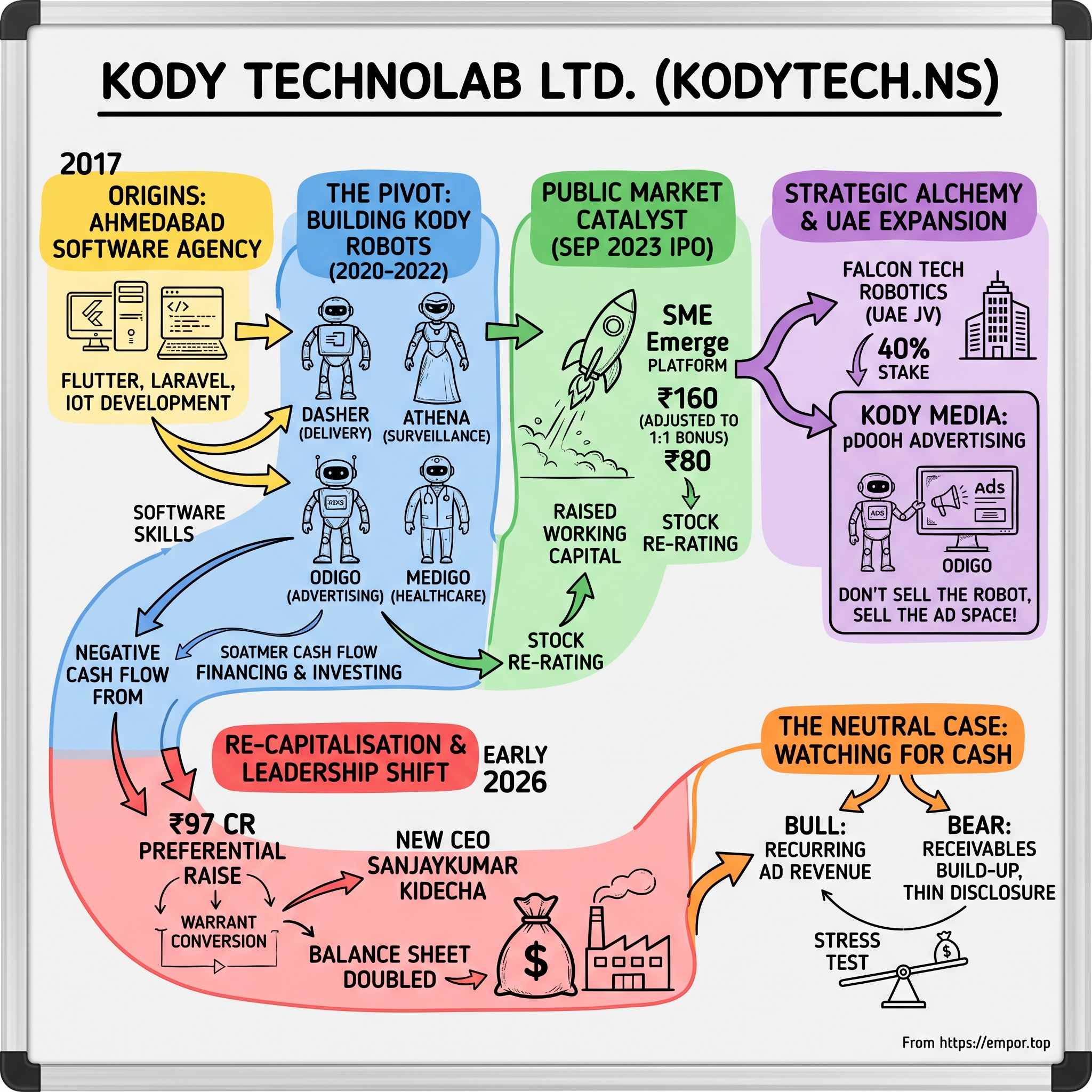
Kody Technolab: The SME Rocketship Building India's First Full-Stack Robotics Powerhouse
I. Introduction & Episode Roadmap
In January 2024, on the exhibition floor of the Vibrant Gujarat Global Summit in Gandhinagar, a small Ahmedabad company set up in Hall No. 10, Stall No. P14 and switched on a humanoid robot it had named Skanda. Prime Minister Narendra Modi walked the hall. The robot talked, answered questions, and performed for the cameras, and the company's founder, Manav Patel, told reporters afterward that his team was "overwhelmed by the response."1 It was, by the company's own count, the fourth robot Kody Technolab had launched in twelve months.
Rewind eighteen months from that moment and the same company was something entirely different: a private software development shop in Ahmedabad writing Flutter apps, Laravel back-ends, and IoT middleware for clients scattered across thirty-odd countries.2 In the financial year ended March 2022, it booked roughly ₹4 crore of revenue and about ₹1 crore of profit — the scale of a mid-sized boutique agency, not a deep-tech platform.3
Fast-forward to the present. On July 27, 2026, Kody Technolab's shares closed at ₹1,345 on the NSE Emerge SME platform, giving the company a market capitalisation of ₹1,923 crore against consolidated FY26 revenue of ₹80 crore and consolidated net profit of ₹17 crore.4 That is roughly 24 times sales and about 115 times trailing earnings for a company whose entire consolidated revenue base would not cover a fortnight of billings at a mid-tier Indian IT services firm.
Here is where the popular version of this story needs correcting immediately. Kody listed in September 2023 at a fixed issue price of ₹160 per share.5 Naively, ₹160 to ₹1,345 looks like an 8.4x run. But the company issued bonus shares in a 1:1 ratio with a record date of December 6, 2024.6 Every IPO subscriber who held on ended up with two shares for every one bought, which means the true adjusted cost basis is ₹80, and the actual return is closer to seventeen times in under three years. The real number is bigger than the headline — and that matters, because the bigger the multiple, the more the market has already paid for a robotics future that has not yet shown up in the income statement.
So the question this story is really asking is not "how did the stock go up." It is a harder one. How does a services agency that sold human hours cross into a business that sells physical machines — and is there any evidence yet that it has actually made the crossing? Software services and robotics hardware are opposite businesses in almost every dimension that matters: capital intensity, working capital, gross margin structure, sales cycle, certification burden, and the sheer brutality of manufacturing at low volume.
The road ahead runs through six turns.
The Ahmedabad services foundry. Where the money and the software brain came from, and why a high-margin, low-capital consulting business is both the perfect and the worst possible launchpad for a hardware bet.
The pivot to steel and silicon. The 2020–2022 build-out of Kody Robots — Dasher, Athena, Odigo, Medigo — and what it actually costs to move from writing code to shipping machines.
The public market catalyst. The September 2023 NSE Emerge listing, what the money was earmarked for, and how a low float plus a retail appetite for Indian deep-tech stories produced the re-rating.
Strategic alchemy. The Abu Dhabi joint venture with the Platinum Group, and the pivot from selling robots to renting advertising space on them through Kody Media's programmatic digital out-of-home model.
The 2026 re-capitalisation and leadership overhaul. A ₹97 crore preferential raise, a balance sheet that more than doubled, a new CEO, and a revised set of audited financials filed one day after the results.
The neutral case. What the bull needs to be true, what the bear needs to be true, and the small number of things an outside investor can actually watch to tell which is winning.
One structural note before we begin, because it colours everything: Kody Technolab does not hold public earnings conference calls, and no analyst transcript exists for FY26. What the market has to work with is a set of stock-exchange filings, a corporate press-release stream, and an investor presentation. For a company carrying a triple-digit multiple, that is a thin evidentiary base, and we will return to it.
 Subscribe on LinkedIn
II. The Origins: Software Services in Ahmedabad (2017–2020)
To understand Kody, start with the geography. Ahmedabad is not Bangalore. It has no Infosys campus, no Koramangala startup ecosystem, no decades-deep bench of engineers who have shipped global-scale software. What Gujarat has instead is a mercantile culture of unusual intensity, a dense network of engineering colleges producing far more graduates than the local economy can absorb, and — critically for anyone building a services business — an engineering wage structure meaningfully below the metros. Add the state government's persistent, almost theatrical courtship of investment through the Vibrant Gujarat summits and the construction of GIFT City in Gandhinagar as a financial and technology special zone, and you have a corridor that spent the 2010s trying very hard to become a tier-one technology destination.
Into that corridor, in 2017, Manav Patel incorporated Kody Technolab Private Limited.7 The company's Corporate Identity Number — L17309GJ2017PLC098117 — carries the Gujarat registration and the 2017 vintage in its own metadata.8
Patel is an unusual profile for an Indian services founder. Per his public professional profile, he holds a Bachelor of Engineering from the L.J. Institute of Engineering and Technology in Ahmedabad and a Master of Business Administration from the Schulich School of Business at York University in Toronto, and he served as Managing Director at Arvind Anticor Ltd, where he was involved in the company's restructuring.9 That combination — local engineering training, a North American MBA, and hands-on experience turning around an industrial company — is worth pausing on. It is not the profile of a coder who accidentally built an agency. It is the profile of someone who understood, from the outset, that a services business is a means rather than an end.
The early Kody was a classic offshore development studio. Mobile applications in Flutter, React Native, native iOS and Android. Web back-ends in Laravel, Java, PHP, Python, Node. IoT connectivity work. Machine learning and computer vision engagements.2 Clients were domestic and small international accounts; by the time of listing the company was describing a track record of more than 250 delivered projects for over 150 clients across 30-plus countries.10 Offices followed the client base — Ahmedabad as headquarters, then a branch at GIFT City, and outposts in London Ontario, Fort Lauderdale, and London.2
The economics of this business are worth spelling out for readers who have not lived inside one, because they explain both why Kody could fund a pivot and why it needed one.
An offshore development studio is, in accounting terms, close to a pure arbitrage. You hire an engineer in Ahmedabad, you bill their time to a client in Toronto or Dubai at a multiple of that cost, and the spread is your gross margin. There is essentially no capital employed — a few laptops, some leased office space, and a bank line for the gap between paying salaries and collecting invoices. Return on capital in a well-run shop is spectacular precisely because there is barely any capital in the denominator. Kody's own reported return on capital employed ran at 28% in FY22 and 38% in FY23, which is exactly what you would expect from a business with almost no balance sheet.3
The trap is on the other side of the ledger. Revenue in this model is a linear function of headcount. To double revenue you roughly double engineers, which means doubling recruiting, doubling management layers, and — in a labour market where every competitor is bidding for the same graduates — accepting wage inflation that eats the arbitrage from the inside. There is no product to amortise, no installed base that compounds, no reason a client cannot move the work to the next shop offering a 10% lower rate. Kody's revenue went from about ₹4 crore in FY22 to roughly ₹11 crore in FY23 — impressive growth in percentage terms, but from a base so small that the absolute numbers were still those of a boutique.3
This is the "people business" ceiling, and every services founder eventually runs into it. Most respond by trying to climb the value chain — moving from staff augmentation to managed services to consulting. Patel chose a different exit from the trap entirely.
But note what the services years actually built, because it is the single most underappreciated asset in this story. Building computer vision pipelines, machine learning models, IoT device middleware, and mobile front-ends for paying clients is, functionally, an apprenticeship in every software layer a modern service robot needs. Perception, navigation logic, fleet management dashboards, over-the-air updates, and the mobile app a mall operator uses to schedule a machine — Kody had been paid by other people to learn all of it. When the company later described itself as building "integrated robotic software," it was not starting from zero.2
What it did not have was any experience whatsoever in mechanical engineering, industrial design, supply chain procurement, or manufacturing. It had built the brain and never touched the body. In 2020, it decided to go find one.
III. The Big Pivot: Building Kody Robots (2021–2022)
Every pivot story has a founder's memo or a whiteboard moment. Kody's is not publicly documented, and inventing one would be a disservice. What the record does show is a decision and its consequences: Kody Robots was established as the company's robotics arm in 2020, and within roughly three years it had four distinct machines out of the lab and a humanoid on a summit stage in front of the Prime Minister.111
The strategic logic behind the move is not hard to reconstruct, and it is the same logic that has driven a hundred services founders to attempt the same jump. Standard IT outsourcing is a race to the bottom. A product, by contrast, can be built once and sold many times. Intellectual property compounds; billable hours do not. If Kody could build a machine that a mall or a hospital or a police department wanted, it would own something that no client could take away by switching vendors.
The macro backdrop cooperated. India's "Make in India" programme and the associated push toward domestic manufacturing self-reliance created genuine procurement preference for locally designed and manufactured technology, particularly anything touching defence, surveillance, or public infrastructure. When Kody described Skanda as "fully indigenously designed, developed, and manufactured," it was not marketing fluff — it was positioning against exactly the criterion that Indian government and public sector buyers apply.1 Being the domestic option in a country actively trying to reduce technology imports is a real, if narrow, form of advantage.
What Kody actually built
The product line is worth walking through slowly, because a reader who has never seen an autonomous mobile robot tends to picture either a Roomba or a Terminator, and the truth is a great deal more mundane and more interesting.
An autonomous mobile robot — an AMR — is essentially a wheeled cabinet that knows where it is. It carries a set of sensors (typically laser rangefinders and cameras) that continuously measure distance to the objects around it, and software that compares those measurements against a stored map of the building to answer two questions many times per second: where am I, and what has changed? "What has changed" is the hard part. A mall floor at 11am is a different world from the same floor at 7pm, and the machine has to distinguish a permanent new kiosk from a toddler who wandered into its path. That is where the perception and machine learning work — the exact work Kody had been doing for clients — becomes the product.
Dasher is a serving and delivery robot for hospitality and retail: trays of food from kitchen to table, goods from stockroom to floor.11 The economics of these machines depend entirely on local labour cost, which is a point we will return to with some force.
Athena is a surveillance and patrol robot, marketed by the company as India's premier surveillance robot.11 Patrol robots are, in principle, an easier sell than service robots, because they compete with a night-shift security guard whose job is genuinely tedious and whose attention genuinely degrades — and because a machine with night vision and continuous recording produces an evidentiary log a human does not.
Odigo is the advertising and wayfinding robot — a screen on wheels that navigates high-footfall zones, displays campaigns, and interacts with shoppers.11 Odigo is, as we will see, the commercially decisive product in the entire portfolio, and not for the reason you would guess from its specifications.
Medigo is the healthcare screening machine, positioned as an AI-powered "Health ATM" that bundles multiple diagnostic tests, vital-sign monitoring, and AI-assisted screening into a single unit for deployment in primary health centres.11 Conceptually it is a diagnostic kiosk with autonomy bolted on, aimed at the enormous gap between where Indian patients are and where diagnostic equipment is.
Beyond the four, Kody has also described Vulcan for cleaning and Telos for industrial tasks, and the company's own materials state that Dasher, Medigo, and Odigo are deployed and operating in real-world conditions.11
The cost of crossing over
Here is the part of the pivot that does not photograph well. Moving from software to hardware inverts the financial model of the company, and Kody's own cash flow statements record the pain in real time.
In FY23, the standalone business generated ₹11 crore of revenue and roughly ₹3 crore of net profit — and burned ₹9 crore in operating cash flow while spending another ₹4 crore on investing activities.3 In FY24, revenue doubled to ₹22 crore and profit reached ₹5 crore, while operating cash flow was negative ₹8 crore and investing outflows ballooned to ₹35 crore.3 Two consecutive years in which the company reported accounting profits and consumed cash at the operating line.
This is not, by itself, a scandal — it is the arithmetic of building a hardware business. Prototyping consumes money before a single unit is sold. Components must be bought in advance. Test rigs, assembly space, and mechanical engineers all cost money that a software agency never spent. But it does mean something concrete for investors: from FY23 onward, Kody was not self-funding its robotics ambition out of services cash flow. The services division was profitable, but it was not throwing off the cash. The financing line tells the real story — ₹21 crore raised in FY23 and ₹38 crore in FY24.3 The seed capital for the robotics business came from investors, not from the cash cow.
That distinction matters, because the tidy narrative — "the services business funded the hardware dream" — is not what the cash flow statement says. The services business supplied the engineering talent, the software stack, and the credibility to raise money. Outside capital supplied the money. Which meant that by 2023, Kody needed a permanent, repeatable channel to that capital.
It needed to go public.
IV. Going Public: The 2023 NSE SME IPO
India's SME exchange boards — NSE Emerge and the BSE SME platform — were created to solve a genuine problem: small companies that could never bear the cost and disclosure burden of a main-board listing still needed access to equity. The regulatory bargain is explicit. Lower compliance thresholds, lighter reporting cadence, a designated market maker to provide some liquidity, and in exchange a minimum lot size large enough to keep the smallest retail investors out. Half-yearly rather than quarterly reporting. No requirement to host earnings calls. It is a lighter-touch regime by design.
What the architects did not anticipate was what happened between 2021 and 2024, when Indian retail investors discovered the SME boards and turned them into one of the most spectacular speculative arenas in global equity markets. Issues routinely subscribed dozens or hundreds of times over. Listing-day gains of 100% became unremarkable. The combination of tiny free floats, restricted supply, and a national enthusiasm for anything labelled "deep tech" produced price behaviour that had, at times, only a passing relationship to the underlying businesses.
Kody's offering was, by the standards of that era, modest and unglamorous. The company issued 17,20,000 fresh equity shares of ₹10 face value at a fixed price of ₹160 per share, raising ₹27.52 crore. The book opened on September 15, 2023, closed on September 20, and the shares listed on NSE Emerge on September 27, 2023.5
Where the money was supposed to go
This is where the received narrative and the prospectus diverge, and the divergence is instructive.
The commonly repeated version is that Kody raised money to build a state-of-the-art robotics manufacturing facility in Ahmedabad. That is not what the objects of the issue said. Of the net proceeds, ₹2.74 crore was earmarked for setting up a development centre at GIFT City in Gandhinagar; ₹12.50 crore — by far the largest slice — for working capital; ₹5.80 crore for repayment or prepayment of certain borrowings; and ₹5.98 crore for general corporate purposes.5
Read that allocation again, because it is the most honest single disclosure about what Kody was in September 2023. Nearly half the raise went to working capital. A fifth went to paying down debt. The largest capital-expenditure item was a software development centre in a financial special economic zone — a services facility, not a robot factory. This was a services company with a robotics division raising money the way a services company raises money: to fund receivables and clean up the balance sheet.
That is not a criticism of the company. It is a correction to the mythology. The robotics manufacturing build-out came later and was funded by later money.
The float and the ownership
Pre-issue, the promoter group held 100% of the company. Post-issue, promoter holding stood at 73.01%.12 The named promoters on the offer document included Manav Patel alongside Manali Krunal Patel and Pooja Sunny Patel.12
Do the arithmetic on what that leaves. A little over a quarter of the equity in public hands, a portion of which sat with anchor-type allottees and the market maker, in a company whose entire market capitalisation at issue was well under ₹120 crore. The genuinely tradeable float was a rounding error. In a market where thousands of retail investors were hunting for the next Indian robotics story, a float that small is not a liquidity feature — it is a price accelerant. Small amounts of buying pressure move a thinly floated stock violently, in both directions.
And the story on offer was close to perfect for the moment. Here was a listed Indian company, profitable, growing revenue at triple-digit rates off a small base, that made autonomous robots and had just put a humanoid on stage in front of the Prime Minister. In an Indian market that had watched American investors assign extraordinary valuations to pre-revenue robotics ventures, Kody offered the domestic equivalent — with actual profits attached.
The re-rating that followed was not driven by any single catalyst. It was driven by the compounding of the two forces: a stream of operational announcements arriving into a float too small to absorb the resulting demand. Add the 1:1 bonus issue announced on October 24, 2024 with a December 6 record date — which does not create value but reliably creates enthusiasm in retail-dominated stocks by halving the optical share price6 — and by early 2026 the shares had appreciated to a level that would let management do something no ₹27 crore IPO could have funded.
They could raise real money.
V. Global Expansion & the GCC Joint Venture (2024–2025)
Start with the uncomfortable arithmetic that governs every service robotics company operating in India.
A Dasher serving food in a restaurant replaces, at best, some fraction of a waiter's labour. In India, that waiter might cost an employer something in the range of ₹15,000–25,000 a month. A capable autonomous service robot, with its lidar, motors, batteries, compute, and screen, costs lakhs of rupees up front plus ongoing maintenance and software support. Run the payback calculation and it stretches into years — and that assumes the robot works reliably in a crowded, chaotic, poorly mapped Indian restaurant floor, which is a considerably harder environment than a German warehouse.
This is the central, structural, unglamorous problem: service robotics economics are inversely proportional to local labour costs. The lower the wage, the worse the business case. India, the world's most populous country with abundant low-cost service labour, is close to the worst possible primary market for labour-substituting service robots. It is an excellent place to build them and a difficult place to sell them.
Management appears to have understood this. The response was to go where labour is expensive, capital is abundant, and governments actively subsidise technology adoption as a matter of national branding. That place is the Gulf.
Falcon Tech Robotics
In January 2025, Kody Technolab announced an exclusive joint venture with Platinum Group for Businessmen Services L.L.C. of the UAE to form Falcon Tech Robotics LLC, a manufacturing company producing "Made in UAE" robots.13 The ownership split is the detail most summaries omit and the one that matters most: Platinum Group holds 60%, Kody Technolab holds 40%.13
Kody is the minority partner in its own Middle East vehicle.
Under the arrangement, Kody contributes R&D expertise, robotic solutions, development kits, integrated software, and proprietary technical know-how; Falcon manufactures in the UAE and markets exclusively across the Middle East and GCC.13 The product scope covers defence and surveillance robots, experiential marketing robots, hospitality service robots, and cleaning robots for commercial and healthcare facilities.13 The company framed the deal as the first collaboration between the Platinum Group and an Indian listed company.14
The "Made in UAE" framing is not decorative. Gulf states run aggressive industrial localisation policies, and public sector procurement — the smart-city contracts, the police and civil defence deployments, the government-linked hospitality assets — frequently carries local content requirements. A robot assembled in Abu Dhabi clears procurement gates that an imported Indian robot does not. Localising manufacturing is the price of admission to the contracts worth having.
But investors need to be clear-eyed about what a 40% stake means in practice. Kody does not control Falcon Tech. It does not consolidate Falcon Tech's revenue. When a headline announces that "Kody Technolab's JV wins a deal," the economics reaching Kody's own income statement flow through two narrower channels: the price at which Kody sells robots, kits, and technology into Falcon, and Kody's 40% share of whatever profit Falcon eventually generates. Those are real, but they are not the same as owning the customer relationship. The party with 60% and the local government relationships holds the stronger hand in any future renegotiation.
There is also a visible cost to the structure in the published numbers. In FY26, Kody's standalone revenue was ₹84.01 crore and standalone net profit ₹21.86 crore, while consolidated revenue was ₹80.28 crore and consolidated net profit ₹16.76 crore.15 Consolidation therefore reduced reported profit by roughly ₹5 crore. Group entities and associates were, in aggregate, losing money while the parent was making it. For a group whose entire growth narrative depends on those subsidiaries and affiliates, that gap is one of the more informative disclosures in the filing — and it is not one the press releases discuss.
The Medigo mandate
The most significant single agreement of the last year arrived on June 22, 2026, when Kody announced a three-year tripartite arrangement with Falcon Tech Robotics LLC and Sccore AI Tech Diagnostic Limited of the UAE. Under it, Kody Technolab was appointed the exclusive worldwide manufacturer of its Medigo range of AI-powered healthcare screening robots, with Falcon as exclusive global distributor and Sccore handling worldwide deployment and commercialisation. Manufacturing and supply were slated to commence in the first half of FY 2026-27, and the company described the agreement as underpinned by a binding minimum purchase framework structured across biannual commercial periods.16
Manav Patel called it "a defining moment in our journey to take Kody Technolab's healthcare robotics platform to global scale."16 The supporting market framing cited WHO and World Bank estimates that 4.5 billion people lack full access to essential health services, and third-party projections of the global preventive healthcare market growing from roughly $268.7 billion in 2023 to $585.6 billion by 2030.16
The structure is genuinely attractive on paper. An exclusive manufacturing mandate with a binding minimum purchase commitment converts an uncertain sales pipeline into contracted volume — precisely the visibility a hardware manufacturer needs to plan capacity and finance inventory. It is, in principle, exactly the kind of agreement that de-risks a hardware scale-up.
And yet the disclosure has a hole in the middle of it: the quantum of the minimum purchase commitment was not disclosed. Neither was the aggregate contract value. "Binding minimum purchase framework" is a phrase that can describe a ₹500 crore obligation or a ₹5 crore one, and without the number an outside investor cannot size the revenue, cannot model the capacity requirement, and cannot judge whether the agreement is transformative or incremental. For an announcement described by the Managing Director as defining, that omission is a legitimate analytical grievance rather than a technicality.
The certification bottleneck
There is a further constraint that almost never appears in press releases and almost always appears in delayed shipments.
Selling an electronic device internationally requires regulatory clearance. In the United States that means FCC certification for electromagnetic emissions; in Europe, CE marking against the applicable machinery, radio equipment, and electromagnetic compatibility directives. For an autonomous machine that moves through spaces occupied by people, the functional safety requirements are materially more demanding than for a static appliance — the certifying body wants evidence about what the machine does when a sensor fails, when a person steps in front of it, when the battery faults.
Then layer on healthcare. A device that performs diagnostic screening is not merely an electronic product; it is potentially a medical device, and medical device regulation is the slowest, most expensive, most jurisdiction-specific approval process in commercial technology. Requirements differ across the UAE, the European Union, the United States, and every other market. Clinical validation may be required. Timelines run in quarters and years, not weeks.
This is the mechanism by which international hardware scale-ups slip. Not because demand disappears, but because the machine cannot legally be sold in the target market until a regulator says so, and regulators do not respond to earnings pressure. Kody has not published a certification roadmap for the Medigo range by market, and until it does, the H1 FY27 supply commencement timeline should be read as an intention rather than a schedule.
Which brings us to the one product in the portfolio that sidesteps almost all of this — because nobody needs a medical device licence to show an advertisement.
VI. The Hidden Growth Engine: Kody Media & pDOOH Advertising
Here is the fundamental curse of the hardware business, and the reason so many robotics companies with good machines end up as bad businesses.
You spend two years and a great deal of money developing a robot. You sell it to a mall for a large one-time payment. You book the revenue, recognise the margin, and then — nothing. The relationship converts into a maintenance contract worth a fraction of the original sale. To grow next year, you must find an entirely new customer and sell an entirely new machine, while carrying inventory, managing a component supply chain, and financing receivables from customers who pay in ninety days. Revenue is lumpy, non-recurring, and capital-hungry. The stock market, quite correctly, assigns low multiples to businesses that look like this.
Kody's answer to the curse is the most genuinely interesting strategic idea in the entire company, and it has almost nothing to do with robotics.
Don't sell the robot. Sell what's on its screen.
Odigo is an advertising robot — a mobile display that navigates a mall. Sell one to a mall operator and you get a single hardware payment. But the company's wholly owned advertising subsidiary, Kody Media, inverts the transaction: deploy the robot into the mall at Kody's cost, and monetise the screen as advertising inventory through programmatic digital out-of-home — pDOOH.17
The concept deserves a plain-English explanation, because "programmatic" is doing a lot of work in that acronym.
Traditional out-of-home advertising is a billboard. A brand buys it for a month. Everyone who walks past sees the same image regardless of who they are or what time it is. The advertiser has almost no idea how many people actually looked. It is the oldest advertising medium in the world and, until recently, the least measurable.
Programmatic DOOH replaces the physical poster with a networked screen and an automated buying system. The screen reports what it displayed and when. Campaigns can be scheduled, changed, and targeted by location and time of day. Advertisers bid for slots the way they bid for internet display inventory, and they get performance data back. The medium acquires the accountability of digital advertising while keeping the physical presence of a billboard.
Now put that screen on wheels. A static screen sits in one spot and waits. Odigo moves to where the footfall is, at the hour the footfall is there. As the company describes it, campaigns can be targeted by floor, by zone, and by time of day, all managed from a centralised dashboard, with analytics tracking ad impressions, interactions, and navigation journeys.18 A brand launching a beverage can put its campaign on the ground floor at lunchtime and the food court at seven in the evening — from the same physical asset.
The financial transformation this represents is the entire point. A hardware sale is one payment. An advertising screen is a rent-generating asset with a multi-year life. Once the robot is deployed and the ad-sales machinery is running, incremental revenue carries software-like margins because the marginal cost of showing one more advertisement is approximately zero. Revenue becomes recurring rather than episodic. And the company that owns the network — rather than the manufacturer that sold the hardware — captures the ongoing economics.
The UAE deployments
The proof-of-concept for this model has been executed not in India but through the Gulf joint venture, and at meaningful scale.
On November 10, 2025, Falcon Tech Robotics announced an agreement with LuLu Group International to deploy 290 Odigo robots across 60 LuLu locations in the UAE — 17 malls and 43 hypermarkets — in a structured two-phase plan, explicitly on an ad revenue sharing basis.19 Falcon took responsibility for manufacturing, deployment, installation, and maintenance across all locations.19
Two weeks later, on November 25, 2025, came a second and structurally similar deal: a partnership with Hypermedia FZ-LLC, a UAE digital out-of-home company and a subsidiary of W Group, to deploy 360 Odigo robots — roughly twelve per mall across 30 Hypermedia-managed malls including Mall of the Emirates, Ibn Battuta Mall, City Centre Mirdif, Yas Mall and Burjuman, plus the Dubai Expo site.18 The company stated that total UAE orders had crossed 600 units.18
The Hypermedia deal in particular is a shrewd piece of channel strategy. Hypermedia already owns the mall media rights, the advertiser relationships, and the sales force. Kody's robots become new inventory in an existing network rather than a new network that must be built and sold from scratch. That removes the single hardest part of the media business — distribution — and it is a considerably better arrangement than trying to build an ad sales operation in a foreign market from zero.
What to believe, and what to withhold
Now the discipline. Six hundred robots is a genuinely large deployment number for a company of Kody's size, and the revenue-share structure is strategically correct. But an investor should hold three reservations firmly in mind.
First, an ad revenue share is a promise about future revenue, not a purchase order. In a conventional hardware sale, the buyer pays and the seller books. Under a revenue share, the deploying party bears the deployment cost up front and gets paid out of advertising revenue that has to be sold, delivered, and collected afterwards. If those 650-odd robots achieve mediocre fill rates or command lower CPMs than modelled, the economics deteriorate — and the party that funded the deployment absorbs the shortfall. Announcing units deployed is not the same as announcing revenue earned.
Second, the pDOOH economics have not been disclosed in any form that can be verified. No revenue per robot per month. No fill rates. No advertising revenue line separated from hardware revenue. Kody Media's own public materials describe the value proposition — "precision ads, zero wasted reach," real-time optimisation — but publish no quantitative performance metrics whatsoever.17 The most important economic claim in the entire investment story is, at present, entirely unaudited by any external number.
Third, most of this sits inside a 40%-owned associate. The LuLu and Hypermedia deployments are Falcon Tech contracts. The gross advertising revenue does not land on Kody's consolidated top line. What Kody captures is equipment supply to Falcon and a minority share of Falcon's eventual profits — and, as noted, group entities collectively detracted from consolidated profit in FY26.15
So the strategy is right and the disclosure is thin. That is a defensible place for a company to be at this stage of its life. It is a harder place to justify at 115 times earnings — a tension that the events of early 2026 brought into sharp relief.
VII. The 2026 Capital War Chest & Standalone Balance Sheet Expansion
By February 2026, Kody Technolab's board was looking at a situation that every small-cap management team dreams about and relatively few handle well. The stock had risen roughly tenfold from its adjusted listing price. The company had operating momentum, a foreign joint venture generating headlines, and a hardware business that needed considerably more capital than a ₹27.52 crore IPO had provided.
They did what the moment invited. They sold equity into their own share price.
On February 19, 2026, Kody executed a set of preferential issues that together raised approximately ₹97.08 crore — roughly three and a half times what the company had raised at IPO, achieved without a public offering and without a prospectus. The components: ₹15,00,52,500 through a preferential issue of equity shares; ₹16,49,94,375 through a preferential issue of convertible warrants; and a separate convertible warrant tranche of ₹65,58,00,000.20 The equity shares and the first warrant tranche were priced at ₹975, with the warrants convertible within eighteen months.21
The mechanics of the warrant, and why they matter
Convertible warrants are the workhorse instrument of Indian preferential fundraising, and their structure is worth understanding because it shapes the incentives of everyone involved.
A warrant gives the holder the right, but not the obligation, to buy a share at a fixed price within a defined window. Under Indian regulations the subscriber pays 25% of the price up front and the balance on conversion. The holder therefore takes a leveraged position: if the share price runs above the exercise price, they convert and capture the gain; if it collapses, they walk away and forfeit only the 25% deposit.
This has a specific consequence for the issuer. Warrant money is not certain money. Kody received an initial tranche and then had to wait to find out whether the balance would arrive, with the answer determined entirely by where the share price sat during the eighteen-month window.
For this round, the answer was emphatically yes. In May 2026, the company converted 6,94,000 warrants into fully paid-up equity shares at an issue price of ₹1,400 per share — a face value of ₹10 plus a share premium of ₹1,390 — and simultaneously issued 6,94,000 bonus equity shares. All 13,88,000 shares received NSE trading approval effective May 25, 2026, with 10,88,000 locked in until December 31, 2027 and 3,00,000 until December 31, 2026.22
Look closely at those two numbers together: warrants priced off a ₹975 reference in February, converted at ₹1,400 in May. Someone was willing to pay ₹1,400 a share for a company whose consolidated FY26 earnings per share was ₹11.73.15 The extended lock-in periods running into late 2027 are the one genuinely reassuring feature — the subscribers cannot exit quickly, which aligns them with the outcome rather than the announcement.
What the money did to the balance sheet
The transformation was dramatic. Total consolidated assets went from ₹111.83 crore at the end of FY25 to ₹266.11 crore at the end of FY26 — the balance sheet more than doubled in a single year.15 On a standalone basis, reserves went from ₹66 crore to ₹191 crore, borrowings fell from ₹13 crore to ₹8 crore, and fixed assets jumped from ₹10 crore to ₹46 crore.3
That fixed asset number is the most encouraging line in the entire FY26 filing. A ₹36 crore increase in gross block is real manufacturing capacity being installed — the physical robot production capability that the 2023 IPO money never actually funded. Combined with the debt reduction, it shows a company using equity to build assets rather than to service liabilities. The company reported no deviations in the utilisation of preferential issue funds.15
But the balance sheet has a second story, and it is less comfortable.
Standalone "other assets" — the catch-all that houses receivables, inventory, advances and loans — swelled from ₹68 crore to ₹157 crore.3 That is an ₹89 crore increase, more than double the increase in fixed assets, at a company with ₹84 crore of standalone revenue. Reported debtor days stand at approximately 173.3 Nearly half a year of sales sitting uncollected.
Free cash flow for FY26 was negative ₹52 crore, driven by heavy investing activity.15
Put these together and a coherent picture emerges. Kody is reporting healthy accounting profits — a 33% standalone operating margin in FY26 — while consuming cash at a substantial rate.3 Some of that is deliberate and defensible: building factories and stocking components for a hardware ramp legitimately absorbs cash before it produces any. But the receivables trajectory is the item that deserves genuine scrutiny. When revenue is growing fast, sales are concentrated in related and affiliated entities, and receivables are growing faster than revenue, the quality of reported earnings becomes an open question rather than a settled one. Profit that has not been collected is a forecast, not a fact.
The most revealing disclosure of the year
Then, on July 13, 2026, the board approved a proposed unsecured loan of up to ₹40 crore from the promoter-Managing Director, subject to member approval.4
Sit with the sequence. In February, the company raised ₹97 crore in fresh equity. By March 31, it was reporting a standalone cash position materially strengthened from the prior year and net debt of roughly negative ₹35 crore — a net cash position.23 Four months later, the board was arranging to borrow ₹40 crore from its own Managing Director.
There are benign readings. A promoter loan is fast, cheap, and unencumbered by bank covenants — precisely the right instrument for bridging a working capital gap on a large order ramp, and it avoids diluting minority shareholders at a moment when the promoter clearly believes the shares are worth more than the market price. A promoter willing to lend the company ₹40 crore of personal money is demonstrating conviction that most managements never have to demonstrate.
There is also a less benign reading, and an investor should hold both. A company that raised ₹97 crore five months earlier and is already reaching for promoter money is a company whose working capital cycle is consuming cash faster than the plan anticipated. And a ₹40 crore related-party loan is, by definition, a related-party transaction on a scale material to the balance sheet, which introduces exactly the governance surface area that public market investors are trained to watch: terms, interest rate, tenure, security, and repayment priority relative to other stakeholders.
The company had, by this point, already given the market one reason to look harder at its financial reporting.
VIII. Professionalization, Leadership Shifts, & The Skeptical Stress Test
May 6, 2026 was a significant day in the boardroom in Ahmedabad. The directors approved the audited financial results for FY26 and, effective the same date, restructured the entire executive layer of the company.15
Sanjaykumar Kidecha was elevated to Chief Executive Officer. A qualified engineer with roughly eight years of experience in finance and accounts, Kidecha had been operating inside the business and moved up into the top executive seat.15 Nirav Panchal, a postgraduate in management with more than eighteen years across marketing and operations, was appointed Chief Operating Officer, and Savant Fernandez, with fourteen years in strategic marketing and brand development, became Chief Marketing Officer.15
Founder Manav Patel moved to Chairman and Managing Director, stepping back from day-to-day chief executive duties.2 The current executive roster also includes Mihir Mistry as Chief Technology Officer, Anchal Patel as Chief Growth Officer, Akshay Shah as Chief Financial Officer, and Kashyap Jani as an Independent Director.2
This is the founder-to-professional-management transition that every scaling company eventually confronts, and on the surface it is exactly the right move. A founder who is personally running operations, sales, product, and strategy is a bottleneck by the time a company is operating across India and the Gulf with a manufacturing ramp and a media subsidiary. Building an executive bench frees the founder for the things only a founder can do — product direction, strategic partnerships, capital markets — and creates the institutional structure a company needs before it can plausibly graduate to the NSE main board.
Two observations temper the enthusiasm. First, the new CEO's disclosed background is in finance and accounts with roughly eight years of experience, which is a modest bench for running a company attempting simultaneous hardware manufacturing scale-up, international expansion, and an advertising network build-out.15 Second, when a founder retains both Chairman and Managing Director titles, the operational reality of the handover is often more gradual than the announcement implies. The market will learn which it is only by watching who answers for execution over the coming years.
The clerical error
One day after the board meeting — on May 7, 2026 — Kody Technolab filed a revised integrated filing for the half year and year ended March 31, 2026, correcting what the company described as inadvertent clerical and grouping errors identified in the Consolidated Cash Flow Statement and Balance Sheet.15
The company stated that all other figures and disclosures remained unchanged, with no impact on revenue from operations, profit before or after tax, earnings per share, net worth, or total cash and cash equivalents.15 The statutory auditors, M/s. Khandhar & Associates, Chartered Accountants, issued an unmodified opinion on both the standalone and consolidated results.15 Secretarial audit was conducted by M/s. Jitendra Parmar & Associates, Company Secretaries, Ahmedabad.15
Let us be scrupulously fair about what this was and was not.
It was not a restatement. Revenue of ₹80.28 crore was unchanged. Net profit of ₹16.76 crore was unchanged. EPS, net worth, and total cash were unchanged. The auditors did not qualify their opinion, did not issue an emphasis of matter, and did not flag a going concern issue. Nothing in the economic substance of FY26 changed between the original filing and the revised one. Grouping errors — line items classified into the wrong bucket within a statement — are genuinely common and genuinely different in kind from misstated profits.
And yet the incident is not nothing, for three reasons.
First, the location. Of all the statements to get wrong, the consolidated cash flow statement is the one that matters most for a company in Kody's exact situation. This is a business reporting strong profits while consuming cash, with a receivables balance approaching half a year of revenue and heavy investing outflows. The cash flow statement is the document a sceptical investor turns to first precisely to test whether the profits are real. Filing it, then refiling it, invites the question of how carefully it was prepared the first time.
Second, the timing. The correction arrived one day after the board approved the results and one day after the entire executive team was reshuffled. A financial reporting process robust enough for a listed company should not require a same-week correction to the primary financial statements.
Third, what it says about internal controls. SME-listed companies operate under a lighter reporting regime, and finance functions frequently lag business growth — the accounting team that could handle a ₹22 crore services company in FY24 is being asked, two years later, to consolidate a group with a foreign associate, multiple preferential issues, warrant conversions, bonus issues, and a manufacturing ramp. That is a genuine step change in complexity. The error is best read not as evidence of bad faith but as evidence that reporting infrastructure has not kept pace with corporate complexity. Which is itself a risk, because the market prices this company as though its numbers are reliable.
The stress test a sceptic would run
Assemble the pieces an activist or short-seller would put on one page, and the file writes itself.
Revenue was heavily back-ended: of ₹80 crore consolidated FY26 revenue, ₹49 crore landed in the second half, with H2 EPS of ₹8.59 against H1's ₹5.82.4 Concentrated back-half revenue in a company with long collection cycles is precisely the pattern that warrants scrutiny of revenue recognition timing.
The FY25 growth was extraordinary — revenue roughly tripled from about ₹22 crore to ₹72 crore, and EPS went from ₹3.84 to ₹13.82.243 Tripling revenue in twelve months is possible; it is also the kind of step-change that a diligent investor wants to see corroborated by cash collection, and the cash flow statements do not yet provide that corroboration.
Related-party structures run through the entire commercial story. The primary international channel is a 40%-owned associate. The Medigo mandate is a tripartite arrangement in which that same associate is the exclusive global distributor. And the company is now proposing to borrow ₹40 crore from its Managing Director.4
Disclosure is thin where it matters most. The Medigo minimum purchase quantum is undisclosed. The robotics-versus-software revenue split is not separately reported in the results filings. pDOOH unit economics are unpublished. And the company holds no public earnings calls — meaning there is no forum in which any analyst can ask management a question and no record against which to test the consistency of the narrative over time.
That last point deserves emphasis for long-term investors. The instruction to "compare the latest materials against prior calls" cannot be executed here, because there are no calls. Management credibility at Kody can currently be assessed only against filings and press releases, and press releases are written by the company. When the shares eventually migrate to the main board, quarterly reporting and the accompanying analyst scrutiny will supply the missing evidence. Until then, the informational asymmetry between management and shareholders is wider than the valuation implies it should be.
None of which means the business is not real. Six hundred robots ordered in the UAE, a ₹36 crore increase in fixed assets, a debt reduction, and an auditor's unmodified opinion are all real too. It means the evidence available to an outside investor is currently insufficient to settle the question either way — and at 115 times earnings, the burden of proof sits with the optimistic reading.
IX. The Playbook: Business & Investing Lessons
Strip away the announcements and ask the structural question: does Kody Technolab possess any durable advantage, or is it simply an early mover in a market that has not yet attracted serious competition?
Hamilton Helmer's framework in 7 Powers is useful here precisely because it is unforgiving. A Power must both increase differential value and be protected by a barrier that a competitor cannot cross even if they see exactly what you are doing.
Counter-Positioning — genuine but narrow. Kody occupies an unusual position between two incumbent types. A conventional Indian IT services firm could hire roboticists but would not, because doing so means accepting inventory, capital expenditure, warranty liability, and gross margins half what software commands — a wholesale degradation of the financial model that made them successful. That is the textbook incumbent's dilemma. Simultaneously, established hardware and automation manufacturers possess mechanical capability but generally lack the in-house AI, computer vision, and mobile software stack that Kody built through a decade of paid client work. Sitting in the middle is real. The barrier, however, is time and organisational will, not physics — and a determined, well-capitalised competitor can hire across the gap in eighteen months.
Cornered Resource — weak, and the outline's optimism should be resisted. Access to lower-cost engineering talent in Gujarat is a cost advantage, not a cornered resource. Anyone can open an office in Ahmedabad. Wage arbitrage is available to every competitor willing to relocate, and it compresses as a talent market matures. The genuine candidate for a cornered resource is the exclusive worldwide manufacturing mandate for Medigo — an exclusive contractual right that no competitor can replicate.16 But contracts expire; this one runs three years, and its value is unknowable while the minimum purchase quantum stays undisclosed.
Scale Economies — essentially absent today. With ₹80 crore of consolidated revenue and a manufacturing base being installed rather than optimised, Kody has no cost position that a competitor cannot match.15 Scale economies in hardware are earned over many production cycles. This is aspiration, not Power.
Network Economies — the one worth watching. Not in robotics, but in advertising. If Kody Media and its Gulf channel partners accumulate enough deployed screens, the network crosses a threshold where advertisers must buy it to reach a given audience, and that demand in turn justifies deploying more screens. Media networks genuinely exhibit this dynamic. Whether 650 robots in the UAE is anywhere near critical mass is unknown, because the fill rates and pricing that would answer the question have not been published.
Porter, applied honestly
Threat of new entrants: moderate, and rising. Robot design has become dramatically more accessible. Open-source robotics middleware, commodity lidar from Chinese suppliers, and off-the-shelf compute modules mean a competent team can field a functional service robot far faster and cheaper than a decade ago. Capital is arriving in force — Indian robotics ventures raised roughly $780 million across 95 rounds in 2025, and the Indian robotics market grew about 17% year over year in 2026, the fastest among the world's top-ten markets.25 Growth of that speed attracts entrants; it does not repel them.
Bargaining power of buyers: high. LuLu Group operates dozens of malls and hypermarkets. Hypermedia controls a mall media network. These are large, sophisticated counterparties negotiating against a supplier with ₹80 crore of revenue. The revenue-share structure of both UAE agreements is itself evidence of buyer power — the buyer conserved capital and transferred deployment risk to the robot provider. That is what a strong counterparty extracts.
Threat of substitutes: high, and structurally so. The substitute for a service robot in most emerging markets is a person, and the person is cheaper. For Odigo specifically, the substitute is a static digital screen, which costs a fraction of a robot, never breaks down from a motor fault, and requires no navigation software. Kody's argument must be that mobility and interaction generate enough incremental advertising value to justify the premium — a proposition that can only be settled by revenue-per-screen data that has not been disclosed.
Rivalry among existing competitors: moderate today, concentrated elsewhere. India's robotics landscape is led by warehouse and industrial automation players — Addverb Technologies, backed by Reliance Industries and operating one of the world's largest mobile robot factories with deployments across more than 500 warehouses; GreyOrange; and a cohort of specialists including Invento Robotics and CynLr.25 Most compete in logistics and industrial automation rather than public-space service robotics, which gives Kody relative room. But an Addverb with Reliance's balance sheet behind it could enter service robotics whenever it judged the market worth entering.
Supplier power: material and underdiscussed. Advanced semiconductors, lidar units, cameras, motors, and battery cells are largely imported. A robotics manufacturer in Ahmedabad is a small customer in global component markets with limited negotiating leverage and full exposure to shortages, currency movements, and trade policy. This is a real constraint on a low-volume manufacturer, and it interacts unpleasantly with the working capital picture — the more you must stockpile components to guarantee delivery, the more cash the business absorbs.
The honest summary: Kody has one credible Power in formation (a media network with real optionality), one narrow structural Power (counter-positioning against both software firms and hardware firms), and a set of forces around it that are neutral-to-hostile. That is a normal profile for a young company. It is not the profile the multiple is describing.
X. The Investment Spine: Bull vs. Bear Case
Why this could work
The bull case rests on one structural insight and two executional bets.
The insight is that Kody may have found a way to escape the hardware curse before it ever fully entered it. By pairing robot manufacturing with an advertising network, the company converts a one-time equipment sale into a rent-generating media asset. If the pDOOH model works at scale, Kody stops being a hardware company that sells 600 robots and becomes a media company that operates 600 revenue-producing screens, with the manufacturing capability as a captive cost advantage rather than the business itself. Media networks earn higher multiples than hardware manufacturers for entirely rational reasons: recurring revenue, operating leverage, and improving economics as the network densifies. This is a genuinely differentiated strategy and the strongest argument for owning the shares.
The first executional bet is geography. Management identified the labour-cost problem early and moved the commercial centre of gravity to the Gulf, where wages are high, capital is abundant, and governments treat visible technology adoption as national branding. Localising manufacturing through the Abu Dhabi joint venture clears procurement gates that an Indian exporter cannot.13 The 600-plus units ordered through LuLu and Hypermedia are evidence that the positioning is producing commercial traction rather than merely press releases.1819
The second is full-stack control. Kody designs the hardware, writes the perception and navigation software, builds the campaign management dashboard, and — through Kody Media — sells the advertising.17 In a young industry, owning every layer means capturing every margin pool and, more importantly, iterating faster than a competitor who must coordinate across vendors. The Medigo mandate is the clearest evidence that a counterparty valued this integration enough to grant an exclusive worldwide manufacturing right.16
What could break it
The valuation leaves no room. At ₹1,345 per share and ₹1,923 crore of market capitalisation against ₹80 crore of consolidated revenue and ₹17 crore of consolidated profit, the shares trade at roughly 24 times sales and about 115 times earnings, with a price-to-book multiple near 8.9x against book value of ₹151.4 Consolidated profit actually declined from ₹18 crore in FY25 to ₹17 crore in FY26, and consolidated EPS fell from ₹13.82 to ₹11.73 as the share count expanded.4 A multiple of that magnitude is a bet on a business several times the current size. Any delay — a certification hold-up, a slipped deployment phase, a soft advertising market in the Gulf — collides with a price that has already discounted success.
Cash conversion is the operational weak point. Negative free cash flow of ₹52 crore in FY26, debtor days near 173, and an ₹89 crore increase in standalone other assets against ₹84 crore of standalone revenue describe a business whose reported profits are not yet arriving as cash.153 The ₹40 crore promoter loan proposed in July 2026, five months after a ₹97 crore equity raise, is consistent with a working capital cycle running harder than planned.4 This is the single most important thing to watch, because it is the mechanism by which fast-growing small companies get into trouble even when demand is genuine.
Governance and disclosure carry a discount the price does not reflect. A revised financial filing one day after the board meeting, no public earnings calls, undisclosed contract values on the flagship agreement, no separate reporting of robotics versus software revenue, no published pDOOH economics, and a material related-party loan under consideration.154 Individually each is explicable. Collectively they mean an outside investor cannot verify the most important claims in the story.
Concentration is severe. The international business runs almost entirely through one 40%-owned joint venture, with a handful of counterparties — Falcon, Platinum Group, LuLu, Hypermedia, Sccore.1316 Kody does not control Falcon. A change in that relationship, or a change of heart at one large customer, would materially alter the growth trajectory. And group entities, in aggregate, reduced consolidated profit relative to standalone in FY26.15
Supply chain and regulation are live constraints. Imported semiconductors and optical sensors expose a small manufacturer to shortages and currency risk with no negotiating leverage. Medical device certification for the Medigo range across multiple jurisdictions is slow, expensive, and outside management's control; no market-by-market certification roadmap has been published.
SME platform dynamics cut both ways. The low float that amplified the rise amplifies declines identically, and the lighter reporting regime that reduces compliance cost also reduces the information available to shareholders.
The three things to watch
Everything above collapses into a small number of observable metrics. An investor tracking this company over the next several years should watch these and largely ignore the rest.
1. Cash conversion — operating cash flow against reported net profit, and the trend in debtor days. This is the first KPI for a reason. It is the single measure that adjudicates between the bull and bear readings of the same income statement. If Kody's profits begin converting into operating cash and receivable days compress, the growth is real and the working capital strain was a transitional feature of a hardware ramp. If profits keep rising while operating cash flow stays negative and receivables keep climbing, the quality of earnings question moves from open to answered — unfavourably. No other metric carries this much diagnostic weight.
2. Recurring advertising revenue from the pDOOH network, disclosed separately. The entire strategic differentiation of this company rests on converting hardware into media rent. Today that claim is unverifiable because the company does not break it out. Investors should watch for the disclosure itself as a signal — a management confident in its unit economics publishes them — and then for the level and trajectory of recurring media revenue and revenue per deployed robot. If advertising revenue becomes a visible, growing, high-margin line, the media multiple is earned. If it never appears in the disclosures, that silence is information.
3. Conversion of the Gulf pipeline into delivered, collected revenue. Kody's May 2026 investor presentation flagged a pipeline exceeding $10 million in orders and over 1,500 units in the deployment pipeline.26 Pipelines are not revenue. The metric that matters is units actually shipped, installed, and paid for — and specifically whether the Medigo minimum purchase commitments begin producing disclosed supply revenue from H1 FY27 as management indicated.16 This is the direct test of whether the announcement flow that drove the re-rating converts into an income statement.
XI. Epilogue & Outro
Nine years is not a long time. In 2017, Kody Technolab was an incorporation certificate in Ahmedabad and a founder with an engineering degree, a Canadian MBA, and experience restructuring an industrial company. In 2026, it is a listed enterprise with a manufacturing base under construction, a humanoid robot that has been demonstrated to a Prime Minister, a joint venture in Abu Dhabi, an advertising subsidiary, six hundred-plus robots ordered in the Gulf, and a market capitalisation of ₹1,923 crore.4
The most instructive thing about the story is not the robots. It is the mechanism. Kody built a software services business, used its profits and credibility to attract equity, listed on a platform designed for small companies at a moment when Indian retail investors were exceptionally receptive, watched its share price appreciate roughly seventeen-fold on a bonus-adjusted basis, and then sold ₹97 crore of that appreciated equity to fund the factories, tooling, and working capital its original ₹27.52 crore IPO never covered.205 That is public market arbitrage executed with real skill. A rising share price became a currency, and the currency was converted into productive assets — a ₹36 crore increase in fixed assets and a reduction in borrowings.3
Whether it becomes a durable business depends on questions the current disclosures cannot answer. Does an advertising robot generate enough revenue per month to justify its cost? Will Gulf deployments convert from units announced to cash collected? Can a company that reported ₹80 crore of consolidated revenue while consuming ₹52 crore of free cash flow reach the scale at which manufacturing turns cash-generative? Will the Medigo mandate produce material revenue, and how much is "material" when the minimum purchase commitment has never been quantified?1516
Those are answerable questions. They will be answered by cash flow statements over the next several years, not by press releases. And the gap between what the market has already paid and what the evidence currently supports is precisely the space in which investors either make or lose money.
The FY26 balance sheet is the document to keep on the desk. It shows a company that doubled its asset base in twelve months, built real productive capacity, reduced its debt — and simultaneously saw receivables balloon, free cash flow turn sharply negative, consolidated profit slip below the prior year, and its board move within months to borrow ₹40 crore from its own Managing Director.1534 Both stories live in the same set of numbers. Which one turns out to have been the true one is, at this valuation, the entire investment question.
References
-
Kody Technolab Humanoid Robot Skanda at Vibrant Gujarat 2024 — Kody Technolab, 2024-01 ↩↩↩
-
About Kody Technolab Ltd — Publicly Listed Robotics & AI Company ↩↩↩↩↩↩
-
Kody Technolab Ltd — Standalone Financials, Balance Sheet, Cash Flow and Shareholding — Screener.in ↩↩↩↩↩↩↩↩↩↩↩↩↩↩
-
Kody Technolab Ltd — Consolidated Financials and Key Insights — Screener.in, accessed 2026-07-28 ↩↩↩↩↩↩↩↩↩↩
-
Kody Technolab NSE SME IPO Review — Chittorgarh, 2023-09 ↩↩↩↩
-
Outcome of Board Meeting — Bonus Issue — Kody Technolab Limited filing with NSE, 2024-10-24 ↩↩
-
Kody Technolab — Company Profile, Team, Competitors & Financials — Tracxn, 2026 ↩
-
Kody Technolab Limited — Corporate Filing (CIN L17309GJ2017PLC098117) — BSE India, 2026-05-30 ↩
-
Kody Technolab Invites Investors to Shape the Future of Tech & Robotics with Its IPO — Kody Robots, 2023-09 ↩
-
Kody Robots — Robotics Company in India for Autonomous Robots ↩↩↩↩↩↩
-
Kody Technolab IPO — Date, Price, Lot Size, Promoter Holding and Details — Chittorgarh ↩↩
-
Kody Technolab & Platinum Group Form Joint Venture for Robotics — Kody Technolab, 2025-01 ↩↩↩↩↩↩
-
Kody Technolab Limited Forms a Joint Venture in Abu Dhabi with Platinum Group to Manufacture Robotic Solutions — Business Standard, 2025-02-04 ↩
-
Kody Technolab Files Revised FY26 Financials; Reports Growth and Leadership Changes — ScanX, 2026-05 ↩↩↩↩↩↩↩↩↩↩↩↩↩↩↩↩↩↩↩↩
-
Kody Technolab Secures Exclusive Worldwide Manufacturing Mandate for its Medigo Range of AI-Powered Healthcare Screening Robots — NewsVoir, 2026-06-22 ↩↩↩↩↩↩↩↩
-
Falcon Tech and Hypermedia Partner to Deploy 360 Odigo Robots in UAE — Kody Technolab, 2025-11-25 ↩↩↩↩
-
Kody Technolab's Joint Venture Falcon Tech Robotics to Deploy Odigo for LuLu Group UAE — Kody Robots, 2025-11-10 ↩↩↩
-
Outcome of Board Meeting and Statement of Deviation — Kody Technolab Limited filing with NSE, 2026-05-07 ↩↩
-
Outcome of Board Meeting held on 21st February, 2026 — Kody Technolab Limited filing with NSE, 2026-02-21 ↩
-
NSE Lists 13.88 Lakh Kody Technolab Shares from Warrant Conversion — ScanX, 2026-05-23 ↩
-
Kody Technolab Ltd — Balance Sheet, Profit & Loss and Cash Flow — Tijori Finance ↩
-
Kody Technolab Full Year 2025 Earnings: EPS ₹13.82 (vs ₹3.84 in FY2024) — Simply Wall St ↩
-
State of Robotics 2026 — India — Robotics Center of Silicon Valley, 2026 ↩↩
-
Kody Technolab Wins 3-Year Deal to Export Hospital Robots to the UAE — Trade Brains, 2026 ↩
 LinkedIn
 WhatsApp
 Reddit
 Hacker News
 Email
Email Kindle
 RSS Feed
 Spotify
 Apple Podcasts
 Amazon Music
 Audible
 YouTube