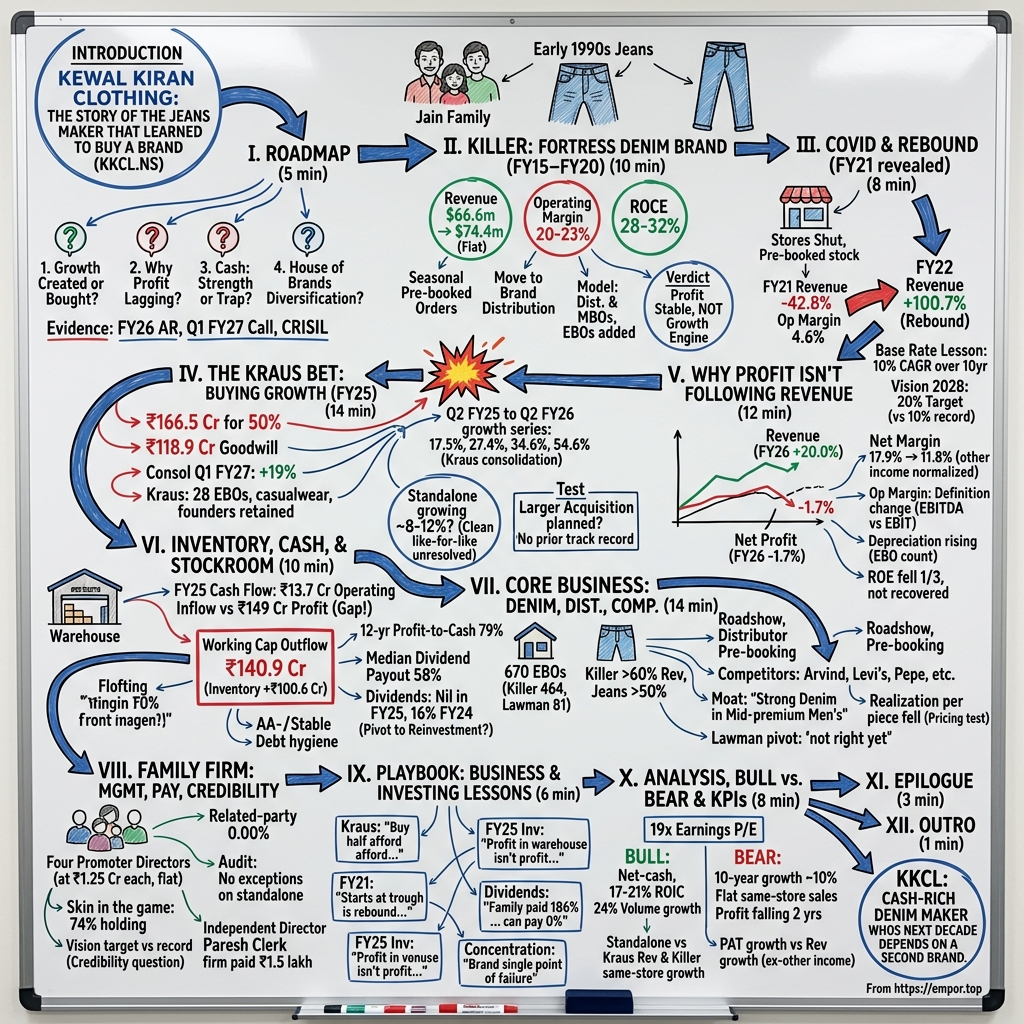
Kewal Kiran Clothing: The Story of the Jeans Maker That Learned to Buy a Brand
I. Introduction & Episode Roadmap
Picture a high street in any large Indian city on a Saturday evening. On one side, a Levi's store with its red tab in the window. Across the road, a Zudio queue that stretches out of the door, with T-shirts priced below the cost of a cinema ticket. And somewhere between the two, often in a smaller shop run by a local franchisee, a store with a black-and-red sign that reads Killer. That sign has sat on Indian streets for about three decades, through the license-raj hangover, the mall boom, the e-commerce boom, a pandemic, and now the fast-fashion boom. It belongs to Kewal Kiran Clothing Limited, a Mumbai family company that the stock market valued at about ₹2,822 crore on 1 October 20264.
Here is the number that frames this story. In the year to March 2026, Kewal Kiran grew consolidated revenue by 20%, to about ₹1,213 crore. Net profit fell by 1.7%1. A company that spent most of its life with the opposite problem (excellent profits, sluggish sales) suddenly had sales racing ahead and profit standing still.
That is not, on its own, a crisis. The company carries no net debt, holds something like ₹350–400 crore of liquid investments, and is rated AA-/Stable by CRISIL13. Its promoters, the Jain family, own about 74% of the shares1. This is a careful, conservative, family-run menswear house. Which is exactly why the recent pattern deserves a closer look. Careful companies do not usually see revenue and profit move in opposite directions two years running without something structural changing underneath.
Something did change. In July 2024, for the first time in its history, Kewal Kiran consolidated a brand it had not built: Kraus, a women's-and-casualwear label, half of which it bought for about ₹166.5 crore1. Management now talks about a "Vision 2028" of 20% annual growth and has said a larger acquisition is on the cards2.
So this story chases four questions:
- Is the ~20% growth created or bought?
- Why is profit not following revenue?
- Is the cash pile a strength or a trap?
- Can a Killer- and denim-led, family-run house of brands actually diversify?
The evidence comes mostly from three places: the FY26 annual report, the Q1 FY27 earnings call held in August 2026, and CRISIL's rating rationale. Together they let us separate what management says from what the numbers show, and in a few important places they disagree.
To understand why the Kraus deal is such a departure, we first need to understand what kind of machine Killer was for its first quarter century: a fortress that earned beautifully and barely grew.
 Subscribe on LinkedIn
II. Killer: How a Denim Brand Became a Fortress (founding to FY2020)
The family and the jeans
The Kewal Kiran story begins with brothers. The Jain family, led in the company's public life by Chairman and Managing Director Dinesh P. Jain, built a garment business in Mumbai and incorporated Kewal Kiran Clothing in 1992, as its corporate identity number records1. The bet they made was unusual for India at the time. In the early 1990s, most Indian men bought trousers stitched by a local tailor or picked up unbranded jeans from a market stall. A "brand" meant something imported, or something sold by a giant textile mill. The Jains built Killer as a domestic jeans brand with a swagger in its name, aimed squarely at young men who wanted to look Western without paying Western prices.
Killer became the anchor of a small family of labels: Lawman Pg3 for a sharper, club-going look, Integriti for value-conscious denim, Easies for smart casuals, and later Junior Killer for boys13. But the hierarchy never really changed. Even today, Killer accounts for more than 60% of revenue and jeans for more than half3.
Four promoter directors run the company today, each paid ₹1.25 crore a year1. Control sits primarily with the P.K. Jain Family Holding Trust, which holds 49.92% of the company, with Dinesh Jain holding a further 5.92% in his own name1. That is a structure built for continuity: the family trust is the owner, and the brothers are the operators.
The model: pre-booked seasons, sold by the piece
How does a brand like Killer actually make money? Not like a modern fast-fashion retailer. Kewal Kiran designs collections ahead of each season, shows them to distributors and retailers at roadshows, and takes pre-booked orders2. It then makes and ships against those orders. The unit is simple: one garment, sold net of turnover discounts1. There are no subscriptions, no contracts, no long-term commitments.
The goods reach customers through four doors. Multi-brand outlets, the neighbourhood clothing shops that stock Killer next to five other labels. Large-format stores, the department chains. Exclusive brand outlets, or EBOs, that sell only Kewal Kiran brands. And, increasingly, e-commerce2. Over time the company shifted from loose wholesale toward controlled brand distribution, which is how a jeans maker becomes a brand owner: it decides where its product sits, and at what price.
Think of the pre-booking model as a restaurant that takes reservations before cooking. It reduces the risk of making the wrong thing. But it does not remove the risk of making too much of the right thing, and it puts a lot of trust in distributors who may pay slowly when the season disappoints.
A decade of excellent, flat returns
What did that model produce? On profitability, it was outstanding. Between FY15 and FY19, operating margins sat in a band of roughly 20–23%, and return on capital employed reached 28–32% in the best years4. For context, a business earning 30% on its capital can, in theory, double its capital base every three years if it reinvests. Few Indian apparel companies have ever come close.
But it did not reinvest at that pace, and it did not grow. Measured in US dollars, revenue was about $67 million in FY15 and about $74 million in FY204. In rupees, sales grew in single digits most years and actually fell 3% in FY184. That year is the telling one. Debtor days, the time retailers took to pay, stretched from about 82 to 129, and inventory days rose from about 69 to 126 over the following year4. When a branded apparel company's sales stall while its stock and its credit to customers swell, it usually means it is pushing goods into the channel to protect volume.
Earn, then hand it back
The family's answer to slow growth was to pay out. Dividend payout ratios ran above 55% of profit in nearly every year from FY15 to FY20, and in FY16 the company paid out more than its full year's profit4. That is the pattern of a mature franchise: when the core business cannot absorb capital at high returns, you return it.
The verdict on the fortress
So was Killer a durable moat or a long fashion cycle? The record supports the first, in a narrower form than "moat" implies. Two decades of 20%-plus operating margins are hard to fake; a brand without pricing power would have been competed down to the 8–10% margins typical of unbranded garment makers. But pricing power showed up in margins, not in share gains. Killer was a highly profitable, stable franchise, not a growth engine. That distinction matters for everything that follows, because the company's current ambition is to become the second thing without losing the first.
Then, in March 2020, the stores shut, and the fortress was tested in a way no fashion cycle had tested it.
III. Covid and the Rebound: What FY21 Revealed
Spring 2020: a season in the warehouse
Consider what the lockdown meant for a pre-booked apparel company. By March 2020 the spring-summer collection had been designed, ordered, made and in many cases shipped to distributors. Then India locked down. Shops closed. The distributors who owed Kewal Kiran money had no customers to sell to, and the goods that had not yet shipped sat in warehouses as the season they were made for slipped away.
The damage showed up in FY21. Revenue fell 42.8%4. Operating margin collapsed from the low twenties to about 4.6%4. Debtor days peaked at 161, meaning the average customer was taking more than five months to pay4. For a discretionary, seasonal business, this was the worst-case stress test, and it is a useful one to remember: it shows how quickly a fortress-margin brand can become a breakeven one when footfall disappears.
The balance sheet did its job
What saved the year was the conservatism of the previous decade. Cash and short-term investments actually rose through FY21 and FY22 to about $37–42 million, even as profit collapsed4. Cash from operations held up because the company collected receivables and sold down stock rather than making new goods. The family did something revealing with that cushion: it paid a dividend worth 186% of the year's profit in FY214. In the worst year in its history, Kewal Kiran paid shareholders nearly twice what it earned, from reserves.
That says two things. It says the balance sheet was strong enough to fund a payout and a recovery at the same time. And it says the family treated the dividend as a promise to shareholders rather than a residual. Hold that thought, because in FY25 the same family paid nothing.
The rebound, and the trap in the growth rate
FY22 revenue roughly doubled from the depressed base, rising about 101%4. By FY23 the business was larger than before Covid. The rebound was complete.
Now comes the analytical trap. Look up Kewal Kiran's five-year revenue growth today and you will see about 32% a year4. That sounds like a high-growth company. It is not. That five-year window starts at FY21, the bottom of the trough. Stretch the window to ten years and the growth rate falls to about 10% a year, with net profit growing about 8% a year4. The ten-year figure is the honest base rate. It captures a full cycle: the flat pre-Covid decade, the crash, and the recovery.
The claim that the rest of the story tests
On the Q1 FY27 call, management described its historical growth as a "15% CAGR" and set out "Vision 2028" with a 20% target2. Neither number matches the ten-year record of about 10%. Management may be choosing a flattering window, or it may be pointing to a recent period that includes acquisition. Either way, the target asks the company to grow at roughly twice its own long-run rate for several years in a row.
The lesson is simple and worth carrying through the rest of this story: always ask where a growth rate starts. And when a family firm that grew at 10% for a decade suddenly targets 20%, the next question is how it plans to close the gap. Kewal Kiran's answer arrived in July 2024, and it involved a chequebook.
IV. The Kraus Bet: Buying Growth for ₹166 Crore (FY25)
18 July 2024
On 18 July 2024, Kewal Kiran's consolidated accounts changed shape. From that day, they included Kraus Casuals Private Limited, a casualwear brand known for women's denim and fashion, in which Kewal Kiran had taken a 50% stake1. For the first time in three decades, reported revenue included sales from a brand the Jain family had not built.
The price was about ₹166.5 crore for half the company, paid through a mix of fresh capital into Kraus and shares bought from its founders, including a deferred portion1. Kewal Kiran booked goodwill of about ₹118.9 crore, which is the part of the price paid for something other than identifiable assets: the brand, the team, the expected growth1. Because Kewal Kiran consolidates Kraus fully while owning only half, its balance sheet now carries a non-controlling interest of about ₹181 crore, which represents the other shareholders' share of Kraus1.
In cash terms, the company paid about ₹104 crore in FY25, net of cash it acquired inside Kraus, and a further ₹20 crore in FY261. For a business that had made no large acquisition before in its listed history, this was a big step: roughly a third of the liquid cushion it carried before the deal.
What Kraus brings
Kraus is small but distinct. It runs 28 exclusive stores2. It skews toward women's wear, which Killer has never seriously served. Management says Kraus earns margins in line with the group2. The founders stayed on and kept half the business, which aligns them with growth and keeps the brand's design sense intact. It is a sensible structure for a first deal.
Strip it out, and the growth rate halves
Now read the quarterly growth series with Kraus in mind. From the September 2024 quarter to the June 2025 quarter, consolidated revenue growth ran at about 18%, then 27%, then 35%, then 55%4. That acceleration looks spectacular. But it reflects Kraus months landing in the current year while the comparison quarters had none. Once Kraus is in both periods, the picture calms down.
CRISIL estimated that Kraus added about ₹109 crore of revenue in the first nine months of FY25 alone3. And management, on the Q1 FY27 call, gave the cleanest split yet: consolidated growth of about 19% in the June 2026 quarter, against standalone growth of about 12%2. In the March 2026 quarter, standalone growth was only about 8%2.
So the answer to the first question is mixed, and a fair reading goes like this. Part of the 20% headline is acquired. The standalone business, the one built around Killer, is growing at roughly 8–12%. That is a little above its ten-year base rate, which is genuine good news, but it is not 20%. And on the same call, management said Killer's same-store growth was flat2. The growth in the core brand is coming from more stores and more volume, not from each store selling more.
Was the price fair?
This is where honesty requires a limit. Kewal Kiran has not published Kraus's standalone profit, the multiple it paid, or the terms on which it might buy, or be required to buy, the remaining 50%. Without those, nobody outside the company can say whether ₹166.5 crore was cheap or expensive, and benchmarking against other deals would be guesswork. What can be said is that Kewal Kiran's auditor, Khimji Kunverji & Co, singled out the Kraus goodwill as the only key audit matter in the consolidated accounts and found no significant exceptions in testing it for impairment1. That is a clean bill for now, not a verdict on the price.
The stress test: what comes next
On the Q1 FY27 call, management said it was looking at a larger acquisition, without naming a target2. A skeptical investor would ask three questions here.
First, how will a bigger deal be priced, when the first one's economics have not been laid out for shareholders? Second, what are the terms for the other half of Kraus? An open option on the remainder is a future cash call whose size is not yet visible to minority shareholders. Third, does the company have a record to judge it by? It does not. Before Kraus, Kewal Kiran's capital allocation was conservative to the point of passivity: build Killer, return the cash. There is no track record of integrating acquisitions, good or bad.
The verdict: Kraus is a reasonable first step that has delivered the growth it was bought for, and the auditors are comfortable with its carrying value. But a growth strategy that leans on acquisitions, run by a team with one deal behind it and no disclosed terms on the remainder, is unproven. The KPI that settles it is simple: standalone revenue growth reported separately from Kraus, quarter after quarter.
Bought growth has another cost, which is that it does not always bring proportional profit. That is the second puzzle.
V. Why Profit Isn't Following Revenue (FY25–FY26)
Two results lines that do not rhyme
FY25: revenue up 16.5%, net profit down 6.2%4. FY26: revenue up 20.0%, net profit down 1.7%4. Two years in a row, the top line raced and the bottom line slipped. Net margin fell from about 18% in FY24 to about 12% in FY264. Return on equity fell from about 23% to about 15%4. That is not a rounding error. A third of the company's return on shareholders' money disappeared in two years.
What happened? There are four moving parts, and they are worth taking one at a time.
Clue one: other income came back to earth
Kewal Kiran earns a lot from its treasury. Consolidated other income, mostly returns on mutual funds, portfolio management schemes, alternative funds and bonds, was about ₹49 crore in FY25 and about ₹24 crore in FY261. FY25 was flattered by a one-off gain of about ₹10.5 crore from selling part of the company's stake in Baazar Style Retail during that company's IPO1. In FY25 other income was about a quarter of pre-tax profit. In FY26 it was about an eighth1.
That alone explains most of the FY26 drop in net margin. The company's own PAT margin fell from about 14.2% to 12.3%, and halving the treasury contribution accounts for much of that1. In other words, FY25 profit was inflated by investment gains, and FY26 profit looks weak partly because the comparison is unfair.
Clue two: a definition shift that looks like a margin collapse
A careful reader of the data needs one warning here. Third-party data shows operating margin falling from 19.0% in FY25 to 16.1% in FY264. But the FY25 figure appears to match the company's EBITDA, before depreciation, while the FY26 figure looks like EBIT, after depreciation. The apparent three-point fall in margin is partly an artefact of comparing two different measures.
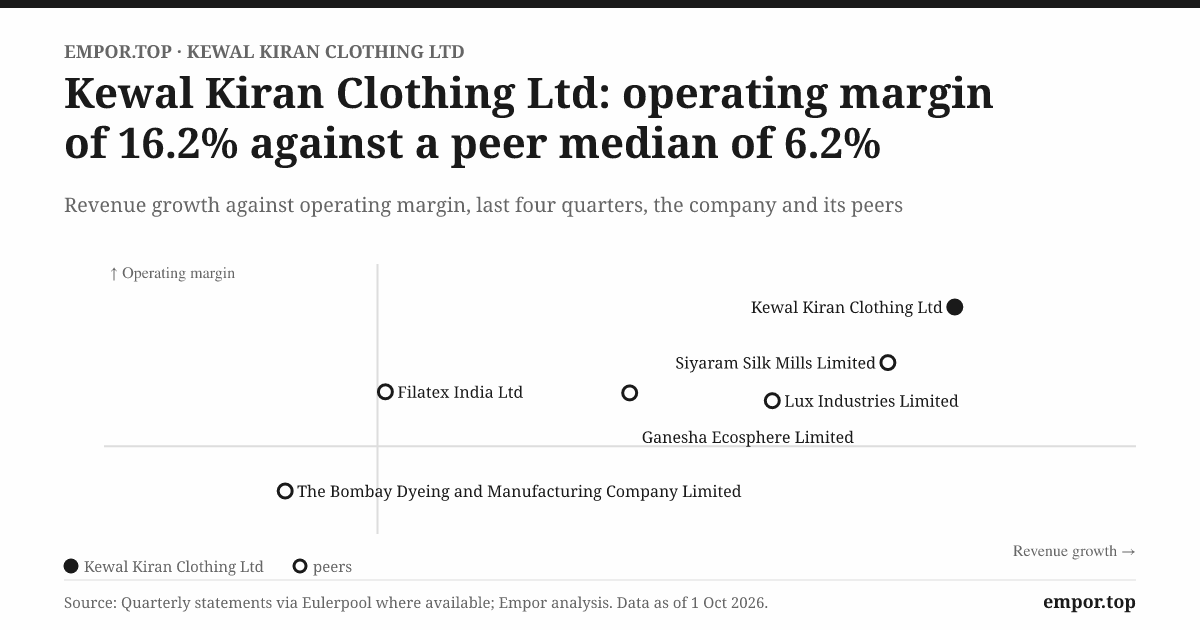
Using the company's own definitions, EBITDA margin was about 19.6% in FY26, above management's guidance of 17–18%, and was over 19% again in Q1 FY2712. That is a point in management's favour. The core operating business is holding its margin even as it adds stores and absorbs a new brand.
Clue three: costs that are genuinely rising
But not everything is definition. Depreciation rose from about ₹32 crore to about ₹44 crore in FY261. Part of that is lease depreciation on right-of-use assets, the accounting treatment of store rentals, which grows as the company opens more EBOs and absorbs Kraus's stores. Employee costs rose to about 14.1% of revenue from 13.6%1. These costs sit below EBITDA, which is why the "holding margin" story and the "falling profit" story can both be true.
Clue four: a small, quiet tailwind from provisions
The last clue is subtle. Kewal Kiran's trade receivables are large: about ₹234 crore at the standalone level, roughly 95 days of sales1. The quality looks acceptable: most of it is under six months old, balances beyond 270 days are fully provided, and very little is older than a year1. But in each of the last two years, the company reversed part of its expected credit loss provision, by about ₹3.5–3.8 crore a year1. That added roughly 1.7–1.9% to pre-tax profit. It is legitimate accounting when collections improve. It is also profit that does not come from selling clothes, and it cannot repeat forever.
The quarterly shape
The quarterly picture confirms the pattern. Net margin fell to about 10% in the December 2024 quarter and was about 10% again in the March 2026 quarter, before recovering to about 14% in the June 2026 quarter4. The September quarter, when festive orders ship, is the seasonal peak.
The verdict
Management's explanation on calls has been that margins are healthy and that the treasury line moves around. That matches the numbers as far as it goes. The fair reading narrows the claim: the operating business holds an EBITDA margin near 19–20%, and most of the PAT margin dip is other income normalising. But depreciation and staff costs are climbing faster than sales, provision releases are flattering profit modestly, and returns on equity have fallen by a third without recovering. The test is FY27 profit growth with other income stripped out. If it matches revenue growth, the dip was timing. If it does not, the new store-heavy, acquisition-heavy model simply earns less per rupee of sales than the old one.
And that raises the obvious follow-up. If the operating business is fine, where did the cash go in FY25?
VI. Inventory, Cash and the ₹140 Crore Stockroom (FY25–FY26)
₹149 crore of profit, ₹14 crore of cash
Open the FY25 consolidated cash-flow statement and one line jumps out. Net profit was about ₹149 crore. Cash generated from operations was about ₹13.7 crore1. For every ₹10 of reported profit, about ₹1 arrived as cash.
The gap was working capital, and above all inventory. The company absorbed about ₹141 crore into working capital in FY25, of which about ₹101 crore was extra stock1. Measured against EBITDA, cash from operations fell to about 7% in FY25, then recovered to about 70% in FY26, when operating cash flow rose to about ₹183 crore14.
Some of the FY25 build is easy to explain. Kraus brought its own stock. New EBOs need shelves filled. And the company was growing fast. But inventory days have stayed in a 134–140 band in FY25 and FY26, and inventory turnover fell from about 6.5 times to about 5.0 times14. Stock has not gone back to where it was. In a fashion business, inventory that sits too long is not an asset; it is a future markdown.
Twelve years of where the cash went
Step back further. Over the twelve years from FY15 to FY26, Kewal Kiran reported about ₹1,096 crore of net profit and generated about ₹869 crore of operating cash, about 79% conversion4. Free cash flow, after capital spending, was about ₹633 crore. Dividends took about ₹502 crore of that, again about 79%4. Cash and short-term investments grew by only about ₹119 crore over the whole period4.
That is the old Kewal Kiran in a single sentence: it earned, it converted most of the profit to cash, and it handed four-fifths of the free cash to shareholders, most of whom are the family.
The payout pivot
Then the pattern broke. The payout ratio fell to about 16% in FY24, nothing in FY25, and about 18% in FY26, against a twelve-year median of 58%4. That is a dramatic shift for a company that paid 186% in the Covid year.
The timing lines up with Kraus and with management's talk of a bigger acquisition. The family appears to be keeping cash for deals. But management has not published a capital-allocation policy saying so. Shareholders are left to infer that the dividend has been turned down to fund growth, without a stated hurdle rate for the deals it might fund.
The cash is real
None of this means the cash is imaginary. The company reported liquidity of about ₹353 crore at March 2026, and management cited "about ₹400 crore" on the Q1 FY27 call12. Around ₹260 crore sits in mutual funds, portfolio management schemes, alternative funds and bonds1. Real bank borrowings were only about ₹48 crore at year-end, down from ₹108 crore, all working-capital lines secured on stock and receivables1. Interest cover was about 15 times1.
One technical caution: third-party data shows borrowings of about $14.5 million and debt to equity of 0.14, which appears to include lease liabilities of about ₹80 crore14. The company's own 0.14 uses only bank debt. The two numbers should not be mixed. Either way, the balance sheet is not stretched.
The idle assets
Two assets deserve a sentence each. Capital spending jumped to about ₹85 crore in FY25, roughly doubling property, plant and equipment, then fell back to about ₹21 crore in FY261. And there is a land investment in Goregaon, Mumbai, that management describes as being "in a standstill position", with the company "exploring development as well as outright sale"2. Idle land does not earn a return. A decision either way would free capital or put it to work.
The verdict
The cash is real and the balance sheet is a genuine strength: it carried the company through FY21 and keeps its credit rating high. But the free cash flow yield today rounds to zero4, the treasury yield swings from year to year, a meaningful chunk of capital sits in a stalled property, and the dividend has been cut without a published replacement policy. The strength is intact. Whether it earns a return for minority shareholders is unproven, and the next acquisition will be the test.
All of that depends, in the end, on the thing that generates the cash: the brands, the stores, and the competitive street they sit on.
VII. The Core Business Up Close: Denim, Distribution and the Competition
The roadshow and the high street
Twice a year, Kewal Kiran puts its new collections in front of distributors and retailers, and they place their orders for the coming season2. That roadshow is where the brand's power is measured in the most direct way: will the shops commit capital to Killer stock, at Killer's prices, months ahead?
Then the clothes go out to the high street, where the competition is brutal. On one side sit the global denim brands: Levi Strauss, Pepe Jeans, and Flying Machine from Arvind Fashions. On another, the big Indian apparel houses: Raymond, Aditya Birla Fashion and Retail, and Arvind's portfolio. And underneath them all, the force that has changed Indian apparel most in the last five years: value fast fashion, led by Trent's Zudio and Reliance Retail's formats, selling basic jeans and shirts at a fraction of Killer's price. Add the online-first brands that live on Myntra and Instagram, and Killer is fighting on every front.
The numbers that show the shape
At 30 June 2026, the company had 670 exclusive stores: 464 Killer, 81 Lawman, 28 Kraus, and the rest spread across smaller labels2. Management targets 50–70 net additions in FY27, but added only 4 in the first quarter2. Retail revenue grew about 29% in that quarter2.
Look at volume against price. In Q1 FY27, apparel volumes rose about 24% while revenue rose about 19%2. Revenue growing slower than volume means the average selling price per garment fell. Management described the growth as "volume as well as value"2, but the arithmetic says value lagged. That could be mix (more Integriti and Junior Killer, which sell for less) or it could be discounting. Either way, it is a sign that pricing power is being tested, not exercised. And Killer's same-store growth was flat2.
How the stores are run
The company's capital spending is light for a business with 670 branded stores. The likeliest explanation is that most EBOs are franchise-run, with partners funding fit-outs and inventory, though Kewal Kiran does not break out the ownership mix. A franchise model is efficient for capital, which helps explain the high historical returns. But it also means less control over how stores are run, how quickly they sell through, and how much the brand can push prices.
The moat, argued once
This is the place to run the frameworks properly.
Hamilton Helmer's 7 Powers. Two powers plausibly apply. Branding: Killer has sustained 16–20%-plus operating margins and returns on invested capital in the high teens to low twenties for most of two decades4. An unbranded garment maker cannot do that. Scale economies in distribution: a network of hundreds of stores and thousands of multi-brand retailers spreads design, marketing and logistics costs. The other powers are absent. There are no network effects, no switching costs (a customer can buy Levi's tomorrow), no cornered resource, no process advantage visible in the numbers, and counter-positioning belongs to the value players, not to Killer.
Porter's Five Forces. Supplier power is low: fabric and garment-making capacity in India are abundant. Buyer power is moderate. Large-format stores and big distributors buy in bulk, and the company notes one customer whose concentration is "greater than other parties", without naming it or its share1. Threat of new entrants is real but has historically been offset by the cost of building brand recall. Threat of substitutes and rivalry are the live forces. Fast fashion substitutes on price; global brands compete on aspiration; online brands compete on novelty.
The evidence base here is thinner than one would like: there is no published market-share data for Killer and no clean peer margin comparison in the company's disclosures. On what is visible, the moat narrows to a smaller, more defensible claim: Killer is a strong denim brand in India's mid-premium men's segment. It is not a diversified house of brands, and flat same-store sales plus falling price per piece say its edge is being contested.
The diversification test
Can the company build a second leg? Take each brand by its weight.
Kraus is the one proven second leg, and it was bought rather than built.
Lawman, the company's long-standing second brand, has gone backwards. Its store count was cut from about 90 to 81, and management said on the Q1 FY27 call that its repositioning "is not right yet"2. That is an unusually candid admission, and it matters: the company's own record of growing a second brand organically is weak.
Integriti and Junior Killer are showing traction, according to management, but their revenues are not disclosed2.
CRISIL frames the same issue in rating terms. It names concentration in Killer and jeans as the constraint, and a rising share from other brands as an upgrade trigger3. Its downgrade triggers, a substantial revenue fall or EBITDA margin below 15%, describe something very close to what FY21 looked like3. That is a reminder that the rating rests on the brand continuing to work.
One footnote on geography: exports are small, flat and unhedged, and currency gains were under ₹0.3 crore in FY261. This is an Indian story.
So the brand works, but it works mainly as one brand. Whether that changes depends on the people running it, which brings us to the family.
VIII. The Family Firm: Management, Pay and Credibility
The remuneration table
Turn to the pay disclosures in the annual report and the picture is unusually tidy. Four promoter executive directors, each paid ₹1.25 crore, with no increase from the prior year1. Together that is about ₹5 crore, roughly 2.5% of FY26 consolidated pre-tax profit of about ₹203 crore1. For a family that controls a ₹2,800 crore company, that is modest. Many Indian promoters pay themselves far more.
Just below that table sits another one. Six relatives of the executive directors are on the payroll: Pankaj K. Jain as President, Retail, and Hitendra H. Jain each at ₹50 lakh; and four younger family members at between ₹10 lakh and ₹28 lakh1. Together, about ₹1.78 crore. The amounts are small. What is odd is the labelling: the company's AOC-2 form lists these under the heading for transactions "not at arm's length basis", while the notes to the accounts describe all related-party dealings as arm's length1. That is probably a drafting inconsistency rather than a substantive admission, but it is the kind of detail a careful governance reviewer notices.
Skin in the game, and its limits
The promoter group owns about 74.29%, with mutual funds at about 7.4%, foreign portfolio investors at about 2.3%, and the rest held by about 33,000 shareholders1. The free float is about a quarter of the company. That means two things. Incentives are aligned through ownership rather than stock options; there is no employee stock option plan that dilutes outsiders. And institutional investors have limited voting weight, so minority shareholders depend on the family's own discipline.
Related-party trade is not a concern. Purchases from and sales to related parties are effectively nil as a share of totals, and rent and royalty income from promoter-linked entities is under ₹4 lakh1.
Small signals worth noting
A few smaller points round out the picture. One independent director, Paresh H. Clerk, is a partner in a firm that was paid about ₹1.5 lakh in professional fees1; small, but it weakens the "independent" label. Key managerial pay rose about 16% against about 10% for staff, with the CFO and Company Secretary getting raises of 20% and 26%1. The annual report prints the directors' pay ratio to the median employee as "36.16%" when it means about 36 times, a minor disclosure slip. Two senior executives left during FY26, a Chief HR Officer and a brand head, though no key managerial personnel resigned1. Succession, for a family firm run by brothers, is not formally documented in the company's disclosures.
Promises against outcomes
The best test of a management team is whether it does what it says. Here the record is split. On margins, management guided to EBITDA of 17–18% and delivered about 19.6%12. That is under-promising and over-delivering. On growth, management describes a 15% historical rate that the ten-year record does not support, and has set a 20% target that is roughly twice that record2. On the Q1 FY27 call, the prepared remarks were confident about volume growth and store expansion; the Q&A drew out the less comfortable details: flat Killer same-store growth, Lawman's unfinished pivot, the stalled Goregaon land, and an unnamed bigger acquisition2.
The verdict
There is no evidence of material leakage to the family, and promoter pay is modest and flat. That is a real strength, and rarer in Indian mid-caps than it should be. The credibility questions are narrower: family employment, the arm's-length labelling, a growth target well above the record, and a first large acquisition whose remaining terms are not disclosed. On pay and related parties, the claim of good governance holds. On capital allocation, it remains unproven until the company shows minority shareholders the price and return of what it buys.
Which leaves the lessons this family's story teaches.
IX. Playbook: Business & Investing Lessons
"Buy the half you can afford, and ask what you owe on the other half." Kraus was a sensible first deal: founders kept, brand intact, growth delivered. But a 50% purchase is half a transaction. The remaining stake is a future obligation or a future opportunity, and until its terms are visible, the true price of the acquisition is unknown. For any investor watching a company buy a minority-structured stake, the second half is where the real cost hides.
"A five-year growth rate that starts at the trough is a rebound, not a trend." Kewal Kiran's 32% five-year revenue growth and its 10% ten-year growth describe the same company. One starts in the Covid crater; the other spans a full cycle. Every growth rate has a starting date, and the starting date is often the whole argument.
"Profit that sits in a warehouse isn't profit yet." In FY25, Kewal Kiran reported about ₹149 crore of profit and turned about ₹14 crore of it into operating cash, because about ₹100 crore went into stock. In fashion, unsold inventory is a bet on next season's taste. Until it sells at full price, the profit is provisional.
"A family that paid out 186% in a crisis year can pay out nothing in a growth year." The dividend was the old Kewal Kiran's promise to its shareholders. Its suspension in FY25 is the clearest signal that the company has changed its mind about what its cash is for. When a dividend policy changes without a stated replacement, shareholders should ask what the cash is now being saved to buy.
"The brand that funds the company is also its single point of failure." Killer pays for everything: the stores, the dividends, the Kraus deal. CRISIL's rating, the company's margins and the family's wealth all rest on one denim label. Diversification is not a strategy here; it is insurance the company has not yet been able to buy organically.
The meta-lesson ties them together. When a mature, profitable company suddenly accelerates, separate the growth it built from the growth it bought, and judge them on different scales. Built growth tests the brand. Bought growth tests the buyer.
X. Analysis, Bull vs. Bear & KPIs
Where the market prices it
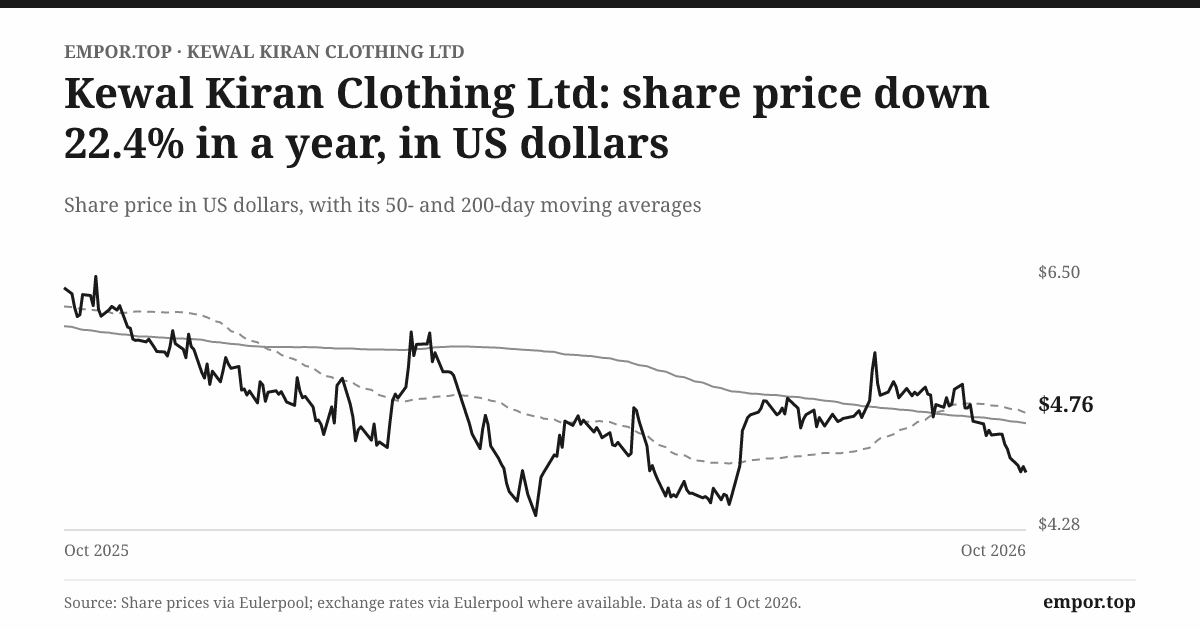
On 1 October 2026, Kewal Kiran's shares closed at about ₹458, about 18% below their 52-week high of ₹5604. The market value of about ₹2,822 crore sits about ₹246 crore above the enterprise value of about ₹2,576 crore, the gap being the company's net cash4.
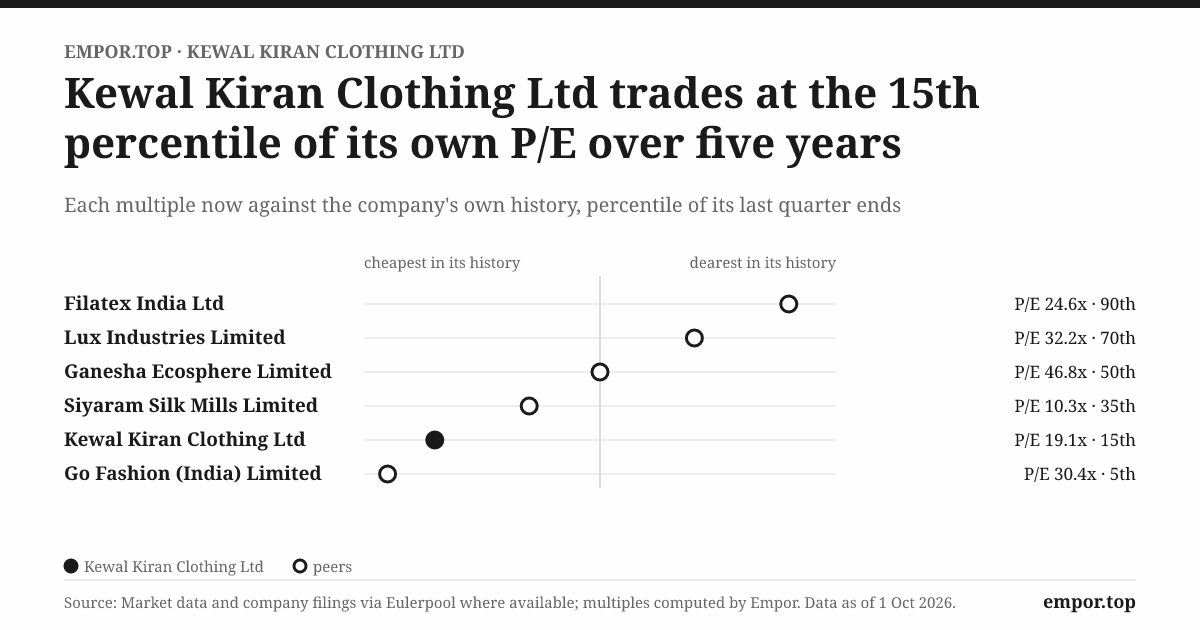
At about 19 times trailing earnings, the stock trades below its own five-year median of about 23 times4. EV to EBITDA is about 10 times, price to book about 3 times, and the dividend yield is under 1%4. The largest fall in the last five years was about 48%4, a reminder that this is a cyclical, discretionary business whose shares can move sharply.
What does that price appear to assume? A multiple below its own history suggests the market has absorbed the two years of falling profit and is not paying for a return to 20% growth with matching earnings. A proper comparison with listed apparel peers would sharpen this, but the company's own history is the cleanest yardstick, and on that yardstick the market is sceptical rather than euphoric.
The bull case
The balance sheet is net cash, rated AA-/Stable, with about ₹350–400 crore of liquidity12. Returns on invested capital remain around 20%4. The operating business delivered EBITDA margins above guidance1. Volume grew about 24% and retail about 29% in Q1 FY272. Standalone growth of about 12% in that quarter is above the ten-year record. If standalone growth stays above 12% and profit growth catches up with revenue, the company is compounding faster than at any time in the last decade, and the market is paying less for it than it used to.
The bear case
The ten-year growth rate is about 10%. Killer's same-store sales are flat, price per piece is slipping, and the company's organic second brand, Lawman, is shrinking. Net profit has fallen two years running and returns on equity have dropped by a third. Cash earns a volatile return, part of it is tied up in stalled land, and the dividend has been cut to fund an unnamed acquisition by a team with one deal behind it. In that reading, the 20% growth is mostly bought, and the company is spending its fortress balance sheet to look like something it is not.
Weighing the two
The history narrows rather than rejects the bull case. The brand is real and the balance sheet is strong; neither is in question. But the evidence does not yet support "Kewal Kiran is a compounding house of brands." It supports "Kewal Kiran is a strong mid-premium denim brand, growing a little faster than its history, that has started buying growth with its cash." Which version proves right depends on two things the company has not yet shown: organic growth beyond Killer, and acquisitions that earn more than the cash they replace.
Material risks
Only four matter. A demand slowdown in discretionary apparel, with FY21 as the stress case. Share loss to value fast fashion and online-first brands, visible already in flat same-store sales. Kraus execution and goodwill: about ₹119 crore of goodwill rests on the brand continuing to perform1. And inventory build, which has already cost one year of cash.
The KPIs that matter
- Standalone revenue growth against Kraus, and Killer same-store growth. Latest reading: standalone about 12% in Q1 FY27, with Killer same-store growth flat2. This tells you whether growth is built or bought.
- Profit growth against revenue growth, with other income stripped out. Latest reading: net profit down 1.7% on revenue up 20% in FY26, though Q1 FY27 net profit rose about 22% on revenue up about 19%4. This tells you whether the new model earns what the old one did.
- Inventory days and cash conversion. Latest reading: inventory days about 134 and cash from operations about 70% of EBITDA in FY26, both improved from FY25 but stock still elevated4.
XI. Epilogue
Tonight, Kewal Kiran stands at an unusual point for a company with its history. It is growing faster than it has in a decade, and earning less on each rupee of growth. It has more cash than it needs, and it has stopped giving it back. It owns a brand that works, half of one it bought, and one it is still trying to fix.
The next few months will start to settle the four questions.
The September 2026 quarter results, due in the coming weeks, cover the seasonal peak and the festive shipping season. If management again splits standalone growth from Kraus, and if standalone holds near 12% with Killer same-store growth turning positive, the "created or bought" question tilts toward created. If standalone slips back toward 8%, the 20% vision looks more like a function of acquisition.
The FY27 annual report will show whether the non-Killer share of revenue is rising. That is the number CRISIL has said would support an upgrade3, and the most direct evidence on whether the house of brands is real.
The terms on the remaining half of Kraus, and the price and return of any next acquisition, will answer the cash question. A deal priced at a sensible multiple of proven profit would show the family can redeploy its cash as well as it once earned it. A large, expensive deal for an unproven brand would turn the cash pile from a strength into the trap that the dividend cut hints at.
And the Goregaon land: develop or sell. Either decision would put idle capital to work. More waiting would not.
The tension that remains is plain. A debt-free balance sheet and a brand that works, pursuing a growth ambition twice the company's historical rate, with the gap to be closed by acquisitions whose economics the family has not yet shown its minority shareholders.
XII. Outro
Go back to the Saturday-evening high street, the Killer sign between the Levi's window and the Zudio queue. For three decades, that one sign earned the Jain family margins most Indian apparel companies could only envy, and they handed most of it back to shareholders. Then, in July 2024, they paid ₹166 crore to find out what else Kewal Kiran could be.
The answer is not in yet. Kewal Kiran is a cash-rich denim maker whose next decade depends on whether a second brand can ever earn what Killer does.
References
-
Annual Report 2025-26 — Kewal Kiran Clothing Limited, 2026 ↩↩↩↩↩↩↩↩↩↩↩↩↩↩↩↩↩↩↩↩↩↩↩↩↩↩↩↩↩↩↩↩↩↩↩↩↩↩↩↩↩↩↩↩↩↩↩↩↩↩
-
Q1 FY27 Earnings Conference Call Transcript — Kewal Kiran Clothing Limited, 2026-08-07 ↩↩↩↩↩↩↩↩↩↩↩↩↩↩↩↩↩↩↩↩↩↩↩↩↩↩↩↩
-
Rating Rationale (CRISIL AA-/Stable, ₹175 cr bank facilities) — CRISIL, 2025-03-25 ↩↩↩↩↩↩↩
-
Kewal Kiran Clothing company page — Screener ↩↩↩↩↩↩↩↩↩↩↩↩↩↩↩↩↩↩↩↩↩↩↩↩↩↩↩↩↩↩↩↩↩↩↩↩↩↩
 LinkedIn
 WhatsApp
 Reddit
 Hacker News
 Email
Email Kindle
 RSS Feed
 Spotify
 Apple Podcasts
 Amazon Music
 Audible
 YouTube