Kalyani Investment Company: The Story of a Family's Vault
I. Introduction & Episode Roadmap
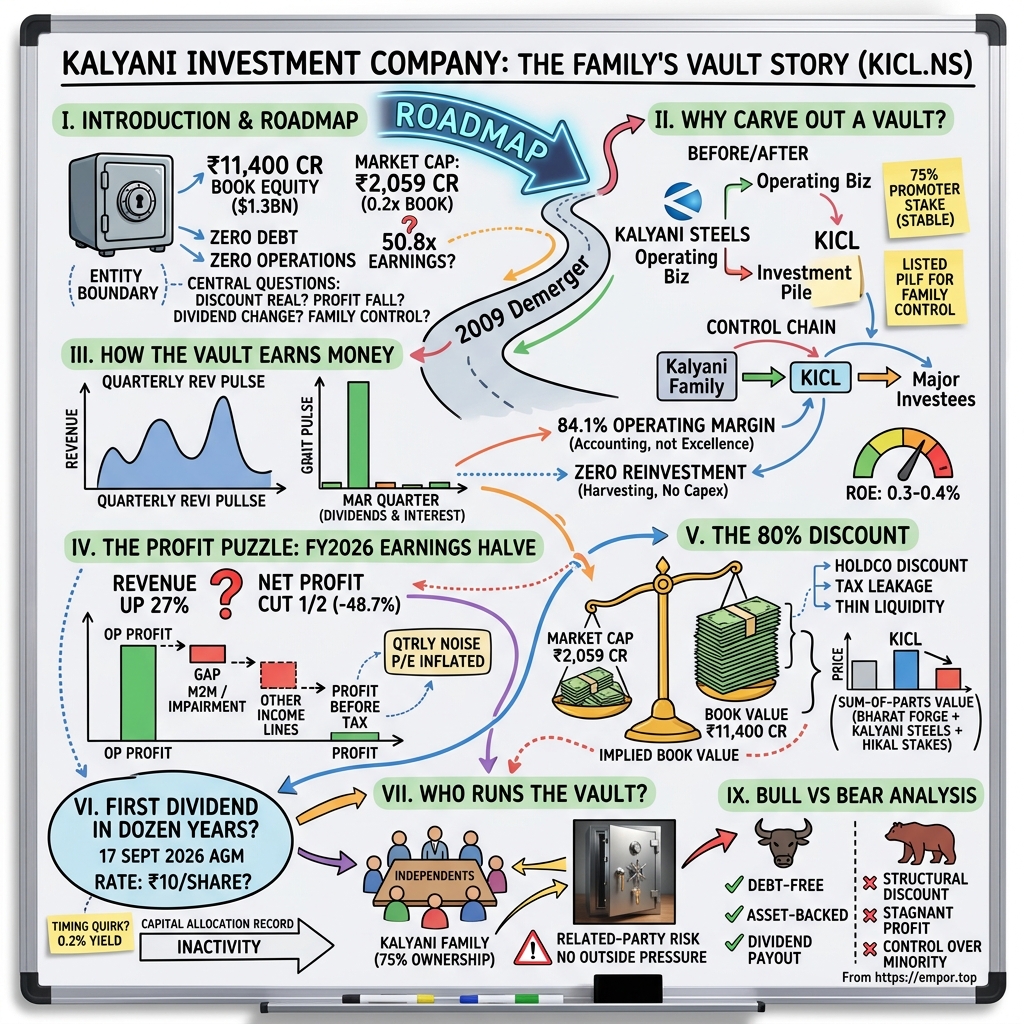
Picture two numbers on one trading screen in Pune on the first morning of October 2026. The first is the book value of a small listed company called Kalyani Investment Company Limited: roughly ₹11,400 crore of shareholders' equity, about $1.3 billion, with not a rupee of debt against it12. The second is what the stock market will pay for all of it: ₹2,059 crore1. The buyer of a single share at ₹4,712 is buying a claim on about ₹26,000 of reported net assets1. The same company trades at 0.2 times book value and at more than 50 times its earnings1. Cheap and expensive at once. That contradiction is the story.
KICL, as the market calls it, is not a forging company. It does not make crankshafts, steel bars or pharmaceutical intermediates. It is a holding company registered as a non-deposit-taking core investment company, created in 2009 when the investment division of Kalyani Steels was demerged into a separate listed entity34. Its job is to hold shares in the companies of the Pune-based Kalyani Group: Bharat Forge, Kalyani Steels, Hikal and others across forging, steel, power, chemicals and banking3. More than 60% of its net assets sit in group equities and more than 90% in group securities4. It is, in plain terms, the family's vault.
That boundary matters from the first paragraph. When people talk about the Kalyani Group they talk about defence artillery, aerospace forgings and global auto supply chains. None of that is KICL's business. KICL's revenue, about $8.8 million over the last twelve months, is the dividends and interest that flow up from the group companies it owns stakes in15. The investees' factories, order books and customers belong to them. The vault only collects what they decide to send.
So this is a different kind of company story. There is no product launch, no founder in a garage, no price war. The drama is quieter and in some ways sharper: who controls a pile of valuable shares, what they earn on it, and whether the 25% of owners outside the family will ever see that value in their own hands.
Four questions run through everything that follows:
- Is the 80% discount to book value real, or an artefact of how the assets are carried?
- Why did FY2026 profit fall by about half while revenue rose 27%?
- Will the dividend put to shareholders in September 2026 change the picture?
- Is Kalyani family control a protection or a constraint for minority holders?
The route runs from the 2009 demerger, through the odd economics of a vault, into the profit puzzle, the discount, the dividend, the family that holds the key, and finally the playbook. Start with the moment the vault was built.
 Subscribe on LinkedIn
II. The 2009 Demerger: Why Carve Out a Vault?
A balance-sheet item becomes a stock
In 2009 India's industrial companies were digging out of the global financial crisis. Auto demand had collapsed the previous winter, forging order books had thinned, and boards across the country were asking what was essential and what was just sitting on the balance sheet. At Kalyani Steels, a maker of forging-quality steel, part of the answer was a pile of shares in sister companies that had nothing to do with melting scrap. The board split it off. The investment division was demerged into a new company, Kalyani Investment Company Limited, incorporated in Pune that year and later listed on both exchanges367.
The mechanics were simple and are now mostly of historical interest. What matters is what the move created. Before the demerger, the group shares were an asset buried inside a cyclical steel business; an investor buying Kalyani Steels bought steel plus a portfolio. After it, the portfolio was its own security, priced every day, with its own shareholder register. A balance-sheet line had become a stock.
Why a core investment company
India's regulator has a specific box for this kind of entity. Under the Reserve Bank of India's rules, a core investment company is a non-banking financial company whose assets are overwhelmingly invested in the shares and securities of its own group companies, and which holds those investments for control rather than for trading8. Large ones above a size threshold register with the RBI; the regime is designed for promoter holding vehicles, not for public savings, and a non-deposit-taking CIC cannot take deposits from the public8.
For a family group, the structure has obvious appeal. It concentrates the family's control stakes in one entity. It keeps those stakes apart from operating risk. And if the vault is itself listed, with the family owning about three-quarters, the family controls operating companies through a vehicle whose own free float is only a quarter of its shares. The promoter group held 74.98% in June 2026, a level that has barely moved since at least March 20234.
The jump that is not growth
The equity line tells a strange story if read naively. In dollar terms it rose from about $51 million in FY2015 to about $1.3 billion in FY20261. Almost all of that came in one step: between FY2016 and FY2017 equity leapt from roughly $67 million to roughly $569 million1. No vault earning a few million dollars a year can grow that fast by saving.
The step coincides with India's move to Ind AS, the local version of international accounting standards, which brought listed financial companies onto fair-value accounting for equity investments in the late 2010s6. Under the old Indian rules, long-term investments sat at cost, so shares bought decades ago at small sums showed up as small sums. Under Ind AS, equity investments that are not subsidiaries are generally re-measured to market value, with the change running through "other comprehensive income" rather than the profit line. The leap in book value is that repricing, not an organic gain.
The rest of the series confirms it. Equity fell sharply into March 2020, when Indian markets crashed in the pandemic sell-off, and then more than doubled by March 2021 as they recovered1. A vault carried at cost does not swing like that. A vault marked to the price of Bharat Forge does.
What sits inside
Concentration is deliberate. Market summaries put Bharat Forge at roughly 13% of the company's holdings by one measure, with Kalyani Steels and Hikal among the other large names4. The company itself describes a "varied" portfolio of listed and unlisted companies3, but varied is generous: almost all of it is one family's industrial empire.
The verdict on 2009 is that the demerger did exactly what it was designed to do for the family. It created a clean, listed control vehicle. What it did for the minority shareholder who got shares in the new entity is the question the rest of this story tries to answer, starting with how the vault actually earns money.
III. How a Vault Earns Money: Dividends, Not Operations
The March heartbeat
Every year, somewhere in Pune between February and May, the boards of Kalyani Group companies meet to approve results and recommend dividends. Those decisions travel up the chain. In KICL's quarterly accounts they show up as a heartbeat: three quiet quarters with revenue of roughly $0.4 million to $0.7 million, then a spike of $1.9 million to $2.4 million in the March quarter15. The September quarter can spike as well, when final dividends approved at investee AGMs are paid out. Then it goes quiet again.
That rhythm is the whole business. KICL does not set prices, win customers or ship goods. Its revenue unit is a dividend per share declared by another board, multiplied by the number of shares it happens to own. Interest on group debentures and loans adds a little. The people who decide KICL's revenue sit on other companies' boards.
Margins that mean nothing
Read the margins in that light. KICL reported an operating margin of 84.1% in FY2026, and above 85% in most years1. In a manufacturing company that would signal an extraordinary moat. Here it signals only that the costs of holding shares are small: a handful of staff, directors' fees, listing costs, audit. Property, plant and equipment is about $5,900, less than a family car1. The margin is an accounting shape, not operating excellence.
The cash-flow trap
A screening model would flag KICL immediately. Cash from operations has been negative every year since FY2021, about minus $1.6 million in FY2026, while profit stayed positive1. On a normal company that gap is a red flag for aggressive accounting.
Here it is classification. Indian financial companies may book dividends received from investments as investing cash flows rather than operating ones. Strip the dividends out of operations, and what remains in the operating line is salaries, overheads and tax: by construction a negative number. The money shows up instead in cash from investing, which has been positive for years and was about plus $1.6 million in FY20261. The honest cash test for a vault is not operating cash flow but dividends received against profit reported, and on that test the two broadly line up in a year when the profit line is mostly dividends.
Harvest, not redeploy
There is no capex, no R&D, no hiring plan, no expansion. Cash from financing has been zero in every year on record: no borrowings, no equity raised, and through FY2026 no dividends paid out1. The vault receives, holds and waits. That is a coherent strategy for a control vehicle. It is not a strategy for compounding.
The base rate
The growth record is the bluntest part of this section. Over ten years, revenue grew about 7% a year in rupees, but net profit grew at zero: FY2026 profit was no higher in rupees than FY2016's1. Over five years profit grew about 1% a year; over three it shrank about 14% a year1. The base rate is stagnation.
Then the sharpest number in the story. Return on equity was 0.3% in FY2026 and has run below 1% for most of the past decade1. A fixed deposit at an Indian bank pays more than twenty times that. The comparison is slightly unfair, because most of the vault's real return arrives as market value changes in other comprehensive income, not as profit. But that is precisely the point for a minority holder: the profit line, the part that could be paid out, is a trickle on a reservoir.
No competitors, only comparables
KICL has no customers to lose and no rivals to fight, so a classic industry analysis would be theatre. The useful comparison is with India's other listed holding companies: Bajaj Holdings & Investment, which holds the Bajaj family's stakes in Bajaj Auto and Bajaj Finserv[^9]; Tata Investment Corporation, a Tata group investment vehicle9; and smaller family vaults of the Birla and other groups. They share the same DNA, and the same affliction: they all trade below the value of what they own. What separates the narrower discounts from the wider ones is mostly payout and investor attention, a theme the discount section returns to.
If the vault's earnings are someone else's decisions, the next puzzle is what happened in the one year when those decisions rose and profit still fell by half.
IV. The Profit Puzzle: Why Did FY2026 Earnings Halve?
The scene
The FY2026 results arrived in May 2026 with a contradiction on their face. Revenue was up about 27%. Operating profit was up too, to about $7.3 million from about $6.3 million1. Yet net profit fell from about $8.5 million to about $4.2 million1. Profit before tax fell from about $11.5 million to about $5.5 million1. Something below the operating line moved by around $6 million in the wrong direction.
First, take out the currency
The headline fall is exaggerated by the rupee. The fact sheet converts to dollars at each year's average rate, and the rupee weakened sharply, reaching about ₹96 to the dollar by October 20261. In rupees net profit fell from roughly ₹70 crore to under ₹40 crore, still close to a halving, but a slightly smaller one than the dollar figure suggests. The story is real; the dollar version overstates it a little.
Second, rule out tax
The tax rate was about 25% in both years1. Tax is not the swing.
Third, follow the bridge
The clue sits in a pattern that is easy to miss. In most years KICL's profit before tax was much larger than its operating profit. In FY2025 operating profit was about $6.3 million and profit before tax about $11.5 million1. Something added roughly $5 million below operating profit. In FY2026 the same bridge ran the other way: operating profit of about $7.3 million, profit before tax of about $5.5 million1. The below-the-line item swung from a large plus to a minus of almost $2 million.
In KICL's consolidated accounts, the obvious occupant of that space is the share of profit or loss of associates: group companies in which the vault holds significant but not controlling stakes, whose earnings it books in proportion to its ownership rather than as dividends45. When those associates earn well, the bridge adds to KICL's profit. When they stumble, or when an exceptional charge such as an impairment passes through, the bridge subtracts. The fact sheet's EBITDA for FY2026, about $5.5 million against operating profit of $7.3 million, points the same way: the data provider is netting off a line the company reports separately1.
So the answer to the puzzle is narrower than "profit collapsed". KICL's own collection of dividends and interest grew. What fell was its share of what its associates earned, an item KICL does not control and which does not arrive as cash. That is a meaningful distinction for a cash-minded holder, and a reason to watch associate performance rather than KICL's revenue.
Single quarters are noise
The quarterly record shows how jumpy that bridge is. Operating profit turned negative in the December 2024 quarter, at about minus $446,0001. The June 2025 quarter showed a loss before tax of about $472,0001. The June 2026 quarter's net profit was only about $72,000, or ₹0.68 crore, against about $2.1 million in the March quarter before it110. None of these moves says much about the vault's long-term worth; they reflect timing of dividends and the swings of associate results.
What the P/E is really saying
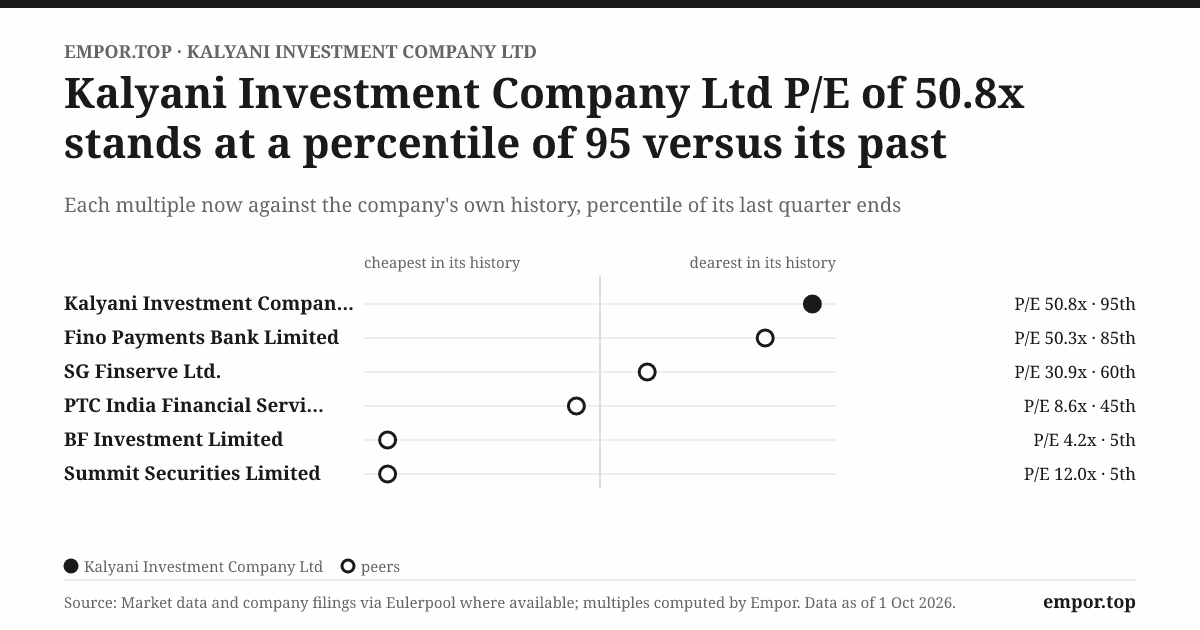
Which brings the multiple back into view. KICL trades at about 51 times trailing earnings against a five-year median of about 26 times1. That is not a growth premium. Earnings halved and the price did not, so the multiple doubled. A high P/E on a holding company at 0.2 times book is a sign the earnings line is a poor measure of what the market is pricing. Which raises the real question: what is the market pricing?
V. The 80% Discount: Real or Artefact?
Two prices on one screen
Imagine an investor in Mumbai with two tabs open. In one, KICL at ₹4,712 a share. In the other, the book value behind each share: about ₹26,0671. Flip to a third tab, Bharat Forge's live share price, and the investor can watch the vault's biggest holding move in real time while KICL barely reacts. That is the trade the stock offers: about ₹11,400 crore of reported net assets for ₹2,059 crore1.
Is the book number real?
The first question is whether ₹11,400 crore is a real number or an old one. The balance-sheet history answers it. If the holdings were carried at historical cost, book value would barely move year to year. Instead it swings with the Indian equity market: down hard into March 2020, up sharply into March 2021, and up again by about a quarter between March 2025 and March 2026 even as profit halved1. Under Ind AS, KICL's equity investments are marked to market, so the book value is close to the current market value of what it holds6. The discount is real, not an accounting artefact.
The settling figure is the look-through value: the number of Bharat Forge, Kalyani Steels and Hikal shares KICL owns, each multiplied by its market price, plus the unlisted holdings and cash, compared with ₹2,059 crore. The book value already approximates that sum. The market is not confused about what the vault holds. It is declining to pay for it.
One data trap deserves a warning. The fact sheet shows "Investments" jumping from about $40 million to about $1.4 billion between March 2025 and March 2026, while "cash and short-term investments" fell from about $1.1 billion to about $35 million1. That is a data provider re-tagging the same shares from one bucket to another, not a cash event. The vault did not spend a billion dollars.
Why holding companies trade at a discount
A minority holder in KICL owns, indirectly, a slice of Bharat Forge. Why accept 20 paise on the rupee for it? Five mechanisms stack up.
First, there is no route to the assets. The family, with three-quarters of the votes, decides whether the shares are ever sold, and it holds them precisely because they carry control of the operating companies. Selling them would mean giving up the empire.
Second, tax leakage. If the vault ever sold, capital gains tax would be paid at the KICL level before anything reached shareholders. Dividends passing up the chain meet tax at the shareholder level too.
Third, no payout. A share that pays nothing must be valued on what it might someday distribute, and in KICL's case "someday" has had no date.
Fourth, liquidity. With about 23,781 shareholders and annual volatility of about 34%, this is a thin, jumpy stock14.
Fifth, no sponsor. Foreign institutions held 2.31% in September 2023 and only 0.64% by June 2026; domestic institutions hold about 0.56%4. Barely more than 1% of the company is in professional hands. Nobody with a large position is arguing for value to be released.
What would close the gap
There are only a handful of doors out of a holdco discount: a large, regular payout; buybacks; a merger of the vault into an operating company at a fair swap ratio; a sale of stakes with proceeds distributed; or a delisting offer by the promoter. Each requires the family to act. None has happened in the vault's listed life.
Testing "value will out"
The bull reflex is to assume that a discount this deep must eventually close. KICL's own history rejects that reflex. The discount has persisted across the whole listed life, through bull markets for Bharat Forge and bear markets alike. Institutional interest has shrunk, not grown. Time alone has not narrowed the gap, and there is no evidence that it will. The claim survives only in a narrower form: the gap could close if the family chose to open a door.
Peer history points the same way. India's listed holdcos such as Bajaj Holdings and Tata Investment Corporation have long traded below their look-through value[^9]9. Where discounts narrowed for some of them, the drivers were payouts, investor attention and specific corporate actions, not the passage of time. KICL has had none of those until, perhaps, the decision put to its shareholders in September 2026.
VI. The First Dividend in a Dozen Years?
The notice
In the summer of 2026, KICL sent out notice of its 17th annual general meeting, to be held on 17 September 202611. Tucked among the routine items was one that had been absent for years: a resolution to declare a dividend on equity shares, with a record date of 14 August 2026 and payment due by 25 September 202611. For a company whose cash-flow statement shows zero dividends paid in every year from FY2015 to FY2026, that was news1.
Resolving the conflict
The data disagree on what came before. The fact sheet shows a payout ratio of 0% in every one of twelve years1. Screener shows a 12% payout for the year to March 2026 and a three-year average near 4%4. The likeliest explanation is timing: a dividend declared for a financial year is approved at the AGM months after year-end and paid in the following year, so it lands in the next year's cash-flow statement. That would make a dividend for FY2026, paid in September 2026, invisible in a cash-flow table that stops in March 2026, and would mean a smaller payout was also declared for FY2025. On that reading the "twelve years of nothing" headline overstates the drought; the vault had begun, modestly, to open the door before 2026. What is clear is the scale.
Why it is too small to re-rate
Market reports put the rate at about ₹10 a share. On roughly 4.4 million shares, that is about ₹4.4 crore in total, against a market value of ₹2,059 crore and FY2026 profit that was itself depressed1. The yield is about 0.2%. A shareholder holding ₹1 lakh of KICL stock would receive about ₹200. Compare that with what the vault itself collects from its investees each year, and the payout is a small fraction of inflows. It is a gesture, not a policy shift. The family receives three-quarters of it, so the cost of being generous is mostly paid to itself; a larger payout would therefore be cheap for the family and valuable for minorities. That asymmetry makes the size of this one telling.
The capital-allocation record
Beyond the dividend, the record is one of inactivity. There have been no buybacks, no acquisitions by KICL in its own name, no borrowings and no equity raises in the twelve years on record1. That is hard to praise and hard to fault. There are no write-offs because there were no bets. There are also no returns beyond what the investees chose to send.
Where does the rest of the dividend inflow go? It accumulates as cash and short-term holdings, or is reinvested in group securities, which is consistent with the cash balance of about $35 million at March 2026 and with the vault's description of holdings that include debentures and loans to group companies13. Any fresh money put into group companies through rights issues or preferential allotments is a related-party transaction in all but name. The question for a minority holder is not whether those investments happened but whether they were priced fairly, and the vault's spare disclosure makes that hard to judge from the outside.
Strength on one side only
On the liability side, KICL is about as safe as a company gets. Zero borrowings for twelve straight years, no refinancing, no dilution1. There has never been a solvency question. But financial strength is not the same as financial value. The weakness is not on the liability side; it is in returns. And the people who decide returns are the family.
VII. Who Runs the Vault? The Family, the Board, the Pay
The meeting
On 17 September 2026 KICL's shareholders gathered, virtually, for the 17th AGM11. With the promoter group holding 74.98% of shares, the arithmetic of every ordinary resolution was settled before the meeting began4. The interesting signal in such meetings is never whether resolutions pass. It is how many of the public's votes were cast against them, which the company files with the exchanges as voting results67.
The cast
At the head of the table sits Amit B. Kalyani, Chairman and executive director12. He is also the vice-chairman and joint managing director of Bharat Forge, the group's flagship, and the elder son of Baba Kalyani, the engineer who turned a modest Pune forging shop into a global supplier of auto and defence components12[^14]. Amit Kalyani trained as a mechanical engineer and rose through Bharat Forge, where he is widely seen as the force behind its push into defence and aerospace. The vault's chairman is, in other words, the operating group's heir apparent. That is alignment of a kind: the person who controls KICL also runs the asset that drives its book value.
Beside him are two other executive directors, Deeksha A. Kalyani, of the family, and R. K. Goyal12. Anurag Jain serves as both chief executive and chief financial officer; Nihal Gupta is company secretary12. Three independent directors complete the board: S. K. Adivarekar, S. G. Joglekar and Shruti A. Shah, exactly half of a six-member board12.
Protection or constraint?
The family owns three-quarters of the equity. That is real alignment on the question of whether the vault's assets are valuable: when Bharat Forge rises, the family gains most. It is not alignment on the question of whether the minority ever receives that value. Here the incentives diverge.
A family with 75% earns most of any dividend, so payouts cost it little. But a family that might one day consider buying out the minority, through a delisting offer or a merger of the vault into an operating company, benefits from a low KICL share price. That is the standard skeptic's worry for a holdco at 0.2 times book: the discount is not just the market's price for illiquidity, it is a potential discount at which the controlling holder could acquire the rest. In fairness, the worry needs evidence before it becomes a charge. No delisting, merger or reverse-book-building proposal for KICL has appeared on the exchanges in its listed history67. The risk is structural, not demonstrated.
Pay and related parties
A vault with almost no operations should have almost no payroll. The test is simple: managerial remuneration set against profit of about ₹40 crore in a weak year. KICL discloses directors' pay in its annual report filed with the exchanges6; the relevant check for a holder is whether executive pay is a meaningful slice of that profit, and whether it rose in a year when profit halved. Three executive directors on a vehicle whose only job is to hold shares is a generous structure, and a holder should watch whether it is paid accordingly.
Related-party flows are near-total by definition. Nearly all of KICL's income comes from group companies, and nearly all of its assets are invested in them34. That is not a scandal; it is the job description of a core investment company. The questions are narrower: are there intercompany loans or guarantees at below-market terms, and are any fees paid to promoter entities? The company's description of debentures and loans in group securities means the first question is live3.
Regulators, auditors and the quiet
KICL sits under RBI supervision as a core investment company8. It has no borrowings, which also means it has no need for a credit rating; the rating agencies cover other Kalyani companies, not the vault. Those ratings matter here only as a read on the investees' quality.
The vault says remarkably little. There are no earnings calls, no investor presentations and no analyst coverage of note. Its public voice is the statutory annual report, the AGM and exchange filings67. For a company worth ₹11,400 crore on paper, that silence is itself a governance fact. A controlling family that wanted the discount to narrow would talk to investors. This one does not.
The verdict is that control is stable and the family's economic interest is large, which rules out the most extreme risks of a flighty, low-stake promoter. But alignment with the asset is not the same as protection for the minority. Until the company publishes a payout policy, or gives the public float a way to reach the assets, the claim of good governance for minority holders stays unproven.
VIII. Playbook: Business & Investing Lessons
A holding company's earnings are someone else's decisions. KICL's revenue spikes every March because boards it does not chair, or chairs only through family, decide to pay dividends. Investors who model the vault's income should model the investees' payout policies instead. The lesson for anyone buying a holdco: you are underwriting other people's board meetings.
A discount to book is the price of a locked door. KICL's assets are real, marked to market and debt-free. The market still pays 20 paise per rupee of them, because a quarter of the shares have no key. Discounts like this do not close with time; they close when the person holding the key turns it.
When profit halves and revenue rises, look below operating profit. KICL's FY2026 collapse was not a collapse in what it collected. It was a swing in its share of associates' results, a non-cash line it does not control. Read the bridge before you read the headline.
Zero debt is a shield, not a strategy. Twelve years without borrowing made KICL unbreakable. It also left it earning well under 1% on its own equity. Safety without a plan for returns is just a well-guarded vault.
Read the cash-flow classification before you read the cash flow. A screen flags KICL's negative operating cash flow as a warning. It is only accounting geography: dividends land in investing. The same mistake, in reverse, can make a weak company look strong.
IX. Analysis, Bull vs. Bear & KPIs
The screen
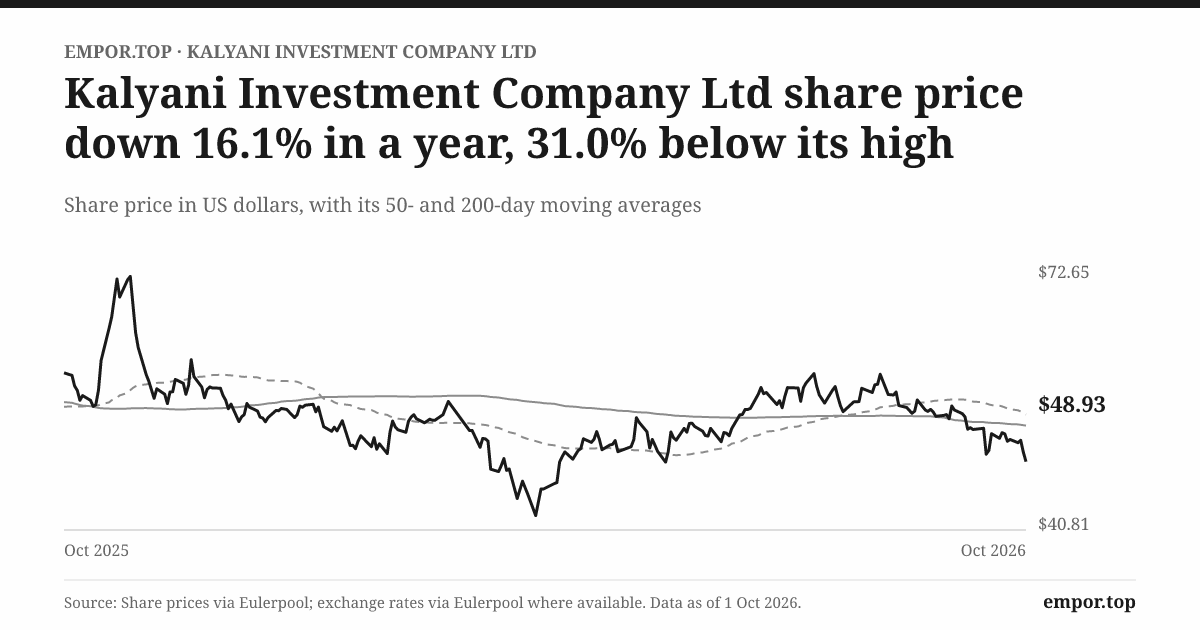
Put KICL's price beside the combined market value of its stakes and the gap is the whole case. The stock trades at about 0.2 times book, about 51 times earnings, an earnings yield of about 2%, and a return on equity of about 0.3%1. It sits about 25% below its 52-week high and fell as much as 57% at one point in the past five years1.
The bull case
The bull case is asset-backed. KICL owns listed stakes in well-known companies, carries no debt, and the market prices them at a fraction of value1. Any of several events would unlock some of that: a regular payout, a buyback, a restructuring that merges the vault into an operating company at a fair ratio, or a group-level simplification. The September 2026 dividend shows the door can open. The bull adds that Bharat Forge's push into defence and aerospace gives the main asset its own growth story[^14].
The bear case
The bear case is that none of that is new. The discount has lasted the vault's whole life. Control at 75% means no outside pressure; institutional ownership near 1% means no one to apply it4. Profit has been flat for a decade, return on equity has been under 1%, and the first-year dividend yields about 0.2%1. The vault is also a concentrated bet on Bharat Forge's cycle: autos, industrial exports and defence orders. When those turn, KICL's book value falls, and through associates its profit too.
Moat and forces
KICL has no moat of its own. Using Hamilton Helmer's seven powers, it has no scale economies, no network effects, no switching costs, no brand and no process power: it sells nothing. The only power in sight is a cornered resource, the control stakes themselves, and that power accrues to the family, not to the minority holder. A Porter-style view lands in the same place: there are no buyers or suppliers in the usual sense and no rivals, only substitutes. And the substitute is decisive. Any investor who wants exposure to Bharat Forge can buy Bharat Forge directly, with full liquidity and no layer of control. That ever-available substitute caps what the market will pay for the vault. The value of KICL is the value of its investees' competitive positions, in forging, special steels and specialty chemicals, minus the cost of holding them through someone else's lock.
The activist's question
A skeptical investor would ask one question. If the vault sold its Bharat Forge stake at market, paid capital gains tax and distributed the proceeds, what would a minority holder receive per share, and how does that compare with ₹4,712? Even after tax leakage, the answer on a fair-value book of ₹26,000 a share is likely to be several times the share price. That is why the question matters: it measures the size of the lock, not the value of the contents. It is also why the family is unlikely to do it; selling the shares would surrender the control they exist to provide.
Risks that matter
The risks that actually move this company are few. A cut in dividends by Bharat Forge or Kalyani Steels reduces revenue directly. A fall in their share prices reduces book value. Weak results at associates reduce reported profit, as FY2026 showed. Related-party investments at unfavourable terms would quietly transfer value. And a buyout or merger at a low price would crystallise the discount against minority holders. Generic technology, cyber and supply-chain risks belong to the investees, not to the vault.
The two numbers to watch
First, dividends received from investees against dividends paid out to shareholders. Today the vault pays out only a small fraction of what it collects; after years of paying nothing in cash-flow terms, the direction is upward but from a tiny base111. Second, the market value of KICL's holdings against its own market capitalisation, the look-through discount, which currently stands at roughly 80% and has shown no sustained narrowing1.
X. Epilogue
Tonight the vault is full and the door is barely ajar. The September 2026 dividend has been paid, or should have been, on schedule11. The AGM voting results sit on the exchange filing systems, and the share of minority votes cast against resolutions, if any, is the quiet measure of how the public float feels67.
The next moments are close. The September 2026 shareholding pattern will show whether any institution has stepped in after the dividend, or whether foreign holders continued to drift out4. The next March quarter will show how much Bharat Forge and Kalyani Steels choose to send up the chain. The FY2027 results will show whether the associate line recovers and the profit puzzle of FY2026 reverses. And any announcement of a merger, a restructuring or a delisting offer would change everything at once.
Each outcome answers one of the four questions. A larger, regular payout and a rising institutional share would begin to narrow the discount, proving the door can be opened from the inside. Silence would leave it exactly where it has been for seventeen years. A buyout at a low price would settle the control question against minorities for good.
The tension that remains is simple to state and hard to resolve. The assets are real. The value is real. The key is in one family's pocket.
XI. Outro
Go back to those two numbers on the screen: ₹11,400 crore of book value, priced at ₹2,059 crore. Same shares, same Bharat Forge, same steel mills and chemical plants beneath them, valued two ways depending on whose hands they sit in. For the family, the vault is worth its full contents, because the family controls them. For everyone else, it is worth what they can reach.
That is what makes Kalyani Investment Company unlike any operating business in this series. Its most important decision is not about a factory or a product. It is whether to open the vault, and the people who decide own three-quarters of it.
References
-
Kalyani Investment Company Ltd — financial statements and market data, BSE corporate filings (scrip 533302) ↩↩↩↩↩↩↩↩↩↩↩↩↩↩↩↩↩↩↩↩↩↩↩↩↩↩↩↩↩↩↩↩↩↩↩↩↩↩↩↩↩↩↩↩↩↩
-
Kalyani Investment Company Ltd — Screener (consolidated), 2026 ↩
-
Kalyani Investment Company Limited — company website, 2026-10-01 ↩↩↩↩↩↩↩
-
Kalyani Investment Company Ltd — Screener (consolidated): shareholding and ratios, 2026 ↩↩↩↩↩↩↩↩↩↩↩↩
-
Kalyani Investment Company Ltd — BSE corporate filings landing page (scrip 533302) ↩↩↩↩↩↩↩↩
-
Kalyani Investment Company Ltd — NSE company page (KICL) ↩↩↩↩↩
-
Master Direction on Core Investment Companies — Reserve Bank of India ↩↩↩
-
Kalyani Investment Company — Business Standard company page, 2026 ↩
-
Kalyani Investment Company to hold 17th AGM on September 17, 2026 — ScanX ↩↩↩↩↩
-
Board of Directors — Kalyani Investment Company Limited ↩↩↩↩↩
 LinkedIn
 WhatsApp
 Reddit
 Hacker News
 Email
Email Kindle
 RSS Feed
 Spotify
 Apple Podcasts
 Amazon Music
 Audible
 YouTube