KDDL Limited: The Horological Monopolist & Precision Powerhouse
I. Introduction & Episode Roadmap
There is a facility in Parwanoo, a small industrial town in the foothills of Himachal Pradesh where the Shivalik range rises toward Shimla. The environment smells faintly of solvents and electroplating baths. Inside, technicians in dust-free smocks work under magnification on brass discs roughly the size of a one-rupee coin—pressing, etching, lacquering, and affixing metal index markers with tolerances measured in hundredths of a millimeter. Those discs are watch dials. Many are destined for Switzerland, where they are cased, marketed under historic horological brand names, and sold to consumers in Geneva, Shanghai, Dubai, and Gurugram.
That factory represents the original manufacturing business of KDDL Limited. Today, however, it constitutes the smaller half of the company's enterprise.
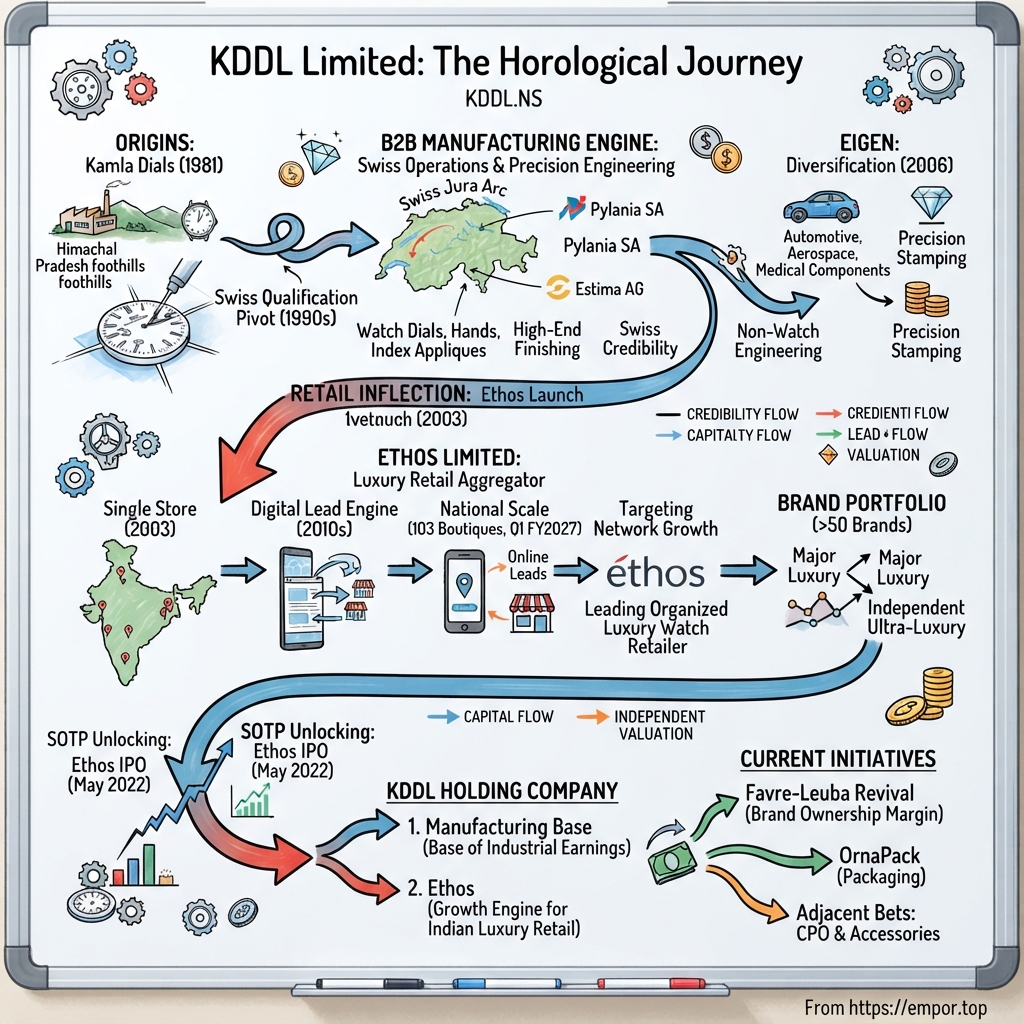
The larger half operates roughly 40 kilometers away in Chandigarh, where the promoter opened a single watch retail store in 2003. That operation grew into Ethos Limited, now a separately listed company and the leading organized luxury watch retailer in India, operating 103 boutiques as of the first quarter of fiscal 2027 and representing over 50 luxury and ultra-luxury brands.[^1] Because KDDL consolidates Ethos, the parent entity's reported top line is overwhelmingly a retail figure paired with a manufacturing brand name.
Structurally, KDDL functions as two distinct engines operating under a single holding entity.
Engine one comprises the standalone manufacturing business: precision watch dials, hands, index appliques, and bracelets, alongside a precision-engineering division, Eigen, which stamps and tools components for automotive, electrical, medical, and aerospace clients. In fiscal 2026, KDDL's standalone operations generated a profit after tax of approximately ₹76.6 crore, providing a solid base of industrial earnings.1
Engine two is Ethos Limited, which generated fiscal 2026 revenue of ₹1,612.2 crore, accounting for the majority of KDDL's consolidated top line of ₹2,207.8 crore.21 Retail operations represent roughly three-quarters of consolidated revenue. An investment in the parent company is primarily an equity claim on Indian luxury retail expansion, accompanied by a niche Swiss-Indian precision component manufacturer.
The central investment debate hinges on whether KDDL possesses a sustainable dual moat: a high-barrier supply position within the Swiss watch industry and a dominant aggregator position in Indian organized luxury retail. While both positions are significant, each carries structural risks. In component manufacturing, key clients form a global oligopoly capable of qualifying secondary suppliers, while KDDL's footprint includes high-cost Swiss labor markets. In retail aggregation, major luxury groups such as Rolex, Swatch Group, and Richemont maintain a strategic incentive to establish direct-to-consumer channels as the Indian market expands.
This analysis evaluates both engines across KDDL's evolution: from its founding as Kamla Dials in 1981, through its entry into the Swiss supply chain during the 1990s, the acquisitions of Swiss manufacturers Pylania SA and Estima AG, the launch of its retail arm in 2003, the May 2022 initial public offering of Ethos that separated the retail and manufacturing valuations, and current growth initiatives. These initiatives include the revival of the historic Swiss watch brand Favre-Leuba, an unprofitable packaging venture, and plans to double the retail boutique network.
The analysis focuses primarily on the last decade, where capital allocation and earnings growth have concentrated. Nevertheless, the company's origins remain central, as the corporate structure stems from the initial decision four decades ago to export Indian precision manufacturing to Switzerland.
A note on how to read the reported numbers
A key accounting feature shapes all reported figures for the company. KDDL consolidates Ethos while holding roughly a 50 percent equity stake. As a result, consolidated revenue and EBITDA reflect 100 percent of the retail business, whereas consolidated net profit attributable to KDDL shareholders excludes non-controlling interests. This distinction creates a substantial gap between reported figures. For example, in the first quarter of fiscal 2027, KDDL reported a consolidated net profit of approximately ₹44.7 crore, compared to roughly ₹29.4 crore attributable to the owners of the parent company.18 Evaluating KDDL's margins or earnings against pure-play manufacturers or pure-play retailers requires adjusting for this consolidation structure.
Additionally, Ethos applies Indian Accounting Standard 116 (Ind AS 116), which capitalizes operating leases. For a retailer operating a broad footprint of premium store locations, this standard increases reported EBITDA relative to legacy accounting metrics by shifting rental costs below the EBITDA line into depreciation and interest expenses. Consequently, reported EBITDA margins must be interpreted with this lease accounting treatment in mind.
 Subscribe on LinkedIn
II. Origins: Kamla Dials & The Indian Horology Landscape
In 1981, the Indian watch industry was largely state-controlled. Hindustan Machine Tools (HMT) held the dominant market position, manufacturing mechanical watches by the million under technology licensed from Citizen in the 1960s. Titan did not yet exist, and imported watches faced prohibitive tariffs or arrived through informal channels. Against this backdrop, establishing an independent facility to supply watch components to domestic makers—and eventually to Switzerland—was an audacious undertaking.
Yashovardhan Saboo took on that challenge. An alumnus of St. Stephen's College in Delhi and IIM Ahmedabad, Saboo founded Kamla Dials and Devices Limited in Parwanoo, Himachal Pradesh. The industrial belt offered tax incentives but lacked an established supplier ecosystem, a skilled micro-engineering labor pool, and proximity to a port.3 In a license-regime economy where securing regulatory approval was the primary entry barrier, a manufacturing license and a blank slate provided a viable starting position.
Why a watch dial is harder than it looks
Understanding the technical complexity of dial manufacturing clarifies the structural moat KDDL later built.
A watch dial appears to be a simple stamped disc of metal with index markings, but it requires several precise manufacturing disciplines executed simultaneously. Stamped from brass to exact thickness, its hand-shaft apertures and date windows require tolerances measured within microns; even slight drift exposes the underlying calendar mechanism. Surface finishing demands sunburst brushing, guilloché engraving, galvanic electroplating, chemical etching, or multi-layered baked lacquering—processes where a single airborne dust particle invalidates the entire component. Metal index markers and numerals are then soldered or riveted to the face with sub-millimeter positional accuracy, as luxury watch buyers easily detect misaligned indices.
Yield economics are demanding. Rejection rates for high-finish dials are high enough that a few percentage points of scrap determine whether a production line is profitable. Swiss horological brands enforce zero-defect standards for incoming components.
Watch hands present equal technical difficulty: stamped from thin steel or gold and polished on tiny facets, they require precise weight balancing to prevent movement lag and time loss.
The industry Saboo was walking into
The Indian horology market shifted dramatically in 1987 when Titan—a joint venture between the Tata Group and the Tamil Nadu Industrial Development Corporation—introduced quartz watches with modern styling and retail networks. Within a decade, Titan dismantled HMT's market leadership. For an independent component supplier, this shift presented both an opportunity and a risk.
The opportunity was clear: a rapidly growing domestic brand required a diverse array of dials. The risk was structural. Titan began vertically integrating its supply chain. A brand expanding its internal component manufacturing gradually reduces reliance on third-party suppliers, leaving an unintegrated vendor vulnerable to pricing pressure. Chasing export clients in Switzerland thus served as a defensive strategy against single-customer concentration as much as an international growth ambition.
Titan would later sell a Swiss watch brand it had failed to turn around to KDDL's retail subsidiary, marking another encounter in a multi-decade competitive overlap between the two firms.
The 1995 pivot: selling Indian precision to Switzerland
By the mid-1990s, Saboo recognized that supplying domestic watchmakers limited operating margins. Indian brands bought primarily on price within a constrained formal market, while value concentrated in Switzerland, the center of global luxury horology.
This transition marked KDDL's pivotal strategic shift. Hindsight accounts often attribute KDDL's export success to labor cost arbitrage over European dial makers.
In practice, the company faced steep qualification hurdles. During the 1990s, Swiss procurement executives rarely sourced precision components from Indian suppliers. Securing orders required upfront capital deployment ahead of revenue: importing European tooling and stamping presses, building quality-control laboratories to Swiss audit standards, and navigating multi-year brand qualification cycles. Brands evaluated initial samples and pilot batches before awarding production contracts, extending timeline commitments over several years per reference. Consequently, capital outlay preceded sales, resulting in suppressed returns on invested capital throughout the onboarding phase.
While the strategy ultimately established KDDL's profitable Swiss component operations, the core advantage stemmed from capital patience rather than simple labor cost arbitrage. Management committed to funding extended gestation periods that competitors bound by short-term return metrics avoided. This capital-allocation approach later characterized the development of Ethos as well as longer-dated expansion ventures.
Building credibility with Swiss watchmakers ultimately led KDDL to acquire a direct operational presence in Switzerland.
What "qualification" actually involves
The multi-step qualification process creates significant switching costs for Swiss brand clients.
When onboarding a supplier, a brand submits technical specifications covering dimensions, surface finishes, color standards, applique geometries, and strict tolerance thresholds. The supplier produces initial samples for microscopic inspection, dimensional measurement, and spectrographic color matching. Upon passing, the supplier manufactures pilot batches subjected to accelerated aging, moisture exposure, ultraviolet radiation, and thermal cycling to prevent long-term lacquer discoloration or material degradation on finished watches. Only after completing these trials does the supplier enter the brand's approved vendor list, with individual product references qualified separately.
Because sales cycles for new brand relationships span multiple years, incumbent suppliers benefit from high customer retention once qualified. However, this extended timeline also required KDDL to absorb upfront capacity, tooling, and testing costs years before generating corresponding contract revenue.
III. The B2B Manufacturing Engine: Swiss Operations & Precision Engineering
"Swiss Made" is not a marketing phrase. It is a legal standard, and it explains why a component maker in Himachal Pradesh eventually established factories in Switzerland.
Under Swiss labeling law, a watch can carry the designation only if a defined majority of its manufacturing costs is generated inside Switzerland, with technical development and final inspection performed there. Regulations tightened in 2017, raising the threshold to 60 percent of manufacturing costs. For a brand assembling a watch, every component sourced entirely outside Switzerland reduces that qualifying percentage. Consequently, a supplier operating exclusively out of India faces a structural ceiling: it can win cost-sensitive volume, but it remains locked out of higher-margin, top-tier references.
KDDL responded by establishing a dual-shore footprint. High-volume stamping, electroplating, and lacquering run through its Indian plants in Parwanoo and Derabassi. High-value finishing, final assembly, and certified Swiss delivery flow through its Swiss subsidiaries—Pylania SA, and later Estima AG in Grenchen, the watchmaking center in Solothurn acquired in 2019 to add watch-hand manufacturing.[^5]
Commercially, this arrangement functions less as a pure cost play than as a permissioning mechanism. The Indian facilities provide a cost advantage, while the Swiss operations supply the regulatory and market credibility required when major watch groups such as Richemont or Swatch Group specify high-end dials.
The switching-cost mechanism, honestly assessed
A standard bullish thesis holds that once a Swiss brand qualifies a supplier's dial for a specific watch reference, replacing that vendor requires months of re-qualification and stress-testing, making revenue sticky across multi-year production runs.
There is substance to this view. Qualification is deliberate, and a brand mid-way through a successful production run has little incentive to re-tool. However, two key constraints limit this mechanism. First, stickiness attaches to the individual reference, not the overarching client relationship; when a collection is redesigned, the vendor selection reopens. Second, major luxury groups deliberately maintain multiple qualified dial suppliers to avoid single-sourcing cosmetic-critical components. The dynamic is more accurately described not as lock-in, but as high mid-cycle retention paired with contestability at every redesign and ongoing wallet-sharing.
Operating leverage presents a second key economic feature. Tool-room capacity, die-making, and clean-room overhead are largely fixed costs. Incremental volume on an existing die flows through to operating margin at a high rate, while falling volume has the reverse effect—causing earnings to swing sharply with the Swiss watch export cycle.
Grenchen, and the geography of Swiss watchmaking
Grenchen sits in the Jura arc, the industrial spine of Swiss watchmaking running from Geneva through Biel/Bienne, Grenchen, La Chaux-de-Fonds, and Le Locle. Movement makers, case manufacturers, dial specialists, and hand suppliers operate within close proximity in this cluster. This geographic concentration makes the Swiss horological supply chain difficult to replicate globally, as technical directors and component vendors interact within a dense local ecosystem.
Operating inside that cluster gives KDDL direct access to brand specification discussions. However, it also exposes the group to Switzerland's high manufacturing labor costs and a labor market where scaling down headcount during industry downturns is slow and expensive.
This trade-off governs the performance of KDDL's Swiss operations: when export volumes are strong, the Swiss units contribute, but during downturns, fixed operating costs depress margins.
Eigen: diversification with a real rationale
In 2006, KDDL expanded its micro-stamping, tooling, and molding capabilities beyond horology. The resulting precision-engineering division, Eigen, manufactures stamped and molded components for automotive, electrical and electronics, medical device, and aerospace clients, as well as parts feeding electric vehicle battery-management and energy-storage applications.
This expansion applies existing technical capabilities to new markets: a tool room capable of holding micron tolerances on watch hands can apply the same precision to connector terminals. Management positions precision engineering as capability-based manufacturing rather than standard component sales. By fiscal 2026, the division reached approximately ₹200 crore in revenue, growing over 35 percent year over year with export momentum and plans to bring electroplating in-house.4
Sustained growth in precision engineering is notable within the standalone entity because its demand drivers differ from both Swiss watch exports and Indian luxury retail.
Other diversification initiatives have progressed more slowly. OrnaPack, the packaging venture, grew revenue by over 35 percent in fiscal 2026 but remained loss-making during its initial expansion, with management projecting profitability in the second half of fiscal 2027.4 The watch bracelet division generated roughly ₹40 crore in revenue and is expected to compound at around 25 percent over the medium term, though management noted that margins may moderate as new customer contracts enter at lower price points.4
Customer concentration: the quiet dependency
The component manufacturing business maintains a concentrated customer base, reflecting an industry dominated by a small number of luxury groups alongside independent brands. As a result, supplier revenue depends heavily on a limited number of purchasing departments. While KDDL does not disclose detailed customer concentration figures, this exposure remains a structural factor.
Bargaining power generally favors major brand groups. Conglomerates purchasing components across multiple product lines can shift volume between qualified suppliers and negotiate aggressively on mid-range pricing. To counter this leverage, component suppliers rely on technical specialization—such as executing complex finishes at high yields. This dynamic underscores management's stated effort to move Estima toward higher specialization, though that shift has yet to translate into sustained profitability for that subsidiary.[^7]
Testing the Swiss acquisition thesis against the record
The claim: Acquiring Swiss manufacturing assets established a high-margin, defensible B2B moat.
The disconfirming evidence comes from KDDL's own disclosures. Estima AG has recorded persistent operating losses. Management acknowledged on earnings calls that market slowdowns—particularly in China and Hong Kong—weighed on performance, framing remediation around technological upgrades and higher specialization.[^7] Swiss operations carry fixed labor costs, high facility overhead, and exposure to foreign exchange movements. The Swiss franc appreciated roughly 26 percent against the Indian rupee over the period management discussed in fiscal 2026, expanding translated revenue for Swiss exports while raising wage and input costs in rupee terms.2 Combined with past contractions in Swiss watch exports, these operating dynamics show that the Swiss subsidiaries have at times required financial support from Indian operations rather than providing consistent profit cushions.
Verdict: The moat rationale holds in a narrower form. Swiss ownership is best understood as a license fee—a structurally expensive asset that buys access to premium references KDDL could not otherwise bid on—rather than as a reliable standalone profit engine. The key metric remains whether Estima and related Swiss units can achieve sustained operating profitability across a full watch cycle, including industry downturns. Until then, standalone manufacturing margins remain subject to cyclical swings.
While the B2B manufacturing engine built KDDL's technical credibility and Swiss access, the retail business subsequently generated the majority of the group's market capitalization.
IV. The Retail Inflection: The Rise & Dominance of Ethos
In 2003, Indian luxury watch retail was fragmented and opaque. A buyer in Delhi or Mumbai seeking a Swiss timekeeper generally faced three imperfect choices: purchase from a family jeweler who might lack official sourcing credentials, ask a relative returning from Dubai or Singapore to buy in a lower-duty market where grey-market price gaps dominated, or purchase abroad directly. Authenticity was assumed rather than verified, post-sale service was informal, warranties were often void or unbacked, and transactions frequently took place in cash.
Into this market, Yashovardhan Saboo opened a retail store in Chandigarh under the name Ethos.
Launching in Chandigarh offered strategic advantages: it was KDDL's home territory, where the promoter's regional reputation provided initial credibility, and where real estate costs allowed room for operational trial and error. The underlying business logic focused on addressing customer risk. Rather than competing strictly on product availability—which independent dealers could match—Ethos built its model around eliminating buyer uncertainty through fully duty-paid inventory, valid international manufacturer warranties, authorized service capabilities, and transparent pricing. In a market characterized by informal channels, compliance and authenticity became the core value proposition.
Counter-positioning against the grey market
This strategy functioned as a classic counter-positioning mechanism against informal importers. Grey-market dealers derived their price advantage from evading import duties. Incumbent dealers could not replicate Ethos's duty-paid, tax-compliant, and authorized-service model without incurring a higher cost structure and higher retail shelf prices. Adapting to Ethos's model would have undermined the grey market's economic rationale.
Macroeconomic and regulatory shifts subsequently reinforced this positioning. Import duty rationalization narrowed grey-market price advantages, while the implementation of the Goods and Services Tax (GST) accelerated retail formalization. Concurrently, demographic shifts expanded a professional buyer base that prioritized official receipts, international warranties, and authorized service support over unverified discounts.
Pranav Saboo and the digital lead engine
The second phase of Ethos's retail evolution was guided by Pranav Saboo, who took over operational leadership as chief executive. Saboo recognized early that for luxury items priced above ₹2 lakh, the digital channel's primary value lay in online lead generation rather than direct e-commerce transactions.
This strategy reflected high-end consumer behavior: while buyers rarely purchase an expensive mechanical watch without inspecting it in person, they conduct extensive online research on specifications, brand heritage, and movements prior to buying. Ethos developed its digital platform to capture national search traffic and research intent, converting online visitors into qualified leads routed to physical boutique consultations. The website serves as a customer-acquisition funnel, generating demand even in locations where Ethos does not yet operate a physical store.
This digital architecture provides data-driven expansion advantages that traditional brick-and-mortar retailers lack. Because the marginal cost of collecting regional lead data online is minimal, store-opening decisions can be based on verified local demand metrics rather than speculative market testing. This data asset gives Ethos a structural advantage over single-city independent operators.
The physics of a luxury boutique
Evaluating Ethos's retail model requires analyzing the financial structure of an individual boutique.
First, location selection is governed by strict brand authorization criteria. Global luxury brand partners require store placement within prime high streets or dedicated luxury wings of top-tier malls to preserve brand positioning. Suitable real estate remains scarce across India, as only a small number of retail developments meet international luxury standards. This scarcity limits network expansion while creating high entry barriers for competing operators.
Second, capital outlay for store fit-outs is substantial. Requirements include specialized security systems, custom display architecture, on-site watchmaker service facilities, and specialized sales personnel capable of advising high-net-worth clients. Given the shortage of experienced luxury retail staff in India, Ethos must invest heavily in internal training programs.
Third, working capital tied up in inventory represents the largest financial commitment per door. Luxury watch showcases require extensive inventory investment. Unlike fashion apparel, luxury watch brands strictly prohibit promotional discounting to clear aging stock. As a result, each boutique holds a high-value, slow-turning asset base that cannot be marked down.
Consequently, while unit-level gross margins are attractive, the capital expenditure and working capital required per location remain high. The primary constraint on expanding the boutique network is therefore not consumer demand or location availability, but the capital required to fund inventory.
Portfolio: the aggregator's real asset
Ethos's principal commercial asset is its brand portfolio of over 50 watch houses. This collection balances major luxury brands that drive customer footfall with independent ultra-luxury brands that offer higher gross margins and product differentiation. Serving as a primary retail partner for major global luxury conglomerates establishes broad market reach, while exclusive and near-exclusive distribution agreements for independent brands position Ethos as a destination retailer for collectors.
This creates a structural scale gap between Ethos and its domestic competitors. Organized watch retail in India remains divided among regional family-owned businesses, single-city luxury specialists, and mass-market retail chains, none of which match Ethos's national footprint or portfolio depth.
Who Ethos actually competes with
A precise assessment of Ethos's competitive environment reveals distinct pressures across market segments.
At the high end, Ethos competes with established regional specialists—long-standing family watch businesses in major metropolitan centers such as Delhi and Mumbai. These operators maintain strong local client relationships and hold specific brand distribution rights. However, their ability to expand nationally is limited by capital constraints, talent availability, and multi-region brand authorization requirements.
In the mid-premium segment, Titan's premium retail formats target aspirational consumers at price points below traditional luxury thresholds. Capturing entry-level buyers at lower price points allows competitors to establish customer relationships before consumers step up to high-luxury purchases.
At the top of the market, the primary long-term threat comes from luxury watch brands establishing direct-to-consumer monobrand boutiques. By opening proprietary retail locations, major brand owners can capture full retail margins, control customer data, and direct inventory allocations.
Ethos thus maintains national scale and portfolio breadth unmatched by domestic organized retailers, but its business model remains exposed to potential direct-to-consumer moves by its major brand partners.
The numbers behind the story, and what they mean
In fiscal 2026, financial results highlighted both operational growth and foreign-exchange vulnerability. Ethos grew revenue 28.8% to ₹1,612.2 crore from ₹1,251.6 crore.2 Profit after tax, however, was essentially flat at about ₹94.8 crore, because the franc's appreciation against the rupee took an estimated ₹18.7 crore out of gross margin.2 This divergence between top-line expansion and stagnant earnings illustrates a core condition of the business: Ethos purchases inventory in hard currencies while selling in rupees, with a contractually constrained ability to reprice instantly.
The first quarter of fiscal 2027 showed performance under more stable currency conditions. Revenue rose 33.3% to ₹461.7 crore, profit before tax rose 43.9%, and profit after tax rose to ₹28.66 crore.5 Average selling price rose about 6% to roughly ₹2.26 lakh, with luxury and high-luxury watches making up 71% of watch sales, and same-store sales growth ran at about 13% as gross margins recovered on currency stabilisation and selective brand price increases.[^1]
These quarterly metrics provide three clear insights. Same-store sales growth in the low teens indicates that existing locations remained productive rather than suffering cannibalization, even as Ethos added nine stores in three months—including entries into Agra, Faridabad, Amritsar and Visakhapatnam.[^1] Rising average selling prices alongside a mix shift toward high luxury demonstrate that consumers are trading up. Finally, the margin recovery driven by currency stabilization confirms that prior margin pressure resulted from macroeconomic currency shifts rather than operational deterioration.
Ethos's boutique count reached 103 in the first quarter of fiscal 2027, after 21 additions during fiscal 2026 and nine more in the opening quarter.[^1] Management's stated ambition is to double the network over three years across tier-1 and tier-2 cities.4 The long-term return on this expansion will depend entirely on the capital efficiency of stocking each new location, shifting the central strategic question from top-line growth to balance-sheet management.
V. Capital Allocation, SOTP Unlocking, & Brand Revival
On 30 May 2022, Ethos Limited listed—and immediately fell. The shares opened at roughly a 6% discount to the ₹878 issue price.6 The offer had run from 18 to 20 May, priced in a band of ₹836–878, raising about ₹472 crore split between a fresh issue of roughly ₹375 crore and an offer for sale, with anchor investors putting in about ₹142 crore ahead of the book.78
A weak debut is an awkward moment for a management team after two decades of building the business. In hindsight, however, the initial trading discount was secondary to the listing's structural objectives.
What the listing actually accomplished
Before May 2022, KDDL was a small-cap watch-component manufacturer holding a fast-growing retail business that public markets could not value independently. The initial public offering established a transparent market price for Ethos, created an equity currency for raising expansion capital, and instituted a standalone governance structure with its own board, minority shareholders, and reporting obligations. Crucially, the fresh-issue proceeds directly funded boutique expansion and working capital—a genuine deployment of primary capital rather than a promoter exit.
For KDDL shareholders, the listing triggered a re-rating driven by valuation arithmetic rather than immediate operational shifts: public markets were finally forced to evaluate the entity on a sum-of-the-parts basis. While this structural separation created no immediate cash flow, it corrected a long-standing valuation blind spot.
Control, and how it has moved
The corporate control structure requires precision, as parent ownership has shifted steadily. KDDL once held over 75% of Ethos before stepping down its stake through pre-IPO placements, the offer for sale, and a subsequent secondary sale by its subsidiary Mahen Distribution.910 As of the third quarter of fiscal 2026, KDDL held about 43.07% directly with Mahen holding a further 7.04%, for a promoter-group total of roughly 50.11%—a working majority with a narrow buffer above the threshold required for accounting consolidation.1
This narrow margin carries direct strategic consequences. Further equity dilution at the Ethos level, whether to fund growth or via stake sales, risks pushing parent ownership below 50%, forcing deconsolidation. This boundary constrains KDDL's financing flexibility. Consequently, majority control represents a tight operational constraint rather than an unassailable cushion.
Regarding promoter alignment, the Saboo family maintains a substantial equity stake in KDDL. The parent company has paid consistent dividends alongside its retail expansion, publishing its fiscal 2026 annual report with a standard AGM and dividend calendar.11 Corporate governance developments have remained routine, including the planned resignation of a Swiss-linked non-executive director during the period.12
Funding the growth
A retail business that consumes cash to expand must periodically raise external capital. Ethos has followed this playbook, utilizing fresh IPO proceeds and subsequent capital raises to support boutique additions and working capital requirements. Expanding a high-ticket store footprint while driving same-store sales growth cannot be financed entirely from operating cash flow.
This capital requirement shapes the core investment thesis. Ethos does not function as a cash machine with an optional growth pipeline; rather, it operates as a capital-absorptive retailer whose long-term compounding depends on whether new stores earn returns above their cost of capital. Empirical evidence so far—low-teen same-store sales growth alongside rapid boutique additions—suggests that new locations are not diluting store-level economics. However, demonstrating sustained economic value creation requires testing unit economics across a complete retail cycle, including an industry downturn.
Favre-Leuba: the most interesting and most questionable bet
In March 2023, Ethos acquired Silvercity Brands AG for CHF 50,000—about the price of a single high-end timepiece—and through that vehicle took ownership of Favre-Leuba, a historic Swiss marque founded in 1737.1314 The seller was Titan Company, which had acquired the brand more than a decade earlier.
The underlying strategic rationale is clear: while a retailer earns a distribution margin, a brand owner captures the higher manufacturing and brand-equity margin pool inherent to Swiss watchmaking. By owning a Swiss brand and selling it through a captive distribution network, Ethos aims to capture both layers.
The disconfirming evidence lies in the transaction history. Titan—a company with vastly greater marketing resources, deep watch-manufacturing expertise, and over a decade of operational control—invested heavily in reviving Favre-Leuba before selling it for a nominal fee. The low purchase price reflects market consensus following an unsuccessful revival attempt rather than a simple bargain. Historically, dormant Swiss marque revivals carry a low base rate of commercial success. The primary financial risk is not losing the initial purchase capital, but committing ongoing product development, marketing, and inventory expenditures to a brand lacking modern consumer awareness.
Subsequent execution highlights early operational steps. Favre-Leuba officially relaunched in August 2024 under chief executive Patrik Hoffmann, a seasoned watch industry executive.15 In 2026, the brand exhibited at Watches and Wonders Geneva for the first time in its history—one of only 65 featured brands, less than two years after relaunch—presenting the Harpoon Revival and a new entry collection named 1737, priced between roughly CHF 1,800 and CHF 3,500.1617
This price positioning reveals the strategic target. Favre-Leuba is competing in accessible Swiss watchmaking rather than ultra-luxury price tiers. The accessible segment features intense competition and demands substantial marketing expenditure relative to unit margins. While inclusion at Watches and Wonders provides industry credibility, trade show presence does not equal commercial sales volume.
Verdict: The brand-ownership thesis remains unproven, and the previous owner's divestment warrants patience rather than optimism. A testable evaluation depends on whether Favre-Leuba can achieve segment-level breakeven contribution within a defined timeframe under transparent reporting. Investors should monitor whether Ethos discloses Favre-Leuba revenue and operating performance as a distinct line item rather than folding it into consolidated retail. Industry recognition must not be mistaken for commercialization, particularly given KDDL's experience with ventures such as OrnaPack that required extended gestations before reaching profitability.
What the price tag really signals
A common bull case suggests that acquiring a 289-year-old Swiss brand for less than the price of a single complicated watch implies minimal downside and substantial upside.
That framing miscalculates the true cost structure of brand revivals. In luxury watchmaking, the initial acquisition price represents a minor fraction of total required investment. The true commitment comprises multi-collection product design, movement sourcing, global brand marketing, exhibition expenses, and working capital to stock inventory across retail channels. Titan's experience serves as a direct baseline: a well-capitalized owner with genuine horological competence spent years and significant capital before exiting for a nominal sum.
Ethos holds one distinct structural advantage over the previous owner: proprietary distribution. While Titan lacked a dedicated luxury multi-brand retail network in key markets, Ethos controls India's leading luxury watch retail shelf. This captive distribution provides a direct channel for new releases. However, this advantage has clear limits. A watch brand reliant predominantly on its parent company's domestic stores functions effectively as a private label with Swiss heritage rather than a globally recognized Swiss luxury brand, carrying fundamentally different valuation and margin expectations.
The adjacent bets, and the working-capital problem
Ethos has extended into adjacent luxury categories, including premium luggage, jewelry distribution, and a certified pre-owned (CPO) watch trading platform. The CPO segment offers notable strategic alignment by monetizing India's installed luxury watch base, generating trade-in liquidity that drives new watch sales, and delivering attractive gross margins. However, scaling a CPO division requires further working capital commitment in inventory.
The claim: Retail expansion generates compounding cash flow.
The evidence indicates capital-intensive expansion. Luxury watch retailing ranks among the most capital-absorptive retail formats, as high-value display timepieces represent locked-up capital per store. Inventory sits for extended periods by structural necessity rather than operational mismanagement. Furthermore, under Ind AS 116, capitalized operating leases for prime retail locations increase reported assets and EBITDA relative to pre-standard comparisons. Consequently, rapid top-line expansion absorbs cash even during strong operational periods. This dynamic was evident in fiscal 2026, when Ethos recorded flat net profit despite 28.8% revenue growth, as foreign-exchange headwinds and inventory absorption constrained earnings flow-through.2
Verdict: The cash-compounding claim remains conditional on working-capital management rather than top-line growth alone. A luxury retailer doubling its store footprint while carrying long-dated, high-ticket inventory can expand revenue continuously without generating positive free cash flow. The key test is whether working capital days stabilize or improve as the network doubles. If inventory days expand alongside store count, growth is being financed by balance-sheet expansion rather than operational cash generation.
That tension—genuine demand growth against genuine capital intensity—defines the strategic balance KDDL must navigate.
VI. Strategic Frameworks: 7 Powers & Porter's 5 Forces
Strategic frameworks are useful only when applied adversarially. Applied uncritically, nearly any established company can appear to possess competitive powers. A rigorous analysis requires evaluating each potential power against the specific conditions under which it could fail.
Two structural realities guide this evaluation. First, KDDL operates as two operationally distinct engines; analyzing competitive advantage at the consolidated level would blend incompatible business models. Consequently, each power must be attributed to the specific division where it resides. Second, competitive benchmarks differ by division: luxury retail competes against regional distribution channels and brand-owned direct-to-consumer networks, whereas component manufacturing competes against specialist dial and hand makers across Switzerland and Asia.
Hamilton Helmer's 7 Powers
Cornered Resource — qualified, not absolute. Ethos's principal cornered resource is its portfolio of exclusive distribution agreements, particularly with independent ultra-luxury houses where Ethos serves as the sole retail partner in India. Competitors cannot replicate these partnerships simply by deploying capital, as brand authorization remains the primary bottleneck. However, this resource is fundamentally contractual. Distribution agreements carry finite terms, and major volume-driving brands maintain substantial leverage to alter terms or reclaim direct control upon renewal. Consequently, this resource functions more like a renewable lease than an indelible asset.
Scale Economies — real on the cost side, modest in absolute terms. Operating a national footprint allows Ethos to amortize centralized overhead that regional operators cannot match: specialized watchmaker training, secure high-value logistics, digital customer acquisition, and brand relationship management. The digital lead engine provides the clearest evidence of operating scale, leveraging a fixed-cost digital infrastructure across a national market. Nevertheless, scale economies in luxury retail remain structurally bounded; retail rents and high-ticket inventory scale linearly with boutique additions, offering limited unit-cost reduction as the network expands.
Counter-Positioning — powerful historically, decaying by design. Ethos's duty-paid, fully authorized retail model successfully counter-positioned against informal grey-market dealers who could not adopt full tax compliance without losing their price advantage. However, counter-positioning diminishes as the informal market contracts. With tax integration and duty rationalization formalizing Indian retail, the relative advantage of being the compliant operator narrows. What remains is customer trust rather than a structural barrier preventing rivals from competing.
Process Power — strongest where least discussed. Four decades of specialized metallurgy, electroplating, and precision-finishing expertise across Parwanoo, Derabassi, and Grenchen represent KDDL's most defensible operational capability. This process power is embedded in proprietary tooling, optimized yield curves, and a specialized workforce—enabling the Eigen division to supply high-precision components to automotive, aerospace, and medical clients. Ironically, the group's most technically defensible asset resides in the standalone manufacturing engine that generates the smaller share of consolidated revenue.
Notably absent are Network Economies (where individual buyers derive no direct utility from other customers using Ethos), consumer-level Switching Costs (where buyers can freely purchase from competing authorized channels), and structural Branding Power (where consumer pricing power resides with global brand principals rather than the retail intermediary). The absence of these powers highlights Ethos's vulnerability to potential direct-to-consumer moves by major luxury watch groups.
Porter's Five Forces
Buyers — weak individually, strengthening structurally. Individual high-net-worth buyers exercise limited bargaining power when purchasing scarce timepieces, as retailers allocate sought-after references at fixed retail prices. Collectively, however, buyers gain leverage as expansion in monobrand boutiques, international travel retail, and certified pre-owned platforms widens their purchasing options, gradually reducing historical channel lock-in.
Suppliers — the dominant force across the retail value chain. Major luxury watch conglomerates exercise significant leverage by setting boutique architectural standards, location requirements, margin structures, and product allocations. Because allocations of high-demand timepieces dictate retail sales volume, retailer performance remains highly dependent on supplier decisions. When a brand partner drives substantial customer footfall and cannot be substituted, the relationship reflects structural supplier dominance.
New Entrants — low threat from independent startups, high threat from brand principals. Replicating Ethos's national multi-brand luxury footprint requires capital, real estate access, and decades of partner authorization, creating high entry barriers for new independent retailers. The primary competitive threat comes from luxury brand owners establishing proprietary retail boutiques, bypassing third-party distribution entirely.
Substitutes — low within high-luxury horology, competing across discretionary spending. While smartwatches disrupted mass-market mechanical watches, they present minimal substitution threat in luxury tiers where purchases are driven by craftsmanship, status, and store-of-value considerations. The primary substitutes for luxury timepieces are alternative high-end discretionary categories—such as fine jewelry, art, and luxury travel—alongside the growing secondary market for certified pre-owned watches.
Rivalry — moderate in organized retail, intense in component manufacturing. While Ethos faces no single national multi-brand competitor of comparable scale in India, localized competition persists among regional luxury specialists and expanding premium retail developments competing for affluent footfall. In component manufacturing, KDDL operates in a highly competitive global market alongside established Swiss and Asian dial and hand specialists with long-standing brand qualifications.
Evaluating KDDL through these strategic frameworks underscores an operational asymmetry across the enterprise. The group's most durable structural advantage—process power in precision micro-engineering—resides in its smaller manufacturing business. Conversely, its most commercially valuable asset—exclusive luxury distribution rights—resides in the larger retail business and remains contractual rather than permanent. This fundamental balance between industrial capability and retail distribution forms the basis for assessing KDDL's overall strategic position.
VII. Stress Test, Current Risk Radar, & Bull vs. Bear Case
Risk one: disintermediation, the thesis-breaker
Every multi-brand luxury retailer operates under an existential vulnerability: the potential for brand principals to reclaim direct control of the customer relationship.
The global industry trend is unambiguous. Over the past decade, major watch conglomerates have shifted sales mix toward proprietary monobrand boutiques and e-commerce platforms to capture full retail margins and direct customer data. India has remained a partial exception due to its market fragmentation, foreign single-brand retail regulations, and the operational complexity of managing store networks across dispersed regions. However, each of these structural protections is gradually weakening.
For Ethos, the primary risk is not complete brand departure, but selective disintermediation. Brand partners can open direct flagship locations in tier-1 metropolitan centers, reserve high-margin and highly allocated timepieces for proprietary channels, and leave multi-brand partners with mid-tier collections and regional markets. In that scenario, top-line revenue might persist while margin quality deteriorates. Ethos's disclosure that luxury and high-luxury watches constitute 71 percent of its sales underscores both its successful premiumization and the volume of earnings exposed if allocation access shifts.[^1]
This dynamic represents the key structural risk to monitor, as deterioration will manifest in average selling prices and same-store sales growth well before appearing in headline revenue.
Risk two: the Swiss export cycle
KDDL's standalone manufacturing business functions as a direct derivative of Swiss watch exports, which are in turn tied to Chinese and American luxury consumer spending. Management acknowledged that Swiss component demand faced headwinds across several markets even as consolidated retail figures expanded, with losses at its Swiss subsidiary Estima stemming directly from weakness in China and Hong Kong.[^7]4 Because fixed clean-room overhead and tool-room capacity create high operating leverage, volume contractions depress segment margins disproportionately. Strong consolidated retail growth can temporarily obscure an underlying cyclical contraction in the component manufacturing business.
Risk three: working capital and inventory valuation
While the mechanics of working capital were established in the operational analysis, the primary risk during a demand slowdown is asset illiquidity. High-ticket luxury inventory cannot be cleared through promotional markdowns, as brand principals strictly prohibit retail discounting. Consequently, slow-moving timepieces remain on the balance sheet. A luxury retail downturn manifests not as an immediate gross margin collapse, but as a cash-flow constraint, characterized by extending inventory days and rising debt to finance static inventory.
Risk four: currency
The Swiss franc-Indian rupee exchange rate creates a permanent structural exposure across both business engines. A stronger franc inflates landed inventory costs for Ethos's imports while expanding the wage and operational overhead of KDDL's Swiss facilities. The financial impact was evident in fiscal 2026, when currency swings absorbed significant gross margin.2 Management acknowledged on earnings calls that while favorable exchange movements periodically assist results, currency volatility remains difficult to quantify and lies outside executive control.4 Investors should view periods of elevated retail gross margin as partially currency-assisted, while anticipating margin pressure during sharp rupee depreciations.
Risk five: execution risk in the expansion itself
Doubling a boutique network over three years presents substantial operational demands beyond capital allocation. Expansion requires recruiting and training specialized sales staff and watchmakers in a constrained labor market, securing brand authorizations for each location, negotiating leases in premium retail developments with scarce availability, and managing working capital across a broader inventory footprint.
Early metrics indicate operational resilience, highlighted by nine store additions in a single quarter—including entries into four new cities—alongside steady same-store sales growth.[^1] However, store openings in tier-2 cities carry longer ramp-up curves than additional locations in established metropolitan markets, and standard same-store calculations exclude newly opened doors. Blended store productivity will naturally dilute as the proportion of regional locations increases, a structural shift distinct from performance decline in mature stores.
The activist's stress test
A rigorous investment evaluation requires addressing four central counterarguments:
Why own the parent rather than the subsidiary? Ethos is separately listed and directly accessible to investors. The argument for holding KDDL rests on acquiring a growing, high-margin precision-engineering division—compounding at over 35 percent—alongside a dividend stream and a majority equity claim on Ethos. The counterargument notes that holding companies routinely trade at a valuation discount that rarely narrows without a structural catalyst, while KDDL's standalone portfolio includes loss-making packaging operations and cyclical Swiss manufacturing assets. Neither view is definitive, but investors should not treat a holding-company discount as an automatic value opportunity.
Related-party transactions. KDDL standalone and Ethos engage in intercompany transactions and shared administrative overhead. While these arrangements are disclosed and standard for consolidated entities, KDDL's narrow majority ownership creates a structural incentive to allocate shared expenses favorably, requiring ongoing scrutiny of related-party disclosures.
Underperforming assets. Capital deployment into Estima and OrnaPack has preceded operational returns. While neither unit is large relative to consolidated earnings, both illustrate the extended gestation periods characteristic of management's long-term capital allocation strategy—an approach that produced significant scale in retail but has entailed prolonged hold periods elsewhere.
Management credibility. KDDL's corporate reporting standards remain detailed relative to small-cap peers, featuring regular earnings calls, published transcripts, detailed segment reporting, and explicit acknowledgments of underperforming units, margin shifts, and Swiss operational losses.4[^7] The primary critique concerns project timelines: new initiatives frequently require longer gestation periods to achieve profitability than initial guidance suggested, establishing a clear benchmark for evaluating the revival of Favre-Leuba and the packaging division.
Bull case
The thesis for long-term compounding rests on expanding Indian luxury consumption. The affluent demographic is growing faster than retail capacity, consumers are trading up to higher price points, and Ethos maintains exclusive brand partnerships built over decades. If boutique expansion proceeds as scheduled while same-store growth remains in the low teens and average selling prices continue to rise, top-line revenue compounding remains structurally supported. Concurrently, the precision-engineering division provides industrial diversification, growing above 35 percent with expanding export contracts across aerospace, medical, and electric vehicle applications. Finally, the acquisition of Favre-Leuba offers long-term brand equity optionality at low initial capital cost.
Recent financial performance reflects this operating momentum. In fiscal 2026, consolidated revenue expanded 30.3 percent to ₹2,207.8 crore, generating EBITDA of approximately ₹363 crore, capped by a fourth quarter where total income rose 42 percent and EBITDA jumped 87.6 percent as margin pressures unwound.14 The first quarter of fiscal 2027 maintained this trajectory: consolidated revenue climbed 36.3 percent to ₹633.8 crore with EBITDA of ₹108.4 crore (a 16.76 percent margin), while standalone revenue increased 39.8 percent, driving a nearly 64 percent surge in standalone profit.18
Bear case
The bear thesis highlights the contingent nature of these growth drivers. Brand principals may expand monobrand networks in major metropolitan centers, diverting high-demand watch allocations to direct channels. Favre-Leuba risks repeating Titan's prior experience, where substantial capital investment failed to build sustainable global brand equity. Boutique expansion could absorb working capital faster than store cash flows generate it, resulting in revenue growth without positive free cash flow. Foreign exchange volatility could reverse gross margin gains, while a downturn in Swiss watch exports would expose the operating leverage inherent in KDDL's high-cost Swiss manufacturing facilities.
In summary, KDDL's retail division has demonstrated strong consumer demand but has yet to prove sustained cash conversion at scale during rapid expansion. Similarly, its manufacturing division has established high-precision capabilities but has not demonstrated cycle-proof profitability in its Swiss operations. Both operational models remain actively tested across their respective industry cycles.
VIII. Playbook: Business & Investing Lessons
Industrial credibility is a distribution asset. Industrial credibility can serve as a primary distribution asset. Ethos exists largely because of KDDL's original watch dial manufacturing operations in Parwanoo. Decades of supplying European watchmakers provided promoter relationships and standing with Swiss brand principals that a greenfield retail startup could not buy. When evaluating a company entering an adjacent sector, the critical question is whether the legacy business confers permission—not merely operational capability—in the new venture. In KDDL's case, Swiss manufacturing credentials provided that permission, establishing access and credibility long before Ethos built its retail store network.
Subsidiary listings are a valuation tool, not a value-creation tool. Subsidiary listings function as valuation mechanisms rather than direct drivers of operational value creation. The Ethos initial public offering did not alter the core operational mechanics of the retail business; rather, it made retail performance visible to public markets and funded boutique expansion with primary equity instead of parent debt. This approach represents an effective capital-allocation strategy for holding structures where underlying units are mispriced in aggregate. However, the long-term discipline lies in post-listing stewardship: a subsidiary carve-out creates lasting value only if the parent retains a meaningful stake and deploys primary proceeds productively. Investors must monitor ownership levels closely, as KDDL's equity stake in Ethos has drifted toward the 50 percent threshold required for accounting consolidation.
Formalising an informal market is a limited-life strategy. Formalizing an informal market is a strategy with a finite shelf life. Operating as the tax-compliant, duty-paid option in a market once dominated by grey-market channels provides a powerful initial advantage, but that advantage diminishes as the broader market formalizes. Companies built on compliance arbitrage must convert early position into durable structural assets—such as brand equity, customer data, national retail scale, or exclusive supply agreements—before the informal price gap closes. Ethos's investments in a digital lead engine and exclusive distribution for independent ultra-luxury brands represent deliberate steps to build those durable assets. Whether those measures prove sufficient against long-term disintermediation remains the central open question.
Being a distributor for an oligopoly is a relationship you manage, not a moat you own. Distributing for a global brand oligopoly represents a commercial relationship to manage rather than a defensible economic moat to own. When brand principals hold superior bargaining power, an intermediary's optimal strategy is to build assets suppliers cannot easily replicate: a national boutique footprint requiring years to assemble, proprietary customer data, adjacent product categories, and owned brand equity. Ethos has pursued all four strategies. The acquisition and planned revival of Favre-Leuba represents the most direct attempt to capture brand-owner margins—and remains its least proven initiative.
Patience arbitrage cuts both ways. Patience arbitrage carries structural trade-offs. A willingness to absorb extended gestation periods and depressed initial returns produced both KDDL's qualified Swiss component footprint and Ethos's national retail network. However, that same tolerance for delayed profitability has also yielded persistent operating losses at Estima AG and extended break-even timelines in packaging ventures such as OrnaPack. Evaluating KDDL requires assessing a specific management temperament: long-horizon, comfortable with multi-year development cycles, and willing to accept near-term earnings drag for strategic positioning. While this patient capital allocation produced a major retail success in Ethos, it has not delivered uniform returns across all capital deployments, and the historical record does not support viewing the group's capital allocation as flawless or uniformly disciplined.
IX. Key KPIs & Epilogue
Three metrics carry most of the analytical value in this business. Everything else is downstream.
1. Ethos same-store sales growth paired with average selling price. These metrics must be read together, never separately. Revenue growth driven by store additions reflects capital deployment, whereas same-store growth reveals whether existing locations are becoming more productive. Average selling price shows whether consumers are trading up and whether Ethos is retaining allocations of high-demand timepieces. The disintermediation risk described earlier would surface here first—as flat or negative same-store growth in major metropolitan centers combined with a plateauing average selling price, even while headline revenue expands through new stores. That divergence serves as the primary early-warning indicator.
2. Inventory days and the cash conversion cycle. This is the direct test of whether retail expansion is self-funding. In a business where display inventory represents substantial locked-up capital, the key question is whether network expansion is accompanied by stable working-capital intensity or by steadily lengthening inventory cycles. The former signals compounding operational cash flow; the latter indicates that balance-sheet expansion is funding growth, leaving the equity thesis dependent on continued access to capital.
3. Standalone manufacturing profitability, with the Swiss subsidiaries visible inside it. Standalone operating margins offer the cleanest measure of whether the component manufacturing moat is durable or cyclical, specifically showing whether Estima and related Swiss operations stop acting as a drag across a complete industry cycle. Concurrently, the growth rate and export share of the precision-engineering division determine whether KDDL can establish a substantial industrial earnings base independent of its retail holding.
What is deliberately not on this list
Evaluating KDDL also requires identifying metrics that provide limited analytical signal, despite receiving significant focus in market coverage.
Consolidated revenue growth is largely uninformative on its own, as top-line expansion is dominated by store additions—a function of capital deployment rather than organic store productivity. Consolidated EBITDA margin is similarly distorted, fluctuating under the combined impact of foreign-exchange movements, retail mix shifts, and lease accounting under Ind AS 116. Promotional milestones for Favre-Leuba—such as trade-show appearances or model launches—reflect initial brand positioning but do not constitute evidence of commercial traction until reflected in disclosed segment revenue. Finally, the holding-company valuation discount between parent and subsidiary reflects market sentiment rather than underlying operational performance.
Epilogue
Forty-five years after founding a watch dial facility in the foothills of Himachal Pradesh, KDDL presents an unusual corporate profile: an industrial component supplier that incubated a leading Indian luxury retail franchise and subsequently listed it, leaving the parent entity as a hybrid structure spanning precision manufacturing and luxury distribution.
The investment thesis rests on two parallel hypotheses. First, that Indian luxury consumption growth remains in an early stage, and that Ethos's brand relationships are sufficiently established to protect its aggregator position before global brand principals expand direct distribution. Second, that KDDL's precision-engineering division—leveraging micro-manufacturing capabilities developed over four decades—can scale into a material industrial earnings engine outside horology.
Both hypotheses are supported by operational evidence: accelerating revenue, rising average selling prices, a precision-engineering division compounding above 35 percent, and management disclosures that explicitly acknowledge operational challenges alongside growth metrics. However, both hypotheses remain exposed to external forces outside management control: pricing strategies of Swiss brand conglomerates, Swiss franc exchange rates, luxury demand in China, and the continued willingness of Indian consumers to trade up.
What makes KDDL a compelling business to evaluate is that its two underlying engines operate under different economic drivers and weather different cyclical conditions. That separation provides structural balance. Whether that balance justifies owning the holding company rather than its publicly traded retail subsidiary remains a judgment for individual investors—and the three metrics outlined above are where the answer will show up first.
References
-
KDDL Ltd — Financial Dashboard and consolidated results — KDDL Limited ↩↩↩↩
-
Ethos Revenue Climbs 29% to ₹1,612 Cr; Profits Muted by Swiss Franc Surge — Trade Brains, 2026 ↩↩↩↩↩↩
-
How Yashovardhan Saboo Built Ethos Into India's Luxury Watch King — Forbes India, 2022-06-15 ↩
-
KDDL Ltd (BOM:532054) Q4 2026 Earnings Call Highlights — GuruFocus via Yahoo Finance, 2026 ↩↩↩↩↩↩↩↩
-
Ethos ends higher after Q1 PAT climbs 48% YoY to Rs 28 cr — Business Standard, 2026-08-03 ↩
-
Ethos debuts on a weak note; stock lists at 6% discount to issue price — Business Standard, 2022-05-30 ↩
-
Ethos IPO Date, Price, GMP, Review, Analysis & Details — Chittorgarh, 2022 ↩
-
Luxury watch player Ethos garners Rs 142 cr from anchor investors ahead of IPO — Business Standard, 2022-05-17 ↩
-
KDDL hikes stake in Ethos to 75.08% — Business Standard, 2020-12-02 ↩
-
KDDL Limited Publishes FY 2025-26 Annual Report, Sets AGM and Dividend — TipRanks, 2026 ↩
-
KDDL Ltd accepts resignation of Non-Executive Director Hanspeter Pieth — ScanX ↩
-
Ethos Limited acquired Silvercity Brands AG for CHF 0.05 million — MarketScreener, 2023-03-31 ↩
-
Silvercity Brands AG acquires 100% stake in Favre Leuba GmbH — EquityBulls, 2023 ↩
-
Favre Leuba's Chief On The Maison's Debut At Watches And Wonders — The Watch Guide, Ethos Watches, 2026 ↩
-
Watches And Wonders 2026: Favre Leuba's Debut With The Harpoon Revival and 1737 Triple Calendar — The Hour Markers, 2026 ↩
-
KDDL consolidated net profit surges 50.7% in Q1FY27 — ScanX, 2026 ↩↩
 LinkedIn
 WhatsApp
 Reddit
 Hacker News
 Email
Email Kindle
 RSS Feed
 Spotify
 Apple Podcasts
 Amazon Music
 Audible
 YouTube