Kajaria Ceramics: The Story of India's Tile King, and Whether Its Comeback Is Real
I. Introduction & Episode Roadmap
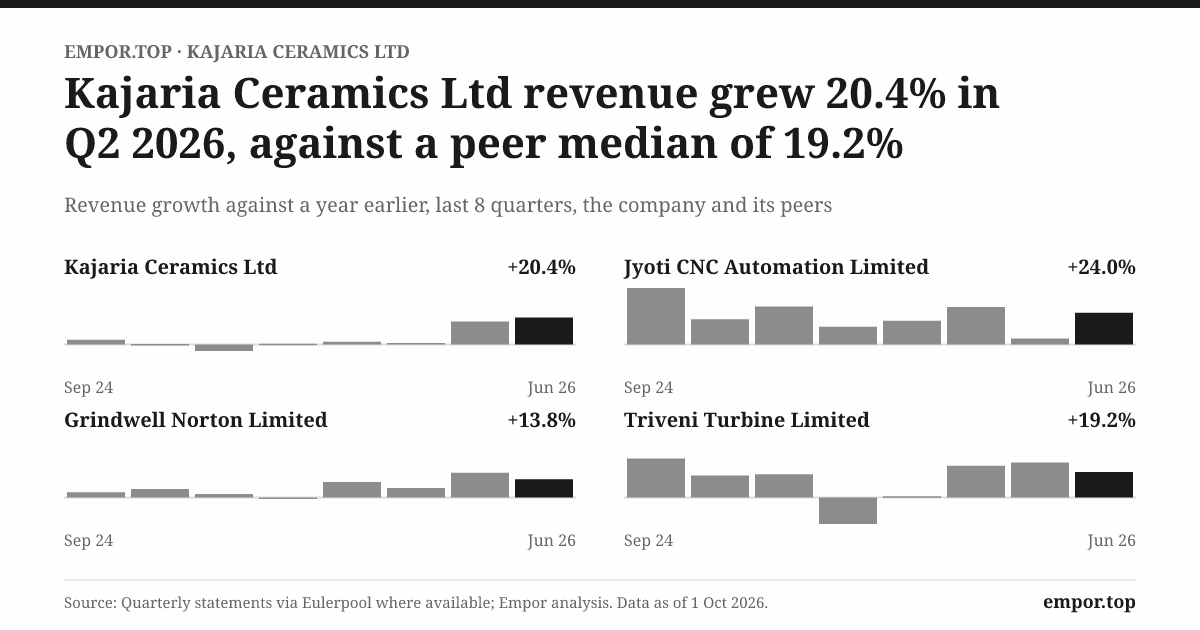
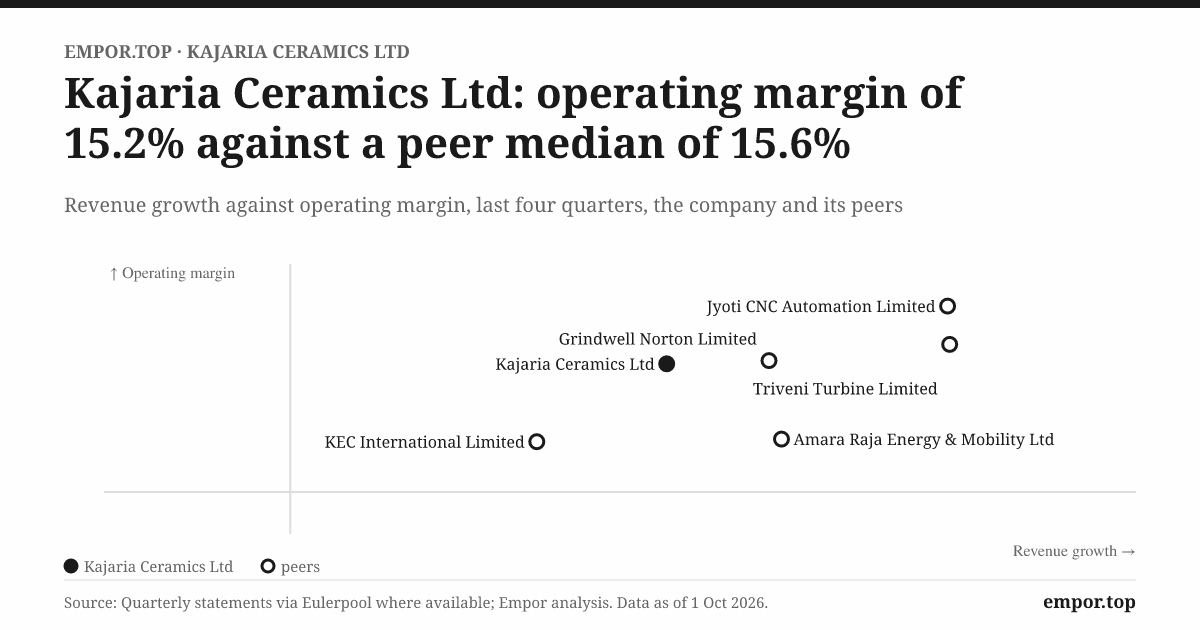
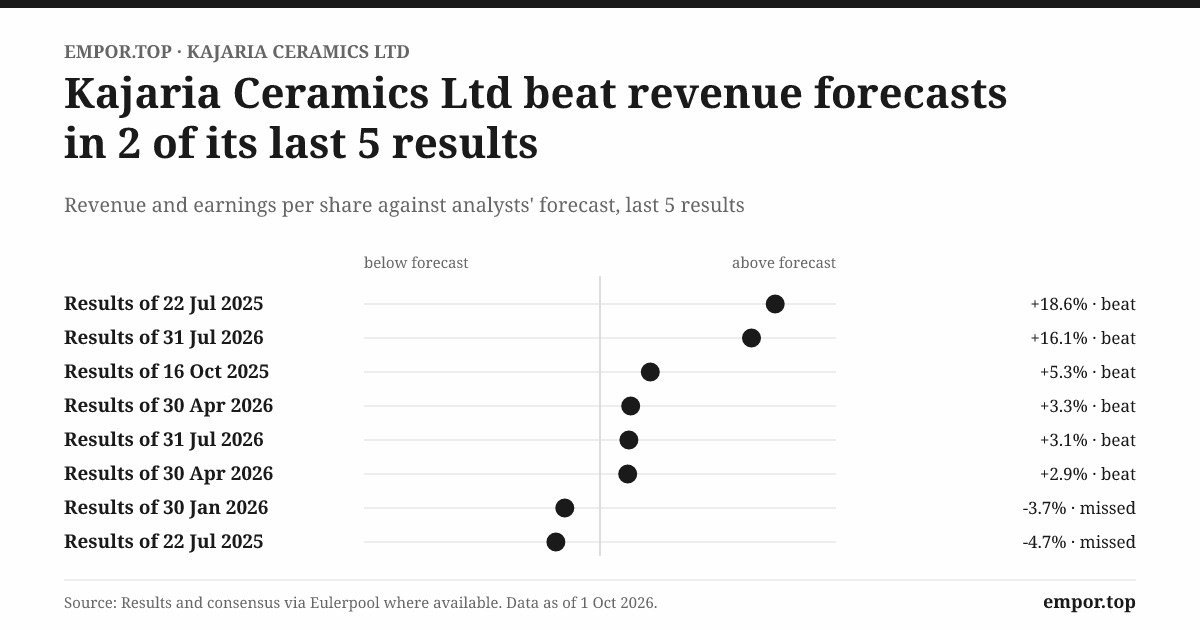
On the last day of July 2026, Kajaria Ceramics put out the kind of quarterly result that changes how a stock gets talked about. For the quarter to June, consolidated revenue rose about 20% from a year earlier, operating margin reached 16.4%, and net profit rose about 56%12. For a company whose sales in US dollars had barely moved for three years, that looked like a breakout.
Then came the detail that matters more than the headline. Management said tile volume, the square metres that actually left the factories and dealer yards, grew only about 6%2. Revenue grew more than three times as fast as volume. Investors therefore need to know where the rest of the growth came from, and whether it will still be there next year.
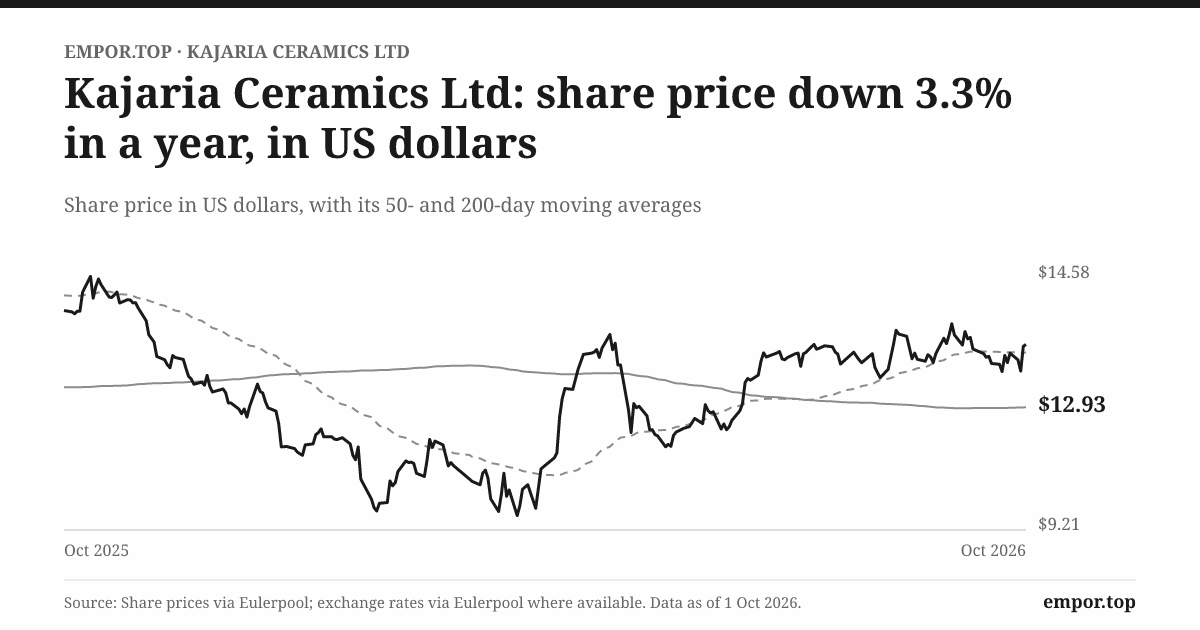
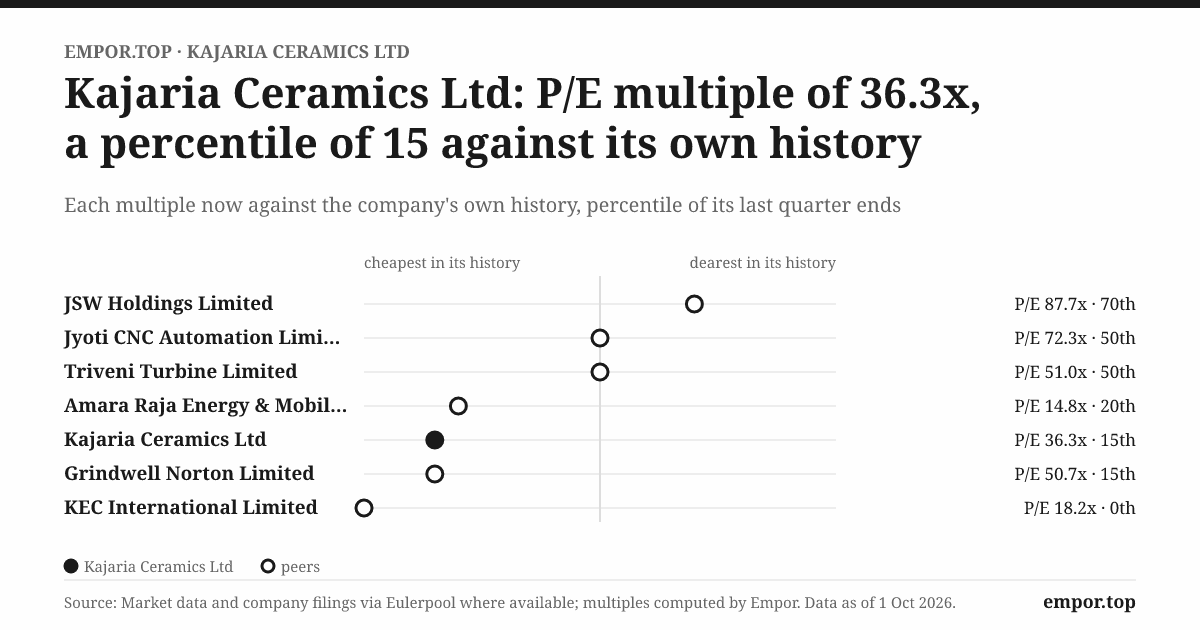
That gap sets up the whole story. Kajaria is India's largest tile maker. It has 82.7 million square metres (MSM) of annual tile capacity, consolidated revenue of about ₹4,830 crore in the year to March 2026, and tiles make up almost 89% of that revenue1. On 1 October 2026 the market valued it at about ₹19,800 crore ($2.1 billion), at roughly 36 times trailing earnings3. That multiple is high for most companies but well below Kajaria's own five-year median of about 49.5 times. Investors are paying a premium price for the business, yet they are not paying the premium they used to.
The puzzle is easy to see in the profit line. Tiles are a slow, steady product: people tile kitchens and bathrooms in good years and bad. Kajaria's net profit has not moved steadily, though. It fell about 30% in the year to March 2025 and then rose about 66% the next year1. A boring business does not normally swing that much, so the swings say something about the hidden variables: what gas costs, what rivals charge, and what happens outside the core tile business.
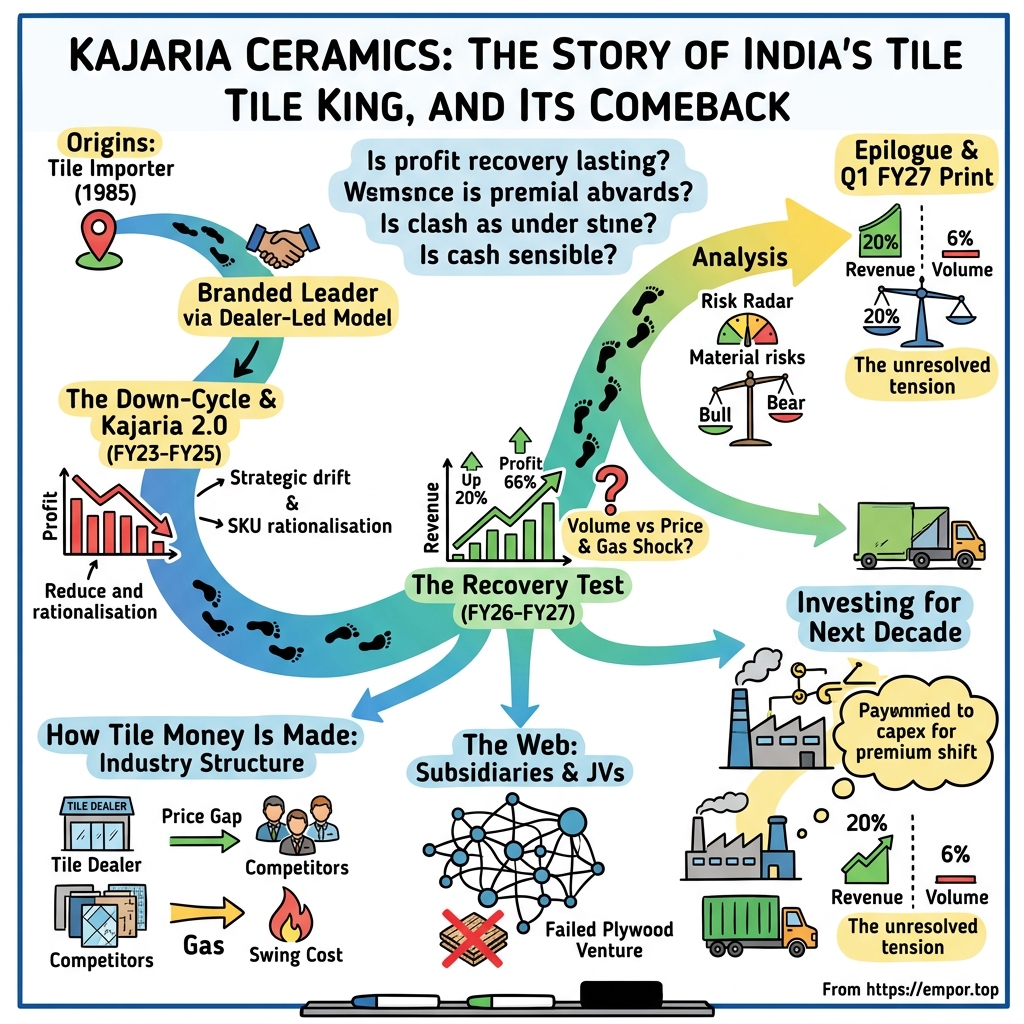
This story is built around four questions:
- Is the recovery real? Is it driven by volume and likely to last, or is it mostly price, cost cuts and a lucky disruption to competitors' gas supply?
- What does the group structure hide? Kajaria owns a network of subsidiaries and joint ventures that make tiles it sells under its own name. Do these hide weaker economics than the consolidated numbers show?
- Is it investing enough? It spends almost nothing on research and development, and its dollar revenue has been flat. Is it doing enough to keep its lead?
- Can management be trusted with the cash? The company holds about ₹793 crore of net cash. Does management deserve that much discretion over it?
The route runs through a short history, the economics of a tile dealer's showroom, the bad stretch from FY23 to FY25, the recovery and what it proves, the group structure, the family that runs the company, its investment plans, the cash pile and the buyback, and finally how the market prices all of it.
Our early view is that Kajaria is a real franchise, and that part of its current recovery depends on conditions outside its control. The rest of the story tests which part is which.
 Subscribe on LinkedIn
II. Origins, Briefly: From Tile Importer to Branded Leader
Picture north India in the mid-1980s. Floors are mostly mosaic, marble chips, Kota stone or plain cement. Ceramic tiles exist, but they are a fragmented, low-brand product sold on price through hardware shops. Into that market came Ashok Kajaria, from a Kolkata-rooted business family. He incorporated Kajaria Ceramics in 1985 and started production at a plant in Sikandrabad, Uttar Pradesh, a few years later45.
His bet was simple to state and hard to execute. Tiles were a commodity, but he would build a brand. A brand in tiles does not mean television advertising alone. It means a dealer who trusts that a shipment will match the sample, that a design will still be available when a customer comes back for twenty more boxes, and that the company will stand behind a cracked batch. Kajaria built its moat out of consistency, design range and dealer relationships rather than technology.
Kajaria has been listed since the 1990s, and the family has never given up control: promoters still owned 47.69% in June 20263. The founder remains Chairman. His sons Chetan Kajaria, the Vice Chairman, and Rishi Kajaria, the Managing Director, run the company with him. All three were re-appointed for five-year terms starting 1 October 20251. This is one family's company, run by that family across two generations.
The model peaked about a decade ago. In FY15 return on capital employed was about 30%, and in FY16 and FY17 operating margins were about 16.3–16.4%1. Kajaria earned high returns, grew quickly, and was widely treated in Indian markets as a high-quality consumer franchise.
What followed was a decade of slow erosion. Over the ten years to FY26, revenue grew about 7.3% a year in rupees1. Return on capital employed now sits around 21%, about a third below the FY15 level. Operating margin fell as low as about 10% in FY25 before recovering. The brand still holds, but it has not prevented a slow decline in returns.
That is the lesson to carry forward from the history. Brand and distribution gave Kajaria its lead, and they kept the company in a profitable position through ten tough years. They did not keep returns at the old peak. Any claim that Kajaria has "pricing power" needs to explain why margins fell for most of a decade. The next section looks at that question from a tile dealer's showroom.
III. How Tile Money Is Made: Industry Structure and Competition
Picture a tile dealer in a tier-2 city: Meerut, Indore or Vijayawada. A contractor walks in with a homeowner and a budget. On one wall there are Kajaria glazed vitrified tiles in a 600-by-1200 format with a marble look. On the next wall there is a tile that looks almost the same, made in Morbi, Gujarat, sold under a name the homeowner has never heard of, at a noticeably lower price per square metre. The dealer can steer the sale either way, and the dealer's margin, rebates and credit terms influence which way the conversation goes.
Indian tile profits are won or lost in that conversation, and it happens every day.
The unit of sale
Kajaria sells by the square metre, at a list price minus dealer rebates and discounts1. The rebates matter so much that the auditor named revenue recognition, specifically the accruals for rebates and discounts, as the only key audit matter1. The discount is a large part of the pricing decision, and it is where both competition and accounting judgement show up.
Dealers and distributors account for about 90% of sales. In FY26 the company served 2,448 dealers, down from 2,649 a year earlier1. The top ten dealers take only about 11% of dealer sales. No single customer can squeeze Kajaria. There are also no long-term contracts or minimum volumes, so a dealer's loyalty has to be won again every quarter.
The Morbi factor and the gas bill
The swing factor is Morbi. This town in Saurashtra hosts hundreds of tile makers, many of them small, family-run, flexible on price and fast at copying designs. When Morbi has capacity to spare, prices across the market weaken. When Morbi is disrupted, branded makers gain room to raise prices.
The main input that decides Morbi's costs, and Kajaria's, is gas. Kilns run on it. Kajaria's own commentary tied its FY26 pricing to gas and LNG costs1. The domestic price gap between branded and unbranded tiles has narrowed, according to the company's own risk discussion1. A narrower gap makes the brand premium harder to defend.
Porter's forces, once
- Buyers: fragmented dealers, so no individual dealer has power, but every dealer has alternatives on the next wall. Collectively, buyer power is moderate.
- Suppliers: gas suppliers hold real power because energy is a major cost and largely set outside the company. Clay and glaze inputs are less concentrated.
- New entrants: setting up a tile plant is not hard, as Morbi proves. Building national distribution and a brand is hard.
- Substitutes: marble, granite, wooden flooring and engineered stone at the top end, and cheaper imports at times. Within tiles, the shift from ceramic to vitrified products is substitution that Kajaria can capture.
- Rivalry: intense. The listed peers include Somany Ceramics, Orient Bell and Asian Granito in tiles, Cera in sanitaryware, and Pidilite in tile adhesives678. Kajaria is the largest of the listed tile makers. Exact market shares are hard to pin down because the unorganised sector is not measured precisely, so any share figure for the industry should be treated as approximate.
Seven Powers, briefly
Using Hamilton Helmer's framework, Kajaria has two powers that can be tested:
- Branding: customers and dealers accept a modest premium in exchange for consistency and confidence in the product.
- Scale economies: a large national manufacturing and logistics network spreads freight and overheads over more volume.
It has little counter-positioning, since any rival could copy the model with enough time and money. Switching costs are low and network effects do not apply. Cornered resources hardly exist, unless the dealer network counts as one.
The test of these powers is the margin record, and it gives a modest answer. Operating margin fell to about 10% in FY251. A company with strong pricing power would have passed on cost increases. ICRA, the rating agency, has listed limited pass-through of input costs under competitive pressure as a constraint on Kajaria's rating9. So the advantage is real but only partial.
The dealer cull deserves a second look too. Cutting about 200 dealers in one year can be described as tightening the network, and that may be accurate. It also shows that the network had more dealers than it needed. A distribution moat in perfect health would not need culling.
The adjacencies
Tiles generated about ₹4,280 crore of revenue in FY26. Bathware, sanitaryware, adhesives and other products together generated about ₹550 crore, roughly 11% of the total1. These smaller businesses use the same dealers, so selling a dealer a faucet or a bag of adhesive along with tiles makes sense. They are options on future growth, not current value. Nearly all of the company's value still comes from tiles.
The conclusion is that Kajaria has a real advantage from its brand and distribution, but the advantage is modest. Gas prices and Morbi's capacity set the margin that the brand defends. That explains why the downturn of FY23 to FY25 hit as hard as it did.
IV. The Down-Cycle and "Kajaria 2.0" (FY23–FY25)
The lowest point came in the March 2025 quarter. Kajaria's net profit for those three months was about $5 million, the weakest quarterly result in the recent record1. Revenue fell about 5% from a year earlier, and operating margin sat around 10%.
Most of that bad quarter came from a one-off charge. Kajaria had tried to build a plywood business, and the effort did not work. In FY25 the company wrote off its ₹45 crore equity investment in Kajaria Plywood and a ₹67 crore loan to it, a total of about ₹112 crore of exceptional items in the standalone accounts1. A tile company, using cash from its tile business, had tried to enter a different building-materials category, and almost all of that money was lost.
The plywood loss does not explain the full year, though. For FY25, consolidated EBITDA before exceptional items fell to about 12.8% of revenue1. Net profit fell about 30%1. Revenue in dollars stayed at about $540–550 million from FY23 to FY261. In practical terms, 2022 to 2025 was a lost stretch for growth.
What went wrong
Three pressures combined:
- Demand: real-estate and renovation demand was soft for most of the period, and management repeatedly described FY26 volumes as "almost flat" for nine months1.
- Competition: Morbi's capacity was looking for buyers, and when demand is soft a branded maker must either cut price or lose volume.
- Internal drift: before 2025, Kajaria ran three separate sales verticals, sold too many product codes, and had a sprawling dealer base. Management acknowledged all of this when it launched its reorganisation.
The repair
Management called the response "Kajaria 2.0." It brought the three sales verticals under one structure, cut the number of product codes (SKUs), let underperforming dealers go, paused non-essential hiring, and brought in new senior executives1.
The results show up clearly in the numbers. Consolidated EBITDA before exceptional items rose to about ₹862 crore in FY26, a margin of about 17.8%, up from about ₹598 crore and 12.8% in FY251. That is roughly five percentage points of margin recovered in one year.
The fair reading is that the margin recovery is real and that management fixed actual problems. Too many SKUs tie up working capital, and too many sales verticals compete with each other for the same dealers. The cleaner inventory data in Section V supports this.
Much of the 66% profit increase in FY26 is also a base effect, though. The FY25 comparison included the ₹112 crore plywood write-off and an unusually low margin. Measured against FY24, the last normal year, net profit in FY26 rose about 8% in dollars1. The improvement is real, but much smaller than the headline suggests.
The FY26 wobble
The recovery was uneven. In the December 2025 quarter net profit dropped to about $10 million, and the tax rate rose above 30%1. During FY26 the standalone company booked about ₹16 crore for gratuity and leave provisions under India's new labour codes, plus about ₹6 crore of impairment on a loan to its Dubai subsidiary1. Neither charge relates to the core business, and the timing fits the December-quarter dip, although the company has not linked the dip to these items quarter by quarter. This is our inference.
Did management promise and deliver?
Management's tone changed more than its numbers did. In FY25 and early FY26 it talked about a demand recovery that kept slipping. By the Q1 FY27 call in July 2026 it was guiding to double-digit volume growth and EBITDA above ₹1,000 crore at an 18–19% margin for FY2710. In FY26 management delivered the margin recovery it said it was working on. It has not yet proved it can hit a volume forecast. Margin guidance has been more reliable than volume guidance.
That leads to the central question about the recovery: where is the growth coming from?
V. The Recovery Test: Volume, Price or Middle East Luck?
The most revealing sentence in Kajaria's FY26 annual report comes from analysts, not management. In the management discussion, the company acknowledges that analysts had raised a concern: a significant part of the FY26 volume uplift came from supply disruption in the Middle East, rather than from underlying Indian demand1. Management's answer, recorded alongside, was that the recovery is "structural, not cyclical"1.
Few companies print their critics' argument in their own annual report. The reply is still management's claim, not independent evidence. When a regional disruption pushes up rivals' gas costs or cuts off supply, a branded domestic maker with its own production can gain volume and price at the same time. Those gains reverse once the disruption ends.
What the numbers say
Take the June 2026 quarter as a worked example:
- Revenue rose about 20%1.
- Management said volume rose about 6%2.
- So roughly 14 percentage points of growth came from price, product mix and other factors.
- Operating profit rose about 52%, which shows how strongly higher realisation per square metre feeds through to profit when costs are fixed.
The shape of FY26 points the same way. Volumes were nearly flat for nine months and only picked up from January 20261. The March 2026 quarter showed revenue up 17% and operating margin about 16%1. The step change came within the last two quarters, and it coincides with the period when management says pricing actions tied to gas costs took effect.
Prepared remarks vs Q&A
On the Q1 FY27 call, management gave precise figures for things it controls: the ₹165 crore Gailpur expansion, the EBITDA target and margin range10. It was less precise about volume drivers and spoke more generally about "demand." When management is specific about costs and general about demand, investors should rely on cost improvements more than volume forecasts.
Cash quality
The cash record mostly supports the recovery story:
- Over FY15–FY26, cumulative cash from operations was about 128% of cumulative net profit1. That is normal for a capital-heavy manufacturer, because depreciation is a non-cash expense, and it is a reassuring sign that profit has turned into cash over a long period.
- In FY26, operating cash flow was about 79% of EBITDA, high by the company's standards, and free cash flow reached about $64 million, the highest in the series1.
There is one asterisk. Inventory days fell from about 107 to about 55 in a single year1. Cutting the number of products and moving slow stock frees up cash once. That release will not repeat, so FY26 free cash flow overstates the normal level.
Receivables, by contrast, look healthy. Debtor days were about 48, compared with a peak of 61 in FY181. Credit-impaired receivables were about 3.7% of gross receivables and fully provided for, and the charge for expected credit losses fell from about ₹24 crore to about ₹10 crore1. Dealers are paying on time, which is a sign of demand and a sign that the dealer cull removed weaker accounts.
The verdict, and the test
We lean toward a cautious view. The margin improvement is real: SKU cuts, the new sales structure and cost discipline are lasting changes. The split between volume and price is not proven, and the latest quarter suggests price contributed more than volume.
The tests are clear. In the Q2 and Q3 FY27 results:
- Confirmation: volume growth that rises toward double digits while EBITDA per square metre holds as rivals' gas supply returns to normal.
- Falsification: volume stays in single digits and margins slip back below 15% as Morbi's costs ease.
The lesson is that margin gains built on higher prices are the first to disappear when competitors' costs fall. The next question is how much of Kajaria's profit depends on businesses that are not visible in the consolidated headline.
VI. The Web: Subsidiaries, JVs and Capital Allocation
Return to the plywood decision, because it is the clearest view of how Kajaria makes decisions outside its core business. The company created Kajaria Plywood, put equity into it and lent it money. By FY25 the business had failed, and the parent wrote off about ₹45 crore of equity and ₹67 crore of loans1. In FY26 it took a further impairment of about ₹6 crore on a loan to its Dubai subsidiary, Kajaria International DMCC1.
These amounts are small relative to a ₹19,800 crore company. They still show that, outside tiles, Kajaria's capital allocation has a poor record.
The sourcing web
Most of the subsidiaries are not outside tiles. They are tile factories. The standalone parent bought about ₹784 crore of finished tiles from subsidiaries in FY26, about 18% of standalone revenue1:
- Kajaria Vitrified supplied the most, about ₹362 crore.
- Kajaria Infinity supplied about ₹158 crore.
- Kajaria Surfaces supplied about ₹142 crore.
- South Asian Ceramic Tiles supplied about ₹122 crore.
The parent's stakes vary, from about 60% in South Asian Ceramic Tiles to 95% in Kajaria Vitrified1. That matters because minority partners share the profits from those plants. The company states that all related-party transactions were at arm's length1.
The structure makes operational sense. Joint ventures with regional tile makers let Kajaria add capacity quickly, often with a local partner, without building every plant itself. The cost is reduced visibility. Investors see the consolidated result, but cannot easily tell which plants earn their cost of capital.
Money lent, money guaranteed
Kajaria's related-party lending is substantial:
- Gross loans to related parties of about ₹324 crore, with an allowance of about ₹93 crore against loans considered doubtful1. Roughly 29 paise of every rupee lent to related parties has been marked as possibly unrecoverable.
- Corporate guarantees of about ₹283 crore, plus standby letters of credit for a joint venture's loan of about ₹130 crore, up from about ₹88 crore1.
The guarantees and letters of credit total about ₹414 crore, roughly 13% of consolidated equity of about ₹3,066 crore1. These are the real contingent liabilities, not tax claims: tax and other disputes fell to under ₹3 crore1. The growing letter-of-credit exposure to a joint venture, Kajaria RMF Trading LLC, deserves attention because its business is outside India and visibility is limited.
A clarification that matters
In India, "related-party transactions" often means business with companies owned by the promoter family. That is not the main issue here. In the FY26 related-party table, the column for enterprises in which key management personnel can exercise significant influence shows no purchases1. Kajaria's related-party exposure is to its own subsidiaries and joint ventures. That is a capital-allocation question, not a governance red flag about the family taking value.
What the auditors said
The auditors reported one key audit matter, revenue recognition, for both standalone and consolidated accounts1. Their CARO report for FY26 found no defaults, no fraud, and no overdue loans to related parties1. Those findings apply to those reports and that year; they are not a general assurance about everything.
The verdict
Kajaria has not done a large acquisition, so there is no takeover price to judge against comparable deals. Its record consists of subsidiary buildouts, joint ventures in Nepal and the UAE, and two failed ventures, in plywood and in Dubai trading.
The plywood failure carries the most weight in judging management: it is recent, material, and happened under the same family management that runs the company today. Any claim that Kajaria allocates capital with discipline should be limited to its core tile business. Outside tiles, the evidence points the other way.
The test is whether subsidiary-level returns improve in the FY26 and FY27 consolidated notes. The next question is about the people making these decisions.
VII. Management: Promoters Who Waived Their Pay
FY26 brought one of the more unusual pay disclosures for an Indian listed company. The Chairman, Vice Chairman and Managing Director, Ashok, Chetan and Rishi Kajaria, drew no remuneration at all, the second consecutive year without salary1. In FY25 each had been paid about ₹5.7–5.8 crore, a combined total of roughly ₹17 crore1.
Promoter families in India are often criticised for paying themselves heavily regardless of results. Here the family took nothing during a profit slump. It is a striking signal.
The family
Ashok Kajaria founded the company and remains Chairman. He is the family figure who represents the company to dealers and the industry. Chetan Kajaria, as Vice Chairman, has been closely associated with manufacturing and the group's expansion through plants and joint ventures. Rishi Kajaria, as Managing Director, has been the public face of the sales and brand transformation, including Kajaria 2.0. All three were re-appointed for five-year terms, approved by shareholders by postal ballot in December 20251.
The family owns about 48% of the company3. No promoter shares are pledged, according to the company's notes and CARO report1. With that much of their own wealth in the stock, the family's interests are closely aligned with those of other shareholders.
The board
The board has three promoter executives, one non-executive director, and five independent directors. Two of the independents, Hitesh Jain and Pradeep Udhas, joined in December 20251. The independent directors are in the majority, which meets Indian requirements, but the business is run by the family.
The senior team also changed. R. C. Rawat, the long-serving COO and Company Secretary, retired at the end of March 2026, and Vinit Kumar became General Counsel and Company Secretary1. CFO Sanjeev Agarwal continues in his role1.
Shareholder dissent
Dissent at shareholder meetings has been low. About 2.2% of votes cast opposed the buyback resolution in June 20261. That is too little to signal a revolt, but it shows some institutions were not fully convinced about the price or size.
The incentive point
While the promoters took no salary, median employee pay rose about 30% in FY261. Some of that increase comes from changes in the employee mix, but it also shows that the cost cuts did not fall heavily on staff. The company paid to keep people while restructuring.
The verdict
Alignment is strong: large family ownership, no pledges, and two years of zero salary. The pay waiver can be reversed, however, and it was made in two weak years. The test is FY27. If profits reach management's guidance and the family resumes pay of ₹17 crore or more, the waiver will look like a temporary gesture. If restraint continues, it will look like a real principle.
On guidance, management's credibility is still unproven: it has a record on margins but not yet on volumes. The next question is whether the company is investing enough for the next decade.
VIII. Investing for the Next Decade: Capex, R&D and the Premium Shift
On the same day as the Q1 FY27 results, the board approved a ₹165 crore expansion: 11 MSM of new glazed vitrified tile capacity at Gailpur, Rajasthan, due in April 2027 and funded from internal cash2. The board also approved about ₹12 crore for solar and wind power in Rajasthan2.
Glazed vitrified tiles are the higher-value part of the market. They are fired at higher temperatures, so they are denser and less porous than ordinary ceramic tiles, and they can carry printed marble, stone or wood designs at large sizes. They usually command higher prices per square metre. Moving the product mix toward vitrified tiles is how a tile company earns more from each square metre it sells.
The capacity plan
The company has 82.7 MSM of tile capacity, plus 5.1 MSM in its Nepal joint venture1. Other projects include:
- a new 10 MSM line for high-value products at Srikalahasti, Andhra Pradesh;
- conversion of a 9.1 MSM ceramic line at Gailpur to glazed vitrified tiles1.
The company reported tile sales of about 118.5 MSM1, well above its own capacity. The difference appears to come from volumes made by outsourced manufacturers and sold under the Kajaria name. That shows how much of the business depends on sourcing as well as manufacturing.
Capex in context
In FY26, cash spent on investing was about $43 million, roughly 8% of revenue1. Gailpur adds a significant but manageable amount to that. Kajaria can fund it many times over from internal cash. Capacity expansion is not limited by money.
The R&D question
Kajaria spent ₹2.04 crore on research and development in FY26, about 0.05% of turnover, down from about 0.14%1. In many industries that would be alarming. For tiles it is a weaker warning sign. Product development in tiles mostly happens through design studios, imported printing equipment and the kiln suppliers that develop new technology. Much of the innovation is bought with equipment rather than created in a lab.
The more relevant question is whether Kajaria is keeping up with design trends and product formats. Its move into large-format glazed vitrified slabs suggests it is. Still, a falling R&D budget at the largest company in the market is a small sign of reduced ambition.
The adjacencies
Bathware, sanitaryware and adhesives, sold under brands such as Kerovit, earn around ₹550 crore of revenue1. The company does not break out margins for them separately in a way that allows a clean judgement. These businesses can use the existing dealer network at little extra cost, which is an advantage. They also compete with stronger specialists such as Cera in sanitaryware and Pidilite in adhesives7. Their potential is plausible but not proven.
Debt
Kajaria has essentially no bank debt. Borrowings were nil at March 2026, and the reported debt is mostly lease liabilities of about ₹89 crore1. The debt-to-equity ratio of 0.07 overstates the company's leverage.
The verdict on investment is that the capacity plan and the shift toward higher-value products are credible and affordable. Returns from Gailpur and Srikalahasti will decide whether they create value. The bigger question is not whether Kajaria can afford growth but what it does with the cash left over.
IX. Where the Cash Goes: Dividends, the Buyback and ₹793 cr of Net Cash
On 30 April 2026, Kajaria's board approved its first notable buyback: up to 21.5 lakh shares, about 1.35% of the company, at ₹1,380 a share, through a tender offer worth up to about ₹297 crore1. Shareholders approved it in June, and the shares were bought back and cancelled1. On 1 October 2026 the stock traded at about ₹1,245, roughly 10% below the buyback price3.
Shareholders who tendered sold at a better price than today's market. Shareholders who did not tender saw the company spend cash at a higher price than the market now offers.
Dividends
Over twelve years, Kajaria paid about 55% of its cumulative free cash flow as dividends1. Its median payout ratio was about 34% of profit, rising to about 59% in FY25, when the company maintained its dividend while profit fell1. Keeping dividends steady through a bad year is a sign of confidence and of a balance sheet that could afford it. The dividend yield is about 1.1%3.
The cash pile
Even after dividends and capex, cash kept accumulating. Kajaria held about ₹1,430 crore of cash and investments at March 2026, with net cash of about ₹793 crore after deducting debt-like items, up from about ₹424 crore a year earlier1. About ₹174 crore of deposits are pledged to banks as security for facilities1.
The cash contributes to profits. Standalone other income, largely interest and treasury returns, was about ₹79 crore in FY26, roughly 12% of standalone profit before tax and exceptional items1. Part of the standalone figure is interest from subsidiaries, which disappears in the consolidated accounts.
Financial strength, verified
Kajaria has no GDRs, warrants or convertibles outstanding1. It did not need to raise equity during the downturn. Its balance sheet is a clear strength.
The activist's question
An activist investor would ask: why hold ₹793 crore of net cash when return on equity is about 16%? Cash earning 6–7% before tax lowers that return. The buyback used only about ₹297 crore, and that was before the year's cash generation. Gailpur requires ₹165 crore. On these numbers, Kajaria can fund its full investment plan and still have spare cash.
Management's likely answer is resilience, to protect the business against a gas shock or demand slump like FY25. It is a fair argument. It is also less convincing given a record of putting surplus cash into plywood and Dubai rather than returning it to shareholders.
The credit lens
ICRA rated Kajaria [ICRA]AA (Stable) for long-term debt in March 20249. The rating rationale assumed the company would borrow to fund capex. It did not borrow. The company is in a stronger position than the rating agency expected.
The verdict is positive on dividend payout and neutral on the buyback, which was well run but too small to matter much and priced above today's market. The idle cash remains the biggest open capital-allocation question. That brings us to what the story teaches.
X. Playbook: Business & Investing Lessons
"In a commodity, the brand is a dealer relationship." Kajaria's moat is less about the logo on the box and more about the 2,448 dealers who decide which wall the contractor sees first. The FY26 dealer cull showed both sides of that moat: the network is valuable enough to prune, and it had grown loose enough to need pruning. Founders who build brands in commodity markets should measure what dealers earn and whether they stay, not just consumer awareness.
"A margin recovery is not a growth story." In FY26 net profit rose 66%, and the headline treated it like a growth story. Against the last normal year, profit was up only modestly, and the recovery came mainly from fixing the business rather than selling much more. Investors who price a recovery from a low base as lasting growth usually end up paying twice.
"Diversification outside your moat is where the write-offs live." Kajaria's tile subsidiaries, whatever their opacity, make the core product. Its plywood venture cost it about ₹112 crore, and its Dubai trading arm has needed impairments. The lesson is not about acquisitions in general. A company's strengths transfer poorly to new businesses that share only the same customer.
"Pay waivers are promises with expiry dates." Three family executives gave up about ₹17 crore a year in a downturn, a rare and real gesture. Its value depends on what happens when profits recover. Governance signals made in bad years are only confirmed when good years arrive.
"Watch volume, not revenue." Q1 FY27 brought 20% revenue growth on 6% volume growth. For any company that sells physical units, the gap between revenue and volume shows how much of the growth depends on price, and price is the part rivals can take back first.
XI. Analysis: Bull vs Bear, KPIs and Risk Radar
On 1 October 2026 Kajaria traded about 36 times trailing earnings and about 20 times EV/EBITDA, close to its 52-week high3. Its five-year median P/E was about 49.5 times. Measured against its own history, the stock looks cheap. Measured against its long-term growth of about 7% a year, it does not.
What the price assumes
At 36 times earnings, with an earnings yield of about 2.8%, the market is paying for more than the past decade's growth. A PEG ratio of about 2.9 says the same: the multiple is high relative to expected earnings growth3. The price effectively assumes that FY27 EBITDA reaches management's guidance of above ₹1,000 crore and stays there, and that the margin reset is permanent rather than a peak.
Listed peers such as Somany Ceramics, Orient Bell and Asian Granito have historically traded at lower multiples than Kajaria. Cera and Pidilite have traded at higher ones, reflecting their own franchises678. Exact peer multiples change daily, so the comparison is approximate. Kajaria's premium to smaller tile makers reflects its scale, balance sheet and brand. That premium is earned, although it has narrowed over the years.
The bull case
- India's largest tile brand, with a national dealer network that rivals cannot easily copy.
- Net cash of about ₹793 crore and almost no debt, so it can invest through a downturn when weaker rivals cannot.
- A margin reset to about 18% EBITDA from structural fixes: fewer SKUs, a unified sales force and leaner inventory.
- Committed capacity in higher-value glazed vitrified tiles, funded internally.
- A family that owns about half the company and took no pay through the downturn.
The bear case
- Q1 FY27 growth relied heavily on price, and part of the FY26 volume gain may have come from Middle East disruption that will not last.
- Gas costs and Morbi's capacity set the industry's margin structure, so Kajaria's margins are partly set by forces it does not control.
- Dollar revenue has been flat since FY23, and returns are still well below the FY15–FY17 peak.
- A network of subsidiaries and joint ventures with about ₹93 crore of doubtful-loan allowances and about ₹414 crore of guarantees and letters of credit.
- Almost no R&D and a falling dealer count.
The weighing
The bull case relies on structural factors that the record partly supports: margins recovered through fixes management controls, the balance sheet is strong, and incentives are aligned. The bear case relies on factors the record also supports: the margin collapse in FY25, the plywood loss, and the latest quarter's dependence on price.
The moat holds, but in a narrower form: Kajaria's advantage is enough to earn above-average returns through the cycle, not enough to protect it from the cycle. The test is the volume trend over the next two quarters.
The three KPIs that matter
- Tile volume growth. Latest reading: about 6% in Q1 FY27, following nearly flat volumes for most of FY2612. The trend is improving but below the double-digit guidance.
- EBITDA per square metre, or EBITDA margin as a proxy. Latest reading: FY26 EBITDA margin of about 17.8%, up from 12.8% in FY251. The trend is up sharply, and the key question is how well it holds.
- Dealer count and quality. Latest reading: 2,448 dealers, down about 8% in one year, with lower credit losses1. Fewer dealers paying more reliably is a good sign as long as the count stabilises.
Risk radar
- Gas and LNG prices: the most material risk. Kajaria's fuel costs and Morbi's costs both move with gas prices. Higher gas prices squeeze margins if they cannot be passed on, and lower gas prices let Morbi cut prices.
- Housing and renovation demand: a slowdown in real estate hits volumes directly.
- Morbi competition: spare capacity in Morbi pressures prices nationally.
- Losses in subsidiaries and joint ventures: further impairments on loans or guarantees.
- Currency: unimportant. Unhedged foreign payables were about ₹4.5 crore1.
Who owns it
Ownership has shifted. Foreign institutional investors fell from about 23% of the company in March 2017 to about 12% by June 2026, while domestic institutions rose to about 26%3. The number of shareholders rose to about 125,0003. Indian mutual funds now set the stock's price more than foreign funds do, and they have tended to pay higher multiples for Indian consumer franchises.
The valuation question cannot be answered yet. The next few quarterly results will provide the evidence.
XII. Epilogue
Today Kajaria is in a strong position. Margins have recovered, the cash pile is growing, a new plant is under construction, and the stock is near its high. Over the next year a sequence of events will show whether that position is earned.
The Q2 FY27 results, around late October 2026. This is the first test of volume. If volume growth moves toward double digits, the argument that price drove the recovery weakens. If it stays near 6% while realisations fall, the bear case gains support.
The Q3 FY27 results, around January 2027. By then the year-on-year comparison includes the period when the volume pickup began, so the base effect turns against Kajaria. Holding margins against that harder comparison would show the recovery is real.
Gailpur commissioning, April 2027. The first new capacity from the post-reset strategy. If it runs at high utilisation and sells at premium prices, it supports the idea that the shift to higher-value tiles is creating value.
FY27 promoter remuneration, in the next annual report. Whether the family resumes salaries will show whether the pay waiver was a gesture for hard times or a lasting principle.
What happens to the cash. Another buyback, a larger dividend, or another venture outside tiles. The choice will answer the fourth question more clearly than any statement.
Each event maps onto the four questions:
- Volume growth tests whether the recovery is real.
- Subsidiary returns test the group structure.
- Gailpur tests whether Kajaria is investing enough.
- Pay and cash decisions test management's discipline.
Underneath all of it is one unresolved tension: Kajaria's franchise is real, but some of its profit recovery depends on gas prices and rivals' problems.
XIII. Outro
The story began with 20% revenue growth on 6% volume growth. Every analysis in this piece comes back to that gap. If volume catches up with revenue, Kajaria is still India's tile king and its brand is earning its premium. If revenue falls back toward volume, the recovery was mainly a cycle in which gas prices helped for a while.
The next four quarters will decide which story is true. Volume, square metre by square metre, is the measure to watch.
References
-
Integrated Annual Report 2025-26 — Kajaria Ceramics, 2026 ↩↩↩↩↩↩↩↩↩↩↩↩↩↩↩↩↩↩↩↩↩↩↩↩↩↩↩↩↩↩↩↩↩↩↩↩↩↩↩↩↩↩↩↩↩↩↩↩↩↩↩↩↩↩↩↩↩↩↩↩↩↩↩↩↩↩↩↩↩↩↩↩↩↩
-
Kajaria Ceramics Reports 56% YoY PAT Growth in Q1 FY27; Approves Rs 165 Crore Capacity Expansion — DSIJ, 2026 ↩↩↩↩↩↩
-
Kajaria Ceramics shareholding and financials — screener.in ↩↩↩↩↩↩↩↩↩
-
Kajaria Ceramics Limited: Ratings reaffirmed — ICRA, 2024-03-12 ↩↩
-
Kajaria Ceramics corporate announcements (results, call transcripts, scrutinizer reports) — BSE ↩↩
 LinkedIn
 WhatsApp
 Reddit
 Hacker News
 Email
Email Kindle
 RSS Feed
 Spotify
 Apple Podcasts
 Amazon Music
 Audible
 YouTube