Jyoti Resins & Adhesives: The ₹1,000 Crore David Against Fevicol's Goliath
I. Introduction & Episode Roadmap
Walk into almost any hardware shop in India and ask for "glue," and the shopkeeper will reach for an orange-and-white Fevicol tin before you finish the sentence. "Fevicol ka jod" is not just a slogan. It is everyday shorthand for a bond that cannot be broken, and for decades it described Pidilite Industries' grip on the synthetic wood-adhesive market just as well. In this category, the brand is the market.
Then there is a single plant in Santej, an industrial suburb near Kalol, north of Ahmedabad. Out of it, a company most Indian investors had never heard of until the early 2020s built a white-glue brand called Euro 7000. Management estimates that brand now holds roughly 15% to 35% of the market across its four mature western states: Gujarat, Maharashtra, Rajasthan and Madhya Pradesh12. The company is Jyoti Resins and Adhesives Limited. It was incorporated in December 1993 and has been listed on the BSE since 19941. Over the ten years to March 2026 its revenue grew about 21% a year, its operating margin rose from about 2.5% to 26.4%, and its net profit grew roughly 80% a year1.
That is the hook. The tension starts where the hook ends.
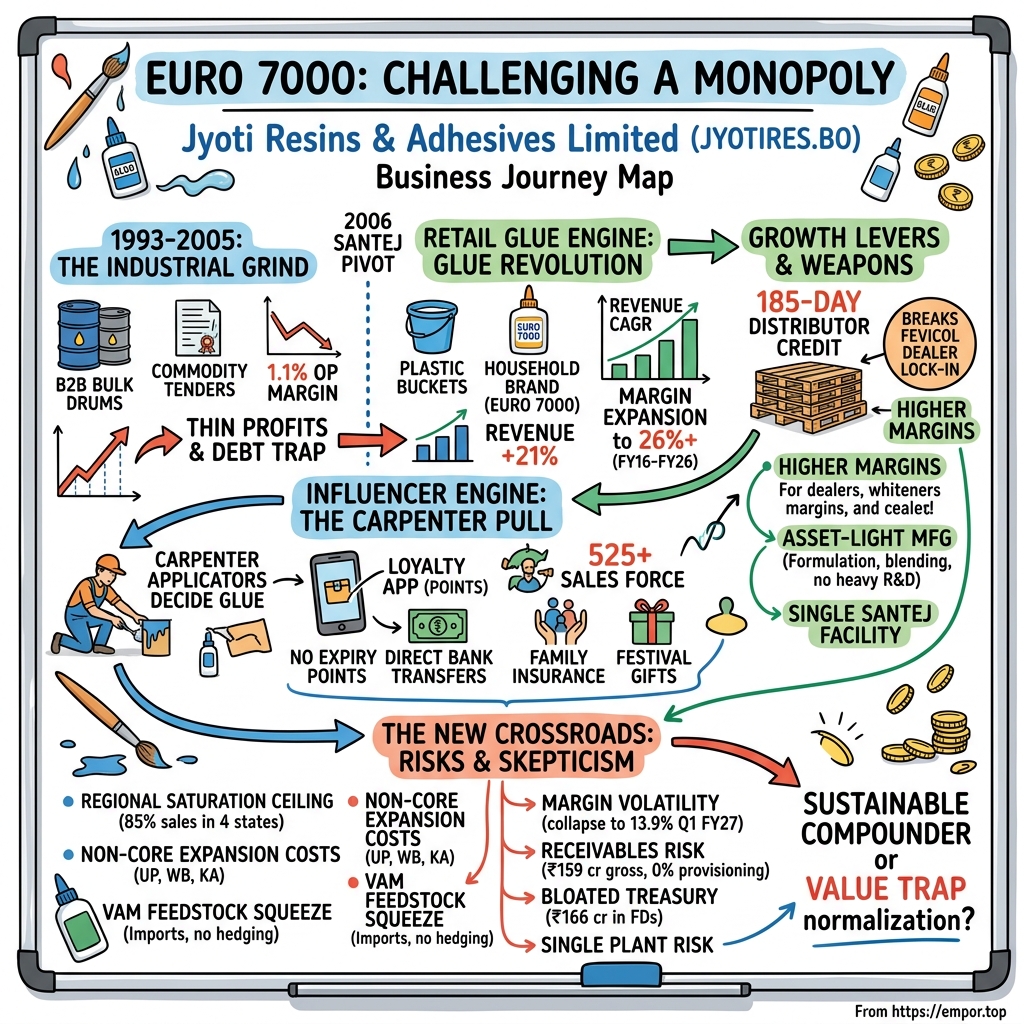
Jyoti Resins built this business without the usual tools of a consumer-goods challenger. It reports nil research and development spending1. It has had no bank debt since FY20231. Its net plant and machinery block is about the price of a few luxury flats in Mumbai1. And just as the stock became a retail favourite, the numbers started to wobble. Revenue grew only about 6% a year from FY2023 to FY2026. Receivables stretched to 185 days of sales. In the quarter to June 2026, the operating margin fell to 13.9%, from 26.9% a year earlier1[^5].
Four questions run through this story:
- The working-capital dilemma. Is the 185-day receivables cycle a deliberate weapon for breaking Pidilite's hold on dealers, or credit risk that the company has not provided for?
- The margin illusion. Did Euro 7000 earn real pricing power, or did a collapse in the price of its main raw material, vinyl acetate monomer, flatter its 30%-plus margins?
- The regional glass ceiling. Can a brand built in western India travel north, east and south without wrecking its returns on capital?
- The capital-allocation puzzle. High promoter pay, no R&D, about ₹166 crore of idle liquid funds and very little factory reinvestment. Is that harvesting, or a disciplined asset-light compounder?
The story runs from a forgotten 1990s penny stock, through a second-generation consumer pivot and a carpenter-loyalty machine, into the forensic detail of receivables and raw-material cycles. It ends with the moat frameworks, the bull and bear cases, and lessons for any challenger facing an entrenched monopoly. It starts where most Indian small-cap stories start: a family, a shed and a public issue in a boom year.
 Subscribe on LinkedIn
II. The Accidental Chemical Processor: 1993–2005
Picture Ahmedabad in 1994. India's economic liberalisation was three years old, the capital-issues controller had gone, and Gujarat's industrial estates were filling with small chemical units hoping to raise money from a newly excited retail public. Jagdish N. Patel's company joined that wave. Jyoti Resins and Adhesives was incorporated on 17 December 1993 and completed its initial public issue in September 1994, which put it on the BSE under scrip code 51444813.
For the next decade it was the sort of company the boom produced by the hundred. It blended resins and adhesives and sold them in bulk to industrial customers, so it won or lost on price. The surviving record from the end of that era shows what this meant. In FY2015, after the consumer pivot had begun but before it had changed the overall economics, the company earned an operating margin of about 1.1% on roughly $4.3 million of sales, and a net profit of about $33,0001. That is a rounding error, not a business.
The economics of being nobody's first choice
Industrial adhesive buyers have every advantage. They buy in volume, they know the chemistry, and they can quote a competitor's price on the next phone call. A small formulator selling to them has no brand to fall back on and no way to stop a customer leaving. The supplier also ends up financing the customer: in FY2015, receivables were about 202 days of sales1. Jyoti Resins was taking on credit risk for clients that paid when it suited them.
The balance sheet showed the strain. In FY2015 borrowings were about $1.5 million against equity of about $670,000, a debt-to-equity ratio of 2.281. The company was borrowing from banks to fund its customers' purchases, at margins too thin to cover the interest with any comfort.
The verdict on that era is blunt. Commodity B2B chemical supply to sophisticated buyers is a margin graveyard. Without a brand, a cost advantage or switching costs, returns settle below the cost of capital, however hard the family works. Everything that followed in this story was a response to that lesson. The question was who would act on it, and how.
III. The 2006 Santej Pivot: Turning White Glue into a Retail Brand
The answer was Jagdish Patel's son. Utkarsh J. Patel joined the company in 20051. His thesis amounted to changing the customer. Instead of selling drums to procurement officers who bargain for a living, the company would sell branded buckets to people who barely think about price: India's carpenters.
In 2006 the company launched Euro 7000, a synthetic polyvinyl acetate (PVAc) wood adhesive packed for retail sale1. Two decades later Utkarsh is still Managing Director and his father is still Chairman. The top team, including long-serving CFO Ashok C. Jardosh, has seen no turnover in the MD, whole-time director or CFO roles over that period1. In a small-cap world full of revolving doors, that continuity is worth noting. It also means the people who built the strategy are the ones being judged on its second act.
Why white glue is a beautiful product
Look at the work from the carpenter's side. A modular kitchen or wardrobe uses plywood, laminates, veneers, hardware and many days of skilled labour. The glue that holds it together costs very little compared with everything around it. But if it fails, laminates lift, veneers bubble, and the carpenter gets the angry phone call and loses the referral. The cost is small and the consequences are large. That combination makes buyers loyal to whatever works and largely indifferent to saving a few rupees a kilogram.
For a challenger, that cuts both ways. Price competition will not win share, so a cheap alternative goes nowhere. But once a carpenter trusts a brand, he can keep buying it without much pressure on price. Euro 7000 therefore had to be presented as a credible premium alternative, not a discount brand. Today the range runs from 500-gram packs to 60-kilogram drums and includes waterproof and fast-drying grades, PVC glue and masking tape2. Each pack size is a different price point for a different job, from the odd-job man repairing a chair to the contractor fitting out a whole apartment block.
What the numbers say about the pivot
The pivot took years to show up in reported profit. Margins were still low single digits through FY2019, and the big step came in FY2020, when the operating margin reached about 15%1. That lag matters. Building the brand, the dealer network and the carpenter base took most of a decade before it paid off. Anyone who calls Euro 7000 an overnight success is reading the chart backwards.
Over the full ten years to FY2026, revenue rose from about ₹48 crore to about ₹315 crore. Net profit rose from about ₹0.2 crore to about ₹70 crore1. Most of that profit growth came from a higher margin, not more volume, and that is the thread the rest of this story pulls on. A business whose earnings rise far faster than its sales has either built real pricing power or enjoyed a favourable cost cycle. Possibly both. Separating the two is the analytical job, and it starts with the people who actually choose the glue.
IV. The Influencer Playbook: The 350,000-Carpenter Pull Machine
Picture a hired hall on a weekday evening somewhere in Rajasthan or Madhya Pradesh. A few dozen carpenters and contractors sit on plastic chairs while a company sales rep explains a new grade, thanks the master craftsmen by name, and walks people through scanning tokens on the app. This is the "carpenter meet." It looks nothing like a television campaign, and it is the real engine of the business.
Jyoti Resins says more than 350,000 carpenters are enrolled in its loyalty programme2. Every bucket carries a token. Carpenters scan it to earn points that can be redeemed for goods or paid straight into a bank account, and, unusually, the points do not expire2. That last feature quietly turns a promotional scheme into a savings account. A carpenter with a growing balance has a reason to keep feeding it.
Who actually chooses the glue
The homeowner chooses the laminate. The interior designer chooses the handles. The carpenter chooses what goes into the glue pot. Pidilite has long understood this and courts carpenters at scale itself. Jyoti Resins' insight was not that the applicator matters. It was that a challenger can fight for the applicator one district at a time, more cheaply than it can fight for the consumer's mind on national television.
Direct bank transfers matter for a specific reason. In traditional schemes, the dealer often sits between the brand and the carpenter and takes a cut. Paying the carpenter directly cuts out that leakage, and it gives the company data on who is buying, where and how often.
The ground game, and its price
The programme runs through people. The company had about 525 sales staff in FY2026, up from 455 a year earlier, working across 54 branch offices12. Total permanent employees rose about 61% in a single year, from 427 to 6861. That is a large step-up in fixed cost for a company whose revenue grew about 11% that year1.
From 2025 the brand also went national in its messaging. It signed actor Pankaj Tripathi as brand ambassador and advertised during ICC T20 World Cup coverage on JioHotstar12. Tripathi was a sensible choice for the trade: grounded, believable and funny, a face a carpenter can relate to more easily than a glossy film star.
Myth vs reality: is carpenter loyalty a moat?
The bullish story treats 350,000 enrolled carpenters as locked in. The cost lines tell a more careful story. Other expenses, the line that holds promotion, schemes, meets and advertising, nearly doubled from about ₹19 crore in FY2025 to about ₹35 crore in FY20261. Loyalty that needs ever-larger payments to hold is not an asset the company owns. It is a contract it keeps renewing at a higher price.
Enrolment is also not exclusivity. Nothing in the company's disclosures shows what share of an enrolled carpenter's glue spend goes to Euro 7000. Pidilite, Jubilant's Jivanjor and Astral all run applicator programmes, and the carpenter can scan whichever token pays best. The honest conclusion is narrower than the bull case. The programme is a real distribution asset that wins trial and repeat purchase in Euro 7000's home states. It is not proven to be a durable switching cost, and its cost is rising faster than revenue. The metric that would settle it is promotional spend per rupee of revenue. If it stabilises while volumes grow, the programme is working as a moat. If it keeps climbing, the company is paying rent for loyalty.
Carpenters, though, are only half of the pull. Glue has to be on the shelf before a carpenter can ask for it, and getting onto that shelf is where Jyoti Resins made its boldest and riskiest bet.
V. The Working Capital Weapon: 185 Days of Distributor Credit
Picture a hardware retailer in Indore. Most of his adhesive shelf belongs to Pidilite, a supplier that is never short of buyers and does not need to be generous on terms. A Euro 7000 distributor arrives with a different offer: stock our buckets, sell them, and pay us much later than you are used to. For a shopkeeper whose biggest constraint is working capital, that offer is hard to turn down.
Jyoti Resins sells through about 65 distributors, who supply around 13,000 retailers across 14 states2. The company does not publish its exact credit terms. Its balance sheet makes the strategy plain anyway. At the end of FY2026, trade receivables were about ₹159 crore against annual sales of about ₹315 crore1. That is 185 days of sales, or roughly half a year of revenue waiting to be collected. Receivables rose about 27% in a single year while revenue rose about 11%1.
The trade-off, step by step
The logic is easy to follow. A dealer who gets long credit from one brand and short credit from another will push the generous brand when a carpenter has no strong preference. Free credit is a hidden discount: it raises the dealer's return on shelf space without cutting the list price. In effect, Jyoti Resins acts as a lender to thousands of small hardware shops, without collateral. Management concedes that expansion into non-core states such as Uttar Pradesh, West Bengal and Karnataka structurally requires longer credit terms12.
The cost shows up in cash. Over the twelve years from FY2015 to FY2026, the company reported about ₹301 crore of cumulative net profit but generated only about ₹107 crore of operating cash flow, roughly 36 rupees of cash for every 100 rupees of profit14. Receivables went from about ₹8.5 crore in FY2019 to about ₹159 crore1. Most of the gap between profit and cash is sitting with dealers.
The forensic look at Note 7
The ageing schedule in the FY2026 annual report gives a more reassuring picture than the headline. About ₹135 crore of the ₹159 crore is less than six months old, and another ₹15 crore is six to twelve months old1. Only about ₹7.5 crore is more than a year old1. So the book is long but mostly current. It looks like a business that offers generous terms, not one that has stopped collecting.
The tail still deserves attention. About ₹1.81 crore is classified as having a "significant increase in credit risk," and around ₹1.6 crore is more than three years old1. Yet the company carries an expected credit loss allowance of zero1. It writes off bad debts directly as they occur: about ₹1.04 crore in FY2025 and ₹1.12 crore in FY202615.
Management's defence is granularity. No customer accounts for 10% or more of revenue, and overdue exposure per dealer rarely exceeds ₹1 to ₹1.5 lakh12. That argument is genuine. Thousands of small exposures behave very differently from one large distributor going bust. But a zero provision against balances the company itself labels high-risk is an accounting judgement that leans optimistic. The auditor gave an unmodified opinion1, so this is a choice within the rules, not a breach of them. Even so, a prudent preparer would hold at least the credit-impaired bucket against profit.
Weighing it
So which is it, weapon or time bomb? The evidence supports a narrower version of the bull claim. In the core western states, where relationships go back two decades and write-offs have stayed around a third of a percent of sales, credit has worked as designed. The risk is in the direction of travel. Debtor days rose from about 128 in FY2023 to 185 in FY20261, during exactly the period when the company pushed into states where it has no long-standing relationships. Long credit to unfamiliar dealers is where defaults tend to come from.
The test for FY2027 is simple. If receivables older than a year stay near ₹7 crore and write-offs stay below about 1% of sales, the weapon is under control. If the over-one-year bucket heads past ₹10 crore while debtor days stay above 180, the market will be right to treat a slice of reported profit as uncollected. And all of that assumes margins stay where they were. The next section shows why that assumption is weaker than it looked.
VI. The Vinyl Acetate Trap & The Margin Reality Check
In March 2026, global vinyl acetate monomer prices rose sharply on geopolitical tension1. In Santej, nobody had to read a commodity newsletter to notice. India has no domestic VAM production1, so every kilogram of the company's main raw material comes from abroad, through domestic chemical traders who reprice their invoices within weeks.
White glue chemistry, briefly
Think of PVAc white glue as a very stable milkshake. Tiny polymer droplets made from vinyl acetate are suspended in water. When the water evaporates or soaks into the wood, the droplets fuse into a tough film that grips the wood fibres. The key ingredient is the monomer, VAM. It accounts for about 90% of Jyoti Resins' raw-material consumption1. Everything else, from water and stabilisers to additives and plastic buckets, is secondary.
That gives the company a currency puzzle. Its statutory report shows zero foreign-exchange outgo, no foreign-currency payables and no hedging1. On paper it has no dollar exposure. In practice it is almost entirely exposed to the dollar: VAM is priced in dollars on global markets, and the rupee-denominated trader invoice is simply that dollar price converted at the current exchange rate. With no commodity or currency hedge, the company carries the full swing, and the accounting presentation hides it.
The windfall years
Here is the decomposition that explains most of the margin story. Gross margin, sales minus materials as a share of sales, rose from about 39% in FY2022 to about 67% in FY2024 and about 70% in FY202612. The operating margin followed, from about 15% in FY2022 to a peak of about 35% in FY20241.
Several things happened together. Feedstock prices that spiked in the pandemic years came back down. Retail glue prices, like most branded consumer prices in India, went up during the spike and did not fall back. Product mix shifted toward premium grades. Management credits mix, carpenter pull and efficiency2. Those factors probably helped. But a 30-percentage-point rise in gross margin over two years in a product with no R&D is mostly a cost story, not a formulation story. Pidilite enjoyed a similar tailwind in the same period, which suggests it was an industry effect, not something unique to Euro 7000.
The reality check
The June 2026 quarter showed the other side. Revenue grew about 17% from a year earlier, so demand was holding up. Operating profit fell about 40%, and the operating margin halved from about 27% to about 14%[^5]. Net profit fell about 32%[^5]. There were two causes: more expensive VAM, and the promotional spending described above, including cricket advertising and the celebrity contract1[^5].
That quarter matters more than any other single data point in this story. Management has framed steady-state EBITDA margins at about 23% to 25%2. That guidance already admitted that the FY2024 peak was not the norm. The June quarter fell well below even that range. A company with strong pricing power raises prices when its input cost jumps and keeps its margin. This one grew volume and gave up margin, which is what a challenger does when it fears losing shelf space to an incumbent that can absorb the cost.
The fair conclusion is that the history narrows the pricing-power claim. Euro 7000 holds premium prices once a cost spike has passed. It has not shown it can protect margin while a spike is happening. The number that decides this is the operating margin over Q2 to Q4 FY2027. A recovery into the low twenties would bring the 23–25% guidance back within reach. A margin stuck in the mid-teens would mean the windfall years were the exception, not the base case.
Whatever the margin, the business has always needed remarkably little physical capital to produce it. That raises the next question: what has the family done with the money?
VII. The Santej Machine & Capital Allocation: Harvesting or Compounding?
The Santej facility is unglamorous: mixing vessels, storage tanks, filling lines and stacks of plastic buckets. Making PVAc adhesive is blending and emulsifying, not high-pressure petrochemical cracking. That is why a business with about ₹315 crore of revenue can run on so little machinery.
A factory that costs almost nothing
The company reports total property, plant and equipment of about ₹50 crore. About ₹28 crore of that is revalued land and about ₹10 crore is office premises1. The net block of plant and equipment is carried at only about ₹3.5 crore1. Capex was about ₹3.5 crore in FY2026, around 1% of revenue, and about ₹1.7 crore in FY202515. (The annual report's notes give slightly different capex figures in different places; the order of magnitude is not in doubt.) A brownfield expansion from 2,000 to 3,500 tonnes a month, costing about ₹7 to ₹8 crore, was reported as about 80% complete2. Capital commitments of about ₹2.3 crore were outstanding at year-end1.
This is the capital-light economics in full, so it is worth stating once what it means. A business that needs almost no new capital to grow can earn extraordinary returns, and Jyoti Resins' return on invested capital is about 45% on the latest twelve months1. The same low barrier lets almost anyone with a shed and a supplier enter the market, which is why the moat has to come from distribution and brand rather than the factory. Section IX returns to this.
The treasury
What the factory did not absorb piled up in cash. At the end of March 2026 the company held about ₹166 crore of liquid assets: about ₹39 crore in cash and short deposits, about ₹79 crore in bank fixed deposits of three to twelve months, and about ₹47 crore in liquid and debt mutual funds1. Only ₹17 lakh is under lien, backing a small bank guarantee to Sabarmati Gas1. There is no debt and there are no lease liabilities1.
That pile earned about ₹11.6 crore of other income in FY2026, roughly 12% of pre-tax profit1. In plain terms, about one rupee in eight of profit came from bank interest, not glue. Deposits yielding around 7% sit beside a business earning far more than that on capital. Every year the cash stays idle, it pulls the company's overall return down.
Pay, loans and the brand
Promoter pay is the governance pressure point. In FY2026, Jagdish Patel and Utkarsh Patel each received ₹3.48 crore and Jyotika Patel ₹0.60 crore, a family total of about ₹7.6 crore, or roughly 11% of net profit1. Those salaries are about 62 times and 53 times the median employee's pay respectively1. Managerial pay was flat year on year while median employee pay rose about 10%1. The flat figure is some comfort. The level is high for a company of this size.
There are two more forensic points, one of which reassures and one of which does not. An advance of about ₹2.47 crore to Utkarsh Patel, recorded in FY2025, was fully repaid during FY2026, and no loans to directors were outstanding at year-end15. A loan from a listed company to its MD is a practice that should not recur, even when it is repaid. On the positive side, the Euro 7000 trademark and formulations sit inside the listed company. No royalty or licence fee flows to a promoter entity1, which is a classic leak in Indian family firms that this one does not have. The CSR payment of ₹7 lakh to the promoter-linked Jyoti Social Welfare Foundation is small but worth noting1.
Capital history and creeping ownership
The equity base is simple. In September 2022 the company issued 2:1 bonus shares, taking share capital from ₹4 crore to ₹12 crore, now 1.2 crore shares of ₹10 each1. It has raised no equity, done no buybacks and has no promoter pledges in the past five years1. Promoters raised their stake from about 50.8% to about 54.4% during FY2026 through open-market buying. Jagdish Patel alone bought about 3.8 lakh shares14.
Verdict on the money
The record does not show a family stripping out cash. There is no royalty, no pledge, and the loan was repaid. Promoters have been buying shares, not selling. But it does not show dynamic capital allocation either. Dividend payout reached about 15% in FY20261. Over twelve years, dividends took about ₹34 crore of the roughly ₹54 crore of free cash flow1, and the treasury grew mostly because profit sat uninvested. The fairest description is conservative family stewardship that is generous to the family. That is an acceptable model for a slow, safe business. It is a weaker one for a company still selling a growth story, and the growth story is exactly what has started to slip.
VIII. The Non-Core Frontier: Why Growth Decelerated to 6%
Picture the company's sales conference in the spring of 2026. The western-state charts look like a victory parade: Gujarat, Maharashtra, Rajasthan and Madhya Pradesh still bring in some 80% to 85% of revenue2. The newer territories look more like a building site, with branches still in the early, loss-making stage and dealers asking for more favourable terms before they will commit shelf space.
The stall in numbers
The decade-long growth rate of about 21% a year hides a clear slowdown. Revenue fell about 1.5% in FY2024, then grew about 10% in FY2025 and about 11% in FY2026, which works out to roughly 6% a year over three years1. Over five years the rate was about 25%1. Some of that high five-year figure is an artefact of the pandemic-era price increases, which inflated revenue in FY2022 and FY2023. Even allowing for that, the company that looked like a 25% compounder is now growing at about the pace of Indian residential construction.
The cause is not mysterious. After almost two decades, the four core states are mature. Euro 7000 is already a standard brand there, so new volume grows roughly in line with home building and renovation. Growth above that has to come from somewhere new.
Crossing the Vindhyas
The somewhere new is hostile ground. In the north and east, Pidilite's dominance is reinforced by Jubilant's Jivanjor. In the south, Astral's adhesive business and local formulators defend their positions. Management says a new region takes two to three years to break even and needs longer credit terms2. So expansion has a double cost: losses in the branch, and cash tied up with new dealers.
The return ratios show the strain. Return on capital employed fell from about 55% in FY2023 to about 32% in FY20261. Working-capital days, close to zero or negative through most of the late 2010s, rose to about 83 days1. Two forces are at work: a lower margin, and more capital tied up per rupee of sales. Expansion is pushing both in the wrong direction.
The honest version of the growth claim
Management's long-term ambition is a ₹1,000 crore revenue business, supported by a proposed greenfield plant costing about ₹45 to ₹50 crore12. That ambition needs more than three times current revenue. The company's own recent record, three years of mid-single-digit growth and a near-flat FY2024, makes it a statement of intent, not a forecast. The data that would change this view is not disclosed: the company publishes no revenue split by state, so outsiders cannot see whether non-core sales are rising quickly from a small base. Until it does, the central question stays open. Growth outside the west has been bought with credit and promotion, and has not yet shown up as a faster group growth rate. That is the business on its own terms. Putting it beside its competitors gives a sharper picture.
IX. Strategy & Moat Analysis: 7 Powers & 5 Forces
Imagine a war-game in two rooms. In one, Pidilite's strategists sit with national manufacturing, national media buying and a balance sheet that could absorb a price war without noticing. In the other, a family-run team in Ahmedabad has one plant, 525 sales reps and a reputation among carpenters built over twenty years. What can the smaller room do that the bigger one cannot?
Hamilton Helmer's 7 Powers
Counter-positioning (moderate, fading). This is Euro 7000's most interesting power. A market leader with tight credit and lean dealer margins cannot match a challenger's generous terms across its entire network without damaging its own economics. Jyoti Resins could offer what Pidilite would not. But counter-positioning weakens as the challenger grows: the 185-day receivables book shows that the generosity is becoming a burden on the challenger too.
Branding (moderate, regional). Among carpenters in the west, the brand is real, which shows in the 15%–35% share estimate2. Among homeowners, "Fevicol" still means glue. The Pankaj Tripathi campaign is an attempt to close that gap, and it is too early to measure whether it has.
Process power (weak). With R&D reported as nil1 and standard blending equipment, there is no secret recipe.
Scale economies (a disadvantage). Pidilite's consolidated revenue is many times Jyoti Resins', with multiple plants and much larger raw-material buying[^9]. In a business where VAM dominates cost, buying scale matters, and the smaller company is on the wrong side of it.
Network effects (weak). Carpenters recommend the app to apprentices, but no user benefits from another user's presence in any meaningful way.
Cornered resource (none). No captive feedstock, no exclusive patents, no port terminal.
Switching costs (low to moderate). For the carpenter the cost is psychological: fear that an untested glue will fail. Once he trusts two brands, switching between them costs nothing. For the dealer, switching costs are close to zero if another brand offers similar credit.
The overall verdict: Jyoti Resins has a regional, relationship-based advantage reinforced by counter-positioning on credit. It lacks the structural powers that protect margins through a downturn: scale, a cornered resource or real switching costs. That is why the June 2026 quarter hurt.
Porter's Five Forces
Threat of new entrants: high. The cost of the factory, seen in Section VII, is no barrier. The barrier is distribution and carpenter trust, and well-funded building-material companies such as Astral are buying their way past it.
Buyer power: high in aggregate. No single distributor matters, because none reaches 10% of revenue1. But dealers collectively decide shelf space according to terms, and the receivables book is the price of their cooperation.
Supplier power: very high. One imported raw material, no domestic production, no hedging and no backward integration1. The company takes whatever price the market sets.
Threat of substitutes: low. PVAc remains the standard for interior woodwork. Polyurethane and hot-melt adhesives serve niches. Software and AI do not disrupt wood glue.
Rivalry: intense. A near-monopolist at the top, aggressive well-funded challengers below it, and every one of them paying carpenters.
Put together, this is an attractive category with high consumer stickiness, but an unattractive position for the third or fourth player in it. Profit pools favour whoever has scale in buying and national reach. Jyoti Resins has earned an outsized share of profit in one region. Defending that share against a rising feedstock cost and expanding into new regions at the same time is the hardest combination in the industry. That tension is what the market is trying to price.
X. The Bull vs. Bear Case & Skeptical Stress Test
Picture an investment committee in Mumbai. The small-cap fund manager calls Jyoti Resins the cheapest quality consumer franchise in the market: a debt-free brand at a fraction of Pidilite's multiple. The head of risk slides three pieces of paper across the table: the receivables ageing schedule, the June 2026 quarterly results and the shareholding pattern. Both of them are looking at the same company.
What the price implies
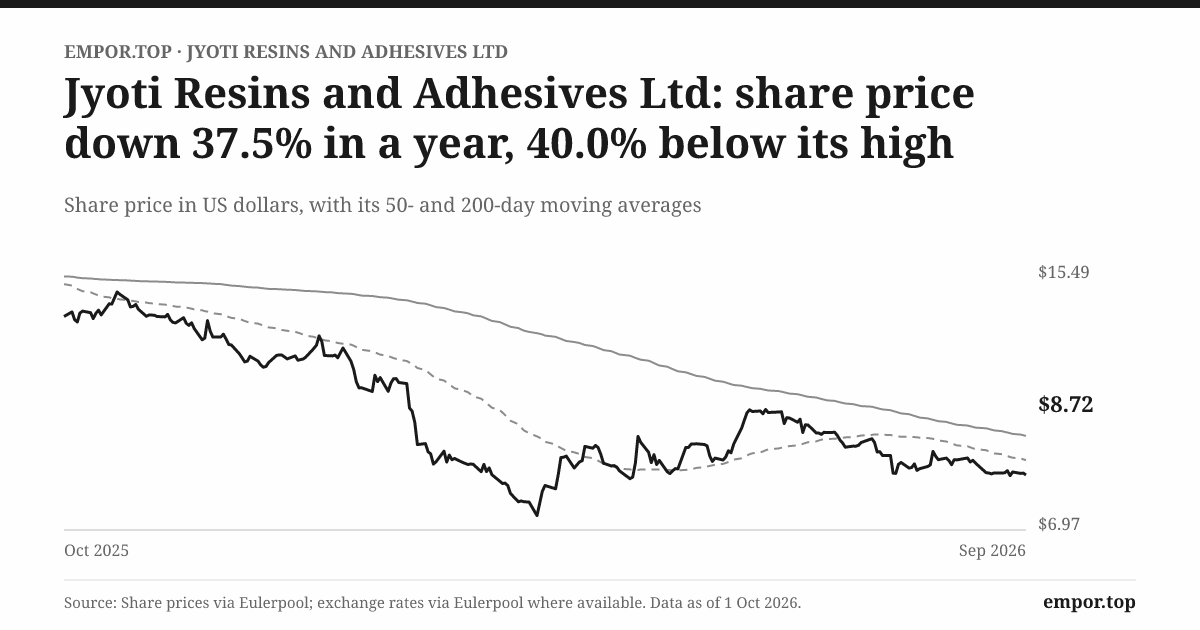
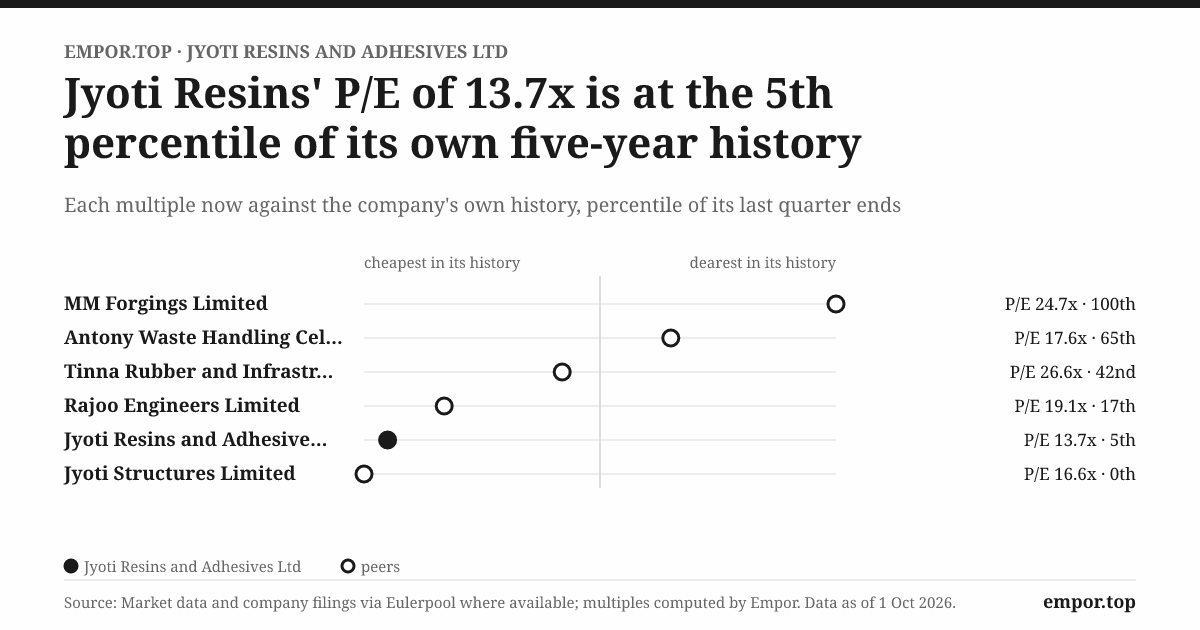
At ₹835.50 on 1 October 2026, the stock is about 35% below its 52-week high. Market value is about ₹1,003 crore and enterprise value about ₹837 crore, after deducting the treasury13. It trades at about 13.7 times trailing earnings, against a five-year median of about 25.6 times, and about 9.8 times EV/EBITDA1. Pidilite trades at roughly 75 to 80 times earnings[^9]4.
A multiple of about 14 is what the market usually pays for a business it expects to grow slowly with cyclical margins, not for a 20%-plus compounder. In plain terms, the current price assumes that the June-quarter margin is closer to the new normal than the FY2024 peak, and that growth stays in single digits. The earnings yield of about 7.3% is roughly what the company earns on its own fixed deposits.
The bull thesis
- Valuation arbitrage. A debt-free, cash-rich company with a high return on capital trading at a multiple below its own history. Cash makes up about a sixth of the market value1.
- Capacity already built. The brownfield expansion gives volume headroom at almost no capital cost2.
- Insiders are buying. Promoters added about 3.5 percentage points to their stake in FY2026, through open-market purchases1.
- A liquidity catalyst. The company applied for a direct listing on the National Stock Exchange in November 2024[^6]. NSE access would make the stock available to many institutional mandates that cannot buy BSE-only stocks. Nearly two years later, the listing had not been completed4, which itself tempers the catalyst.
- A clean audit record. An unmodified audit opinion, no tax disputes under appeal and no material contingent liabilities1.
The bear thesis
- Credit risk with no buffer. Applying a 3% loss to the receivables book would cost about ₹4.8 crore before tax, against a provision of zero1. That is not catastrophic, but it would turn an accounting judgement into a hit to profit.
- Margins revert. If the June quarter rather than FY2024 is the base, earnings will fall in FY2027 even with healthy volume growth.
- Expansion dilutes returns. Every new region adds receivables and branch losses before profit.
- Single-plant risk. All production sits at one site in Santej1. A fire, a regulatory shutdown or a labour dispute would halt revenue entirely.
- A shareholder base built on momentum. FII ownership was about 0.06% and DII ownership about 0.08% in June 2026, and the number of public shareholders grew from about 1,300 in 2020 to about 44,80014. The stock fell about 60% at its worst point in the last five years1. When a stock is owned almost entirely by retail investors, the price tends to fall hardest when disappointment arrives.
The activist's memo
A sceptical outside investor would push on two issues. First, the treasury. Why hold about ₹166 crore in 7% deposits while the core business earns several times that on capital? A large special dividend or buyback would raise the return on equity at once without touching operations. The family's answer is likely to be the greenfield plant and the credit needed for expansion. That is a reasonable answer only if the plant gets built and the expansion pays back.
Second, pay. If net profit falls in FY2027, as the June quarter suggests it might, does the family's ₹7.6 crore fall with it? Promoter pay at 11% of profit is defensible in a record year. Flat pay against falling profit would test the "aligned owners" story that the share purchases support.
What the evidence says
The evidence leaves the bull case intact but unproven. The balance sheet limits the downside: no debt, plenty of cash, no pledges. But a lasting re-rating needs two things the company has not yet shown at the same time: margins holding in the low twenties through a raw-material spike, and debtor days falling while growth continues. The three numbers to watch are the quarterly operating margin (last reading 13.9%, falling), debtor days (185, rising) and revenue growth (about 17% in the June quarter, improving)1[^5]. If the first two turn while the third holds, the bulls are right. If not, the cheap multiple is not cheap.
XI. Playbook: Business & Investing Lessons
Lesson 1: Win the hand that holds the brush, not the eye that watches the ad. While Pidilite dominated television, a family company in Gujarat built a token-in-every-bucket programme with points that never expire and paid carpenters straight into their bank accounts. For founders facing a dominant consumer brand, the lesson is to find the person who actually makes the purchase decision and get to them more directly than the incumbent can. For investors, the follow-up is to check whether that relationship is owned or rented.
"When you cannot outspend Goliath on national television, out-pay him at the workbench."
Lesson 2: Free credit buys shelves, not sales. Receivables grew from about ₹8.5 crore to about ₹159 crore as Euro 7000 won space across thousands of hardware stores. Credit is a legitimate competitive weapon. It is also the easiest way to turn profit on paper into cash that never arrives. Investors in any challenger brand should read the ageing schedule before the income statement.
"A sale is a promise from a dealer; it becomes revenue the day the cheque clears."
Lesson 3: A falling input price is not a moat. Margins near 35% in FY2024 looked like the reward for brand power. Two years later one quarter of expensive VAM cut them in half. When a no-R&D formulator's gross margin rises by thirty points in two years, the first suspect is the commodity price.
"In white glue, the tide of vinyl acetate lifts every margin, and then shows who has pricing power."
Lesson 4: A cheap factory is a gift to you and an invitation to everyone else. A ₹315 crore business runs on about ₹3.5 crore of plant. That produces spectacular returns on capital, and nothing in the factory stops a paint giant or a pipe maker from building one next door. In businesses that need little capital, the moat has to come from somewhere other than the factory.
"The plant that costs nothing to build is the plant every rival can afford."
Lesson 5: Trust does not cross state borders on its own. The 25% compounder became a 6% grower once the home states matured and expansion meant subsidising strangers. Regional champions often mistake a relationship advantage for a product advantage.
"Twenty years of trust in Gujarat cannot be shipped to Lucknow in a bucket."
XII. Epilogue & What to Watch
Tonight, 1 October 2026, Jyoti Resins sits at ₹835.50 on the BSE, valued at about ₹1,003 crore, with about ₹166 crore of cash and no debt13. The easy decade is over. The home states are won, the raw-material windfall has turned, and the stock has given back about a third of its value from the year's high.
Four events over the next twelve months will answer the questions this story started with.
The September and December quarters. Results for Q2 FY2027 are due in the coming weeks. If the operating margin recovers toward 20% or more, the June quarter will look like a temporary squeeze caused by the timing of a VAM spike. If it stays in the mid-teens, the 23%–25% guidance2 stops being a target and becomes history, and the margin-illusion question will have been answered against the bulls.
The FY2027 receivables note. If debtor days come in below about 150 and the over-one-year bucket shrinks, the credit strategy will have passed its hardest test, scaling into new states. If debtor days stay above 180 and old balances keep growing while the provision stays at zero, the working-capital question will have been answered too.
The greenfield decision. Breaking ground on the proposed ₹45–50 crore plant1 would put idle cash to work and add a second site, reducing single-plant risk. Further delay would leave the treasury as a monument to caution.
The NSE listing. The application has been pending since late 2024[^6]. Approval would open the door to institutional owners. Continued delay would leave the stock to a shareholder base that tends to sell first and ask questions later.
The tension that remains is simple. Jyoti Resins has shown it can build a brand against a monopolist. It has not yet shown that the brand can protect its profits on its own, without cheap raw materials and generous credit doing much of the work.
XIII. Outro
Back in a workshop on the edge of Ahmedabad, a carpenter presses the last sheet of veneer into place and wipes the excess glue from the edge. At his feet sits an empty Euro 7000 bucket. He peels back the inner seal, pulls out the token, and holds his phone over it. A chime: points credited, with no expiry date. It is a small moment, repeated thousands of times a day across western India, and it is the whole company in miniature: a reward to the applicator, a debt from the dealer, and a raw material priced half a world away.
Jyoti Resins proved that Fevicol could be challenged by a company willing to finance the shopkeeper and pay the craftsman. What it must prove next is that it built an enduring franchise rather than a very clever way of selling credit in a white-glue bucket. Jyoti Resins showed India that Fevicol was not invincible. Now it has to prove that Euro 7000 is more than a western Indian success built on 185 days of credit.
References
-
FY2026 Annual Report (33rd Annual Report), Jyoti Resins and Adhesives Ltd — BSE India, 2026-08-24 ↩↩↩↩↩↩↩↩↩↩↩↩↩↩↩↩↩↩↩↩↩↩↩↩↩↩↩↩↩↩↩↩↩↩↩↩↩↩↩↩↩↩↩↩↩↩↩↩↩↩↩↩↩↩↩↩↩↩↩↩↩↩↩↩↩↩↩↩↩↩↩↩↩↩↩↩↩↩↩↩↩
-
Investor Presentation for Q4 FY26 and Full Year FY2026 — BSE India, 2026-05-07 ↩↩↩↩↩↩↩↩↩↩↩↩↩↩↩↩↩↩↩
-
Jyoti Resins and Adhesives Ltd Stock Quote & Corporate Filings (Scrip 514448) — BSE India ↩↩↩
-
Jyoti Resins and Adhesives Ltd Financials and Shareholding — Screener India, 2026-10-01 ↩↩↩↩↩
-
FY2025 Annual Report (32nd Annual Report), Jyoti Resins and Adhesives Ltd — BSE India, 2025-09-04 ↩↩↩
 LinkedIn
 WhatsApp
 Reddit
 Hacker News
 Email
Email Kindle
 RSS Feed
 Spotify
 Apple Podcasts
 Amazon Music
 Audible
 YouTube