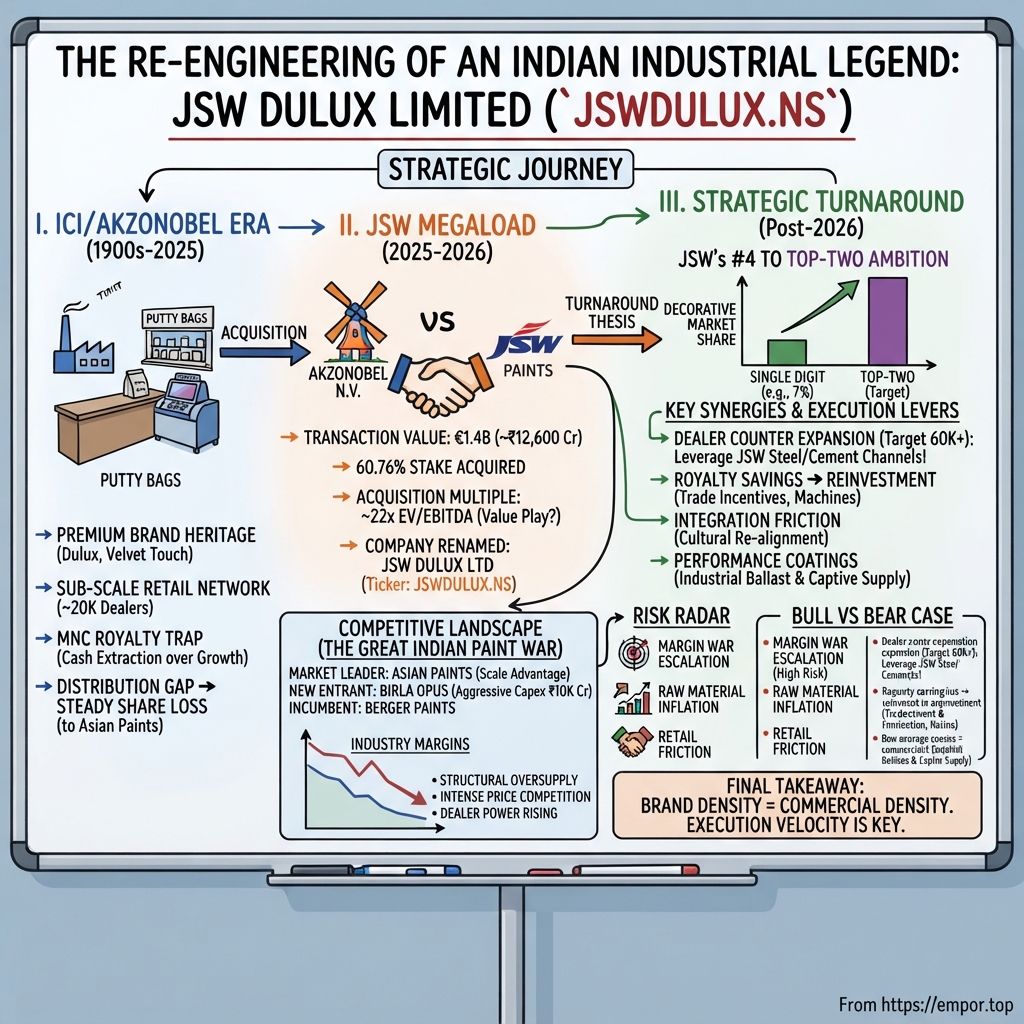
JSW Dulux Limited: The Re-Engineering of an Indian Industrial Legend
I. Introduction & Episode Roadmap
There is a particular kind of quiet that settles over a paint dealership in a Tier-2 Indian city on a weekday afternoon. The shutters are half-down against the heat. A ceiling fan turns. And in the corner, humming faintly, sits the machine that actually runs the Indian paint industry: a computerized tinting dispenser, roughly the size of a washing machine, loaded with a dozen colorant cartridges. The dealer walks a customer over to a fan deck of shade cards, the customer points at something called "Misty Morning," and ninety seconds later a base can of white paint becomes exactly that shade. Whoever owns that machine — whoever paid for it, services it, and keeps it stocked — owns the counter. And whoever owns the counters owns India's paint market.
For most of the last thirty years, the machine on the front counter in India was supplied by Asian Paints. The machine pushed toward the back, behind the putty bags, was often the Dulux one.
That single image explains more about the trajectory of JSW Dulux Limited than any income statement. Here is a brand with a century of pedigree — the interior finish that urban Indian households aspired to, the name that painters could pronounce and homeowners trusted. Here is a company with global-standard research laboratories, a Dutch parent with international scale, and audited books that were never in question. Yet none of that prevented it from being out-competed at the shop counter, decade after decade, by rivals who placed more machines in more retail locations and offered dealers better incentives to keep them active.
In June 2025, that gradual loss of market share culminated in a structural shift. AkzoNobel N.V. agreed to sell its Indian decorative paints business to JSW Paints, the four-year-old challenger arm of Sajjan Jindal's steel-and-cement conglomerate, in a transaction valuing the business at roughly €1.4 billion — about ₹12,600 crore.[^4][^7] JSW acquired a controlling 60.76% stake in the listed entity, Akzo Nobel India Limited, followed the deal with a mandatory open offer, and closed the transaction on December 10, 2025.2 On March 11, 2026, the company formally became JSW Dulux Limited following regulatory approval, and the NSE ticker changed from AKZOINDIA to JSWDULUX on April 15, 2026.31
The timing makes this transaction particularly significant. JSW acquired the paint business at the precise moment the Indian paint sector ceased to be one of Asia's most predictably lucrative consumer markets.
For decades, Indian decorative paints operated as a highly profitable oligopoly: a roughly ₹75,000 crore market where Asian Paints held more than half of the organized decorative segment, Berger Paints maintained a solid second place, and remaining players competed for the rest. Returns on capital were high, working capital requirements were low, brands were durable, and the dealer network functioned as a formidable barrier to entry. Dealers had finite counter space and finite working capital, directing both toward whichever brands moved the highest volume.
Then, in February 2024, Kumar Mangalam Birla's Grasim Industries launched Birla Opus with a committed capital program of roughly ₹10,000 crore, aiming for immediate scale among the country's largest producers and seeking to secure a top-three market position.4 The strategy relied on aggressive commercial terms: offering dealers significantly higher margins, providing tinting machines at no upfront cost, extending generous credit terms, and absorbing initial operating losses. When a well-capitalized new entrant prioritizes market share over immediate profitability, incumbents face a choice between sacrificing price realization or surrendering market share.
The central question of this analysis is not whether JSW Dulux possesses a recognized brand. It does. The critical issue is whether an industrial conglomerate rooted in steel — a sector defined by bulk volume, long-term contracts, and B2B negotiations — can execute a fast-moving consumer distribution turnaround during an intense price war. Managing Director Parth Jindal outlined JSW's objective: elevating the combined entity from fourth place to a top-two position in Indian decorative paints.
Three key analytical questions frame the story ahead:
Can an industrial conglomerate unlock a consumer MNC subsidiary? The core thesis holds that Akzo Nobel India underperformed not because of brand weakness, but due to corporate capital allocation that prioritized dividends and parent royalties over dealer counter expansion. Redirecting capital into domestic distribution could improve operational performance. While a plausible mechanism, it represents a standard corporate turnaround thesis that requires execution proof.
Did JSW overpay? Struck at approximately 22 times EV/EBITDA, the transaction appeared modestly valued relative to historical multiples for Asian Paints and Berger Paints, but expensive if industry earnings power compresses under a structural capacity glut. Valuation multiples remain attractive only if underlying earnings hold steady.
Where does the money actually get made? Decorative paints operates on high-volume consumer economics, whereas performance coatings — covering marine, protective, coil, and automotive refinishes — relies on B2B tendering with distinct working capital, margin profiles, and customer cycles. Evaluating JSW Dulux as a single uniform entity risks misinterpreting its underlying financial performance.
A key baseline metric provides context for this strategy. While bullish arguments view Dulux as an unshakeable premium consumer brand in India, market data indicates otherwise. From 2010 through 2024, Akzo Nobel India's decorative market share fell from high-single to low-double digits down into the mid-single digits, while Asian Paints expanded. Established brand equity alone failed to halt market share erosion in a sector driven primarily by retail distribution density. This distribution gap defines the fundamental operational challenge JSW is attempting to address.
 Subscribe on LinkedIn
II. Colonial Foundations: Imperial Chemical Industries and the Century-Long Dulux Heritage
Understanding why a Dutch multinational ultimately sold a century-old Indian franchise to a steel conglomerate requires examining what that enterprise was originally designed to do — which was not selling paint to Indian households.
Imperial Chemical Industries (ICI) entered India in the early twentieth century as an arm of British industrial policy rather than a consumer enterprise. Its initial footprint centered on chemicals, explosives, and industrial intermediates for mining, railways, and infrastructure development. Paint was an adjacent product line derived from shared pigment and resin chemistry, serving government public works departments and commercial contractors rather than individual homeowners selecting interior colors.
Indian independence and the regulatory environment of the License Raj reshaped the business. From the 1950s through the 1980s, India restricted imports, rationed industrial capacity through licensing, and required foreign multinationals to establish local manufacturing. For ICI India, this regulatory regime served as both a constraint and a shield. Capacity expansion depended on government approvals, technology transfer lagged, and product lines remained stagnant. At the same time, trade protections shielded incumbents from global competitors. ICI India constructed manufacturing plants across West Bengal, Telangana, and Punjab, operating in an environment where securing regulatory licenses mattered more than competing for retail customers.
This history created a persistent structural legacy. An organization structured around regulatory compliance develops very different operational capabilities than one focused on winning retail shelf space and dealer distribution networks.
The Dulux brand subsequently emerged as ICI's primary consumer offering in India, introducing premium synthetic enamels for woodwork and metal before expanding into interior wall paints targeted at affluent urban households. The brand positioned itself on superior finish, durability, and a premium price point. In an era when most Indian homes relied on basic distemper or lime wash, Dulux established itself as an aspirational, modern brand. The equity accumulated during this period formed the cornerstone of the franchise that JSW acquired in 2025.
The invention of the real moat
While ICI cultivated brand equity, domestic Indian competitors built a more defensive asset: an agile distribution and supply chain network.
The modernization of the Indian paint market unfolded in two stages. The first was the transition from job-site pigment mixing to factory ready-mixed decorative paint. Shifting from on-site blending to standardized sealed cans transformed paint from a raw trade material into a packaged consumer good that could be branded, advertised, and distributed through retail stores.
The second transformation — and the true source of competitive advantage in Indian decorative paints — was the introduction of the computerized tinting machine across retail dealerships during the 1990s. Tinting technology resolved a massive working capital challenge. Previously, offering two thousand color shades required manufacturing, transporting, and storing two thousand distinct stock-keeping units (SKUs), leading to frequent stockouts of niche shades. The tinting machine decentralized final color blending to the retail counter. Manufacturers needed to ship only basic white bases and concentrated colorant canisters, enabling dealers to hold modest base inventory while dispensing thousands of custom shades on demand.
This model yielded three critical strategic advantages: it dramatically reduced working capital across the supply chain, relocated final tinting to the point of sale, and effectively turned retail counters into proprietary distribution infrastructure. A dealer equipped with a manufacturer's machine, colorant canisters, shade cards, and dedicated service technicians ceased to be a neutral retailer, functioning instead as a brand outpost.
Domestic rivals Asian Paints and Berger Paints recognized this structural shift earlier and invested far more aggressively. They subsidized tinting machine deployments at scale, built supply chains to deliver colorants to Tier-2 and Tier-3 towns, and secured trade loyalty through prompt cash rebates for painters and contractors. Because contractors exert substantial influence over brand selection in Indian residential repainting, reliable trade incentives proved decisive in driving retail volume.
Where the first thesis breaks
The conventional premise that ICI India's early arrival and premium brand authority would automatically translate into a durable distribution moat proved incorrect.
ICI focused primarily on major metropolitan areas and Tier-1 cities where affluent consumers paid premium prices. While profit margins were high in these urban centers, the bulk of Indian decorative paint volume growth from the 1990s onward originated in Tier-2 and Tier-3 towns, driven by shortening repainting cycles and consumers upgrading from unorganized distemper to entry-level emulsions. Domestic competitors expanded aggressively into regional markets, establishing expansive retail networks and building the volume scale necessary to dominate the broader market.
By the late 1990s, Asian Paints had established a dominant market position, leaving ICI India as a respected premium niche player hindered by sub-scale distribution density. The outcome was driven by retail execution and supply chain scale rather than product innovation.
This evolution highlights a fundamental principle in consumer physical distribution: retail network density often overrides brand equity, as distribution determines presence at the point of sale. A premium brand missing from dealer counters routinely loses share to an accessible alternative. When AkzoNobel acquired ICI globally in 2008, it inherited this distribution deficit in India without altering the underlying strategy.
III. The AkzoNobel Era: Premium Stagnation and the MNC Royalty Trap
In 2008, in one of the larger chemical transactions of the era, Dutch coatings group AkzoNobel N.V. completed the acquisition of ICI plc globally. The Indian subsidiary changed nameplates — becoming Akzo Nobel India Limited, listed on both national exchanges — but altered very little of its core strategy.
That became the defining reality of the sixteen years that followed: new ownership, but the same strategic posture.
To be fair, the AkzoNobel era was not a failure by conventional corporate standards. The company launched respected products. Dulux Velvet Touch became a credible super-premium interior finish specified by architects. WeatherShield established a strong position in exterior emulsions — a category in India's monsoon climate where product durability is immediately visible. Low-VOC and eco-friendly formulations arrived early relative to domestic competitors, reflecting global R&D capabilities that no purely Indian rival could match. Operating margins remained in a respectable band — roughly the low-to-mid teens across the decade to FY24 — consistent with a business selling premium products to price-insensitive urban buyers.
The fundamental issue, however, was that steady margins on a stagnant revenue base gradually eroded the company's relative market standing. From roughly FY15 through FY24, Akzo Nobel India's top line compounded in the mid-single digits while domestic peers compounded at low double-digit rates. Over a decade, that growth differential produced a clear arithmetic outcome: the company shrank relative to its broader market every year while reporting acceptable quarterly earnings.
The capital allocation question
This performance gap highlights the core rationale for JSW's acquisition.
Under Dutch ownership, Akzo Nobel India remitted an annual brand and technology royalty to its European parent — reported at up to 3% of sales — while maintaining a policy of substantial dividend distribution. Simultaneously, the company limited the domestic capital expenditure required to expand its retail footprint and close the distribution gap.
Viewed from a global corporate headquarters, that capital allocation logic was straightforward. AkzoNobel N.V. allocated capital across global markets against group-level return hurdles. Investing several hundred crore rupees in tinting machines and dealer credit terms across Indian Tier-3 towns represented a long-payback, low-visibility deployment whose financial returns would materialize years later on a local P&L. By contrast, royalty payments and dividends provided immediate, predictable, euro-denominated cash flows. A multinational parent optimizing for group-level capital efficiency prioritized cash extraction over domestic market expansion.
Consequently, Akzo Nobel India maintained a distribution footprint of roughly 20,000 dealer counters, concentrated primarily in major metropolitan centers and Tier-1 cities. By comparison, market leader Asian Paints operated a nationwide network several times larger. Closing a distribution gap of that magnitude required sustained capital deployment over years rather than short-term advertising spend.
The retail shareholder revolt that wasn't
This capital allocation dynamic also provides insight into corporate governance within multinational subsidiaries.
By standard formal metrics, Akzo Nobel India maintained high governance standards: financial audits were clean, disclosures were thorough, and board processes followed established corporate governance codes. However, formal governance quality did not guarantee structural alignment between parent company incentives and minority shareholder interests. Minority investors in Indian MNC subsidiaries have long raised concerns over royalty payments to foreign parents, arguing that cash outflows tied to sales rather than net profits create a preferential claim on cash regardless of domestic revenue growth. Voting records on related-party and royalty resolutions at Indian MNC subsidiaries repeatedly showed institutional and retail dissent well above routine levels, and Akzo Nobel India's own scrutinizer filings were part of that pattern.[^13]
This pattern did not indicate regulatory non-compliance. Rather, it demonstrated that a controlling parent with distinct financial incentives will consistently allocate capital toward its own objectives, and formal governance frameworks afford minority shareholders little protection against that reality. Investors who treated foreign parentage as a proxy for minority alignment received a sixteen-year demonstration that the two do not necessarily coincide.
The machine at the back of the shop
A second operational factor challenges the prevailing industry assumption regarding dealer switching costs.
Industry consensus held that installing a proprietary tinting machine locked in dealer loyalty. In practice, established Indian paint dealers regularly installed machines from two or three competing manufacturers. While store floor space posed a physical constraint, multi-homing offered dealers key commercial advantages: stocking multiple brands enhanced margin leverage and protected against stockouts.
Once multi-homing became standard practice across retail stores, the tinting machine stopped functioning as an exclusive lock and became a retail popularity contest. The fastest-turning brand secured prime front-counter placement and active dealer recommendations, while slower-moving brands were relegated to back-store storage and dispensed only when customers requested them by name. Dulux, suffering from lower inventory turn across most locations, spent years on the wrong side of that dynamic. Its machines were present on dealer premises, but they were rarely recommended.
This dynamic clarifies the true nature of tinting machine infrastructure: machines create operational friction rather than absolute lock-in. That friction advantages incumbents with superior inventory turn while offering little protection to a sub-scale premium brand. It was precisely this retail vulnerability that Birla Opus later targeted by offering financial incentives sufficient to make installing a new machine worth the dealer's floor space.
By 2024, Akzo Nobel India operated as a profitable business constrained by structural limitations: a respected brand, a restricted network, a cash-extracting parent entity, and an impending industry surge in manufacturing capacity. Resolving these challenges required either operational restructuring or a change in ownership. Ultimately, JSW elected to pursue both.
IV. The Great Indian Paint War: JSW's Disruption and the Birla Opus Shock
When Parth Jindal led the JSW Group into decorative paints in 2019, the strategic rationale rested on industrial adjacency. The conglomerate already manufactured steel and cement—the primary heavy materials for Indian building construction—and distributed them through tens of thousands of regional dealers. Because those same trade channels interacted with the building contractors and homeowners who ultimately selected decorative finishes, management viewed paint not as an unrelated diversification, but as the final, high-margin layer of a comprehensive building-materials portfolio.
JSW Paints entered the market in 2019 with a distinct strategy: "Any Colour One Price."
To understand the disruption, consider traditional industry pricing. Under standard computerized tinting systems, the retail price of paint varies depending on the volume of tinting concentrate required. Saturated, deep-tone shades require substantially more colorant than pale pastels, resulting in a higher price per liter. While defensible on a raw-material cost basis, this structure often appeared opaque to retail consumers, who effectively faced a price penalty for selecting vibrant colors. JSW eliminated colorant surcharges entirely, offering every shade in a given product line at an identical price point.
In strategic terms, this move reflected classic counter-positioning: a new entrant adopting a business model that established leaders cannot easily match without damaging their existing unit economics. Market leader Asian Paints could have matched the policy only by surrendering lucrative margins on its deep-shade product mix across an immense installed retail volume. For a challenger with negligible initial market share, absorbing that colorant cost carried minimal financial penalty.
The friction that became a legal case
Incumbent producers did not respond by altering their pricing structures. Instead, according to JSW's regulatory filings, incumbents targeted the distribution channel by discouraging multi-brand dealers from displaying JSW products or installing its tinting machines, leveraging the value of established dealer relationships against the newcomer. JSW filed a complaint with the Competition Commission of India, which investigated the alleged restrictive trade practices of incumbent manufacturers.5
Regardless of the eventual legal outcome, the episode underscored two structural realities of the Indian market. First, primary competition occurs at the dealer counter rather than in consumer advertising; brand awareness generates little revenue if products lack shelf presence. Second, counter-positioning alone cannot overcome physical distribution barriers. An innovative pricing model creates consumer interest, but without accessible retail counter placement, that interest fails to convert into sales.
Grasim changes the physics
The competitive dynamic shifted dramatically in February 2024 when Grasim Industries launched Birla Opus, backed by a committed capital expenditure program of approximately ₹10,000 crore to construct massive manufacturing capacity from a standing start.4 Introducing such large-scale industrial capacity into a market growing at high single-digit rates ensured that the decorative paint sector would face structural oversupply for years.
Birla Opus targeted the industry's primary distribution bottleneck directly. It offered dealers significantly higher retail margins than incumbents, deployed tinting machines without upfront capital charges, and extended liberal credit terms. By compensating dealers generously for retail counter space, the new entrant systematically lowered the financial barriers to securing store placement.
The market impact materialized rapidly. Across financial year 2025, incumbents implemented mid-single-digit price reductions to protect sales volumes. Consequently, gross margins compressed across the industry despite favorable trends in key raw materials, including crude oil derivatives used in monomers and solvents, and titanium dioxide pigments. This divergence highlighted the underlying industry pressure: margins fell while input costs were stable. The margin compression reflected eroding pricing power rather than cost inflation—a structural condition stemming from permanent capacity additions that rarely resolves quickly when economic cycles turn.
Where JSW's own thesis broke
This shifting competitive environment exposed the limitations of JSW's original standalone strategy.
The strategic premise behind JSW Paints' 2019 launch assumed that a well-capitalized greenfield entrant could achieve standalone profitability within three to five years. However, financial performance from FY20 through FY24 demonstrated the substantial cost of building a consumer franchise from scratch. JSW Paints experienced sustained operating losses and negative cash flows, driven by heavy promotional spend to establish brand awareness, aggressive trade discounts to secure counter placement, and overhead costs sized for scale that had not yet materialized. In decorative paints, national brand building and logistics infrastructure demand heavy upfront fixed investment long before retail sales volume grows enough to absorb it.
By 2024, JSW faced a difficult operational trajectory. Reaching meaningful market share organically threatened to require another five to seven years. With Birla Opus deploying ₹10,000 crore to capture trade channels, pursuing purely organic growth in an oversupplied market risked high capital consumption for uncertain returns.
These economics drove the acquisition of Akzo Nobel India. Rather than an opportunistic expansion, the deal represented a strategic pivot: recognizing that in a rapidly consolidating capacity race, acquiring an established brand, a 20,000-counter distribution network, operating production facilities, and a profitable industrial coatings division was far faster and more capital-efficient than building them organically.
The fundamental analytical question, therefore, turns on transaction pricing: did JSW pay an excessive premium for that speed?
V. The Megadeal: JSW's ₹12,600 Crore Takeover of Akzo Nobel India
On June 19, 2025, AkzoNobel N.V. announced an agreement to sell its Indian decorative paints business to JSW Paints.[^4] The transaction valued the business at an enterprise value of approximately €1.4 billion, or roughly ₹12,600 crore, structured as a controlling stake purchase of 60.76% in the listed entity, Akzo Nobel India Limited.[^7]
For AkzoNobel, the sale represented portfolio optimization. The Dutch group was actively refocusing on global markets where it maintained top-tier scale. In contrast, holding a sub-scale fourth-place position in Indian decorative paints—profitable, yet steadily losing market share—was an asset a disciplined global operator preferred to monetize. Selling into an active Indian bidding environment at a time when strategic buyers were placing premium valuations on paint assets allowed AkzoNobel to exit at an advantageous moment.
The mechanics, and what got left behind
Under Indian takeover regulations, JSW launched a mandatory open offer for an additional 25.24% stake, valued at approximately ₹3,929 crore, and upon completion on December 10, 2025, promoter holding settled at 61.2%.2 The Competition Commission of India cleared the combination in September 2025.[^15]
The specific asset boundaries of the deal carried critical strategic implications. AkzoNobel N.V. retained 100% ownership of its Indian powder coatings business as well as its International Research Centre in India.[^4] JSW acquired the liquid formulation businesses: decorative paints under the Dulux brand, alongside liquid performance coatings—comprising protective, marine, coil, and automotive refinishes—under the International and Sikkens lines.
This division is central to evaluating the acquired portfolio. Powder coatings represents a higher-margin, more technically differentiated category than liquid industrial coatings, and AkzoNobel retained it entirely. The research facility—the core engine of product formulation capability—likewise stayed with the Dutch parent. Consequently, the industrial coatings operations acquired by JSW comprise the lower-margin portion of the portfolio, detached from the R&D infrastructure that historically supported it.
Following regulatory approvals, the entity was formally renamed JSW Dulux Limited on March 11, 2026, and its stock ticker transitioned to JSWDULUX on April 15, 2026.31 Crucially, JSW Dulux operates the Dulux brand under a licensing agreement rather than full ownership, introducing a long-term structural condition to the business.
Did JSW overpay?
The acquisition closed at an enterprise value multiple of approximately 22 times trailing EBITDA. At the time of the transaction, market leader Asian Paints traded near 45 times trailing EBITDA, Berger Paints near 38 times, and Kansai Nerolac in the mid-20s. On a relative valuation basis, JSW secured the country's fourth-largest paint producer at roughly half the market leader's multiple.
However, relative multiples depend heavily on earnings stability. JSW purchased the business just as industry earnings power came under severe pressure. In fiscal 2026, revenue declined 9.74% year-over-year to ₹3,697.7 crore.[^8] An asset acquired at 22 times trailing EBITDA whose top line subsequently shrinks by nearly ten percent amid widespread industry price discounting carries a significantly higher forward multiple.
The counter-argument centers on platform value rather than immediate cash flow. JSW was purchasing an established operating platform—including brand recognition, manufacturing facilities, a 20,000-dealer distribution network, and a commercial B2B franchise—that would require far greater time and capital to build organically. While strategic buyers routinely pay a premium for immediate scale, the validity of that premium will depend on execution over the next three to four years: specifically, whether counter density and volume gains expand sufficiently to offset industry-wide price erosion.
The royalty unlock, and its asterisk
The most direct financial synergy from the transaction is the elimination of the brand royalty previously remitted to the European parent. Management indicated plans to redirect those funds—historically up to 3% of sales—into domestic dealer incentives, tinting machine installations, and contractor loyalty programs.
Reallocating capital from parent royalties into trade channels provides essential funding during an industry-wide price war, directly matching the aggressive trade terms deployed by new entrants like Birla Opus. However, this reallocation shifts cash usage rather than increasing operating profit; funds previously sent to Europe are spent in regional retail markets. Investors anticipating that royalty savings would flow directly to net earnings misinterpret the planned trade reinvestment.
Furthermore, the brand licensing arrangement introduces an unresolved variable. JSW Dulux utilizes the Dulux brand under contract from AkzoNobel. Because the specific duration and royalty escalation terms of this licence have not been publicly disclosed, it remains an open question whether the brand royalty was permanently eliminated or merely restructured. Until these contractual terms are fully clarified, the licensing structure remains an unquantified long-term overhang.
What the calls revealed
Management commentary across three key earnings calls—the June 2025 transaction announcement, the fourth-quarter FY26 results following rebranding, and the first-quarter FY27 results—highlighted the operational realities of the integration.
While management emphasized long-term synergies across JSW's broader building-materials portfolio, analyst inquiries focused consistently on three execution risks.
First, organizational integration: combining a value-focused, price-competitive sales force with a premium, specification-driven sales organization presents operational friction. Aligning incentive structures, dealer management, and pricing discretion between two distinct commercial cultures requires careful navigation during an ongoing market share battle.
Second, the driver of revenue decline: during fiscal 2026, revenue contractions across the sector reflected widespread price discounting. Analysts pressed management to separate price compression from volume trends, as volume growth during price deflation indicates market share gains, whereas simultaneous volume decline signals competitive erosion.
Third, the contractual terms of the long-term brand licence, which management addressed only in general terms.
Initial operating results for the first quarter of fiscal 2027 underscored these near-term headwinds. Net profit fell 12.42% year-over-year to ₹79.70 crore on revenue of ₹965 crore.6 Near-term price competition from Birla Opus and Asian Paints' defensive discounting offset immediate distribution synergies. While quarterly results do not invalidate a multi-year turnaround strategy, they demonstrate that earnings recovery will depend on verifiable counter expansion and volume outperformance rather than transaction narrative.
VI. Business Anatomy & Segment Economics: Decorative Power vs. Performance Coatings
Evaluating JSW Dulux's consolidated financial results requires analyzing two distinct business operations sharing a single corporate entity, a brand portfolio, and little operational overlap.
                       +-------------------------------------------------------+
                       |                  JSW DULUX LIMITED                    |
                       |                (Consolidated Revenue)                 |
                       +---------------------------+---------------------------+
                                                   |
                        +--------------------------+--------------------------+
                        |                                                     |
                        v                                                     v
        +-------------------------------+                     +-------------------------------+
        |       DECORATIVE PAINTS       |                     |     PERFORMANCE COATINGS      |
        |       (~65-70% Revenue)       |                     |       (~30-35% Revenue)       |
        +---------------+---------------+                     +---------------+---------------+
                        |                                                     |
   +--------------------+--------------------+           +--------------------+--------------------+
   |                    |                    |           |                    |                    |
   v                    v                    v           v                    v                    v
[Dulux Decor]    [Velvet Touch]       [WeatherShield]  [International]    [Sikkens Auto]    [Coil Coatings]
 (Architectural)  (Super-Premium)       (Exterior)       (Marine/Protective)  (Refinish)        (Industrial)
Decorative: the consumer engine
Roughly two-thirds of consolidated revenue originates in decorative paints, anchored by Dulux architectural finishes, the super-premium Velvet Touch interior range, WeatherShield exterior coatings, and value-tier products under the Promise label.
Historically, the decorative segment generated the attractive economics that defined the broader Indian paint sector. Gross margins ranged between 42% and 48%, EBITDA margins held in the mid-teens, and working capital requirements remained light to negative. This working capital efficiency stems from traditional industry trade terms, where dealers purchase largely on a cash-and-carry basis. Manufacturers collect payment at or near dispatch while settling supplier obligations on standard commercial schedules, allowing the retail channel to fund operating growth. Consequently, expanded sales volume required minimal incremental capital, driving high historical returns on capital.
However, the ongoing price war directly threatens this working capital structure. Generous dealer credit terms—a key commercial lever deployed by Birla Opus—have forced incumbents to adjust trade terms. Shifting from cash-and-carry transactions to 30- or 60-day credit windows permanently increases capital employed across the sector, dampening cash conversion even if gross margins eventually stabilize. In this environment, expansion in receivable days serves as a critical indicator of underlying channel pressure.
Operational success in decorative paints relies on four primary drivers: painter and contractor recommendations, tinting machine placement across active retail counters, consumer brand recall, and proven product durability. To accelerate growth, JSW management set a target to expand Dulux dealer counters from approximately 20,000 to over 60,000 by cross-leveraging JSW Paints' existing retail network alongside the group's established steel and cement distribution channels.
Achieving a threefold expansion in retail coverage represents the core operational assumption of the bull thesis—providing a clear, verifiable benchmark for monitoring execution.
Performance coatings: the industrial ballast
The remaining third of revenue derives from performance coatings, encompassing industrial protective finishes, marine coatings under the International brand, Sikkens automotive refinishes, and industrial coil coatings.
The financial profile of performance coatings differs substantially from decorative paints. Gross margins run lower, in the low-to-mid 30% range, EBITDA margins average between 10% and 13%, and the working capital structure is inverted. Because B2B industrial sales are tender-driven, invoiced on extended credit terms, and tied to project completion schedules, the segment consumes working capital during expansion cycles rather than generating spontaneous cash flow.
In exchange for lower margins and higher working capital intensity, performance coatings provides structural customer retention through technical specification approvals. Once a specialized coating is written into an infrastructure project or shipyard specification, switching suppliers requires lengthy re-qualification processes and introduces potential warranty liability. This technical qualification requirement creates a genuine switching cost that is structurally more defensible than retail counter loyalty.
From a strategic perspective, performance coatings serves two main functions within the combined entity. First, it provides a stable revenue and cash flow stream that is largely unexposed to the retail price competition affecting decorative paints. Second, it aligns with JSW Group's broader industrial footprint—offering captive supply opportunities for coil coatings used in JSW Steel production and protective coatings for group infrastructure projects.
Testing the "hidden industrial moat"
Proponents of the acquisition argue that performance coatings provides JSW Dulux with a high-margin industrial moat insulated from consumer market volatility. However, structural details of the portfolio temper this view.
As established during the acquisition, AkzoNobel N.V. retained its higher-margin powder coatings business, leaving JSW Dulux with the liquid performance coatings division. In this market, the company competes against established industrial suppliers, including Kansai Nerolac and the PPG-Asian Paints joint venture. Because corporate and industrial clients utilize competitive tendering processes and resist brand premiums, segment EBIT margins have historically remained capped below 12%.
Additionally, prospective captive sales to JSW Steel represent related-party transactions. While internal demand offers guaranteed volume, related-party revenue carries lower analytical weight when assessing market competitiveness, as pricing is determined internally rather than through open competition. Investors evaluating long-term performance will need to monitor related-party disclosures to separate internal group demand from external commercial growth.
Ultimately, performance coatings functions as an operational stabilizer rather than a high-return growth engine. The segment provides a floor for consolidated cash flow during periods of intense retail price competition, but it operates at lower return multiples and lacks the margin expansion potential of decorative paints. Consequently, the core investment thesis remains dependent on executing the retail distribution turnaround in the decorative segment.
VII. Competitive Dynamics: Helmer's 7 Powers and Porter's 5 Forces
Behind the transaction narrative lies a structural question: what prevents a competitor from capturing JSW Dulux's market share?
Evaluating the business through Hamilton Helmer's 7 Powers framework provides a clear map of its competitive position:
Scale economies — moderate, at best emerging. Post-merger, the combined entity holds roughly 7% to 9% of the decorative market, compared to Asian Paints' market share of over 50%. In paint manufacturing, scale drives advantages in two key areas: bulk procurement of raw materials such as titanium dioxide and monomer resins, and distribution density, where route economics improve alongside delivery size per retail drop. On both counts, JSW Dulux operates at a structural disadvantage relative to the market leader. Scale advantages remain aspirational rather than operational today.
Network effects — weak. Decorative paint possesses no direct user-to-user network effects. One homeowner's choice of interior emulsion does not enhance another consumer's product experience. While contractor loyalty programs foster channel engagement, they function as financial switching incentives rather than true network dynamics, leaving them vulnerable to competing trade rebates.
Counter-positioning — historically strong, eroding in practice. The "Any Colour One Price" model served as an effective counter-positioning strategy against established industry pricing. However, counter-positioning loses efficacy when incumbents choose to absorb share losses and lower prices. With industry-wide discounting reaching 5% to 8%, the price gap that initially differentiated the model has narrowed substantially. It functions primarily as a marketing asset rather than a structural barrier.
Switching costs — moderate, and lower than commonly assumed. Multi-homing across retail tinting machines remains common practice, making dealer switching friction modest. The segment where switching costs prove durable—technical specification approvals in industrial performance coatings—represents the smaller portion of consolidated revenue.
Branding — strong, and the most defensible asset. Brands such as Dulux, Velvet Touch, and WeatherShield command high unprompted recall and pricing power in premium categories. This consumer equity represents the core asset acquired by JSW. However, brand equity generates financial returns only in proportion to retail distribution density. A recognized brand without active dealer counter placement remains unrealized potential.
Cornered resource — essentially none. Paint formulations rely on widely available chemical compounds, and tinting algorithms are not exclusive. Furthermore, the global research center that provided primary product formulation capabilities remained with AkzoNobel.
Process power — moderate. Legacy manufacturing discipline and quality control standards, particularly in specialized protective coatings, reflect accumulated technical expertise that competitors cannot easily replicate. While real, process capability does not represent the primary point of competition in the current market.
This assessment reveals one clear strength in branding, alongside moderate and emerging capabilities elsewhere. The combined business lacks a dominant structural moat in its core segment, meaning financial outcomes will depend primarily on operational execution.
The five forces, and why the industry got worse
Michael Porter's Five Forces framework illustrates how industry structure deteriorated following the competitive shifts of 2024:
Threat of new entrants: very high. For decades, industry consensus held that Indian decorative paints was protected by a distribution barrier that capital expenditure alone could not breach. The entry of Birla Opus in 2024 demonstrated that this distribution barrier could be overcome through substantial balance-sheet deployment. Capitalizing on a ₹10,000 crore capital investment program, the entrant established that well-funded conglomerates can secure trade distribution by absorbing initial costs.
Bargaining power of buyers: high, and rising. The primary buyer in the supply chain is the retail dealer rather than the end consumer, and dealer leverage has reached historically high levels. Five well-funded national brands competing for finite store counter space provides dealers with substantial negotiating power, driving capital toward channel discounts, extended credit terms, and subsidized tinting equipment.
Bargaining power of suppliers: moderate. Key raw materials—such as titanium dioxide and crude oil derivatives—are globally traded commodities with diverse supply sources. While input costs fluctuate with global energy and commodity cycles, individual suppliers exercise limited pricing power over paint manufacturers. Furthermore, favorable input cost trends in fiscal 2025 provided little margin protection against industry-wide price discounting.
Threat of substitutes: low. Alternative wall coverings, such as wallpaper, exposed concrete, textured panels, and glass facades, maintain niche market shares. Indian residential and commercial construction continues to rely predominantly on decorative paint, supported by culturally established repainting cycles.
Rivalry: intense, and structurally entrenched. Competition among the five primary national producers—Asian Paints, Berger Paints, JSW Dulux, Birla Opus, and Kansai Nerolac—remains elevated. The market features substantial manufacturing capacity additions, minimal product differentiation in mass-market segments, and new entrants prioritizing volume acquisition over short-term profitability.
Synthesizing both frameworks indicates that the Indian decorative paint sector has transitioned from a concentrated, high-margin oligopoly into a contested market characterized by structural oversupply. Historical valuation multiples reflected the industry's legacy structure; whether future returns justify current market valuations across the sector remains the central analytical question. For JSW Dulux, navigating this environment requires relying on operational execution rather than structural market protection.
VIII. Governance, Management Credibility & Capital Allocation Audit
Two leaders define the strategic trajectory of JSW Dulux Limited, representing contrasting executive backgrounds and operating styles.
Parth Jindal serves as Non-Executive Chairman. Son of JSW Group Chairman Sajjan Jindal, he is the founder of JSW Paints and Managing Director of JSW Cement—a second-generation industrialist who has focused on building new ventures within the conglomerate. His public approach is target-driven, highlighted by the ambitious goal of elevating JSW Dulux into a top-two position in Indian decorative paints. As owner of the Delhi Capitals sports franchise, Jindal brings a high-visibility consumer marketing orientation distinct from traditional heavy-industrial management.
However, consumer visibility differs fundamentally from retail distribution execution. Announcing market share targets carries minimal cost; funding, deploying, and servicing tens of thousands of additional retail tinting machines demands sustained operational investment.
Rajiv Rajgopal serves as CEO and Joint Managing Director, providing executive continuity following the transaction. Having led Akzo Nobel India under Dutch ownership, Rajgopal remained through the change of control, preserving critical dealer, trade, and architectural specifier relationships. In a relationship-driven distribution network, retaining incumbent leadership helps safeguard trade goodwill and institutional knowledge across key retail channels.
This continuity, however, introduces an operational paradox. Rajgopal oversaw the strategy of modest growth that JSW now explicitly seeks to reform. While capital allocation constraints were previously established by AkzoNobel headquarters in Amsterdam rather than local management in Gurugram, investors must monitor whether daily operating practices genuinely shift under new ownership. The primary test of execution will be whether trade incentives as a percentage of sales increase materially and whether dealer counter additions accelerate.
Structure and the minority question
Promoter holding stands at 61.2%, held through JSW Paints Limited, with the remaining 38.8% distributed across domestic mutual funds, foreign portfolio investors, and retail holders.2 The board includes JSW Group nominees alongside independent directors as required under Securities and Exchange Board of India (SEBI) listing regulations.
The governance profile has shifted in character rather than eliminated potential friction. Under Dutch control, governance concerns centered on brand royalty fees and dividend extractions by a foreign parent. Under JSW ownership, corporate oversight shifts to related-party interactions across an industrial conglomerate—including inter-company industrial coatings supply, parent-negotiated brand licensing, and a listed subsidiary operating beneath an unlisted parent that retains the original JSW Paints business.
This corporate structure presents potential governance challenges for minority shareholders. Unlisted JSW Paints Limited holds the 61.2% controlling stake in listed JSW Dulux Limited. Because both entities operate in decorative paints, share retail distribution strategies, and coordinate channel programs, the allocation of product lines, geographical territories, marketing expenditure, and eventual corporate consolidation between the listed entity and its unlisted parent will require rigorous oversight. Investors who scrutinized historical cash outflows to foreign parents face a similar requirement to examine intra-group commercial terms and related-party disclosures.
The track record, honestly weighed
JSW Group's capital allocation track record demonstrates clear execution strength in heavy industry. Successful turnarounds, such as the operational restoration of Bhushan Power & Steel and the expansion of JSW Energy, highlight the conglomerate's ability to acquire industrial assets and optimize manufacturing operations.
However, industrial turnarounds differ fundamentally from consumer distribution turnarounds. Restructuring a steel enterprise is an operational engineering problem involving consolidated customer bases, long-term procurement contracts, and strict cost controls. Winning in decorative paints requires managing a fragmented retail network of tens of thousands of independent dealers, where individual floor-space decisions depend on inventory turn, trade margins, and commercial trust. Capital allocation capabilities in heavy industry do not automatically guarantee retail success—a reality underscored by JSW Paints' initial five years of operating losses.
Management's stated goal of achieving a top-two position in Indian decorative paints should be evaluated with similar analytical caution. Expanding from a combined market share of roughly 7% to 9% into a top-two position requires a dramatic increase in sales volume. This objective must be achieved in an oversupplied market dominated by Asian Paints' 50%-plus market share, alongside aggressive expansion from Birla Opus and established positions held by Berger Paints and Kansai Nerolac. Consequently, market participants view the top-two ambition as a long-term statement of strategic intent rather than near-term financial guidance. Building management credibility will depend on transparently reporting dealer counter expansion, disclosing volume share gains, and demonstrating sustained distribution growth.
IX. Valuation Stress Test, Bear vs. Bull Case & Current Risk Radar
A critical audit of JSW Dulux's valuation and strategic thesis highlights three primary vulnerabilities.
The brand licence. First is the structural vulnerability of operating under a licensed brand rather than owning it outright. The company carries the Dulux name under contract from AkzoNobel, yet specific licensing terms — including duration, fee schedules, escalation clauses, termination rights, and change-of-control provisions — have not been publicly disclosed. If these terms entail meaningful ongoing licensing fees, the celebrated elimination of parent royalties becomes partly cosmetic, allowing corporate cash to flow back to Europe under a different accounting line. Consequently, the lack of disclosure remains an unpriced structural risk.
The synergy claim. Second is the operational assumption that industrial building-material channels can be seamlessly converted into retail decorative paint counters. Converting cement and steel stockists into high-turnover paint outlets faces clear retail friction. Cement dealerships operate as high-tonnage, low-footfall B2B environments selling bulk materials to contractors. By contrast, a decorative paint counter requires dedicated retail floor space for tinting machines, shade cards, color consultation, and walk-in retail customers. While customer overlap exists at the contractor level for exterior and value-tier paints, retail overlap for super-premium lines like Velvet Touch is minimal. Adding counters that sell only entry-level products fails to revitalize the core premium franchise.
Valuation and the earnings base. Third is the quality of the underlying earnings base. Acquiring the business at 22 times trailing EBITDA appeared reasonable relative to historical market multiples, but an entry multiple on compressed earnings represents a far more expensive transaction. The entity's initial post-acquisition financial results for fiscal 2026 and the first quarter of fiscal 2027 confirmed top-line contraction and margin pressure, underscoring that valuation multiples remain attractive only if earnings hold steady.
Current risk radar
Margin war escalation — high impact, high likelihood. Continued margin compression remains the primary operational risk. With Grasim's Birla Opus deploying committed capital to capture retail share and market leader Asian Paints defending its dominant profit pool, JSW Dulux is caught between a leader with superior scale and a new entrant with high capital patience. Sustaining position requires elevated promotional trade spend, creating a realistic risk that operating margins remain compressed below 10% over the medium term.
Raw material inflation — high impact, moderate likelihood. The principal hazard lies in potential input cost inflation occurring during an active price war. Under standard market conditions, paint producers pass through crude oil derivative and titanium dioxide price increases with a lag. In an environment defined by aggressive trade discounting, passing cost increases to dealers becomes difficult, meaning a raw material cost spike would directly compress gross margins.
Integration friction — moderate impact, moderate likelihood. Combining distinct sales cultures, reconciling pricing structures, and navigating dealer relationships across two organizations presents ongoing execution risks, particularly with unlisted JSW Paints operating alongside listed JSW Dulux in decorative paints. Misaligned channel messaging or dealer ambiguity risks losing commercial momentum during a critical competitive window.
Credit and balance sheet exposure. Rating agency commentary on the post-acquisition entity warrants close monitoring, given that acquisition financing occurred at the parent level while domestic paint operations require sustained capital deployment into an intense price war.7 Key indicators include whether the listed entity's balance sheet remains isolated from parent debt obligations and whether extended dealer credit terms drive an expansion in receivables.
The bull and bear cases
+---------------------------------------------------------------------------------------------------+
|                                      BULL VS. BEAR CASE MATRIX                                    |
+-------------------------------------------------------------------+-------------------------------+
| BULL CASE                                                         | BEAR CASE                     |
+-------------------------------------------------------------------+-------------------------------+
| 1. Scale Acceleration: JSW cross-merges distribution, expanding   | 1. Price War Victim:          |
|    Dulux counters from 20k to 60k+, unlocking volume scale.       |    Trapped in a margin squeeze|
| 2. Royalty Savings: Reinvesting ~3% former royalty fee into       |    between Asian Paints' scale|
|    dealer margins and painter schemes fuels market share gains.   |    and Birla Opus's capex.    |
| 3. B2B Industrial Synergy: JSW Steel & Infra projects consume     | 2. Retail Friction:           |
|    massive performance coatings, driving steady B2B revenue.      |    Building-material dealers  |
| 4. #4 to #2 Strategy: Out-executes Berger and Nerolac to capture  |    refuse to convert into     |
|    the premium decorative runner-up slot.                         |    high-turn paint stockists. |
+-------------------------------------------------------------------+-------------------------------+
The bull case centers on a specific operational thesis: expanding distribution for a premium consumer brand that operated under retail network constraints for sixteen years. If JSW successfully expands active counters from 20,000 to over 60,000 and converts that shelf presence into inventory turnover, the resulting volume leverage within a working-capital-light business model would drive substantial financial returns.
Conversely, the bear case rests on a structural thesis: that industry profitability has permanently reset under long-term capacity expansion. Operating as a sub-scale fourth player in an oversupplied market presents severe competitive friction, where the capital required to secure and service dealer counters may exceed the cash flows those counters generate during a prolonged price war.
Evaluating both perspectives establishes the empirical burden of proof. The sixteen-year historical record demonstrates that brand equity alone could not prevent market share loss without retail density. This leaves the core investment thesis dependent on whether a committed domestic owner can successfully relieve distribution bottlenecks and translate retail reach into sustained volume growth.
The three KPIs that matter
Monitoring this turnaround requires tracking three primary operational metrics:
Net active tinting machine and dealer counter additions, quarterly. Validating the growth thesis requires verifiable expansion in active retail coverage toward the 60,000-counter target. Beyond total machine deployments, tracking active utilization is critical, as idle machines represent operating costs rather than income-generating assets.
Decorative volume growth versus peers. Headline revenue in a discounting environment reflects both price realizations and physical shipments. Comparing JSW Dulux's quarterly volume growth against Asian Paints and Berger Paints indicates whether top-line performance reflects genuine market share gains rather than market-wide price compression.
Gross margin per liter after trade spend. Evaluating gross margin per liter net of dealer discounts, rebates, and contractor schemes provides the clearest indicator of underlying profitability. Tracking this spread ensures that counter expansion generates profitable sales volume rather than un-economical revenue acquisition.
X. Epilogue & Playbook: Key Lessons for Investors & Strategists
Return, finally, to that half-shuttered shop and the tinting machine at the back.
Everything in this story — a century of colonial chemistry, a Dutch takeover, a ₹12,600 crore transaction, a corporate rebranding, and an industry price war — resolves into a single operational question: where that machine sits on the retail floor and whether the dealer recommends it. The Indian paint sector historically generated exceptional equity compounding not through brand prestige alone, but through the unglamorous work of placing equipment across retail counters and settling trade credits reliably.
Three broader strategic lessons extend well beyond the paint industry:
Brand equity without distribution density is a depreciating asset. Dulux possessed key consumer attributes — brand recall, customer trust, and recognized product quality in premium categories — yet steadily lost market share for a quarter of a century. Brand strength governs what a customer is willing to pay only when a product is available at the point of sale; it creates no value on purchase occasions where the product is missing. In retail categories distributed through independent intermediaries, network density dictates commercial performance long before brand equity can take effect.
Multinational subsidiary turnarounds represent capital transfers, not operational miracles. The rationale for acquiring a foreign-parented subsidiary is clear: a global corporation allocating capital across dozens of countries systematically restricts investment in long-payback local distribution, prioritizing immediate cash extractions instead. A dedicated domestic owner can redirect those cash flows back into the business. However, that redirected capital must be spent on trade channels rather than accumulated as profit. Investors evaluating a multinational turnaround thesis should expect operating margins to compress before retail market share expands, remaining skeptical of claims that promise both simultaneously.
The timing paradox of strategic acquisitions. JSW acquired an established retail franchise precisely as sector production capacity expanded at its fastest rate. Structurally, an industry supply surge presents a challenging backdrop for operating paint assets, yet an opportune window for acquisitions, as sellers exit and valuation multiples compress. Resolving this timing paradox depends on execution velocity. An acquirer who rapidly converts acquired retail infrastructure before margin compression fully takes hold creates long-term value; an acquirer who integrates slowly risks paying a historical valuation multiple for compressed future earnings. Speed of distribution expansion, rather than entry multiple, ultimately determines the transaction outcome.
JSW Dulux Limited represents an ongoing operational test: whether a committed industrial conglomerate can scale a well-branded, structurally under-distributed asset fast enough to outrun an industry capacity glut. Initial post-acquisition financial results demonstrate near-term headwinds. While the operational thesis remains plausible, the ultimate outcome will be determined over coming quarters by verifiable metrics: dealer counter expansion, physical volume growth, and net gross margin per liter.
References
-
NSE India Company Directory: JSW Dulux Limited (JSWDULUX) — National Stock Exchange of India, 2026-04-15 ↩↩
-
JSW Paints Completes Majority Stake Acquisition in Akzo Nobel India — JSW Group Press Release, 2025-12-10 ↩↩↩
-
Akzo Nobel India Rebranded as JSW Dulux Limited Following MCA Approval — Business Standard, 2026-03-12 ↩↩
-
Grasim's Birla Opus Launch Triggers Margin Squeeze Across Indian Paint Sector — Reuters, 2024-02-22 ↩↩
-
CCI Orders Investigation Into Incumbent Paint Makers On JSW Paints Complaint — Competition Commission of India, 2020-01-20 ↩
-
JSW Dulux Q1 FY27 Net Profit Declines 12.4% Amid Paint Price War — Moneycontrol, 2026-08-05 ↩
-
CRISIL Credit Rating Rationale for JSW Dulux Limited (formerly Akzo Nobel India) — CRISIL Ratings, 2026-02-10 ↩
 LinkedIn
 WhatsApp
 Reddit
 Hacker News
 Email
Email Kindle
 RSS Feed
 Spotify
 Apple Podcasts
 Amazon Music
 Audible
 YouTube